Introduction
Biological warfare is the use of biological toxins or infectious agents as an act of war. Category A pathogens pose the most significant risk to national security due to ease of dissemination and transmission from person to person; as a result, these pathogens cause high morbidity and mortality rates, contribute to public panic and social disruption, and necessitate special action for public health preparedness.1 They are characterized by having three of the following five characteristics: (1) Highly contagious and a low infective dose, (2) Difficult to identify or be suspected as a biological weapon, (3) Easily mass produced, stored, weaponized, and stable during dissemination, (4) Target population has little to no immunity, or is unable to be treated, and (5) Terrorists should be able to protect or treat themselves.Reference Khardori and Kanchanapoom2 According to the Centers for Disease Control and Prevention (CDC; Atlanta, Georgia USA), Category A pathogens can cause anthrax, plague, botulism, smallpox, tularemia, and viral hemorrhagic fevers.
Biowarfare is not new; in fact, it has a long-standing historical presence associated with it, ranging from rudimentary practices, like poisoning water wells with diseased human bodies, to more advanced practices and agents.Reference Carus3 More than 500 million deaths have occurred from exposure to infectious disease in the past century, several tens of thousands resulting from deliberate exposure.Reference Frischknecht4 For example, during the French and Indian War, the British intentionally infected Native Americans by giving them blankets that had been used by smallpox patients.Reference Wappes and Soucheray5 During World War II, the Japanese fed C. botulinum cultures to their prisoners.Reference Arnon, Schechter and Inglesby6 More recently, five people were killed and 17 others infected after politician and media offices were sent letters containing anthrax.Reference Jernigan, Raghunathan and Bell7 While these are isolated events, it is still estimated that anywhere from 10 to 17 nations possess biological warfare agents, some known to sponsor international terrorism.Reference Khardori and Kanchanapoom2
These outcomes led to the development of a treaty in 1972 that prohibited the production, storage, testing, and transfer of pathogens in large quantities, as well as the eventual termination of bioweapons research, production, and destruction of any existing bioweapons.Reference Riedel8 Research was permitted for the purpose of developing countermeasures, like vaccines and antisera, which are an important aspect of preparedness.Reference Riedel8
Fortunately, bioweapons have not been used on a large-scale, but rogue states or terrorist organizations may target the United States, arguably a likely target for bioterrorism.Reference Roffey, Lantorp, Tegnell and Elgh9 With this information, public health officials have a lot to consider for implementing a successful preparedness plan. In the event of a bioterrorist attack, these plans could greatly minimize panic and mortality; moreover, vaccine advancements could greatly reduce morbidity rates.
A scoping review was used to provide information and awareness on the threat of Category A agents as bioweapons. The objective of this study was to synthesize what is currently known about Category A agents and extrapolate their potential for harm. Biowarfare has a long-standing historical success in targeting groups and inflicting wide-spread effects on population health. These scenarios offer insight into the importance of planning and mitigating accordingly. Health organizations and agencies must be informed and be able to recognize potential plans of attack to expertly educate the general public, offer protection by vaccination, where possible, and be equipped for treatment should individuals become infected.
Methods
A scoping review was conducted and included papers published on biowarfare, bioterrorism, and outcomes related to these exposures, as well as curating possible solutions against them. For this scoping review, research was performed by using data from Google (Google Inc.; Mountain View, California USA), Google Scholar (Google Inc.; Mountain View, California USA), PubMed (National Center for Biotechnology Information, National Institutes of Health; Bethesda, Maryland USA), NCBI (National Center for Biotechnology Information, National Institutes of Health; Bethesda, Maryland USA), and the University Library databases (eg, EBSCO [EBSCO Information Services; Ipswich, Massachusetts USA]). A comprehensive search was conducted in each search engine using the keywords: “bioterrorism,” “history of bioterrorism,” “history of bioweapons,” “threat of bioterrorism,” “bioterrorism agents,” “anthrax,” “botulism,” “plague,” “smallpox,” “tularemia,” “viral hemorrhagic fever,” “Ebola,” “Marburg,” “Lassa,” and “Machupo,” and the phrases “as a biological weapon,” “Bacillus anthracis,” “Clostridium botulinum,” “Yersinia pestis,” “Variola major,” “Francisella tularensis,” “Filoviridae,” and “Arenaviridae,” and the terms “vaccine” or “treatment.” In addition to scholarly peer-reviewed manuscripts, a general search was conducted on Google using the following keywords: “bioterrorism,” “bioweapons,” “biowarfare,” “Geneva Protocol of 1925,” “BWC,” “Category A agents,” “anthrax,” “botulism,” “plague,” “smallpox,” “tularemia,” “viral hemorrhagic fever,” “Ebola,” “Marburg,” “Lassa,” and “Machupo.”
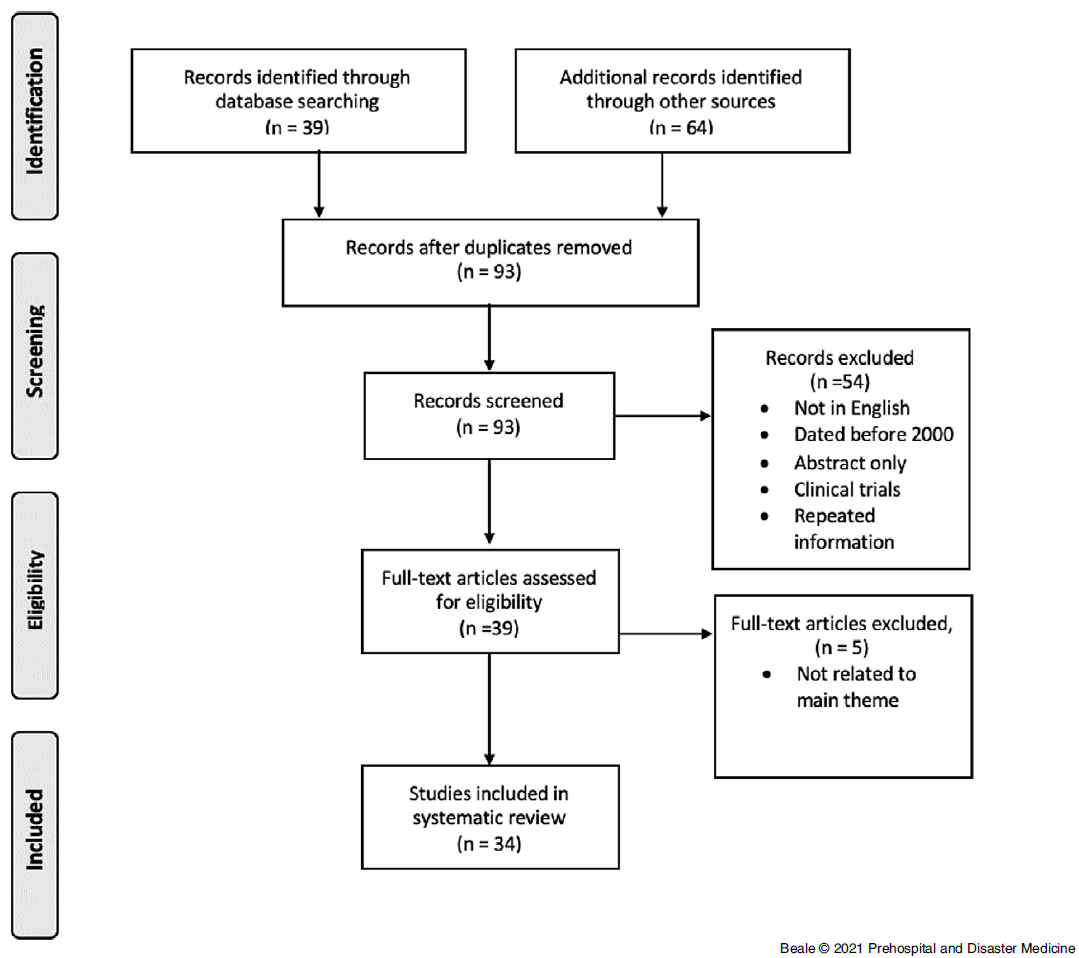
Due to data collection similarities between scoping and systematic reviews, the Preferred Reporting Items for Systematic Reviews and Meta-Analyses (PRISMA) guidelines were used for reporting the search and selection of results.Reference Moher, Liberati, Tetzlaff and Altman10 All references were imported into an Excel sheet (Microsoft Corporation; Redmond, Washington USA) and duplicates were removed manually, leaving a total of 93 results. A two-stage screening method recommended by Mateen and colleaguesReference Mateen, Oh, Tergas, Bhayani and Kamdar11 was used after this point, where titles alone were screened, followed by abstracts. The researchers reviewed the full-text articles and discrepancies were resolved through discussion. The inclusion criteria for first review articles included focused topics on bioterrorism, bioweapons, Category A agents, anthrax, botulism, plague, smallpox, tularemia, and viral hemorrhagic fever. Dates of articles were primarily recent, but included information beginning in 2000. In PubMed, all articles were dated within the last ten years to ensure the most up-to-date research pertaining to vaccines and treatments. Articles published before 2000 and those that were not in English were also excluded. Selected studies used in this review also included information on the reference, year of publication, location of study, type of disease, and intervention (if available), as well as purpose of the study, and brief description of the study results. The brief description was used to identify the type of biowarfare, its public health relevance, and possible threat level. The expectation of this amassed information was that the culmination of these factors would highlight possible threats of biological agents that could contribute to negative population effects in the future.
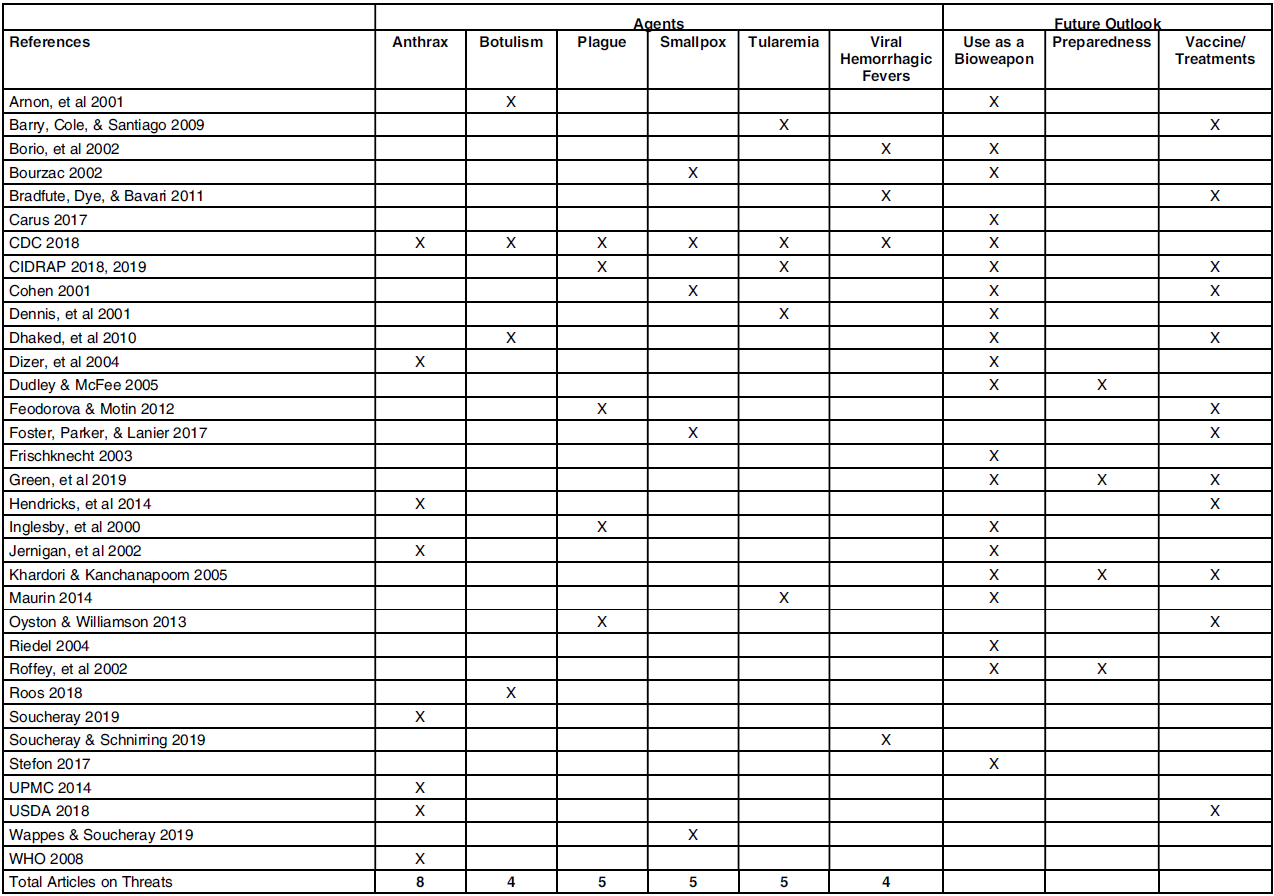
The literature search identified 39 studies which focused on Category A biowarfare threats (Table 1). Of these articles, 26 were reviews (systematic and/or research support) and 13 were grey literature.
Each Study as it Applies to Biowarfare, Use as a Bioweapon, and Preparedness

There were five articles that were excluded from inclusion in the review. Duggan and colleagues was excluded because the article discussed the history of smallpox without discussing use as a biological weapon. Doganay and Demiraslan was excluded because the article discussed naturally occurring anthrax, not weaponized anthrax. Gonzalez and Macgregor-Skinner was excluded because the article discussed zoonotic threats rather than weaponized threats. Both Sobel and Rasetti-Escargueil and colleagues were excluded because the article discussed naturally occurring botulism, not weaponized botulism. The final review included 34 studies (Figure 1). Results of reviews should include the following: a flowchart to show literature search and selection process for inclusion/exclusion criteria and a table with study characteristic with quality of evidence.Reference Ahn and Kang12 This study followed this criterion for collection, analysis, and results (Figure 1, Table 1).
PRISMA Data Collection for Category A Biological Weapons in Scientific Literature.
Abbreviation: PRISMA, Preferred Reporting Items for Systematic Reviews and Meta-Analyses.

Results
In order to fully understand the complexity and capability of these types of biological contaminants as weapons, descriptions were provided (Table 1). This information can be used as evidence per the pathogen’s contagion, transmission, and potential lethality levels. Further, the use as a bioweapon was explored, with historical examples provided as support.
Vaccinations and treatments were also reviewed, as they are an important aspect of preparedness. Data provided in this review confirm that continued research into vaccine development and/or treatment options are both significantly needed. These biological pathogens exist today, and some have been formerly weaponized with successful infection of primates.Reference Borio, Inglesby and Peters13 Only four of the reviewed articles examined preparedness plans for Category A biological attacks. While having a plan is the first step to combatting the effects of a biological attack, strengthening the public-health infrastructure is probably one of the most effective steps towards preparedness. There are significant gaps that exist regarding preparedness against bioweapon use.
Anthrax
Anthrax is caused by the bacteria Bacillus anthracis and has a low infective dose: one kilogram has the capability to kill up to 100,000 people.Reference Khardori and Kanchanapoom2 In the 2001 outbreak in the United States, the powdery substance was easily seen, giving cause to investigate. However, if the spores were introduced into an airway system where the powder disperses, they would be undetectable until anthrax developed in those who inhaled them. It is unknown whether terrorist groups have the means to vaccinate against B. anthracis or access to antimicrobial drugs.Reference Soucheray14 However, B. anthracis spores will only infect those directly exposed, giving terrorists the ability to protect themselves.Reference Dizer, Kenar, Ortatatli and Karayilanoglu15
The population’s immunity to anthrax is very low. There is only one licensed vaccine available and it has been designated for adults who are at high risk of exposure, including some military personnel and some professionals that may encounter naturally occurring B. anthracis.16 The vaccine has an efficacy level of 92.5% and anyone, vaccinated or not, who is exposed to the spores will still require antimicrobial drugs.Reference Hendricks, Wright and Shadomy17 Even with treatment, inhalational anthrax has a 45% mortality rate.Reference Hendricks, Wright and Shadomy17
Botulism
Botulism is caused when the bacteria Clostridium botulinum produces the neurotoxin, botulinum, which is the most lethal known.Reference Roos18 They are not contagious and cannot be spread from person to person, but a microbe intentionally modified to produce botulinum toxin might be contagious.Reference Arnon, Schechter and Inglesby6 C. botulinum also has a very low effective dose. Assuming an average weight of 150 pounds, it would only take about 40 grams of pure botulinum toxin to kill the world’s population.Reference Dhaked, Singh, Singh and Gupta19
Botulinum toxin is easily produced and stored; however, it is not easily weaponized due to limitations concentrating and stabilizing the toxin for aerosol delivery.Reference Roos18 However, should the toxin be successfully aerosolized, it is estimated that it could incapacitate or kill 10% of the population within 0.5km of the point of release.Reference Arnon, Schechter and Inglesby6
Currently, vaccinations for the public are not justified because of the rarity of the disease, cost, and adverse reactions.Reference Arnon, Schechter and Inglesby6 The CDC has a crude vaccine for military and research workers that might encounter the toxin.Reference Dhaked, Singh, Singh and Gupta19 While there are antitoxins that can be used in the event of infection to prevent furthering nerve damage, they will not reverse existing damage.Reference Roos18
Plague
The plague is caused by the bacteria Yersinia pestis, a communicable zoonotic disease that is highly contagious and has a low effective dose.20 The initial symptoms of infection are similar to those of other respiratory illnesses and do not start to occur until one to six days following exposure.Reference Inglesby, Dennis and Henderson21
When the bioweapons program was terminated in 1970, it was reported that Russia had more than ten institutes and thousands of scientists working on, and had developed, techniques to aerosolize Y. pestis.Reference Inglesby, Dennis and Henderson21 In 1970, the World Health Organization (WHO; Geneva, Switzerland) estimated that 50kg of Y. pestis released as an aerosol over a city of five million would infect as many as 150,000 people, killing 36,000, and would remain viable for one hour for up to 10km.Reference Inglesby, Dennis and Henderson21 Because the plague is so contagious, the disease would spread further when residents began to flee.Reference Inglesby, Dennis and Henderson21 Plague vaccines are currently available but are not part of the normal vaccine schedule unless the individual is at particularly high risk of exposure.Reference Feodorova and Motin22
Smallpox
Smallpox is caused by the virus Variola major, which is infectious via aerosol, has a low infectious dose, and is transmissible from person to person. The virus is primarily spread from person to person by breathing in droplets, however airborne transmission, fomite transmission, and transmission by direct contact with skin lesions have been documented.Reference Wappes and Soucheray5
The V. major virus is easily mass produced. The Russian government, at its peak production level, produced 100 metric tons annually.Reference Bourzac23 The virus is easily stored in lab-like conditions, but as an aerosol, it requires more stringent conditions in order to remain stable.Reference Wappes and Soucheray5
The majority of the population is prone to infection.Reference Wappes and Soucheray5 Most countries stopped vaccinating against smallpox in the early 1970s, meaning most of the population born after then would be completely vulnerable.Reference Cohen24 Anyone vaccinated after 1969 that has not come in contact with the virus is no longer immune. In 1977 in Somalia, the last reported case of smallpox occurred and in 1980, smallpox was declared eradicated.Reference Wappes and Soucheray5 After eradication, routine vaccination was halted and production of vaccines dwindled; however, small stockpiles remain.Reference Cohen24
Tularemia
Tularemia is caused by the bacteria Francisella tularensis, which occurs naturally, is easily acquired and grown in large quantities, and is highly infectious with a low infective dose.Reference Maurin25,Reference Dennis, Inglesby and Henderson26 The rapid replicative ability of F. tularensis is believed to be an important factor in virulence.
It is expected that the release of F. tularensis in a densely populated area would result in a sudden onset of numerous cases of severe, nonspecific febrile illness beginning three to five days later.Reference Dennis, Inglesby and Henderson26 An outbreak of unusual respiratory disease would be reported, but there would likely be difficulty in distinguishing it from a natural outbreak, like the flu.Reference Maurin25 The bacteria can also be aerosolized and remains viable in the environment for a long time, making it possible for recurring infections.
Research has led to the development of several vaccine candidates, none of which are licensed in the United States, leaving the population with no immunity.Reference Barry, Cole and Santiago27
Viral Hemorrhagic Fever
Hemorrhagic fever viruses (HFVs) belong to four families: Filoviridae, Arenaviridae, Bunyaviridae, and Flaviviridae.Reference Soucheray and Schnirring28 However, the filoviruses Ebola and Marburg, and the arenaviruses Lassa and Machupo, pose a serious risk for use as a biological weapon.Reference Borio, Inglesby and Peters13 They are all contagious, have low effective doses, and (aside from Machupo) can be transmitted sexually.Reference Soucheray and Schnirring28 Additionally, they are all readily available, can be produced in large quantities, can be aerosolized, and have formerly been weaponized.Reference Borio, Inglesby and Peters13,Reference Soucheray and Schnirring28
There is no immunity to HFVs because there are no effective vaccines.Reference Soucheray and Schnirring28 In recent years, there has been a lot of progress made in vaccines and therapeutics for filoviruses in animal models.Reference Bradfute, Dye and Bavari29 Unfortunately, there are many aspects of pathogenesis and immunity that remain unknown. The CDC has not published recent recommendations on antiviral prophylaxis for persons exposed to HFVs.Reference Soucheray and Schnirring28 One drug, ribavirin, has shown some therapeutic benefits against arenaviruses, but has not shown any benefit against filoviruses.Reference Borio, Inglesby and Peters13 Recently, the United States’ Food and Drug Administration (FDA; Silver Spring, Maryland USA) has allowed the use of the Animal Rule for developing an Ebola treatment.Reference Schnirring30 An antiviral, remdesivir, has been authorized for compassionate use in the Democratic Republic of the Congo’s Ebola treatment centers, which are conducting clinical trials.Reference Schnirring30
Discussion
This scoping review outlines the potential harms of Category A agents and emphasizes the need for a preparedness plan. After analysis, the data confirmed that anthrax would be the most preferred agent for use as a bioweapon as it is easily grown, with low barriers for production, and because it forms spores, it is easy to store and to weaponize.Reference Dizer, Kenar, Ortatatli and Karayilanoglu15 Even with antimicrobial drug treatment, anthrax has a high mortality rate.Reference Hendricks, Wright and Shadomy17 Additionally, it is estimated that an anthrax attack would carry an economic burden of approximately US$26 billion per 100,000 exposed persons, further exacerbating the panic and chaos that ensues after an attack.Reference Dizer, Kenar, Ortatatli and Karayilanoglu15 Use of bioweapons can quickly create a crippling impact that can overwhelm the health care system and local services, particularly if public health officials are not adequately prepared. That said, preparedness can be attained by vaccines, and the continued research and development of them, and the proper education and training of public health officials.
Vaccinations
In 2004, Project BioShield was signed into law, establishing mandatory and protected funds for biowarfare countermeasures, like vaccines, research, and stockpiling.Reference Dudley and McFee31 This allowed for the Strategic National Stockpile, giving the Department of Homeland Security (DHS; Washington, DC USA) a hand in vaccine distribution.Reference Dudley and McFee31 In the event of a biological attack, or a naturally occurring epidemic, medicines and supplies are to be distributed to any state in need within a 12-hour window. The act allowed further research, and any medications and vaccines developed under the act were added to the Strategic National Stockpile.Reference Dudley and McFee31 However, there is still a great need to continue research and development in order to increase the arsenal against biowarfare. It is important to continue to develop safer and more effective vaccines, as many are unavailable or unrefined. In addition, vaccines that are developed should be tested and proven effective in more diverse samples, representative of the target population. Continued research is also important because of mutated strains of viruses and bacteria.
In addition to creating a vaccine, social aspects also need to be further researched and considered, as vaccination skepticism is on the rise in the United States. The benefits of vaccines to society should be promoted in culturally competent ways to increase adherence to all vaccines, including any that may be required to reduce the impact of a bioweapons attack.
Education and Training
Another consideration vital to improving the nation’s preparedness plan for bioterrorism is education and adequate training of public health officials and medical personnel. A tremendous strain on public health infrastructure could occur with a bioterrorist attack. Initially, a biological attack may resemble a naturally occurring epidemic.Reference Green, Leduc, Cohen and Franz32 It is imperative that medical professionals be educated on the signs and symptoms of exposure to Category A agents in order to quickly recognize exposure, isolate patients, and notify public health officials. Because bioterrorist attacks are remarkably similar to naturally occurring epidemics, preparedness involves strengthening the infrastructure in order to properly care for large masses of critically ill patients over a very short time span.Reference Green, Leduc, Cohen and Franz32
The 2014 Ebola outbreak in West Africa is a good starting point for public health officials for developing a preparedness plan. The outbreak highlighted areas that lacked, including local and international preparedness and national medical infrastructure.Reference Green, Leduc, Cohen and Franz32 Internationally, there was a delay in declaration of a public health emergency by the WHO, a delay in international assistance efforts, shortcomings in regional WHO offices, and no global plans in addressing an epidemic of a high-risk pathogen.Reference Green, Leduc, Cohen and Franz32 Locally, there were problems in implementing border control in order to regulate travel, and thus the spread of the disease, and quarantine guidelines were not consistent.Reference Green, Leduc, Cohen and Franz32 Another major issue was the inability of the region to handle the epidemic due to the shortcomings of national medical infrastructure. Finally, it is important to note that many strategies were implemented for the containment and treatment of the disease, but interventions lacked social and behavioral characteristics necessary for outbreak response.Reference Zolnikov33 Specialized equipment, hospital beds, highly trained professionals, and medical staff capable of managing large numbers of high-risk patients were scarce.Reference Green, Leduc, Cohen and Franz32 Furthermore, inadequate training and resources meant that early cases were not recognized properly, thus allowing the disease to develop into an epidemic, and personal protective equipment was not used properly.Reference Green, Leduc, Cohen and Franz32 Removing barriers to outbreak response could strengthen health and social systems and prevent infections.Reference Zolnikov33 These are all measures the United States should be taking into consideration in order to improve national preparedness. In the case of a bioterrorist attack, these measures are vital to stopping the spread.
Additionally, coordinated and effective communication between medical personnel, public health officials, and government officials is vital. It is also important for public health officials to establish effective disease surveillance and to use their knowledge in order to enhance society’s awareness.
Role Playing Exercises
Role playing exercises are also an important aspect of preparedness. Military personnel, hospital systems, and even school children engage in these types of exercises so that should an emergency occur, there is a plan in place, and they are prepared to react. Role playing exercises test the ability of the federal, state, and local governments to respond to incidents of bioterrorism and those conducted in the US have highlighted many vulnerabilities in the current plan.Reference Dudley and McFee31
In 2001, the Center for Strategic and International Studies (CSIS; Washington, DC USA), Johns Hopkins Center for Civilian Biodefense Studies (Baltimore, Maryland USA), and Analytic Services Institute for Homeland Security (Falls Church, Virginia USA) developed and produced an exercise called Dark Winter.Reference Dudley and McFee31 This was a mock smallpox attack that tested the government’s ability to communicate effectively, properly execute the procedures in place, and make important decisions about responses to the attack.Reference Dudley and McFee31 Dark Winter proved that the United States lacks adequate supplies, communication, and effective organization. Furthermore, the exercise revealed that the public health infrastructure would be overwhelmed.Reference Dudley and McFee31 In 2005, another role-playing exercise highlighted the need for improved communications, training, disease containment, and more resources.Reference Dudley and McFee31 Over the past 15 years, natural disasters have further called attention to the weaknesses in the United States’ preparedness plan in terms of leadership, communication, and public health infrastructure and resources.
Lessons From Coronavirus Disease 2019 (COVID-19)
The COVID-19 pandemic has demonstrated that the United States lacks a coordinated federal response to an environmental and/or infectious disease outbreak and is vulnerable to a biological attack. Public health agencies from the local, state, to federal level are lacking critical funding and infrastructure which has prevented an effective response. In addition, public adherence to behaviors promoted to prevent or reduce the spread of COVID-19 such as social distancing, masking, and improved hygiene have not been high enough.34 This is an area of concern if any part of the response plan to a biological weapon attack will include behavior change.
Summary
A response to a biological attack must be an organized, federal response from the proper authorized agencies, which must rise above partisanship, focus on evidence-based scientific solutions, and work to appeal to a deeply divided social and economic landscape that is the United States. All tools available to respond should be considered, including preventative measures such as vaccines, individual, and societal preparedness plans that include education, ear-marked resources, and personnel and continued investigation into effective therapeutics. Effective communication with the public is vital to successful emergency management and public health as it helps mitigate the risks and supports the implementation of protective actions.Reference Savoia, Lin and Viswanath35 However, given that information, it is imperative to design local preparedness plans that take socioeconomic factors into consideration, as underserved populations and some racial and ethnic minorities suffer disproportionately in the event of a disaster.Reference Savoia, Lin and Viswanath35 Finally, society must prioritize and invest in public health and homeland security infrastructure and personnel to remain vigilant and prepared for an event that, like a pandemic, is a matter of when, not if.
Limitations
The paper included all articles regarding bioterrorism and biowarfare, which included various definitions of it, regardless of the type of study conducted within the paper; as a result, this collection of articles provided the most comprehensive review possible. Without doing this, this review would have offered significantly less information; moreover, because of the conglomeration of research methods and information amassed, the focus was less quantitative and more specific on the history, current status, and possible solutions for bioterrorism agents. Afterwards, results and characteristics of studies were displayed in a table and described.
As such, a major limitation of any review is the research available on the topic; additionally, keywords and search engines used to identify information can be limiting. The benefit of a scoping review is that all data available on the topic are gathered and analyzed. A final limitation is that this review focused solely on Category A biological threats because the CDC has deemed them the most harmful. Information was assessed based on the threat of the warfare; however, there are two other categories of agents that could prove just as harmful to the population if weaponized. Hypothetically, any biological agent, bacterial or viral, could be used as a bioweapon.
Conclusion
This information suggests that there has been a lot of research on Category A agents and even their use or possible use as bioweapons. However, research into the development of preparedness plans is lacking and the urgency of the need to inform the public is absent. The data presented in this scoping review on Category A bioweapons highlight the importance of a bioterrorism preparedness plan. These types of plans can evaluate and focus on areas that may suffer if bioweapons are used in the future (eg, leadership, awareness, and resource availability). Directives for communication between government leaders, public health officials, medical personnel, and the public can also be created, which can ensure health communication is being upheld. Ultimately, awareness encourages preparedness. All of these aspects together create a stronger public health infrastructure to assist against possible threats in the future.
Ideas for future research on biowarfare include epidemiological investigations of naturally occurring infectious diseases, genetic research of Category A agents, and continued vaccine research and production. Epidemiological investigations can serve as templates for understanding how a bioweapon will affect and spread throughout a population. Genetics research allows scientists to understand how agents can mutate. Further vaccine research and production allows scientists to discover new and improved vaccine options and to create stockpiles.
Conflicts of interest/funding
All authors declare no conflicts of interest. No funding was received.
Author Contribution
Sarah Beale, Tara Rava Zolnikov, and Casey Mace Firebaugh wrote and developed paper.