Introduction
The success of a plant species will depend on its capacity to avoid (or minimize) the effects of environmental conditions unfavourable to germination and establishment (Hölzel and Otte, Reference Hölzel and Otte2004). The mechanisms that regulate these germination and establishment events in the life cycle of plants are under strong pressure from the environment (Meyer et al., Reference Meyer, Kitchen and Carlson1995), and natural selection only favours germination under environmental conditions adequate for successful establishment and seedling growth (Donohue et al., Reference Donohue, Dorn, Griffith, Kim, Aguilera, Polisetty and Schmitt2005).
The morphological and physiological characteristics of seeds are central components in the life histories of plants, as they play a fundamental role in initial seedling establishment (Thompson, Reference Thompson1987; Mamo et al., Reference Mamo, Mihretu, Fekadu, Tigabu and Teketay2006). Seed size is genetically determined, but environmental factors in differing habitats will affect the production and selection of seeds of different sizes (Khurana and Singh, Reference Khurana and Singh2001; Moles et al., Reference Moles, Ackerly, Webb, Tweddle, Dickie and Westoby2005). Seed mass occupies a critical position in the ecology of any species (Leishman et al., Reference Leishman, Wright, Moles, Westoby and Fenner2000), and it can be considered one of the characteristics that restrict plant distributions (Fenner and Thompson, Reference Fenner and Thompson2005).
Environmental control of germination involves the interactions of various factors – with temperature, light and water availability generally exercising the greatest influence (Baskin and Baskin, Reference Baskin and Baskin1988). Differences in temperature requirements are very important in determining species distributions and limit plants to regions with thermal amplitudes compatible with their germination and growth requirements (Orozco-Almanza et al., Reference Orozco-Almanza, León-García, Grether and García-Moya2003). The light requirements of seeds prevent their germination while still buried, allowing even seedlings originating from very small seeds to survive (Pons, Reference Pons and Fenner1992) and regenerate populations through seed banks (Vázquez-Yanes and Orozco-Segovia, Reference Vázquez-Yanes and Orozco-Segovia1993). Differences in the germination behaviour of species of the same genus may indicate their adaptation to specific microhabitats (Specht and Keller, Reference Specht and Keller1997; Van Assche et al., Reference Van Assche, Van Nerum and Darius2002; Heggie and Halliday, Reference Heggie and Halliday2005).
The Velloziaceae family has a tropical distribution, with approximately 280 described species, of which more than 80% are endemic to Brazil (Giulietti et al., Reference Giulietti, Harley, De Queiroz, Wanderley and Van Den Berg2005). The Brazilian species largely occur on quartzite formations in the Espinhaço Range (Mello-Silva, Reference Mello-Silva1995, Reference Mello-Silva2005) – a discontinuous mountain chain of high altitudes found in the states of Minas Gerais and Bahia, the vegetation of which is classified as campos rupestres (rocky fields). The largest number of species of Velloziaceae is concentrated in Minas Gerais (Giulietti and Pirani, Reference Giulietti, Pirani, Heyer and Vanzolini1988; Mello-Silva, Reference Mello-Silva1995; Giulietti et al., Reference Giulietti, Harley, De Queiroz, Wanderley and Van Den Berg2005), including 21 taxa that are listed as threatened with extinction (Biodiversitas, 2007).
In spite of the recognized floristic richness of the Espinhaço Range (declared as a Biosphere Reserve by UNESCO) and the importance of germination studies to our understanding of the ecological processes of plant communities, very little is actually known about the reproductive biology of most species – which makes investigations of this theme in the campos rupestres environment especially relevant. The present study evaluated seed sizes and the influence of light and temperature on the germination of freshly collected seeds of the genus Vellozia (Velloziaceae) that occurs throughout the Espinhaço Range in Minas Gerais State, Brazil. Due to the phylogenetic proximity among the species examined and their restricted geographical distributions, we sought to determine: (1) whether there were consistent patterns of seed and germination characteristics within the genus; and (2) whether these characteristics aid in explaining germination responses and restricted occurrences of these species.
Materials and methods
Collection area
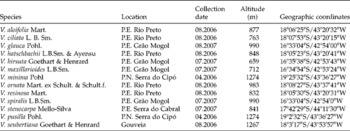
Seeds of Vellozia spp. were collected throughout the Espinhaço Range (including within four conservation areas) in Minas Gerais State, Brazil (Table 1). Campos rupestres is the dominant vegetation in the Espinhaço Range at altitudes above 800 m on rock outcrops with thin soils. Its flora demonstrates high numbers of local endemics, and this region is the centre of diversity for various genera (Giulietti and Pirani, Reference Giulietti, Pirani, Heyer and Vanzolini1988; Harley, Reference Harley, Heyer and Vanzolini1988; Giulietti et al., Reference Giulietti, Harley, De Queiroz, Wanderley and Van Den Berg2005). The region has a mesothermic climate with average annual temperatures between 17.4 and 19.8°C (Giulietti and Pirani, Reference Giulietti, Pirani, Heyer and Vanzolini1988) but with wide daily fluctuations (Harley, Reference Harley, Heyer and Vanzolini1988; Jacobi and Carmo, Reference Jacobi and Carmo2008). Likewise, rainfall shows great variation during the year, with well-defined dry (winter) and rainy (summer) seasons.
List of species and data concerning the collection locations and date (month.–year) of the studied species (P.E.=State Park, P.N.=National Park)

Reference specimens of the species investigated were deposited in the herbarium of the Departamento de Botânica, Universidade Federal de Minas Gerais. Mature fruits in their dispersal phase were collected from at least 20 different individuals of each species, and freshly collected seeds were selected from them to be used in the different experiments.
Seed size and germination testing
The lengths of 100 seeds of each species were measured using digital calipers; as Velloziaceae seeds are generally very irregularly shaped, their lengths were considered as the extension of their major axis. The average dry mass of the seeds (and their standard errors) were calculated by drying four lots of 25 or 50 seeds (depending on their sizes) for 24 h at 105°C and subsequently weighing them on an analytical balance.
Germination tests for all species studied were performed with freshly collected seeds. We used intact seeds, with the exception of V. hatschbachii, seeds of which have a much more pronounced exotesta than the other species, which impedes their visual evaluation. In this case, the exotesta was removed from the seeds using tweezers, and the reported sizes and germination percentage for this species refer to seeds from which the exotesta had been removed.
For each type of treatment, four repetitions of 25 seeds were placed in Petri dishes lined with double layers of filter paper dampened with an antifungal solution of nystatin (Oliveira and Garcia, Reference Oliveira and Garcia2011). The plates were maintained in germination chambers under a 12-h photoperiod (30 μmol m− 2s− 1) or in continuous darkness at constant temperatures of 15, 20, 25, 30, 35 and 40°C. The species that demonstrated >50% germinability at 15°C were also exposed to temperatures of 10°C. The dark treatments were realized using opaque Petri dishes wrapped in black polyethylene bags; the seeds that were maintained under these dark conditions were only observed under a green security light. Germination was defined as the protrusion of the radicle through the seed tegument and was evaluated daily until the response stabilized.
Statistical analyses
The germination percentages and the mean germination times were calculated (Labouriau, Reference Labouriau1983); mean germination time was only calculated when final germination was >10%. The data were submitted to non-parametric statistical tests, as they did not exhibit normality by the Shapiro–Wilk test or homogeneity by the Brown–Forsythe test. Optimal temperatures were calculated only for germination in the presence of light, with optimal temperatures being considered those that showed the greatest germinability associated with the lowest average germination time (Labouriau, Reference Labouriau1983). The correlations between average sizes and seed mass were analysed using the Spearman rank correlation coefficient.
The Kruskal–Wallis test was used in comparisons of the different temperatures utilized, followed by their comparisons in pairs using the Conover test at a 5% level of significance (Conover, Reference Conover1999). The Mann–Whitney test (at a 5% level of significance) was used in the comparisons between the light and dark treatments. Among those species in which germination was only observed at two temperatures, comparisons were made using the Mann–Whitney test. All statistical analyses were performed using BrightStat Software (Stricker, Reference Stricker2008).
Results
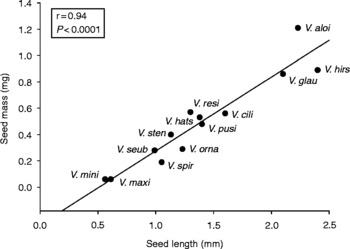
Seeds of the species investigated had lengths that varied between 0.56 and 2.4 mm, and dry masses that varied between 0.06 and 1.21 mg. Seed masses were positively correlated with seed length (r Spearman 0.94; n= 13; P< 0.0001) (Fig. 1).
Correlation between average size and mass of Vellozia seeds (Spearman rank correlation coefficient).

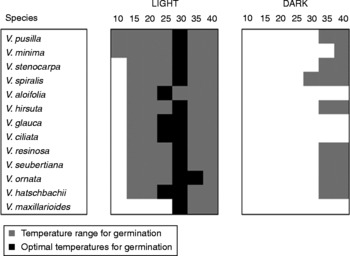
In the presence of light, the seeds of only two species, V. pusilla and V. minima, germinated at all of the temperatures tested (10–40°C) (Fig. 2). Seeds of ten species germinated between 15 and 40°C, and one species (V. maxillarioides) had a very restricted germination range (between 30 and 40°C). The temperature ranges over which seeds germinated in the dark were very restricted (Fig. 2), with the seeds of seven species germinating only between 35 and 40°C; one species germinated between 30 and 40°C, and one exclusively at 40°C. Seeds of four species did not germinate at all in the dark or had germination percentages below 15%. The optimal temperature for germination among all of the species under a 12-h photoperiod was 30°C (with the exception of V. aloifolia, which had a temperature optimum of 25°C) (Fig. 2). Three species also had temperature optima of 25°C, and one species of 35°C.
Temperature range for germination in light and darkness (grey) and optimal temperature (black) in light of seeds of 13 species of Vellozia, 12-h photoperiod, at constant temperatures of 10–40°C (only germinability above 15% was considered).

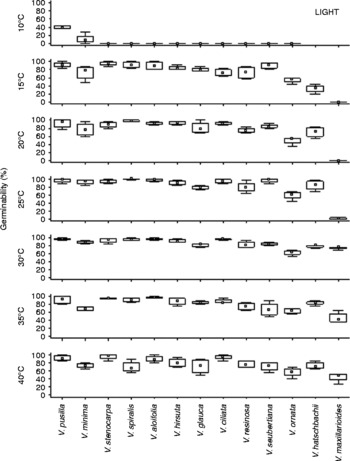
Germinability was always observed to be above 50% in the temperature range between 15–35°C in the presence of light (Fig. 3) with the exception of V. hatschibachii at 15°C and V. maxillarioides, which showed germinability below 20% over the temperature range of 15–25°C. V. pusilla and V. minima had germination values of 40% and 8% at 10°C, respectively. All species showed germinability higher than 75% at 30°C, except V. ornata, which had a germination percentage below 65% at all of the temperatures tested. Germinability was ≤ 60% at 35 and 40°C for V. maxillarioides and at 40°C for V. ornata (Fig. 3).
Germinability of seeds of 13 Vellozia species at 12-h photoperiod and constant temperatures of 10–40°C (■, median; □, 25–75%; I, min.–max. values).

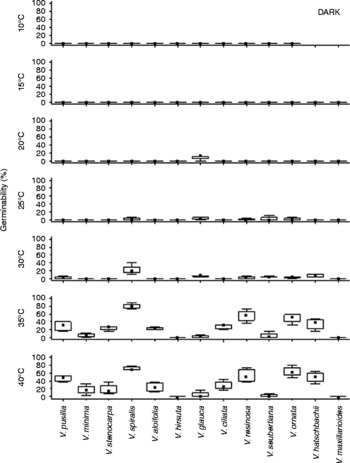
No germination was observed in any of the species in the dark at low temperatures (10 and 15°C) (Fig. 4); at 20°C germination was seen in V. ciliata ( < 15%); and at 25 and 30°C four species germinated ≤ 15% and six species < 10%. Only V. spiralis seeds showed 25% of germination at 30°C and seeds of 11 species germinated at the highest temperatures (35 and 40°C), with values >50% in V. ornata, V. seubertiana and V. spiralis; V. hatschbachii displayed >50% germination only at 40°C.
Germinability of seeds of 13 Vellozia species in darkness, at constant temperatures of 10–40°C (■, median; □, 25–75%; I, min.–max. values).

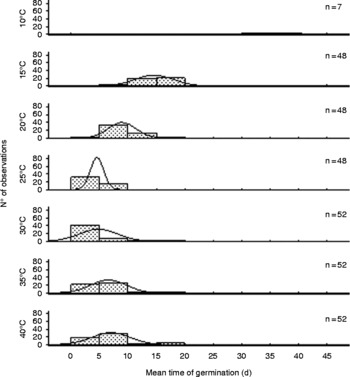
The mean germination time in the light was generally less than 8 d in the temperature range of 25–40°C, with the exception of V. maxillarioides and V. pusilla (Fig. 5). At 25 and 30°C, mean germination time in the light was generally between 2 and 5 d, indicating a greater velocity of germination at these temperatures (Fig. 5). In the temperature range of 35 and 40°C, the values of the mean germination time were mostly between 4 and 8 d, demonstrating a delay in germination in relation to temperatures of 25 and 30°C. At the lowest temperatures, germination was increasingly delayed as the temperature diminished, with the values of mean time for germination between 5 and 15 d at 20°C; between 10 and 20 d at 15°C and after more than 30 d at 10°C. V. maxillarioides displayed mean germination times above 15 d at all of the temperatures at which it germinated (30–40°C). Among those species that showed germinability above 10% in the dark, mean germination times were always greater than 9 d (data not shown).
Absolute frequency of mean time of germination values distributed by temperature (n= number of observations for all species at each temperature).

Discussion
In spite of the variations observed in the lengths and masses of Vellozia spp. seeds, they all had basically similar shapes and were quite small (max. 1.21 mg). Seed mass will influence the responses of both the seeds and the seedlings to the selective processes that impact them in the time between seed production and seedling establishment (Leishman et al., Reference Leishman, Wright, Moles, Westoby and Fenner2000; Moles et al., Reference Moles, Warton and Westoby2003, Reference Moles, Falster, Leishman and Westoby2004), and it will also influence their mean germination times (Norden et al., Reference Norden, Daws, Antoine, Gonzalez, Garwood and Chave2008). Small seeds may have a selective advantage as they are produced in large numbers, although they will, of course, contain fewer reserves per dispersal unit (Jakobsson and Eriksson, Reference Jakobsson and Eriksson2000) and it will be more difficult for the germinating seedlings to reach the soil surface if the seeds are deeply buried. To overcome this limitation, most small seeds require light to initiate the germination processes and will not germinate when deeply buried (Pons, Reference Pons and Fenner1992; Westoby et al., Reference Westoby, Jurado and Leishman1992).
The freshly collected seeds of the Vellozia species studied here could be separated into three distinct groups according to their sensitivity to light: an absolute light requirement (V. aloifolia, V. glauca, V. maxillarioides), partial light requirement under a wide range of temperatures (V. ciliata, V. hirsuta, V. minima, V. resinosa, V. stenocarpa, V. pusilla) and an independence of light at high temperatures (V. ornata, V. spiralis, V. seubertiana, V. hatschbachii). This seed classification in terms of their light requirements was not related to their sizes or masses (i.e. two of the largest seeds, V. aloifolia and V. glauca, and one of the smallest, V. maxillarioides, were dependent on light for germination at all of the temperatures tested).
In addition to the influence of seed size on the light requirement for germination, there is a phylogenetic component for the occurrence of photoblastism (Fenner and Thompson, Reference Fenner and Thompson2005) and it has been reported for species of other genera typical of campos rupestres vegetation, such as Arthrocereus (Cactaceae), Syngonanthus (Eriocaulaceae) and Xyris (Xyridaceae) (Abreu and Garcia, Reference Abreu and Garcia2005; Oliveira and Garcia, Reference Oliveira and Garcia2005, Reference Oliveira and Garcia2011; Cheib and Garcia, Reference Cheib and Garcia2012). Some studied species of Vellozia had light responses that were very similar to those seen in the present study, with dark germination only occurring at high temperatures (Garcia and Diniz, Reference Garcia and Diniz2003; Garcia et al., Reference Garcia, Jacobi and Ribeiro2007).
Temperature may affect germination and light sensitivity in such a way that seeds may require light at one temperature but not at another (Pons, Reference Pons and Fenner1992), and these responses to temperature can be mediated by phytochromes (Donohue et al., Reference Donohue, Heschel, Chiang, Butler and Barua2007; Heschel et al., Reference Heschel, Selby, Whitelam, Sharrock and Donohue2007). Some species are insensitive to light at low temperatures (Smith, Reference Smith1975), while others are less sensitive at high temperatures (Pons, Reference Pons and Fenner1992). The results of the present study appear to be aligned with the latter category.
Light requirements for germination at most temperatures, associated with small seed sizes, suggest that Vellozia seeds can form seed banks. As small seeds are more likely to be buried in the soil (Khurana and Singh, Reference Khurana and Singh2001) and commonly show high longevity in the soil (Thompson, Reference Thompson and Fenner2000; Moles et al., Reference Moles, Warton and Westoby2003), they can remain viable for long periods of time and constitute soil seed banks that are important to ecosystem regeneration (Pons, Reference Pons and Fenner1992; Schütz, Reference Schütz2000). The fact that seeds of some species of Vellozia will germinate in the dark at high temperatures probably does not cause large negative impacts on their soil seed banks as temperatures above 30°C were not observed in shaded campos rupestres microhabitats or below the soil surface (5 cm) (Garcia and Oliveira, Reference Garcia and Oliveira2007).
Small seeds tend to germinate rapidly in the presence of light, which allows them to take advantage of even short periods with favourable germination conditions (Pons, Reference Pons and Fenner1992; Hölzel and Otte, 2004). According to the classification system developed by Ferreira et al. (Reference Ferreira, Cassol, Rosa, Silveira, Stival and Silva2001), germination of Vellozia spp. seeds was: rapid ( < 5 d) at 25 and 30°C, intermediate (from 5 to 10 d) at 35 and 40°C, and slow (>10 d) in the 10–20°C range. The germination delays noted at the lowest temperatures may reflect reduction in metabolic activity (Bewley and Black, Reference Bewley and Black1994). Similar types of delays at high temperatures may reflect the reduced availability of free amino acids, lower levels of protein synthesis and increases in anabolic reactions that can denature proteins and alter membrane permeability (Riley, Reference Riley1981). The smallest mean germination times were observed in the temperature range between 25 and 35°C, with 30°C representing the temperature optimum for more than 90% of the Vellozia species studied.
Each species has a distinct temperature range in which seed germination and seedling establishment are possible (Bewley and Black, Reference Bewley and Black1994). The majority of the species studied here showed wide temperature ranges for germination in the light, with only one species showing a restricted range (V. maxillarioides, 30–40°C). Other species typical of campos rupestres vegetation also show wide temperature ranges for germination (Abreu and Garcia, Reference Abreu and Garcia2005; Oliveira and Garcia, Reference Oliveira and Garcia2005, Reference Oliveira and Garcia2011; Cheib and Garcia, Reference Cheib and Garcia2012). However, of the species from this environment that have been studied so far, only the seeds of Vellozia spp. germinated at 40°C [as pointed out by Garcia and Oliveira (Reference Garcia and Oliveira2007) and confirmed in the present study]. Germination temperature optima of 30°C would confer adaptive advantages to Vellozia spp., in relation to the other endemic species found in this habitat. As the highest temperatures occur during the rainy season in campos rupestres sites (Madeira and Fernandes, Reference Madeira and Fernandes1999), seedlings are able to survive because of the abundant water resources available despite the high temperatures. It should also be noted that these characteristics may be of importance to the species of this genus in the current context of global climatic changes.
The ability to germinate over a wide temperature range can be very important in areas where the irregular regional topography generates varied environmental conditions (Orozco-Almanza et al., Reference Orozco-Almanza, León-García, Grether and García-Moya2003), as can be seen in areas of campos rupestres vegetation (Harley, Reference Harley, Heyer and Vanzolini1988; Conceição and Pirani, Reference Conceição and Pirani2005). This ability will allow species to exploit wider ranges of recruitment opportunities (both spatial and temporal) and to occupy different environments – with consequent opportunities for wider distributions (Thompson and Ceriani, Reference Thompson and Ceriani2003). In spite of the fact that temperature did not appear to be a limiting factor for the germination of seeds of the endemic Vellozia species studied here, their distributions were in fact restricted to very specific environments in the Espinhaço Range. This restriction of these species to certain environments may be related to other factors controlling the initial establishment of their seedlings or the growth of the plants (such as the specific conditions of the soils and the microhabitats). A study undertaken in the northern sector of the Espinhaço Range demonstrated that the Velloziaceae are abundant on rock outcrops where the soils have greater quantities of organic material and clay (despite the fact that they are very shallow) – which would increase the capacity of these soils to retain both nutrients and water (Conceição and Pirani, Reference Conceição and Pirani2005). As such, the diversity of climatic and edaphic conditions encountered in campos rupestres habitats appears to have an even more crucial role than seed germination requirements in terms of seedling establishment and, consequently, for species distribution.
Despite the observed differences among the various species, we can conclude that: (1) size and mass of the seeds were significantly linearly correlated, although light sensitivity was not related to these seed characteristics; (2) seeds of Vellozia spp. have a distinctive germination pattern (high germinability over a wide range of temperatures, light requirements at low and intermediate temperatures but an independence of light at high temperatures); (3) germination characteristics alone cannot explain the high degrees of endemism observed in this genus, and it is probable that factors that affect seedling establishment limit species distributions among the Vellozia.
Acknowledgements
The authors thank Coordenação de Aperfeiçoamento de Pessoal de Nível Superior (CAPES) for providing a grant and financial support to the first author and Fundação de Amparo à Pesquisa do Estado de Minas Gerais (FAPEMIG) and Fundação o Boticário de Proteção à Natureza (FBPN) (Process 043720001) for financing the project. Q.S.G. receives a research productivity scholarship from Conselho Nacional de Desenvolvimento Científico e Tecnológico (CNPq). The authors would like to thank R. Mello-Silva and N.L. Menezes for identifying the species and Instituto Estadual de Florestas de Minas Gerais (IEF-MG) and Instituto Brasileiro do Meio Ambiente e dos Recursos Naturais Renováveis (IBAMA) for their authorization to undertake this study. We greatly appreciate the help in statistical analyses and suggested comments by Fábio Vieira on an earlier draft of this paper.