


Introduction
Several new possibilities for change and development have emerged recently in the politics of the state of Bihar in India. These new hopes have also provided a new direction for writings, lectures and debates on several issues relating to the languages and culture of Bihar. The impact of some of these changes was also witnessed in the Jaipur Literary festival of 2011 where a whole new session was organized on the topic of cinema in Bhojpuri, one of the languages spoken in Bihar. A great desire to try and identify the various aspects of the emergence of a specifically Bihari literary world could be seen at this session. However, despite the effort of the participants in this panel to discuss the languages and literature of Bihar, it was clear that they lacked the historical perspective necessary for a fruitful discussion on such a topic. For this to happen it is essential first to accept that in order to understand these issues we need to comprehend the niceties of their historical background. It is necessary to relate the important questions connected to the history of languages and literature in Bihar to the discussions and policies that arose about them in the context of colonialism in nineteenth and early twentieth-century India. This paper seeks to do this by drawing attention to certain key developments in the history of languages and literature in India between 1850 and 1900, probing the historical background of the development of ‘Hindi’ in Bihar as a modern Indian language and the making of a new literary sphere in it in this region.
Specifically, the aim of this paper is to connect the study of the encounter between the advocates of the regional languages of Bihar (Maithili, Magahi and Bhojpuri) and those of the developing form of a hegemonizing ‘Hindi’ language on the one hand, with the question of the role colonial officials played in the fate of Indian languages in the nineteenth century from within mainstream imperialist politics on the other.Footnote 2 A prime focus of attention in this paper is Sir George Abraham Grierson (1851–1941), the famous British colonial official who lived and worked in different parts of North India, including Bihar, in the late nineteenth and early twentieth centuries.
Why Bihar?
Today the name of an independent state in Eastern India, Bihar did not always mean the same political entity in the past.Footnote 3 Following separate farmans (orders) for each of the three Mughal provinces of Bengal, Bihar and Orissa, with the Grant of Dewani rights the British took control of this vast region in 1865.Footnote 4 Under the British, Bihar, together with Bengal and Orissa, constituted the erstwhile Bengal Presidency.Footnote 5 Separated from Bengal in 1912 to form another province, Bihar and Orissa continued as one administrative unit until 1937 when Orissa was separated from Bihar.
The reason why a history of ‘Hindi’ in the colonial period calls for a study of developments in Bihar is quite simply because it has never been given the attention it deserves, despite the fact that historically it has constituted one of the largest Hindi-speaking regions of India. On the one hand it is possibly because of this precise reason that studies on the history of languages in the Bengal Presidency have tended to ignore Bihar, seeing it as an area properly speaking belonging to studies either of North India or the so-called Hindi-belt. In fact many scholars, including historians of the Hindi language and literature, refer to Bihar in these latter terms.Footnote 6 Unfortunately, on the other hand, whenever Bihar has been subsumed under such categories, it has suffered from a token gesture by scholars whereby although, it finds mention by name in their works, it does not receive close examination by them.Footnote 7 Whilst the specificities of the language situation in other parts of North India, in particular the North-Western Provinces, have received careful scholarly consideration in studies of Hindi, those marking Bihar have been largely disregarded.Footnote 8 This scholarly neglect of Bihar has meant that most studies of Hindi have tended to focus on the history of the making of a standardized ‘Hindi’ language, and its conflict with Urdu, as these phenomena were the dominant ones in the North-Western Provinces in the colonial period.Footnote 9 It is suggested here that the roots of this bias towards concern for developments in the North-Western Provinces and the ‘Hindi’-Urdu debate can be traced back to the early days of British colonial rule in South Asia, when it is first seen that a clear cut stance was being adopted by colonial officials towards the language question in North India. The terms of the debate on the question of which language would be the most effective for communication for the British in India and most suitable for use at different levels of North Indian society,Footnote 10 were set in the days of East India Company rule in BengalFootnote 11 and proved to be decisive for all future discussions on the character, status and role of ‘Hindi’ and Urdu as languages. They have remained the main reference point for the dominant participatory groups in the language debate in North India.
A scrutiny of language-related developments in Bihar during the colonial period, however, reveals a scenario that was significantly different to that in other parts of North India. It is to some of these differences that this paper seeks to draw attention. This raises a complex question: can the region which today constitutes the modern Indian state of Bihar but which at various points in its earlier history, albeit with different boundaries, was also known as Bihar, be regarded as one distinctive cultural region? Having received inadequate scholarly attention, this is a tricky question to answer at present. Moreover, the question is made more difficult by the fact that unlike some other states in India, the boundaries of the languages spoken in the state of Bihar and the cultures connected to them do not in every instance coincide with political-administrative boundaries. Magahi is the only language of Bihar which is spoken in this state alone.Footnote 12 But both Maithili, and especially Bhojpuri, are also spoken outside Bihar.Footnote 13 The fact that Bhojpuri is also spoken in parts of Bihar's neighbouring state of Uttar Pradesh, and in the separate country of Nepal, means that the cultural world of Bhojpuri is not confined to one political unit in India alone.
No doubt, a sense of Bihari identity exists today but the question of how far back in time this goes is uncertain. What can be said more definitely about the region called Bihar is that it includes, as indeed it always did in the past, at least three distinctive linguistic areas. These three areas are those of Maithili, Bhojpuri and Magahi. Not only does Maithili have a written literary tradition that goes back to pre-colonial times, it is a tradition that is far older than either Bhojpuri or Magahi. Although there is a substantial and rich corpus of folk literature and folk songs in Bhojpuri a considerable portion of which is now available in printed publications,Footnote 14 a large part of it was still extant in the oral form in the late nineteenth century when it first began to be collected, written down and, in some instances, published in print.Footnote 15 While, undoubtedly Bihar's own regional languages represented a major characteristic of this region's cultural life, there was another notable feature that made Bihar different from the other Hindi speaking areas of North India. This component relates to the history of the relationship between ‘Hindi’ and Urdu in Bihar the theme of the next section.
‘Hindi’ and Urdu in Bihar
The nature of the relationship between ‘Hindi’ and Urdu in colonial Bihar marks one of the most striking aspects of this region's language situation in the nineteenth century. Compared with the North-Western Provinces, in Bihar the antagonism between these two languages was far less consequential. A major reason behind the harmonious co-existence of ‘Hindi’ and Urdu here was the city of Patna.Footnote 16 In the eighteenth century, Patna had emerged as a major centre of Persian and Urdu culture in Eastern India when, in the wake of the decline and break-up of the Mughal empire, a number of prominent Persian and Urdu poets migrated and settled there.Footnote 17 Despite the weakening of the indigo and opium trades, Patna still retained its place as an important commercial venue. Goods coming from Calcutta and its distribution to different places in the region prevailed and were strengthened by the coming of the railways in the second half of the nineteenth century. Moreover, institutions for elementary education and higher education were established after the 1850s.Footnote 18 It is against this background that the spread of printing and the arrival of Hindi journals, magazines and newspapers must be seen and which laid the foundation for an enhanced literary life in Bihar and the Bihari intelligentsia to expand their activities. It is in this context that the Hindi journal called Bihar Bandhu, and the printing press-cum-publisher, Kharagvilas Press, were established in 1874 and 1880 respectively in Patna.Footnote 19 The wider significance of Patna's flourishing Persian and Urdu literary culture was that it cast its influence also upon the local languages and cultures of Bihar. For example, the literary forms of the ghazal (an Urdu poem/song made up of several couplets, strung together on a recurring/connected theme but making sense and able to stand on their own) and sher (couplet) which were so dominant in Urdu were emulated in the Bihari local languages. Shers were produced in Bhojpuri by writers like Bedil, the famous poet who recited two slightly different versions of the same couplet in Urdu (given below) on two different occasions.Footnote 20
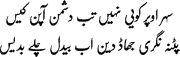
No one is here to look after me when the enemy embraced me
Leaving Patna city, now Bedil is going to a foreign land.
Although, the above couplets are essentially in Urdu they show the influence of the Magahi language. In both the shers the conjugation of a verb ending follows the pattern of grammatical usage in Magahi and not in Urdu. This openness towards Urdu literary forms and their acceptance in Bihari languages shows that the form which animosities between ‘Hindi’ and Urdu took in the North-Western Provinces in the nineteenth century was largely absent in Bihar. It is due to the antagonistic relationship between ‘Hindi’ and Urdu in the North-Western Provinces that forms of Urdu poetry could not be integrated into and made part of ‘Hindi’ poetry in this region. It was as a result of the distance that crept in between ‘Hindi’ and Urdu, that poetry in the North-Western Provinces was initially written in Braj and later expressed in Khari boli. But in Bihar, in contrast, features of Urdu forms of poetry were experimented with in the Bihari languages, and appropriated. Thus, the tradition of writing ghazals and couplets which began in Bhojpuri gave birth to new cultural dimensions in Bihar which unfortunately did not commence in ‘Hindi’. Thus, for instance, the poet Teg Ali wrote a diwan (a collection of poems) of 23 ghazals in 1895 in Bhojpuri called ‘Badmash Darpan’.Footnote 21 This lack of antipathy towards Urdu is the main reason why a North Indian writer like Shivprasad Sitarehind did not face discrimination in Bihar and his works shunned because of his usage of Urdu vocabulary, the way they were in the North-Western Provinces.
Shivprasad wrote his books at a time when the question of what kind of language should be used in ‘Hindi’ school textbooks had become one of the main issues of debate amongst colonial officials and the Indian intelligentsia in North India. Shivprasad used both ‘Hindi’ and Urdu words in his textbooks. This dual usage of language soon became a target of attack by the group of writers collectively known as the Bharatendu Mandal because of their support for the leading Hindi writer of the period, Bharatendu Harishchandra.Footnote 22 This group's main accusation against Shivprasad was that the latter had failed to incorporate in his books what they believed were the rightful expressions of ‘Hindi’. It is as a result of this debate on what constituted proper ‘Hindi’ and the objections that were raised against Shivprasad's writings in the North-Western Provinces that demand was created in this region for books free from Urdu words and approval secured for it from a dominant section of the North Indian intelligentsia. As a consequence, whilst new forms of prose were created in the North-Western Provinces in a ‘Hindi’ that was deliberately purged of Urdu usages, the mixed languages that Shivprasad used in his books became increasingly pariah here. In contrast, in Bihar, no absolute dividing line was drawn between ‘Hindi’ and Urdu in the nineteenth century so here Shivprasad's books faced little censure.Footnote 23 All Shivprasad's books were published in Bihar and there is also clear evidence that they were taught in schools.Footnote 24
It is important therefore to take into account historian Papiya Ghosh's critique of the inclination of many scholars to perceive a ‘Muslim identity’ solely around Islam, to the exclusion of ‘everything else’.Footnote 25 Given this caveat, it is worth bearing in mind that the whole process of the purging of Urdu words from ‘Hindi’ writing as occurred in the North-Western Provinces did not unfold in Bihar in the same way, although there was also a sizeable Muslim population in Bihar. On the contrary, the people in Bihar appreciated the mixture of ‘Hindi’ and Urdu. It was a result of this appreciation that later writers like, for example, Raja Radhikaraman Singh, were instilled to write novels such as Ram Rahim (1936) in which both ‘Hindi’ and Urdu words were used to great effect. The popularity of this novel was in large part due to this mixed language, a point that has been noted by several contributors to a work published to commemorate this publication in 1991.Footnote 26
The lack of a sharp antagonism between these languages is made clear from the observations of colonial officials about the language situation in Bihar. A. W. Croft wrote in 1875:
Hindi compositions of the present day—pure Hindi, as they are called—bristle with Sanskrit compounds as far removed in one direction from the ordinary spoken language of Behar as the dialect of the courts or the publications of the Delhi press differ from it in another. And yet, when Brahman and Mussulman meet, they find that there is a spoken language, the common property of both. True, when a kayastha of superior education addresses a Brahmin, a tol-pandit for example, or addresses a Mussulman, he will use a different set of words. He will say ‘parantu’ [but], ‘vastu’ [object], ‘manushya’ [human being], to the one, and ‘magar’ [but], ‘chiz’ [object], ‘shukhs’ [human being] to the other. That is, he will accept the position which has been created by the jealousy and antagonism of two races, and which Government and the Education Department have as yet done little to combat.Footnote 27
Despite the awareness shown by some colonial officials of the availability to both Muslims and Hindus of a mutually comprehensible language, most British administrators—when taking a stand in colonial India in debates on educational reforms or on the question of choice of language used in connection with the law, administration or education—chose to support ‘Hindi’ in Bihar instead of either a composite Hindustani language or the local languages of the region. Most colonial officials, even in the late nineteenth century, continued to subscribe to a way of thinking first articulated in the early nineteenth century on the language question in North India whereby ‘Hindi’ and Urdu were seen as two separate and independent languages to which people subscribed depending on their religious affiliation: Hindus to Hindi and Muslims to Urdu.
Support for ‘Hindi’ in Bihar
The support given to ‘Hindi’ by the majority of colonial officials, amongst whom there were not only British personnel, but also members of the Bengali intelligentsia, played a critical role in establishing the hegemonic status of ‘Hindi’ in Bihar. The publication of ‘Hindi’ journals like, for instance, the Bihar Bandhu, first in Calcutta in 1872 and later from Patna in 1874 was no coincidence. Rather, it was the outcome of the debates and the plans initiated by colonial officials of the time. These developments helped create a favourable atmosphere for the introduction of ‘Hindi’ in the schools of Bihar. By involving men like Ramdeen Singh,Footnote 28 editor of Bihar Bandhu, the movement for a wider dissemination of ‘Hindi’ also gained strength from these developments and in turn facilitated the process by which ‘Hindi’ came to be recognized in the courts of Bihar. This formal acceptance meant that from 1875, for the first time in Bihar, people were given the option of submitting applications in not only Urdu but also in ‘Hindi’ and Devanagari script.Footnote 29 These successes won by ‘Hindi’ proved critical to its future role as a standardized, modern Indian language.Footnote 30
Similarly, the publication of the fortnightly Dvij Patrika in 1890 was another significant forum for serious discussions on social, historical, cultural and gender issues in Bihar. The front cover of this periodical clearly revealed its leaning towards the three main varnas (castes) of Hindus, which included the Brahmins, the Kshatriyas and Vaishyas. Another key feature of this magazine was that it reprinted entire ‘Hindi’ textbooks in a serial form. Most of the content published in this magazine was taken from the works of authors like Bharatendu Harishchandra and his mandal (group) like Pratap Narayan Mishra, or Ambika Dutt Vyas. The Dvij Patrika was branded by some as a magazine heavily focused on caste issues. However, in its content Dvij Patrika reinforced the subscribed views of the intellectuals of the North-Western Provinces and also promoted the issue of the ‘Hindi’ language in Bihar. A geography textbook used in different schools of Bihar which was reprinted in Dvij Patrika, clearly stated that ‘Hindi’ and Hindustani were the languages of Bihar.Footnote 31
Backing by British colonial officials for ‘Hindi’ in the late nineteenth century was, no doubt, important to its growth as a distinct language. Unfortunately, as far as the majority of colonial officials were concerned their support was not based on any deep understanding of language issues. Few British officials were familiar with the variety and complexities of social and cultural life in Bihar and the differences between this region and the North-Western Provinces. We will later see how the best part of these officials’ views stood in marked contrast to those of the British administrator George Abraham Grierson who arrived in Bihar in the late 1870s and who sought to understand the language question from a new perspective, demonstrating in the process a great depth of understanding of local conditions.
Colonial administration in Bihar in the nineteenth century included besides British officials, also several members of the Bengali intelligentsia. The latter also favoured the adoption of ‘Hindi’ in Bihar for both educational and administrative purposes and held strong views on this subject. When considering which language to employ in school textbooks in the course of debating educational reforms in Bihar, these officials seriously considered the option of a standardized ‘Hindi’ which was emerging at the time along with its prescribed textbooks in the North-Western Provinces which were later also accepted in Bihar. However, they did not take into account for this purpose any of the local languages of the region.Footnote 32
Amongst the factors that contributed to the whole process of making ‘Hindi’ the language of education in Bihar, the role of Bhudev Mukherjee, a member of the erstwhile Bengali intelligentsia who came to Patna in 1877 as a School Inspector, was an important one.Footnote 33 The rise in the number of school textbooks in ‘Hindi’, a phenomenon that played a critical part in the dissemination of standardized ‘Hindi’ in Bihar was to a significant extent a result of Mukherjee's efforts. The foundation of the Khadagvilas Press in Bankipur in 1888 soon after Mukherjee’ s arrival in Patna proved to be of great consequence to the history of ‘Hindi’ in Bihar.Footnote 34 But Mukherjee was not alone in his bias towards Hindi. Another Bengali, Biresvar Chakravarti, the author of a ‘Hindi’ text-book called Sahitya Sangraha, showed his approval for adopting ‘Hindi’ as the language of communication and transmission of knowledge in Bihar, made amply clear in the introduction to his book. He wrote:
Along with the spread of education in Bihar and the other Hindi-speaking tracts under the Lieutenant Governor of Bengal, and with the replacement of the Urdu by the Hindi language, in courts, a most healthy impetus has been given to the cultivation of the real vernacular of the country. This has resulted in the publication of a large number of Hindi books and periodicals, which, in combination with the splendid classics that already exist, bids fair to raise the status of the language to a very high pitch, before long.Footnote 35
The above views show that the advocates of ‘Hindi’ in Bihar sought to garner support for it through the argument that the publication of ‘Hindi’ school books was the right course of action, indeed ‘Hindi’ was the only rightful option. Nowhere in text-books of this period was an effort made to present the argument on the side of the local languages of Bihar. At this point it is important to note that the Bengali intelligentsia was not just in favour of adopting ‘Hindi’, it was also very critical of Grierson's thinking on language issues and his theory of the existence of a separate group of Bihari dialects, as we shall see later in this section.Footnote 36 Rejecting Grierson's rationale for demanding the adoption of a ‘Bihari’ dialect instead of ‘Hindi’ in Bihar, another Bengali writer Babu Radhika Prasanna Mukherji wrote a lengthy piece against Grierson's arguments. Mukherji's views which were openly and directly opposed to Grierson's became all the more important because they show how the former believed that the latter's views had the support of other government officials and therefore needed to be combated. Mukherji's fear is evident from some of his statements.
They plead ostensibly for the people's tongue, a tongue which is understood by people in the streets. Mr. Grierson of Bengal Civil Service has given expression to the views of this class. Sir George Campbell, while Lieutenant-Governor of Bengal, created no little stir by proclaiming officially his determination to make the language of the streets the language of literature, and since his time his theory has found both among officials and non-officials some supporters.Footnote 37
Mukherji's anxieties led him to pen a 14-page memorial in response to Grierson's arguments in favour of ‘Bihari’, to which we will turn a little later.Footnote 38 On the basis of an article by Grierson published in a leading journal, Mukherji presented seven points which constituted the main part of Grierson's analysis.Footnote 39 Mukherji completely rejected Grierson's argument that the ‘Bihari’ languages should be employed for the administration and the courts in Bihar.Footnote 40 Although a detailed discussion of all these seven points will not be possible here, a brief examination would be useful for our purposes. This is especially important given the fact that although arguments in favour of the many languages of the ordinary people and harmony amongst them were presented, their actual use was not envisaged as a goal by Mukherji. He was not willing under any condition whatsoever to give up his support in favour of ‘Hindi’ in Bihar. Although he acknowledged Grierson's point that only 10 per cent of the people of Bihar spoke ‘Hindi’, whereas the remaining 90 per cent spoke in their local languages, Mukherji nevertheless argued against Grierson's reasoning that this should be the logic for accepting the local languages of the region by stating:
Do the educated 10 percent of the population speak a language organically different from that of the remaining 90 percent, and is it proposed to adopt the latter as the standard literary language? In other words, is street talk to be stamped with authority as the official language? Is the stock of words familiar to the peasant and the day-labourer to form the vocabulary of the man of learning, and is literature to confine itself to the few words current among the mass of the people? Are the poems of Bidyapati, Tulsi Das, and Sura Das to be discarded, and in their place to be substituted the trashy street songs?Footnote 41
As we shall see later, in articulating his views in this manner not only did Mukherji fail to respond to the issues that had been raised by Grierson in his article, he also moved away from the main points of the debate on the language question in North India. Mukherji's implication that the poetical works of Vidyapati, Tulsidas and Surdas were not in the language of the ordinary masses was a grossly erroneous one.Footnote 42 As has been shown by several scholars, the primary basis of the popularity of these poets’ works was in fact the use in them of the people's language of the time. Instead of composing poetical works in the language of 10 per cent of the people, these poets had, in fact, made the language of the remaining 90 per cent the basis for their compositions. There are several other such examples in Mukherji's long write-up which show that he did not understand the full spirit of Grierson's arguments. In many ways Mukherji was representative of the group of Bihar intelligentsia that wanted to establish the ‘Hindi’ language in Bihar. The circumstances of this group of intelligentsia had become such at this point that it could, on the basis of its economic and social status and strength, get its views accepted as part of the colonial state's administrative policies.
The Bihari intelligentsia played a prominent role in extending support to the ‘Hindi’ language. Supported by Bihari landlords, a substantial number of this group also came from this background having acquired their zamindaris in the nineteenth century. These new zamindars had earned their wealth first through trade or banking and then used it to buy landholdings. For example, traders like Shambhu Shah traded in tobacco, salt and molasses. Then he traded in items like saltpetre from which he earned great profits. Others like, for example, Banvari Shah also earned their wealth initially from trade and later gave it up. Another landlord called Shivgulam Shah also earned his wealth from trade in items like salt, saltpetre, refined and unrefined sugar, and mustard, and then used it to buy a zamindari in the district of Muzaffarpur in Bihar. These examples from the nineteenth century show how traders in this period made their greatest monetary investments in buying up zamindaris.Footnote 43
The Bihari intelligentsia's views were in tandem with those of the Bengali intelligentsia alongside that of the majority of British colonial officials. Thus the Bengali intelligentsia was not alone in backing ‘Hindi’ in nineteenth-century Bihar. Behind the Bihari intelligentsia's support for ‘Hindi’ lay its conscious decision to make common cause with the intelligentsia of the North-Western Provinces in the latter's efforts to construct and establish all over North India a uniform standardized ‘Hindi’ that was self-consciously and overtly distinct from Urdu. The Bihari intelligentsia's role, though, was not confined to boosting the cause of ‘Hindi’ in the North-Western Provinces alone. It also took an active role in publicizing through various forums the view that ‘Hindi’ was the language of Bihar. Thus, for example, the author of an article on the geography of Bengal published in 1891 in an issue of the Dvija Patrika said, ‘Bihar has two important parts, i.e., Bhagalpur or East Bihar and Patna or West Bihar. The language of this region is Hindi or Hindustani’.Footnote 44 Another article in the same newspaper sought to strengthen the case for the claim that the original language of Bihar was, in fact, always ‘Hindi’ by providing historical evidence. Thus, its author argued: ‘Earlier all writing was written in Hindi, but at the orders of Raja Todarmal writing began in Persian as a result of which many Hindus started studying Persian. As this continued to happen, due to a mixture of Hindi and Persian a mixed language (Urdu) became prevalent in the western and northern regions’.Footnote 45
In this way the Bihari intelligentsia sought to publicize through newspaper articles the view that the real language of Bihar was ‘Hindi’. Disregarding the claims of the regional languages of Bihar, the upper classes of this region never considered them as a viable option and instead chose to give their support to ‘Hindi’ which they did in a sustained manner through various platforms. In a 1942 publication of a commemorative volume on various aspects of Bihar's history, language, and culture, it is remarkable that no section was included on the various regional languages of Bihar. Instead this 1,000-page book on Bihar gave prominence to ‘Hindi’. Whilst considering the case of whether any of Bihar's own languages such as Maithili could be regarded as an independent language, this book argued:

[Pray, what right does a language that does not want to keep ties with and adopt the languages of Bengal, Assam, Orissa, Sindh, Gujarat, Maharashtra, Andhra, etc., have at the level of language to represent the whole of Hindustan—to be called ‘Hindi’ or ‘Hindustani? If she cannot do this, then for it to adopt Maithili, Magahi or Bhojpuri is useless.]
Statements like these show that for the Bihari intelligentsia for all practical purposes, in front of ‘Hindi’ the option of any of the regional languages of Bihar was untenable and therefore non-existent as an alternative. However, we will later see how this view was far from being correct, nor the only one regarding the language situation in Bihar.Footnote 47
It is crucial to understand how, despite the claims being put forward in support of Bihar's own languages by people like Grierson, the Bihari elite was able to get its views on the language question accepted in the spheres of education and government and translated in practical terms in Bihar. Here, in addition to the cultural ties, other kinds of ties between the intelligentsias of Bihar and the North-Western Provinces proved to be significant. Small in number, the Bihari intelligentsia had already established (like its counterpart in the North-Western Provinces) its social and cultural prominence in Bihar by the latter half of the nineteenth century.Footnote 48 For example, Babu Ramdeen Singh took over the responsibility of publishing the Brahman when the economic situation of this periodical, published at that time by Pratap Narayan Mishra, had begun to decline. This periodical which was earlier published from Kanpur began to be printed by the Khadagvilas Press from 15 July 1889. The good relationship between Bharatendu Harishchandra and Babu Ramdeen Singh is an example of the close ties that prevailed between the intelligentsias of Bihar and the North-Western Provinces. The evidence for Bharatendu and Ramdeen's deep friendship comes from not only what Dhirendranath Singh has to say about it in his book but also very concretely from the list of books actually published by the Khadagvilas Press, which shows that several books written by Bharatendu were issued from this press.Footnote 49 The mutual support and collaboration between this group and the intelligentsia of Bengal and the North-Western Provinces led to some notable successes for standardized ‘Hindi’ by the early twentieth century. The next section looks at some of the reasons behind these achievements.
Some successes of standardized Hindi
We noted earlier how members of the Bengali intelligentsia like Bhudev Mukherjee helped to augment the number of school textbooks produced in ‘Hindi’. Additionally, by facilitating the establishment of the Devanagari script in place of Kaithi in the courts of Bihar, officials like Mukherjee made critical contributions to the growth of standardized ‘Hindi’ in this region. But the collaboration between the intelligentsias of Bihar and the North-Western Provinces also proved to be a key factor in the successful dissemination of ‘Hindi’ across large parts of North India. The close friendship that developed between Bharatendu Harishchandra of Benaras in the North-Western Provinces and Ramdeen Singh of Patna in Bihar led to one of the best and most successful examples of such collaborations. Regarded as one of the founding fathers of modern Hindi, Bharatendu, as is well known, was the most prominent leader of the movement to expand the reach and influence of ‘Hindi’ across North India. Ramdeen Singh, who had come to know Bharatendu through the Raja of Majhauli, Kharagbahadur Malla, and had extended great help to Bharatendu at a time when the latter was in a dire financial crisis, was an enthusiastic supporter of ‘Hindi’ in Bihar and deeply aware of the arenas where it was lacking in this region. Recognizing that paucity of ‘Hindi’ textbooks was one such area in Bihar, Ramdeen Singh sought to help overcome this problem by establishing a printing press. Thus he set up the Khadagvilas Press in 1880 in a place called Bankipur, a suburb of Patna in Bihar. Ramdeen and Bharatendu's close ties meant that the task of printing the latter's writings on ‘Hindi’ was taken on by the Khadagvilas Press right from the start of its operations. Amongst the most important school textbooks in ‘Hindi’ published by this press, Bhashasaar, issued in 1886, included several essays by Bharatendu. The inclusion of not just Bharatendu's writings in this book but those of many of his close associates was a direct result of his links with Ramdeen. Books like these, although produced in Bihar and recommended for use in schools in this region as part of the educational reforms being implemented at the time, contained language and content that were either the same or similar to books being prescribed in schools in the North-Western Provinces. Since the bulk of the authors of these books came from the latter region and supported the cause of ‘Hindi’, these publications were considerably effective in spreading a certain kind of ‘Hindi’ rather than other languages, even in areas where such alternatives to it were present. The question that arises here is, was there no one in Bihar at this time who articulated the claims of its own local languages? The answer to this is yes there was. A consensus had certainly not been reached amongst the people of Bihar across different localities, groups, classes, castes and gender that the language of this area was ‘Hindi’.Footnote 50 Why this should have been so is what the next section is concerned with.
‘Hindi’, the languages of Bihar and George Abraham Grierson
The study of the life and works of the British colonial administrator George Abraham Grierson shows that, even amongst what seems at first sight to be a monolithic group of colonial officials, there were exceptions and dissenting voices. Although, these dissenters may not always have been successful in making their views prevail, the fact that needs to be acknowledged is that they tried to put forward a different and sometimes more nuanced view than most other British administrators did on matters of the greatest concern to local people of a certain region in colonial India. Only by doing so can we begin to probe the implications of the alternative insights that such dissenters can sometimes provide about certain historical developments. It is only then that the significance of the dissenter's voice to our historical understanding of such developments and the complexities involved therein can become clearer. Grierson's is one dissenter's voice in the history of North Indian languages whose thinking and actions relating to particularly the language question in nineteenth-century Bihar, showed differences of a significant kind both from the views of other British colonial officials of his time, as well as from those of the Bengali and the majority of Bihari intelligentsia of the period.Footnote 51 In the following section I look at how Grierson was different to these groups and what his observations and activities can tell us about the history of ‘Hindi’ in Bihar during the period under discussion.
George Abraham Grierson was born on 7 January 1851 at Glanageary, County Dublin. Before being appointed as a civil servant in the Bengal Presidency in 1873, he studied mathematics at Trinity College, Dublin. During his university days a significant influence on Grierson was Professor Robert Atkinson who had a wonderful library to which the former made frequent visits. The books, particularly those from the field of linguistics in Atkinson's collection greatly influenced Grierson. The problem of language in North India was an area of particular interest to him. However, his official commitments as a colonial official meant that Grierson was unable to work in a steady and continuous manner because of his constant transfers from place to place.
Grierson was unable to make any special contribution to the educational reforms being debated and implemented in North India during the 1870s. His important work on Indian languages began only from the 1880s onwards, once his job situation became steady. Returning from Britain in 1880 after six-months leave, Grierson was appointed Circle Inspector in Bihar. Subsequently, in 1881 he became Patna's Assistant Magistrate and Collector. It was during his posting in Bihar that he delved deep into the languages of the region. This interest and the work that he pursued partly as a result of it, differed in important ways to that undertaken by other British officials and non-officials in North India from the second half of the nineteenth century. Like many of these men and women, Grierson was also a collector who amassed a range of oral and written texts, including works like folk tales, folk songs, sayings and words.Footnote 52 However, his motivations, perspective and modus operandi were distinct from those of other collectors at this time—he was not an amateur collector for whom collecting was a hobby like it was for some of the wives and daughters of British colonial officials in India. Some of these women had collected folk tales from different parts of North India which they later published in England in the form of books attempting to throw light on what appeared to them as the exotic country of India.Footnote 53 Nor did Grierson collect materials merely with the view of achieving more effective administrative control through better understanding of the social and cultural life of those Indians who were to be governed by the British. It is true that, like William Crooke another well known British colonial official and collector, Grierson also collected words related to, for example, Indian peasant society.Footnote 54 No doubt, this cannot be dissociated with the effective functioning of colonial rule, the machinery for which Grierson was a part. The view proffered by scholars such as Sadhana Naithani that British colonial collecting was one of the conditions upon which the extension and security of colonialism in India was based, is true.Footnote 55 But her reading of collectors like Crooke who, she argues, gained the status of an India expert by printing the materials he had collected, is too narrow and simplistic in the case of Grierson. What is it, then, that distinguished Grierson from other nineteenth-century British collectors in India?
Three factors made Grierson unique. The first was his formal academic training in linguistics which he received whilst he was a student at Edinburgh. His later writings make it clear that the principal reason for why his robust support for the local speeches of Bihar and Eastern Uttar Pradesh was so different from that of contemporary colonial officials was because his perspective was rooted in a scholarly understanding of language, specifically the discipline of linguistics. This linguistic background would become evident not only during the mammoth project of the Linguistic Survey of India, which he led, but also in his work of collecting materials on and writing about the local languages of Bihar. An example of such a project he undertook was the material he collected on the grammar of the so-called gaonwari bolis (rustic speech)Footnote 56 of Bihar. In a letter to the Director of Public Instruction regarding the enormous project he had been asked to complete, Grierson wrote with an evident degree of satisfaction of how he was able to accept that the project needed to be completed within the six weeks he had been given to do so, only because he had already collected a vast amount of material prior to the proposal being presented to him. In this letter he clearly referred to the problems faced by officials working in Bihar when they could not fully comprehend the language of the local people of this region. Quoting from correspondence from February 1881 which he had earlier written to the Director of Public Instruction, Grierson wrote in a subsequent letter to the same official which he also included in his famous 1883 publication on the languages of Bihar:
Many Bihar officials have complained to me of the impossibility of understanding the gaonwari boli of the witnesses who come into their courts, and more than one has suggested to me that I should compile a grammar of it, imagining apparently that the gaonwari boli was one uniform language current over the whole of Bihar.Footnote 57
In collecting materials such as Bhojpuri songs, Grierson's motive was not simply one of collecting information about local languages. Materials relating to various aspects of local culture and society in colonial India, collected for the narrow purpose of aiding effective administration under the aegis of British colonial officials, were generally published in the Roman script. Sensitive to the distinctive characteristics of the local languages of Bihar, Grierson used the Devanagari script for publishing in print the materials he had collected.Footnote 58 His use of an Indian script was part of his larger scholarly agenda of showing how languages from one area in India differed to those from another.Footnote 59 His scholarly perspective towards languages helped him to demonstrate how, from the point of view of usage and structure, the regional languages of Bihar differed to that of the ‘Hindi’ that was in the process of emerging in other parts of North India in the late nineteenth century. Grierson used examples from Bhojpuri songs to show how the construction of tadbhav words (words derived from Sanskrit) in the regional languages of Bihar was different to the way in which they were constructed in the standardized version of ‘Hindi’.Footnote 60 Elaborating upon how what he described as the ‘Bihari group of dialects’ and the ‘Hindi group of dialects’ derived from Prakrit in his book-length work called Seven Grammars, Grierson asserted:
At this time there were two Prakrit languages current over Northern India, - one called Sauraseni, and covering the greater part of the tract of country now occupied by the Western Gaudian languages; and the other called Magadhi, and covering the tract now occupied by the greater part of the Eastern Gaudian languages.Footnote 61
Further on he wrote:
It is this Magadhi-derived Eastern Gaudian language which in [the] process of time still further subdivided itself into the Bihari group of dialects, Uriya, Bangali, and, at a later period, Asami; and in the same way the Sauarseni-derived Western Gaudian language subdivided itself into the Hindi group of dialects, Panjabi, Sindhi, and, at a later period, Gujarati.
Hence it appears that while the Bihari and the Hindi groups of dialects are widely distinct languages, each has its congeners of similar origin: that is to say, Bangali is much more nearly related to, and much more like, the Bihari dialects than they are to the Hindi dialects; and vice versa, Panjabi is much more nearly related to and like the Hindi dialects than they are to the Bihari. It therefore follows as a necessary logical sequence that if Bangali or Panjabi are to be considered as languages independent of the Bihari and Hindi groups of dialects respectively, much more must these Bihari and Hindi groups of dialects be considered as languages independent among themselves and of each other.
Hence I shall for the future no longer designate them in these pages as groups of dialects, but shall call them the Bihari language and the Hindi language respectively.Footnote 62
Although Grierson regarded languages like Bengali as being more closely related to the so-called Bihari dialects than to the Hindi dialects, it is on the grounds of historical linguistics that he objected to considering this language or the other languages spoken in the eastern parts of India such as Oriya and Assamese as being part of Eastern Hindi dialects. He supported his argument by saying:
This is not the fact; for though, doubtless, Hindi and the dialects herein treated of may ultimately be traced up to a common parentage, this point of departure is so extremely distant, and the stems of these languages have developed and branched off so luxuriantly in different directions, that they have nothing in common but their roots.Footnote 63
Thus we can see from the above statements how Grierson made his arguments about Indian languages on scholarly grounds, although these would be questioned later on by other scholars.Footnote 64 The extracts from Seven Grammars referred to above testify to the considerable lengths to which Grierson went to establish that the languages of Bihar were not Hindi and constituted a separate group of languages. But there was another important point made by him, one about which he felt very strongly and which he made several times in different places. This was his view that the language that was being called ‘Hindi’ in various quarters in the late nineteenth century was, in fact, an altogether foreign language in Bihar! Thus he wrote in 1883:
The numerous gross grammatical blunders in documents, most of which are written by fairly educated men, may surprise those who do not know that book-Hindi, and a fortiori court-Hindi is a foreign language to all who use it in Bihar. The native language of every Bihari (excepting those born and bred in the large towns) is as different from Hindi, as French is from Italian; and the little they ever knew of that language has been learnt after several years of painful training in the Government higher schools, and most of that little forgotten before they have any occasion to use it. I think that a perusal of the documents herewith presented will appear to be a sufficient answer to those who oppose the substitution of one of the Bihar languages for Hindi as a Court-language, on the ground that the latter is already in possession, and should not be disturbed except for very strong reasons. Unless the ungrammatical jargon of these petitions can be called Hindi or Urdu, Hindi is no more in possession than Norman-French was in possession as the language of England, at a time when the lawyers spoke what they called Norman-French in the law Courts. The matter, no doubt, is different in the North-West Provinces, west of Benaras; for there, Hindi may fairly claim to be the vernacular of the country; but it is not, never was, and never can be, the vernacular of Bihar.Footnote 65
The second factor that distinguished Grierson not only from other British colonial officials but also from the Bengali and to a certain extent Bihari intelligentsia of his time, was his great curiosity about, openness towards and empathy for the people of Bihar at the grassroots level.Footnote 66 Whenever he went on official tours of Bihar large groups of Indian peasants always thronged outside his tent. Showing interest in their lives in general, Grierson is known to have listened to not only their more serious grievances with sympathy but, also to have shared in their accounts of the many tales, songs and satires that the local village people took pleasure in. Thus his biographers wrote:
We learn without surprise that, when on tour, he would always have a crowd of Indian peasants round his tent, bringing to him their many difficulties: his somewhat indistinct articulation did not balk them, and ‘he loved them like a father and they him’.Footnote 67
It is the very lively human context in which Grierson heard these literary works and his own empathy for those recounting them to him, which explains his leaning towards the peasants’ folk creations, whose meanings and depth touched him greatly. Similar views were echoed in his biography by its authors:
On matters of Indian folk-lore and kindred topics he made rather frequent brief communications to Folk-lore and other journals. He still delighted to discover Indian parallels to western stories and usages, the ‘water of life’, ‘the headless horseman’, ‘Duryodhana and the Queen of Sheba’, birth customs, omens, folk-etymologies, ‘sortes’, and so forth.Footnote 68
These close and frequent contacts with people at grassroots levels in different parts of rural Bihar, his own academic training, together with the absence in him of the kind of prejudices and pre-conceived notions about language that some of his other contemporary colonial officials displayed, enabled Grierson to appreciate the variety and complexity of the language situation in Bihar. His close observation of ground realities in Bihar had led him to conclude that ‘Hindi’ was a foreign tongue in this region. But his appreciation of the complexities of the language situation in India in general, and Bihar in particular, was not confined to this. It is also evident from the critique he offered on what he felt was the erroneous way terms like ‘dialect’ had been applied in the case of Indian languages. In the introduction to his work called Seven Grammars he proffered several reasons for this objection. Whilst discussing the history of the languages whose grammars he was writing in this work, Grierson referred to the fact that these were ‘. . .all various forms of one class of languages, called by some Eastern Gaudian and by others Eastern Neo-Indo-Aryan’. Including Assamese, Bengali, Oriya and the languages of Bihar in this class, Grierson elaborated why although these were usually referred to as Eastern Hindi dialects, it was an objectionable term. Thus he wrote:
These last are usually called the Eastern Hindi dialects; but the name is liable to objection on the score that it suggests the fact that they are mere dialectic forms of the so-called Hindi language which we meet in Bagh o Bahar and the Prem-Sagar, and which is a modified form in Braja Bhasha or Dialect of the Doab. This is not the fact; for though, doubtless, Hindi and the dialects herein treated of may ultimately be traced up to a common parentage, this point of departure is so extremely distant, and the stema of these languages have developed and branched off so luxuriantly in different directions, that they have nothing in common but their roots.Footnote 69
Proceeding to give a second reason for his objection to the word dialect, Grierson wrote:
Besides this, there is this other grave objection against the use of the term ‘dialect’, that this term, as popularly (though not scientifically) accepted, necessarily presupposes the existence of some one closely connected form of speech to which the dialects can be referred as a standard. Thus there are Yorkshire and Somersetshire dialects of literary English, and Provencal and Norman dialects of literary French. But there is no standard language of which, Tirhuti or Bhagalpuri can be called dialects, for there is no standard of the so called Eastern Hindi language.Footnote 70
Grierson's long stay in various parts of Bihar and close observation of life there also made him sensitive to, and appreciative of, the specificities of the experiences of the local people of this region and what made it different from other parts of the North-Western Provinces, a distinction that he believed manifested itself through languages and literary forms that were specific to Bihar. Grierson's ability to see what was unique to Bihar came from an openness to take into account the different literary genres and forms of language usage that were prevalent in different parts of this region. He tried to highlight the distinct nature of Bihari literary forms in dialects like Magahi and Bhojpuri when he wrote:
If a people, however, has not poems by great masters, it must have songs, and so we find abundant stores of songs of all kinds some original, and some translated from other languages, in these last two dialects. The peculiarity of all these songs is that the fetters of metre lie upon them very loosely indeed.Footnote 71
Made aware of this rich variety and uniqueness of local culture in the course of his official visits to different localities, Grierson set about collecting in a systematic manner materials that would help him prove the importance and distinctiveness of this region's own local languages.Footnote 72 The materials collected by Grierson helped him appreciate the specificities related to not just the languages of Bihar but also to its literary and cultural traditions. Seeking to highlight these specificities, Grierson showed through his collection of popular tales and songs how the same story would often find different expressions in the various speeches used in different parts of Eastern India, including Bihar. Thus, he demonstrated how one of the most popular songs of nineteenth-century India was known as the Song of Manikchand in the district of Rangpur in Bengal where it was composed in the speech local to this region, but it was also popular in Bihar and known there as the Song of Gopichand in the local Bihari languages.Footnote 73
Grierson's sensitivity to the particularities of the culture of Bihar extended to an acute awareness of the literary and cultural forms that had developed out of and were rooted in the material and cultural experiences specific to the local people of Bihar. The way in which, for example, Grierson sought to highlight the significance of the literary form known as the biraha geet (songs of longing) in Bihar shows the extent to which he was deeply aware of these forms:
Every stout young fellow with good lungs has a repertoire of them, out of which he sings whenever he has nothing better to do, whether alone or in company. He has probably only one tune, to which he fits all his words; and as the tune wanders about through all keys, and generally has a cadenza of twenty or thirty notes every second or third syllable, it is difficult for the European, uneducated to native tastes, to catch what he sings. This paucity of melodies has often struck me. In the country districts I never heard of a new tune being invented. There seems to be a certain stock of tunes ready made, to which the words of every new song must be fitted. Thus, every mill-song must be sung to the melody called ‘jatsar’, and such songs are classed as jatsars.Footnote 74
Grierson not only collected these songs and other oral literary works in the local Bihari languages, he also published many of them in print. In doing so he was trying to realise two aims. One was to establish the fact that despite the absence of large quantities of written literature, the local languages of Bihar did not lack a literary basis. He not only wrote academic papers but also published pamphlets on oral literary forms. He published a pamphlet, for example, on the genre of ‘Alha’ and described some of the effects of rustic speech on it:

[In order to write long ballads the meter of Doha, Chaupai, Lavani are convenient forms to use, because the form can be shortened or stretched according to your needs. One can only enjoy this style of poetry when the language is simple and rustic. Purified Hindi words such as pryapt, vyapt, samapt etc. spoil the enjoyment of the meter.]
Grierson's aim in printing materials like the Alha stories and biraha songs which had traditionally been transmitted through oral means, was to show that the Bihari languages did have a body of literature in them even if this literature had not been written down.Footnote 76 Its original oral character did not make this literature devoid of any merit:
I cannot say that they possess much literary excellence; on the contrary, some of them are the merest doggerel; but they are valuable as being one of the few trustworthy exponents which we have of the inner thoughts and desires of the people.Footnote 77
Seeking to reinforce the extent and sheer variety of themes of this literature, Grierson published many biraha songs in print. Grierson's second aim in publishing such works was to establish that the languages and literatures of Bihar had their own separate identity.Footnote 78 For example, the jatsars (songs sung while milling grain) or kajri (songs sung during the rainy season) were typically composed in Bhojpuri, the most widely spoken language of Bihar. Printing was an important means through which Grierson sought to highlight the distinctiveness of these works.Footnote 79
Acknowledging that the Bihari dialects were not as fortunate in terms of a literary heritage in the way that Braj bhasha and the Bengali language were, Grierson conceded the fact that unlike the latter, Bihari literature could not boast to having many great poets.Footnote 80 The one exception, whose name Grierson noted, was the fourteenth-century poet Vidyapati who wrote in Maithili. Counting Magahi and Bhojpuri, amongst the other main Bihari dialects, Grierson reiterated that no great poet had been born in Bihar under whose name a ‘literary school’ could form.Footnote 81 In Grierson's view, however, this absence did not mean the absence of ‘popular literature’ in Bihar.Footnote 82 According to Grierson, the existence of the vast number of songs, in Bhojpuri in particular, was evidence to the contrary. Grierson tried to highlight the essentially Bihari literary characteristics of these songs. But while explaining all the various forms of songs that were sung in Bihar, Grierson mainly focussed upon and discussed the biraha geet. In the course of this discussion Grierson, showed how many of these songs were centred upon beliefs that were prevalent in Bihari society relating to religion and gods and goddesses.Footnote 83 But he also referred to songs which had for their themes social and cultural issues.Footnote 84 In printing such songs Grierson appears to have been motivated by the quest to highlight the cultural importance of literary traditions that were specific to Bihar, embodying as they did experiences that were important to the people of this region and which were articulated through words and cultural expressions that carried a special emotional resonance for those familiar with them.
For example, one of the biraha songs that Grierson discussed in detail was based on the theme of many a young girls’ experience of growing up and getting married in Bihar.Footnote 85 In discussing these songs Grierson showed how well acquainted he was with sensitive social issues in Bihari society. The main theme in the example of the biraha song that Grierson took up for discussion was the emotions of a girl who had been married at a very young age and was living with her parents even after marriage because, being at a pre-puberty age, she had to wait till she reached puberty before she could join her husband in his home. Such a girl would undergo physical changes while still living with her parents, changes that would indicate her transition from being a pre-puberty girl to a grown woman. Finding it difficult to hide these very visible biological changes, such young girls would often draw the attention of people other than her family in the village, inviting unwanted interest in them particularly from men. To these young girls the only person who could protect them from the unwanted gaze and suggestive comments of men were their husbands, who would take these girls home with them after the special gauna Footnote 86 ceremony. The anxieties, embarrassment and, longing for their husbands that such young married girls experienced were expressed through biraha songs like the one Grierson referred to. Clearly showing the stark reality that was faced by many girls in Bihar, the words of these biraha songs were very effective in communicating some of the turbulent emotions that girls experienced whilst waiting to begin married life because there were expressions in languages specific to Bihar and not in an artificial standardized ‘Hindi’:
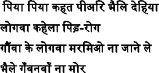
[As I constantly call ‘Beloved, beloved,’ my poor little body has turned pale. The neighbours say I have got consumption. But the village neighbours know not the secret cause: it is that my husband has not come to take me to his home.]Footnote 87
By drawing attention to such emotionally resonant literary forms like the biraha geet, Grierson wanted to highlight the richness of literary and cultural traditions even in dialects like Magahi and Bhojpuri which were lacking in great names of individual poets but in which a vast number of different types of song existed. Grierson's awareness of the existence of such works resulted from the long years he had spent in studying the regional languages of Bihar. This insight into what made Bihar different also gave Grierson an understanding as to why teaching in standardized ‘Hindi’ in schools in Bihar was an imposition here.Footnote 88 It was problematic because this ‘Hindi’ was primarily based on a form of language that was familiar to people in the North-Western Provinces but not to people in Bihar.Footnote 89 ‘Hindi’ was a ‘foreign’ language for the students in the latter region and, therefore, for the government to promote it here as the language of primary education, would be wrong in Grierson's opinion.Footnote 90 Thus Grierson explicitly asserted that ‘. . .the people of Bihar should be taught their own language in the schools, and be ready to come to cutcherry without the fear of not being able to understand what is quite as bad as the Norman-French of our old English law-courts. . .’.Footnote 91
Grierson's recognition of the distinctiveness of Bihari languages and their separate identity led him to take a stand that was directly and strongly critical of the British colonial government's education and language policies. Expressing his disapproval of the way in which the government had handled the whole question of which language to adopt in the schools of Bihar, Grierson wrote in a note on primary education sent to the Indian Education Commission in 1885:
I would take as an additional text the passage in p 343 of the report, ‘a larger objection was brought’ against the language, ‘Hindi, as the medium of’ primary instruction ‘in the primary schools of’ Bihar. This was said ‘to be a language not’ understood at all by ‘the boys in many parts’ of that Province, & but ‘little understood even’ by their teachers. The ‘essence of the objection’ is that ‘the Hindi of the text-books is what’ is known as ‘high Hindi’ ‘and that while this’ form is closely allied ‘with the dialects of’ ‘northern India from’ Allahabad to Delhi, ‘it is too far removed’ from the Eastern group—i.e., chiefly, the ‘dialects of Bihar’ to be safely used in ‘schools as the standard’ or literary form of ‘the language’. The ‘practical result, it is’ urged, is to impose ‘on the children a foreign’ tongue before teaching ‘them their own vernacular.’Footnote 92
Further on in his letter Grierson wrote:
This I know by experience to be the actual fact. Thus a boy sees before him the syllables pakka am khao. He reads them fairly enough, if he knows the character, but words convey no meaning to him till the Guru explains that they mean pakal am'wa khah, when he first learns that the combination of letters he has just read means ‘eat ripe mangoes’, and this is by no means a far-fetched example. So on, through out his whole education the pupil has to learn a foreign language before he can learn (in a Govt. school) that twice two are four, or that sixteen chhatanks make a ser.Footnote 93
Grierson noted the irony of a situation where the very teachers who were expected to teach through the medium of ‘Hindi’ textbooks were finding the task of translating the ‘Hindi’ content of the books into a dialect which the pupils understood, to be incredibly challenging. Appreciative also of the difficulties faced by the Bihari student, Grierson went on to describe in the same letter referred to above, as what such a student did to cope with the unhappy predicament thrust upon him:
He then goes home and retains the useful portion of his knowledge in his memory, but speedily disencumbers himself of the heavy baggage in the shape of a foreign language of which he has no need, and which he rather dislikes than otherwise.Footnote 94
This brings us to the third and final reason as to why Grierson was different to other colonial officials and the Indian intelligentsia of his time. Grierson proved to be more in tune with the needs of the people of Bihar than either of the two other main groups embroiled in the whole language debate in North India. We have seen how, highly critical of the attempts to impose standardized ‘Hindi’ in Bihar, Grierson became the unofficial spokesperson for and self-appointed advocate of the local languages of Bihar. The other important issue related to the languages of Bihar was connected to the matter of choice of script when writing government documents or courts papers. The debate between the option of using either the Kaithi script or the Devanagari script became a dimension which created further division between the officials and the intelligentsia of Bihar. In the case of the North-Western Provinces the conflict over which script to use (Devanagari or Nastaliq) became an integral part of the whole contest between ‘Hindi’ verses Urdu and had important repercussions in the destiny of these languages.Footnote 95 In contrast, the situation in Bihar was different because, in addition to the Devanagari and Nastaliq scripts, there was a third choice available for writing, that of the script known as Kaithi. Not all the agents involved in considering the pros and cons of these various scripts available for use in Bihar held one consistent opinion on which script was most appropriate for writing languages like, for instance, the newly emerging form of ‘Hindi’ or the various regional languages of Bihar. The views of these various agents have remained outside even the purview of scholars who have considered the history of the whole language and script question in North India. But it is important to reflect upon these positions because script forms an important dimension in the history of language. It is also important for another reason. The various opinions here expressed on the question of script in Bihar and the steps that were taken to implement certain viewpoints and not others, made this region significantly different to the North-Western Provinces. This hitherto little examined aspect of the history of North Indian languages is the focus of the next section.
Kaithi versus Devanagari
The first person whose views on the question of script in Bihar which merits examination is Grierson not only because he is of central focus in this paper but because his views interestingly changed over time which may come as a surprise to the reader. Quite vocal in espousing the cause of Bihar's own languages rather than ‘Hindi’ and open in his criticism of the government's action on the language question in North India especially in Bihar, ironically, Grierson remained more accommodating of the official establishment's policy towards the question of script in Bihar.
There were three scripts used for writing the regional languages of Bihar in the nineteenth century (Kaithi, Devanagari and Maithili).Footnote 96 The use of the last script, however, was confined to the region of North Mithila only. Of the first two, Kaithi was the more common and popular in Bihar. From the late nineteenth century onwards the question of whether to adopt the Kaithi or the Devanagari script in North India became a subject of intense debate amongst colonial officials and the North Indian intelligentsia. Grierson also referred to the issue of script in his various writings during the late nineteenth century when he wrote a handbook specifically on the Kaithi script.Footnote 97 But it is from a letter written by Grierson in 1911 that we get one of his most candid and explicit statements regarding his stance towards the script question in Bihar. This letter makes it clear that Grierson's views on this matter shifted over time and that there was a connection between the official position he occupied in the colonial government and the viewpoint that he publicly supported at that time. Writing in response to a letter from another official, Grierson wrote:
I am commonly credited with having introduced Kaithi character into Bihar. But this is not the case. When it was introduced I was a very junior officer, and was not consulted at all. What I did was simply obey [the] orders of my superiors. It is true that I often supported the introduction of the Kaithi into the Province as being an improvement on the Persian character hitherto in vogue, but I never concealed my opinion that I should have preferred Nagari to Kaithi if I had been consulted. However, my business was to obey orders, not go against them. Personally, if I had my way, I should now retain both characters, adopting Nagari for general use, and employing Kaithi where we, in English, use italics. For writing Kaithi is certainly preferable to Nagari on account of the speed with which it can be written.Footnote 98
The above statement shows that at one point in time as a junior officer, when in any case he was not consulted on the matter, it was pragmatic for Grierson to follow his superior's dictum and support Kaithi. This was, however, not the only reason why he sided with this script. At this point in time he did also feel that Kaithi was a better option than Persian. But in the same document he conceded that had he been consulted, he would have preferred the adoption of Devanagari rather than Kaithi. By 1911, though, he felt differently and believed that both scripts merited adoption but for different purposes; Devanagari for ‘general purpose’ and Kaithi for handwriting.Footnote 99
The issue of script, like language, has until now only been superficially examined as far as the region of Bihar is concerned. It was noted above how Grierson remained rather restrained and accommodating of government views on the question of the script appropriate for use in Bihar. Another colonial official, however, proved more forthcoming on this issue. This man, who took an active interest in the language question in North India and some of whose views we have already considered above, was Radhika Prasanna Mukherji.
Mukherji's interest in the languages of North India, like Grierson, also extended to the issue of script, about which he made certain arguments whilst presenting his case for the adoption of one particular script over another. It is very striking that whereas he accepted ‘Hindi’ as the language of Bihar, in the case of script he supported the Kaithi script rather than Devanagari which was the script favoured by many of the supporters of ‘Hindi’ in North India. Mukherji presented four options in connection with the question of script and expressed his views on all four. The first option that he considered was the Roman script, the adoption of which in his opinion would violate the sentiments of ordinary people. He said, ‘It has, however, no resemblance whatever to any of the Indian characters; and, however ingeniously it is made to do duty for any of them, it is both redundant and defective, and does not fully represent the indigenous sounds of the native tongue’.Footnote 100 He presented the Persian script as his second option, giving old historical reasons for its inappropriateness, arguing that ‘Persian was also not the right option for Bihar’.
Mukherji next discussed the Devanagari script as his third option. Despite showing that Devanagari had a strong claim, Mukherji gave Kaithi the status of being a more useful and pragmatic script than Devanagari. It is interesting that even whilst expressing the relevance of the Devanagari script, Mukherji presented the case for the Kaithi script very strongly. Thus he said:
The objections to its [Devanagari] general adoption by Government are certainly feebler than those to the use of Persian, but they are strong enough to turn the scale in favour of Kaithi. In the first place, it is not used in the daily business of life, and is not so widely diffused as Kaithi. Next, Muhammadans generally dislike it as the sacred character of the Hindus. Thirdly, it cannot be written so quickly as Kaithi, being more elaborately formed.Footnote 101
In this way it appears that the arguments that Mukherji presented to establish the claims of Devanagari were really aimed mainly at extending support to the claims of the Kaithi script. After this he spoke of Kaithi as his last option. Arguing that the use of Kaithi was still prevalent in Bihar, Mukherji nevertheless took on board the several limitations that Kaithi was believed to possess.Footnote 102 Thus, for example, he said one of the criticisms was that there was no equality between the different ways in which Kaithi was written at the regional level. Moreover, the sounds of words from languages like Sanskrit, Persian and even English could not be reproduced adequately in Kaithi. It could not be read fast and was faulted for being what he described as a ‘clumsy’ script. Whilst Mukherji instantly accepted all these limitations he went on to not only debunk all these allegations, but also make fun of purists who believed that only Devanagari was the ideal option. He said:
There is a class of native purist who see[s] no objection to the adoption of Kaithi as the current character of official proceedings, but want to improve it by the addition of compound consonants on the model of the Deva Nagri, and also to borrow from the latter all the nice distinctions of the two N's, the three S's, and long, short and middle E's and I's. To such friends I can only say that mere imitation of classical languages is not calculated to serve the purposes of current dialects; and that, to introduce into Kaithi changes foreign to its genus, would be to fetter it with the trammels of Persian and Sanskrit, which have hitherto done much to check the growth of the popular tongue.Footnote 103
On the basis of this argument, Mukherji put forth the claim of the Kaithi script as the right option. Giving the example of Bengali, he said that it is through printing that the limitations of the Bengali script had been eliminated and that harmony had already been established between the Bengali script and the Bengali language. In the same way the limitations of the Kaithi script also could be eliminated in the future. According to Mukherji it was a golden opportunity for the people of Bihar to adopt the Kaithi script in a way, however, that would prevent it from going the way, unfortunately, Bengali had, which had led to the latter being ‘overburdened’ with the pedantic sounds of Sanskrit.Footnote 104 This was a good time for Bihar when it could save its language from foreign influences. Thus it is interesting that despite supporting Hindi, at the level of scripts Mukherji considered the claims of Kaithi to be important.
The views of men like Grierson and Mukherji show that the script question in Bihar was not similar to that of this issue in the North-Western Provinces. There can be no doubt, however, about the fact that this matter was a very crucial part of the whole language debate taking place in North India in the period of our study and needs to be looked into if we are to ascertain more fully the significance of the issues at stake for those embroiled in this debate and, particularly, for those affected by the outcome of it. The language situation and script question in Bihar cannot be ignored by scholars studying the history of North Indian languages. This is particularly so because the manner in which developments unfolded in Bihar shows that what the colonial government and the North Indian intelligentsia wanted people to follow in terms of language, did not always match with realities on the ground. Just because ‘Hindi’ and the Devanagari script were introduced at the level of courts and aided primary schools in Bihar, did not mean that the regional languages and script that had been traditionally employed in this area disappeared overnight. People continued to speak ‘Bihari’ at home in Bihar, as indeed many still do today.
The fact that Kaithi was available in Bihar as an additional script option for writing the local vernaculars, unlike in the North-Western Provinces, also has not been seriously considered by scholars until now. But we cannot ignore the fact that not only did people continue to use Kaithi at home and in schools in Bihar up to the early twentieth century, it was an option that even secured support from many colonial officials. The decline and final disappearance of Kaithi from Bihar in the face of the steady progress of Devanagari for the people who once had the choice of using it has not yet been examined by scholars thoroughly. Consequently we are not fully conversant with the implications of this phenomenon for the history of languages in North India. Thus, we do not know much about, for example, the kind of price the people of Bihar had to pay for giving up Kaithi and adopting Devanagari in its place, in all spheres of life. The first certainly had certain advantages over the latter. The giving up of the once more common and popular script of Kaithi meant that people who had been using it for a long time had to now to take the trouble to learn Devanagari, an imposition by the colonial government and the North Indian intelligentsia upon the Bihari people. Again, whilst we know of the convenience of employing Kaithi for writing a cursive hand faster, thanks to the efforts of officials like Grierson, we remain ignorant about the question of whether this script also provided a more effective means of conveying the correct pronunciation of words in the Bihari languages, an aspect of language study that still awaits scholarly examination.
Conclusion
Reiterating the importance of studying the role of colonial officials and local intelligentsia in the history of the making of such modern Indian languages as Hindi, it is here emphasized that the East India Company's attitudes towards India's languages proved to be far more influential and enduring than has been hitherto recognized by scholars. By separating into and calling by different names what were once part of a composite whole repertoire of languages and cultural expressions, East India Company officials and their associates helped to lay through institutions like the Fort William College, the basis for the creation of such artificially distinct languages as ‘Hindi’ and ‘Urdu’ in the colonial period. No doubt ‘Hindi’ and the demand for the Devanagari script in the North-Western Provinces was important and contributed to the birth of the ‘Hindi’-Urdu controversy. This controversy and the whole process of debate and discussion that followed in its wake helped to lay the foundations for the movement to create a modern, standardized ‘Hindi’ language in colonial India. This movement helped to generate amongst the intelligentsia of the North-Western Provinces sympathy and support for this new modern ‘Hindi’. A united stand against British colonial rule amongst large sections of the people of North India was strengthened by and in turn bolstered the cause of modern, standardized ‘Hindi’. However, it is important to remember that what may well have been true for (no doubt) large but nevertheless only some parts of North India was not universally applicable to the whole of this region. Although, the majority of colonial officials and the Indian intelligentsia accepted the old language policy whereby ‘Hindi’ and Urdu were seen to be two different languages, and supported the adoption of standardized ‘Hindi’, both in the North-Western Provinces and in Bihar, Grierson's life and work shows that there were dissenting voices amongst colonial officials. The views of Indian intellectuals like Rahul Sankrityayan and Udai Narayan Tiwari, not dealt with in detail in this paper, shows that there were such voices amongst the Bihari intelligentsia as well. Grierson's own scholarly perspective as a linguist, and his quest to understand carefully the case for adopting the local languages of Bihar for schooling and administrative purposes in this region, helped him formulate arguments in support of his theory that a separate, independent group of what he called the ‘Bihari’ languages existed. In his view it was this group that represented a viable language alternative in Bihar rather than standardized ‘Hindi’. Grierson went to great lengths to look for, collect and publicize all such materials that could be used to prove that, despite the lack of a great deal of written literature, the Bihari languages did not lack a literary basis and therefore merited recognition. It is true that despite these great efforts and his robust support for the Bihari languages Grierson was unable to convince either his fellow colonial officials or the Indian intelligentsia as a whole, of the merits of the case for adopting these languages. However, it is clear from his writings and from the materials he helped to collect that, despite the avowed support for a standardized ‘Hindi’ by the colonial government and the Bihari intelligentsia, Bihari literary and cultural traditions continued to be popular amongst the general populace throughout the nineteenth century.Footnote 105 This is an important dimension to the story of the development of ‘Hindi’ as a modern Indian language that was distinctive to the Bihar region but not to other parts of the North-Western Provinces. By focusing upon this dimension this paper has drawn attention to the part played in the history of ‘Hindi’ by an agent whose voice was marginalized and later ignored or suppressed in canonical accounts of the development of this modern Indian language. By doing so it has sought to contest histories of the ‘Hindi’ language which have remained confined to this day to a narrative account of the ‘victories’ won through the struggles of the ‘Hindi’ language movement alone and not to the efforts made by advocates of alternative languages to ‘Hindi’ in the so-called Hindi region.


