INTRODUCTION
Parasitic diseases are an ancient and stubborn problem in many parts of the world. The HIV-1 pandemic is new by comparison but has had devastating impacts on generalized populations in sub-Saharan Africa and on particular risk groups worldwide (UNAIDS, 2006). There is substantial geographic and social overlap in populations afflicted with high prevalence of both HIV-1 and parasitic infections (Harms and Feldmeier, Reference Harms and Feldmeier2005), leading to opportunities for HIV-1/parasite interactions at individual and population scales. Considerable attention has been paid to how parasitic infections may influence the dynamics of HIV-1 infection (Desjeux and Alvar, Reference Desjeux and Alvar2003; Brown et al. Reference Brown, Mawa, Kaleebu and Elliott2006; Secor, Reference Secor2006; Whitworth, Reference Whitworth, Peiperl, Coffey, Bacon and Voberding2006). Here we ask how co-infection with HIV-1 may alter the population dynamics of parasitic infections, focusing on the emergence of new parasite strains.
This question is motivated by a simple hypothesis and some empirical observations. We hypothesize that immunodeficiencies arising from HIV-1 infection can alter the clinical course of parasitic infections within individual hosts, which in turn can alter the epidemiological dynamics of parasites at population scales. Such multi-scale interactions are known to occur between HIV-1 and microparasites such as Mycobacterium tuberculosis, and have been studied both empirically (Corbett et al. Reference Corbett, Steketee, ter Kuile, Latif, Kamali and Hayes2002; Williams and Dye, Reference Williams and Dye2003) and theoretically (Porco, Small and Blower, Reference Porco, Small and Blower2001). HIV-1/parasite interactions have received less attention. However, south-western Europe experienced striking rises in leishmaniasis cases in HIV-1-infected people through the 1990s, suggesting strong interactions at individual and population scales between Leishmania and HIV-1 infections (Desjeux and Alvar, Reference Desjeux and Alvar2003). More recently, there is compelling evidence that within-host interactions between HIV-1 and malaria lead to profound consequences for the population dynamics of both infections (Korenromp et al. Reference Korenromp, Williams, de Vlas, Gouws, Gilks, Ghys and Nahlen2005; Abu-Raddad, Patnaik and Kublin, Reference Abu-Raddad, Patnaik and Kublin2006; Whitworth, Reference Whitworth, Peiperl, Coffey, Bacon and Voberding2006). For other parasitic diseases, evidence for individual-level effects is often scanty or plagued by apparent contradictions, largely due to a lack of controlled studies (Brown et al. Reference Brown, Mawa, Kaleebu and Elliott2006). We are not aware of other studies investigating the population-level effects of HIV-1/parasite co-infection.
Nevertheless, several patterns in epidemiological reports suggest that HIV-1 may be influencing the dynamics of parasitic diseases. Numerous diseases, such as leishmaniasis and malaria, that were previously stable or declining have resurged in the HIV-1 era (Desjeux and Alvar, Reference Desjeux and Alvar2003; Korenromp et al. Reference Korenromp, Williams, de Vlas, Gouws, Gilks, Ghys and Nahlen2005; Kaare et al. Reference Kaare, Picozzi, Mlengeya, Fèvre, Mellau, Mtambo, Cleaveland and Welburn2007). Co-infection with HIV-1 is often associated with greater strain variability in parasites (Pieniazek et al. Reference Pieniazek, Bornay-Llinares, Slemenda, da Silva, Moura, Arrowood, Ditrich and Addiss1999; Chicharro, Jimenez and Alvar, Reference Chicharro, Jimenez and Alvar2003; Pratlong et al. Reference Pratlong, Dereure, Deniau, Marty, Faraut-Gambarelli and Dedet2003). There has been a simultaneous rise in the emergence of drug-resistant parasite strains (Legros et al. Reference Legros, Evans, Maiso, Enyaru and Mbulamberi1999; Croft, Sundar and Fairlamb, Reference Croft, Sundar and Fairlamb2006; Kibona et al. Reference Kibona, Matemba, Kaboya and Lubega2006), and for several parasitic diseases drug resistance is associated with depressed host immune function (Matovu et al. Reference Matovu, Seebeck, Enyaru and Kaminsky2001; Croft et al. Reference Croft, Sundar and Fairlamb2006). There are also worrying indications that HIV-1-positive populations open new routes of transmission for some parasites, and possibly act as reservoirs for evolution of new parasite strains that transmit more effectively among humans (Ambroise-Thomas, Reference Ambroise-Thomas2001; Molina, Gradoni and Alvar, Reference Molina, Gradoni and Alvar2003).
Parasite strain emergence can be broken into several constituent processes. First, a novel strain must be introduced into the host population, either by evolutionary change from existing strains or by contact with an external reservoir of infection. Second, this novel strain may evolve to become better adapted to the new host environment. Third, the novel strain must establish a chain of transmission in the host population – a particular challenge because of stochastic effects when the number of infected hosts is small, and because the transmissibility of the unadapted strain may be low. Finally, the newly-emerged strain must persist in the host population, avoiding extinction due to depletion of the susceptible population or other factors. HIV-1 co-infection may influence each of these processes; in this article we review empirical evidence relevant to all processes, then focus on the transmission dynamics of strain invasion.
We begin by reviewing the known interactions between HIV-1 and some major parasitic infections. We focus on two diseases (malaria and leishmaniasis) that are well-studied and briefly summarize what is known about several others (schistosomiasis, trypanosomiasis and strongyloidiasis). We emphasize the influences of HIV-1 co-infection on epidemiological properties of the parasites (which will affect transmission dynamics) and on the efficacy of anti-parasite drug treatments (since treatment failure is associated with the generation of drug-resistant strains). We then discuss how simple mathematical models can be used to explore the population-level impacts of host-level effects of co-infection. We show some illustrative results of how HIV-1 co-infection could influence the emergence of new parasite strains, focusing on the epidemiological dynamics of strain invasion. Detailed investigation of this model and its extension to evolutionary dynamics will be presented elsewhere (Lloyd-Smith et al. unpublished); here we focus on qualitative insights and applied aspects, such as the potential benefit of targeting parasite control or surveillance efforts, and the crucial gaps in available data.
OBSERVED EFFECTS OF HIV-1 CO-INFECTION ON PARASITIC INFECTIONS
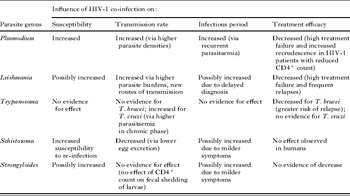
HIV-1 infection leads to progressive deterioration of cellular immunity of most human hosts, weakening their ability to combat some other parasitic infections. The concentration of CD4+ T lymphocytes in the blood is often used as a crude index of immune compromise in HIV-1-infected hosts, with a CD4+ count of <200 cells/μL (and associated opportunistic infections) used as a diagnostic criterion for progression to AIDS (e.g. Williams et al. Reference Williams, Korenromp, Gouws, Schmid, Auvert and Dye2006). Here we consider the effects of HIV-1 infection on some representative parasitic infections, focusing particularly on those with known interactions – or substantial geographic overlap – with HIV-1. We focus on the influence of HIV-1 infection on susceptibility, transmission rate and duration of infection with other parasites, and on the efficacy of anti-parasite drug treatments; these properties are summarized in Table 1. Because our emphasis is on the transmission dynamics of the parasites, we do not consider the important consequences of HIV-1 co-infection for parasitic disease unless these influence transmission.
Influences of HIV-1 co-infection on the epidemiology of parasitic infections. Evidence based on references cited in the text

Malaria
Malaria is caused by infection with protozoans of the genus Plasmodium, and is transmitted between humans by anopheline mosquito vectors. The host-level interaction between HIV-1 and malaria is complex, and significant general effects have been recognized only in recent years (Butcher, Reference Butcher2005; Harms and Feldmeier, Reference Harms and Feldmeier2005; Whitworth, Reference Whitworth, Peiperl, Coffey, Bacon and Voberding2006). There is a clear interaction in pregnant women, where HIV-1 infection leads to higher malaria incidence, more frequent parasitaemia and higher parasite densities, as well as increased morbidity and adverse birth outcomes (Ter Kuile et al. Reference Ter Kuile, Parise, Verhoeff, Udhayakumar, Newman, Van Eijk, Rogerson and Steketee2004). In non-pregnant adult populations, the effects of co-infection vary depending on the regional intensity of malaria transmission. In endemic regions with continual malaria transmission, frequent exposure leads to development of immunity during childhood, and severe morbidity and mortality are typically limited to young children and pregnant women. In these regions, cohort studies have revealed that HIV-1 co-infection leads to higher rates of symptomatic parasitaemia, with both risk of recurrent parasitaemia and parasite densities increasing as CD4+ counts decline (Whitworth et al. Reference Whitworth, Morgen, Quigley, Smith, Mayanja, Eotu, Omoding, Okongo, Malamba and Ojwiya2000; French et al. Reference French, Nakiyingi, Lugada, Watera, Whitworth and Gilks2001). In regions where malaria transmission is sporadic, many individuals have not developed immunity to malaria in childhood and HIV-1 co-infection acts to increase the risk of severe disease or mortality (Whitworth, Reference Whitworth, Peiperl, Coffey, Bacon and Voberding2006). HIV-1 co-infection is associated with increased case fatality from malaria in all regions (Korenromp et al. Reference Korenromp, Williams, de Vlas, Gouws, Gilks, Ghys and Nahlen2005).
Development of resistance to antimalarial drugs is a major challenge in malaria control, but surprisingly little is known about the influence of HIV-1 co-infection on emergence of drug-resistant strains of Plasmodium (Corbett et al. Reference Corbett, Steketee, ter Kuile, Latif, Kamali and Hayes2002; White, Reference White2004). Declining CD4+ counts associated with HIV-1 co-infection lead to increased treatment failure and recrudescent parasitaemia following treatment (Van Geertruyden et al. Reference Van Geertruyden, Mulenga, Mwananyanda, Chalwe, Moerman, Chilengi, Kasongo, Van Overmeir, Dujardin, Colebunders, Kestens and D'Alessandro2006), and antimalarials are given routinely to HIV-1-positive patients as prophylaxis or presumptive treatment of fever (Corbett et al. Reference Corbett, Steketee, ter Kuile, Latif, Kamali and Hayes2002); both factors increase the risk of developing drug-resistant strains. A recent review highlighted the central role of host immunity in preventing the emergence and establishment of antimalarial resistance in high-transmission settings, and speculated on the probable risk arising from HIV-1 co-infection but concluded that existing data are insufficient to draw firm conclusions (White, Reference White2004).
Leishmaniasis
Co-infection with Leishmania species and HIV-1 emerged as an important problem in south-western Europe in the 1990s (Desjeux and Alvar, Reference Desjeux and Alvar2003). Incidence of co-infections is now declining in that region due to the advent of anti-retroviral drugs, but is rising in India and probably in Africa though data are sparse (Desjeux and Alvar, Reference Desjeux and Alvar2003; Redhu et al. Reference Redhu, Dey, Balooni and Singh2006). Leishmania is a genus of protozoan parasites which, in immunocompetent hosts, causes a spectrum of disease ranging from asymptomatic carriage to visceral leishmaniasis; the latter is the most severe form of the disease and the one most commonly associated with HIV-1 infection (Desjeux and Alvar, Reference Desjeux and Alvar2003), so we focus on it here.
In the natural route of transmission, Leishmania parasites are transmitted between mammals by phlebotomine sandflies. There are several broad epidemiological patterns of visceral leishmaniasis in different regions. The Mediterranean basin, Latin America and central Asia are dominated by the zoonotic form caused by L. infantum, in which domestic and wild canids are the major reservoir of infection for human infections. East Africa and south Asia suffer the anthroponotic form caused by L. donovani, where the parasite is maintained by human-to-human transmission via peridomestic sandfly vectors; this form is normally endemic but severe and deadly epidemics can arise (Molina et al. Reference Molina, Gradoni and Alvar2003).
Early analyses showed that AIDS patients are at 100- to 1000-fold higher risk of visceral leishmaniasis, and suffer more severe symptoms (Ambroise-Thomas, Reference Ambroise-Thomas2001). Molina and colleagues used a simple mathematical model to argue that the high incidence of HIV-1/Leishmania co-infections arose from newly acquired Leishmania infections rather than from reactivation of asymptomatic visceral leishmaniasis (Molina et al. Reference Molina, Gradoni and Alvar2003). Increased incidence of Leishmania infection associated with the HIV-1 epidemic is thought to derive from several factors. A strong negative correlation between CD4+ count and Leishmania incidence may indicate elevated susceptibility due to HIV-1-induced immunosuppression (Desjeux and Alvar, Reference Desjeux and Alvar2003). Treatment of co-infected patients with anti-leishmanial drugs has a high failure rate, and relapse following cure is almost certain (Laguna, Reference Laguna2003). In south-western Europe and increasingly elsewhere, HIV-1/Leishmania co-infections are concentrated in intravenous drug users, and both infections are probably transmitted by needle-sharing (Desjeux and Alvar, Reference Desjeux and Alvar2003; Molina et al. Reference Molina, Gradoni and Alvar2003). Finally, experiments with L. infantum cases show that the blood of HIV-1 co-infected leishmaniasis patients is highly infectious to sandfly vectors, while that of immunocompetent patients is not (Molina et al. Reference Molina, Gradoni and Alvar2003). This raises the possibility of natural anthroponotic transmission of L. infantum, in addition to the normal zoonotic cycle, and concern has been raised that human-adapted strains of L. infantum may evolve as a result (Molina et al. Reference Molina, Gradoni and Alvar2003). This concern is corroborated – and the importance of immunocompromised populations emphasized – by the consistent detection of greater genetic variability of L. infantum in HIV-1-positive versus HIV-1-negative individuals, leading to the suggestion that HIV-1-positive populations may be acting as reservoir hosts for anthroponotic strains (Chicharro et al. Reference Chicharro, Jimenez and Alvar2003). Lower trypanosomatids – distinct from the Leishmania and Trypanosoma species previously known to infect humans – have also been isolated from HIV-1-positive patients (Chicharro and Alvar, Reference Chicharro and Alvar2003).
Taken together, the evidence suggests that HIV-1 co-infection raises both susceptibility to Leishmania infection and the rate of infecting others (via sandflies and perhaps needles). Little is known about the relative duration of infectiousness in HIV-1-positive and HIV-1-negative cases, but co-infection leads to atypical symptoms and serology of leishmaniasis (Harms and Feldmeier, Reference Harms and Feldmeier2005), so patients may have unrestricted contacts for a longer period due to delays in diagnosis. Because of their high parasite burden, weak immune response, slow response to treatment and frequent relapses, and alternative routes of transmission, HIV-1/Leishmania co-infected populations have been proposed to be a potential source for emergence of drug-resistant Leishmania strains (Croft et al. Reference Croft, Sundar and Fairlamb2006).
Trypanosomiasis
Trypanosomiasis is caused by infection with protozoa of the genus Trypanosoma, members of the same family (Trypanosomatidae) as Leishmania. Despite this close relation, interactions with HIV-1 appear to be much less important for trypanosomiasis than for leishmaniasis.
In Africa, human African trypanosomiasis (sleeping sickness) is caused by Trypanosoma brucei vectored by the tsetse fly. There is no evidence for significant effects of HIV-1 co-infection on susceptibility or infectiousness of T. brucei infection, though HIV-1-infected patients are at greater risk for relapse following treatment (Harms and Feldmeier, Reference Harms and Feldmeier2005). Recent studies have identified alarming patterns of increasing relapse rates and reduced drug sensitivity throughout Africa (Kibona et al. Reference Kibona, Matemba, Kaboya and Lubega2006), but the contribution of HIV-1 co-infection to this pattern has not been studied.
In South America, Chagas disease is caused by T. cruzi vectored by reduviid bugs. In immunocompetent hosts, Chagas disease entails an acute phase with high parasitaemia followed by a chronic phase with parasitaemia undetectable by microscopy. In hosts immunocompromised by HIV-1 infection, parasitaemia during the chronic phase is significantly more frequent and higher. Reactivation of dormant T. cruzi infection in HIV-1-positive patients is observed, and also leads to high parasitaemia (Harms and Feldmeier, Reference Harms and Feldmeier2005).
Schistosomiasis
Schistosomiasis (bilharzia) is caused by infection with trematodes of the genus Schistosoma, which have an indirect life cycle with snails as the intermediate host. The effects of HIV-1 co-infection on schistosomiasis have been controversial, owing to apparently contradictory study results (Brown et al. Reference Brown, Mawa, Kaleebu and Elliott2006; Secor, Reference Secor2006). The most detailed research comes from studies of car washers in western Kenya, who experience heavy occupational exposure to Schistosoma mansoni. From studies at this and two other African sites, reduced CD4+ counts due to HIV-1 infection lead to lower excretion of parasite eggs, and hence reduced infectiousness. These results align with experiments in mouse models, which show that CD4+ T lymphocytes are needed for worm maturation (Davies et al. Reference Davies, Grogan, Blank, Lim, Locksley and McKerrow2001) and that the host cell mediated immune response may help with transposition of parasite eggs to the intestine (Doenhoff et al. Reference Doenhoff, Hassounah, Murare, Bain and Lucas1986), but conflict with several other human studies that failed to find any effect of HIV-1 infection or CD4+ count on egg excretion (Secor, Reference Secor2006). The emerging consensus is that HIV-1 co-infection lowers egg excretion in individuals with moderate to high intensity schistosome infections, but not measurably in individuals with low intensity infections. Co-infected patients also have less haematuria than those with HIV-1 infection, making diagnosis more challenging and possibly extending the infectious period prior to treatment (Harms and Feldmeier, Reference Harms and Feldmeier2005). Studies of the Kenyan car washers indicate that HIV-1 co-infection leads to increased susceptibility to re-infection with schistosomiasis, owing to breakdown of protective mechanisms as the CD4+ count decreases (Secor, Reference Secor2006).
Further contradictions surround the influence of HIV-1 on treatment of schistosomiasis (Secor, Reference Secor2006). Experiments in mice indicate that praziquantel, the main drug used against Schistosoma infections, has diminished efficacy in immunodeficient hosts, because the drug's suspected mode of action is to augment antibody-mediated killing of parasites. In contrast, studies in humans show no influence of HIV-1 co-infection on treatment efficacy. This conflict may arise from differences in the nature or degree of immunodeficiency between mice with congenitally low CD4+ counts (the subjects of the experiments) and humans with HIV-1 infection. Another explanation, drawn from epidemiology, is that humans in endemic areas tend to be exposed and infected with schistosomiasis before they encounter HIV-1, so they are not immunocompromised at their first infection and can develop a robust antibody response to the schistosomes (Secor, Reference Secor2006).
Strongyloidiasis
Strongyloidiasis, caused by infection with the nematode Strongyloides stercoralis, presents another example of the hazards of generalizing findings among different mechanisms of immunosuppression. Strongyloides species can reproduce via an indirect life cycle with a free-living adult stage, or via a direct life cycle wherein larvae develop directly into infective third-stage larvae within the host gut, leading to auto-infection (Viney et al. Reference Viney, Brown, Omoding, Bailey, Gardner, Roberts, Morgan, Elliott and Whitworth2004). Immunosuppression arising from corticosteroid drugs, malignancy or infection with human T-lymphotropic virus-1 (HTLV-1) is associated with disseminated strongyloidiasis, a severe and often fatal condition that is thought to arise from a switch towards direct development and runaway auto-infection (Ambroise-Thomas, Reference Ambroise-Thomas2001; Viney et al. Reference Viney, Brown, Omoding, Bailey, Gardner, Roberts, Morgan, Elliott and Whitworth2004). The immunological mechanisms underlying this association are not well understood, but it is noteworthy that disseminated S. stercoralis infection is not strongly associated with HIV-1 infection (Ambroise-Thomas, Reference Ambroise-Thomas2001; Viney et al. Reference Viney, Brown, Omoding, Bailey, Gardner, Roberts, Morgan, Elliott and Whitworth2004). Indeed, a study of HIV-1 patients in Uganda showed that lower CD4+ count correlated with a lower degree of auto-infection – in direct contrast to immunosuppression by other mechanisms (Viney et al. Reference Viney, Brown, Omoding, Bailey, Gardner, Roberts, Morgan, Elliott and Whitworth2004). This finding, combined with observations of symptomatic strongyloidiasis as an immune reconstitution syndrome following anti-retroviral treatment (Brown et al. Reference Brown, Mawa, Kaleebu and Elliott2006), indicates that immunological consequences of HIV-1 co-infection may reduce symptoms of S. stercoralis infection and hence delay time to diagnosis. There was no association between CD4+ count and the total number of larvae per faecal culture in the Ugandan study (Brown et al. Reference Brown, Mawa, Kaleebu and Elliott2006), so there is no evidence that the transmission rate of strongyloidiasis cases depends on HIV-1 status. Meanwhile a positive association observed between strongyloidiasis and HIV-1 infection may indicate increased susceptibility to Strongyloides infection (Brown et al. Reference Brown, Mawa, Kaleebu and Elliott2006).
POPULATION-LEVEL EFFECTS
We have seen that HIV-1 co-infection can have many effects on parasitic infections in individual patients, including increased susceptibility, elevated parasite burdens and prolonged periods before diagnosis or recovery from infection (Table 1). We now ask how these effects will scale up to influence population dynamics of parasitic infections and the emergence of new parasite strains. Mathematical models of disease transmission offer a convenient framework to link individual and population-level effects, and can be formulated with an appropriate degree of detail to address the questions being posed. The simplest disease models make sweeping assumptions – for instance, that every host individual has identical characteristics – but reward the modeller with clear relationships among parameters that determine epidemic dynamics (Anderson and May, Reference Anderson and May1991; Diekmann and Heesterbeek, Reference Diekmann and Heesterbeek2000). The most fundamental product of epidemic models is the basic reproductive number, R 0, which is defined as the expected number of secondary cases caused by a typical infected individual in a wholly susceptible population. If R 0>1, then each case more than replaces itself and the epidemic has potential to grow; if R 0<1 the epidemic will certainly fail. In addition to this epidemic threshold property, the value of R 0 determines such quantities as the growth rate of invading infections, the prevalence of an infection at steady state, and the critical proportion of a population that must be vaccinated to eradicate a disease (Gupta et al. Reference Gupta, Swinton and Anderson1994; Diekmann and Heesterbeek, Reference Diekmann and Heesterbeek2000).
A simple model for an immunosuppressed population
We begin by discussing models with the minimal level of complexity needed to ask questions about the impact of HIV-1 on the population dynamics of parasitic infections. To draw general conclusions, we do not include specific features of the transmission cycle for particular pathogens, but instead think about the rate at which infection in one human host leads to infections in other human hosts (thus implicitly averaging over dynamics in intermediate hosts or vectors), and about the duration that each host remains infectious. Detailed analyses of particular infections will require models tailored to the unique biology of each parasite-host interaction.
We consider a host population that is divided into several groups according to their state of HIV-1 disease: for illustrative purposes we will define an immunologically normal group including HIV-1-negative individuals and HIV-1-positive individuals with CD4+ count >500 cells/μL, a moderately immunocompromised group with CD4+ count between 200 and 500 cells/μL, and a severely immunocompromised group with CD4+ count <200 cells/μL. We label the three groups with index i=1,2,3 respectively, and denote the proportion of the population in each group as p i such that p 1+p 2+p 3=1. To reduce the number of free parameters, we assume here that 10% of HIV-1-positive individuals are severely immunocompromised (group 3) and the remaining 90% are moderately immunocompromised (group 2), such that p 2=0·9 p HIV and p 3=0·1 p HIV, where p HIV is the total prevalence of HIV-1. This assumption can be changed easily to account for different HIV-1 epidemic phases or anti-retroviral treatment (Williams et al. Reference Williams, Korenromp, Gouws, Schmid, Auvert and Dye2006). We further assume that individuals mix randomly with respect to immunological status.
For a given parasitic infection, we describe the epidemiological effect of different degrees of immunocompetence by defining parameters for the relative susceptibility (σi) and infectiousness (τi) of each group. Models with this structure have been analyzed elsewhere (Becker and Marschner, Reference Becker, Marschner, Picard, Gabriel and Lefevre1990; Yates, Antia and Regoes, Reference Yates, Antia and Regoes2006). Because individuals in group 1 are immunologically normal, we take σ1=1 and τ1=1 and define σi and τi (for i=2,3) relative to the normal group, so for instance σ2>1 and τ2<1 indicates that moderate immune compromise causes elevated susceptibility and reduced infectiousness. Note that τi can describe variation in either the transmission rate or infectious period, which together determine the total infectiousness of individuals in group i.
To summarize transmission in this population, we define R ij as the expected number of individuals in group j infected by an infective individual in group i. Thus the reproductive number of the parasite in an HIV-1-free population (i.e. one where p 1=1) is denoted R 11. It follows that R ij=τiσjp jR 11, i.e. the product of the infectiousness of group i, the susceptibility of group j, and the proportion of randomly-chosen contacts that are with individuals in group j. The basic reproductive number describing transmission in the heterogeneous population can be shown to be (Becker and Marschner, Reference Becker, Marschner, Picard, Gabriel and Lefevre1990; Yates et al. Reference Yates, Antia and Regoes2006)

Note that this expression, wherein R 0 simply equals the trace of the R ij matrix, holds only in the so-called ‘separable’ case when each element of R ij is a product of separate factors pertaining to groups i and j. When this assumption does not hold – for instance if there are complex non-random patterns of mixing among groups – the expression must be generalized (Yates et al. Reference Yates, Antia and Regoes2006).
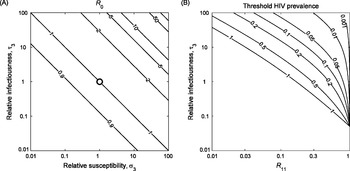
This simple result yields immediate insights into the effects of HIV-1 co-infections on parasite population dynamics. First, it emphasizes that the covariation of susceptibility and infectiousness has a dramatic influence on parasite transmission. Even for populations with relatively small immunocompromised groups, positive covariation between σi and τi can greatly increase R 0 (Fig. 1a). In contrast, negative covariation between these properties in small groups has comparatively minor influence on R 0, serving to reduce or remove the contribution from those groups without affecting transmission in the broader population.
Dependence of the basic reproductive number and threshold HIV-1 prevalence on epidemiological parameters. (A) Contour plot showing the value of R 0 versus the relative susceptibility σ3 and infectiousness τ3 of severely immunocompromised hosts, in a population with HIV-1 prevalence of 0·15 (hence p 1=0·85, p 2=0·135 and p 3=0·015, as explained in the text). The transmissibility in an HIV-free population, given by R 11=1, is depicted by the open circle. Moderate immune compromise is assumed to cause similar but smaller changes in susceptibility and infectiousness; in particular, we assumed that  (B) The threshold HIV-1 prevalence required to allow successful invasion of a parasite (i.e. the prevalence that gives R 0=1; see equation 2), as a function of the relative infectiousness of immunocompromised hosts and the transmissibility of the parasite in an HIV-1-free population. Susceptibility parameters are σ3=20 and
 .

Equation 1 can be inverted to determine the threshold HIV-1 prevalence p*HIV required to allow sustained transmission of a parasite which cannot survive in an HIV-1-free population (i.e. one with R 11<1). Applying the relations stated above between p i and p HIV, the minimum HIV-1 prevalence to obtain R 0⩾1 is

This quantity is undefined for parasites for which HIV-1-induced immune modulation reduces R 0, or when the numerator exceeds the denominator. Threshold HIV-1 prevalences are explored in Fig. 1b, for a range of scenarios where immune compromise causes a moderate rise in susceptibility. We see that observed HIV-1 prevalences (up to ~30%, or higher in particular risk groups (UNAIDS, 2006)) can enable sustained transmission of parasites with R 11 as low as 0·1, for reasonable values of τi.
A model for parasite strain invasion in an HIV-1-affected population
This framework can be extended to consider the dynamics of strain invasion in a population that is immunologically heterogeneous due to HIV-1 infection. The epidemiological dynamics of parasite invasion into a population have been studied for decades using stochastic models such as branching processes or birth-death processes (Taylor and Karlin, Reference Taylor and Karlin1998; Diekmann and Heesterbeek, Reference Diekmann and Heesterbeek2000). A nascent body of theory extends this work to consider the simultaneous evolution and transmission of emerging strains (Antia et al. Reference Antia, Regoes, Koella and Bergstrom2003; Andre and Day, Reference Andre and Day2005). Development of this theory to explore the influence of HIV-1 on parasite emergence follows a tradition of considering the impact of host heterogeneities on disease transmission, control, and evolution (Woolhouse et al. Reference Woolhouse, Haydon and Antia1997; Lloyd-Smith et al. Reference Lloyd-Smith, Schreiber, Kopp and Getz2005; Yates et al. Reference Yates, Antia and Regoes2006; Graham et al. Reference Graham, Cattadori, Lloyd-Smith, Ferrari and Bjornstad2007). Here we briefly describe the modelling framework used to study parasite invasion in heterogeneous populations; a full exploration of the model and its extension to address evolutionary dynamics will be presented elsewhere (Lloyd-Smith et al. unpublished).
The population is structured into three groups as described above. The transmission dynamics of a non-evolving parasite strain are described by a multi-type branching process with discrete generations (Harris, Reference Harris1963; Yates et al. Reference Yates, Antia and Regoes2006). We assume that infected hosts transmit the parasite at a constant per capita rate, and also leave the infectious state (by recovering or dying) at a constant rate so that the infectious period is exponentially distributed. Under these assumptions, the number of secondary cases in group j arising from an infected host in group i is geometrically distributed with mean R ij (Lloyd-Smith et al. Reference Lloyd-Smith, Schreiber, Kopp and Getz2005). Following the standard methodology for branching processes (Harris, Reference Harris1963; Yates et al. Reference Yates, Antia and Regoes2006), the extinction probabilities q i are calculated by numerically solving the following system of coupled equations:

Then 1−q i is the probability that introduction of a single infected individual into group i leads to successful invasion of the parasite (i.e. a generalized epidemic in the host population). The overall probability of invasion can be calculated by weighting these group-wise results by the probability that the first infected individual (often termed the ‘index case’ in the epidemiological literature) will be in each group, which is assumed to be proportional to the susceptibility of each group and its frequency in the population (Yates et al. Reference Yates, Antia and Regoes2006):

As with many models of disease invasion, it is assumed that there is no limitation on the number of susceptibles available to be infected. Also note that host infectiousness τi can vary via either the transmission rate or recovery rate (reflecting changes in infectious period), and the susceptibility of other hosts influences the rate at which new infections occur.
Influence of HIV-1 prevalence on parasite strain invasion
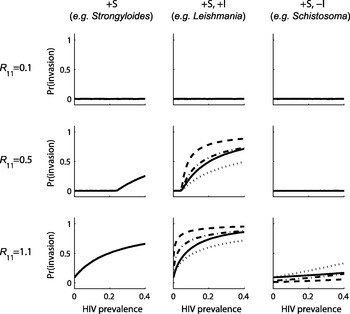
We first examine the ability of a non-evolving parasite strain to invade a host population with a given prevalence of HIV-1 infection (Fig. 2). We consider three levels of transmissibility of the invading strain (R 11=0·1, 0·5 or 1·1), and three basic scenarios for the influence of HIV-1 co-infection on the epidemiology of the parasite: (1) HIV-1 co-infection increases susceptibility only (labelled “+S”). This scenario corresponds qualitatively to Strongyloides infection (Table 1). (2) Co-infection increases both susceptibility and infectiousness (through higher parasite burden or prolonged shedding; labelled “+S,+I”). This scenario corresponds to Plasmodium or Leishmania infection. (3) Co-infection increases susceptibility but decreases infectiousness (through reduced parasite shedding or rapid host death; labelled “+S,−I”). This scenario corresponds to Schistosoma infection.
Probability of strain invasion as a function of HIV prevalence, for different parasite transmissibility (rows) and effects of immune compromise on susceptibility and infectiousness (columns). The labels (e.g. “+S,+I”) indicate whether immune compromise raises or lowers susceptibility and infectiousness for the scenario in question. Lines show the probability that introduction of a single infected host will lead to a major epidemic, when the first host is immunologically normal (group 1; dotted line), moderately immunocompromised (group 2; dot-dash line), or severely immunocompromised (group 3; dashed line). Solid lines show the total probability of invasion, which is the weighted average of the group-wise probabilities. (When the broken lines are not visible, it is because all group-wise probabilities are equal.) The HIV prevalence defines the sizes of the three groups, as explained in the text. The epidemiological parameters are chosen for illustrative purposes. In all scenarios the relative susceptibility of the three groups is given by σ1=1, σ2=4, σ3=16. In the column labelled “+S,+I”, the relative infectiousness of the three groups is τ1=1,  , τ3=8; in the column labelled “+S, −I”, τ1=1,
 , τ3=1/8=0·125.

No level of HIV-1 prevalence can enable invasion of a parasite strain with very low transmissibility (here represented by R 11=0·1, though as seen in Fig. 1b the threshold values of R 11 will depend on the values of σi and τi). Crucially, though, a parasite with moderately low transmissibility, which will fail to spread in an HIV-1-free population (i.e. R 11<1), can become a viable invader in the presence of sufficient HIV-1 co-infection. Parasites with R 11 slightly greater than 1 have a non-zero chance of invading an HIV-1-free population, but can be greatly aided by HIV-1-induced immune compromise. For all values of R 11, the nature of this facilitation depends on the epidemiological effects of HIV-1 co-infection, being greatest when σi and τi co-vary positively, and smaller or non-existent when they co-vary negatively. The magnitude of the facilitation can be striking: for the illustrative parameters considered here, a parasite with R 11=0·5 (that will certainly die out in an HIV-1-free population) has >50% chance of invading a population with HIV-1 prevalence of 20% or greater.
These findings can be applied to the public health challenge of targeting parasite prevention measures, by considering how the invasion probabilities change depending on the group in which the index case occurs (Fig. 2, broken lines). If HIV-1 co-infection raises both susceptibility and infectiousness (+S,+I), then successful parasite invasion is substantially more likely when the index case is severely immunocompromised, and targeting this group for prophylaxis will yield rewards at both individual and population scales. If σi and τi co-vary negatively (+S,−I), then immunocompromised hosts are less likely than normal hosts to initiate a major outbreak (though still more likely to be the index case for any given introduction, due to their elevated susceptibility). If only susceptibility varies by HIV-1 status, then the group membership of the index case has no bearing on invasion probability.
DISCUSSION
There is conclusive evidence that HIV-1 co-infection alters the epidemiological traits that underpin transmission for a range of parasitic infections (Table 1). We reviewed empirical evidence for these influences for the five best-studied examples of HIV-1/parasite co-infection, but the lack of clear evidence regarding other parasites probably arises as much from a lack of controlled research as from a lack of effects. For our five examples, the emergent pattern is that HIV-1-induced immune compromise increases susceptibility to parasitic infections, and often (but not always) allows higher parasite burdens. In at least one case (leishmaniasis) the elevated parasite burden allows entirely new pathways of transmission, while in another (schistosomiasis) HIV-1 co-infection leads to reduced excretion of transmission stages. Compromised immunity may cause the duration of infectiousness to rise because of poor response to treatment or atypical symptoms.
Our modelling analysis indicates that these interactions could have significant effects on the invasion of new parasite strains into HIV-1-affected populations. If immunocompromised hosts are more susceptible – and particularly if they are also more infectious – then the population-average transmissibility of a parasite can be increased such that a strain that would die out in an HIV-1-free population is able to successfully invade and persist. We identify a threshold HIV-1 prevalence required for such a parasite to succeed, and see that (for illustrative epidemiological parameters) prevalences in the range observed in some African populations could enable invasion of parasites with R 11 values as low as 0·1. (To place this value in context, the reproductive number for monkey pox in humans has been estimated to be approximately 0·3 (Lloyd-Smith et al. Reference Lloyd-Smith, Schreiber, Kopp and Getz2005).) This finding may account for the apparent persistence of previously unknown parasite strains in populations that are severely affected by HIV-1 (Pieniazek et al. Reference Pieniazek, Bornay-Llinares, Slemenda, da Silva, Moura, Arrowood, Ditrich and Addiss1999; Gramiccia, Reference Gramiccia2003; Pratlong et al. Reference Pratlong, Dereure, Deniau, Marty, Faraut-Gambarelli and Dedet2003). Under some circumstances, the probability that parasite introduction will lead to invasion is influenced by the immune status of the index case. By calculating the extent of this effect, we quantify the communal benefit of targeting immunocompromised groups with control measures to limit their exposure or reduce transmission; such measures could include vaccination, chemoprophylaxis or surveillance and case isolation. A recent study demonstrated how targeted preventative measures can reduce infection beyond the targeted group, concluding that giving cotrimoxazole prophylaxis to HIV-1-positive individuals led to reduced malaria incidence (as well as reduced diarrhoea, morbidity and mortality) in their HIV-negative family members (Mermin et al. Reference Mermin, Lule, Ekwaru, Downing, Hughes, Bunnell, Malamba, Ransom, Kaharuza, Coutinho, Kigozi and Quick2005). The benefit of targeted prevention is greatest when infectiousness increases with immune compromise and for parasites with low to moderate transmissibility, for which the immunocompromised groups are needed to provide a toehold for invasion.
Evidence is incomplete regarding whether these predictions are borne out for observed HIV-1-parasite co-infections. Certainly HIV-1 co-infection has caused marked rises in incidence and prevalence of parasitic infections such as leishmaniasis and malaria (Desjeux and Alvar, Reference Desjeux and Alvar2003; Korenromp et al. Reference Korenromp, Williams, de Vlas, Gouws, Gilks, Ghys and Nahlen2005), which signifies that HIV-1 co-infection has increased R 0 for those parasites. Also the introduction of widespread anti-retroviral therapy has led to reductions in some parasitic infections (Desjeux and Alvar, Reference Desjeux and Alvar2003; Mathis, Weber and Deplazes, Reference Mathis, Weber and Deplazes2005), providing further evidence that HIV-1-induced immune compromise was amplifying these infections. Emergence of novel parasite strains is harder to assess, for several reasons. First, strain emergence is a rare event so by definition its rate is difficult to measure, particularly because access to healthcare is limited for many populations severely impacted by HIV-1. Second, assessment of strain emergence requires detailed knowledge of what strains have historically circulated in a population, which is often lacking for these populations. Finally, there is a fundamental challenge in distinguishing between emergence of novel strains (in the sense described in the introduction) and ‘appearance’ of strains that are already prevalent in a population but are asymptomatic in immunocompetent hosts. It is common for HIV-1 co-infection to be associated with increased variability of parasite strains (Chicharro et al. Reference Chicharro, Jimenez and Alvar2003; Mathis et al. Reference Mathis, Weber and Deplazes2005) or the discovery of previously unknown strains (Pieniazek et al. Reference Pieniazek, Bornay-Llinares, Slemenda, da Silva, Moura, Arrowood, Ditrich and Addiss1999; Gramiccia, Reference Gramiccia2003), but the origin and epidemiological characteristics of these strains are often unknown.
Analyses in this paper address whether non-evolving parasite strains are able to invade a host population in the presence of HIV-1 co-infections. A crucial question is whether invading strains, perhaps having gained a foothold in an immunocompromised group, will evolve to transmit more efficiently in the general population. Explicit concerns have been raised about the impact of HIV-1 prevalence on possible evolutionary emergence of anthroponotic Leishmania infantum and drug-resistant malaria (Molina et al. Reference Molina, Gradoni and Alvar2003; White, Reference White2004). We will present a theoretical analysis of this problem in an upcoming publication, addressing the role of chronically infected individuals in generating parasite diversity and the characteristics of the fitness landscape on which the parasite is evolving, but well-designed empirical studies of these questions are desperately needed.
Challenges to interpreting data on HIV-1-parasite co-infections extend to the level of individual hosts. Similar to the problem of detecting emergence in population studies, individual-level studies face the challenge of distinguishing between increased susceptibility to new infections versus increased (re-)activation of asymptomatic infections. For example, increased rates of toxoplasmosis in AIDS patients are thought to arise primarily from reactivation (Ambroise-Thomas, Reference Ambroise-Thomas2001), while those for visceral leishmaniasis are thought to arise from primary infections (Molina et al. Reference Molina, Gradoni and Alvar2003). This distinction has important consequences for inferring changes in susceptibility to infection due to HIV-1. Also, it has become clear that immunodeficiencies with different etiologies can have very different effects on parasitic infections. This is most conspicuously apparent for strongyloidiasis, for which the influence of HIV-1 co-infection on parasite development is opposite to what is observed for immunosuppression caused by factors such as corticosteroid drugs or HTLV-1 infection (Viney et al. Reference Viney, Brown, Omoding, Bailey, Gardner, Roberts, Morgan, Elliott and Whitworth2004). Similar disparities have been observed for schistosomiasis (Secor, Reference Secor2006) and microsporidial infections (Mathis et al. Reference Mathis, Weber and Deplazes2005). This creates problems in extrapolating from laboratory studies of experimental immunosuppression to predict the influence of HIV-1 co-infection, and highlights the fact – self-evident in light of the extraordinary complexity of the immune system – that immunocompetence is not a one-dimensional characteristic. Yet controlled studies of HIV-1-parasite co-infections in human hosts are not always feasible, and many experimental approaches can only be applied in model systems. To move forward, it will be necessary to use model systems that more closely mimic the effect of HIV-1 infection, and to understand how immunosuppressive factors change transmission in light of underlying immunological effectors (Brown et al. Reference Brown, Mawa, Kaleebu and Elliott2006; Graham et al. Reference Graham, Cattadori, Lloyd-Smith, Ferrari and Bjornstad2007).
The preceding paragraphs outline a series of challenges for empirical researchers. To better understand the influence of HIV-1 co-infection on parasite strain emergence – and to test the theoretical findings outlined in this study – we will require quantitative data at both individual and population scales for the same parasite/HIV-1 system. At the individual scale, we require solid estimates of the influence of HIV-1 co-infection (or better yet, the degree of immune compromise) on host susceptibility, transmission rate and infectious period. Controlled studies of parasite strain diversity in both healthy and immunocompromised individuals might enable us to distinguish between greater susceptibility versus greater tendency to exhibit symptoms. At the population scale, we need to characterize the relative success (as measured by on-going transmission) of parasite strains in comparable populations with different degrees of immune compromise. This characterization could include detailed epidemiological investigations of limited outbreaks, assessment of the intensity of parasite transmission (R 0, age-prevalence curves, or similar measures), or determination of whether particular parasites can persist in populations after being introduced. To extend this work to encompass parasite evolutionary dynamics, data on evolutionary rates and the relative fitness of different parasite genotypes will also be needed. Many of these quantities are challenging to measure under favourable conditions; measuring them in the populations most affected by HIV-1 is a formidable goal, but an important one.
As with all simple models applied to complex problems, our approach includes a number of important assumptions. Our model for strain invasion does not incorporate population structure and assumes an unlimited supply of susceptible hosts. These are standard assumptions for many stochastic invasion models (Taylor and Karlin, Reference Taylor and Karlin1998; Diekmann and Heesterbeek, Reference Diekmann and Heesterbeek2000; Antia et al. Reference Antia, Regoes, Koella and Bergstrom2003; Lloyd-Smith et al. Reference Lloyd-Smith, Schreiber, Kopp and Getz2005), but both are problematic under some circumstances. Population structure can exert a strong influence on parasite invasion dynamics, particularly when group sizes are small and between-group contact events are slow compared to the parasite infectious period (Cross et al. Reference Cross, Lloyd-Smith, Johnson and Getz2005). Susceptible limitation becomes important when the number infected becomes a substantial proportion of the total population; for the moderately transmissible parasites considered here, this is unlikely to be a problem for the general population but may arise for the immunocompromised groups. In the worst case, our model might predict successful invasion, whereas in small populations the infection would exhaust the pool of immunocompromised hosts and fail to take root in the HIV-1-free population. The model does not account for competition between the invading parasite strain and other parasite strains already circulating in the population, which can be a significant barrier to invasion if cross-immunity is strong (Gupta et al. Reference Gupta, Swinton and Anderson1994). Detailed models will be needed to address this and other questions linked to the life histories and transmission biology of specific parasites. Finally, we have assumed that individuals with different immune status mix at random, which may not be true when socio-economic factors are strong determinants of HIV-1 prevalence patterns. In this situation, mixing patterns are probably associative such that individuals are disproportionately likely to contact other individuals in the same group. Associative mixing is likely to increase the probability of strain invasion into immunocompromised groups, but also to reduce the spread of new strains in the general population; the model presented here can be extended easily to incorporate non-random mixing (Yates et al. Reference Yates, Antia and Regoes2006).
Here we have compiled empirical evidence and analyzed a simple model to illuminate generalities regarding how HIV-1 co-infection influences strain emergence. We have identified important gaps in what is currently known about HIV-1/parasite co-infection, and posed questions for on-going research. To advance our understanding of this complex public health problem and to guide associated health policy will require the combined efforts of empirical and theoretical researchers.
ACKNOWLEDGEMENTS
We are grateful for valuable discussions with A. Graham, O. Bjornstad, P. Hudson, M. Ferrari, N. Bharti, and K. Pepin, and for the support of the British Society of Parasitologists to attend the symposium on co-infections. This research was supported by a Center for Infectious Disease Dynamics Postdoctoral Fellowship (JL-S) by NIH-NIGMS grant GM83606 (JL-S, MP, BTG) and NSF grant EF0742373 (JL-S, BTG).