In June 1942, Time magazine described a dramatic case of psychological breakdown. “For hours she sat in her corner,” the magazine reported of the unfortunate patient, “staring silently into space, her pupils dilated, her heart pounding, her breathing labored. She shunned her old friends, refused to eat for days at a time. Occasionally she became agitated or infantile and kittenish. But often she just sat, in a catatonic stupor, brooding and lonely, quiet as a cat” (Anon. 1942).
In fact, the magazine disclosed, she was a cat.
The catatonic cat was one of 200 animal research subjects in a series of experiments by Jules Masserman (1905–1989) at the University of Chicago. Masserman was using animal conditioning techniques to study phenomena that had previously been associated only with human beings. As Time put it, his goal was to “to find out by experiment what makes and breaks a neurosis” (ibid.). In effect, Masserman was declaring that the stock-in-trade of mid-century psychiatrists could be observed more generally as an animal's response to stressful stimuli. But he was not a behaviorist. He was trying to negotiate a kind of reconciliation between behaviorist psychology and psychoanalysis.
Masserman used conditioning techniques, but he intended them to help him study phenomena that most people understood in terms of mental processes. In particular, Masserman was interested in issues “owned” by psychoanalysis, such as the classic disorder of neurosis. He was yoking techniques drawn from a scientific program that denied the relevance, and perhaps even the existence, of mind and ideas, to one in which mind and self were fundamental. Most curiously, Masserman aspired to use simple animals (with arguably simple brains) to produce findings that would be relevant to the therapeutic treatment of human beings – not within a behaviorist framework, now, but a psychoanalytic one.
One might assume that Masserman was seeking to find a way to treat human beings like animals: to find the simple animal structure of stimulus response and conditioning beneath the apparent complexity of psychological processes. But in fact he was doing the converse. He was treating animals like people – or so it might seem, if one were able to look past the cages, starvation, and electric shocks. The “nervous breakdowns” he produced in his cats, and the recoveries he orchestrated in them by practices that he described as a kind of feline psychoanalysis, were all intended to demonstrate the universal nature of ego psychology. Masserman's project was intended to answer the call from analysts such as Franz Alexander and Heinz Hartmann for psychoanalysis to become more systematized (Hale Reference Hale1995, 231), and to allow it to take its place as a fully confirmed member of the prestigious sciences of mid twentieth-century America.
The role of animals in these experiments was therefore dramatically different from their more familiar place in behaviorist psychology. Instead of trying to use a simpler animal (simpler than a human being) to lay bare the behavioral mechanisms of a phenomenon, Masserman was seeking to demonstrate that all animals adapted to their environments in ways that demonstrated psychoanalytic principles, particularly the internalized response to stresses and conflicts. In these experiments, Masserman claimed, cats seemed to be making choices, to be agonizing over the conflict between several problematic options. He portrayed them as decision makers who were reflecting on their situation. If a cat could be shown to demonstrate the phenomena of an “ego” under threat, and could respond favorably to the educational framework of psychoanalytic therapy, then experimental psychology could be used, in effect, to anthropomorphize – or perhaps “psychologize” – the animal kingdom. That might establish the universal validity of a psychodynamic framework for understanding the response of any creature to its environment.
This paper will reconstruct the role of animals in Masserman's project. It will reveal some surprising ways in which a creative, even maverick, psychiatrist worked to bring together elements of behaviorism, Pavlovian theory, and psychoanalysis in the mid-twentieth century. Along the way, it examines how he used motion-picture film, photography, and drawings to encourage particular interpretations of the cats’ agency. Understanding why it was so important to Masserman to experiment on animals at a time (the middle of the Second World War) when there was such a ready supply of neurotic human beings can help unpack the ways in which people looked to animals to understand themselves, and looked to humans to understand animals.
* * *
Jules Masserman (1911–1994) was born in Poland, the son of a tailor who emigrated to the United States and settled in Detroit in the 1910s. Masserman himself was determined not to spend his life in a tailor's shop and he hated Detroit. After an initial crash course in pharmacology in 1922, he spent a decade working his way up to a medical degree. Eventually, he landed residencies in neurology and psychiatry at Stanford, and then moved to the Johns Hopkins University for a psychiatric residency at the Phipps Psychiatric Clinic with Adolf Meyer from 1932 to 1935. It was here that his interests in what he often called a “holistic” attitude to psychiatry (seeing the mind and body as inseparable), in studying animals, and in film most likely coalesced. What particularly appealed to him was Meyer's embrace of a holistic approach to mind and behavior, bringing together psychological and biological approaches to the study of human beings, labeled by Meyer and others “psychobiology” (Meyer Reference Meyer1915; Leys Reference Leys, Leys and Evans1990; Levens Reference Levens2006, 3). Meyer was also impatient with psychoanalysis's “esoteric” methods of research, urging the need for systematic, empirical study of mental states and dynamics (Hale Reference Hale1995, 170). Psychobiology became the banner under which a wide variety of different kinds of animal experimentation was done in the middle decades of the century, loosely connected by an interest in the relationship between biology and behavior.
In 1934, Masserman moved to the University of Chicago at the invitation of Roy Grinker, then head of Psychiatry. Masserman soon decided to become a psychoanalyst, training at the Chicago Psychoanalytic Institute from 1936 to 1940 under Franz Alexander. Grinker and Alexander were both unsatisfied with the empirical basis of psychoanalytic knowledge – the reliance on anecdote and conversation – and called for the development of approaches that could submit psychoanalysis to “scientific verification” (Alexander Reference Alexander1938, 300; Grinker Reference Grinker1939, 765). Masserman's interest in laboratory experiment would answer this call.
It was in some ways a natural move. “Experimental neurosis” was an exciting new area of animal research, and one that Masserman had seen directly during his time at Hopkins. Ever since Pavlov had documented experimental neurosis in the late 1920s, when a flood nearly killed the dogs in his Leningrad laboratory, a stream of experiments had explored the phenomenon of laboratory-induced “neurosis.” Pavlov himself defined neurosis in relation to what he called the “difficult differentiation” in which an animal was made to choose between competing stimuli – such as the need for food and the need to avoid pain, in a situation in which it was impossible to obtain food without triggering a painful stimulus (Pavlov Reference Pavlov and Pavlov1928, 365; Todes Reference Todes2001, 217–254; Smith Reference Smith1992, 190–205). American psychologist W. Horsley Gantt had visited Pavlov's laboratory and been intrigued by the phenomenon of neurosis, among other things; and when he moved to Johns Hopkins, around the same time as Masserman, he began a long and extremely close study of a dog who had become “neurotic” after difficult training sessions.
Masserman became acquainted with this dog, who would become known a decade later as the longest-studied case of experimental neurosis. This dog was trained to earn his food by distinguishing between two different metronome tones. After the dog had mastered this task, Gantt revised the tones to make them increasingly difficult to distinguish. The dog became uncomfortable, then acutely “neurotic,” including sexual abnormalities (an erection when the dog, Nick, was brought into the laboratory) (Gantt Reference Gantt1944).
Nick was the longest-serving example of experimental neurosis, but he was by no means the only officially neurotic animal in American laboratories. A number of behaviorists were developing a guarded interest in psychoanalysis, particularly the implications of Freudian concepts of instinct and drive for motivational theories and psychopathology. At Yale, Clark Hull and colleagues at his Learning Center were known for their mechanistic behaviorist approach, but they thought that psychoanalysis had something to offer in the study of psychopathology. So they set about trying to find behavioral ways of defining psychoanalytic phenomena. Hull himself proposed to “derive phenomena and principles covered by psychoanalysis from those of ordinary habit, and to devise ways to submit these deductions to experimental or observational test” (Hull and Mowrer 1/20/Reference Hull and Hobart Mowrer1936:1; Mills Reference Mills1998, 162).
By the time Masserman began his psychoanalytic training, he was already making plans to carry out his own animal experiments. In 1939 he described an apparatus for carrying out the “central conditioning of small animals” (Masserman Reference Masserman1939). Unlike Hull and Gantt, however, Masserman was skeptical about the idea of conditioned reflexes, because he construed Pavlovian theory as excluding the factor of motivation (a claim that no behaviorist of the time would have accepted, since they would have commonly understood motivating factors like hunger as fundamental to conditioning). Gantt, who knew Masserman when they were both at the Phipps Clinic, was known to make fun of what he saw as Masserman's confused skepticism. He had heard Masserman say in lectures that he had “never seen a conditioned reflex,” referring implicitly to a rigid, static behavior. Gantt would recount this claim to colleagues as a lesson in the imprecision of psychoanalysts; he had replied to Masserman that “he was right” – but for the “wrong reasons.” Pavlov had “never used the word “conditioned” reflex but only because “there is, in fact, no such phenomenon as a conditioned reflex. He specifically used the term conditional reflex to emphasize that the connection was a dynamic rather than a fixed phenomenon” (quoted in McGuigan and Ban Reference McGuigan and Ban1987).
Gantt was an example to Masserman of both how much interest there was in bridging the gaps between different psychological fields and how perilous it could be to try to accomplish this. Gantt had come to Johns Hopkins confident that conditioned reflexes would provide a means of integrating laboratory psychology and clinical psychiatry (Levens Reference Levens2006, 152), but he soon fielded criticisms that the study of a “single [salivary] reflex” did not address the “integration” of several physiological systems (ibid., 156–160) – in short, it was too narrow for his psychiatric colleagues, and he grew estranged from his mentor Adolf Meyer. Gantt broadened his approach, staging a multidisciplinary conference on experimental neurosis (National Research Council, Reference Council1937), including a paper by Hull on “a projected integration of the conditioned reflex and the psychoanalytic approaches to the study of psychogenic disorders”), but his own work remained straightforwardly behaviorist. It seems likely that Masserman saw himself as delivering on Gantt's failed promise: to use techniques associated with behaviorism to engage other psychological fields, to produce a holistic psychology encompassing body, brain, behavior, and mind.
Chicago was in some ways an ideal institution in which to attempt such a thing. The nascent field of “animal ecology,” centered on Warder Clyde Allee and his colleagues, worked from the premise that the response of an individual animal to its environment is the overwhelming factor in patterns of behavior (trumping, for instance, inherited characteristics; see Mitman and Burkhardt Reference Mitman, Burkhardt, Benson, Maienschein and Rainger1991). Masserman teamed up with colleagues in Chicago and elsewhere – Gantt at Johns Hopkins, Howard Liddell at Cornell (whose research reached from comparative psychobiology into psychoanalysis), Thomas French at Chicago (one of the first psychoanalysts to engage with Pavlov's work [French Reference French1933]), Donald Hebb of McGill (who was at this time trying to create neuroses in a chimpanzee he had raised apart from her mother [Hebb Reference Hebb1947]), Frank Beach (then building a comparative psychobiology program at the Museum of Natural History in New York), and Calvin Stone and Carl R. Moore (Gantt and Liddell Reference Gantt and Liddell1945). Together they formed an interdisciplinary “Committee on Animal Experimentation” (Gantt and Liddell, 1944), whose general purpose was to develop broadly interdisciplinary accounts of animal functioning. A major initial focus of this committee was the finding of animal equivalents to human phenomena, and neurosis was a special interest. For instance, Liddell presented work on the production of “animal neurosis” in goats and sheep, using standard conditioned-reflex techniques. Liddell claimed that he was able to produce behavior in his animals that was strikingly similar to human “conversion hysteria” (Liddell Reference Liddell1947).
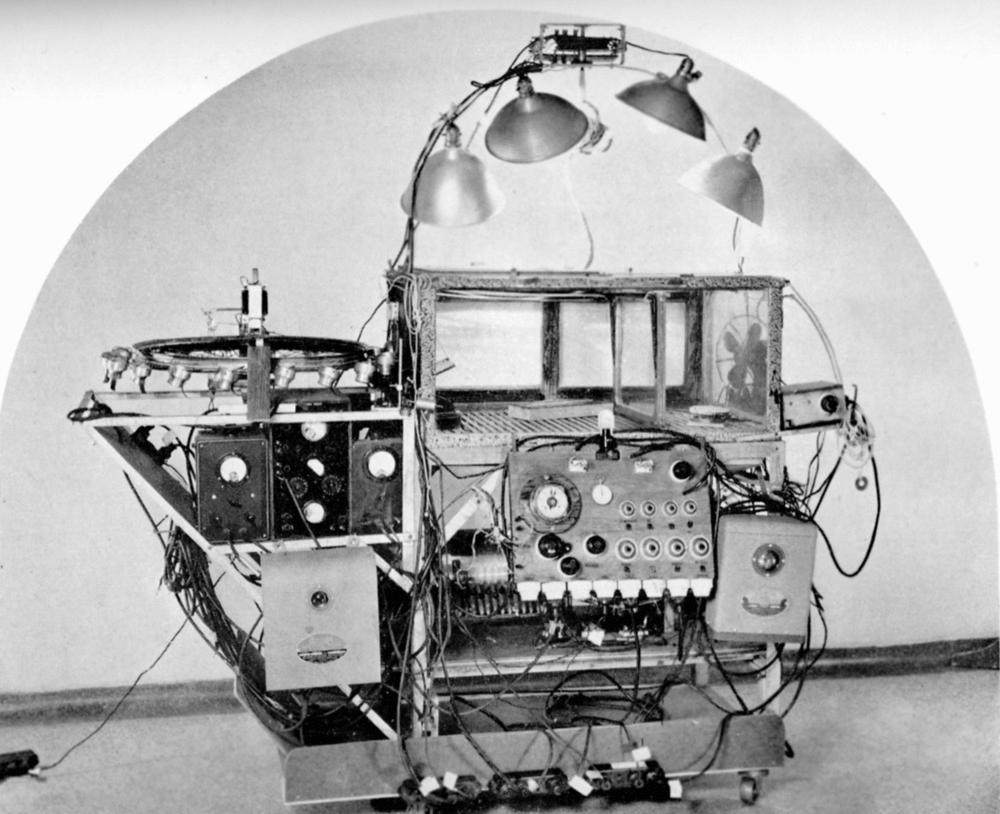
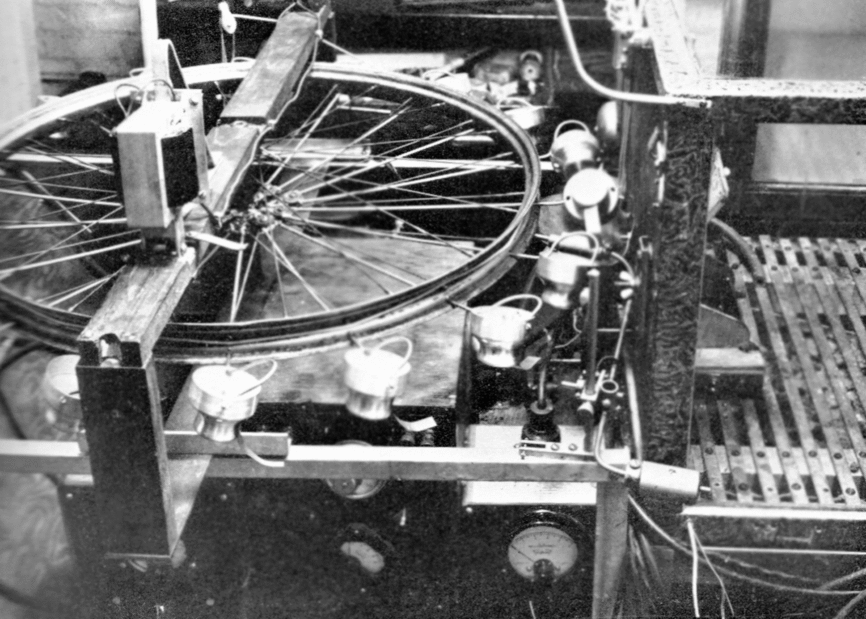
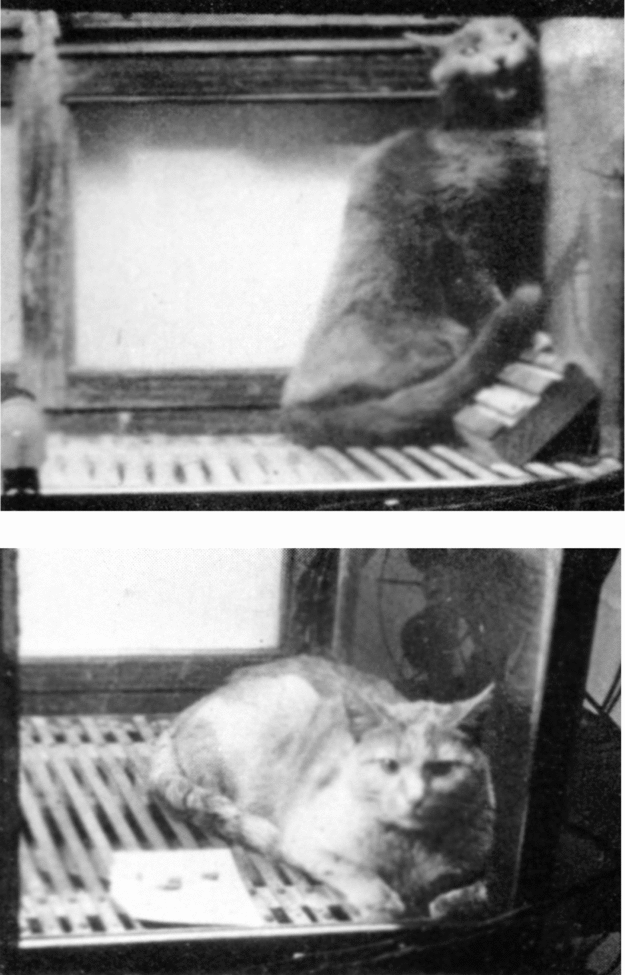
In 1942 Masserman began his own course of experiments to produce neurosis in a group of half-starved cats. Masserman's cats were kept in cages that were equipped with special levers, wires, and lights (figs. 1 and 2).
Masserman's apparatus. The main box is a 40X20X20″ glass cage. The main box was divided into two spaces with a movable dividing wall, illuminated by several lights, and fitted with a wheel that turned to deliver new food to a food tray inside the box. Masserman, Behavior and Neurosis (Reference Masserman1943).

Masserman's mechanism for delivering food trays: a bicycle wheel with a food container attached to the rim at each spoke, with a mechanism for automatically delivering a food pellet to the food box when the wheel turned. Masserman, Behavior and Neurosis (Reference Masserman1943).
The experimental setup resembled that of many other psychologists, at least in a general way. Masserman was not as interested in controlling every aspect of his cats’ environments as he thought other experimentalists were. It was unnecessary to control the temperature, noise, and other ambient phenomena in the laboratory space; nor was it necessary to closely monitor the cats physiologically (pulse, breathing), nor to itemize their movements. Masserman thought such itemizations missed the big picture; he wanted to take a more holistic approach.
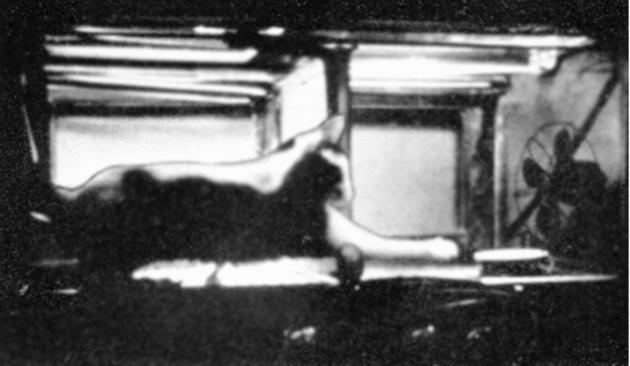
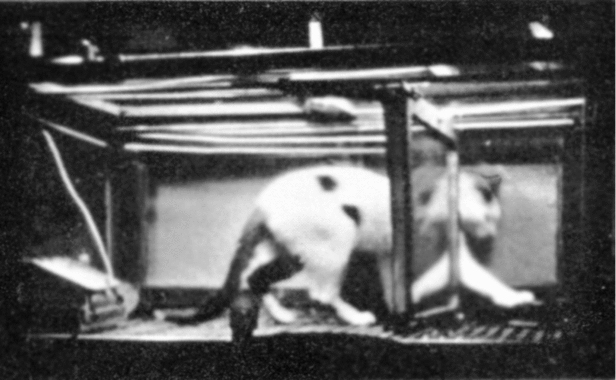
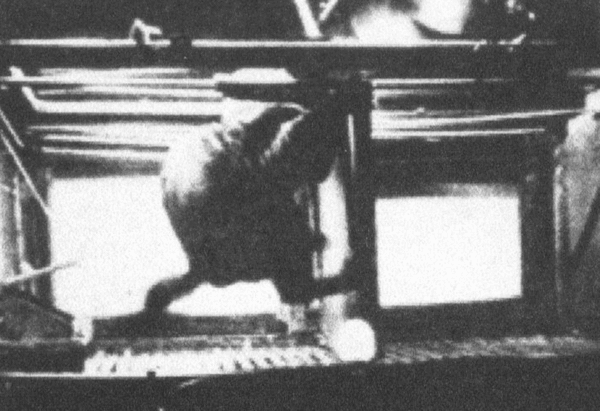
First, he taught his cats to carry out a series of different maneuvers in order to obtain food pellets. When the cat depressed a lever (once or several times depending on the experimenter's protocol, e.g. fig. 3) a flash of light would signal the presence of food, and the cat learned to get it from a small box (fig. 4). For instance, over the course of several weeks, “Cat 29” – one of 200 – became accustomed to the laboratory routine and a daily ration of food. She was then starved for 24 hrs and placed in the conditioning apparatus, where she found food in the food box, whose lid was initially open. After a few days the conditioning began. A flash of light and ringing bell were triggered, just as a portion of food was dropped into the open food box through a funnel. The cat “suspended any other activity” when the feeding signal was sounded, and would wait for the food to appear. The cat was also trained to open the lid of the box to obtain the food (Masserman, Reference Masserman1943, 58–9). The animals adapted quickly – in part because they had frequent opportunities to learn. Masserman kept them hungry. Food came in tiny doses: they had to eat 30–50 times a day to maintain their scrawny weight.
A cat making a “strenuous” attempt to depress the lever to earn a food pellet. Masserman, Behavior and Neurosis (Reference Masserman1943).
This image is intended to demonstrate that a cat trained to depress a platform “switch” (under the cat's paw, to the right) will ignore the food box (left) until it sees or hears the signal that food is present in the box. Masserman, Behavior and Neurosis (Reference Masserman1943).
After a regular pattern had become established, Masserman planned to produce acute neuroses in cats by adding to the lever-light-food pattern an unpredictable blast of air that would be dispelled in the cat's face as it opened the food box after the flash of light. The idea behind this was to produce conflicts between the cats’ need for food and fear of the air blast. This was compatible with Pavlov's claim that situations involving “difficult differentiation” between two stimuli produced neurosis, but Masserman's theoretical references were psychoanalytic. This literature primarily focused on the war, and related neurosis to a conflict between irresolvable stresses on human behavior. Accounts of traumatic neurosis that represented symptoms as the result of irreconcilable conflict (between the demands of patriotism or duty and those of self preservation) dated back to the First World War, when psychoanalysts, including Freud himself, articulated this formulation (e.g. Freud Reference Freud1919 and [Reference Freud1920] Reference Freud1956; Wessely and Jones Reference Wesseley and Jones2006). But this account became much better developed in the Second World War, when it underpinned standard treatments for traumatized soldiers.
Masserman cited a wide swathe of psychoanalytic work, and came to be identified with what one reviewer called the “neo-psychoanalytic trends” of Karl Menninger, Lawrence Kubie, Sandor Rado, and Franz Alexander. Grinker and Spiegel's Men under Stress, then in typescript form, was their manifesto. Masserman and Grinker both saw an analogy between the situation of animals in the lab and soldiers in the field, so Grinker's take on the neuroses, developed near the front lines with acutely traumatized soldiers, was apt. Moreover, Grinker had written a comparison of psychoanalytic “repression” and Pavlov's account of neurological inhibition that attempted to inject mental processes (on Freudian terms) into Pavlovian phenomena (Grinker Reference Grinker1939). Kubie reviewed several books on Pavlov during the time when Masserman was launching his experiments (e.g. Kubie Reference Kubie1941) and reported techniques in the treatment of war neurosis in which “working-through” was accomplished by a dramatic restaging of traumatic events (Kubie Reference Kubie1934).
After cats had been trained to obtain food by a regular series of actions and signals, Masserman added obstacles. They would feel a strong blast of air when they lifted the food-box lid, or an electric shock across the grid that they needed to traverse to reach the food (Masserman Reference Masserman1943, 66). After many such experiences, a cat developed symptoms of neurosis: “physiological signs of tension,” fear of “minor stimuli,” and “psychosomatic problems.” Masserman claimed to produce “a wide range of behavior in animals,” which he saw as suggestive of “cooperation, parasitism, altruism, or aggression” – and, perhaps most important, as “neurotic reactions closely corresponding to human dysfunctions.”
The signs of neurosis varied, Masserman wrote, “from cat to cat” (ibid., 67). But there was a marked change in behavior in all animals who were subjected to “motivational conflict.” Cats who were normally quiet “tended to show restlessness or agitation,” and active cats “developed marked restriction of activity and a tendency to passivity” (ibid.). For instance, Cat 53, a quiet animal, was given a sequence of two air blasts after being trained to use the levers and signals to obtain her food. She stopped responding to the feeding signals, and commenced “a fidgety, incessant” movement, shifting “from side to side” and other “postures and activity mimetic of anxiety” (Masserman Reference Masserman1943 (film), plate V(c), 60). Masserman also identified “phobic,” “counterphobic,” and “regressive” behavior patterns, triggered by different combinations of “conflictual” situations.
These effects often lessened with time when the conflicts were removed. But Masserman found that in many cats, if the “traumatizing” stimulus were re-introduced later – even months later – the cats’ neurotic behavior would return full force, with all the signs of panic or “severe anxiety” that had been there at the height of the original neurosis (figs. 5 and 6). For example, cat 56 had been trained to the feedbox and presented with the usual conflicting stimuli, including the blast of air. She “responded with a violent retreat.” When, after this, she was given the signal to feed, she responded with what Masserman called “anxious vocalization” and rushed about her cage – but avoided the food box. Masserman also noticed that “slight extraneous noises” caused “startled jumping, horripilation, and papillary dilation.” Masserman then constricted the space within her cage, forcing her closer and closer to the food box in a sequence of steps. Finally, he starved her for two days and then reduced the space in the cage to make her move ¾ of the way to the food box (and the source of the blast of air). This produced, he said, “maximum excitement” (Masserman Reference Masserman1943, 71–2).
“Hysterical starvation”: two examples of cats who refused to eat, even when the food was freely presented to them. Masserman, Behavior and Neurosis (Reference Masserman1943).
Masserman was not satisfied with merely producing these symptoms. He wanted to show that he could also cure them – again, in a controlled experimental situation. Through methods “similar to some forms of psychotherapy,” he claimed, “the same neurotic animals could also be cured.”
* * *
What were the implications of this for psychoanalysis – and for behaviorism? Unlike most other animal experimentalists, Masserman was not trying to use a behaviorist disciplinary framework to explain certain phenomena described by analysts, but the converse: he wanted to demonstrate psychoanalytic principles in the laboratory. His work certainly reached across the divides between several fields. Masserman's experimental protocol was similar to ones outlined by Gantt over the previous decade, but here the framework was interdisciplinary, with an overarching emphasis on psychoanalysis. Masserman's colleagues at Chicago would have recognized his project as belonging to “animal ecology”; colleagues elsewhere would have seen it as an ambitious contribution to “psychobiology.” And although Masserman did not say so himself, the experiments were framed to deliver the kind of approach that Gantt had been rebuked by Meyers and other psychiatrists for not delivering – a study of animals that used conditioned reflexes but made sense to psychoanalysts.
Masserman's most ambitious – and, some reviewers said, most arrogant – move was to launch an attack on the idea of a conditioned reflex and hence on behaviorism more generally. Masserman had had a distaste for behaviorism since his days at Johns Hopkins, and he wanted to use his experiments as a platform from which to rebuke Pavlov. Pavlov, Masserman claimed, defined a reflex as “a unitary, stereotyped reaction which was mediated by a definite sensorimotor neural engram and could be experimentally ‘induced’” by the right combination of stimuli. Masserman was troubled by behaviorism's rejection of explanatory categories such as “meaning” and internal psychical states, and he inferred from this that Pavlov failed adequately to incorporate motivation into his theory. Pavlov had noted early on, wrote Masserman, that “an animal with a ‘conditioned salivary reflex’ to the sound of a bell would soon stop salivating in response to any amount of bell-ringing either if food were not presented or if the animal became satiated” (Masserman Reference Masserman1943, 16). The need for reinforcement, Masserman claimed, raised questions about the sufficiency of the idea of conditioning, without the addition of a concept of motivation. It should be noted that Masserman's claim that Pavlovian theory did not involve motivation set him at odds with how most scientists of this period understood Pavlovian theory (they would have seen hunger, for instance, as playing a fundamentally motivating role in conditioning).
Masserman's reviewers thought he had misunderstood Pavlov and conditioning, whether willfully or through naiveté. Thomas French at Chicago, one of the first analysts to write about the implications of Pavlov's work for psychoanalysis (French Reference French1933), thought Masserman had done something important by showing neurosis to be produced by conflicts, rather than just by frustration. But in his criticisms of behaviorism and of Pavlov in particular, French remarked, “sometimes the author does not take the trouble to understand the views he is criticizing”; Masserman quoted Pavlov out of context, twisting the significance of a project that had sought to impose scientific rigor on the study of animals, countering “a loose kind of anthropomorphic and teleological thinking [that] was in vogue.” While Masserman had indeed shown that an organism will react only to “motivationally meaningful” situations, there still remained “the problems that Pavlov was attempting to solve. What were the detailed mechanisms by means of which an animal achieved satisfaction for its needs, or failed to do so (as in neuroses)? Problems of this second category do not interest the author, and he seems, indeed, to be completely blind to their existence” (French Reference French1943).
Masserman also thought it significant that animals sometimes treated the signal itself – the bell or light – as it if were the food itself. When animals licked an electric bulb after it flashed, or snapped at the air at the sound of a bell ringing, Masserman wrote, it showed “a definite appreciation of sensory symbolisms (‘sign-gestalts’).” This term came from Edward Tolman, who was developing a strain of behaviorist psychology that incorporated the idea of “purpose” in animal behavior; Masserman was familiar with Tolman's work and cited it approvingly (Tolman Reference Tolman1932, Reference Tolman1942), but without spelling out in detail its relevance for his own work.
Masserman thought that purpose and motivation supplied a new way of thinking about the conflicts that produced neurosis. In the Pavlovian system, animals could become “neurotic” when “exernal stimuli” produced incompatible reactions – of both excitation and inhibition – in the brain. Again, Masserman reframed this to be a conflict not ultimately between incompatible conditioned reactions, but between “conflictful incentives and the consequences of their frustration.” The experiment Masserman discussed was one in which Pavlov gave dogs food when he showed them a circle, but no food when he presented an ellipse. Then he made the circle increasingly oval and the ellipse increasingly circular until the dog seemed not to be able to distinguish them. Masserman claimed that this was the result of conflicting purposes: one of obtaining food, and the other of escaping from the “motivationally conflictual situation” of the experiment itself (Masserman Reference Masserman1943, 17–18).
This rather tortured way of framing the dog's dilemma probably came from another claim Masserman was committed to, about the causes of neurosis. He wanted to say that the dog was not merely frustrated (by its inability to distinguish between the ellipse and a circle) but torn between conflicting purposes. There was an ongoing conversation among analysts about whether neurosis was produced by frustration or by the conflict between competing drives. Masserman claimed that his experiments showed clearly that neurosis was the result of conflict rather than frustration – the cats did not become neurotic when starved (when their need for food was frustrated) but when their need for food came in conflict with their need to avoid pain and discomfort. Masserman's claim, as an analyst, that he was producing neurosis also helped shore up the idea that neurosis could be a short-term, acute condition, as Grinker and other analysts had claimed from their war work.
Neurosis and trauma became issues of central concern to psychiatrists and psychologists in the 1940s because they loomed so large in the Second World War. By 1942, military psychiatrists were reporting that as many as 20–25 percent of casualties were psychiatric, and by far the highest proportion of these were diagnosed with “neurosis.” Many diagnostic terms fell under this broad umbrella, but all encompassed the old “shell shock,” the newer “battle exhaustion” and “battle fatigue,” and more general ones like “stress.” Most psychologists understood neurosis as being produced when an individual confronted immensely demanding but irreconcilable demands – such as the need to remain in a fox hole, but a desperation to remove oneself as shells rain down. The symptoms of neurosis varied, but they all involved behaviors that somehow evoked or even embodied these irreconcilable conflicts. They might include, an inability to consciously remember a particular experience, even while behaviors indicated that in some way the individual was constantly reliving the situation. For example, a soldier might experience amnesia about a battle situation, but show extreme reactions to routine noises, as if he were still on the battlefield.
One result of all this was a shift in the concept of neurosis. In classical psychoanalysis, neuroses developed over the course of many years – they were not manufactured by brief periods of stress. But military psychiatrists saw thousands of neurotic soldiers whose symptoms had emerged suddenly after intense periods of battle; Masserman himself treated soldiers on psychiatric discharge (this was, until late 1942, the default procedure for soldiers suffering significant psychiatric problems). He also researched various problems of military psychiatry. By 1943 it was becoming commonly (though not universally) accepted that neuroses could be produced by short periods of intense stress, and researchers would not have thought that the time-frame for the experimental production of neurosis was out of line with what they might expect to see clinically. Grinker's Men under Stress began as classified information for military psychiatrists, but it ultimately delivered a broader account of the nature of stress that was loosely couched in biological (or perhaps meta-biological) terms, describing his patients as animals adapted to particular constraints but suffering from a need to respond to intense, conflicting demands.
So what did animals offer to a psychoanalytic psychiatrist that thousands of traumatized soldiers could not provide? Masserman's project was part of a strained conversation that was taking place throughout the Second World War about the nature of battle-induced neurosis, in works like Grinker's Men under Stress (Reference Grinker and Spiegel1945) and John Huston's film “Let There Be Light” (Reference Huston1946). Many psychiatrists were arguing that war neuroses should not be seen as the result of inherent weakness, and that most (though not all) cases could not be ascribed to malingering. Traumatic neurosis, they claimed, was caused by stress, and could only be understood by a broad-based reflection on the nature of stress and psychological adaptation. If an experimental psychologist could produce neurosis in all research subjects, this underscored psychiatrists’ claims that neurosis was an inevitable response to extreme stress, rather than the behavior of a significant subgroup of people who were temperamentally weak, self-pitying, or deceitful. Skeptics had also complained that psychoanalysis was not a scientific tool for understanding psychological problems, focused as it was on conversation and testimony, on words rather than observable or even quantifiable behaviors. Here, the significance of using cats was clear. The obvious disadvantage of cats – that unlike humans, they presumably do not have complex inner lives that can be accessed through their use of language – was set off by clear, related advantages. They do not use language to mask, consciously as well as unconsciously, as much as they reveal of those inner lives. And they cannot lie.
Cats on the Couch
The standard of care for a psychoneurosis was psychoanalysis. In psychoanalytic practice, patients “transferred” to the therapist feelings and patterns of interaction in important relationships (with parents, for instance). The “transference relationship” then established with a sophisticated and empathetic practitioner became the arena in which to reflect the causes of the patient's neurosis.
Masserman was not satisfied with merely producing neurosis in his cats. He wanted to cure them, too – using psychoanalysis. But transference was the central phenomenon in psychoanalytic practice. Could cats experience transference? Naturally, some adjustment was necessary in what the term could mean. When dealing with his feline, rather than human, patients, Masserman defined transference as “a dependent confidence in the experimenter, who customarily fed and cared for them,” and the analytic procedure as that of “[utilizing] this relationship to diminish the insecurities and anxieties the animals later developed in the motivationally conflictual situation” (Masserman Reference Masserman1943, 73). He also supplied a photograph to illustrate the “transference technique” – showing an experimenter petting a cat.
The psychoanalytic notion of “working through” a neurosis customarily meant a process begun after the establishment of a transference, in which the patient developed an awareness of the nature of his or her problems and their cause, and then tried to apply this awareness to aspects of daily life. Of course, “working through,” defined this way, involved a conscious goal shared between analyst and patient. It is hard to see evidence either of the goal or of the notion of awareness in Masserman's experiments. Nevertheless, Masserman himself insisted that there was a feline equivalent: he “manipulated the environment” in which the cat functioned, by moving the walls of the cage to force the cat closer and closer to the food box. Eventually, the combination of hunger and proximity seemed to be too much for the cat, who snatched a bite of food, and after the first try, was able to eat with decreasing difficulty. This, for Masserman, was a phenomenon equivalent to “working through” because the cat was forced to confront the situation that had been made the crux of her anxiety, and to act in new ways (eating the food after a period of self-imposed starvation). But he neither suggested nor demonstrated that any of this was voluntary or conscious on the animal's part.
There were other situations and practices that Masserman also described as equivalents to human relationships and therapeutic situations. In the experimental protocol labeled “social example,” for instance, a normal cat was put into the cage of the neurotic animal, to demonstrate that the feedbox was safe to approach (in the single case described by Masserman, the neurotic cat did follow the normal cat's example, after the fourteenth try). In a series of protocols labeled “inter-cat relationships,” neurotic cats were put into a cage together, the idea being that together they would find ways of approaching the box and consuming the food. The suggestion here was a kind of feline group therapy.
Masserman thus insisted that cats underwent the process fundamental to psychoanalysis of “working through.” As Masserman put it, this work took place after an initial “transference” had been established, and after the patient had “begun to acquire insights into his or her problems.” This was a process in which the patient's “new awareness is repeatedly tested and ‘tried on for size’ in other areas of [his] life. It allows the patient to understand the influence of the past on his or her present situation, to accept it emotionally as well as intellectually, and to use the new understanding to make changes in present life.” All of this was being done by Masserman's cats, toward the goal of gaining “some measure of control over inner conflicts and to resolve them or minimize their power.”
Most ambitiously, Masserman concluded from his work that four principles underlay all animal behavior: motivation, from physiological needs; learning from the combination of innate potential with experience; “substitute gratification” arising from frustrations, and conflicts between “mutually incompatible responses.” He would later coin the term biodynamics to refer to this collection of principles, which he continued to develop both theoretically and through a sequence of experiments.
Masserman detailed and analyzed this work in his first book, Behavior and Neurosis (1943). It received a mixed reception. Almost all reviewers found the research fascinating and important, though the more experimentally oriented found Masserman's account frustratingly vague about both his methods and his results (Stone 1943); one animal learning researcher found the only compliment he could give the book was that it was “well-bound” (Bitterman Reference Bitterman1946). As for the more general thrust of Masserman's claims, several reviewers were convinced that his work was helping with the “rational trend” of postwar psychiatry (British Medical Journal [BMJ] 1946), and a useful corrective of the deficiencies of psychoanalysis in its lack of “psychobiological orientation” (Stone Reference Stone1944). Most found his attack on Pavlov misguided, but some approved of it; a lead editorial in the British Medical Journal lauded the critique of Pavlov, and hailed Masserman's as the “first criticism of Pavlov's work by means of experiments based on a wider philosophy” (BMJ 1943).
Meaning and the Moving Image
It is worth taking a moment to consider the role of visual material, both still photographs and motion pictures, in Masserman's project. There was nothing new, of course, in photographing and filming animals as an aid to observation. Both practices date back to the beginnings of photography and of motion picture film. But Masserman's project was unusual in the way it yoked together established, but disjoint, conventions for the use of these techniques.
As for the photographs, it required considerable generosity and imagination on the part of the reader/viewer to see in these images what Masserman wanted them to see. Masserman's published accounts of the cat experiments were heavily illustrated with still shots of the experimental apparatus, the trainers working with the cats, and, especially, the cats themselves, caught at key moments that were intended to demonstrate phenomena described in the text. The use of the photographs invited a particular understanding of what kinds of observations and inferences were possible in research that yoked mind and meaning to animal behavior. One can see cats moving from one side of a cage to the other, or crouched with back arched and fur standing on end. It is not hard to infer purpose or fear or aggression in some of the images. But Masserman used these pictures as tags for more subtle or specific phenomena not normally associated with animals– e.g. altruism, cooperation, or psychosis. He wanted to make fine distinctions between simple anxiety, for instance, and phobia; between simple fear and neurosis.
One of the first things that registers about these images is how inadequate to our eyes they are to the task. Granted, the scanned images reproduced in this paper – what the readers of this essay are able to see – are not as good in quality as the original published images, but those published images are not all that much better. It is as if the blurred shapes of cats on the move, either towards or away from the feedbox, either towards or away from the hands of the trainers, are intended as placeholders for the experience of being there in the experiment room. Masserman himself did not discuss the extent to which the images could be seen as substantive evidence for the claims he linked to them, and I have not found readers’ comments on the photos, so what follows is entirely my speculation. I would find implausible any claim that the photographs in this book could allow for a kind of virtual witnessing, to use Simon Schaffer's and Steven Shapin's term. It seems more likely that they are intended to convey to readers the message that what was done was truly a set of animal behavior experiments, with the academic credentials that came with this. And they would also have reminded readers – all of whom, one assumes, were academic psychologists or neurologists – that a high proportion of them had already seen Masserman's motion pictures of the experiments. They were widely distributed and were shown at every annual meeting of the American Psychology Association in the mid-1940s.
The films were structured in a way that was reminiscent of an academic paper. The intertitles outlined the methods and purposes of the experiment, with a level of detail that allowed them to stand on their own without much, or perhaps any, additional input from the presenter. Most of the films’ contents, from the methods outlined in the intertitles to the footage of cats pressing levers, nudging open food-boxes, and ringing bells, would have suggested that Masserman was engaged in a straightforward project in animal ecology using various conditioning techniques. For instance, in a film of 1942 presenting evidence that morphine could temporarily relieve the symptoms of neurosis, Masserman's opening text explained that “Cats were trained in an automatic apparatus to respond to a bell-and-light signal by lifting the lid of a food box for a pellet of food.” After some brief footage demonstrating this, the next screen of text stated that the cat was then “trained to elicit the light-bell-feeding signal by depressing a platform switch with his snout or paw.” Despite all this, the opening credits suggested that something less simple was going on: Masserman's collaborators were analytically-minded clinicians and public health officials (Masserman 1942). More tellingly, and as the film began to demonstrate the “production of neurosis,” the text changed subtly to lay the grounds for Masserman's analytic interpretations. For instance, Masserman explained his technique for inducing neurosis in the following way:
Method of inducing experimental neurosis. The cat operates the switch and responds to signals as before, without reinforcement. [next text screen:] but just as he lifts the lid of the food box, a harmless air blast is directed against his face. The process is repeated several times.
The film then progresses to narrate and display the cat's increasingly “neurotic” behavior, and as it does, the language increasingly makes inferences about the cats’ internal mental state, not just characterizing their behavior:
Behavior suggestive of anxiety is increased at the light (previously – feeding) signal. [next text:] refuses to feed either from the box or elsewhere in the cage. [next text:] Constriction of the field of reaction by the moveable partition accentuates the ‘neurotic’ behavior [next text:] The cat has refused to feed for three days. Note fearful reactions (attempts to escape) and substitutive behavior (repetitive closing of the switch without follow-up to obtain food).
The films themselves arguably did a better job in delivering the kind of observational experience that viewers would find convincing.
The eminent Harvard psychiatrist Abraham Myerson (Myerson Reference Myerson1944), reviewing Behavior and Neurosis, said that it was “impossible” for anyone who had viewed Masserman's films to deny that his cats were suffering from neurosis (he made no reference to the photos in the book). Masserman inferred anxiety from details of the behavior of the cats, not from particular still positions they took up; so it makes sense that a moving image of the animal would be the more appropriate form of evidence, enabling others to make the same inferences: to see the cat's behavior as an expression of internal emotional states, and of particular motivations. Perhaps another piece to this was that each film showed a single animal in a sequence of behaviors that played out over time. An observer was not being presented with cumulative or averaged representations, or summary information about the total population of cats studied, but rather with one animal's actions over a series of minutes, and in several sequences.
This technique invited viewers to see Masserman's experimental subjects as individual agents, apparently “deciding” between different courses of action, seeming “uncertain,” “frustrated,” and of course anxious. The subtleties of movement in the film, and the choice to focus on one cat for an extended period, made it possible for observers to draw these inferences themselves, rather than merely accepting Masserman's own assertions.
This suggests an important rhetorical role for film in Masserman's attempt to document meaning and motivation in his animals. There is no indication that any behaviorists were persuaded by his claims to have cast doubt on the importance of Pavlov's work; and some psychiatrists publicly rejected Masserman's claim to have debunked behaviorism. Yale psychiatrist Frederick Redlich wrote that Masserman's basic thesis “on meaning” was not “well-founded,” and although his statements perhaps sounded “appealing,” they did not allow “greater predictability of behavior” than Pavlov's, Tolman's, or Hull's (Redlich Reference Redlich1943). Yet if some of Masserman's colleagues and readers thought his theoretical claims seemed to miss the mark, or even to be founded on misunderstanding, they never failed to be compelled by his films. Although behaviorist psychologists were unlikely to discern the kinds of internal processes in the behavior of Masserman's cats that he described, others, from experienced analysts like Myerson (above) to newspaper journalists, had an almost visceral response to the films, “seeing” distress, purposes, decisions, and longing. The rhetoric of the moving image was more eloquent than Masserman's own words.
Some of Masserman's motivations are classic and obvious: motion-picture film was used, from the late nineteenth-century, to make possible the study of animal movement in ways that seemed otherwise impossible; for instance, by allowing the manipulation of time so that movements could be studied in slow motion. The basic idea of studying animals in action was a natural rationale for using film. But Masserman was not manipulating the timing of his recorded animals’ movements; though the camera was positioned closer to the cage than any observer would be likely to be able to stand without provoking a response from the cat. Masserman did not find it necessary to discuss any technical issues (lighting, shadow, filters, camera position, etc.), and the lack of this discussion, both in the book and by reviewers, suggests that to Masserman and his readers, filming technique was taken as neutral with respect to what it conveyed to viewers. The camera both allowed a privileged perspective, and also a closeness to the animal that seemed to allow a “fact” to speak for itself, a technique that had a long history in psychiatry (e.g. Mayer Reference Mayer2006).
In addition to the use of film to study bodily movement (in animals and humans alike), there was another convention in play in Masserman's work. The earliest psychological reflections on film argued that this medium could capture and convey human emotion in ways that other media could not. Film was far more effective than stage or page in communicating internal mental phenomena, claimed psychologist Hugo Munsterberg in his classic essay on the photo play, because of tools like the close-up and the ability to edit film sequences.
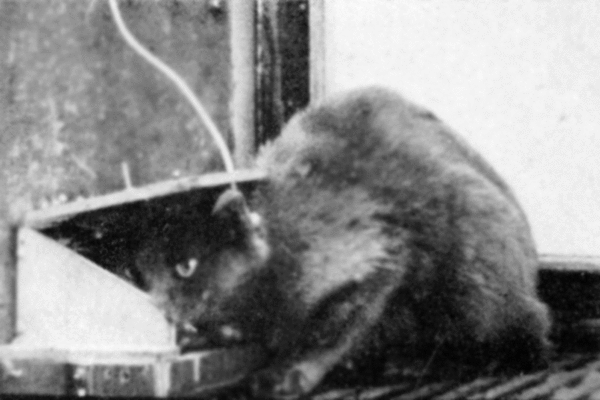
Masserman was unusual in using the genre of animal behavior films for a purpose more akin to the goals to which Munsterberg alluded. His camera got closer to the cage, he claimed, than a human observer could – close enough to record the expressions of anxiety, panic, aggression, contentment, etc., on his animals’ faces, and not just the postures of their whole body. For instance, the following image (fig. 7) was used as an example of anxiety.
Masserman represents this cat as having developed a “phobia”; here it has been photographed during a “frantic attempt” to get out of the box. Masserman, Behavior and Neurosis (Reference Masserman1943).
Several shots of animals in motion were used to demonstrate panic or phobia, or compulsive behavior (here, fig. 8, the cat is said to compulsively hide its head in the food box at the feeding signal bell/light).
An example of “neurotic” behavior: This cat regularly “hides” its head in the food box when the feeding signal is given. Masserman, Behavior and Neurosis (Reference Masserman1943).

The medium of film captured animal movement – and the crude movements of the whole animal were what one mainly saw in these simple films – but the goal of all of this was to convey a sense of the animal's internal emotional state and to provide records that could be studied for signs of other “internal” phenomena as expressed through subtleties of action. So Masserman's project straddled, and even brought together, two familiar, but usually quite separate, uses of film: the recording and manipulation of movement, and the expression of emotion and other internal mental phenomena.
There is a curious relationship between the use he made of these media and their accessibility and intelligibility. On the one hand, the very idea of the existence of these kinds of records had a rhetorical force of its own. It suggested a transparency of the experimental situation to outside observers – something that was particularly forceful coming from an analyst, since the intimacy and confidentiality of the consulting room involved its being a particularly closed space. Cat neurosis and psychoanalysis were presented as allowing for greater experimental controls than were possible (ethically and practically) with human beings. At the same time, the use of film made possible greater witness validation, through the little virtual witnessing that films mediated.
But the accessibility of this material was very limited in various respects. The films, of course, could not be circulated in the way that a published paper could, so the number of people who viewed these films was far fewer than the number who read the papers. And they could view the films only on specific occasions. There were many such occasions – Masserman showed the films at many psychological meetings, both regional and national, throughout the 1940s and 50s. And eventually copies of the films were circulated as teaching aids from the 1950s onward. But in the 1940s, people saw the films almost entirely at one-off events, scheduled screenings at professional conferences. In these contexts, the intensive study of one moment in a film was not possible the way one might now imagine it could be (and the way that Masserman was able to intensively study footage in the privacy of his own labs).
The question remains of whether readers and viewers accepted the common ground that Masserman was trying to establish between humans and cats, and the equivalence of psychoanalytic categories he was trying to broker in his experimental work. Reviewers in the psychology journals were intrigued – and some rather in awe – of Masserman's venture. Psychiatrist Jules Eisenbud, for example, writing in a psychoanalytic journal, claimed that Masserman had proved that his animals’ behavior could not simply be understood as a complex reflex response but rather “was purposive, adaptive, and could be interpreted only in terms of an environmental field rendered meaningful by those needs” (Eisenbud Reference Eisenbud1944). Masserman's experimental production of neurosis was an appropriate, indeed brilliant, realization in practice of the influential psychiatrist Paul Schilder's reflection that one “cannot interpret the neurosis by means of the conditioned reflex, but by means of the psychic mechanism we have studied in the neurosis we can well explain what occurs in the conditioned reflex,” (Bender Reference Bender1979). Eisenbud, like other psychoanalytic reviewers (e.g. Gillespie Reference Gillespie1945) saw Masserman's efforts as the culmination of a series of efforts toward a more holistic understanding of behavior, one that was ignored by Pavlov to the ultimate impoverishment of his own work. He was satisfied with Masserman's study as far as it went, and thought it the first step toward a better understanding of the nature of conditioning. He was convinced that “the net effect of these experiments has been to demonstrate that the cat, as it were, is only human after all.”
Abraham Myerson called Masserman's work “brilliant” (Myerson Reference Myerson1944). Myerson proclaimed “the voice of Masserman” to be the “voice of Freud; the work is the work of Pavlov.” However convinced he was that Masserman's animals had indeed become neurotic, he was not yet convinced that animal and human neurosis were equivalent – he was skeptical not because of a priori reasons to do with the differences in brain and mind between people and cats, but because of the specifics of Masserman's experiments. Human neurosis was usually the result of conflicting motivations that Myerson saw as more “internal” than the starvation and fear that framed the cats’ responses: in people, sexual drives and oedipal dilemmas produced the conflicts of neurosis. While Masserman had indeed produced conflicts – the conflict between motivations related to hunger and to flight – the hunger and fear themselves likely played a role in the production of the animal's neurosis, and should have been considered on their own terms. This was his only caveat in accepting Masserman's main thesis: that “bringing conflictful situations into the life of an animal produces a neurosis.” Similarly, he was not convinced by Masserman's feline version of the concept of transference. Likening confidence of the animal in the person who fed and trained it to the transference “that analysts lay so much stress upon in the treatment of a neurotic patient and which transference has later to be broken up in the interest of the patient is to make the same word define radically different relationships.” The practices that Masserman described as effective in curing his cats of their neuroses were really the stuff of mental healers long predating Freud: rest, drugs, and reassurance, and not the elaborate transference and working-through of psychoanalysis.
Popular journals and newspapers were happier to accept the logic of Masserman's claims, and although they tended to report his experiments with a touch of humor, most represented his work as consequential and convincing. He received a considerable amount of publicity – several major newspaper articles per year that I have found to date. For instance, shortly after Behavior and Neurosis was released, the New York Times reported how Masserman was able to induce neurosis in cats, then explained that “the working-through method of helping the cat overcome its jitteriness was brought about by teaching it to press an electric switch that activated the light-and-bell feeding signal.” Cats trained in this way, it continued, and ones that were forced (by constricting space in the cage) to move closer to the feed box, eventually became able to return to feeding faster and were not bothered by the air blast. The implication was that there were specific techniques available for the cure of neurosis – whether in cats or in humans – that provided the ingredients for a “self cure” (Kaempffert Reference Kaempffert1943).
Masserman tried electroshock therapy on his cats soon after he moved to Northwestern in 1947, and the Tribune gave the experiments a full column. The shock treatments administrated to a group of “loony cats,” reported the Tribune, “left the animals with impaired intelligences although it did set them on the right track” (Anon. 1947).
Masserman's experiments using alcohol on the neurotic cats, which he carried out from 1945–1949, drew even more publicity. The New York Times announced in February of 1945 that he had proved alcohol to be of use in treating trauma, when Masserman gave his cats a “bad case of ‘nerves’ and then made them drunk.” Although there was a “vast difference between the most intelligent of cats and the humblest of human topers,” they quoted him favorably as saying, from an “objective scientific viewpoint” a human being was still “an animal whose behavior conforms to biological and biodynamic principles” (Kaempffert Reference Kaempffert1945). The Washington Post recounted that the “story of a cat that was driven to drink was told . . . today . . . to point up what [one] might do in combating psychoneurosis in humans” (Anon. 1948); and the Chicago Tribune described, with a touch of humor, how “12 cats switch to cocktails to aid humanity.” The paper suggested that the mixture of milk and alcohol that Masserman's cats were imbibing was a feline version of a popular cocktail, the Alexander (the recipe for which – a combination of brandy and crème de cacao – the journalist had researched in consultation with barmen in the preparation for the article) (Gibbons Reference Gibbons1949).
Masserman claimed that the “disorganizing” effects of alcohol counteracted the entrenched patterns of neurosis in cats, and could both prevent a neurosis from becoming fully established, and also help in curing it. He suggested that this was also the key to managing alcohol consumption in a way that avoided the development of alcoholism. Masserman spoke on this topic, linking it to his earlier research and his broader theory of biodynamics, often at popular venues, on the radio, and eventually (from the late 1950s) on television.
Another part of his research that drew popular attention was experiments on monkeys, which he carried out from the early 1950s (Anon. 1947; Anon. 1951a; Anon. 1949; Masserman 1958; Anon. 1961; Browning Reference Browning1961; Masserman, Wechkin, and Terris 1964). The plan, and the claims, were basically the same as in the cat research – but Masserman was now better funded, and was able to move up to more expensive, more complex animals with closer connections to human beings. The Tribune explained that they had learned from Masserman that “It only takes three or four weeks to make a monkey neurotic. The real problem, as with humans, is to restore him to normal” (Anon. 1953). Masserman, as a practicing psychoanalyst, used only clinically-approved treatments on his “people patients,” but the monkeys could receive any form of experimental care. Unfortunately, Masserman was less successful with monkeys than he had been with cats, and the standard experimental techniques – rest, reassurance, drugs, and behavioral training – often failed with these monkeys, most of whom remained highly neurotic and in some cases “psychotic” for years.
The coverage of these experiments provoked several responses from irate readers, because Masserman, during the course of an account of the importance of adaptability to mental health and the potential for neurosis of individuals unable to adapt to new constraints and demands, had anonymously quoted someone who claimed that “Many workers feel that some of the adaptability and intelligence of a woman, particularly a housewife, can be more easily spared than that of males who must carry on in the business and professional world.” Alice Hall and Florence Crew (identified by the newspaper as “housewives”) wrote in to suggest that Masserman be told that “working to help the human mind should prove much more beneficial than torturing monkeys to insanity and then proving nothing. I could have told the experimenters that a snake rising up in close proximity to me at frequent intervals would drive me to insanity too. Then they could have saved the cost of buying the monkeys!” (Crew and Hall Reference Crew and Hall1953).
Semantics
One intellectual enterprise that saw an opportunity to make common cause with Masserman's project was the new and – at this time – growing field of “general semantics.” This was a discipline founded by the early twentieth-century Polish philosopher and scientist Alfred Korzybski, and dedicated to the study of what Korzybski called “semantic reactions” – reactions of the organism as a whole to an event or to something in its environment. The most familiar use of Korzybski's claims was to refer to delayed reactions that Korzybski claimed were useful for survival in situations of great stress. The concept of General Semantics was put to work in the Second World War to treat thousands of psychiatric casualties in the European Theatre, under the supervision of Douglas M. Kelly, and advocates sought to establish it as a field of psychology in the immediate postwar years. It peaked in the late 1940s and began to decline in the early 1950s, when it found its way into a few science fiction novels, was taken up and adapted by L Ron Hubbard in Dianetics, and was then excoriated by Martin Gardner in his Fads and Fallacies of Science in 1952.
Masserman's project was a natural fit for General Semantics because of its holism and its emphasis on the response of the whole organism (in principle, any higher organism) to stresses from its environment. It caught the attention of psychologist and later politician S. I. Hayakawa, an adherent of General Semantics, who harnessed his psychology to racial activism. In the late 1940s, Hayakawa was a lecturer at the University of Chicago, and was becoming already well-known for a book, Language in Action (Hayakawa Reference Hayakawa1938), which was reprinted several times in the 1940s with the new title, Language in Thought and Action (Hayakawa Reference Hayakawa1949), both of which were contributions to General Semantics. In addition to his academic work, he wrote for the historically important African American paper, the Chicago Defender. In 1944 he wrote an article on Masserman's cat experiments, calling them “enormously useful.” They showed, he thought, that
Fear doesn't drive cats crazy. Hunger doesn't drive them crazy either. Nor does disappointment. What does drive cats crazy is internal conflict: when it wants to approach the food box, yet at the same time fears to approach it. (Hayakawa Reference Hayakawa1944)
Hayakawa found that “Experiment after experiment has human implications that need to be followed up.” But he saw more than general human implications in Masserman's work. His most immediate inferences related to issues of civil rights and the social conditions of the “negro” in urban situations. Hayakawa, who had recently begun writing for the Chicago Defender, was an outspoken critic of segregation and a champion of civil rights more generally. “When a Negro stands outside a white restaurant and wants to go in because he is hungry, yet fears humiliation and insult if he does,” Hayakawa wrote, “that's internal conflict too.”
Hayakawa was also struck by Masserman's manipulation of cage size. Masserman had changed this in an attempt to force his cats closer to their food cage, but Hayakawa saw their reactions as a basic phenomenon of cramped space. Hayakawa, who had recently joined the faculty of the University of Chicago, on the city's South Side, was appalled by the living conditions in the poorer black communities between Hyde Park and the Loop. He wrote that the deleterious effects of cooping up cats in small spaces had implications “for designers, builders, and owners of apartment houses and kitchenettes, especially right here on our own south side. . . if there are too many delinquent children, divorces, suicides, and murders in the crowded Negro areas, there is no sense in blaming a hypothetical entity called the “Negro character.” Other entities, even cats, can be driven to distraction by too much internal conflict, and too much distraction.” The recruitment of Masserman's cats in the service of the reform of race relations and civic planning in Chicago showed how portable and malleable his claims could be.
* * *
Masserman maintained a presence in the press through the 1970s, appearing regularly on the radio and television, appearing as the subject of newspaper articles, and publishing some himself. He continually pushed the idea of “biodynamics” in his own speaking engagements and essays, and regularly cited his animal research in his psychoanalytic writings on human beings (Masserman Reference Masserman1963–1964). Masserman's animal experiments, and especially the films he made during the 1940s, were in regular use in the 1950s and 1960s, and he is still remembered as carrying out benchmark work in developing animal “models” for psychiatry (Keehn Reference Keehn1986, 118–119). He himself thrived, both as a clinician and as an experimentalist. He moved to Northwestern in the late 1940s, and over the next several decades continued his animal experiments, focusing primarily on monkeys and cats. He remained a sought-after psychotherapist. He was able to maintain his status both as a biological psychologist and as a clinician, and was made president of several psychological organizations. Perhaps the largest and most prestigious position he held was as president of the American Psychiatric Association, to which he was appointed in 1979, when he was in his late 60s.
Throughout this time he had had a glittering career, apparently going from strength to strength, even if the theory of biodynamics, to which he still adhered, never really got traction with either analysts or experimentalists. But in 1979 his career came to an abrupt end. A patient he was treating with sodium pentothal (one of his staple drugs in the animal neurosis experiments) to facilitate the exploration of traumatic memories awoke from her pentothal trance to find he was having sex with her. He resigned from the APA in disgrace, although he did not concede the legitimacy of his patient's accusations: he later published a book arguing that the incident had taught him the power of fantasies and hallucinations patients could sometimes experience under the influence of pentothal.
Conclusion
Masserman's effort to develop a multi-species convergence of psychiatric knowledge was in large part an effort to extend psychoanalysis’ legitimacy as a human science, and to negotiate its relationship with psychiatry. One major goal related to the possibility of facilitating the integration of psychoanalysis and psychiatry at a key period for them both. Psychoanalysis was on the ascendant in the 1940s and 50s, but it offered a challenge to non-psychoanalytic psychiatry, where there was a strong urge, even an imperative, to seek a somatic basis for every disorder. What was the unifying feature of the response of a being (animal or human) to stresses, and what was the underlying commonality in the kinds of interventions that could help? Cats offered a conspicuously naturalized environment in which to study emotions, demonstrating psychoanalytic principles in cats could produce a useful intellectual bridge between psychoanalysis and psychiatry. If one could demonstrate in cats’ behavior phenomena that were otherwise associated with quintessentially human sufferings (identified with the metaphysical, the religious, the moral), then this would point toward a natural and therefore (potentially) disciplinary common ground. This effort could lead to claims that seemed to simplify the complexity of emotional dynamics to a frivolous and even comic degree, such as Masserman's assertion that stroking a cat produced a transference. But on the other hand, it was understood as demonstrating the fundamental natural basis of certain emotional problems, such as neurosis, whose scientific and social status were uncertain.
One helpful feature of his project was that it offered a route around one of the major obstacles standing in the way of psychoanalysis's scientific legitimacy: the private character of psychoanalytic work. Psychoanalysis was by design a private enterprise, carried out in the seclusion of the consulting room. There was an obvious ethical dimension to this feature of psychoanalysis – analysts, like lawyers, were not supposed to violate the privilege of conversations with their clients (though this convention was certainly breached). But more important was the epistemological importance of privacy. Privacy was a key constraint in the design of psychoanalytic knowledge-making: it was a necessary precondition for the conversations that would allow a diagnosis to be reached, for the development of transference, and for the sustained reflections that were intended to lead to a cure. But the cloistered character of all of this was a barrier to the kind of detailed scrutiny of scientific practice, results, and inference that was (at least in principle) the norm for the natural sciences, where experimenters could publish details of specific experiments and their results, and could even invite other researchers into their labs to observe an experiment.
In Masserman's laboratory, unlike his analytic consulting room, visitors could view, as scientific spectacle, a whole arc of mental transformation: stresses imposed from without, becoming internalized in neuroses; the development of a transference between the sufferer and a sophisticated healer; and a variety of situations in which the sufferer was made to confront her most terrifying demons and ultimately overcome them. For those who accepted Masserman's framework for viewing the performances of these animals, this was a rare glimpse into some of the most intimate and powerful of human events, played out in another species. In his project it was assumed that it did not matter that the cat was entirely publicly exposed. There are indications of efforts elsewhere, in more established psychoanalytic projects, to develop ways of giving a more public dimension to psychoanalytic knowledge-making and to allow for the kind of observations by multiple researchers that were common in other branches of science. For instance, Anna Freud's Hampstead War Nurseries, which treated children traumatized by loss during the Second World War, was seen as offering psychoanalytic researchers and students rare opportunities for direct and collaborative observation of psychological phenomena, in ways that were impossible in adults and that contributed to Freud's later reflections on the role of observation in infant studies (Midgley Reference Midgley2007); the project led eventually to more ambitious and formal reflections on the role of observation in infant studies (Anna Freud Reference Freud1953). Another, perhaps even more salient example, is James Robertson's extraordinarily effective use of motion-picture recording to document separation anxiety in hospitalized toddlers (Robertson Reference Robertson1953). Robertson's work led to huge transformations in the management of pediatric wards in British hospitals. Masserman's filmed cats may not have achieved such evident effects, but in a very different way they too demonstrated the potential for filmic practices to address central questions of medical and psychological epistemology.
Acknowledgments
I would like to thank John Forrester, Adrian Johns, two anonymous referees, and especially Andreas Mayer for comments and suggestions on earlier drafts of this paper. Very special thanks go to Alexandre Métraux for comments, patience, and encouragement.