Implications
Heat exposure, whether acute or seasonal in temperate zones or chronic in tropical areas, causes high mortality at the end of the rearing period and decreases animal welfare and growth performance. Carried out in incubators, thermal manipulation of embryos allows enhanced animal resistance and reduced mortality during heat stress while maintaining growth performance.
Introduction
In recent decades, poultry production has increased in countries that experience heat waves or chronic heat (Collin et al., Reference Collin, Loyau, Bedrani, Berri, Métayer-Coustard, Praud, Duclos, Tesseraud, Rideau, Hennequet-Antier, Everaert, Mignon-Grasteau and Yahav2012). The genetic strains of domestic birds used are often the ones used in Europe and the United States that are selected under temperate climate. Exposure to chronic and moderate heat results in a decline in the growth performance of domestic birds. Virtually all animals including poultry tend to decrease their heat production by limiting their feed intake and in consequence the growth period before slaughter is extended. Hot spells in 2003 induced high mortality and morbidity in poultry houses in North Africa and in France and resulted in huge economic losses. Such heat waves cause welfare issues, especially during the last period of rearing when meat-type poultry species are the most sensitive to heat (Tesseraud and Temim, Reference Tesseraud and Temim1999). It has been reported that 10% of mortality in poultry houses at slaughter age in Venezuela could be owing to heat exposure (Lozano et al., Reference Lozano, De Basilio, Oliveros, Alvarez, Colina, Bastianelli, Yahav and Picard2006). One hypothesis is that the selection programs ignored the enlargement of visceral organs such as the cardiovascular and respiratory systems, whereas muscle yield increased significantly during the selection (Havenstein et al., Reference Havenstein, Ferket and Qureshi2003; Yahav et al., Reference Yahav, Collin, Shinder and Picard2004a). Vital functions such as thermoregulation that solicits the respiratory and cardiovascular systems for hyperventilation and heat loss (Leterrier et al., Reference Leterrier, Colina, Collin, Bastianelli, Constantin and De Basilio2009), have thus become less efficient. In order to reduce the effects of heat exposure in avian species, genetic strategies such as cross-breeding with chickens selected for improved thermotolerance, management techniques such as feed withdrawal before and during the hottest hours of the day, acclimatization, etc. and nutritional techniques such as sequential feeding can be applied. Thermal manipulation (TM) during embryogenesis has recently been developed to increase thermotolerance in chickens without affecting performance (Piestun et al., Reference Piestun, Shinder, Ruzal, Halevy, Brake and Yahav2008 and 2009a). This technique results in long-lasting physiological and metabolic changes in growing chickens.
Effects of heat exposure on avian physiology
Heat exposure can be classified into two categories, that is, acute and chronic. Acute heat stress is the consequence of exposure to high ambient temperatures for several hours, which induces physiological and metabolic changes intended to support animal survival. Chronic heat stress is induced by cyclic or continuous high environmental temperatures over a long period (days to weeks), permitting acclimatization to the environment. These stressful climatic conditions, especially acute heat exposure, cause welfare issues and increase morbidity and mortality (Lozano et al., Reference Lozano, De Basilio, Oliveros, Alvarez, Colina, Bastianelli, Yahav and Picard2006).
Rapid physiological and metabolic response to hot environment
Heat exposure induces rapid physiological responses such as hyperthermia, hyperventilation, and modification of blood parameters, plasma hormone concentrations, oxidative stress and meat acidity. Recovery from hyperthermia can occur in broilers and turkeys if the body temperature remains below 44.0°C to 44.5°C (Yahav et al., Reference Yahav, Shinder, Ruzal, Giloh and Piestun2009). However, heat dissipation in fast-growing broilers is limited by their poor capacity for sensible heat loss owing to feathers. Acute heat-induced hyperthermia may be reduced during a 2 h 30 min period of heat exposure at 32°C following a first identical exposition, a sign of possible acclimatization to heat (Leterrier et al., Reference Leterrier, Colina, Collin, Bastianelli, Constantin and De Basilio2009). Under regular thermal conditions, the respiratory rate is between 25 and 50 inspirations/min. When the ambient temperature increases, chickens rely on hyperventilation to lose heat through evaporative heat loss, with respiratory rates reaching up to 350 inspirations/min at 32.5°C (Leterrier et al., Reference Leterrier, Colina, Collin, Bastianelli, Constantin and De Basilio2009). However, this mechanism is energy demanding, and hyperventilation increases blood alkalosis and decreases blood concentrations of Ca2+, HCO3 − and pCO2 (Arad and Marder, Reference Arad and Marder1983). Acute heat exposure increases stress response suggested by elevated blood corticosterone concentrations (Yahav et al., Reference Yahav, Sasson-Rath and Shinder2004b) and heterophil/lymphocyte ratio that is commonly used marker of stress in poultry (Altan et al., Reference Altan, Altan, Çabuk and Bayraktar2000). The plasma thyroxin (T4) concentration rises under acute heat exposure, whereas the plasma concentration of triiodothyronine (T3), a major stimulator of heat production in poultry, falls as a result of the reduction in the peripheral deiodination of T4 to T3 (Yahav, Reference Yahav2009). Heat exposure also triggers oxidative stress in muscle mitochondria (Mujahid et al., Reference Mujahid, Yoshiki, Akiba and Toyomizu2005), increases muscle membrane damage (Sandercock et al., Reference Sandercock, Hunter, Mitchell and Hocking2006) and can affect certain parameters of meat quality such as meat acidity (Debut et al., Reference Debut, Berri, Arnould, Guémené, Santé-Lhoutellier, Sellier, Baéza, Jehl, Jégo, Beaumont and Le Bihan-Duval2005).
Long-lasting changes
Chronic heat exposure drastically affects chicken growth performance and feed intake. It causes a series of physiological and metabolic changes, which lead to a new dynamic steady state permitting survival. It was reported that chronic heat exposure (32°C) resulted in a 4% decrease in feed intake between 2 and 4 weeks of age and 24% decrease between 4 and 6 weeks of age compared with intake at 22°C (Geraert et al., Reference Geraert, Padilha and Guillaumin1996a). Furthermore, the feed to gain ratio in this experiment was 38% higher in 4- to 6-week-old heat-exposed chickens as compared with controls, reflecting a decline in feed efficiency under these environmental conditions. Chronic hot conditions cause an increase in plasma T4 concentration coinciding with a decline in T3 concentration (Klandorf et al., Reference Klandorf, Sharp and Macleod1981; Yahav, Reference Yahav2009) and a tendency to lower heat production (Geraert et al., Reference Geraert, Padilha and Guillaumin1996a). Acclimatization for 2 weeks at 32°C in another study induced greater glycemia in ad libitum-fed broilers compared with pair-fed chickens at 22°C (Geraert et al., Reference Geraert, Padilha and Guillaumin1996b). Proteosynthesis and proteolysis signaling pathways in the muscle were also reported to be affected by 2 weeks of heat exposure (Boussaid-Om Ezzine et al., Reference Boussaid-Om Ezzine, Everaert, Metayer-Coustard, Rideau, Berri, Joubert, Temim, Collin and Tesseraud2010). In the long term, chronic heat exposure has been described as increasing plasma volume expansion (Whittow et al., Reference Whittow, Sturkie and Stein1964; Yahav et al., Reference Yahav, Straschnow, Plavnik and Hurwitz1997) and inducing a redistribution of blood flow, especially toward peripheral tissues (Wolfenson, Reference Wolfenson1986; Giloh et al., Reference Giloh, Shinder and Yahav2012). Such physiological responses probably enhance sensible heat loss. Several teams have researched different strategies to improve thermal resistance without affecting growth performance (Renaudeau et al., Reference Renaudeau, Collin, Yahav, de Basilio, Gourdine and Collier2012). Early TM is one of these strategies, applied either in the postnatal period or during embryogenesis.
Early TM of poultry species
Postnatal TM
Studies performed on fast-growing chickens showed that the postnatal exposure of chicks at 3 or 5 day (for 24 h at 37.5°C to 38°C) enables chickens to limit the rise in body temperature during exposure to heat challenge at 35°C later on (at 34 or 42 day), reducing the mortality rate by ∼50% (De Basilio et al., Reference De Basilio, Vilariño, Yahav and Picard2001; Yahav and McMurtry, Reference Yahav and McMurtry2001). Furthermore, the body temperature of chicks exposed to 38°C at 5 day post-hatch remained significantly lower than that of controls up to 40 days in tropical conditions (De Basilio and Picard, Reference De Basilio and Picard2002). Body temperature was shown to be an accurate indicator of thermotolerance of endotherms under a wide range of ambient temperatures, including chickens during their life span (De Basilio et al., Reference De Basilio, Requena, León, Vilariño and Picard2003): chickens that died during heat challenge at 34 day had higher body temperatures (+0.6°C) before heat exposure than those of the survivors. Postnatal heat exposure has also been shown to improve growth performance of broilers (Yahav and Hurwitz, Reference Yahav and Hurwitz1996; Halevy et al., Reference Halevy, Krispin, Leshem, McMurtry and Yahav2001), with a beneficial impact on intestinal morphometry. Indeed, higher and more voluminous brush border cells were found in postnatal-treated chickens (Uni et al., Reference Uni, Gal-Garber, Geyra, Sklan and Yahav2001; Temim et al., Reference Temim, Bedrani, Ain Baziz, Ghaoui, Boudina, Adjou, Collin and Tesseraud2009). Finally, the interaction between this method and the feed distribution mode was investigated by De Basilio et al. (Reference De Basilio, Vilariño, Yahav and Picard2001). By evaluating the effects of both postnatal heat exposure and sequential feeding programs, the authors showed beneficial effects on survival during heat challenge. This was associated with slight but positive effects on performance (+4% in BW).
Although postnatal TM seems to be an interesting technique, there are limitations to applying it on a large scale because of the difficulties of maintaining 38°C homogeneously for 24 h in the poultry house. It depends on the type and efficacy of the heat source (De Basilio et al., Reference De Basilio, Requena, León, Vilariño and Picard2003) and on the poultry house insulation. TM during embryogenesis, performed directly in incubators, may therefore be easier for the poultry industry to apply. This technique may also be biologically more effective when applied during the initiation of the energy control mechanism of the body.
TM during embryogenesis
Accurate tuning of increases in incubation temperature during embryogenesis and the induced adaptive responses
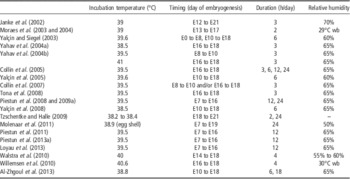
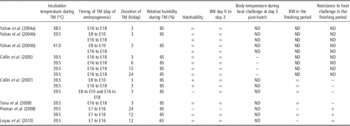
Improvement of embryo’s heat thermotolerance has been the goal of many studies during recent decades (Iqbal et al., Reference Iqbal, Decuypere, Abd El Azim and Kühn1990; Piestun et al., Reference Piestun, Shinder, Ruzal, Halevy, Brake and Yahav2008; Yahav, Reference Yahav2009; Druyan et al., Reference Druyan, Piestun and Yahav2012; Loyau et al., Reference Loyau, Berri, Bedrani, Métayer-Coustard, Praud, Duclos, Tesseraud, Rideau, Baéza, Chartrin, Hennequet-Antier, Everaert, Yahav, Mignon-Grasteau and Collin2013). The hypothesis on which these studies were based highlighted the positive effects of increasing incubation temperature on the long-lasting improvement of thermotolerance. Cyclic changes in incubation temperature have the advantage of partially mimicking natural incubation conditions of avian species (Piestun et al., Reference Piestun, Shinder, Ruzal, Halevy, Brake and Yahav2008). Several studies testing different thermal conditions during incubation of eggs to improve thermotolerance also examined their consequences on production performance. They investigated the sensitive periods of embryogenesis during which the thermoregulatory threshold response was susceptible to be manipulated, without affecting hatchability or growth. Three main factors must be considered during the application of TM: (a) the critical period; (b) the level to which temperature is increased; and (c) the daily duration of temperature elevation (Yahav, Reference Yahav2009). Breeder age also has to be considered (Yalçin et al., Reference Yalçin, Özkan, Çabuk, Buyse, Decuypere and Siegel2005). The different strategies used for TM of embryos are summarized in Table 1. Periods of TM from very early embryogenesis (E0 to E8; Yalçin and Siegel, Reference Yalçin and Siegel2003) to the last days of incubation (E21; Janke et al., Reference Janke, Tzschentke, Höchel and Nichelmann2002) have been tested; the fluctuations applied for incubation temperatures ranged from 38.2°C (Tzschentke and Halle, Reference Tzschentke and Halle2009) to 41°C (Yahav et al., Reference Yahav, Sasson-Rath and Shinder2004b), relative humidity (RH) was increased in some studies and the duration of cyclic increases per day were from 2 (Tzschentke and Halle, Reference Tzschentke and Halle2009) to 24 h/day (Piestun et al., Reference Piestun, Shinder, Ruzal, Halevy, Brake and Yahav2008). The effects of different TM are summarized in Table 2 in terms of hatchability, body temperature at day 3 and at marketing age, and long-lasting thermal resistance.
Studies presenting the fine tuning of thermal manipulation during embryogenesis

wb=wet bulb temperature, measurement of relative humidity in some incubators.
Different parameters taken into account are the critical period of embryogenesis, the level and the duration of thermal changes.
Comparison of the effects of growth performance and thermotolerance parameters between control and thermally manipulated chickens during embryogenesis

TM=thermal manipulation; E=embryonic day; ND=no data for this study; ‘=’ = no significant difference between control and thermally manipulated chickens during embryogenesis for the parameter studied, +=higher value for thermally manipulated chickens during embryogenesis than those of controls for the parameter studied, −=lower value for thermally manipulated chickens during embryogenesis than those of controls for the parameter studied.
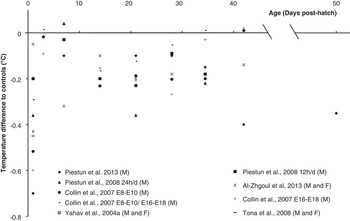
First, the critical period of TM during embryogenesis has to be determined. Several studies have tested increases in incubation temperature before embryonic day 10 (E10; Yahav et al., Reference Yahav, Collin, Shinder and Picard2004a; Collin et al., Reference Collin, Berri, Tesseraud, Requena, Cassy, Crochet, Duclos, Rideau, Tona, Buyse, Bruggeman, Decuypere, Picard and Yahav2007; Piestun et al., Reference Piestun, Shinder, Ruzal, Halevy, Brake and Yahav2008), during the phase before the adrenal axis regulating the stress response of animals is established. The period following E13 was also explored (Moraes et al., Reference Moraes, Malheiros, Bruggeman, Collin, Tona, Van As, Onagbesan, Buyse, Decuypere and Macari2003 and Reference Moraes, Malheiros, Bruggeman, Collin, Tona, Van As, Onagbesan, Buyse, Decuypere and Macari2004; Yahav et al., Reference Yahav, Sasson-Rath and Shinder2004b; Collin et al., Reference Collin, Picard and Yahav2005), because it precedes the phase during which the production of T3, that is involved in the stimulation of heat production, significantly increases. These studies undertaken in meat-type chickens yielded interesting results in the short term such as induction of significant decreases in body temperature post-hatching and up to day 28 of age (Collin et al., Reference Collin, Berri, Tesseraud, Requena, Cassy, Crochet, Duclos, Rideau, Tona, Buyse, Bruggeman, Decuypere, Picard and Yahav2007). Tona et al. (Reference Tona, Onagbesan, Bruggeman, Collin, Berri, Duclos, Tesseraud, Buyse, Decuypere and Yahav2008) also reported a reduced oxygen consumption of embryos submitted to heat exposure between days E16 and E18 of embryogenesis compared with that of control embryos. However, body temperatures were not different between TM and controls at 42 day post-hatch, and treated broilers exhibited similar to higher mortality than controls when exposed to a heat challenge of 35°C. Similarly, heat exposure of layer embryos during late embryogenesis only affected body temperature up to 8 days of age (Walstra et al., Reference Walstra, Ten Napel, Kemp and Van Den Brand2010). The lack of maintenance of the lower body temperature induced by embryo heat exposure in the long term was thought to be owing to interference with mechanisms controlling growth when the treatment was applied during late embryogenesis (Collin et al., Reference Collin, Berri, Tesseraud, Requena, Cassy, Crochet, Duclos, Rideau, Tona, Buyse, Bruggeman, Decuypere, Picard and Yahav2007). The longer period of development and maturation of thermoregulatory mechanisms, including the hypothalamus–pituitary–thyroid and –adrenal axes, has recently been proposed as the critical period for TM to achieve efficient thermotolerance (Piestun et al., Reference Piestun, Shinder, Ruzal, Halevy, Brake and Yahav2008 and 2009a). Results obtained from Cobb broiler chickens (Piestun et al., Reference Piestun, Shinder, Ruzal, Halevy, Brake and Yahav2008; Loyau et al., Reference Loyau, Berri, Bedrani, Métayer-Coustard, Praud, Duclos, Tesseraud, Rideau, Baéza, Chartrin, Hennequet-Antier, Everaert, Yahav, Mignon-Grasteau and Collin2013) indicated that the critical period for improvement of thermotolerance is between days E7 and E16 of embryogenesis, a period which covers the setting up of both regulatory axes. TM during this period has a long-lasting positive effect on body temperature until day 70 of age (Piestun et al., Reference Piestun, Druyan, Brake and Yahav2013a), resulting in improvement in thermal resistance by reducing mortality during heat challenge by 50% in male chickens (Piestun et al., Reference Piestun, Shinder, Ruzal, Halevy, Brake and Yahav2008). Differences in body temperature between control and thermally manipulated chickens are presented in Figure 1. The effects of TM were more often studied in the short term than in the long term, and a greater overall difference in body temperature was observed between controls and TM chickens at hatching than at the end of the growing period.
Post-hatch differential in body temperatures between control and thermally manipulated chickens during embryogenesis, measured at different ages. Temperature of control chickens who received a standard incubation was subtracted from that of those who received thermal manipulation at different ages. M=temperature of males; M and F=temperature of males and females; E=embryonic day.

Second, the level of increase in incubation temperature during embryogenesis has to be accurately tuned. Thermal treatment during incubation of eggs has in many studies been based on repeated increases in incubation temperature up to 39.5°C to improve thermotolerance (v. 37.8°C; Moraes et al., Reference Moraes, Malheiros, Bruggeman, Collin, Tona, Van As, Onagbesan, Buyse, Decuypere and Macari2004; Collin et al., Reference Collin, Berri, Tesseraud, Requena, Cassy, Crochet, Duclos, Rideau, Tona, Buyse, Bruggeman, Decuypere, Picard and Yahav2007; Piestun et al., Reference Piestun, Shinder, Ruzal, Halevy, Brake and Yahav2008; Loyau et al., Reference Loyau, Berri, Bedrani, Métayer-Coustard, Praud, Duclos, Tesseraud, Rideau, Baéza, Chartrin, Hennequet-Antier, Everaert, Yahav, Mignon-Grasteau and Collin2013). A treatment temperature of 41°C appeared to be too high to maintain hatchability as good as in controls (Yahav et al., Reference Yahav, Collin, Shinder and Picard2004a). Simultaneous increase in RH in the incubator from 56% to 65% was investigated in order to maintain regular water evaporation from the egg during temperature increment (Piestun et al., Reference Piestun, Shinder, Ruzal, Halevy, Brake and Yahav2008).
Third, the duration of elevating temperature is a critical parameter to take into account. The effectiveness of TM on embryos is based on alternation between TM and control conditions (for control 37.8°C, 56% RH; Bruzual et al., Reference Bruzual, Peak, Brake and Peebles2000). Duration of TM of 3 h/day avoided the deleterious effects of longer treatments on hatchability. However, in the study by Collin et al. (Reference Collin, Picard and Yahav2005), durations of 6, 12 and 24 h/day were also investigated, with similar short-term effects on body temperature of chicks but decreased hatchability rates. A 10-day treatment with daily exposure of 12 or 24 h improved the long-term heat tolerance in male broiler chickens (Piestun et al., Reference Piestun, Shinder, Ruzal, Halevy, Brake and Yahav2008). Continuous treatment at 39.5°C between days E7 and E16 of embryogenesis significantly lowered hatchability and growth performance post-hatching, whereas 12 h/day at 39.5°C did not change hatchability or growth performance post-hatching (Piestun et al., Reference Piestun, Shinder, Ruzal, Halevy, Brake and Yahav2008).
Finally, the age of the breeders may influence the response of the embryo to TM. A greater reduction in body temperature was reported in thermally treated eggs (from days E8 to E10 of embryogenesis) during recovery from heat challenge at 4 weeks of age when eggs were obtained from 28-week-old breeders than from 58-week-old breeders (Yalçin et al., Reference Yalçin, Özkan, Çabuk, Buyse, Decuypere and Siegel2005). In most of the studies, embryos from young breeder hens (34- to 44-week old) were used for TM (Yahav et al., Reference Yahav, Collin, Shinder and Picard2004a; Piestun et al., Reference Piestun, Shinder, Ruzal, Halevy, Brake and Yahav2008; Loyau et al., Reference Loyau, Berri, Bedrani, Métayer-Coustard, Praud, Duclos, Tesseraud, Rideau, Baéza, Chartrin, Hennequet-Antier, Everaert, Yahav, Mignon-Grasteau and Collin2013).
Taken together, these results suggest that among conditions tested, combining 39.5°C with 65% RH for 12 h/day between days E7 and E16 of embryogenesis is optimal to enhance thermotolerance of broiler chickens without adverse consequence on hatchability.
Short- and long-term effects of thermal treatment during embryogenesis on performance, body composition, meat production and processing quality
Different conditions of TM during embryogenesis have been investigated on the criteria of body temperature, hatchability and thermal resistance. However, a technique applicable in practice must also maintain growth performance of meat-type chickens. Treatments applying 6 or 12 h/day heat exposure to 39.5°C from days E16 to E18 of embryogenesis triggered the initial chick growth (Collin et al., Reference Collin, Picard and Yahav2005). The study of Yalçin et al. (Reference Yalçin, Cabuk, Bruggeman, Babacanoglu, Buyse, Decuypere and Siegel2008) demonstrated a transitory increase in BW in chicks that were heat-treated from days E10 to E18 of embryogenesis (6 h/day at 38.5°C). Exposure to 39.5°C for 3 h/day between days E16 and E18 of embryogenesis did not decrease growth performance up to slaughter age. Furthermore, Collin et al. (Reference Collin, Berri, Tesseraud, Requena, Cassy, Crochet, Duclos, Rideau, Tona, Buyse, Bruggeman, Decuypere, Picard and Yahav2007) did not show any change in feed efficiency or BW at day 28 or day 42 between TM and control chickens. In the latter study, breast meat processing ability (ultimate pH measured 24 h postmortem, drip loss) was not or only slightly affected by TM. Piestun et al. (Reference Piestun, Shinder, Ruzal, Halevy, Brake and Yahav2008 and 2009a) proposed optimal conditions for embryo heat treatment (39.5°C and 65% RH for 12 h/day from E7 to E16 of embryogenesis) in meat-type chickens (Cobb 500) reared in cages. This treatment reduced body temperature until marketing age and increased survival rate during a heat challenge at 35 day, without deteriorating hatchability or growth. However, a recent study demonstrated slightly lower BW (−1.4%) at day 34 in Cobb 500 chickens reared in groups in floor pens and exposed to similar thermal treatment during embryogenesis (Loyau et al., Reference Loyau, Berri, Bedrani, Métayer-Coustard, Praud, Duclos, Tesseraud, Rideau, Baéza, Chartrin, Hennequet-Antier, Everaert, Yahav, Mignon-Grasteau and Collin2013). It is now important to test, and if necessary adapt, these conditions of TM treatment to ensure high hatchability and viability of chickens of other genotypes.
Embryo thermal treatment may also have consequences on body composition and embryo metabolism. Continuous high temperature (40.6°C) from E16 to E18 reduces embryo growth and yolk consumption and is associated with transient changes in carbohydrate and lipid metabolism (Willemsen et al., Reference Willemsen, Kamers, Dahlke, Han, Song, Ansari Pirsaraei, Tona, Decuypere and Everaert2010). Indeed, liver glycogen concentration, triglycerides and fatty acid plasma concentrations were reduced, whereas venous blood glucose and lactate concentrations increased in TM embryos during TM but not during later stages of incubation. Breast muscle yield at marketing age has been described to be greater in TM than in control chickens (Collin et al., Reference Collin, Berri, Tesseraud, Requena, Cassy, Crochet, Duclos, Rideau, Tona, Buyse, Bruggeman, Decuypere, Picard and Yahav2007; Piestun et al., Reference Piestun, Halevy, Shinder, Ruzal, Druyan and Yahav2011; Loyau et al., Reference Loyau, Berri, Bedrani, Métayer-Coustard, Praud, Duclos, Tesseraud, Rideau, Baéza, Chartrin, Hennequet-Antier, Everaert, Yahav, Mignon-Grasteau and Collin2013), even up to day 70 of age (Piestun et al., Reference Piestun, Druyan, Brake and Yahav2013a). Such an increase in relative breast muscle weight of TM broilers is probably related to the TM effect on myoblast proliferation (Piestun et al., Reference Piestun, Harel, Barak, Yahav and Halevy2009b) with subsequent effects on myofiber hypertrophy, diameter and/or their number in the Pectoralis major muscle. The stimulation of satellite cell DNA synthesis was also described by Halevy et al. (Reference Halevy, Krispin, Leshem, McMurtry and Yahav2001) after early heat exposure of chicks on day 3 post-hatch (37°C over 24 h). Furthermore, these authors reported a significantly higher breast yield with the postnatal heat treatment at marketing age. Several studies demonstrated a lower fat pad yield in chickens that were thermally treated during embryogenesis both under regular and high ambient temperatures during the growth period (Piestun et al., Reference Piestun, Halevy, Shinder, Ruzal, Druyan and Yahav2011; Loyau et al., Reference Loyau, Berri, Bedrani, Métayer-Coustard, Praud, Duclos, Tesseraud, Rideau, Baéza, Chartrin, Hennequet-Antier, Everaert, Yahav, Mignon-Grasteau and Collin2013). Improvement of thermotolerance via TM could open up interesting prospects in other bird species. In a recent study, TM of turkeys (+1.9°C and +9% RH compared with control) lowered body temperature at hatching and improved the feed conversion ratio (Piestun et al., Reference Piestun, Zimmerman and Yahav2013b). However, further fine tuning of the TM in the turkey is required for treatment optimization to improve thermotolerance.
Thermoregulatory mechanisms induced by TM during embryogenesis
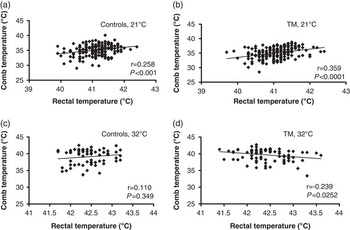
Thermoregulatory mechanisms underlying early heat acclimation are based on heat production, heat loss and the balance between the two. Most studies to date have focused on post-hatched chickens and only a few have elucidated the effects of TM on these mechanisms during incubation and post-hatching. Studies of the effects of TM on heat loss have focused mainly on sensible heat loss during heat challenge post-hatching. These studies demonstrated the effects of TM on the vasodilatation and vasoconstriction of the peripheral blood system, demonstrating a long-lasting effect of TM on the vasomotor response (Yahav et al., Reference Yahav, Shinder, Ruzal, Giloh and Piestun2009). The density of blood vessels in the chorioallantoic membrane and expression of angiogenic genes during embryogenesis was also increased by TM (Pinchuck et al., Reference Pinchuck, Meiri and Yahav2011). Efficiency of TM during a heat challenge may also involve a better dissipation of heat via the comb (Figure 2). In fact, when broiler chickens were reared at 21°C, correlation between comb and rectal temperature was significantly positive, either for controls or TM chickens, with correlation coefficients r=0.26 (P<0.001) and r=0.36 (P<0.0001), respectively. When they were exposed to a heat challenge (32°C for 5 h) there was no correlation between rectal and comb temperatures in control chickens (r=0.11; P=0.35), whereas in TM chickens, these parameters were negatively correlated (r=0.24; P<0.05).
Correlations between rectal and comb temperatures in control and thermally manipulated (TM) broiler chickens at 21°C or during a heat challenge at 32°C at 34 days of age. (a) Correlation coefficient (r and associated P-value) between rectal and comb temperature of control broiler chickens (eggs incubated at 37.8°C and 56% RH continuously) reared at 21°C; (b) correlation coefficient between rectal and comb temperatures of TM broiler chickens (eggs incubated with 12 h/day at 39.5°C and 65% RH between days 7 and 16 of embryogenesis) reared at 21°C; (c) correlation coefficient between rectal and comb temperatures of control broiler chickens exposed to a heat challenge (32°C/5 h); (d) correlation coefficient between rectal and comb temperatures of TM broiler chickens exposed to a heat challenge (32°C/5 h).

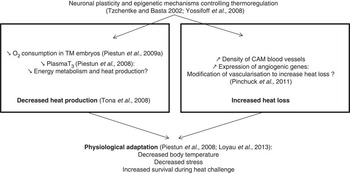
On the other hand, heat production (thermogenesis) and stress responses may have been modified by early thermal exposure (Piestun et al., Reference Piestun, Shinder, Ruzal, Halevy, Brake and Yahav2008), resulting in significant decreases in oxygen consumption, heart rate and egg shell temperature, which is an accurate indicator of embryo body temperature (Piestun et al., Reference Piestun, Halevy and Yahav2009a). Perinatal thermal treatments intend to act through modification of the thermoregulatory threshold responses to changes in ambient temperature. Embryogenesis and the early postnatal period are the most effective at adapting the neuro-endocrine thermoregulatory system. Indeed, this regulatory axis is under development and maturation during embryogenesis, and the feedback mechanism is not yet completed during the 10 days post-hatch. Neurons forming the preoptic area of the anterior hypothalamus (PO/AH) are involved in this adaptation. PO/AH is the center of body temperature control in avian and mammalian species, monitoring both local temperature changes and integrating temperature sensing from the periphery. Electrophysiological studies in the PO/AH have demonstrated that an increase in prenatal incubation temperatures increases the proportion of cold-sensitive neurons and decreases the proportion of warm-sensitive neurons at day 10 post-hatch (Tzschentke and Basta, Reference Tzschentke and Basta2002). The warm-sensitive neurons are predicted by Hammel’s model to regulate the activity of both heat loss and heat production effector neurons (Boulant, Reference Boulant2006). After cold temperature incubation, the proportions of sensitive neurons are reversed. This might contribute to the long-term modification of the individual reference temperature and consequently of the thermoregulatory threshold response of the animal (heat flow, behavior, etc.), thus inducing a faster reaction to post-hatch changes in ambient temperature by efficient thermolysis and/or thermogenesis responses (Collin et al., Reference Collin, Bedrani, Loyau, Mignon-Grasteau, Metayer-Coustard, Praud, De Basilio, Requena Rodon, Bastianelli, Duclos, Tesseraud, Berri and Yahav2011; Figure 3). This hypothesis is supported by the decline in basal plasma concentrations of the thyroid hormone T3, as reported in several studies dealing with perinatal heat manipulation (Yahav and McMurtry, Reference Yahav and McMurtry2001; Yahav et al., Reference Yahav, Sasson-Rath and Shinder2004b; Piestun et al. Reference Piestun, Shinder, Ruzal, Halevy, Brake and Yahav2008; Loyau et al., Reference Loyau, Berri, Bedrani, Métayer-Coustard, Praud, Duclos, Tesseraud, Rideau, Baéza, Chartrin, Hennequet-Antier, Everaert, Yahav, Mignon-Grasteau and Collin2013). Moreover, O2 consumption by embryos submitted to TM during the late phase of embryogenesis was lower than that of control embryos (Piestun et al., Reference Piestun, Halevy and Yahav2009a). In addition, plasma corticosterone concentrations and the blood heterophil/lymphocyte ratio (stress marker) induced by a heat challenge at marketing age were found to be lower in chickens that had been thermally treated as embryos than in their control counterparts (Piestun et al., Reference Piestun, Shinder, Ruzal, Halevy, Brake and Yahav2008; Loyau et al., Reference Loyau, Berri, Bedrani, Métayer-Coustard, Praud, Duclos, Tesseraud, Rideau, Baéza, Chartrin, Hennequet-Antier, Everaert, Yahav, Mignon-Grasteau and Collin2013). Furthermore, in the chicken postnatal TM model, expression of the avian uncoupling protein avian UCP3, successively suggested to be involved in heat production and in limiting oxidative stress, was strongly inhibited (Taouis et al., Reference Taouis, De Basilio, Mignon-Grasteau, Crochet, Bouchot, Bigot, Collin and Picard2002).
Potential mechanisms involved in thermotolerance induced by thermal manipulation of embryos. CAM=chorioallantoic membrane.

The most effective period for exposing embryos to heat treatment is when the thyroid and adrenal axes are establishing. Studies are ongoing to identify the target genes and enzymes affected by TM treatments and potentially responsible for a decrease in thermogenesis and stress response in heat-treated chickens. One underlying mechanism probably involves epigenetic modifications that are possibly mitotically stable but reversible modifications of gene expression and/or phenotypes, without any change in the DNA nucleotide sequence. External stimuli such as environmental temperature increase the neuronal influence and probably the peripheral protein repertoire and ultimately cell properties via activation or silencing of gene transcription, both of which are regulated by epigenetic modifications. The postnatal or embryo heat exposure might modify the chromatin structure in the long term or the methylation status of some DNA regions, regulating the expression of genes involved in thermoregulation. Yossifoff et al. (Reference Yossifoff, Kisliouk and Meiri2008) and Kisliouk and Meiri (Reference Kisliouk and Meiri2009) showed that the hypothalamic expression of the brain-derived neurotrophic factor (BDNF), transcription factor involved in thermal adaptation during the critical period of establishment of thermal control, is regulated by epigenetic mechanisms. These modifications are associated with changes in DNA methyltransferase expression and binding to the BDNF promoter. In another study, BDNF expression was significantly increased in the PO/AH of day 3 postnatal chicks submitted to TM. Late TM during embryogenesis also induced long-lasting changes in heat-induced neuronal hypothalamic c-Fos expression, a marker involved in neuronal changes (Janke and Tzschentke, Reference Janke and Tzschentke2010). However, epigenetic modifications have not yet been explored at the peripheral level after embryo heat manipulation. Moreover, the potential transmission of acquisition of thermotolerance to next generations of chickens has not yet been reported to date.
Conclusion
Techniques manipulating the thermal environment of embryos have potential to be beneficial to poultry production. This treatment would require fine tuning of temperature and RH in the incubator, and adjustment to the genotypes used. If the early heat and cold treatment techniques are, in addition, proven to enhance poultry robustness and welfare, they could be an advantage for large-scale rearing of chickens. Such strategy has been optimized for broiler chickens and turkeys in terms of later response of birds to heat challenge at marketing age. The behavioral responses of chickens and the capacity of embryos to establish regulatory mechanisms lowering internal temperature until marketing age may depend on their parental origin or their genotype, especially during long periods of subsequent heat exposure. Possible interference of breeder nutrition (e.g. feed restriction of broiler breeders) and breeder exposure to various environmental conditions (e.g. ambient temperature) has also to be taken into account. In theory, early TM offers the possibility of reducing heating or air-conditioning costs in poultry houses. These potential reductions have to be estimated through an economic analysis, taking into account farming systems. Finally, thermal exposure of the embryo represents a unique model for investigating the mechanisms underlying the thermoregulatory response and their interactions with growth, body composition and welfare in avian species.
Acknowledgments
Certain studies included in this review were made possible by the financial support of the French Agence Nationale de la Recherche (ANR), Project ‘Jeunes Chercheuses et Jeunes Chercheurs’, ANR-09-JCJC-0015-01, Thermochick. The authors thank S. Crochet, E. Cailleau-Audouin, T. Bordeau, P. Chartrin, L. Bouyer, E. Baéza, S. Boussaid-OmEzzine, N. Couroussé, M. Chabault, M. Sannier, E. Godet, L. Dillet, M. Leduc and other researchers and technicians of INRA, UR83 Recherches Avicoles and UE1295 Pôle d’Expérimentation Avicole de Tours, F-37380 Nouzilly, France, for their contribution to this project, and D. Raine for editing the English language. T. Loyau is funded by the French Ministère de l’Enseignement Supérieur et de la Recherche for undertaking his PhD studies and by ANR.