

For a number of years now, Spain has been one of the countries in Western Europe with the highest incidence of Acquired Immune Deficiency Syndrome, with 1,275 new cases diagnosed in 2009 (Ministerio de Sanidad, Política Social e Igualdad, 2010). Sexual transmission is predominant and was responsible for 57% of new cases of AIDS in 2009; more specifically, 34.7% of individuals who contracted AIDS that year did it through unprotected heterosexual sex (Ministerio de Sanidad, Política Social e Igualdad, 2010).
It is important to highlight the risk of HIV infection among youth, considering that, in 2008, 40% of new HIV infections occurred among individuals aged between 15 and 24 years (United Nations Programme on HIV/AIDS, 2010). Spain is currently the country with the highest prevalence of HIV/AIDS in Western Europe among people aged between 15 and 49 years (Bermúdez & Teva, Reference Bermúdez and Teva2004; Teva, Bermúdez, & Buela-Casal, Reference Teva, Bermúdez and Buela-Casal2009a). Therefore, one of the most immediate dangers for the health of adolescents is that of contracting HIV (Bermúdez, Castro, Madrid, & Buela-Casal, Reference Bermúdez, Castro, Madrid and Buela-Casal2010). According to O’Donnell, O’Donnell, and Stueve (Reference O’Donnell, O’Donnell and Stueve2001), one of the factors that predisposes individuals to a high risk of HIV infection is early sexual initiation, which has shown to be related to a higher number of sexual partners and encounters and less condom use (Dancy, Crittenden, & Ning, Reference Dancy, Crittenden and Ning2010; Yotebieng, Halpern, Mitchell, & Adimora, Reference Yotebieng, Halpern, Mitchell and Adimora2009). In Spain, a number of studies (Bermúdez et al., Reference Bermúdez, Castro, Madrid and Buela-Casal2010; Teva et al., Reference Teva, Bermúdez and Buela-Casal2009a; Cerqueira-Santos, Koller, & Wilcox, Reference Cerqueira-Santos, Koller and Wilcox2008; Teva, Bermúdez, & Buela-Casal, Reference Teva, Bermúdez and Buela-Casal2009b) have determined that the mean age of coital debut is about 14.8 years for females and 15 years for males.
Many studies have related the risk sexual behavior of adolescents with various psychosocial variables. One of the variables of greatest interest for researchers is the influence exerted on adolescents by their peers to adopt more risk sexual behaviors (Muñoz-Silva, Sánchez-García, Martins, & Nunes, Reference Muñoz-Silva, Sánchez-García, Martins and Nunes2009). Similarly, Bauermeister, Elkington, Brackis-Cott, Dolezal, and Mellins (Reference Bermúdez, Herencia-Leva and Uribe Rodríguez2009) concluded that adolescents are influenced by the fact that their peers have sexual relations and consider those who are most sexually active to be more interesting and popular.
In addition, various studies agree that there is a relationship between perceived self-efficacy for risk reduction in sexual relations among youth and adolescents and a lower probability of risk sexual behavior. Bandura (Reference Bandura1990) analyzed perceived self-efficacy for risk reduction and concluded that perceived self-efficacy is the best predictor of risk sexual behavior. Other studies have highlighted that self-efficacy can be modified by factors such as adolescents’ motivation and behavioral skills (Bermúdez, Herencia-Leva, & Uribe Rodríguez, Reference Bermúdez, Herencia-Leva and Uribe Rodríguez2009) or by sensation seeking, given that individuals with higher scores in the Sensation Seeking Scale show lower condom use self-efficacy and vice-versa (Teva, Bermúdez, & Buela-Casal, Reference Teva, Bermúdez and Buela-Casal2011).
Other studies have explored the attitudes of youth towards condom use, how such attitudes influence risk sexual behavior and whether they are related to sensation seeking. According to Noar, Zimmerman, Palmgreen, Lustria, and Horosewski (Reference Noar, Zimmerman, Palmgreen, Lustria and Horosewski2006), lower sensation seeking scores are related to greater condom use and safer sexual relations in general.
Finally, many studies have highlighted the importance of communication between parents and their adolescent children on sexuality as an effective strategy to achieve long-term reduction of risk behaviors among them (Nappi et al., Reference Nappi, Thakral, Kapungu, Donenberg, DiClemente and Brown2009). According to other studies, good communication between adolescents and their parents about sex is associated with later sexual initiation (Bleakley, Hennessy, Fishbein, & Jordan, Reference Bleakley, Hennessy, Fishbein and Jordan2009) and poor communication between adolescents and their parents is associated with less condom use (DiClemente, Reference DiClemente2001).
Based on a literature review, the present study was designed with the main objective of analyzing the differences between a number of psychosocial risk variables for HIV as a function of sexual experience in an adolescent population. This involved assessing four variables related to risk sexual behavior for HIV: 1) perception of peer group norms, 2) condom-use self-efficacy, 3) attitudes towards condom use and 4) parental communication about sexuality, STIs, HIV and pregnancy. The aim was to obtain information about the status of adolescents with regard to these variables that can be used to design sexual health prevention programs adapted to a specific type of sexual experience.
Method
Participants
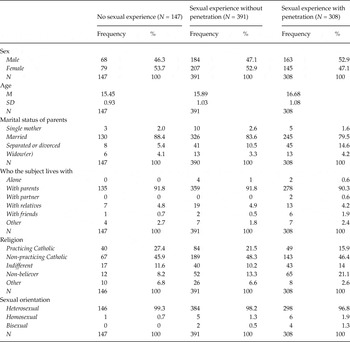
A total of 846 participants were recruited by incidental sampling in the province of Granada, Spain. The sample was composed of participants of both sexes (49.1% male and 50.9% female) aged between 14 and 19 years (M = 16.08; SD = 1.23). The confidence interval was 92%, with a margin of error of 3%. All participants attended public secondary schools in Granada and participated voluntarily in the research after being duly informed. Participants were divided into three groups according to their sexual experience: a) no sexual experience, b) sexual experience without penetration and c) sexual experience with penetration. The remaining sociodemographic characteristics of participants are shown in Table 1.
Data on sociodemographic characteristics and the sexual experience variable

Instruments
-
– Questionnaire on sociodemographic data and type of sexual behavior. This instrument, developed by Bermúdez et al. (Reference Bermúdez, Castro, Madrid and Buela-Casal2010), collects sociodemographic data (age, sex, marital status of parents, who the participant lives with, religious orientation, sexual orientation) and asks participants whether they have had sexual relations and, if so, what kind (with or without penetration).
-
– Questionnaire on parental communication (Wingood & DiClemente, Reference Wingood and DiClemente1998). This 10-item scale collects information about frequency of communication between adolescents and their mother and father on sexuality, condom use, STIs, AIDS and pregnancy (for example, “how often have you talked to your father about how to use a condom?”). Five items assess frequency of communication with the mother and 5 assess frequency of communication with the father. Responses are coded on a 4-point Likert scale, ranging from “0 = Never” to “3 = Often”, with a maximum score of 15 and a minimum score of 0. In the present study, Cronbach’s alpha values were 0.89 for items on communication with the mother and 0.90 for communication with the father.
-
– Questionnaire on attitudes towards condom use (Wingood & DiClemente, Reference Wingood and DiClemente1998). This instrument is composed of 8 items that assess positive attitude towards condom use (for example, “Condoms make you feel safe”). Each item has five response options ranging from “0 = “Totally disagree” to “4 = Completely agree”. Scores range from 0 to 32. In the present study, Cronbach’s alpha was 0.70.
-
– Questionnaire on condom use self-efficacy (Wingood & DiClemente, Reference Wingood and DiClemente1998). It is composed of 9 items that assess condom use self-efficacy (for example, “How difficult would it be for you to use a new condom if you placed it incorrectly?”) with 5 response options depending on the degree of difficulty, from “1 = Not at all” to “5 = A lot”. Scores range from 5 to 40. In the present study, Cronbach’s alpha was 0.90.
-
– Scale on perceptions of peer group norms (Wingood & DiClemente, Reference Wingood and DiClemente1998). This is a 5-item scale that assesses the perception of negative peer group norms regarding safe sexual behavior (for example, “How many of your friends think that it is safe to have sex under the influence of drugs or alcohol?”). Responses are coded on a 5-point Likert scale, ranging from “0 = None” a “4 = All of them”, with a maximum score of 20 and a minimum score of 0. In the present study, Cronbach’s alpha was 0.67.
Procedure
Data were collected from 15 public secondary schools of the city and province of Granada. The researchers contacted 22 randomly selected schools, of which 7 chose not to participate in the study – a rejection rate of 31.8%. The questionnaire was administered collectively by the same researcher to groups of 25 to 30 adolescents, always under the same conditions for all participants. It took participants a maximum of 45 minutes to answer the questionnaire. Participants gave their prior informed consent. Confidentiality and anonymity were guaranteed and the adolescents were informed that their participation was voluntary. No adolescents declined to participate in the study.
Results
Psychosocial variables associated to the variable “type of sexual experience”
First of all, a multiple covariate analysis was performed to determine the relationship between dependent psychosocial variables (parental communication on sexuality issues, condom use, sexually transmitted infections, AIDS and pregnancy, attitudes towards condom use, condom-use self-efficacy and perception of peer group norms) and the independent variable “type of sexual experience”, which divided participants into three groups: a) no sexual experience, b) sexual experience without penetration and c) sexual experience with penetration. As shown in Table 1, the three groups differed in mean age, with statistically significant differences, F = 84.671; p = .001. For this reason, age was introduced as a covariate to eliminate the possible variation caused by age in the dependent variables.
Results showed significant differences between the type of sexual experience groups in the following variables: communication with the mother, attitudes towards condom use, condom use self-efficacy and perception of peer group norms (see Table 2). By contrast, no significant differences were found in the variable “communication with the father”, F = 2, 291; p = .102.
Differences in psychosocial variables as a function of type of sexual experience, controlling for the effect of the age variable

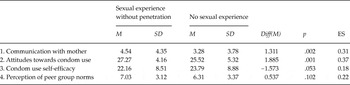
To determine which groups differed with one another, differences between the three levels of the factor “type of sexual experience” were compared a posteriori. This was done by comparing the means obtained in the psychosocial variables by the sexual experience without penetration group and the sexual experience with penetration group with the no sexual experience group.
Results showed that adolescents who had had sexual relations without penetration scored higher in communication with the mother (M = 4.54; SD = 3.28) and positive attitudes towards condom use (M = 27.27; SD = 4.16) than adolescents who had not had sexual relations. However, no significant differences were obtained in the remaining variables (see Table 3).
Difference in psychosocial variables between the groups No sexual experience and Sexual experience without penetration

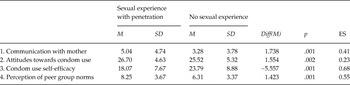
As regards differences between the groups no sexual experience and sexual experience with penetration, adolescents who had had sexual relations with penetration scored higher in communication with the mother, positive attitudes towards condom use and perception of negative peer group norms regarding safe sexual behavior and scored lower in condom use self-efficacy than adolescents who had not had sexual relations (see Table 4).
Difference in psychosocial variables between the groups No sexual experience and Sexual experience with penetration

Discussion
Results showed statistically significant differences between the three groups according to the type of sexual experience in the variables assessed. First, both groups that had sexual experience (with and without penetration) showed greater communication with the mother about sexuality issues compared to the group that had not had sexual relations. These results are consistent with those of numerous studies according to which adolescents tend to communicate more with mothers than with fathers (Moreno, Muñoz, Pérez, & Sánchez-Queija, Reference Moreno, Muñoz, Pérez and Sánchez-Queija2004). This may be influenced by certain characteristics of mothers, since, according to some studies, mothers are perceived as being more understanding and interested in adolescent issues and tend to initiate communication with their adolescent children more often than do fathers. This relationship is also more egalitarian, which facilitates two-way and closer communication (Lanz, Iafrate, Rosnati, & Scabini, Reference Lanz, Iafrate, Rosnati and Scabini1999).
Both groups that had had sexual relations (with and without penetration) scored higher in positive attitudes towards condom use than the group without sexual experience, as found by other studies with Spanish adolescent samples (Castro, Bermúdez, Buela-Casal, & Madrid, Reference Castro, Bermúdez, Buela-Casal and Madrid2010). Several studies have related this finding with the assurance and familiarity with condoms of adolescents who have coital sexual experience (Harvey & Henderson, Reference Harvey and Henderson2006). In addition, if we consider that these two groups showed greater communication with mothers than the group that had not had sexual relations, this better communication may also influence the attitudes of adolescents (Miller, Levin, Whitaker, & Xu, Reference Miller, Levin, Whitaker and Xu1998). Therefore, it would be interesting for future studies to determine whether, as shown by other authors (DiClemente, Reference DiClemente2001; Hadley et al., Reference Hadley, Brown, Lescano, Kell, Spalding, DiClemente and Donenberg2009), communication promotes a positive attitude towards condom use by providing more information about its importance in avoiding unwanted pregnancies and STIs.
Results showed significant differences between the group with sexual experience with penetration and the group without sexual experience in two other psychosocial variables. The first refers to the perception of peer group norms; the group with sexual experience with penetration perceived more negative peer group norms regarding safe sexual behavior than the group without sexual relations. Numerous studies on adolescents’ perception of their sources of information about risk behaviors for HIV have found that friends are considered the most credible sources and set norms of behavior (Bermúdez, Teva, & Buela-Casal, Reference Bermúdez, Teva, Buela-Casal and Liberman2005). In the present study, adolescents who perceive a negative norm regarding safe sexual behavior are those who initiate coital relations. The second psychosocial variable in which differences were found between the group with sexual experience with penetration and the group without sexual experience was the perception of condom use self-efficacy. The group without sexual experience showed higher perception of condom use self-efficacy than the group with sexual experience with penetration. According to Kelly, Murphy, Sikkema, and Kalichman (Reference Kelly, Murphy, Sikkema and Kalichman1993), these results may be explained by two cognitive biases, the “illusion of invulnerability” and “illusory optimism”, which may give adolescents a greater perception of self-efficacy for prevention. Moreover, some studies have concluded that adolescents underestimate both the seriousness of STIs/HIV and their own risk of transmission, perhaps as a defense mechanism (Eng & Butler, Reference Eng and Butler1997). Along these lines, Lameiras, Rodriguez, and Dafonte (Reference Lameiras, Rodríguez and Dafonte2002) argued that risk susceptibility is closely related to the perception of self-efficacy, defined as “the subjective probability that a negative consequence will happen to us”. For this reason, adolescents who have not initiated sexual relations would have a lower subjective probability of something negative happening to them than those who have initiated them, that is, a higher perception of self-efficacy. However, it would be interesting to conduct further studies to determine which variables influence the fact that these adolescents have a higher perception of self-efficacy for prevention. These studies should also verify whether cognitive biases such as those mentioned above affect adolescents differently depending on their sexual experience.
The main contribution of the present study is the fact that it highlights the situation of adolescents who have not initiated sexual relations with regard to the possible risk of HIV and other STIs. Considering that these adolescents are in the age range at which sexual relations with penetration begin, have little communication with their parents and a higher perception of self-efficacy, they are likely to initiate sexual relations without using appropriate preventive strategies. Therefore, the information provided by this study is interesting to generate patterns of intervention that can be used in multi-component prevention programs, that is, prevention programs that use different strategies adapted to the variables that influence risk sexual behavior. These contributions will also be useful to adapt the interventions to different adolescents depending on their sexual experience.
One of the main limitations of this study is the fact that it is not a longitudinal study and therefore cannot be used to make effective predictions. It would be interesting to conduct similar studies with representative samples as a function of sex and age, including adolescents that are not attending school, so as to determine patterns of intervention adapted to the different profiles of adolescents.