INTRODUCTION
Interest in the subject of death has increased among medical professionals and patients, with such questions arising as what form end-of-life care should take and whether patients undergoing cancer treatment should be informed about their diagnosis. Dramatic advances have been made in cancer treatment during recent years, and, if detected early, patients can now hope to achieve remission or live for a much longer period of time. However, since many patients' diseases are incurable and cancer is the leading cause of death (Matsuda et al., Reference Matsuda, Marugame and Kamo2011), patients in Japan still immediately associate a cancer diagnosis with death. Further, as symbolized by the Japanese phrase that translates as “cancer refugees,” providing psychological support to cancer patients involves understanding the psychological processes they undergo in accepting their condition and their death when there is no longer any effective treatment available.
Previous research into views on death includes both qualitative and quantitative studies. Kübler-Ross (Reference Kübler-Ross2009) carried out a notable qualitative inquiry into the process of accepting death. Quantitative studies have primarily dealt with factors relating to medical professionals' and patients' understanding of and anxieties about death and the related factors, the process patients undergo in coming to terms with death, and dealing with the fears surrounding death (Neimeyer et al., Reference Neimeyer, Wittkowski and Moser2004). Fortner and Neimeyer's literature review cites the following factors as linked to greater death anxiety: (1) having a higher number of health problems; (2) having a history of psychological suffering; (3) having less religious faith; and (4) having a weak sense of ego integrity or sense of life satisfaction/resilience (Fortner & Neimeyer, Reference Fortner and Neimeyer1999; Reference Fortner and Neimeyer2010).
Studies into the views about death associated with a patient's health condition were enabled by Feifel's groundbreaking work in the 1960s. The 1970s saw studies focusing on patients at the end of life or those with chronic diseases (e.g., AIDS) or psychiatric disorders (Feifel & Branscomb, Reference Feifel and Branscomb1973; Feifel & Hermann, Reference Feifel and Hermann1973). From the 1980s onward, studies were carried out with patients who were infirm or had diminished physical capabilities, smokers, and patients with serious illnesses. These subjects were shown to have higher levels of anxiety surrounding death compared to the general population (Cicirelli, Reference Cicirelli1999; Mullins & Lopez, Reference Mullins and Lopez1982; Tate, Reference Tate1982; Viney, Reference Viney1983).
Only a limited number of studies have examined views on life and death in cancer patients. Ho and Shin administered the Death Anxiety Questionnaire (DAQ) to Chinese cancer patients to study death anxiety and its associated defense mechanisms. They found that, compared with the control group (patients with hand injuries), the cancer patient group demonstrated either higher or lower levels of anxiety (Ho & Shiu, Reference Ho and Shiu1995). Cella and Tross (Reference Cella and Tross1987) conducted a study using the DAQ among patients with Hodgkin's disease and those with cancer. They found a positive correlation between death anxiety and generalized anxiety disorder, depression, somatic symptoms, and general psychological suffering. Gonen and coworkers (Reference Gonen, Kaymak and Cankurtaran2012) also utilized the DAQ to measure death anxiety and considered how this related to performance on a structured clinical interview for the DSM–IV, the Hospital Anxiety and Depression Scale, the Distress Thermometer, and pain VAS scores. They found death anxiety in cancer patients to be related to anxiety and depression, as well as to the belief that death is imminent.
Research in Japan related to views on death include analyses of ordinary people from a developmental perspective and studies focusing on views about life and death among specific groups (e.g., nurses and nursing students). For example, Kawai (Reference Kawai2004) considered elderly people, Tange (Reference Tange2004; Reference Tange2009) studied adolescence and adulthood, and Nakamura and coworkers (Reference Nakamura1994) looked at children aged 3 to 13. Kawai (Reference Kawai2004) studied attitudes toward death among 315 men and women aged 60 and over and found that elderly people in Japan had higher levels of death anxiety or fear compared with other countries, and that their fears primarily concerned the suffering that they might experience at the time of death, rather than a fear of death itself (Kawai, Reference Kawai2004). Tange (Reference Tange2004) showed a decrease in both negative attitudes toward death and positive attitudes toward life among junior and senior high school pupils. Studies of nurses and nursing students have shown that death anxiety and fear are relatively higher in both qualified and student nurses, and that they also have a low tendency for death avoidance (Ishida, Reference Ishida2007). However, almost no studies have been carried out on views about life and death among Japanese cancer patients.
An additional consideration is that most of the quantitative studies on the views about death carried out in Japan employed translations of Western scales. This means that most of the scales were compiled within the cultural framework of Christianity, which, it has been argued, is not sufficient to provide an understanding of Japanese people's attitudes toward death. In response, Hirai (Reference Hirai2000) developed a scale for the purpose of better understanding views on death within the Japanese context. This scale is composed of seven subscales relating to attitudes about death: existence of an afterlife; fear or anxiety surrounding death; death as a release; avoidance of death; sense of purpose in life; interest in death; and existence of a predetermined lifespan. This questionnaire is remarkable in that it focuses on the positive aspect of a sense of purpose rather than solely concentrating on the negative aspects of fear and anxiety.
To summarize, there are not enough quantitative studies on the views about death that employ scales developed specifically for the Japanese context. There are also very few studies of the views on death among cancer patients in Japan. Our study utilizes a scale developed in Japan by Hirai to investigate views on death among Japanese cancer patients, and to examine how these views correlate with age, sex, and physical condition. To further demonstrate patients' views on death and perceptions of end-of-life care, we also investigate how these views are related to where patients would like to spend their final days and whether they would like to be told how long they have left to live. In furthering our understanding of how cancer patients view death, this study may make it possible to enhance the delivery of palliative care to Japanese cancer patients.
METHODOLOGY
Participants
We targeted 450 cancer patients receiving outpatient treatment in the radiology department at the University of Tokyo Hospital. Their doctors directly explained to patients, orally and in writing, the purpose of our study and what it would involve. We received written consent from 310 patients (average age ± SD = 61.9 ± 13.8 years; men = 58.7%).
Survey Methodology
Between January and August of 2008, we distributed questionnaires among the cancer patients who had provided written consent. The completed questionnaires were either returned by post or turned in to their doctor during subsequent outpatient appointments. The study was conducted with the approval of the ethical review board of the Faculty of Medicine at the University of Tokyo.
Survey Questions
Regarding Attitudes Toward Death
We employed the Death Attitudes Inventory (DAI) developed by Hirai (Reference Hirai2000) to measure attitudes toward death. This instrument includes seven subscales (view on an afterlife; death anxiety/fear; death as a release; avoidance of death; sense of purpose in life; interest in death; view on a predestined lifespan). The subscales are interpreted as follows: (1) a higher score on “view on an afterlife” shows a stronger belief in the existence of life after death; (2) a higher score on “death anxiety/fear” shows a greater fear of death or a stronger propensity for thoughts of death to trigger anxiety; (3) a higher score on “death as a release” shows a stronger sense of death as a release from pain and suffering; (4) a higher score on “avoidance of death” shows a stronger tendency to avoid thinking about death; (5) a higher score on “sense of purpose” shows that the patient has found a clearer sense of purpose or a goal in their life; (6) a higher score on “interest in death” shows a more frequent tendency to think about one's own death or the death of members of one's social circle; and (7) a higher score on “view on a predestined lifespan” shows a stronger belief that our lifespan is determined from the outset or that our life and death are determined by an invisible force (fate, a divine being, etc.). Subscales 1–6 comprise four questions (4–28 points); only subscale 7 is made up of three questions (3–21 points). Responding to these 27 questions requires participants to undergo a seven-stage self-assessment.
Regarding Perceptions of End-of-Life Care
To examine perceptions of end-of-life care, we created a dedicated list of questions considering where patients wanted to spend their final days. One question was phrased as follows: “If you were in a situation where physical symptoms such as pain and suffering had been alleviated, but you were unable to look after yourself, where would you prefer to spend your final days?” Respondents were asked to choose from three options: at home, in the hospital where they had been receiving treatment, or in a hospice or palliative care unit (PCU). We also asked about wishes concerning life-expectancy disclosure: “How would you prefer your doctor to explain how many years you have left to live?” Three possible answers were provided: “I don't want to know,” “I only want to be told if I ask,” and “I would like to know, but want the doctor to check with me first. For example, I would like the doctor to ask me whether I would like to be told approximately how much time it is estimated that I have remaining” (hereinafter, “I would like the doctor to ask me”), and “I would like the doctor to explain in detail.”
Regarding Participant Backgrounds
We obtained participants' background information from their patient charts: sex, age, physical condition (presence of metastasis), Karnofsky performance status (KPS), and treatment purpose.
Analysis Methodology
We first calculated frequencies and percentages for average age ±SD and age range, sex, presence of metastases, KPS, and purpose of treatment. For KPS we divided the scores into three categories based on the scoring manual: 90–100 (able to carry on normal activity or do active work), 80 (able to carry on normal activity/active work with effort), and 70 or lower (unable to carry on normal activity or do active work). We divided treatment purpose into four categories: follow-up, permanent cure, palliative, and pretreatment.
We next calculated frequencies and percentages for responses to each of the Death Attitudes Inventory questions (from “strongly disagree” to “strongly agree”). We also calculated average scores (±SD) for each of the seven subscales, as well as average scores (±SD) for age (≥65 vs. <65), sex (male vs. female), metastases (present vs. not present), KPS (≥70 vs. <70), and treatment stage (pretreatment, permanent cure, palliative, or follow-up). We next performed an independent samples t test for age (≥65 vs. <65), sex (male vs. female), metastasis (present vs. not present), and KPS (≥70 vs. < 70). For each of the seven subscales, we performed a one-way ANOVA for treatment stage (pretreatment, permanent cure, palliative, and follow-up) followed by a Tukey multiple-comparisons test. We then performed a multiple regression analysis on each of the seven subscales, setting the background factors (age, sex, metastasis, KPS, and treatment stage) as independent variables and subscale scores as the dependent variables. For the multiple regression analysis, we employed the forced-entry method, setting the treatment stage of permanent cure as the dummy variable.
We next divided scores for each of the seven subscales into two groups based on the median score: participants scoring between 4 and 16 were considered the low group, while participants scoring between 17 and 28 were placed in the high group. The exception was the subscale “view on a predestined lifespan.” (Since this comprises only three questions, we based it on the median of scores and assigned scores between 3 and 12 to the low group and scores between 13 and 21 to the high group.) We then wanted to find out whether frequencies differed depending on where patients wished to spend their final days. We calculated the frequency for the high and low groups and performed a chi-square test on each of the subscale scores, comparing the DAI group (high or low group) and where they wanted to spend their final days (home, hospital, or palliative care unit). Similarly, to determine whether frequencies differed depending on life-expectancy disclosure preferences, we performed a chi-square test on each of the subscale scores, comparing the DAI group (high or low) and patients' life-expectancy disclosure preferences (“don't want to know,” “would like to be told if I ask,” “would like the doctor to ask me,” and “would like the doctor to explain in detail”). We utilized SPSS (v. 19.0) software for the data analysis.
RESULTS
Participant Backgrounds
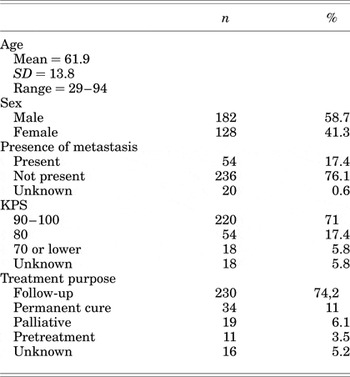
Of the 450 patients approached, we received responses from 310 (69% collection rate). The age, sex, and physical condition of participants are given in Table 1. Metastasis was present in 76.1% of participants, most had a KPS score between 90 and 100 (71%), and most were receiving treatment for follow-up purposes (74.2%).
Participant characteristics (n = 310)

Death Attitudes Inventory Scores
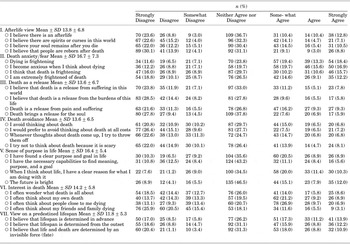
We calculated the average values (±SD) for each of the seven subscales on the Death Attitudes Inventory (Table 2). The average score for “afterlife view” was 13.8 (6.8), which fell between “neither agree nor disagree” and “somewhat disagree.” “Death anxiety/fear” had an average score of 16.7 (7.3), which fell between “neither agree nor disagree” and “somewhat agree.” The average score for “death as a release” was 13.7 (6.9), falling between “neither agree nor disagree” and “somewhat disagree,” while the average score for “avoidance of death” was 13.6 (6.5), also falling between “neither agree nor disagree” and “somewhat disagree.” “Sense of purpose” scored 16.4 (5.4), which fell between “neither agree nor disagree” and “somewhat agree.” The average score for “interest in death” was 14.2 (5.8), which fell between “neither agree nor disagree” and “somewhat disagree.” Finally, the average score for predestined lifespan was 11.6 (5.3), which fell between “somewhat disagree” and “neither agree nor disagree.”
Distribution of scores for views on life and death

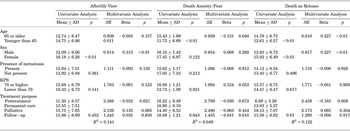
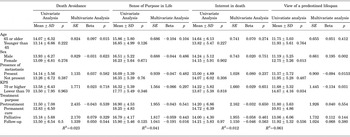
Regarding Background Factors and Subscale Scores
Tables 3 and 4 present, respectively, the results of the t test and one-way ANOVA for background factors and the results of the multiple regression analysis with background factors as independent variables, performed on scores for each subscale of the DAI. The results of the t test and one-way ANOVA demonstrated that, for “afterlife view,” the under-65 group (14.75 ± 6.96) scored significantly higher than the 65-and-over group (12.74 ± 6.47) (t = 2.548, df = 292, p = 0.011); women (16.18 ± 6.28) scored significantly higher than men (12.09 ± 6.66, t = 5.316, df = 292, p < 0.01); and no significant difference was found in scores for metastasis, KPS, or treatment stage. The results for “fear of death” showed that the under-65 group (17.73 ± 6.69) scored significantly higher than the 65-and-over group (15.43 ± 7.69, t = 2.685, df = 280, p < 0.01); the group with KPS scores 70 or over (16.88 ± 7.21) scored higher than the group with KPS scores lower than 70 (12.73 ± 7.09, t = 2.168, df = 280, p = 0.03); and no significant difference was found in scores for sex, metastasis, or treatment stage. On “death as a release,” the 65-and-over group (14.79 ± 6.73) scored higher than the under-65 group (12.61 ± 6.57, t = 2.760, df = 282, p < 0.01); women (15.02 ± 6.49) scored higher than men (12.63 ± 6.72, t = 2.794, df = 282, p < 0.01); and no significant difference was found in scores for metastasis or KPS. The ANOVA for treatment stage found a significant difference in scores (F 3,266 = 3.822, p = 0.01), with a post-hoc test showing that the groups receiving treatment for the purpose of follow-up (13.56 ± 6.82), permanent cure (13.83 ± 5.37), and palliative care (16.13 ± 7.07) scored significantly higher than the pretreatment group (6.89 ± 3.29). On “predestined lifespan view,” women (12.75 ± 5.26) scored significantly higher than men (11.19 ± 5.25, t = 2.503, df = 291, p = 0.013); the group with KPS scores less than 70 (14.67 ± 4.16) scored significantly higher than the group with KPS scores 70 or over (11.68 ± 5.32, t = 2.136, df = 291, p = 0,034); and no significant difference was found in scores for age, metastasis, or treatment stage.
Results of the t test and multiple regression analysis with background factors on scores for each subscale of the Death Attitudes Inventory (afterlife view, death anxiety/fear, death as a release)

Results of the t test and multiple regression analysis with background factors on scores for each subscale of the Death Attitudes Inventory (death avoidance, sense of purpose in life, interest in death, view on a predestined lifespan)

The multiple regression analysis produced a multiple regression model for “afterlife view” of R 2 = 0.141 (F 7,264 = 6.261, p < 0.01), with only sex showing a significant difference; “fear of death” R 2 = 0.049 (F 7,252 = 2.206, p = 0.034), with only age showing a significant difference; and “death as a release” R 2 = 0.122 (F 7,254 = 5.998, p < 0.01), with age, sex, and pretreatment stage showing a significant difference. The result for avoidance of death was R 2 = 0.023 (F 7,259 = 0.780, p = 0.605), with no factors showing a significant difference; “sense of purpose” R 2 = 0.041 (F 7,252 = 1.318, p = 0.242), with only the follow-up treatment stage showing a significant difference; “interest in death” R 2 = 0.012 (F 7,260 = 0.372, p = 0.918), with no factors showing a significant difference; and “predestined lifespan view” R 2 = 0.061 (F 7,263 = 2.963, p < 0.01), with sex and KPS showing a significant difference.
Death Attitudes Scores and Preferred Place to Spend Final Days
We performed a chi-square test for each of the seven subscale scores to compare DAI groups (high or low) in terms of where they wanted to spend their final days (home, hospital, or palliative care unit [PCU]). These results yielded a significant difference only for “sense of purpose” score (χ2 = 8.112, p = 0.017). The high group for “sense of purpose” showed the following preferences for where they wished to see out their life: home (57.6%), hospital (13.6%), and PCU (28.8%). The preferences for the low group were home (42.3%), hospital (23.8%), and PCU (33.9%). Bias in the frequencies was identified for both groups.
Death Attitudes Scores and Life-Expectancy Disclosure Preferences
We performed a chi-square test to compare the DAI groups (high or low) and patients' life-expectancy disclosure preferences (“don't want to know,” “would like to be told if I ask,” “would like the doctor to ask me,” and “would like the doctor to explain in detail”). These results yielded a significant difference only for “fear of death” (χ2 = 8.245, p = 0.041). The high group for “fear of death” showed the following preferences for life-expectancy disclosure: don't want to know (8.3%), would like to be told if I ask (34.5%), would like the doctor to ask me (17.2%), and would like the doctor to explain in detail (45.8%). The preferences for the low group were as follows: “don't want to know” (6.2%), “would like to be told if I ask” (21.1%), “would like the doctor to ask me” (23.0%), and “would like the doctor to explain in detail” (49.7%). Bias in the frequencies was identified in both groups.
DISCUSSION
Views on Death in Cancer Patients: Overall Trends
Let us first look at each of the seven DAI subscales. Death anxiety/fear and sense of purpose were rated as “somewhat agree” (16.7 and 16.6 points, respectively). Afterlife view, death as a release, death avoidance, interest in death, and view on a predestined lifespan were all rated as “somewhat disagree” (13.8, 13.6, 13.6, 14.2, and 11.8 points, respectively). These results suggest that, while cancer patients experience fear in the face of inescapable death and feelings of isolation, death is certainly not only about fear and anxiety; there is another side, which is about escaping into death and wanting to make the most of the time they have left. In Nakagawa's (Reference Nakagawa2012) study of a random sample of 1,180 people from the general population, death anxiety/fear and sense of purpose were rated as “somewhat agree” (17.5 and 16.1 points, respectively). Afterlife view, death as a release, death avoidance, interest in death, and view on a predestined lifespan were rated as “somewhat disagree” (15.4, 13.0, 13.1, 13.8 and 11.3 points, respectively). This demonstrates that there is no difference between the general population and cancer patients in terms of overall DAI score. Derogatis and colleagues (Reference Derogatis, Morrow and Fetting1983) found that 32% of cancer patients meet the diagnostic criteria for an adjustment disorder, 6% for depression, and 4% for delirium. Among these, a higher prevalence rate of psychological problems was found after disclosure of the diagnosis. Chochinov and coworkers (Reference Chochinov, Wilson and Enns1995) also found that suicide ideation (wanting to die or feeling that life is not worth living) among end-of-life cancer patients was not uncommon, with more than half in a depressive state. Most of the cancer patients in our study were cancer survivors in the follow-up stage of their treatment; only a small number were recently diagnosed or undergoing treatment. Even if they had become conscious of death when they were diagnosed with cancer, cancer patients were coming to see cancer as a chronic disease with critical episodes, rather than necessarily a death sentence (Aziz & Rowland, Reference Aziz and Rowland2003; Sprague et al., Reference Sprague, Dittus and Pace2013). As a result, no difference was found between cancer patients and the general population in terms of fear and anxiety associated with death.
Relation Between Views on Death and Age, Sex, and Physical Condition Among Cancer Patients
We next considered views on death among cancer patients with respect to age, sex, and physical condition (metastasis, KPS, and treatment stage). We found a significant difference in afterlife view depending on age and sex, with a greater belief in an afterlife found in cancer patients younger than 65 compared with those 65 and older, as well as in women compared to men. These results support the findings of Kaneko (Reference Kaneko1994), who showed that women in general have a stronger tendency to believe that there is an afterlife and that they will be able to start again in the next life. We could argue that this sense of a belief in an afterlife and acceptance of fate works to reduce fear of death in women. Further, our results showing a greater belief in an afterlife among cancer patients younger than 65 support the findings of Tomimatsu (Reference Tomimatsu2012), who reported a greater belief in the existence of an afterlife during adolescence than in old age. This could be attributed to older people tending to accept death and see it as the final stage of life. Cancer patients in mid and late adolescence, on the other hand, in their current, stable state, see death as a remote event and tend to see it in the vague and distant future in the same way as the general healthy population (Tomimatsu, Reference Tomimatsu2012).
Our results showed a higher level of death anxiety/fear in cancer patients younger than 65 compared to those 65 and older, as well as in those with KPS scores 70 or higher compared to those with scores lower than 70. Tange (Reference Tange2004) showed that fear of death is strongest during middle adulthood, and that it wanes and we tend to gradually come to accept death during late adulthood. Gesser and colleagues (Reference Gesser, Wong and Reker1987), who also studied the relationship between age and fear of death, found a curvilinear relationship, with fear and anxiety surrounding death being relatively high during adulthood, peaking in middle to late adulthood, and at its lowest point during old age. The results of our study that death anxiety/fear is higher in cancer patients younger than 65 reflect the findings of Tange and Gesser and coworkers. The increased death anxiety and fear during middle to late adulthood could be attributed to the risks associated with dying from cancer at a time when most people are preoccupied with their careers or raising children. A new insight provided by our study is that cancer patients with KPS scores lower than 70 are more likely to be coming to terms with death and have less fear and anxiety, even though they are unable to carry on normal activities or to do active work, and death may be imminent.
With regard to death as a release, a significant difference was identified for age, sex, and treatment stage. We found more of a sense of death as a release from suffering in cancer patients 65 and older compared with those younger than 65, in women compared to men, and in those at the permanent cure, palliative, or follow-up stage in their cancer treatment compared with those at the pretreatment stage. Tomimatsu and colleagues (Reference Tomimatsu2012) showed that women take a more sincere and earnest approach to death, and their findings suggest that women are more likely to see death as a release from pain and suffering. We also found that it was easier for cancer patients at the permanent cure, palliative, or follow-up stage to accept death as a release compared to those in pretreatment. It can be surmised that pretreatment cancer patients have yet to develop an acceptance since the cancer was discovered only a short time ago. It can therefore be inferred that this is why they are not in a state of accepting death as a release. From a developmental perspective, we can infer that elderly people see death as a release to a greater extent than the general population. According to Erikson's life-stage theory, the psychosocial developmental challenges that we confront from infancy onward are reconciled during adolescence in the form of a search for our role in society, which is when our identity is established. Later, in old age, we come to accept responsibility for our life (Erikson, Reference Erikson1980). According to Levinson's theory of developmental stages, as well, it is during old age—having overcome midlife crises—that we achieve the sense of freedom that comes with making peace with ourselves (Levinson, Reference Levinson1990). Therefore, elderly people seeing death as a release could be considered as having reached the developmental life stage where they accept death as the terminal point in life, and that it makes no difference whether they are healthy or have cancer.
With regard to view on a predestined lifespan, a significant difference was identified for sex and KPS. Our results showed a greater belief in a predestined lifespan in female cancer patients compared with males, as well as in those with KPS scores lower than 70 compared to those with scores 70 and higher. In other words, women to a greater extent than men view our lifespan as determined by an invisible force (fate, a divine being, etc.). Aihara and colleagues (Reference Aihara, Sato and Hashimoto2004) conducted an interview among chronically ill patients who had been informed of their diagnosis. They reported that believing in a predestined lifespan was a way of accepting their diagnosis as part of the cycle of life and death, thus preparing themselves mentally for death. This suggests that our view on a predestined lifespan changes as the disease progresses.
Views on Death and Perceptions of End-of-Life Care
The results on where patients wished to spend their final days in relation to sense of purpose showed a higher frequency of patients preferring to be at home in the high group, where 57.6% elected home and 13.6% hospital, while in the low group 42.3% elected home and 23.8% hospital. This demonstrates that cancer patients with a greater sense of purpose in life tend to choose their home as the preferred place to spend their final days. Wishing to spend their final days at home can be interpreted as their wanting to live a better life in their own way and with more autonomy through until the end. It is also related to findings from interviews conducted by Sonoda (Reference Sonoda2008) among lung cancer patients, who reported wanting to live in their own way during their final days, and those of Ushida (Reference Ushida2007) among late-stage elderly cancer patients, who saw it as waiting for the end as just part of ordinary, everyday life. This demonstrates that people with a sense of purpose in life tend to want to continue to be themselves until they die.
Our results on views on death and life-expectancy disclosure showed that a higher frequency of those in the high fear of death group “only want to be told if asked” (34.5% for the high group and 21.1% for the low group). This demonstrates that cancer patients with a greater fear of death are more hesitant to hear about life expectancy, and that they tend to only want to be informed if they themselves ask. For cancer patients, being informed about life expectancy means once again facing up to their impending death, and our findings show that people who fear death prefer to be informed only when they have prepared themselves. Since the 1990s, we have seen advances in research and practice relating to doctor–patient communication and how to communicate bad news (diagnosis and life-expectancy disclosure). A considerate approach is recommended when communicating bad news to patients who take the stance “I would like to know, but want the doctor to ask first. For example, I would like the doctor to ask me whether I would like to be told approximately how much time is estimated I have remaining.” Our study demonstrates the importance of taking into account how fearful the patient is of death.
CONCLUSION
There are several limits to our study. First, the participants were all cancer patients attending one radiology department at a university hospital, with most at the follow-up stage and with a view to achieving a complete cure. Further research is needed to give further consideration to the views of terminal cancer patients.
Most studies focusing on Japan-specific views on life and death look at generational differences or are conducted among students. Studies that consider state of health in relation to views on life and death are also virtually nonexistent. Our study is significant in that it considers views on death among cancer patients from the perspectives of age, sex, and where they would like to spend their final days. However, since we only looked at university hospital in- and outpatients and did not include cancer patients attending general hospitals or clinics, there are limits on the extent to which we can generalize from our results. In addition, since this is a cross-sectional study, we were unable to show how patients' views on life and death changed over time. Since it is possible that views about death are affected by deteriorating health or changes in treatment strategies, further research is needed to examine such changes over time.
Although many people in Japan would prefer to die at home, in reality this only occurs in around 15% of cases, with 80% or more dying in a general hospital (Fukui, Reference Fukui, Yoshiuchi and Fujita2011). Going forward, if we can further investigate where patients would like to spend their final days and the related factors, and feed this back to clinical practice, this should help to enable patients to die in the way that they wish.
Our study has shown that, although views on death among cancer patients may differ according to sex and age, taking these factors into account when understanding their views can be useful in predicting where a patient may wish to spend their final days.