Borderline personality disorder (BPD) is a severe mental illness characterized by dysregulation across affective, behavioral, cognitive, and interpersonal domains (American Psychiatric Association, 2013). BPD can onset as early as adolescence, a sensitive window for socioemotional development (Schriber & Guyer, Reference Schriber and Guyer2016). Importantly, even subclinical levels of BPD symptoms (“BPD features”) during adolescence are associated with poor interpersonal and occupational functioning (Thompson, Jackson, et al., Reference Thompson, Jackson, Cavelti, Betts, McCutcheon, Jovev and Chanen2018). It is therefore necessary to understand mechanisms associated with the severity and exacerbation of BPD features during this developmental period of high risk. BPD is theorized to develop when children with biological vulnerability experience non-supportive social contexts (Crowell et al., Reference Crowell, Beauchaine and Linehan2009; Linehan, Reference Linehan1993).The current study tested the independent and interactive effects of biological indices of vulnerability (i.e., cardiac autonomic response) and experiences of non-supportive and supportive parental responses to youth negative emotions as predictors of severity and exacerbation of youths’ BPD features during the transition to adolescence.
The transition to adolescence is a sensitive period for the development of BPD
Adolescence is a unique developmental window during which biological maturation and changes in the social network coincide to create a critical etiological period for a range of psychopathology (Cicchetti & Rogosch, Reference Cicchetti and Rogosch2002), including BPD (Sharp et al., Reference Sharp, Vanwoerden and Wall2018; Sharp & Wall, Reference Sharp and Wall2018). Specifically, brain regions and systems responsible for the regulation of emotion and behavior mature rapidly during adolescence (Spear, Reference Spear2000; Steinberg, Reference Steinberg2005), resulting in heightened emotional and behavioral reactivity and increased sensitivity to social context (Schriber & Guyer, Reference Schriber and Guyer2016). These changes contribute to adolescence being a time of greater susceptibility to negative events, particularly those occurring within relationships with strong personal relevance (e.g., parent-child relationship).
In addition to the biological changes characteristic of adolescence, this period is also characterized by a social reorientation. Adolescents navigate increased social network complexity, individuation from parents, and formation of romantic relationships. Altogether, these factors contribute to increased conflict in the family during early adolescence (Arnett, Reference Arnett1992). Adolescents strive for autonomy and a more egalitarian relationship with their parents (Pinquart & Silbereisen, Reference Pinquart and Silbereisen2002), which, combined with their still-developing regulatory capacity, leads to more frequent parent-child conflict (Branje, Reference Branje2018). While this is a normative process that can ultimately function to facilitate youths’ development, parent-child conflict that is predominantly unresolved, marked by intense negative arousal, or occurs without the context of a supportive parent-child relationship can contribute to maladaptation (Adams & Laursen, Reference Adams and Laursen2007; Huey et al., Reference Huey, Hiatt, Laursen, Burk and Rubin2017; Moed et al., Reference Moed, Gershoff, Eisenberg, Hofer, Losoya, Spinrad and Liew2015; Weymouth et al., Reference Weymouth, Buehler, Zhou and Henson2016). Thus, parent-child conflict represents an especially salient social context for this developmental phase, and understanding youths’ internal experiences (i.e., heightened physiological reactivity) during these conflicts has value for predicting trajectories of BPD features.
Importantly, specific parent behaviors, such as the way parents respond to their child’s negative emotions have also been linked to severity and exacerbation of BPD features across this period (Dixon-Gordon et al., Reference Dixon-Gordon, Whalen, Scott, Cummins and Stepp2015; Vanwoerden et al., Reference Vanwoerden, Kalpakci and Sharp2017, Reference Vanwoerden, Byrd, Vine, Beeney, Scott and Stepp2022; Whalen et al., Reference Whalen, Scott, Jakubowski, McMakin, Hipwell, Silk and Stepp2014). Unsupportive responses (i.e., invalidation) appear to be a key process related to BPD development and refer to communication that a child’s emotional experiences are inappropriate, overblown, or unimportant (Musser et al., Reference Musser, Zalewski, Stepp and Lewis2018). Effects of parental responses to emotion on youths’ BPD features emerge when studied independently (Dixon-Gordon et al., Reference Dixon-Gordon, Whalen, Scott, Cummins and Stepp2015; Vanwoerden et al., Reference Vanwoerden, Byrd, Vine, Beeney, Scott and Stepp2022; Whalen et al., Reference Whalen, Scott, Jakubowski, McMakin, Hipwell, Silk and Stepp2014). However, according to a prominent theory of BPD development, unsupportive parental responses also disrupt typical maturational processes by interacting with youths’ biological vulnerabilities (Linehan, Reference Linehan1993). This diathesis-stress hypothesis has been supported in empirical studies using questionnaires to infer biological vulnerability (e.g., measures of temperament, negative emotionality; Belsky et al., Reference Belsky, Caspi, Arseneault, Bleidorn, Fonagy, Goodman, Houts and Moffitt2012; Dixon-Gordon et al., Reference Dixon-Gordon, Whalen, Scott, Cummins and Stepp2015; Haltigan & Vaillancourt, Reference Haltigan and Vaillancourt2016), and, as described below, in as small number of studies measuring biological vulnerability physiologically (Dixon-Gordon et al., Reference Dixon-Gordon, Marsh, Balda and McQuade2020; McQuade et al., Reference McQuade, Dixon-Gordon, Breaux and Babinski2021). It is important for studies to not only replicate these few studies, but also extend these studies to measure biological vulnerabilities in the context of the highly fraught parent-adolescent context and using more nuanced physiological measures.
The autonomic nervous system as an index of biological vulnerability to BPD
Biological vulnerability relevant to BPD development has been conceptualized as a propensity toward emotional reactivity (Linehan, Reference Linehan1993). This vulnerability can be indexed with a variety of biological markers, including physiological reactivity of the autonomic nervous system to stress (e.g., parent-child conflict). The sympathetic (SNS) and parasympathetic (PNS) branches of the autonomic nervous system work to modulate cardiovascular and other physiological activity (Porges, Reference Porges2011). The SNS is associated with an active coping response to threat or challenge, while activation of the PNS facilitates regulation of energy and recovery by lowering cardiovascular activity and arousal. In situations perceived to be threatening or stressful, SNS activation and/or PNS deactivation work to increase heart rate and arousal, which mobilizes resources and prepares the body for action. While all humans have evolved with these systems, there is individual variability in their responsiveness and the biosocial model postulates that risk for BPD can be identified via maladaptation in these systems (Cavazzi & Becerra, Reference Cavazzi and Becerra2014; Linehan, Reference Linehan1993). Specifically, some researchers have theorized that a dominance of the SNS in BPD (Cavazzi & Becerra, Reference Cavazzi and Becerra2014), in which hyperreactivity of the SNS reflects greater emotional reactivity to stressors, interfering with the use of adaptive coping strategies. Without intervention, these maladaptive patterns can be reinforced over time (Linehan, Reference Linehan1993). However, findings have been inconsistent, perhaps due to differences in SNS measures (e.g., electrodermal response vs. heart rate), sampling characteristics (e.g., adults vs. adolescents), and experimental stimuli (e.g., cognitive vs. social stressors).
For example, adolescents with BPD were no different from controls in electrodermal response to startling stimuli (Koenig et al., Reference Koenig, Brunner, Parzer, Resch and Kaess2018; Thompson, Allen, et al., Reference Thompson, Allen, Chong and Chanen2018), whereas adults with BPD demonstrated greater increases in electrodermal activity in response to a cognitive stressor relative to healthy controls (Geiss et al., Reference Geiss, Beck, Hitzl, Hillemacher and Hösl2021; Villarreal et al., Reference Villarreal, Wainsztein, Mercè, Goldberg, Castro, Brusco, de Guevara, Bodurka, Paulus, Menchón, Soriano-Mas and Guinjoan2021). Other studies have interpreted greater heart rate among adults and adolescents with BPD as indicating greater SNS response to stress (Eddie et al., Reference Eddie, Bates, Vaschillo, Lehrer, Retkwa and Miuccio2018; Koenig et al., Reference Koenig, Brunner, Parzer, Resch and Kaess2018; Maiß et al., Reference Maiß, Engemann, Kern, Flasbeck, Mügge, Lücke and Brüne2021), though heart rate reflects both SNS and PNS response, making it difficult to pinpoint their relative contributions. Emerging research has examined PNS response to stressors in relation to BPD using respiratory sinus arrhythmia (RSA), which is the variability in time-series of consecutive heartbeats synchronized with respiration (Berntson et al., Reference Berntson, Cacioppo and Quigley1991). While one study found adults with BPD to have lower RSA activity following a social stressor (Maiß et al., Reference Maiß, Engemann, Kern, Flasbeck, Mügge, Lücke and Brüne2021), other studies have found no differences in RSA reactivity to social (exposure to facial affect stimuli; Sigrist et al., Reference Sigrist, Reichl, Schmidt, Brunner, Kaess and Koenig2021), cognitive (mental calculation; Geiss et al., Reference Geiss, Beck, Hitzl, Hillemacher and Hösl2021; Villarreal et al., Reference Villarreal, Wainsztein, Mercè, Goldberg, Castro, Brusco, de Guevara, Bodurka, Paulus, Menchón, Soriano-Mas and Guinjoan2021), or emotional (emotionally evocative photos; Eddie et al., Reference Eddie, Bates, Vaschillo, Lehrer, Retkwa and Miuccio2018) stressors among adults with BPD, compared to control groups. It is also notable that many studies have used either cognitive stressors or presentation of static images that may not be salient enough to elicit differences in physiological activation among those at risk for BPD (Koenig et al., Reference Koenig, Thayer and Kaess2021). Given the centrality of interpersonal stress to BPD, and parent-child conflict during the transition to adolescence, this may be a more salient context to capture autonomic reactivity related to BPD risk.
Methodological advances needed in the study of autonomic response related to BPD
Given the discrepant nature of previous findings, we propose three methodological advances that may help to clarify the role of the autonomic nervous system in the development of BPD features during the transition to adolescence. First, all previous studies in this area have examined indices of SNS and PNS response separately and rarely within the context of interpersonal stressors (i.e., parent-child conflict); however, examining the interplay and/or coordination between these two branches in response to parent-child conflict may clarify our understanding of physiological reactivity as a biological vulnerability for BPD development (Berntson et al., Reference Berntson, Cacioppo and Quigley1991). The PNS and SNS branches operate independently of each other such that nonreciprocal activation of the PNS and SNS (e.g., increases in PNS activity with corresponding increase in SNS activity) lead to contradictory influences on the heart and other organs. Additionally, the PNS and SNS may exert disproportionate levels of influence, leading to either PNS or SNS dominance in the context of stress. Thus, examining combined activity in the PNS and SNS can provide a more comprehensive picture of autonomic functioning. Berntson et al. (Reference Berntson, Norman, Hawkley and Cacioppo2008) introduced one method for examining the simultaneous influence of PNS and SNS on the heart: cardiac autonomic regulation (CAR) is the sum of SNS and PNS activity, such that higher values indicate coactivation (i.e., simultaneous PNS and SNS activation) and lower values indicate coinhibition (e.g., simultaneous PNS and SNS deactivation). Cardiac autonomic balance (CAB) is the difference between SNS and PNS activity, with higher values reflecting relative PNS dominance and lower values reflecting SNS dominance.
To date, CAB and CAR have been examined as indicators of autonomic function related to psychopathology in a small, but growing number of studies, with the majority of studies assessing associations with depression in youth. Depressed youth shifted toward PNS dominance (higher CAB scores) during lab-based physical and psychological stressors, which was contrary to the expected shift toward SNS dominance and was hypothesized to reflect lack of engagement or attentional deployment in the face of a challenge (Bylsma et al., Reference Bylsma, Yaroslavsky, Rottenberg, Jennings, George, Kiss, Kapornai, Halas, Dochnal, Lefkovics, Benák, Baji, Vetró and Kovacs2015; Miller et al., Reference Miller, Wood, Lim, Ballow and Hsu2009). Only one study by Bylsma et al. (Reference Bylsma, Yaroslavsky, Rottenberg, Jennings, George, Kiss, Kapornai, Halas, Dochnal, Lefkovics, Benák, Baji, Vetró and Kovacs2015) examined CAR and found that depressed youth demonstrated coactivation of the PNS and SNS in response to a physical stressor, in contrast to the expected reciprocal activation. These findings highlight the potential relevance of evaluating cardiac autonomic coordination for understanding risk of psychopathology in youth, yet questions remain as to the expected patterns of activation among those at risk for BPD. While lack of engagement may be more characteristic of depression, individuals with BPD have been observed to take a more confrontational or approach-based response, particularly in the context of interpersonal stress (Scott et al., Reference Scott, Wright, Beeney, Lazarus, Pilkonis and Stepp2017).
Second, and consistent with the biosocial theory, it is necessary to examine how biological vulnerability represented by autonomic nervous system activity interacts with parent behaviors, and specifically parental responses to child emotions. While there appear to be direct, independent effects of autonomic response in predicting BPD pathology, some evidence suggests that the effect of autonomic response is only relevant for BPD in the context of maladaptive caregiving experiences (Sigrist et al., Reference Sigrist, Reichl, Schmidt, Brunner, Kaess and Koenig2021). Two recent studies found support for interaction effects between autonomic reactivity to interpersonal stress (simulated peer rejection) and parent responses to negative emotions among pre- and young adolescents. A combination of greater SNS reactivity with high levels of supportive responses and/or low levels of non-supportive responses predicted greater BPD features (Dixon-Gordon et al., Reference Dixon-Gordon, Marsh, Balda and McQuade2020; McQuade et al., Reference McQuade, Dixon-Gordon, Breaux and Babinski2021); however, neither study found effects of PNS reactivity. These results are surprising in their suggestion that a presumed adaptive pattern of parental responses to child emotions was associated with higher severity of BPD features in reactive youth. More research is needed to replicate and elaborate on these findings, given the importance of understanding the diathesis-stress process implied in the biosocial theory, especially among at-risk samples.
A third and final necessary methodological advance is to measure change in BPD features over time. All aforementioned studies examined levels of BPD features at one point in time as a function of physiological activation and parental responses to youth emotion. However, understanding how these risk mechanisms are also associated with change in BPD symptoms is important given the developmental significance of the transition to adolescence for the etiology of BPD. While some youth may demonstrate high levels of BPD features in pre- or early adolescence, decreases in features indicate better prognosis compared to those with high, persisting levels (Bornovalova et al., Reference Bornovalova, Hicks, Iacono and McGue2009, Reference Bornovalova, Hicks, Iacono and McGue2013). It is also notable that many prior studies evaluating cross-sectional associations between autonomic response and BPD have used case-control designs among small samples of adults meeting DSM diagnostic criteria for the disorder. Taking a dimensional approach to understand how biological vulnerability indexed as reactivity in the autonomic nervous system represents risk for change in BPD severity would further inform our understanding risk for BPD during the transition to adolescence.
Current study
The current study expanded on previous research to test the biosocial model and advance our understanding of the independent and interactive effects of biological vulnerabilities and environmental risk for BPD development. Specifically, we examined effects of autonomic response to parent-child conflict and parental responses to child emotion in predicting BPD features in youth across a 9-month period. Given the focus of SNS overreliance in the biosocial model of BPD development, we also tested interactions between these factors. We hypothesized that the combination of sympathetic dominance (i.e., lower CAB scores) with both low supportive and/or high non-supportive parental responses would predict higher features of BPD concurrently and after 9 months. We had no a priori hypotheses for the relation between CAR scores (coactivation vs. coinhibition of SNS and PNS) and BPD features, given that this index has not yet emerged as a significant correlate of psychopathology outcomes in the studies where it has been examined.
Method
Participants
A sample of 162 youth (age range = 10–14 years; M age = 12.04 (0.93); 47.2% female) and one of their parents were recruited from pediatric primary care and ambulatory psychiatric treatment clinics in an urban setting in the midwestern United States. Families made their own decision about which parent would participate in the case of multiple-parent households. The resulting sample included mostly mothersFootnote 1 (n = 151; 93.2%) who all had legal and primary physical custody of their child and were mostly (94.4%) biological parents of the child participating. All youth were receiving psychiatric treatment for a mood or behavior problem at the time of recruitment. To obtain a sample at high risk for BPD, youth were oversampled for emotional reactivityFootnote 2 using the Affective Instability subscale from the Personality Assessment Inventory-Adolescent version (PAI-A; Morey, Reference Morey2007). Exclusion criteria included an IQ estimate <70, an organic neurological medical condition, diagnosis of an autism spectrum disorder, or a current manic or psychotic episode.
The sample included 59.9% of youth who identified as a minoritized race (40.7% Black or African American; 0.6% American Indian or Alaskan Native; 16.7% Biracial and 3.7% of the sample identifying as Hispanic or Latino) and 47.5% of parents who identified as a minoritized race (39.5% Black or African American; 0.6% Asian; 6.2% Biracial and 1.9% of the sample identifying as Hispanic or Latino). Parents reported having M = 3.24 children (SD = 1.68) in their home and 49% reported living with their romantic partners. While 64% of households had at least one employed parent, 19% reported an annual household income between $20,000–$39,000 and 31% reported annual income <$20,000. Approximately half of the sample reported receiving public assistance (i.e., Special Supplemental Nutrition Program for Women, Infants, and Children (WIC), food stamps, welfare, or aid for dependents). Additional demographic information is available upon request.
Procedures
All study procedures were approved by the Human Research Protection Office and the Clinical and Translational Science Institute pediatric practice-based research network. Youth and parents provided written informed consent and were compensated for their participation. During the first study visit, youth completed questionnaire measures and a series of lab tasks during which children’s autonomic nervous system functioning was assessed continuously. Tasks included three, 2-min vanilla baselines (youth reading silently, youth listening to parent read, and youth thinking about a conflict discussion topic) designed following best practice recommendations (Jennings et al., Reference Jennings, Kamarck, Stewart, Eddy and Johnson1992), and an 8-min parent-child conflict discussion task. Prior to the conflict discussion, youth and parents independently identified areas of conflict using a 25-item questionnaire of common areas of conflict (e.g., internet usage, behavior in school). For each area of conflict endorsed, respondents rated the frequency (1 = once in past month to 6 = more than once per day) and intensity (1 = not at all bad to 5 = extremely bad). Research assistants identified two conflict topics that were rated highly in terms of frequency (M = 5.23; SD = 1.13) and severity (M = 3.99; SD = 0.92) by both members of the dyad. Dyads were then asked to discuss these two topics with a goal of resolving disagreements in the future.
Before leaving the lab, youth were oriented to the ecological momentary assessment (EMA) protocol and provided with mobile phones. In the week following the visit, they completed a 4-day EMA, which consisted of 10 time-based prompts (indicated via a “beep”) administered over four days, with two of the days including Saturday and Sunday (e.g., Friday: midday, nighttime; Saturday/Sunday: morning, midday, nighttime; Monday: midday, nighttime). Compliance was high, with 91.1% of all prompts responded to by youth.
Nine months after the first visit, youth returned to the lab and completed a questionnaire assessing BPD features alongside other measures not included in this study.
Physiological measurement
Physiological responses were sampled at 500 Hz using MindWare mobile devices and BioLab software (MindWare Technologies, Ltd., n.d.). To represent SNS responding, pre-ejection Period (PEP) was estimated by measuring thoracic impedance (ICG) using disposable Ag/Ag-Cl spot electrodes at clavicle and xiphoid levels and the electrocardiogram signals described below. ICG signals were processed with 60 Hz notch and 25–40 Hz bandpass muscle noise filters in MindWare IMP 3.2.5 software (MindWare Technologies, Ltd., n.d.). The first derivative of the change in ICG was computed, and the resulting dZ/dt waveforms were visually inspected by trained scorers. Any dZ/dt cycles containing artifacts were removed from analyses, and the remaining dZ/dt cycles were ensemble-averaged over the period of each task. To minimize human error and maximize within-subject reliability, the B-point (i.e., opening of the left ventricular valve) in each ensemble average was estimated using the RZ interval, following Lozano et al. (Reference Lozano, Norman, Knox, Wood, Miller, Emery and Berntson2007), with Z placement visually inspected and manually corrected as needed (Sherwood et al., Reference Sherwood, Allen, Fahrenberg, Kelsey, Lovallo and van Doornen1990). PEP was expressed as the duration in milliseconds between Q (the start of isovolumetric contraction) and B (Berntson et al., Reference Berntson, Lozano, Chen and Cacioppo2004). A total of 145 youth had usable PEP data across the baseline and conflict tasks. One youth had missing data from the conflict discussion due to movement artifacts.
To represent PNS responding, respiratory sinus arrhythmia was estimated using an electrocardiogram with disposable Ag/Ag-Cl spot electrodes positioned in a modified lead-II configuration. Two trained scorers visually inspected each recoded waveform (Berntson et al., Reference Berntson, Bigger, Eckberg, Grossman, Kaufmann, Malik, Nagaraja, Porges, Saul, Stone and van der Molen1997) and manually corrected artifacts using Mindware HRV 3.1.4 software (MindWare Technologies, Ltd). Any discrepancies arising in this process were resolved by consensus between second and third authors. The interbeat interval series was resampled in equal 250 ms intervals, linearly detrended, and tapered using a Hanning window. Heart rate variability was calculated using Fast Fourier transformation analysis of the interbeat interval series, and high-frequency heart rate variability associated with the log-transformed high-frequency respiratory power band (0.12–0.50 Hz range; Berntson et al., Reference Berntson, Bigger, Eckberg, Grossman, Kaufmann, Malik, Nagaraja, Porges, Saul, Stone and van der Molen1997)Footnote 3 was used as a measure of RSA. N = 154 youth had usable RSA data across baseline and conflict tasks. Three youth had missing RSA data from the conflict discussion due to movement artifacts.
RSA and PEP were estimated separately during each of the tasks (three vanilla baselines, conflict discussion). Data were examined for possible outliers within each task (>3 SD outside the mean), which were removed prior to analysis. Following our previous procedures (Byrd, Vine, Beeney, et al., Reference Byrd, Vine, Beeney, Scott, Jennings and Stepp2022), RSA and PEP values for each of the three vanilla baseline periods were averaged together. To measure within-individual reactivity to parent-child conflict for each autonomic nervous system index, a difference score was calculated by subtracting values during baseline from values during the conflict discussion. Negative change scores for RSA reflect withdrawal (PNS reductions during conflict relative to baseline), while positive scores reflect RSA (PNS) augmentation. Negative change scores for PEP reflect SNS activation during conflict relative to baseline whereas positive change scores indicate SNS deactivation.
To compute cardiac autonomic balance (CAB) and cardiac autonomic regulation (CAR), baseline and change score values were each standardized. Standardized PEP values were multiplied by −1, so that higher values always reflect activation of the respective autonomic system. CAB was computed as the difference between RSA and negative PEP scores (CAB = RSAz-(-PEPz)) such that higher scores of CAB represent PNS dominance whereas lower scores indicate SNS dominance. CAR was computed as the sum of RSA and PEP scores (RSAz+(-PEPz)) such that higher scores of CAR represent coactivation and lower scores indicate coinhibition. CAB and CAR scores during the conflict discussion could not be computed for 20 youth who were missing data on RSA and/or PEP. Youth with any missing data on CAB and CAR did not differ from those with complete data in terms of Wave 2 borderline features (t(125) = −1.43, p = 1.55), child age (t(160) = 0.16, p = .874, non-supportive parental responses (t(160) = −1.03, p = .306), supportive parental responses (t(160) = −0.16, p = .876), or child gender χ 2(1) = 0.03, p = .855). However, those with missing data reported higher BPD features at Wave 1 (M missing = 62.16 (15.06) versus M complete = 54.80 (13.10); t(144) = −2.24, p = .013, Cohen’s d = −.55), suggesting that the final sample included in analysis was weighted toward lower severity BPD features.
Other measures
Non-supportive and supportive parental responses to emotion were measured using youth questionnaire reports and EMA indices to leverage multi-method assessment. For all measures, youth were instructed to complete ratings based on the parent participating in the study with them. Youth completed the Emotion Socialization Measure (ESM; Klimes-Dougan et al., Reference Klimes-Dougan, Brand, Zahn-Waxler, Usher, Hastings, Kendziora and Garside2007) in which youth rate how likely their parents were to respond to negative emotions (sadness, anger, fear, and shame) with supportive (i.e., validating) or unsupportive (i.e., neglecting, magnifying, or punishing) responses. Each item was rated on a 5-point Likert scale (1 = not at all to 5 = very much), and responses were summed for each type of supportive and non-supportive responses with α’s ranging from 0.71 (magnifying) to 0.98 (validating/rewarding). Youth also reported on parent’s supportive and non-supportive responses during the EMA. At each prompt, youth rated how supportive (loving, encouraging) or unsupportive (critical) they perceived their parent to be using a 4-point Likert scale (1 = not at all to 4 = very). Responses were averaged across all prompts.
Structural equation models were derived from models presented in a previous paper (Byrd, Vine, Frigoletto, et al., Reference Byrd, Vine, Frigoletto, Vanwoerden and Stepp2022), which included two separate models representing supportive and non-supportive parental responses. For main analyses, factor scores were extracted from these models. The latent factor of supportive responses consisted of three indicators including the validation subscale of ESM and two EMA items (i.e., loving, encouraging). Standardized factor loadings ranged from 0.54 (validating subscale of ESM) to 0.91 (EMA loving item). The latent factor for non-supportive responses included four indicators: three ESM scales (i.e., neglect, magnify, punish) and one EMA item (i.e., critical). Standardized factor loadings ranged from 0.34 (EMA critical item) to 0.93 (punishing subscale of ESM).
Borderline personality disorder features
The Borderline Personality Features Scale for Children (BPFS-C; Crick et al., Reference Crick, Murray-Close and Woods2005) is a 24-item self-report measure of BPD features for youth ages 9 and older. Items are rated on a 5-point Likert scale from 1 (not at all true) to 5 (always true). A total score indicating severity of BPD features was calculated by summing all items. Internal consistency was α = 0.83 at baseline and α = .89 at 9 months follow-up. The BPFS-C is one of the few measures of BPD features developed for youth. The BPFS-C was originally validated in a sample of 9–12-year-olds, with results suggesting that indicators of borderline pathology in childhood including cognitive and emotional sensitivity, friendship problems, and aggression (Geiger & Crick, Reference Geiger and Crick2001) tracked longitudinally with BPFS-C assessed BPD features over the course of a year (Crick et al., Reference Crick, Murray-Close and Woods2005). Since then, additional research has extended validity evidence for the BPFS-C into adolescence (i.e., ages 12–18), with criterion validity based on a diagnosis of BPD (Chang et al., Reference Chang, Sharp and Ha2011), concurrent validity with clinical and psychosocial functioning (Carreiras et al., Reference Carreiras, Loureiro, Cunha, Sharp and Castilho2020; Sharp et al., Reference Sharp, Mosko, Chang and Ha2011), and suicide and self-harm (Sharp et al., Reference Sharp, Green, Yaroslavsky, Venta, Zanarini and Pettit2014). Furthermore, scores on the BPFS-C have shown to be invariant across males and females as well as over time in samples of adolescents (Carreiras et al., Reference Carreiras, Loureiro, Cunha, Sharp and Castilho2020; Haltigan & Vaillancourt, Reference Haltigan and Vaillancourt2016).
Covariates
Youth age, sex (0 = male; 1 = female), minoritized race/ethnicity (0 = white; 1 = minoritized race/ethnicity), and receipt of public assistance (0 = no public assistance; 1 = receipt of public assistance) were included as demographic covariates in analyses. Additionally, same-day stimulant use (0 = no stimulants; 1 = stimulant use; reported by ∼18% of youth) and BMI were assessed and used as covariates given their respective influence on autonomic indices.
Data analytic strategy
Descriptive statistics and bivariate correlations were examined for main study variables using SPSS (Version 28.0; IBM Corp., 2021). Primary analyses were conducted in Mplus using MLR estimation (Version 8.1; Muthén & Muthén, Reference Muthén and Muthén1998). Two models tested main effects of and interactions between parental responses and autonomic responses to conflict (CAB and CAR in separate, otherwise identical models), as predictors of BPD features over time (see Figure 1). Change in BPD features over time was assessed by including a measure of BPD features at baseline as a predictor of BPD features at 9 months. Each model included the corresponding baseline autonomic value (CAB or CAR, as needed). Both models included the effects of child sex, child age, and receipt of public assistance on all exogenous variables. The effects of BMI and same-day stimulant use were included on physiological variables only.
Main effects of independent variables were included on BPD features at Baseline and 9-month follow-up. Black dots represent interaction between CAB and unsupportive and supportive parental responses, respectively. All variables included in gray-shaded boxes included in same paths. CAB = cardiac autonomic balance (SNS vs. PNS dominance); CAR = cardiac autonomic regulation (coactivation vs. coinhibition); BPD = borderline personality disorder; Assistance = receipt of public assistance; BMI = body mass index; Stimulant = same-day stimulant use. Unsupportive and supportive parental responses were measured with factor scores derived from SEM model described in Methods section.

Results
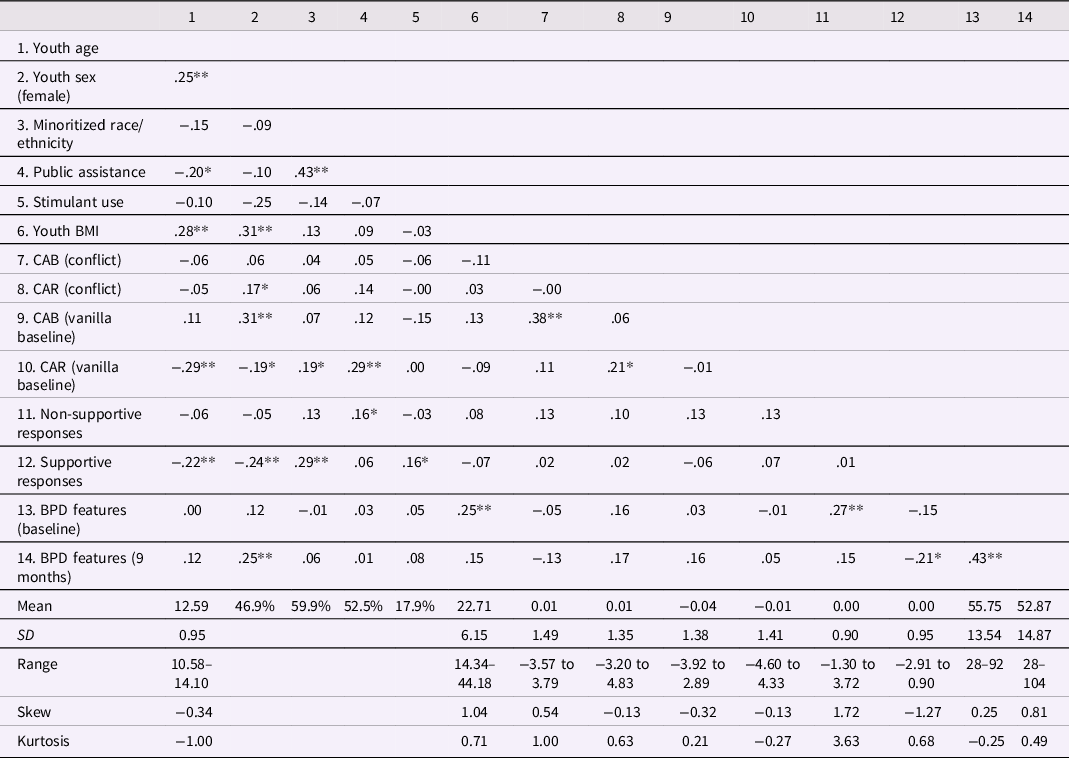
Table 1 displays descriptive statistics and bivariate correlations between main study variables. Distributions of all variables were approximately normal. BPD features were moderately stable across 9 months and were moderately correlated with both supportive and non-supportive parental responses in the expected directions, with the exception of non-supportive responses at baseline and supportive response at 9-month follow-up, which showed smaller-than-expected effects. CAB and CAR scores were not associated with BPD features at baseline or 9-month follow-up.
Correlations between and descriptives for main study variables

Note. *p < .05, **p < .01. CAB = cardiac autonomic balance; CAR = cardiac autonomic regulation; BPD = borderline personality disorder.
CAB model: PNS/SNS dominance and parental responses as predictors of BPD features
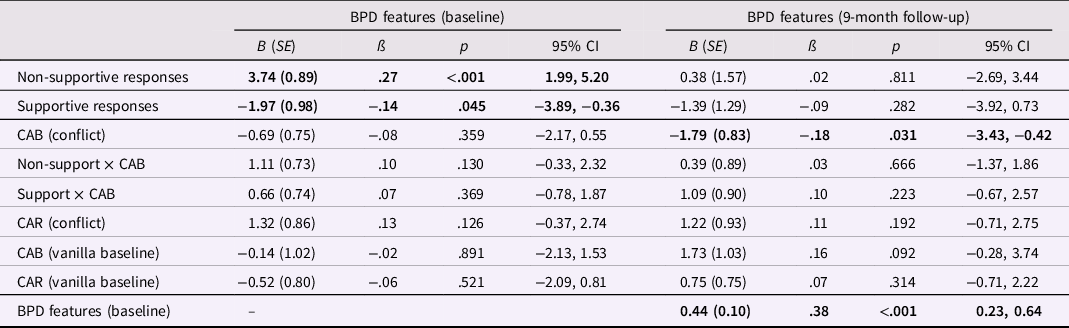
Fit for this model was good (χ 2 (28) = 40.41, p = .061; RMSEA = .056; CFI = .904; SRMR = .056) and all results are shown in Table 2. Supportive and non-supportive parental responses were significantly associated with BPD features at baseline, but not at 9-month follow-up. Neither CAB response to conflict nor its interaction with parental responses were associated with BPD features at baseline. However, CAB response to conflict was a significant predictor (albeit small in magnitude) of BPD features at 9-month follow-up, suggesting that shifting toward SNS dominance during conflict was associated with exacerbation of or increasing BPD features. Effects of demographic covariates are listed in the online supplement (Table S1) and suggest that females were more likely to demonstrate PNS dominance at baseline and shift toward coactivation during conflict. Youth of minoritized race/ethnicity experienced greater supportive responses from their parents. Receipt of public assistance was negatively associated with supportive parental responses and with coactivation at baseline. Only BMI values had a negative effect on CAB scores during conflict such that youth with higher BMI were more likely to shift toward sympathetic dominance during conflict.
Interaction between parental responses and CAB scores in response to parent-child conflict

Note. CAB = cardiac autonomic balance; CAR = cardiac autonomic regulation; BPD = borderline personality disorder. Bolded values were statistically significant at p < .05.
CAR model: autonomic coactivation/coinhibition and parental responses as predictors of BPD features
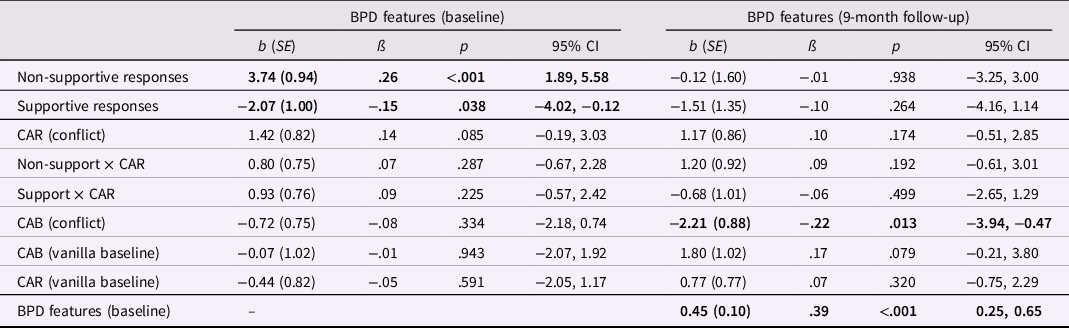
This model also fit the data well (χ 2 (28) = 33.20, p = .229; RMSEA = .037; CFI = .956; SRMR = .053) and results are shown in Table 3. CAR response to conflict, both independently and in interaction with parental responses, was unrelated to BPD features at baseline or 9-month follow-up. The effects of remaining variables are identical to those in the previous model (i.e., the effects of supportive and non-supportive parental responses on BPD features at baseline and the effect of CAB response to conflict on BPD features at 9 months follow-up). Effects of demographic covariates are listed in the online supplement (Table S2).
Interaction between parental responses and CAR scores in response to parent-child conflict

Note. CAB = cardiac autonomic balance; CAR = cardiac autonomic regulation; BPD = borderline personality disorder. Bolded values were statistically significant at p < .05.
Discussion
The current study explored the independent and interactive effects of autonomic nervous system response to parent-child conflict and parental non-supportive and supportive responses on youths’ BPD features both concurrently and change in BPD features over 9 months. These effects were evaluated in a sample of pre-adolescents at high risk for developing BPD. Results demonstrated a significant effect of autonomic response, specifically CAB response, to parent-child conflict in the prediction of BPD features. Specifically, shifting toward sympathetic dominance independently predicted increases in BPD features over the 9-month follow-up period. Additionally, we replicated findings that fewer experiences of supportive parental responses and more non-supportive parental responses were associated with greater severity of BPD features in youth (Dixon-Gordon et al., Reference Dixon-Gordon, Whalen, Scott, Cummins and Stepp2015; Vanwoerden et al., Reference Vanwoerden, Kalpakci and Sharp2017, Reference Vanwoerden, Byrd, Vine, Beeney, Scott and Stepp2022; Whalen et al., Reference Whalen, Scott, Jakubowski, McMakin, Hipwell, Silk and Stepp2014). However, contrary to hypotheses, we found no evidence of an interaction between autonomic responses and parental responses to emotion. This study highlights the role physiological reactivity to parent-child conflict as well as the significance of parental responses to their child’s emotion in the development of BPD during the transition to adolescence.
One of the strengths of our study design was that we evaluated patterns of SNS and PNS responses together via the indices CAB and CAR. We found that SNS dominance independently predicted exacerbation of BPD features over time, complementing previous studies in pre-adolescent youth associating stronger SNS reactivity to an interpersonal stressor with higher severity of BPD features (Dixon-Gordon et al., Reference Dixon-Gordon, Marsh, Balda and McQuade2020; McQuade et al., Reference McQuade, Dixon-Gordon, Breaux and Babinski2021). While previous literature has been highly mixed in terms of differences in SNS and PNS reactivity to stressors in relation to BPD (Koenig et al., Reference Koenig, Thayer and Kaess2021), our results provide complementary findings to help contextualize these discrepancies. For example, studies examining RSA response to interpersonal and social stressors (e.g., social exclusion and social-evaluative stress) have found both lower RSA activity following (Maiß et al., Reference Maiß, Engemann, Kern, Flasbeck, Mügge, Lücke and Brüne2021) and no differences in RSA withdrawal during (Sigrist et al., Reference Sigrist, Reichl, Schmidt, Brunner, Kaess and Koenig2021) stressors among adults with BPD compared to controls. Based on our findings, we suggest that it is the relative balance of SNS and PNS activation that represents unique risk for BPD and measuring activity of both systems allowed us to derive a more nuanced picture of the psychophysiological concomitants of BPD.
Altogether, our findings complement theory (Cavazzi & Becerra, Reference Cavazzi and Becerra2014) and results from prior studies measuring autonomic response to simulated peer exclusion (Dixon-Gordon et al., Reference Dixon-Gordon, Marsh, Balda and McQuade2020; McQuade et al., Reference McQuade, Dixon-Gordon, Breaux and Babinski2021), which suggest that risk for BPD is characterized by heightened SNS responsiveness. Notably, the overlap between our research and prior empirical studies supports our hypothesis that physiological activation relevant to BPD is best captured in interpersonal contexts of high social salience. Interpersonal contexts are unique in that they involve interaction with one or more individuals whereas social stimuli are static and not interactive (e.g., presentation of photos of emotional faces). Research shows that interpersonal interactions activate multiple neural systems that are not activated when perceiving more constrained, artificial stimuli used in traditional tasks (Redcay et al., Reference Redcay, Dodell-Feder, Pearrow, Mavros, Kleiner, Gabrieli and Saxe2010). In addition, both parent-child conflict and peer acceptance are highly salient aspects of adolescents’ lives and central to socioemotional development (Cicchetti & Rogosch, Reference Cicchetti and Rogosch2002). Thus, identifying biologically based vulnerability that manifests in these contexts will likely have strong predictive value.
Sympathetic influences on the heart are present in conditions characterized by novelty, unpredictability, and uncertainty (Kelsey, Reference Kelsey2012). Our finding that exacerbated or increasing BPD features over time was predicted by shifting toward SNS dominance (i.e., lower CAB scores) suggests that exacerbation of BPD features may be associated with perceptions of parent-child conflict as uncertain or unpredictable, leading to engagement of active coping. In fact, sympathetic dominance (based on electrodermal activity) has been linked to stress sensitivity in other research (Ho et al., Reference Ho, Pham, Miller, Kircanski and Gotlib2020). This type of physiological response could set the stage for worsening emotion reactivity over time by prompting maladaptive coping strategies in youth. In the context of parent-child conflict, this pattern of autonomic coordination may also have a cascading effect on the parent-child relationship, leading to unresolved conflict or repeated patterns of maladaptive parent-child dynamics. These results highlight the value of understanding physiological reactivity to conflict and suggest that more research focused on balance between SNS and PNS may be fruitful for research on BPD development.
Results of this study also included robust independent effects of parental responses to youth negative emotion in predicting youths’ concurrent BPD features. Youth with higher BPD features reported that their parents tend to respond both with less supportive and with more non-supportive responses to their displays of negative emotion. This is in line with multiple previous studies showing that parental responses to their child’s emotion represent both risk for and resilience against BPD (Musser et al., Reference Musser, Zalewski, Stepp and Lewis2018; Stepp et al., Reference Stepp, Lazarus and Byrd2016) and extends this work by using a multi-method approach incorporating youth-report of their parental behavior via questionnaire and during daily life with EMA. While we found significant effects of parental responses to youth emotion concurrently, the effect of parental responses on change in BPD features over 9 months was not statistically significant. It is possible that parental responses to emotion changed over time, potentially for the better, and this change was not included in our models. Importantly, our findings do not eliminate the possibility that parental responses to youth emotions have longstanding effects for BPD, as previous research found that parental responses measured during childhood predicted within-person associations between daily stressors and BPD symptom expression among adults (Vanwoerden et al., Reference Vanwoerden, Hofmans and De Clercq2020). Thus, it may be that the effects of parental responses to youth emotion on BPD features over time operates indirectly through severity of concurrent BPD features (i.e., which relates to higher stability of BPD features over time) as well as by influencing how individuals process and respond to their environments.
Interestingly, our hypothesis about the presence of interaction effects, which was guided by Linehan’s biopsychosocial theory of BPD development, was not supported. Instead, we found that patterns of biological vulnerability (i.e., sympathetic dominance) and experiences of parental supportive and non-supportive responses predicted BPD features independently. This somewhat contrasts previous studies, which have found interactions between these factors, albeit with unexpected patterns. Two studies found that SNS reactivity was associated with BPD features when parental responses were purportedly adaptive (i.e., high support, low non-support) (Dixon-Gordon et al., Reference Dixon-Gordon, Marsh, Balda and McQuade2020; McQuade et al., Reference McQuade, Dixon-Gordon, Breaux and Babinski2021). One potential reason for the discrepancy between our results and these two prior studies (and theory) may include methodological aspects of our study. Although these previous studies used a similar questionnaire measure of parent responses to youth negative emotions, those studies focused solely on parent-report. Our previous work has shown clear informant effects, whereby parents’ perceptions of supportive responses to their child’s emotion differs from that of their child’s perception (Byrd, Vine, Frigoletto, et al., Reference Byrd, Vine, Frigoletto, Vanwoerden and Stepp2022; Vanwoerden et al., Reference Vanwoerden, Kalpakci and Sharp2017, Reference Vanwoerden, Byrd, Vine, Beeney, Scott and Stepp2022). For example, youths’ subjective experiences of parental support predicted decreases in emotion and behavior dysregulation, while parent-reported support predicted increases in these same constructs (Byrd, Vine, Frigoletto, et al., Reference Byrd, Vine, Frigoletto, Vanwoerden and Stepp2022). Similarly, youth-reported support predicted BPD features, above and beyond parents reports of their own behaviors (Vanwoerden et al., Reference Vanwoerden, Kalpakci and Sharp2017, Reference Vanwoerden, Byrd, Vine, Beeney, Scott and Stepp2022). This work suggests that effects of parents’ behavior are largely in the eye of the beholder, which highlights the importance of considering informant-specific effects when examining the influence of parental response to emotion as it affects risk for BPD. That being said, our reliance on youth reports of parent responses to emotion and BPD features could have led to a common response bias in our findings. Future designs would benefit from a truly multi-modal assessment approach by including parent reports as well as observational coding of conflict discussions.
It is also possible that another environmental mechanism, other than one assessed by our youth-report measures, might interact with SNS dominance to predict BPD features. For example, some research suggests that parents of adolescents with mental health problems are more likely to respond to anger, specifically, with punishing, magnification, or neglect (Klimes-Dougan et al., Reference Klimes-Dougan, Brand, Zahn-Waxler, Usher, Hastings, Kendziora and Garside2007). Given that anger expressions are highly relevant for conflict interactions, future research should evaluate what types of parental responses may be especially maladaptive for youth who display atypical physiological responding during conflict. In addition to role that overt behavioral responses expressed by parents have for youth BPD development, it is likely that parents’ own arousal has an influence on their children’s autonomic regulation and BPD features. Extant research has demonstrated the effect that parent autonomic activity has on their children’s physiology (Fuchs et al., Reference Fuchs, Lunkenheimer and Lobo2021; Lobo & Lunkenheimer, Reference Lobo and Lunkenheimer2020); however, this has not yet been studied in relation to BPD.
Limitations
Despite notable strengths of the longitudinal design and use of a high-risk sample, our current findings should be considered in the context of notable limitations. First, our smaller sample size limited our ability to examine all interactions in the same model as well as three-way interactions including both types of parent responses as was done in previous research (Dixon-Gordon et al., Reference Dixon-Gordon, Marsh, Balda and McQuade2020; McQuade et al., Reference McQuade, Dixon-Gordon, Breaux and Babinski2021). Related to our sample size, we were unable to evaluate the effect of sex in these processes, which are likely at play. Specifically, both parent and youth sex are interacting factors that influence parental responses to emotions (Brand & Klimes-Dougan, Reference Brand and Klimes-Dougan2010; Garside & Klimes-Dougan, Reference Garside and Klimes-Dougan2002) and vulnerability for BPD development (Goodman et al., Reference Goodman, Patil, Oakes, Matho and Triebwasser2013). These interactions should be evaluated in more highly powered designs that include a sufficient number of both mothers and fathers. Third, we are not able to infer any causality of effects between physiological responding and BPD feature development as the interaction between these factors is present very early in life. It is likely that autonomic responses reflect a partly inherited vulnerability that jointly influences BPD features (Koenig et al., Reference Koenig, Thayer and Kaess2021) and is also influenced by transactions with caregivers across development (McLaughlin et al., Reference McLaughlin, Sheridan, Tibu, Fox, Zeanah and Nelson2015), such that the interactions between inherited vulnerabilities and environmental effects are difficult to disentangle (J. Cui et al., Reference Cui, Mistur, Wei, Lansford, Putnick and Bornstein2018). To this point, it cannot be assumed that youths’ autonomic activity during the conflict discussion solely reflects an intrinsic regulatory capacity. Instead, it is also a function of both historical (within and outside of the dyadic relationship) and contextual factors (i.e., how the specific conflict unfolded). Lastly, we relied on change scores to characterize an average autonomic response during the conflict discussion relative to baseline levels. However, autonomic responding is a dynamic process that does not always follow linear trends. Future research should apply modeling techniques that can capture this dynamic quality (e.g., see L. Cui et al., Reference Cui, Morris, Harrist, Larzelere, Criss and Houltberg2015).
Clinical implications
Despite these limitations, the current study may have important clinical implications. As mentioned previously, direct intervention on youths’ physiological responding that targets PNS activation (and thus improves the balance between SNS and PNS) should be explored further. There are several skills currently used to target adolescent BPD that can be applied, for example: deep breathing, muscle relaxation, and activating the Dive Reflex (Rathus & Miller, Reference Rathus and Miller2000). Given extant research suggesting that increasing supportive parent behavior during conflict doesn't necessarily influence adolescents’ psychophysiology responding (Kaufman et al., Reference Kaufman, Puzia, Godfrey and Crowell2019), it is possible that interventions could focus instead on enhancing parent emotion regulation (Flujas-Contreras et al., Reference Flujas-Contreras, García-Palacios and Gómez2021; Hajal & Paley, Reference Hajal and Paley2020), and teaching parents to scaffold youth in regulating emotions during conflictual interactions (Aghaie Meybodi et al., Reference Aghaie Meybodi, Mohammadkhani, Pourshahbaz, Dolatshahi and Havighurst2019; Havighurst et al., Reference Havighurst, Wilson, Harley, Prior and Kehoe2010; Kehoe et al., Reference Kehoe, Havighurst and Harley2014). Additionally, implementing these interventions early in life, particularly among high-risk families, could have important preventative effects for the development of emotion and behavior dysregulation in youth, as has been demonstrated in a recent randomized control trial (Byrd et al., Reference Byrd, Lee, Frigoletto, Zalewski and Stepp2021). Parents are the first line in helping youth learn and even practice skills taught in therapy, which can be capitalized on by having parents coach children to implement behaviors that activate PNS and lower SNS activity.
Supplementary material
The supplementary material for this article can be found at https://doi.org/10.1017/S095457942300024X
Funding statement
This work was supported by the National Institute of Mental Health (SS, R01 MH101088; SV, F32 MH126510; AB, K01 MH119216).
Conflicts of interest
None.