In recent years it has become increasingly apparent that multiple levels of analysis can provide important insights into both the development of behavior problems in children and resilience under stress (Cicchetti, Reference Cicchetti2010). Within this context, increasing evidence has accumulated for an association between prenatal risk factors and later psychopathology. These factors include fetal exposure to malnutrition (Neugebauer, Hoek, & Susser, Reference Neugebauer, Hoek and Susser1999), nicotine (Brennan, Grekin, Mortensen, & Mednick, Reference Brennan, Grekin, Mortensen and Mednick2002), and lead (Dietrich, Ris, Succop, Berger, & Bornschein, Reference Dietrich, Ris, Succop, Berger and Bornschein2001). More recently, aggressive/antisocial behavior and its neurobiological foundations have been examined; and fetal androgen exposure, indirectly measured by the second to fourth finger length digit ratio (2D:4D), has been implicated in developmental psychopathology. In this study we extend prior work on prenatal risk factors for externalizing behavior problems by further examining this indirect marker for prenatal androgen exposure in a community sample of male and female schoolchildren, extending research from Western cultures to an East Asian culture.
2D:4D Ratios as a Marker for Prenatal Androgen Exposure
In humans, the 2D:4D ratio has long been recognized as a sexually dimorphic trait (George, Reference George1930) and has more recently been associated with prenatal testosterone exposure (Manning, Scott, Wilson, & Lewis-Jones, 1998). On average, this ratio is lower for males than it is for females (Manning et al., Reference Manning, Scutt, Wilson and Lewis-Jones1998; Vermeersch, T'Sjoen, Kaufman, & Vincke, Reference Vermeersch, T'Sjoen, Kaufman and Vincke2008), a finding that has been replicated in several geographic locations (Manning, Stewart, Bundred, & Trivers, Reference Manning, Stewart, Bundred and Trivers2004). A study of aborted human fetuses has argued that fetal 2D:4D ratios do not change with gestational age and sex differences in 2D:4D ratios are already present by the end of the first trimester of fetal development (Malas, Dogan, Evcil, & Desdicioglu, Reference Malas, Dogan, Evcil and Desdicioglu2006). That 2D:4D ratios are also relatively little affected by puberty and increase only slightly during childhood (McIntyre, Ellison, Lieberman, Demerath, & Towne, Reference McIntyre, Ellison, Lieberman, Demerath and Towne2005; Trivers, Manning, & Jacobson, Reference Trivers, Manning and Jacobson2006) has resulted in this ratio being proposed as a viable biological marker of early developmental processes (Manning et al., Reference Manning, Scutt, Wilson and Lewis-Jones1998).
Many studies have reported sex differences in digit ratios, but at least two studies have failed to observe this effect in children and infants (Fink, Manning, Williams, & Podmore-Nappin, Reference Fink, Manning, Williams and Podmore-Nappin2007; Knickmeyer, Woolson, Hamer, Konneker, & Gilmore, Reference Knickmeyer, Woolson, Hamer, Konneker and Gilmore2011). Furthermore, several adult studies have failed to observe this gender difference (Austin, Manning, McInroy, & Mathews, Reference Austin, Manning, McInroy and Mathews2002; Benderlioglu & Nelson, Reference Benderlioglu and Nelson2004). Although most of the studies that did not detect a gender difference had relatively balanced male to female gender ratios (0.91–1.07), their sample sizes were small (N = 56–165). Therefore, researchers have partly attributed these anomalous findings in children and adults to be due to the study's small sample size. However, at least one study (Knickmeyer et al., Reference Knickmeyer, Woolson, Hamer, Konneker and Gilmore2011) that failed to observe a gender difference had a relatively large sample size (N = 374). Because the gender difference may not be as strong as previously claimed, we examined this in the context of our cohort study of Chinese children.
Until recently, the evidence linking the 2D:4D ratio to prenatal androgen exposure has been either correlational or indirect. In the past, several findings have been frequently cited as evidence of this relationship. For instance, males and females with congenital adrenal hyperplasia (CAH), a disorder that results in increased in utero androgen production, have been shown to have lower 2D:4D ratios than males and females without CAH (Brown, Hines, Fane, & Breedlove, Reference Brown, Hines, Fane and Breedlove2002; Okten, Kalyoncu, & Yaris, Reference Okten, Kalyoncu and Yaris2002). In addition, mothers with high waist to hip ratios, a trait that is positively associated with maternal testosterone levels, have been shown to have low 2D:4D ratios (Manning, Trivers, Singh, & Thornhill, Reference Manning, Trivers, Singh and Thornhill1999). A correlational study of routine amniocentesis samples taken during the second trimester of pregnancy found that 2D:4D ratios were negatively associated with the prenatal testosterone to estrogen ratio at age 2 years (Lutchmaya, Baron-Cohen, Raggatt, Knickmayer, & Manning, 2004). Furthermore, the Hoxa and Hoxd genes, which control the patterning of digits during gestation, have also been shown to help give rise to the urogenital system (Kondo, Zakany, Innis, & Duboule, Reference Kondo, Zakany, Innis and Duboule1997). This suggests that androgens, which likely modulate the action of the Hoxa and Hoxd genes, also play a role in determining the 2D:4D ratio. A recent experimental study in mice has also provided more direct support for the association between the 2D:4D ratio and prenatal testosterone. Zheng and Cohn (Reference Zheng and Cohn2011) found that inactivation of the androgen receptor during gestation resulted in more feminized digit ratios in mice, while inactivation of the estrogen receptor resulted in more masculinized digit ratios. Conversely, postnatal doses of androgen and estrogen had no effect on digit ratios, a finding that argues for a critical prenatal period for the determination of digit ratios.
Fetal androgen exposure is of interest to researchers because it has been shown to play a role in neurological development and is thought to make a vital contribution to biological and psychological sex differentiation (Breedlove, Reference Breedlove1994). Animal studies have been central to our understanding of this phenomenon. Studies of guinea pigs, rhesus monkeys, and other animals have all found that females exposed to androgens in utero are less likely to display feminine behaviors and more likely to display masculine ones (Breedlove, Reference Breedlove1994; Tomaszycki, Gouzoules, & Wallen, Reference Tomaszycki, Gouzoules and Wallen2005). According to Breedlove (Reference Breedlove1994), these results suggest that there are sensitive periods in each species during which androgen exposure determines whether the animal will possess a more masculine or feminine nervous system configuration.
Evidence for this conclusion in humans has been partly derived from studies of females with CAH. Berenbaum (Reference Berenbaum1999) found that females with CAH reported more interest in masculine-type activities and professions than their sisters who were not affected by CAH. These results suggest that it is the increase in prenatal androgen exposure associated with CAH, rather than postnatal environmental influences, that affect the developing brains of the CAH-affected females. Females with CAH have also been found to display more masculine behaviors such as aggression (Berenbaum & Resnick, Reference Berenbaum and Resnick1997). These results suggest that, as in other animal species, prenatal androgen exposure in humans contributes to the masculinization of the nervous system's organization.
2D:4D Ratio and Aggression in Adults
Given the role that prenatal androgen exposure appears to play in sexual differentiation and its well-established correlation with 2D:4D ratios, researchers have begun to consider the relationship between 2D:4D ratios and sexually dimorphic personality, cognitive, and behavioral traits that are thought to be influenced by androgen exposure. Spatial abilities, athletic abilities, and sensation seeking, for instance, are each more male-typical traits that are thought to be related to testosterone, the most well known of the androgens. Although some results have varied (e.g., Austin et al., Reference Austin, Manning, McInroy and Mathews2002), other studies have found high levels of each of these traits to be correlated with low 2D:4D ratios (Csathó et al., Reference Csathó, Osváth, Karádi, Bicsák, Manning and Kállai2001; Hampson, Ellis, & Tenk, Reference Hampson, Ellis and Tenk2008; Manning & Taylor, Reference Manning and Taylor2001).
Aggression has also long been recognized as a sexually dimorphic trait in humans and other animals (Hyde, Reference Hyde, Hyde and Linn1986; Van Goozen, Cohen-Kettenis, Gooren, Frijda, & Van De Poll, Reference Van Goozen, Cohen-Kettenis, Gooren, Frijda and Van De Poll1995). This has been observed early in the human life course because sex differences in aggression are already present by 2 years of age (Archer, Reference Archer2004). Given its recognition as a male-typical trait and aggression's likely correlation with testosterone (Finkelstein et al., Reference Finkelstein, Susman, Chinchilli, Schwab, Demers and Liben1995; Harris, Rushton, Hampson, & Jackson, Reference Harris, Rushton, Hampson and Jackson1996; Pope, Kouri, & Hudson, Reference Pope, Kouri and Hudson2000), a small but growing body of research has considered aggression in relation to the 2D:4D ratio. Benderlioglu and Nelson (Reference Benderlioglu and Nelson2004) investigated the relationship between digit length ratio and reactive aggression, a form of aggression that occurs in response to provocation (as compared to proactive aggression, which is primarily instrumental in nature). Participants in this study each placed two telephone calls to confederates to ask for a charity donation. The first caller was amenable to charitable contributions, but unable to donate, whereas the other was confrontational. Researchers found that reactive aggression, as measured by response to the confrontational caller, was correlated with low 2D:4D ratios. However, this was only the case for women.
Austin et al. (Reference Austin, Manning, McInroy and Mathews2002) used Buss and Perry's Aggression Questionnaire to measure physical aggression, verbal aggression, anger, and hostility. Neither total aggression nor any of the aggression subscales was significantly correlated with 2D:4D ratios in this study. Additional studies using aggression questionnaires have found that 2D:4D ratios are associated with total aggression scores in men and women and physical aggression in men only (Dogan, Barut, Konuk, & Bilge, Reference Dogan, Barut, Konuk and Bilge2008; Hampson et al., Reference Hampson, Ellis and Tenk2008). Studies have also found that low 2D:4D ratios are related to dating violence in men (Cousins, Fugere, & Franklin, Reference Cousins, Fugere and Franklin2009), use of indirect aggression by women (Coyne, Manning, Ringer, & Bailey, Reference Coyne, Manning, Ringer and Bailey2007), and the use of proactive political aggression by males during a simulated war game (McIntyre et al., Reference McIntyre, Barrett, McDermott, Johnson, Cowden and Rosen2007). A recent meta-analysis of 2D:4D and aggression (Honekopp & Watson, Reference Honekopp and Watson2011) found a small negative relationship between 2D:4D and aggression in males but not in females. Nevertheless, because these were almost all in adults (with only one study on adolescents and none in children), it remains to be seen whether this same effect can be substantiated in children.
2D:4D Ratios and Externalizing Behavior in Children
To our knowledge, only one study has examined the relationship between 2D:4D ratios and aggressive behavior in children. Butovskaya, Burkova, and Mabulla (Reference Butovskaya, Burkova and Mabulla2010) recently found a significant negative correlation between the right-hand 2D:4D ratio and self-report ratings of physical aggression for girls (but not boys) in a sample of 219 children (7–20 years old) in Tanzania, using the Swahili version of the Self-Estimated Conflict Behavior Inventory. Fink et al. (Reference Fink, Manning, Williams and Podmore-Nappin2007) found in both Austrian and English schoolchildren that conduct problems were negatively correlated with 2D:4D ratios in boys in the predicted direction, but not in girls. In a sample of 108 boys and 88 girls (ages 2–5 years), Williams, Greenhalgh, and Manning (Reference Williams, Greenhalgh and Manning2003) used the Strengths and Difficulties Questionnaire and the Social Cognition Questionnaire and found that low 2D:4D ratios were related to hyperactivity and poor social cognitive function in girls, whereas high 2D:4D ratios were associated with emotional symptoms in boys. Overall, these studies suggest that a low 2D:4D ratio is related to increased behavior problems in children, although the literature on childhood aggression is particularly sparse and findings are mixed regarding gender.
Similarly, few studies have examined the relationship between 2D:4D ratios and attention problems, even though attention problems are known to be a sexually dimorphic behavior. Martel, Gobrogge, Breedlove, and Nigg (Reference Martel, Gobrogge, Breedlove and Nigg2008) conducted a study of 250 children with attention-deficit/hyperactivity disorder (ADHD) and found masculinized (i.e., low) finger length ratios to be associated most strongly with symptoms of inattention, along with hyperactive–impulsive and oppositional–defiant symptoms. Fink et al. (Reference Fink, Manning, Williams and Podmore-Nappin2007) found low 2D:4D ratios to be associated with hyperactivity in an English child sample (N = 58), but not with attention problems in an Austrian sample (N = 50). Furthermore, in a relatively small clinically referred sample (N = 64) no association was found between 2D:4D ratios and attention problems using the Child Behavior Checklist (CBCL; Lemiere, Boets, & Danckaerts, Reference Lemiere, Boets and Danckaerts2010). This finding challenges the hypothesis that fetal testosterone exposure plays a prominent role in the etiology of attention problems. Consequently, one goal of this study was to examine the relationship between 2D:4D ratios and measures of both aggression and attention problems in children.
The Current Study
Despite initial evidence for a relationship between prenatal testosterone levels and aggression in adults, the findings on children are limited to one study of African children. Furthermore, no study of children's aggressive behavior has used well-established instruments or multiple informants. In addition, although most studies have reported right-hand digit ratios to be related to behavior problems, there are only two studies that have reported data for both left and right hands. Most studies in Western cultures have focused exclusively on right-hand 2D:4D ratios because the right hand is thought to be more reflective of prenatal testosterone exposure (Manning, Reference Manning2002), but it remains to be seen whether the 2D:4D ratio difference is stronger on the right hand than on the left; the converse may be the case. A further limitation is that only one study has investigated the aggression–2D:4D ratios relationship in a Chinese population, and this was an adult sample (Yang, Gray, Zhang, & Pope, Reference Yang, Gray, Zhang and Pope2009). Similarly, the literature on attention problems is sparse. It is therefore unclear whether these trends hold true across different cultures and ethnic populations using well-established measures and can be observed in children.
Given these gaps in the literature, a key goal of this study was to assess the relationship between 2D:4D ratios and children's externalizing behaviors (aggression and attention problems) using both mothers’ and teachers’ ratings in a Chinese population. It was hypothesized that aggression and attention problems would be associated with a lower 2D:4D ratio in males and females on left and right hands.
Methods
Participants
The current study was part of a larger population-based community cohort study of 1,656 Chinese children (55.5% boys, 44.5% girls) initially recruited in the Spring of 2005 from four preschools in the town of Jintan, located in the southeastern coastal region of mainland China. Detailed sampling and research procedures of this larger cohort study have been described elsewhere (Liu, McCauley, Zhao, Zhang, & Pinto-Martin, Reference Liu, McCauley, Zhao, Zhang and Pinto-Martin2010). Briefly, the China Jintan Child Cohort Study is an ongoing prospective longitudinal study with the main aim of assessing the early health risk factors for the development of child neurobehavioral outcomes.
In the last year of kindergarten, parents and teachers were asked to rate child behavioral outcomes using the Chinese version of the CBCL (Liu, Cheng, & Leung, Reference Liu, Cheng and Leung2011; see below). After kindergarten, children from the cohort were enrolled in six elementary schools in Jintan. Children were in the third, fourth, and fifth grades in 2000 when we conducted the current study. We invited children from the fifth grade in one of the six elementary schools to participate in the current study.
The sample consisted of 239 fifth grade 11-year-old Chinese children (130 boys, 109 girls). Written informed consent was obtained from parents. Institutional Review Board approval was obtained from both the University of Pennsylvania and the Ethical Committee for Research at Jintan Hospital in China.
2D:4D ratios
The second and fourth finger digit of each participant was measured directly, because the size of the fat pads in the fingers is believed to result in lower measurements of 2D:4D ratios when using scanned pictures of the hand (Manning, Fink, Neave, & Caswell, Reference Manning, Fink, Neave and Caswell2005). Ultratech digital calipers (General Tools & Instruments Co., New York), which are reliable to 0.001 mm, were used to measure the digits. Children were measured on their finger digits when they were in the fifth grade. Researchers instructed participants to fully flex their fingers. The second and fourth digits of the right hand were then measured from the finger's basal crease (crease closest to the palm) to the most distal point of the distal phalange of the finger. Each finger of the right hand was measured twice according to this protocol. The same process was then employed to measure the digits of the left hand. The 2D:4D ratio for each hand was calculated by dividing the average length of the second digit by the average length of the fourth digit. This procedure has been utilized in several digit ratio studies (e.g., Benderlioglu & Nelson, Reference Benderlioglu and Nelson2004). Fifteen participants were measured by two bachelor's degree, trained research assistants in order to assess interrater reliability. Each rater was blind to the ratings of the other rater.
Externalizing behavior problems
Externalizing behavior was assessed from parental and teacher ratings when children were in their last month of kindergarten. Parents and teachers were asked to assess the children with the Chinese version of the CBCL (CBCL/1.5–5) and Caregiver Teacher Report Form (C-TRF/1.5–5) separately. The CBCL/C-TRF is one of the most widely used rating scales for assessing behavioral and emotional problems in children, and it consists of 99 items dealing with a child's behavior within the past 12 months. Items are rated on a 3-point scale (0 = not true, 1 = sometimes true, or 2 = often true; Achenbach & Rescorla, Reference Achenbach and Rescorla2000). Factor analysis performed on the CBCL/C-TRF has produced two broadband factors: Internalizing behaviors and Externalizing behaviors. Two syndromes for Externalizing behaviors include attention problems and aggressive behavior. The internal reliabilities (coefficient α) for the scales in our study sample were 0.64 for attention problems and 0.87 for aggression. Confirmatory factor analysis confirmed that the original, US-derived second-order, multifactor model best fit the Chinese preschool data of the CBCL/1.5–5 and C-TRF. The rates of total behavior problems in Chinese preschoolers were largely similar to those in American preschoolers. The validation of the factor structure was documented in our previous paper (Liu et al., Reference Liu, Cheng and Leung2011). We used raw scores on all behavioral assessments for the analysis, as recommended by Achenbach (Reference Achenbach1991). In addition, we combined CBCL (mother's ratings) and C-TRF (teacher's ratings) to create an average score for each subscale in order to include a more holistic perspective of the children's behavior problems.
Early adversity
Parents were asked to fill in a sociodemographic questionnaire at the same time they completed the CBCL when children were 6 years old. The adversity index was created along lines similar to those described by Rutter, Hersov, and Shaffer (Reference Rutter, Hersov, Shaffer, Rutter, Hersov and Shaffer1978) and Moffitt (Reference Moffitt1990). A total adversity score was derived based on 11 variables. This score was created by adding 1 point (for 9 of the 11 indicators) or 2 points (for 2 indicators) for each of the following 11 adversity indicators: mother's low education (below middle school, 8.8%), father's low education (below middle school, 5.4%), mother's low occupational status (3-point scale: 0 = professional or skilled work, 22.2%; 1 = unskilled worker, 38.9%; and 2 = no occupation, 31.8%), father's low occupational status (3-point scale: 0 = professional or skilled work, 26.8%; 1 = unskilled worker, 60.3%; and 2 = no job, 3.8%), mother's poor health status (2.1%), father's poor health status (3.8%), obstetric complication (bleeding, hypertension, diabetes, Caesarian section, difficult birth, low birth weight, difficulty breathing, 35.6%), divorce (3.3%), absence of biological mother (4.2%), house size below 70 m2 (8.4%), and poor neighborhood (overcrowded neighborhood, noise pollution, damp, 35.6%). The adversity score ranged from 0 to 13 (M = 3.97, SD = 2.17). We used a 50th percentile cut point (≥4 points) to establish a dichotomy of high–low adversity.
Statistical analyses
All statistical analyses were conducted by using SPSS version 19.0 (IBM SPSS Statistics). Independent sample t tests were used to calculate gender differences in 2D:4D, attention problems, aggression, externalizing problems, and total problems behavior. Pearson correlations were used to assess the association between 2D:4D ratios and behavior problems in both the total sample and in males and females separately. Linear regression models of the ratings of behavioral problems as the dependent variable were also fitted using 2D:4D ratios as the regressor and social adversity as a covariate to assess if findings remained significant after controlling for adversity. All results were considered significant if p < .05 using a two-tailed test. To assess for any significant differences between the size of correlations observed for boys and girls, Fisher r to z transformations were employed, with the difference between the two transformed correlations divided by the standard error to yield a normal curve deviate, using a two-tailed test for significance.
Results
Test–retest reliability of 2D:4D
Test–retest reliabilities between the measurements were high for absolute measures (individual fingers) and moderate for ratio measures. Correlations for left-hand 2D were 0.978 for girls and 0.98 for boys. For left-hand 4D, test–retest reliability was 0.98 for girls and 0.98 for boys. Reliability coefficients for right-hand 2D were 0.97 for girls and 0.980 for boys. Right-hand 4D reliabilities were 0.98 for girls and 0.98 for boys. The reliabilities for 2D:4D ratios were somewhat lower at 0.79 for the left hand and 0.77 for the right hand (all ps < .001). A relatively high positive correlation was found between the left digit ratio and the right digit ratio (r = 0.633, p < .001), a level that is consistent with prior findings (Coyne et al., Reference Coyne, Manning, Ringer and Bailey2007; Manning, Baron-Cohen, Wheelwright, & Sanders, Reference Manning, Baron-Cohen, Wheelwright and Sanders2001; Voracek, Manning, & Ponocny, Reference Voracek, Manning and Ponocny2005).
Gender differences in 2D:4D ratios
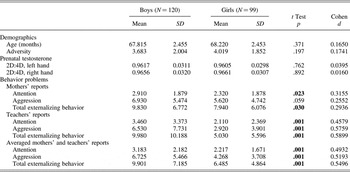
No significant gender differences were found in the mean 2D:4D ratio in either hand. The mean left-hand 2D:4D ratio in boys was slightly higher than in girls, whereas the right-hand ratio in boys was slightly lower than in girls (Table 1). However, t tests did not reveal any of the gender differences to be significant (p > .46).
Means and standard deviations for 2D:4D ratios, behavior problems, and demographics for each gender

Note: Significant gender differences are highlighted in bold. 2D:4D, ratio of the length of the second finger digit relative to the fourth digit.
Laterality difference in 2D:4D ratios
Left-hand ratios (M = 0.960, SD = 0.030) were significantly lower than right-hand ratios (M = 0.966, SD = 0.031, t = 2.48, p = .014).
Gender differences in behavior problems
Boys were shown to have more externalizing behavior problems than girls in general (see Table 1). This gender difference held true for both parents and teachers ratings, as well as when averaged together. For teachers’ and averaged reports, boys scored higher than girls on all measures of behavior problems (all ps < .05). For mothers’ reports, gender differences were observed for attention problems and total externalizing behaviors, but not for aggression.
2D:4D ratios and child behavior problems
Laterality effects
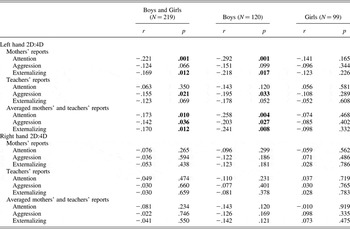
No associations were observed between right-hand 2D:4D ratios and child behavior problems for the total sample (see Table 2). In contrast, significant negative associations were generally observed for left-hand 2D:4D ratios. Increasing levels of behavior problems were associated with smaller ratios, indicating increased prenatal testosterone exposure and increased behavior problems.
Pearson correlations between measures of externalizing behavior and digit ratios of both hands, separately for males and females

Note: Significant p values are printed in bold. 2D:4D, ratio of the length of the second finger digit relative to the fourth digit.
Rater effects
For the total sample of boys and girls, averaged behavior problems (teachers and mothers combined) were significantly associated with left-hand 2D:4D ratios, and higher behavior problems were associated with lower 2D:4D ratios. Significant effects were observed for attention, aggression, and externalizing behavior.
For mothers, the effects were significant for attention and externalizing behavior, with a trend (p = .066) for aggression. In contrast, for teachers, the effects were significant for aggression, with a trend for externalizing behavior (p = .069) and no significant effect for attention problems.
Gender effects
Significant associations between 2D:4D ratios and behavior problems were observed for boys, but not girls (see Table 2). In boys, smaller left-hand 2D:4D ratios were associated with increased behavior problems of all types for averaged (mother and teacher) ratings. However, no significant differences were observed between the size of the correlation in boys compared to girls in any analysis (all ps > .16). The pattern of results for parent and teacher raters followed that outlined above, with slightly stronger effects observed for mothers compared to teachers.
Controlling for adversity
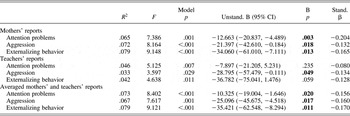
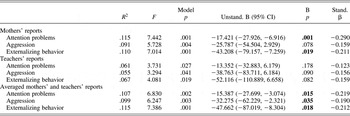
Regression analyses indicate that significant associations exist between left-hand 2D:4D ratios and boys’ behavior problems after controlling for early adversity for the total sample (Table 3) and for boys only (Table 4). In mother's reports for the total sample, the boys’ left-hand digit ratio was found to be significantly associated with attention problems, externalizing problems, and total problems. The association was strongest for attention problems, where a 0.10 decrease in boys’ left-hand 2D:4D ratios was associated with a 2.90 point increase in their attention problem score.
Linear regressions of left-hand digit ratio for the total sample (N = 219) against children's attention problems, aggression, total externalizing behaviors, and total behavior problems, controlling for adversity

Note: All regressions control for social adversity. The adversity variable is significant at the p < .05 level for all analyses.
Linear regressions of left-hand digit ratio for the against boys’ (N = 120) attention problems, aggression, total externalizing behaviors, and total behavior problems, controlling for adversity

Note: All regressions control for social adversity. The social adversity variable is significant at the p < .05 level for all regressions.
For teachers’ reports, no significant association was found between boys’ left-hand digit ratio and any measure of behavior problems. However, averaged mothers’ and teachers’ reports indicate all measures of boys’ behavior problems to be significantly associated with their left-hand 2D:4D ratio.
Discussion
We examined the relationship between the 2D:4D ratio and behavior problems in a community sample of preschool children in China. Based on joint caregiver–teacher reports, the left-hand 2D:4D ratio was significantly associated with behavior problems in boys, but not girls. The findings could not be explained by early adversity. To our knowledge, this is only the second study to establish a relationship between an indirect indicator of fetal androgen exposure (2D:4D ratio) and aggressive behavior in children. The results suggest that early prenatal exposure to androgens is associated with a moderate increase in the levels of externalizing behavior problems in children, and they highlight the contribution made by the prenatal environment to later behavior. The current findings also extend prior work by documenting some degree of cross-cultural generalizability of these associations to an East Asian population.
Mechanism of action
The link between increased aggression and lower 2D:4D ratios in children is generally consistent with the small but significant associations observed between adult aggression and postnatal testosterone (Honekopp & Watson, Reference Honekopp and Watson2011), and it takes this literature a step further by documenting an extremely early developmental association between testosterone exposure and aggression. The effect size (r) that we observed for child aggression (averaged r across raters) was –0.20, which is substantially higher than the small effect size (r = –.08) observed for adult male aggression in the meta-analysis of Honekopp and Watson (Reference Honekopp and Watson2011). This suggests that prenatal testosterone may play a stronger explanatory role for childhood aggression than for adult aggression, which may be more influenced by later psychosocial influences. This finding further suggests that prenatal testosterone may play a particularly strong role in explaining clinical disorders that are characteristic of children, such as conduct disorder and ADHD. However, because only one study reviewed here used a clinically referred sample (Lemiere et al., Reference Lemiere, Boets and Danckaerts2010), future studies are required to assess whether the association between 2D:4D and externalizing problems may be stronger in clinical than community samples.
An important question however concerns the process whereby the 2D:4D ratio is associated with behavior problems in children. The prenatal hormonal environment has been found to be instrumental in structural development of the fetal brain. More than 50 years ago, Phoenix, Goy, Gerall, and Young (Reference Phoenix, Goy, Gerall and Young1959) proposed that prenatal exposure to hormones during a critical period of development could permanently alter the structure of the developing brain, which in turn may help shape behavioral outcomes later on in life. It has been argued that high levels of testosterone leads to neural lateralization and, more importantly, slower overall development of the brain (e.g., Goodman, Reference Goodman, Rutter and Caesar1991; Lyon & Gadisseux, Reference Lyon, Gadisseux, Rutter and Caesar1991). Slower development of the brain in boys has traditionally been viewed as making them more vulnerable to environmental insults because of the prolonging of the critical period of development (Geschwind & Galaburda, Reference Geschwind and Galaburda1985).
Extending this neurodevelopmental gender perspective, studies have shown that the effects of early insults, including exposure to toxins and malnutrition, tend to have more profound effects on males than on females (Goodman, Reference Goodman, Rutter and Caesar1991; Levy & Heller, Reference Levy, Heller, Arnold, Moltz and Ward1992). McManus and Bryden (Reference McManus and Bryden1991) further proposed that males are at increased risk for externalizing behavior problems and learning disorders because prenatal testosterone levels slow down the normal development of the right hemisphere, which makes males more vulnerable to insults and structural abnormalities in the left hemisphere for a longer period of time. This long-established gender-based neurodevelopmental perspective on the role of prenatal testosterone on child psychopathology has been receiving recent support (James, Reference James2008; Martel, Klump, Nigg, Breedlove, & Sisk, Reference Martel, Klump, Nigg, Breedlove and Sisk2009). We observed somewhat stronger effects in boys than in girls, which is broadly consistent both with this gender-based perspective and with a neurodevelopmental perspective of conduct disorder and aggression (Fairchild et al., Reference Fairchild, Passamonti, Hurford, Hagan, von dem Hagen and van Goozen2011; Raine, Reference Raine2011).
Alternative mechanisms need to be considered. Manning et al. (Reference Manning, Scutt, Wilson and Lewis-Jones1998), who first proposed 2D:4D ratios as a marker of prenatal testosterone exposure, found 2D:4D to be positively associated with estrogen, but many researchers have focused only on 2D:4D as a marker of prenatal testosterone. However, research studies are increasingly suggesting that 2D:4D reflects both testosterone and estrogen exposure. Lutchmaya et al. (Reference Lutchmaya, Baron-Cohen, Raggatt, Knickmeyer and Manning2004) found 2D:4D to be correlated with the ratio of testosterone to estradiol, not the absolute amount of either androgen. Furthermore, in an experimental study in mice, Zheng and Cohn (Reference Zheng and Cohn2011) report that both estrogen and testosterone determine the 2D:4D ratios during prenatal development. As such, it may be overly simplistic to use 2D:4D ratios as a marker for prenatal testosterone exposure, and consideration should also be given to the balance of testosterone relative to estrogen in predisposing to aggression.
Laterality effects
Although most studies have observed 2D:4D ratio correlations with behavior problems most predominantly on the right hand (e.g., Bailey & Hurd, Reference Bailey and Hurd2005; Benderlioglu & Nelson, Reference Benderlioglu and Nelson2004; Butovskaya et al., Reference Butovskaya, Burkova and Mabulla2010; Martel et al., Reference Martel, Gobrogge, Breedlove and Nigg2008; Williams et al., Reference Williams, Greenhalgh and Manning2003), we observed the expected relationship more strongly on the left hand. One of the only other studies that reported a correlation on the left hand was Fink et al. (Reference Fink, Manning, Williams and Podmore-Nappin2007). Furthermore, the recent meta-analysis of Honekopp and Watson (Reference Honekopp and Watson2011) did not find evidence for laterality effects with respect to the 2D:4D–aggression relationship. An important question therefore concerns why effects were observed on the left hand in our Chinese sample compared with findings that are predominantly observed on the right hand in Caucasian populations.
One possible explanation lies in the laterality effect we observed for 2D:4D ratios in our sample. As outlined earlier, Western studies have focused almost exclusively on right-hand 2D:4D ratios because it is hypothesized to be more reflective of prenatal testosterone exposure (Manning, Reference Manning2002). This might lead one to expect that 2D:4D ratios may be lower on the right than the left hand, although because most studies do not examine left-hand ratios, it is unclear whether such a laterality difference exists in Caucasians. However, in this Chinese population, 2D:4D ratios were significantly lower on the left hand compared to the right hand. Although this laterality effect requires replication, left-hand ratios in Chinese samples may conceivably be more reflective of prenatal androgen exposure, which may explain why behavioral relationships were observed for this hand. This hypothesis clearly needs to be tested further in cross-cultural research. Consequently, because most studies report 2D:4D ratios on just the right hand, one methodological implication of the current findings is that it would be informative and important to measure and report findings on both hands in future studies in order to further resolve this laterality issue.
Gender and ethnic differences
We observed the expected gender difference in externalizing behavior problems in boys in our Chinese sample in both ratings (see Table 1). In contrast, we did not find the sexual dimorphism in digit ratios in our sample that would normally be expected. In contrast, most prior studies, with some notable exceptions, have reported males to have lower a 2D:4D ratio than females. It is more important that the Chinese boys in our sample appear to exhibit a somewhat higher 2D:4D ratio compared to that observed in Western populations. This suggests that boys in this Chinese sample may not have been exposed to as much prenatal testosterone as boys from other populations (Knickmeyer et al., Reference Knickmeyer, Woolson, Hamer, Konneker and Gilmore2011).
The exact cause of this potential cultural and gender anomaly, if it truly exists, is unknown. However, some evidence does exist that variation in the 2D:4D ratio exists across different ethnic groups. Manning et al. (Reference Manning, Stewart, Bundred and Trivers2004) reported that there were significant ethnic differences in the 2D:4D ratio in children and that the oriental Han ethnic group had the highest mean 2D:4D ratio out of all groups examined, suggesting less prenatal testosterone exposure in Chinese children. However, Manning et al. still found that 2D:4D ratios were lower among Han Chinese males than females, whereas we could not confirm this gender difference. The only firm conclusion that we can draw at this point from our findings is that prenatal testosterone differences do not help explain the gender difference in aggression in children, because we observed the gender difference in aggression in children, but not in 2D:4D ratios.
Although we observed the expected gender difference in externalizing behavior on boys, note from Table 2 that these gender effects were more pronounced for teacher than parent ratings. In particular, parents with daughters tended to rate their girls as more aggressive than teachers (d = 0.62, p < .001). This is not unique to the current study because at least two prior studies have observed this rating effect for externalizing behavior problems (Ekblad, Reference Ekblad1990; Weine, Phillips, & Achenbach, Reference Weine, Phillips and Achenbach1995). Any interpretation of this finding must remain provisional, but we can offer two related hypotheses. First, it is conceivable that the one-child policy in China where parents tend to prefer to have a son than a daughter encourages more masculine qualities in girls. A recent study of urban Chinese children found that girls exhibit more masculinized behaviors, whereas boys tended to exhibit more feminine behaviors (Yu & Winter, Reference Yu and Winter2011). Second, teachers can more easily compare the behavior of girls with boys in the classroom and witness lower levels of aggression in girls, whereas caregivers in the home with their one (female) child have more limited availability to directly draw these gender differences. Taken together, these results point to an interesting discrepancy between parents’ and teachers’ perceptions of girls’ versus boys’ behavior problems in China, a difference that may result from cultural influences and warrants further scrutiny.
Attention problems and prenatal testosterone
Increased prenatal testosterone exposure was also associated with increased attention problems in boys. To our knowledge, there have been relatively few studies on attention problems/ADHD and 2D:4D ratios, particularly in community samples. The findings of the current study provide further empirical support for the notion that early prenatal testosterone exposure may be an early risk factor for attention problems, adding empirical support to prior studies observing this relationship (Fink et al., Reference Fink, Manning, Williams and Podmore-Nappin2007; Martel et al., Reference Martel, Gobrogge, Breedlove and Nigg2008), and potentially providing a relatively novel neurohormonal perspective on inattention. Nevertheless, there has been little discussion in prior studies on how this finding should be viewed from a conceptual standpoint.
One theoretical framework for interpreting and understanding this linkage is that developed by Martel (Reference Martel2009). This organizational theory emphasizes the importance of gonadal hormones in influencing and organizing the early sexual differentiation of both body and brain, a cascade of events that in turn shapes cognition and behavior. Prenatal testosterone is hypothesized to influence the development of dopaminergic circuitry, including the striatum, nucleus accumbens, and their projections to the prefrontal cortex. This is of particular relevance to ADHD in that striatal abnormalities are argued to be one of the key brain regions that develops abnormally in ADHD and because ADHD is more prevalent in boys than girls (Martel, Reference Martel2009). This initial theory that attempts to understand why males are more vulnerable to externalizing behavior than females could be further examined in the future in brain imaging studies of children that include measures of 2D:4D ratios as well as ADHD.
Limitations
The limitations of this study need to be recognized. First, predicted effects were observed for boys, but not for girls. At the same time, the effects for boys were not found to be significantly stronger than for girls, and the correlation for girls on combined mother and teacher ratings was –.098. Although this effect size is small, it is larger than the marginally significant (p = .052) effect size for female adult aggression (r = –.04) observed in a meta-analysis of aggression and 2D:4D ratios (Honekopp, & Watson, Reference Honekopp and Watson2011). As such, the lack of significance in the current study could be attributable to reduced power to detect a small but genuine effect size. Nevertheless, in strict terms we can only conclude that the findings hold for males, which is consistent with a gender-based neurodevelopmental perspective of male externalizing behavior.
Second, there was some variability in the significance of the findings in mothers compared to teachers (see Table 2). Nevertheless, the findings were broadly comparable across raters, which suggests the results are modestly robust in that the concordance between parent and teacher ratings of psychopathology are not high. Third, whereas the sample size here was larger than that of many prior child studies, we caution that Type II error remains a problem, particularly with respect to null findings in females. Fourth, we emphasize that 2D:4D ratios are a proxy for prenatal androgen exposure, and as with other studies we did not have direct measures of prenatal circulating testosterone levels. We did however employ direct in vivo measurement of 2D:4D ratios with calipers, whereas the majority of studies in the literature used digital scan/photocopying that may be less accurate (Burriss, Little, & Nelson, Reference Burriss, Little and Nelson2007; Manning et al., Reference Manning, Fink, Neave and Caswell2005). Fifth, gender differences in aggression were observed, but the expected gender effect for 2D:4D ratios was not observed, indicating the need for replication and extension of these findings to Western cultures.
Direction for future research and conclusions
We believe our findings provide the initial scaffolding for more detailed multilevel research on externalizing behavior problems in children. We linked neuroendocrinology with child psychopathology in a developmental context, but future studies could build on this base by attempting to understand the intermediary processes by which prenatal testosterone exposure gives rise to the development of aggressive behavior.
As one example, brain imaging research is increasingly establishing the neural circuitry that is disrupted in antisocial and aggressive child and adult populations (Raine, Reference Raine2008; Rubia, Reference Rubia2011), in which structural impairments to the amygdala are interpreted as reflecting a potential neurodevelopmental basis to conduct disorder (Fairchild et al., Reference Fairchild, Passamonti, Hurford, Hagan, von dem Hagen and van Goozen2011; Raine, Reference Raine2011). Children with CAH (exposed to high levels of testosterone in utero) also have reduced amygdala volumes, and there are structural impairments observed in both male and female samples (Giedd et al., Reference Giedd, Clasen, Lenroot, Greenstein, Wallace and Ordaz2006). This gives rise to the hypothesis that increased prenatal testosterone exposure could predispose to aggressive and antisocial behavior via structural impairment to the amygdala and its consequent impairment of fear conditioning, an early developmental risk factor for later adult crime (Gao, Raine, Venables, Dawson, & Mednick, Reference Gao, Raine, Venables, Dawson and Mednick2010).
At the genetic level, left-hand 2D:4D ratios have been found to be highly heritable in males (81%) with somewhat reduced heritability in females (51%; Gobrogge, Breedlove, & Klump, Reference Gobrogge, Breedlove and Klump2008). At the same time, nonshared environmental influences are also salient in both males (19%) and females (49%). As such, future behavioral genetic studies may help establish whether the linkage between 2D:4D ratios and aggression is predominantly genetically mediated in boys, but both genetically and environmentally mediated in girls.
At a developmental level, future prospective longitudinal studies could map developmental change in externalizing behavior problems with 2D:4D ratios. Are those children with a more stable pattern of high levels of externalizing behavior the subgroup most likely to possess the early neurobiological risk factor of low 2D:4D ratios? Related to this developmental trajectory issue, there has been relatively little research on factors that promote resilience in children who are biologically at risk for antisocial behavior (Raine, Venables, & Williams, Reference Raine, Venables and Williams1996). It has been argued that taking a multilevel perspective that incorporates multiple neural, hormonal, psychophysiological, and genetic processes into account can advance our understanding of resilience research that has relied largely on behavioral and psychosocial variables (Cicchetti, Reference Cicchetti2010). This raises the intriguing question for future researchers regarding not only what neurobiological factors make a child resilient in the face of social adversity but also how these same biological processes can promote resilience in children at neurobiological risk to externalizing behavior.
In conclusion, this community study of Chinese preschool children provides some degree of initial evidence to support links between prenatal testosterone and both aggression and attention problems that are independent of early adversity. This in turn highlights the importance of very early neurohormonal processes in predisposing to later externalizing behavior problems and calls for broader multilevel longitudinal research in the future that can address issues of risk and resilience from both social and biological perspectives.