1. INTRODUCTION – JOHN KEMP
In the middle years of the 20th Century, few merchant ships were fitted with radar and, on those that were, shipmasters often looked upon it as a distraction from a watchkeeper's proper duties rather than as a useful aid to navigation.
For shipmasters of that persuasion, the only place to keep watch was outside the wheelhouse on an exposed bridge wing; mostly the starboard wing because the COLREGS (‘Collision Regulations’ or, more properly, ‘The International Regulations for Preventing Collisions at Sea’) required us to give way to ships approaching from the starboard side. Well, the bridge wing was an attractive place to spend a few hours on a calm, tropical night, but it could be highly disagreeable and sometimes, I thought, actually dangerous, in a North Atlantic rainstorm.
I remember one such occasion, as an uncertificated Third Mate on a T2 tanker. We were carrying oil from the Caribbean to New York and the Captain was a particular martinet who thought that, if we spent more than a minute or two in a warm wheelhouse, we were in danger of falling asleep. He was a huge man, six feet (1·83 m) tall and over 20 stone (127 kg) in weight. When he bellowed a command, it was clear that he did not intend it to be a basis for discussion.
In accordance with his standing orders, I was keeping watch on the starboard bridge wing. We had just left the warmth of the Gulf Stream around Cape Hatteras and entered the cold Labrador Current, and were hit by a succession of rainsqualls. Steaming at 15 knots into a head-wind, the icy raindrops were driving into my face like pellets from a shot-gun, and I had to keep my eyes shut most of the time. Under these conditions, it would have been quite impossible to use binoculars to look out for approaching ships.
The American-built T2 tankers were the best designed ships I ever sailed on but, among their few faults was the geometry of the bridge front. This was shaped so that the slipstream striking the bridge front would be deflected downwards, which permitted the slipstream just above the bridge front to flow, unimpeded, into the face of a watchkeeper. Even a flat bridge front would have been better since the air-stream in front of a watchkeeper's face would have been deflected upwardsFootnote 1.
More by luck than good look-out, we arrived safely at Sandy Hook to pick up the pilot. As soon as he arrived on the bridge, he set up the pilot stool in front of the centre window in the wheelhouse, sat himself firmly on it, and switched on the windscreen wipers.
“Shut that door, son,” he said, indicating the starboard wheelhouse door through which a gale of wind was blowing. I complied, but he still shivered and felt the cold radiators that the Captain never allowed us to use in case we spent time warming our hands on them instead of maintaining a cold vigil on the bridge wing.
“And get some steam into these radiators,” ordered the pilot, fishing a cigar out of his top pocket and lighting it up.
“The Captain won't like this,” I muttered worriedly, as I turned the valve on.
“Let me tell you this son,” said the pilot, leaning his elbows on a ledge under the window. “A man is most efficient when he is comfortable.”
At last, a man after my own heart, I thought and I noted that, as well as being comfortable, he could keep his eyes open and was able to see where we were going.
Later, as we entered the Hudson River, the Captain came up on the bridge. If he had found me alone in such a state of cosiness, there would have been an explosion of nuclear proportions, but he never said a word to the pilot. It was as well for that particular shipmaster's blood pressure that all-enclosed bridges were not introduced until well after he retired.
The Eagle Oil fleet, in which I served, began to fit radar to their new ships after about 1955, although I don't believe they ever got to retrofit their older ships. By this time, some of the earlier reliability issues relating to radar had been resolved, but small, hooded screens and unstabilised, ‘Ship's Head Up’ only presentations were still the norm.
As readers of previous papers in our series about navigation in the Mid-20th Century will be aware, the Eagle Oil Company was one of many at the time without a properly organised policy for the safe navigation of their ships. However, a significant number of companies did have such policies and these are reflected in some of the following contributions to this paper.
As compared to today, it seems to me that it is the changed attitudes of ship owners, shipmasters and crews that are primarily of interest, although there has also been a huge step from the primitive navigational equipment we had available to the high performance and reliability of a modern electronic instruments.
2. WHISTLING IN THE WIND – JOHN KEMP
It was around 1951. We had loaded aviation gasoline at St Rose, just above New Orleans and were proceeding down the Mississippi, piloted by a spiritual descendent of Mark Twain. I was Third Mate on the San Virgilio, a wartime-built tanker which, like most British ships of the day, was provided with an ‘organ pipe’ whistle on the fore side of the funnel. This was actuated by a lanyard stretching some fifty metres from the bridge to the funnel.
A problem was that the steam pipe supplying the whistle was poorly lagged (and probably also poorly designed) so that, when one yanked the lanyard, there would be a kind of strangulated squeak as water which had condensed in the steam pipes was expelled through the whistle. This was followed, after a few seconds, by a spluttering moan like a dying duck and then, after what seemed an eternity, the proper, sonorous sound of the whistle.
Ships’ steam whistles are quarter-wave resonators, so our whistle, which I remember as being about 60 centimetres long, would have eventually produced a note with a wavelength of 2·4 metres and a frequency of 143 Hertz. Around ‘D’ in the bass clef of a music scoreFootnote 2. However, the important point was that the San Virgilio was quite incapable of making a short blast of the whistle as required by the regulations for navigating US Inland Waterways.
These regulations specify an intent and consent system of sound signals by which, when two ships are approaching one another, one ship may sound one short blast to mean “I am intending to leave you on my port side”, which is answered by one short blast from the other ship if accepting the arrangement. Alternatively, one ship may sound two short blasts to mean “I am intending to leave you on my starboard side”, which is answered by two short blasts from the other ship if accepting. These signals apply in both meeting and overtaking situationsFootnote 3.
The complete inability of the San Virgilio to make a short blast (i.e., about one second duration) when requested by the pilot was a source of acute embarrassment to me. As mentioned in Section 1, I had previously served on an American-built T2 tanker. One of the many excellent design features on these ships was that the sound-generating mechanism was housed in the warmth of the funnel casing with just a horn protruding out of the fore end. There was, consequently, no problem of condensing steam so one simply pressed a button in the wheelhouse to get an immediate blast of whatever length one chose.
The Pilot, in the best tradition of the laid-back southern US gentleman, simply said, quietly, that the ability to make a short blast on the whistle was an important anti-collision safety factor. Then he carried on taking us down the river without mentioning the subject again.
3. COLLISION AVOIDANCE IN THE 1960s – MIKE BECHLEY
Inevitably, a first trip cadet would be instructed in the art of keeping a look-out; on a British India cadet ship, this would have involved spending an hour on the focsle in all weathers and ringing the focsle bell if anything was seen (one stroke for something to starboard, two to port and three for dead ahead). Equally, whatever it was would have been seen on the bridge first, it being so much higher and with at least two people keeping a look-out there too. When on the wheel, the cadet was not encouraged to keep a visual look-out but to concentrate on the steering. Progressing up the seniority list led to being able to stand on the bridge, first on the wings, then in the cabs (put there to keep the tropical sun at bay when berthing) and, if very lucky, in the wheelhouse itself. In the mid-1960s, there was still a certain mistrust of radar and the ‘Mark 1 Eyeball’ was preferred.
In the oral examination for Second Mate, when verbatim knowledge of COLREGS was still compulsory, the Rules dealing with ‘look-out’ were given a high priority, along with the importance of watching the compass bearings of approaching vessels. The COLREGS in those days did not cater for electronic means; only in the 1972 Rules (as far as I recall) did the paramount need to keep the ‘eyeball aimed out of the window’ become partially superseded in Rules 5, 6, 7 and 8. Even in late 1965, there were still one or two prospective Second Mates whose radar experience was limited to the ‘Observer’ course.
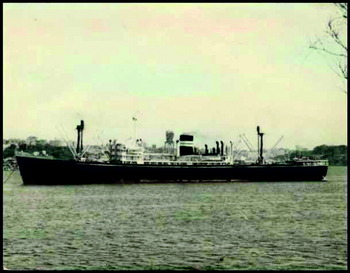
On my first ship as Third Officer (the MS Chanda, built 1942 and trading between Japan and the Gulf) the Captain was not a radar fan. As the ship had no gyro compass, the requirement to ascertain risk of collision by watching the bearing of an approaching vessel meant several trips to the Monkey Island to squint through the prism on the standard (magnetic) compass (see Figure 1).
MS CHANDA.

Fortunately there was an autopilot linked to the steering compass so the risk of the ‘Secunny’ (Quartermaster) drifting off course was not high. The target acquisition of radars in those days was not good anyway, and numerous ‘country craft’ (dhows, small coastal fishing vessels, sampans, junks and so on) would rarely show on the radar with any degree of certainty. In any case the lights, if any, of such vessels could not be regarded as complying with the recently hard-learned Rules; if the whistle was used to indicate a change of course, then there was no certainty that anyone hearing it would have understood, so that never happened.
East of Singapore, vast fleets of junks would be encountered, especially to the north of the Paracel Islands. A light might be at the forward end of one junk, in the middle of the next (only feet away) and at deck level of a third. While I cannot recall any reports of actual collisions, there were innumerable near misses, generally indicated by a lot of shouting from the junks as we glided past at 14 knots. At least the local vessels on the Japanese coast would have recognisable lights but the incidence of reduced visibility was higher there, so relaxation would have to wait until we reached the Bay of Bengal on the way west toward India.
Realising that fog was likely would mean ‘waking up’ the radar; a long process that involved calling the Master, starting the power supply, sharpening chinagraph pencils to use on the plastic plotter (there was no such thing as a reflection plotter), checking the ship's position, noting what other vessels were around, sending for an extra look-out, ensuring from the engine room that there was steam available for the whistle and making sure that there was a cup of tea awaiting the Master when he arrived, grumpily, on the bridge. Once the Master was awake, it was safe to switch on the VHF radio as well, as the converter for that was inconveniently sited over his pillow in his cabin one deck below. Most Masters would willingly take over from the OOW, who would be reduced to the role of chief plotter, but getting access to the radar in daylight was not always easy; the Plan Position Indicator (PPI) was not designed for daylight viewing and was only usable with a hood over it. Inevitably the Master would be looking in the radar hood at the very moment in the 3 or 6 minute interval when plots had to be checked and updated.
In the Gulf, a similar sequence would have to be followed, but with the added risk of sandstorms reducing visibility as well; flying sand affected the radar in much the same way as snow, in that target acquisition was reduced and sometimes the screen would be as orange as the world outside the bridge.
Being in the liner trade, we would often be in company with ships of other companies proceeding in similar directions at the same time; crossing traffic, at least in the Bay of Bengal and Arabian Sea, was minimal. The situation in the Gulf meant that ships would be on many different courses and convergences, as oil terminals and cargo ports were rarely reasonably close together until approaching the headwaters of the Gulf, bound for Iran or Iraq. There was still no alternative to going up the ladder to the Monkey Island to check bearings.
In pilotage waters, it was often assumed that the pilot would take care of the collision avoidance problem; in fact, in the Yangtze and Huangpu Rivers up to Shanghai there was no choice, as the pilot forbade use of everything, including charts, radar, echo sounder and Direction Finder (DF). Fog in the area was not an enjoyable experience. Elsewhere, a passage plan of sorts would have been prepared but the random movement of local vessels required a local language ability. As a Third Officer, I did not have this skill except in Indian ports where ‘bazaar baht’ (maritime Hindi) was occasionally used, as it was every day with our Indian crews. In Gulf ports, and more especially in the Shatt-al-Arab waterway, the Iraqi pilots would expect to take care of all things nautical; they would often yell abuse in Arabic at barges obstructing the way of a 7,000 ton cargo ship. As a result, collision problems there were dealt with simply.
East of Suez, there were no such things as Traffic Separation Schemes (TSS) in the mid-1960s; I doubt whether any of the local craft would have observed them anyway. What few natural features there were, such as one or two banks around Malaysia, lent themselves to being mid-channel marks, but otherwise we had to trust the other vessels’ OOW. Trust them we did, as close-quarter situations were almost non-existent. The watches would generally pass without much excitement, as there was no need to listen to VHF radio; we could often spend a contented four hours at night merely leaning over the bridge front, once the regulation compass error had been observed and compasses compared. ‘Speaking’ to a ship meant calling her up on the Aldis lamp and ‘talking’ by light for perhaps 10 minutes.
Later, in 1966, I was appointed for a year (with no leave) to the SS Nuddea, which was faster, had a newer radar and a proper VHF radio. The radar was not sensibly sited (by 21st century standards) and had considerable blind spots caused by the large funnel and two masts forward of the bridge. The problems were appreciated, as the forward derricks would almost invariably be lowered, even on the shortest coastal passages.
Even with a better radar, the Gulf still posed problems, as before, in ‘Shamals’ (a north westerly wind blowing over Iraq and the Gulf states). Crewmen were still asked to spend look-out time on the focsle and report their sightings by bell, exactly as cadets had been expected to do some years before. There was no thought of doubling up look-outs in reduced visibility, even with the large deck crews which we carried in those days. The vast majority of Indian seamen could readily identify what type of ship was approaching, and whether it would pose a risk; but there was no question of them being allowed to have an explanation of how radar worked or how to use it for collision avoidance. Nuddea had a Decca Navigator (the trusty Mark 12) and we were made well aware of the dangers of steaming along a particular lane and meeting something doing the same thing but on a reciprocal course.
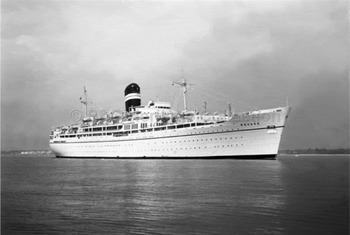
To end the decade, in 1968, I was appointed to the Company's Educational Cruise ships SS Nevasa and SS Uganda. We rarely left European waters and saw the introduction of TSSs, even better radars and, to me at least, the advent of lots of real ships with proper lights. It was also here that I had my only collision (see Figure 2).
SS NEVASA.

In the Nevasa, we were steaming south towards Copenhagen in 1970. South of Anholt, in dense fog and following the NEMEDRI routes (North European, Mediterranean Danger Route Instructions, Kemp et al., Reference Kemp, Bechley, Lyon, Sellers and Thirslund2011). I was the 0001 to 0400 watchkeeper, with the Master, Cadet, Quartermaster and Look-out all on the (comparatively) small bridge. All was proceeding smoothly and slowly until a small target was detected at about 2 nautical miles, approaching from the south west. Our whistle was keeping everyone awake, but there were few other vessels around us. The target continued on its way at about 9 knots; our engines were stopped and then put astern. The fishing vessel (for that was what it was) gave a direct hit on the porthole in the Nursing Sister's cabin perhaps 8 or 9 feet above the waterline, broke the glass and then stern-boarded off into the fog. The bridge telephone rang, with a surprised Nurse on the other end saying:
“Mike, there's someone trying to get into my porthole”.
“Yes”, I said, “We know, but he's gone away now”.
“In that case, I'll go back to bed, I am on call you know”.
All was explained when we reached Copenhagen some 3 or 4 hours later and fitted a blank to her porthole. We did not get the fishing vessel's name, nor were details exchanged.
Compared with the information sources available in the 21st century, our collision avoidance aids in the mid-20th century were comparatively rudimentary, but they worked. There was probably less commercial pressure, as satellite telephones had not even been invented; messages reached ship by telegram (and then only when the Radio Officer was on watch) and we passed all vessels at a very safe distance. The watchword was that if you could read the passing ships’ name, then you were too close. Look-outs were posted in all weathers and the reliance on eyes and compass was huge.
4. USING RADAR FOR COLLISION AVOIDANCE ON MS BATORY – MIROSŁAW JURDZINSKY
4.1. Bridge Procedure on Board Passenger Vessel MS Batory
In the 1950s, Poland had only one passenger vessel on the North Atlantic route, the MS Batory, which the author joined in 1957 and worked onboard in the capacity of Third Officer and later as the Second Officer until 1959. MS Batory (14,300 GRT) carried 816 passengers and a crew of 370. She had a speed of 18 knots and was owned by the Gdynia America Line. At that time the Batory was operated on the North Atlantic run from Gdynia to Montreal via Copenhagen and Southampton (Cowes). During winter, the vessel went on cruises in the region of the Caribbean.
As one of the Navigating Officers, I prepared the passage plans to be accepted by the Master. In those days we used to cross the Atlantic using great circle sailing, in accordance with the recommendations of the publication Ocean Passages for the World.
Our vessel was equipped with a 3 cm wavelength ‘Kelvin Hughes – 14’ radar, and a 10 cm wavelength Raytheon (USA) radar. Additionally, we had a Decca Navigator Positioning System as well as a gyrocompass, magnetic compasses and all remaining equipment complying with SOLAS (Safety of Life at Sea) convention regulations.
The Master himself had the con of the vessel in restricted waters or in difficult hydro- meteorological conditions such as fog, stormy weather or ice. In favourable weather conditions, Navigating Officers kept watches on the bridge by themselves.
In restricted visibility, the work on the bridge of a passenger vessel such as the Batory was organized in accordance with good seamanship practice. The Master took the conning position and navigated the vessel on the basis of traffic information from the Officer of the Watch (OOW) who continuously kept his eyes on the radar screen. Under normal circumstances and in good visibility only one radar was used but, in restricted visibility, both of the radars were used. The ship's position was plotted at equal intervals of ten minutes, twenty minutes or one hour, depending on the weather conditions.
In restricted visibility, one helmsman was employed on manual steering while the other one kept a look-out on a bridge wing. Depending on the weather conditions, another seaman on watch might be posted as a look-out, either on the focsle on the bow or high up on the Monkey Island.
The OOW was helped in navigation by his assistant who recorded all the navigational data in a rough logbook. In restricted visibility, fog signals were sounded, the ship's steaming lights were switched on, there was a continuous listening watch for signals from other vessels in the vicinity and the engines were kept ready for manoeuvring.
4.2. The Process of Using Radar Information by the Master on Board MS Batory
In those days, there were two methods of navigating the vessel in dense fog. The first one was based on the Master's personal continuous observation of the radar's PPI display. The second method was based on the Master acquiring the information about ship traffic from the OOW and checking it personally at random times on the radar screen. At that time, the radars could only be observed during the day if the display was protected from daylight by a hood and visor, so access to the PPI was limited to one observer at a time.
During my time onboard Batory, I personally passed the radar information about the traffic situation on to the Master. He trusted my expertise, so he did not make the random checks which would have disturbed my concentration on the radar picture.
The observation of the ships’ traffic was done in the following way: When observing the ‘Kelvin Hughes – 14’ radar, I usually worked using the 6 nautical miles range scale, changing from time to time to 12 or 24 nautical miles range scale. I gave priority to the echoes of vessels moving within several degrees to port and starboard of our heading.
At that time (1957–1959), the radar was an unstabilised (i.e., ‘Ship's Head Up’ orientation) relative motion display. On the basis of constant observation of the PPI, I used to report the traffic situation to the Master. I established the main trends in ships’ traffic using a ‘Reflection Plotter’ (on which parallel lines were engraved) as the only method available of estimating the relative movement of ships. There was neither the time nor the facilities for plotting the radar picture onto paper.
4.3. A Memorable Experience
One case of a dangerous ship manoeuvre occurred in the English Channel, after the vessel left Southampton heading for the North Atlantic. It was late in the evening in the autumn of 1958 and I was standing my usual watch. The Master was on the bridge because of restricted visibility (1 to 2 nautical miles). Our vessel was on a heading of 270 degrees, at a speed of 18·0 knots. The automatic whistle was sounding the fog signal specified for a vessel underway.
At the beginning of my watch we passed several vessels on our portside. They were proceeding on opposite and parallel courses. Towards the end of my watch I noticed an echo of a ship on the (unstabilised, ‘Ship's Head Up’) radar screen at a distance of 6·0 nautical miles, close to the limits of the radar range and on the right side of the heading line by some 2 to 3 degrees. I reported it to the Master.
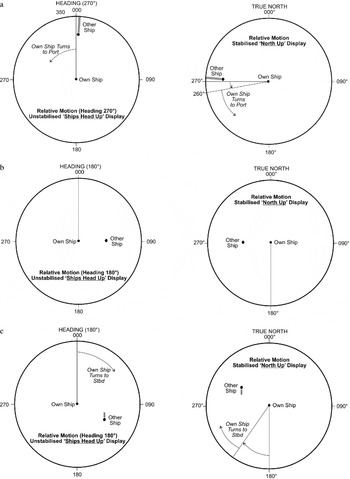
After a few minutes I noticed that the echo was getting closer to the heading line of our vessel (see Figure 3a).
(a) Wheel-Over to Port (Relative Motion Ship's Head Up display [left], modern equivalent North Up display [right]). (b) Situation after course change of 90° to Port. (Relative Motion Ship's Head Up display [left], modern equivalent North Up display [right]). (c) Course Changing Slowly to Starboard, Ahead of Other Ship. (Relative Motion Ship's Head Up display [left], modern equivalent North Up display [right]).

The Master ordered the helmsman to steer 10 degrees to port. After a while, I reported to the Master that the bearing on the approaching vessel has not changed so the Master ordered the helmsman to put the helm hard-a-port. After a while our ship was on course of 180 degrees. The observed vessel was about 2·5 nautical miles on our starboard side, on a fixed relative bearing of about 90 degrees and at an unchanged distance. Both vessels were proceeding southward on parallel courses (see Figure 3b).
After a few minutes, the relative bearing on the other vessel's echo has increased from 100 to 120 degrees. The other vessel has considerably reduced her speed (see Figure 3c).
The Master ordered the helmsman to slowly return to a heading of 270 degrees. Fortunately, while turning to port, no echoes of other vessels on our port side were observed in our vicinity. After returning to a heading of 270 degrees, our vessel was several nautical miles off her planned course. So the correction was made of some degrees to starboard. After a while, we could see echoes of other vessels on our starboard side.
I remembered that situation throughout my sea career and I still remember it today. In poor visibility, the COLREGS now advise against an alteration of course to port in order to avoid a vessel forward of the beamFootnote 4. However, the Master's manoeuvre was successful and the miss distance was a comfortable 2·5 nautical miles but not least because the other vessel reduced her speed.
5. THOUGHTS FROM DENMARK – SØREN THIRSLUND
5.1. Learning the COLREGS
The importance of the navigator's ability to prevent collisions was emphasized to me and my colleagues when we began our studies in 1941 at the navigation school in Copenhagen. We were told that if we were not able to repeat the COLREGS by heart, we would be dismissed. It should be mentioned that, at that time, the COLREGS dated from the late 19th Century and the language was not up to date. The COLREGS were not renewed until 1954, as a result of an international conference in 1948.
In 1944/45 I was teaching fishermen who were studying for their certificates as ‘fiskeskipper’ (Master of fishing vessels). These practical seamen did not understand why it was necessary to learn the COLREGS by heart, but I told them that there was no alternative.
My first experiences of the COLREGS was as an able seaman when steering the ship. I noticed that the OOW always took a series of bearings of approaching ships and that when the bearing did not change, he gave the order to change course and avoid collision.
In my many years as Mate and Master from 1944 to 1968 I was lucky not to have a collision. I mention this because four of my colleagues had collisions and they had a terrible time thereafter. It is hard when the lawyers take over and start discussing who was right and who was wrong. It is good business for the lawyers, so naturally it takes time.
It seems quite clear that the COLREGS, if respected, should prevent any collision. Which mistakes then, have been the reason for various collisions? One was certainly bad look-out. The old rhyme “Both in safety and in doubt – always keep a good look-out” Footnote 5, was taught to the youngsters onboard.
The danger of collision, it seems to me, is greatest in darkness and low visibility. This could be fog, snow, sand storms and even dense smoke from a forest-fire (experienced by myself on a river in Venezuela). These were particularly difficult conditions before radar became available.
Ships’ navigation lights should help mariners decide how to manoeuvre correctly. It was, however, quite late before sailing ships had extra lights high enough to be seen at a distance, and many sailing ships suffered collision because their low-freeboard side and stern lights could not be seen in time. The shining of a torch was often used by the sailing ships when approached by another ship. The two masthead lights of power driven vessels are still very useful for estimating the course of an approaching ship. The rhyme: “Green to green or red to red – perfect safety, go ahead”5 was easily learnt by seaman.”
As Master, my order to the Mates was always to show what they intended to do as early as possible and to indicate it by sound and/or light signal. This would give the other ship a chance to see that she was observed and that action was being taken.
At the change of watches it was important that the officer taking over should know which ships had been observed and if they still needed to be monitored. In the Mærsk-Line it became mandatory that the officers should tape-record what was said at the time of take over.
5.2. Observing a Collision
I had a serious experience on the Mississippi River in the mid-1950s. My ship had left New Orleans and was approaching one of the many bends in the river, when the pilot said to the Mate:
“Call the Captain and tell him that if he wants to see a fresh collision he should come up now”.
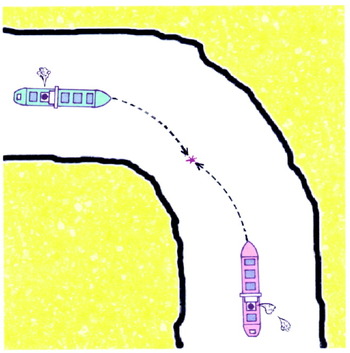
I went to the bridge, and the pilot said that he had noticed two ships approaching each other on the bend. One had given two short blasts meaning turning to port, the other gave one short blast, but this signal ‘killed’ one of the other ship's two blasts and so a misunderstanding occurred. The first ship altered course to port and the second ship altered course to starboard and collided. There was only minor damage, but I am sure that similar mistakes have been the reason that it became permissible that a signal light on top of the bridge could make the same signal as given by soundFootnote 6 (see Figure 4).
The green/blue ship gives one short blast but only hears one of the two blasts given by the red ship.

On another occasion, in 1955, we had left New York for a voyage to Columbia. Two days later, I was sitting in my cabin when I heard the Chief Officer ringing the engine telegraph to stop and, shortly thereafter, he gave 6 or 8 short blasts on the whistle. This is the ‘wake-up’ signal specified by the COLREGS when a vessel believes that insufficient action is being taken by the other vessel to avoid collision. I rushed to the bridge and found the Chief Officer with his glasses in his hand, laughing. On our port side, a Greek freighter was running at full speed across our bow and, on the bridge, two men were fighting. As they had not given way for us, my Chief Officer had sounded the ‘wake-up’ signal, and probably the skipper of the freighter had rushed up to give his OOW a painful lesson.
6. TWO INCIDENTS IN THE 1940s – NORMAN COCKCROFT
I recall two incidents in the late 1940s which serve to illustrate the difficulties of collision avoidance before radar, ARPA and AIS came into general use and before TSSs were established (Cockcroft, Reference Cockcroft1983).
6.1. Restricted Visibility
The first incident occurred in restricted visibility. Article 15 of the COLREGS in force at that time prescribed fog signals to be given on the whistle by steam-vessels. A steam-vessel with way upon her was required to sound one prolonged blast, and if stopped two prolonged blasts, at intervals of not more than two minutes.
I joined my first ship as an apprentice Navigating Officer in 1946. Early in 1947 the ship was off the Newfoundland Banks in dense fog. I was called to the bridge to act as an extra look-out. The Master was on the bridge with the OOW. A seaman was posted as a look-out on the focsle. A signal of one prolonged blast was heard from another ship forward of the beam. The Master asked the OOW and myself to indicate the direction from which the other vessel's signal was coming. We all three found ourselves pointing in different directions. Both vessels began sounding fog signals more frequently which meant frequent stopping of engines. The signals from the other vessel got louder as the two vessels closed each other. Eventually the two vessels managed to feel their way past each other without coming into sight due to the density of the fog.
This was my only experience of navigating in thick fog without radar, as most ships I sailed in afterwards were fitted with the equipment.
6.2. Clear Weather
The second incident was a crossing situation in clear visibility. The rules were clear as to the conduct of the vessel which had the other on her own starboard side. She was required to keep out of the way and to avoid crossing ahead. There was no specific requirement to take early action. The most likely action to be taken by the give-way vessel would be a turn to starboard.
The vessel with the other on her own port side was not permitted to take action until collision could not be avoided by the giving-way vessel alone. Turning to port would be dangerous as the other vessel could be expected to turn to starboard. For many crossing situations the two ships could get to within a distance of half a mile from each other before it would not be possible for the give-way vessel to avoid collision by her own action. By that time collision is likely to be inevitable so turning to starboard to turn broadside to the oncoming ship would be a dangerous manoeuvre.
In 1949 I was an uncertificated Third Mate on a tanker. I was on the bridge keeping the 8 to 12 watch. The ship was in the open sea in good visibility. Another ship was seen to be approaching from about 30 degrees on the port bow. The compass bearing was found to be constant, indicating risk of collision. It was clearly the duty of the other vessel to keep out of the way. As the other vessel got closer I became increasingly concerned. At that time a ‘wake-up’ signal was not prescribed in the COLREGS. The Master had given clear instructions to be called if in doubt. I blew down on his voice pipe and was very relieved when he came quickly to the bridge.
The ship was not fitted with radar but I believe the other vessel was over a mile away when the Master came to the bridge. He did not hesitate. He ordered the helmsman to put the wheel hard over to port. We watched anxiously in case the other ship turned to starboard at about the same time. She took no action. The two ships passed at close distance. Clearly another case of bad look-out.
The Master took a risk in taking action before the vessels got so close that collision could not be avoided by the give-way vessel alone and in turning to port. There was high probability that the other ship would turn to starboard at about the same time. If a collision had occurred our ship was likely to have been held at fault. However, if he had waited any longer and then turned to starboard the consequences could have been much worse. The rules at that time did not deal adequately with such a situationFootnote 7.
7. CONCLUSIONS – JOHN KEMP
It is hoped that the experiences and recollections of the previous sections will provide a flavour of the way we used the available technology for collision avoidance in the middle years of the 20th Century, and the attitudes that prevailed at the time.
The technology was basic and, even when radar became available, the displays were often ‘Ship's Head Up’ and unstabilised. I experienced one such on a cross-channel ferry that was a ‘pig to steer’ and which only had a transmitting magnetic compass to control the auto-helm. In anything more than a moderate sea, we yawed our way through the traffic causing the echoes to trace large zig-zags as they progressed across the radar display. The only way to choose a safe collision avoidance manoeuvre was to allow a huge margin of error.
Shipmasters at the time were generally autocratic and, if a junior officer made a mistake, he was often more worried about the Captain finding out than about the safety of the ship. The eminently sensible concept of bridge teamwork, and the idea that junior officers might routinely question a senior officer's judgement, was still in the future.
It is worthy of note that two of the related experiences involve a case where an experienced shipmaster altered course to port for a vessel approaching from forward of the beam. They were good manoeuvres in so far as they successfully avoided collision but, if a collision had occurred, the courts would certainly have found the shipmasters at fault. However that might be, the decisions clearly made such an alarming impression on the then junior officers that they vividly remember the circumstances some 50 or 60 years later.
Finally, I must thank my fellow ancient mariners for their contributions to this paper. Among our ramblings perhaps we have given a feeling for how we worked and how we thought in avoiding collisions in the mid-20th Century.