The broader autism phenotype refers to a collection of traits that, when they are sufficiently pronounced and associated with clinical levels of distress, may result in a diagnosis of autism spectrum disorder (ASD; e.g., Ingersoll & Wainer, Reference Ingersoll and Wainer2014; Sucksmith, Roth, & Hoekstra, Reference Sucksmith, Roth and Hoekstra2011; Wheelwright, Auyeung, Allison, & Baron-Cohen, Reference Wheelwright, Auyeung, Allison and Baron-Cohen2008). These traits encompass, on the one hand, stereotypical, obsessive, and repetitive interests and behaviors, and, on the other hand, difficulties in verbal and nonverbal communication, as well as in social interaction (American Psychiatric Association, 2013).
The communicative difficulties of people in the broader autism phenotype, as well as of people with an ASD diagnosis, manifest themselves specifically in problems with pragmatic aspects of language. Thus, people on the autism spectrum whose linguistic and cognitive abilities are otherwise unimpaired still exhibit marked difficulties initiating and managing conversations (e.g., de Villiers, Fine, Ginsberg, Vaccarella, & Szatmari, Reference de Villiers, Fine, Ginsberg, Vaccarella and Szatmari2006; Kaland, Mortensen, & Smith, Reference Kaland, Mortensen and Smith2011; Nadig, Lee, Singh, Bosshart, & Ozonoff, Reference Nadig, Lee, Singh, Bosshart and Ozonoff2010; Paul, Orlovski, Marcinko, & Volkmar, Reference Paul, Orlovski, Marcinko and Volkmar2008).
In addition to these well-documented interactional problems, it is also often claimed that one of the most characteristic features of autism is having difficulties understanding utterances for which the communicated content departs from the literal linguistic meaning (e.g., Dennis, Lazenby, & Lockyer, Reference Dennis, Lazenby and Lockyer2001; Ingersoll & Wainer, Reference Ingersoll and Wainer2014; Loukusa et al., Reference Loukusa, Leinonen, Kuusikko, Jussila, Mattila, Ryder and Moilanen2006; Paul & Cohen, Reference Paul and Cohen1985). The most recent edition of the Diagnosis and Statistical Manual of Mental Disorders (DSM-5) lists the following as one of the diagnostic conditions of social (pragmatic) communication disorder, which, together with repeated and restrictive interests, leads to a diagnosis of ASD (but see Norbury, Reference Norbury2014, for a criticism of this construal):
Difficulties understanding what is not explicitly stated (e.g., making inferences) and nonliteral or ambiguous meanings of language (e.g., idioms, humor, metaphors, multiple meanings that depend on the context for interpretation). (DSM-5, American Psychiatric Association, 2013, p. 48)
Pragmatic deficits in autism are often connected to more general difficulties with reading other people’s mental states (e.g., Heavey, Phillips, Baron-Cohen, & Rutter, Reference Heavey, Phillips, Baron-Cohen and Rutter2000; Jolliffe & Baron-Cohen, Reference Jolliffe and Baron-Cohen1999a; Yirmiya, Erel, Shaked, & Solomonica-Levi, Reference Yirmiya, Erel, Shaked and Solomonica-Levi1998). Such difficulties are attested all across the spectrum, even though their severity may vary greatly across individuals, and is partly modulated by structural language proficiency (e.g., Fisher, Happé, & Dunn, Reference Fisher, Happé and Dunn2005; Happé, Reference Happé1995). Theorists often surmise that problems integrating the speaker’s intentions and beliefs within the processing of utterances is what causes certain people on the autism spectrum to stick to inappropriately literal interpretations of utterances. According to these theorists, then, pragmatic deficits are a manifestation of “mind-blindness,” which is understood to be a core feature of autism (Baron-Cohen, Reference Baron-Cohen1988, Reference Baron-Cohen1995; Frith & Happé, Reference Frith and Happé1994; Happé, Reference Happé1993).
The connection between pragmatics and mental state attribution is all the more intuitive, as current pragmatic theorizing is largely based on Grice’s (Reference Grice1957, Reference Grice1975a, Reference Grice1975b) idea that the communicated meaning of an utterance should be reconstructed in terms of the attribution of communicative intentions to the speaker. According to Grice, this kind of intention attribution rests on the assumption that communication is a cooperative enterprise geared at jointly achieving certain conversational goals. Grice operationalized the notion of cooperativity on the basis of four maxims that all participants to a conversation expect a rational speaker to fulfill:
1. Quality: make sure that your utterance is true.
2. Quantity: make sure that your utterance is informative.
3. Relation: make sure that your utterance is relevant.
4. Manner: make sure that your utterance is clear.
To illustrate, suppose that the speaker says “My sister is an angel.” On its literal interpretation, this utterance constitutes a manifest and blatant violation of the maxim of quality. Hence, in order to maintain the assumption that the speaker is rational and intends her utterance to be a meaningful contribution to the conversation, one must opt for a nonliteral, metaphorical interpretation. This nonliteral meaning, which is different from the linguistic content, and which results from pragmatic inferencing about the speaker’s communicative intentions, is called an implicature of the utterance. Implicatures are thus pragmatic inferences that can be understood in terms of Grice’s conversational maxims.
Implicatures are not restricted to situations in which the speaker blatantly violates one of the maxims, that is, to cases of nonliteral language use. The speaker might also find herself in a situation in which she has to choose between two maxims. Implicatures that arise when there is a conflict between the maxims of quantity and quality are called quantity implicatures. In such cases, the speaker has to choose between being less informative (viz. violate the maxim of quantity) and saying something for which she lacks evidence or which she believes to be false (viz. the maxim of quality). In most such cases, quality trumps quantity, and the speaker will choose to say something less informative.
To illustrate, suppose a student tells you “I did some of my homework.” It is commonly assumed that the literal meaning of “some” can be paraphrased as “at least some.” Hence, on its literal reading, this utterance is true both in a situation in which the speaker did some but not all of her homework and in a situation in which she did all of it. In the latter situation, however, the speaker could have been more informative by saying “I did all of my homework.” Why did she not produce this alternative sentence? Presumably because she did not do all of her homework. In this way, then, making a less informative utterance indicates to the hearer that the speaker lacks evidence for the more informative alternative, or even believes that the alternative is false (e.g., Gazdar, Reference Gazdar1979; Geurts, Reference Geurts2010; Horn, Reference Horn1972).
The particular kind of quantity implicature used in the foregoing example (i.e., the inference from “some” to “not all”) is known as a scalar implicature. Scalar implicatures are so-called for being associated with expressions that evoke scales consisting of multiple expressions that are ordered in terms of informativeness. For example, “some” and “or” are associated, respectively, with the scales <some, all> and <or, and>. Accordingly, a scalar implicature associated with the weaker term (“some”) consists in the negation of its stronger scalemate (“all”).
Recall that, on a traditional Gricean view, the derivation of scalar implicatures, and of quantity implicatures in general, requires reasoning about the speaker’s intentions for making a certain utterance. Hence, given their aforementioned difficulties with reasoning about other people’s intentions, one might reasonably hypothesize that individuals on the autism spectrum are less likely to derive scalar implicatures than neurotypicals. This hypothesis, however, has been disconfirmed in three studies that show that people who have been diagnosed with ASD are just as likely to derive scalar implicatures as neurotypical controls (Chevallier, Wilson, Happé, & Noveck, Reference Chevallier, Wilson, Happé and Noveck2010; Pijnacker, Hagoort, van Buitelaar, Teunisse, & Geurts, Reference Pijnacker, Hagoort, van Buitelaar, Teunisse and Geurts2009; Su & Su, Reference Su and Su2015). In what follows, we will briefly discuss these studies in chronological order.
PREVIOUS WORK
Pijnacker et al. (Reference Pijnacker, Hagoort, van Buitelaar, Teunisse and Geurts2009) were the first to investigate the effect of ASD on the probability of deriving scalar implicatures. Their study tested three types of participants: adults diagnosed with high-functioning autism, adults diagnosed with Asperger syndrome, and neurotypical controls. Participants were presented with sentences such as:
(1) a. Some sparrows are birds.
b. Zebras have black or white stripes.
Both of these sentences are associated with scalar implicatures. For example, someone who utters (1b) could have been more informative by using the alternative “Zebras have black and white stripes.” Why did she not produce this alternative? Presumably because she believes zebras do not have black and white stripes. Hence, (1b) triggers the scalar implicature that, according to the speaker, zebras do not have black and white stripes.
Participants had to indicate whether they considered sentences such as (1) to be true or false. Participants who derived the corresponding scalar implicatures were predicted to answer “false,” while participants who interpreted these sentences literally were predicted to answer “true.” In what follows, we will refer to these two types of answers as pragmatic and literal, respectively.
In contrast with their predictions, Pijnacker et al. found no difference in the rates of pragmatic responses between neurotypicals and either adults with high-functioning autism or adults with Asperger syndrome. On the contrary, adults with Asperger syndrome were significantly more likely to provide pragmatic responses to underinformative sentences with “some” than both adults with high-functioning autism and neurotypical controls.
Pijnacker et al. also investigated a possible effect of language competence on the responses in their experiment. To this end, they determined the level of linguistic functioning of their participants by means of three tests focusing on their phonological, syntactic, and semantic abilities. They found that, within the group of people with high-functioning autism, there was a significant effect of language competence, such that individuals with greater language competence were more likely to provide pragmatic responses.
Chevallier et al. (Reference Chevallier, Wilson, Happé and Noveck2010) tested a group of adolescents with and without ASD, hypothesizing that the null result found by Pijnacker et al. might be due to compensatory strategies that people with ASD acquire at a later age. Rather than a sentence verification task, Chevallier et al. administered a sentence–picture verification task, in which participants listened to sentences such as the following:
(2) There is a sun OR a train.
The scalar expression “or” was prosodically marked so as to facilitate pragmatic responses (cf. Chevallier et al., Reference Chevallier, Noveck, Nazir, Bott, Lanzetti and Sperber2008).
Each utterance was presented with a display, and participants had to decide whether the uttered sentence was true or false in the corresponding display. In the target condition, (2) was presented with a display containing both a sun and a train. In line with the results reported by Pijnacker et al., Chevallier et al. observed no difference in the rates of pragmatic responses for adolescents with and without ASD.
In order to test for potential effects of verbal competence, Chevallier et al. measured the receptive vocabulary size of their participants. Consistently with Pijnacker et al., it was observed that, within the group of adolescents with ASD, there was a significant effect of vocabulary skills, such that individuals with greater vocabulary skills were more likely to provide pragmatic responses.
Finally, Su and Su (Reference Su and Su2015) tested an even younger group of participants with and without ASD. These participants were divided into a younger group (aged 4 to 8) and an older group (aged 9 to 15). Like Chevallier et al., Su and Su engaged participants in a sentence–picture verification task, in which they listened to sentences such as
(3) a. Some children found sea snails.
b. Every child got a sea star or a shell.
In the critical condition, (3a) was presented with a picture in which all children found sea snails, and (3b) with a picture in which every child got both a sea star and a shell. In both cases, the sentence was true on its literal interpretation, but false if the scalar implicature was derived, namely, “some” and “or” were interpreted, respectively, as “some but not all” and “or but not and.” In both the younger and older groups, the rates of pragmatic responses for both sentence types were statistically indistinguishable for children with and without ASD, thus confirming and generalizing the results found in the previous studies.
Although Su and Su matched participants based on their language competence, they did not report whether there were any significant effects of language competence on the rates of pragmatic responses in their task.
SUMMARY AND OUTLOOK
The results of the foregoing studies indicate that people with and without ASD are equally likely to derive scalar implicatures. Assuming that these findings can be generalized across people in the broader autism phenotype, this conclusion might be further taken to suggest that one’s adeptness with reasoning about the speaker’s intentions for being underinformative is independent of the degree to which one has autistic traits. There are, however, compelling reasons to doubt that findings about scalar implicatures can be generalized across the entire family of quantity implicatures (e.g., Chemla & Bott, Reference Chemla and Bott2014; Tieu, Romoli, Zhou, & Crain, Reference Tieu, Romoli, Zhou and Crain2016; van Tiel & Schaeken, Reference van Tiel and Schaeken2017). In particular, scalar implicatures have three distinctive features that might preclude such a generalization.
First, a number of theorists have argued, controversially, that scalar implicatures, notwithstanding their name, are not a variety of pragmatic inferences at all, but are rather an aspect of the lexical meaning of scalar expressions (Chierchia, Reference Chierchia2004; Grodner, Klein, Carbary, & Tanenhaus, Reference Grodner, Klein, Carbary and Tanenhaus2010; Levinson, Reference Levinson2000; Storto & Tanenhaus, Reference Storto and Tanenhaus2005). According to these theorists, for example, “some” simply means “some but not all.” An ongoing debate is concerned with testing the predictions of this lexicalist account (e.g., Bott & Noveck, Reference Bott and Noveck2004; Breheny, Katsos, & Williams, Reference Breheny, Katsos and Williams2006; Huang & Snedeker, Reference Huang and Snedeker2009; Noveck, Reference Noveck2001), with the current experimental record apparently favoring a nonlexicalist approach, according to which scalar implicatures draw upon mentalizing abilities. However, as noted before, both Pijnacker et al. and Chevallier et al. found that, within the group of people with ASD, the probability with which participants derived scalar implicatures increased with their language competence. Therefore, an alternative possibility is that only people on the broader autism spectrum have encoded scalar implicatures in the lexicon instead of deriving them through pragmatic inferencing.
Second, the derivation of scalar implicatures is simple in that it can essentially be reduced to constructing and rejecting alternatives the speaker could have said. To illustrate, suppose, once again, that a student says “I did some of my homework.” It might be the case that the hearer simply activates the alternative “I did all of my homework” and then rejects it, without reasoning about the speaker’s motivations for producing her utterance (cf. Kissine, Reference Kissine2013, Reference Kissine2016; Perkins, Reference Perkins2007; Recanati, Reference Recanati2003; and contrary to Geurts, Reference Geurts2010; Sperber & Wilson, Reference Sperber and Wilson2002). If this reductionist approach is on the right track, it might explain why people with and without ASD are equally likely to derive scalar implicatures.
One of our reviewers pointed out a third feature of scalar implicatures that might preclude generalizing previous findings to all varieties of quantity implicature: the nature of the alternatives. In the case of scalar implicatures, the construction of the required alternative (e.g., “I did all of my homework” in the running example) involves substituting an expression in the uttered sentence (“some”) with another expression from the lexicon (“all”). As we will see, in the case of other types of quantity implicature, the required alternatives are already contained within the uttered sentence, or are provided by the context (Fox & Katzir, Reference Fox and Katzir2010; Katzir, Reference Katzir2007). It might be the case that quantity implicatures with different types of alternatives pattern differently from scalar implicatures.
In summary, then, scalar implicatures are distinctive in at least three respects. First, scalar implicatures are lexicalisable, that is, one might hold that they are an aspect of lexical meaning rather than involving pragmatic inferencing. Second, their derivation is simple in that it suffices for the hearer to construct and reject the stronger alternative. Third, the derivation of scalar implicatures involves alternatives that are constructed by substituting elements in the uttered sentence with expressions from the lexicon.
As these three features are not shared across the entire family of quantity implicatures, the observation that people in the broader autism phenotype derive scalar implicatures at the same rate as neurotypicals should not be taken to entail that they are equally adept at reasoning about why the speaker produced an underinformative utterance. In order to arrive at a more decisive verdict, we extended the scope of inquiry to four types of quantity implicature that differ in their lexicalisability, the complexity of their derivation procedure, and the source of the required alternatives.
To this end, we make use of the experimental study introduced by van Tiel and Schaeken (Reference van Tiel and Schaeken2017). Their study tested four types of quantity implicature: scalar implicatures, distributivity implicatures (called “free choice inferences” in their paper), conditional implicatures, and exhaustivity implicatures. The goal of our study will be to determine if the probability of deriving these four types of quantity implicature varies with the degree to which one has traits associated with the autism spectrum.
In the next section, we discuss these four varieties of quantity implicature in more detail, focusing in particular on their lexicalisability, the complexity of their derivation, and the source of the required alternatives.
VARIETIES OF QUANTITY IMPLICATURE
Scalar implicatures
Although we have discussed scalar implicatures at length, we briefly summarize their characteristics here for ease of reference. Hereafter, we use the symbol “→” to refer to the implicature associated with an utterance. Consider the following sentences:
(4) Some of my friends support Hillary.
→ Not all of my friends support Hillary.
(5) Joe supports Hillary or Bernie.
→ Joe does not support both Hillary and Bernie.
Someone who utters (4) could have been more informative by saying “All of my friends support Hillary.” Why did she not? Presumably because not all of the speaker’s friends support Hillary. Analogously, someone who utters (5) could have been more informative by saying “Joe supports Hillary and Bernie.” Why did she not? Presumably because Joe does not support both Hillary and Bernie.
Scalar implicatures are lexicalizable, because one might reasonably posit that the lexical meaning of “some” or “or” is “some but not all” or “or but not and.” Furthermore, their derivation is simple in that it suffices for the hearer to construct and reject the stronger alternative, without necessarily engaging into reasoning about the speaker’s mental states. Finally, constructing the required alternative involves substituting an element in the uttered sentence (e.g., “some”) with an expression from the lexicon (e.g., “all”).
Distributivity implicatures
Distributivity implicatures are associated with occurrences of “or” under universal quantifiers (Fox, Reference Fox2007; Geurts, Reference Geurts2010). As an illustration, consider the following sentence:
(6) Each of my friends supports Hillary or Bernie.
→Some of my friends support Hillary and some of them support Bernie.
On its literal interpretation, this sentence is compatible with a situation in which all of the speaker’s friends support Hillary and none of them support Bernie, or, conversely, with a situation in which all of the speaker’s friends support Bernie and none of them support Hillary. After all, a disjunction is true whenever one of its disjuncts is. Someone who utters this sentence, however, implies that such a situation does not obtain, that is, that some of her friends support Hillary and that some of them support Bernie.
On the face of it, distributivity implicatures might appear to be similar to the scalar implicature from “or” to “not and,” which was tested in all of the previous studies. However, scalar implicatures and distributivity implicatures are importantly distinct. An utterance of (6) might lead to the scalar implicature that not all of the speaker’s friends support both Hillary and Bernie, but this scalar implicature is compatible with a situation in which all of the speaker’s friends support Hillary and none of them support Bernie. Such a situation is ruled out if the corresponding distributivity implicature is derived.
In order to derive the distributivity implicature associated with (6), the hearer might reason as follows: the speaker could have been more informative by saying either “Each of my friends supports Hillary” or “Each of my friends supports Bernie.” Had she said “Each of my friends supports Hillary,” she would have implied that none of her friends support Bernie; had she said “Each of my friends supports Bernie,” she would have implied that none of her friends support Hillary. The reason the speaker did not produce either alternative, then, is that it is false that all of the speaker’s friends support Hillary but not Bernie, and it is false that all of the speaker’s friends support Bernie but not Hillary. Together with the literal meaning of the sentence, this leads to the desired distributivity implicature that some of the speaker’s friends support Hillary and that some of them support Bernie.
A lexicalist approach to distributivity implicatures has never been proposed in the literature, and it is not difficult to see why. How should “or” in (6) be interpreted in order to generate the desired interpretation? Perhaps as “and”? Unfortunately, this would lead to an even stronger interpretation according to which all of the speaker’s friends support both Hillary and Bernie. Moreover, in other contexts (e.g., “Joe supports Hillary or Bernie”), “or” tends to exclude “and” rather than implying it. As we do not readily see a viable alternative, and as none has been proposed in the literature, we conclude that distributivity implicatures are not lexicalizable.
As described in the foregoing, the derivation of distributivity implicatures is more complex than the derivation of scalar implicatures, as it involves reasoning about what the speaker would have implied had she produced either alternative. By contrast, in the derivation of scalar implicatures, it suffices to reason about the literal meaning of the “all”-alternative.
One might consider a simpler approach, according to which someone who hears (6) simply activates and rejects the alternatives “Each of my friends supports Hillary” and “Each of my friends supports Bernie.” Note that these inferences are stronger than the distributivity implicature that we described above: whereas the implicature described in (6) is compatible with a situation in which all of the speaker’s friends support Hillary and some of them, in addition, support Bernie, such a situation in ruled out on the simple approach.
Crnič, Chemla, and Fox (Reference Crnič, Chemla and Fox2015) provide persuasive evidence in favor of the more complex approach: 97% of the participants in their experiment judged sentences such as (6) true in situations in which all of the speaker’s friends support Hillary and some of them also support Bernie. Hence, we conclude that the derivation of distributivity implicatures is more complex than that of scalar implicatures.
Finally, the alternatives needed to derive distributivity implicatures (e.g., “Each of my friends supports Bernie” and “Each of my friends supports Hillary” in example above) are already contained within the uttered sentence. Hence, their construction involves deleting elements from the uttered sentence. In this respect, distributivity implicatures differ from scalar implicatures. Recall that, in the case of scalar implicatures, constructing alternatives involves substitution from the lexicon.
Conditional implicatures
As the name suggests, conditional implicatures are associated with utterances containing conditionals, such as the following:
(7) Each of my friends will support Bernie if he wins the primaries.
→ Not all of my friends support Bernie.
Someone who utters this sentence implies that not all of her friends support Bernie. After all, the speaker could have been more informative by saying “Each of my friends supports Bernie.” Why did she not? Presumably because not all of her friends support Bernie.
Are conditional implicatures lexicalizable? Geis and Zwicky (Reference Geis and Zwicky1971) put forward a potentially lexicalist approach to conditional implicatures. According to these authors, “if” is normally read as “if and only if.” In the case of (7), however, this lexicalist account leads to an even stronger interpretation according to which none of the speaker’s friends currently support Bernie. According to our intuitions, as well as those of most current theorists, this characterization is too strong (e.g., Franke, Reference Franke2009; Geurts, Reference Geurts2010; Lilje, Reference Lilje1972). As we do not see a viable alternative, and as no such alternative has been proposed in the literature, we conclude that conditional implicatures are not lexicalizable. In this respect, then, conditional implicatures mirror distributivity implicatures.
Conditional implicatures also mirror distributivity implicatures in that the required alternative (e.g., “Each of my friends supports Bernie” in the example above) is already contained within the uttered sentence. Unlike distributivity implicatures, however, the derivation of conditional implicatures is simple in that it only requires that the hearer construct and reject this stronger alternative.
Exhaustivity implicatures
Exhaustivity implicatures are associated with “it”-clefts, such as the following:
(8) It is Hillary that I support.
→ I only support Hillary.
Someone who utters this sentence may imply that she does not support Bernie. Had she supported both Hillary and Bernie, she should have said “It is both Hillary and Bernie that I support.” Why did she not? Presumably because she does not support both Hillary and Bernie. This reasoning can be applied to any combination of presidential candidates, which licenses the exhaustivity implicature that the speaker only supports Hillary (e.g., DeClerck, Reference DeClerck1988; Dufter, Reference Dufter2009; Hartmann & Veenstra, Reference Hartmann and Veenstra2013; Horn, Reference Horn1981; Pavey, Reference Pavey2004; Vallduví, Reference Vallduví1993).
Are exhaustivity implicatures lexicalizable? One might propose that exhaustivity is encoded in the meaning of “it”-clefts. However, this proposal tends to overgenerate. For example, someone who says “It is with great pleasure that I welcome everyone” does not implicate that she does not have any other feelings (see, e.g., Huddleston & Pullum, Reference Huddleston and Pullum2002). We do not readily see a viable alternative, and none has been proposed in the literature. Hence, exhaustivity implicatures are akin to distributivity implicatures and conditional implicatures in that they are not straightforwardly lexicalizable.
Exhaustivity implicatures mirror scalar implicatures and conditional implicatures in that their derivation procedure is simple, as all the hearer has to do is construct and reject the relevant alternative (e.g., “It is both Hillary and Bernie that I support”). Constructing this alternative involves adding material to the uttered sentence. It is generally assumed that this material is provided by the context. Thus, an utterance of (8) only excludes the possibility that the speaker supports Bernie in a context that makes the contrast between Hillary and Bernie salient. When uttered in a context that makes the contrast between, for example, Hillary and Donald salient, (8) might not license this exhaustivity implicature (e.g., Geurts, Reference Geurts2010).
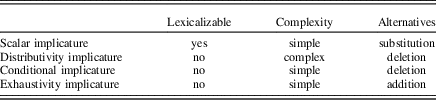
To summarize this section, Table 1 provides an overview of the relevant characteristics of the four varieties of quantity implicature that we just reviewed and that will be tested in the experiment. Given that people in the broader autism phenotype derive scalar implicatures at the same rate as neurotypicals, what might one expect for the other three varieties of quantity implicature? In the following section, we distinguish between four possible answers to this question.
Characteristics of four types of quantity implicature. Lexicalizable: is it tenable to hold that the inference is encoded in the lexical meaning? Complexity: can the derivation be reduced to constructing and negating alternatives? Alternatives: how are the required alternatives constructed from the uttered sentence?

PREDICTIONS
Social motivation theory
Does the probability with which the four aforementioned varieties of quantity implicature are derived depend on the degree to which one has autistic traits? Perhaps the most straightforward answer is a simple no: people derive all four varieties of quantity implicature irrespective of the degree to which they have autistic traits. This position is suggested by the social motivation theory of autism (Chevallier, Noveck, Happé, & Wilson, Reference Chevallier, Noveck, Happé and Wilson2011). Proponents of this theory attempt to reconcile the existence of intact pragmatic processes in people in the broader autism phenotype (specifically, people who have been diagnosed with ASD) with a purely Gricean, modular conception of pragmatic competence (Chevallier, Kohls, Troiani, Brodkin, & Schultz, Reference Chevallier, Kohls, Troiani, Brodkin and Schultz2012).
The main idea of the social motivation theory is that individuals with ASD are affected by a neurodevelopmental disruption of the motivation to seek, maintain, and enjoy social contact. As a consequence, they often lack the impetus to spontaneously interact and adopt the conversational partner’s perspective, and thereby miss the opportunities required to hone their pragmatic skills. According to proponents of the social motivation theory, then, the often reported interactional deficits of people in the broader autism phenotype are compatible with there being no pragmatic, or, for that matter, mindreading, deficits in autism. In other words, the capacity to attribute communicative intentions would be intact in individuals in the broader autism phenotype, although, most of the time, the functioning of this pragmatic competence is blocked due to their diminished social motivation.
A clear empirical prediction of the social motivation theory is that, under the right experimental conditions, people in the broader autism phenotype should be able to adequately comprehend even those pragmatic phenomena that require genuine perspective shifting. In line with this prediction, a couple of studies have suggested that adults with high-functioning autism are able to determine whether or not an utterance was intended to be ironic on the basis of prosodic cues (Chevallier et al., Reference Chevallier, Noveck, Happé and Wilson2011; Colich et al., Reference Colich, Wang, Rudie, Hernandez, Bookheimer and Dapretto2012). However, in these binary choice tasks, ironic stimuli were clearly marked by incongruence with the surrounding context, as well as a salient, contrastive intonation contour. What can be concluded from these studies, then, is that high-functioning individuals with ASD are able to use contextual and, especially, salient prosodic cues to detect irony, not that they can routinely reach the intended ironical interpretation by reasoning about the speaker’s mental states.
While evidence about irony detection needs further investigation, different varieties of quantity implicature offer a clear-cut test case for the social motivation theory. Within an experimental paradigm in which different types of quantity implicature are elicited in the same way, proponents of the social motivation theory should expect that the degree to which one has autistic traits does not affect the frequency with which different varieties of quantity implicature are derived. So if individuals in the broader autism phenotype derive scalar implicatures at the same rate as neurotypicals, the same should hold for the other three varieties of quantity implicature.
Lexicalism
As noted in the previous section, scalar implicatures are distinctive among the four varieties of quantity implicature in that they are lexicalizable. That is, a number of theorists have argued that, for example, the inference from “some” to “not all” is encoded in the meaning of “some,” rather than involving reasoning about the speaker’s intentions (e.g., Chierchia, Reference Chierchia2004; Levinson, Reference Levinson2000). In line with this approach, both Pijnacker et al. and Chevallier et al. observed that the probability with which individuals with ASD derived scalar implicatures increased as a function of their language competence. Hence, the reason that previous studies failed to find a difference between individuals with and without ASD in the rates at which they derived scalar implicatures might be (a) that scalar implicatures are an aspect of lexical knowledge, which is unimpaired in individuals with ASD, or (b) that neurotypicals derive scalar implicatures by reasoning about the speaker’s intentions, and that individuals with ASD compensate for their difficulties with this type of reasoning by encoding these implicatures in the lexicon (see Andrés-Roqueta & Katsos, Reference Andrés-Roqueta and Katsos2017).
According to this lexicalist approach, which we favor, we should expect that the frequency of deriving scalar implicatures is independent of the degree to which one exhibits autistic traits, but that more autistic traits are associated with lower rates of derivation for the other three types of quantity implicature, as these cannot be encoded in the lexicon.
Selective pragmatic impairment
The third way of explaining intact scalar implicatures in autism is to abandon both the idea that pragmatic deficits in autism are global and the monolithic conception of pragmatics that underlies it. It is important to keep in mind that Grice’s objective was a rational reconstruction of communicative behavior, with no ambition for a psychologically realistic implementation. For instance, no contemporary theory takes metaphor comprehension to be a two-step Gricean derivation, which would involve first computing and then discarding the literal meaning (for an overview, see, e.g., Ritchie, Reference Ritchie2013).
Having said that, the cognitive reinterpretation of Grice’s idea that the speaker’s meaning involves communicative intentions proved much more entrenched in pragmatic theorizing. According to many “post”-Gricean models of utterance interpretation, any kind of pragmatic processing involves reasoning about the speaker’s mental states (Geurts, Reference Geurts2010; Sperber & Wilson, Reference Sperber and Wilson2002). This position entails that in a population with poor mind-reading capacities, such as people with autistic traits, pragmatic processing should be impaired across the board.
However, other authors advocate less monolithic conceptions of pragmatics, arguing that, while some pragmatic processes involve reasoning about the speaker’s communicative intentions, other pragmatic inferences can be derived without such mental state attribution (Kissine, Reference Kissine2013, Reference Kissine2016; Perkins, Reference Perkins2007; Recanati, Reference Recanati2003). Such nonmonolithic models predict that some pragmatic, context-driven processing of linguistic utterances might be preserved in autism, in particular if it does not involve adopting the interlocutor’s perspective (Deliens, Papastamou, Ruytenbeek, Geelhand de Merxem, & Kissine, Reference Deliens, Papastamou, Ruytenbeek, Geelhand de Merxem and Kissine2018; Kissine, Reference Kissine2012). Theories of this kind, then, are able to accommodate the finding that individuals with ASD have been found to derive scalar implicatures at the same rate as neurotypicals, as long as these implicatures do not require reasoning about the mental state of the speaker.
In the previous section, we have seen that conditional implicatures and exhaustivity implicatures mirror scalar implicatures in that their derivation can be reduced to constructing and negating alternatives. The derivation of distributivity implicatures, by contrast, is more complex in that it requires considering what the speaker would have implied had she used one of the alternatives. According to the selective impairment hypothesis, then, more autistic traits might be associated with lower rates of distributivity implicatures, whereas there should be no effect of the number of autistic traits on the probability of deriving the other three types of quantity implicature.
The source of alternatives
One of our reviewers suggested a fourth possible explanation for the finding that people with and without ASD derive scalar implicatures at the same rates. His or her explanation centers on the source of the alternatives needed to derive different types of quantity implicature.
The alternatives needed to derive scalar implicatures involve substituting an expression in the uttered sentence (e.g., “some”) with another expression in the lexicon (e.g., “all”). By contrast, in the cases of distributivity implicatures and conditional implicatures, the required alternatives are already contained within the uttered sentence. Finally, in the case of exhaustivity implicatures, the required alternatives are given by the situational context. That is, an utterance of “It is Hillary that I support” is more likely to imply that the speaker does not support Bernie in a context that makes the contrast between Hillary and Bernie salient than in a context that makes the contrast between Hillary and Donald salient.
It has been found that the source of the required alternatives influences the ease of deriving the corresponding inference. In particular, inferences whose derivation involves reasoning with alternatives that are constructed by consulting the lexicon appear to be cognitively more demanding than inferences whose derivation involves reasoning with alternatives that are already contained within the uttered sentence or that are contextually given. Hence, the former type of inferences occurs later in language development (Barner, Brooks, & Bale, Reference Barner, Brooks and Bale2011; Tieu et al., Reference Tieu, Romoli, Zhou and Crain2016) and is associated with longer response times (Chemla & Bott, Reference Chemla and Bott2014; van Tiel & Schaeken, Reference van Tiel and Schaeken2017) than the latter types of inferences.
Given these findings, the most straightforward hypothesis would be that people with more autistic traits are less likely to derive scalar implicatures, which, given the current state of the art, is not the case. An alternative possibility, however, is that people with a high number of autistic traits experience specific difficulties with inferences whose derivation involves reasoning with alternatives that depend on the context. To support this hypothesis, one could invoke the weak coherence account of autism (Frith & Happé, Reference Frith and Happé1994; Happé & Frith, Reference Happé and Frith2006), which predicts that autism is sometimes connected to problems integrating contextual information into linguistic communication (e.g., Jolliffe & Baron-Cohen, Reference Jolliffe and Baron-Cohen1999b; but see Brock, Norbury, Einav, & Nation, Reference Brock, Norbury, Einav and Nation2008; Norbury, Reference Norbury2005). In that case, people with more autistic traits should be less likely to derive exhaustivity implicatures, whereas there should be no such effect for the other three types of quantity implicature.
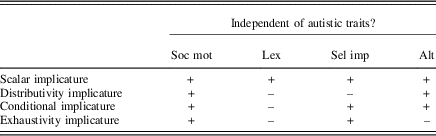
Table 2 provides a summary of the predictions of these four accounts. In the foregoing, we assumed that any effects of autistic traits will manifest themselves in lower rates of derivation of the respective implicatures. However, an alternative possibility is that such effects manifest themselves in increased response times. Thus, for example, the selective pragmatic impairment hypothesis might be taken to predict that participants with more autistic traits are slower in deriving distributivity implicatures compared to participants with fewer autistic traits, even though, ultimately, there might be no such effect on the frequency with which these implicatures are derived.
Predictions of the four accounts for each type of quantity implicature

Note: Soc mot: social motivation theory of autism. Lex: the lexicalist approach. Sel imp: selective pragmatic impairment. Alt: the alternatives approach.
In the next section, we discuss our experiment, in which we tested whether the frequency and time course of four types of quantity implicature vary with the degree to which people have traits associated with autism.
Method
The task
We adopted the experimental task reported in van Tiel and Schaeken (Reference van Tiel and Schaeken2017). This means that, like Chevallier et al. and Su and Su, we conducted a sentence–picture verification task. The main advantage of this task is that it does not draw upon people’s world knowledge, thus allowing for a homogeneous testing of all four varieties of quantity implicature.
Each trial in the experiment started with a sentence that was followed by a picture. Participants had to indicate whether the sentence was a good description of the depicted situation. All of the situations consisted of a number of colored geometrical shapes. Four colors (red, green, blue, and yellow) and three kinds of geometrical shapes (squares, circles, and triangles) were used. The target sentences were followed by three types of situations: a target situation, in which the sentence was literally true but false if the quantity implicature in question was derived, and two control situations, in which the sentence was unambiguously true or false.
In order to obtain a quantitative measure of the degree to which participants had traits that are associated with autism, we asked participants to fill in the autism spectrum quotient test (Baron-Cohen et al., Reference Baron-Cohen, Wheelwright, Skinner, Martin and Clubley2001), which is a questionnaire consisting of 50 statements for which participants have to indicate whether they definitely agree, slightly agree, slightly disagree, or definitely disagree. These statements pertain to various autistic traits, such as poor communication and exceptional attention to detail. A couple of examples are
(9) a. I find social situations easy.
b. I find it difficult to work out people’s intentions.
c. It does not upset me if my daily routine is disturbed.
Answers are coded as 1 or 0, depending on whether they are indicative of autism. In this way, each participant is scored between 0 and 50, where 0 indicates that the participant had no autistic traits whatsoever, and 50 indicates that the participant had all traits commonly associated with autism.
The entire experiment was performed online. In recent years, online judgments have proven to be a reliable source of native speakers’ intuitions about linguistic materials (see, e.g., Birnbaum, Reference Birnbaum2004; Buhrmester, Kwang, & Gosling, Reference Buhrmester, Kwang and Gosling2011; Gibson, Piantadosi, & Fedorenko, Reference Gibson, Piantadosi and Fedorenko2011; Sprouse, Reference Sprouse2011). As such, it represents an efficient way of data collection, without burdening participants with trips to the laboratory. Aside from saving the time of the participants, it might be less stressful for participants with a high number of autistic traits to take part in an online experiment than facing a journey to the laboratory with all the implications this might entail.
One of the initial motivations for conducting web-based studies was the potential of reaching larger groups of participants with less common characteristics, such as participants with a high number of autistic traits (e.g., Birnbaum, Reference Birnbaum2004). Nonetheless, there have been, to our knowledge, no previous web-based studies involving participants with a high number of autistic traits. One of our goals was thus to determine the potential of running web-based studies on autism.
Before launching this study, we registered its method, including the choice of statistical analyses, on the Open Science Framework Platform. The preregistration form can be accessed via https://osf.io/tj5kh/.
Participants
In order to test participants with a sufficiently wide range of autistic traits, we drafted 63 adult participants on Prolific (11), Mechanical Turk (30), and three web forums that are frequented by people with ASD: Autism Research (3), WrongPlanet (7), and Reddit (12). We initially set out to test 90 participants, but were unable to recruit a sufficient number of participants on the forums for people with ASD, even after reposting our advertisement.
The mean age of the participants was 34 (SD = 11, range = 18–64), and 32 participants were male. Participants were asked to indicate their native language, but payment was not contingent on their response to this question. Three participants were removed from the analysis for not having English as their native language, thus leaving a sample of 60 participants. Participants took between 16 and 52 min to complete the entire experiment (M = 29 min, SD = 9 min).
In general, we observed quite some skepticism from people on the web forums that we visited. In particular, these people were worried that we would negatively portray people with autism, and that we might, in a sense, merely make use of them without engaging in any meaningful way with their plight. At the same time, many of the participants who did sign up for our study were very enthusiastic. At the end of the experiment, we asked them whether they wanted to be informed about the outcome of the study, and whether they wanted to be informed about any similar future studies of ours. Nearly all participants answered yes to both questions, and a handful of them contacted us by e-mail to share their thoughts on the task.
We asked all participants whether they had been diagnosed with an ASD, offering participants the option of not answering this question. Nineteen participants answered “yes”; the remaining 41 participants “no.” Furthermore, we asked whether they believed they had an ASD, again offering participants the option of not answering this question. Twenty-seven participants answered “yes”; the remaining 33 participants answered “no.” As this was a web-based study, we could not confirm participants’ diagnosis with ASD using gold-standard instruments such as the Autism Diagnostic Observation Schedule (Lord et al., Reference Lord, Risi, Lambrecht, Cook, Leventhal, DiLavore and Rutter2000). For that reason, unlike previous studies, we did not subdivide participants based on whether they had been diagnosed with ASD, but rather measured the degree to which they exhibited autistic traits, as measured with the autism spectrum quotient test (Baron-Cohen et al., Reference Baron-Cohen, Wheelwright, Skinner, Martin and Clubley2001). This is an important difference with previous studies on scalar implicatures, which compared participants with and without a clinical diagnosis of ASD.
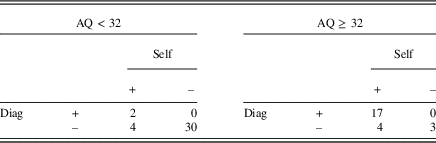
The three measures of autism (i.e., diagnosis, self-diagnosis, and autism spectrum quotient) were strongly associated. A contingency table showing their relationship is provided in Table 3. In all of the following analysis, we use the autism spectrum quotient as the guiding measure of the degree to which a participant has traits associated with the autism spectrum. The mean autism spectrum quotient in our sample was 27 (range: 7–46, SD=12). Twenty-four participants had an autism spectrum quotient of 32 or higher, which is usually taken as a useful cutoff value to delineate people who are at risk of having an ASD. The autism spectrum quotients were distributed relatively evenly across the whole range of possible values, as shown in 4.
Contigency table with the number of participants who answered that they were clinically diagnosed with having an ASD (Diag), or self-diagnosed as having an ASD (Self), subdivided by whether their autism spectrum quotient (AQ) was 32 or higher

Number of participants for each range of autism quotients

In addition, participants completed a receptive vocabulary test (Nation & Beglar, Reference Nation and Beglar2007), consisting of 100 multiple-choice items, in which participants had to determine the meaning of the underlined expression, such as the following:
(10) This azalea is very pretty.
a. small tree with many flowers growing in groups.
b. light natural fabric.
c. long piece of material worn in India.
d. sea shell shaped like a fan
The vocabulary test was included because previous research has shown that language skills may have a significant effect on the probability that individuals in the broader autism phenotype provide pragmatic responses for scalar implicatures (Chevallier et al., Reference Chevallier, Wilson, Happé and Noveck2010; Pijnacker et al., Reference Pijnacker, Hagoort, van Buitelaar, Teunisse and Geurts2009). Note that Pijnacker et al. also tested the phonological and syntactic abilities of their participants. Chevallier et al. only administered a vocabulary test; so did we in our experiment.
There was no significant association between autism spectrum quotient and age, r=.14, t (58)=1.06, p=.29. There was, however, a significant positive association between autism spectrum quotient and vocabulary size, r=.33, t (58)=2.68, p=.01. Hence, we include vocabulary size as a predictor in all of the analyses to be reported below. There was no effect of autism spectrum quotient on gender (β=–0.03, SE=0.02, Z=–1.20, p=.23). That is, participants with a higher autism spectrum quotient were not more or less likely to be male than participants with a lower autism spectrum quotient.
We did not explicitly ask participants whether or not they were color-blind. However, participants who were unable to distinguish the colors in the pictures are expected to perform poorly on control items, and, as we note presently, such participants were removed from the analysis. Hence, we may plausibly assume that none of the participants who were included in the analysis were color-blind.
Materials
The materials were the same as used by van Tiel and Schaeken (Reference van Tiel and Schaeken2017). That is, the experiment consisted of 60 trials in total and included four types of sentences corresponding to the four types of quantity implicature:
(11) a. Some of the shapes are C. Scalar implicature
b. Each of the shapes is C1 or C2. Distributivity implicature
c. Each of the shapes is C if it is a S. Conditional implicature
d. It is the S that is C. Exhaustivity implicature
C was varied between red, green, blue, and yellow. S was varied between square, circle, and triangle. The pictures for the first three types of quantity implicature always consisted of five shapes, because it has been shown that “some” and “all,” which presumably patterns with “each,” are judged to be less natural when they refer to smaller quantities (Degen & Tanenhaus, Reference Degen and Tanenhaus2016; van Tiel & Geurts, Reference van Tiel and Geurts2014). The pictures for exhaustivity implicatures always consisted of two shapes, which is the minimal number of shapes needed to felicitously use “it”-clefts. Note that, as we only used three types of shapes, it was impossible to construct pictures with five shapes in this condition. However, we assume that the way participants interpret sentences and, correspondingly, their truth judgments, are not influenced by the number of shapes in the pictures. At the same time, the differential number of shapes might have an effect on the overall response times, which we should carefully control for in the analysis of the response times.
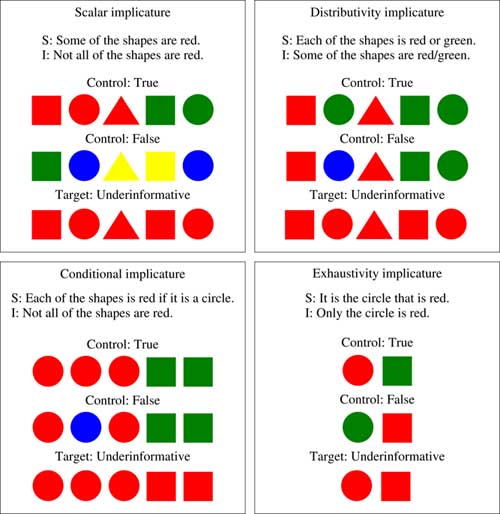
For each implicature type, three kinds of situations were constructed: two control situations and one target situation. In the first control situation, the sentence was unambiguously true; in the second control situation, it was unambiguously false; in the target situation, its truth value depended on whether a quantity implicature was derived. See Figure 1 (taken from van Tiel & Schaeken, Reference van Tiel and Schaeken2017) for examples of these situations. Each kind of situation occurred five times for each implicature type. The order of the items was randomized for each participant.
(Color online) Examples of target sentences for each variety of quantity implicature. In the first picture the sentence is unambiguously true, in the second picture unambiguously false, and in the third picture the truth value depends on whether the target implicature is computed (S: target sentence; I: target inference). Taken from van Tiel and Schaeken (Reference van Tiel and Schaeken2017).

Procedure
On each trial, the target sentence was displayed first. Participants were instructed to press the space bar as soon as they had read and understood the sentence. Thereupon, the sentence disappeared and was replaced by a picture. Participants had to decide as quickly as possible whether the sentence was true or false as a description of the depicted situation, and had to register their decision by pressing one of two keys. Thereupon, the picture disappeared and was replaced by the message “Press the space bar to continue.” Upon pressing the space bar, the next trial commenced.
Response times were recorded from situation onset to the point at which the “1” or “0” key was pressed. The entire experiment can be accessed online via http://spellout.net/ibexexps/bobvantiel/quantity-english2/experiment.html.
The experiment was followed by a second task on sentence interpretation, which will not be reported here. Afterward, participants filled in the autism spectrum quotient test and the vocabulary test.
RESULTS
Data preparation
Seven participants were removed from the analysis for making errors in more than 10% of the control items. This criterion was chosen because there was a marked difference between these 7 participants, whose error rates were higher than 17.5%, and the other 53 participants, whose error rates were lower than 10%. All of the removed participants had an autism spectrum quotient lower than 32. Two of them had been diagnosed with ASD, and 3 of them self-diagnosed as having ASD. The average error rate on control items of the remaining 53 participants was 2.0%. Error rates ranged from 0.4% for the false control condition for scalar implicatures to 6.5% for the false control condition for conditional implicatures.
Furthermore, trials for which the response time was faster than 200 ms or slower than 10,000 ms were removed from the analysis, as we assume that these correspond to accidental button presses or a lack of concentration on the task at hand. This resulted in the removal of 1.3% of the trials.
Choice proportions
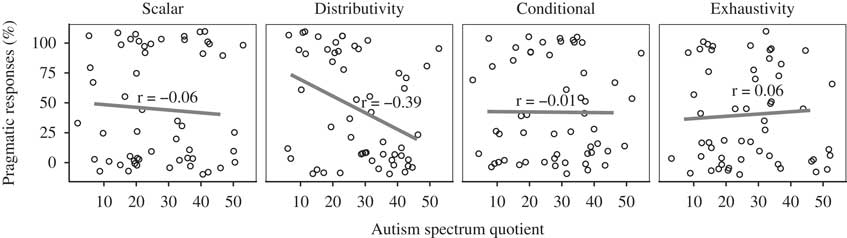
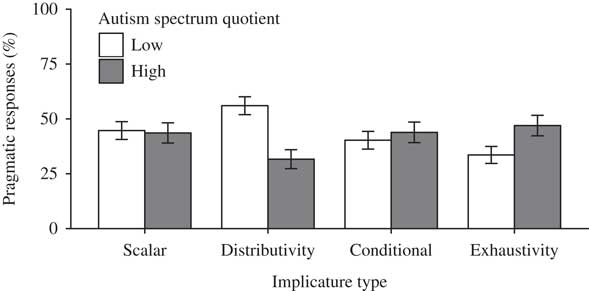
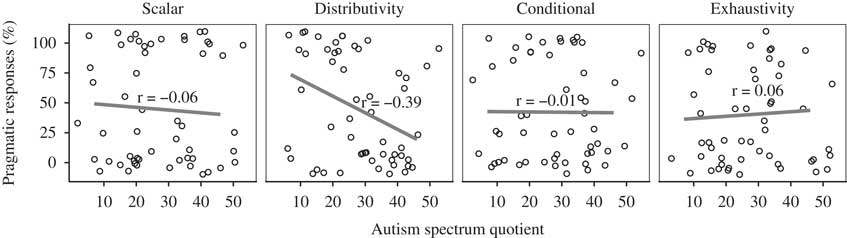
In the target condition of each implicature type, participants are predicted to answer “true” if they interpret the sentence literally, and “false” if they derive the corresponding implicature. In what follows, we will refer to these two types of answers as literal and pragmatic, respectively. Figure 2 shows the proportion of pragmatic responses for each implicature type against the autism spectrum quotient scores. Figure 3 shows the proportion of pragmatic responses for each implicature type, but groups together participants based on whether their autism spectrum quotient was lower than 32.
Proportion of pragmatic responses for each implicature type plotted against autism spectrum quotients. Jitter added for purposes of illustration.
Proportion of pragmatic responses subdivided by whether the participants had a low (<32) or high (≥32) autism spectrum quotient. Errors bars represent standard errors.
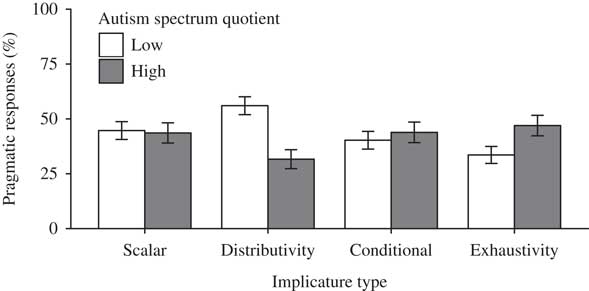
Figures 2 and 3 suggest that autism spectrum quotient affects the proportion of pragmatic responses for distributivity implicatures, but not for any of the other implicature types. In order to arrive at a more decisive verdict, we constructed, for each implicature type, a mixed-effects logistic regression model predicting responses in the target condition based on autism spectrum quotient and vocabulary size. These models were constructed using the lme4 package (Bates & Maechler, Reference Bates and Maechler2009), as implemented in R, a programming language and environment for statistical computing (R Development Core Team, 2006). We attempted to construct maximal models with random slopes for participants and items (Barr, Levy, Scheepers, & Tily, Reference Barr, Levy, Scheepers and Tily2013). In many cases, however, these models failed to converge, and we decided to remove the random slopes. The model formulae thus had the following structure:
(12) response ∼ aq.score + voc.size + (1 | subject)+(1 | item)
Vocabulary size did not have a significant effect for any of the four implicature types (all ps < .14). Autism spectrum quotient had a significant negative effect on the probability of pragmatic responses for distributivity implicatures (β=–0.17, SE = 0.08, Z=–2.18, p=.03) and no effect for any of the other implicature types (all Zs < 1).
We repeated this analysis using autism spectrum quotient as a binary rather than a continuous factor, categorizing participants depending on whether their autism spectrum quotient exceeded 31. The model formulae for these analyses thus had the following structure:
(13) response ∼ aq.binary + voc.size + (1 | subject)+(1 | item)
In this analysis, there were no significant effects of autism spectrum quotient on the probability of pragmatic responses for any of the four implicature types (all ps > .17). Vocabulary size had a marginally significant effect on the probability of pragmatic responses for distributivity implicatures (β=14.49, SE = 8.56, Z=1.69, p=.09) but no effect for any of the other implicature types (all ps > .31).
To determine if the effect of autism spectrum quotient, as a continuous factor, was different for different implicature types, we also analyzed the interaction between autism spectrum quotient and implicature type for each pair of implicature types, using mixed-effects logistic regression models that included vocabulary size as a fixed factor. Again, we attempted to construct maximal models with random slopes for participants and items, but often had to remove some or all of them in order to obtain convergence. The model formulae for these analyses thus had the following structure:
(14) response ∼ aq.score ∗ imp.type + voc.size + (1 | subject)+(1 | item)
The interaction between autism spectrum quotient and implicature type was significant for distributivity implicatures and all other implicature types (scalar implicatures: β=–0.11, SE=0.02, Z=–4.44, p<.01; conditional implicatures: β=0.11, SE = 0.02, Z=4.76, p<.01; and exhaustivity implicatures β=0.13, SE = 0.02, Z=5.42, p<.01). The remaining interactions were not significant (all ps > .09).
Again, we repeated these analyses using autism spectrum quotient as a binary rather than continuous factor. The model formulae for these analyses had the following structure:
(15) response ∼ aq.binary ∗ imp.type + voc.size + (1 | subject)+(1 | item)
The interaction between autism spectrum quotient and implicature type was significant for distributivity implicatures and all other implicature types (scalar implicatures: β=2.22, SE=0.56, Z=–3.94, p<.01; conditional implicatures: β=–1.20, SE=0.37, Z=–3.28, p<.01; and exhaustivity implicatures: β=–2.85, SE=0.52, Z=–5.51, p<.01). In addition, there was a significant interaction for scalar implicatures and exhaustivity implicatures (β=–1.10, SE = 0.47, Z=–2.33, p=.02).
In summary, autism spectrum quotient had a different effect on the probability of deriving distributivity implicatures than on the probability of deriving any of the other implicature types, irrespective of whether autism spectrum quotient was treated as a continuous or a binary factor. When treated as a continuous factor, but not when treated as a binary factor, there was a significant negative effect of autism spectrum quotient on the probability of pragmatic responses for distributivity implicatures.
We believe it is more adequate to treat autism spectrum quotient as a continuous rather than a binary factor, as dichotomization leads to a substantial loss of information (e.g., Altman & Royston, Reference Altman and Royston2006). In addition, the autism spectrum quotient test was specifically designed as an instrument for “quantifying where any given individual is situated on the continuum from autism to normality” (Baron-Cohen et al., Reference Baron-Cohen, Wheelwright, Skinner, Martin and Clubley2001, p. 5), rather than an instrument for making binary decisions about the presence or absence of an ASD.
For that reason, we conclude that autism spectrum quotient had a negative effect on the probability of pragmatic responses for distributivity implicatures, but not for any of the other implicature types. For the same reason, we will also not pursue the observed interaction between autism spectrum quotient, as a binary factor, and implicature type for scalar implicatures and exhaustivity implicatures. A cursory look at Figures 2 and 3 indicates that the significance of this interaction is largely dependent on the precise cutoff value.
A trait that is particular to autism is having difficulties disengaging from certain behavioral patterns (e.g., Hill, Reference Hill2004; Hughes & Russell, Reference Hughes and Russell1993; Prior & Hoffmann, Reference Prior and Hoffmann1990). Hence, one might hypothesize that participants with a higher autism spectrum quotient tend to be more consistent in providing pragmatic or literal responses, regardless of the type of implicature. In order to test this hypothesis, we determined, for each participant, the number of implicature types for which their behavior was consistent (i.e., only literal or only pragmatic responses). Hence, every participant received a score between 0 (inconsistent across all implicature types) and 4 (consistent across all implicature types). However, these consistency values did not correlate with autism spectrum quotients, r=–.04, t(52)<1.
Finally, we investigated whether we confirmed the finding that the probability with which people with ASD provide pragmatic responses for scalar implicatures increases with their linguistic competence (Chevallier et al., Reference Chevallier, Wilson, Happé and Noveck2010; Pijnacker et al., Reference Pijnacker, Hagoort, van Buitelaar, Teunisse and Geurts2009) within our pool of participants. To that end, we constructed mixed-effects logistic regression models predicting responses based on vocabulary size, including random intercepts for participants and items. The model formula for this analysis was as follows:
(16) response ∼ voc.size + (1 | subject)+(1 | item)
There were no significant effects of vocabulary size either in the group of participants with an autism spectrum quotient of 32 or higher or in the group of participants with an autism spectrum quotient lower than 32 (both ps > .18).
Response times
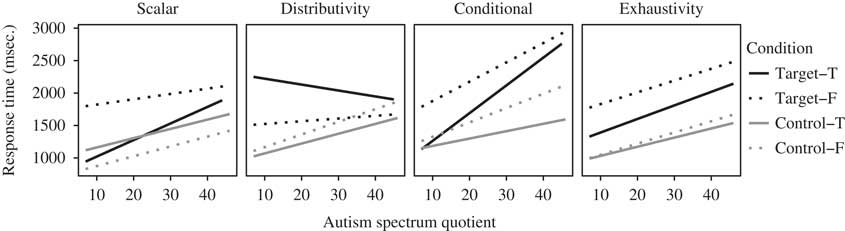
Figure 4 shows the effect of autism spectrum quotient on response times (i.e., the time between the presentation of the display and the button press indicating that the sentence was true or false) for each condition and implicature type. We were interested in determining whether the time needed to derive a quantity implicature increases with the number of autistic traits. Hence, we constructed, for each implicature type, a mixed-effects linear regression model predicting logarithmized response times based on autism spectrum quotient, condition (target or control), response (true or false), their interactions, vocabulary size, and trial number, including random intercepts for participants and items. The model formulae for these analyses had the following structure:
(17) lmer(log(rt) ∼ aq.score ∗ condition ∗ response + voc.size + trial + (1 | subject) + (1 | item)
Regression lines showing, for each implicature type, the effect of autism spectrum on response times, subdivided by condition (target or control) and response (true or false).
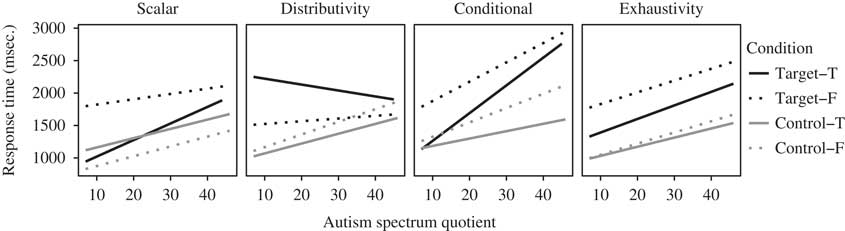
The three-way interaction between autism spectrum quotient, condition, and response was marginally significant for distributivity implicatures (β=–0.01, SE = 0.01, t = –1.77, p = .08) and not significant for the other three types of implicature (all ps > .14). On closer inspection, the marginally significant three-way interaction was driven by the fact that people with a higher autism spectrum quotient were comparatively faster to answer “true” in the target condition than people with a lower autism spectrum quotient. However, given that this effect was only marginally significant, we will not consider it in more detail.
DISCUSSION
Our results confirm previous findings that the probability of deriving scalar implicatures is independent of the number of autistic traits (Chevallier et al., Reference Chevallier, Wilson, Happé and Noveck2010; Pijnacker et al., Reference Pijnacker, Hagoort, van Buitelaar, Teunisse and Geurts2009; Su & Su, Reference Su and Su2015), thus reinforcing the conclusion that individuals in the broader autism phenotype, or at least those individuals who were able to complete our experiment, are able to go beyond the literal meaning of utterances. Against our initial hypothesis, the results indicate that the ability to go beyond the literal meaning was not restricted to scalar implicatures: the probability of deriving conditional implicatures and exhaustivity implicatures was also found to be independent of the number of autistic traits.
While scalar implicatures have a strong lexical component, conditional implicatures and exhaustivity implicatures cannot be attributed to lexical knowledge. Therefore, the pragmatic enrichment of utterance meaning observed in individuals in the broader autism phenotype is not restricted to those pragmatic inferences that have a strong lexical basis. Moreover, the alternatives needed to derive these three types of quantity implicature are heterogenous in origin: the alternatives needed to derive scalar implicatures involve substituting elements in the uttered sentence with expressions from the lexicon, the alternatives needed to derive conditional implicatures are already contained within the uttered sentence, and the alternatives needed to derive exhaustivity implicatures are provided by the context.
There is some concurring evidence that the broader autism phenotype is not characterized by a uniform incapacity to go beyond literal meaning. Kissine, De Brabanter, and Leybaert (Reference Kissine, De Brabanter and Leybaert2012) observed that, in ecological conditions, French-speaking low-functioning children with autism comply as much to direct requests, cast in the imperative mood, as to more ambiguous, indirect requests, such as “You forgot the water in your bag” intended as an instruction to get a bottle of water out of the child’s bag, or the prosodically interrogative “You close the jar?” intended as a suggestion to close the jar. In a subsequent experimental investigation, Kissine et al. (Reference Kissine, Cano-Chervel, Carlier, De Brabanter, Ducenne, Pairon and … Leybaert2015) found that, depending on the context, children with autism correctly interpret declarative sentences, such as “He has no hat,” intended either as a suggestion to put a hat on a doll or a comment about a picture. Kissine et al. thus confirmed that the comprehension of indirect requests is genuinely contextual and does not result from an automatic behavioral association with certain words.
In line with these results, Deliens et al. (Reference Deliens, Papastamou, Ruytenbeek, Geelhand de Merxem and Kissine2018) found that in a setting in which an interrogative sentence such as “Is it possible to put the red triangle to the left of the green square?” can be interpreted both as a question and an indirect request, adults with ASD spontaneously generate indirect interpretations to the same extent as neurotypical adults. Nevertheless, the same group of adults with ASD struggled with irony comprehension, again suggesting that pragmatic impairment is not uniform in autism.
The present study also provides important evidence against the monolithic conception of pragmatics embodied by the social motivation theory of autism (Chevallier et al., Reference Chevallier, Kohls, Troiani, Brodkin and Schultz2012). Proponents of this position explicitly assume that pragmatics is a modular competence, intrinsically preserved in autism. Observed pragmatic deficits would then be explained by an inherent lack of impetus to interact with others and to spontaneously reason about other people’s communicative intentions (Chevallier et al., Reference Chevallier, Noveck, Happé and Wilson2011). A clear prediction of the social motivation theory is that, in constant experimental conditions, different pragmatic interpretations should be elicited at the same rate.
Contrary to this prediction, we found that, while simple varieties of quantity implicature were derived independently of the degree to which one has traits associated with the autism spectrum, participants with a higher autism quotient were significantly less likely to derive the more complex distributivity implicatures. As we argued above, the main difference between distributivity implicatures and the three other varieties of quantity implicature that we tested is that the derivation of the former necessarily involves more complex counterfactual reasoning about what the speaker could have said, whereas the latter implicature types are reducible to constructing and rejecting stronger alternatives. Hence, this difference is presumably the reason why the derivation rate of only distributivity implicatures depends on the number of autistic traits.
A provocative piece of evidence in favor of the mentalistic nature of deriving distributivity implicatures lies in an analysis of the subscales of the autism spectrum quotient test. The test comprises five subscales: social skills, attention switching, attention to detail, communication, and imagination. Participants receive a score for each subscale, and these scores are summed to determine their overall autism spectrum quotient. The correlation between the number of pragmatic responses for distributivity implicatures and the scores on the various subscales was the highest for social skills (r=–.41) rather than communication (r=–.35), in line with the view that deriving these implicatures draws upon mentalizing abilities rather than linguistic skills.
An alternative explanation of the effect of autism spectrum quotient on the rates of pragmatic responses for distributivity implicatures would be that the items used for distributivity implicatures are intrinsically more difficult to process. There are, however, compelling arguments against this explanation. Overall response times for distributivity implicatures were not significantly different from those for conditional inferences, and were even marginally faster than those for exhaustivity implicatures. Focusing on the target condition, response times for distributivity implicatures were as fast as those for scalar implicatures and conditional implicatures, and significantly faster than those for exhaustivity implicatures. These response time patterns speak against the view that the items for distributivity implicatures were deemed to be more complex.
It is perhaps important to emphasize that our goal is not to deny the existence or importance of pragmatic deficits in individuals in the broader autism phenotype. There is no doubt that these individuals face important challenges with social interactions and with subtle, nonliteral uses of language, and these challenges should be targeted with screening and intervention methods. However, identifying the preserved islets of pragmatic functioning is a step toward a better understanding of the nature and causes of communicative deficits in autism. Our results indicate that some context-driven pragmatic interpretation of linguistic utterances is preserved in autism. In addition, our results reveal that the decisive factor that blocks pragmatic inferences in individuals in the broader autism phenotype who are otherwise linguistically competent is the necessity to engage in counterfactual reasoning about what the speaker could have said. In other words, individuals in the broader autism phenotype seem to be able to use contextual information during communication, but in an essentially egocentric manner (Kissine, Reference Kissine2012, Reference Kissine2013, Chap. 7).
The selective pragmatic impairment observed in this study can be accounted for by a standard “mind-blindness” theory of autism, according to which pragmatic deficits are due to the inability to reason about other people’s mental states. Of course, such an explanation entails abandoning the currently dominant monolithic Gricean conception of pragmatics as necessarily involving mindreading, and accepting that pragmatic competence draws upon a range of different cognitive mechanisms, not all of which are rooted in the ability to read other people’s intentions (Kissine, Reference Kissine2013, Reference Kissine2016; Perkins, Reference Perkins2007; Recanati, Reference Recanati2003).
A compatible, but subtler explanation could be that mindreading and pragmatic deficits in autism share an underlying executive core. It has been argued that whether or not people with ASD pass false-belief tasks is conditioned by several independent factors (e.g., Bloom & German, Reference Bloom and German2000; Grant, Riggs, & Boucher, Reference Grant, Riggs and Boucher2004; Surian & Leslie, Reference Surian and Leslie1999; Yirmiya et al., Reference Yirmiya, Erel, Shaked and Solomonica-Levi1998). Particularly important for mindreading is the capacity to generate and shift between alternative models of reality (e.g., Nichols & Stich, Reference Nichols and Stich2003; Perner, Rendl, & Garnham, Reference Perner, Rendl and Garnham2007). This capacity is rooted within the flexibility component of executive functioning. Crucially, there is ample evidence that adults and children with ASD present specific difficulties with those executive tasks that tap cognitive flexibility (e.g., Ozonoff, Reference Ozonoff1997; Zelazo, Jacques, Burack, & Frye, Reference Zelazo, Jacques, Burack and Frye2002). To be sure, the precise nature of perspective shifting in autism still stands in need of a fuller characterization (see, e.g., Frith & De Vignemont, Reference Frith and De Vignemont2005), partly because flexibility is not always easy to tease apart from other executive components (de Vries & Geurts, Reference de Vries and Geurts2012). However, cognitive flexibility clearly emerges as the main locus of executive problems in autism (Hill, Reference Hill2004), which disrupts cognitive functioning in a varied array of domains, including mindreading (Ozonoff, South, & Provencal, Reference Ozonoff, South and Provencal2005; Russell, Reference Russell2002). An interesting hypothesis for further research, then, is that diminished cognitive flexibility in the broader autism phenotype affects both mindreading and those aspects of communication that involve perspective shifting, that is, those dimensions of communication that require adopting the conversational partner’s perspective.
To conclude, we should acknowledge that the obvious limitation of our study consists in the unorthodox method of participant recruitment. Because participants were reached and performed our experiment entirely online, we could not double-check the autism diagnosis using more standard diagnostic tools. Hence, our data are not straightforwardly comparable to previous studies that subdivided participants based on their clinical status, and should not be construed as providing conclusive evidence about the pragmatic capacities of people with a clinical diagnosis of ASD. At the same time, however, it should be noted that responses on the autism spectrum quotient questionnaire (Baron-Cohen et al., Reference Baron-Cohen, Wheelwright, Skinner, Martin and Clubley2001) were highly consistent with their reports of having been diagnosed with ASD or not, as well as with their self-perception of having ASD. Nonetheless, our results certainly stand in need of a more traditional laboratory replication. That said, our recruiting method also allowed us to involve the autism community within our research, while minimizing the energy cost and the stress load for our participants.
ACKNOWLEDGMENTS
This research was funded by F.R.S.-FNRS Research Incentive Grant F.4502.15 (PI: M. Kissine) and by the German Research Council (Grant DFG FR 3482/2-1, KR 951/14-1, SA 925/17-1) within SPP 1727 (XPRAG.de), which are gratefully acknowledged. We would like to thank the editor and reviewers of Applied Psycholinguistics for their insightful and constructive feedback on an earlier version of this article.