




No CrossRef data available.
Article contents
- Abstract
- A THIRD PRE-HISPANIC GAME?
- THE PELOTA MIXTECA
- THE DAINZU RELIEFS
- DAINZU: AN ANCESTOR OF PELOTA MIXTECA?
- A CHRONOLOGICAL GAP OR EUROPEAN ORIGIN?
- OTHER ICONOGRAPHIC EVIDENCE FROM OAXACA
- THE GUATEMALAN HIGHLANDS: OTHER ICONOGRAPHIC EVIDENCE
- THE PALANGANA BALLCOURTS: AN UNUSUAL TYPE
- CHRONOLOGICAL AND REGIONAL PLACEMENT
- OAXACA AND GUATEMALAN HIGHLANDS: POSSIBLE TIES?
- THE PALANGANA COURTS: AN ARCHITECTURAL CONTEXT FOR THE PELOTA MIXTECA
- RESUMEN
- ACKNOWLEDGMENTS
- References
COULD WE SPEAK OF THE SUPER BOWL AT FLUSHING MEADOWS?: La pelota mixteca, a third pre-Hispanic ballgame, and its possible architectural context
Published online by Cambridge University Press: 04 March 2004
Article contents
- Abstract
- A THIRD PRE-HISPANIC GAME?
- THE PELOTA MIXTECA
- THE DAINZU RELIEFS
- DAINZU: AN ANCESTOR OF PELOTA MIXTECA?
- A CHRONOLOGICAL GAP OR EUROPEAN ORIGIN?
- OTHER ICONOGRAPHIC EVIDENCE FROM OAXACA
- THE GUATEMALAN HIGHLANDS: OTHER ICONOGRAPHIC EVIDENCE
- THE PALANGANA BALLCOURTS: AN UNUSUAL TYPE
- CHRONOLOGICAL AND REGIONAL PLACEMENT
- OAXACA AND GUATEMALAN HIGHLANDS: POSSIBLE TIES?
- THE PALANGANA COURTS: AN ARCHITECTURAL CONTEXT FOR THE PELOTA MIXTECA
- RESUMEN
- ACKNOWLEDGMENTS
- References
Abstract
Mesoamerican studies have long focused on the well-known pre-Columbian game ullamaliztli, its architectural context, and its possible variants. But other games can be identified, among them the stick game from Teotihuacan and a handball game depicted at Dainzù. Despite a large chronological gap, the handball game at Dainzu can be related to the present pelota mixteca, taking into account other artifacts. It may also be associated with the palangana-type ballcourts, thus modifying our interpretations of the ballgame architectural context.
Information
- Type
- Research Article
- Information
- Copyright
- © 2003 Cambridge University Press
It is commonplace in archaeological literature to speak about the “pre-Hispanic ballgame” by referring only to the Mesoamerican ullamaliztli (Scarborough and Wilcox 1991; Scheffler et al. 1985). For the majority of scholars, this implies a unity principle that tends to minimize possible differences among the most famous ballgame and others, which generally are considered as simple variants. One cannot deny that ullamaliztli did evolve, through its long history, which would explain changes in ballcourt morphology and, perhaps, in the size of the ball. The rules probably also were modified. But such internal diversity remains insufficient to explain more important differences—for instance, the use of sticks at Teotihuacan.
In this article, I hypothesize that, in addition to ullamaliztli and the Teotihuacan stick game, a third game—the pelota mixteca—can be identified; its pre-Hispanic roots can be established; and it can be related to the Dainzù reliefs and other evidence. Further, the game could have been played in the palangana-type ballcourts (Smith 1961), most of which are located in Oaxaca and the Guatemalan highlands. This game spread at the end of the Preclassic and during the Early Classic period, at a time that influences from Oaxaca were felt in eastern Mesoamerica but before Teotihuacan influence became popular in the Maya area.
On previous occasions, I have had the opportunity to insist on the diversity of pre-Hispanic ballgames, contrasting the ullamaliztli with the Teotihuacan game as depicted on the Tepantitla murals (Taladoire 2000). After Theodore Stern's (1948) pioneering study of the diversity of rubber-ball games in the Americas, it seemed obvious that even in Mesoamerica proper, several different games existed—at least, from an ethnological point of view (Cohodas 1991; Scheffler et al. 1985). Although agreement about such diversity is nearly universal, strong reluctance persists in accepting the possibility of more than one basic game with local or chronological varieties (Uriarte 2000).
One of the possible explanations for this reluctance may stem from the fact that no ballcourt has been discovered thus far in Teotihuacan, the most important metropolis of pre-Hispanic Mesoamerica, despite the tremendous amount of research and the results obtained by the Teotihuacan Mapping Project. Other remarkable exceptions exist in the Maya area, of course, such as at Aguateca, Bonampak, and Tamarindito. However, this may suggest that these locations did not fulfill the same functions as other sites nearby, which do have courts. Because almost every Late Classic city has at least one court, and some have many more (Cantona has as many as 24), the apparent absence of a ballcourt at Teotihuacan during the Early Classic period and even later, after its fall, is all the more surprising. To explain this seeming anomaly, many scholars have offered possible explanations. It has been suggested that the game was played in the Street of the Dead, for instance. But the most popular hypothesis stems from a unity principle: Most authors consider that the Teotihuacan game with sticks and composite stelae of the La Ventilla type represents only a local variety of the ullamaliztli. They emphasize that both games are simultaneously depicted on the Tepantitla murals. Besides, a rubber ball has been found at La Ventilla, along with yokes and other paraphernalia traditionally associated with ballgames. Accordingly, the absence of a formal court is interpreted in terms of local adaptation instead of different traditions (Braniff 1988).
Although I agree with the evidence of Teotihuacan's knowledge of the ullamaliztli, I suggest that we are confronted with two very different games. Teotihuacan's ties with the Gulf Coast, where the game was still played during the Early Classic period (Daneels 1990, 1991), have been well documented. It is therefore natural to find artifacts such as yokes from the same area. The representation of a ballcourt on the Tepantitla mural can be interpreted as an evocation of Gulf Coast traditions. Even if Teotihuacan does favor another type of game, the existence of rubber balls would seem quite natural. However, the representation of two different ballgames on the same murals cannot be mere coincidence. The Teotihuacanos deliberately represented both, giving more importance to their own. Even if the rules of the Teotihuacan game remain difficult to understand, the composite stelae obviously play an important part in it. Similar sculptures have been discovered at several sites where Teotihuacan influence was strong, such as Tikal, Kaminaljuyu, and Matacapan. Finally, during the Early Classic period, and mainly in those areas of Mesoamerica where Teotihuacan's influence was most felt, ballcourts tend to disappear. Only in areas where its influence is minimal—that is, in the northern Gulf Coast and in western and northern Mexico—does the practice of ullamaliztli remain popular (Taladoire 2000, 2001).
It thus seems that Teotihuacan favored another game, which became most popular during the city's apogee. After the fall of Teotihuacan, a reverse tendency gave birth to the ullamaliztli apogee, with more than 800 registered ballcourts in the Late and Epiclassic periods. If this theory is correct, we would then have evidence of the existence of at least two very different games in pre-Hispanic Mesoamerica (Taladoire 2000, 2001).
A THIRD PRE-HISPANIC GAME?
Ethnological studies have documented the existence of other games, whose pre-Hispanic origins are still controversial. There is little doubt about the relationship between the ulama from Nayarit and Sinaloa and the ullamaliztli (Leyenaar 1978). The game of pelota mixteca is undoubtedly original, from an ethnological point of view (Swezey 1972), and very different from ulama. But can it be considered pre-Hispanic?
The pelota mixteca has been the focus of very few studies, despite its continuing popularity in Mexico. First documented in 1901 (Peralta 1903), with well-established roots (Pérez Ricárdez, personal communication, 2001), the pelota mixteca is currently played in many towns and villages in Oaxaca, Puebla, and Veracruz, as well as among Zapotec and Mixtec communities in Mexico City and even in the United States. A game was even organized at Monte Alban in 1977—strangely enough, in the Main Plaza, instead of on a ballcourt (Figure 4). Despite its popularity, the game's origins are mysterious. Three questions arise: (1) Was the pelota mixteca introduced after the Conquest, or does it represent a pre-Hispanic survival? (2) If it has pre-Hispanic roots, what kind of related archaeological evidence might attest to its existence? (3) If its pre-Hispanic origins can be proved, what is its relationship with other games—specifically, the ullamaliztli?
THE PELOTA MIXTECA
It would be pointless here to dwell on ethnographic aspects of the pelota mixteca, but it is necessary to describe its main features. The rules have been published in several places, even if one can register some minor differences (Bolaños Cacho 1946; Peralta 1903; Pérez Bazán and Manterola 1936; Scheffler et al. 1985). Other investigators have published data on the games they attended (Cortés Ruiz 1992; Grace 1954; Inzua, in Scheffler et al. 1985; Swezey 1972). Finally, we are indebted to Cornelio Pérez Ricárdez, who is currently working on the topic and has generously shared his data.
Basically, the pelota mixteca is a competitive game in which two teams oppose each other on an open field, striking a small rubber ball with heavy wooden gloves. The playing area, called the pasajuego (Figure 1a), is an open, flat, rectangular field 10–12 m wide and approximately 70 m long. According to Efraín Cortés Ruiz (1992), it may reach up to 100 m, or even 120 m (Inzua, in Scheffler et al. 1985). Although it has no end limits, the playing area is defined by two lateral lines, the escases laterales, and is divided internally by two transverse lines. Those lines, the escases de atrás y de adelante, 8 m apart, define the cajón, or rest zone (Cortés Ruiz 1992; Pérez Bazán and Manterola 1936). The cajón is located not in the center of the playing area but near one end. The longest part of the court is called the zona de saque, and at its end stands the botadera, or serving stone. F. J. S. Grace (1954) says that he saw a game played in 1953 in a partly enclosed court, with two end walls and a lateral wall. This is the sole reference to such an architectural court.

Pelota mixteca courts, according to Inzua (Scheffler et al. 1985): (a) form and terminology; (b) players' repartition on the court.
Each team has the same number of players—that is, one to five—and is headed by a captain (Grace 1954; Pérez Bazán and Manterola 1936; Peralta 1903; Swezey 1972). The serving, or saque (also called contrarresto), team, deployed in the longest area, is composed of five players called saque, rayas, and contraresto, and the receiving team (or resto) is composed of the resto, rayas, and boleas. According to Inzua (in Scheffler et al. 1985), the boleas stand in the cajón, while the rayas stand in front and the resto stands behind. Both teams cover nearly half the playing area (Figure 1b). Cortés Ruiz (1992), Grace (1954), and William Swezey (1972) insist on the presence of a flat stone, the botadera, at the serving side end of the playing field, which is used to drop the ball on, and catch it at its first rebound, at the start of the game.
According to Pérez Bazán and Manterola (1936), all players wear the same basic garb of trousers, white shirt, belt, and flat shoes, but the teams wear different-color armbands. The most significant part of the attire is a heavy wooden glove covered with hide and nails (Figure 2). While Grace and Pérez Ricárdez (personal communication 2001) mention that the ball can be struck barehanded (hence, the game's earlier name, a mano fría), all other authors agree on the necessity of such gloves. The glove is very heavy, from 4 to 6 kg; it is tied to the hand to strengthen the wrist and painted red, blue, or yellow. Formerly, the glove was reputedly lighter (ca. 100–150 g), and Cortés Ruiz (1992) even mentions games with simple gloves. Each player usually wears one glove on his right hand (Swezey 1972).

Pelota mixteca equipment: the glove.
Most sources agree that the ball is 10–12 cm in diameter, but they do not agree on its weight. Some specify that it weighs 155 g; others say that it weighs 500 g (Grace 1954) (Figure 3). Despite such disagreements, a general value of 175–280 g seems reasonable. The ball may be made of rubber, but Cortés Ruiz (1992) and Pérez Bazán (1936) also mention balls made of hide (forro). Whatever the material, all agree that the ball bounces well, and that, given its weight and hardness, the game is both fast and dangerous—hence, the need for reinforced gloves.

Pelota mixteca equipment: the ball.

Pelota mixteca players in action at Monte Alban in 1977.
To prevent problems, several judges are responsible for refereeing the game. One of them, the coime, is in charge of the playing field, the bets, and the ball. He should not be related to any player (Peralta 1903). There may also be one or two other judges, called chazeros, for each team. They determine the place of each team on the playing field and which team will serve first. Finally, they place the botadera on the playing field.
Before the game begins, and in agreement with the judges, the players decide on which kind of game they will play. Cortés Ruiz (1992) and Inzua (in Scheffler et al. 1985) mention two types of games—libre (free) and de compromiso (on agreement). Pérez Ricárdez (personal communication 2001) refers to the latter as opposing different communities. Pérez Bazán and Manterola (1936) discuss two other types—a lo largo, in which case the players use only one transversal line, and con rayas, in which the cajón is used. In con rayas games, the ball must fall inside the cajón on the first service. It is possible that the game de compromiso refers to those last types, but a detailed study is lacking.
The aim of the game is to keep the ball in the air from one team to the other, striking it as it flies or on its first bounce, and trying to send it beyond the reach of the opposing players (Figure 4). The service is done by the saque, who drops the ball on the botadera and catches it on its first bounce, either from under (à la cuillère), straight, or above the arm. The resto, or receiving team, must send the ball at least 40 m, flying back or on its first bounce. The goal is to prevent the other team from catching the ball. But points may also be scored through faults, such as touching the ball with both hands, a sleeve, a foot, or any other part of the body. Failing to send the ball back, letting it rebound twice, and having two players of the same team touch the ball in succession are other faults. A match is played in three rounds, and the winner has to win two rounds and two points.
According to Grace (1954), the players usually count in points (15, 30, 40) and rounds, as in tennis. But there are also other methods, the rayas. The first kind of raya occurs when the ball drops outside one of the lateral lines. A judge then shouts, “Raya,” and marks the place with a stick. If the ball goes out of bounds a second time, the teams switch sides and play for the raya. The team that wins it has thus a smaller, easier-to-defend playing area to cover, but its players are more crowded, while the opposing team must cover a larger area. In another instance, a raya might be won when the serving team succeeds in catching the return ball on volley before it reaches the botadera. After two rayas, the teams change ends, and the former receiving team has the saque. If its first ball reaches the raya, the team wins the point. If the team wins again on its second service, its gets 30 points. Such highly complex scoring methods seem to correspond to different playing techniques.
The pelota mixteca is not only a leisure game. Grace (1954) mentions that betting is quite usual; Pérez Bazán and Manterola (1936) go so far as to say that it is compulsory between competing teams. The public may take part, but money bets are part of the game, and if one team does not attend, it loses the game and the bets. This can be justified partly through the high degree of danger for the players, as fatal accidents can, and did, occur. But it also gives the game more social significance, especially when distinct local communities are concerned.
Despite such apparent diversity, the pelota mixteca shows originality and a deep consistency that sets it apart from the ullamaliztli. The use of gloves, the form of the playing field, the scoring method, the rules, and the ball itself are just a few of those differences. There can be little doubt—and there is none for ethnologists—that we are facing a quite different game from the ulama documented by Ted Leyenaar (1978) in Sinaloa and Nayarit. The problem with the pelota mixteca is to identify its possible pre-Hispanic antecedents.
THE DAINZU RELIEFS
The comparison made by Ignacio Bernal (1968, 1969, 1973) between the Dainzu reliefs and the pelota mixteca is generally taken for granted. But one must remember that most authors consider simultaneously that these sculptures represent some ancient ullamaliztli variety. In Bernal's opinion, as well as that of others (Cohodas 1991), however, there was no doubt about differences between the games. Bernal even showed the Dainzu reliefs to local players who agreed on the identification of the local game.
Located in the Oaxaca valley, Dainzu stands halfway between Oaxaca and Mitla, near Macuilxochitl. From 1966 to 1972, Bernal excavated several of the site structures. He devoted the greatest part of his fieldwork to the ballcourt, Complex A, and to creating a register of the monuments associated with this last building and of the petroglyphs on the adjoining hilltop (Bernal 1968, 1969, 1973; Bernal and Oliveros 1988; Bernal and Seuffert 1973, 1979; Oliveros 1997). According to the style of the slabs, the architectural context, and the excavations, the site's main occupation corresponds to the Late Monte Alban I and Monte Alban II phases—that is, to between 300 b.c. and a.d. 250. The ullamaliztli ballcourt belongs to the much later Monte Alban III (Oliveros 1997) or Monte Alban IV (Marcus and Flannery 1996) occupation.
Complex A is a large, L-shaped building that faces west. It measures 45.7 × 54 m, with a projecting stairway (Figure 5). Its three tiers reach a total height of 7.6 m, the lower tier being the highest, at some 5 m. The vertical walls resemble those of the Danzante building at Monte Alban. The lower tier is divided into a northern and a southern half; all of the monuments except one are located in the southern part. The upper tiers do not bear any sculptured slab. Most of the 27 worked slabs were found in place on the lower part of the vertical wall of the first tier, and the other 21 were on the ground nearby. The irregular slabs, worked in a soft local stone that wears easily, vary in height between 54 and 130 cm, except Monument 1, which is 3.81 m high. All of the monuments, except Monument 23, show only one figure; according to Bernal and Seuffert (1979), on one monument, at least, the motif does not fit perfectly on the slab, and it slightly overlaps onto the wall, suggesting that the slab had been worked in situ. Some petroglyphs (P1–10) were recorded on the rocky outcrop that crowns the site, among them several helmeted heads as well as the principal scene, called the pared del sacrificio, or the sacrifice wall. The project recorded 50 sculptured slabs—48 on the south wall, one unidentified fragment, and the unique slab from the northern side. They found three more unrelated slabs (Monuments 75, 78, and 86) and 10 groups of petroglyphs, raising the total to 63 monuments. Out of the 50 slabs associated with Complex A, three were fragments, and eight are completely illegible (Monuments 2, 10, 12, 16, 24, 25, 48, and 49). Most of the other 39 are complete, albeit sometimes broken, as exemplified by Monuments 8–9, 30–37, and 33–35, which could be pieced together (Table 1).
Dainzu reliefs


Dainzu Complex A.
Bernal (1968, 1969, 1973; Bernal and Seuffert 1973, 1979) divides the corpus into three groups: I, II, and III. A fourth group could include only isolated motifs. Group I, represented by Monuments 40 and 50, depicts two seated figures with elaborate bird headdresses, wearing capes and collars and presenting offerings. One holds a jaguar head; the other, a torch. One of them wears a mask. Group II also includes two monuments (38 and 44), which show anthropomorphized jaguars or figures in jaguar attire (Oliveros 1997). One of them wears a mask and a false beard and presents a jaguar's head as an offering. Bernal noted that these four monuments can be divided in pairs, with two masked figures on one side, and two unmasked on the other, each pair associated with a team.
Group IV would include the few slabs that bear only isolated motifs, such as glyphs (Monuments 29, 45, and 46) or a skull (Monument 43) (Figure 6). They could be independent or may have been associated with other slabs. While Monument 43 is unique, glyphs, apparently toponyms, may appear on other monuments, such as Monument 1, 3, or on top of the hill (P5, P10). The few occurrences of such glyphs might mean that they are related more closely to teams than to individuals.

Dainzu Group IV motive: Monument 43, a skull.
The bulk of the monuments (thirty-three in total) form Group III, which is dedicated to representations of players (Figure 7). All of them, except one shown standing, are depicted in acrobatic postures and wearing the same outfit: a visored helmet with jaguar's ears, gloves that reach the elbow, and short pants knotted at the knees. Further, most hold a small ball in their right hand. Many other pieces of equipment are also depicted, such as earplugs, feathers, horns, pectorals, collars, kneepads, short boots or ankle ornaments, and are sufficient to individualize numerous players. Marvin Cohodas (1991) also stresses the global lack of hip protection, as contrasted with the ullamaliztli player's equipment.

Dainzu Group III players: (a) Monument 26; (b) Monument 42.
Although the corpus demonstrates great homogeneity, an examination of the equipment shows a few potentially significant differences that may aid one in understanding the slab's iconography. As mentioned earlier, most pelota mixteca players wear long gloves that seem to be tied near the elbow. Usually, the player wears the glove only on his right hand, which holds the ball, but in two or three instances the ball and the glove correspond to the left hand. Because of the poor state of preservation of many monuments, it is difficult to determine whether both hands wear gloves. Although this is the case in six examples, in four others one can distinguish the fingers of the hand that does not hold anything. Compared with the size of the players' hands, the ball seems small: It fits very easily into the gloved hand. One can estimate it at about 10 cm, or the size of a tennis ball. This would give an approximate weight of some 200 g.
Every player wears a visored helmet whose front part looks like a grid. The helmet's upper part shows what looks very much like jaguar's ears (in 21 cases). In all cases but one, the helmets are very simple, but eight players wear much more complex headdresses, with feathers (one or two), horns (one or two), mouth masks, or other motives. Curiously, except in one case, those headdresses lack the jaguar's ears. It would be difficult to regard those differences in headdresses as corresponding to team affiliation, because one team would then have had to be composed of only eight players while the other had as many as 21. It would be more consistent to interpret those differences as symbolizing the players' importance within each team.
Although all of the players wear the same short pants tied at the knees, only six, or possibly eight, wear elaborate heavy kneepads, mostly on their right knee. Only one wears two kneepads, but it is impossible to establish any relationship between the kneepads and any other part of the equipment. Finally, most players seem to wear a belt or some torso gear, and a few of them wear capes and sometimes ornaments on their backs, such as a jaguar's tail. Most wear scrolls around their necks, which have been interpreted as collars, pectorals, or blood symbols, thus suggesting decapitation.
Players represented on Monuments 75, 78, and 86, holding a ball in their right hand, do correspond with the general description. The situation is somewhat different for the petroglyphs (P1–10). Even if one can divide them among the identified Groups II, III, and IV, they do not represent true players, because most only show helmeted heads, with collars or associated scrolls. Almost every helmet is decorated with jaguar's ears, though some show feathered headdresses or horns. It is impossible to establish consistency among the number of isolated heads and the players from Complex A. One petroglyph (P5) stands apart from the others. It represents two figures involved in what is interpreted as a post-game sacrificial ritual. Both wear players' attire, with gloves, helmets, balls in hand, scrolls, and elaborate headdresses. The figure on the left stands on top of a possible toponym, and in his left hand he brandishes a sword or a pointed stick at the other protagonist. The other protagonist seems to be falling backward and might be considered dead or dying, as well as depicted in an acrobatic position similar to those of other players. His headdress seems to be crowned by a jaguar's head.
DAINZU: AN ANCESTOR OF PELOTA MIXTECA?
Although obvious differences exist between the Complex monuments and the hilltop petroglyphs, there are enough similarities to believe, in agreement with Bernal and Seuffert (1973, 1979), that they pertain to the same complex. Apart from their stylistic and thematic unity, they seem to complement each other, especially in the case of P5. The Complex A slabs would depict the players engaged in a game; the sacrificial scene (P5) would represent the result and its consequences—if, indeed, we have here a ballgame representation.
Following Bernal (1968, 1969, 1973), Arturo Oliveros (1997; Bernal and Oliveros 1988), and most other authors, we have assumed that the Dainzu reliefs represent a ballgame, although we do not know that with certainty (and some scholars disagree with the hypothesis). However, the complete corpus of 63 monuments can be described in another way. The Complex A monuments might form a first group that, in turn, could be divided in two subgroups (Bernal 1968, 1969, 1973). Each subgroup would comprise one relief from Group I and one from Group II, as patrons, and about half of the Group III player slabs, corresponding to a team. Each team would then include regular players (those with simple helmets), as well as prominent ones (those with elaborate headdresses). Group IV's glyphic reliefs would respectively correspond to each team. The second group, the hilltop petroglyphs, would describe a sacrificial (decapitation?) ritual consecutive to the game.
It is still difficult to assert that the main ritual does represent a ballgame. But it seems obvious that it corresponds to a violent competitive ritual, whether it is a game or a fight. Besides, the round objects that the figures hold in their hands obviously play an important part as potentially dangerous, thrown artifacts. As mentioned earlier, several authors disagree with a ballgame interpretation, but on different grounds. Bernal (1968, 1969, 1973), Oliveros (1997), and Swezey (1972) went so far as to identify the pelota mixteca and the Dainzu slabs with Olmec origins, and the gloves or manoplas with Olmec knuckle-dusters. Several other authors, however, have expressed doubts about this identification.
The main dissenting line of thought (Nicholas Hellmuth, personal communication 2000) calls on three arguments against identifying the Dainzu slabs with the pelota mixteca. The first is the long chronological gap; the second is the lack of any representation of the game in Mixtec codices; and the third is the lack of positive evidence of the Dainzu reliefs as representing a game, let alone a ballgame. The dissenting scholars do not deny the ritual meaning of the slabs, but they prefer to interpret that meaning in other terms. Hellmuth has proposed that the Dainzu slabs transcribe a ritual fight between two groups, local or social, using balls or stones—hence, the need for heavy protective gear. But his hypothesis relies mainly on the Complex A slabs and does not take into consideration the sacrificial ritual depicted on the hilltop. Karl Taube (personal communication 2001), after Heather Orr (unpublished data), proposes to interpret the slabs as some sort of boxing game. According to Orr, in Guerrero, such boxing games appear to be connected with rainmaking rituals. Although this suggestion is poorly documented ethnographically and ethnohistorically, it could be related to the small stone examples of boxing gloves found on the Pacific piedmont of Guatemala. Norman Hammond (personal communication 2001) favors such an interpretation for the Lubaantun figurines. The Piedras Negras players panel could stand as another representation of such ritual (Stephen Houston, personal communication 1999).
This boxing hypothesis does not contradict the data as summarized earlier, and such fights have been documented elsewhere in the Americas. There is little doubt that the Complex A slabs do represent two opposing teams, with their respective patrons, engaged in a highly dangerous, competitive ritual. But it remains impossible to prove definitively that the round objects the players hold are made of rubber or any other material. The fact that almost every player holds a round object could correspond to an identification as ballplayers, but it could also be interpreted in a stricter sense—that is, as a fight with stones or other material. Such ritual fights are not unknown. In the Andean area, Antoinette Molinié-Fioravanti (1988) documented an ethnographic example whose roots could be traced to pre-Hispanic times.
Although we acknowledge the value of such arguments, this hypothesis seems very unlikely. Among the many games known by the Aztecs (López Austín 1965), no such ritual fight is documented. Alfredo López Austín mentions ritual fighting in Tenochtitlan—for instance, between the young warriors and priests—but he never refers to violence that would necessitate protective gear. Of course, one has to take into consideration the Flowery Wars of the Late Postclassic period. They truly belong to what can be classified as “heavy ritual fighting,” thus documenting its existence among Mesoamerican traditions. But sufficient data about the Flower Wars' origins are available to see them as a late innovation rather than as the codification of an earlier ritual. They belong to a completely different cultural context, and it would be difficult to associate them with the Dainzu slabs. Besides, the mere existence of protective gear would contradict this hypothesis, because gloves and protective kneepads would fit better with a game ritual than with plain fighting. Let us consider, then, that even if the notion of ritual fights does exist in Mesoamerica, it does not allow for a proper interpretation of the Dainzu reliefs.
Among those who accept Bernal's hypothesis, one can distinguish between Bernal (1968, 1969, 1973) himself, who identified the game with only the pelota mixteca, and almost all others, who believe that the Dainzu reliefs represent a local variety of the ullamaliztli. In agreement with his informants, Bernal proposed that the Dainzu slabs were archaeological proof of the pre-Hispanic origins of the pelota mixteca, thus implying its difference from the other game. But was Bernal right? How can the chronological gap be resolved?
A CHRONOLOGICAL GAP OR EUROPEAN ORIGIN?
As mentioned earlier, since 1903 the pelota mixteca has been documented as a well-established tradition. Thus, its origins can be traced to the end of nineteenth century. According to Pérez Ricardez (personal communication 2000), one might even date its existence earlier, perhaps to the beginning of the nineteenth century. The Dainzu reliefs, however, date to the Monte Alban II phase, at the latest. This leaves a chronological gap of some 1,700 years, which is far too important to be overlooked. What kind of evidence is available to help bridge this gap? In the absence of historical documents, one can first look at the scant available ethnohistorical data.
In his study of rubber-ball games in the Americas, Stern (1948) looked at dictionaries that provide insights into the diversity of pre-Hispanic and Colonial games in Mesoamerica. Despite the data he presented, Stern himself decided in favor of the unity of the pre-Hispanic game, arguing that lexical differences reflected European influences rather than local origins. The richest source is the Vocabulario Castellano Zapoteco (Cordova 1942 [1578]). In it, one finds the following terms:
Jugar a la pelota de los yndios con las nalgas: Tiquija láchi, cotija, qquiquijaya. I Tíquijaya.
Jugador así: pènicoquijalàchi.
Juego así: Quelacoquijalàchi.
Jugar à la pelota nuestra con la mano: Tigàapayapitípi, pelólo, cotàapaya.
Jugador así: pènicogàapapitípi, pelólo.
Juego así: Quelacogàapapitípi, pelólo.
Pelota como quiera: Pitípi, pel lólo, pal lólo, natóbi.
Pelota antigua de los Indios para su juego: làchi.
Pelota de las nuestras para jugar: Pitípi.
The difference brought out between the hip ballgame (juego de los indios con las nalgas) and the handball game (la pelota nuestra) is quite meaningful and suggests some local or chronological variety. The Vocabulario Mixteca (Alvarado 1593) also distinguishes between two games: jugar a la pelota de los Yndios (Yocotendinama), which would correspond to ullamaliztli, and jugar a la pelota como dizen de boleo. In the Molina Nahuatl Dictionary (1880), the handball game is called nematotopeuiliztli, as opposed to the hip ballgame, ullamaliztli. Another handball game is mentioned in the Gilberti Tarascan Dictionary (1901):
Juego de pelota con la mano: Apantzequa Chanaqua.
jugar a la pelota con la mano: Apantzeti.
Jugador asi: Apantzeti.
Juego de pelota con las nalgas: Taranduqua chanaqua.
Jugar a la pelota con las nalgas: Taranduni.
jugador tal: Taranduti.
It is notable that four distinct dictionaries, produced shortly after the Conquest and in different languages, simultaneously mention a handball game. This could, of course, reflect the game's recent introduction. But that does not explain why different groups would adopt the game and simultaneously translate its name into their own languages rather than use a common Spanish name. Further, in the four languages, different roots are used to identify each game: apantzequa versus taranduqua, nematotopeuiliztli versus ullamaliztli, and the various Zapotec and Mixtec terms. This may, of course, refer to different techniques, but it may also stress the existence of very different games. It is nearly impossible to choose between these interpretations, but there is no doubt that shortly after the Conquest, a handball game did exist in Mesoamerica—specifically, in Oaxaca and adjoining areas.
The strongest case against the pelota mixteca's having pre-Hispanic origins is made by European investigators who specialize in the study of medieval games (Gillmeister 1988). Heiner Gillmeister bases his case on two arguments. First, using iconography and historical investigations, he has documented every game known in Europe before the discovery of the Americas. These include pelota vasca (Blazy 1929), parkspel, pelotamano (practiced near Valencia), and other tennis-like games. His second argument has a linguistic base: Terms related to traditional games tend to remain in use longer in peripheral or isolated areas than in central places. His analysis registers many old words that may parallel those used in the pelota mixteca. In one variety of the pelota vasca, according to Gillmeister (1988), the lines that define the playing area are called eskaza—very similar to the escases in the pelota mixteca. In pelotamano, the word saque is used to refer to the service. Moreover, in ancient tennis, as in pelota mixteca, the ball was thrown first on a stone surface, called the bote or the boundadou in southeastern France. This fits with the Mixtec botadera. In Spanish, coime is the term used for the person in charge of pool cues; in the pelota mixteca, as noted earlier, the coime is in charge of the playing field, the bets, and the ball. Finally, the attacking team in ancient tennis could win chazas, or rayas, and after two winning chazas, the teams changed sides. This closely parallels the rayas in the pelota mixteca.
These linguistic similarities undoubtedly prove at least European influences. Gillmeister (1988) also records numerous formal similarities between parkspel and the pelota mixteca. The former game involves two teams of five players on a rectangular field defined by lines on the ground. The players strike the ball with the hand; the attacking team tries to gain ground on the defending team. After a few points, the teams switch sides, and the scoring is very much like that in tennis. In Gillmeister's eyes, the similarities are far too numerous to be coincidental, and he argues that the pelota mixteca's origins are purely European. Finally, Gillmeister refers to an ethnological game that is known in the Colombian–Ecuadorian frontier zone (Ortiz 1963) that has no pre-Columbian roots and is obviously of European origin. In that game, two teams play with a rubber ball, and winning points are scored in chazas. The scoring is the same as in tennis. The similarities to the pelota mixteca are obvious, strengthening Gillmeister's arguments.
The validity of Gillmeister's evidence cannot be denied, and one cannot discard his proof of European influences in terminology and playing and scoring methods on the Mixtec game. But even if one accepts most of Gillmeister's arguments and data, one is still left with the Dainzu reliefs. If the pelota mixteca indeed originated completely in Europe, how can one interpret the Dainzu slabs and their numerous parallels with the ethnographic game? As shown earlier, many aspects of the Dainzu iconography strongly resemble today's pelota mixteca—the size of the ball, the players' posture and attire, the gloves. And why would a Spanish game become so popular in several areas of Mesoamerica—specifically, in Oaxaca, an area where another very similar, but distinct, tradition has been documented? The only possible explanation is that, at the time of the Conquest, a local game existed that was already similar to the European games and was further influenced by them, giving birth to the present pelota mixteca. This would not only account for the game's survival to our time, albeit in modified form. More important, it would confirm the existence of a local pre-Hispanic game, thus strengthening the validity of the comparison with the Dainzu reliefs. In summary, accepting Gillmeister's arguments reinforces, and almost implicitly confirms, the pre-Hispanic origin of the Mixtec game, providing something of a bridge across the chronological gap.
OTHER ICONOGRAPHIC EVIDENCE FROM OAXACA
Aside from Dainzu, the available archaeological data are not numerous. As far as is known, they amount to merely four more monuments, three ceramic artifacts, and a mural from Oaxaca; two monuments, illustrated in Bernal and Seuffert (1973, 1979), from Tlacochahuaya (Monument 3, No. 52), and Macuilxochitl (Monument 4, No. 56), near Dainzu. They may even have been transported to these places, because they lack archaeological context (Marcus 1983). The Macuilxochitl monument is fragmentary, showing only a helmeted head with jaguar's ears, the same scrolls around the neck, and maybe a knotted arm. It cannot be assigned chronologically, but it fits with the Dainzu slabs. The monument from Tlacochahuaya depicts a complete player in an acrobatic posture on top of a possible glyph. He seems to be wearing gloves, short pants, and a helmet, which also fits with other monuments. The third monument comes from Monte Alban and is also dated from Phase II (Bernal and Seuffert 1973, 1979). This 34- × 40-cm slab shows a helmeted head, with a headdress and a mouth mask, looking very much like the hilltop petroglyphs from Dainzu. The fourth monument is more interesting, because it comes from outside the valley. In Tequixtepec, in the Mixteca Baja, an unprovenienced panel or lintel, Stone 1, has been documented and interpreted as a possible ballplayer representation. According to Christopher Moser (1977) and John Paddock (1966), it represents a Conquest scene or a sacrifice. On the left, a figure whose glyphic name appears in a cartouche seems to strike another figure on the right with a stick he holds in his gloved hand. The attacked man is shown falling on his face on top of a mountain toponym. Although it is difficult to assert that he is wearing a helmet, he does have a headdress, and more important, he wears gloves on both hands. The presence of gloves knotted at the elbow led both Moser and Paddock to compare the panel to the Dainzu ballplayers. The similarity to the sacrificial ritual represented in the P5 monument from the Dainzu hilltop is even greater. Those monuments thus complete the Dainzu corpus but without modifying its chronological placement—except the last one, for which Paddock (1966) proposed a late Early Classic dating purely on stylistic grounds.
The ceramic artifacts come from Dainzu proper (Bernal and Seuffert 1973, 1979), from Huijazoo (Gomez Ramirez 1997), and from and Monte Alban (Paddock 1966). In the first instance, a Monte Alban II figurine head wears a visored helmet with jaguar's ears, quite similar to those represented on the slabs, thus confirming their characteristic morphology. The second piece is also a figurine fragment, now in the Suchilquitongo local museum. A tentative dating to Monte Alban II has been proposed (Gomez Ramirez 1997). It shows a naked hand holding what looks like a manopla (handstone) by the handle. Although its aspect is very different from the Dainzu gloves, it is described as a player's hand, holding what looks like the pelota mixteca's heavy wooden gloves. On these grounds, it has been related to both Dainzu and today's game.
The third piece is a brasero (censer) from Monte Alban Tomb 58, dated from Phase IIIB, currently described as representing Xipe Totec (Paddock 1966:Figure 175) (Figure 9). In a semi-sitting posture he bears in his right hand a small rounded object that could be a ball, while his left hand holds by the handle a manopla representing a human head. This manopla looks very much like the one illustrated by Stephan F. De Borhegyi (1961:Figure 7: no. 6 or 8) (Figure 9), who interpreted such objects as ballgame-related artifacts. A systematic study of manoplas and related pieces remains to be done but it is outside the scope of this article. Most documented manoplas come from the Oaxaca area, adjoining Veracruz and the highlands and Pacific piedmont of Guatemala. The head of the figure is hidden by what looks more like a mask than human skin. The figure does not wear gloves or a kneepad. Its identification as Xipe Totec is based mainly on the loincloth and ear pendants, but the figure does not present any of the usual Xipe Totec attributes. In agreement with Claude F. Baudez (personal communication 2001), I believe that its identification as Xipe Totec stands on very tenuous evidence. A ballplayer representation would be much more consistent.
The last occurrence corresponds to the murals from Tomb 5 from Cerro de la Campana, Huijazoo (Miller 1995, 1997) (Figure 8). Among the motifs depicted in the main chamber, nine figures currently interpreted as ballplayers stand on the lower frieze. All of them wear elaborate headdresses, capes, shoes, and different types of personal ornaments. But what stands out is that all of them wear visored helmets, maybe with jaguar's ears, quite similar to those on the Dainzu slabs. Each holds in his right hand a rounded object that looks very much like the manopla in the figurine fragment or the Tomb 58 brasero. The presence of both the helmets and the manopla, instead of a glove, allows one to regard them as ballplayers; they are different from the Dainzu figures but closely related. Further, present on the same mural are numerous bone or skull representations, as well as a jaguar's head—both motifs tha tare present among the Dainzu slabs. This may be some local or chronological variation of the same ritual, as this mural dates from Monte Alban IIIB (ca. a.d. 700).

Huijazoo mural ballplayers (after Miller 1995).

Monte Alban Tomb 58 brasero, currently described as Xipe Totec.
These few archaeological and ethnohistorical data partly reduce the chronological gap—or, at least, help minimize its importance. But many uncertainties still remain, and we still face a lack of data from the Postclassic period. However, the scope of the analysis has been enlarged, because one can now consider a much larger area than just the Dainzu site and distinct support for the iconographic representation of this ritual. In spite of the relative lack of data for long periods, we can now assert with reasonable security that the pelota mixteca can be traced up to late pre-Hispanic times and that its comparison with the Dainzu and Huijazoo iconographic representations stands on much firmer ground, thus strengthening Bernal's proposals.
THE GUATEMALAN HIGHLANDS: OTHER ICONOGRAPHIC EVIDENCE
To this point I have limited the analysis to the Oaxaca area—that is, Dainzu and the few related sites. Although this helps to confirm the existence and identity of the game and reduce the chronological gap, it does not suffice to prove the pelota mixteca's originality. The resemblance of El Baúl Monument 27 to the Dainzu reliefs has been stressed many times (Bernal 1968, 1969, 1973; Cohodas 1991; Parsons 1986). This well-known Late Classic monument from the Pacific coast of Guatemala shows two figures, one standing on the right and the other in a supine position; two cartouched glyphs; and, in the upper left corner, what looks like a diving god (Figure 9). The standing figure wears a zoomorphic helmet with what has been described as either a jaguar or an opossum's ear, a collar, short pants knotted under the knees, what looks like a tail on his back, and two gloves. In his left hand, he holds a rounded small ball of the same type as those in Dainzu. He seems to dominate the second figure, who is falling on his back, with one arm raised. In his gloved left hand, he holds the same kind of ball. Although both are devoid of the Dainzu-type visored helmets, the mask they wear can be compared to the one worn by the person depicted on the Tomb 58 brasero. The two figures show enough similarities with the Dainzu ballplayers, albeit in a different style, to attract most investigators' attention. Further, the reclining figure in many respects looks like the figures in Dainzu reliefs 7, 19, 20, 21, 31, 41, and 42. But the comparison to the sacrificial scene from Dainzu (P5) and the Tequixtepec lintel (Moser 1977; Paddock 1966) is more significant. In all three instances, a standing figure in player's attire is dominating a reclining or falling figure. The El Baúl monument might then be interpreted as a sacrificial scene related to the game. Further, J.E.S. Thompson (in Castellon Huerta 1995) noticed similarities in glyph representation between the Ñuiñe area of Oaxaca and the Pacific coast of Guatemala, especially in the circular cartouche in which glyphs are inscribed. Such cartouched glyphs are found in both El Baul Monument 27 and the Tequixtepec lintel.
Other monuments from the Guatemalan highlands are worth mentioning. At La Lagunita, Alain Ichon (1977) discovered several sculptures in an original style that was quite different from that of other Maya Highlands monuments. Monument 22, a stela fragment, is especially relevant because it shows in low relief the lower part of the body of a figure for which one can identify a belt, short pants, and a hand wearing a glove that may be knotted above the elbow; it is also holding a small ball (Figure 10a). This monument is tentatively dated to the beginning of the Early Classic period, which in La Lagunita is associated with influence from central Mexico (Ichon 1977). La Lagunita Monument 22 in some respects can be compared to the lower part of Dainzu Monument 1, or possibly with Monument 78. Regardless of whether this comparison is pertinent, the presence of a gloved hand holding a small ball reminds one of the Dainzu reliefs (Figure 10b), and the monument belongs to what Ichon considers a foreign style.

(a) La Lagunita Monument 22 (from Ichon 1977). (b) A gloved hand from Dainzu.
The third and fourth monuments are from Abaj Takalik (Schieber de Lavarreda 1994) (Figure 11a and 11b). Monument 64 shows a masked figure, one knee on the ground, holding a stick in his left hand. Both hands wear gloves. The mask could represent a jaguar or another unidentified animal head. Although the figure does not wear the player's attire, his dynamic posture recalls Dainzu reliefs 6 and 13. The similarity would be insufficient, however, were it not for Monument 1 from the same site: It shows another figure in the same posture and wearing what look like short pants knotted at the knees, a glove on his right hand, a jaguar's mask, and an elaborate headdress. In his right hand, he holds a club or a scepter. Although the style of the Abaj Takalik monuments is obviously quite different from the Dainzu reliefs, the figure's attire resembles the Dainzu players' gear, and the jaguar mask bears some similarity with Dainzu Monuments 38 and 50. Both Abaj Takalik monuments date to the end of the Preclassic or the beginning of the Early Classic period.

Abaj Takalik reliefs (after Schieber de Lavarreda 1994): (a) Relief 64; (b) Relief 1.
The last monument is from Kaminaljuyu (Parsons 1986:Figure 147). According to Lee Parsons, Stela 25, which dates to the Early Arenal phase (a.d. 0–200), depicts a seated ballplayer in the earth monster's jaws. He wears a helmet that looks like the Dainzu reliefs' visored helmets, an elaborate headdress, a kneepad, and gloves on both hands. Despite its different style and the static posture, Parsons compares this monument to the Dainzu reliefs. But for Parsons, the Guatemalan highlands would have rather influenced Oaxaca.
Thus, it is possible to register four more monuments in addition to El Baúl Monument 27. Despite their many iconographic and stylistic differences, they share several features, such as gloved hands, balls, masks or helmets, and short pants tied at the knees. All of the monuments come from the Guatemalan highlands and the Pacific coast, and most belong to the same Late Preclassic and Early Classic periods—that is, they are contemporaries of the Dainzu relief and most other archaeological data from Oaxaca, except the brasero and the Huijazoo mural.
Although it is consistent, one must consider this evidence scanty. The corpus could be increased by adding some Xochipala figurines that may wear the same ballplayer outfit (Gay 1972:Figure 19, 20). Finally, the Lubaantun figurines (56 pieces) have been compared to the El Baúl and Dainzu monuments (Cohodas 1991; Joyce 1933). Their wearing of gloves and visored helmets has led authors to interpret them as ballplayers, despite the lack of balls. But, as mentioned earlier, Hammond (1975) disagrees with such an interpretation, favoring the boxing hypothesis. And his excavations at Lubaantun did not disclose any such figurine in archaeological context. Anyway, we can now rely on a larger area for occurrences of iconography related to Dainzu—that is, from northern Oaxaca to at least the Guatemalan highlands (Figure 12). Inside this vast territory there is relative consistency in chronological placement of almost all of the monuments and artifacts, apart from the Huijazoo murals, El Baúl Monument 27, and the brasero. Although this does not help bridge the chronological gap, it does provide a geographical frame that is quite different from the original one.

Map of the repartition of palangana courts and associated monuments.
THE PALANGANA BALLCOURTS: AN UNUSUAL TYPE
In his study of ballcourts from the Guatemalan highlands, A. Ledyard Smith (1961) identified a very peculiar type that he called palangana (washbasin) after its specific morphology. In contrast with most other types, the palangana is closed at both ends but does not include end zones. The playing area is strictly rectangular. In the near-absence of excavations, except Cotio (Shook 1952b), Smith was unable to identify any profile, but his palangana type did not fit well in his typology. I amplified Smith's corpus in my own study (Taladoire 1981) and named his palangana courts Type V. But I was unable to include this type within my ballcourt-evolution scheme (Taladoire 2000, 2001). I could only propose a chronological placement in the Late Preclassic to Early Classic period. New data have made it possible to provide a somewhat better definition of this type.
With almost 100 registered courts (Table 2), mainly in the Guatemalan highlands, but also in the Tehuacan Valley (MacNeish et al. 1972), in Oaxaca (Acosta Nieva and Tercero Fernandez 1991–1992; Blanton et al. 1982; Gaxiola 1984; Kowalewski et al. 1989, 1991; Winter et al. 1987), and possibly in Chiapas (Agrinier 1991), the palangana type is obviously important. But oddly, it has not drawn archaeologists' attention. The number of excavated courts remains very low. Only three—Cotio (Shook 1952b), La Lagunita (Ichon 1983, 1988), and Los Cerritos-Chijoj (Ichon 1992)—have been excavated sufficiently to determine their morphology. Four more have been only tested: Los Encuentros, San Juan Las Vegas, Cerro de Las Minas, and Kaminaljuyu. The type is thus identified through its general floor plan instead of the combined criteria proposed by Smith (1966) and Taladoire (1981).
Registered palangana and related courts, with their main reference and chronological placement

Continued

Instead of the usual open-ended or I-shaped courts with end zones, palangana ballcourts are enclosed on all four sides by low walls, giving the playing area a generally rectangular form that can be irregular (Figures 13 and 15). In many instances, the lateral walls may be slightly higher than the end walls. Small buildings have sometimes been identified on the enclosing structures, and at four sites, an inserted stairway occupies the central part of an end wall. The alley is usually 10 to 12 m wide, though the width may vary from 5 to 18 m. The mean length is about 30 m, with one court measuring only 20 m and the largest, 91 m. Ichon (1988, 1991) noted some consistency in the proportions of the 18 palangana courts he surveyed in Jalapa, Guatemala, but given his sample, this is not entirely confirmed. Although it seems true that the width and length of palangana-type ballcourts could vary simultaneously, it is impossible to assert any definitive proportions. Although the largest known court is 91 m long, it is only 9 m wide (Shook 1952a). In any case, the palangana courts are generally larger than open-ended courts.

Guatemalan highands Palangana courts.
A large problem lies in the lack of precise data on most courts' transverse profiles. The few registered profiles show great heterogeneity, from the hypothetical stepped lateral structures of San Juan Las Vegas (Ichon 1983) (Figure 14), with a 60° slope, or Llano Grande (Smith 1955), to the high, steep benches of Los Cerritos-Chijoj (Ichon 1992) (Figure 15). In fact, the only secure profile, with high curving walls, comes from the La Lagunita court (Ichon 1983, 1988), where Ichon proved that this curved morphology was purposeful (Figures 16 and 17). A similar slightly curved profile may have been identified at Cerro de las Minas, Oaxaca (Winter et al. 1987). This last example may continue to raise doubts, but two facts seem clear: (1) it is impossible to identify a pattern, from the general steepness of lateral structures, using the few registered profiles; and (2) those profiles do not resemble the profiles from other identified types. Thus, both floor morphology and profiles differentiate palangana courts from other types.

San Juan de Las Vegas palangana court (Structure 5; after Ichon 1983) and its reconstitution (after Aguilar, in Inchon 1983).

Cotio palangana courts (after Shook 1952b) and Los Cerritos Chijoj Structure 6 (after Ichon 1992).

Reconstitution of La Lagunita palangana court, Structure 12 (after Courau, in Ichon 1977).

Ballcourt profile from La Lagunita. Photograph by Alain Ichon.
CHRONOLOGICAL AND REGIONAL PLACEMENT
The chronological placement of the palangana courts also remains insecure. Edwin Shook, who surveyed most of them (1952a), tentatively proposed a Late Classic dating based on surface collections, and Smith (1961) confirmed this hypothesis. But Shook also noted that many sites that included palangana courts had been occupied from the Late Preclassic to the Late Classic period. In his synthesis on the Guatemalan highlands, Borhegyi (1964–1965) favored an Early Classic dating because, as at Kaminaljuyu, most sites with palangana courts were contemporaneous with Teotihuacan and Mexican influences. The few excavated courts validated Borhegyi's proposal. One (La Lagunita) belongs to the Protoclassic; two to the Early Classic (Los Encuentros, San Juan Las Vegas); and only one (Los Cerritos Chijoj) to the Late Classic (Ichon 1992). During his excavations at La Lagunita, Ichon confirmed that the palangana court intentionally had been filled with earth, probably in the Late Classic period. The same is true of the San Juan Las Vegas court. And at Los Encuentros, a Late Classic open-ended court was built on top of the earlier palangana (Ichon 1982). This suggests both an intentional abandonment of such courts and their earlier chronological placement. Ichon (1991) proposed a Late Preclassic or Early Classic date for most of the eighteen palangana courts he surveyed in Jalapa. In agreement with Kenneth Brown's (1973) studies at Kaminaljuyu and in the Guatemala valley, Parsons (1986, 1991) favors an Early Middle Classic dating for most of the palangana courts in this region. Richard MacNeish and colleagues (1972) suggested a Late Preclassic date for four courts, an Early Classic date for a fifth court, and a Late Postclassic date for a sixth court in the Tehuacan Valley. The Cerro de las Minas court in Oaxaca (Acosta and Tercero 1991–1992; Winter et al. 1987) has been dated to between a.d. 400 and 700, and the Huamelulpan example could be slightly later (Monte Alban III) (Gaxiola 1976). Finally, courts from the Valley of Oaxaca have been dated to Monte Alban Phase II (Blanton et al. 1982; Kowalewski et al. 1989, 1991). Although it is difficult to define precisely the chronological placement of Type V, most well-established chronologies confirm that it was most popular during the Late Preclassic and Early Classic periods—that is, from the common era to about the sixth century.
Surprisingly, this corresponds perfectly to the relative disappearance of courts devoted to ullamaliztli. I have discussed the general evolution of ballcourts in Mesoamerica elsewhere (Taladoire 2000, 2001) and will limit this discussion to a few basic points. First, open-ended courts have been documented on the Pacific coast of Chiapas and Guatemala at least as early as the Middle Preclassic (El Ujuxte, Abaj Takalik, Paso de la Amada) (Hill et al. 1998), and ballcourts dating from the in the Late Preclassic have been identified from the Maya area to western Mexico, around Teuchitlan. More than thirty examples have been recorded, making ullamaliztli an undoubtedly well-established Mesoamerican tradition. During the Early Classic period, however, most of the courts fell into disuse; the number of known courts decreases drastically. As I have proposed elsewhere, this could correspond to Teotihuacan's apogee and its favoring a different game.
Without direct relation with the Teotihuacan stick game, the multiplication of palangana courts would also correspond quite well with this relative disappearance of other ballcourt types. Of course, this might be explained differently. The palangana courts could be interpreted as a new architectural variety of the ullamaliztli courts, thus accounting largely for the absence of other types during the Early Classic period. But this would not explain the reintroduction of open-ended courts afterward, unless the specific morphology of the palangana courts did not correspond satisfactorily to the game's needs. But why would it have taken several centuries to see their imperfection? A much more logical explanation is that those courts were dedicated to another kind of game or ritual restricted to specific areas of Mesoamerica.
Palangana courts thus stand apart from most other identified types—in floor plan and profile, as well as in their chronological placement and geographical distribution. Although most scholars agree on their ballgame function, their anomalous morphology could be interpreted as related to other ritual activities. But no evidence has been found in the few excavated cases that suggests any other function. However, their dimensions, which somewhat parallel those of other courts; their unusual profiles; and their location on the sites confirm in many respects some similarity with other ballcourts. Finally, tenoned heads or markers have been discovered in several palangana courts, such as La Lagunita. The presence of such sculptures on palangana courts strengthens their identification as structures dedicated to ballgames.
A final argument can be put forward to confirm this identification. The periodic reconstruction of structures is a well-documented tradition in Mesoamerica, and ballcourts conform to this rule. The Copan A court has known three consecutive building phases, and at Pacbitun, the Late Classic court was reinstalled on the same spot where the abandoned Preclassic court had stood. At Los Encuentros, the Late Classic court covers a previous palangana court, confirming functional, if not morphological, continuity. One can thus assert a ballgame function for palangana courts without minimizing their differences from other types. In summary, palangana courts may have served for ballgames, but at the same time the game does not seem to correspond to the ullamaliztli.
The next important point to be considered is the geographic distribution of palangana courts. They have been identified mainly in the Guatemalan highlands (Shook1952a; Smith 1961)—specifically, around Kaminaljuyu. The greatest number are located in the central Highlands, in the Oriente (Ichon 1991), and on the Pacific slopes, with only a few examples reported on the fringes of the northern highlands (Ichon 1983, 1992). The other, far reduced concentration area is in northern Oaxaca, in the Tehuacan Valley (MacNeish 1972), the Mixteca (Acosta and Tercero 1991–1992; Gaxiola 1976; Winter et al. 1987) and the Valley of Oaxaca (Blanton et al.1982; Kowalewski et al. 1989, 1991). Other palangana courts potentially have been identified at San Lorenzo, and Table 2 includes courts with unusual morphology from central Chiapas. According to Pierre Agrinier (1991), those Late Classic ballcourts are U-shaped, with three walls and an open side. They are thus rectangular and partly enclosed and do not have formal end zones. Agrinier registered eight examples, for which there are no more data. They cannot be included in the corpus proper, but their unusual morphology at least is worth mentioning—especially as Shook (1952a) noted the lack of an east wall at the Taltic court in the Guatemalan highlands, a U form similar to Agrinier's courts. This recalls Grace's reference (1954) to a game played in a partly enclosed rectangular court, with two end walls and a lateral wall.
Thus, the distribution of palangana courts is restricted to Oaxaca, the southern Guatemalan highlands, and perhaps the area in between. No other such court has been registered elsewhere. If those palangana courts had been a transitional variety of the ullamaliztli courts, why were they not in use in the Maya Lowlands or in central Mexico? The combination of the disappearance of traditional courts in most areas of Mesoamerica and a restricted local distribution of the palangana courts contradicts this hypothesis. The geographic distribution of palangana courts thus appears as a distinct phenomenon, which reinforces the idea of their specificity.
It is very tempting to compare the restricted geographical and chronological distribution of palangana courts with Dainzu-related iconography. As noted earlier, the Dainzu reliefs and the monuments that they have been, or can be, compared to come from three main areas—that is, the Valley of Oaxaca, the Mixteca, and the Pacific Coast and central Guatemalan highlands (Figure 12). Basically, they all correspond to the Late Preclassic and Early Classic (or Early Middle Classic) periods. The same can be said of the palangana courts. Strangely, palangana courts are absent in the intermediate area, apart from Agrinier's U-shaped courts, and the same is true for related iconography. Both features correspond to the same purpose: the Dainzu reliefs are best interpreted as a game, and palangana courts were also probably dedicated to a game. Finally, both features are noticeably absent from all other areas of Mesoamerica, where the ullamaliztli flourished.
OAXACA AND GUATEMALAN HIGHLANDS: POSSIBLE TIES?
Based on these data, I propose on far firmer ground that palangana courts correspond to the pelota mixteca. Although the pelota mixteca never enjoyed the same popularity as the ullamaliztli, it developed during the Late Preclassic and Early Classic periods, when influences from Mexico were important in the Guatemalan highlands. In the Late Classic period, with Teotihuacan's decline, such influences lost their importance, and the pelota mixteca and related palangana courts disappeared from many regions, remaining in use only in central and northern Oaxaca. Because the game survived in remote areas up to the Conquest, it could be influenced by European games, thus perpetuating its existence to the present.
This hypothesis must be tested, of course, but it stands on firmer ground than one might think if the scope of the analysis is enlarged. Many authors have discussed the importance of relationships between central Mexico and the Guatemalan highlands, stressing Teotihuacan's predominance in this respect. In very few instances do they look for other origins of exogenous traits. Parsons (1986, 1991) is among the few investigators who looked for influences from other areas; he favored the Gulf Coast. This is surprising because, in the general Preclassic sense, much evidence have been disclosed that confirms relationships between those regions. But surprisingly, very few studies are devoted to analyzing this evidence.
Alfonso Caso and Ignacio Bernal (1965:876) wrote: “The change from Phase I to Phase II [from Oaxaca] is marked not by cultural evolution, but rather by new contributions coming in from a distance, probably from the Highlands of Guatemala via Chiapas.” They insisted on similar changes in other aspects, such as architecture, sculpture, and writing. They add: “In period II, the principal connections is with Tliltepec in the Mixteca. Connections also exist with Guatemala and British Honduras” (Caso and Bernal 1965:880–881). Joyce Marcus and Kent Flannery (1996) confirm the presence of Monte Alban II ceramics at Chiapa de Corzo. And for the Protoclassic and Early Classic periods in central Chiapas, Gareth Lowe (1974) mentions strong ties with the western and southeastern Guatemalan highlands. His Figure 9.5 illustrates possible exchanges and/or influences with Oaxaca (Polished Gray), as well as with the Pacific Coast of Guatemala (Zoned Bichrome, Miraflores-Arenal Incised), or the Central Highlands (Salcaja Black). About the same Chiapa VI phase (100 b.c.–a.d. 1), Lowe and J. Alden Mason (1965:218) write: “Chiapa VI seems to have had its closest affiliations with the Arenal phase of sites such as Kaminaljuyu in the Highlands of Guatemala…. Other vessels certainly arrived in Chiapa de Corzo from southern Veracruz, Oaxaca and El Salvador.” And on the Chiapa VIII phase (a.d. 200–350), they write: “[R]are examples of early Tzakol Maya polychromes and other Early classic diagnostics testify to the contemporary status of Chiapa VIII, but Lowland Maya influence seems to have been minimal. What superficially seem to be Chiapa VIII trade pieces appear at Monte Alban and Zaculeu” (Lowe and Mason 1965:226). For his Kuak-Niti phases, Robert Zeitlin (1978:201–202) confirms the existence of strong ties with Monte Alban (as exemplified by Burnished Gray ceramics), but he also mentions ties with the Guanacaste White Rim Black from central Chiapas and possible similarities with the Chiapas Pacific Coast (Horcones). This does not amount to much, of course, and mainly concerns the intermediate area—Chiapas—where evidence for my hypothesis is scanty. But it does allow one to assert that, during the Late Preclassic and Early Classic periods and before any relationship with Teotihuacan, the Guatemalan highlands were at least indirectly in contact with Oaxaca.
Finally, Flora Clancy (1983) and Clemency Coggins (1983) have insisted on the possible Monte Alban origin of some traits in the Maya Lowlands during the Early Classic period. It is not necessary to dwell on their analysis, but it is pertinent to stress that both consider that such influences would have moved through the highlands.
THE PALANGANA COURTS: AN ARCHITECTURAL CONTEXT FOR THE PELOTA MIXTECA
A detailed study of relationships between Oaxaca and the Guatemalan highlands remains to be done. But for the present, the foregoing evidence seems sufficient to show that connections did exist at the time that the palangana courts and related iconography enjoyed their greatest popularity. The pelota mixteca's expansion toward the Guatemalan highlands at the beginning of the common era is thus quite possible.
As has been demonstrated, it is possible to identify distinct pre-Hispanic games. In addition to ullamaliztli, evidence of another specific ballgame, at Teotihuacan, has been found at La Ventilla and Tepantitla. The game's popularity coincides—not only in Teotihuacan proper, but also at sites influenced by Teotihuacan, such as Tikal—with a drastic reduction in the number of ballcourts during the Early Classic period. The existence of other possible pre-Hispanic ballgames is documented in ethnohistorical sources, as well as from an ethnological point of view. Among them, the pelota mixteca stands as a particular example. It has been related to the Dainzu reliefs from the time of their discovery. Comparing those reliefs with other monuments—from Oaxaca and from the Guatemalan highlands—helps somewhat to bridge the chronological gap, and other available evidence allowed one to trace the game's existence in several areas of Mesoamerica during the Classic period and at the time of Conquest. Further, the chronological placement of such iconography, as well as its geographical distribution, fits with the repartition of palangana ballcourts. The morphology of these courts does not correspond to most other open-ended and I-shaped courts: Palangana courts' floor plans, as well as their poorly known profiles, set them apart. Besides, some clues suggest that pelota mixteca could be played in rectangular courts (Grace 1954). This suggests that palangana courts may have been used for the pelota mixteca, whose apogee coincided with the relative disappearance of ullamaliztli and associated ballcourts. The restriction of the pelota mixteca to Oaxaca and areas related to Oaxaca would simultaneously explain the restricted geographical distribution of palangana ballcourts and their abandonment when Mexican influences diminished in the Guatemalan highlands. The ullamaliztli ballcourts then reached an apogee, with pelota mixteca and associated courts remaining in use only in restricted areas of Oaxaca proper. This situation lasted until the Spanish Conquest, at which time they were modified by European influences. The existence of this third pre-Hispanic ballgame and its architectural background is thus confirmed. A final test could be the excavation of a palangana court in Oaxaca or the discovery of a palangana court in the Oaxaca district at Teotihuacan. After all, a handball game is also represented on the Tepantitla murals.
RESUMEN
Los estudios mesoamericanistas han enfocado sobre el juego de pelota prehispánico mas conocido, el ullamaliztli, su entorno arquitectónico y sus posibles variedades. Pero se puede documentar la existencia de otros juegos, tales como él de Teotihuacan, con palos, y el juego de pelota a mano presente en Dainzu. A pesar de la diferencia cronológica, este último juego se puede relacionar con la pelota mixteca, tomando en consideración otros artefactos Y sería posiblemente asociado con las canchas llamadas palangana, lo que cambiaría profundamente nuestras interpretaciones de los juegos prehispánicos.
ACKNOWLEDGMENTS
The hypothesis presented here was developed in my doctoral thesis and kindly received by the committee, who encouraged its investigation. I thank Claude F. Baudez, Jean José Garanger Pierre Becquelin, Louis Huot, and Marion Lichardus for their help. I am indebted to Alain Ichon, who provided unpublished data on the Jalapa, Guatemala, palangana courts. Rosario Acosta, Claude F. Baudez, Pierre Becquelin, Stephen Houston, Leonardo Lopez Lujan, Dominique Michelet, Karl Taube, and Gabriela Uruñuela y Ladron de Guevara drew my attention to many mistakes and contributed to making this article what it is. I also acknowledge the criticism of Vernon Scarborough and of the anonymous reviewers who provided many observations on the last draft. Their comments helped greatly. Of course, whatever mistakes remain are mine.
References
REFERENCES
Acosta Nieva, María del Rosario, and
Geraldina Tercero Fernandez
1991–1992
La cerámica y las unidades habitacionales de Cerro de las
Minas.
Notas Mesoamericanas
8:129–146.
Universidad de las Américas,
Puebla.Google Scholar
Agrinier, Pierre
1991
The Ball Courts of Southern Chiapas, Mexico. In
The Mesoamerican Ballgame, edited by
David R. Wilcox and
Vernon L. Scarborough, pp.
175–194.
University of Arizona Press,
Tucson.
Alvarado, Francisco de
1593
Vocabulario Mixteca.
Vocabulario en lengua mixteca hecho por los Padres de la Orden de
Predicadores,
Mexico.
Becquelin, Pierre, and
Eric Bosc
1972
Notas sobre los yacimientos de albita y jadeita de San Cristobal
Acasaguastlan, Guatemala.
Estudios de Cultura Maya
IX:67–74.
Universidad Nacional de Autonóma de México,
Mexico.Google Scholar
Bernal, Ignacio
1973
Stone Reliefs in the Dainzú Area. In
The Iconography of Middle American Sculpture, pp.
13–23.
Metropolitan Museum,
New York.
Bernal, Ignacio, and
Arturo Oliveros
1988
Exploraciones arqueológicas en Dainzú.
Colección Científica No. 167.
Instituto Nacional de Antropología e Historia,
Mexico.
Bernal, Ignacio, and
Andy Seuffert
1973
Esculturas asociadas del valle de Oaxaca. Corpus Antiquitatum
Americanensum, vol. IV.
Instituto Nacional de Antropología e Historia,
Mexico.
Bernal, Ignacio, and
Andy Seuffert
1979
The Ball Players of Dainzú.
Akademische Druck- u Verlaganstalt,
Graz.
Blanton, Richard E.,
Stephen A. Kowalewski,
Gary Feiniman, and
Jill Appel
1982
Monte Alban's Hinterland, Part 1: The Prehispanic Settlement
Patterns of the Central and Southern Parts of the Valley of Oaxaca.
Memoirs of the Museum of Anthropology, No. 15.
University of Michigan,
Ann Arbor.
Blazy, Emile
1929
La pelote Basque.
Libraire de Pialloux,
Bayonne.
Bolaños Cacho, Raúl
1946
Reglamento de pelota Mixteca.
Dirección de Educación Física,
Oaxaca.
Borhegyi, Stephan F. De
1950
Estudio arqueológico en la falda norte del volcán de
Agua.
Antropología e Historia de Guatemala
II(1):3–22.Google Scholar
Borhegyi, Stephan F. De
1961
Ball-Game Handstones and Ball-Game Gloves. In
Essays in Pre-Columbian Art and Archaeology, edited by
Samuel K. Lothrop
et al. pp.
126–151.
Harvard University Press,
Cambridge, MA.
Borhegyi, Stephan F. De
1964–1965
Archaeological Synthesis of the Guatemala Highlands. In
Handbook of Middle American Indians,
vol. 2, pt. 1, edited by
Robert E. Wauchope and
Gordon R. Willey, pp.
3–58.
University of Texas Press,
Austin.
Braniff, Beatríz
1988
A propósito del Ulama en el norte de México.
Arqueología
3:47–94.
Instituto Nacional de Antropología e Historia, Mexico.Google Scholar
Brown, Kenneth L.
1973
The BIII-5 Mound Group: Early and Middle Classic Civic
Architecture. In
The Pennsylvania State University Kaminaljuyú Project.
1969–1970 Seasons. Part I: Mound Excavations. Edited by
J.W. Michels and
W.T. Sanders.
Occasional Papers in Anthropology No. 9.
Pennsylvania State University,
University Park.
Caso, Alfonso, and
Ignacio Bernal
1965
Ceramics of Oaxaca. In
Archaeology of Southern Mesoamerica, part 2, pp.
871–895.
Handbook of Middle American Indians, vol. 3.
University of Texas Press,
Austin.
Castellon Huerta, Blas Roman
1995
Relaciones entre el estilo Ñuiñe y el sur de
Mesoamérica: Una revisión. In
IX° Simposio de Investigaciones Arqueológicas en
Guatemala, pp.
583–600.
Museo Nacional de Arqueología y Etnología,
Guatemala.
Clancy, Flora S.
1983
A Comparison of Highland Zapotec and Lowland Maya Graphic Styles.
In
Highland–Lowland Interaction in Mesoamerica:
Interdisciplinary Approaches, edited by
A.G. Miller, pp.
223–240.
Dumbarton Oaks,
Washington, DC.
Coggins, Clemency
1983
An Instrument of Expansion: Monte Alban, Teotihuacan and Tikal.
In
Highland–Lowland Interaction in Mesoamerica:
Interdisciplinary Approaches, edited by
A.G. Miller, pp.
49–68.
Dumbarton Oaks,
Washington, DC.
Cohodas, Marvin
1991
Ballgame Imagery of the Maya Lowlands: History and Iconography.
In
The Mesoamerican Ballgame, edited by
David R. Wilcox and
Vernon L. Scarborough, pp.
251–288.
University of Arizona Press,
Tucson.
Cordova, Juan de
1942(1578)
Vocabulario Castellano–Zapoteco. 1578. Biblioteca
Linguística Mexicana I.
Instituto Nacional de Antropología e Historia,
Mexico.
Cortés Ruiz, Efraín
1992
El juego de pelota Mixteca. In
El juego de pelota precolombino y su perviviencia en la actualidad,
pp.
169–177.
Museu Etnologic,
Ajuntamento de Barcelona.
Daneels, Annick
1990
Patrón de asentamiento prehispánico en la cuenca de
Veracruz.
Consejo de Arqueología, Boletín: 79–82.
Instituto Nacional de Antropología e Historia,
Mexico.
Daneels, Annick
1991
Patrón de asentamiento prehispánico en la cuenca de
Veracruz.
Consejo de Arqueología, Boletín: 71–74.
Instituto Nacional de Antropología e Historia,
Mexico.
Estrada Belli, Francisco,
Laura J. Kosakowky,
Marc Wolf, and
Damian Blanck
1996
Patrones de asentamiento y de uso de la tierra desde el
preclásico ao postclásico en la Costa del Pacífico
de Guatemala: La arqueología de Santa Rosa, 1995.
Mexicon
XVIII:110–115.
Möckmühl.Google Scholar
Gaxiola, Margarita
1984
Huamelulpan Un centro urbano de la Mixteca Alta.
Colección Científica No. 114.
Instituto Nacional de Antropología e Historia,
Mexico.
Gay, Carlo
1972
Xochipala: The Beginnings of Olmec Art.
Art Museum, Princeton University Press,
Princeton, NJ.
Gillmeister, Heiner
1988
La dissémination géographique des jeux traditionnels:
l'unité et la diversité des jeux traditionnels en
Europe. Séminaire sur les Jeux Traditionnels.
Comité pour le développement du sport,
Vila Real.
Gomez Ramirez, Juan de Dios
1997
Loohuana: El valle de Etla.
Guia para niños,
Oaxaca.
Gruhn, Ruth, and
Alan L. Bryan
1976
An Archaeological Survey of the Chichicastenango Area of Highland
Guatemala.
Ceramica de Cultura Maya
9:75–119.Google Scholar
Hammond, Norman
1975
Lubaantún, a Classic Maya Realm.
Papers of the Peabody Museum of Archaeology and Ethnology No. 2.
Harvard University,
Cambridge, MA.
Hill, Warren D.,
Michael Blake, and
John E. Clark
1998
Ball Court Design Dates back 3400 Years.
Nature
392:878–879.Google Scholar
Ichon, Alain
1977
Les sculptures de La Lagunita, El Quiché, Guatemala.
Centre National de la Recherche Scientifique, Recherche
Coopérative sur Programme 294.
Institut d'Ethnologie,
Paris.
Ichon, Alain
1982
Archéologie de sauvetage dans la vallée du Rio Chixoy
4—Los Encuentros.
CNRS et Institut d'Ethnologie.
Paris.
Ichon, Alain
1983
Archéologie de sauvetage 5—Les sites classiques de la
vallée moyenne du Chixoy.
CNRS et Institut d'Ethnologie,
Paris.
Ichon, Alain
1988
Reconocimiento arqueológico en el Oriente de Guatemala.
Mayab 4:44–53.
Sociedad Española de Estudios Mayas,
Madrid.
Ichon, Alain
1991
Les terrains de jeu de balle dans l'est du Guatemala. In
Vingt études sur le Mexique et le Guatemala réunies
à la mémoire de Nicole Percheron,
coordinated by A. Breton, J.P. Berthe, and S. Lecoin.
College Hespérides, Presses Universitaires du Mirail,
Toulouse.
Ichon, Alain
1992
Los Cerritos-Chijoj: la transicion epiclásica en las tierras
altas de Guatemala.
Centre d'Etudes Mexicaines et Centre Américaines,
Mexico, and
Centre National de la Recherche Scientifique, Recherche
Coopérative sur Programme 294, Guatemala.
Joyce, Thomas A.
1933
The Pottery Whistle Figurines of Lubaantún.
Journal of the Royal Anthropological Institute
63:XV–XXV.
London.Google Scholar
Kowalewski, Stephen A., and
et al.
1989
Monte Alban's Hinterland, Part I1: The Prehispanic Settlement
Patterns in Tlacolula, Etla and Ocotlan, the Valley of Oaxaca.
Technical Reports of the Museum of Anthropology.
University of Michigan,
Ann Arbor.
Kowalewski, Stephen A.,
et al.
1991
Prehispanic Ballcourts from the Valley of Oaxaca, Mexico. In
The Mesoamerican Ballgame, edited by
David R. Wilcox and
Vernon L. Scarborough, pp.
25–44.
University of Arizona Press,
Tucson.
Leyenaar, Ted J.J.
1978
Ulama: The Perpetuation in Mexico of the Pre-Spanish Ballgame
Ullamaliztli.
E.J. Brill,
Leiden.
López Austin, Alfredo
1965
Juegos rituales aztecas.
Instituto de Investigaciones Históricas No. 5. Universidad
Nacional de Autonóma de México,
Mexico.
Lowe, Gareth W.
1974
The Mixe–Zoque as Competing Neighbors of the Early Lowland
Maya. In
The Origins of Maya Civilization, edited by
R.E.W. Adams, pp.
197–248.
University of New Mexico Press,
Albuquerque.
Lowe, Gareth W., and
J. Alden Mason
1965
Archaeological Survey of the Chiapas Coast, Highlands and Upper
Grijalva Basin. In
Archaeology of Southern Mesoamerica, pp.
195–236.
Handbook of Middle American Indians, vol. 2, pt. 1.
University of Texas Press,
Austin.
MacNeish, Richard S.,
Melvin L. Fowler,
Angel García Cook,
Frederick A. Peterson,
Antoinette Nelken-Terner, and
James A. Neely (editors)
1972
Excavations and Reconnaissance. Volume 5: Prehistory of the
Tehuacan Valley.
University of Texas Press,
Austin.
Marcus, Joyce
1983
Monte Alban II in the Macuilxochitl Area. Topic 39. In
The Cloud People, edited by
Kent V. Flannery and
Joyce Marcus, pp.
113–115.
Academic Press,
New York.
Marcus, Joyce, and
Kent Flannery
1996
Zapotec Civilization.
Thames and Hudson,
London.
Miller, Arthur
1995
The Painted Tombs of Oaxaca, Mexico: Living with the Dead.
Cambridge University Press,
Cambridge.
Molinié-Fioravanti, Antoinette
1988
Sanglantes et fertiles frontières. A propos des batailles
rituelles andines.
Journal de la Société des Américanistes
74:49–70.Google Scholar
Moser, Christopher L.
1977
Ñuiñe Writing and Iconography of the Mixteca Baja.
Vanderbilt University Publications in Anthropology No. 19.
Nashville, TN.
Oliveros, Arturo
1997
Un lugar para el juego de pelota: Dainzú-Macuilxochitl.
Arqueología Mexicana
V(2):24–29.Google Scholar
Ortiz, Sergio Elías
1963
Tres modos de jugar a la pelota en Colombia.
Revista Colombiana de Folclor
3:84–87.Google Scholar
Paddock, John
1966
Ancient Oaxaca: Discoveries in Mexican Archaeology and History.
Stanford University Press,
Stanford, CA.
Parsons, Lee A.
1986
The Origins of Maya Art: Monumental Stone Sculptures of
Kaminaljuyú, Guatemala, and the Southern Pacific Coast.
Dumbarton Oaks Studies in Precolumbian Art and Archaeology No. 28.
Washington, DC.
Parsons, Lee A.
1991
The Ballgame in the Southern Pacific Coast Cotzumalhuapa Region
and Its Impact on Kaminaljuyú during the Middle Classic. In
The Mesoamerican Ballgame, edited by
Gerrard van Bussel,
Paul van Dongen, and
Ted J.J. Leyenaar, pp.
17–42.
Rijksmuseum voor Volkenkunde,
Leiden.
Peralta, Espiridión
1903
Juego de pelota. Reglamento.
Oaxaca de Juarez.
Pérez Bazán, Tomás, and
Adulfo Manterola
1936
Disposiciones y reglamento para el juego de la pelota a mano.
Oaxaca.
Plazola, A.
1972
Arquitectura deportiva, pp.
590–596.
Reglas oficiales de pelota Mixteca.
Limusa, Mexico.
Scarborough, Vernon L., and
David R Wilcox (editors)
1991
The Mesoamerican Ballgame.
University of Arizona Press,
Tucson.
Scheffler, Lillian,
Regina Reynoso, and
Víctor Inzua C.
1985
El juego de pelota prehispánico y sus pervivencias actuales.
La Red de Jonas,
Mexico.
Schieber de Lavarreda, Christa
1994
Abaj Takalik: hallazgo de un juego de pelota del preclásico
medio. In
VIII Simposio de Investigaciones Arqueológicas en Guatemala,
pp.
95–111.
Museo Nacional de Arqueología y Etnografía, Ministerio
de Cultura y Deportes, Instituto de Antropología e Historia,
Asociación Tikal,
Guatemala.
Shook, Edwin M.
1952a
Lugares arqueológicos del Altiplano Meridional central de
Guatemala.
Antropología e Historia de Guatemala
4(2):3–40.Google Scholar
Shook, Edwin M.
1952b
The Ruins of Cotio, Department of Guatemala, Guatemala.
Notes on Middle American Archaeology and Ethnology No. 107.
Carnegie Institute of Washington,
Washington, DC.
Shook, Edwin M.
1964–1965
Archaeological Survey of the Pacific Coast of Guatemala. In
Handbook of Middle American Indians, vol. 2, edited by
Robert E. Wauchope and
Gordon R. Willey, pp.
180–194.
University of Texas Press,
Austin.
Smith, A. Ledyard
1955
Archaeological Reconnaissance in Central Guatemala.
Carnegie Institution of Washington Publication 608.
Carnegie Institution,
Washington, DC.
Smith, A. Ledyard
1961
Types of Ball Courts in the Highlands of Guatemala. In
Essays in Pre-Columbian Art and Archaeology, edited by
S.K. Lothrop et al., pp.
100–125.
Harvard University Press,
Cambridge, MA.
Stern, Theodore
1948
The Rubber Ball Game of the Americas.
American Ethnological Society Monograph No. 17.
University of Washington Press,
Seattle.
Strömsvik, Gustav
1952
The Ball Courts at Copan, with Notes on Courts at La Unión,
Quirigua, San Pedro Pinula and Asunción Mita.
Publication No. 596.
Carnegie Institution of Washington,
Washington, DC.
Swezey, William R.
1972
La pelota mixteca. In
Religión en Mesoamerica, pp.
471–477.
XII Mesa Redonda de la Sociedad Mexicana de Antropología,
Mexico.
Taladoire, Eric
1981
Les terrains de jeu de balle (Mésoamérique et Sud
Ouest des Etats Unis).
Etudes Mésoaméricaines, series II, vol. 4.
Mission Arquéologique et Ethnologique Française au
Mexique,
Mexico.
Taladoire, Eric
2000
El juego de pelota mesoamericano: Origen y desarrollo.
Arqueología Mexicana
VIII(43):20–27.Google Scholar
Taladoire, Eric
2001
The Architectural Background of the Prehispanic Ballgame: An
Evolutionary Perspective. In
The Sport of Life and Death: The Mesoamerican Ballgame, edited by
M. Whittington, pp.
96–115.
Mint Museum of Arts, Thames and Hudson,
London.
Uriarte, María Teresa
2000
Práctica y símbolos del juego de pelota.
Arqueología Mexicana
VIII(44):28–35.Google Scholar
Wauchope, Robert E.
1948
Excavations at Zacualpa, Guatemala.
Middle American Research Institute, Publication No. 14.
Tulane University,
New Orleans.
Winter, Marcus,
María del Rosario Acosta Nieva, and
Geraldina Tercero Fernandez
1987
Exploraciones en Cerro de las Minas, pp.
304–317.
Notas Mesoamericanas No. 11.
Universidad de las Américas,
Puebla.
Zeitlin, Robert N.
1978
Long Distance Exchange and the Growth of a Regional Center on the
Southern Isthmus of Tehuantepec, Mexico. In
Prehistoric Coastal Adaptations: The Economy and Ecology of
Maritime Middle America, edited by
B.L. Stark and
B. Voorhies, pp.
183–210.
Academic Press,
New York.
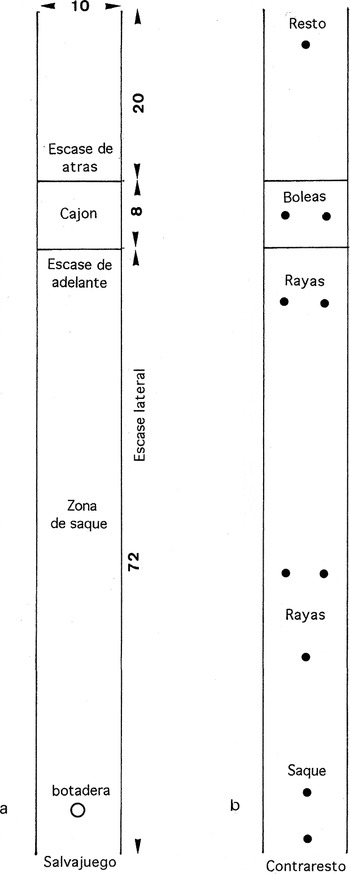
Pelota mixteca courts, according to Inzua (Scheffler et al. 1985): (a) form and terminology; (b) players' repartition on the court.
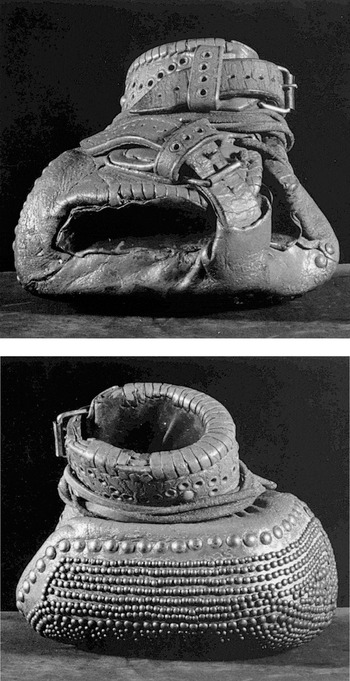
Pelota mixteca equipment: the glove.
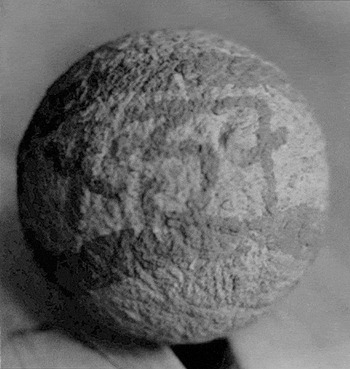
Pelota mixteca equipment: the ball.
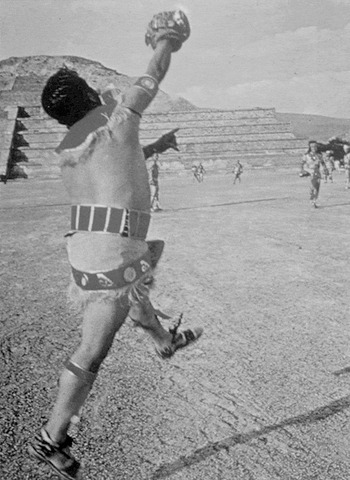
Pelota mixteca players in action at Monte Alban in 1977.
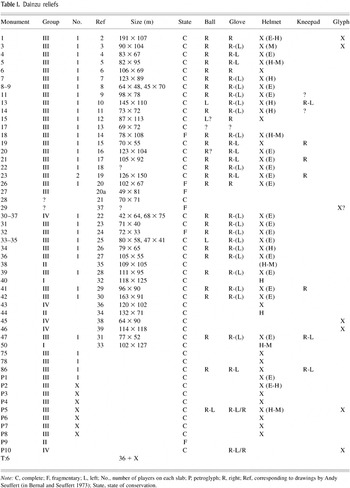
Dainzu reliefs
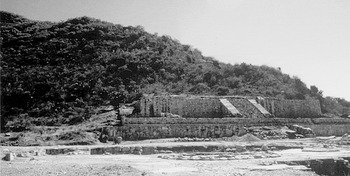
Dainzu Complex A.
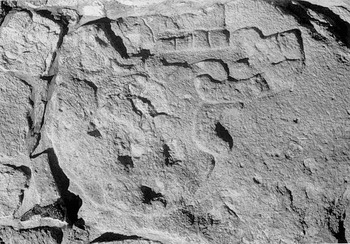
Dainzu Group IV motive: Monument 43, a skull.
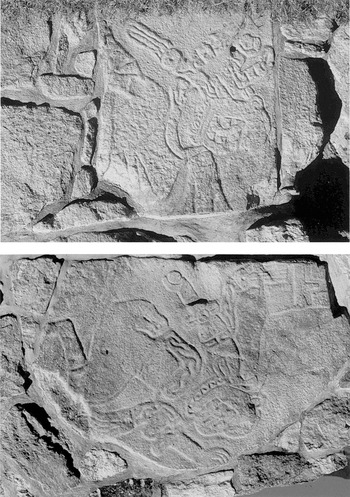
Dainzu Group III players: (a) Monument 26; (b) Monument 42.
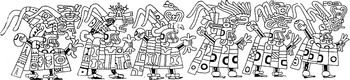
Huijazoo mural ballplayers (after Miller 1995).
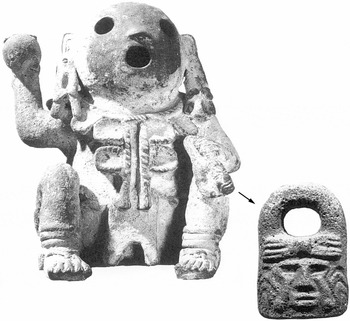
Monte Alban Tomb 58 brasero, currently described as Xipe Totec.
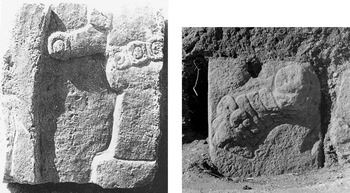
(a) La Lagunita Monument 22 (from Ichon 1977). (b) A gloved hand from Dainzu.
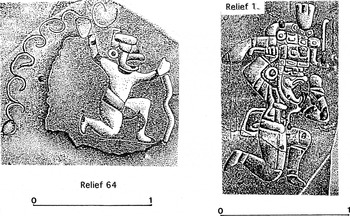
Abaj Takalik reliefs (after Schieber de Lavarreda 1994): (a) Relief 64; (b) Relief 1.
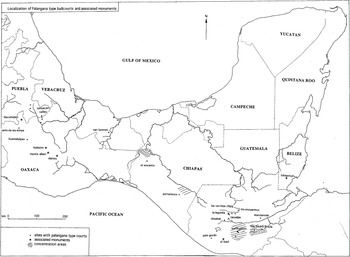
Map of the repartition of palangana courts and associated monuments.
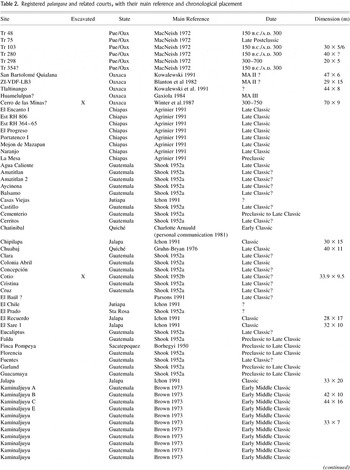
Registered palangana and related courts, with their main reference and chronological placement
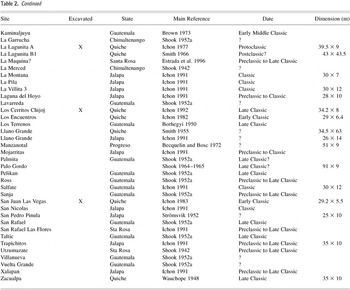
Continued
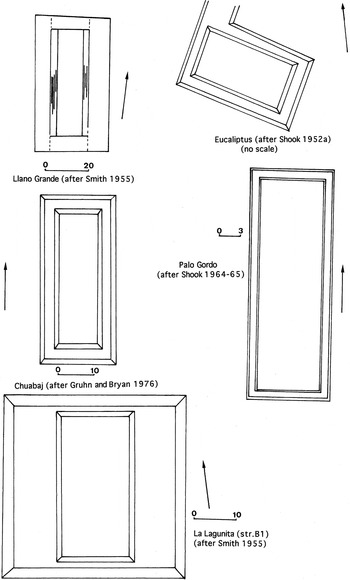
Guatemalan highands Palangana courts.
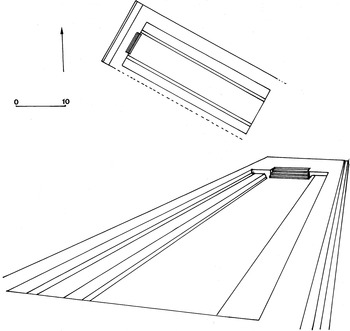
San Juan de Las Vegas palangana court (Structure 5; after Ichon 1983) and its reconstitution (after Aguilar, in Inchon 1983).
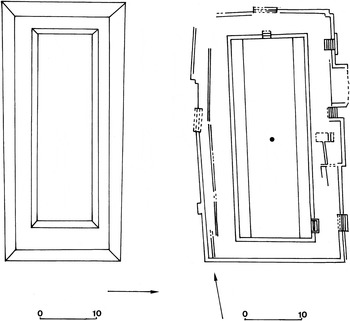
Cotio palangana courts (after Shook 1952b) and Los Cerritos Chijoj Structure 6 (after Ichon 1992).
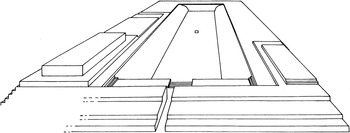
Reconstitution of La Lagunita palangana court, Structure 12 (after Courau, in Ichon 1977).
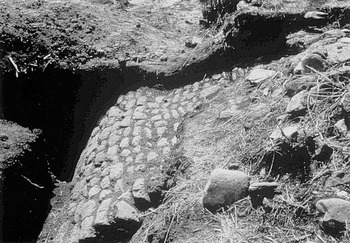
Ballcourt profile from La Lagunita. Photograph by Alain Ichon.
 You have
Access
- 10
- Cited by