Implications
Nitrous oxide (N2O), the most powerful greenhouse gas, is emitted largely from agricultural systems primarily through soil biological processes – nitrification and denitrification. Modern agricultural systems have become high-nitrifying, N-inefficient and leak large amounts of reactive nitrogen (N) to the environment. Biological nitrification inhibition (BNI) is the natural ability of certain plant species to release nitrification inhibitors from roots to suppress nitrification and N2O emission. The BNI function in Brachiaria pastures and feed-grain crops (e.g. sorghum) can be exploited both genetically and, from a cropping system's perspective, to develop low-nitrifying and low N2O-emitting production systems that would benefit both agriculture and the environment.
Introduction
Nitrification and denitrification are the biological drivers for N2O production
Nitrification and subsequent denitrification are the primary drivers for the generation of nitrous oxide (N2O), the most powerful greenhouse gas with a global warming potential (GWP) of 300 times greater than that of CO2 (Hahn and Crutzen, Reference Hahn and Crutzen1982; Kroeze, Reference Kroeze1994; Intergovernmental Panel on Climate Change (IPCC), 2012). N2O is emitted during two enzymatic pathways ((ammonia mono-oxygenase (AMO) and hydroxylamine oxidoreductase (HAO)) involved in the oxidation of ammonia (NH3+) to nitrite (NO2−) and nitrate (NO3−) (Prosser, Reference Prosser1989; Supplementary Figure S1). In addition, during denitrification (i.e. reduction of NO3− into N2), N2O is emitted (Supplementary Figure S1; Prosser, Reference Prosser1989). Nearly 70% of the global N2O emissions come from agricultural systems, and nitrification–denitrification is the only known soil biological process responsible for the generation of N2O (Bremner and Blackmer, Reference Bremner and Blackmer1978; Smith et al., Reference Smith, McTaggart and Tsuruta1997; Hofstra and Bouwman, Reference Hofstra and Bouwman2005; Tubiello et al., Reference Tubiello, Salvatore, Rossi, Ferrara, Fitton and Smith2013). As denitrification cannot take place without substrate NO3− (produced by nitrification), controlling nitrification thus is the most effective strategy to reduce N2O emissions from agricultural systems (Subbarao et al., Reference Subbarao, Sahrawat, Nakahara, Ishikawa, Kishii, Rao, Hash, George, Srinivasa Rao, Nardi, Bonnett, Berry, Suenaga and Lata2012 and Reference Subbarao, Sahrawat, Nakahara, Rao, Ishitani, Hash, Kishii, Bonnett, Berry and Lata2013b).
Two groups of soil bacteria – ammonia-oxidizing bacteria (AOB; mainly Nitrosomonas spp. and Nitrosospira spp.) and ammonia-oxidizing archaea (AOA) – are largely responsible for the biological oxidation of NH3+ to NO3− (Leninger et al., Reference Leninger, Urich, Schloter, Schwark, Qi, Nicol, Prosser, Schuster and Schleper2006; Taylor et al., Reference Taylor, Zeglin, Dooley, Myrold and Bottomley2010). As a cation, NH4+ is electrostatically held by the negatively charged clay surfaces and functional groups of soil organic matter (SOM) that reduce the loss of NH4+-N by leaching (Sahrawat, Reference Sahrawat1989). In contrast, NO3−, with negative charge, does not readily bond to the soil, and is more labile to be leached out of the root zone. In addition, several heterotrophic soil bacteria denitrify NO3− under anaerobic or partially anaerobic conditions (which can often coincide with temporary water-logging of a soil after a heavy rainfall or irrigation in fields that have improper drainage; Bremner and Blackmer, Reference Bremner and Blackmer1978; Mosier et al., Reference Mosier, Duxbury, Freney, Heinemeyer and Minami1996). The loss of nitrogen (N) during and following nitrification reduces the effectiveness of N fertilization, causing environmental degradation, loss of biodiversity, loss of ecosystem services, emergence of pathogens and threatening the long-term sustainability of agricultural production systems (Clark, Reference Clark1962; Jarvis, Reference Jarvis1996; Vitousek et al., Reference Vitousek, Mooney, Lubchenco and Melillo1997a and Reference Vitousek, Aber, Howarth, Likens, Matson, Schindler and Tilman1997b; Dalgaard et al., Reference Dalgaard, Bienkowski, Bleeker, Dragosits, Drouet, Durand, Frumau, Hutchings, Kedziora, Magliulo, Olesen, Theobald, Maury, Akkal and Cellier2012).
Low N recovery is the major cause of N pollution and N2O emissions from agricultural systems
Industrially fixed N (i.e. N fertilizers) is the primary driver of agricultural productivity since the 1960s. Massive amounts of N fertilizer transformed agricultural production to feed the growing population during the last five decades (i.e. from 1960 to 2010) (Broadbent and Rauschkolb, Reference Broadbent and Rauschkolb1977; Matson et al., Reference Matson, McDowell Townsend and Vitousek1999; Tilman et al., Reference Tilman, Fargione, Wolff, Antonio, Dobson, Howarth, Schindler, Schlesinger, Simberloff and Swackhamer2001 and Reference Tilman, Cassman, Matson, Naylor and Polasky2002; Hungate et al., Reference Hungate, Dukes, Shaw, Luo and Field2003; Sutton et al., Reference Sutton, Oenema, Erisman, Leip, van Grinsven and Winiwarter2011). Global cereal production has tripled in the last 50 years, largely driven by an eightfold increase in N-fertilizer consumption, coupled with the use of N-responsive high-yielding crop cultivars, a combination often referred as ‘Green Revolution’ (Smil, Reference Smil2001; Tilman et al., Reference Tilman, Fargione, Wolff, Antonio, Dobson, Howarth, Schindler, Schlesinger, Simberloff and Swackhamer2001 and Reference Tilman, Cassman, Matson, Naylor and Polasky2002; Steinfeld and Wassenaar, Reference Steinfeld and Wassenaar2007; Food and Agriculture Organization (FAO), 2009; Pelletier and Tyedmers, Reference Pelletier and Tyedmers2010; Sutton et al., Reference Sutton, Oenema, Erisman, Leip, van Grinsven and Winiwarter2011). By 2050, global population is projected to be 50% larger than at present; global grain demand and N-fertilizer consumption are projected to double during this period (Cassman and Pingali, Reference Cassman and Pingali1995; Alexandratos, Reference Alexandratos1999; Cassman, Reference Cassman1999; Cohen and Federoff, Reference Cohen and Federoff1999; Tilman et al., Reference Tilman, Fargione, Wolff, Antonio, Dobson, Howarth, Schindler, Schlesinger, Simberloff and Swackhamer2001). Doubling food production again (i.e. by 2050) and to sustain food production at that level without compromising on environmental integrity and public health are the greatest challenges to humankind (Alexandratos, Reference Alexandratos1999; Ruttan, Reference Ruttan1999; Tilman et al., Reference Tilman, Cassman, Matson, Naylor and Polasky2002).
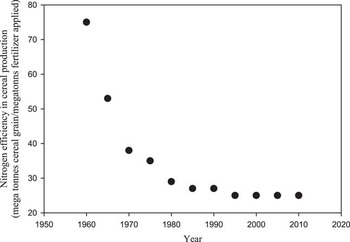
N efficiency (mega tons of cereal grain produced per mega ton of N fertilizer applied) in cereal production has declined from about 80 in 1960s to 20 at present (Tilman et al., Reference Tilman, Cassman, Matson, Naylor and Polasky2002; Figure 1), suggesting a diminishing returns to N-fertilizer applications; this is largely associated with the accelerated soil-nitrifier activity led to diminished ability to retain soil-N. In addition, this implies that further applications may not be effective in increasing yields in the future (Cassman and Pingali, Reference Cassman and Pingali1995; Tilman et al., Reference Tilman, Cassman, Matson, Naylor and Polasky2002; Cassman et al., Reference Cassman, Dobermann, Walters and Yang2003; Zhang et al., Reference Zhang, Wang and Xu2008). Several changes in agricultural management practices during the twentieth century led to the development of high-nitrifying soil environments, and they are largely responsible for N loss (through NO3− leaching and gaseous N emissions (N2O, NO)) and N pollution of the environment (NO3− pollution of water bodies and global warming) (Vitousek et al., Reference Vitousek, Mooney, Lubchenco and Melillo1997a and Reference Vitousek, Aber, Howarth, Likens, Matson, Schindler and Tilman1997b; Matson et al., Reference Matson, Naylor and Ortiz-Monasterio1998; Tilman et al., Reference Tilman, Fargione, Wolff, Antonio, Dobson, Howarth, Schindler, Schlesinger, Simberloff and Swackhamer2001 and Reference Tilman, Cassman, Matson, Naylor and Polasky2002; Dinnes et al., Reference Dinnes, Karlen, Jaynes, Kasper, Hatfield, Colvin and Cambardella2002; Wagner-Riddle et al., Reference Wagner-Riddle, Furon, McLaughlin, Lee, Barbeau, Jayasundara, Parkin, von Bertoldi and Warland2007; Turner et al., Reference Turner, Rabalais and Justic2008).
Trends in N-fertilization efficiency in cereal production (annual global cereal production divided by annual global application of N fertilizer) systems – global food production has tripled during this period (1960 to 2010), but the N fertilizer applied has increased eightfold (Adapted from Tilman et al., 2002 and FAO, 2012).

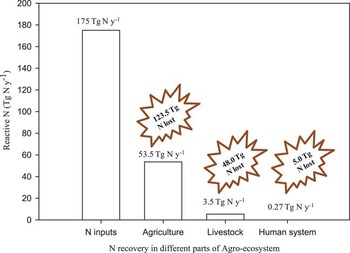
N recovery in various components of agro-ecosystems that include agriculture (i.e. pasture/crop production), livestock production and human systems indicate a diminishing flow of N from agriculture (through N fertilization) to human nutrition (either vegetable or animal protein) (Supplementary Figure S2, Figure 2). Only 30% of the applied N fertilizer is taken by crops to produce plant protein (Raun and Johnson, Reference Raun and Johnson1999; Smil, Reference Smil1999; Cassman et al., Reference Cassman, Dobermann and Walters2002). Nearly 70% of the 150 Tg N as N fertilizer applied to the agricultural systems is lost either through NO3− leaching or gaseous N emissions; moreover, a large proportion of the leached NO3− is eventually denitrified, generating N2O and NO (Peterjohn and Schlesinger, Reference Peterjohn and Schlesinger1990; Vitousek and Howarath, Reference Vitousek and Howarath1991; Vitousek et al., Reference Vitousek, Mooney, Lubchenco and Melillo1997a and Reference Vitousek, Aber, Howarth, Likens, Matson, Schindler and Tilman1997b; Matson et al., Reference Matson, Naylor and Ortiz-Monasterio1998 and Reference Matson, McDowell Townsend and Vitousek1999; Smil, Reference Smil1999; Tilman et al., Reference Tilman, Fargione, Wolff, Antonio, Dobson, Howarth, Schindler, Schlesinger, Simberloff and Swackhamer2001; Wagner-Riddle et al., Reference Wagner-Riddle, Furon, McLaughlin, Lee, Barbeau, Jayasundara, Parkin, von Bertoldi and Warland2007; Jahangir et al., Reference Jahangir, Johnston, Khalil, Hennessy, Humphreys, Fenton and Richards2012). The N-recovery efficiency by the livestock sector is only about 10% at best (ranging from 5% for beef cattle, 13% for dairy cows, about 20% for pigs and 34% for poultry, i.e. for converting plant protein to animal protein) (van der Hoek, Reference van der Hoek1998), losing 90% of the fertilizer N to the environment through NO3− leaching or gaseous emissions (Supplementary Figure S2, Figure 2). Some of the reactive N excreted from intensive livestock systems (i.e. urine and feces) is recycled through agricultural systems in a limited way, results in N-saturation hotspots (farm soil NO3− levels often reaching 300 to 400 kg N/ha per year), causing NO3− contamination of groundwater (Dalgaard et al., Reference Dalgaard, Bienkowski, Bleeker, Dragosits, Drouet, Durand, Frumau, Hutchings, Kedziora, Magliulo, Olesen, Theobald, Maury, Akkal and Cellier2012; Hansen et al., Reference Hansen, Dalgaard, Thorling, Sorensen and Erlandsen2012). A major portion of the reactive N excreted from livestock systems is not recycled effectively through modern production systems as N source (Wagner-Riddle et al., Reference Wagner-Riddle, Furon, McLaughlin, Lee, Barbeau, Jayasundara, Parkin, von Bertoldi and Warland2007; Centner and Newton, Reference Centner and Newton2008; Schlesinger, Reference Schlesinger2009). The situation is same in the case of N excreted by humans (i.e. domestic sewage), as most of this reactive N (human urine and fecal matter) is lost directly to the environment. However, the greatest loss of reactive N occurs from agricultural (crop/pasture) systems (Supplementary Figure S2, Figure 2) (Peterjohn and Schlesinger, Reference Peterjohn and Schlesinger1990; Vitousek and Howarath, Reference Vitousek and Howarath1991; Smil, Reference Smil1999).
Nitrogen recovered in different components of an agro-ecosystem [calculated on the basis of the assumption that total N input into agricultural systems is 175 Tg N/year (25 Tg N/year is from biological nitrogen fixation from legumes and from N fertilizer is at 150 Tg N/year (Smil, Reference Smil1999); 30% of this N recovered by crops to produce plant protein (Raun and Johnson, Reference Raun and Johnson1999; Cassman et al., Reference Cassman, Dobermann and Walters2002); the N-recovery efficiency by the livestock sector is about 10% at best (van der Hoek, Reference van der Hoek1998); the N-retention capacity in human systems is about 5% of the protein-N intake (van der Hoek, Reference van der Hoek1998)).

Greenhouse gas emissions associated with N-fertilizer production
Substantial amounts of GHGs (e.g. CO2, N2O and CH4) are emitted during the production of N fertilizers, which is expressed as CO2 equivalents per unit mass of fertilizer (g CO2-e/kg N fertilizer) on the basis of their GWP (IPCC, 2012). Synthesis of NH3+ (the basic ingredient of all N fertilizers) is an energy-intensive process, and requires about 25 to 35 GJ/t of NH3+ (Kongshaug, Reference Kongshaug1998). Nearly 5% of the natural gas produced in the world is used for the manufacture of N fertilizers (Smil, Reference Smil2001). The emission factor is about 4 kg CO2-e/kg urea N, about 10 kg CO2-e/kg N in complex fertilizers (i.e. NPK; Kuesters and Jenssen, Reference Kuesters and Jenssen1998; Kramer et al., Reference Kramer, Moll and Nonhebel1999). With the current levels of annual N-fertilizer applications in agriculture (i.e. 150 Tg N/year), this amounts to annual emissions of 458 Tg of CO2 associated with the manufacture of N fertilizer alone (excluding GHG emissions during transportation of N fertilizers from factory to farm; Smil, Reference Smil2001). These GHG emissions are similar in magnitude to annual CO2-e emissions from running motor vehicles, which are at 900 Tg CO2-e (Schafer and Victor, Reference Schafer and Victor1999). By 2050, GHG emissions from global N-fertilizer production will reach 1200 to 3000 Tg CO2-e (on the basis of the current estimates that N-fertilizer usage will reach 300 Tg by 2050; Galloway et al., Reference Galloway, Townsend, Erisman, Bekunda, Zai, Freney, Martinelli, Seitzinger and Sutton2008; Schlesinger, Reference Schlesinger2009). Currently, global CO2 emissions are at 34 000 Tg CO2-e (IPCC, 2012) and GHG emissions from N-fertilizer production accounts for about 2% to 4% of the global CO2 emissions.
High-nitrifying modern agricultural systems are inherently N-inefficient and affect global environment
Unlike most climax ecosystems that have tightly closed N cycling to protect N from leaking, the modern agricultural systems have open N cycling, extremely leaky and inherently N-inefficient (Rice and Pancholy, Reference Rice and Pancholy1972 and Reference Rice and Pancholy1974; White, Reference White1991; Nasholm et al., Reference Nasholm, Ekblad, Nordin, Gisler, Hosberg and Hosberg1998; Paavolainen et al., Reference Paavolainen, Kitunen and Smolander1998; Cassman et al., Reference Cassman, Dobermann and Walters2002). Large amounts of fertilizer N are added from industrial processes; moreover, N is being continuously removed from the system (through harvested food/feed grains) to support intensive livestock feed and human food systems, often located away from the primary production sites. This results in not returning the reactive N (i.e. N excreted from livestock and humans) to the agricultural systems for nutrient cycling (Dinnes et al., Reference Dinnes, Karlen, Jaynes, Kasper, Hatfield, Colvin and Cambardella2002). The intensification of agricultural practices coupled with the separation of crop production from livestock production has disrupted natural nutrient cycling, deplete SOM levels, changes in soil, physical and chemical properties, brought major shifts in soil microbial activity and diversity, resulted in the development of high-nitrifying soil environments, where NO3− accounts for >95% of the crop N uptake in modern agricultural systems (Supplementary Figure S3) (Elliot, Reference Elliot1986; Ross, Reference Ross1993; Tiessen et al., Reference Tiessen, Cuevas and Chacon1994; Matson et al., Reference Matson, Naylor and Ortiz-Monasterio1998; Poudel et al., Reference Poudel, Horwath and Lanini2002; Celik, Reference Celik2005; Khan et al., Reference Khan, Mulvaney, Ellsworth and Boast2007; Mulvaney et al., Reference Mulvaney, Khan and Ellsworth2009; Russell et al., Reference Russell, Cambardella, Laird, Jaynes and Meek2009; van Wesemael et al., Reference Van Wesemael, Paustian, Meersmans, Goidts, Barancikova and Easter2010). These high-nitrifying soil environments are largely responsible for the loss of 70% N fertilizer applied to the production systems (Peterjohn and Schlesinger, Reference Peterjohn and Schlesinger1990; Vitousek and Howarath, Reference Vitousek and Howarath1991; Raun and Johnson, Reference Raun and Johnson1999). With the worldwide N-fertilizer application reaching 150 Tg/year (Smil, Reference Smil1999; Galloway et al., Reference Galloway, Townsend, Erisman, Bekunda, Zai, Freney, Martinelli, Seitzinger and Sutton2008) and the cost of urea N ranging from US$ 0.80 to 0.54/kg N, the direct annual economic loss is estimated at nearly US$ 90 billion (Fertilizer Market Bulletin, 2008; Mulvaney et al., Reference Mulvaney, Khan and Ellsworth2009; Subbarao et al., Reference Subbarao, Sahrawat, Nakahara, Rao, Ishitani, Hash, Kishii, Bonnett, Berry and Lata2013b). Fertilizer-N use is projected to double by 2050 to reach close to 300 Tg/year, (Tilman et al., Reference Tilman, Fargione, Wolff, Antonio, Dobson, Howarth, Schindler, Schlesinger, Simberloff and Swackhamer2001; Turner et al., Reference Turner, Rabalais and Justic2008; Schlesinger, Reference Schlesinger2009), and N lost from NO3− leaching from agricultural systems can be at 61.5 Tg N/year (Schlesinger, Reference Schlesinger2009). Nearly 17 Tg N is emitted as N2O, which is expected to quadruple by 2100 largely because of an increase in the use of N fertilizers (Galloway et al., Reference Galloway, Townsend, Erisman, Bekunda, Zai, Freney, Martinelli, Seitzinger and Sutton2008; Schlesinger, Reference Schlesinger2009; Burney et al., Reference Burney, Davis and Lobell2010; Kahrl et al., Reference Kahrl, Li, Su, Tenngkeit, Walkes and Xu2010).
A case for moving toward low-nitrifying agricultural systems
Nitrification is one of the several pathways (e.g. N fixation, organic matter mineralization, ammonification, nitrification and denitrification) in the soil-N cycle. Most climax ecosystems tightly control nitrification by suppressing nitrifier activity, and N flow is facilitated through multiple paths of the N cycle; a variety of organic and inorganic N forms are used as N source for uptake and assimilation to conserve N and to have a closed N cycling (Vitousek and Matson, Reference Vitousek and Matson1984; Northup et al., Reference Northup, Zengshou, Dahlgren and Vogt1995; Smolander et al., Reference Smolander, Kanerva, Adamezyk and Kitunen2012). In contrast, nitrification became a dominant pathway for N flow; NO3− is the primary N form for uptake and assimilation (>95% of the N uptake is in NO3− form) in the intensively managed high production systems, making N cycling extremely inefficient and leaky to the environment (Supplementary Figure S3) (Galloway et al., Reference Galloway, Townsend, Erisman, Bekunda, Zai, Freney, Martinelli, Seitzinger and Sutton2008; Schlesinger, Reference Schlesinger2009; Subbarao et al., Reference Subbarao, Sahrawat, Nakahara, Ishikawa, Kishii, Rao, Hash, George, Srinivasa Rao, Nardi, Bonnett, Berry, Suenaga and Lata2012 and Reference Subbarao, Sahrawat, Nakahara, Rao, Ishitani, Hash, Kishii, Bonnett, Berry and Lata2013b).
High-nitrifying soil environments rapidly convert NH4+ to NO3−, which results in inefficient use of both soil N (i.e. N mineralized from SOM) and applied N (N fertilizer) as NO3− is lost to the environment either through leaching or denitrification (Poudel et al., Reference Poudel, Horwath and Lanini2002). In addition, the assimilation of NO3−, but not of NH4+, results in the direct emission of N2O from crop canopies, further reducing nitrogen use efficiency (NUE; Smart and Bloom, Reference Smart and Bloom2001). Thus, maintaining soil N in NH4+ form is advantageous even after taking into consideration the potential negative effects of rhizosphere acidification from its uptake and assimilation (caused by H+ excretion). By slowing the soil nitrification rates, NH4+ can move into the microbial pool (i.e. microbial immobilization) where it is converted to slow-release N source (Vitousek and Matson, Reference Vitousek and Matson1984; Hodge et al., Reference Hodge, Robinson and Fitter2000). Most plants have the ability to use either NH4+ or NO3− as their N source (Haynes and Goh, Reference Haynes and Goh1978; Salsac et al., Reference Salsac, Chaillou, Morot-Gaudry and Lesaint1987; Boudsocq et al., Reference Boudsocq, Niboyet and Lata2012). Reducing nitrification rates in agricultural systems thus do not alter the intrinsic ability of plants to absorb N, but increases N-retention time in the root zone as NH4+, which is less mobile than NO3−, provides additional time for plants to absorb N. This in turn reduces the amount of N lost through leaching and denitrification, and thus leads to improved N recovery and NUE in agricultural systems (Hodge et al., Reference Hodge, Robinson and Fitter2000; Subbarao et al., Reference Subbarao, Sahrawat, Nakahara, Ishikawa, Kishii, Rao, Hash, George, Srinivasa Rao, Nardi, Bonnett, Berry, Suenaga and Lata2012). Restricting the nitrification pathway by suppressing soil nitrifier activity thus could be a key strategy to shift the current NO3− dominated crop N nutrition toward NH4+ as the primary N form for uptake and assimilation (Subbarao et al., Reference Subbarao, Sahrawat, Nakahara, Ishikawa, Kishii, Rao, Hash, George, Srinivasa Rao, Nardi, Bonnett, Berry, Suenaga and Lata2012 and Reference Subbarao, Sahrawat, Nakahara, Rao, Ishitani, Hash, Kishii, Bonnett, Berry and Lata2013b). Such a paradigm shift in the N nutrition of field crops and pastures is necessary for developing next-generation N-efficient production systems that leak less N, thus contributing to the ecological and economic intensification of agriculture and livestock production. Many of these advantages associated with inhibiting nitrification in improving crop yield, grain quality, livestock production and environmental quality have been demonstrated using chemical nitrification inhibitors (Slangen and Kerkhoff, Reference Slangen and Kerkhoff1984; Prasad and Power, Reference Prasad and Power1995; Subbarao et al., Reference Subbarao, Ito, Sahrawat, Berry, Nakahara, Ishikawa, Watanabe, Suenaga, Rondon and Rao2006a; Giltrap et al., Reference Giltrap, Singh, Saggar and Zaman2010; Dennis et al., Reference Dennis, Cameron, Di, Moir, Staples, Sills and Richards2012).
Biological nitrification inhibition (BNI)
The BNI concept
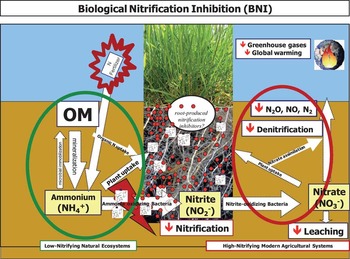
The natural ability of some plants to produce and release nitrification inhibitors from roots to suppress nitrifier activity in soils is termed ‘biological nitrification inhibition (BNI)’ (for details see Figure 3) (Subbarao et al., Reference Subbarao, Ito, Sahrawat, Berry, Nakahara, Ishikawa, Watanabe, Suenaga, Rondon and Rao2006a, Reference Subbarao, Ishikawa, Ito, Nakahara, Wang and Berry2006b, Reference Subbarao, Wang, Ito, Nakahara and Berry2007a, Reference Subbarao, Rondon, Ito, Ishikawa, Rao, Nakahara, Lascano and Berry2007b, Reference Subbarao, Ban, Masahiro, Ito, Samejima, Wang, Pearse, Gopalakrishnan, Nakahara, Zakir Hossain, Tsujimoto and Berry2007c, Reference Subbarao, Nakahara, Ishikawa, Yoshihashi, Ito, Ono, Ohnishi-Kameyama, Yoshida, Kawano and Berry2008, Reference Subbarao, Nakahara, Hurtado, Ono, Moreta, Salcedo, Rondon, Rao, Lascano, Berry and Ito2009a, Reference Subbarao, Kishii, Nakahara, Ishikawa, Ban, Tsujimoto, George, Berry, Hash and Ito2009b, Reference Subbarao, Sahrawat, Nakahara, Ishikawa, Kishii, Rao, Hash, George, Srinivasa Rao, Nardi, Bonnett, Berry, Suenaga and Lata2012 and Reference Subbarao, Sahrawat, Nakahara, Rao, Ishitani, Hash, Kishii, Bonnett, Berry and Lata2013b). As nitrification is the most important process determining the N-cycling efficiency (i.e. proportion of N that stays in the ecosystem during a complete recycling loop), restricting nitrification will minimize the N leakage and facilitate N flow through the NH4+ assimilation pathways (Subbarao et al., Reference Subbarao, Sahrawat, Nakahara, Ishikawa, Kishii, Rao, Hash, George, Srinivasa Rao, Nardi, Bonnett, Berry, Suenaga and Lata2012 and Reference Subbarao, Sahrawat, Nakahara, Rao, Ishitani, Hash, Kishii, Bonnett, Berry and Lata2013b). Agronomic NUE (NUEagronomic = grain yield per unit of applied N) is a function of both intrinsic NUE (NUEintrinsic = dry matter produced per unit N absorbed), HI (harvest index optimized for most high yielding cultivars) and N uptake (Raun and Johnson, Reference Raun and Johnson1999). NUEintrinsic is physiologically conserved (Glass, Reference Glass2003), and thus improvements in NUEagronomic can only come from improvements in crop-N uptake (Finzi et al., Reference Finzi, Norby, Calfapietra, Gallet-Budynek, Gielen, Holmes, Hoosbeek, Iversen, Jackson and Kubiske2007), which is largely a function of recovering the applied N fertilizer. The BNI function in plants thus can exert a positive influence on NUEagronomic by reducing N loss associated with nitrification–denitrification (Subbarao et al., Reference Subbarao, Sahrawat, Nakahara, Ishikawa, Kishii, Rao, Hash, George, Srinivasa Rao, Nardi, Bonnett, Berry, Suenaga and Lata2012 and Reference Subbarao, Sahrawat, Nakahara, Rao, Ishitani, Hash, Kishii, Bonnett, Berry and Lata2013b). Recent modeling studies suggest that tropical grasses that inhibit nitrification exhibit a twofold greater productivity than those that lack such ability (Lata et al., Reference Lata, Durand, Lensi and Abbadie1999; Boudsocq et al., Reference Boudsocq, Lata, Mathieu, Abbadie and Barot2009 and Reference Boudsocq, Niboyet and Lata2012).
Schematic representation of the biological nitrification inhibition (BNI) interfaces in the N cycle. The BNI exuded by the plant root systems inhibits the first step of nitrification. In ecosystems with high BNI (e.g. brachialactone), such as with Brachiaria grasses, the flow of nitrogen from NH4+ to NO3− is restricted, and NH4+ and microbial N rather than NO3− accumulate in the soil and root system. In systems with little or no BNI, such as modern agricultural systems, nitrification occurs at a rapid rate, converting NH4+ to NO3−, which is highly susceptible to loss from the system by denitrification and or leaching (adapted from Subbarao et al., Reference Subbarao, Sahrawat, Nakahara, Ishikawa, Kishii, Rao, Hash, George, Srinivasa Rao, Nardi, Bonnett, Berry, Suenaga and Lata2012).

Recent methodological developments have facilitated the detection and quantification of nitrification inhibitors from plant roots using a recombinant luminescent Nitrosomonas construct (Iizumi et al., Reference Iizumi, Mizumoto and Nakamura1998; Subbarao et al., Reference Subbarao, Ishikawa, Ito, Nakahara, Wang and Berry2006b); the inhibitory activity released from roots is termed ‘BNI activity’ (expressed in ATU (allylthiourea unit) the inhibition caused by 0.22 μM AT in the assay is defined as one ATU); and the ability to release BNI activity is termed BNI capacity of the plant root system (Subbarao et al., Reference Subbarao, Ishikawa, Ito, Nakahara, Wang and Berry2006b). These recently developed research tools facilitated the characterization of BNI function in plants (Subbarao et al., Reference Subbarao, Ishikawa, Ito, Nakahara, Wang and Berry2006b). Soil-based assays to determine the changes in nitrification potential of rhizosphere soil complement this characterization of BNI capacity in plant root systems. The changes in potential soil nitrification by BNI function can be determined by monitoring NH3+-oxidizing activity (Subbarao et al., Reference Subbarao, Nakahara, Hurtado, Ono, Moreta, Salcedo, Rondon, Rao, Lascano, Berry and Ito2009a; Smits et al., Reference Smits, Bobbink, Laanbrock, Paalman and Hefting2010).
BNI capacity in selected field crops and pasture grasses
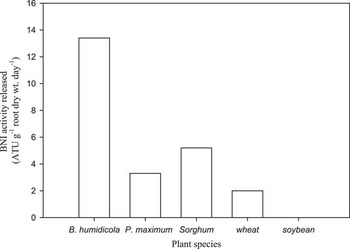
Tropical pasture grasses and selected field crops showed a wide range in the BNI capacity in their root systems (Figure 4; Subbarao et al., Reference Subbarao, Rondon, Ito, Ishikawa, Rao, Nakahara, Lascano and Berry2007b). Forage grasses of Brachiaria humidicola, which are highly adapted to low-N production environments of South American savannas (Miles et al., Reference Miles, do Valle, Rao and Euclides2004) showed the greatest BNI capacity (Subbarao et al., Reference Subbarao, Rondon, Ito, Ishikawa, Rao, Nakahara, Lascano and Berry2007b). By contrast, Panicum maximum, which is adapted to high-N availability environments, showed the least BNI capacity among tropical pasture grasses (Subbarao et al., Reference Subbarao, Rondon, Ito, Ishikawa, Rao, Nakahara, Lascano and Berry2007b). Among the cereal crops evaluated, only sorghum (Sorghum bicolor), which is adapted to low N-input conditions showed significant BNI capacity (Subbarao et al., Reference Subbarao, Rondon, Ito, Ishikawa, Rao, Nakahara, Lascano and Berry2007b and Reference Subbarao, Nakahara, Ishikawa, Ono, Yoshida, Yoshihashi, Zhu, Zakir, Deshpande, Hash and Sahrawat2013a). Other cereal crops including rice, maize, wheat and barley lacked detectable BNI capacity in their root systems during the initial screening studies (Subbarao et al., Reference Subbarao, Rondon, Ito, Ishikawa, Rao, Nakahara, Lascano and Berry2007b and Reference Subbarao, Sahrawat, Nakahara, Ishikawa, Kishii, Rao, Hash, George, Srinivasa Rao, Nardi, Bonnett, Berry, Suenaga and Lata2012; Zakir et al., Reference Zakir, Subbarao, Pearse, Gopalakrishnan, Ito, Ishikawa, Kawano, Nakahara, Yoshihashi, Ono and Yoshida2008). Most legumes evaluated showed stimulation of nitrification and showed no BNI capacity in their root systems (Subbarao et al., Reference Subbarao, Rondon, Ito, Ishikawa, Rao, Nakahara, Lascano and Berry2007b). Inhibition of nitrification is likely to be part of an adaptation mechanism to conserve and use N efficiently in natural systems where N is the most limiting nutrient determining the ecosystem productivity (Lata et al., Reference Lata, Degrange, Raynaud, Maron, Lensi and Abbadie2004; Subbarao et al., Reference Subbarao, Wang, Ito, Nakahara and Berry2007a), and in driving the evolution of BNI function (Rice and Pancholy, Reference Rice and Pancholy1972; Lata et al., Reference Lata, Degrange, Raynaud, Maron, Lensi and Abbadie2004). The lack of BNI capacity in legumes is not surprising as the BNI attribute may have no adaptive value owing to their ability to fix N symbiotically. Conserving N thus may not offer much of an advantage for legumes as it may attract non-legumes as competitors (Subbarao et al., Reference Subbarao, Kishii, Nakahara, Ishikawa, Ban, Tsujimoto, George, Berry, Hash and Ito2009b and Reference Subbarao, Sahrawat, Nakahara, Rao, Ishitani, Hash, Kishii, Bonnett, Berry and Lata2013b).
The biological nitrification inhibition (BNI) activity released from intact roots of various plant species grown in sand-vermiculite (3 : 1 v/v) culture for 60 days (Source: Subbarao et al., Reference Subbarao, Rondon, Ito, Ishikawa, Rao, Nakahara, Lascano and Berry2007b).

Characterization of BNI function in sorghum and B. humidicola
Two categories of biological nitrification inhibitors (BNIs) released from roots of sorghum (Supplementary Figure S4):
(a) Hydrophilic BNIs
(b) Hydrophobic BNIs
These two BNI fractions differ in their mobility in the soil and their solubility in water. The hydrophobic BNIs may remain close to the root as they could be strongly sorbed on the soil particles, increasing their persistence; their movement in soil is likely to be via diffusion across the concentration gradient and is likely to be confined to the rhizosphere (Dayan et al., Reference Dayan, Rimando, Pan, baerson, Gimsing and Duke2010; Subbarao et al., Reference Subbarao, Sahrawat, Nakahara, Ishikawa, Kishii, Rao, Hash, George, Srinivasa Rao, Nardi, Bonnett, Berry, Suenaga and Lata2012). In contrast, the hydrophilic BNIs may move further from the point of release owing to their solubility in water, and this may improve their capacity to control nitrification beyond the rhizosphere (Subbarao et al., Reference Subbarao, Sahrawat, Nakahara, Ishikawa, Kishii, Rao, Hash, George, Srinivasa Rao, Nardi, Bonnett, Berry, Suenaga and Lata2012 and Reference Subbarao, Nakahara, Ishikawa, Ono, Yoshida, Yoshihashi, Zhu, Zakir, Deshpande, Hash and Sahrawat2013a). However, the distribution of hydrophobic and hydrophilic BNIs in the rhizosphere likely differs and may have complementary functional roles such as differential inhibitory effects on AOB v. AOA (Subbarao et al., Reference Subbarao, Nakahara, Ishikawa, Ono, Yoshida, Yoshihashi, Zhu, Zakir, Deshpande, Hash and Sahrawat2013a). In sorghum, the production and release of hydrophilic and hydrophobic BNIs appear to be of similar magnitude during crop development (Subbarao et al., Reference Subbarao, Nakahara, Ishikawa, Ono, Yoshida, Yoshihashi, Zhu, Zakir, Deshpande, Hash and Sahrawat2013a). On the basis of the BNI activity release observed from a number of studies, we estimated that the amounts of BNIs (hydrophilic plus hydrophobic) released from sorghum during a 130-day growing period (i.e. nearly up to physiological maturity) can reduce nitrification in about 500 g soil per plant (Subbarao et al., Reference Subbarao, Nakahara, Ishikawa, Ono, Yoshida, Yoshihashi, Zhu, Zakir, Deshpande, Hash and Sahrawat2013a).
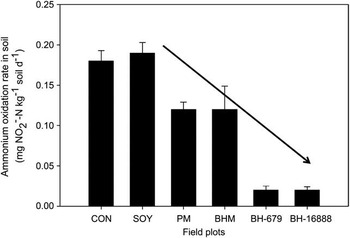
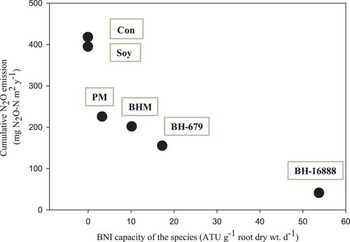
For Brachiaria sp. (B. humidicola), assuming the average live root biomass from a long-term grass pasture at 1.5 Mg/ha (Fisher et al., Reference Fisher, Rao, Ayarza, Lascano, Sanz, Thomas and Vera1994) with a BNI capacity of 17 to 70 ATU/g root dry wt per day (Subbarao et al., Reference Subbarao, Wang, Ito, Nakahara and Berry2007a), it was estimated that BNI activity of 2.6 × 10⁶–7.5 × 10⁶ ATU/ha per day can potentially be released (Subbarao et al., Reference Subbarao, Wang, Ito, Nakahara and Berry2007a and Reference Subbarao, Nakahara, Hurtado, Ono, Moreta, Salcedo, Rondon, Rao, Lascano, Berry and Ito2009a). This estimate amounts to an inhibitory potential equivalent to that by the application of 6.2 to 18 kg of nitrapyrin/ha per year (based on 1 ATU being equal to 0.6 μg of nitrapyrin), which is large enough to have a significant influence on the function of soil nitrifier population and nitrification rates (Subbarao et al., Reference Subbarao, Nakahara, Hurtado, Ono, Moreta, Salcedo, Rondon, Rao, Lascano, Berry and Ito2009a). Field studies indicate a 90% decline in soil ammonium oxidation rates owing to extremely small populations of nitrifiers ((AOB and AOA); determined as amoA genes) within 3 years of establishment of B. humidicola (Subbarao et al., Reference Subbarao, Nakahara, Hurtado, Ono, Moreta, Salcedo, Rondon, Rao, Lascano, Berry and Ito2009a; Figure 5). N2O emission was also suppressed by >90% in field plots of B. humidicola (CIAT 16888) compared with soybean (Glycine max (L.) Merr.), which lacks BNI capacity in its roots or control plots (plots without plants). Two other pasture grasses P. maximum and Brachiaria spp. hybrid cv. Mulato that have a low to moderate level of BNI capacity (3 to 10 ATU/g root dry wt. per day) showed only an intermediate level of inhibitory effect on soil ammonium oxidation rate. A negative relationship was observed between the BNI capacity of roots of a species and N2O emissions, on the basis of field monitoring of N2O emissions over a 3-year period in tropical pasture grasses having a wide range of BNI capacity in roots (Figure 6).
Soil ammonium oxidation rates (mg of NO2−-N/kg soil per day) in field plots planted to tropical pasture grasses (differing in BNI capacity) and soybean (lacking BNI capacity in roots) (covering 3 years from establishment of pastures (September 2004 to November 2007); for soybean, two planting seasons every year and after six seasons of cultivation). CON, control (plant-free) plots; SOY, soybean; PM, P. maximum; BHM, Brachiaria hybrid cv. Mulato; BH-679, B. humidicola CIAT 679 (commercial cultivar); BH-16888, B. humidicola accession CIAT 16888 (a germplasm accession). Values are means ± s.e. of three replications (adapted from a study by Subbarao et al., Reference Subbarao, Nakahara, Hurtado, Ono, Moreta, Salcedo, Rondon, Rao, Lascano, Berry and Ito2009a).

Relationships of the biological nitrification inhibition (BNI) capacity of plant species with N2O emitted from field plots. The N2O emission was monitored over a period of 3 years (adapted from a study by Subbarao et al., Reference Subbarao, Sahrawat, Nakahara, Ishikawa, Kishii, Rao, Hash, George, Srinivasa Rao, Nardi, Bonnett, Berry, Suenaga and Lata2012; see Figure 5 for abbreviations and treatment details).

BNIs and their mode of action
Several BNIs that belong to different chemical functional groups have been isolated and identified (Subbarao et al., Reference Subbarao, Ishikawa, Ito, Nakahara, Wang and Berry2006b, Reference Subbarao, Nakahara, Ishikawa, Yoshihashi, Ito, Ono, Ohnishi-Kameyama, Yoshida, Kawano and Berry2008 and Reference Subbarao, Nakahara, Hurtado, Ono, Moreta, Salcedo, Rondon, Rao, Lascano, Berry and Ito2009a; Zakir et al., Reference Zakir, Subbarao, Pearse, Gopalakrishnan, Ito, Ishikawa, Kawano, Nakahara, Yoshihashi, Ono and Yoshida2008). A phenyl propanoid isolated from root exudates of hydroponically grown sorghum, methyl 3-(4-hydroxyphenyl) propionate (MHPP), has been identified as the hydrophilic BNI component of the inhibitory activity released from sorghum roots (Zakir et al., Reference Zakir, Subbarao, Pearse, Gopalakrishnan, Ito, Ishikawa, Kawano, Nakahara, Yoshihashi, Ono and Yoshida2008). The IC50 (concentration required for 50% inhibition) value for MHPP is 9 × 10⁻⁶ M (Zakir et al., Reference Zakir, Subbarao, Pearse, Gopalakrishnan, Ito, Ishikawa, Kawano, Nakahara, Yoshihashi, Ono and Yoshida2008). The mode of inhibitory action for MHPP is based on the disruption of the AMO enzymatic pathway, and it does not affect the HAO enzymatic pathway as has been observed in the case of synthetic nitrification inhibitors (Zakir et al., Reference Zakir, Subbarao, Pearse, Gopalakrishnan, Ito, Ishikawa, Kawano, Nakahara, Yoshihashi, Ono and Yoshida2008). Sorgoleone, a p-benzoquinone, exuded from sorghum roots has a strong inhibitory effect on Nitrosomonas sp., and it contributes significantly to the hydrophobic BNI capacity in sorghum (Subbarao et al., Reference Subbarao, Sahrawat, Nakahara, Ishikawa, Kishii, Rao, Hash, George, Srinivasa Rao, Nardi, Bonnett, Berry, Suenaga and Lata2012; Supplementary Figure S5a).
Several isothiocyanate-based compounds such as 2-propenyl-glucosinolate, methyl-isothiocyanate, 2-propenyl isothiocyanate, butyl-isothiocyanate, phenyl-isothiocyanate, benzyl-isothiocyanate and phenethyl-isothiocyanate are formed during the degradation of cruciferous tissues and they have been reported to have varying degree of inhibitory effects on nitrification (Bending and Lincoln, Reference Bending and Lincoln2000). Preliminary evaluation of these isothiocyanates showed inhibitory activity in the bioassay, indicating the possibility of incorporating cruciferous crop residues as a means to control soil nitrification in agricultural systems (G.V. Subbarao, JIRCAS, unpublished results).
The compounds with BNI activity in the aerial parts of B. humidicola are unsaturated free fatty acids, linoleic acid (LA) and α-lenolenic acid (LN; Subbarao et al., Reference Subbarao, Nakahara, Ishikawa, Yoshihashi, Ito, Ono, Ohnishi-Kameyama, Yoshida, Kawano and Berry2008), which are relatively weak inhibitors of nitrification with IC50 values of 3 × 10⁻⁵ M, whereas the IC50 value of the synthetic nitrification inhibitor AT is 1 × 10⁻⁷ M. Both LA and LN inhibit Nitrosomonas by blocking of both the AMO and HAO enzymatic pathways (Subbarao et al., Reference Subbarao, Nakahara, Ishikawa, Yoshihashi, Ito, Ono, Ohnishi-Kameyama, Yoshida, Kawano and Berry2008). In addition, BNIs could also disrupt the electron transfer pathway via HAO to ubiquinone and cytochrome (which need to be maintained to generate reducing power, i.e. NADPH), which is crucial to the metabolic functions of Nitrosomonas (Subbarao et al., Reference Subbarao, Nakahara, Hurtado, Ono, Moreta, Salcedo, Rondon, Rao, Lascano, Berry and Ito2009a). Most synthetic nitrification inhibitors (e.g. nitrapyrin, dicyandiamide (DCD) and 3,4-dimethylpyrazolephosphate) suppress Nitrosomonas activity by suppressing the AMO enzymatic pathway (McCarty, Reference McCarty1999; Subbarao et al., Reference Subbarao, Ito, Sahrawat, Berry, Nakahara, Ishikawa, Watanabe, Suenaga, Rondon and Rao2006a). Two phenyl propanoids, methyl-p-coumarate and methyl ferulate were identified and accounted for the BNI activity in the root tissues of B. humidicola (Gopalakrishnan et al., Reference Gopalakrishnan, Subbarao, Nakahara, Yoshihashi, Ito, Maeda, Ono and Yoshida2007).
The major nitrification inhibitor released from the roots of B. humidicola, a cyclic diterpene, has been discovered and termed ‘brachialactone’ (Supplementary Figure S5b; Subbarao et al., Reference Subbarao, Nakahara, Hurtado, Ono, Moreta, Salcedo, Rondon, Rao, Lascano, Berry and Ito2009a). This compound has a dicyclopenta [a,d] cyclooctane skeleton (5–8–5 ring system) with a γ-lactone ring bridging one of the five-membered rings and the eight-membered rings (Subbarao et al., Reference Subbarao, Nakahara, Hurtado, Ono, Moreta, Salcedo, Rondon, Rao, Lascano, Berry and Ito2009a). Brachialactone, with an ED80 (effective dose for 80% inhibition) of 10.6 μM, is considered as one of the most potent nitrification inhibitors compared with nitrapyrin or DCD, two of the synthetic nitrification inhibitors most commonly used in practical agriculture (ED80 of 5.8 μM for ©nitrapyrin and 2200 μM for ©dicyandiamide). Brachialactone inhibits Nitrosomonas sp. by blocking both the AMO and HAO enzymatic functions, but appears to have a relatively stronger effect on the AMO than on the HAO enzymatic pathway (Subbarao et al., Reference Subbarao, Nakahara, Hurtado, Ono, Moreta, Salcedo, Rondon, Rao, Lascano, Berry and Ito2009a). About 60% to 90% of the inhibitory activity released from the roots of B. humidicola is brachialactone, and its release is triggered by NH4+ in the rhizosphere. In addition, brachialactone release is confined to the root regions where NH4+ is present, and is mostly localized in the nature (Subbarao et al., Reference Subbarao, Nakahara, Hurtado, Ono, Moreta, Salcedo, Rondon, Rao, Lascano, Berry and Ito2009a).
Genetic improvement of BNI capacity in pasture grasses and cereal crops
Availability of genetic variability is a prerequisite for the genetic improvement of any plant trait through conventional and/or molecular breeding approaches. Significant genetic variability exists for the BNI capacity in B. humidicola (Subbarao et al., Reference Subbarao, Rondon, Ito, Ishikawa, Rao, Nakahara, Lascano and Berry2007b). Specific BNI activity (ATU/g root dry wt. per day) ranged from 7.1 to 46.3, indicating a significant potential for genetic improvement of the BNI capacity by selection and recombination (Subbarao et al., Reference Subbarao, Rondon, Ito, Ishikawa, Rao, Nakahara, Lascano and Berry2007b and 2009). Recent findings suggest substantial genetic variability for brachialactone release in the germplasm accessions of B. humidicola, and several genetic stocks with contrasting ability (nearly 10-fold differences) for brachialactone release capacity have been identified (G.V. Subbarao and K. Nakahara, JIRCAS, unpublished results), suggesting the potential of breeding for high-brachialactone release genetic stocks to improve the BNI capacity in B. humidicola. The discovery of sorgoleone's BNI function adds a new dimension to the functional significance of its release from sorghum roots (Subbarao et al., Reference Subbarao, Nakahara, Ishikawa, Ono, Yoshida, Yoshihashi, Zhu, Zakir, Deshpande, Hash and Sahrawat2013a). A substantial genetic variability for sorgoleone (a major component of hydrophobic BNI activity released from sorghum roots) release has been found in sorghum germplasm (G.V. Subbarao and C.T. Hash, JIRCAS & ICRISAT, unpublished results). Several mapping populations of recombinant inbred lines (RIL) based on crosses of sorghum parental lines differ in their capacity to exude sorgoleone, and these results are being currently used to map additional sorghum genomic regions contributing to genetic variation in sorgoleone exudation. As these populations are generally based on elite germplasm, this approach has the advantage of facilitating deployment of BNI traits in relevant high-yielding cultivars of sorghum. Preliminary evaluation suggested a lack of significant BNI capacity in the cultivated wheat. Subsequent evaluation of wild wheats indicated that roots of Leymus racemosus, a wild relative of wheat, possess high-BNI capacity (Subbarao et al., Reference Subbarao, Ban, Masahiro, Ito, Samejima, Wang, Pearse, Gopalakrishnan, Nakahara, Zakir Hossain, Tsujimoto and Berry2007c). The rate of suppression by L. racemosus was effective in reducing soil nitrification (Subbarao et al., Reference Subbarao, Ban, Masahiro, Ito, Samejima, Wang, Pearse, Gopalakrishnan, Nakahara, Zakir Hossain, Tsujimoto and Berry2007c). Using chromosome addition lines derived from the hybridization of L. racemosus with cultivated wheat, it was shown that genes conferring high-BNI capacity were located on chromosomes Lr#n, Lr#I and Lr#J, and they could successfully be introduced into and expressed in cultivated wheat (Subbarao et al., Reference Subbarao, Ban, Masahiro, Ito, Samejima, Wang, Pearse, Gopalakrishnan, Nakahara, Zakir Hossain, Tsujimoto and Berry2007c). These results indicate that there is a potential for developing future wheat cultivars with BNI capacity to suppress soil nitrification in wheat production systems (Subbarao et al., Reference Subbarao, Ban, Masahiro, Ito, Samejima, Wang, Pearse, Gopalakrishnan, Nakahara, Zakir Hossain, Tsujimoto and Berry2007c; Zahn, Reference Zahn2007).
Strategies for deployment of BNI function in production agriculture
In the case of annual crops with duration usually <120 days may not be adequate with the current BNI-activity release rates observed for sorghum and other major food crops (Subbarao et al., Reference Subbarao, Rondon, Ito, Ishikawa, Rao, Nakahara, Lascano and Berry2007b, Reference Subbarao, Ban, Masahiro, Ito, Samejima, Wang, Pearse, Gopalakrishnan, Nakahara, Zakir Hossain, Tsujimoto and Berry2007c, Reference Subbarao, Nakahara, Hurtado, Ono, Moreta, Salcedo, Rondon, Rao, Lascano, Berry and Ito2009a and Reference Subbarao, Nakahara, Ishikawa, Ono, Yoshida, Yoshihashi, Zhu, Zakir, Deshpande, Hash and Sahrawat2013a; Zakir et al., Reference Zakir, Subbarao, Pearse, Gopalakrishnan, Ito, Ishikawa, Kawano, Nakahara, Yoshihashi, Ono and Yoshida2008; Zhu et al., Reference Zhu, Zeng, Shen, Ishikawa and Subbarao2012) to reach the critical threshold levels (i.e. >6 ATU/g soil) needed to substantially reduce nitrification in the bulk soil (Subbarao et al., Reference Subbarao, Nakahara, Ishikawa, Ono, Yoshida, Yoshihashi, Zhu, Zakir, Deshpande, Hash and Sahrawat2013a). It is thus likely that the impact of BNI from annual crops may be confined to the rhizosphere soil environment, where NH4+ oxidation can be substantially reduced to make NH4+ available for crop uptake and assimilation, thus helping to shift more toward NH4+ form of N in annual field crops with high-BNI capacity in the root systems (Subbarao et al., Reference Subbarao, Nakahara, Ishikawa, Ono, Yoshida, Yoshihashi, Zhu, Zakir, Deshpande, Hash and Sahrawat2013a). But for tropical pastures (e.g. Brachiaria spp.) with high-BNI capacity in root systems and extensive root systems coupled with perennial habits can significantly reduce the soil nitrification potential and nitrifier populations (i.e. low-nitrifying production environments; Subbarao et al., Reference Subbarao, Nakahara, Hurtado, Ono, Moreta, Salcedo, Rondon, Rao, Lascano, Berry and Ito2009a and Reference Subbarao, Sahrawat, Nakahara, Ishikawa, Kishii, Rao, Hash, George, Srinivasa Rao, Nardi, Bonnett, Berry, Suenaga and Lata2012a). This could be exploited for the benefit of annual crops, such as maize and wheat that receive most of the N fertilization, but at present have little inherent BNI capacity in their root systems, by integrating pastures with high-BNI capacity with crop production using agro-pastoral systems or mixed crop–livestock systems (Subbarao et al., Reference Subbarao, Nakahara, Ishikawa, Ono, Yoshida, Yoshihashi, Zhu, Zakir, Deshpande, Hash and Sahrawat2013a). The pasture component could provide the required BNI activity to suppress soil nitrifier activity to improve N economy of the annual crops (a weak contributor of BNIs) that follow the pasture phase. The stability of the residual BNI effects (determined as NH4+ oxidation rates) from Brachiaria pastures, where an annual crop such as maize or soybean is grown after pasture phase is not yet known, but this is needed to determine the cropping duration between pasture phases in such agro-pastoral systems (Subbarao et al., Reference Subbarao, Sahrawat, Nakahara, Ishikawa, Kishii, Rao, Hash, George, Srinivasa Rao, Nardi, Bonnett, Berry, Suenaga and Lata2012 and Reference Subbarao, Sahrawat, Nakahara, Rao, Ishitani, Hash, Kishii, Bonnett, Berry and Lata2013b). For crops that produce BNIs in their plant tissues, but do not release them from their root systems, for example, crucifers (Bending and Lincoln, Reference Bending and Lincoln2000), the incorporation of plant residues into the soil could be an alternative way to control soil nitrification (Subbarao et al., Reference Subbarao, Sahrawat, Nakahara, Rao, Ishitani, Hash, Kishii, Bonnett, Berry and Lata2013b). In addition, Brachiaria grasses could also be used as short-term cover crops for using the BNIs produced in their biomass as mulch after 3 to 4 months of growth, followed by direct sowing of maize or soybean into the mulch. Appropriate agronomic practices need to be developed to supplement the addition of BNIs by Brachiaria's shoot tissues (Subbarao et al., Reference Subbarao, Nakahara, Ishikawa, Yoshihashi, Ito, Ono, Ohnishi-Kameyama, Yoshida, Kawano and Berry2008), in addition to that added from the root systems. Increased reliance on soil microbial root and microbial rhizosphere processes through ‘ecological intensification’ in agroecosystems generate environmental benefits and decrease reliance on fossil fuel-based fertilizers (Jackson et al., Reference Jackson, Bowles, Hodson and Lazcano2012). Thus, multi-disciplinary efforts are needed for crop and forage genetic improvement in the BNI capacity coupled with agronomic practices in suitable cropping systems that could be used to utilize BNI function to promote low-nitrifying production systems in agriculture.
The way forward
Global food systems have a profound impact on disrupting the N cycle with introducing massive amounts of reactive N through industrial fertilizer production (Socolow, Reference Socolow1999; Tubiello et al., Reference Tubiello, Salvatore, Rossi, Ferrara, Fitton and Smith2013). Half of the synthetic N fertilizer ever used on Earth has been applied in just the last 15 to 20 years (Pelletier and Tyedmers, Reference Pelletier and Tyedmers2010); most of this reactive N is routed through just 11% of the Earth's surface leading to degradation of soil quality, reduction of ecosystems ability to provide goods and services, resulting in serious environmental problems (Newbould, Reference Newbould1989; Tilman et al., Reference Tilman, Fargione, Wolff, Antonio, Dobson, Howarth, Schindler, Schlesinger, Simberloff and Swackhamer2001). Despite efforts over the last 40 years involving genetic and cultural improvements, a 66% decline was observed in global agronomic N efficiency (Tilman et al., Reference Tilman, Cassman, Matson, Naylor and Polasky2002). Global food demand is expected to double by 2050 (Alexandratos, Reference Alexandratos1999; Cassman, Reference Cassman1999; Cohen and Federoff, Reference Cohen and Federoff1999), and the world's N-fertilizer consumption will double from the present levels by 2050 reaching 300 Tg N/year, unless there is a substantial improvement in NUE of our production systems (Cassman and Pingali, Reference Cassman and Pingali1995; Tilman et al., Reference Tilman, Fargione, Wolff, Antonio, Dobson, Howarth, Schindler, Schlesinger, Simberloff and Swackhamer2001; Galloway et al., Reference Galloway, Townsend, Erisman, Bekunda, Zai, Freney, Martinelli, Seitzinger and Sutton2008; Schlesinger, Reference Schlesinger2009). There is serious concern that reactive N levels in the environment have already reached a critical planetary boundary limit and that further increase will threaten the future habitability of our planet Earth (Rockstrom et al., Reference Rockstrom, Steffen, Noone, Persson, Chapin, Lambin, Lenten, Scheffer, Folke, Schellnhuber, Nykvist, devit, Hughes, vander Luuw, Rodhe, Sortin, Snyder, Costanza, Svedin, Falkenmark, Karlberg, Corell, Fabrey, Hansen, Walker, Liverman, Richardson, Crutzen and Foley2009). In the worst-case scenario, we would move toward a N-saturated planet – not a pleasant situation (e.g. algae-infested green lakes with reduced aquatic life and NO3−-contaminated drinking water supplies unfit for human consumption without treatment; Galloway et al., Reference Galloway, Townsend, Erisman, Bekunda, Zai, Freney, Martinelli, Seitzinger and Sutton2008).
The problem is that at present we waste most of the Haber's N fertilizer, manufactured using vast amounts of energy and by emitting enormous amounts of CO2. Of the 150 Tg N fertilizers we presently apply to agricultural fields annually, 70% is lost, largely because of the high-nitrifying nature of our production systems. The NUE of the world's cereals has fallen from 80% in 1960s to just below 30% at present (Raun and Johnson, Reference Raun and Johnson1999; Tilman et al., Reference Tilman, Cassman, Matson, Naylor and Polasky2002). In our quest for enhancing food production, we rather failed to consider the flow of industrially produced reactive N through the multiple pathways of soil N cycling. The consequence is the emergence of nitrification as the major N-flow pathway, acting as a powerful driving force, largely responsible for the inefficient use of N and for the resulting N pollution (Vitousek et al., Reference Vitousek, Mooney, Lubchenco and Melillo1997a and Reference Vitousek, Aber, Howarth, Likens, Matson, Schindler and Tilman1997b; Matson et al., Reference Matson, Naylor and Ortiz-Monasterio1998; Tilman et al., Reference Tilman, Fargione, Wolff, Antonio, Dobson, Howarth, Schindler, Schlesinger, Simberloff and Swackhamer2001; Mulvaney et al., Reference Mulvaney, Khan and Ellsworth2009; Subbarao et al., Reference Subbarao, Sahrawat, Nakahara, Rao, Ishitani, Hash, Kishii, Bonnett, Berry and Lata2013b). It is neither necessary nor prudent for most N to be cycled through the nitrification pathway to achieve higher productivity.
Nature has shown that by routing reactive N through multiple pathways and restricting the flow through nitrification path, N can be cycled more effectively with limited leakage into the environment (Vitousek and Matson, Reference Vitousek and Matson1984; Cooper, Reference Cooper1986; White, Reference White1991; Northup et al., Reference Northup, Zengshou, Dahlgren and Vogt1995; Stelzer and Bowman, Reference Stelzer and Bowman1998; Harrison et al., Reference Harrison, Bol and Bardgett2007; Ashton et al., Reference Ashton, Miller, Bowman and Suding2010; Smolander et al., Reference Smolander, Kanerva, Adamezyk and Kitunen2012). As nitrification and denitrification are the two primary biological drivers for the production of NO3−, N2O and NO (i.e. the reactive N forms largely responsible for environmental pollution), suppressing nitrification is critical for the development of low N2O-emitting and low NO3−-producing agricultural systems (Subbarao et al., Reference Subbarao, Sahrawat, Nakahara, Ishikawa, Kishii, Rao, Hash, George, Srinivasa Rao, Nardi, Bonnett, Berry, Suenaga and Lata2012 and Reference Subbarao, Sahrawat, Nakahara, Rao, Ishitani, Hash, Kishii, Bonnett, Berry and Lata2013b). This is a major challenge and requires a new paradigm of approaches on how to manage N in agricultural systems. A fundamental shift from the current NO3−-dominated production systems to NH4+ as the preferred crop nutrient for uptake and assimilation is a must to create such N-efficient production systems. The BNI function in plants is such a biological mechanism that could facilitate a shift in N nutrition toward NH4+ form in production systems. The BNI function in forage grasses and field crops can be exploited using both genetic and crop and/or production system management to design low-nitrifying agronomic environments to improve NUE of agricultural systems. Better integration of crop and livestock production to recycle C and N wastes through agricultural systems is critical for sustaining soil fertility and to minimize N losses from livestock production. A paradigm shift is needed to steer N management from the current high-nitrifying environments to low-nitrifying and low N2O-emitting production systems that are sustainable both from ecological and economic perspective.
Acknowledgements
The author from CIAT acknowledges the financial support for BNI research from the Ministry of Foreign Affairs (MOFA), Japan; Japan International Research Center for Agricultural Sciences (JIRCAS), Japan; Ministry of Agriculture and Rural Development (MADR), Colombia; and Federal Ministry for Economic Cooperation (BMZ-GTZ), Germany.
This paper was published as part of a supplement to animal, publication of which was supported by the Greenhouse Gases & Animal Agriculture Conference 2013. The papers included in this supplement were invited by the Guest Editors and have undergone the standard journal formal review process. They may be cited. The Guest Editors appointed to this supplement are R. J. Dewhurst, D. R. Chadwick, E. Charmley, N. M. Holden, D. A. Kenny, G. Lanigan, D. Moran, C. J. Newbold, P. O'Kiely, and T. Yan. The Guest Editors declare no conflict of interest.
Supplementary materials
For supplementary material referred to in this article, please visit http://dx.doi.org/10.1017/S1751731113000761