The 2014 referendum on Scottish independence from the United Kingdom was the culmination of a decades-long increase in support for Scottish autonomy. More recently, the Catalonian regional parliament has voted in favor of a formal declaration of secession from Spain.Footnote 1 Violent conflicts over ethno-nationalist self-determination (SD) have become among the most common type of conflict in the international system.Footnote 2 These referendums and violent conflicts emerge out of a larger set of disputes in which groups of people within a state (typically defined by an ethno-nationalist distinction) make demands for greater local control, which can include, but are not limited to, secessionist aspirations. These challenges occur through conventional politics and nonviolent campaigns, as well as violent conflict.Footnote 3 Disputes over self-determination (both violent and nonviolent) plague a large number of countries. Since 1960, seventy-six states have faced challenges for greater self-determination. Yet just over half of the states in the international system have avoided these challenges. Why have some states faced self-determination challenges while others do not?
Existing work addressing self-determination tends to focus on the attributes of groups or states engaged in secessionist struggle, or on the global legality of self-determination.Footnote 4 Some types of states are more prone to have groups mobilize to make collective demands against them, such as nondemocratic states,Footnote 5 federal states,Footnote 6 or ethnically diverse states.Footnote 7 A number of sub state groups’ characteristics have also been associated with the emergence of rebellion, including relatively poor groups,Footnote 8 relatively wealthy groups,Footnote 9 those with access to resources,Footnote 10 geographically concentrated groups,Footnote 11 and those on the periphery.Footnote 12 While these works identify situations with a high probability of mobilization against the state, they do not speak to the pattern of the spread of claims over self-determination. Nor do many of these works directly address why claims over self-determination emerge in some places but not others, tending to focus instead on extreme challenges, whether violent or secessionist or both.
We propose an explanation focused on the spread of identification and mobilization related to national self-determination as a transnational process. That is, the rise of contemporary demands for self-determination is, in some sense, contagious. There are three mechanisms through which self-determination claim making can spread. First, the increase in states facing demands over time creates more opportunity for nonrelational diffusion, whereby individuals watch and learn from the experiences of others. Second, observation of such claims can inspire greater attention to related grievances that have not previously been a focus of political identity. Third, observed accommodation of self-determination demands can increase perceptions of potential gains for making such demands. Each of these mechanisms relies on the observation of claim making, and we argue that seeing self-determination claims emerge nearby leads to a spread of identification with self-determination-related identity and claims.
We evaluate this approach using a spatial analysis that builds on work by Kristian Gleditsch and Halvard Buhaug,Footnote 13 employing a multilevel spatial autologistic model developed specifically to address this question. Each country is linked to a neighborhood of states, and we examine the effect of the onset of new claims related to self-determination being made in this set of states. An onset is the first appearance of an organization making claims on the group's behalf in the study period. We find that the chance that states will face new claims related to self-determination emerging increases when there is an onset of self-determination claims in the nearby states. This result holds even controlling for a number of characteristics of regional self-determination movements, states, and the international system.
A Global Norm of Self-determination
The development of the contemporary state system, which grounds political legitimacy in territorially based sovereignty, is intimately connected to the concept of the nation.Footnote 14 The principle of self-determination evolved from a focus on the individual in the French Revolution to an emphasis on “peoples” or “nations” by the 1950s at the end of colonialism. After World War II, the right to self-determination solidified as an international norm and colonialism stopped being considered a legitimate practice. United Nations resolution 1514 established a right to self-determination and was designed to end the colonial ties between Europe and the developing world.Footnote 15 The resolution created a set of principles to guide the development of international law that allows people freedom from alien subjugation and the freedom to determine their political status and economic and cultural development.Footnote 16
The international community generally regarded the norm shift that led to decolonization as applying specifically to “colonies,” however, a number of groups have interpreted the right more broadly. There remains a tension between the norms of territorial sovereignty and self-determination, yet we have seen the successful secession of a number of noncolonial nations, such as South Sudan, Eritrea, East Timor, and Montenegro.
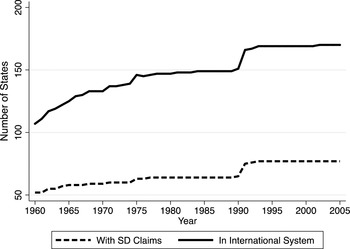
The outcome of the development of an internationally recognized (if not universally applied) right to self-determination is that we have seen the emergence of more states over time, more states facing subnational claims to self-determination, and more groups making claims to self-determination. Figure 1 shows the growth in the number of states in the international system and the number of states facing challenges over self-determination from 1960 to 2005. We describe these data in more detail in the statistical analysis section.Footnote 17
Number of states and states facing SD claims over time

The solid line indicates the number of states in the international system, which has steadily increased, with a jump at the dissolution of the Soviet Union. The dashed line indicates a commensurate increase in the number of states that face internal challenges over self-determination. The overall peak in the number of states facing self-determination claims in a given year is seventy-three states in the late 1990s. Many states face one or two groups, though a number of states consistently face more (such as India, which faced nine separate claims over self-determination at one point).
The proliferation of self-determination disputes over time is clear. However, there are many more groups that could choose to make self-determination claims at any given time than actually do so. For example, the Bretons in France have the historical credentials to make claims to self-determination, but did not do so until the late 1960s.Footnote 18 States with multiples groups that have distinct cultures, languages, and historical ties to land abound, but only some states face claims for greater self-determination.
Most of the literature on secession addresses the spread of self-determination as a question of mobilization, generally focusing on the ability and incentives for groups to violently challenge the state.Footnote 19 However, making claims over self-determination is not just a question of overcoming collective action within a group to seek some goods from the state. It is also a fundamental question about social identification. Brubaker argues that nationalism is a way of thinking and behaving.Footnote 20 Nationalist identity (which forms the basis of self-determination claims) is not just a pre-condition, it is a process and a choice. Individuals are both subject to and a constructive part of the narrative that guides their aggregate behavior that leads to claims for greater self-determination.Footnote 21
Spatial Diffusion of Self-Determination Identity
The onset of claim making over self-determination can be understood as the result of a diffusion process.Footnote 22 The activation of self-determination group identity as a basis for making claims on the state spreads across the globe spatially. Three things are required for a group of individuals to make collective claims related to self-determination.Footnote 23
First, individuals need to identify themselves in relation to a collective group that has a basis for making self-determination claims.Footnote 24 Even with some sense of “ethnic potential,” individuals have a number of identities they subscribe to at any given time. To make demands over self-determination, individuals need to see their ethno-nationalist identity as politically and culturally relevant.Footnote 25
Second, individuals need to perceive some unaddressed grievance or social purpose related to that self-determination identity. This is the motivation for acting on their ethno-nationalist identity, and could entail issues such as discontent over the distance between people and governance structures or respect for traditional language or cultural practice, but it could also align with other grievances such as economic disadvantage.
Third, there must be some expectation of success (whether short or long term). Individuals must see some positive benefit to activating their identity related to self-determination and supporting claims related to it. Success, per se, is difficult to define. The strengthening of affinity for an identity related to self-determination may be seen as a proximate success. Varshey suggests that identity is linked to value rationality in the context of nationalist mobilization.Footnote 26 Collective claims for self-determination can, in themselves, provide benefits for individuals. Success can also be the expectation of other positive externalities, such as concessions from the state or international recognition.
We identify three mechanisms through which making claims related to a self-determination identity can diffuse across space. These mechanisms correspond to the factors addressed here—recognition/activation of identity, perception of purpose or grievance, and perception of success.
Non relational Diffusion and Norms Entrepreneurs
The first mechanism specifies a path for self-determination norm adoption at the local level. The adoption of self-determination as a legitimate local identity can occur through nonrelational diffusion and the actions of norm entrepreneurs. Nonrelational diffusion is essentially learning through watching others and adjusting individual behavior to conform to collective standards.Footnote 27 Individuals watch the experiences of people outside their own state and observe the rise in claim making related to self-determination. The activation or use of identity related to self-determination consequently becomes more appropriate as others engage in it.
Observing self-determination claims in other places also creates a sense of relational comparison within the state, emphasizing the distinction between a group that can make claims to self-determination and a dominant population. For example, groups such as the Irish Republican Army (IRA) and Euskadi Ta Askatasuna (ETA) were known to learn from each other and share both tactics (e.g., discriminate killings) and appeals (e.g., political/economic autonomy and territorial claims).Footnote 28 Early on, links between the IRA and the Basque separatist group were observed, each having similar aims. Subsequently, the IRA provided both a logistical and political example for ETA to emulate in conflict, and eventually, in peace.
This type of emulation concerning both self-determination tactics and appeals occurs not only among rebels in conflict situations but can also be observed among indigenous peoples and minority groups peacefully seeking greater autonomy. We observe indications of diffusion of self-determination claims among indigenous peoples of South America, particularly in Ecuador, Colombia, and Peru.Footnote 29 In 1980, indigenous people of Ecuador began to mobilize, creating the Confederation of Indigenous Nationalities of Ecuador (CONAIE), a powerful grassroots organization that pushed for a bilingual educational system. In neighboring Columbia, the National Indigenous Organization of Colombia (ONIC) was created in 1982, with the goals of greater political representation in addition to educational reforms. ONIC was able to achieve increased representation and concession through a strategy of aligning with established political parties. Ecuadorian indigenous organizations, as well as those of the Afro-Colombian community within their own culture, observed this success. Agrawal and colleagues argue that “regional political transformations—including constitutional reforms in Colombia (1991), Peru (1992), Bolivia (1994), and Venezuela (1999)—paved the way for an opening of Ecuador's political system to Indigenous people.”Footnote 30 ONIC's success in aligning with established political parties and gaining representation later informed their Ecuadorian precursor, CONAIE.Footnote 31
In combination with increased international recognition of minority “rights” and successful secessions, individuals increasingly adopt the belief that their own identification as a member of a group means that they can and should make claims to self-determination.Footnote 32 This diffusion process can be bolstered by norm entrepreneurs—individuals who promote the adoption and use of the self-determination identity.Footnote 33 For example, organizations such as the Cornish Language Fellowship promote the use of the Cornish language in Cornwall in the United Kingdom.Footnote 34 Similarly, the Tatar Public Center attempted to bolster Tatar identification within Crimea.Footnote 35 Thus, observation of other groups and individuals making claims over self-determination influences individuals to be mindful of their own ethno-nationalist identity and predisposes people to respond positively to norms entrepreneurs who seek to rally individuals to collective claim making.
Perceptions of Grievance
An increasing number of actors making claims related to national self-determination can also increase perceptions of grievance for individuals who have not previously had a high affinity for their ethno-nationalist identity. The issue of language is a common concern among self-determination groups. Observing an increasing number of groups that demand greater respect and rights for their traditional languages can induce grievance among others who then question why their own traditional language has been suppressed.
For example, many groups saw increased linguistic rights in Eastern Europe in the 1990s, including the Hungarians in Romania, the Buryat in Russia, and the Albanians in Macedonia. Initially, the Romanian government began to ease language restrictions against Hungarian in 1990 (although this was rescinded for a period in the early 1990s).Footnote 36 Ethnic minority groups in Russia and Macedonia soon echoed this demand. The Buryat pushed for increased language rights in Russia, and won these rights from the Russian minister of education by 1993.Footnote 37 By 1996, several states had signed bilateral treaty agreements supporting the use of Hungarian within their minority populations.Footnote 38 By 2000, Albanians in Macedonia received legal recognition of their language for higher education following state-wide protests.Footnote 39
The expression of grievance related to self-determination claims has the potential to focus other people on those same issues and increase their desire to make similar claims.Footnote 40 Moreover, greater exposure to self-determination claims can also shape how individuals perceive and identify events surrounding them.Footnote 41
Perception of Likelihood of Material Success
In addition to value that comes purely from social identification, observation of success for groups that make claims over self-determination can create instrumental motivation to make self-determination claims. While successful secession is both uncommon and unlikely for any particular group of people, states offer a wide range of accommodations to groups making self-determination demands. These range from inclusion in power at the center of the state (such as the inclusion of the Afar in the transitional government in Ethiopia in 1991) to devolution and creation of new political institutions (such as the creation of the Scottish Parliament in 1997). While few groups that make claims for self-determination secede, the majority of active self-determination groups have gotten some type of concessions from the state they reside in. If other movements for self-determination are getting concessions from states, this may create further incentive for making claims.
States may also respond negatively to groups making self-determination claims by repressing demands. For example, Angola suppressed Cabindan claims for greater self-determination in 2003. However, negative responses will not necessarily suppress claim making. Repression can increase perceptions of grievance related to self-determination in general and can potentially bolster the legitimacy of groups and their claims that existing states are mistreating their people.
The Geographic Dimension
None of these three mechanisms—nonrelational norm diffusion and entrepreneurship, increased perception of grievance, and increased perception of benefits to seeking self-determination—are by nature spatially bounded. For example, the debate over the status of the Quebecois frequently references how the Scottish have fared in the United Kingdom. However, all three mechanisms rely on information to facilitate comparison to others. Actions by people who are geographically closer are more observable than those of distant populations. News coverage and other media are likely to connect individuals and groups that are geographically closer. Moreover, individuals and groups are likely to perceive “others” who are nearby as likely to have more similarity than distant individuals or groups. As such, the effects of observing claims for self-determination should resonate more with people who have a greater perceived similarity.Footnote 42
Predictions
The theoretical discussion leads to two main hypotheses. First, claims for self-determination should influence the onset of claims by other groups nearby.
H1
The onset of self-determination claims in a country will be more likely when an onset of claims has recently occurred in the country's geographic neighborhood.
Second, new claims should be more likely when individuals observe accommodation of self-determination demands.
H2
The onset of self-determination claims in a country will be more likely when accommodation of claims has recently occurred in the country's geographic neighborhood.
Data and Empirical Analyses
We test these two hypotheses using data on all claims made for ethno-nationalist self-determination movements in all states for the period between 1960 and 2005. The unit of analysis is the country-year. The dependent variable is a measure of whether an organization representing an ethno-nationalist group in the country began demanding self-determination in the country in a given year (sd new onset in country). We code the year in which a group makes its first claim for self-determination in the history of the group's tenure as 1, with all other years coded as 0 where subsequent claims are made by the same self-determination group. The emergence of additional organizations making claims on behalf of the group are not considered a new onset, however, a period of no claims can lead the group to have a second onset.Footnote 43 The coding of self-determination movements is based on the Center for International Development and Conflict Management (CIDCM) list of self-determination movements provided in the 2003 Peace and Conflict Report and Cunningham's study of internal politics of self-determination disputes.Footnote 44 The CIDCM report includes all minority groups deemed at risk that demonstrate concern in one of the following areas: “general concern for autonomy, union with kindred groups, political independence, greater regional autonomy, limited autonomy, or other autonomy issues.”Footnote 45 Cunningham improves upon this by providing novel data with a yearly indicator of whether demands were made related to the group's self-determination status by directly examining organizations representing these groups and when they are actively making demands on the state.Footnote 46 We coded self-determination movements as active if groups made demands for increased autonomy, independence, union or reunion with another state, or the creation of a supernational entity (such as a pan-ethnic state that includes group members in other states).Footnote 47 Empirical examples of different types of demands include those for cultural and linguistic autonomy from the Kurdish People's Democracy Party in Turkey, and demands for federalism and independence from the Democratic Crimea Movement and the Republican Movement of Crimea in Ukraine, respectively.
The time-varying measure of whether the group was actively making claims relies on public demands being observed. Cunningham's coding is from the Minorities at Risk project, Uppsala Conflict Data Project, Keesing's Record of World Events, and Lexis Nexis Academic news sources. We then aggregate these data for all groups seeking self-determination to the country level, allowing us to determine whether new claims over self-determination are made in a country in any given year.
Countries that had no self-determination movements listed in the CIDCM report are considered to have no demands for self-determination. Countries can experience multiple onsets in different years. For example, in India, the Bodos began pressing demands for greater self-determination in 1973, while the Tripuras had done so in 1968. Among countries that face self-determination challengers, about 14 percent have experienced multiple onsets since 1960.Footnote 48 There are 6,811 country-years in the data, with 118 onsets of demands for self-determination in 69 of the 175 countries.
To capture the concept of diffusion, the primary independent variable is a measure of the onset of new self-determination demands in the state's neighborhood. We code a new onset when an organization representing an ethno-nationalist group makes a new claim on behalf of the group in a state within the neighborhood. Employing Gleditsch and Ward's database on minimum distances, we code states as “neighbors” if the shortest distance between the two polities, in the particular year, is less than 950 kilometers.Footnote 49
Because the chance of a self-determination movement making claims is likely affected by the presence/absence of other groups making claims in the region, we develop a multilevel spatial autologistic model for this analysis to account for both the dependence between observations, as well as the variance in accommodations between movements that are spatially close to the group and those that are farther away. The advantage of using a random-intercept, multilevel, spatial autologistic model is that it provides a balance between ignoring any variation in claim making between near and distant self-determination movements and overstating differences between geographic regions by offering a partial-pooling compromise.
While ignoring spatial nesting can lead to underestimated standard errors, and overstated statistical significance, no pooling can lead to skeptical or even biased estimates.Footnote 50 Together, the inclusion of a spatial lag and random intercept can account for different forms of spatial dependence that we would ignore if we employed a spatial autologistic model alone. For example, when nearby self-determination movements do not engage in claim making, the coefficient on the spatial lag is 0, and the model reduces to its logit form. By properly adjusting for spatial dependence, we can gain a better understanding of why and when some self-determination movements make claims.Footnote 51
Empirically, we model this by including the spatial lag,
 $r_{i,t-1}^s$
, and by allowing the intercepts for the expression of the self-determination movement's attributes, α, to vary according to their proximity to other self-determination groups, indexed by j.Footnote
52
Because we expect that the likelihood of any particular self-determination group making claims will be conditioned by the presence/absence of claim making from nearby groups in the previous year,
 $r_{i,t-1}^s $
, present attributes of the state (e.g, the country's area, population) X
i,t
, as well as attributes of the international system, N
i,t
(e.g., intergovernmental legislation), the probability of observing the onset of self-determination claims by a group, i, at time t, can be estimated as follows:
 $$Pr\left( {y_{i,t}^s = 1} \right) = \; \displaystyle{{e^{Z_i}} \over {1 + e^{Z_i}}}$$
 $$\matrix{{\rm where}\,Z_i = \gamma r_{i,t-1}^s + \pi _{i,t} + N_{i,t}\varphi} \matrix{{\rm and}\,\pi _{i,t\;} = \; \alpha _{\,j[i,t]} + \; X_{i,t}\beta.}\hfill$$
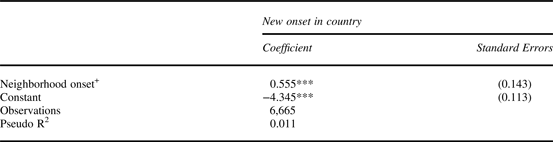
As a means of comparison, we first run a bivariate logistic model (see Table 1 below) predicting the onset of self-determination claims based on the presence of claims in the country's surrounding geographic neighborhood in the previous year. The bivariate logistic model returns a positive and significant coefficient on the onset of a self-determination claim in the country's neighborhood. That is, the onset of claims to national self-determination in a nearby state in a given year increases the likelihood of a new claim in the next year in a country that is in the state's neighborhood.
Spatial determinants of onset of self-determination claims

Notes: *p < .10; **p < .05; ***p < .01, two-tailed tests. +Indicates one-year lag.
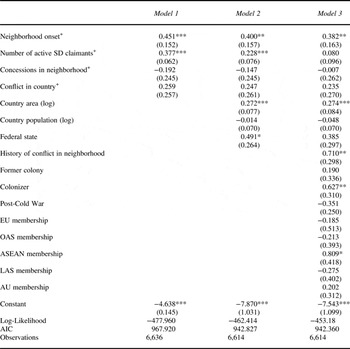
Other factors beyond the existence of claims in the neighborhood should affect the emergence of self-determination claims. Indeed, H2 suggests that the success of self-determination claims should also matter. In Table 2, we include a number of factors at the neighborhood, country, and international levels.Footnote 53 The first set of covariates is used to measure the extent to which self-determination claims in the neighborhood affect the probability of onset at home and includes a one-year lagged measure of whether concessions were made in response to self-determination claims in the neighborhood (which follows the same coding procedure for spatial neighborhoods as the onset variable). The concessions data come from Cunningham and include all concessions made to self-determination groups related to the group's status in the state.Footnote 54 Concessions must be related to the issue of self-determination, which we would expect to affect perceptions of the efficacy of making a claim. Neighborhood concessions occur in approximately 18.25 percent (1,243) of country-year observations.
Multilevel spatial autologistic analysis of determinants of self-determination claims onset

Notes: *p < .10; **p < .05; ***p < .01, two-tailed tests. +Indicates one-year lag.
We also include additional measures on self-determination. Specifically, we include the number of active self-determination movements in the home country (lagged one year) and whether or not there was civil conflict in the country over self-determination (lagged one year). Countries with a history of conflict over the issue of self-determination may have dissuaded such claims, and may have incentives to do so if there are many challengers.Footnote 55 Moreover, a history of conflict over the issue in the neighborhood could dissuade potential self-determination claims. Conflict data are drawn from the Uppsala Conflict Data Project (UCDP)/Peace Research Institute Oslo (PRIO)’s Armed Conflict Data set.Footnote 56
In Model 2, we control for the size of the country, both in terms of land mass and population size, because the extant literature has shown these measures to be positively associated with conflict over self-determination.Footnote 57 Alberto Alesina and Enrico Spolaore argue that larger states may create incentives for self-determination claims because such states may be greater than their optimal size.Footnote 58 The state's land mass is measured in (logged) squared kilometers. Data for country area and population (logged) come from the World Development Indicators.Footnote 59
We also include a binary measure of the country's federalist nature.Footnote 60 States with federal governance structures may invite such claims because they are already organized in a way that favors localized political demands. Several global changes in the international system have been shown historically to affect self-determination claim making. We account for these changes in Model 3. In particular, following the ratification of the United Nations Charter in 1945 and the United Nations Declaration of Human Rights, which states that every person has a right to nationality, new states emerged from colonial powers. We explicitly address colonization, both whether the state was a colonial empire as well as whether an emerging country was a former colony, using data from the ICOW Colonial History data set.Footnote 61
Significant changes in both regional politics and the international system occurred after the Cold War. We account for these changes in Model 3. We include a variable to distinguish the pre- and post-Cold War era. Changes in intergovernmental bodies also arose, affecting legislation surrounding self-determination claim making. We include variables for whether or not the country was a member of the European Union, the African Union, the Organization of American States, the Association of Southeast Asian Nations, and the Latin American States. These bodies indicate institutional change regarding the norms of state creation and represent newly created states in the period of our analyses, 1960 to 2005. Finally, we control for the history of conflict in the region with a binary measure of the neighboring states’ conflict history (interstate and civil) from the UCDP/PRIO Armed Conflict Data.
The results reported in Table 2 not only demonstrate that the initial diffusion findings are robust to the inclusion of other factors but are statistically significant while adjusting for the spatial clustering of self-determination claim making as well. The onset of self-determination claims in the neighborhood remains a statistically significant predictor of claims onset in a country (in support of Hypothesis 1). We do not find strong support for H2—that observing success in other countries will increase the chance of onset. This may suggest that material or instrumental logic does not primarily drive the onset of new claims over self-determination, or that individuals view the chance of getting concessions as being more intimately tied to the behavior of their home state so concessions made by others states would have little impact on their decision to make a claim.
We find that geographically larger countries have a greater chance of onset of self-determination claims. We also find that a higher number of ongoing self-determination claimants increases the chance of new ones within a state. This potentially provides further support for the diffusion hypothesis. More actors making self-determination claims both in the country and in the geographic neighborhood make new claims over self-determination more likely. A history of conflict over self-determination in the neighborhood is associated with new onsets, suggesting some support for the grievance mechanism wherein observing conflict against other similar groups promotes activation of self-determination claims.
The baseline probability of a new onset of self-determination in any given country year is low, about 0.01. To evaluate further the substantive effect of the statistically significant factors in Table 2, we calculated the predicted probability of the onset of self-determination claims using the margins program and holding all other variables to their observed values.Footnote 62 For binary variables, mean effect sizes are predicted as a change from 0 to 1, and for continuous variables, from the first to third quartiles.
The effect of a movement in the number of onsets in the neighborhood in the previous year from no neighboring claims, 0, to even one onset in the neighborhood, leads to over a 47 percent increase in the probability that the country experiences a new claim in the year. The probability of a new onset increases exponentially with more neighboring claims: a change from no neighboring claims in the last year to the median number of neighboring claims, four, increases the probability that a given country makes a new claim in that year by more than 350 percent.Footnote 63 The positive effect of a country's size (natural log of the geographic area measured in kilometers squared) is quite large. Moving from the first quartile (a country about the size of Costa Rica) to the third quartile (about the size of Afghanistan) about doubles the probability of an onset in a year. Moving from no active self-determination groups in the country to one active claim-making group in the country leads to about a 25 percent increase in the chance of a new onset of self-determination claims in a country in a year.Footnote 64 These results demonstrate that in addition to structural and domestic factors, the onset of claims over self-determination in the neighborhood greatly increase the chance of a country facing the emergence of claims in their own territory.
Further Analysis
The length of time a state exists may also affect the probability of onset of self-determination claims, though potentially in either direction. New states may face early challengers, while older states have the potential to foster grievances over time that can lead to such claims. We adjust for issues of time dependence (i.e., that the number of years a state exists in the international system likely affects both the presence and number of claims) in two ways. First, we include three terms: t (the length of time the state exists in the international system measured in years), t2, and t3; second, a model with a simple control for state age.Footnote 65 The results remain similar to those presented here (Appendix Table 6 and Appendix Table 7).
The emergence of new states during the period of our analyses here likely affects the propensity for future self-determination claims, so we duplicated our analyses controlling for the number of states in the international system (Appendix Table 2). The effect of neighboring claims on the probability of new claim making within a state remains the same. We also include a measure of nonfederal states with autonomous ethnic regions (Appendix Table 8),Footnote 66 and control for democratization and political instability (Appendix Table 9).
Properly adjusting for spatial dependence improves our understanding of why and when some SD movements make claims. This analysis reflects the diffusions of self-determination as a norm of social identification via spatial diffusion. But norm diffusion could be transmitted through a number of different pathways. Since network misspecification can result in biased spatial autocorrelation estimates, we follow Yuri Zhukov and Brandon Stewart's approach to adjudicate between multiple sets of potential networks.Footnote 67 We examine three alternative networks linking states—domestic political links, ethnic links, and similar levels of domestic repression.Footnote 68 We do not find any evidence of signal transmission along other paths beyond spatial diffusion.
Finally, in part to assess the value added of accounting for spatial proximity in our model, we compare the ROC curve from our multilevel spatial autologistic model from Model 2 of Table 2 (with the statistically significant predictors of contagion: neighborhood self-determination claim onset, the number of active self-determination groups, and the country size) to the ROC curve from a standard logit model without these predictors of spatial dependence. We then computed the area under the curve (AUC) to compare the predictive accuracy with and without our measures of spatial contagion. In comparing the figures, we find that adding the measures of spatial dependence increases the predictive accuracy of our modeling from 0.6929 (Appendix Figure 1) to 0.7311 (Appendix Figure 2).Footnote 69
Conclusion
A number of studies have demonstrated spatial diffusion of a variety of events, including democratization,Footnote 70 liberalization,Footnote 71 and civil war.Footnote 72 We apply the basic concept of spatial diffusion to self-determination politics by treating social identification and subsequent claim making related to self-determination as a process. Existing work that emphasizes links across borders has focused on state actions or on violent secession and rebellion.Footnote 73 Yet previous studies on conflict contagion have been somewhat limited by an absence of data on potential challengers. Here, we argue that the basic underpinning of the most common source of conflict—self-determination—is also contagious.
Using data on self-determination movements and a sophisticated empirical approach, our analysis shows that the onset of claims over self-determination in a state's neighborhood in the previous year increases the chance of claims beginning in a country in any given year. Self-determination appears to be contagious. As such, the challenges of self-determination can be seen, in part, as a regional phenomenon.
One avenue for extension is to look at the types of demands that emerge. We have examined claims over self-determination but not distinguished between different types of claims. It is also possible that the types of demands are spatially clustered. Further exploration could include distinctions such as autonomy versus independence, cultural versus political demands, or the degree to which claims are multifaceted. Further analysis could also address more regional dynamics, perhaps examining whether different types of interventions occur in disputes over self-determination and which actors are inserting themselves in such disputes.
Finally, if self-determination is contagious in the contemporary international system, are there ways for states to avoid such claims, as Alex Braithwaite suggests they can for civil war contagion?Footnote 74 Should that be a policy that is promoted (even tacitly)? Claims for self-determination can generate high costs for states, but they can also lead to better governance and higher quality of life for minorities. Based on our analysis, the success of claims in the neighborhood does not appear to influence the chance of an onset of self-determination claims. Just the existence of claims is enough to engender the spread of self-determination.
Supplementary Material
Supplementary material for this research note is available at <https://doi.org/10.1017/S0020818317000200>.