Introduction
Echinostephilla patellae, exploiting the common limpet Patella vulgata as a first intermediate host, is an abundant but scarcely investigated trematode on rocky shores of the British Isles. Larval stages of an echinostome philophthalmid digenean occurring in the digestive gland of P. vulgata were first recorded and described by Lebour (Reference Lebour1907) at Loch Ryan in Scotland and later named by the same author as Cercaria patellae (Lebour, Reference Lebour1911). Although Nicoll (cited by Lebour, Reference Lebour1911) suggested that it is probably the cercaria of Echinostephilla virgula from the turnstone Arenaria interpres, the life cycle of C. patellae remained unknown for a long time. Measurements and detailed descriptions of both rediae and cercariae were given by Rees (Reference Rees1934). Furthermore, she observed pathological effects on the host caused by the parasite and specified histological and cytological changes in the digestive gland and gonads of infected limpets. Crewe (Reference Crewe1951) discussed the behaviour of the cercaria and described the impact on the host as a result of invasion by the parasite, but did not find the second intermediate host. Subsequent studies provided information on the ecology of the infection in P. vulgata and Patella spp. from various localities in Great Britain and Northern Ireland, respectively (Thomas, Reference Thomas1965; James, Reference James1968b; Copeland et al., Reference Copeland, Montgomery and Hanna1987). Although abundant, neither the definitive nor the secondary host of this parasite had been identified at this stage. Kollien (Reference Kollien1996) gave the first account of the life history of C. patellae and suggested P. vulgata as a second intermediate host. With regard to the adult fluke, she also stated that this species should be referred to as E. patellae (Lebour, Reference Lebour1911) n. comb. belonging to the family Philophthalmidae. No other alternative second intermediate hosts have been specified until now.
Recent findings have indicated that the blue mussel Mytilus edulis may serve as a second intermediate host for E. patellae (Prinz, pers. obs.). In the laboratory, M. edulis kept together with parasitized P. vulgata in the same tank thereafter proved to be heavily infected with E. patellae metacercariae. Moreover, mussels collected from sites where limpets are parasitized by this trematode harboured metacercarial stages, which have not been described in the literature so far and were very similar to those observed in the laboratory. Following these observations, experimental infections under controlled laboratory conditions were conducted to further investigate this unknown host–parasite system. Mytilus edulis were exposed to different concentrations of E. patellae cercariae, to test whether infection efficiency is affected by exposure levels. Since temperature is a key factor controlling cercarial transmission from first to second intermediate hosts (Pietrock & Marcogliese, Reference Pietrock and Marcogliese2003; Poulin, Reference Poulin2006), metacercarial infection success was determined at four different temperature regimes. Measurements of metacercariae were taken from experimental as well as natural infections.
Materials and methods
Parasite and host material
Common limpets P. vulgata parasitized by E. patellae were identified in the field by visual examination of the snails' mantle blood vessels, in which cercariae accumulate before release from their host. In the laboratory, infected specimens were kept in aerated seawater with light and temperature applied according to natural conditions. Prior to the experiments, isolated limpets were maintained dry in darkness for 1 h before being immersed in seawater under bright light, to induce cercarial shedding. For each infection trial, cercariae produced by 6–8 limpets were pooled and used in the experiments at a maximum age of 2 h to ensure infectivity. For infection experiments, M. edulis were obtained from a non-parasitized mussel population from Blackrock, Ireland (53°17′N, 6°09′W), which was previously examined by screening 100 individuals and found to be free of trematode infections. Naturally infected mussels for comparative measurements of E. patellae metacercariae were collected from Ballyandreen Bay, Ireland (51°49′N, 8°02′W).
Infection experiments
Uninfected M. edulis (39–42 mm shell length) were individually placed in 300 ml plastic dishes filled with aerated seawater at 12°C under constant light. A total of 10, 100 and 1000 E. patellae cercariae, respectively, were added per dish. Each of the three treatments was replicated ten times. After 24 h, mussels were removed from the dishes and transferred into fresh, aerated seawater for another 48 h to allow encystment of metacercariae to take place. Mussel tissues were subsequently removed from the shell and squashed between pressure glasses. Squash preparations were screened through a stereomicroscope with transmitted illumination. Numbers and position of metacercariae within the host tissue were recorded. To test whether temperature has an effect on infection success, ten M. edulis (39–42 mm shell length) were individually exposed to 100 E. patellae cercariae at 10, 15, 20 and 25°C, respectively, in 300 ml of seawater for 24 h. Constant aeration and artificial daylight were applied throughout the experiment. After another 48 h, the complete mussel tissues were analysed for metacercarial infection using pressure glasses under a stereomicroscope with transmitted light.
Morphological data
Measurements were based on metacercariae from laboratory infections 24 h, 48 h and 12 days post-infection as well as on cysts recovered from naturally infected mussels (age of infection unknown). To obtain metacercariae of different ages, isolated individuals of M. edulis were exposed to a high number of E. patellae cercariae (approximately 500) for 1 h. After being transferred into aquaria, mussels were maintained in aerated seawater for 24 h, 48 h and 12 days, respectively, before dissection. All metacercariae (N = 120 for 24- and 48-h-old experimental infections, respectively; N = 265 for 12-day-old experimental and natural infections, respectively) were recovered from the foot tissue of infected mussels (cysts obtained from six M. edulis, respectively), transferred to a depression slide to avoid distortion of cyst dimensions by cover slip pressure and measured under a light microscope.
Statistical analysis
Data analyses were performed using analysis of variance (one-way ANOVA) in combination with post-hoc comparisons (Tukey's honestly significant difference (HSD) test). Prior to the parametric tests, assumptions of homogeneity of variance and normally distributed data were assured (data were not transformed). Statistical analyses were executed using the statistical package SPSS for Windows (SPSS Inc., Chicago, Illinois, USA). Results were considered as significant at P < 0.05.
Results
Experimental exposure of M. edulis to cercariae of E. patellae resulted in metacercarial infections in the mussels.
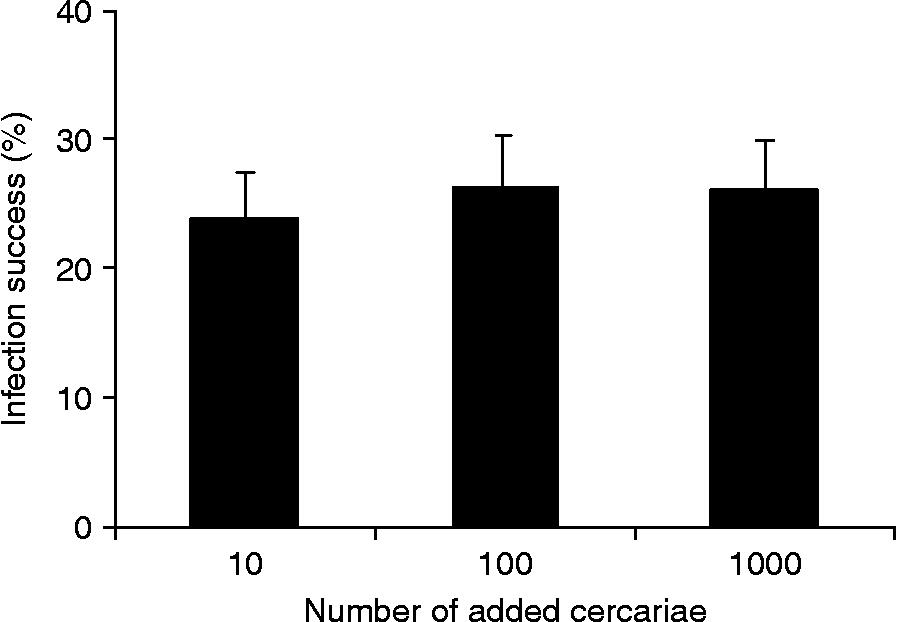
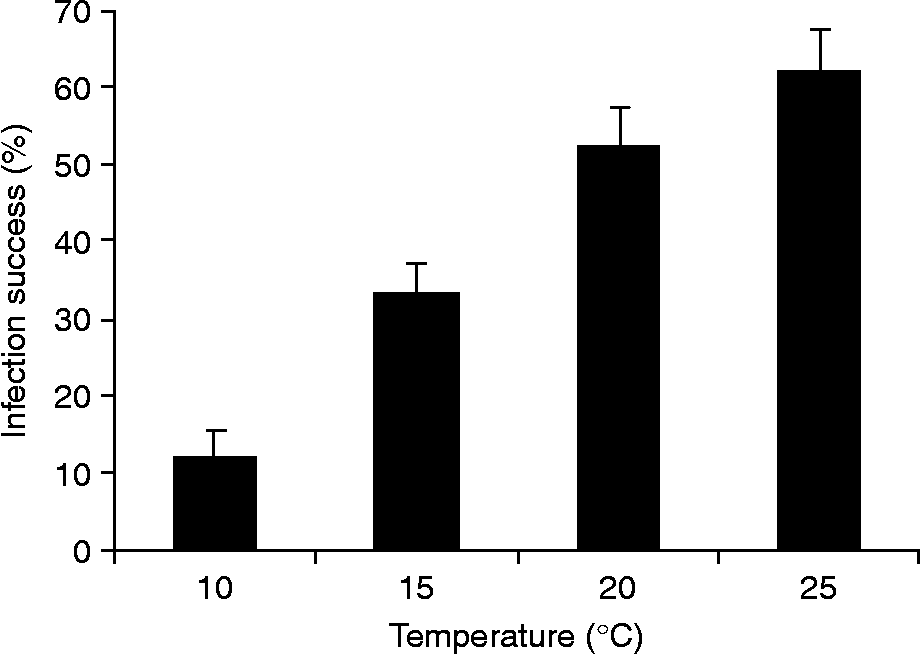
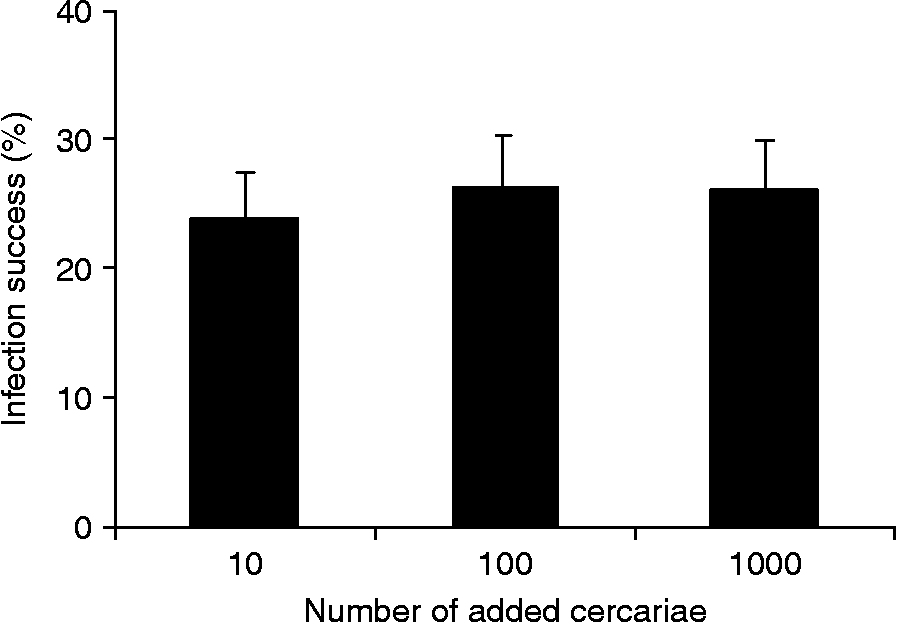
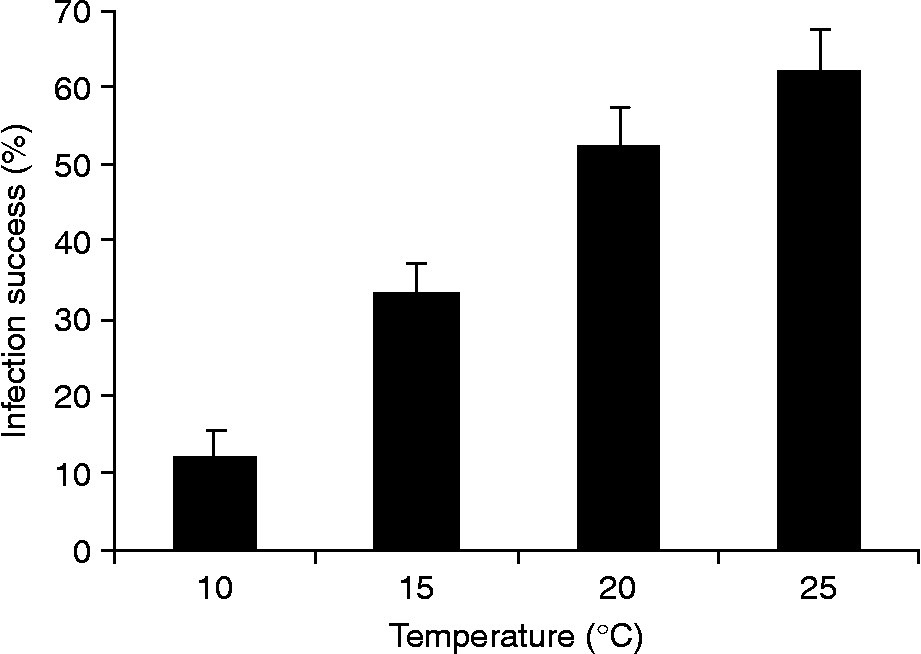
The number of added cercariae had no effect on infection rates (one-way ANOVA, F 2,26 = 0.18, P = 0.83; fig. 1). Infection success was significantly different between temperature regimes (one-way ANOVA, F 3,36 = 23.86, P < 0.001; fig. 2) and increased with increasing temperature. A significant difference in infection success was observed between 10°C and all other temperatures (Tukey's HSD test, P = 0.01 for 15°C and P < 0.001 for 20 and 25°C) as well as between 15 and 20°C (P = 0.028) and 25°C (P < 0.001), respectively.
Mean infection success (%)+SE of Echinostephilla patellae in Mytilus edulis (N = 10) at three different cercarial concentrations.
Mean infection success (%)+SE of Echinostephilla patellae in Mytilus edulis (N = 10; 100 cercariae per mussel) at four different temperature regimes.
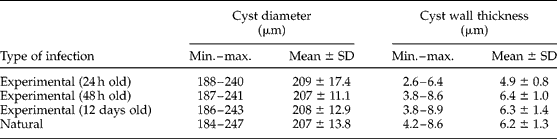
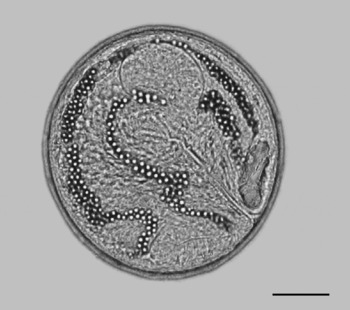
Metacercariae from experimental infections showed a high specificity and encysted exclusively in the mussel foot. They were almost spherical, equipped with a thin-walled, completely transparent cyst wall, which was slightly thinner in 24-h-old cysts than in older infections. Morphological measurements are given in table 1. The parasite could be observed moving inside the cyst and the oral and ventral suckers were clearly visible through the cyst wall. A most conspicuous feature was the large lateral excretory canals running along the whole length of the body filled with refractive excretory granules (fig. 3). In some specimens, the excretory vesicle receiving the two unbranched lateral canals was also discernible. The metacercaria coiled inside the cyst greatly resembled the cercaria (for description, see Rees, Reference Rees1934; Kollien, Reference Kollien1996) in all visible morphological characteristics, except that it did not possess a tail, which is shed during the process of penetration. Metacercarial stages recovered from naturally infected M. edulis were similar in size and morphological features, with infections also being restricted to the foot of parasitized mussels.
Measurements (in μm, given as range and mean±SD) of Echinostephilla patellae metacercariae from experimental infections at different ages compared to cysts from natural infections.
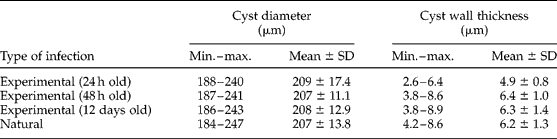
Min., minimum; max., maximum.
N = 120 for 24- and 48-h-old experimental infections; N = 265 for 12-day-old experimental and natural infections; cysts obtained from six Mytilus edulis, respectively.
Echinostephilla patellae metacercaria recovered from an artificially infected Mytilus edulis, showing conspicuous lateral excretory canals filled with refractive excretory granules (scale bar: 50 μm).

Discussion
Mussels were successfully infected with cercariae of E. patellae under laboratory conditions. The parasite exhibited a strong specificity in relation to the microhabitat within M. edulis, with metacercariae being restricted to the foot tissue. The existence of a preferential site for encystment is characteristic for many digeneans utilizing bivalves as secondary hosts. The muscular foot of M. edulis can easily accommodate greater numbers of the relatively large cyst of E. patellae. Cercariae of comparably sized trematode species, e.g. Himasthla elongata, are also found to settle preferably in the foot tissue of mussels (Lauckner, Reference Lauckner and Kinne1983). The microhabitat in combination with the size of the cyst and the conspicuous lateral excretory canals filled with excretory granules are distinguishable characteristics and main identification features of the encysted metacercaria of E. patellae. The noted variation in cyst diameter is a regular feature and has been found in many other marine digeneans (Lauckner, Reference Lauckner and Kinne1983). The observed infection rates in the experiments are comparable to values reported from artificial infections in established bivalve–trematode associations (de Montaudouin et al., Reference de Montaudouin, Wegeberg, Jensen and Sauriau1998, Reference de Montaudouin, Jensen, Desclaux, Wegeberg and Sajus2005; Thieltges & Rick, Reference Thieltges and Rick2006; Thieltges et al., Reference Thieltges, Reise, Prinz and Jensen2009), showing that M. edulis is a suitable secondary host for this parasite. The increase in infection efficiency with increasing temperature can be attributed to enhanced cercarial and host activity at higher temperatures and has also been reported from other host–parasite systems (Evans, Reference Evans1985; Lyholt & Buchmann, Reference Lyholt and Buchmann1996; Mouritsen & Jensen, Reference Mouritsen and Jensen1997; McCarthy, Reference McCarthy1999; Thieltges & Rick, Reference Thieltges and Rick2006). Considering the high susceptibility of M. edulis to infection by E. patellae in the laboratory and similarities of encysted metacercariae from experimental and natural infections in relation to size, morphological features and microhabitat, infection of mussels can be assumed to occur naturally. Both intermediate hosts are widespread, abundant and sympatric in rocky shore habitats, facilitating transmission from gastropod to bivalve host. Moreover, prevalences of E. patellae in common limpets have been reported to be frequently high, and further Patella species are known to serve as alternative first intermediate host for this trematode (Crewe, Reference Crewe1951; James, Reference James1968b). Recent findings of a parasitological survey of mussels on the south coast of Ireland suggest that E. patellae is widespread, with a mean prevalence of approximately 30%, reaching up to 100% at some sites (Prinz et al., submitted).
The only investigation about the life history of E. patellae as yet was provided by Kollien (Reference Kollien1996), suggesting the common limpet P. vulgata as a secondary host. However, that study failed to produce positive experimental evidence, since infection rates in limpets artificially exposed to high numbers of E. patellae cercariae were extremely low (mean 0.001%). Compared to the results that Kollien (Reference Kollien1996) obtained for limpets, mussels were highly susceptible to infection with E. patellae, irrespective of the number of added cercariae and at all temperature regimes, indicating that P. vulgata might not be an adequate second intermediate host for this trematode. This assumption is corroborated by morphological data of E. patellae cysts obtained from artificially infected M. edulis, which are not concordant with measurements of metacercariae from experimentally and naturally infected P. vulgata (Kollien, Reference Kollien1996). In the present study, no differences in shape and size (diameter of outer cyst wall) were found between 24-h-old, 48-h-old and 12-day-old metacercariae. In contrast, Kollien (Reference Kollien1996) noted that young (24- to 36-h-old) metacercariae from experimental infections were considerably larger than 5-day-old cysts and cysts from natural infections. Furthermore, they possessed a distinct oval shape instead of being spherical as older, fully developed cysts. Without closer examination, Kollien (Reference Kollien1996) assigned all metacercarial infections found in P. vulgata to E. patellae. The noticeable differences in young and fully developed cysts were interpreted as cyst development within several days of parasite invasion, involving a considerable alteration of cyst shape and a substantial reduction in size. Instead, the existence of two distinct types of cysts in P. vulgata can most likely be attributed to the presence of two entirely different metacercariae, of which the larger, oval one (‘young cyst’) can be referred to E. patellae acquired in the laboratory infection trials conducted by Kollien (Reference Kollien1996), whereas the smaller one (‘older, fully developed cyst’) probably belonged to another trematode species already harboured by the limpets prior to the experiments. The occurrence of very few comparatively large, conspicuously shaped metacercariae suggests that during the artificial exposures, some cercariae succeeded in penetrating the limpets or were accidentally caught in the gills, where they attempted to encyst. The distinct oval shape, in comparison with the round E. patellae cysts found in M. edulis, indicates that the transformation process from cercaria to metacercaria could not be completed, presumably due to P. vulgata constituting a poorly suited habitat for encystment. Since the encystment phase usually has to be completed in a couple of hours to be successful, as known from related trematode species (Gorbushin & Levakin, Reference Gorbushin and Levakin2005), incompletely encysted metacercariae were possibly attacked and degraded by components of the host's defensive system. This assumption is strengthened by the fact that Kollien (Reference Kollien1996) did not observe any metacercariae of similar size and shape 5 days post-infection, but only smaller, spherical cysts. The second type of cyst detected by Kollien (Reference Kollien1996) in experimentally, as well as naturally, infected P. vulgata was considerably smaller and equipped with a noticeable thick cyst wall. She pointed out that her measurements are consistent with data on metacercarial infections in limpets given by Crewe (Reference Crewe1951). However, this author did not describe the metacercaria of E. patellae, but the cyst of ‘Cercaria B’, an unidentified distome xiphidiocercaria, developing in the digestive gland and kidney of limpets and utilizing P. vulgata also as a second intermediate host. The life cycle of this trematode is yet unknown. The appearance of the sporocyst infection as well as morphological features of the cercariae and encysted metacercariae resembles infections with the digenean trematode Renicola roscovita of the family Renicolidae (see Lauckner, Reference Lauckner and Kinne1980; pers. obs.; for detailed description, see Werding, Reference Werding1969). It can be concluded that the second type of cyst found by Kollien (Reference Kollien1996) occurs naturally in limpets and can be ascribed to Cercaria B, but was misinterpreted by her as metacercaria of E. patellae.
Based on present knowledge, M. edulis can be regarded as the only experimentally proved second intermediate host for E. patellae at this stage, and measurements of the encysted metacercariae are reported in this study for the first time. Marine bivalves in general, and mussels in particular, are known to act as second intermediate hosts for a great number of digenetic trematodes and are definitely more important than gastropods in this respect (Lauckner, Reference Lauckner and Kinne1983). Since trematodes generally exhibit low host specificity in the second intermediate host, alternative secondary hosts possibly exist. To finally clarify the complete life cycle, parasitological examinations and experimental infections of final hosts or in vitro cultivation using metacercariae from artificially infected blue mussels are necessary. Remarkably, Kollien (Reference Kollien1996) obtained few philophthalmid flukes when feeding chicks with pieces of gill filaments containing hundreds of cysts from naturally infected P. vulgata. This seems surprising, since the cysts were presumably Cercaria B. However, the development of adult philophthalmid stages can be ascribed to sporadic metacercarial infections with E. patellae acquired by the limpets through being infected with redial stages of E. patellae, or by being kept in the same tank with infected limpets. Several cercariae probably got caught in the gills or attempted to penetrate P. vulgata intended for infection of chicks. This is confirmed by very low infection rates with adult philophthalmid flukes in the chicks despite being exposed to a high number of metacercariae. Since Cercaria B is most certainly a kidney parasite of marine birds (Lauckner, Reference Lauckner and Kinne1980) and Kollien (Reference Kollien1996) dissected adult worms from the intestine of experimentally infected chicks, she probably missed the adult flukes potentially having developed from the majority of the metacercariae in the kidneys of the chicks.
Although mussels are very common, E. patellae has not been reported from M. edulis in the literature so far. This can be attributed to the fact that investigations on trematodes in molluscs of European rocky shore ecosystems have focused on gastropod hosts (e.g. Crewe, Reference Crewe1951; James, Reference James1968a, Reference Jamesb; Matthews et al., Reference Matthews, Montgomery and Hanna1985; Galaktionov & Bustness, Reference Galaktionov and Bustness1995) or dealt with blue mussels as first intermediate hosts (e.g. Cole, Reference Cole1935; Matthews, Reference Matthews1973). Studies on M. edulis serving as second intermediate host for trematodes primarily covered soft sediment habitats (e.g. de Montaudouin et al., Reference de Montaudouin, Kisielewski, Bachelet and Desclaux2000; Thieltges et al., Reference Thieltges, Krakau, Andresen, Fottner and Reise2006), where limpets generally do not occur. The newly described host–parasite relationship raises further question regarding the transmission ecology of the larvae, possible effects on the host due to invasion by the trematode and the relative importance of the parasite within the ecosystem. It constitutes an interesting model system for the study of trematodes in rocky shore habitats, due to the relatively easy availability of infected gastropod hosts, the manageable large cercariae, as well as the high susceptibility of the mussel second intermediate host. The significance of M. edulis being a secondary host for E. patellae is of particular interest with regard to the abundance of the parasite and host organisms in intertidal rocky shore ecosystems, since trematode parasites may influence host organisms to a large extent and function as an important population and community structuring factor. Furthermore, M. edulis is a commercially important bivalve species and should therefore be addressed in subsequent parasitological studies.
Acknowledgements
K.P. received funding from the Irish Research Council for Science, Engineering and Technology (IRCSET) under the National Development Plan.