1. Introduction
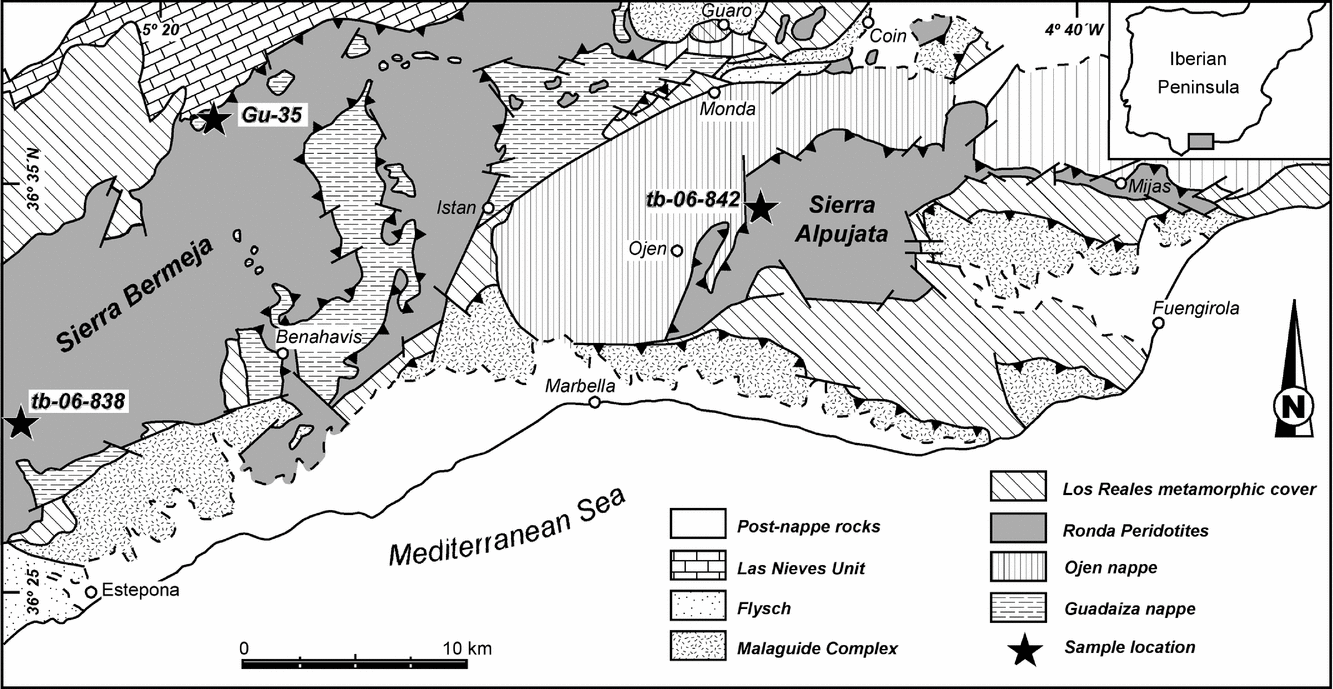
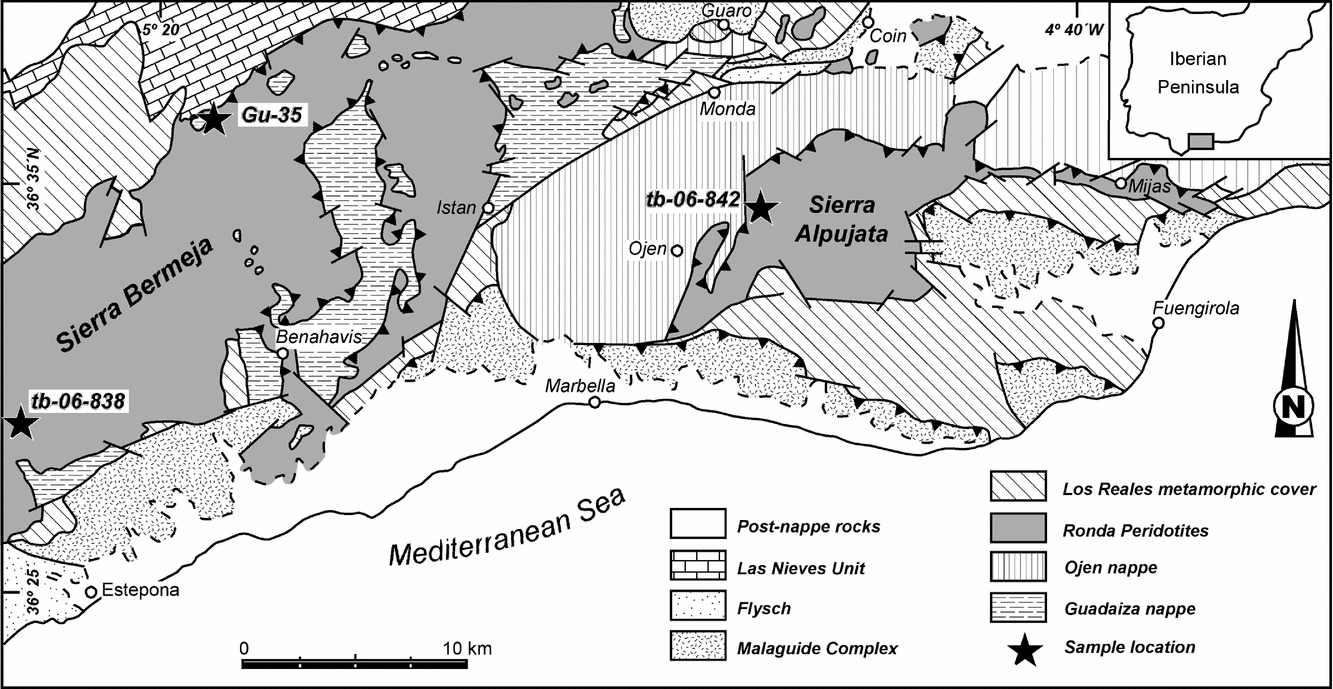
The Ronda peridotites, the largest exposures of subcontinental lithospheric mantle of the world, are incorporated into the Internal Zone of the Betic Cordilleras, southern Spain (Fig. 1). The peridotites rest over a continental crustal sequence composed mainly of gneisses, quartzites, metapelites, marbles and minor amphibolites belonging to the Guadaiza and Ojen nappes (Navarro-Vilá & Tubía, Reference Navarro-Vilá and Tubía1983). As result of the hot emplacement of the Ronda peridotites, the underlying crustal rocks developed a dynamothermal aureole and experienced partial melting, leading to the intrusion of granite dykes in the peridotites (Tubía & Cuevas, Reference Tubía and Cuevas1986).
Tectonic map of the western Internal Zone of the Betic Cordilleras (modified from Navarro-Vilá & Tubía, Reference Navarro-Vilá and Tubía1983) with the location of analysed samples.
The structural evolution of the Ojen (Tubía, Cuevas & Gil Ibarguchi, Reference Tubía, Cuevas and Ibarguchi1997) and Guadaiza (Esteban et al. Reference Esteban, Cuevas, Vegas and Tubía2008) dynamothermal aureoles as well as the emplacement of the granite dykes (Cuevas, Esteban & Tubía, Reference Cuevas, Esteban and Tubía2006) have been studied in detail, but the ages of the aureole formation and dyke intrusion are as yet poorly constrained. U–Pb SHRIMP dating of zircons from the dynamothermal aureoles of Guadaiza and Ojen nappes provided a discordant 206Pb–238U age of 22.5±1.2 (2σ) and a concordia lower intercept age of 20.8±1.2 (2σ) Ma, respectively, that were interpreted as the maximum age for zircon recrystallization during a migmatization event that led in some cases to zircon Pb-loss (Sánchez-Rodríguez, Reference Sánchez-Rodríguez1998). Previous results from undeformed dykes reflect mainly cooling ages and provide diverse age values: 22±4 (2σ) Ma from Rb–Sr whole rock analyses (Priem et al. Reference Priem, Boelrijk, Hebeda, Oen, Verdurmen and Verschure1979) and 18.8±8 (2σ) Ma (Monié, Torres-Roldán & García-Casco, Reference Monié, Torres-Roldán and García-Casco1994) or 18.9±0.8 (2σ) (Sosson et al. Reference Sosson, Morillon, Bourgois, Féraud, Poupeau and Saint-Marc1998) from 40Ar–39Ar on biotite. According to Sánchez-Rodríguez & Gebauer (Reference Sánchez-Rodríguez and Gebauer2000), the lower intercept age of 18.8±6 (2σ) Ma obtained by U–Pb SHRIMP analyses of zircons from an undeformed dyke represents the time of recrystallization of the granite dykes.
In addition to the large errors of most of the previous results, it is worth noting an apparent low resolution implicit in the fact that the SHRIMP crystallization age was younger than the Rb–Sr and Ar–Ar cooling ages or even than some fission-track ages (Esteban et al. Reference Esteban, Sánchez-Rodríguez, Seward, Cuevas and Tubía2004). With the aim to constrain better the emplacement age of the Ronda peridotites, we present new U–Pb SHRIMP ages on zircons from three samples (Fig. 1): a mylonitic gneiss from the dynamothermal aureole of the Guadaiza nappe (Gu-35) and two granite dykes, tb-06–838 and tb-06–842, that intrude in the peridotites of Sierra Bermeja and Sierra Alpujata massifs, respectively (Fig. 1).
2. Description of samples
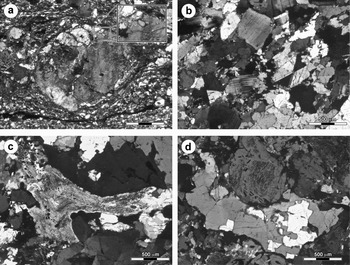
Gu-35 is a representative sample of the deformed migmatite layer that has been interpreted as a component of the dynamothermal aureole developed below the Ronda peridotites (M. T. Lundeen, unpub. Ph.D. thesis, Univ. Harvard, 1976; Lundeen, Reference Lundeen1978; Tubía, Reference Tubía1988; Tubía, Cuevas & Gil Ibarguchi, Reference Tubía, Cuevas and Ibarguchi1997; Esteban et al. Reference Esteban, Cuevas, Vegas and Tubía2008). This lithology is a fine-grained mylonite with the mineral assemblage of quartz + K-feldspar + plagioclase + biotite + tourmaline + sillimanite. K-feldspar porphyroclasts with zircon inclusions are common (Fig. 2a). The calculated migmatization pressure–temperature conditions are approximately 725°C and 600 MPa (Esteban et al. Reference Esteban, Cuevas, Vegas and Tubía2008). The aureole grades progressively downwards to schists and quartzites of lower-grade metamorphic conditions.
Photomicrographs of analysed samples. (a) K-feldspar porphyroclast surrounded by the mylonitic foliation in sample Gu-35. The insert shows a zircon grain included in the porphyroclast. (b) Porphyritic texture with euhedral cordierite and mechanical twins in a plagioclase crystal (sample tb-06–838). (c) Anhedral poikilitic cordierite with abundant inclusions of sillimanite needles and (d) high temperature, chessboard microstructure in a grain of quartz (sample tb-06–842).

Granite dykes were crystallized from felsic magmas derived by partial melting of the continental crust related to the formation of this dynamothermal aureole. They emanate from the aureole and intrude within the overlying peridotites (Cuevas, Esteban & Tubía, Reference Cuevas, Esteban and Tubía2006). Moreover, their 87Sr/86Sr signature (Priem et al. Reference Priem, Boelrijk, Hebeda, Oen, Verdurmen and Verschure1979) also confirms their crustal affinity. Tb-06-838 is a slightly deformed porphyritic dyke containing euhedral to subhedral crystals of plagioclase, cordierite and K-feldspar immersed in a euhedral and fine-grained cordierite–plagioclase–quartz matrix. Cordierite is slightly pinnitized and shows hourglass twinning and epitactic microstructure with inclusions of prismatic sillimanite. Mechanical twins in plagioclase crystals are frequent (Fig. 2b). Tb-06-842 is a mylonitic dyke composed mainly of quartz, feldspar, garnet and boudinaged crystals of cordierite. Cordierite appears as lobulated and intergranular xenomorphic grains (Fig. 2c), rich in inclusions of biotite, garnet, hercynite, ilmenite and prismatic sillimanite (Fig. 2c). Two generations of garnet can be differentiated petrographically: (1) coarse-grained poikilitic crystals, with anhedral shapes and optically zoned and (2) small, subhedral and inclusion-free crystals included within feldspar and cordierite. Chessboard patterns and basal sub-grain boundaries are frequent in the quartz grains (Fig. 2d), pointing to high-temperature conditions during mylonitization.
The dark colour of these dykes in the field, together with their degree of deformation, serves to distinguish them from the white, undeformed granite dykes previously dated (Cuevas, Esteban & Tubía, Reference Cuevas, Esteban and Tubía2006).
3. U–Pb SIMS SHRIMP dating
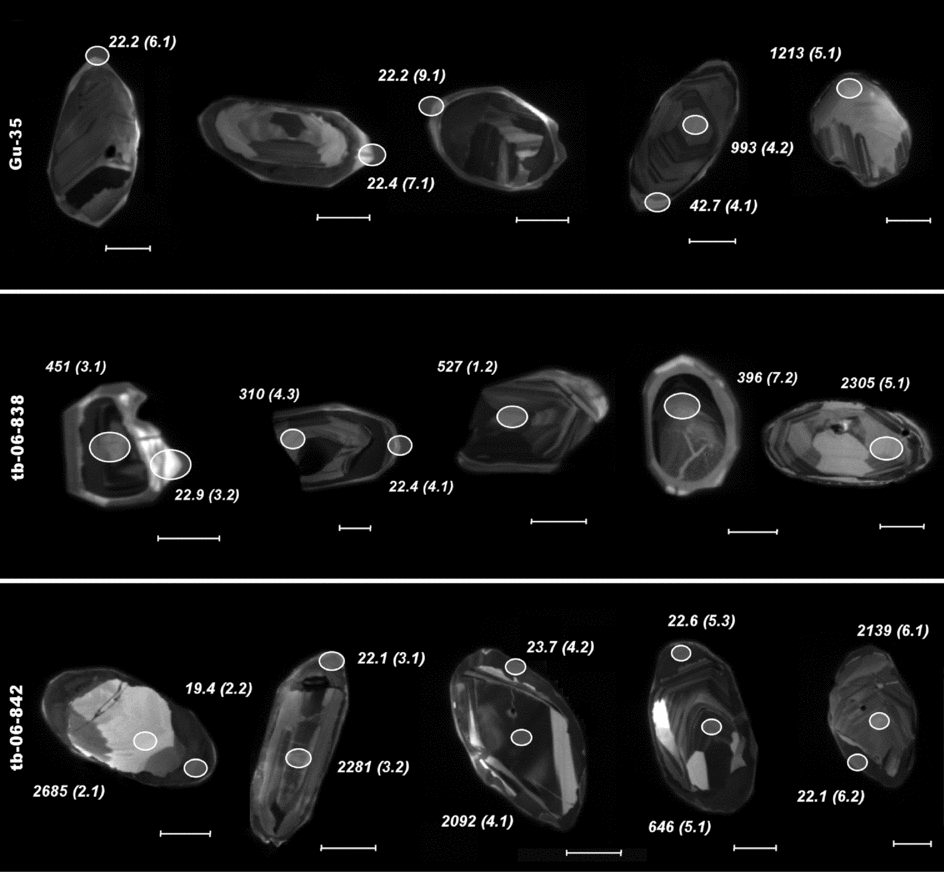
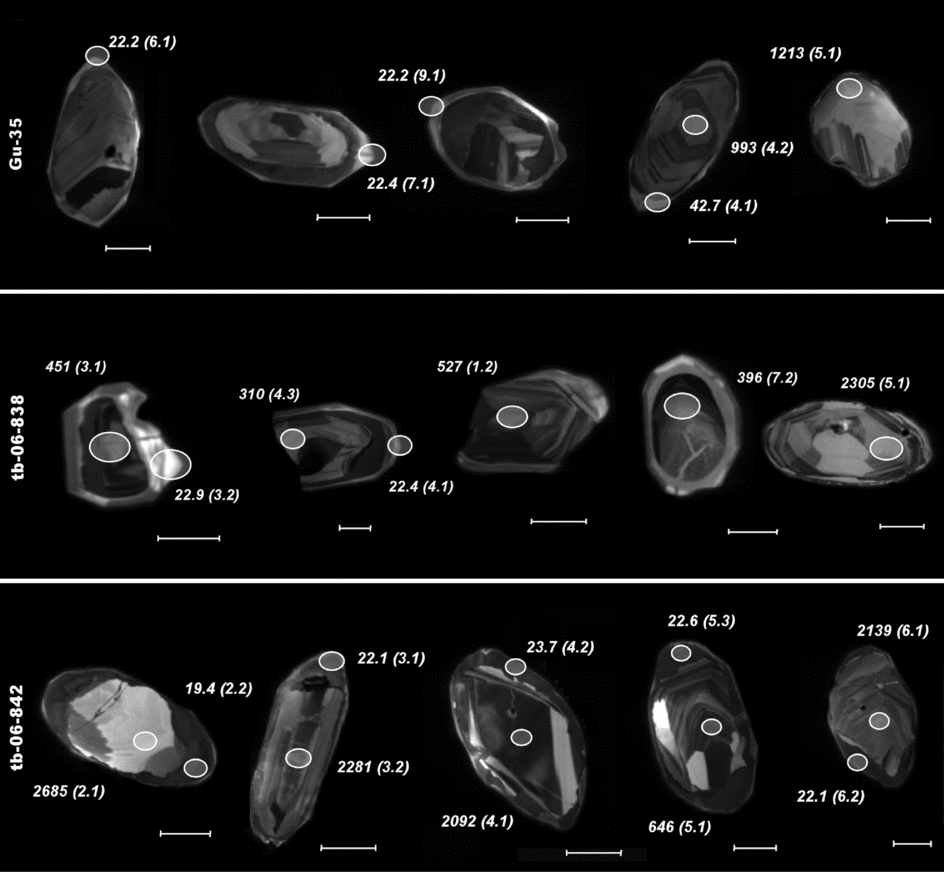
Zircons from studied samples were extracted from 10 to 20 kg blocks in order to obtain very large zircon populations with wide enough neocrystallized peripheral areas to perform precise SHRIMP analyses. Selected zircon grains were mounted in epoxy resin together with the TEMORA 1 reference zircons (Black et al. Reference Black, Kamo, Allen, Aleinikoff, Davis, Korsch and Foudoulis2003) and analysed on a SHRIMP-II SIMS at the Centre of Isotopic Research (CIR) at VSEGEI (St Petersburg). Cathodoluminescence (Fig. 3) and electron back-scattering images were used to reveal the internal structures of the zircon grains and target areas for analysis. The results were obtained with a secondary electron multiplier in peak-jumping mode and following the procedure described by Larionov, Andreichev & Gee (Reference Larionov, Andreichev, Gee, Gee and Pease2004). Seven cycles for each analysed spot were acquired. Every fourth measurement was carried out on the zircon Pb/U standard TEMORA 1.
Cathodoluminescence images of studied zircons. Ellipses show the spot locations. The attached numbers give the obtained 206Pb–238U age and the spot name. All scale bars are 50 μm long.
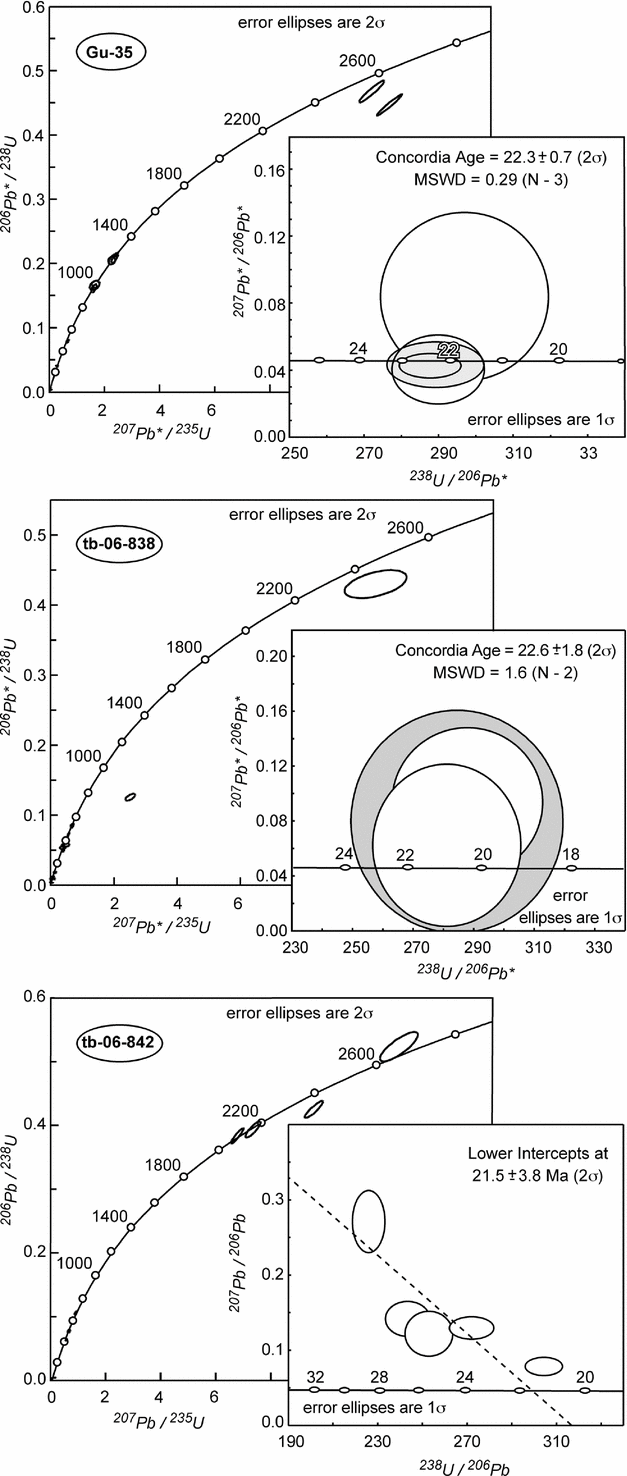
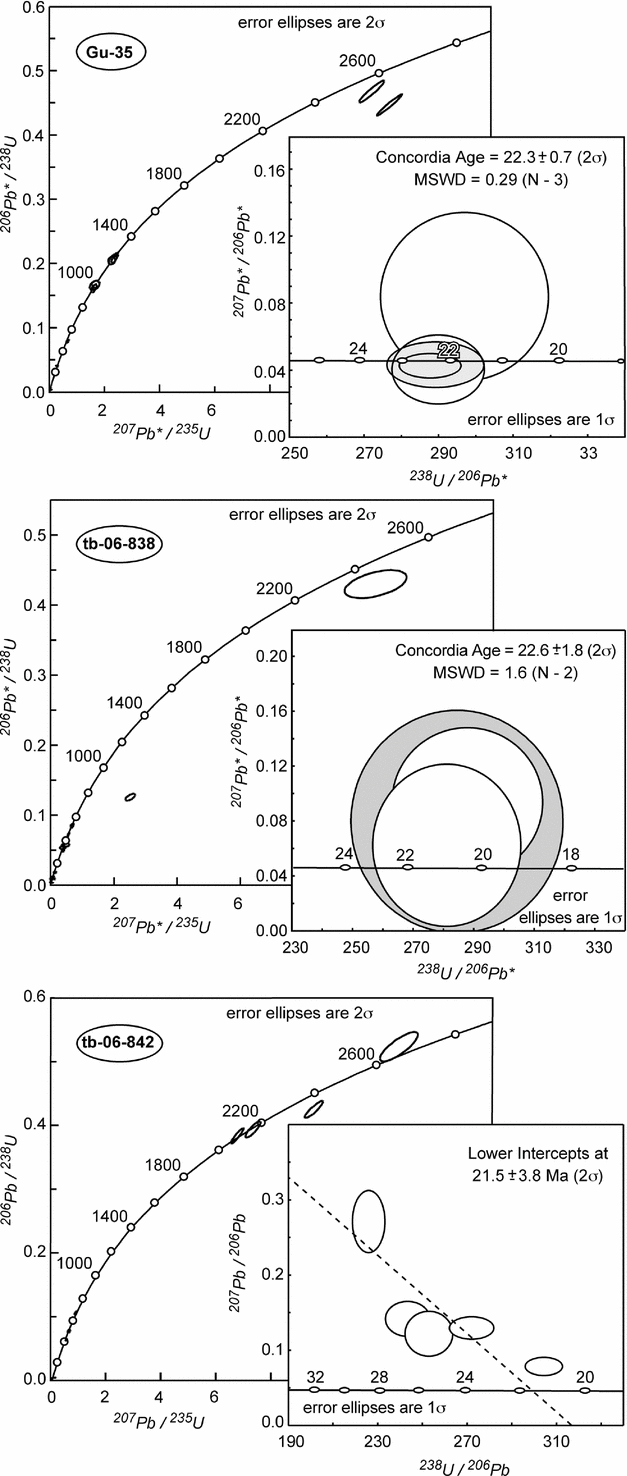
The U–Pb ion microprobe data are presented in online Appendix Table 1 (http://journals.cambridge.org/geo). The results were processed with the SQUID 1.02 (Ludwig, Reference Ludwig2001) and Isoplot/Ex 3.00 (Ludwig, Reference Ludwig2003) software, using the decay constants of Steiger & Jäger (Reference Steiger and Jäger1977). The common lead correction was done on the basis of measured 204Pb/206Pb according to the model of Stacey & Kramers (Reference Stacey and Kramers1975). The data are plotted in Figure 4.
Concordia diagrams for each analysed sample with all the zircon age data based on the 207Pb/238U versus 207U/235U ratios. Each diagram has a Tera-Wasserburg diagram with the youngest concordant age data set based on 207Pb/206Pb versus 238U/206Pb ratios. All age errors are 2σ.
Zircon grains from all the samples have many similarities. They display rounded, corroded or truncated inherited xenomorphic cores with typical magmatic oscillatory and sector zonings (Fig. 3). The cores are surrounded by CL-bright or CL-dark unzoned rims with very low 232Th/238U ratios, typical of newly grown domains (online Appendix Table 1 at http://journals.cambridge.org/geo). However, some grains also have external areas with more than one unzoned domain (e.g. zircons tb-06–838.4 and Gu-35.7).
Zircon core morphology points to their detrital nature, while their magmatic oscillatory zoning and mean Th/U ratio (0.51) confirm an igneous origin. Nineteen spot analyses were carried out, yielding 206Pb–238U ages from 310 to 2685 Ma (online Appendix Table 1 at http://journals.cambridge.org/geo). Some of the Archaean grains are significantly discordant (Fig. 4), attesting to Pb-loss.
Fifteen analyses have been carried out in the widest peripheral areas of the zircons in order to date the last events recorded by new zircon growth. The peripheral newly grown domains for all three samples give similar c. 22 Ma concordia ages (Fig. 4) with similar Th/U ratios, except for four spots (see online Appendix Table 1 at http://journals.cambridge.org/geo), which yield mixed core–rim ages with no geological meaning. Samples Gu-35 and tb-06-838 have concordia ages of 22.3±0.7 (2σ) (Th/U = 0.02–0.04) and 22.6±1.8 (2σ) Ma (Th/U = 0.06–0.09), respectively, while sample tb-06-842 gives a lower intercept age of 21.5±3.8 (2σ) Ma (Th/U = 0.01). A high probability of age coherence is indicated by the overlapping of the youngest most concordant data from all three samples. On a total ratio anchored Tera-Wasserburg plot, all the analyses define a mixing line intersecting the concordia at 21.7±0.8 Ma (2σ - MSWD 3.2) and also confirm their age coherence. According to the presented data, we think that the age of 22.3±0.7 (2σ) Ma can be interpreted as the time of the dynamothermal aureole formation. The ages obtained for the granite dyke crystallization, albeit imprecise, do support their formation from the aureole.
4. Discussion and conclusions
According to previous geochronological data from the dynamothermal aureole and granite dykes associated with the Ronda peridotites, only a vague span of 3 Ma, between 22 and 19 Ma, can be established for the emplacement of the ultrabasic rocks. Sánchez-Rodríguez (Reference Sánchez-Rodríguez1998) indicated that Pb-loss related to migmatization in the dynamothermal aureoles could result in the lower-intercept ages of 22.5 to 20.8 Ma and also that some results could represent mixed ages with no geological meaning since the SHRIMP spots include portions of innermost, older zircon domains due to the narrow rims. We have been able to avoid similar analytical errors working with large zircon populations and selecting zircon grains with rims broad enough to be analysed (Fig. 3). This time-consuming approach has proved to be very successful, as a precise age of 22.3±0.7 Ma has been obtained for the formation of the dynamothermal aureole of the Guadaiza nappe. This result is consistent with the ages obtained for the crystallization of the granite dykes. The diverse ages for the intrusion of granite dykes (see the Introduction) suggest that partial melting conditions in the aureole prevailed during a period of several millions of years.
Based on the previously published radiometric ages (Priem et al. Reference Priem, Boelrijk, Hebeda, Oen, Verdurmen and Verschure1979; Monié, Torres-Roldán & García-Casco, Reference Monié, Torres-Roldán and García-Casco1994; Sosson et al. Reference Sosson, Morillon, Bourgois, Féraud, Poupeau and Saint-Marc1998; Sánchez-Rodríguez & Gebauer, Reference Sánchez-Rodríguez and Gebauer2000), it was proposed that the intrusion (c. 19 Ma ago) of the granite dykes was restricted to late metamorphic stages in the dynamothermal aureole (Cuevas, Esteban & Tubía, Reference Cuevas, Esteban and Tubía2006). The new data presented here attest that the generation and intrusion of granite melts occurred about 3 Ma prior to what was thought. On this point, we would remark that several generations of dykes can be recognized based on cross-cutting relationships, the mylonitic dykes being commonly older than undeformed ones (Cuevas, Esteban & Tubía, Reference Cuevas, Esteban and Tubía2006). This observation provides a coherent explanation for the range of ages of the granite dykes published up to now and also for the apparent inconsistency arising from the finding of younger ages for the crystallization of some granite dykes than for the cooling ages of other, and probably older dykes.
Therefore, from the new data presented in this work we propose that: (1) the age of 22.3±0.7 Ma dates the formation of the dynamothermal aureoles and hence the emplacement of the Ronda peridotites in middle crustal levels, at temperatures high enough to promote the generation of partial melts which intrude as granite dykes in the peridotites and (2) the development of the aureole and the intrusion of the granite dykes formation persisted from 22.3 to c. 19 Ma.
Acknowledgements
This work has been supported by grants CGL2007–60039BTE, IT-270-07 and IT-364-10. E. Lepekhina and S. Presnyakov are also thanked for their analytical support. An anonymous reviewer and the editor Mark Allen are thanked for the revision and improvement of the manuscript.