Disaster responders involved in natural or manmade disaster response and recovery efforts may be exposed to a wide variety of physical and mental stressors that may have longlasting and detrimental psychopathological outcomes.Reference McFarlane, Williamson and Barton1 When a disaster occurs, first responders are typically in charge of securing the disaster site, providing life-saving medical care, organizing immediate response activities, and directly risking their personal health and safety to safeguard the lives of victims. Civilian first responders such as police, fire, and emergency medical service technicians, along with military service members have been shown to experience stress-related physiological, cognitive, psychological, and behavioral disorders at elevated rates.Reference McFarlane, Williamson and Barton1 In some disaster situations, huge numbers of secondary responders can also be involved in contaminant cleanup and removal of debris. Secondary responders are emergency response and recovery workers who do not belong to the traditional first-responder population and are typically involved in non-immediate search and rescue, cleanup, and recovery operations at the site of a disaster. Given their exposures, secondary responders may be at risk of developing the same traumatic stress-related psychopathological outcomes as first responders and military service members.
Emergency responders can be potentially exposed to a wide variety of health and safety hazards. As a result, a standardized training regimen, known as the hazardous waste operations and emergency response (HAZWOPER) standard, was developed by the US Occupational Safety and Health Administration (OSHA). HAZWOPER training has become one of a number of generally accepted training regimens for emergency response personnel in the United States.
The HAZWOPER Standard
The OSHA HAZWOPER final rule (29 CFR 1910.120) was issued in 1990.2 The HAZWOPER standard applies to all personnel who are exposed, or will be potentially exposed, to hazardous substances—including hazardous waste—and who are engaged in 1 of 5 types of cleanup operations.3
HAZWOPER training focuses predominantly on teaching safe handling and removal procedures for risks presenting physical harm to worker health, such as falling debris, unknown chemicals, infectious agents, and radioactive materials. Very little attention is provided to the mental health aspects inherent to and affected by emergency response. In fact, no mental health education component currently exists in OSHA's suggested HAZWOPER training guidelines (29 CFR 1910.120).4
OSHA defines critical incident stress as the inability to function during response activities resulting from the witnessing or experiencing of traumatic events during an emergency or disaster situation. To date, OSHA has not promulgated any standards that apply to the hazards associated with critical incident stress.5 Bills and coworkers state that negative mental health outcomes of emergency response can include posttraumatic stress disorder (PTSD), major depressive disorder, panic disorder, alcohol abuse, and generalized anxiety disorder.Reference Bills, Levy and Sharma6 Stressors that can trigger these mental effects in responders include dealing with severely injured or deceased persons; facing personal threat during disasters; and witnessing the impact of disasters on others.Reference McFarlane, Williamson and Barton1
Posttraumatic Stress Disorder
PTSD is defined by the Diagnostic and Statistical Manual of Mental Disorders (Fourth Edition) (DSM-IV) Reference Russell7 as follows:
…the development of certain symptoms following exposure to an extreme traumatic stressor involving direct personal experience of an event that involves actual or threatened death or serious injury, or other threat to one's physical integrity; or witnessing an event that involves death, injury, or a threat to the physical integrity of another person; or learning about unexpected or violent death, serious harm, or threat of death or injury experienced by a family member or other close associate. The person's response to the event must involve intense fear, helplessness, or horror….
According to Berninger and colleagues, PTSD is associated with poor mental and physical health, violent behavior, adjustment issues, poor performance at work and school, altered lifestyle causing difficulty in functioning at home and at work, depression and anxiety, and changes in social and leisure habits.Reference Berninger, Webber and Cohen8 Contextual stimuli or environmental cues presented during, but not associated with, a traumatic event can evoke conditioned responses.Reference Whealin, Ruzek and Southwick9 In addition, research has shown that disasters caused by human intent, such as terrorist attacks, create more negative psychological consequences in survivors than natural disasters. PTSD is one of the most prevalent and debilitating effects of terrorism-related incidents.Reference Berninger, Webber and Cohen8
Bills etal have stated that the estimated risk of PTSD among September 11th responder workers was 24%, and those who experienced personal loss or exposure to death or bodily remains were significantly more likely to suffer from PTSD.Reference Bills, Levy and Sharma6 The authors provide 2 explanations to support this statement: (1) September 11th responders were subjected to severe, ongoing exposure; and, (2) almost 40 000 people participated in rescue and recovery efforts at ground zero in New York City, representing responder population magnitudes larger than anything previously reported.
In the study by Berninger and associates, a significant increase in difficulty with functioning at home or at work was reported for World Trade Center rescue, recovery, and cleanup workers. They also discovered that firefighters performing supervisory responsibilities during the collapse of the twin towers—tasks that were not normally assigned to them—were nearly twice as likely to have risks for elevated PTSD compared to officers trained in supervision.Reference Berninger, Webber and Cohen8 Perrin and coworkers found that PTSD rates were lowest in police officers and highest in unaffiliated volunteers. The authors concluded that performing tasks not common to one's occupation led to increased rates of PTSD.Reference Perrin, DiGrande, Wheeler, Thorpe, Farfel and Brackbill10
Resilience
Whealin etal define resilience as the capacity of individuals or groups to implement early, effective adjustment processes to alleviate strain imposed by stress exposure. The authors explain that resilient individuals are more likely to have personality traits such as extraversion, optimism, and hardiness and report stronger social bonds and more social resources during stress than those who develop PTSD.Reference Whealin, Ruzek and Southwick9 Further, responders who are resilient to PTSD are more likely to engage in adaptive coping strategies such as problem solving, goal-setting, stress management, and use of social support. Similarly, the ability to reappraise, reframe, or find positive meaning in an adverse event is characteristic of many resilient individuals. Resilience is associated with perceiving potentially stressful events in less-threatening terms and remaining optimistic about the ability to cope with stressors.Reference Southwick, Vythilingam and Charney11
Interventions and Treatments
Bills and coworkers state that more training leads to increased resiliency to cope in disaster response workers.Reference Bills, Levy and Sharma6 Realistic training experiences that include a leadership component are valuable for practicing anxiety management because they allow for in vivo use of skills and can result in superior performance compared to “training as usual”.Reference Whealin, Ruzek and Southwick9 Many interventions have been shown to help improve psychosocial functioning in responder populations. These interventions include psychoeducation about traumatic stimuli; rehearsal of task-related behaviors; mental planning; exposure interventions; cognitive challenging; stress-inoculation interventions; stress management; guided self-dialogue; attentional distraction techniques; behavioral activation; and social skills interventions.Reference Whealin, Ruzek and Southwick9
OSHA recommends critical incident stress debriefing (CISD) as an effective intervention for addressing the mental health needs of response personnel. CISD is a 7-step, facilitator-led group process.5 Participants describe their traumatic experiences and view a presentation on common stress reactions and stress management. CISD can provide group support and connect workers to further counseling and treatment services, if necessary.5
Whealin etal state that providing verbal information about what may happen during a future event should help decrease the novelty and unexpectedness of any traumatic situation that may be encountered during the event. The authors explain that, although informational preparation strategies have received little formal evaluation, these strategies have been used in military training for years and, today many first responder and military organizations use informational preparation as a key training element.Reference Whealin, Ruzek and Southwick9
In a study investigating the mitigation of stress during complex tasks, Inzana and colleagues found that preparatory information had a positive effect on reducing anxiety and enhancing performance accuracy in both high-stress and normal-stress task conditions.Reference Inzana, Driskell, Salas and Johnston12 They state that preparatory information mitigates negative reactions to stress in several ways: (1) preparatory information provides a preview of the stress environment and renders the task less novel and unfamiliar, leading to a more positive expectation of self-efficacy; (2) knowledge regarding an upcoming event increases predictability, which can decrease the attentional demand and distraction of having to monitor and interpret novel events; and (3) preparatory information may enhance the sense of behavioral or cognitive control over a traumatic event by providing the individual with the means to respond to the stress.Reference Inzana, Driskell, Salas and Johnston12 They conclude by saying that preparatory information (pre-event training) that is tailored to the specific event that is likely to be encountered will provide a more effective mitigation of mental distress.
The present study examined PTSD symptomology, resiliency to cope with stress, and the health and lifestyle effects of traumatic mental and physical stressors among secondary responders who had received or expressed interest in receiving HAZWOPER training through the National Institute of Environmental Health Sciences (NIEHS). NIEHS is a key proponent and provider of hazardous waste worker training and is one of a few research institutes composing the National Institutes of Health (NIH). The federally funded Worker Education and Training Program (WETP) supports the training and education of workers engaged in hazardous materials and HAZWOPER activities.13
Methods
Subjects and Recruitment Process
During a 6-month period, 202 responses were collected; of these, 6 respondents were excluded from the study for incomplete survey responses and 20 were excluded because they self-identified as first responders. The remaining 176 respondents completed secondary responder surveys that were included for analysis. All participants were anonymous to the investigator. Also, the investigator was blinded and had no direct interaction with any participant during the recruitment process. The study population was recruited from secondary responder groups throughout the United States, including the consortia comprising the membership of the NIEHS WETP—potentially thousands of survey respondents. The exact number of eligible participants, however, was unable to be quantified due to incomplete database records. The investigators contacted member organizations within the NIEHS WETP, seeking their assistance in notifying their previous and current trainee memberships about the study. Each organization contacted its membership through personal e-mail accounts. The method of notification was at the discretion of each organization.
The survey data contained no identifying information, thus protecting the confidentiality and privacy of the study participants. Further, all digital data were stored in an encrypted personal computer database that was password protected and accessible only to the lead investigator (J.C.C.). Key-card security access was required to enter the office housing the computer. Data were not linked with external databases, nor were they transmitted for collaborative use. Data were only manipulated by the lead investigator and only viewed in its raw form by the authors. All data will be retained for 3 years and then destroyed in compliance with policies implemented by The University of Texas Health Science Center at Houston Committee for the Protection of Human Subjects.
Consent Process
Subject participation was completely voluntary and anonymous. All participants were recruited and consented for inclusion through an online, modified informed consent document (ICD) not requiring a signature, based on 21 CFR 56.109(c)(1).14 The modified ICD explained the study, the purpose of the survey, and how to gain access to it on the Internet, and it addressed all the key elements of a written ICD. The ICD was attached to the online survey as a cover letter. A subject's willingness to complete the anonymous survey was tantamount to consenting.
Study Measures
A 25-item, online survey (SurveyMonkey ) was developed to collect anonymous data to assess PTSD symptomology, resiliency to cope, and the health and lifestyle effects of traumatic mental and physical stressors among secondary responders. Respondents were not observed while completing the surveys. Survey questions were drawn in their entirety from preexisting and validated PTSD and stress-related instruments: the PTSD Checklist–Civilian Version,Reference Blanchard, Jones-Alexander, Buckley and Forneris15, Reference Ruggiero, Del Ben and Scotti16 and the Connor-Davidson Resilience Scale.Reference Connor and Davidson17 The PTSD Checklist is a 17-item self-report rating-scale instrument that parallels the DSM-IV diagnostic criteria B, C, and D for PTSD. The recommended baseline PTSD level is a score of 44.Reference Blanchard, Jones-Alexander, Buckley and Forneris15 The cutoff point for being PTSD negative is a score of 34 or less. Scores between 35 and 43 are considered PTSD probable. Examples of question statements include the following: “I have lost interest in things I used to enjoy” and “I have avoided activities or situations because they reminded me of a stressful experience in the past.”
The Connor-Davidson Resilience Scale comprises 25 items, with higher scores reflecting greater resilience.Reference Connor and Davidson17 The higher the score, the more resilient a person is. The scale ranges from 0 to 100. Examples of question statements include the following: “If things look hopeless, I don't give up” and “I am in control of my life.” Both assessments use a 5-point Likert scale with associated values of (1) strongly disagree; (2) disagree; (3) neither agree nor disagree; (4) agree; and (5) strongly agree.
Seven additional questions assessed the participants’ training and secondary responder work experience and background, including their personal opinion about whether a mental health education training module would be needed or not. Participants could respond either (1) yes; (0) no; or (2) do not know to these questions. The survey took approximately 15 minutes to complete.
Data Analysis
Survey responses were analyzed by the SurveyMonkey software. The Fisher exact test analysis at the 95% and 99% significance levels (P = .05 and .01) was performed to compare the relationships between HAZWOPER training status, disaster work experience, mental distress, negative effect, PTSD status, and support of pre- or postresponse mental health education. One-way ANOVA analysis at the 95% and 99% significance levels (P = .05 and .01) and Bonferroni correction to address the effect of multiple comparisons were performed to determine the impact of HAZWOPER training status, disaster work experience, mental distress, negative effect, PTSD status, and support for mental health education on PTSD score and resiliency level. One-sample t tests were performed at the 95% and 99% significance levels (P = .05 and .01) to determine the impact of different grouping variables on PTSD score, resiliency level, mental distress, and negative effects experience. These data were used to determine the need for pre- or postdisaster mental health education.
Study Protocol Review and Exemption
The study protocol was reviewed and approved for exempt status according to 45 CFR 46.101(b)18 by The University of Texas Health Science Center at Houston Committee for the Protection of Human Subjects.
Results
Descriptive Statistics
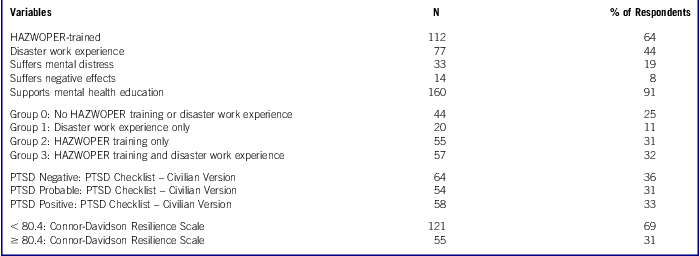
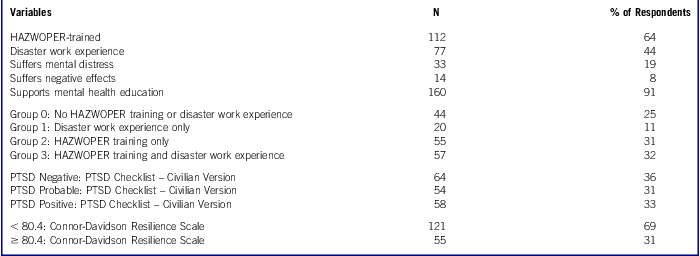
A total of 176 surveys were included in the data analysis. Respondent survey data were grouped by yes/no answers to 2 questions involving the characteristics of HAZWOPER training status and disaster work experience. Data were grouped using the characteristics of disaster work experience and HAZWOPER training status due to their high correlation with a respondent's level of mental distress and resiliency to cope, as described previously. Group 0 was composed of individuals who did not possess either characteristic. Group 1 was composed of individuals who possessed disaster work experience but did not undergo HAZWOPER training. Group 2 was composed of individuals who possessed HAZWOPER training but no disaster work experience. Group 3 was composed of individuals who possessed both HAZWOPER training and disaster work experience. Table 1 presents descriptive statistics for key categorical variables.
Descriptive Statistics for Key Categorical Variables (N = 176)
Abbreviations: HAZWOPER, hazardous waste operations and emergency response; PTSD, posttraumatic stress disorder.
The key variables analyzed in this study include the categorical variables of HAZWOPER training status, disaster work experience, mental distress, negative effect, support of mental health education, group, PTSD status, and resiliency status. The table shows that one-third of respondents scored at or above the cutoff point for PTSD positivity and almost one-third of respondents scored in the PTSD probable range. Also, the mean resiliency score for the study population was 76.3, which was below the national average resilience level of 80.4 for the general population.Reference Connor and Davidson17 One-fifth of all respondents reported suffering mental distress from their disaster work experience. A clear majority of respondents (91%) supported mental health education. The mean PTSD score for the study population (38.9) was within the PTSD probable range.
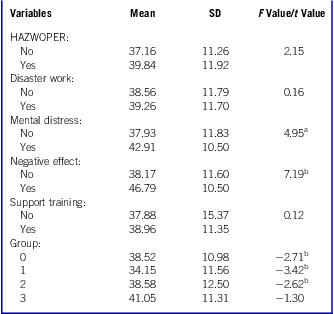
PTSD Checklist–Civilian Version Analysis of Means
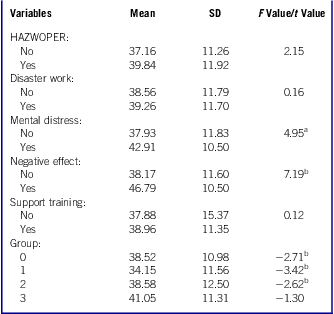
Table 2 describes the mean differences on the dependent variable, PTSD score, of different nominal and dichotomous independent variables. One-way ANOVA tests with Bonferroni corrections and 1-sample t tests to compare groups were used. Results indicated that those who experienced mental distress and negative effects after responding to a disaster were significantly more likely to have higher PTSD scores than those who did not experience mental distress or negative effects after a disaster. Group means were compared to an average mean of 43 in 1-sample t tests, as described by Blanchard etal.Reference Blanchard, Jones-Alexander, Buckley and Forneris15 Results indicated that responders in groups 0, 1, and 2 were significantly less likely to be PTSD positive than responders in group 3, as compared to an average PTSD score of 43.
Mean Differences for PTSD Score (Mean, SD, and Dichotomy Significance; N = 176)
Abbreviations: HAZWOPER, hazardous waste operations and emergency response; PTSD, posttraumatic stress disorder.
aP ≤ .05; bP ≤ .01.
Connor-Davidson Resilience Scale Analysis of Means
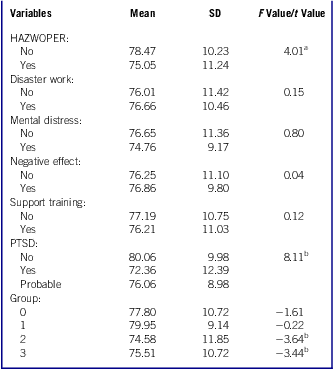
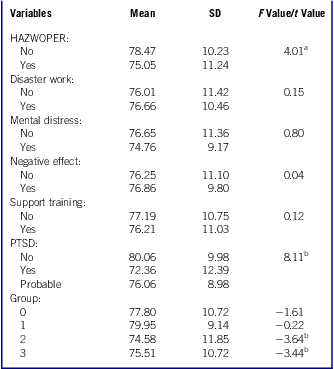
Table 3 describes the mean differences on resiliency score of different nominal and dichotomous independent variables. The 1-way ANOVA tests with Bonferroni corrections and 1-sample t tests to compare groups were used. Results indicated that those who had not undergone HAZWOPER training had significantly higher resiliency scores than those responders who had undergone HAZWOPER training. Also, responders who were PTSD negative had significantly higher resiliency scores than those who were classified as PTSD positive. Group means were compared to an average population mean of 80.4 in 1-sample t tests, as suggested by Connor and Davidson.Reference Connor and Davidson17 Results indicated that groups 2 and 3 were significantly more likely to have lower resiliency scores than groups 0 and 1.
Mean Differences for Resiliency Score (Mean, SD, and Dichotomy Significance; N = 176)
Abbreviations: HAZWOPER, hazardous waste operations and emergency response; PTSD, posttraumatic stress disorder.
aP ≤ .05; bP ≤ .01.
Mental Distress and Negative Effect
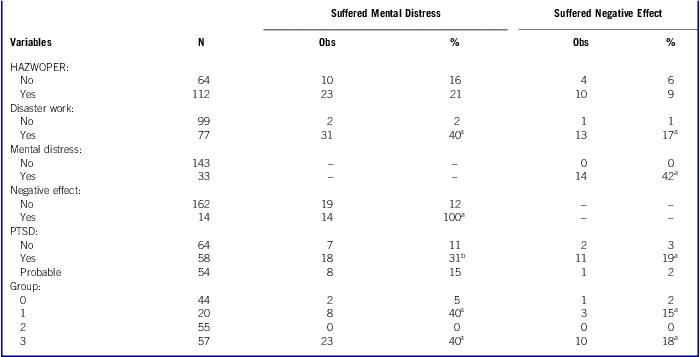
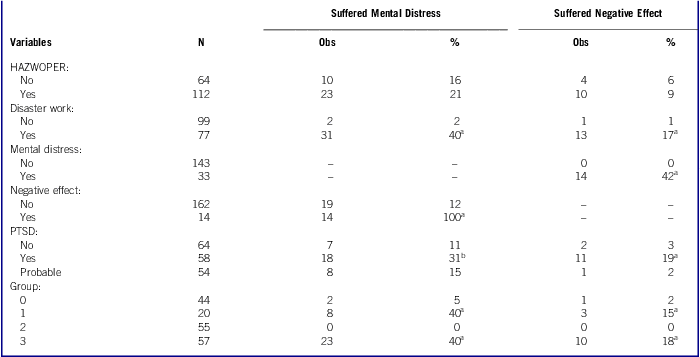
Table 4 shows the number and percent of respondents affected by mental distress and negative effects grouped by key categorical variables. The relationships between disaster work experience, PTSD positivity, and group status were statistically significant in terms of suffering mental distress and negative effects.
Number and Percent Affected by Mental Distress and NegativeEffect Grouped by Key Categorical Variables (N = 176)
Abbreviations: HAZWOPER, hazardous waste operations and emergency response; Obs, observations; PTSD, posttraumatic stress disorder.
aP ≤ .01; P ≤ .05.
Support of Training
Support for mental health education was universally high regardless of training, group, disaster work experience, PTSD status, or experience with mental distress and/or negative effects. Results indicated no statistically significant relationships between any variable.
Discussion
Levels of PTSD
Elevated PTSD levels were noted in the study population. Bills etal stated that the prevalence of PTSD among September 11th rescue workers ranged between 8% and 22.5%.Reference Bills, Levy and Sharma6 A PTSD score of 43 on the PTSD Checklist was used to distinguish PTSD positive from PTSD probable respondents. Bliese and coworkers recommend a cutoff point between 30 and 34 for civilian primary care populations.Reference Bliese, Wright, Adler, Cabrera, Castro and Hoge19 However, a score of 43 was used because it was a more realistic and appropriate cutoff point for a secondary responder population with disaster work experience.Reference Bliese, Wright, Adler, Cabrera, Castro and Hoge19 Elevated PTSD levels were expected, given the abundance of studies that showed increased PTSD incidence in first-responder and military populations.Reference Bills, Levy and Sharma6, Reference Berninger, Webber and Cohen8, Reference Perrin, DiGrande, Wheeler, Thorpe, Farfel and Brackbill10, Reference Bliese, Wright, Adler, Cabrera, Castro and Hoge19-25 However, such a high prevalence of PTSD positivity among this study group of secondary responders, which eclipsed even that of the September 11th disaster responders (32.9% vs 8%-22.5%), was not expected.
Some possible factors contributing to the high prevalence of PTSD could involve the following: (1) the study population was minimally or improperly trained to cope with their disaster response experiences; (2) regardless of training background, these responders witnessed or participated in a particularly severe traumatic event; (3) the stress from multiple disaster deployments was cumulative and caused severe mental distress in the responders; (4) secondary responders, as a group, are less prepared for the traumatic experiences they encounter in their work than other groups previously studied; and/or (5) secondary responders have a higher baseline PTSD tendency than other groups studied, for unknown reasons.
Results indicated that responders in group 3 were likely to test positive for PTSD, whereas responders in groups 0, 1, and 2 were likely to test negative. These findings imply an additive, or perhaps synergistic, relationship between HAZWOPER training status and disaster work experience that resulted in increased levels of PTSD among HAZWOPER-trained disaster workers.
Resiliency
A majority of the study population tested below the mean resiliency score of the average worker population. This finding was unexpected, given that many research studies have shown that responder populations are generally more resilient than their civilian counterparts.Reference Bills, Levy and Sharma6, Reference Whealin, Ruzek and Southwick9, Reference Perrin, DiGrande, Wheeler, Thorpe, Farfel and Brackbill10, Reference Murphy, Beaton, Pike and Johnson26, Reference Bryant and Guthrie27 Results further indicated that those who were in groups 2 and 3 were significantly more likely to have lower resiliency scores than those in groups 0 and 1. This finding was unexpected as the literature shows that, in general, the more comprehensive a person's training, the higher their resiliency.Reference Bills, Levy and Sharma6, Reference Whealin, Ruzek and Southwick9
An inverse relationship was observed between resiliency score and PTSD status. Lower PTSD scores coincided with higher resiliency scores, and vice versa, as expected. Also, groups 0 and 1 showed no differences from the mean resiliency score in the general worker population. Similar to the findings for PTSD status, these results indicated that an additive, or synergistic, relationship may exist among the grouping variables, especially HAZWOPER training status, resulting in decreased resiliency in responders. It was not clear, however, why HAZWOPER training seems to negatively affect the resiliency of workers, regardless of their disaster work experience. Some possible explanations for this finding could have included that (1) the study population was minimally or improperly trained to cope with their disaster response experiences; (2) these responders had other nonwork-related factors in their lives negatively affecting their ability to cope with stress; and/or (3) the finding may have been an artifact of not evaluating a large enough HAZWOPER-trained secondary responder population.
Mental Distress and Negative Effect
Responders with disaster experience were more likely to suffer mental distress and negative effects than responders with no disaster experience. As expected, responders testing positive for PTSD were more likely to suffer mental distress and negative effects than responders classified as PTSD negative and PTSD probable.
Results indicated that a direct correlation existed between having worked at a disaster site and experiencing mental distress. Responders in groups 1 and 3 were more likely to have mental distress and suffer negative effects than those in groups 0 and 2. These results were similar to those found by McFarlane and Bookless, who state that those who suffered mental distress as a result of their experiences at a disaster work site were likely to also experience negative effects.Reference McFarlane and Bookless22 No one in group 2 suffered mental distress or negative effects. Overall, these results supported the effect of response work as the primary influence on mental distress and negative effects in this population.
Support of Training
Results showed clear support for mental health education. No significant differences were found across any variable in terms of support of training. Unexpectedly, HAZWOPER-trained respondents were less likely to support mental health education than those with no training. This result was not significant, however, and subsequent analysis of a larger population might reverse this negative trend and show positive support for mental health education.
A reason for the nonsignificance in the latter findings is that the overall support of mental health education was very high—91%. This high level of support inherently skews all of the comparative analyses into nonsignificance; this complication could be avoided in the future by surveying a larger study population.
Limitations and Strengths
Several limitations associated with this study must be acknowledged and considered when evaluating the results obtained. First, a larger secondary responder study population would have increased our statistical power to examine group differences. Second, collectors for standard demographic data, such as gender, race/ethnicity, educational background, geographic location, among others, would have been helpful to better characterize differences among certain responder groups. Third, the cross-sectional study design that was used did not allow for the determination of temporal associations among the study variables. Finally, PTSD and resiliency symptomology was self-reported and could have resulted in biases in the results.
A strength of this study was that the PTSD Checklist–Civilian Version and the Connor-Davidson Resilience Scale were included in their entirety on the survey that was sent to study participants. Both instruments have been widely recognized for their accuracy and are thoroughly vetted and validated in the literature. Second, volunteer selection bias was minimized due to the fact that the survey was administered almost exclusively to a secondary responder population.
Conclusions
The results of this study suggest a clear need for mental health education for secondary responders. Almost two-thirds of the study population exhibited elevated PTSD levels and more than two-thirds of the population exhibited lower-than-average resiliency scores. Hence, the importance of teaching responders about their mental health and how to safeguard it should not be overlooked.
Recommendations for Mental Health Education Programs
Based on the elevated PTSD levels, lower-than-average resiliency scores, and the high degree of support indicated by secondary responders in this study for mental health education, the development of a pre- and postdeployment training module is strongly recommended. It is further recommended that predeployment mental health education be included in the current HAZWOPER 24- and 40-hour course curriculums. Also, consideration should be given to integrating a stand-alone postdeployment mental health education training course into the current HAZWOPER hierarchy. This training should provide responders with the necessary knowledge and skills to recognize the symptomology of PTSD, mental stressors, and physical and traumatic stressors, thus empowering them to employ protective strategies or seek professional help if needed. Proposed course topics may include the following:
• Secondary responder stress and the psychological ramifications of disaster response
• Causative factors of physical and mental stress
• Effects of responding to acute, traumatic, destructive, and high-profile disasters
• Mitigating effects of trauma and stress with coping skills, self-efficacy, and resiliency
• PTSD: signs/symptoms, how it develops, coping with it, and treatment
• Professional help and support resources.
A documentation mechanism can be woven into this training that would allow concerned parties to track (1) which workers were informed about the traumatic exposures that could be encountered during HAZWOPER operations, and (2) the possible signs and symptoms of traumatic stress-related mental health disorders that may be experienced as a result of these exposures. This mechanism can also be used to identify disaster response and remediation workers for long-term follow-up.
Future research should investigate the efficacy of this training intervention to reduce or eliminate traumatic stress-induced mental health sequels in secondary responders. Research has shown that more training equates with higher resiliency against traumatic stress. The mental health of our secondary responder population can no longer be glossed over or ignored within the current OSHA HAZWOPER training hierarchy. We need to safeguard those who sacrifice so much to help others in the line of duty.