Introduction
In this article we analyze the perceptions and knowledge of nonexperts regarding language planning and the Portuguese orthographic reform. We argue that studying the public understanding of language planning through the analysis of language ideological debates (Blommaert Reference Blommaert1999) allows us to determine the context and social conditions under which language policies are developed and subsequently interpreted. Public understanding can be defined as ‘the depth of understanding required for a citizen to be able to follow and participate in public policy discussions of a scientific or technological issue’ (Miller Reference Miller2004:273).
Our aim is to understand how a specific language planning action—an orthographic reform implemented in all Portuguese speaking countries—is seen by European Portuguese speakers. As elsewhere, reactions to the reform have been very polarized; this is not surprising, since they are often a matter of emotions: ‘orthography… is a topic of great interest not least because it is a point where issues of language as a formal object and of language as a social and cultural phenomenon intersect. It touches matters of social identity, national identity, cultural politics, representation and voice’ (Sebba Reference Sebba2009:6).
We analyze public understanding of language planning (and the respect or violation of linguistic rights) by focusing on a public discussion forum in the online version of a daily Portuguese newspaper (Público) using critical discourse analysis. We show how Portuguese speakers evoked their linguistic rights in order to question the legitimacy of language planning and of its official discourses. We focus this analysis on three major issues that embody the linguistic-rights discourse of our target sample: the right to political action and political choice, ownership and ‘postcolonial orthography’ (Sebba Reference Sebba2009), and protection against hegemony. Thus, our purpose in engaging with the specific arguments surrounding the violation of linguistic rights is twofold. First, we intend to show how the argumentation surrounding linguistic rights and the protection of minorities and minority languages has migrated to new discursive fields and embraced other vigorous language ideological debates. Second, we intend to dismantle the argumentation put forward by defenders and detractors of the orthographic reform, bringing to light hidden or underlying motivations, following a critical discourse analysis that recognizes that power relations are at the centre of the discussion (Blommaert Reference Blommaert2005).
These power relations arise from the fact that Portuguese is a pluricentric language (Baxter Reference Baxter and Clyne2012) and lusophone territories follow specific linguistic, political, and economic agendas. This should always be acknowledged when talking about ‘Portuguese’, ‘Lusophony’, or ‘orthographic agreement’ in the singular. To embrace the claims of the speakers in our case study—that is, speakers of Portuguese, classified variously as the seventh, sixth, or fifth largest language of the world (Ethnologue; Simões 2014; Moita Lopes Reference Moita Lopes2015)—is to move beyond a perspective of linguistic rights adapted to minorities and endangered languages, although the arguments may seem very similar. This perspective is quite innovative, since linguistic-rights rhetoric has mostly arisen in diglossic power discussions between minority and majority languages. Here, however, we find it in the diglossic power relations of linguistic varieties within ‘global Portuguese’ (Moita Lopes Reference Moita Lopes2015). Because ‘pluricentric languages are both unifiers and dividers of people’ (Clyne Reference Clyne and Clyne2012:1), they are an important arena for the observation and analysis of ideologies attached to ownership, authenticity, power, and hegemonies, that is, all issues related to linguistic rights. Our discussion of linguistic rights in the realm of a pluricentric language highlights the ideologies put forward to define such languages: (i) the distance and differences between varieties, (ii) the individual, social, and national identity values attached to them, and (iii) their own status as norm-setting centers (as in the case of orthographic rules).
In this article, we do not intend to review the scope of linguistic rights, or the arguments for and against them (see, for example, Skutnabb-Kangas & Phillipson Reference Skutnabb-Kangas and Phillipson1995, Wiley Reference Wiley and Tollefson2002, Skutnabb-Kangas Reference Skutnabb-Kangas and Ricento2006, and May Reference May, Martin-Jones, Blackledge and Creese2012, Reference May2015 for a defense of linguistic rights as human rights, and Rajagopalan Reference Rajagopalan1999, Wee Reference Wee2005, Arzoz Reference Arzoz2007, and Duchêne & Heller Reference Duchêne and Heller2008 for critical reviews of the subject). Rather, we aim to understand the discursive materiality of linguistic rights from the speakers’ perspective and the elements making up the language ideological debates where public understanding of language planning emerges.
According to research on linguistic rights (May Reference May, Martin-Jones, Blackledge and Creese2012), many of the linguistic conflicts studied are based on a fundamental dichotomy between minority and majority languages. Little attention is paid to intra-linguistic discrimination or prejudice or to conflicts between varieties of the same language (nor between minority languages, or even between majority languages themselves). In an attempt to counteract the tendency highlighted in several studies of the ‘depersonalization of both production and reception’ (Stevenson Reference Stevenson2008:3) of language planning, we try to address these issues here. Thus, we analyze the subjects’ positions as to their understanding of this orthographic reform and their linguistic rights as ‘national native speakers’.
Mapping a language ideological debate: Orthographic reform and linguistic rights
Linguistic ideologies are mobilized, shared, and co-constructed during language ideological debates and discussions (Blommaert Reference Blommaert1999; Chand Reference Chand2011; Kang Reference Kang2012; Moita Lopes Reference Moita Lopes2015) on language policies being carried out and directly affecting speakers’ ways of doing, engaging through, or thinking about their languages. Linguistic ideologies are ‘neither simple nor monolithic’ (Martin-Jones, Blackledge, & Creese Reference Martin-Jones, Blackledge, Creese, Martin-Jones, Blackledge and Creese2012:9), but unstable and composite, shaped by social discourse, practice, and dynamics.
As language policies are closely connected to economic, political, social, and historical agendas, processes, and structures, they aim to bring about social change (Ricento Reference Ricento and Ricento2006). Because they touch what is perceived as a constitutive part of a nation-state's identity (the language), language policies are discussed in the public arena of social life, mobilizing argumentative and well-established ideologies that conform to what Billig (Reference Billig1995) calls ‘banal nationalism’, that is, forms of nationalism and discourse on nationhood that are embedded in routines of social life and that contribute to group dynamics and cohesion.
Language policy, as ‘a policy mechanism that impacts the structure, function, use, or acquisition of language’ (D. Johnson Reference Johnson2013:9), includes official regulations that embody language planning. It therefore ‘re-invents’ language as a social, legal, and political construct (see Makoni & Pennycook Reference Makoni and Pennycook2007), with a potentially strong impact on the social balance and relationships between speakers. Such regulations are intended to ‘effect some change in the form, function, use, or acquisition of language’ (Makoni & Pennycook Reference Makoni and Pennycook2007; see also S. Johnson Reference Johnson2002) and, thus, potentially, in what we call the linguistic public order. In the case of a pluricentric language the linguistic public order can span different countries and is characterized by variation and multinormativity (as we discuss later; see also Keating, Solovova, & Barradas Reference Keating, Solovova and Barradas2015).
A specific legal measure of language planning is the reform of orthography, that is, the written norm of a language, following phonetic, morphological, etymological, and historical principles (Catach Reference Catach1991:52). A reform is not a spontaneous or voluntary action; instead, it follows certain distinct phases (preparation, consultation, redaction, revision, application, and evaluation). Therefore, it is not a product but a process. Unlike other dimensions of language (for example, pronunciation and syntax), orthography depends on the explicit intervention of states or academies (Catach Reference Catach1991; S. Johnson Reference Johnson2002), and that is why so many misconceptions circulate about the role of speakers in this domain. Often, a part of the written language seems to preserve many of its ‘original’ characteristics, while other parts visibly change. Or, as argued by Johnson (Reference Johnson2002:566) with reference to the German orthographic reform, there is a ‘classic modernist dilemma of how to reconcile the static quality of a fixed standard with the dynamics of social and linguistic change’. The first tendency tends to be used by orthographic reform opponents, while the second usually constitutes an argument for defenders (Catach Reference Catach1991:52).
On the opponents’ side we find the ‘more emotional’ arguments (Geerts et al. Reference Geerts, van den Broeck, Verdoodt and Fishman1977, in Sebba Reference Sebba2009). As Sebba explains, ‘opponents of the reforms may claim that proposed changes make the spelling ugly, that they corrupt and impoverish the language, or that they encourage laziness and are the result of permissive thinking’ (Sebba Reference Sebba2009:45). A common argument used by adversaries relates to a process known as ‘erasure’, that is, ‘the process of sociolinguistic simplification to which speakers or linguists make recourse so that their model of language fits in with their language ideology’ (Moita Lopes Reference Moita Lopes2015:7). They claim that, by resorting to linguistic erasure (e.g. by eliminating consonants), sociolinguistic variation may be lost, ‘creating a homogeneous or essentialist view of a language or a social group’ (Moita Lopes Reference Moita Lopes2015:7). And finally, some other speakers ‘argue that changing the spelling frequently “makes fools of us”’, while others are simply against all change, on the grounds that ‘any change is worse than none’ (Sebba Reference Sebba2009:45). In addition, in this contribution we see how speakers evoke linguistic rights to show their disapproval of the orthographic reform.
On the defenders’ side, we find the explicit idea that a language develops in response to the surrounding conditions and to its speakers, within an ecological perspective of language vitality and decline. Sometimes, an orthographic agreement is mentioned as a sign of the maturity of a language, with the orthographic needs of a language changing with its growth, just as other elements of an ecosystem do. Defenders label this evolution as ‘simplification’ (also known as ‘facilitation’ by opponents) and they claim that a language tends to get rid of any obstacle to its transmission and evolution. They assert that a language is a dynamic social co-construction and not a static structure with intrinsically valid norms. So orthography, as other dimensions of language functioning, is challengeable, dynamic, and even reversible.
The idea of language as a living being, within an ecological perspective, aligns linguistic rights with discursive and epistemological tendencies in the social sciences (May Reference May2005): languages, as species, must be protected from attacks and any actions attempting to diminish or destroy their vitality or environment. It is precisely here that the tensions regarding orthographic reform come together: for opponents, orthographic reforms are external violations and impositions, clearly affecting the well-being of a language and of its speakers; for defenders, orthographic reforms are evolutionary processes, proving that a language is a living organism (controversial though this perspective may be, as Cameron Reference Cameron2008 demonstrates), and thus a sign that linguistic rights are being granted.
Other perspectives on linguistic rights include acknowledging ‘language as a means of social control’ and language as a ‘factor of mediation of social injustice’ (Phillipson, Rannut, & Skutnabb-Kangas Reference Phillipson, Rannut, Skutnabb-Kangas, Skutnabb-Kangas and Phillipson1995:1) in a world marked by imbalanced access to power and resources. In the field of orthographic reform debates, these perspectives may lead to the following two contradictory views: (i) that the reform embodies social injustice and establishes social control through language, because the new norm will not be known by all speakers (the opponents’ perspective); or (ii) that the reform attempts to achieve greater social justice through simplification of the orthographic rules (the supporters’ perspective), granting easier access to power and resources (and to school and literacy practices).
These tensions can also be found in the UNESCO universal declaration of linguistic rights (1996): ‘Article 9. All language communities have the right to codify, standardize, preserve, develop and promote their linguistic system, without induced or forced interference’. Opponents of orthographic reforms tend to see the reform process as a ‘forced interference’ in the preservation of their language; but then defenders see in it the right to ‘develop and promote’ the language, through a broader access to it. Thus, debating orthographic reform is a matter of ideologies and social representations, and, as with all ideological settings, it is a site of tensions and unsolved discussions.
From this perspective, disputes configure a language ideological debate, defined as ‘occurring in specific times and spaces where real social actors have collectively disputed the nature and function of language’ (S. Johnson Reference Johnson2002:551, following Blommaert Reference Blommaert1999), each language broker engaging in the promotion, reproduction, and destruction of one or several linguistic ideologies.
Empirical study
The beauty and the beast: The implementation of the Portuguese language orthographic reform between tensions and discourses
Portuguese is a Romance language with linguistic roots in Vulgar Latin (see Bagno Reference Bagno, Lagares and Bagno2011 for a critique of this standpoint).Footnote 1 The first written document in Portuguese is said to date back to 1214 (Pinto Reference Pinto2001:35). Until 1415, the year usually accepted as marking the start of the Portuguese discoveries, Portuguese was spoken only in Portugal. Gradually, and not always peacefully, as in most colonial regimes, it was adopted and became the official language of Angola, Brazil, Cape Verde, East-Timor, Guinea-Bissau, Mozambique, and São Tomé and Príncipe (Pinto Reference Pinto2001:35). Portuguese was also spoken in many regions of the colonial territories, such as Macau (now Chinese territory), Goa, Damão, and Diu (belonging to India), and in some territories of the Caribbean. In eighteenth-century Portugal, the Portuguese language was seen as an imperial language (Pinto Reference Pinto2001:69), lasting until the first movements of decolonization, which retracted the power of the overseas empire. In Portuguese mythology, mainly in the nineteenth and beginning of the twentieth centuries, the nationalist ideology of a Quinto Império ‘Fifth empire’, based on the authority of the Portuguese language, remained deep-rooted, and was developed further, especially in philosophical studies (namely in the work of Fernando Pessoa).
Because of the different linguistic substrates and cultural realities speakers came across during their travels, the Portuguese language acquired varying phonetic, phonological, syntactic, and lexical characteristics, which nonetheless do not impede communication or understanding between speakers from the different countries. Furthermore, some scholars claim that different local linguistic policies have led to distinct rules and regulations (Signorini Reference Signorini and Lopes2015). And, finally, other scholars claim it is necessary to recognize a distinct Brazilian language, as a sign of the evolution and contacts that this language suffers throughout its life (Bagno Reference Bagno, Lagares and Bagno2011). For these scholars, it is the Brazilian language that is the international language we are talking about in linguistic rankings, because of its demographic and economic weight.
Before the current orthographic agreement, two orthographic norms coexisted: the Brazilian norm and the norm of the other Portuguese speaking countries (the African-Portuguese-speaking countries did not adopt any local norms, but followed the European norm). The Portuguese Language Orthographic Agreement was signed in 1990 by Angola, Brazil, Cape Verde, Guinea-Bissau, Mozambique, Portugal, and São Tomé and Príncipe, with Galicia (a Spanish region where Galician is spoken) attending the meeting as observer (Garcez Reference Garcez1995). According to its preamble, the agreement is essential to defend the ‘unity of the Portuguese language’ and promote its ‘international prestige’, conferring some unity on the coexisting spelling rules, mainly the European and Brazilian norms. In practical terms, the new agreement is said to change 1.6% of the European Portuguese norm (in some accounts, it goes up to 4%), as opposed to 0.5% for the Brazilian norm, but these quantifications are never objective (Garcez Reference Garcez1993:52). The major alterations agreed upon in this document relate to the orthographic suppression of silent consonants, in an attempt to reconcile writing conventions with phonetics (pronunciation). This suppression leads to the visual removal of some etymological traces (for example, new <Egito> instead of the previous <Egipto> loses an etymological <p>). It should be noticed that the Brazilian Portuguese norm no longer had silent consonants. This led some European Portuguese opponents, claiming ownership of the Portuguese language, to define the suppression of silent consonants not only as a violation of etymology, but also as a sign of symbolic domination by the Brazilian norm and a loss of power.Footnote 2 Because of the many internal discussions in Portugal, the promulgation of the text by the Portuguese president did not happen until 2008.
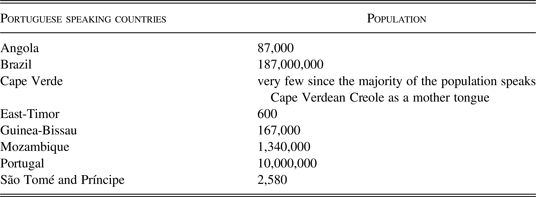
In terms of language planning, we might agree that the intentions are honorable. The aim is to defend Portuguese speakers’ interests abroad by building a more ‘cohesive community’ while at the same time making it easier to teach and learn Portuguese as a foreign language. Table 1 shows the population potentially covered by the orthographic reform in terms of mother tongue only (see Pinto Reference Pinto2001 on the difficulties of counting the precise number of speakers in the so-called lusophone world). This information is useful in order to understand some of the arguments used by Portuguese citizens who defend or attack the reform.
Portuguese speakers (as mother tongue), according to Ethnologue (http://www.ethnologue.com/language/por).

We must include other populations that are missing from that table. Anyone who uses Portuguese as a medium of written communicationFootnote 3 or as a medium of instruction or who is learning Portuguese as a foreign language is also affected by the orthographic agreement. Furthermore, we should acknowledge that Portuguese-speaking communities are spread throughout the globe, with large diasporic communities in, for example, Luxembourg, Venezuela, France, Germany, Australia, and Argentina (Simões Reference Simões and Fäcke2014; Moita Lopes Reference Moita Lopes2015). In terms of the teaching and learning of Portuguese as a foreign language, Moita Lopes reports a growing number of enrolments, for example, in American universities.
It should also be added that orthographic reforms are never peaceful (S. Johnson Reference Johnson2002), even within a single country. In this case, the agreement has seen a long list of opponents and defenders both in Portugal, the setting of this study, and in Brazil.Footnote 4 Some of the arguments in the public sphere (alongside demographic and economic quarrels, as we see below) are related to speakers’ rights, namely, constitutional rights. The Portuguese Constitution recognizes Portuguese as the official language (article 11), and protects any citizen from being discriminated against because of his or her language (article 13). This means that Portuguese is not in danger in Portugal and has majority language status there. The fundamental rights are explicitly referred to as those expressed in the Declaration of Human Rights (article 16). Discussion related to ‘Linguistic (Human) Rights’ (Arzoz Reference Arzoz2007) has silently broadened the scope of article 16 to include language rights. This means that no particular disposition can be found regarding the right to protect or to promote any minority language, and there is no public position or statement regarding language policies.
Other articles worth mentioning are article 21 (the right to resist), article 36 (rights regarding family, marriage, and parenting), and article 43 (freedom of learning and teaching). All of these articles can help us understand several of the arguments put forward by the participants in the discussion forum to be analysed later:
• Article 21 clearly states that everyone has the right to resist any order that offends his or her rights and liberties;
• Article 36 asserts parents’ right to educate their children;
• Article 43 explains that in matters of culture and education the State cannot impose any philosophical, aesthetical, political, ideological, or religious stance.
In the text of the Portuguese Language Orthographic Agreement it is also stressed that the implementation process was publicly discussed in each of the member states. As we see below, Portuguese opponents felt that this discussion was not held properly (or denied that it even took place), and that their opinions were not considered (specifically, in a referendum). Because of this, they refuse to accept the orthographic reform and consider that their linguistic rights are being abused. Furthermore, they recognize that the reform follows economic and political interests that they should fight against, identifying them as external impositions (see Melo-Pfeifer Reference Melo-Pfeifer, Marçalo, Fonseca, Gonçalves, Vilela and Silva2010 regarding these arguments).
Methodological design
Our study acknowledges the need to become aware of public understanding of the orthographic reform, mainly because of speakers’ constant contact with writing practices (Millet, Lucci, & Billiez Reference Millet, Lucci and Billiez1990). Unlike Millet and colleagues, we did not conduct our research via interviews or surveys, but by means of a critical discourse analysis of discussion forums in the Portuguese daily press (see Melo-Pfeifer Reference Melo-Pfeifer, Marçalo, Fonseca, Gonçalves, Vilela and Silva2010 for a previous study). We recognize the ‘central impact of value predispositions, relevant schema, and forms of mass media use in shaping public perceptions of controversial science and technology’ (Nisbet & Goidel Reference Nisbet and Goidel2007:434), as well as in contentious linguistic matters.
This methodology has the advantage of not eliciting replies to questions in a research context, which risks encouraging biased answers: our corpus is collected ‘in the wild’, in a real-life situation of communication, without interference from the researcher or the data collection instrument. This ‘non-interfering methodology’ is very relevant in studies relating to the analysis of ideologies, social representations, and beliefs. It incorporates some of the characteristics of ethnographic research, because it ‘is concerned with the community's own point of view about such matters [activities… in defining language relationships]’, the ‘micro-level of interpersonal relationships, conversation and everyday life’ (Canagarajah Reference Canagarajah and Ricento2006:153). Like social networks, mainstream media (such as newspapers, which we analyse here) are supporting the rise of online conversation. Our approach recognizes the influence of studies on ‘nethnographic research’ (Kozinets, Dolbec, & Earley Reference Kozinets, Dolbec, Earley and Flick2014), which acknowledge internet discussions as a significant field for qualitative social inquiry. As stressed by Kozinets and colleagues, ‘online data present unique challenges for researchers, as they are voluminous, optionally anonymous, and often difficult to categorize’ (Reference Kozinets, Dolbec, Earley and Flick2014:262). In order to address these challenges, a limited corpus from the available discussions in different newspapers was chosen and a tailored analytical path was designed in accordance with our research aims (see the following sections). The corpus was chosen on the basis of two criteria: (i) the length of the discussion (other discussions available on the same topic are usually much shorter), and (ii) the acknowledged seriousness of the newspaper (i.e. not seen as tabloid or sensationalist in the landscape of the Portuguese press). The decision to focus on Portuguese opinions was closely related to the fact that the author is a European Portuguese speaker, puzzled by the arguments used throughout the discussions on the orthographic agreement. It was also related to the fact that, in contrast to a noticeable lack of public participation in political debates, this topic attracted a great deal of attention from Portuguese citizens (not only those living in Portugal, but also those in the Portuguese diaspora).
Corpus
Our corpus is made up of 179 messagesFootnote 5 from readers of a daily online newspaper (Público) following an article on December 16, 2009 about the implementation of the orthographic reform, constituting a language ideological debate. It is thus a lay linguistic discussion (Marcoccia Reference Marcoccia2003), as opposed to a ‘specialists’ discussion’.
The discussion forum has the designation ‘Comments’ and each news article has a ‘comment box’. Readers/writers may:
• Give their comment a title
• Write a message of up to 1,200 characters
• Identify themselves, using real names or pseudonyms, or remain anonymous
• Reveal their location
• Publish an e-mail contact
It is clearly stated that the forum is not subject to editing or moderation and that all comments are automatically published. Readers may, however, report any abusive comments. 102 readers of the news article, Ministério da Educação não avança com acordo ortográfico no próximo ano [The Ministry of Education will not be moving forward with the orthographic reform in the next school year], were involved in the production of the corpus. The content of the news article was the trigger of the discussion. In this article, the authors comment on the fact that the Minister of Education publicly declared that a strategy was being defined in order to introduce the orthographic agreement in public schools in Portugal. It is impossible to be sure about the exact number of participants, because of the possibility of remaining anonymous and because there is nothing to prevent a person posting several messages under different identities.
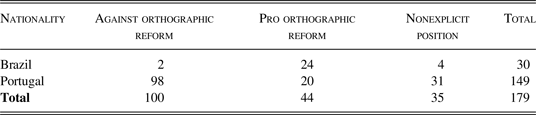
Table 2 shows the distribution of messages in terms of nationality and type of argument.
Arguments and participation.
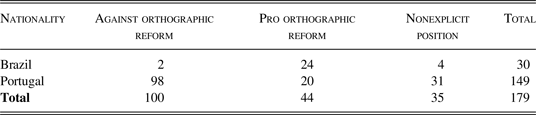
We first note that there is a far larger number of Portuguese participants relative to Brazilians. This may be partially explained by the fact that Público is a Portuguese newspaper. Second, the majority, mostly Portuguese readers, are against orthographic reform. Even though some readers are anonymous and do not indicate where they come from, the syntactic differences between European and Brazilian Portuguese make it possible to identify the origins of the participants. It should also be mentioned that twenty-four of the comments counted as Portuguese originate from the European Diaspora (Portuguese immigrants in Belgium, England, France, Germany, and Ireland). The preponderance of opinions against the reform will probably favor the emergence of a collective voice anchored in social values, ‘in a politico-economic sense’ (Blommaert Reference Blommaert2005:69), and the mobilization of orders of indexicality around a sense of unity and community against the orthographic agreement. The result will be an identity work around the co-construction of ‘groupness’ (Blommaert Reference Blommaert2005:74) and polarized affiliations (or loyalties).
Analytical path: Categories and discourse analysis
Because we intended to analyse the arguments put forward in defense of linguistic rights by European Portuguese speakers, we analyzed only the messages written by those readers. A first look at the data revealed that linguistic rights are claimed by speakers who position themselves against the orthographic reform, on the grounds that the integrity and the purity of the language are threatened (see also Sebba Reference Sebba2009).
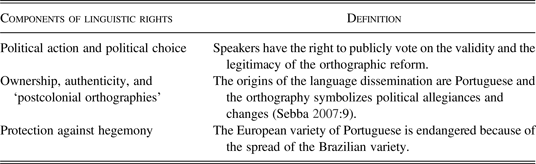
After a preliminary analysis of our corpora regarding the several claims of ‘linguistic rights’ and preservation of the language, three main categories emerged (Table 3).
Categories of analysis.
Combining these arguments, we may anticipate an emotional, nationalistic, and sometimes xenophobic discussion, because of the different sources of normativity to which Brazilian and Portuguese participants conform (Signorini Reference Signorini and Lopes2015). In the next section, a detailed analysis of each of these three categories is given, describing the most frequent beliefs referred to by the Portuguese participants. In order to do this, we selected some messages that illustrate the ‘argumentative’ power of this discussion as well as the emotional dimension.
We do not attempt a quantitative analysis of the corpus or of the distribution of the arguments, because it is the complex (but quite coherent) interplay of the quantitative and qualitative analysis that really explains the linguistic-rights claims and content (based on the idea of ‘self-determination’). A critical discourse analysis of these claims is made, guiding us towards a wide-ranging and multilayered approach to linguistic-rights claims and the dismantling of their validity.
linguistic rights from a majority language perspective: What are ‘linguistic rights’ made of?
Political action and political choice
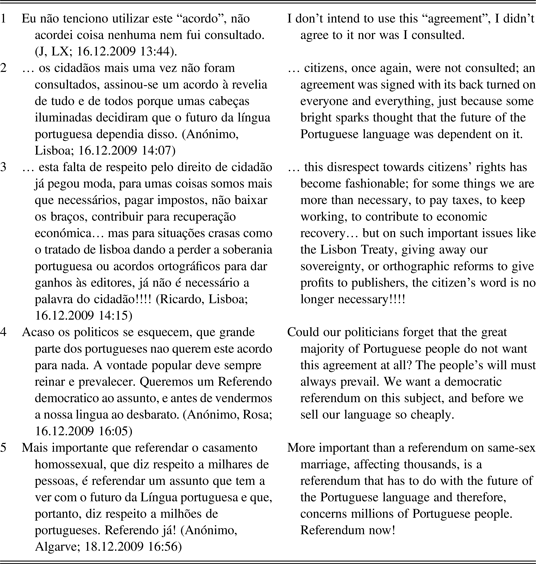
The first set of arguments refers to the right to express one's opinion, by vote or public scrutiny, on whether or not the reform should be carried out (Table 4). Basic principles such as democracy and citizen participation are constantly appealed to in order to justify the call for a referendum.
Political action and political choice arguments.
The basic tenet of this view on linguistic rights is that an orthographic agreement requires the agreement of the speakers. Thus, when this does not occur, citizens may fight against political arrangements, seen as undemocratic and external impositions (cf. article 21 of the Portuguese Constitution).
The claims for a referendum are also politically and socially founded, as messages 3 and 5 illustrate. Message 3 evokes political discourses on the need to keep together to fight the economic crisis and to push Portugal's economy forward (the discourse on ‘a social consensus’ to survive the economic reforms suggested by the so-called ‘Troika’); message 5 evokes the call for a referendum to legalize same-sex marriage in Portugal (which turned out to be unnecessary). Both are based on the idea of social consensus, guiding public opinion towards the possibility and desirability of a referendum on the orthographic reform, as a sign of democratic participation in nationally relevant issues (explicitly compared to the Lisbon Treaty, which was also approved without a referendum).
As a result, the question of the international dimension and pluricentrality of the Portuguese language is not used as a valid argument to fight this supposed deficit of democracy (messages 3 and 4, particularly ‘this disrespect towards citizens’ rights’). In the same way, arguments recognizing the direct intervention of states or academies on orthography as a matter of course or as a normal procedure in such aspects of language planning were simply not invoked, despite the fact that orthography evolves through direct intervention from academies. These opinions also hide the number of Portuguese defenders of the orthographic reform, seen as the ‘enemy from within’, happily duped by political discourse and unrealistic promises of economic profit. It also masks the lack of public support for referendums in Portugal, which usually have meager participation.
Ownership, authenticity and ‘postcolonial orthographies’
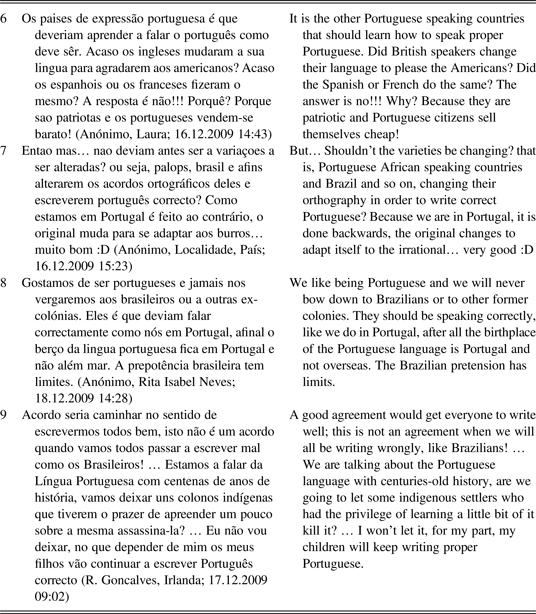
The linguistic rights evoked by European Portuguese speakers constitute an inversion of terms related to ‘postcolonial orthographies’. In these arguments, ideas of ownership and authenticity clearly dispossess the former colonies of any right or legitimacy regarding the evolution of the language.
The arguments presented in Table 5 draw on the conviction that ownership and authenticity are a given, since ‘particular languages typically already have a historical association with specific ethnic/national identities. So, when authenticity is contested, it tends to involve competing varieties of what is considered the “same” language rather than different languages’ (Wee Reference Wee2005:54). The idea of authenticity, in particular, is based on the premise that such a thing as a ‘native speaker’ exists, and that native speakers have some authority upon the language (Rajagopalan Reference Rajagopalan1999). This ‘native speaker’ is, thus, narrowed down to an enigmatic, glorious, and past original context that excludes any ‘transplanted variety’ and any ‘transplanted speaker’ (Rajagopalan Reference Rajagopalan1999:204). The concept of ‘native speaker’ is contested nowadays and is becoming increasingly unhelpful for explaining linguistic dynamics and relationships, so using it in this rhetorical battle about the orthographic reform is completely unreasonable.
Ownership and ‘postcolonial orthographies’ arguments.
These arguments point to other postcolonial relationships (France and African francophone countries, Spain and the Hispanic countries, or England and the United States) in order to justify the right to preserve the European norm (message 6). These messages visibly ignore the fact that ‘colonial language policies have been destructive to the world's linguistic diversity’ (D. Johnson Reference Johnson2013:19). More precisely, this argument refuses an imposed orthographic homogenization even after the imposed linguistic homogenization: ‘adopting a presentist approach inevitably entails ignoring, or at best underemphasizing, the specific socio-historical and socio-political processes by which these majority languages have come to be created, and accepted as dominant and legitimate’ (May Reference May2005:322).
In the opinions expressed in Table 5 the core ideas are: (i) being patriotic means refusing any influence from the former colonies (message 6); (ii) the European norm is the only correct and dignified norm (messages 7, 8, and 9); (iii) former colonies have had the privilege of acquiring (even if only partially) a European language and they should be grateful for that (message 9); and (iv) trying to impose a norm on the former colonizer is an arrogant act (message 8). This set of arguments, absurd as they may seem, have an internal logic: since the European Portuguese model is intended to be the only norm, the authentic and valuable one, it is consequently considered the one worth protecting against linguistic violations and external hegemony. Articles 36 and 43 of the Constitution, granting parents the right to educate their children and the right to resist any impositions on education guided by political or ideological principles, may also contribute to speakers’ perceptions (as in message 9).
These issues show that ideologies and public understanding of language policies are not just ‘opinions’, since they dehistoricize and mystify the power practices supporting them (S. Johnson Reference Johnson2002; Signorini Reference Signorini and Lopes2015). Likewise, they establish and spread an ideology of standardness and correctness (Wee Reference Wee2005) and, thus, a sort of ‘linguistic moral panic’ (Heller & Duchêne Reference Heller and Duchêne2008:4). In fact, the arguments provided by readers tend to erase linguistic destruction and linguistic imposition; they obviously mystify history and the (supposedly) well-founded nature of the spread of the Portuguese language and its strength, unity, and authenticity (see also May Reference May2005 and Wee Reference Wee2005).
Protection against hegemony
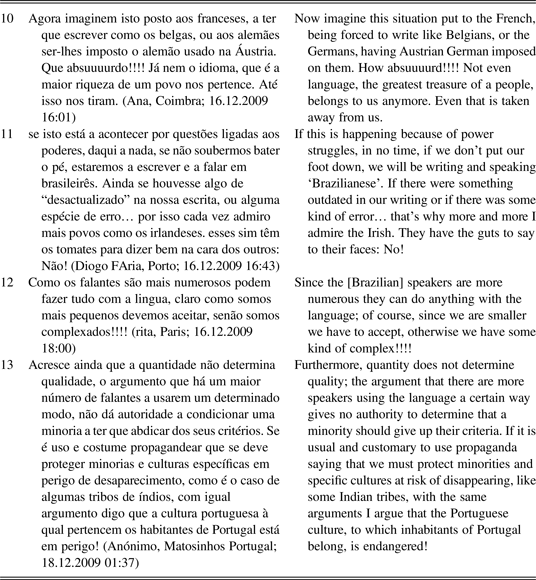
The idea behind this set of arguments (Table 6) is the need to avoid or reverse a ‘language shift’ (or ‘variety shift’ in our case) imposed by the largest community of speakers (see Table 1). It is thus in line with ‘minority rights’ and ‘language endangerment’ discourses.
Protection against hegemony arguments.
This ‘variety shift’ is considered a sort of material and immaterial dispossession (message 10), imposed by the force of numbers (the number of speakers, but also numbers related to economic growth). The arguments seem to invoke a sort of ‘linguicide’, where the stronger linguistic variety tries to eliminate or reduce the weaker variety (with fewer speakers, with scarcer economic resources). Since the Portuguese State aligned with the orthographic reform (and even promoted it), it is thus also seen as being criminally involved in this variety shift, being guilty of complicity, namely, by not preserving Portuguese as the official language in Portugal (disrespecting the Constitution) and by defending its conversion to a so-called ‘Brazilianse’ (message 11) or ‘Brazilian Language’.
The arguments presented in Table 6 acknowledge ‘variety shift’ as a result of economic (message 10), political (message 11), social (messages 12 and 13), and cultural (message 13) supplanting. Thus, the discussion on the orthographic reform directly relates to broader contextual and historical issues, associated with other perceived dispossessions. These include, recently, the financial crisis (and being one of the PIGS, the abbreviation for European countries in economic difficulties: Portugal, Italy, Greece, and Spain), as opposed to the economic growth in Brazil (an emerging BRIC country, alongside Russia, India, and China).
At stake in this argument are also the power relations between languages and language varieties, and between their speakers. This argument tends to forget that communication between speakers of a so-called language or variety is not exempt from problems, and that such things as communicative harmony and happiness in a monolingual setting are always menaced by (or even depend on) power relations, linguistic disturbances, and imbalance in linguistic repertoires. This fight against ‘variety hegemony’ is closely connected to what is perceived as a homogeneous linguistic and cultural identity (from both sides). At the same time, ‘when there are tensions and unresolved political disputes between warring factions, minor or even non-existing differences are blown up so as to justify the existence of different and “mutually incomprehensible” languages’ (Rajagopalan Reference Rajagopalan2001:23). That is why, in this discussion forum, common observations relating to lexical or phonological differences between European and Brazilian Portuguese are used as rhetorical weapons, aiming at supporting separatist ideologies, based upon the idea of two different languages, two different cultures, two different allegiances, spreading the ‘language-culture-nation ideological nexus’ (Heller & Duchêne Reference Heller and Duchêne2008:7). As we can see, the discussions of orthographic reform are mediated by ideologies, that is, what triggers debates on orthographic reform is always a kind of ideological nexus (Sebba Reference Sebba2007).
Another aspect worth analyzing is the inherent contradiction between this set of arguments and those presented under the name ‘ownership, authenticity’. Indeed, if speakers claim the right to be protected against hegemony, recognizing a minority status (the European variety being but one variety of Portuguese), they somehow lose the right to claim ownership of the language, and even to dispute authenticity, since they claim to be linguistically underrepresented in the Portuguese sphere. These participants recognize that a language may have different varieties, in order to be able to claim a minority status and the protection that comes along with it, but this understanding of the pluricentric nature of the Portuguese language contradicts the arguments about the validity of a single ‘norm’ and of a ‘standard’. It is not just about being inconsistent or cynical: it is about manipulating discourse and laudable causes (such as the protection of minorities and minority languages) to make their arguments stronger. It is about speakers’ attachment not to a language, but to a variety (and its cultural load), but also claiming linguistic rights as ‘variety rights’ or ‘the right to a variety’. It is about replacing one classification with another, while keeping the same boundaries in place.
Discussion and further questions: Public understanding of linguistic rights (and wrongs)
In this article, we have examined discussions on the recent orthographic agreement for the Portuguese language, a pluricentric language diversely used across several continents. We saw that European Portuguese speakers who are against this reform evoke linguistic rights based on ideas of purity, ownership, and authenticity that noticeably disinherit the former colonies (especially Brazil) of any legitimacy regarding the evolution of the language (Keating et al. Reference Keating, Solovova and Barradas2015; Signorini Reference Signorini and Lopes2015). The arguments were analyzed through the discursive dismantlement of historical, cultural, political, demographic, economic, and political explanations provided by the participants in a discussion forum. We should note that those arguments were produced in a particularly critical period of Portuguese history. Thus, arguments related to (de/post/re)colonisation, to globalisation, to capitalism (BRIC versus PIGS countries), and to profit-driven commodification of linguistic goods are powerful insights into the conditions that produce and reproduce ideologies about, and hierarchies between, languages and varieties.
Only European Portuguese speakers’ arguments against the orthographic reform were analyzed here. Other stories must be told and other discourses must be combined in order to complete the narrative of the reform of Portuguese orthography. In the analysis presented here, as a part of this narrative, the Portuguese State's language planning interests appear to be in contradiction with the linguistic rights claimed by a part of its citizens. The story of this orthographic reform, following Blommaert (Reference Blommaert1999), is a story of the people who use it, manipulate it, manufacture it, and name it in a context of colonial legacy and reinterpretation, as well as specific political, social, historical, and financial configurations (sometimes mixed up in the discussion, as we saw). Indeed, in the scope of Portuguese language planning, as a widespread language present in Europe, South America, and Africa (as well as Asia and East-Timor), the localized historical processes of orthographic reform must ‘be explored in relation to their … complex interactions with wider global processes of colonisation and decolonisation, transnationalism and globalisation’ (May Reference May2005:323; see also Wee Reference Wee2005 and Blommaert Reference Blommaert1999). This is due to the fact that ‘linguistic ideologies are multiple and derive from specific political, cultural and economic perspectives’ (Moita Lopes Reference Moita Lopes2015:3).
The analysis of the linguistic rights claimed by these speakers shows that public understanding of this specific measure of language planning is constituted by the following premises: (i) The Portuguese people's sovereignty and self-determination is threatened because of the lack of public discussion and participation, (ii) ‘overseas’ countries do not recognize the Portuguese legitimacy to impose the European norm, and (iii) the hegemony of a specific Portuguese speaking country (and variety) above others is clearly a threat to the diversity of varieties, in general, and to minority varieties, in particular. Linguistic rights are thus claimed to question the legitimacy of the content, processes, and factors involved in the orthographic reform.
Similarly to what has been observed by other authors, the quarrels about orthographic (dis)agreements, as we have seen here, highlight the ‘ideological relationship between individual, speech community, and (nation-)state’ (S. Johnson Reference Johnson2002:549). Additionally, our study shows that this ideological relationship extends to speech communities abroad and to all states applying this reform: it is thus concerned with ‘intra-language’ prejudices and intra-language linguistic rights claims (Wee Reference Wee2005:51). Furthermore, these claims of linguistic rights are not about language and they are not about rights tout court, but about competition, autonomy, and nationhood. As we have seen, those prerogatives are anchored in two discursive instances of legitimation: an intertextual one, that acknowledges the historical charge of the discussion, and a pretextual one, that recognizes its politico-economical nature (following Blommaert Reference Blommaert2005:77).
Our analysis has shown how protests regarding the Portuguese orthographic reform are useful for questioning linguistic ideologies, and this from two perspectives: (i) the arguments put forward by opponents question the one-way perspective on linguistic-rights discourses that usually highlights speakers’ rights against external impositions and inter-linguistic threats; and (ii) debates on linguistic issues in general, and orthographic aspects in particular, are far more ideological and emotional than conscientious and unbiased. This explains why ‘ideologies not only constrain the formulation [and application, we add] of policies, they are also central to public discussion and public acceptance of policies’ (Tollefson Reference Tollefson and Tollefson2002:180).
Both of these perspectives call for a strong need to contextualize discourses and rhetorical choices, and to adopt a diachronic approach to linguistic rights: not all perceived rights are right. Indeed, evoking linguistic rights, even if surrounded by the rhetoric of threat, endangerment, or democracy, does not legitimate those claims, as we have observed. In the area of linguistic rights and language planning, this article raises several critical and ethical questions: are there any limits to (claims of) linguistic rights? What are those limits? Is intra-linguistic group consensus required to claim linguistic rights? Can we evoke intra-linguistic/inter-variety rights as the European Portuguese speakers do, against standardization and homogenization? How far are questions regarding language planning and linguistic rights a matter of ideology in public discourse and research, and thus, in ‘banal nationalism’ discourses? How paternalist or violent are discourses on linguistic rights? How unfair can they turn out to be?