Approximately 1 in 8 children in the United States reside with a parent who has a substance use disorder (Lipari & Van Horn, Reference Lipari and Van Horn2017). Children of parents with substance use disorders are at an increased risk of maladjustment and psychopathology, such as aggression and behavioral problems (Luthar, Cushing, Merikangas, & Rounsaville, Reference Luthar, Cushing, Merikangas and Rounsaville1998), antisocial behavior (Waller et al., Reference Waller, Gardner, Hyde, Shaw, Dishion and Wilson2012), and problematic substance use in adolescence and adulthood (Orford & Velleman, Reference Orford and Velleman1990). Additionally, parental substance use disorders have been linked to child internalizing symptomatology, including mood disorders and anxiety (Peleg-Oren & Teichman, Reference Peleg-Oren and Teichman2006). Given the prevalence of parental substance use disorders and their effects on child development, it is imperative to understand the pathways through which parental chemical dependence affects children. Parenting is one of the most proximal and salient developmental contexts, so caregiving behaviors significantly influence developmental trajectories. However, parenting is also adversely affected by chemical dependence (Mayes & Truman, Reference Mayes and Truman2002). Thus, maladaptive caregiving may be one significant pathway through which parental substance use disorders undermine child adjustment and facilitate the development of child psychopathology. Specifically, parents struggling with substance use disorders are thought to have negative parenting attitudes (Flykt et al., Reference Flykt, Punamäki, Belt, Biringen, Salo, Posa and Pajulo2012), display more maladaptive parenting behaviors (Mayes & Truman, Reference Mayes and Truman2002), and have poorer relationships with their children (Slesnik, Feng, Brakenhoff, & Brigham, Reference Slesnik, Feng, Brakenhoff and Brigham2014).
Prior research on parental substance abuse has focused on many substances of abuse; however, alcohol is one of the most commonly abused substances, and one of the most readily available (Sussman, Lisha, & Griffiths, Reference Sussman, Lisha and Griffiths2011). It is important to examine alcohol dependence among mothers given that rates of alcohol dependence among women of childrearing age are steadily increasing (McHugh, Wigderson, & Greenfield, Reference McHugh, Wigderson and Greenfield2014). Furthermore, the detrimental effects of pathological alcohol use are exaggerated among women, which can have significant implications for parenting (Mann et al., Reference Mann, Ackermann, Croissant, Mundle, Nakovics and Diehl2005). Testifying to this, research has demonstrated that alcohol interferes with many of cognitive processes that facilitate sensitive and supportive parenting among mothers (e.g. Kim et al., Reference Kim, Iyengar, Mayes, Potenza, Rutherford and Strathearn2017). When taken together, these findings underscore the importance of examining the pathways through which maternal alcohol dependence undermines caregiving.
Overall, several studies suggest a strong link between parental substance dependence and harsh, coercive caregiving practices (Famularo, Kinscherff, & Fenton, Reference Famularo, Kinscherff and Fenton1992; Kim, Pears, Fisher, Connelly, & Landsverk, Reference Kim, Pears, Fisher, Connelly and Landsverk2010; Miller, Smyth, & Mudar, Reference Miller, Smyth and Mudar1999). Parental harshness is one of the primary antecedents of child maltreatment (Afifi, Mota, Sareen, & MacMillan, Reference Afifi, Mota, Sareen and MacMillan2017) and is broadly linked with maladaptive developmental outcomes, such as child antisocial behavior and aggression (Chang, Schwartz, Dodge, & McBride-Chang, Reference Chang, Schwartz, Dodge and McBride-Chang2003). Nevertheless, the few studies focusing on parental harshness among chemically-dependent parents have yet to investigate harsh childrearing practices via parenting process models and developmental theoretical frameworks. Thus, one of the preliminary objectives of this study is to use a developmental process model of caregiving to further understand whether and how maternal alcohol dependence is associated with harsh caregiving. Furthermore, parenting behaviors may manifest and operate differently in distinct childrearing contexts. Therefore, although parental aggressiveness is linked with parental substance use disorders (Hien & Honeyman, Reference Hien and Honeyman2000), it is unknown whether the effects of maternal alcohol dependence may be similar or different across caregiving situations. Thus, this study's second objective is to examine changes in harsh parenting behaviors over time and across two distinct parenting contexts. Further, process models of parenting emphasize that caregiving behaviors are influenced by the interplay between parent and child characteristics, such as parent psychopathology and child temperament (Belsky, Reference Belsky1984); however, this perspective has not been explicitly examined within the parental substance abuse literature. Therefore, the final objective of this study is to examine whether and how dimensions of child temperament may moderate the relationship between parental alcohol dependence and harsh caregiving over time and in different caregiving contexts.
Parenting in the Context of Maternal Alcohol Dependence
Parenting is a dynamic and multifaceted process that features many challenges and stressors (Deater-Deckard, Reference Deater-Deckard1998; Strohschein, Gauthier, Campbell, & Kleparchuk, Reference Strohschein, Gauthier, Campbell and Kleparchuk2008). As such, caregiving behaviors may be influenced by several intertwining factors, namely characteristics of the parent, the child, and the broader familial environment (Abidin, Reference Abidin1992). Specifically, Belsky's (Reference Belsky1984) parenting process model introduces three dimensions that determine caregiving, the first being characteristics of the parent. For alcohol-dependent mothers, alcohol dependence may either deplete or interfere with the psychological resources needed for optimal caregiving (e.g. Kim et al., Reference Kim, Iyengar, Mayes, Potenza, Rutherford and Strathearn2017) such as coping skills needed to successfully navigate the challenges and demands of childrearing, particularly in stressful parenting situations (McCormick & Smith, Reference McCormick and Smith1995). Incidentally, impaired or adverse coping strategies may significantly contribute to maternal aggressive behavior (Hien & Honeyman, Reference Hien and Honeyman2000). Thus, this illustrates one pathway through which maternal alcohol dependence undermines caregiving and facilitates expressions of maternal harsh parenting.
However, the stressors inherent to the parenting role may differ across distinct parenting situations (Deater-Deckard, Reference Deater-Deckard1998). In particular, some caregiving contexts may be more or less stressful for parents to navigate. For example, discipline contexts can be inherently stressful for parents given the socialization goals of child compliance and behavioral control in comparison to play contexts in which the socialization goal is affiliative and prosocial. Maternal characteristics may be essential factors that influence caregiving behaviors in more demanding childrearing contexts (Sturge-Apple, Suor, & Skibo, Reference Sturge-Apple, Suor and Skibo2014). Research has demonstrated that alcohol dependence may dysregulate neural stress response systems (Rutherford & Mayes, Reference Rutherford and Mayes2017) and reduce distress tolerance (Leyro, Zvolensky, & Bernstein, Reference Leyro, Zvolensky and Bernstein2010), thereby increasing maladaptive behavioral coping responses to environmental stressors. Thus, considered within parenting process models, alcohol-dependent mothers may be particularly vulnerable to parenting stressors, especially in stressful caregiving situations. As such, harsh parenting behaviors may be more likely to manifest when parents struggle to effectively regulate stress responses in stressful childrearing contexts such as discipline situations when compared with more benign contexts (Webster-Stratton, Reference Webster-Stratton1990). In short, maternal alcohol dependence is one maternal characteristic that compromises sensitive, nurturing, and adaptive caregiving behaviors and can influence the development of harsh parenting practices. Although this link between maternal alcohol dependence and parenting deficits is well documented, less is known about how maternal alcohol dependence predicts parenting difficulties across challenging parenting contexts.
It may be particularly important to examine harsh parenting among alcohol dependent mothers with toddlers. Specifically, early childhood is a critical period for children's development of core regulatory processes, such as emotion and behavioral regulation (Bronson, Reference Bronson2000). Harsh parenting behaviors, which peak during early childhood (Kim et al., Reference Kim, Pears, Fisher, Connelly and Landsverk2010) significantly undermine children's ability to successfully develop these fundamental capabilities (Hughes & Ensor, Reference Hughes and Ensor2006). Moreover, parental substance abuse may have a particularly strong negative effect on children's emotional and behavioral adjustment during this developmental period (Salo & Flykt, Reference Salo, Flykt, Suchman, Pajulo and Mayes2013), which can increase risk for child psychopathology (for a review, see Velleman & Templeton, Reference Velleman and Templeton2007). Furthermore, parental harshness during early childhood not only affects risk for psychopathology during this developmental period but can also have a lasting effect on adjustment during adolescence and adulthood (Raby, Roisman, Fraley, & Simpson, Reference Raby, Roisman, Fraley and Simpson2015). When consolidating these notions, it is vital to further understand the association between maternal alcohol dependence and harsh parenting among mothers with young children.
The Moderating Role of Child Negative Emotionality
Research on parenting in the context of maternal alcohol dependence has yet to comprehensively examine other factors that could potentially influence harsh parenting across distinct childrearing situations, such as child characteristics. Parenting process models posit that child factors also aid in determining parenting behaviors in different caregiving contexts (Belsky, Reference Belsky1984). According to these theoretical frameworks, children's characteristics may moderate the caregiving that they receive (Davidov, Knafo-Noam, Serbin, & Moss, Reference Davidov, Knafo-Noam, Serbin and Moss2015). One such characteristic that has been shown to influence caregiving has been child temperament (i.e., Sturge-Apple, Davies, Martin, Cicchetti, & Hentges, Reference Sturge-Apple, Davies, Martin, Cicchetti and Hentges2012), often defined as biologically-based differences in reactivity and self-regulation (Rothbart & Bates, Reference Rothbart, Bates, Damon and Eisenberg1998). Although many studies report main effects of child temperament on parenting (i.e., Gallagher, Reference Gallagher2002), few studies have examined the potential moderating role of temperament on parenting from within parenting process models. Nonetheless, aspects of child temperament have been shown to moderate relationships between maternal characteristics— such as maternal personality—and parenting behaviors (Clark, Kochanska, & Ready, Reference Clark, Kochanska and Ready2000; Koenig, Barry, & Kochanska, Reference Koenig, Barry and Kochanska2010). Other findings show that child temperamental traits may also moderate associations between parenting and parent's stress reactivity during parent–child interactions (Martorell & Bugental, Reference Martorell and Bugental2006; Merwin, Smith & Dougherty, Reference Merwin, Smith and Dougherty2015).
Historically, research examining the potentiating role of child temperament in family process models has focused on child negative emotionality, defined as a child's tendency to react to environmental stimuli with high levels of anger, irritability, fear, or sadness (Rothbart, Ahadi, & Hershey, Reference Rothbart, Ahadi and Hershey1994). Particularly, child negative emotionality has been linked with increased parenting stress (Gelfand, Teti, & Radin Fox, Reference Gelfand, Teti and Radin Fox1992), suggesting that high levels of parenting stress may result in deficits in the provision of sensitive, warm parenting in the presence of child negative emotionality. Given that mothers from at-risk populations exhibit greater deficits in caregiving when stressed (Martorell & Bugental, Reference Martorell and Bugental2006) and that alcohol dependence significantly interferes with one's ability to regulate stress, the links between maternal alcohol dependence and harsh parenting may be particularly exaggerated in the presence of child negative emotionality. Although child temperament among children of alcohol-dependent parents has been examined (Peterson Edwards, Leonard, & Eiden, Reference Peterson Edwards, Leonard and Eiden2001), less is known about the influence of child negative emotionality in caregiving among alcohol-dependent mothers and whether the interaction between child negative emotionality and maternal alcohol dependence may differ in specific caregiving contexts. To address this gap, the current study examines the moderating role of two dimensions of child negative emotionality in the association between maternal alcohol dependence and harsh parenting within stressful and benign caregiving contexts.
Although commonly examined as one overarching temperamental construct, conceptualizations of negative emotionality have expanded to consider distinct dimensions of emotionality, each serving as behavioral strategies children employ to adapt to environmental stressors (Rothbart et al., Reference Rothbart, Ahadi and Hershey1994). From this perspective, children faced with threat or novelty may respond to distress in two distinct ways. The first, dominant negative emotionality typically refers to defensive affective responses, such as frustration and anger in the face of environmental threat or challenge (Calkins & Johnson, Reference Calkins and Johnson1998). Specifically, young children of alcohol dependent parents may respond to their maladaptive caregiving environments with expressions of frustration or aggressiveness (Edwards, Eiden, Colder, & Leonard, Reference Edwards, Eiden, Colder and Leonard2006). Therefore, this aspect of child emotionality may be a particularly salient temperamental expression to examine within this population of children. Alternatively, expressions of vulnerable negative affect reflect a dimension of negative emotionality in which children respond to stressful external stimuli via expressions of sadness, crying, freezing, and withdrawal. Research has demonstrated that these two dimensions of negative emotionality—dominant negative affect (i.e., frustration) and vulnerable negative affect (i.e., fearfulness)—may operate as distinct temperamental constructs that differentially influence child adjustment (Rothbart et al., Reference Rothbart, Ahadi and Hershey1994); however, few studies have focused on whether and how these dimensions of emotionality moderate caregiving.
To our knowledge, the few studies that have examined children's emotionality as a moderator between parental characteristics and caregiving behaviors have been concentrated in the maternal personality literature. Although maternal personality is not the focus of our paper, findings from this research area provide some conceptual and predictive utility for examining child emotionality as a moderator of parenting. For example, Coplan and colleagues (Reference Coplan, Reichel and Rowan2009) found that aspects of maternal personality were strongly negatively associated with harsh parenting among parents of emotionally-dysregulated children. Additionally, a similar study found that mothers with low optimism displayed less positive parenting when parenting difficult, anger-prone children (Koenig et al., Reference Koenig, Barry and Kochanska2010). In short, these studies proffer that aspects of children's negative emotionality may interact with parent characteristics to predict caregiving behavior.
We believe that components of child negative emotionality—frustration and fear—may differentially evoke caregiving behaviors from their parents, thereby operating as a moderator of caregiving in distinct parenting contexts. Specifically, in discipline contexts, children may be more likely to display opposition in reaction to their parents’ demands for behavioral compliance. However, high levels of fearfulness may make children easier to discipline, which may increase child compliance (Kochanska, Coy, & Murray Reference Kochanska, Coy and Murray2001; van der Mark, Bakersmans-Krandenberg, & van Ijzendoorn, Reference van der Mark, Bakersmans-Krandenberg and van Ijzendoorn2002). Importantly, if children are easier to discipline and are more likely to comply with their parents’ commands, parents may not need to use frequent or intense harsh discipline tactics to obtain or maintain child compliance. This offers one thought as to how and why child fearfulness may moderate harsh caregiving. Conversely, high levels of child frustration may predict more behavioral and emotional problems (Lengua & Kovacs, Reference Lengua and Kovacs2005; Lengua, Reference Lengua2006; Rothbart & Bates, Reference Rothbart, Bates, Eisenberg, Damon and Lerner2006), which can increase children's behavioral defiance within discipline contexts. In the presence of these difficulties, parents may find caregiving to be more stressful, difficult, and emotionally challenging (i.e., Pelham et al., Reference Pelham, Lang, Atketson, Murphy, Gnagy, Greiner and Greenslade1997). This may, in turn, result in higher levels of harsh parenting. In sum, aspects of child emotionality may moderate caregiving in specific parent–child situations; however, the concept that child factors moderate parenting has been significantly underexplored.
Thus, while research has extensively examined children's emotional responses to insensitive parenting (Cummings, Goeke-Morey, & Papp, Reference Cummings, Goeke-Morey and Papp2003; Pluess & Belsky, Reference Pluess and Belsky2010; Solantaus-Simula, Punamäki, & Beardslee, Reference Solantaus-Simula, Punamäki and Beardslee2002), underexplored is how children's emotional responses may moderate determinants of caregiving and insensitive parenting. Consequently, less is known about whether parents’ behaviors manifest differently when child emotions are expressed in different intensities and in different caregiving situations. Important for our study, when children express these intense emotions, alcohol-dependent parents may react with heightened levels of maladaptive caregiving, including harsh parenting behaviors. However, no prior study has examined child negative emotionality as a moderator of parenting among chemically dependent mothers. Additionally, to our knowledge, no study has examined relationships between distinct components of child negative emotionality and harsh caregiving in the context of maternal alcohol dependence.
The present study
In sum, maternal alcohol dependence significantly interferes with caregiving behaviors that facilitate positive child adjustment; however, missing from the literature is a thorough integration of developmental theoretical frameworks that examine parenting as a multifaceted process and developmental context. Moreover, less is known about how maternal caregiving practices in the context of alcohol dependence may change over time and across different caregiving situations. Recent theoretical frameworks also suggest that child characteristics may affect caregiving in diverse contexts. The present study is designed to address these important gaps by examining the joint role of maternal alcohol dependence and child negative emotionality as predictors of harsh parenting across childrearing contexts. Moreover, the current study seeks to address several methodological and conceptual limitations seen in prior research. First, many studies examining alcohol dependence recruit samples from rehabilitation and psychiatric clinics to ensure variability in the levels and subsequent effects of substance abuse. However, this excludes parents who may struggle with untreated or undiagnosed chemical dependence (West & Prinz, Reference West and Prinz1987). Therefore, this study will use a community sample to better understand associations between maternal alcohol dependence and parenting for mothers who are not receiving treatment for their alcohol use disorder. Additionally, prior studies often fail to distinguish between alcohol use, abuse, and dependence (Mayes & Truman, Reference Mayes and Truman2002). Thus, this study included measures for alcohol dependence based on diagnostic criteria that indicate the most significant and debilitating psychological impairments stemming from alcohol abuse (Segal, Reference Segal2010).
Relatedly, prior studies of substance-abusing mothers have relied on parent reports and hypothetical vignettes of parenting behaviors even though research with other at-risk parenting populations suggest recommend using behavioral observation techniques that allow researchers to garner rich, comprehensive, unbiased “snapshots” of parenting in context (Herbers, Garcia, & Obradović, Reference Herbers, Garcia and Obradović2017). Many studies of at-risk parents also focus on physical expressions of parental harshness, even though parental harshness includes both physical and verbal behavior toward the child (Wang & Kenny, Reference Wang and Kenny2014). Thus, verbal expressions of harshness among alcohol dependent mothers have been underexplored. Therefore, this study will use behavioral observation coding of physical and verbal maternal harshness during parent–child interactions. Lastly, given a lack of research examining maternal alcohol dependence and caregiving across early childhood, the present study employs a longitudinal research design to examine whether and how processes of caregiving among alcohol-dependent mothers change over time.
Given findings from prior research on parenting and maternal alcohol use disorders (i.e., Miller et al., Reference Miller, Smyth and Mudar1999), we hypothesize that maternal alcohol dependence would predict increases in harsh parenting over time in the more challenging and demanding parenting context relative to the less challenging and demanding parenting context. Guided by contextual models of caregiving and parenting stress, we also hypothesized that this association will be moderated by child temperament characteristics in a manner consistent with diathesis–stress frameworks. Given the dearth of research examining how child emotionality may moderate determinants of caregiving, we made no a priori hypotheses with respect to the moderating role of dominant and vulnerable negative affect.
Methods
Data for this project were drawn from a larger 3-year longitudinal study that examined children's socioemotional adjustment in the context of interparental conflict. Secondary data analysis included an assessment of maternal alcohol dependence, maternal depression, PTSD symptomatology, and behavioral observation of parenting behaviors and child temperamental traits.
Participants
Participants included 201 two-year old children and their mothers, who were residing in a moderately sized metropolitan area in the Northeastern United States. Child participants were approximately 26 months old at the first wave of data collection. A two-step recruitment process was used to ensure the enrollment of a high-risk sample endorsing an array of psychological risk factors and sociodemographic adversity. The first step entailed recruitment of subjects through agencies serving disadvantaged children and families, including Temporary Assistance to Needy Families rosters obtained from the Department of Health and Human Services and the county family court system. A truncated version of the Conflict Tactics Scale 2 (CTS2; Straus, Hamby, Boney-McCoy, & Sugarman, Reference Straus, Hamby, Boney-McCoy and Sugarman1996) was administered in the second step to ensure proportionate distribution of exposure to interpartner conflict. Other inclusion criteria were that (a) the target child's biological mother was the participating female adult, (b) the child participant was approximately 27 months old and without significant developmental delays, and (c) mothers’ male relationship partner had regular contact with the mother–child dyad during the year prior to participation.
Median annual income for families was $18,300 per year, and many mothers (30%) and their partners (24%) had not completed secondary education. A substantial percentage of the families received public assistance (95%), and nearly all of the families were impoverished according to the United States Federal Poverty Guidelines (99.5%). The median age for child participants at Wave 1 of data collection was 26 months (SD = 1.69), with 44% of the sample consisting of females. Most of the participants identified as African American (56%), followed by moderate proportions of European American (23%), and smaller percentages of Latino (11%), multiracial (7%), and “other” (3%).
Procedure
Data for the initial study were collected across three waves, each spaced one year apart, with the first wave beginning when the child was approximately 2 years of age. For each wave, mother–child dyads made three visits to a research laboratory within a one-to-two-week interval to obtain and complete the study's assessments, all of which were approved by the university's Institutional Review Board prior to their dissemination. Mothers completed questionnaires and interviews with a member of the research team across the three visits. Additionally, a parent–child free-play/cleanup interaction task was recorded and subsequently coded by a team of independent coders. Procedures were standardized across all participants.
Mother–child free-play and clean-up task
An unstructured parent–child free-play paradigm was used to assess maternal parenting behaviors at each wave. This task was an adaptation of the ABA free-play and clean-up task used in Beeghly and Cicchetti (Reference Beeghly and Cicchetti1994). Specifically, the free-play paradigm resembles a parenting context characterized by low levels of stress, demandingness, and challenge, whereas the cleanup task represents a more stressful parenting situation that also elicits aversive affective states from children. The main reason that this context is perceived as being more challenging is likely because children often disregard their parent's instructions to cleanup and mothers are responsible for gaining child compliance in a short amount of time. This mismatch between the mother's goals and the child's interests is thought to increase the amount of stress, childrearing demands, and responsibility perceived by the mother. In summary, these parent–child interaction tasks provide an effective framework that adequately contextualizes caregiving in two distinct contexts: benign and challenging parenting situations. Therefore, the use of this conceptual approach allows for a more comprehensive interpretation and understanding on the effects of maternal alcohol dependence on parenting behaviors in different childrearing situations.
Child “dominant” and “vulnerable” negative emotionality
At Wave 1, children were administered a series of standard temperament paradigms that were designed to assess children's emotional reactivity in novel situations (as used in Kagan, Reznik, & Snidman, Reference Kagan, Reznik and Snidman1987; Putnam & Stifter, Reference Putnam and Stifter2005). First, the experimenter escorted the child into a room containing several unusual objects. Mothers were in the same room but were instructed to complete questionnaires and refrain from interfering with the procedure unless there was a concern for the child's safety. Following a period where the child was free to explore the contents of the room, an experimenter instructed the child to maneuver the objects in different ways. In the next paradigm, an unfamiliar experimenter dressed as a clown invited the child to play with different toys for 2 min. After the clown left the observation room, a different experimenter came to the room and presented the child with a robot that was holding an attractive toy. The robot was operated from an adjacent room via remote control and alternated between periods of inactivity and movement. The experimenter encouraged the child to approach the toy during periods in which the toy was not moving. In the final part of the paradigm, the primary experimenter portrayed the following series of behaviors and asked the child to emulate them: (a) reach behind a black curtain to retrieve a doll, (b) place a finger in glasses of water and prune juice, and (c) pick up a rubber snake and let it slide back upon the table. Coding of these temperament paradigms have been used in prior studies of at-risk parents and children with good reliability (Davies, Cicchetti, & Martin, Reference Davies, Cicchetti and Martin2012; Sturge-Apple et al., Reference Sturge-Apple, Davies, Martin, Cicchetti and Hentges2012).
Measures
Maternal alcohol dependence
Maternal alcohol dependence was assessed via the Diagnostic Interview Schedule IV (DIS-IV; Robins, Cottler, Bucholz, & Compton, Reference Robins, Cottler, Bucholz and Compton1995). The DIS-IV is a comprehensive measure of adult psychopathology, including mood/depressive disorders (i.e., major depression), anxiety disorders (i.e., generalized anxiety disorder), and posttraumatic stress disorders. Furthermore, this assessment features a rich array of varying levels of substance use and misuse, including alcohol dependence. This semistructured interview is specifically designed for use by nonclinical interviewers and researchers to capture symptoms and impairments characteristic of alcohol use disorders as delineated in the fourth edition of the Diagnostic and Statistical Manual of Mental Disorders (DSM-IV-TR; American Psychiatric Association, 2000). This study will use the seven-item subscale for the most problematic level of use for alcohol: alcohol dependence, which can be summed and scored to create an index of alcohol dependency. Responses to each of the items are recorded in a “yes/no” format. The items included in the subscale are (a) “alcohol tolerance,” (b) “alcohol withdrawal,” (c) “alcohol is often taken in larger amounts or over longer period than intended,” (d) “persistent desire or unsuccessful efforts to cut down or control alcohol use,” (e) “great deal of time spent in activities to obtain, use, or recover from alcohol,” (f) “important activities are given up or reduced because of alcohol,” and (g) “alcohol use is continued despite a persistent physical or psychological problem that is caused or exacerbated by alcohol.” Importantly, this index represents a combination of current, past-year, and lifetime alcohol-related impairments. This robust and comprehensive index allowed us to examine the distal and proximal effects of significant alcohol misuse on parenting behaviors while also accounting for the heterogeneity in the prevalence and trajectory of alcohol dependence and alcohol-related impairments among different ethnic groups (Caetano, Clark, & Tam, Reference Caetano, Clark and Tam1998; Collins & McNair, Reference Collins and McNair2002; Galvin & Caetano, Reference Galvin and Caetano2003; Lex, Reference Lex1987). The DIS-IV was completed by the mother at the study's first wave with assistance from a trained experimenter. This measure has been successfully used in prior studies with community samples, and the overall psychometric properties have been particularly strong (Compton & Cottler, Reference Compton and Cottler2004).
Child “vulnerable” and “dominant” negative affect
Video recordings of children's behavioral expressions of emotions during the unfamiliar episodes described above were independently rated by two coders. Consistent with prior procedures (Davies et al., Reference Davies, Cicchetti and Martin2012; Sturge-Apple et al., Reference Sturge-Apple, Davies, Martin, Cicchetti and Hentges2012), coders rated indices of “dominant” and “vulnerable” temperamental traits along 5-point rating scales ranging from (0) “no” to (4) “multiple, intense, and prolonged indications.” The dominant negative affect subscale is indicated by aggressive and assertive behavioral responses to novel situations, high levels of frustration, anger, and hostility. The vulnerable negative affect subscale is indicated by distress, sadness crying, fear in novel situations, and emotional inhibition, assessed as the ability and tendency to restrain emotional expression. The intraclass correlation coefficients of the inter-rater reliability for the two independent coders ranged from .85 to .98 across the temperament dimensions, indicating good to excellent reliability (Cicchetti, Reference Cicchetti1994).
Maternal harsh caregiving
Maternal harsh caregiving was assessed via behavioral observation in both the free-play and clean-up tasks at Wave 1 when the child was 2 years old, and at Wave 2 when the child was 3 years old. Observational ratings were conducted using the scale for Harsh Maternal Caregiving from the Iowa Family Interaction Rating Scales (IFIRS; Melby & Conger, Reference Melby, Conger, Kerig and Lindahl2001). The IFIRS coding system features a global coding paradigm that was designed to examine benign and challenging parenting contexts. The harsh subscale measures the extent to which the parent exhibits harsh, critical, angry, rejecting, and/or disapproving behavior toward the child's behavior, appearance, or state. The parental responses included in this coding construct are intended to capture both verbal and nonverbal expressions directed at the child. Two independent coders completed ratings on a 9-point Likert scale ranging from 1 (not at all characteristic) to 9 (mainly characteristic). The IFIRS system has been used in prior studies examining harsh caregiving behaviors across childrearing contexts, including free-play (benign) and cleanup/compliance (challenging) contexts (Sturge-Apple et al., Reference Sturge-Apple, Davies, Martin, Cicchetti and Hentges2012). The intraclass correlation coefficients of the inter-rater reliability for the two independent coders ranged from .89 to .98 across the three coders and across the two interaction paradigms, thereby indicating good to excellent reliability (Cicchetti, Reference Cicchetti1994).
Covariate: Maternal depression symptomatology
An index of depression symptoms was also assessed using the DIS-IV (Robins et al., Reference Robins, Cottler, Bucholz and Compton1995). Similar to the assessment for alcohol dependence, this study will use a nine-item index designed to capture symptoms of major depression that adhere to the diagnostic criteria for depression outlined in the DSM-IV-TR (American Psychiatric Association, 2000). The symptoms included in this subscale are (a) “sad, angry, or depressed,” (b) “lost interest,” (c) “appetite problems,” (d) “sleep problems,” (e) “slow/restless,” (f) “tired or lack of energy,” (g) “feeling worthless or guilty,” (h) “trouble thinking,” and (i) “thoughts about death or suicide.” Each symptom was included if the participants answered “yes” to a question that captured that specific symptom.
Covariate: Maternal post-traumatic stress symptomatology (PTSS)
Maternal posttraumatic stress disorder symptoms (PTSS) were also measured using the DIS-IV's four-item index of symptoms drawn from the DSM-IV-TR diagnostic criteria for PTSD. This index features the following symptoms: (a) “difficulty falling asleep or staying asleep,” (b) “irritability or outbursts of anger,” (c) “difficulty concentrating,” (d) “hypervigilance,” and (e) “exaggerated startle response.” The responses for these items were summed with higher scores indicating higher levels of PTSD symptomatology.
Results
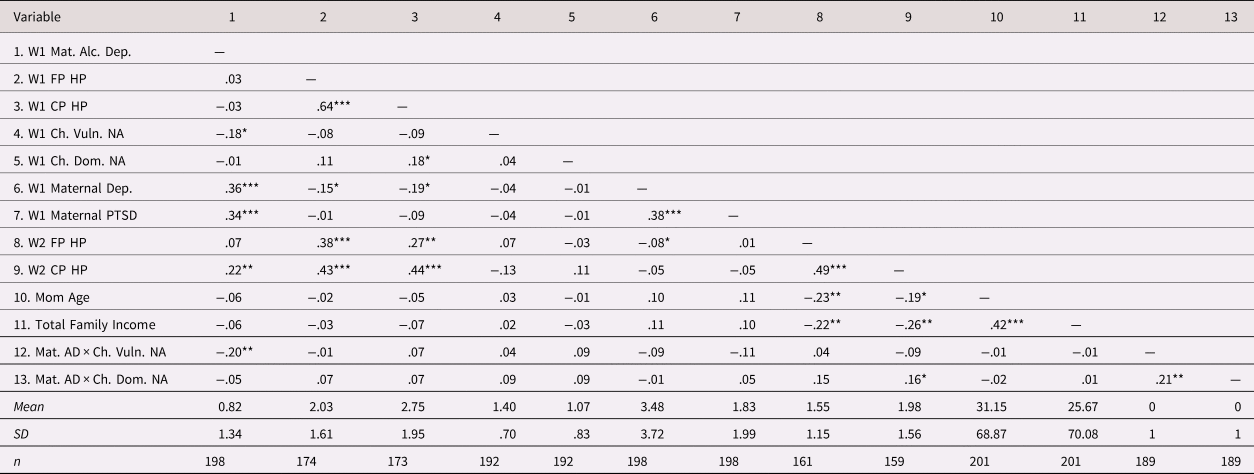
Descriptive statistics, including means, standard deviations, and zero-order correlations between the study's primary variables were examined using SPSS Version 25 (IBM Corp., 2017) and are presented in Table 1. Seventy-five mothers (37.9%) reported at least one psychosocial impairment that stemmed from alcohol dependence. A smaller subset of mothers (11.6%) endorsed three or more impairments associated with alcohol dependence. Patterns of missingness were examined using Little's (Reference Little1988) test for data missing completely at random (MCAR). The null hypothesis for this test is that the data are missing completely at random. Results indicated that the data were missing completely at random, χ2 = 81.704, df = 97, p = .867. To maximize the study's sample size and minimize the effect of missing data, full information maximum likelihood was selected as the estimator for our structural equation models that were carried out in AMOS Version 24 (Arbuckle, Reference Arbuckle2017).
Means, standard deviations, and correlations for all primary study variables

Note: Maternal alcohol dependence, maternal depression, maternal PTSD, child vulnerable negative affect, child dominant negative affect, and the interaction terms between maternal alcohol dependence and the two child temperament scales were centered. W1 = Wave 1; W2 = Wave 2; FP = Free Play; CP = Cleanup; Ch. = Child; Vuln. = Vulnerable; Dom. = Dominant; NA = Negative Affect; Dep. = Depression; AD = Alcohol Dependence. *p < .05. **p < .01. ***p < .001.
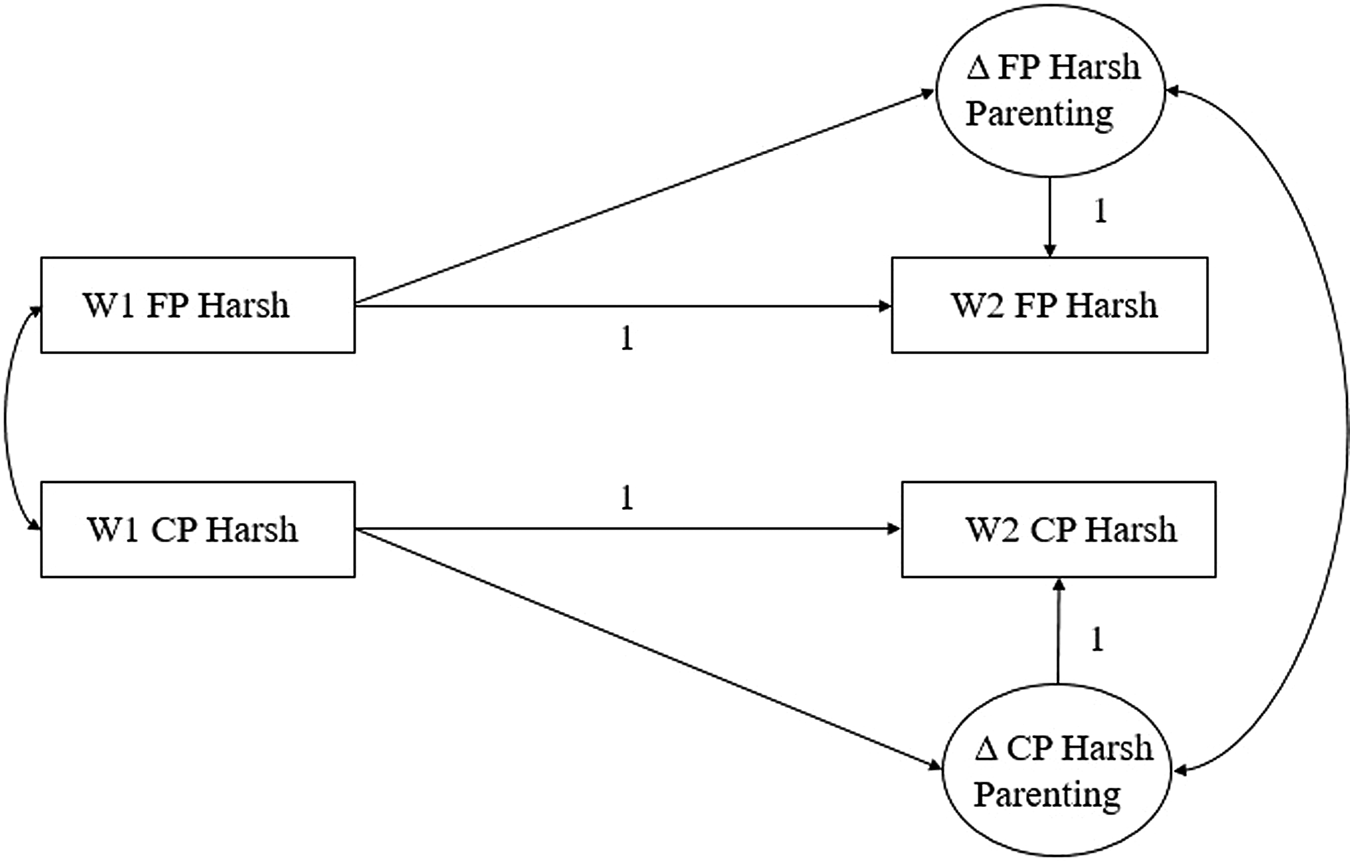
Change in maternal harsh caregiving over time was parameterized using a latent difference scores (LDS) approach (see Figure 1). Latent difference scores models are useful statistical models for examining change in an endogenous variable across multiple data points (McArdle & Hamagami, Reference McArdle, Hamagami, Collins and Sayer2001). The LDS approach accounts for internal sources of change in a dependent variable, including the influence of initial levels on subsequent levels of that variable (King, McArdle, Saxe, Doron-LaMarca, & Orazem, Reference King, McArdle, Saxe, Doron-LaMarca and Orazem2006). Theoretically, this framework is fitting for inclusion in this study because maternal harsh caregiving is thought to naturally decrease across early childhood (Kim et al., Reference Kim, Pears, Fisher, Connelly and Landsverk2010) and parametrization of LDS models account for the tendency of individuals to experience natural change over time while allowing for interindividual differences in change (King et al., Reference King, McArdle, Saxe, Doron-LaMarca and Orazem2006). Furthermore, prior research has evidenced the utility of LDS models in examining change in parenting behaviors across early childhood (i.e., Sturge-Apple, Jones, & Suor, Reference Sturge-Apple, Jones and Suor2017).
Parameterization of latent difference score (LDS) model for baseline and change in maternal harsh parenting in the free play and cleanup tasks. W1 = Wave 1; W2 = Wave 2; FP = Free Play; CP = Cleanup.

Analyses first examined the effect of maternal alcohol dependence on change in harsh caregiving over time and across benign and challenging parenting situations. Pairwise parameter comparisons were examined to determine whether the differential strength of predictive pathways were significantly different from one another. Next, the moderating role of child dominant negative and vulnerable affect in the association between maternal alcohol dependence and changes in harsh parenting in benign and challenging parenting contexts was examined. To accomplish this, the two temperamental profiles were mean centered and used to create interaction terms with maternal alcohol dependence. Lastly, maternal depression, maternal PTSD, maternal age, and total family income were entered as covariates in both structural equation path models. The decision to control for depression was made for several reasons. First, depression frequently co-occurs with alcohol dependence (Boden & Fergusson, Reference Boden and Fergusson2011), especially among women (Wilsnack, Wilsnack, & Kantor, Reference Wilsnack, Wilsnack and Kantor2013), although studies examining alcohol dependence among mothers inconsistently control for the comorbid effects of alcohol dependence and depression (Mayes & Truman, Reference Mayes and Truman2002). Furthermore, depression has been shown to influence parenting behaviors, especially among mothers with histories of substance use disorders (Hans, Bernstein, & Henson, Reference Hans, Bernstein and Henson1999). Similarly, rates of depression are thought to be higher among women from ethnic minority backgrounds (Myers et al., Reference Myers, Lesser, Rodriguez, Mira, Hwang, Camp and Wohl2002). Given that PTSD is also comorbid with alcohol dependence (Brady, Back, & Coffey, Reference Brady, Back and Coffey2004), PTSD was also included as a covariate. Moreover, maternal age has been associated with harsh and punitive parenting behaviors (Lee, Reference Lee2009; Trillingsgaard & Sommer, Reference Trillingsgaard and Sommer2018), as has family income (Barajas-Gonzalez & Brooks-Gunn, Reference Barajas-Gonzalez and Brooks-Gunn2014).
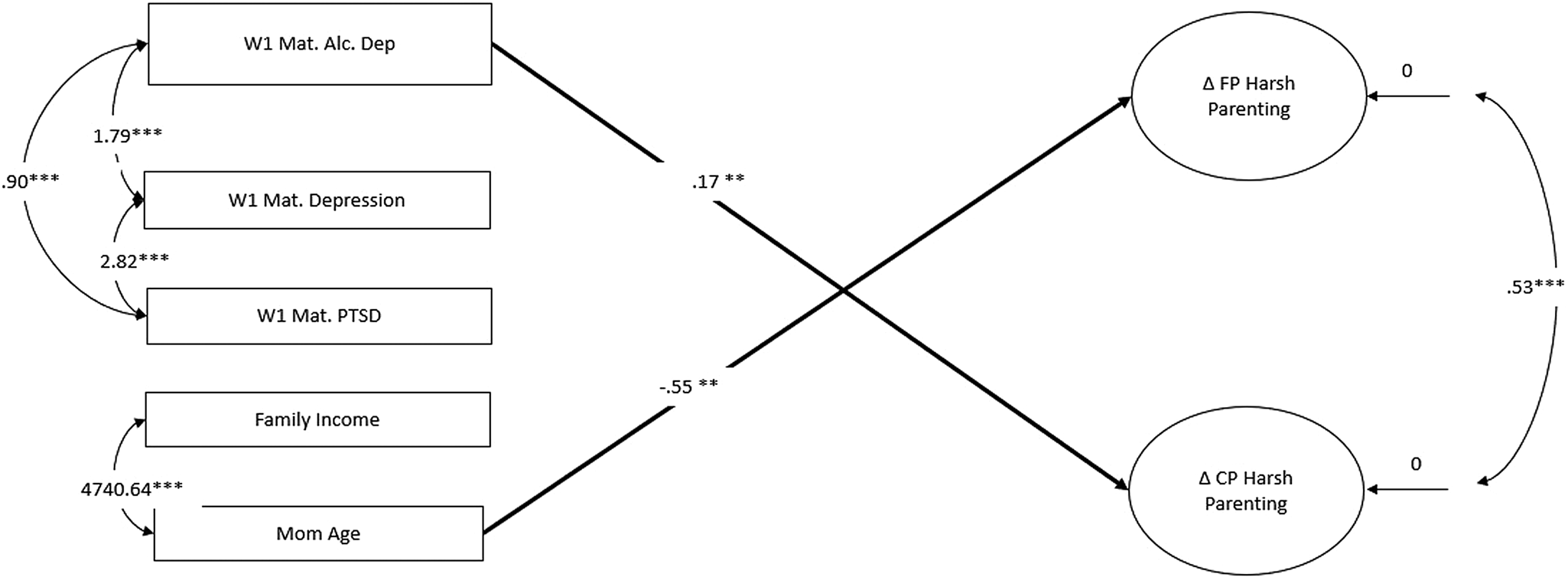
The first model (see Figure 2) examining the main effect of maternal alcohol dependence on change in harsh parenting over time indicated that maternal alcohol dependence predicted increases in harsh parenting in the cleanup task, β = .17, SE = .09, p = .002, but not in the free-play task, β = .01, SE = .070, p = .753. Fit statistics are not provided because the model was just-identified, thereby resulting in perfect model fit and a χ2 value of 0 with 0 degrees of freedom (West, Taylor, & Wu, Reference West, Taylor and Wu2012). Pairwise parameter comparisons showed that the path from maternal alcohol dependence to change in harsh parenting in the compliance task was significantly different from the path from maternal alcohol dependence to change in harsh parenting in the free-play task, z = 2.79, p = .05. Additionally, maternal age was the only covariate that significantly predicted change in harsh parenting over time such that younger mothers evidenced harsher parenting over time only in the free-play task, β = -.55, SE = .008, p = .007. Because our first model showed that maternal alcohol dependence predicted change in harsh caregiving in the cleanup task and maternal psychopathology is thought to interact with child temperament dimensions, our next model examined the moderating effect of two dimensions of child negative emotionality on associations between maternal alcohol dependence and harsh parenting.
SEM path model examining the main effect of maternal alcohol dependence, maternal depression and posttraumatic stress symptomatology, maternal age, and total family income on change in harsh parenting over time in the free play and cleanup tasks. W1 = Wave 1; W2 = Wave 2; Mat. = maternal; Alc. = alcohol; Dep. = dependence; FP = Free Play; CP = Cleanup; PTSD, posttraumatic stress disorder symptoms. *p < .05. **p < .01. ***p < .001.

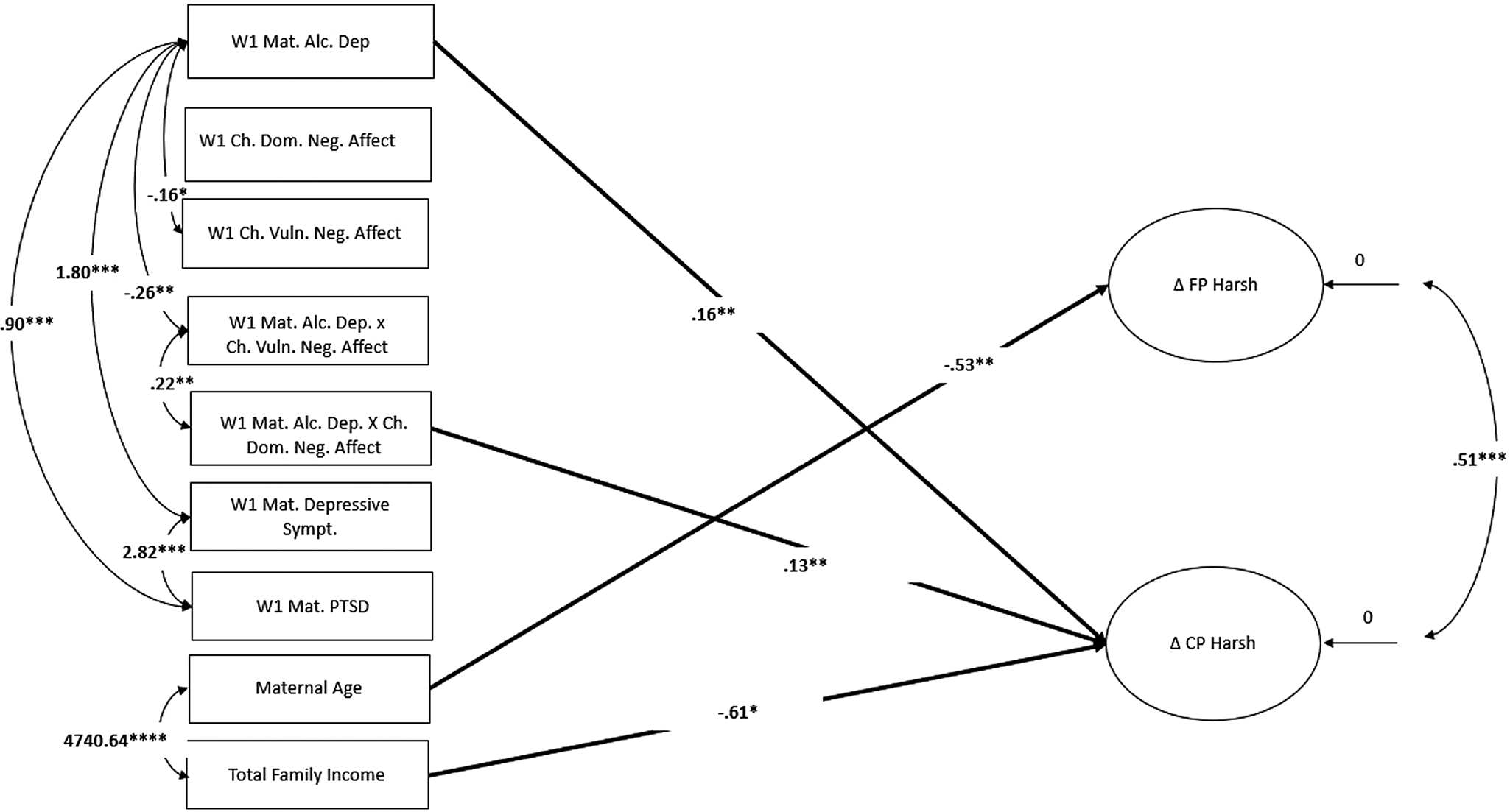
The path model examining the potential moderating effect of dominant and vulnerable negative affect on harsh parenting is depicted in Figure 3. Results show that maternal alcohol dependence predicts increases in harsh caregiving over time in the more challenging and demanding cleanup task, β = .14, SE = .09, p = .011, but not in the relatively benign free-play task, β = .03, SE = .07, p = .427. Pairwise parameter estimates indicated that this path from maternal alcohol dependence to change in harsh parenting in the compliance task was significantly different from the path estimating change in harsh parenting in the free-play task, z = 2.24, p = .025. Additionally, lower total family income predicted higher levels of harsh parenting over time in the compliance task, β = -.61, SE = .01, p = .022. Alternatively, younger mothers displayed higher levels of harshness over time in the free-play task, β = -.47, SE = .01, p = .022. Moreover, there was no significant interaction between maternal alcohol dependence and child vulnerable negative affect in predicting harsh parenting in the cleanup task, β = -.05, SE = .12, p = .321. Thus, the association between maternal alcohol dependence and increases in harsh parenting in the clean-up task was not moderated by children's vulnerable negative affect.
SEM path model examining associations between maternal alcohol dependence, child dominant negative affect, child vulnerable negative affect, the interactions between maternal alcohol dependence and child dominant and vulnerable affect, and longitudinal change in harsh parenting in the free play and cleanup tasks. All pathways between exogenous and endogenous variables were estimated but only significant paths are depicted in this figure. W1 = Wave 1; W2 = Wave 2; Mat. = maternal; Alc. = alcohol; Dep. = dependence; FP = Free Play; CP = Cleanup; PTSD = posttraumatic stress disorder symptoms. *p < .05. **p < .01. ***p < .001.

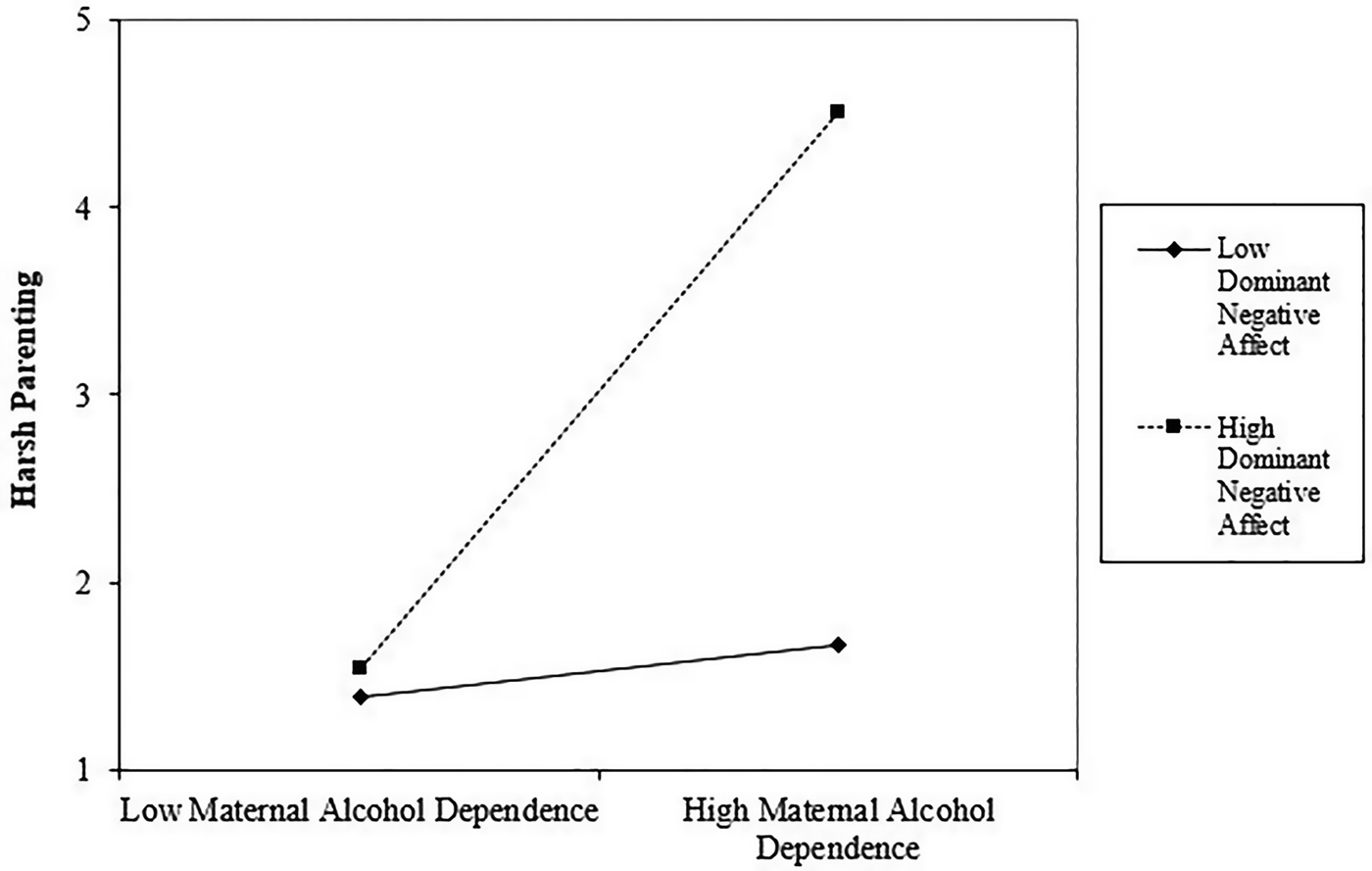
Importantly, child dominant negative affect moderated the association between maternal alcohol dependence and harsh parenting in the cleanup task, β = .13, SE = .10, p = .010. Simple slope analyses were subsequently conducted to determine the nature and locus of the moderating effect of child dominant negative affect (see Figure 4). Results showed that the simple slope for mothers of children displaying higher levels of dominant negative affect was significantly different from zero, β = 0.49, t = 3.96, p < .001, whereas the simple slope for mothers of children with lower levels of dominant negative affect was not significantly different from zero, β = .05, t = .37, p = .71. Additional analyses were conducted to determine the regions of significance with respect to the interaction between maternal alcohol dependence and children's dominant negative affect. Regions of significance tests provide z statistics that represent the upper and lower bounds of values for maternal alcohol dependence at which the regression of harsh parenting on child dominant negative affect is statistically significant (alpha = .05). The regression of harsh parenting on child dominant negative affect is significant for all values of maternal alcohol dependence that fall outside the region, 0.433 (lower threshold); 0.969 (upper threshold). When the results from the above analyses are collectively considered, our findings indicate that mothers with greater psychosocial impairment from alcohol dependence who also had children exhibiting high levels of dominant negative affect displayed higher levels of harsh parenting over time in the cleanup task.
Plot of simple slopes of the moderating effect of child dominant negative affect on associations between maternal alcohol dependence and harsh parenting in the cleanup task. The solid line represents a slope significantly different from zero. High and low values of the moderator were calculated at ± 1 SD from the mean.

Discussion
Maternal substance abuse is a ubiquitous risk factor for child psychopathology. One pathway through which maternal alcohol dependence adversely affects children's developmental trajectories is through maladaptive parenting behaviors, such as harsh caregiving. Although prior research has identified some of the parenting deficits exhibited by alcohol-abusing mothers (i.e. Miller et al., Reference Miller, Smyth and Mudar1999), to our knowledge, no studies have examined whether these deficits persist across childrearing contexts or how they may be influenced by specific child characteristics. Findings from this study demonstrate that maternal alcohol dependence differentially predicts harsh parenting over time and across distinct parenting situations. Moreover, our results also indicate that distinct dimensions of child negative emotionality moderate the effect of maternal alcohol dependence on parenting behaviors. Importantly, maternal alcohol dependence remains a significant and robust predictor of harsh parenting over and above other parenting risk factors, such as other manifestations of maternal psychopathology, maternal age, and family income.
The present study's findings lead us to first consider why and how alcohol dependence uniquely undermines caregiving in discipline-oriented parenting contexts. Within these parent–child interactions, parents must adopt discipline strategies that are both flexible to their child's distinctive behavior and won't further increase child noncompliance and misbehavior. Therefore, sensitive parenting in discipline contexts relies on cognitive flexibility and adaptive cognitive-emotional processes (Crandall, Deater-Deckard, & Riley, Reference Crandall, Deater-Deckard and Riley2015; Sturge-Apple et al., Reference Sturge-Apple, Jones and Suor2017). Specifically, disruptions in these processes can facilitate or promote harsh, coercive parenting responses, particularly at times when parenting demands are heightened, as is the case in discipline contexts. Importantly, alcohol dependence has a distinct adverse effect on many of the higher order cognitive-affective processes underlying parental sensitivity (Porreca et al., Reference Porreca, Beringen, Parolin, Saunders, Ballarotto and Simonelli2018; Verdejo-García, Bechara, Recknor, & Perez-Garcia, Reference Verdejo-García, Bechara, Recknor and Perez-Garcia2006). Encompassed within these processes are inhibitory control, working memory, planning, and set-shifting. Research has demonstrated that deficits in these executive functions may facilitate maternal harshness. For example, prior research has demonstrated that mothers with poorer working memory are more likely to engage in harsh caregiving practices in their reactions to their children's oppositional behavior (Deater-Deckard, Sewell, Petrill, & Thompson, Reference Deater-Deckard, Sewell, Petrill and Thompson2010). Therefore, reactive harshness may result from deficits in maternal working memory. In short, alcohol-related impairments in maternal executive functioning may constitute one pathway through which maternal alcohol dependence may undermine adaptive parenting and aid in the development of harsh parenting behaviors.
Breakdowns in emotion regulation processes may serve as an additional avenue through which maternal alcohol dependence may lead to harsh caregiving in parent–child discipline situations. Specifically, alcohol dependence has been linked with emotion dysregulation, or the inability to adaptively and effectively regulate intense negative emotions and emotional experiences (Dvorak et al., Reference Dvorak, Sargent, Kilwein, Stevenson, Kuvaas and Williams2014; Petit et al., Reference Petit, Luminet, Maurage, Tecco, Lechantre, Ferauge and de Timary2015). Indicatively, Jakubcyzk et al. (Reference Jakubczyk, Trucco, Kopera, Kobyliński, Suszek, Fudalej and Wojnar2018) found that alcohol-dependent individuals had poorer emotion regulation compared to healthy controls. Particularly in demanding and emotionally challenging parenting contexts, mothers may be more likely to experience intense negative emotions such as frustration and hostility in the presence of child noncompliance and misbehavior (Deater-Deckard, Wang, Chen, & Bell, Reference Deater-Deckard, Wang, Chen and Bell2012). Thus, to use adaptive discipline responses, parents must regulate feelings of hostility to avoid reacting harshly to their child's behavior. Moreover, alcohol-dependent parents reported experiencing higher levels of hostility and distress when in the presence of oppositional child behavior (Pelham et al. Reference Pelham, Lang, Atketson, Murphy, Gnagy, Greiner and Greenslade1997). Thus, if alcohol dependent mothers struggle to regulate their emotional distress, that dysregulation may give rise to harsh, reactive discipline practices. Although no research has comprehensively compared these processes in mothers with and without alcohol-related impairments, it may be that deficits in emotion regulation and behavioral inhibition provide further explanation for why and how maternal alcohol dependence undermines caregiving in distinct parenting contexts.
Findings regarding specificity in model pathways were also clarified by examining children's temperamental negative emotionality. Although elements of child negative emotionality have been examined as a moderator of the relation between maternal personality characteristics and parenting (i.e., Clark et al., Reference Clark, Kochanska and Ready2000), to our knowledge, no studies have examined whether and how distinct dimensions of child negative emotionality moderate parenting in the context of maternal psychopathology. The present study demonstrated that child dominant negative emotionality may moderate associations between maternal alcohol dependence and harsh parenting during demanding childrearing contexts. In particular, mothers who are experiencing substance use disorders may be at a heightened risk for harsh parenting when children display high levels of frustration, anger, and aggressive temperamental traits. In contrast, process pathways were not influenced by children's displays of vulnerable emotionality. Taken together, our findings suggest that examining the moderating effect of children's negative emotionality, and in particular increased specificity in conceptualizations of child temperament, may have important implications for parenting process models.
Maternal distress intolerance may provide one potential explanatory conceptualization regarding the moderating effect of children's dominant negative emotionality. Traditionally, distress tolerance has referenced the ways in which an individual processes and experiences their own aversive emotional states (Simons & Gaher, Reference Simons and Gaher2005), but it could also encompass the way individuals perceive and process broader emotional contexts and emotional interactions. Importantly, an inability to withstand negative emotions, or distress intolerance, may increase a person's risk to engage in maladaptive behaviors in response to stressors encountered during challenging emotional contexts (Zvolensky, Vujanovic, Bernstein, & Leyro, Reference Zvolensky, Vujanovic, Bernstein and Leyro2010), such as parent–child discipline situations. Within these parenting situations, parents may be prone to experience hostility and other negative emotions in the presence of child noncompliance and/or intense emotional expressions. Alternatively, parents who are predisposed to difficulties in distress tolerance may be more likely to perceive children's dominant negative emotionality (i.e., frustration and aggression) as more intense, uncomfortable, and overwhelming. As a result of their discomfort with experiencing negative emotional states, the association between maternal alcohol dependence and harsh caregiving may be particularly pronounced for mothers with lower distress tolerance who may have a strong desire to quickly remove intense affective experiences (McHugh, Reynolds, Leyro, & Otto, Reference McHugh, Reynolds, Leyro and Otto2013). To borrow from diathesis–stress frameworks (i.e., Belsky & Pluess, Reference Belsky and Pluess2009), low distress tolerance may serve as a predispositional vulnerability (a diathesis) that interacts with external stressors (i.e., challenging child characteristics) to predict harsh parenting behaviors. Interestingly, no studies to date have examined how personal characteristics such as distress tolerance may operate as a diathesis factor with respect to parenting and children's temperament, and this may be one interesting potential avenue for future research.
To further understand the moderating role of children's dominant negative affect, it is also important to consider why children's expressions of these specific negative emotions influence harsh parenting compared with more vulnerable forms of emotionality. One possible explanation could be that children's displays of temperamental aggression may elicit harsh, coercive parenting behaviors (Kiff, Lengua, & Zalewski, Reference Kiff, Lengua and Zalewski2011; Paulussen-Hoogeboom, Stams, Hermanns & Peetsma, Reference Paulussen-Hoogeboom, Stams, Hermanns and Peetsma2007). Specifically, research has demonstrated that heightened levels of child frustration may contribute to emotional distress in parents (Fabes, Leonard, Kupanoff, & Martin, Reference Fabes, Leonard, Kupanoff and Martin2001; Hagan, Luecken, Modecki, Sandler, & Wolchik, Reference Hagan, Luecken, Modecki, Sandler and Wolchik2016). Given that alcohol dependence may disrupt the cognitive-emotional processes that regulate parents’ responses to child behavior that is emotionally aversive to the parent (Deater-Deckard et al., Reference Deater-Deckard, Sewell, Petrill and Thompson2010), it may be particularly difficult for alcohol dependent mothers to respond to angry, demanding children with noncoercive discipline strategies. In contrast, our findings suggested that vulnerable emotionality consisting of heightened levels of fear, sadness, and distress did not moderate model pathways. It may be that children displaying high levels of fear and emotional reticence may fly under the radar, so to speak, during discipline situations. Specifically, parents with substance use disorders may not be emotionally distressed when their children are displaying these emotional expressions. Therefore, they may be less likely to respond to their child with high levels of impulsive aggression. Moreover, fearful temperamental traits may be more likely to evoke protective and nurturing maternal responses (i.e., Buss & Kiel, Reference Buss and Kiel2011), so mothers with substance use disorders may react to this domain of child negative emotionality with noncoercive caregiving behaviors.
Interestingly, maternal depressive and posttraumatic stress symptoms were not predictive of maternal harshness in either parenting context, even though other studies on parental substance abuse (i.e., Hans et al., Reference Hans, Bernstein and Henson1999) highlight the major influence these disorders can have on caregiving. Specifically, mood disorders such as depression not only commonly co-occur with substance use disorders (Boden & Fergusson, Reference Boden and Fergusson2011), but rates of depression may also be higher among ethnic minority women (Brown, Abe-Kim, & Barrio, Reference Brown, Abe-Kim and Barrio2003; Myers et al., Reference Myers, Lesser, Rodriguez, Mira, Hwang, Camp and Wohl2002). This elevated risk for depression may stem from high rates of perceived institutional racism (Chou, Asnaani, & Hofmann, Reference Chou, Asnaani and Hofmann2012) and gender discrimination (Landrine, Klonoff, Gibbs, Manning, & Lund, Reference Landrine, Klonoff, Gibbs, Manning and Lund1995) often endorsed by ethnic minority women. To compound this complex association between ethnicity and depression, minority women from lower-income urban communities may be more likely to suffer from severe mood disorders given the lack of access and ability to participate in psychiatric treatment programs (Miranda, Azocar, Organista, Dwyer, & Areane, Reference Miranda, Azocar, Organista, Dwyer and Areane2003). Moreover, maternal psychopathology has been linked with parenting deficits and more severe forms of child maltreatment (Stith et al., Reference Stith, Lui, Davies, Boykin, Alder, Harris and Dees2009). Therefore, it is interesting that depressive symptomatology was not predictive of parenting deficits within our sample of high-risk, low-income, ethnic minority mothers. We assume that the underlying reason that depressive symptoms were not predictive may be because of the nature of the wording of the questions on the major depressive index that seek to capture the more severe indicators of depression. Even though the DIS-IV has been used in samples that contain a majority of ethnic minorities and has been shown to be reliable, perhaps the true rates of depression within our sample were subclinical, so they were not adequately captured with the major depression index on the DIS-IV. Future studies may yield different findings for depressive symptoms when using a nonclinically based assessment within a community sample.
It was also interesting that maternal posttraumatic stress symptoms did not predict harsh caregiving, especially because PTSD and substance abuse can often co-occur among ethnic minority women (Davis, Mill, & Roper, Reference Davis, Mill and Roper1997). Specifically, minority women may be at heightened risk for PTSD considering that many of the traumatic events they experience (i.e., high rates of childhood maltreatment and greater exposure to assaultive violence) have been linked with PTSD in adulthood (Brewin, Andrews, & Valentine, Reference Brewin, Andrews and Valentine2000; Roberts, Gilman, Breslau, Breslau, & Koenen, Reference Roberts, Gilman, Breslau, Breslau and Koenen2011). The risk of developing PTSD may be further exacerbated among those residing in low-income urban areas where these traumatic experiences may be more likely to occur (i.e., Gill, Page, Sharps, & Campbell, Reference Gill, Page, Sharps and Campbell2008). Consequently, ethnic minority women are notably likely to experience complex trauma, typically defined as repeated exposure to multiple types of traumatic experiences (Cloitre et al., Reference Cloitre, Stolbach, Herman, Kolk, Pynoos, Wang and Petkova2009), yet as a group, minority women remain underdiagnosed with PTSD relative to their Caucasian peers (Ford, Reference Ford2008). This may be because many PTSD diagnostic instruments focus on an individual's exposure to one general traumatic event rather than consistent exposure to multiple traumatic experiences that may accumulate throughout the lifespan (Cloitre et al., Reference Cloitre, Stolbach, Herman, Kolk, Pynoos, Wang and Petkova2009). Therefore, measures such as the DIS-IV may feature items that inadequately capture the dynamic symptomatology associated with complex trauma, such as dissociation (Briere & Hedges, Reference Briere, Hedges, Weiner and Craighead2010; Courtois, Reference Courtois2008; Van der Hart, Nijenhuis, & Steele, Reference Van der Hart, Nijenhuis and Steele2005; Wilson & Keane, Reference Wilson and Keane2004). This inability to capture complex trauma symptoms constitutes one potential reason why maternal posttraumatic stress symptoms did not predict harsh parenting in our study. Importantly, complex trauma can undermine caregiving and healthy parent–child relationships (Banyard, Williams, & Siegel, Reference Banyard, Williams and Siegel2003; Cohen, Hien, & Batchelder, Reference Cohen, Hien and Batchelder2008; Levendosky & Graham-Bermann, Reference Levendosky and Graham-Bermann2001; Muzik et al., Reference Muzik, Morelen, Hruschak, Rosenblum, Bocknek and Beeghly2017); however, studies of maternal substance abuse have yet to fully consider complex trauma as a contributing risk factor for maladaptive parenting. Given increasing ethnic diversity within families and the influential role of trauma exposure in ethnic minority mental health, subsequent research should strive to include comprehensive, culturally informed PTSD assessments that directly address complex stress symptomatology. Moreover, while our findings indicated that maternal alcohol dependence uniquely undermined caregiving over and above the influence of depressive and PTSD symptoms, this may not be the case for parents and families from other cultural or sociodemographic backgrounds (i.e., immigrant families). Thus, further investigation is needed to better understand how the comorbid presentations of substance dependence and other psychopathologies may contribute to the development and maintenance of maladaptive parenting behaviors among ethnically diverse parent–child dyads.
It is also possible that parenting stress may have contributed to harsher caregiving in the cleanup task. Parenting stress is an important predictor of caregiving in general (Deater-Deckard, Reference Deater-Deckard1998); however, challenging parent–child situations likely elevate the amount of stress that mothers experience. Moreover, increased parenting stress has been shown to adversely influence the discipline behaviors ethnic minority and low-income mothers employ to obtain child compliance (Pinderhughes, Dodge, Bates, Petit, & Zelli, Reference Pinderhughes, Dodge, Bates, Petit and Zelli2000). While all mothers may be highly stressed in discipline contexts, alcohol-dependent mothers may be at a heightened risk to engage in harsh behaviors during stressful parenting situations. For one, prolonged chemical dependence often results in dysregulation of the neural substrates (i.e., the amygdala) that govern stress regulation and stress reactivity (Koob, Reference Koob2009). Therefore, when these mothers experience high levels of parenting stress, they may respond with maladaptive parenting behaviors as a way of reducing stress. Additionally, child characteristics such as high levels of dominant negative affect may also activate these dysfunctional stress response systems. Prior research has demonstrated that parents may be more distressed when parenting a difficult or noncompliant child, which can lead parents to adopt maladaptive discipline practices (Chamberlain & Patterson, Reference Chamberlain, Patterson and Bornstein1995; Crnic & Acevedo, Reference Crnic, Acevedo and Bornstein1995). Thus, parenting stress from the childrearing context in tandem with challenging child behaviors may prove particularly debilitating for alcohol-dependent mothers. It is important for future research to further analyze the role that parenting stress may play on maternal caregiving because parenting stress may also facilitate the maintenance of substance dependence (Rutherford & Mayes, Reference Rutherford and Mayes2019). Indeed, Pelham and colleagues (Reference Pelham, Lang, Atketson, Murphy, Gnagy, Greiner and Greenslade1997) found that parents consumed more alcohol when stressed after interacting with noncompliant and difficult children. This and other research (i.e., Pelham & Lang, Reference Pelham and Lang1999) supports the notion that parenting stress may contribute to stress-induced drinking, thereby sustaining a cycle in which chemically dependent parents continue to abuse substances, which leads to their continued engagement in maladaptive parenting behaviors. In sum, future research should further examine parenting stress as a mechanism underlying the continued association between maternal alcohol dependence and harsh caregiving across specific childrearing contexts.
We believe this study's results have notable clinical implications. First, given that mothers in our study exhibited increases in harshness in the more demanding parenting context, clinicians and interventionists may be able to isolate these parenting situations as targets of interventions, and teach alcohol dependent mothers how to sensitively and noncoercively navigate these parenting contexts. Second, many parenting interventions are focused on global conceptualizations of parenting deficits, such as maternal insensitivity (Bakermans-Kranenburg, van Ijzendoorn, & Juffer, Reference Bakermans-Kranenburg, van Ijzendoorn and Juffer2003); however, our findings imply that specific forms of insensitivity (i.e., maternal harshness) may be more or less likely to manifest or increase in specific parenting situations. Thus, interventionists may also be better able to tailor parenting programs to address the distinct types of maladaptive behaviors these mothers are employing and subsequently focus on implementing strategies that may reduce or eliminate aversive parenting behaviors (i.e., stress management). Third, this study alludes to the benefits of using family-oriented interventions for substance-dependent mothers. Interventionists assisting alcohol-dependent mothers of children displaying heightened dominant negative affect may now identify their heightened risk for harsh parenting in discipline contexts. Accordingly, these mothers may benefit from parenting training that promotes maternal sensitivity in the presence of child dominant affect. Lastly, parenting interventions may be more effective for improving children's developmental trajectories if they are received when children are in early childhood. The behaviors parents use to obtain child compliance can have far-reaching implications for children's behavioral outcomes (Bailey, Hill, Oesterle, & Hawkins, Reference Bailey, Hill, Oesterle and Hawkins2009; Brenner & Fox, Reference Brenner and Fox1998; Stormshak, Bierman, McMahon, & Lengua, Reference Stormshak, Bierman, McMahon and Lengua2000). Therefore, it is important to rectify harsh parenting behaviors that may exacerbate young children's risk for behavioral maladjustment. Moreover, parenting interventions received when children are young may cultivate sensitive caregiving practices that promote rather than hinder positive developmental trajectories.
Importantly, many substance dependence treatment protocols exclude family members, thereby making it harder for clinicians to address parent–child relationship characteristics that may exacerbate the challenges and deficits experienced by alcohol dependent mothers. Past research has indicated the effectiveness of family-based interventions in treating adult substance abuse (Rowe, Reference Rowe2012), and it further suggests that family-based interventions may significantly reduce the negative effects of parental substance abuse on child psychopathology (Calhoun, Conner, Miller, & Messina, Reference Calhoun, Conner, Miller and Messina2015). However, more research is needed to develop more comprehensive parenting interventions for substance-dependent, ethnic minority mothers. Thus, future research should continue to (a) investigate the parenting deficits exhibited by alcohol-dependent mothers of young children, (b) determine whether and how these deficits manifest and change across parenting contexts, and (c) identify child characteristics that may contribute to the development and maintenance of harsh caregiving behaviors.
Although the present study builds upon the theoretical and empirical findings from prior research, there are several limitations to note. To start, the mean number of psychosocial deficits stemming from alcohol dependence was relatively low and invariant. Because alcohol dependence was assessed via participant self-report, it is possible that low rates may be attributed to socially desirable responding, with mothers underreporting or underplaying the extent of their alcohol dependence. Findings from other studies often report higher levels of alcohol dependence or alcohol-related impairments, likely because many studies use samples from clinical populations (Neger & Prinz, Reference Neger and Prinz2015). However, rates of psychosocial impairment found in our study mirror those found in prior studies that feature community samples, especially those featuring larger proportions of ethnic minority women (i.e., Klein, Sterk, & Elifson, Reference Klein, Sterk and Elifson2016). Interestingly, although our participants endorsed relatively few impairments, harsh parenting still increased over time in the cleanup task. Thus, even minor alcohol-related impairments can operate as robust predictors of maladaptive caregiving. Additionally, levels of harsh parenting were relatively low at both points. This may have occurred because parents adopted other parenting strategies—instead of parental harshness—to garner child compliance. Parents were also aware that their interactions were being recorded, so it is possible that parents refrained from using intense and distinctively harsh parenting behaviors, even if those behaviors commonly occur in nonlaboratory contexts. Additionally, even though this study longitudinally examined associations between maternal alcohol dependence, harsh parenting, and child negative emotionality, the relations between these constructs were only studied over the course of 1 year. Thus, a longer longitudinal study would further specify the role of alcohol dependence on the development of trajectories of harsh parenting across parenting contexts and developmental periods.
In summary, prior research has examined the effect of maternal substance abuse on child development, with parenting as one salient pathway that influences risks for future psychopathology. Findings from this study show that the determinants of harsh caregiving among alcohol-dependent mothers may be characterized by a complex interplay between maternal and child factors, such as children's expressions of distinct negative emotions. Future research should continue to examine the specific parenting deficits that alcohol-dependent mothers face while also identifying the parenting contexts in which these deficits are more likely to occur. Subsequent research should also move toward more specificity in conceptualizing the factors that modulate the effect of alcohol dependence on parenting processes and child adjustment. This may be especially beneficial because the present study shows that these contextual factors may play different roles in distinct childrearing situations. Further establishing these lines of research will inform the development and dissemination of parenting interventions that directly address the needs of this at-risk parenting population and aid in reducing the effects of maternal alcohol dependence on children's developmental outcomes.
Acknowledgments
We are incredibly grateful to the families who participated in our study and to the project's research staff and student collaborators who helped make this research possible.
Financial Support
This research was supported by grant R01 MH071256 from the National Institute of Mental Health awarded to Patrick T. Davies and Dante Cicchetti.