INTRODUCTION
There are still many hidden and cryptic species among the marine fauna (cf. Chen et al., Reference Chen, Li, Kong and Yu2011). The morphological plasticity of Ostreidae oyster species can cause taxonomic confusion. For example, shell morphology has been used as a primary feature to distinguish among species, but it is affected by habitat and environment (Tack et al., Reference Tack, Berghe and Polk1992; Lam & Morton, Reference Lam and Morton2006, Reference Lam and Morton2009). Therefore, Ostreidae oysters should be reclassified using accurate species identification methods. This process will probably lead to the discovery of hidden and cryptic species.
Over the last decade, molecular species identification and phylogenies have helped to resolve the taxonomic confusion among genus Crassostrea oyster species. These taxa include commercially imported species, and accurate species identification is needed for fisheries and aquaculture resource management. Some hidden and cryptic species belonging to genus Crassostrea have been discovered through molecular analysis (Banks et al., Reference Banks, Waters and Hedgecock1993; Hedgecock et al., Reference Hedgecock, Banks and McGoldrick1993; Boudry et al., Reference Boudry, Heurtebise and Lapegue2003; Lam & Morton, Reference Lam and Morton2003). Moreover, molecular analysis was used to resolve the question for the origin of the Portuguese oyster, C. angulata (O'Foighil et al., Reference O'Foighil, Gaffney, Wilbur and Hilbish1998), and has provided information about the new habitats of some Crassostrea species (Hedgecock et al., Reference Hedgecock, Li, Banks and Kain1999; Reece et al., Reference Reece, Cordes, Stubbs, Hudson and Francis2008; Hong et al., Reference Hong, Sekino and Sato2012; Sekino et al., Reference Sekino, Sato, Hong and Li2012; Hamaguchi et al., Reference Hamaguchi, Shimabukuro, Kawane and Hamaguchi2013; Sekino & Yamashita Reference Sekino and Yamashita2013; Wang et al., Reference Wang, Qian, Wang and Guo2013).
Among the Ostreidae oysters, the taxonomy of genus Saccostrea is the most problematic because these species have greater morphological plasticity than that of other taxa. Saccostrea oysters mainly inhabit subtropical and tropical areas. The Indo-West Pacific rock oyster, S. cucullata (Born, Reference Born1778), is a common oyster that is widely distributed between the Red Sea and Japan. This species is considered to be a superspecies that contains S. glomerata and S. mordax (Dinamani, Reference Dinamani1976). Lam & Morton (Reference Lam and Morton2006) reported that Saccostrea species with distinct morphotypes were collected between Japan and Australia. These oysters were reclassified after morphological and mitochondrial-DNA analysis. They discovered 7 groups of S. cucullata, S. kegaki and S. glomerata in one clade, and two groups of S. mordax in another clade. Saccostrea cucullata-C, S. cucullata-G and S. kegaki are restricted to the Northern Hemisphere, whereas S. glomerata inhabit the area around southern Australia.
The Yaeyama Islands are the southernmost part of Japan and tropical flora and fauna can be found in their mangrove estuaries and coral reef ecosystem. The Yaeyama Islands, Nansei Islands and Tokara Islands were connected to the mainland of China until the Middle or Late Pleistocene and have flora and fauna in common with southern regions of mainland China and Taiwan. This region includes both temperate and tropical oyster species and the islands are considered to be a hot spot of genus Saccostrea oyster species.
We began searching for new genetic resources for aquaculture seeding in 1996. In 1997, we collected 55 oyster specimens in the Yaeyama Islands and identified them based on morphological features under the mentorship of Dr Akihiko Inaba, Emeritus Professor at Hiroshima University, who has authored several taxonomic reviews of oyster species (Torigoe, Reference Torigoe1981; Torigoe & Inaba, Reference Torigoe and Inaba1981; Inaba & Torigoe, Reference Inaba and Torigoe2004). In addition, we isolated total genomic DNA from the specimens for future accurate species identification by molecular analysis. We re-identified the Saccostrea oyster specimens using DNA barcoding (e.g. Hebert et al., Reference Hebert, Cywinska, Ball and de Waard2003), because we used the genetic data to promote marine fauna biodiversity projects in Japan since 2008. In recent years, genetic information on the oysters that occur in China, Taiwan and Japan has increased (e.g. Liu et al., Reference Liu, Li, Kong, Yu and Zheng2011; Sekino & Yamashita, Reference Sekino and Yamashita2013). Sekino & Yamashita (Reference Sekino and Yamashita2013) discovered S. cucullata-C and S. cucullata-F, described by Lam & Morton (Reference Lam and Morton2006) in the Okinawa Islands. Mainland Japan consists of four major islands (Hokkaido, Honshu, Shikoku and Kyushu) and is several hundred km away from Okinawa. The Kuroshio Current runs along the coastal areas of south-western mainland Japan and common oyster species that inhabit Okinawa, Taiwan and southern China are occasionally observed. We have begun a survey of Saccostrea species in south-western mainland Japan.
MATERIALS AND METHODS
Samples and DNA preparation
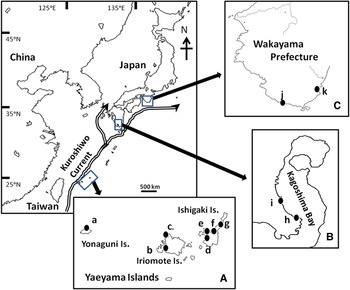
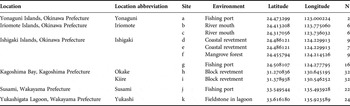
Samples were collected from the sites shown in Figure 1 and Table 1. In 1997, Saccostrea oysters with the morphological features were collected on 12–14 March from 7 sites in Yaeyama Islands (Figure 1A). A total of 55 Saccostrea oysters were collected from rocky shores with different degrees of wave exposure: mangrove estuaries; a waterfall basin in an estuary; fisheries ports; and artificial substances in the islands. The adductor muscle was removed from each oyster in the field and preserved in 95% ethanol solution until DNA extraction. 64 Saccostrea oysters were collected from Okake and the port of Kiire (Figure 1B), southern Kagoshima Bay, in the southern part of Kyushu on 19 April 2012 and 14 March 2013. 46 Saccostrea oysters were collected from Yukashigata Lagoon on 15 August 2013 and Susami fishing port on 23 June 2004. Yukashigata Lagoon and Susami are near the most southern part of the Honshu Inland in Wakayama Prefecture (Figure 1C). The oysters were collected from Kagoshima Bay and Wakayama Prefecture and transported alive to the National Research Institute of Fisheries and Environment of Inland Sea in Hiroshima Prefecture, Japan. The adductor muscle was removed from each specimen along with the chomata of the interior of the shell. Total genomic DNA was extracted from each specimen using DNeasy Blood & Tissue Kits (Qiagen, Valencia, CA, USA) according to the manufacturer's instructions.
Sampling sites of genus Saccostrea oyster specimens.

Description of locations of the oyster specimens used in this study.

Morphological species identification of Saccostrea specimens
Morphological features of the Saccostrea oyster specimens collected in 1997 were analysed with the help of Dr Akihiko Inaba and were identified according to the criteria of Torigoe (Reference Torigoe1981) and Torigoe & Inaba (Reference Torigoe and Inaba1981) in 1998. Another of the Saccostrea oyster specimens was identified according to the criteria of Torigoe (Reference Torigoe1981), Torigoe & Inaba (Reference Torigoe and Inaba1981) and Inaba & Torigoe (Reference Inaba and Torigoe2004).
DNA barcoding by the mitochondrial LSrRNA
Using original primers (16SUF 5′–GAACTCGGCAAAATTAAACCTCGCCT–3′, 16SUR 5′–ARRGKWTTAARGGTCGAACAGA–3′) and a polymerase chain reaction (PCR) method, we amplified a section of mitochondrial LSrRNA. PCR amplification was conducted in a total volume of 20 µL containing 5 U of Takara Ex TaqTM (5 units/μL, TaKaRa), 1× Ex TaqTM Buffer, 2.5 mM of each dNTP, 0.5–1.0 µM of each primer and 0.8 µL of template. The PCR conditions for the 16S region were 35 cycles of denaturation (94°C, 30 s), annealing (40°C, 30 s) and extension (72°C, 45 s) in a My CyclerTM thermocycler (Bio-Rad; Hercules, CA, USA). The amplification products were checked by loading 3 µL PCR product and 3 µL loading dye on a 2% agarose gel (Agarose S; NIPPON GENE, Tokyo, Japan) with 0.5 µg/mL ethidium bromide. Of the remaining PCR product, 15 µL was added to 0.005 U thermo-sensitive alkaline phosphatase (Promega, Madison WI, USA) and 0.6 U exonuclease I (New England Biolabs, Ipswich, MA, USA). The mixture was incubated at 37°C for 45 min, followed by a post-reaction heating step at 80°C for 15 min. The treated PCR amplicon was sequenced using LSrRNA primer and ABI PRISM BigDye Terminator Cycle Sequencing Ready Reaction Kit ver. 3.1 (Applied Biosystems, Carlsbad, CA, USA) with a Genetic Analyzer 3100 automated DNA sequencer (Applied Biosystems, Carlsbad, CA, USA). The final COI sequences were obtained from both strands for verification, and all newly obtained sequences were deposited in the DDBJ (DNA database of Japan)/EMBL (European Molecular Biology Laboratory)/GenBank DNA database.
Phylogenetic relationships of Saccostrea oysters analysed in this study
Lam & Morton (Reference Lam and Morton2006) reported the phylogenetic relationships among the Saccostrea specimens collected from the Indo-Pacific coast that resulted from a LSrRNA-based neighbour-joining (NJ) analysis in which the distance calculation was based on Kimura's two parameter method (Kimura, Reference Kimura1980). In their phylogenetic analysis, Sekino & Yamashita (Reference Sekino and Yamashita2013) followed the method reported by Lam & Morton (Reference Lam and Morton2006) for the sake of methodological consistency. For the same reason, we used this method for analysis of the phylogenetic relationships among the Saccostrea oysters collected in this study. We examined the taxonomic separation between samples by constructing an NJ tree using the LSrDNA nucleotide sequences. The obtained sequences were aligned using Clustal W (Thompson et al., Reference Thompson, Higgins and Gibson1994; gap opening penalty, 15; gap extension penalty, 6.6; and transition weight, 0.5). An NJ tree was constructed using MEGA 5.2 (Tamura et al., Reference Tamura, Peterson, Peterson, Stecher, Nei and Kumar2011) and Kimura's two parameter method.
RESULTS
Specimens were identified by morphological and anatomical features according to the criteria of Torigoe (Reference Torigoe1981) and Torigoe & Inaba (Reference Torigoe and Inaba1981). Saccostrea glomerata, S. kegaki and S. mordax were represented in our sample. We also observed two morphologically different forms of S. malabonensis and recorded them as S. malabonensis and S. malabonensis-like.
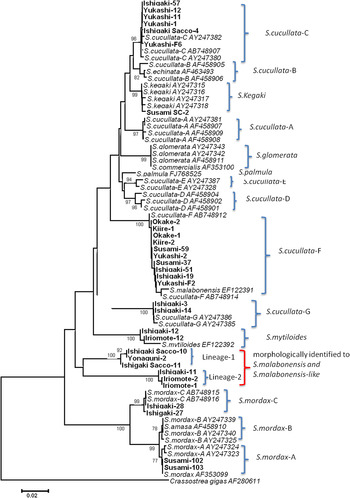
All newly obtained LSrDNA nucleotide sequences (about 470 base pairs) for Saccostrea oysters collected from the Yaeyama Islands, Kagoshima Bay and Wakayama Prefecture have been deposited in the DDBJ/EMBL/GenBank DNA database (accession numbers AB898206–AB898234). Phylogenetic analysis of the LSrDNA obtained is shown in Figure 2. The LSrRNA nucleotide sequences of the specimens from the Yaeyama Islands clearly showed that the S. glomerata identified by morphological and anatomical features consisted of several species: S. cucullata-C; S. cucullata-F; and S. cucullata-G. We also observed S. mordax-C, S. mytiloides and S. kegaki. On the other hand, S. malabonensis and S. malabonensis-like were clearly distinguished by the nucleotide sequences of LSrRNA. However, the LSrRNA nucleotide sequences from S. malabonensis and S. malabonensis-like specimens were different to that of S. malabonensis in the DDBJ/EMBL/GenBank DNA database (accession number EF122391). We therefore refer to these samples as ‘putative S. malabonensis’ throughout the remainder of this paper.
Neighbour-joining tree of LSRNA for Saccostrea species (see Table 1 for detailed information) rooted with Crassostrea gigas. Bootstrap values above 70% are shown. Specimens sampled in this study are in bold face type, whereas sequences from other species, represented by scientific name and accession numbers, were obtained from GenBank.

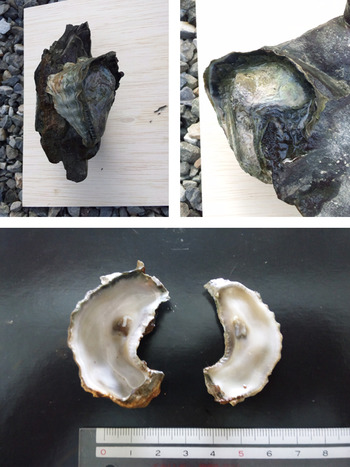
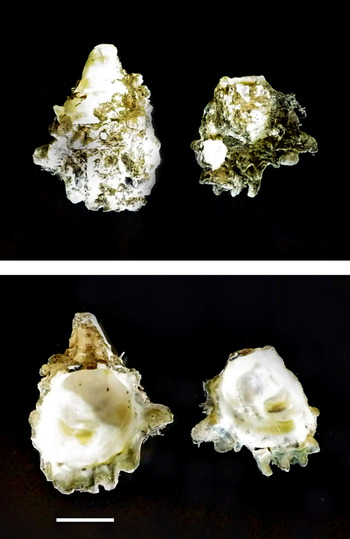
Some Saccostrea specimens collected in Kagoshima Bay and Wakayama Prefecture were distinguished from domestic Saccostrea species (S. kegaki and S. mordax) collected from mainland Japan. These specimens shared a cluster with S. cucullata-C and S. cucullata-F, which were collected from the Yaeyama Islands. The Indo-West Pacific rock oyster S. cucullata-F occurred in Kagoshima Bay, Susami and Yukashigata Lagoon. Saccostrea cucullata-C occurred in Yukashigata Lagoon. The morphological features of S. cucullata-C are shown in Figure 3. Saccostrea cucullata-C only occurred in Yukashigata Lagoon. The chomata of S. cucullata-C are well developed and are arranged in a single line around the inner margin of right valve (Figure 3). Hyote spines were not observed. The margin of the left valve was built up steeply along the anterior side. The crescent-like shell shape and adductor muscle scar of S. cucullata-C were very similar to those reported by Ohgaki (Reference Ohgaki1997) for S. glomerata from the Tonda River estuary, Wakayama Prefecture.
Saccostrea cucullata-C sampled form Yukashigata Lagoon, Wakayama Prefecture, Japan. Scale bar: 1 cm.

The morphological features of S. cucullata-F are shown in Figure 4. Hyote spines were not observed. The chomata of the S. cucullata-F collected from Kagoshima Bay and Susami were poorly developed or were well developed near the hinge region only. In Kagoshima Bay, we originally misidentified S. cucullata-F as Crassostrea species because the chomata was inconspicuous (Figure 4). The shell shape, adductor muscle scar, and umbonal cavity of S. cucullata-F from Kagoshima Bay and Wakayama Prefecture were very similar to the third ecotype reported by Lam & Morton (Reference Lam and Morton2009).
Saccostrea cucullata-F sampled from Kiire, Kagoshima Prefecture, Japan. Scale bar: 1 cm.

DISCUSSION
In Japan, Saccostrea species mainly inhabit Yaeyama and Ryukyu Islands, the most south-western part of Japan. Torigoe (Reference Torigoe1981), Torigoe & Inaba (Reference Torigoe and Inaba1981) and Inaba & Torigoe (Reference Inaba and Torigoe2004) reported the occurrence of S. glomerata, S. mordax, S. kegaki, S. ehinata and S. malabonensis near these islands. Ohgaki (Reference Ohgaki1997) recorded S. glomerata (Gould) in the Tonda River estuary, Wakayama Prefecture, Japan. Nishimura et al. (Reference Nishimura, Kurozumi and Kimura1998) reported the occurrence of S. cucullata in the Ogasawara Islands. Iijima (Reference Iijima2007) summarized the results of the biodiversity survey of marine fauna in tidal flats throughout Japan that was conducted as part of the 7th National Survey on the Natural Environment by the Ministry of the Environment. They verified the presence of S. cucullata in the Okinawa Islands. However, a comprehensive review of these studies by adding molecular analysis is needed, because these research papers only used the morphological and anatomical methods for species identification. Only S. mordax and S. kegaki are clearly distinguished from other Saccostrea species. It is not clear whether the remainder of the oysters currently identified as other Saccostrea species are actually separate species.
In recent years, some researchers have begun using molecular analysis to reconstruct the taxonomy of the oysters in genus Saccostrea that are found in Japan. According to Aranishi & Iidzuka (Reference Aranishi and Iidzuka2007), mitochondrial DNA analysis confirmed that S. echinata was found along the south-eastern coast of Kyushu. However, they did not deposit the nucleotide sequences of their S. echinata specimens. Therefore, their findings could not be confirmed. Sekino & Yamashita (Reference Sekino and Yamashita2013) confirmed the presence of S. cucullata clade C (S. cucullata-C) and clade F (S. cucullata-F), previously described by Lam & Morton (Reference Lam and Morton2006), in the Okinawa Islands using mitochondrial LSrRNA (16S) and cytochrome c oxidase subunit I (COI) analysis. Sekino & Yamashita (Reference Sekino and Yamashita2013) discovered a new genetic form of S. mordax clade C (S. mordax-C) in Japan that was not reported by Lam & Morton (Reference Lam and Morton2006). Molecular analysis, including DNA barcoding, can be used to find hidden and cryptic oyster species, monitor the biodiversity of marine fauna and reconstruct the taxonomy of Saccostrea species in Japan.
In this study, samples identified as S. glomerata according to the criteria of Torigoe (Reference Torigoe1981) and Torigoe & Inaba (Reference Torigoe and Inaba1981) included at least three species: S. cucullata-C; S. cucullata-F; and S. cucullata-G. Moreover, this is the first report of S. cucullata-C and S. cucullata-F in the south-western part of the Japanese mainland. Saccostrea cucullata-C and S. cucullata-F were widely distributed from the Yaeyama Islands to Wakayama Prefecture. Some illustrated books of shells published in Japan have included ‘S. glomerata’ and its putative Japanese common name ‘nyujirando-gaki’ (e.g. Kihira et al., Reference Kihira, Matsuda and Uchiyama2009). However, Lam & Morton (Reference Lam and Morton2006) clearly described the S. glomerata as limited to Australia. We considered S. glomerata to be an inappropriate classification for Saccostrea oyster specimens in Japan. Based on our molecular analysis, we determined that, with the exception of S. kegaki, S. mordax, S. mytiloides and two lineages of putative S. malabonensis, Japanese Saccostrea oysters are S. cucullata. The phylogenetic status of S. echinata is still undetermined, although Lam & Morton (Reference Lam and Morton2006) suggested that this species was synonymous with S. cucullata-B.
Ohgaki (Reference Ohgaki1997) suggested that the subtropical marine fauna observed in the Okinawa Islands also inhabited Wakayama Prefecture. The results of the present study support his suggestion. Wakayama Prefecture is in the south-western part of the Kii Peninsula on Honshu Island and faces the Kuroshio Current. Many subtropical marine fauna have been discovered in Wakayama Prefecture (e.g. Fukui & Wada, Reference Fukui and Wada1986; Yasuda et al., Reference Yasuda, Hamaguchi, Sasaki, Nagai, Saba and Nadaoka2004). In Wakayama Prefecture, Yasuda et al. (Reference Yasuda, Hamaguchi, Sasaki, Nagai, Saba and Nadaoka2004) collected the tropical sea star Acanthaster brevispinus, which is a cryptic species in northern Australia. Other subtropical Saccostrea species may be discovered in Wakayama Prefecture or Kii Peninsula in the near future.
Nishimura et al. (Reference Nishimura, Kurozumi and Kimura1998) collected S. cucullata from the Ogasawara Islands in the southernmost part of Japan. These authors proposed the new Japanese common name ‘ohagurogakimodoki’ for these oysters. Further, they compared the morphological features of the specimens with those of S. mytuloides (Lamarck) collected from the Solomon Islands and concluded that they were a separate species. We believe that the specimens collected by Nishimura et al. (Reference Nishimura, Kurozumi and Kimura1998) are probably S. cucullata-C or S. cucullata-G. Our molecular analysis indicates that these species are clearly separated from S. mytuloides, thus supporting the conclusions of Nishimura et al. (Reference Nishimura, Kurozumi and Kimura1998).
We compared the partial mitochondrial LSrRNA for S. malabonensis deposited in the DDBJ/EMBL/GenBank DNA database (accession number EF122391) and our specimens. As a result, we would think the nucleotide sequences (EF122391) were determined from misidentified specimens, because phylogenetic analysis showed the data shared a cluster with S. cucullata-F. In this study, Dr Inaba clearly distinguished S. malabonensis and S. malabonensis-like specimens from other Saccostrea species using morphological features. The nucleotide sequences of these specimens clearly showed that they formed different clades of S. cucullata-F and S. malabonensis (EF22391). Buroker et al. (Reference Buroker, Hershberger and Chew1979) reported two lineages of S. malabonensis collected from the Philippines. These lineages were identified based on variations in the proteins encoded by 25–34 gene loci. Although these two lineages had the same shell characteristics, Buroker et al. (Reference Buroker, Hershberger and Chew1979) concluded that they were separate species (S. malabonensis and S. manila). The two lineages in the putative species S. malabonensis that we observed in this study might also indicate the presence of these two species in our sample set. The status of S. malabonensis should be clarified using both molecular and morphological methods in the future.
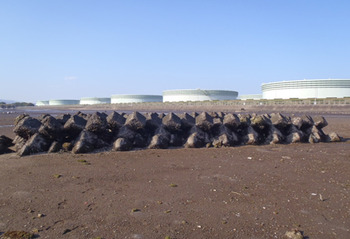
The subtropical species S. cucullata-C and S. cucullata-F occurred in the south-western part of mainland Japan. The presence of these oysters in this region may be due to a northward shift in the distribution patterns of these species, the result of relic species from the Middle or Late Pleistocene, or the result of the introduction of non-indigenous species by oil tankers or other human activities. In recent years, it has been postulated that rising seawater temperatures resulting from global warming have caused a northward shift in the distribution patterns of the species in the Yaeyama and Ryukyu Islands. The Japan Meteorological Agency reported that seawater temperatures close to Japan have been rising 1.08°C from the previous century (http://www.data.kishou.go.jp/kaiyou/shindan/a_1/japan_warm/japan_warm_data.html). The seaweed species are more sensitive to changes of seawater temperature than benthos species. Shimabukuro et al. (Reference Shimabukuro, Arai, Terawaki and Noro2006) reported the presence of Sargassum seaweed species, normally found in Okinawa, along the coast of mainland Japan. Furthermore, Shimabukuro et al. (Reference Shimabukuro, Kawane and Hamaguchi2012) collected Sargassum denticarpum Ajisaka (Fucales: Phaeophyceae) from Iriomote Island (Figure 1A). This species is endemic in Vietnam and its presence at Iriomote Island indicates that at least some of the marine flora of the Yaeyama Islands is also common to that in the coastal areas of South-east Asia. Saccostrea oysters have a long planktonic stage during which they can be widely dispersed by the Kuroshiwo Current (Figure 1). Therefore, Saccostrea oysters may easily be distributed northward as a consequence of rising seawater temperature resulting from global warming around Japan. However, it is also possible that these species are relic species because the Yaeyama Islands, Okinawa Islands and mainland Japan were connected to southern China and Taiwan during the Middle or Late Pleistocene. A third explanation for the presence of S. cucullata-F along the coast of mainland Japan is anthropogenic introduction from other habitats. Saccostrea cucullata is listed in the Delivering Alien Invasive Species Inventories for Europe (Invasive Species Compendium: http://www.cabi.org/isc/?compid=5&dsid=116838&loadmodule=datasheet&page=481&site=144). There is a petroleum station (Figure 5) in Kiire and oil tankers might have introduced S. cucullata-F to the area from the Arabian Sea or from countries bordering the Indo-Pacific Ocean. A high-resolution molecular diagnostic method would be needed in order to identify non-indigenous S. cucullata oysters in the region. DNA barcoding has provided new information that can be used to monitor biodiversity, discover undescribed species, document environmental changes and identify invasive species. In Japan, DNA barcoding has been used to begin taxonomic re-classification of Saccostrea oysters. Further accurate studies using morphological and molecular techniques are needed to fully resolve the relationships between Saccostrea species.
Sampling sites at Kiire, Kagoshima Prefecture, Japan.

ACKNOWLEDGEMENTS
We express our sincere gratitude to the late Dr Akihiko Inaba, Professor Emeritus at Hiroshima University, for assistance with morphological identification of samples. The authors thank Dr S. Nishihama (Seikai National Fisheries Research Institute) and Mr Hiromi Hamaguchi for assistance with sample collection. Molecular analysis performed as part of this study was supported by ‘A feasibility study on biodiversity assessment methods in fishing ground environment’ from the Fisheries Agency, Japan.