Introduction
On June 13, 2017, members of the US Senate Intelligence Committee questioned Mr. Jeff Sessions, Attorney General of the United States, regarding Russian involvement in the 2016 US presidential election. Over the course of two and a half hours, Sessions was questioned by seventeen senators sitting on the Committee. One of these senators was Ms. Kamala Harris, a former district attorney and Attorney General of California, who serves as the junior Democratic senator for the state. After subjecting Sessions to several minutes of ‘rapid-fire questioning’ (Rogers Reference Rogers2017), Harris was interrupted by Senator John McCain, a Republican member of the Committee, and admonished by Senator Richard Burr, also a Republican and the Chair of the Committee, for not giving Sessions an opportunity to supply answers to her questions. This episode occurred on the heels of a similar exchange just one week earlier, during the hearing of Deputy Attorney General Rod Rosenstein, when Harris was similarly interrupted for failing to allow the witness to answer her questions. Notably, Harris was the only senator censured at the two hearings.
The two incidents drew both criticism and praise from politicians, the news media, and the general public. Democrats rallied to Harris's support, quick to point out that the male senators’ actions were motivated by sexism and condemned them for interrupting Harris. Senator Elizabeth Warren tweeted, ‘Silencing [Kamala Harris] for not being “courteous” enough is just unbelievable’.Footnote 1 Senator Ron Wyden of Oregon, also on the Committee, added that Harris ‘was doing her job. She was interrupted for asking tough questions. I was not interrupted’.Footnote 2 Harris herself chimed in: ‘The women of the United States Senate will not be silenced when seeking the truth’.Footnote 3 One day after the hearing, The New York Times published an article condemning the incident as a problem of gender inequality and what it called the ‘universal phenomenon of men interrupting women’ (Chira Reference Chira2017), known colloquially as ‘manterrupting’.
Commentators on the right (Republican) side of the aisle dismissed claims of sexism. Some accused Harris of being ‘too aggressive’ (Daponte-Smith Reference Daponte-Smith2017), while one TV pundit called her behavior ‘hysterical’ (Mettler Reference Mettler2017) and therefore deserving of criticism. Conservative news outlets published articles with authors opining that McCain's interruption was not only justified, but that the incident was blown out of proportion by the mainstream media, Democrats, and left-leaning feminists (see e.g. Jashinsky Reference Jashinsky2017).
Following the hearing, the Cable News Network (CNN) announced various ‘winners’ and ‘losers’ in the televised event (Cilizza Reference Cilizza2017). While Harris was declared a clear winner, the network observed that she showed ‘very little deference’ to Attorney General Sessions and ‘repeatedly interrupted’ him. The senator who ‘stole the show’, according to CNN, was Mr. Angus King, an Independent from Maine who asked probing questions ‘without coming across as overly partisan or angry’.
The controversy surrounding the hearing raises questions. Did Harris interrupt the Attorney General disproportionately? Was her manner so antagonistic as to warrant interruption and censure from her colleagues, and negative evaluation by the media and general public? This article seeks to answer these questions by focusing on the questioning of Jeff Sessions by both Angus King and Kamala Harris. Fine-grained analyses of the two exchanges, grounded in conversation analytic (CA) methodology, reveal that simultaneous and near-simultaneous talk initiated by the senators is pervasive in both exchanges. However, Sessions does ‘being interrupted’ (Hutchby Reference Hutchby1996; Bilmes Reference Bilmes1997)—that is, displays an orientation toward his interlocutor's turns as a violation of his speaking rights—three times more often when he is questioned by Harris rather than King. The discrepancy in Sessions’ reaction may explain why Harris is sanctioned by Senators McCain and Burr during her questioning, as well as why commentators have characterized her as aggressive and interruptive, while at the same time lauding (or ignoring) King. These findings ultimately suggest that doing being interrupted may influence how others perceive an interaction and those participating in it.
The article continues with a general description of the US Senate Intelligence Committee and a linguistic description of Senate Intelligence hearings. This section highlights the interactional asymmetry between senators (questioners) and witnesses (answerers), as well as two interactional resources senators may draw upon to exercise conversational control during their questioning of witnesses: overlap and latching. Next is a description of the video data used and key players participating in the hearing. This section also outlines the analytic framework of the study, based in CA methodology and largely informed by the work of Tannen (Reference Tannen1990, Reference Tannen1994), Hutchby (Reference Hutchby1996), and Bilmes (Reference Bilmes1997) on interruption. Following this is a quantitative account of overlap and latching in the senators’ talk, the conversational ‘moves’ they deploy during overlapping and latching talk, as well as Sessions’ orientation toward such talk. This quantitative analysis is supplemented with a qualitative examination of excerpts from both King's and Harris's questioning of Sessions to show when and under what circumstances the attorney general does being interrupted. Finally, the article reviews how Harris is sanctioned by her colleagues, the news media, and the public at large, speculating that Sessions’ handling of her turns as violative influences the way others perceive what happened during the hearing. The article concludes with a brief discussion of the possible role of gender in shaping the interactions studied here and proposes avenues for further research.
A general and linguistic account of the US Senate Intelligence Committee and committee hearings
The US Senate Intelligence Committee and Senate intelligence hearings
The US Senate, one of two lawmaking bodies in a bicameral legislature, is composed of 100 senators, with two senators representing each of the fifty states. Much of the work of the US Senate is done through the work of specialized standing committees. One such committee, the Senate Intelligence Committee, was established in 1976 to fulfill three functions: (i) ‘oversee and make continuing studies of the intelligence activities and programs of the United States Government’; (ii) ‘submit to the Senate appropriate proposals for legislation’; and (iii) ‘provide vigilant legislative oversight over the intelligence activities of the United States’ (US Senate Select Committee on Intelligence 2018). The Committee is made up of fifteen senators, with eight from the majority party—at the time of Sessions’ hearing, Republicans—and seven from the minority party—Democrats. Committee activities include hearings, legislation, and investigation.
Senate intelligence hearings are usually closed sessions, but may be open if the Committee receives ‘intelligence testimony on the national security threats to the United States’ (US Senate Select Committee on Intelligence 2018). The June 2017 hearing was an open hearing related to investigation into Russia's interference in the 2016 election. It was presented as an opportunity for Sessions to ‘set the record straight on a number of allegations reported in the press’ regarding what he knew (Burr Reference Burr2017). The rules for open hearings are as follows: The Chair and Vice-Chair hold the floor for ten minutes to ask questions, while other Senators on the committee are allotted five minutes each. Questioning happens in order of seniority.
Senate Intelligence hearings: Questions, overlap, and latching
Senate intelligence hearings are characterized by a strict ‘turn-type pre-allocation’ (Atkinson & Drew Reference Atkinson and Drew1979) system much like the questioning of witnesses in the courtroom (see e.g. Danet, Hoffman, Kermish, Rafn, & Stayman Reference Danet, Hoffman, Kermish, Jeffrey Rafn, Stayman, Shuy and Shnukal1980; Woodbury Reference Woodbury1984; Philips Reference Philips, Tannen and Alatis1986; Matoesian Reference Matoesian1993, Reference Matoesian2001; Luchjenbroers Reference Luchjenbroers1997). An asymmetrical distribution of turn types is predetermined by institutional roles (Drew & Heritage Reference Drew, Heritage, Drew and Heritage1992): senators get to ask questions, while witnesses supply answers. In the role of questioner, senators typically direct the talk (i.e. introduce topics) and set the interactional ‘agenda for the occasion’ (Drew & Heritage Reference Drew, Heritage, Drew and Heritage1992:49; see also Drew Reference Drew, Drew and Heritage1992; Hobbs Reference Hobbs2003; Eades Reference Eades2000; and Ehrlich Reference Ehrlich2001 for related research on courtroom examination). This allows senators to exercise conversational control and play a key role in shaping the interaction.
While questions are a powerful resource in senators’ interactional toolkit, senators may draw upon other features of talk to exert control while questioning witnesses. Two such resources, which are the focus of this article, include overlap and latching. Overlap refers to simultaneous speech initiated during an interlocutor's turn-at-talk. Under certain circumstances, overlap may be regarded as ‘intrusive’ (Murata Reference Murata1994), ‘confrontational’ (Hutchby Reference Hutchby1996), and violative of a current speaker's turn. Murata demonstrates, for instance, that a speaker may initiate overlapping talk to grab the conversational floor and change the topic from the one developed by her interlocutor. Overlap has been referred to as a ‘control device’ (West & Zimmerman Reference West and Zimmerman1977:527) because speakers who succeed in usurping the current speaker's turn-at-talk may develop their own topics and take the reins of an interaction (see e.g. Bogoch & Danet Reference Bogoch and Danet1984; Carbó Reference Carbó1992; Ainsworth-Vaughn Reference Ainsworth-Vaugh1995; Li, Krysko, Desroches, & Deagle Reference Li, Krysko, Desroches; and Deagle2004; Liao Reference Liao2009). While overlap is often ‘competitive’ (Schegloff Reference Schegloff2000), it may also serve a supportive or affiliative function, conveying involvement and helping interactants to build camaraderie (see e.g. Tannen Reference Tannen, Di Pietro, Frawley and Wedel1983, Reference Tannen1994; Goldberg Reference Goldberg1990). The present study is concerned with the controlling, potentially ‘incursive’ (Hutchby Reference Hutchby1996:81) function of this discourse feature, however.
Another way for senators to exercise conversational control in the questioning of witnesses is through latching. Latching refers to ‘turn exchanges with no perceptible intervening pause’ (Tannen Reference Tannen1994:64). Unlike overlap, latching talk is produced not simultaneously with a current speaker's turn, but rather immediately after the other speaker has produced an utterance. Latching may afford a measure of control over a conversational exchange because it allows for the appropriation of what might have been a slot for an interlocutor's turn. Similar to overlap, latching may also allow speakers to impose their own topical agenda on the interaction. And because latching may be used to usurp a previous speaker's turn, it may be treated by participants as interruptive.
Although testifying witnesses occupy the less ‘powerful’ position in congressional hearings, they may nevertheless resist the constraints placed upon them by the question-answer format of the speech event (for work on how question recipients resist control in a variety of institutional settings, see e.g. Greatbatch Reference Greatbatch1986; Clayman Reference Clayman2001; Stivers & Heritage Reference Stivers, Hayashi and Heritage2001; Clayman & Heritage Reference Clayman and Heritage2002; Ehrlich & Sidnell Reference Ehrlich and Sidnell2006; Galatolo & Drew Reference Galatolo and Drew2006; Galatolo Reference Galatolo, Holt and Clift2007; Stivers & Hayashi Reference Stivers and Hayashi2010). For example, in the context of courtroom testimony, Galatolo & Drew (Reference Galatolo and Drew2006:661) show how witnesses provide expanded answers to yes/no questions. The function of expansions is to ‘go beyond the framework’ of the question and afford witnesses some degree of control over the information conveyed.
Data and analytic framework
The June 2017 hearing and participants
The hearing analyzed in this article took place on June 13, 2017 and lasted two hours and twenty-five minutes. The questioning of Sessions by King and Harris took 5:31 minutes and 6:45 minutes, respectively. Video data were accessed through the Senate Intelligence Committee website at https://www.intelligence.senate.gov, and various other news outlets that published the hearing. Data were collected from multiple government and news media sources to allow for viewing the hearing from a variety of camera angles and ensure that nonverbal behaviors could be captured accurately and recorded in transcripts. Data were transcribed using CA conventions (see the appendix).
Key participants in the portion of the hearing reported on here include Attorney General Jeff Sessions and Senators Angus King and Kamala Harris. At the time of his testimony, Jeff Sessions had been US Attorney General for approximately four months. Prior to his appointment as Attorney General by President Donald Trump, Sessions had been a Republican senator for the state of Alabama for twenty years and a US Attorney for the Southern District of Alabama for twelve years before that. In 1986, Sessions was nominated by President Ronald Reagan to be a federal judge in Alabama; however, his nomination was rejected by the Senate Judiciary Committee due to allegations that he had made a number of racially insensitive remarks while he was a US Attorney (Williams Reference Williams1986). As a result, a number of Democrats and civil rights groups also opposed Sessions’ nomination as US Attorney General in 2017 (Berenson Reference Berenson2017).
Angus King is an Independent senator for the state of Maine. Before becoming senator, King was governor of Maine for ten years and had practiced law for a number of years. As an Independent, King claims to be a ‘strong believer in the need for greater bipartisan dialogue and relationship building’ (Angus King, United States Senator for Maine 2018); however, he has been critical of several Trump administration policies. Kamala Harris, a Democratic senator for California, is the second African American woman to be elected to serve in the US Senate. Prior to her career in Congress, Harris was the Attorney General of California and a prosecutor for twenty years, serving as a deputy District Attorney and District Attorney of San Francisco. Harris, a former Democratic presidential candidate in 2020, has been a vocal critic of the Trump administration. Significantly, neither King nor Harris is politically aligned with Sessions.
Minimally participating in one of the interactions analyzed in this article are also Richard Burr, Republican senator for the state of North Carolina, and the late Senator John McCain, representing Arizona.
Analytic framework
This study draws on conversation analysis (CA) methodology to address ‘how social action is brought about through the close organization of talk’ (Antaki Reference Antaki and Antaki2011:1). Per the CA framework, ‘when people talk with each other this is not seen as a series of individual acts, but rather as an emergent collectively organized event’ (ten Have Reference ten Have2007:9). In this vein, the goal of the present research is to identify instances of overlap and latching in King's and Harris's talk and reveal how these are responded to and handled within the interaction by Sessions.
To determine when overlap and latching are deemed ‘interruptive’, the work of Tannen (Reference Tannen1990, Reference Tannen1994), Hutchby (Reference Hutchby1996), and Bilmes (Reference Bilmes1997) is informative. Tannen (Reference Tannen1990:192) asserts that interruption is ‘not a mechanical category’, but a ‘matter of interpretation’ for participants to the interaction. Hutchby (Reference Hutchby1996:84) maintains that the ‘confrontational… nature of an interruption can be highlighted… by the reactions of interrupted speakers themselves’. Similarly, Bilmes (Reference Bilmes1997:511–12) argues that ‘in order for an event to be an interruption… [i]t must be displayed and handled as violative within the interaction’ by the participants (emphasis in original). Thus, it is not for analysts to impose interruption on the data; rather, the analyst's task is to determine whether interactants orient to talk as disruptive—in other words, to ascertain when and how they do ‘being interrupted’ (Hutchby Reference Hutchby1996; Bilmes Reference Bilmes1997).
According to Bilmes (Reference Bilmes1997), participants must make an overt signal that their speaking rights have been violated in order to label a turn or stretch of talk as interruption. He identifies three ways in which participants show that their turn to speak has been disrupted. First, participants may make a ‘direct claim’ of interruption. A speaker saying ‘Excuse me, please let me finish’ would qualify as such a claim. Second, participants may produce an ‘interruption display’, that is, a ‘verbal and non-verbal display[ ]—of annoyance, of determination to hold the floor, of being obstructed’ (Reference Bilmes1997:519). These displays may manifest in a variety of ways, including lexical choices, repetition, raised voice, and facial expressions and gestures. Third, a participant may do being interrupted by ignoring what the ‘interrupter’ has said, thereby ‘treating the interruptive utterance as illegitimate, null, and void’ (Reference Bilmes1997:520). These three categories, which can be used simultaneously, inform the analyses presented below.
Analysis
The present study is concerned with how Attorney General Sessions orients to Senator King's and Harris's overlapping and latching turns (henceforth ‘O/L turns’) and, in turn, how these interactions are perceived by others. Accordingly, this section begins with a description of O/L turns in the senators’ questioning of Sessions, focusing on the frequency and sequential position of these turns. Next, this section addresses how Sessions himself orients to the senators’ O/L turns, beginning with the conversational ‘moves’ associated with the senators’ O/L turns (e.g. question, clarification), followed by a quantitative analysis of the frequency with which the attorney general treats the senators’ turns as interruptive, as well as the types of interruption signals he employs (i.e. direct claim, interruption display, and ignoring). Finally, qualitative analyses of extracts from both King's and Harris's questioning of Sessions are presented to show how and under what circumstances the attorney general does (or does not do) ‘being interrupted’ while questioned by the senators.
Overlap and latching in the senators’ questioning of Sessions
For the purposes of the foregoing analysis, overlap is defined as any turn-at-talk initiated while another person is speaking, including ‘supportive’ utterances such as backchannels (e.g. okay; cf. Schegloff Reference Schegloff2000). As mentioned, latching refers to ‘turn exchanges with no perceptible intervening pause’ (Tannen Reference Tannen1994:64), operationalized in this study as utterances with a transition time between turns of 0 to 0.1 second.
As shown in Table 1, Senators King and Harris overlap and latch with Sessions’ talk with strikingly similar frequency: both senators initiate overlapping turns eleven times while the attorney general is speaking. In terms of latching, Harris does so slightly more often than King, with five versus three occurrences.
O/L turn frequency in the senators’ questioning of Sessions.

Examining the onset of overlap in the senators’ questioning of Sessions reveals another similarity in the senators’ talk. There are four ‘positions’ in which overlap typically occurs: (i) transition space onset, (ii) last item onset, (iii) post transition onset, and (iv) interjacent onset (Jefferson Reference Jefferson1986; Drew Reference Drew, Haakana, Laakso and Lindström2009).
Transition space onset overlap refers to talk begun in the ‘transition space’ (Drew Reference Drew, Haakana, Laakso and Lindström2009) or ‘transition relevance place’ (Sacks, Schegloff, & Jefferson Reference Sacks, Schegloff and Jefferson1974:721) between turn constructional units (TCUs). (A brief note on terminology: TCUs are the ‘building blocks of turns in conversation’ (Drew Reference Drew, Haakana, Laakso and Lindström2009:76); they may consist of a word, phrase, clause, or sentence. Turns can be made up of one or multiple TCUs, and following each TCU, a transition space opens up signaling a possible completion point for the turn-at-talk.) Last item onset overlap occurs when a next speaker overlaps with the last item of a TCU (e.g. a syllable or word), right before the current speaker has reached the transition space. Post transition onset overlap happens when a next speaker begins after the transition space when the current speaker has begun a next TCU. As Drew (Reference Drew, Haakana, Laakso and Lindström2009:88) observes, ‘overlapping talk begins, to a very considerable extent, in close proximity to turn transition points’, that is, in the transition space between TCUs, during the last item in a TCU, or post transition after a TCU.
Occasionally, speakers begin speaking at points where ‘the current speaker cannot be close to completing their turn’ (Drew Reference Drew, Haakana, Laakso and Lindström2009:89). Termed interjacent onset overlaps, these are ‘perhaps closest to what might be regarded as “interruptive”’ (Reference Drew, Haakana, Laakso and Lindström2009:91) by interlocutors.
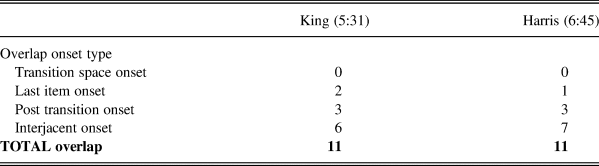
Table 2 shows that most of the senators’ overlapping turns are interjacent onset: six of King's eleven overlapping turns, and seven of Harris's eleven overlapping turns begin in this position. This finding suggests that the two senators interject in the middle of Sessions’ TCUs—probably the most disruptive form of overlap—with similar frequency.
Onset of overlap in the senators’ questioning of Sessions.

From a technical perspective, then, the two senators overlap and latch with Sessions’ talk in similar ways. The key difference in the senators’ overlapping and latching talk therefore lies primarily in how Sessions himself orients to these O/L turns—that is, whether he treats them as violative of his speaking rights.
How Sessions orients to the senators’ overlapping and latching turns
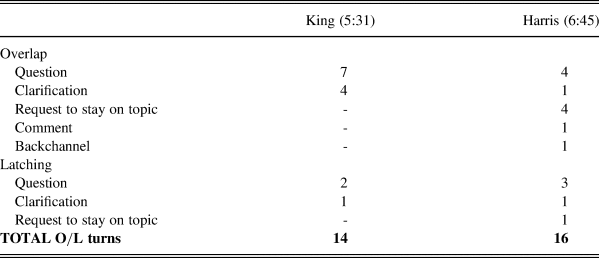
The attorney general's handling of the senators’ O/L turns is likely influenced by the conversational moves deployed by the senators in these turns. As shown in Table 3, the majority of King's O/L turns begin with a question (nine of fourteen O/L turns),Footnote 4 while the remaining five of his O/L turns function to clarify previous questions (e.g. “I'm not talking about the campaign, I'm talking about what the Russians did”).Footnote 5
Conversational moves associated with the senators’ O/L turns.

There is greater variety in the conversational moves associated with Harris's O/L turns. She too overlaps and latches with the attorney general's talk to ask questions (seven of sixteen O/L turns). However, Harris also clarifies previous questions (e.g. “My question is only as it relates to your knowledge”); requests the attorney general to stay on topic (e.g. “Sir, I'd like to just talk about what you did keep notes [on]”); comments on the attorney general's previous turn (e.g. “I do want you to be honest”); and supplies a backchannel cue (e.g. “Okay”).
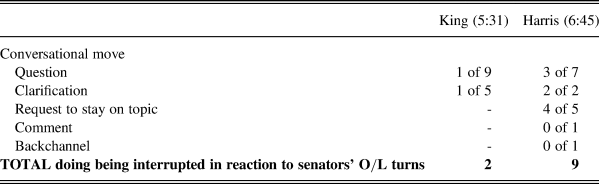
Table 4 shows the frequency with which Sessions does being interrupted during King's and Harris's questioning of him, and how interruption signals interface with the conversational moves used by the senators in their O/L turns. Whereas Sessions orients to King's O/L turns as interruptive two times, he treats nine of Harris's O/L turns as a violation of his speaking turns.
Frequency of Sessions doing being interrupted in reaction to the senators’ O/L turns.

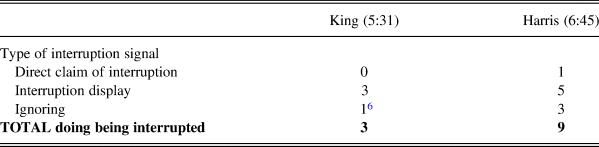
It should be noted that Sessions sends one interruption signal not in response to an O/L turn, but rather after King initiates a turn-at-talk following a very brief 0.2-second pause in Sessions’ discourse. As this pause is too long to constitute a latching turn as operationalized in this article, this interruption signal has been excluded from Table 4. However, it is important to note that the attorney general does being interrupted three times in total during King's questioning of him (see Table 5 below). During Harris's questioning, Sessions deploys interruption signals only in response to O/L turns.
Types of interruption signals used by Sessions in reaction to the senators’ turns.

One of the most remarkable findings displayed in Table 4 is that Sessions handles all of Harris's clarification O/L turns (two of two) and most of Harris's request to stay on topic O/L turns (four of five) as interruptive. As suggested in the qualitative analyses below, this may point to a tendency on Sessions’ part to resist Harris's overt attempts to control the topic of the interaction and to impose her conversational agenda.
As for how Sessions does being interrupted, he employs each of the interruption signals described by Bilmes (Reference Bilmes1997). As shown in Table 5, he directly claims that he was interrupted, makes interruption displays, and ignores his interlocutors. On one occasion during King's questioning, the attorney general mobilizes two of these interruption signals simultaneously.
In what follows, excerpts from both King's and Harris's questioning of Sessions are provided to show when and how Sessions orients to the two senators’ O/L turns as interruptive.
King's questioning
Broadly speaking, King's questioning of Sessions touches on two themes: the legal basis for Sessions’ refusal to answer certain questions put to him by committee members, and whether Sessions believes that Russians interfered in the election and how much he knows about the alleged interference. In the following example, King focuses on the second point, inquiring about information Sessions ‘sought’ and ‘received’ about Russian meddling in the 2016 US election.
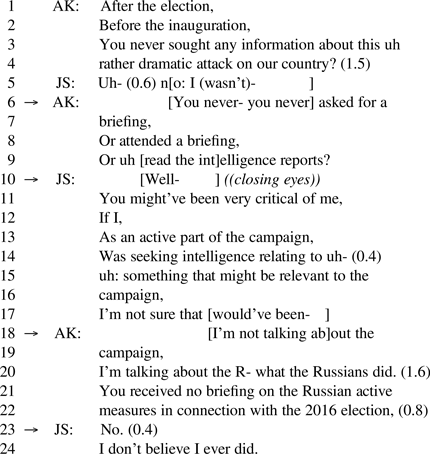
(1) (1:35:18) AK: Senator Angus King; JS: Attorney General Jeff Sessions


The senator begins by asking the following question: “You never sought any information about this uh rather dramatic attack on our country?” (lines 3–4). King then uses the same lexical construction (‘you never’) in a follow-up question, initiated in overlapping talk: “You never asked for a briefing, or attended a briefing, or uh read the intelligence reports?” (lines 6–9). The senator's formulation conveys incredulity and indirectly allocates blame to the attorney general. Using the term ‘never’ with multiple verbs denoting action, King suggests Sessions’ lack of concern for the ‘dramatic attack’ on the United States: “you never sought”, “you never asked for”, “you [never] attended”, and “you [never] read”. The senator expertly weaves these damaging propositions into his questions, which, even if Sessions denies, remain ‘on the record’.Footnote 7
The grammatical design of King's questions is likely not accidental. Negative declaratives such as “You never asked for a briefing” favor ‘no’ responses (Boyd & Heritage Reference Boyd, Heritage, Heritage and Maynard2006; Heritage Reference Heritage, Freed and Ehrlich2010). Indeed, after a brief hesitation, this is the ‘type conforming’ answer (Raymond Reference Raymond2003) Sessions begins to formulate in line 5 (“Uh no”) before King cuts him off to ask a follow-up question.
As King formulates this follow-up question, Sessions interjects, uttering a brief “well” before giving King the space to complete his question (line 10). At first blush, this “well” may be construed as an interruption signal. However, the attorney general's subsequent actions suggest otherwise. First, Sessions permits King to finish asking his question and ‘drop[s] out of competition for the floor’ (Hutchby Reference Hutchby1996:82) before starting up his defense in line 11. On other occasions, Sessions continues with his train of thought and ignores the overlap (see extract (2)); makes displays of frustration or annoyance by raising his volume, pursing his lips, and leaning back in his chair (see extract (3)); or explicitly sanctions his interlocutor for violating his speaking rights (see extract (4)). Though Sessions closes his eyes while waiting for King to complete his question (line 10), this appears to be self-regulatory as opposed to annoyed, as if closing one's eyes to an interlocutor so as not to start speaking out of turn (notably, the attorney general does not press his lips together or shake his head, unlike on other occasions). Furthermore, Sessions’ brief overlapping utterance occurs at post transition onset position. He presumably initiates the turn thinking that King has finished his TCU, but then drops out when he realizes that the senator has not yet finished his question.
Second, Sessions appears to be motivated by a desire to vindicate himself and explain away his actions (or lack of action) during the election campaign, not to display his annoyance at having been interrupted. As a discourse marker, ‘well’ may be used to express disagreement with a proposition contained in a prior utterance (Bolinger Reference Bolinger1989). The attorney general seemingly recognizes the negative sanction inscribed in King's questions; his use of ‘well’ serves as a preface to a forthcoming defense and explanation for not seeking out information about Russian meddling in the election.
Sessions’ defense consists of the following explanation: “You might've been very critical of me, if I, as an active part of the campaign, was seeking intelligence relating to… something that might be relevant to the campaign. I'm not sure that would've been-” (lines 11–17). Before the attorney general has a chance to continue, however, King again overlaps with Sessions’ talk in interjacent onset position, stating: “I'm not talking about the campaign, I'm talking about… what the Russians did” (lines 18–20).
The senator follows up this clarification with a question: “You received no briefing on the Russian active measures in connection with the 2016 election” (lines 21–22). Like his previous two questions, this one is also couched in a yes/no declarative. Notably, however, the senator has changed tack in formulating this question. Instead of positioning Sessions as a nonseeker of information (line 3: “You never sought”; line 6: “You never asked for”; etc.), he casts the attorney general in a more passive role as a nonrecipient of information (line 21: “You received no briefing”). This reframing of Sessions’ participation ultimately secures the answer that the senator appears to be looking for, with Sessions replying, “No, I don't believe I ever did” (lines 23–24).
Remarkably, Sessions does not orient to either of King's two overlapping turns in this extract as interruptive. He readily cedes the floor on each occasion and responds to the questions contained in the senator's turns. He does so despite the fact that the senator's questions contain damaging propositions about his lack of action regarding Russian intervention, and even though the second of these overlapping turns is initiated in interjacent onset position, before Session's turn has reached any sort of projectable completion point. This is what Hutchby (Reference Hutchby1996:88) might refer to as a ‘deep incursion’ that contributes to a ‘greater sense of interruptiveness’.
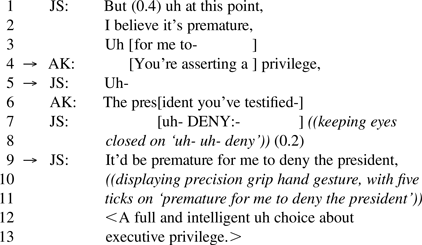
Sessions, however, does treat three of King's turns as interruptive (see again Table 4). The excerpt below is an illustrative example. Here, Sessions is responding to the senator's remark that he ‘just doesn't understand the legal basis for [Sessions’] refusal to answer’ some of the questions put to him by Committee members, considering that President Donald Trump has not invoked executive privilege regarding Sessions’ testimony. The attorney general is in the middle of an elaborate explanation that goes on for thirty-four seconds when King finally cuts in.
(2) (1:32:57) AK: Senator Angus King; JS: Attorney General Jeff Sessions

Unlike in example (1), here Sessions does not give up the floor when King overlaps in line 4. Instead, he produces an interruption display and simultaneously ignores the senator's turn. Sessions signals annoyance by a prolonged blink: he keeps his eyes closed for the latter part of King's overlapping utterance (line 6), as if trying to ‘unsee’ him. At the same time, Sessions speaks over the senator, attempting to continue with this train of thought (lines 5 and 7: “uh- uh- DENY”). Further displaying frustration and a determination to hold the floor, Sessions raises his voice on the word deny. Taken together, these actions suggest the attorney general's attempt to ignore, talk over, and, on the whole, treat King's overlapping turn as disruptive.
In line 9, Sessions then ‘recycles’ (Schegloff Reference Schegloff, Button and Lee1987) the same utterance that he began in line 2 (“It would be premature for me to deny the president”). He also employs the precision grip hand gesture (Kendon Reference Kendon2004; Streeck Reference Streeck2008) by joining his thumb with the tip of his forefinger and making five ‘ticks’ as he utters the phrase “premature for me to deny the president”. Sessions may employ this hand gesture, which is typically used to denote specificity and precision (Lempert Reference Lempert2011), to underscore the point that he could not get across because of King's interruptive turn.
As for King, he does not pursue the question that he begins to formulate in overlapping talk (lines 4 and 6: “You're asserting the privilege… the president you testified…”). Rather, he cuts himself off to permit Sessions to complete his utterance. Perhaps this is King's tacit acknowledgment that he is speaking out of turn.
The three instances of Sessions’ doing being interrupted during King's questioning all follow a similar pattern: the attorney general is in the midst of formulating a thought and the senator cuts in before Sessions has an opportunity to finish. As extract (1) demonstrates, however, Sessions does not orient to all such interjections as interruptions.
Harris's questioning
As shown in Table 5, Sessions does being interrupted more often during Harris's questioning than King's (nine versus three occurrences). In the context of Harris's questioning, Sessions sends an interruption signal most frequently when Harris makes overt efforts to ‘rein back’ (Hutchby Reference Hutchby1996:85) the attorney general's attempts to initiate a topic shift (six of nine occurrences). She accomplishes this ‘reining back’ by clarifying a previous question she has already asked or by requesting that the attorney general stay on topic.
The next excerpt is from early in the exchange between Harris and Sessions and it contains the first question that the senator puts to the attorney general. It is an example of the interactional tug of war that becomes increasingly evident as their interaction progresses.
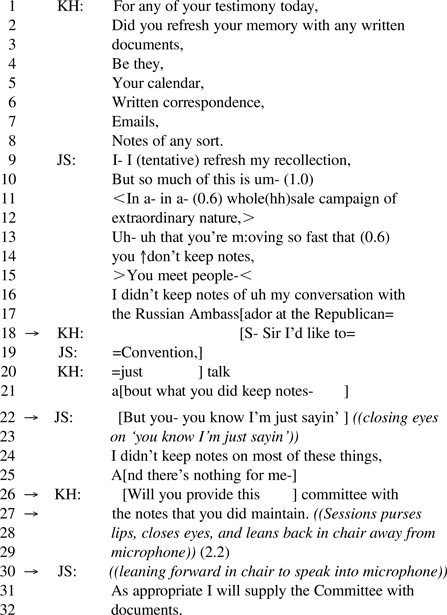
(3) (1:55:17) KH: Senator Kamala Harris; JS: Attorney General Jeff Sessions

Harris seeks to control the topic of the interaction by starting off with a direct yes/no interrogative question: “Did you refresh your memory with… notes of any sort” (lines 2–8). This phrasing is restrictive in that it favors a simple ‘yes’ or ‘no’ response. However, unlike King's questions in extract (1) (e.g. “You never sought information about this rather dramatic attack on our country”), Harris's formulation does not embody a negative proposition about Sessions or his actions. Indeed, the senator's question conveys an unknowing epistemic stance (Heritage Reference Heritage, Freed and Ehrlich2010) toward the attorney general and his prior actions. On the face of it, this seems to be a ‘genuine’ question to which Harris does not know the answer.Footnote 8
The attorney general responds to Harris's query first with a general statement about refreshing his memory (line 9: “I- I (tentative) refresh my recollection”) and then subtly resists the constraints placed on his response. He qualifies and expands upon his answer beyond a straightforward ‘yes’ or ‘no’, elaborating in lines 10–17 and 19: “But so much of this is… in a wholesale campaign of extraordinary nature… I didn't keep notes of my conversation with the Russian Ambassador at the Republican Convention”. Such an expansion ‘departs from the agenda of the question’ (Stivers & Heritage Reference Stivers, Hayashi and Heritage2001:154) and may serve to initiate a topic transition, allowing the question recipient to gain control over the information elicited through the question (see Greatbatch Reference Greatbatch1986; Drew Reference Drew, Drew and Heritage1992; Ehrlich & Sidnell Reference Ehrlich and Sidnell2006; Galatolo & Drew Reference Galatolo and Drew2006). Here, instead of elaborating upon whether he refreshed his memory with written documents (i.e. the topical agenda of the question), Sessions shifts the focus to the challenges of keeping written records in a campaign of ‘such extraordinary nature’.
Sessions initiates similar topic transitions a number of times during Harris's questioning. In response, Harris typically clarifies her question or makes a direct or indirect appeal for him to stay on topic. In example (3), her request is quite straightforward (lines 18, 20–21: “Sir, I'd like to just talk about what you did keep notes [on]”), while at other times it is somewhat more muted (e.g. “Sir, I'm just asking you about the DOJ policy”, “Thank you Sir, thank you”).
Four out of the five times that Harris makes an appeal to Sessions to stay on topic, she uses the politeness marker ‘Sir’, presumably to ‘show deference to the interlocutor and to bid for cooperative behavior’ (House & Kasper Reference House, Kasper and Coulmas1981:166). In doing so, Harris likely seeks to mitigate or ‘downgrade’ (Reference House, Kasper and Coulmas1981:166) the potential face threat entailed in the request and incursion. Nevertheless, on each of the four occasions, Sessions does being interrupted: he initiates an interruption display, makes a claim of interruption, or simply ignores the senator's plea.
In extract (3), above, the attorney general produces an interruption display in response to Harris's request for him to stay on topic. He does not relinquish the floor to Harris but continues with his line of thought (lines 22–24: “I'm just sayin’ I didn't keep notes on most of these things”) and closes his eyes while uttering the words “I'm just sayin’”, suggesting frustration or a desire to physically ignore Harris (similar to the interruption display exhibited during King's questioning in extract (2) above).
As Sessions continues to pursue the topic of what he did not keep notes on, Harris overlaps with his turn-at-talk in post completion onset position, asking the attorney general, “Will you provide the committee with the notes that you did maintain” (lines 26–27). Presumably, this is the senator's attempt to use overlap as a control device to ‘cut into an unacceptable response-in-progress in order to press for a response that would be acceptable’ (Hutchby Reference Hutchby1996:91). And, in pressing Sessions about “the notes that you [Sessions] did maintain”, the senator seeks to restore the topical agenda that she had introduced in the beginning of the exchange.
Harris's attempt to regain topical control over this interaction does not go unnoticed. As she formulates her question (lines 26–27: “Will you provide this committee with the notes that you did maintain”), Sessions produces an even more marked interruption display. He purses his lips, closes his eyes, and leans back in his chair, as if to communicate, ‘I've been silenced’. Further, Sessions pauses for 2.2 seconds before answering the question, deploying what Bilmes (Reference Bilmes1997:520) calls an ‘extended cut-off’ that may serve to ‘underline the disruptive effect of… [the] interruption’.
As far as interruption signals go, the two examples in extract (3) are rather mild compared to the more confrontational claim of interruption in the following excerpt. Roughly three minutes into questioning Sessions, Harris is pressing the attorney general about conversations between him and Russians. As Sessions again seeks to expand upon his reply to a yes/no question, Harris implores him to stay on topic. This elicits the most direct interruption signal from Sessions throughout the entire hearing.
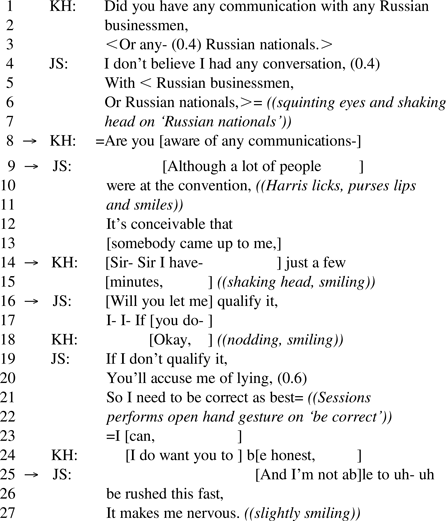
(4) (1:57:47) KH: Senator Kamala Harris; JS: Attorney General Jeff Sessions

Again, Harris begins in this excerpt by asking an interrogative yes/no question. This time the focus of her question is whether Sessions had any communications with Russians (lines 1–3: “Did you have any communication with Russian businessmen or Russian nationals”). Sessions replies by echoing: “I don't believe I had any conversations with Russian businessmen or nationals” (lines 4–6). He utters this statement in slow, drawn-out speech, possibly to buy time to think about how to best formulate his answer. Harris quickly latches on to Sessions’ response and immediately initiates a follow-up question (line 8: “Are you aware of any communications”), likely to prevent the attorney general from elaborating upon his prior reply as on other occasions.
Before her run for Senate, Harris was a prosecutor for twenty years. Her adeptness at exploiting the question/answer format of witness examination—and not giving interactional space to the witness to elaborate on a yes/no question—is on full display here. But the attorney general does not kowtow to Harris's interactional agenda. Not long after Harris launches into her new question (line 8: “Are you aware of any communications-”), Sessions proceeds to qualify his previous answer in overlapping talk: “Although a lot of people were at the convention, it's conceivable that somebody came up to me” (lines 9–13).
At this point, Harris's frustration becomes visible. She licks and purses her lips and then smiles a broad, seemingly forced smile that suggests annoyance and that her own speaking rights have been violated. In turn, she interjects in the middle of Session's utterance, making an indirect appeal to him to stay on topic and allow her to ask her questions. She pleads: “Sir- Sir I have- just a few minutes” (lines 14–15). Harris again uses the politeness marker ‘Sir’, possibly to mitigate the impact of any perceived violation to the attorney general's speaking turn.
For his part, Sessions explicitly sanctions the senator for not giving him the space to qualify and contextualize his response to her question. He exclaims: “Will you let me qualify it… If I don't qualify it, you'll accuse me of lying, so I need to be correct as best I can” (lines 16, 17, 19–23). The attorney general's statement is striking because it is an overt display of frustration that flips the script on the asymmetry inherent in institutional talk. Refusing to be backed into an interactional corner, so to speak, Sessions calls out the senator for interrupting him. He then goes on to indirectly criticize Harris's questioning style, stating, “I'm not able to… be rushed this fast. It makes me nervous” (lines 25–27).
These few moments mark the most contentious point of the entire hearing. But they are not the only time Harris is censured during her questioning.
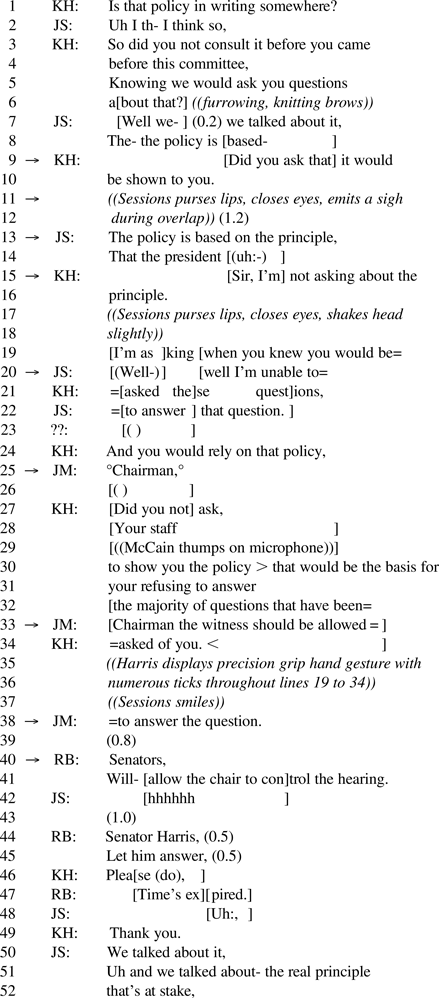
The following exchange occurs not two minutes after the interaction in extract (4). Here, Harris is inquiring about a US Department of Justice policy that Sessions relies on to avoid answering questions put to him by committee members. As she pushes Sessions to answer her questions regarding this policy, Senator John McCain inserts himself, as well as Senator Richard Burr, Chairman of the Senate Intelligence Committee, into the exchange.
(5) (2:00:10) KH: Senator Kamala Harris; JS: Attorney General Jeff Sessions; JM: Senator John McCain; RB: Senator Richard Burr (Chairman)

Harris begins in this excerpt by asking about whether the policy that Sessions is relying on to avoid answering questions is in writing (line 1: “Is that policy in writing somewhere?”) and subsequently, whether Sessions reviewed it before attending the hearing (lines 3–6: “So did you not consult it before you came before this committee, knowing we would ask you questions about that?”). Harris's second question is accusatory in tone. First, embedded in her question is the proposition that Sessions knew he would be asked questions but he either shirked his responsibility to review the policy or that he reviewed the policy but is not being forthcoming at the hearing. Either interpretation is damaging to Sessions’ reputation. Second, in delivering the question, Harris knits her brows in a way that suggests anger, confusion, and perhaps a bit of scolding.
As Sessions starts up a reply (lines 7–8: “Well… we talked about it, the… policy is based…”), Harris cuts in at interjacent onset position to ‘cut to the chase’ and ask a more direct question: “Did you ask that it [the policy] would be shown to you” (lines 9–10). The attorney general handles this turn as interruptive. He cuts himself off, presses his lips together, closes his eyes, emits a quiet sigh, and extends his cut off by 1.2 seconds before recycling his previous turn, which he could not finish due to Harris's overlapping talk (lines 13–14: “The policy is based on the principle that the president…”). But before Sessions has an opportunity to complete this recycled utterance, Harris again interjects. Recognizing that Sessions has begun to initiate a topic shift—that is, from whether the attorney general asked to see the policy to the principle that the policy is based on—she presumably wishes to reinstate her own topical agenda. Perhaps also aware that she has run out of time (at five minutes and twenty seconds), the senator may be trying out a more direct approach to securing an answer to her question.
Harris clarifies and repeats an extended version of her previous question, stating: “Sir, I'm not asking about the principle. I'm asking when you knew you would be asked these questions, and you would rely on that policy, did you not ask your staff to show you the policy that would be the basis for your refusing to answer the majority of questions that have been asked of you” (lines 15–16, 19, 21, 24, 27–28, 30–32, 34). Sessions again treats the senator's turn as an incursion on his speaking rights and produces an interruption display: he purses his lips, closes his eyes, and shakes his head slightly before providing a reply: “Well I'm unable to answer that question” (lines 20, 22).
While Harris is in the middle of articulating this lengthy question, McCain cuts in, directing his talk to Burr. He entreats Burr to step in and states in overlapping talk: “Chairman, the witness should be allowed to answer the question” (lines 33, 38). What is most remarkable about McCain's interjection is that it is the only time during the two-and-a-half-hour hearing that a senator who is not the Chairman cuts into another senator's time. Furthermore, McCain's utterance seems to serve as an interruption signal on behalf of Sessions.
As for the attorney general, after he momentarily drops out of this interaction in lines 20 and 22, he appears to be entertained by the overlapping talk and conversational turmoil. He smiles and chuckles while Richard Burr asserts his authority and states, “Senators will allow the chair to control the hearing. Senator Harris, let him answer… Time's expired” (lines 40–41, 44–45, 47). Following this warning, Harris permits Sessions to continue with his line of thought. And soon thereafter, her questioning comes to an end without the senator receiving the reply she was seeking.
The analyses of exchanges between King, Harris, and Sessions demonstrate that the attorney general occasionally resists a senator's attempts to cut in while he is in the middle of formulating a thought, though he does not always treat such utterances as interruptive (see again extract (1)). Sessions does, however, appear to handle nearly all of Harris's clarification and request to stay on topic O/L turns as violative of his speaking rights (see again Table 4 and extracts (3), (4), and (5)). This suggests that Sessions rebuffs overt attempts to ‘rein back’ his responses or expose his attempts to shift topic. Although Harris tends to use the politeness marker ‘Sir’ in these situations, this strategy might be counterproductive in that it calls greater attention to and may amplify the perceived incursion.
Conclusions
The quantitative analyses presented in this article show that Senators Angus King and Kamala Harris, two ‘winners’ (Cilizza Reference Cilizza2017) in the Sessions Senate Intelligence hearing, employ overlap and latching with similar frequency in their questioning of the attorney general. In terms of overlapping with Sessions’ talk, Harris does not speak over the attorney general more than King. Further, she latches on to his utterances only marginally more than her male colleague. Nevertheless, Sessions orients to Harris's turns as interruptive three times more often than King's. The attorney general most resists attempts on the part of Harris to impose her conversational agenda and keep him on topic.
It is worth noting that situational factors may have played a role in shaping the attorney general's testimony. The Senate Intelligence hearing on June 13, 2017 was approximately two and a half hours in length. Harris's questioning took place almost two hours into the hearing, after a number of other senators had pressed Sessions on similar issues. By this point, Sessions, as well as the senators on the Committee, may have experienced fatigue and frustration. This could have affected how Sessions oriented to Harris’ turns-at-talk. By comparison, King's questioning began slightly earlier, at approximately the one and a half hour mark.
Reactions to the hearing suggest that viewers are likely influenced by Sessions’ orientation to the senators’ talk in their own interpretation of what happened during the hearing. Because of the way Sessions handles Harris's turns, the interaction is widely regarded as contentious, and Harris is generally perceived as interruptive. Harris is first criticized by her interlocutor for not giving him enough time to answer her questions and for ‘rushing him’ (extract (4): “will you let me finish… I can't be rushed this fast”). Harris is then censured by her male colleagues, Senators John McCain and Richard Burr, for not allowing Sessions to respond to her line of questioning (extract (4): “Chairman, the witness should be allowed to answer the question”; extract (5): “Senator Harris, let him answer”). Notably, no other senators are sanctioned in this way during the hearing.
In the news media following the hearing, Harris is negatively evaluated by commentators and political pundits for being ‘aggressive’ (Daponte-Smith Reference Daponte-Smith2017; Finnegan Reference Finnegan2017), and worse, ‘hysterical’ (Mettler Reference Mettler2017) during Sessions’ testimony. Even liberal media outlets such as The New York Times and New York (magazine) characterize the interaction as a ‘brutal exchange’ (Chait Reference Chait2017) and Harris as interrupting (see e.g. Rogers Reference Rogers2017).
Multiple news outlets have published videos of Harris ‘grilling’ (Feldscher Reference Feldscher2017; McAfee Reference McAfee2017) Sessions to the video-sharing website, YouTube. Members of the general public have offered their interpretations of the hearing by commenting on these videos. Although some praise Harris for being ‘tough’,Footnote 9 many others admonish her for her questioning style. One YouTube commenter writes that ‘being respectful and allowing Sessions to answer the question seems to escape Kamala’,Footnote 10 while another remarks that Harris ‘doesn't have a clue about how to ask a question’.Footnote 11 Still others call the senator ‘unprofessional’, ‘rude’, ‘unhinged’, and ‘evil’.Footnote 12
The attorney general's handling of Harris's questioning thus appears to create a ripple effect with negative repercussions for Harris. Participants—both the more ‘immediate’ (Sessions, McCain, Burr) and the more ‘removed’ (the media, the public)—call Harris's competence and character into question.Footnote 13 Remarkably, despite deploying a similar number of overlapping and latching turns, King is not subject to widespread criticism or indeed, much media attention at all.
As stated in the introduction, some observers aver that sexism is at the root of negative evaluations of Harris and her ‘aggressive’ questioning of Sessions. This is certainly possible. Research shows that gender informs perceptions of linguistic behavior (see e.g. Ehrlich Reference Ehrlich2002, Reference Ehrlich2007; Romaniuk & Ehrlich Reference Romaniuk, Ehrlich, Wodak and Forchtner2017), and numerous studies have found that female politicians are sanctioned for linguistic behaviors that their male counterparts display without penalty. Such behaviors include ‘illegal turns’ (Shaw Reference Shaw2016), attempts to (re)claim the floor (Cameron & Shaw Reference Cameron and Shaw2016), and even laughter (Romaniuk Reference Romaniuk2014, Reference Romaniuk2016).
Overlap and latching, when used to exercise interactional control in a congressional hearing, may also be less readily available to female politicians. Prior research on ordinary conversation suggests a gender difference in the use of interruption (see e.g. Zimmerman & West Reference Zimmerman, West, Thorne and Henley1975; Orcutt & Mennella Reference Orcutt and Mennella1995; cf. Tannen Reference Tannen1994). A larger sample of interactions is necessary to generalize as to the possible gendered use of these two features in the political context—as well as others’ interpretations of their use by women (versus men). Future studies could be directed at analyzing interactions between female (and male) politicians and their interlocutors to determine how overlap and latching are employed and to what overall effect. These studies may be carried out in a variety of political settings, including congressional hearings, debates, press conferences, and other political speech events.
Appendix: Transcription conventions
Adapted from Schegloff (Reference Schegloff2007) and Clift (Reference Clift2016)