Introduction
Nasopharyngeal carcinoma is an epithelial malignancy with a high incidence in southern China. Epidemiologic studies have implied that the pathogenesis of nasopharyngeal carcinoma correlates with multiple factors, such as genetic susceptibility, Epstein–Barr virus infection and certain environmental carcinogens.Reference Li, Wang, Zhao, Ren, Jin and Yao1–Reference Lo and Huang4 The molecular mechanisms leading to the development of nasopharyngeal carcinoma are not yet well understood.
Common chromosomal fragile sites have been shown to be involved in the development of many cancers, through the mechanism of large-scale chromosomal abnormalities, such as deletions and rearrangements. One of these, fragile site FRA3B, is the most unstable site in the human genome and is directly involved in the breakpoints of deletion and translocation in a wide spectrum of cancers.Reference Becker, Thorland, Denison, Phillips and Smith5, Reference Fang, Arlt, Buegess, Dagenais, Beer and Glover6 The FRA3B site at 3p14.2 is located within the fragile histidine triad gene, spanning several hundred kilobases from exon four to the proximal portion of intron five.Reference Corbin, Neilly, Espinosa, Davis, McKeithan and Le Beau7, Reference Kameoka, Tagawa, Tsuzuki, Karnan, Ota and Suguro8 Aberrant alteration of the fragile histidine triad gene has been observed in various cancers.Reference Huebner and Croce9–Reference Yuge, Nibu, Kondo, Shibahara, Tayama and Sugasawa11 Many deletions and rearrangements of this gene have been mapped to the FRA3B site in tumour cell lines.Reference Corbin, Neilly, Espinosa, Davis, McKeithan and Le Beau7, Reference Kameoka, Tagawa, Tsuzuki, Karnan, Ota and Suguro8, Reference Thavathiru, Ludes-Meyers, Macleod and Aldaz12 These results suggest that instability of FRA3B contributes to the development of various cancers.
Allelic loss at chromosome 3p is a frequent event in many tumours, including nasopharyngeal carcinoma,Reference Li, Wang, Zhao, Ren, Jin and Yao1, Reference Lo and Huang4, Reference Shao, Zeng and Zeng13 suggesting the inactivation of a putative tumour suppressor gene in this region. Recent attention has focussed on a candidate 3p14.2 tumour suppressor gene, fragile histidine triad, which spans FRA3B. Although the fragile histidine triad gene is altered in many human cancers, its status as a tumour suppressor gene has remained controversial, particularly since functional studies have provided contradictory results. It had been suggested that alterations in the fragile histidine triad gene result from FRA3B induction, promoted by carcinogens interfering with deoxyribonucleic acid (DNA) replication.Reference Thavathiru, Ludes-Meyers, Macleod and Aldaz12, Reference Kuroki, Tajima, Furui and Kanematsu14 However, Michael and RajewskyReference Michael and Rajewsky15 found that FRA3B induction had no direct effect on fragile histidine triad transcription and translation. Previous studies have presented different and conflicting results with regard to the role of the fragile histidine triad gene in nasopharyngeal carcinogenesis. Deng et al. Reference Deng, Tian, Lu, Chen, Xie and Yang10 revealed that the fragile histidine triad gene may play an important role in the pathogenesis of nasopharyngeal carcinoma. However, Sung et al. Reference Sung, Zeng and Raab-Traub16 studied the fragile histidine triad gene structure and its transcription in primary tumours, and concluded that the results did not support a role for the gene in nasopharyngeal carcinoma.
Previous studies have shown allelic loss on 3p12–14 in nasopharyngeal carcinoma.Reference Lo and Huang4, Reference Shao, Zeng and Zeng13 However, no precise data are available on the patterns of loss of heterozygosity at the FRA3B site (at 3p14.2). To determine the precise patterns of allelic loss at the fragile site in nasopharyngeal carcinoma, we examined loss of heterozygosity at the FRA3B region, using eight high dense, polymorphic, microsatellite markers, in 40 nasopharyngeal carcinoma cases. Furthermore, we analysed the potential association between loss of heterozygosity, Epstein–Barr virus infection and clinicopathological features.
Materials and methods
Patients and specimens
Biopsies of primary nasopharyngeal carcinoma and corresponding peripheral blood samples were obtained from untreated Chinese patients at the Zhongshan Hospital of Xiamen University in Xiamen, Fujian Province, and at the Second Xiangya Hospital of Central South University in Changsha, Hunan Province. Nasopharyngeal carcinoma is endemic in both these regions. We also recorded the serum antibody titres of immunoglobulin (Ig) A against Epstein–Barr virus capsid antigen for each blood sample, and other clinicopathologic features. The tumour–node–metastasis (TNM) classification was defined according to the International Union Against Cancer (UICC) 1997 nasopharyngeal carcinoma staging system. The pathology was evaluated according to the World Health Organization (WHO) histological classification. Tumour tissue samples that contained more than 80 per cent tumour cells were examined by microdissection.
DNA extraction
Genomic DNA was extracted from the tumour tissues and blood leucocytes by conventional methods.Reference Maniatis, Fritsch and Sambrook17 The concentration of DNA was diluted to 100 ng/µl and stored at 4ºC.
Microsatellite analysis
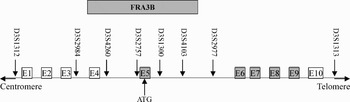
Eight microsatellite, polymorphic markers at or flanking the FRA3B site (Figure 1, Table I) were used to examine loss of heterozygosity, via polymerase chain reaction analysis. Of these, four markers were within the FRA3B site: D3S4103 and D3S1300 in intron five of the fragile histidine triad gene; and D3S2757 and D3S4260 in intron four of the gene. In addition, we used two markers (D3S2977 and D3S2984) flanking the FRA3B site and another two markers (D3S1313 and D3S1312) flanking the fragile histidine triad gene. The sequences of the primers and chromosomal localisation were obtained from the Genome Database and the National Center for Biotechnology Information (NCBI), sequence tagged sites (STS) Database. Polymerase chain reactions were conducted in a DNA thermal cycler (Perkin Elmer, Boston, USA) and used 100 ng of template DNA, 20 ng of each primer, 0.2 mM of each deoxynucleotide triphosphates, 1.5 mM MgCl2, 50 mM KCl, 10 mM Tris-HCl and one unit of Taq DNA polymerase (Promegra, Madison, USA) in a final volume of 25 µl. The polymerase chain reaction amplifications were performed as follows: initial denaturation at 94°C for 5 minutes, followed by 28 cycles of denaturation at 94°C for 30 seconds, annealing at the appropriate temperature for 30 seconds, with an extension at 72°C for 40 seconds and a final extension at 72°C for 5 minutes. The polymerase chain reaction products were heat-denatured and electrophoresed on 8 or 10 per cent denaturing polyacrylamide gels and then detected using silver staining.
Genomic organisation of the FRA3B/fragile histidine triad (FHIT) region. The position of the unstable FRA3B region is indicated by the shaded bar. The approximate location of the initiation of translation codon (ATG) is indicated. Open boxes=exons 1 to 10 of the FHIT gene; shaded boxes=protein-coding exons; ATG=the initiation codon of the FHIT gene

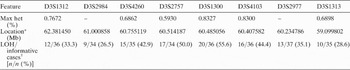
Features of intragenic and flanking markers used to determine genomic organisation of FRA3B/fragile histidine triad region

* Distance from telomeric end (based on Homo sapiens from the Genome Database and National Center for Biotechnology Information (NCBT) map viewer). See also Figure 1.†Number of samples showing loss of heterozygosity and informative samples, giving a percentage of overall loss of heterozygosity. Max het=maximum heterozygosity; –=data unavailable
Assessment of loss of heterozygosity
Loss of heterozygosity was analysed using the Applied Biosystems Prism Genescan and the Applied Biosystems Prism Genetyper analysis software (Perkin Elmer/Applied Biosystems, Foster city, USA). A sample was considered to have allelic loss if the intensity of one allele in the tumour tissue was reduced by 50 per cent or more, compared with matching normal tissue.Reference Kuroki, Trapasso, Yendamuri, Matsuyama, Alder and Mori18 Constitutional homozygosity was regarded as uninformative. Allelic loss was confirmed at least twice in separate polymerase chain reactions.
Statistical analysis
Statistical analysis was performed using the Statistical Package for the Social Sciences 13.0 software package (SPSS, Chicago, Illinois, USA). Fisher's exact test was used to assess the relationship between loss of heterozygosity and clinicopathologic features and Epstein–Barr virus infection. The results were considered to be significant at p<0.05.
Results
Analysis of loss of heterozygosity
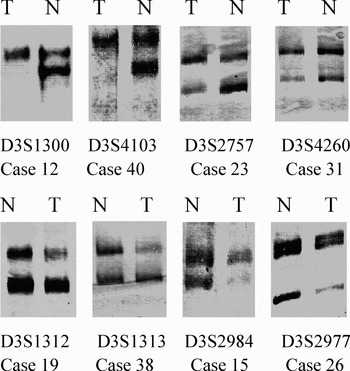
Forty matched tumour and normal DNA pairs were analysed for allelic losses with eight polymorphic microsatellite markers. Figure 2 shows representative allelic loss for different markers from several cases. Loss of heterozygosity at one or more loci was observed in 31 of the 40 (77.5 per cent) cases (Table I, Table II). Of the 31 cases with allelic loss, eight exhibited two or more regions of loss of heterozygosity, 13 showed loss of heterozygosity in one continuous and nonrandom region between D3S4103 and D3S4260, and four showed loss of heterozygosity at all informative loci, indicating loss of the entire FRA3B/fragile histidine triad region. Loss of heterozygosity was particularly frequent at D3S4103 (44.4 per cent), D3S1300 (55.6 per cent), D3S2757 (50.0 per cent) and D3S4260 (42.9 per cent). The frequency of loss of heterozygosity at the eight loci ranged from 28.6 per cent (D3S1313) to 55.6 per cent (D3S1300). Of the eight loci, four showed a frequency of loss of heterozygosity of more than 40 per cent, all within the FRA3B site. A common deletion area within the FRA3B region was defined, located between the D3S4103 and D3S4260 loci. The interval was about 350 kb.
Representative examples of loss of heterozygosity for each marker. N=normal tissue; T=tumour tissue

Correlation between loss of heterozygosity and clinicopathological features
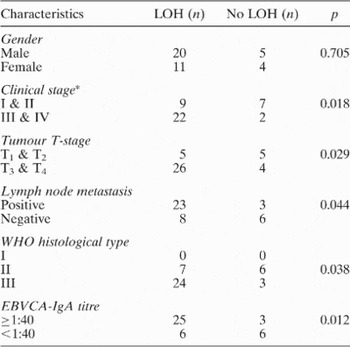
Clinical data for the 40 nasopharyngeal carcinoma patients are summarised in Table II. Table II shows the relationship between loss of heterozygosity and the clinicopathological features of nasopharyngeal carcinoma. Loss of heterozygosity at the FRA3B region correlated with the following clinicopathological parameters: tumour T-stage, lymph node metastasis, TNM classification, tumour cell differentiation and serological antibody titres of IgA against Epstein–Barr virus capsid antigen. No correlation was observed between loss of heterozygosity and gender. A significantly greater frequency of loss of heterozygosity was observed in nasopharyngeal carcinoma cases characterised by stage T3 and T4, lymph node metastasis and advanced clinical stage (III and IV), compared with nasopharyngeal carcinoma cases characterised by stage T1 and T2, no lymph node metastasis and early clinical stage (I and II) (p<0.05). A significantly greater frequency of loss of heterozygosity was observed in nasopharyngeal carcinoma cases which were WHO type III, compared with those which were WHO type II (p=0.038). We also detected a significantly greater frequency of loss of heterozygosity in nasopharyngeal carcinoma cases with higher serological antibody titres of IgA against Epstein–Barr virus capsid antigen (≥1:40), compared with cases with lower such titres (<1:40) (p=0.012).
Correlation between loss of heterozygosity of fra3b region and nasopharyngeal carcinoma characteristics

* By International Union Against Cancer (UICC) 1997 tumour–node–metastasis staging system. LOH=loss of heterozygosity; WHO=World Health Organization; EBVCA-IgA=immunoglobulin A against Epstein–Barr virus capsid antigen
Discussion
We examined 40 cases of nasopharyngeal carcinoma for loss of heterozygosity at eight high dense, polymorphic, microsatellite loci in or near the FRA3B site. In 13 cases, we observed a continous region of loss of heterozygosity between the D3S4260 and D3S4103 loci. The common deletion region was within the human common fragile site FRA3B and encompassed introns four and five and exon five of the fragile histidine triad gene. This gene, mapping at 3p14.2, has been found to be deleted in some cases of head and neck cancer, including several nasopharyngeal carcinoma cell lines.Reference Yuge, Nibu, Kondo, Shibahara, Tayama and Sugasawa11, Reference Ohta, Inoue, Cotticelli, Kastury, Baffa and Palazzo19 In the current study, we found a higher frequency of loss of heterozygosity at the FRA3B site within nasopharyngeal carcinoma tissue. At 3p14.2, loss of heterozygosity was highly localised to markers mapping around the FRA3B site, especially to the intronic region of the fragile histidine triad gene. Furthermore, the markers with a higher frequency of loss of heterozygosity (i.e. D3S1300 and D3S2757) flank exon five of the fragile histidine triad gene, implying that the exon is missing. Exon five contains the imitiation codon (ATG) for synthesis of the fragile histidine triad protein.Reference Ohta, Inoue, Cotticelli, Kastury, Baffa and Palazzo19
These findings suggest that genomic deletion in the FRA3B region may be involved in the pathogenesis of nasopharyngeal carcinoma, possibly preceding the loss or inactivation of the fragile histidine triad gene or another tumour suppressor gene. Furthermore, the findings indicate that the fragile histidine triad gene, or an as yet undiscovered tumour suppressor gene mapping to the D3S4103–D3S4260 interval, could be the molecular target of the 3p14.2 deletions.
There are different theories regarding the role of the fragile histidine triad gene in the development of primary nasopharyngeal carcinoma. Sung et al., following their analysis of the fragile histidine triad gene structure and transcription in primary tumours, did not support a role for the gene in nasopharyngeal carcinoma.Reference Sung, Zeng and Raab-Traub16 On the other hand, Deng et al. found aberrant alterations of the fragile histidine triad gene on the genomic and transcriptional levels in primary nasopharyngeal carcinoma.Reference Deng, Tian, Lu, Chen, Xie and Yang10 In order to elucidate the role of the fragile histidine triad gene in nasopharyngeal carcinoma, further study must focus on functional analysis of the fragile histidine triad protein.
In this study, we found a significantly higher incidence of loss of heterozygosity at the FRA3B region within tumours staged as III and IV, compared with those staged as I and II. Also, a significantly greater frequency of loss of heterozygosity was found in nasopharyngeal carcinomas staged as T3 and T4, compared with those staged as T1 and T2. Finally, a significantly greater frequency of loss of heterozygosity was found in nasopharyngeal carcinomas with lymph node metastasis, compared with those without lymph node metastasis.
• This study determined the precise patterns of allelic loss at the fragile site FRA3B in cases of endemic nasopharyngeal carcinoma
• Frequent allelic loss at the FRA3B site was associated with the following clinicopathological parameters: tumour T-stage (T3 and T4), lymph node metastasis, clinical stage (III and IV), tumour differentiation (World Health Organization type III) and high titres of immunoglobulin A against Epstein–Barr virus capsid antigen (≥1:40)
• The region between the D3S4103 and D3S4260 loci may be a preferential target site in nasopharyngeal tumourigenesis
These results show that, in nasopharyngeal carcinoma cases, allelic loss at the FRA3B region correlated with advanced TNM stage (III and IV). This indicates that allelic loss in this region may be associated with aggressive and progressive behaviour of nasopharyngeal carcinoma. It has been reported that chromosomal abnormalities are associated with neck nodal metastasis in nasopharyngeal carcinoma.Reference Yan, Song, Wei, Li, Liu and Fang20 In nasopharyngeal carcinoma, deletion of the fragile histidine triad gene may be a consequence of its proximity to the unstable FRA3B region. Therefore, any involvement of this gene in nasopharyngeal carcinoma would be at the level of preventing tumour progression rather than initiation.
In our study, loss of heterozygosity at the FRA3B region was also found more frequently in WHO type III than in WHO type II nasopharyngeal carcinoma cases. This suggests that accumulative allelic loss at this region may be responsible for poor tumour cell differentiation, and that a putative tumour suppressor gene may be involved in the differentiation of nasopharyngeal carcinoma tumour cells.
Epstein–Barr virus has been revealed as an important aetiological factor in the development of nasopharyngeal carcinoma.Reference Burgos2, Reference Chan, Teo and Huang3 However, the role that this virus plays in initiation or progression is unclear. In nasopharyngeal carcinoma tumourigenesis, it is also unclear whether or not there is any interaction between genetic alterations and Epstein–Barr virus infection. In the present study, a significantly greater frequency of loss of heterozygosity at the FRA3B region was observed in nasopharyngeal carcinoma cases with higher titres of IgA against Epstein–Barr virus capsid antigen (≥1:40) than in those with lower titres (<1:40).
Mutirangura et al. Reference Mutirangura, Tanunyutthawongese, Pornthanakasem, Kerekhanjanarong, Sriuranpong and Yenrudi21 also found a high frequency of allelic loss at 3p14 in nasopharyngeal carcinoma cases associated with Epstein–Barr virus. These data suggest a possible counteracting role of Epstein–Barr virus infection and genetic alterations in nasopharyngeal carcinoma tumourigenesis. Pathmanathan et al. Reference Pathmanathan, Prasad, Sadler, Flynn and Raab-Traub22 have identified clonal proliferations of cells infected with Epstein–Barr virus within preinvasive lesions related to nasopharyngeal carcinoma. Pegtel et al. have demonstrated that Epstein–Barr virus encoded protein induces primary epithelial cell migration and invasion, suggesting that Epstein–Barr virus infection may contribute to the high incidence of metastasis in nasopharyngeal carcinoma progression.Reference Pegtel, Subramanian, Sheen, Tsai, Golub and Thorley-Lawson23
The FRA3B region may be a genetic susceptibility locus for nasopharyngeal carcinoma, conferring a unique susceptibility to the effects of environmental and viral carcinogens. We hypothesised that a possible role of Epstein–Barr virus in the promotion of endemic Chinese nasopharyngeal carcinoma might be through viral DNA integration into the FRA3B region. Epstein–Barr virus associated with nasopharyngeal carcinoma might promote induction of the FRA3B region, contributing to deletion on 3p14.2 and possibly to inactivation of the putative tumour suppressor gene. Our investigation supports the possibility that an important tumour suppressor gene or fragile histidine triad gene resides in this region and complements Epstein–Barr virus transformation.
Further exploration, focussing on genetic alteration correlated with Epstein–Barr virus infection, should be performed by quantitative analysis of the Epstein–Barr virus genome and the Epstein–Barr virus encoded protein, using nasopharyngeal carcinoma tissue, to assess possible interactions and mechanisms.
Conclusion
Allelic loss at the FRA3B site is a common event in endemic nasopharyngeal carcinoma, and it correlates with certain clinicopathological characteristics. The region between D3S4103 and D3S4260 may be a preferential target in the development of nasopharyngeal carcinoma. Future research is needed to identify the associated gene involved in the identified site of chromosomal deletion and to determine more precisely its role in nasopharyngeal carcinogenesis.
Acknowledgements
This study was supported in part by grant 39500172 from the National Natural Science Foundation of China.