Context
Whole Class Ensemble Tuition (WCET) is a model of teaching and learning music which takes place in English schools. It is a relatively recent addition to the canon of musical pedagogies in the English context, but will probably be recognisable in some form to many from an international audience. WCET normally consists of a visiting instrumental music teacher teaching whole class lessons in Primary Schools. The policy background to WCET is that the then Secretary of State for Education announced in 2000 that ‘over time, all pupils in primary schools who wish to, will have the opportunity to learn a musical instrument’ (Ofsted, 2004: p. 4). Financial support for this initiative came from the government, and in a Department for Children, Schools, and Families circular, it was observed that:
By 2011 we believe that all primary school pupils who want to can have the opportunity to learn a musical instrument. (DCSF, 2008: p. 1)
Since that time, funding from the government has been devolved to, and managed by, Arts Council England.
The work of WCET most commonly takes place in primary schools and involves a whole class of children learning to play a musical instrument at the same time. Often the visiting teachers will need to bring, and set-up, the instruments beforehand. In a number of cases, however, the instruments remain in the schools between lessons. The costs of both providing the instruments and their on-going upkeep and maintenance are normally borne by the music hub. As we explore later, conceptualisations of what WCET actually entails are not subject to widespread agreement. There is no centrally prescribed curriculum for WCET, each music education hub (MEH, described below) is able to provide its own version, and neither is there any stipulation as to which instruments are involved; both of these matters are discussed in this paper. It is not statutory for schools to take up WCET; MEHs can offer the programme, but there is no compulsion for it to be delivered. In this sense, it is distinct from the national curriculum for music, which is funded directly by schools from their own budgets.
In the academic year 2016/2017, Birmingham City University undertook research into the Whole Class Ensemble Teaching (WCET) programme operated in England and this paper reports on findings from that research. In this special edition of the BJME, Fautley and Daubney (this volume) give some of the background to WCET and its introduction, so will not be reprised in this present paper.
The music education context in England
For an international audience, it is helpful to explain that music education in England is somewhat different to that found in many other jurisdictions. The curricula context for music education in primary schools is legislated for in the National Curriculum (DfE, 2013). Primary schools, encompassing what is known is England as Key Stages 1 (KS1) and 2 (KS2), are for pupils up to the age of 11 years old. After this, they transfer to secondary schools at age 11 for Key Stages 3 and 4. Specialist instrumental music tuition is provided by visiting teachers, nowadays often provided by the local MEH (described below), previously by music services (MSs), and unlike curriculum provision, there is a cost attached to this. A government-commissioned report (Henley, Reference HENLEY2011) noted that the range of music education provision at the time was both ‘fragmented’ and ‘patchy’. In response to this, a National Plan for Music Education was published by the government (DfE & DCMS, 2011), which established a series of often independent or arms-length (i.e. not subject to Local Authority control) (MEHs) which are purposed with providing access to music in their local areas. MEHs are:
… groups of organisations – such as local authorities, schools, other hubs, art organisations, community or voluntary organisations – working together to create joined-up music education provision, respond to local need and fulfil the objectives of the Hub as set out in the National Plan for Music Education. (Artscouncil.org.uk, no date)
Following their establishment, MEHs have been charged with providing WCET through what is known as ‘Core Role A’, as set out in the NPME:
[MEHs will] ensure that every child aged 5-18 has the opportunity to learn a musical instrument (other than voice) through whole-class ensemble teaching programmes for ideally a year (but for a minimum of a term) of weekly tuition on the same instrument. (DfE & DCMS, 2011: p. 26)
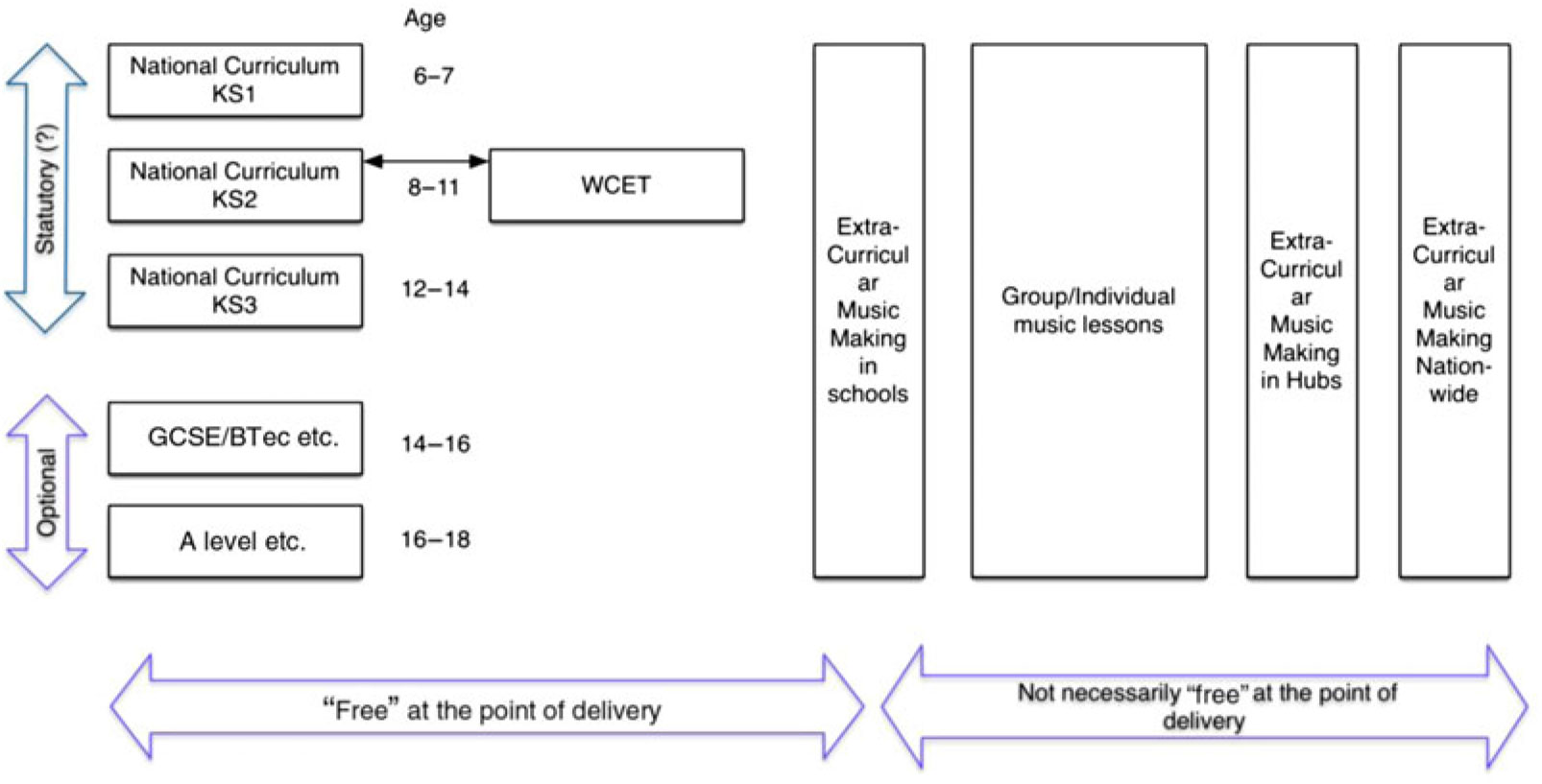
WCET disrupted previous music education provision, which Henley had described as ‘being fragmented’ and ‘patchy’. Funding for it was provided by central government, with WCET incurring no costs at the point of delivery to schools. Other MEH activity is funded, however, and this results in a rather complex mixed-economy of free-at-the-point-of-delivery and costed and charged-for provision in England, as Figure 1 shows.
The mixed economy of music education provision in England.

This complex mixed economy goes some way to explain why WCET has been such an important innovation in music education in England and why it is worthy of study.
Background
The issue of what there is to learn in classroom music education is highly contested in some jurisdictions. In a number of countries, music education is predicated primarily on a performing basis. Although some 10 years old now, Reimer, describing the situation then pertaining in the US noted that:
Music offerings in United States schools have remained largely the same for well over half a century. Our basic program consists of general music classes up to and sometimes through middle school and elective performance opportunities in upper elementary grades through high school, primarily focused on band (including jazz groups), orchestra, and chorus, with some additional offerings occasionally available. (Reimer, Reference REIMER2004: p. 33)
This focus, as Reimer described in the US, is not uncommon. Indeed, music education programmes ‘…centered on the development of performance techniques and notational literacy’ (Campbell, Reference CAMPBELL2002: p. 28) are the norm in many parts of the world, as are those whose focus is on what might be called ‘school music ensemble programs’ (Elpus & Abril, Reference ELPUS and ABRIL2011: p. 131). The issue of what should be taught in generalist class music teaching programmes is less commonly described, however, as Berryman observes:
Music educators do need to reflect on their own beliefs about the curriculum that they wish to offer their students: we want to recognise that we can explain musical skills as musical knowledge, and that creativity can be seen as the creation of knowledge rather than something that is only made possible through extensive knowing. We need to decide what content and products will shape the curriculum, and to what extent we see music as a subject that deals with a human practice or as one that celebrates a canon of ‘great’ music. (Berryman, Reference BERRYMAN2018: p. 39)
Berryman makes an important point, as the purposes of curriculum music in England are not necessarily clearly defined. The issues of both what to teach and why to teach it in primary music lessons in England have been under debate for many years, with Janet Mills (Mills, 1989, Reference MILLS1991) describing many of these over 30 years ago. Curriculum content matters have remained an issue for many years (Glover & Young, Reference GLOVER and YOUNG1999), whilst teacher confidence and preparedness have also been scrutinised (Hennessy, Reference HENNESSY1995; Holden & Button, Reference HOLDEN and BUTTON2006; Jeanneret, Reference JEANNERET1997; Mills, Reference MILLS1989; Wiggins & Wiggins, Reference WIGGINS and WIGGINS2008). Alongside these, Paynter (Reference PAYNTER2002) asked us to reflect on why we teach music in schools at all.
It is against this background that the novelty of WCET, alongside its relatively rapid introduction into the English context, warrants examination.
Participants
The research was conducted in three phases:
1. A nationwide online survey open to all heads of MEHs and MSs to complete. This produced 89 usable responses.
2. A series of semi-structured interviews with key MEH and MS leads, 24 such interviews were undertaken.
3. A series of elite interviews with experts in the field of WCET.
Analysis reported on in this paper focuses primarily on responses to the survey and is amplified where appropriate by material from the other two phases. In analysing survey data, extensive use is made of what might be termed a modified form of grounded theory analytical techniques (Glaser & Strauss, Reference GLASER and STRAUSS1967; Strauss & Corbin, Reference STRAUSS and CORBIN1990), wherein codings for data arise from the data itself wherein data are repeatedly scrutinised, and headers for response categories generated. A number of iterations of coding were undertaken, until sufficient detail had emerged from the data that enabled sense to be made of it. Data from surveys and interviews in this research underwent multiple repeated iterations of scrutiny, resulting in greater coding accuracy, and using a reductive methodology, codings were then placed into unique sets. It is important to note that using this modified grounded theory process, coding categories were not presented to respondents to choose from; they are research interpretations of what was actually said by respondents.
Results
The key aspect of the research that this paper reports upon is models of teaching and learning in WCET, but in order to make sense of these, we first need to understand two aspects of WCET provision; these are the ages at which WCET takes please, and the musical instruments involved in its delivery.
It should be noted at the outset that there is no stipulated year group or age at which the WCET programme should be offered to schools. From the survey responses, we know that year 4 (children normally aged 8–9 years old) is the commonest point of WCET, with survey responses showing that 45.8% of WCET activity takes place at this juncture. This is followed, but with a reduced percentage, by year 5 (23.2%) and year 3 (20.3%).
Musical instruments involved
The second of the pieces of background information required to understand WCET is the range of musical instruments involved. Just as there is no statutory requirement to offer WCET to specific age range of children and young people, neither is there a requirement nor even a recommendation, as to what musical instruments might be involved in WCET. Respondents to the survey produced an eclectic range of responses to the question concerning which instruments were taught in their MEH, ranging from the most popular, violin, trumpet/cornet, clarinet, to those which only garnered a few responses, including oboe, tabla and keyboard.
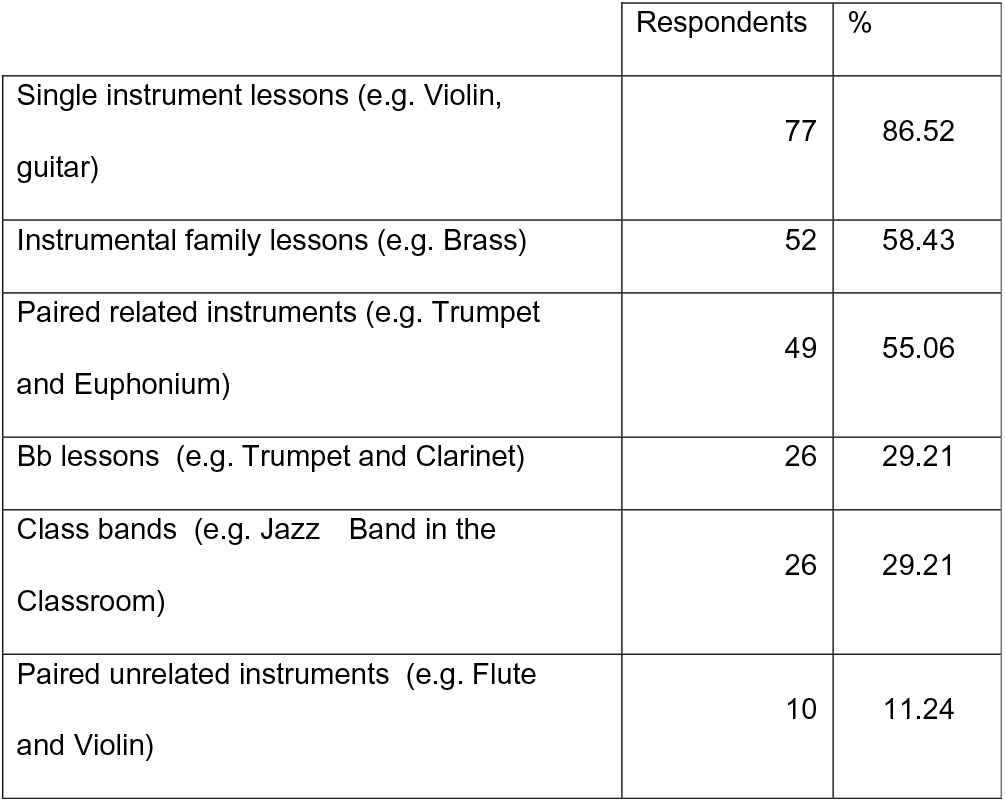
Respondents were also asked how instruments in these lessons were organised. Their answers are shown in Figure 2.
Organisation of instruments for WCET sessions.

Whilst a single instrumental modality is the most common and possibly the most manageable way of delivering WCET, there is also a range of other instrumental combinations too.
When taken together, analysis reveals that there is little commonality of either instrument of choice or of instrumental delivery modality in WCET.
Progress and progression
‘Progress’ has a number of meanings in education generally, and this is especially the case for music education. It can mean the movement from one task or learning situation to another, the journey through stages in attainment as measured by summative assessment, and it can also refer to the speed at which attainment takes place – for example, it is common to speak of ‘rapid progress’. In this research, two clear understandings of the term were noted:

In order to investigate what MEHs thought about the notion of ‘progress’ in WCET, the online survey asked an open-ended free-text response question,
Do you have a view as to what good progress in WCET consists of? If so, are you able to articulate this?
This question garnered 78 responses, and elicited respondents writing over 5,200 words between them, making this an area in which clearly they felt they had something to say. In order to analyse these text responses, a post-hoc coding methodology was employed. This involved repeated codings which aimed for saturation. These were undertaken by a single researcher to mitigate against inter-rater reliability issues. These codings were then reviewed by the research team, and concordance agreed.
Models of teaching and learning in WCET
The result of this analysis was that the various MEHs charged with its delivery employ two distinct conceptualisations of WCET. These are:
1. Music education starts with the instrument
2. Music education takes place via the instrument
These categorisations have distinct differences that separate them one from the other. In the ‘music education starts with the instrument’ (MSWI), it is that musical learning arises from utility with the instrument and it is proficiency on the instrument which will lead to more broad music learning as a result. In the ‘music education via the instrument’ (MVI) classification, musical learning takes place through the medium of the instrument. From analysis of the responses, it can be said to be the case that in this conceptualisation, it is a general music education which is important, this education being achieved through the mediating affordances of playing the instrument but also going beyond it. As noted above, arriving at these classifications was not straightforward, as they were derived post-hoc from data, not presented to respondents. It should also be noted that none of the respondents used these terminologies; these are interpretations delivered by this research.
As instantiation of the sorts of things leaders of MEHs were reporting, here are exemplar responses from each category:
A: Music education starts with the instrument:
Each week the children should become more familiar with the instrument and more adept at the technical aspects of playing it. They should have a greater understanding of how to produce and manipulate the sound of the instrument. They should also have an increased awareness of musical elements and be developing critical listening skills. By the end of the year, all the children in a class should be able to play a number of simple tunes on their instrument. Most will be able to read and play tunes with developing musicality. Some will be able to read the written music (in whatever form) and play new pieces quickly, with an enthusiasm for performance and composition. (MEH Leader 3)
B: Music education takes place via the instrument:
It all depends on what has happened in the school prior to the WCET session taking place. We treat every school separately and before any session starts a conversation takes place finding out exactly where the class/pupils are at with their musical learning. In [name of area] our sessions are very much a ‘musical’ lesson, not just an instrumental lesson. We insist to all our staff that it is all about learning music through playing an instrument and not just an instrument lesson. So obviously there is lots of playing each week and in the early months depending on the instrument delivered, then more time may be spent on posture and technique. Performance is key, we expect 3 performances a year. Singing is a large part of the learning and all staff receive regular training in this area. (MEH leader 17)
These two responses show not only the overlap but also the classificational specificity of MSWI and MVI, and how they find their outworking in the professional practice of MEH leaders.
Discussion
These classifications are important because the specific categorisation of WCET employed impacts upon (a) how it is conceptualised by MEHs and teachers concerned, and (b) how it is treated operationally as a musical teaching and learning programme. There are significant and key differences between music education professionals conceptualising and operationalising the WCET music teaching and learning programmes as being either about learning to play an instrument or about a general music education. Indeed, these distinctions take us to the very heart of current music education discussions outlined earlier with regard to what the purposes of classroom music education actually are or might be.
There is a considerable debate in the literature about this matter, and so it is of little surprise that WCET, a pedagogic format relatively recently arrived, also finds this to be the case. Cain and Cursley argue for some aspects of these differences:
…fundamental questions, including, ‘Why teach music?’, ‘What repertoire should be taught?’, ‘ What activities should be undertaken?’, and ‘What knowledge is foregrounded?’ have been answered in different ways at different times… (Cain & Cursley, Reference CAIN and CURSLEY2017: p. 143)
Cain and Cursley also introduce the notion of ‘knowledge’ to the discussion. This is a central component of both theorisation and delivery of WCET as a teaching and learning modality, in that the types of knowledge differ with the conceptualisation employed. For instance, Howard (Reference HOWARD, Bowman and Frega2012) argues strongly about what music education is not:
…music education is not conservatory training. It is not in the business of training music performers. It is in the business of enlightening the public about music’s various facets and influences from many perspectives, including how artists think. (Howard, Reference HOWARD, Bowman and Frega2012: p. 259)
This is important here, as in the music via the instrument view of WCET, it is being treated in essence as group instrumental tuition. This is very different from a generalist or non-specific view of music education. MVI involves a view of teaching and learning which is described by Howard as ‘training music performers’, which does not perform the same function as music education as a way of knowing (Swanwick, Reference SWANWICK1994; Philpott, Reference PHILPOTT, Cooke, Evans and Philpott2016). However, what is important for WCET is that if, as seems to be the case in a number of schools, it is forming the entirety of the music education for the children and young people concerned, then it should be multi-faceted:
Music education may be described as a ‘family’ of activities consisting of class music lessons and a range of extended or extracurricular pursuits. (Plummeridge, Reference PLUMMERIDGE and Spruce2001: p. 12)
This point is further amplified by Savage:
The concept of a performance lesson without listening, or a composition lesson without reviewing and evaluating is a misplaced one. First and foremost, teachers should ensure that the Key Processes of music education are taught in an integrated way. (Savage, Reference SAVAGE, Price and Savage2011: p. 7)
What Savage also reminds us here is that a music lesson, particularly one delivered according to the outlines of the National Curriculum in England, needs to be about more than ‘just’ performing; it needs to be educative in multiple simultaneous musical ways. This discussion links back to the delineation of generalist classroom music lessons in England described above. Indeed, this all harks back to a former incarnation of the National Curriculum, now superseded, where the point of music as a school subject was clearly delineated:
Music is a unique form of communication that can change the way pupils feel, think and act. Music forms part of an individual’s identity and positive interaction with music can develop pupils’ competence as learners and increase their self-esteem. (QCA, 2007: p. 179)
The teaching and learning of MVI and MSWI are not only taking different starting points, and consequently different framing of learning encounters, but in a very real way they also have different aims and objectives and, consequently, different proposed outcomes too. This becomes an important issue for a number of reasons as the purpose of the WCET programme in each scenario is somewhat different. For those MEHs who are using WCET as a means of learning an instrument, the specificity of the instrument matters maybe more to the MEH than it does to the children and young people concerned. This is because it is likely that MEHs will have an eye to their broader offer and will be wanting to promote the supply of instruments which are low in demand in their area. The fact that whole class lessons involving the French horn or the double bass are offered means questions need to be raised as to why this is being done. Of course this is not to say that neither of these instruments provides a worthwhile and musical learning experience, but the cost of equipping a whole class of either, with, as we saw earlier, the costs being borne by the MEH to make WCET free at the point of delivery, does raise financial issues when other MEHs are offering WCET on recorders or Ukuleles, a class set of 30 of either of these costing less than a single French horn or double bass.
For MVI advocates, the important aspects of music education are covered in WCET lessons, but this does not mean that they see the instrument as necessarily sidelined. In one of the interviews, a head of a MEH noted that:
We try to cover a lot of curriculum as well. We have a problem in that a lot of our classroom teachers don’t feel confident. A lot of them are not teaching curriculum music at all. So what we try to do is to add in elements of listening and composing to our lessons so that the kids are getting a balanced curriculum as well as learning an instrument. It’s like learning curriculum through instruments. (R1)
What is being described here is a situation where MVI is covering more than instrumental technique. WCET here is not a group instrumental lesson. The final phrase ‘It’s like learning curriculum through instruments’ is telling here and is what MVI means when put into practice.
Conclusion
One of the many issues in music education as an international endeavour is that descriptions of different pedagogies, curriculum contents and activity systems are that they all take place against a policy and practice discourse which can often be rooted in the local. This means that when investigating and reporting on a different system of musical teaching and learning, sometimes the words employed carry a ‘baggage’ that is not immediately apparent to a reader from a different context. For example, discussions about formal, informal and non-formal teaching and learning in music (inter alia Folkestad, Reference FOLKESTAD2006; Green, Reference GREEN2008; Price & D’Amore, Reference PRICE and D’AMORE2007) have developed both our understanding and, importantly, given us a language to use. A similar thing happened last century with the ‘music education as aesthetic education’ discussions (Elliott, Reference ELLIOTT1989; Reimer, Reference REIMER1989) in the US. By describing pedagogies in this way, we hope to open up debates concerning the purposes of generalist classroom music education both nationally and internationally.
The two conceptualisations of WCET presented in this paper are novel and original from this research and do not figure in common parlance. It is to be hoped that they will be helpful. What is notably the case is that when different MEH leaders discuss WCET, they can be operating from entirely separate conceptual starting points, and so having some awareness of the distinct ways in which WCET can be viewed may well prove to be helpful. The two distinct conceptualisations of WCET are potentially problematic in terms of not only teaching and learning but also funding. In times of austerity, governments will look to save cash where they can and the MEH offer in England is funded by some £75 million each year. With such a bifurcated stance on WCET, there are some MEHs who find this way of working problematic, whilst there are others for whom it is an essential activity. There are difficult questions that need to be asked, and the placement of particular MEH WCET programmes into one or the other of these two classifications might possibly lead to the continuation or axing of WCET locally or nationally. For those MEHs measuring success of WCET only by continuation numbers, this could prove to be an issue. Where WCET can be shown to be an integral part of the curricular entitlement of all young people, it is likely that this may prove potentially more sustainable.
The labelling and describing of the two standpoints of music via the instrument, and music starting with the instrument, are the distinct and novel contribution of this research to the literature in music education. It is the case that these different approaches are also to be seen in other national contexts around the world. By offering these terminological exactitudes, it is the case that music educators in other jurisdictions will also be able to employ them in order to label ways of approaching teaching and learning in music that are different from their own.
Acknowledgements
The authors would like to express their thanks to Arts Council England, and Music Mark, a UK Association for Music Education, for funding and facilitating this research.