1. Introduction
European countries have traditionally been the major trading partners of Iran. However, over the past two decades Iran has intensified its trade relations with other countries, mostly in the Middle Eastern region and in Asia, whereas the economic relations between Europe and Iran, which had been shaped mainly by their political relations (Ghodsi, Reference Ghodsi, Gärtner and Shahmoradi2019), deteriorated for a number of reasons, such as allegations of violations of human rights in Iran and the country's nuclear programme.
Following the adoption on 31 July by the United Nations (UN) Security Council of Resolution 1696, the EU Council imposed comprehensive sanctions against Iran with the adoption of EC Regulation 423/2007 of 19 April 2007. Between 2010 and early 2012, this sanctions regime was greatly intensified, targeting Iran's economy with prohibitive measures aimed at its trade and financial sectors. The general comprehensive sanctions were then accompanied by numerous EU sanctions targeting Iranian individuals and entities. The international comprehensive and ‘general sanctions’ against Iran led to a strong economic recession that affected the lives of many ordinary citizens. However, targeting Iranian individuals by banning their international trips and business transaction and freezing their overseas assets seemed to have the same effect as a ‘smart sanction’, which does not necessarily harm ordinary Iranians and the general economy.
Sanctions can increase the transactional costs of doing business with the sanctioned nation. While trade restrictiveness indices are usually constructed for trade policy measures imposed by the importing nations to protect their domestic industries (Hoekman and Nicita, Reference Hoekman and Nicita2008), sanctions are trade restrictions imposed by other nations to deprive the target country of the benefits of international trade. The term ‘general sanctions’ is sometimes also referred to in the literature as comprehensive sanctions (Afesorgbor, Reference Afesorgbor2019), extensive sanctions (Caruso, Reference Caruso2003), or large sanctions (Garoupa and Gata, Reference Garoupa and Gata2002). General and comprehensive sanctions usually lead to the repression of internal protests that result from an economic downturn, rising unemployment, and poverty, all of which lead to a less democratic regime, thereby weakening the human rights conditions, political rights, and civil liberties in the target country (Wood, Reference Wood2008; Peksen, Reference Peksen2009; Peksen and Drury, Reference Peksen and Drury2009, Reference Peksen and Drury2010; Adam and Tsarsitalidou, Reference Adam and Tsarsitalidou2019; Gutmann, Neuenkirch, and Neumeier, Reference Gutmann, Neuenkirch and Neumeier2020). Since less democratic countries have lower growth (Acemoglu et al., Reference Acemoglu, Naidu, Restrepo and Robinson2019), this will result in an additional negative effect from ‘general sanctions’ on the targeted economy and the lives of its ordinary citizens.
Oechslin (Reference Oechslin2014) also argues that in response to sanctions autocratic target regimes usually reduce the supply of public goods to restrict the productivity of the private sector. Such actions are typically taken by the target regime to reinforce its role in the economy and defend its power against the sanctioning or sending country. However, this worsens the economic conditions of the general population, which usually has no role in determining its own fate in an autocratic regime, while the main objective of the sanctions – to change the behaviour of the ruling elite – is completely missed. Neuenkirch and Neumeier (Reference Neuenkirch and Neumeier2016) also find that US comprehensive sanctions affect the bottom decile of total income distribution in the target economies more strongly than others. The severity of sanctions and larger multilateral sanctions have an even harsher impact on poverty rates in target countries. Slavov (Reference Slavov2007) further shows that comprehensive UN sanctions have a negative impact not only on the trade of the target country but also on the trade of the target's neighbours with the rest of the world. This happens when the earlier transit routes of trade and the supply chain network around a target economy are significantly disturbed. Garoupa and Gata (Reference Garoupa and Gata2002), following Malik (Reference Malik1990), also argue that large comprehensive sanctions may lead to more offensive behaviour by the target country, as the punishment is not proportionate to the offence and the crimes.
Overall, the literature offers empirical evidence of the bad consequences of general economy-wide sanctions with severe negative externalities on ordinary people. Therefore, to reduce the humanitarian impact of general sanctions, smart sanctions that target the responsible individuals and eliminate their sources of income are usually imposed instead of general sanctions. Along these lines, Portela (Reference Portela2010) examines the efficacy of sanctions used by the EU as an international actor. She finds that new targeted and smart sanctions that harm mainly individuals responsible for some wrongdoing through visa restrictions, financial sanctions, arms embargoes, and flight bans usually achieve their objectives better than traditional general sanctions that affect the whole society.
Therefore, in this paper we distinguish between the ‘general sanctions’ and the ‘smart sanctions’ imposed by the EU against Iran. The initial objectives of all these sanctions were to keep Iran in a dialogue with the EU, while their ultimate objectives were to change the behaviour and policies of the Islamic Republic and to control Iran's nuclear programme, its role in the region, its aerospace and intercontinental missile programme, and its violation of human rights. However, the main economic aim of ‘general sanctions’ was to deprive Iran of revenues derived from its exports to the EU and its imports of technology from the EU, which could be used by Iran's military and intelligence and security services. Iran's bilateral trade with the EU is the first economic indicator affected by the EU's ‘general sanctions’. Blocking bilateral trade was used to bring Iran to the negotiating table, which led to the Joint Comprehensive Plan of Action (JCPOA) that was signed between Iran and the P5+1 (the United States, the United Kingdom, France, China, and Russia, plus Germany). After the implementation of the deal, all general sanctions imposed by the EU were removed. However, ‘smart sanctions’ against Iranian individuals and entities remained in force. The main motivation behind the imposition of smart sanctions against Iranian individuals and entities was to penalize the authorities, which the EU believes have played a direct and indirect role in violation of human rights and the crackdown of nationwide protests, the support of militia groups in the region, and in the military, aerospace, and nuclear activities of Iran. With these ‘smart sanctions’ in force, doing business with the targeted individuals and entities is banned across the whole EU and their assets in the EU are frozen. Such sanctions may affect the economy and bilateral trade only partially, and only to the extent that these individuals and entities have a role in Iran's economy. Therefore, it is important to quantify the difference between the impact of ‘general sanctions’ versus ‘smart sanctions’ on the bilateral trade between Iran and the EU.
Thus, this paper analyses the impact of sanctions imposed by the EU against Iran on quarterly trade flows between Iran and the EU28 and EA19 at the aggregate and sector level between Q1 1999 and Q4 2018. While many studies in the literature analyse the impact of sanctions on bilateral trade using the gravity model (Montenegro and Soto, Reference Montenegro and Soto1996; Hufbauer et al., Reference Hufbauer, Elliott, Cyrus and Winston1997; Caruso, Reference Caruso2003; Yang et al., Reference Yang, Askari, Forrer and Teegen2004; Slavov, Reference Slavov2007; Morgan, Bapat, and Krustev, Reference Morgan, Bapat and Krustev2009; Felbermayr et al., Reference Felbermayr, Syropoulos, Yalcin and Yotov2019) as the benchmark specification, this paper applies a nonlinear autoregressive distributed lag (NARDL) model to estimate the impact of sanctions on bilateral trade flows, taking the asymmetric impact of real exchange rates on bilateral trade flows into consideration. However, in the robustness specification the gravity model of bilateral trade between the member states of the EU and Iran is estimated. The benchmark NARDL is designed like a gravity model, in which the bilateral trade between only two trading partners is estimated. Sobel (Reference Sobel1998) finds evidence that increased international tensions, such as UN-imposed sanctions, lead to the depreciation of the target country's currency, while the resolution of conflicts would lead to the appreciation of the target country's currency. Therefore, we find it important to control carefully for changes in the exchange rate in the time-series analysis following the literature (Shin, Yu, and Greenwood-Nimmo, Reference Shin, Yu and Greenwood-Nimmo2014; Bahmani-Oskooee and Aftab, Reference Bahmani-Oskooee and Aftab2018; Bahmani-Oskooee and Karamelikli, Reference Bahmani-Oskooee and Karamelikli2019) using the NARDL to estimate the impact of sanctions on bilateral trade flows. Since EA19 member states use the same currency (i.e., the euro), the benchmark specification estimates the impact of sanctions on the bilateral trade flows between Iran and the whole euro area. However, as a robustness NARDL specification, the impact of sanctions on the bilateral trade flows between Iran and the whole EU28 is also analysed.
The remainder of this paper is organized as follows: in Section 2 we review the relevant literature; in Section 3 we describe the methodology, our econometrics model, and the data; in Section 4 we present the estimation results; and in Section 5 we summaries our findings.
2. Literature Review and Anecdotal Evidence
Our paper is in line with several works on the impact of sanctions and contributes to the literature on the use of sanctions as a foreign policy tool in both political science and economics. The political science literature is abundant in the studies of sanctions as a foreign policy tool (Hartley and Sandler, Reference Hartley and Sandler2007; Hufbauer, Schott, and Elliott, Reference Hufbauer, Schott and Elliott2009). Several econometric studies have also supported works on political science and international relations by showing the economic impact of sanctions (Afesorgbor, Reference Afesorgbor2019; Felbermayr et al., Reference Felbermayr, Syropoulos, Yalcin and Yotov2019). Sanctions, like any other trade restrictions on the flow of goods or factors of production between countries, must be welfare-reducing (Findlay and Wellisz, Reference Findlay and Wellisz2009; Baldwin, Reference Baldwin1989; Anderson and Van Wincoop, Reference Anderson and Van Wincoop2001; Caliendo and Parro, Reference Caliendo and Parro2015). Spindler (Reference Spindler1995) argues that quota-like sanctions that prohibit trade are frequently used. However, the most effective sanctions should be those that act like tariffs by increasing the trade costs of the target country while increasing the revenue of the sending country.
Since World War I, and especially in the past two decades, economic sanctions have become popular instruments of foreign policy. Wars and military confrontations have been replaced by liberal alternatives to war that take the form of economic sanctions and trade protection measures (Pape, Reference Pape1997). In peacetime, economic integration has become a means of strengthening relations. Multilateral agreements that have led to the establishment of international organizations such as the World Trade Organization (WTO), on the one hand, and bilateral trade deals and comprehensive trade agreements, on the other, have become tools of international diplomacy to influence policies abroad without resorting to military force or covert operations.
In recent years, sanctions have been focused on the sources of income most valued by those responsible for the key undesired policy decisions, rather than the whole economy of the sanctioned country. Portela (Reference Portela2016) argues that in the 1990s the humanitarian impact of general sanctions against the whole economy of the sanctioned country led to the creation of targeted sanctions against those whose actions should be condemned. Major and McGann (Reference Major and McGann2005) argue that sanctions must inflict the largest costs on those interest groups whose actions have the greatest marginal effect on the hostile policies of the target country.
Biersteker, Eckert, and Tourinho (Reference Biersteker, Eckert and Tourinho2016) provide a taxonomy of UN targeted sanctions, their type and their impact, while Biersteker et al. (Reference Biersteker, Eckert, Tourinho and Hudáková2018) elaborate on the dataset of UN targeted sanctions during the period 1991–2013. The general sanctions discussed in the previous section are targeting the whole economy of Iran, while sanctions against entities are targeting certain key figures in Iran's political and military system. Nevertheless, the consequences of the general sanctions discussed above indicate that they are typically found to be ineffective in changing the policies of the sanctioned country. In other words, general sanctions have rarely achieved their ultimate objectives.
Moreover, sanctions imply costs for the imposing country as well, which limits their effectiveness in achieving their main objectives. The reduction of bilateral trade as a result of sanctions is not only an obstacle for the sanctioned entities and the sanctioned country to survive and evolve, but it also affects the revenues of the companies in the sanctioning country that were engaged in trade and business relations with the sanctioned country. Morgan and Schwebach (Reference Morgan and Schwebach1997) show that sanctions are unlikely to alter significantly the expected outcome that has the highest joint probability of being accepted by both parties, essentially because the more costly the sanctions are to the target, the more costly they are to the sanctioning countries as well. They propose a theoretical framework and an empirical test, which assumes that the higher the cost of economic sanctions to the target, the higher the probability that the sanctions will succeed. Crozet and Hinz (Reference Crozet and Hinz2016) find large negative impacts on trade between Russia and many EU members as a result of sanctions imposed against Russia. Therefore, these sanctions have contributed to losses for both the sanctioned and the sanctioning countries. A study by the World Bank (2015) shows that sanctions imposed on the Russian Federation over the conflict in Ukraine have affected investment and consumption. However, the study does not provide any specific numbers.
Harkness (Reference Harkness1990) examines the sanctions imposed by Canada against South Africa in 1985. While the data show that South African export values to Canada were rising despite the sanctions, he finds that the volume of trade was declining. He argues that this effect is caused by changes in the terms of trade and the exchange rate between the two countries. Due to Bahmani-Oskooee et al. (Reference Bahmani, Harvey and Hegerty2013), the Marshall Lerner condition claims that the effects of such sanctions on the sanctioning country's terms of trade and trade balance depend on the elasticities of demand for its imports and exports.
Kaempfer and Lowenberg (Reference Kaempfer and Lowenberg1999) argue that multilateral sanctions are less effective in causing economic damage via negative terms-of-trade effects on the targeting country than unilateral sanctions. However, the opposite is usually expected. The intuition behind their argument is that a unilateral sanction by a country with close ties to the target country could do more harm to the interest groups in the target country. This applies, for example, to the sanctions imposed by the US against Iran since 1979, which have suffocated Iran's economy for a long time, given the US's strong role in the international economy. As a result of the US's unilateral but secondary sanctions since 2018, Iran's economy has experienced its worst recession of about 9% since its eight-year war with Iraq in 1980s. Kaempfer and Lowenberg (Reference Kaempfer and Lowenberg1999) argue that with multilateral sanctions the interest groups in the target country may find ways to consolidate their power, while coalition members imposing the multilateral sanctions may not fully cooperate to tackle this strong solidarity in the target country. However, this was not the case with Iran, and the international coalition that intensified its sanctions against Iran during 2009–2012 forced Iran to come to the negotiating table.
Drezner (Reference Drezner2003) claims that the negative impact of coercive economic measures is usually underestimated, as the target country may acquiesce to incurring the cost of sanctions. This was illustrated by the response of Iran under President Ahmadinejad: to show its strength, the Islamic Republic did not admit the effectiveness of sanctions. Furthermore, Drezner (Reference Drezner2003) argues that even before the imposition of sanctions, the target country has an incentive to acquiesce. This was the case for Iran before the US's withdrawal from the JCPOA and the imposition of secondary sanctions by the Trump administration. Selden (Reference Selden1999) notes that, in the long run, sanctions often foster the development of domestic industries in the target country, thus reducing the target's dependence on the outside world and the ability of the sanctioning country to influence the sanctioned country's behaviour through economic coercion. Using a panel database of countries and sanctions during the period 1947–1999, Marinov (Reference Marinov2005) finds evidence that coercive measures destabilize the political system of the target country significantly, as demonstrated by the survival of leaders in their office as the least expected outcome of the economic sanctions.
Maloney (Reference Maloney2010), in her investigation of the sanctions against Iran, argues that crippling Iran's economy through the use of strict economic sanctions has become drastically harder than before. One major reason is that Iran's economy and its trade relations with the international economy have become more complex and diversified. Unlike the Europeans, Russia, China, and India are reluctant to follow the US's foreign policies in the region, which was the case when the international sanctions intensified in 2012 and following the US's withdrawal from the JCPOA in 2018. Iran's trade with these three major countries is hampered but has remained much larger than its trade with the EU. Another reason why Maloney (Reference Maloney2010) argues that sanctions against Iran were not very effective at the time was the reluctance of regional countries to pressurize Iran. However, with the recent campaign of ‘maximum pressure’ initiated by the Trump administration, the escalated tensions have managed to destabilize Iran's role in the region.
Torbat (Reference Torbat2005) finds that the financial sanctions imposed by the US against Iran had a more powerful impact than trade sanctions. This is mainly because of the inability of Iran to finance its imports, leading to larger foreign debt, currency depreciations, exchange-rate volatilities, long-run instability, and welfare loss. He notes that these sanctions, while delivering a powerful economic blow to the ruling elite, have had little political success. Moreover, he advocates the use of smart sanctions designed to exert pressure directly on the ruling clerics while avoiding negative impacts on the Iranian population as side effects of general sanctions.
Caruso (Reference Caruso2003) uses a gravity model to analyse the impact of general US sanctions on the bilateral trade flows between 49 target countries and the US. He finds a significant negative impact of US sanctions on bilateral trade. Moreover, he finds the negative impact of US sanctions on the bilateral trade of target economies and G7 economies, namely Canada, Japan, France, Germany, Italy, and the United Kingdom. This secondary impact demonstrates the stringency of sanctions that disturb the international network of trade in which the target country operates.
Using a gravity model and the Threat and Imposition of Economic Sanctions (TIES) dataset by Morgan, Banat, and Krustev (Reference Morgan, Bapat and Krustev2009), Afesorgbor (Reference Afesorgbor2019) finds empirically that while general and comprehensive sanctions have a negative impact on the bilateral trade between the target and the sanctioning country, the threat of sanction imposition has a stimulative impact on bilateral trade. This is due to the short window of opportunity that opens up between the time when a sanction is threatened and the point at which it is implemented, during which traders can conduct their bilateral transactions and stockpile supplies. Moreover, Afesorgbor (Reference Afesorgbor2019) finds that a total economic embargo has the most significant impact on trade, while other instruments, such as travel bans and the freezing of individuals’ assets, have no significant impact on trade. Furthermore, his empirical evidence suggests that the threat of an imposition of sanctions restricts exports of essential products, food and animal products, and medicines from the sender to the target country.
Using a vector autoregressive (VAR) model, Dizaji and Van Bergeijk (Reference Dizaji and Van Bergeijk2013) find evidence that the general sanctions imposed against Iran had their most negative impacts on its main economic indicators, such as government consumption, imports, investment, and income, mainly in the first few years. However, as the Iranian government finds that compliance with sanctions brings no greater benefits to its free trade than non-compliance afterwards, the sanctions do not achieve their political objectives, and the government reverts to its earlier behaviour. Van Bergeijk (Reference van Bergeijk1989) also argues that sanctions rarely achieve their main objectives. Sanctions become effective when the trade relations before their imposition are strong, the political situation in the target country is unstable, and the sanction period is short. Therefore, the effectiveness of sanctions tends to disappear in the longer run. Analysing foreign direct investment (FDI) inflows in 184 countries during the period 1970–2010 and using the TIES dataset, Mirkina (Reference Mirkina2018) also finds that the negative impact of sanctions on FDI vanishes in the long run. In contrast to these studies, Neuenkirch and Neumeier (Reference Neuenkirch and Neumeier2015) find that the negative impact of UN sanctions on a target country's real GDP per capita last for about 10 years. This negative impact is estimated to be about 2%. They also find that US sanctions reduce the real GDP growth of target countries by 0.75–1 percentage point, which vanishes after seven years.
Felbermayr et al. (Reference Felbermayr, Syropoulos, Yalcin and Yotov2019) apply the gravity framework to estimate the impact of sanctions on bilateral aggregate trade values during the period 1950–2016. They use the Global Sanctions Data Base (GSDB) and find a significant negative impact of sanctions against Iran on its bilateral trade flows. Using a general equilibrium framework of the gravity model, their counterfactual scenario suggests that Iran's real per-capita income would have been larger by only 4.2% if there had been no sanctions against Iran. However, this underestimation is an oversimplification of the reality, as the real GDP per capita of Iran has never again reached its peak of 1976 (see Ghodsi et al., Reference Ghodsi, Astrov, Grieveson and Stehrer2018), given the long-existing US sanctions in force since 1979.
Using Iranian customs data, Haidar (Reference Haidar2017) finds evidence of export deflection and re-exporting through third-party countries after the imposition of UN non-oil export sanctions in 2008. Ghodsi and Elhami (Reference Ghodsi and Elhami2015) also show that Iran's export unit values increased owing to the intensification of sanctions in 2012 and trade deflection through third countries. Thus, while exports became more expensive in the destination country, it produced lower revenues for Iranian exporters. Moreover, Iran's imports of goods became more expensive, causing prices to soar and inflation to rise during the sanction years.
Draca et al. (Reference Draca, Garred, Stickland and Warrinnie2019) study the relationship between sanctions relief over the course of negotiating the JCPOA and the performance of companies on the Tehran Stock Exchange. Companies owned by the Islamic Revolutionary Guard Corps (IRGC) and the semi-public conglomerates under the Supreme Leader of Iran are the main firms under investigation. The authors find evidence that the conglomerates linked to the main circle of power in Iran that were targeted by sanctions showed more positive returns than other firms during the diplomatic negotiations.
This paper contributes to the literature by studying the impact of sanctions imposed by the EU against Iran since 2006 on the whole economy and targeted entities and natural persons. Although there are several studies in the literature which are mentioned above and which also analyse the impact of sanctions against Iran's economy, they mostly consider UN or US sanctions against Iran (e.g. Torbat, Reference Torbat2005; Dizaji and Van Bergeijk, Reference Dizaji and Van Bergeijk2013; Felbermayr et al., Reference Felbermayr, Syropoulos, Yalcin and Yotov2019), this is the first paper to analyse the difference between the impact of general sanctions and the impact of smart targeted sanctions of the EU against Iran on their bilateral trade flows. As illustrated by the literature discussed above, it is expected that general sanctions affect the whole economy, while targeted sanctions may only deprive specific interest groups in the sanctioned country from their financial and economic benefits. Thus, by applying a NARDL econometric framework that considers the asymmetric role of exchange rates in bilateral trade flows between the EA19/EU28 and Iran, this paper analyses how general and targeted sanctions affect trade values between these two trading partners. While ARDL is applied in other studies in the literature (Thaver and Ekanayake, Reference Thaver and Ekanayake2010), as a robustness check the impact of sanctions on the bilateral trade between Iran and single EU member states is also analysed in a gravity framework. Moreover, this paper is one of the first studies to analyse the impact of sanctions across different product categories and industries. Total trade and trade by 22 sections of the HS will be studied to indicate how humanitarian trade flows could be maintained through the application of targeted sanctions.
2.1 Iran–EU Relations
After the Islamic Revolution in 1979 and the hostage crisis, Iran's relations with the United States turned into long-term animosity, leading to the imposition of the first US economic sanctions against Iran. This was followed by strained relations between Iran and the US and its allies, including Western Europe. In 2001, for the first time since the establishment of the Islamic Republic of Iran in 1979, the Council of the European Union mandated a dialogue between the EU and Iran. This was initiated by the Iranian reformist president, Mohammad Khatami (1997–2005), who reached out to the international community for a Dialogue among Civilizations. The EU–Iran dialogue was meant to lead to comprehensive diplomatic negotiations on the Middle East Peace Process, the fight against terrorism, human rights, and the non-proliferation of weapons of mass destruction, which involved Iran's nuclear activities. However, after the 9/11 terrorist attacks and the subsequent invasions of Afghanistan and Iraq in 2001 and 2003 by the US and its allies, Iran's dialogue with the West under the auspices of the EU broke down (for additional information, see Ghodsi et al., Reference Ghodsi, Astrov, Grieveson and Stehrer2018).
After this, the Islamic Republic steered systematically away from all the elements that were supposed to have been negotiated and finally resolved within the framework of the EU–Iran dialogue. Iran's political system became hardline after Mahmoud Ahmadinejad was elected president in 2005 and again in 2009. During his presidency, Mr Ahmadinejad stopped all cooperation with the International Atomic Energy Agency (IAEA), withdrew Iran from the Non-Proliferation Treaty (NPT) Safeguard Agreement, and banned the IAEA's inspectors from visiting its nuclear sites, making it impossible for the organization to verify that Iran's nuclear programme had no military dimension. In response, the US government under the presidency of George W. Bush imposed nuclear-related sanctions against Iran in 2005.
Iran's hardline actions were met with sanctions by the international community. On 31 July 2006, the UN Security Council adopted Resolution 1696, which called on Iran to halt its uranium enrichment programme and abide by the provisions of the NPT. As Iran did not stop its nuclear activities, a series of other UN Security Council resolutions was adopted over the years to intensify sanctions against Iran.
The accumulated number of these UN sanctions is depicted by a black solid line in Figure 1. It shows that the total number of UN Security Council sanctions against Iran reached a peak of eight in the second quarter of 2012. Following the first UN Security Council Resolution, the EU Council also imposed sanctions against Iran with the adoption of EC Regulation 423/2007 of 19 April 2007.Footnote 1 From 2010 through to early 2012 the sanctions regime was greatly intensified, targeting Iran's economy with prohibitive measures aimed at its trade and financial sectors mandated by the UN Security Council and single countries such as the US, Canada, Australia, and the EU member states. As depicted by the grey solid line in Figure 1, the number of these general sanctions against Iran that were implemented by the EU also reached a peak in the first quarter of 2012, when the EU introduced an oil embargo and froze the assets of Iran's Central Bank.
Accumulated sanctions imposed by the EU and the UN against Iran, general versus individual targeting, 2006–2015
Sources: European Union Open Data Portal; Service for Foreign Policy Instrument (FPI); European Commission; United Nations Security Council Resolutions website;Footnote 6 authors’ elaboration.

In addition to the general sanctions imposed by the EU, which were mainly related to Iran's nuclear activities, in the second quarter of 2007, the EU imposed its first sanctions against seven Iranian entities and 11 natural persons with travel bans and asset freezes, which were mostly aimed at Iran's aerospace industry and its military. Assets of these individuals are frozen, and doing business with them is prohibited for any EU firm. Most of these entities and natural persons had been designated by the UN Security Council a few months earlier. The number of entities and natural persons targeted by the European sanctions has been rising over the years, as depicted in dotted and dashed lines in Figure 1, respectively. Data on the EU sanctions list have been published since 2017 by the Service for Foreign Policy Instruments (FPI) of the European Commission. Among the natural persons are high-ranking generals and commanders of the IRGC, such as Qasem Soleimani, the late commander of the Quds Force of the IRGC and his deputies. Furthermore, the EU joined the international alliance against nuclear Iran that was initiated by the first round of executive orders by the US president, Barak Obama, in September 2010. As illustrated in Figure 2, the share of the 19 members of the euro areaFootnote 2 in Iran's trade has been decreasing since 1996, while the level in US dollars terms reached its peak in 2011. From 2002 to 2004, the share of EA19 exports in Iran's total imports recorded a slight increase. This coincided with the first surge in FDI to Iran (Ghodsi et al., Reference Ghodsi, Astrov, Grieveson and Stehrer2018) since 1979, following the adoption in 2002 by Iran's parliament of the Foreign Investment Promotion and Protection Act (FIPPA), which was passed by a majority of reformists and aimed to increase the incentives for FDI. The large volume of imports by the EA19 from Iran during 2007–2011 is mostly attributable to the rising price of oil in that period. The share of Iran's total exports going to the EA19 during that period actually contracted.
EA19 trade of goods with Iran, 1996–2018
Sources: UN COMTRADE; authors’ elaboration

The EA19's share in Iran's total trade dropped to a historical low in 2013, after the Council of the EU imposed stringent sanctions against Iranian individuals, companies, government entities, officials, and the Central Bank of Iran in January 2012. These sanctions disconnected Iran from the international monetary system and the SWIFT international payment network, paralyzing all of Iran's international trade and financial transactions. Although Iran's revenue from its exports to the EA19 dropped to a negligible figure of about USD 1bn in 2013, its imports from the EU still hovered around a significant figure of USD 7bn in the same year. These imports consisted mainly of primary products, such as pharmaceuticals and food, which were mostly re-exported through third-party countries such as Turkey and the United Arab Emirates.
The nuclear-related sanctions were removed after the implementation of the Joint Comprehensive Plan of Action (JCPOA) on 16 January 2016. As illustrated in Figure 2, the implementation of the deal led to an increase in imports by the EA19 from Iran, with a surge of business and investments into Iran. Investment projects in Iran worth more than USD 200bn were pledged.Footnote 3 Trade in Machinery and capital goods would have been stimulated if these pledged investment projects had been realized, which could have changed Iran from a large market of 84 m inhabitants with a diversity of natural resources, industries, ethnicities, and large human capital to a substantial hub of energy and transport in the middle of the ancient Silk Road.
However, these promising prospects of attracting foreign businesses to Iran did not last long after Donald Trump took office as the 45th president of the US in January 2017. Mr Trump did not like any of the policies of his predecessor and was determined to roll back President Obama's Affordable Care Act (Obamacare) and to withdraw from agreements that Mr Obama had concluded with other nations, such as the Trans-Pacific Partnership,Footnote 4 the Paris Agreement,Footnote 5 and indeed the JCPOA. On 8 May 2018, Mr Trump withdrew the US from the JCPOA and warned other countries not to trade or do business with Iran. This was regarded as secondary sanctions against third parties, and all the investment projects pledged after the deal were halted. Many European multinationals withdrew from the Memorandums of Understanding they had signed with Iran for fear of losing the US market and being penalized with enormous fines by the US Treasury. This again led to a reduction in imports by the EA19 from Iran in 2018.
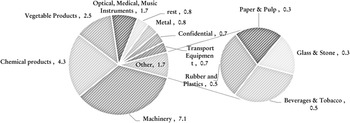
As far as trade relations between Iran and the EA19 in 1999–2018 are concerned, the period can be divided between the time before the intensification of sanctions in 2011 and thereafter. In 2013, Iran's revenues from its exports to the EA19 dropped to their lowest value of only USD 1bn, while its imports from these countries still accounted for USD 6bn (Figure 2). Figure 3 shows the structure of the EA19's exports to Iran organized by Harmonized System (HS) sections averaged over three years from 2009 to 2011, before the EU sanctions were intensified. Figure 4 shows the structure for the period of intensified sanctions in 2013–2015. A significant drop in the level of exports to Iran in Machinery, the largest traded sector, indicates a smaller transfer of capital goods to Iran. However, for some sectors, such as Chemical products and Optical and Medical industries, the drop in export levels to Iran as a result of sanctions was much milder. The most important reason is that medicines and medical devices are the major products in these two industries which should remain unaffected by sanctions. This suggests that the impact of sanctions may differ depending on the sector of activity.
Structure of EA19 exports to Iran, average over the period 2009–2011, USD billion
Sources: UN COMTRADE; authors’ elaboration.

Structure of EA19 exports to Iran, average over the period 2013–2015, USD billion
Sources: UN COMTRADE; authors’ elaboration.

3. Methodology
We follow the recent strand of the literature to estimate the quarterly bilateral trade flows between the EA19/EU28 and Iran against the sanctions controlling for other variables during the period Q1 1999–Q4 2018. As the benchmark specification technique, NARDL is used, while the Poisson Pseudo Maximum Likelihood (PPML) estimation of structural gravity models is used as the robustness specification technique. In the NARDL specification, the whole bloc of European countries is used as the trading partners of Iran, while in the gravity specification, single countries are used in the data as trading partners of Iran. Since countries across the EU use different currencies and EA19 countries use a single currency, the whole EA19 is considered as the benchmark NARDL specification. However, the whole EU28 is also considered as the robustness NARDL test. Due to data restrictions for the price index, the period of analysis for the EU28 is from Q1 2000 to Q1 2018. The GDP of the importing country and the real exchange rate (RER) between the two trading partners are the main control variables in the model. In a famous remark, Keynes (Reference Keynes1936, 314) noted that ‘the substitution of a downward for an upward tendency often takes place suddenly and violently, whereas there is, as a rule, no such sharp turning point when an upward is substituted for a downward tendency’. Based on Shin, Yu, and Greenwood-Nimmo (Reference Shin, Yu and Greenwood-Nimmo2014), ‘the nonlinearity of many macroeconomic variables and processes has long been recognized and nonlinearity is endemic within the social sciences and that asymmetry is fundamental to the human condition’.
Following the suggestions in the literature (Kahneman and Tversky, Reference Kahneman and Tversky1979; Shiller, Reference Shiller1993, Reference Shiller2005), we use the nonlinear approach, which also corrects for the short-term changes in an error correction mechanism (ECM). This model, which has been developed by Shin, Yu, and Greenwood-Nimmo (Reference Shin, Yu and Greenwood-Nimmo2014) and is frequently used in the literature (Bahmani-Oskooee and Aftab, Reference Bahmani-Oskooee and Aftab2018; Bahmani-Oskooee and Karamelikli, Reference Bahmani-Oskooee and Karamelikli2019), also considers that the relation between the RER and trade values is non-linear, meaning that the impact of an increase in the RER on trade values is different from the impact of a decrease in the RER on trade values. This asymmetric relation between the RER and trade values originates in the behaviour of consumers and importers with respect to changes in relative prices that is usually referred to as ‘price stickiness’. Neglecting this asymmetry when it is statistically significant leads to the omitted variable bias in the estimation of trade values, which may also cause bias in the estimation of other explanatory variables. This asymmetric model is quite important to control for, because Sobel (Reference Sobel1998) finds evidence that imposed sanctions lead to the depreciation of the target country's currency, and sanction removals lead to the appreciation of the target country's currency. Here we describe this model briefly by showing first the long-run equation of traded value with respect to the control variables as follows:
 $$X_{st}^{EZ, IR} = \alpha _0^x + \alpha _1^x REX_t + \alpha _2^x Y_t^{IR} + \alpha _3^x SANC_t^G + \alpha _4^x SANC_t^I + e_t^x $$
 $$M_{st}^{EZ, IR} = \alpha _0^m + \alpha _1^m REX_t + \alpha _2^m Y_t^{EZ} + \alpha _3^m SANC_t^G + \alpha _4^m SANC_t^I + e_t^m $$
where  $X_{st}^{EZ, IR} $ in equation (1) represents the log of the real export value of sector s from the whole EA19 (identified with subscript EZ) to Iran (identified with subscript IR) at time t;
 $M_{st}^{EZ, IR} $ in equation (2) represents the log of the real import value of sector s to the EA19 from Iran; REX t is the logarithmic value of the real exchange rate at time t that is defined as the relative prices of goods in the EA19 in terms of Iran's prices;
 $SANC_t^G $ represents the number of general sanctions imposed by the EU that are all waived after the implementation of the JCPOA;
 $SANC_t^I $ defines the number of smart sanctions imposed by the EU targeted either against individual entities (including companies, banks, foundations etc.) or natural persons (including military officers or judges); and
 $e_t^x $ and
 $e_t^m $ represent the error terms. As it is commonly addressed in the econometric and economic literature, the reverse causality between the dependent and independent variables, cointegration between these variables, and spurious regression, these error terms in the long-run relations are corrected using the short-term relations. Thus, the ARDL model for both equations is defined as follows:
 $$\eqalign{\Delta X_{st}^{EZ, IR} & = \psi ^x + \eta _0X_{s, t-j}^{EZ, IR} + \eta _1{\rm RE}{\rm X}_{t-1} + \eta _2Y_{t-1}^{IR} + \eta _3SANC_{t-j}^G + \eta _4SANC_{t-j}^I \cr & \quad + \mathop \sum \limits_{\,j = 1}^c \beta _{1j}^x \Delta X_{s, t-j}^{EZ, IR} + \mathop \sum \limits_{\,j = 0}^d \beta _{2j}^x \Delta {\rm RE}{\rm X}_{t-j} + \mathop \sum \limits_{\,j = 0}^e \beta _{3j}^x \Delta Y_{t-j}^{IR} \cr & \quad + \mathop \sum \limits_{\,j = 0}^f \beta _{4j}^x \Delta SANC_{t-j}^G + \mathop \sum \limits_{\,j = 0}^g \beta _{5j}^x \Delta SANC_{t-j}^I + \varepsilon _t^x } $$
 $$\eqalign{\Delta M_{st}^{EZ, IR} & = \psi ^m + \eta _5X_{s, t-j}^{EZ, IR} + \eta _6{\rm RE}{\rm X}_{t-1} + \eta _7Y_{t-1}^{IR} + \eta _8SANC_{t-j}^G + \eta _9SANC_{t-j}^I \cr & \quad + \mathop \sum \limits_{\,j = 1}^p \beta _{1j}^m \Delta M_{s, t-j}^{EZ, IR} + \mathop \sum \limits_{\,j = 0}^q \beta _{2j}^m \Delta {\rm RE}{\rm X}_{t-j} + \mathop \sum \limits_{\,j = 0}^n \beta _{3j}^m \Delta Y_{t-j}^{EZ} + \mathop \sum \limits_{\,j = 0}^r \beta _{4j}^m \Delta SANC_{t-j}^G \cr & \quad + \mathop \sum \limits_{\,j = 0}^s \beta _{5j}^m \Delta SANC_{t-j}^I + \varepsilon _t^m } $$
where Δ indicates the time difference in the variables in logs; thus, ΔREXt−j would indicate the j's time difference in the RER. The ARDL model can become non-linear (NARDL) in terms of the RER by decomposing its growth into two separate variables of positive POS t and negative NEG t changes:
 $$\eqalign{& POS_t = \mathop \sum \limits_{i = 1}^t \Delta POS_i = \mathop \sum \limits_{i = 1}^t {\rm max}( {\Delta {\rm LRE}{\rm R}_i, \;{\rm \;}0} ) {\rm \;}; \;\cr & {\rm \;}NEG_t = \mathop \sum \limits_{i = 1}^t \Delta NEG_i = \mathop \sum \limits_{i = 1}^t min( {\Delta {\rm LRE}{\rm R}_i, \;{\rm \;}0} ) } $$
Decomposition of the real exchange rate into two separate variables, the asymmetric model, can be defined as follows:
 $$\eqalign{\Delta X_{st}^{EZ, IR} & = \psi ^x + \eta _0X_{s, t-j}^{EZ, IR} + \eta _1^{ + {\rm \;}} POS_{t-1} + \eta _1^{-{\rm \;}} NEG_{t-1} + \eta _2Y_{t-1}^{IR} + \eta _3SANC_{t-j}^G \cr & \quad + \eta _4SANC_{t-j}^I + \mathop \sum \limits_{\,j = 1}^c \beta ^x_{1j} \Delta X_{s, t-j}^{EZ, IR} + \mathop \sum \limits_{\,j = 0}^d ( {\beta_{2j}^{x{\rm \;} + {\rm \;}\,} \Delta POS_{t-j} + \beta_{2j}^{x{\rm \;}-{\rm \;}} \Delta NEG_{t-j}} ) \cr & \quad + \mathop \sum \limits_{\,j = 0}^e \beta ^x_{3j} \Delta Y_{t-j}^{IR} + \mathop \sum \limits_{\,j = 0}^f \beta ^x_{4j} \Delta SANC_{t-j}^G + \mathop \sum \limits_{\,j = 0}^g \beta ^x_{5j} \Delta SANC_{t-j}^I + \epsilon _t^x } $$
 $$\eqalign{\Delta M_{st}^{EZ, IR} & = \psi ^m + \eta _5X_{s, t-j}^{EZ, IR} + \eta _6^{ + {\rm \;}} POS_{t-1} + \eta _6^{-{\rm \;}} NEG_{t-1} + \eta _7Y_{t-1}^{IR} + \eta _8SANC_{t-j}^G + \eta _9SANC_{t-j}^I \cr & \quad + \mathop \sum \limits_{\,j = 1}^p \beta ^m_{1j} \Delta M_{s, t-j}^{EZ, IR} + \mathop \sum \limits_{\,j = 0}^q ( {\beta_{2j}^{m{\rm \;} + {\rm \;}\,} \Delta POS_{t-j} + \beta_{2j}^{m{\rm \;}-{\rm \;}} \Delta NEG_{t-j}} ) + \mathop \sum \limits_{\,j = 0}^n \beta ^m_{3j} \Delta Y_{t-j}^{EZ} \cr & \quad + \mathop \sum \limits_{\,j = 0}^r \beta ^m_{4j} \Delta SANC_{t-j}^G + \mathop \sum \limits_{\,j = 0}^s \beta ^m_{5j} \Delta SANC_{t-j}^I + \epsilon _t^m } $$
While equations (6) and (7) included asymmetric RER in both the long term and the short term, following Shin Yu, and Greenwood-Nimmo (Reference Shin, Yu and Greenwood-Nimmo2014) we introduce asymmetry only in the short run, which can be displayed in the equations as follows:
 $$\eqalign{\Delta X_{st}^{EZ, IR} & = \psi ^x + \eta _0X_{s, t-j}^{EZ, IR} + \eta _1{\rm RE}{\rm X}_{t-1} + \eta _2Y_{t-1}^{IR} + \eta _3SANC_{t-j}^G \cr & \quad + \eta _4SANC_{t-j}^I + \mathop \sum \limits_{\,j = 1}^c \beta ^x_{1j} \Delta X_{s, t-j}^{EZ, IR} + \mathop \sum \limits_{\,j = 0}^d ( {\beta_{2j}^{x{\rm \;} + {\rm \;}\,} \Delta POS_{t-j} + \beta_{2j}^{x{\rm \;}-{\rm \;}} \Delta NEG_{t-j}} ) \cr & \quad + \mathop \sum \limits_{\,j = 0}^e \beta ^x_{3j} \Delta Y_{t-j}^{IR} + \mathop \sum \limits_{\,j = 0}^f \beta ^x_{4j} \Delta SANC_{t-j}^G + \mathop \sum \limits_{\,j = 0}^g \beta ^x_{5j} \Delta SANC_{t-j}^I + \epsilon _t^x } $$
 $$\eqalign{\Delta M_{st}^{EZ, IR} & = \psi ^m + \eta _5X_{s, t-j}^{EZ, IR} + \eta _6{\rm RE}{\rm X}_{t-1} + \eta _7Y_{t-1}^{IR} + \eta _8SANC_{t-j}^G \cr & \quad + \eta _9SANC_{t-j}^I + \mathop \sum \limits_{\,j = 1}^p \beta ^m_{1j} \Delta M_{s, t-j}^{EZ, IR} + \mathop \sum \limits_{\,j = 0}^q \left({\matrix{ {\beta_{2j}^{m{\rm \;} + {\rm \;}\,} \Delta POS_{t-j}} \cr { + \beta_{2j}^{m{\rm \;}-{\rm \;}} \Delta NEG_{t-j}} \cr } } \right)\cr & \quad + \mathop \sum \limits_{\,j = 0}^n \beta ^m_{3j} \Delta Y_{t-j}^{EZ} + \mathop \sum \limits_{\,j = 0}^r \beta ^m_{4j} \Delta SANC_{t-j}^G + \mathop \sum \limits_{\,j = 0}^s \beta ^m_{5j} \Delta SANC_{t-j}^I + \epsilon _t^m } $$
Besides, if the asymmetry is valid only in the long run and symmetry exists in the short run, the model of estimation could be as follows:
 $$\eqalign{\Delta X_{st}^{EZ, IR} & = \psi ^x + \eta _0X_{s, t-j}^{EZ, IR} + \eta _1^{ + {\rm \;}} POS_{t-1} + \eta _1^{-{\rm \;}} NEG_{t-1} + \eta _2Y_{t-1}^{IR} \cr & \quad + \eta _3SANC_{t-j}^G + \eta _4SANC_{t-j}^I + \mathop \sum \limits_{\,j = 1}^c \beta ^x_{1j} \Delta X_{s, t-j}^{EZ, IR} + \mathop \sum \limits_{\,j = 0}^d \beta ^x_{2j} \Delta {\rm RE}{\rm X}_{t-j} \cr & \quad + \mathop \sum \limits_{\,j = 0}^e \beta ^x_{3j} \Delta Y_{t-j}^{IR} + \mathop \sum \limits_{\,j = 0}^f \beta ^x_{4j} \Delta SANC_{t-j}^G + \mathop \sum \limits_{\,j = 0}^g \beta ^x_{5j} \Delta SANC_{t-j}^I + \epsilon _t^x } $$
 $$\eqalign{\Delta M_{st}^{EZ, IR} & = \psi ^m + \eta _5X_{s, t-j}^{EZ, IR} + \eta _6^{ + {\rm \;}} POS_{t-1} + \eta _6^{-{\rm \;}} NEG_{t-1} + \eta _7Y_{t-1}^{IR} \cr & \quad + \eta _8SANC_{t-j}^G + \eta _9SANC_{t-j}^I + \mathop \sum \limits_{\,j = 1}^p \beta ^m_{1j} \Delta M_{s, t-j}^{EZ, IR} \cr & \quad + \mathop \sum \limits_{\,j = 0}^d \beta ^m_{2j} \Delta {\rm RE}{\rm X}_{t-j} + \mathop \sum \limits_{\,j = 0}^n \beta ^m_{3j} \Delta Y_{t-j}^{EZ} + \mathop \sum \limits_{\,j = 0}^r \beta ^m_{4j} \Delta SANC_{t-j}^G \cr & \quad + \mathop \sum \limits_{\,j = 0}^s \beta ^m_{5j} \Delta SANC_{t-j}^I + \epsilon _t^m } $$
Here we have four types of ARDL models. The main presumption is the non-linearity unless it is rejected. Therefore, the model with asymmetry in both the long-run and the short-run equations (6) and (7)) is considered to be the most comprehensive model, and it is. It would be valid until the null hypotheses of having equal coefficients for POS t and NEG t are rejected in both the long-run and the short-run equations. By not rejecting the linearity hypothesis in the long-run equation and rejecting the null hypothesis of linearity in the short-run equation, equations (8) and (9) have to be seen as the valid models. By rejecting the linearity hypothesis in the long-run and not rejecting the null hypothesis of linearity in the short-run equation, equations (10) and (11) would be the most fitted models. If the symmetry hypothesis both in the long run and the short run is not rejected, the linear models in equations (3) and (4) should be the most fitted models.
3.1 Robustness Gravity Model
In a robustness check, a gravity model of bilateral trade between single member states of the EU and Iran is estimated. The gravity model was first introduced by Tinbergen (Reference Tinbergen1966) and then improved by other scholars such as Anderson and Van Wincoop (Reference Anderson and Van Wincoop2001). The PPML estimation technique is usually used for gravity models to control for zero trade flows and to give estimators that are more robust against heteroscedasticity of the error terms (Silva and Tenreyro, Reference Silva and Tenreyro2006). The equation of bilateral trade to be estimated using the gravity model is as follows:
 $$X_{st}^{EUM, IR} = exp^{\left({\matrix{ {\beta_0^x + \beta_1^x Y_t^{EUM} + \beta_2^x Y_t^{IR} + \beta_3^x DIST^{EUM, {\rm \;}IR} + \beta_4^x REX_t^{EUM, IR} } \cr { + \beta_5^x SANC_t^G + \beta_6^x SANC_t^I + \beta_7^x EU_t^{EUM} + \mu_t^x } \cr } } \right)}$$
 $$M_{st}^{EUM, IR} = exp^{\left({\matrix{ {\beta_0^m + \beta_1^m Y_t^{EUM} + \beta_2^m Y_t^{IR} + \beta_3^m DIST^{EUM, {\rm \;}IR} + \beta_4^m REX_t^{EUM, IR} } \cr { + \beta_5^m SANC_t^G + \beta_6^m SANC_t^I + \beta_7^m EU_t^{EUM} + \mu_t^m } \cr } } \right)}$$
where  $X_{st}^{EUM, IR} $ is exports of sector s (or total exports) from EU member state EUM to Iran at time t;
 $M_{st}^{EUM, IR} $ is imports of sector s (or total imports) to EU member state EUM from Iran at time t; DIST EUM, IR is the geographical distance between the EU member state EUM and Iran;
 $REX_t^{EUM, IR} $ is the real exchange rate between Iran and the EU member state;
 $EU_t^{EUM} $ is a dummy variable taking value of one when the European country is a member of the EU at time t;
 $\mu _t^x $ and
 $\mu _t^m $ are the error terms; and the definition of other variables remains as above. Since one side of trade is only one single country, inclusion of additional fixed effects would exclude gravity variables. And since most member states had already joined the EU in 2007, when the first EU sanction was imposed against Iran, additional fixed effects would be collinear with the sanction variables. Robust standard errors are used to estimate these equations.
3.2 Data
As mentioned before, the EA19 as the trading partner of Iran is considered as the benchmark specification, and the EU28 as the trading partner of Iran is considered as the robustness test. Quarterly real export and import values are calculated by dividing nominal export (import) values by export (import) price indices. Import and export price indices are downloaded from the Statistical Data Warehouse of the European Central Bank. To calculate real values of imports and exports for the EU28, the implicit GDP deflator is used. Nominal values for bilateral exports or imports by HS sections are collected from Eurostat's Comext database. Because of the existence of seasonality in the real values of imports and exports, the variables are adjusted. Nominal values of imports and exports are used in the gravity model. Data on the geographical distance between Iran and the EU member states are retrieved from CEPII (Mayer and Zignago, Reference Mayer and Zignago2011).
The real exchange rate is calculated using the nominal exchange rate of the euro in terms of Iranian rials, multiplied by the price index in the EA19 and divided by the Iranian price index. Price indices are consumer price indices (CPIs) for both Iran and the EA19. The official exchange rates are obtained from the Central Bank of Iran (CBI). The CPI and the implicit GDP deflator for the EA19 and EU28 are retrieved from Eurostat, and the CPI for Iran is downloaded from the Statistical Centre of Iran. Real income data for the EA19 and EU28 are downloaded from Eurostat, and the real income for Iran is downloaded from the Statistical Centre of Iran.
4. Results
Quarterly data over the period Q1 1999 to Q4 2018 are used to carry out the estimations. Since the data are quarterly, a maximum of four lags is imposed on each first-differenced variable, and Akaike's Information Criterion (AIC) is used to select the optimum number of lags. There are two models with different sets of targeted smart sanctions which are estimated: Model I uses both general sanctions  $SANC_t^G $ and smart sanctions
 $SANC_t^I $ targeting entities, while Model II uses both general sanctions and smart sanctions
 $SANC_t^I $ targeting natural persons.
4.1 Fitness of NARDL Models
At the first step, the short-run and long-run symmetry hypothesis with regard to the RER should be examined using the Wald test. Table A1 in the appendix can display Wald test results for both export and import models using equations referring to short-run asymmetries in equations (8) and (9), long-run asymmetries in equations (10) and (11), asymmetries in both the long run and the short run represented in equations (6) and (7), or symmetries in both represented in equations (3) and (4).
Wald-S tests the null hypothesis of the symmetric effect of the exchange rate in the short run, while Wald-L tests the null hypothesis of the symmetric effect of the exchange rate in the long run. Then, using these for instance for total exports, the symmetry hypothesis of equation (6) in the long run and the short run cannot be rejected. Therefore, both Wald-S and Wald-L test are not rejected and the linear model, which claims symmetry in both the long run and the short run, is the most fitted model for total exports in Model I. As another example for the sector on Confidential (XXII), the situation is different. Wald-S for equation (6) reveals the rejection of the null hypothesis of symmetry, and Wald-L cannot reject the null hypothesis. Hence, equation (8), which claims symmetry in the short run and asymmetry in the long run, should be the most fitted model. In the second step, Wald-S for equation (8) rejects the symmetry hypothesis, so this model can be considered to be the most fitted model.
To ensure the robustness of our estimations, some diagnostic statistics are reported in Table A2 in the Appendix. Pesaran F statistics can test cointegration in the models. Exports from the EU to Iran in Model I using sanctioned entities reveal that cointegration exits for all industries except for Leather and Skins, Wood, and Optical, Medical and Music Instruments. Exports in Model II using sanctioned persons reveal that variables in the sectors Vegetable Products, Beverages and Tobacco, Chemical products, Footwear, Furniture, Toys, Misc., Confidential, and Optical, Medical, and Music Instruments are not cointegrated. However, for the Beverages and Tobacco and Footwear industries Pesaran F tests are inconclusive; then, Pesaran t statistics can show the existence of cointegration. While variables in import Model I, which is using sanctioned entities for the Live Animals and Products, Mineral Products, Rubber and Plastics, Leather and Skins and Footwear industries, are not cointegrated, for the remaining industries the variables are cointegrated. In import Model II using sanctioned persons, variables for the Live Animals and Products, Beverages and Tobacco, Mineral Products, Rubber and Plastics, Footwear, Glass and Stone, Furniture, Toys, Misc., and Art and Antiques sectors are not integrated. Residuals of all most fitted models are free of autocorrelation. The Ramsey Regression Equation Specification Error Test (RESET) rejects the functional misspecification of the models for almost all industries.
4.2 Impact of Sanctions
Table 1 presents the estimation results of the impact of sanctions imposed by the EU on the export of the EA19 to Iran in both the short run (ΔSANC t) and the long run (SANC t). The estimated long-run coefficients are normalized. As explained above, in Model I the number of sanctions targeting entities are included in  ${\it SANC}_{\boldsymbol t}^{\boldsymbol I} $, while in Model II the number of sanctions targeting natural persons are included in
 ${ SANC}_{\boldsymbol t}^{\boldsymbol I} $. In both models, the number of general sanctions that were lifted after the implementation of the JCPOA are also included as
 ${ SANC}_{\boldsymbol t}^{\boldsymbol G} $. With the exception of the Vegetable Products, Animal or Vegetable Fats and Oils, and Art and Antiques industries, exports of all other industries from the EA19 to Iran are negatively affected by the general sanctions in the long run. It is interesting to note that general sanctions have stimulated exports of food to Iran from the EA19. This suggests that when international sanctions became an obstacle for Iran to import food products from other countries in the world, the exports of food products from the EA19 to Iran increased. Arms and Ammunition, Transport Equipment, Machinery, Metal, Rubber and Plastics, Glass and Stone are among the sectors that show statistically significant negative coefficients of the long-run general sanctions in Model I. Exports from many other sectors are also negatively affected by general EU sanctions in Model II. The statistically significant coefficient for total exports in Model II suggests that an additional sanction imposed by the EU led to a reduction in total exports from the EA19 to Iran of about 13% in the long run.
The impact of the sanctions on the exports of the EA19 to Iran (most fitted models)

Notes: *, **, and *** show the significance at the 1%, 5% and 10% respectively. The critical values of standard t-distribution, i.e., 2.63, 1.99, and 1.66 are used to arrive at *, **, and ***, respectively. The long-run coefficients were normalised.
While in the majority of models general sanctions have statistically insignificant coefficients in the short run, targeted sanctions have statistically significant coefficients in both the long run and the short run. Controlling for general sanctions, smart sanctions targeting entities and natural persons have a statistically significant negative impact on total exports from the EA19 to Iran. However, the impact of targeted sanctions is much smaller than the impact of general sanctions. Moreover, sanctions against persons have a stronger impact than sanctions against entities. This is also the case for many sectors. For instance, an additional sanction targeting natural persons decreases total exports from the EA19 to Iran by 0.7% in the short run and by 0.8% in the long run. However, an additional sanction targeting entities decreases total exports from the EA19 to Iran by 0.4% only in the long run, because these sanctions are specifically targeted at those individuals and do not necessarily target general trade.
Table 2 displays the estimation results of the impact of EU sanctions on the import values of the EA19 from Iran. Some positive signs can be spotted for sanctions in the long and short run. Except for the Leather and Skins and Animal or Vegetable Fats and Oils industries, the impact of general EU sanctions on the imports from Iran is statistically significantly negative for almost all sectors. Considering Model II, including sanctions targeting natural persons, an additional general EU sanction reduces imports by the EA19 from Iran by 58%, which is more than four times higher than the impact on the EA19's exports to Iran. This is in line with the description presented in the introduction regarding Figure 2, namely that the EU's general sanctions have hampered imports from Iran more than exports to Iran. Furthermore, for some sectors, such as Vegetable Products, the long-run impact of general EU sanctions on imports from Iran is statistically insignificant, while they have a short-run negative impact on imports from Iran.
The impact of the sanctions on the imports of the EA19 from Iran (most fitted models)

Notes: *,**, and *** show the significance at the 1%, 5% and 10% respectively. The critical values of standard t-distribution, i.e., 2.63, 1.99, and 1.66 are used to arrive at *,**, and ***, respectively. The long-run coefficients were normalised.
For the smart sanctions targeting entities and natural persons, coefficients for many of the sectors are statistically insignificant. Comparing this with the results in Table 1 on exports to Iran indicates that smart EU sanctions have a stronger impact on exports to Iran than on imports from Iran. However, the coefficient for sanctions targeting natural persons is stronger on imports from Iran than exports to Iran. An additional sanction targeting natural persons reduces total imports from Iran by 3%, which is statistically only significant at a level of 5%. Interestingly, sanctions targeting entities have resulted in positive and statistically significant coefficients for the Live Animals and Products, Vegetable Products, Animal or Vegetable Fats and Oils, and Beverages and Tobacco industries. Again, this may indicate that while general sanctions were controlled for in the econometrics model of imports from Iran, smart sanctions have facilitated imports of these primary products and food products from Iran.
The results of the robustness NARDL specification that analyses the impact of sanctions on exports of the whole EU28 to Iran are presented in Table A3 in the Appendix. The results on the impact of sanctions on imports of the whole EU28 from Iran are presented in Table A4 in the Appendix. Comparing the benchmark results with the robustness NARDL results, one cannot find any significant inconsistency between the two sets. In fact, there are no contradictory results between the two specifications that are also statistically significant. Overall, one can conclude that the impact of general sanctions is much more severe than the impact of smart sanctions targeting Iranian entities and individuals on the trade flows between the EU28 and Iran.
The results of the gravity specification using PPML are presented in tables A5 through to A8 in the Appendix. Goodness of fit of all models estimating the total exports or total imports shows relatively high R-square statistics. In all models for almost all sectors, the GDP of the importers and exporters has statistically significant and positive coefficients, which is in line with the gravity models in the literature. Moreover, in most of the models the geographical distance has statistically significant and negative coefficients, while the EU dummy has a statistically significant and positive coefficient in almost all models. This suggests that when a European country joins the EU, its trade with Iran increases significantly. The impact of the bilateral real exchange rate on both total imports and total exports is positive. However, the magnitude of the impact is larger for imports to the EU member states than for exports from the EU member states. This could suggest that the impact of the real exchange rate on the trade balance between the EU member states and Iran is negative, which is in line with the expected theories, such as the Marshall Lerner condition.
Like the NARDL specification, robustness gravity models also indicate the much larger impact of general sanctions than of smart sanctions targeting entities and natural persons on trade values. However, the impact of general sanctions on total trade becomes weakly significant in the models in which sanctioned entities are included, while in the models that include sanctioned persons the impact of general sanctions is statistically more significant. It is evident that general sanctions negatively affect the trade of some sectors weakly significantly, or that they even affect the trade of a few sectors positively. This is more evident in models including the sanctioned entities. Exports of Vegetable Products (sector II) from the EU member states are positively affected by the general sanctions in both models. Exports of Wood (sector IX) from the EU member states are also positively affected by the general sanctions only in the model including sanctioned entities. Imports of Wood to the EU member states are also positively affected by the general EU sanctions in both models. Imports of Beverages and Tobacco (sector VI), Rubber and Plastics (sector VII), and Footwear (sector XII) from Iran are positively affected by the general EU sanctions only in the model including the sanctioned entities. However, a positive impact of smart sanctions targeting both entities and natural persons is only evident in the exports of Vegetable Products (sector II) from the EU member states.
4.3 Income and Exchange Rates as Control Variables
Table 3 displays the effect of real GDP on exports and imports in the long run as well as the short run. As noted in equations (1) and (2), the GDP of the importer in each model is included. Long-run estimated coefficients are again normalized. It is observed that statistically the total exports of the EA19 to Iran are significantly affected by Iran's income in both the long and the short run, and that this is valid for both Model I and Model II. It is also valid for most of the sectors. However, the income of the EA19 has a significant and positive effect on the bloc's imports from Iran only in the long run, and its coefficient in the short run is statistically insignificant. The real GDP of the EA19 has statistically significant and negative coefficients for imports of some products from Iran. This could be interpreted in a way that when the income of the EA19 increases, there could be a substitution of products from those import sectors by a surge in domestic production. This could be mainly because the imports of the EA19 from Iran in those sectors are very negligible.
The impact of income on real bilateral trade values between the EA19 and Iran (most fitted models)

Notes: *, **, and *** show the significance at the 1%, 5% and 10% respectively. The critical values of standard t-distribution is 1.99.
Table 4 presents the normalized values of the estimated RER in the long run. The results suggest that the elasticity of exports and imports to the RER is not homogeneous across sectors. For instance, the impact of the RER on exports of Chemical products, Textiles, Footwear, Metal, Machinery, Optical, Medical and Music Instruments in Model I is asymmetric. While the impact of the RER on total exports to Iran is symmetric, the impact on total imports from Iran in Model I is shown to be asymmetric. A 1% real depreciation of the euro against the Iranian rial increases total imports from Iran to the EA19 by 1.27%, while the real appreciation has no statistically significant impact on imports from Iran.
Long-run impact of exchange rate on real bilateral trade values between the EA19 and Iran (most fitted models)

Notes:*, **, and *** show the significance at the 1%, 5% and 10% respectively. The critical values of standard t-distribution, i.e., 2.64, 1.66 and 1.99 are used to arrive at *,** and ***, respectively.
5. Summary and Concluding Remarks
The European Union has been using economic sanctions as a foreign policy tool and as a liberal alternative to military action. Since 2006, the EU has been implementing general sanctions against the whole economy of Iran, affecting the bloc's trade relations with the country. These general sanctions were implemented to stop Iran from violating the Safeguard Agreement of the nuclear Non-Proliferation Treaty. After years of diplomacy and dialogue, the signing of the Joint Comprehensive Plan of Action (JCPOA) between Iran and the P5+1 removed all general EU sanctions against Iran. Moreover, since 2007, and following the designations by the UN Security Council, the EU has also used smart sanctions targeting Iranian entities and natural persons associated with its military activities and aerospace industry. These targeted sanctions were introduced to avoid the humanitarian impact of general sanctions on ordinary people, whose lives are affected by the wide-ranging impact of these measures.
In a non-linear autoregressive distributed lag (NARDL), this paper investigates the impact of general and targeted EU sanctions against Iran on quarterly bilateral trade values between the EA19 and Iran from Q1 1999 to Q4 2018. As a robustness specification, the impact of general and targeted EU sanctions against Iran on bilateral trade values between the EU28 and Iran from Q1 2000 to Q4 2018 was also estimated using the NARDL. Following Shin, Yu, and Greenwood-Nimmo (Reference Shin, Yu and Greenwood-Nimmo2014), the asymmetric impact of the real exchange rate on traded values is considered to provide robust and unbiased estimations of the impact of sanctions on trade. The results indicate that general sanctions have strongly hampered trade flows between the two trading partners. The impact of general sanctions on the EA19's (and also EU28's) total imports from Iran is more than four times stronger than it is on its total exports to Iran. Moreover, the EU's general sanctions have hampered trade in almost all sectors, with the exception of the primary sectors. For instance, exports and imports of Vegetable Products and Animal or Vegetable Fats and Oils, as well as Live Animals and Products and Beverages and Tobacco, have been positively affected by the EU's general sanctions. This is mostly attributable to Iran's strong diaspora network in the EU and the numerous Iranian grocery stores across the EA19 and EU28 countries. Furthermore, the robustness gravity estimations on bilateral trade between individual member states of the EU and Iran indicate results that are similar to the results of the benchmark specifications. This suggests that general sanctions have a more severe impact on total (and some sectoral) bilateral trade between the EU members and Iran than smart sanctions.
Furthermore, our analysis finds that the impact of smart sanctions targeting Iranian entities and natural persons is much smaller than the impact of general sanctions on total trade values and the trade values of many sectors. Smart sanctions affect the exports of most sectors from the EA19 and the EU28 to Iran, while they are statistically insignificant for the imports of many sectors from Iran. EU smart sanctions have also been trying to prevent Iran's military and intelligence sectors from retrieving technologically advanced goods and devices from the EU. Therefore, the empirical evidence suggests that these smart sanctions have mostly affected the exports of many sectors from the EU to Iran, rather than the imports from Iran. Since the 1990s, sanctions have been designed to reduce the negative humanitarian impact on the whole economy. Thus, targeted sanctions have the smart motivation not to harm the normal citizens of a country but only those who are unfriendly to the sanctioning country. This paper provides strong evidence of the smart motivation behind the imposition of targeted sanctions compared with general sanctions, which deprive the whole economy of export revenue.
Supplementary materials
To view supplementary material for this article, please visit https://doi.org/10.1017/S1474745621000318.
Acknowledgements
We gratefully appreciate the anonymous referees and the editor of the World Trade Review for their constructive comments that enhanced the quality of this paper. We gratefully acknowledge the financial support from the Vienna Institute for International Economic Studies on the editing process of the text and also appreciate Lolli Duvivier for her careful reading and proofreading of the text.