Introduction
The documentation of falls requires valid and reliable assessment methods. Surprisingly, methodological studies are lacking for patients with dementia who represent the highest risk group for falls (van Doorn et al., Reference van Doorn2003) and in whom self-reports are likely be influenced by cognitive deficits.
A fundamental methodological problem in the documentation of falls is the lack of a gold-standard that reliably records all falls and against which other methods can be validated. Among nursing home residents, chart reviews or incident reporting are used to measure the number of sustained falls (Kanten et al., Reference Kanten, Mulrow, Gerety, Lichtenstein, Aguilar and Cornell1993). In community-dwelling older people, self or proxy reports are relied upon. Prospective methods such as fall calendars or postcards have been recommended (Lamb et al., Reference Lamb, Jorstad-Stein, Hauer and Becker2005; Hauer et al., Reference Hauer, Lamb, Jorstad, Todd and Becker2006) and have been used as a criterion-standard to validate other methods (Cummings et al., Reference Cummings, Nevitt and Kidd1988; Peel, Reference Peel2000; Hannan et al., Reference Hannan2010) but have not been examined in persons with dementia. Over-reporting (Kanten et al., Reference Kanten, Mulrow, Gerety, Lichtenstein, Aguilar and Cornell1993) and under-reporting (Cummings et al., Reference Cummings, Nevitt and Kidd1988; Cumming et al., Reference Cumming, Kelsey and Nevitt1990; Peel, Reference Peel2000; Hannan et al., Reference Hannan2010) have both been described. Although older people are able to recall falls over one year, placement in time can be inaccurate (Cummings et al., Reference Cummings, Nevitt and Kidd1988; Hale et al., Reference Hale, Delaney and Cable1993). The impact of the length of the recall period on self-reporting is controversial, and this is complicated by the fact that studies covering this issue tend to have methodological limitations, such as comparing different cohorts or comparing recall for the previous year versus follow-up during the study period (Ganz et al., Reference Ganz, Higashi and Rubenstein2005; Fleming et al., Reference Fleming, Matthews and Brayne2008). Recommendations for fall recording in this population are lacking.
Another important methodological issue that lacks standardization and thereby reduces comparability of study results is fall definition. Some authors prefer definitions that exclude specified medical events (Cumming et al., Reference Cumming, Kelsey and Nevitt1990; Hale et al., Reference Hale, Delaney and Cable1993), whereas others use comprehensive definitions (Cummings et al., Reference Cummings, Nevitt and Kidd1988; Peel et al., Reference Peel2000; Allan et al., Reference Allan, Ballard, Rowan and Kenny2009; Hill et al., Reference Hill2010).
The primary aim of this study of older persons with confirmed dementia was to compare the accuracy of fall reports using different methods of fall recording, as well as comparing recall periods of one week, one month and 12 months for phone interviews. Secondary aims were to evaluate the completion rates of fall calendars and the test-retest-reliability of phone interviews for fall recording in persons with dementia and to assess the influence of the level of cognitive impairment. To examine the influence of the applied fall definition on results, the comprehensive definition recommended by the Prevention of Falls Network Europe (ProFaNE) working group was compared with the exclusive Kellogg definition.
Methods
Design
The design was a prospective, observational study conducted over 12 months nested within a randomized controlled trial (RCT) on motor training in persons with dementia. Written informed consent was obtained from all participants (or their legal guardians). The study was registered at www.controlled.trials.com (ISRCTN49243245) and approved by the local ethics committee.
Setting
The study was conducted at the Agaplesion Bethanien Hospital, Geriatric Centre of the University of Heidelberg, Germany. The participants enrolled in the RCT were recruited consecutively from geriatric rehabilitation wards or out-patient nursing services between January 2006 and March 2008. The intervention group underwent a regimen of progressive resistance and functional motor training twice a week for 12 weeks, while the control group met twice a week for 12 weeks for an hour of supervised motor placebo group training. The participants were observed and monitored for falls for 12 months. Details are described elsewhere (Hüger et al., Reference Hüger, Zieschang, Schwenk, Oster, Becker and Hauer2009).
Participants
The 122 participants enrolled in the RCT met the following inclusion criteria: (i) a Mini-Mental State Examination (MMSE) score (Folstein et al., Reference Folstein, Folstein and McHugh1975) between 17 and 26 points;(ii) a diagnosis of dementia confirmed by international standards for Alzheimer's disease (McKhann et al., Reference McKhann, Drachman, Folstein, Katzmann, Price and Stadlan1984) or vascular dementia (Roman et al., Reference Roman1993) based on medical history, clinical examination, cerebral imaging, and neuropsychological testing (Morris et al., Reference Morris, Mohs, Rogers, Fillenbaum and Heyman1988); (iii) written informed consent including approval by the treating physician and by the legal guardian (if appointed); (iv) age over 65 years; (v) no uncontrolled or terminal neurological, cardiovascular, metabolic, or psychiatric disorders; (vi) ability to walk 10 meters without a walking aid; and (vii) residence within 15 km of the study center.
Baseline measurements included a thorough geriatric assessment involving the following tests: MMSE, Barthel Index, Geriatric Depression Scale, and Comorbidity Illness Rating Scale (see Hüger et al., Reference Hüger, Zieschang, Schwenk, Oster, Becker and Hauer2009 for information on the tests used).
To evaluate the effect of dementia severity on fall reports, two cognitive subgroups were compared based on their median MMSE scores: MMSE ≤ 22 (n = 57) and MMSE ≥ 23 (n = 53).
Procedure
All participants enrolled in the RCT were monitored for falls for 12 months following commencement of their motor training. During the 12-week training period participants were asked about falls at each training session (twice a week) by the trainer who also handed out and explained the monthly fall calendars. Additionally, weekly phone interviews with the participants inquiring about falls were conducted by one of the authors (TZ). If necessary, participants were called several times for a maximum of three consecutive days.
During the nine-month follow-up period, fall calendars were sent to the participants with written instructions and a prepaid return envelope. Regular phone interviews were conducted once a month by the same author (TZ). If necessary, phone calls were repeated several times, with a delay of up to one week being considered acceptable. All phone calls were also used to remind the participants of missing calendars and to ascertain details of falls and injuries (Lamb et al., Reference Lamb, Jorstad-Stein, Hauer and Becker2005). The researchers took care to consider the lay perspective of falls (Lamb et al., Reference Lamb, Jorstad-Stein, Hauer and Becker2005) and to set reference points (e.g. training sessions, the last call, holidays) to facilitate placement in time (Cummings et al., Reference Cummings, Nevitt and Kidd1988). If the details of two fall descriptions placed at different times suggested reference to the same occasion, they were not counted as separate falls. A subsample of 62 participants was asked about falls retrospectively after 12 months. During the follow-up period the test-retest-reliability of the monthly phone interviews as well as the 12-month recall was examined in a random subsample (n = 33). The interview was repeated two days after the regular call. The main proxy, which was either the most involved relative (n = 93) or a nurse in the nursing home or out-patient nursing service (n = 16), and the GP of each participant were interviewed after 3, 6 and 12 months.
Two fall definitions were applied and compared. The ProFaNE definition (Lamb et al., Reference Lamb, Jorstad-Stein, Hauer and Becker2005; Hauer et al., Reference Hauer, Lamb, Jorstad, Todd and Becker2006): “an unexpected event in which the participants come to rest on the ground, floor, or lower level” and the more restricted Kellogg definition (Kellogg International, 1987): “an unexpected event in which the participants come to rest on the ground, floor, or lower level other than due to sustaining a violent blow, loss of consciousness, sudden onset of paralysis, as in stroke, or an epileptic seizure”.
Measurements
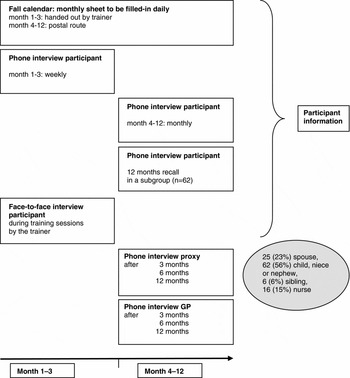
Seven established methods of fall recording were applied (Figure 1):
(1) Prospective monthly fall calendars.
(2) Face-to-face interview (twice a week) at the training sessions during the first three months.
(3) Weekly phone interviews with the participants during the first three months.
(4) Monthly phone interviews with the participants applied during the next nine months.
(5) Retrospective 12 month recall in a random subsample (n = 62).
(6) Proxies were interviewed after 3, 6 and 12 months.
(7) Participants’ GPs were interviewed after 3, 6 and 12 months.
The seven methods of fall recording applied in this study. The 12-month recall was conducted in a random subsample (n = 62), all other methods in the whole group (n = 110).

For the phone interviews, the accessibility of the participants was used as an indicator of feasibility. For the calendars, adherence to the method was assessed. The monthly calendar sheets were categorized as: (i) correctly filled-in, (ii) obviously not marked every day (e.g. brackets covering several days), (iii) three or fewer unmarked days (often due to the calendar being sent back at the end of the month), (iv) more than three unmarked days but at least one documented fall, thus, containing relevant information. Categories (i–iv) were considered valid for fall recording. The following categories were considered invalid: (v) more than three unmarked days and no documented fall, (vi) calendar not returned.
Since the accuracy of the fall recording methods has not been studied in persons with dementia the authors refrained from presuming one method to be superior to the others. Rather, the number of falls identified by all methods in total was deemed the closest estimation of the actual number of falls and was used as the criterion standard in this study, as has been done in a study on in-hospital falls (Hill et al., Reference Hill2010). To adjust for multiple counting of the same fall by different methods, falls related to the same event were eliminated. For this purpose the information about the date, time, place and process of the fall event obtained from the participants, proxies and GPs respectively was matched.
To assess the effect of the length of the recall period on the accuracy of self-reports the data of the weekly phone interviews (months 1–3) were compared with the monthly interviews (months 4–12). Falls reported by face-to-face interview were not included since the interviews were not carried out over the entire observation period. Six participants who died during follow-up were excluded from this analysis.
In a subgroup (n = 62), the 12-month recall at the end of the observation was compared with falls prospectively recorded (calendars plus phone interviews) in the same population over the same time period.
Statistical analysis
The number of falls recorded by each method and the three-month observation periods were compared using an overall Friedman test (to account for multiple testing) and, in the case of significance, by pairwise Wilcoxon-signed-rank tests. A weighted κ analysis (presented with 95% confidence intervals) compared the methods for the identified non-fallers, single-fallers and multiple-fallers and retrospective 12-month recall with prospective follow-up. Test-retest reliability was calculated by the intra-class correlation coefficient (ICC, two-way mixed model, single measure) as well as a weighted κ analysis. ICCs can be classified as follows (Cicchetti and Sparrow, Reference Cicchetti and Sparrow1981): 0–0.39 poor, 0.4–0.59 fair, 0.6–0.79 good, and 0.8–1.0 excellent. A κ of 0.41–0.60 implied moderate agreement, 0.61–0.80 substantial agreement, and 0.81–1.00 almost perfect agreement (Landis and Koch, Reference Landis and Koch1977). The cognitive subgroups were compared with the χ2 test (categorical variables) and the Mann-Whitney-U test (ordinal variables). A two-sided p-value ≤0.05 indicated statistical significance. Data were analysed using SPSS for windows version 16.0 and SAS version 9.1.3.
Results
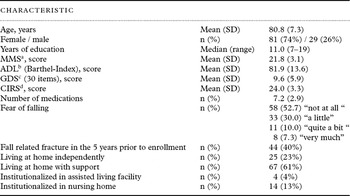
Of 122 subjects enrolled in the RCT, eight chose not to participate after having consented earlier and four died. Thus, the study sample comprised 110 multimorbid, geriatric patients with confirmed dementia. Table 1 shows the participants’ characteristics. Twenty (18%) subjects reported a single fall and 23 (21%) multiple falls in the preceding year; 44 (40%) had a fall-related fracture in the five years prior to enrollment.
Patient characteristics (n = 110)

aMini-Mental State Examination; bActivities of Daily Living: Barthel Index; cGeriatric Depression Scale; dComorbidity Illness Rating Scale; see Hüger et al., Reference Hüger, Zieschang, Schwenk, Oster, Becker and Hauer2009 for information on the tests used.
Feasibility of phone interviews
During the first three months 37 (34%) participants were contacted every week (MMSE≤22 vs. ≥23, 20 vs. 17, p = 0.209); monthly interviews were missed in between four and seven participants (MMSE≤22: 3–5; MMSE ≥23: 1–5 participants) each month due to vacations, respite care or hospital stays. In 24 participants (22%) (MMSE≤22 vs. ≥23, 15 vs. 9, p = 0.236) no phone call was missed; they were contacted every week during the first three months and afterwards every month. A total of 70 participants (64%) (MMSE≤22: 36; MMSE≥23: 34) were contacted at least once in each of the 12 months.
Proxies and GPs were contacted at all time points except for one participant who did not have a proxy, two who did not have a GP, and one who refused to have her GP contacted.
Test-retest-reliability
In five of 33 participants the number of falls reported by the repeat phone call differed from the initial statement (2 for 4-week recall, 2 for 12-month recall, one for both). ICCs were good to excellent (0.715 for 4-week recall, 0.979 for 12-month recall). For the cognitively more impaired subgroup re-test reliability was lower (ICC 0.673 for 4 weeks, 0.966 for 12 months) than for the cognitively less impaired subgroup (ICC 0.776 for 4 weeks, 0.989 for 12 months). The results were confirmed by κ analysis: simple κ for 4-week recall was 0.713 (MMSE≤22: 0.673; MMSE≥23: 0.765); for 12 -month recall the weighted κ was 0.930 (MMSE≤22: 0.881; MMSE≥23: 0.960).
Adherence to the calendar method
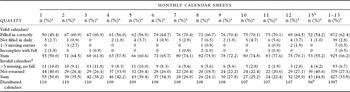
Only 16 (14.5%) participants returned all calendar sheets and of these only 12 (10.8%) completed all correctly. Of the 1397 distributed calendars, 1018 (72.9%) were returned, 925 (66%) were valid and 872 (62%) were filled in correctly (Table 2). The proportion of valid calendars was higher in the cognitively less impaired subgroup. However, this difference was statistically significant only for pooled data (month 1–3 MMSE≤22 vs. MMSE≥23: 53.2% vs. 64.8% valid, p = 0.033; month 4–6 MMSE≤22 vs. MMSE≥23: 57.9% vs. 68.6% valid, p = 0.048; month 7–9 MMSE≤22 vs. MMSE≥23: 72.2% vs. 80.5% valid, p = 0.106; month 10–12 MMSE≤22 vs. MMSE≥23: 72.2% vs. 76.1% valid, p = 0.428; month 1–12 MMSE≤22 vs. MMSE≥23: 63.8% vs. 72.5% valid, p<0.001) but not for single months (p-value range: 0.096–0.959).
Return rate and quality of fall calendars

a Number of calendars and percentage related to the distributed calendars of the particular month
b Calendar sheets covered one month of the calendar year, whereas fall recording started the date of the fist training of each participant, Therefore, 13 calendar sheets were necessary to cover 12 months of fall recording. In the cases when participants started training on the last or the first day of a month only 12 calendar sheets were distributed. This resulted in only 96 of the 13th calendar sheet being distributed.
c Correctly filled-in calendars, calendars obviously not marked every day (e.g. brackets covering several days), calendars with three or less missing entries, and calendars with at least one registered fall but otherwise incomplete are considered valid for fall recording.
d Calendars with more than three missing entries and no documented fall and calendar that were not returned are considered invalid.
Accuracy
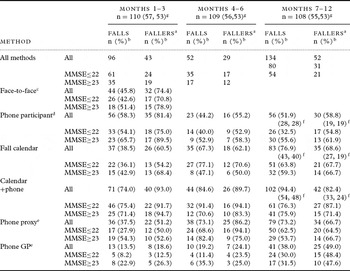
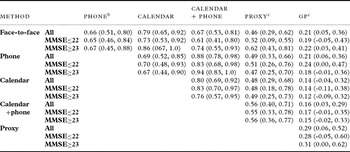
The number of falls recorded by each method is shown in Table 3. The combination of calendars and weekly phone calls (months 1–3) showed the highest accuracy. As a single method, weekly phone interviews with participants recorded the largest number of falls, and were thus more accurate than the calendar method alone or interviews with the proxies. This was also true for the cognitive subgroups. In only eight cases (four in each group) the proxy reported more falls than the participant. Thirty falls were missing on returned and completed calendar sheets. GPs only reported 14% of falls and 19% of fallers. The accuracy of the GP reporting was better for multiple fallers (n = 23, 16% of falls, 30% of fallers) versus single fallers (n = 20, 5% of falls/fallers) (p = 0.050) and for participants with a history of a fracture in the preceding five years (n = 44, 17 of 43 falls reported) versus subjects without a fall-related fracture (n = 66, 0 of 52 falls reported) (p = 0.015). The number of reported falls differed significantly between methods in the overall analysis (p<0.001). Pairwise comparison revealed a significantly higher accuracy for the combination of calendars and phone calls versus all other methods (largest p-value = 0.007) and a significantly lower accuracy for the GPs versus all other methods (p<0.001). Kappa analysis for identified non-fallers, single or multiple fallers showed substantial agreement between participant interviews and calendars but only moderate agreement between self-reports and proxy-reports for the whole group as well as the cognitive subgroups (Table 4).
Number of recorded falls and identified fallers by each applied fall recording method

MMSE = Mini-Mental State Examination
a Fallers are subjects with at least one recorded fall by any method in the corresponding time period.
b Percentages refer to the total number of falls or fallers in the entire study population or the cognitive subgroups in the corresponding time period.
c Face-to-face interview during training session twice a week
d Phone interviews with the participants took place once a week during months 1–3 and once a month during months 4 -12.
e Phone interview with proxy and GP after 3, 6 and 12 months.
f number of falls or fallers for the three-months periods (months 7–9, months 10–12)
The difference in number of reported falls by different methods was highly significant (p<0.001) in the overall analysis (Friedman test to account for multiple testing). Pair wise comparison revealed a significantly higher accuracy for the combination of calendars and phone calls versus all other methods (largest p-value 0.007) and a significantly lower accuracy for the GPs versus all other methods (p<0.001). For the other comparisons the numerical differences did not reach statistical significance.
g number of participants in the whole group (subgroup MMSE≤22, subgroup MMSE≥23)
Agreement of fall recording methods in identifying non-fallers, single-fallers, and multiple-fallersa

MMSE = Mini-Mental State Examination
a The number of identified non-fallers, single-fallers and multiple-fallers by each method during months 1–3 were compared by weighted kappa analysis. Results are presented as κ (95% confidence interval). A kappa of 0.41–0.60 implies moderate agreement, 0.61–0.80 substantial agreement, and 0.81–1.00 almost perfect agreement (Landis & Koch, Reference Landis and Koch1977). The analysis was conducted for the whole group as well as the cognitive subgroups.
b Phone interviews with the participants were conducted once a week during month 1–3
c Phone interview with proxy and GP after 3 months
The comparison of the methods for months 4–12 revealed a different pattern (Table 3). Monthly phone interviews with the participants recorded fewer falls than calendars (p = 0.012) or proxy-reports (p = 0.024). In 30 cases (MMSE≤22: 19; MMSE≥23: 11) proxies reported more falls than the participants. The combination of phone interviews and calendars again showed a significantly higher accuracy than either phone or calendar alone or GPs (p<0.001, = 0.002, <0.001), but compared to proxy-reporting there was only a trend for significance (p = 0.097).
A comparison of the cognitive subgroups showed a significantly higher proportion of falls recorded by weekly phone interview in the cognitively less impaired subgroup (p = 0.041) (Table 3). For the other methods the differences were not significant (p-values: 0.190–0.880 for months 1–3, 0.180–0.636 for months 4–12).
Effect of recall period
Weekly phone interviews (months 1–3) recorded significantly more falls than monthly phone interviews (months 4–12) (months 1–3 vs. 4–6, 7–9, 10–12: 54 vs. 23, 27, 28 falls; p = 0.003, 0.003, 0.024, respectively). As a consequence, the number of all reported falls was substantially higher during the first three months (months 1–3 vs. 4–6: 82 vs. 44 falls, p<0.001). For the other methods there was no significant difference (calendars: 36 vs.27, p = 0.309; proxy: 35 vs. 33, p = 0.872; GP: 13 vs. 10, p = 0.711).
Prospective fall reporting versus 12-month recall
The examined subgroup comprised 21 non-fallers, 12 single fallers and 29 multiple fallers, identified by using all information available. Retrospective recall after 12 months recorded fewer falls and fallers (40 non-fallers, 14 single fallers, and 8 multiple fallers) compared to the prospective recording of falls by the combination of calendars and phone interviews (23 non-fallers, 13 single fallers, 26 multiple fallers).
The κ statistic showed poor agreement between the two methods for the whole group (κ = 0.13, 95% confidence interval: 0.01, 0.26) and especially for the cognitively more impaired subgroup (MMSE≤22: κ = 0.03 (-0.10, 0.16); MMSE≥23: κ = 0.25 (0.01, 0.49)).
Fall definitions
A single fall could have up to three descriptions (from participant, proxy and GP). During the first six months, 213 fall descriptions according to the ProFaNE definition were documented. Of these, only eight (3.8%), relating to six distinct falls, met the exclusion criteria of the Kellogg definition. These falls were due to a cardiac arrest, a witnessed syncope, three unwitnessed syncopes, and the powerful braking of a tram in which the subject was travelling.
Discussion
Fall recording methods
In this study significantly more falls and fallers were revealed by a combination of the calendar method and regular phone interviews compared to any single method alone. Importantly, phone calls not only served as a reminder about the calendar sheet but also allowed regular enquiries about falls. Weekly phone interviews provided more information than the calendar method whereas monthly calls, though less accurate, added significant information to the calendars.
Adherence to the calendar method was poor; only 15% of the participants returned all the calendars, and only 60% of calendars were valid. Our findings differ substantially from studies in a population without cognitive impairment (85% returned all postcards) (Hale et al., Reference Hale, Delaney and Cable1993). In a study of persons with dementia, when caregivers were explicitly asked to assist, the return rate was 83% (Allan et al., Reference Allan, Ballard, Rowan and Kenny2009), but the number of completed calendars was not described in these studies. Accuracy of the calendar method was also low when considering only the returned calendars. Consequently, fall calendars cannot be recommended as a single method for patients with cognitive impairment and do not qualify as a criterion standard.
Accuracy of the face-to-face interviews during training sessions, although conducted twice a week, was inferior to weekly phone calls. Embarrassment to admit falls in front of the group may have influenced reporting, as falls are often perceived as menacing signs of terminal decline (Yardley et al., Reference Yardley2006).
When cognitive impairment compromises the validity of self-reports, healthcare providers often turn to the proxy-report as the exclusive source of information (Kiyak et al., Reference Kiyak, Teri and Borson1994). However, a lack of agreement between patients and their family proxies unrelated to dementia severity was found for the assessment of depression (Teri and Wagner, Reference Teri and Wagner1991) and of physical and functional health (Kiyak et al., Reference Kiyak, Teri and Borson1994). In our study, although self-reporting was significantly influenced by dementia severity, weekly interviews were superior to proxy-report for both cognitive subgroups, and agreement between self-reports and proxy-reports was only moderate. Test-retest reliability of self-reporting was good, even in the cognitively more impaired subgroup, as has been shown in persons with moderate dementia for self-reported data such as quality of life measurements (Novella et al., Reference Novella2001) or falls efficacy (Hauer et al., Reference Hauer2010). The high accuracy and the good test-retest reliability of self-reports found in this study not only confirm that it is possible to assess persons with dementia directly (Kiyak et al., Reference Kiyak, Teri and Borson1994; Novella et al., Reference Novella2001) but should encourage researchers to ask the subjects themselves about falls.
The GPs of our participants were informed about the study and were thus sensitized to the problem of falls. Nevertheless, they reported by far the smallest number of falls (14%) and only for participants with a fall-related fracture in their history. Our results confirm epidemiological studies in which less than 20% of falls were noted in GPs’ charts (Hale et al., Reference Hale, Delaney and Cable1993) and only half of injured and multiple fallers (Rubenstein et al., Reference Rubenstein2004).
Length of recall period
The feasibility of frequent phone interviews is limited by the high costs in terms of time expended (Hannan et al., Reference Hannan2010). On the other hand, our data show that monthly interviews recorded fewer than half the number of falls compared to weekly interviews and was less accurate than the calendar method or proxy interview. A limitation of this study is that weekly and monthly phone interviews, although conducted with the same subjects, were applied in consecutive time periods. When comparing these periods a decrease in reported falls could not be detected for any other method (calendar, proxy or GP). Therefore, we conclude that the reduction was not due to fewer falls having occurred but to fewer falls being reported by phone interview due to the longer recall interval.
In our study sample, 12-month recall showed poor agreement with prospective recording, especially in the cognitively more impaired subgroup. Eighteen of 39 (46%) (MMSE≤22: 12 of 22 (55%); MMSE≥23: 6 of 17 (35%)) subjects who documented a fall prospectively (calendars plus regular phone interviews) did not recall having had a fall at the end of the study. This proportion was worse compared to other studies, with 13% reported by Cummings et al. (Reference Cummings, Nevitt and Kidd1988) or 20% by Peel (Reference Peel2000) in community-dwelling older persons predominantly without cognitive decline. Thus, 12-month recall, though convenient and recommended in clinical practice guidelines for fall prevention (American Geriatrics Society, 2001), has to be considered an inaccurate method for fall recording in persons with dementia.
Criterion standard
In many studies, the calendar method with phone interviews only in case of missing calendars has been used as a criterion standard (Cummings et al., Reference Cummings, Nevitt and Kidd1988; Peel, Reference Peel2000; Hannan et al., Reference Hannan2010). As our data show the assumption that it is the most reliable method is not well founded for persons with dementia. To achieve the best approximation of the actual number of falls, the sum of all recorded falls, with adjustment for multiple counting of the same fall, was used as the reference value as has been done in a study on inpatient falls (Hill et al., Reference Hill2010). As all falls reported are included in the criterion standard, this approach formally excludes over-reporting for single methods that are compared to this criterion standard. Of course, fall events may have been reported that did not occur. Using indepth interviews, employing the questioning techniques described in the methods section, false-positives were minimized. Extending the recall period from one week to one month resulted in only half the number of falls being reported, suggesting that, as in previous studies (Cummings et al., Reference Cummings, Nevitt and Kidd1988; Cumming et al., Reference Cumming, Kelsey and Nevitt1990; Peel, Reference Peel2000) under-reporting was the greater issue.
Comparison of the cognitive subgroups
As expected, accuracy of all self-reported measures was worse in the cognitively more impaired subgroup. Statistical significance (α <0.05) was reached for the weekly phone interviews but not for monthly interviews. A recall period of four weeks is perhaps also too long for the cognitively less impaired group, resulting in a similar performance. Since the monthly interviews reported fewer falls resulting in the numerical difference between the groups being smaller, undersampling might be another reason why the differences were not statistically significant. The median split of the group resulted in only a small separation of cognitive performance. A division of the group at quartiles of the MMSE score resulted in a better separation but also smaller numbers and provided similar results (data not shown).
Adherence to the calendar method was worse in the cognitively more impaired subgroup. Statistically significant differences were seen when the data were pooled over 3 or 12 months. The assistance of proxies might have reduced the difference between the cognitive subgroups.
Fall definitions
In this study the vast majority of fall events conformed to both definitions. Only two events out of 148 met the exclusion criteria of the Kellogg definition with certainty. Another four were doubtful since it is impossible to obtain a valid diagnosis of an unwitnessed syncope historically, even in cognitively intact patients (Parry et al., Reference Parry, Steen, Baptist and Kenny2005) and the appraisal of a violent blow is subjective. Specifying medical events or situations is difficult and excludes only a small number of fall events. Therefore, we recommend a simple, inclusive, and easy to administer fall definition such as the ProFaNE-definition.
Strengths and limitations
An important limitation inherent to all studies on fall recording is the lack of a real gold standard. The progress that has been achieved in the field of technical devices for fall recording to record falls objectively is promising, but the devices still show severe limitations in their practical application (Bourke et al., Reference Bourke2010). Until a feasible technical measure is established, we have to rely on valid assessment measures as recommended in international guidelines. A strength of this study is the thorough fall recording using short recall periods and several sources of information. Having integrated all information on falls available, we obtained the best approximation of the actual number of falls sustained.
The study design was administered to a sample consecutively recruited for a RCT on motor training. Thus, the power calculation was performed for the RCT's assumption and not this study's hypothesis. As the sample size may be limited for subgroup analysis, results may therefore underestimate effects in some of the research issues. The RCT intervention, which primarily targeted motor performances, did not influence risk of falling within the study as both groups showed almost identical fall rates during intervention and follow-up. The fact that fewer falls were recorded in the follow-up period appears to be due to a change in recall interval (1 week versus 1 month) and not due to the intervention.
The extent of assistance that the participants received with the calendars was not recorded. Thus, the number of participants unable to apply the method independently cannot be specified. However, our data represent results in a real-life scenario for studies conducted among community-dwelling elderly people with cognitive impairment.
A cost estimate of the different data collection procedures was not planned in this study. This would be an interesting topic for future research and would help to address the feasibility of the methods in research and clinical practice.
Conclusion
This study has demonstrated that in persons with mild to moderate dementia fall calendars with reminder phone calls (ProFaNE recommendation, Lamb et al., Reference Lamb, Jorstad-Stein, Hauer and Becker2005) are not sufficient. Calendars should be combined with regular telephone interviews inquiring about falls. Ideally, recall periods for the interviews should be as short as one week. If this is not feasible, gaining additional information from proxies should be considered. Clinicians and researchers should not rely on retrospective recall of falling with long recall periods in persons with dementia. The authors recommend the use of a simple, inclusive fall definition such as the ProFaNE definition.
Conflict of interest
None.
Description of authors' roles
T. Zieschang prepared the paper and collected the data, helped with the acquisition of patients, and with the statistical analysis and interpretation of data. M. Schwenk contributed to the acquisition of patients. K. Hauer developed the concept and design of the study, applied for the funding, managed the study, contributed to the acquisition of subjects and interpretation of the data. All authors, including C. Becker and P. Oster, contributed to interpretation of data and the drafting of the paper, and approved the final version.
Acknowledgments
We thank Anna-Denise Trumpfheller for data collection and Anna Czempik for training supervision and patient recruitment. This work was supported by the Landesstiftung Baden-Württemberg (P-LS-Sport/10) and the Dietmar Hopp Stiftung. T. Zieschang was supported by a Forschungskolleg Geriatrie Grant (32.5.1141.0024.0) from the Robert Bosch Foundation, Stuttgart, Germany.