




No CrossRef data available.
Article contents
Individual and combined effects of cadmium and 3,3′,4,4′,5-pentachlorobiphenyl (PCB 126) on the humoral immune response in European eel (Anguilla anguilla) experimentally infected with larvae of Anguillicola crassus (Nematoda)
Published online by Cambridge University Press: 16 April 2004
Abstract
The individual and combined effects of cadmium (Cd) and 3,3′,4,4′,5-pentachlorobiphenyl (PCB 126) on the antibody response of fish against metazoan parasites were tested. Eels experimentally infected with the swim bladder nematode Anguillicola crassus were exposed to sublethal concentrations of Cd and PCB 126. Cd was added to the water resulting in an effective concentration of 21·7±12·8 μg/l (mean±S.D.). PCB 126 was applied orally at a dose of approximately 100 ng PCB 126 per g body weight. At the end of the experiment, 76 days post-infection (p.i.), eels were found to be infected with 2–3 worms. Immunoblot analyses revealed that the body wall of adult worms was the most suitable crude antigen, and was subsequently used for an ELISA to evaluate the immune response of A. anguilla under various conditions. A significant increase of Anguillicola-specific antibodies in the peripheral blood was first detected 61 days p.i., indicating that it was not the invasive larvae but the adult worms which elicit the antibody response. The presence of Cd in the concentrations applied did not appear to modulate the production of antibodies. In contrast, the exposure to PCB 126 resulted in a complete suppression of the antibody response. A similar effect was also found for the combined exposure of the infected eels to Cd and PCB 126. A suppressed immune response, as demonstrated here, may be the reason why hosts exposed to environmental pollution became often much more easily infected than unexposed conspecifics.
Information
- Type
- Research Article
- Information
- Copyright
- © 2004 Cambridge University Press
INTRODUCTION
All species of the genus Anguillicola, Yamaguti 1935, inhabit the swim bladder of eels (genus Anguilla) in various regions of the world (Taraschewski et al. 1987; Moravec & Taraschewski, 1988). A. crassus originates from East Asia where it parasitizes Anguilla japonica and also cultivated European eels (A. anguilla) (Nagasawa, Kim & Hirose, 1994). Soon after its first report in Germany A. crassus successfully invaded the European continent (Moravec, 1992) and now shows a prevalence of nearly 100% and mean intensities of approximately 5–8 adult worms per eel (e.g. Sures et al. 1999a; Sures & Streit, 2001). Water temperature and salinity are factors limiting the parasite's distribution (Höglund et al. 1992; Knopf et al. 1998; Kirk, Lewis & Kennedy, 2000a; Kirk, Kennedy & Lewis, 2000b). Recently, A. crassus was also found in North America (Fries & Williams, 1996; Barse & Secor, 1999) and in North Africa (Maamouri et al. 1999). The rapid spread of A. crassus was assisted by human interference (Belpaire et al. 1989; Kennedy & Fitch, 1990) and the excellent colonizing ability of A. crassus (Kennedy & Fitch, 1990). For example, at least 30 fish species (Haenen & Van Banning, 1991; Thomas & Ollevier, 1992; Moravec & Konecny, 1994; Székely, 1994, 1995, 1996; Sures, Knopf & Taraschewski, 1999b) and also aquatic snails and insects, as well as amphibians (Moravec, 1996; Moravec & škoriková, 1998) are known to serve as paratenic hosts which support the spread of A. crassus in various biotopes.
Due to the pathological effects comprising histopathological changes of the swim bladder wall (Van Banning & Haenen, 1990; Molnár et al. 1993; Molnár, 1994; Molnár, Szakolczai & Vetési, 1995; Würtz & Taraschewski, 2000) as well as alterations of the host's physiology (Würtz, Taraschewski & Pelster, 1996; Kelly, Kennedy & Brown, 2000; Sures, Knopf & Kloas, 2001) special interest has been shown in the immune response of eels infected with this parasite (Buchmann, Pedersen & Glamann, 1991; Höglund & Pilström, 1995; Haenen et al. 1996; Nielsen & Buchmann, 1997; Knopf et al. 2000a,b). The humoral immune response of eels against A. crassus following experimental infection was recently described in detail by Knopf et al. (2000a). Anti-A. crassus antibodies were first observed 8 weeks post-infection, and appeared to be independent of the number of infective 3rd-stage larvae (L3).
Knowing the detailed characterization of the eel's antibody response against A. crassus, factors suppressing the immune response are of great interest, as eels are known to live in polluted waters (Tesch, 1999). It is commonly accepted that the immune response of organisms can be impaired due to exposure with immunosuppressive chemicals (Bols et al. 2001). Among a variety of environmental pollutants, heavy metals such as cadmium (Cd) and polychlorinated biphenyls (PCB) have direct immunomodulatory effects (Thuvander, 1989; Arkoosh et al. 1998a,b; Zelikoff, 1998). Cd is still released into the environment, especially from metal processing industries (Merian, 1991) and has been reported to cause immunosuppression as well as immunostimulation (Schulte et al. 1994; Zelikoff, 1998). PCBs were manufactured for industrial purposes, such as dielectric fluids in transformers, and as paint additives and are still present in the environment due to their high persistence (Safe, 1994). Coplanar congeners such as PCB 126 are especially known to affect the immune response of fish (Regala et al. 2001).
Most studies dealing with immunotoxicity of xenobiotics are based on challenges with viral and bacterial pathogens or synthetic antigens rather than dealing with parasitic infections (Hoole, 1997). This is not surprising since the ability to infect fish with a known number of parasites has been achieved only with a few metazoan parasite species like Diplostomum sp. and Sanguinicola inermis (Hoole, 1997). However, infective stages (L3) of A. crassus can be grown in the laboratory, which allows an exact number of worms to be given by experimental infection with a feeding tube (Haenen, Van Wijngaarden & Borgsteede, 1994; Knopf et al. 1998; Sures et al. 2001).
The aim of the present study was to identify the individual and combined effects of Cd and PCB 126 on the antibody response of eels experimentally infected with larvae of A. crassus. Antigens were prepared from different tissues of A. crassus and characterized with SDS–PAGE and immunoblotting. The body wall antigen of adult worms was found to be the most suitable antigen and was subsequently used in an ELISA to evaluate the immune response of A. anguilla under various conditions.
MATERIALS AND METHODS
Source and treatment of eels
Uninfected European eels (Anguilla anguilla) with a length of 41·5±4·0 cm (mean±S.D.) and a weight of 101±22 g (mean±S.D.) were obtained from an eel farm (Limnotherm, Bergheim, Germany) known to be free of Anguillicola crassus (see Knopf et al. 1998; Sures et al. 2001). The absence of A. crassus was confirmed by necroscopy of 12 eels.
The experimental design is summarized in Tables 1 and 2. Eels were randomly divided into 5 groups with 8 eels each (Table 1). Four groups of eels were infected with larvae of A. crassus. Three groups of these infected eels were additionally orally exposed to 3,3′,4,4′,5-pentachlorobiphenyl (PCB 126) and/or kept in water with Cd (Table 2). One group of eels was used as control and these eels were sham infected, by dosing with 100 μl of RPMI-1640 medium and were not exposed to chemicals. Eels were maintained individually in 40 l-tanks equipped with a polypropylene tube serving as a hiding place. The water was aerated and kept at a constant temperature of 20 °C. Due to the Cd exposure a flow-through system could not be used, but 80% of the water was replaced weekly. Eels were force fed once weekly with pellet food at a rate of 0·5 g per eel. Prior to the experiment, fish were allowed to acclimatize for 2 months.


Infection of eels and detection of Anguillicola crassus
Second-stage larvae (L2) were collected from the swim bladder lumen of eels naturally infected with A. crassus. These larvae were fed to wild-caught planktonic copepods. After 20 days at 20 °C the infective 3rd-stage larvae (L3) were isolated from the intermediate hosts by the method described by Haenen et al. (1994). The larvae were stored in RPMI-1640 medium (Sigma, Taufkirchen, Germany) containing 0·2% kanamycin at 4 °C until use. For the experimental infection 10 L3 were counted and suspended in approximately 100 μl of RPMI-1640. This suspension was introduced into the stomach of unsedated eels, using a feeding tube (diameter 1·5 mm, length 12 cm).
At the end of the experiment, eels were dissected and swim bladders were examined macroscopically and microscopically for adult and larval A. crassus.
Exposure
According to the main uptake routes of the substances used, PCB 126 was administered orally whilst Cd was given into the water. A stock solution of 1 g/l Cd2+ was prepared from Cd(Cl)2 (Merck, Darmstadt) dissolved in distilled water and was subsequently used to prepare exposure concentrations of 50 μg/l. Cd exposure started on day 54 and continued for 7 weeks until day 103 (see Table 2). The tank water was replaced weekly and Cd was dosed accordingly. To evaluate real Cd concentrations in the tanks, 15 water samples were taken from each tank through time and analysed by electrothermal atomic absorption spectrometry. The mean Cd concentration over time was found to be 21·7±12·8 μg/l (mean±S.D.) for the exposed eels whereas the Cd level in the tanks of the unexposed eels was 2·9±1·7 μg/l (mean±S.D.).
Because chlorinated biphenyls are lipophilic (Rice et al. 1998; Quabius et al. 2002), PCB 126 was administered via the food. After preparing a stock solution of 5 mg PCB 126 (AccuStandard Europe, Niederbipp, Switzerland) in 20 ml of ethanol (96%, Roth, Karlsruhe, Germany), 1·6 ml of this solution was mixed with 10 ml of pellet food and 10 ml of water. Following the evaporation of ethanol overnight, each eel was force fed with 0·5 ml of mushy food using a 1-ml syringe fitted with a feeding tube according to the infection procedure. Considering a mean weight of 101 g, the applied dose was approximately 100 ng PCB 126 per 1 g body weight. Fish which were not exposed to PCB 126 were also force fed pellet food which was prepared using the same volume of ethanol without addition of PCB. After a first application of PCB 126 on day 54, the procedure was repeated on day 75 (see Table 2).
Sampling of sera
Blood samples of 150 μl were drawn from the caudal vein of unsedated eels every 3 to 4 weeks. Samples were collected on 2 occasions prior to infection and 3 times prior to chemical exposure (Table 2). Blood was allowed to clot for 20 min at 20 °C and subsequently centrifuged for 5 min at 2000 g. Sera were collected and stored at −70 °C.
Preparation of crude antigen
Crude antigen extracts were prepared from adult Anguillicola crassus and infective larvae (L3) as described by Knopf et al. (2000b). Adult nematodes collected from naturally infected eels were washed in phosphate-buffered saline, pH 7·2 (PBS) and dissected. The worms were divided into body wall, female reproductive tract comprising eggs with L2, and intestinal content. For immunoblotting these parts of adult nematodes and L3 were suspended in sample buffer containing 50 mM Tris, 10% (v/v) glycerol, 7% (w/v) sodium dodecyl phosphate (SDS), 1 mM EDTA, 1 mM phenylmethyl sulfonylfluoride (PMSF) and 3% (w/v) dithiothreitol (DTT), heated for 3·5 min at 95 °C and centrifuged for 20 min at 16000 g. The resulting supernatants were used as crude antigens.
For ELISA, body walls of adult A. crassus were sonicated in Sarcosyl-TE-buffer (10 mM Tris, 1 mM ethylenediamine tetracetic acid disodium salt (EDTA), 2% N-lauroylsarcosine-sodium salt, pH 8·0) and centrifuged for 20 min at 16000 g. The resulting supernatant was used as crude antigen.
Immunoblot
The immunoblotting procedure was described in detail by Knopf et al. (2000a). Briefly, SDS–PAGE was performed under reducing conditions in the Phast-System (Pharmacia LKB, Uppsala, Sweden) with purchasable homogenous gels containing 12·5% polyacrylamide (Pharmacia LKB, Uppsala, Sweden). Semi-dry Western blotting on a polyvinyldiene fluoride (PVDF) membrane (Pall Gelman Sciences, Roßdorf, Germany) was also performed in the Phast-System.
Strips of the membrane were successively incubated with eel sera diluted 1[ratio ]100 in PBS containing 0·05% Tween 20 (PBS-T), with mouse anti-eel Ig (WEI 1, Van der Heijden et al. 1995; 1[ratio ]500 in PBS-T) and with sheep anti-mouse IgG conjugated with horseradish peroxidase (AP271, The Binding Site, England; 1[ratio ]1000 in PBS-T). Bands were visualized by adding the chromogenic substrate, diaminobenzidine (DAB, Sigma, Deisenhofen, Germany). For the immunoblotting procedure, sera of 4 eels from previous experiments were used (for details see Knopf et al. 2000a; Sures et al. 2001). Sera of eels were collected prior to experimental infection with larvae of A. crassus and, after repeated infection (20 L3 once a week, for 20 weeks), on day 325 (Knopf et al. 2000a).
Enzyme-linked immunosorbent assay (ELISA)
The ELISA protocol was similar to the procedure published recently by Knopf et al. (2000a,b). Polystyrene microtitre plates (Maxisorp, Nunc, Kamstrup, Denmark) were coated with the body wall antigen extract at a concentration of 1·0 μg/ml in carbonate coating buffer (10 mM Na2CO3, 35 mM NaHCO3, pH 9·6) and blocked with 1% (w/v) bovine serum albumin (Fluka, Buchs, Switzerland) in PBS containing 0·05% (v/v) Tween 20 (PBS-T-BSA). Eel sera were tested in duplicate at a dilution of 1[ratio ]100 in PBS-T-BSA and incubated for 1 h at 37 °C. As secondary and tertiary antibodies, monoclonal antibodies specific for the heavy chain of eel immunoglobulin (WEI 1, Van der Heijden et al. 1995; 1[ratio ]1000 in PBS-T-BSA) and sheep anti-mouse IgG conjugated with horseradish peroxidase (AP271, The Binding Site, England; 1[ratio ]4000 in PBS-T-BSA) were used, respectively. Both antibodies were incubated for 45 min at 37 °C. For each step the wells were filled with a volume of 75 μl and after incubation plates were washed 3 times with PBS-T. As substrate 75 μl of 3,3′,5,5′-tetramethylbenzidine (TMB, Sigma, Steinheim, Germany) was added and the reaction was stopped after 15 min with 50 μl of 0·5 M H2SO4. Results were read at 450 nm (Spectra Fluor, Tecan, Crailsheim).
The inter-assay variation was eliminated by relating the measurements to the absorbance value of a defined negative control-serum by calculation of the quotient Q:

The relative increase of Anguillicola-specific antibodies in the eels as shown in Fig. 2 was calculated by dividing Q determined at any time during the experiment by Q determined for the respective eel at day 0.
Statistical analysis
The time of onset and the intensity of the antibody response were compared between different treatments using the Kruskal–Wallis Test and the U-test with a significance level of P[les ]0·05.
RESULTS
Recovery of Anguillicola crassus
The prevalence of Anguillicola crassus in the experimentally infected eels ranged between 67 to 88%, with mean intensities of 2–3 worms (adults and L4). Statistical analysis revealed no significant effects of the treatment on the recovery rate of the nematode. Thus, the infection success, as well as the individual development of A. crassus, was not affected by exposure of the eels to Cd and/or PCB 126.
Immunoblotting
Immunoblotting was performed to demonstrate the suitability of the body wall extract as crude antigen in the subsequent ELISA. The most diversified pattern of antigen bands was obtained using the body wall antigen preparation with the sera collected on day 325 (Fig. 1). Strong bands were detected in the high molecular weight range at 71 kDa and higher. Additionally, further antigens of a lower molecular weight appeared at about 43 and 38 kDa. No or only weak reactions were detected with proteins from the female reproductive system and the intestinal content. Using the crude antigen prepared from L3, two antigens with a molecular weight of approximately 100–110 kDa and around 43 kDa were detected. However, the bands detected appeared to be similar to, but weaker than, those found with the body wall antigen preparation. Prior to infection, sera of the same eels failed to show a positive reaction with any of the antigen preparations (Fig. 1). Because of the conspicuous strong and diversified antigen–antibody reaction found for the adult worm body wall extract, this antigen preparation was used for the subsequent ELISA procedure.

Fig. 1. Immunoblot analysis of Anguillicola crassus antigens with sera from 4 experimentally and repeat-infected eels (lanes 1–4), taken prior to infection (day 0) and 325 days after the first infection. bw, Body wall from adults; frs, female reproductive system; ic, intestinal content, (L3) 3rd-stage larvae. Molecular weight markers (MW) are indicated in kDa.
Time-course of the antibody response
The intra-assay coefficient of variation for the ELISA procedure was found to be 4·8% (n=80), whilst the inter-assay variance was 13·1% (n=12).
The antibody response of all groups of eels is summarized in Fig. 2 and in Table 3. At the end of the experiment (day 103), the level of Anguillicola-specific antibodies in the peripheral blood was significantly higher in the eels which were only infected, and in eels infected and simultaneously exposed to Cd, compared with the controls (Fig. 2). Between these two groups, no significant differences appeared and increasing antibody levels were first detected at day 88, which is 61 days p.i. However, on day 88 the antibody levels of both groups were not found to be significantly different from the control levels. The controls, inoculated with RPMI-1640, and the remaining groups of eels showed no increased extinction values over the entire experimental period of 103 days. Table 3 shows that the antibody levels of all three groups were very similar. Thus, administration of PCB 126, either alone or in combination with Cd, suppresses the immune response of eels. In contrast, exclusive exposure of eels to Cd at an aqueous concentration of approximately 22 μg/l does not reduce the production of A. crassus-specific antibodies.

Fig. 2. Time-course of the antibody response of eels inoculated with 10 L3 on day 27 as measured by ELISA using a crude antigen from the body wall of adult Anguillicola crassus. Closed symbols: significant difference from controls (U-test, P[les ]0·05); open symbols: no significant difference from controls.

DISCUSSION
Immunoblot analyses with sera from eels experimentally infected with A. crassus revealed that the antigen extract from the body wall of adult A. crassus is the most suitable antigen preparation to detect the antibody response against this parasite. Strongest antigen–antibody reactions and most antigens were detected in this antigen preparation. This confirms previous results in which serum antibodies of eels naturally infected with A. crassus showed comparable strong reactions with antigens from body wall preparations of the adult nematodes (Knopf et al. 2000b). These authors investigated a variety of other possible crude antigens but concluded from their immunoblot analyses that best results can be expected from antigens associated with the body wall of adult A. crassus. Although L3 are in close contact with the host tissues and are thus directly exposed to the host's immune system while migrating into the swim bladder wall, there was only a weak reaction with proteins of these larvae and no L3-specific antigens could be detected. Thus, our results support the finding that it is not the invading L3 but the adult parasites, most likely excretory–secretory antigens derived from their body wall, which elicit the production of antibodies in European eels.
The first detection of Anguillicola-specific antibodies by ELISA at day 88 (61 days p.i.) in the present study resembles the results of Knopf et al. (2000a) who found an immune response 8 weeks post-infection. In contrast, following an intraperitoneal injection of homogenized larval or adult A. crassus, antibody production occurred within 5–12 days (Knopf, 1999). Since the development of A. crassus from the L3 stage into the adult worm takes at least 50 days at a water temperature of about 20 °C (Haenen et al. 1996; Knopf et al. 1998; Sures et al. 1999b), it could be assumed that the migrating L3, despite its intimate contact with the host tissues, is not sufficiently immunogenic to elicit a detectable antibody response. The onset of the antibody response, about 8 weeks p.i., seems rather to be elicited by the first adult worms appearing in the swim bladder lumen.
Furthermore, Knopf et al. (2000a) demonstrated that the onset and the intensity of the antibody response was independent of the number of infective larvae inoculated, but individual eels showed great differences in the course of the antibody response. A high heterogeneity in the antibody response was also found in the present study, which may be due to the genetic variability of eels. As breeding of eels is not possible so far, the eels used in our experiment were caught from a natural population of glass eels, which were subsequently grown in an eel farm. Qualitative and quantitative differences in the individual immune response against parasites are well known also from mammals and it emerges that differences in the susceptibility or resistance against a variety of parasitic infections result from the genetic variability within the host population (Wakelin, 1996).
Not only the post-infection interval at which first antibodies against the parasite were detected, but also the height of the relative antibody content in the present study was similar to the data presented by Knopf et al. (2000a). The authors have monitored the immune response of eels over a period of 325 days and found highest values for the antibodies at approximately 150 to 200 days post-initial infection. As the present experiment was finished on day 76 p.i., a considerably lower increase of antibodies could be expected. However, eels inoculated with A. crassus larvae only and those eels being additionally exposed to cadmium were found to have approximately 1·5 to 2 times higher antibody levels than the uninfected controls and those groups of eels which were exposed to PCB 126. Due to the similarities between the antibody response of infected eels in the present study and those of the previous investigation a further increase of the antibody content in the sera of infected eels could be expected if the experiment would have been prolonged.
Concerning the immunomodulatory effects of the chemicals tested it can be seen that Cd did not obviously affect the antibody production of eels against A. crassus, whereas PCB 126 was found to prevent any humoral immune response. Previous studies have shown that exposure to Cd may modulate cell-mediated and humoral immune response in fish. This comprises increased phagocytic activity and chemiluminescence in macrophages (Elsasser, Roberson & Hetrick, 1986; Zelikoff, 1993; Lemaire-Gony, Lemaire & Pulsford, 1995; Zelikoff, 1998), alterations in leucocyte numbers and lymphocyte activity (Murad & Houston, 1988; Ghanmi et al. 1989) and antibody-producing cells (O'Neill, 1981; Anderson et al. 1989; Thuvander, 1989). It is known from the literature that immunomodulatory effects of Cd are dependent on the sensitivity of the species tested, the time and route of exposure and the concentration applied (Sanchez-Dardon et al. 1999). Using aqueous Cd levels of 6 μg/l and 60 μg/l no effect on the immune response was found for Oryzias latipes which were intraperitoneally infected with Yersinia ruckeri whereas concentrations of 600 μg/l caused an immunosuppression (Zelikoff, 1998). There are also indications that the humoral immune response may be stimulated on exposure to Cd (Hoole, 1997). Robohm (1986) noted that the antibody response in Morone saxatilis exposed to Cd at a concentration of 10 μg/l was enhanced and Thuvander (1989) observed an increase in antibody response to the O-antigen of Vibrio anguillarum when rainbow trout were exposed to 3·6 μg/l Cd. From the information available it appears that the Cd concentrations applied in the present study were not high enough to suppress the immune response of European eels. Furthermore, as it is known that eels are able to withstand environmental pollution and tend to accumulate heavy metals to a very high degree (e.g. Barak & Mason, 1990; Sures, Taraschewski & Jackwerth, 1994) it seems likely that this species is not sensitive enough to show alterations in its immune response at low levels of Cd pollution.
In contrast to Cd, the application of PCB 126 had a clear immunosuppressive effect. All groups of eels treated with polychlorinated biphenyls either alone or in combination with Cd had antibody levels similar to the uninfected control eels. There is evidence from the literature that certain commercial PCB mixtures are immunotoxic to fish (Rice & Schlenk, 1995). Among the 209 congeners of PCBs, those with coplanar structures receive the most attention due to their toxicity, which seems to be related to a structural similarity to 2,3,7,8-tetrachlorodibenzo-p-dioxin (TCDD), the most toxic and prototype halogenated aromatic hydrocarbon (HAH) (Regala et al. 2001). The degree of immunotoxicity of PCBs correlates with the degree of binding affinity to the cytosolic aryl hydrocarbon receptor (Ahr) (Kafafi et al. 1993), which is a well-described transcription factor for a variety of gene products, including cytochrome P 450 1A (Hahn & Stegemann, 1994). Due to its similarity with TCDD (equivalent factor of 0·1), PCB-126 should exhibit TCDD-like toxicities, but at a lower level (Regala et al. 2001; Kafafi et al. 1993). HAH were described to show a moderate suppression of antibody response in rainbow trout (Spitzbergen et al. 1986a,b) whereas, due to its lower toxicity, PCB-126 was not found to affect the antibody response of channel catfish, Ictalurus punctatus, to Edwardsiella ictaluri (Rice & Schlenk, 1995). In contrast, Regala et al. (2001) found a suppression of the antibody response in channel catfish against Vibrio anguillarum following intraperitoneal injection of I. punctatus with 1 mg/kg PCB-126, whereas the application of 0·01 mg/kg PCB-126 did not reduce the antibody responses. Accordingly, the immunotoxicity is clearly related to the PCB-126 concentrations applied. In mammals, PCB-126 and other planar HAHs are known to be potent suppressors of the antibody response (Holsapple et al. 1991). In the present study a dietary exposure of 0·1 mg/kg PCB-126 was sufficient to prevent the immune response of eels against A. crassus.
Studies addressing the question as to how environmental pollution affects the immune status of aquatic animals are of increasing interest (e.g. Aaltonen et al. 2000; Grinwis et al. 2000; Van Loveren et al. 2000; Bols et al. 2001). Because the immune and the endocrine systems are closely related in fish (Weyts et al. 1999) and both systems play an essential role in the maintenance of homoeostasis, the stress and immune response should not be regarded separately. Chronic stressors like pollution may cause a slight but chronic elevation of cortisol levels (reviewed by Barton & Iwama, 1991) and immunosuppression in fish is often associated with increased plasma cortisol levels (e.g. Wendelaar Bonga, 1997; Weyts et al. 1999). The results presented in this article are part of a series of experiments in which also plasma cortisol levels were determined in eels (Sures, 2002). Correlation analysis of the cortisol concentrations and antibody levels revealed that high plasma cortisol levels in eels were associated with low antibody levels. However, not only pollution but also parasitic infections may cause stress in fish as recently demonstrated for eels infected with A. crassus (Sures et al. 2001). Eels were found to elicit a stress response during larval development and initial appearance of adult A. crassus, but no chronic response to older adults as confirmed by Kelly et al. (2000).
From our results and the studies cited above it emerges that investigations aimed at the combined effects of parasite infections and pollution are very important to understand their interaction and effects of these ‘stressors’ on the physiological homeostasis of the host. It is commonly accepted that parasitized hosts show a higher susceptibility to environmental pollutants than uninfected conspecifics (reviewed by MacKenzie et al. 1995; Lafferty, 1997; Sures, 2001, 2003). Similarly, hosts which were exposed to pollutants often became much more easily infected than unexposed fish (MacKenzie et al. 1995; Lafferty, 1997). Due to insufficient knowledge on possible antagonistic or synergistic effects of parasitic infections and environmental factors on the physiological status of the hosts, further studies are necessary.
We are grateful to Dr Van der Heijden for providing antibodies.
References
REFERENCES
AALTONEN, T. M.,
JOKINEN, E. I.,
LAPPIVAARA, J.,
MARKKULA, S. E.,
SALO, H. M.,
LEPPÄNEN, H. &
LAMMI, R.
(2000).
Effects of primary- and secondary-treated bleached kraft mill effluents on the immune system and physiological parameters of roach.
Aquatic Toxicology
51, 55–67.CrossRefGoogle Scholar
ANDERSON, D. E.,
DIXON, O. W.,
BODAMMER, J. E. &
LIZZIO, E. F.
(1989).
Suppression of antibody-producing cells in rainbow trout spleen sections exposed to copper in vitro.
Journal of Aquatic Animal Health
1, 57–61.2.3.CO;2>CrossRefGoogle Scholar
ARKOOSH, M. R.,
CASILLAS, E.,
CLEMONS, E.,
KAGLEY, A. N.,
OLSON, R.,
RENO, P. &
STEIN, J. E.
(1998 a).
Effect of pollution on fish diseases: Potential impacts on salmonid populations.
Journal of Aquatic Animal Health
10, 182–190.Google Scholar
ARKOOSH, M. R.,
CASILLAS, E.,
HUFFMAN, P.,
CLEMONS, E.,
EVERED, J.,
STEIN, J. E. &
VARANASI, U.
(1998 b).
Increased susceptibility of juvenile chinook salmon from a contaminated estuary to Vibrio anguillarum.
Transactions of the American Fisheries Society
127, 360–374.Google Scholar
BARAK, N. A. E. &
MASON, C. F.
(1990).
Mercury, cadmium and lead in eels and roach: the effects of size, season and locality on metal concentrations in flesh and liver.
Science of the Total Environment
92, 249–256.CrossRefGoogle Scholar
BARSE, A. M. &
SECOR, D. H.
(1999).
An exotic nematode parasite of the American eel.
Fisheries
24, 6–10.2.0.CO;2>CrossRefGoogle Scholar
BARTON, B. A. &
IWAMA, G. K.
(1991).
Physiological changes in fish from stress in aquaculture with emphasis on the response and effects of corticosteroids.
Annual Review of Fish Diseases
1, 3–26.CrossRefGoogle Scholar
BELPAIRE, C.,
DE CHARLEROY, D.,
THOMAS, K.,
VAN DAMME, P. &
OLLEVIER, F.
(1989).
Effects of eel restocking on the distribution of the swimbladder nematode Anguillicola crassus in Flanders, Belgium.
Journal of Applied Ichthyology
5, 151–153.CrossRefGoogle Scholar
BOLS, N. C.,
BRUBACHER, J. L.,
GANASSIN, R. C. &
LEE, L. E. J.
(2001).
Ecotoxicology and innate immunity in fish.
Developmental and Comparative Immunology
25, 853–873.CrossRefGoogle Scholar
BUCHMANN, K.,
PEDERSEN, L. Ø. &
GLAMANN, J.
(1991).
Humoral immune response of European eel Anguilla anguilla to a major antigen in Anguillicola crassus (Nematoda).
Diseases of Aquatic Organisms
12, 55–57.Google Scholar
ELSASSER, M. S.,
ROBERSON, B. S. &
HETRICK, F. M.
(1986).
Effects of metals on the chemiluminescent response of rainbow trout (Salmo gairdneri) phagocytes.
Veterinary Immunology and Immunopathology
12, 243–250.CrossRefGoogle Scholar
FRIES, L. T. &
WILLIAMS, D. J.
(1996).
Occurrence of Anguillicola crassus, an exotic parasitic swim bladder nematode of eels, in the southeastern United States.
Transactions of the American Fisheries Society
125, 794–797.2.3.CO;2>CrossRefGoogle Scholar
GHANMI, Z.,
ROUABHIA, M.,
OTHMANE, O. &
DESCHAUX, P. A.
(1989).
Effects of metal ions on cyprinid fish immune response: in vitro effects of Zn2+ and Mn2+ on the mitogenic response of carp pronephros lymphocytes.
Ecotoxicology and Environmental Safety
17, 183–189.CrossRefGoogle Scholar
GRINWIS, G. C. M.,
VETHAAK, A. D.,
WESTER, P. W. &
VOS, J. G.
(2000).
Toxicology of environmental chemicals in the flounder (Platichthys flesus) with emphasis on the immune system: field, semi-field (mesocosm) and laboratory studies. Toxicology Letters 112–113, 289–301.CrossRefGoogle Scholar
HAENEN, O. L. M. &
VAN BANNING, P.
(1991).
Experimental transmission of Anguillicola crassus (Nematoda, Dracunculoidea) larvae from infected prey fish to the eel Anguilla anguilla.
Aquaculture
92, 115–119.CrossRefGoogle Scholar
HAENEN, O. L. M.,
VAN WIJNGAARDEN, T. A. M. &
BORGSTEEDE, F. H. M.
(1994).
An improved method for the production of infective third-stage juveniles of Anguillicola crassus.
Aquaculture
123, 163–165.CrossRefGoogle Scholar
HAENEN, O. L. M.,
VAN WIJNGAARDEN, T. A. M.,
VAN DER HEIJDEN, M. H. T.,
HÖGLUND, J.,
CORNELISSEN, J. B. J. W.,
VAN LENGOED, L. A. M. G.,
BORGSTEEDE, F. H. M. &
VAN MUISWINKEL, W. B.
(1996).
Effects of experimental infections with different doses of Anguillicola crassus (Nematoda, Dracunculoidea) on European eel (Anguilla anguilla).
Aquaculture
141, 41–57.CrossRefGoogle Scholar
HAHN, M. E. &
STEGEMANN, J. J.
(1994).
Regulation of cytochrome P4501A1 in teleosts: sustained induction of CYP1A1 mRNA, protein, and catalytic activity by 2,3,7,8-tetrachlorodibenzo-p-dioxin in the marine fish Stenotomous chrysops.
Toxicology and Applied Pharmacology
127, 187–198.CrossRefGoogle Scholar
HOLSAPPLE, M. P.,
SNYDER, N. K.,
WOOD, S. C. &
MORRIS, D. L.
(1991).
A review of 2,3,7,8-tetrachlorodibenzo-p-dioxin-induced changes in immuno-competence: 1991 update.
Toxicology
69, 219–255.CrossRefGoogle Scholar
HÖGLUND, J. &
PILSTRÖM, L.
(1995).
Mechanical isolation and characterization of antigens from adult Anguillicola crassus.
Fish and Shellfish Immunology
5, 51–60.CrossRefGoogle Scholar
HÖGLUND, J.,
ANDERSSON, J.,
WICKSTRÖM, H. &
REIZENSTEIN, M.
(1992).
The distribution of Anguillicola in Sweden and its association with thermal discharge areas.
Irish Fisheries Investigations
36, 143–150.Google Scholar
HOOLE, D.
(1997).
The effects of pollutants on the immune response of fish: implications for helminth parasites.
Parassitologia
39, 219–225.Google Scholar
KAFAFI, S. A.,
AFEEFY, H. Y.,
ALI, A. H.,
SAID, H. K. &
KAFAFI, G. (1993).
Binding of polychlorinated biphenyls to the aryl hydrocarbon receptor.
Environmental Health Perspectives
101, 422–428.CrossRefGoogle Scholar
KELLY, C. E.,
KENNEDY, C. R. &
BROWN, J. A. (2000).
Physiological status of wild European eels (Anguilla anguilla) infected with the parasitic nematode Anguillicola crassus. Parasitology
120, 195–202.CrossRefGoogle Scholar
KENNEDY, C. &
FITCH, D. J.
(1990).
Colonization, larval survival and epidemiology of the nematode Anguillicola crassus, parasitic in the eel, Anguilla anguilla, in Britain.
Journal of Fish Biology
36, 117–131.CrossRefGoogle Scholar
KIRK, R. S.,
LEWIS, J. W. &
KENNEDY, C. R.
(2000 a). Survival and transmission of Anguillicola crassus Kuwahara, Niimi & Itagaki, 1974 (Nematoda) in seawater eels.
Parasitology
120, 289–295.Google Scholar
KIRK, R. S.,
KENNEDY, C. R. &
LEWIS, J. W.
(2000 b).
Effect of salinity on hatching, survival and infectivity of Anguillicola crassus (Nematoda: Dracunculoidea) larvae.
Diseases of Aquatic Organisms
40, 211–218.Google Scholar
KNOPF, K.
(1999).
Untersuchungen zur Immunantwort des Europäischen Aals (Anguilla anguilla) auf den Schwimmblasen-Nematoden Anguillicola crassus. Ph.D. thesis.
University of Karlsruhe.
KNOPF, K.,
NASER, K.,
VAN DER HEIJDEN, M. H. T. &
TARASCHEWSKI, H.
(2000 a). Development of the humoral immune-response in European eel (Anguilla anguilla) experimentally infected with Anguillicola crassus. Diseases of Aquatic Organisms
42, 61–69.Google Scholar
KNOPF, K.,
NASER, K.,
VAN DER HEIJDEN, M. H. T. &
TARASCHEWSKI, H.
(2000 b). Evaluation of an ELISA and immunoblotting for studying the humoral immune response in Anguillicola crassus infected European eel Anguilla anguilla.
Diseases of Aquatic Organisms
43, 39–48.Google Scholar
KNOPF, K.,
WÜRTZ, J.,
SURES, B. &
TARASCHEWSKI, H.
(1998).
Impact of low water temperature on the development of Anguillicola crassus in the final host Anguilla anguilla.
Diseases of Aquatic Organisms
33, 143–149.CrossRefGoogle Scholar
LAFFERTY, K. D.
(1997).
Environmental parasitology: What can parasites tell us about human impacts on the environment?
Parasitology Today
13, 251–255.Google Scholar
LEMAIRE-GONY, S.,
LEMAIRE, P. &
PULSFORD, A. L.
(1995).
Effects of cadmium and benzo(a)pyrene on the immune system, gill ATPase and EROD activity of European sea bass Dicentrarchus labrax.
Aquatic Toxicology
31, 297–313.CrossRefGoogle Scholar
MACKENZIE, K.,
WILLIAMS, H. H.,
WILLIAMS, B.,
McVICAR, A. H. &
SIDDALL, R.
(1995).
Parasites as indicators of water quality and the potential use of helminth transmission in marine pollution studies.
Advances in Parasitology
35, 85–144.CrossRefGoogle Scholar
MAAMOURI, F.,
GARGOURI, L.,
OULD DADDAH, M. &
BOUIX, G.
(1999).
Occurrence of Anguillicola crassus (Nematoda, Anguillicolidae) in the Ichkeul lake (Northern Tunisia).
Bulletin of the European Association of Fish Pathologists
19, 17–19.Google Scholar
MERIAN, E.
(1991).
Metals and their Compounds in Environment and Life. Occurence, Analysis and Biological Relevance. Verlag Chemie Weinheim, New York.
MOLNÁR, K.
(1994).
Formation of parasitic nodules in the swimbladder and intestinal walls of the eel Anguilla anguilla due to infections with larval stages of Anguillicola crassus.
Diseases of Aquatic Organisms
20, 163–170.Google Scholar
MOLNÁR, K.,
BASKA, F.,
CSABA, G.,
GLÁVITS, R. &
SZÉKELY, C.
(1993).
Pathological and histopathological studies of the swimbladder of eels Anguilla anguilla infected by Anguillicola crassus (Nematoda: Dracunculoidea).
Diseases of Aquatic Organisms
15, 41–50.CrossRefGoogle Scholar
MOLNÁR, K.,
SZAKOLCZAI, J. &
VETÉSI, F.
(1995).
Histological changes in the swimbladder wall of eels due to abnormal location of adult and second stage larvae of Anguillicola crassus.
Acta Veterinaria Hungarica
43, 125–137.Google Scholar
MORAVEC, F.
(1992).
Spreading of the nematode Anguillicola crassus (Dracunculoidea) among eel populations in Europe.
Folia Parasitologica
39, 247–248.Google Scholar
MORAVEC, F.
(1996).
Aquatic invertebrates (snails) as new paratenic hosts of Anguillicola crassus (Nematoda: Dracunculoidea) and the role of paratenic hosts in the life cycle of this parasite.
Diseases of Aquatic Organisms
27, 237–239.CrossRefGoogle Scholar
MORAVEC, F. &
KONECNY, R.
(1994).
Some new data on the intermediate and paratenic hosts of the nematode Anguillicola crassus Kuwahara, Niimi & Itagaki, 1974 (Dracunculoidea), a swimbladder parasite of eels.
Folia Parasitologica
41, 65–70.Google Scholar
MORAVEC, F. &
šKORIKOVÁ, B.
(1998).
Amphibians and larvae of aquatic insects as new paratenic hosts of Anguillicola crassus (Nematoda: Dracunculoidea), a swimbladder parasite of eels.
Diseases of Aquatic Organisms
34, 217–222.CrossRefGoogle Scholar
MORAVEC, F. &
TARASCHEWSKI, H.
(1988).
Revision of the genus Anguillicola Yamaguti 1935 (Nematoda: Anguillicolidae) of the swimbladder of eels, including descriptions of two new species, A. novaezelandiae sp. n. and A. papernai sp. n.
Folia Parasitologica
35, 125–146.Google Scholar
MURAD, A. &
HOUSTON, A. H.
(1988).
Leucocytes and leucopoitic capacity in goldfish, Carassius auratus exposed to sublethal levels of cadmium.
Aquatic Toxicology
13, 141–154.CrossRefGoogle Scholar
NAGASAWA, K.,
KIM, Y. G. &
HIROSE, H.
(1994).
Anguillicola crassus and Anguillicola globiceps (Nematoda: Dracunculoidea) parasitic in the swimbladder of eels (Anguilla japonica and A. anguilla) in East Asia.
Folia Parasitologica
41, 127–137.Google Scholar
NIELSEN, M. E. &
BUCHMANN, K.
(1997).
Glutathione-s-transferase is an important antigen in the eel nematode Anguillicola crassus.
Journal of Helminthology
71, 319–324.CrossRefGoogle Scholar
O'NEILL, J. G.
(1981).
Effects of intraperitoneal lead and cadmium on the humoral immune response of Salmo trutta.
Bulletin of Environmental Contamination and Toxicology
27, 42–48.CrossRefGoogle Scholar
QUABIUS, E. S.,
NOLAN, D. T.,
SEGNER, H. &
WENDELAAR BONGA, S. E.
(2002).
Confinement stress and starvation modulate the induction of EROD activity after dietary exposure to PCB 126 in the Mozambique tilapia (Oreochromis mossambicus).
Fish Physiology and Biochemistry
25, 109–119.Google Scholar
REGALA, R. P.,
RICE, C. D.,
SCHWEDLER, T. E. &
DOROCIAK, I. R.
(2001).
The effects of tributyltin (TBT) and 3,3′4,4′5-pentachlorobiphenyl (PCB-126) mixtures on antibody responses and phagocyte oxidative burst activity in channel catfish, Ictalurus punctatus.
Archives of Environmental Contamination and Toxicology 40, 386–391.Google Scholar
RICE, C. D. &
SCHLENK, D.
(1995).
Immune function and cytochrome P4501A activity after acute exposure to 3,3′4,4′,5-Pentachlorobiphenyl (PCB 126) in channel catfish.
Journal of Aquatic Animal Health
7, 195–204.2.3.CO;2>CrossRefGoogle Scholar
RICE, C. D.,
ROSZELL, L. E.,
BANES, M. M. &
ARNOLD, R. E.
(1998).
Effects of dietary PCBs and nonyl-phenol on immune function and CYP1Y activity in channel catfish, Ictalurus punctatus.
Marine Environmental Research
46, 351–354.CrossRefGoogle Scholar
ROBOHM, R. A.
(1986).
Paradoxical effects of cadmium exposure on antibacterial antibody responses in two fish species: inhibition in cunners (Tautogolabrus adspersus) and enhancement in striped bass (Morone saxatilis).
Veterinary Immunology and Immunopathology
12, 251–262.CrossRefGoogle Scholar
SAFE, S.
(1994).
Polychlorinated biphenyls (PCBs), dibenzo-p-dioxins (PCDDs), dibenzofurans (PCDFs) and related compounds. Environmental and mechanistic considerations which support the development of toxic equivalency factors (TEFs).
Critical Reviews in Toxicology
21, 51–88.Google Scholar
SANCHEZ-DARDON, J.,
VOCCIA, I.,
HONTELA, A.,
CHILMONCYK, S.,
DUNIER, M.,
BOERMANS, H.,
BLAKELY, B. &
FOURNIER, M.
(1999).
Immunomodulation by heavy metals tested individually or in mixtures in rainbow trout (Oncorhynchus mykiss) exposed in vivo.
Environmental Toxicology and Chemistry
18, 1492–1497.CrossRefGoogle Scholar
SCHULTE, S.,
MENGEL, K.,
GÄTKE, U. &
FRIEDBERG, K. D.
(1994).
No influence of cadmium on the reproduction of specific antibodies in mice.
Toxicology
93, 263–268.CrossRefGoogle Scholar
SPITZBERGEN, J. M.,
SCHAT, K. A.,
KLEEMAN, J. M. &
PETERSON, R.
(1986 a).
Interactions of 2,3,7,8-tetrachlorodibenzo-p-dioxin (TCDD) with immune responses of rainbow trout.
Veterinary Immunology and Immunopathology
12, 263–280.Google Scholar
SPITZBERGEN, J. M.,
SCHAT, K. A.,
KLEEMAN, J. M. &
PETERSON, R.
(1986 b).
Effects of 2,3,7,8-tetrachlorodibenzo-p-dioxin (TCDD) or Aroclor 1254 on the resistance of rainbow trout, Salmo gairdneri T, to infectious haematopoietic necrosis virus.
Journal of Fish Diseases
11, 73–83.Google Scholar
SURES, B.
(2001).
The use of parasites as bioindicators in aquatic ecosystems: a review.
Aquatic Ecology
35, 245–255.CrossRefGoogle Scholar
SURES, B.
(2002).
Charakterisierung aquatischer Wirt-Parasit-Interaktionen aus ökologischer und (öko-)toxikologischer Sicht. Habilitationsschrift, Universität Karlsruhe.
SURES, B.
(2003).
Accumulation of heavy metals by intestinal helminths in fish: facts, appraisal and perspectives.
Parasitology 126 (Suppl.), S53–S60.Google Scholar
SURES, B. &
STREIT, B.
(2001).
Eel parasite diversity and intermediate host abundance in the River Rhine, Germany.
Parasitology
123, 185–191.CrossRefGoogle Scholar
SURES, B.,
KNOPF, K. &
KLOAS, W.
(2001).
Induction of stress by the swimbladder nematode Anguillicola crassus in European eels, Anguilla anguilla, after repeated experimental infection.
Parasitology
123, 179–184.CrossRefGoogle Scholar
SURES, B.,
KNOPF, K. &
TARASCHEWSKI, H.
(1999 b). Development of Anguillicola crassus (Dracunculoidea, Anguillicolidae) in experimentally infected Balearic congers Ariosoma balearicum (Anguilloidea, Congridae).
Diseases of Aquatic Organisms
39, 75–78.Google Scholar
SURES, B.,
TARASCHEWSKI, H. &
JACKWERTH, E.
(1994).
Lead content of Paratenuisentis ambiguus (Acanthocephala), Anguillicola crassus (Nematodes) and their host Anguilla anguilla.
Diseases of Aquatic Organisms
19, 105–107.CrossRefGoogle Scholar
SURES, B.,
KNOPF, K.,
WÜRTZ, J. &
HIRT, J.
(1999 a). Richness and diversity of parasite communities in European eels Anguilla anguilla of the River Rhine, Germany, with special reference to helminth parasites.
Parasitology
119, 323–330.Google Scholar
SZÉKELY, C.
(1994).
Paratenic hosts for the parasitic nematode Anguillicola crassus in Lake Balaton, Hungary.
Diseases of Aquatic Organisms
18, 11–20.CrossRefGoogle Scholar
SZÉKELY, C.
(1995).
Dynamics of Anguillicola crassus (Nematoda: Dracunculoidea) larval infection in paratenic host fishes of Lake Balaton, Hungary.
Acta Veterinaria Hungarica
43, 401–422.Google Scholar
SZÉKELY, C.
(1996).
Experimental studies on the infectivity of Anguillicola crassus third stage larvae (Nematoda) from paratenic hosts.
Folia Parasitologica
43, 305–311.Google Scholar
TARASCHEWSKI, H.,
MORAVEC, F.,
LAMAH, T. &
ANDERS, K.
(1987).
Distribution and morphology of two helminths recently introduced into European eel populations: Anguillicola crassus (Nematoda, Dracunculoidea) and Paratenuisentis ambiguus (Acanthocephala, Tenuisentidae).
Diseases of Aquatic Organisms
3, 167–176.CrossRefGoogle Scholar
TESCH, F. W.
(1999).
Der Aal.
Blackwell Wissenschafts-Verlag,
Berlin, Wien.
THOMAS, K. &
OLLEVIER, F.
(1992).
Paratenic hosts of the swimbladder nematode Anguillicola crassus.
Diseases of Aquatic Organisms
13, 165–174.CrossRefGoogle Scholar
THUVANDER, A.
(1989).
Cadmium exposure of rainbow trout, Salmo gairdneri Richardson: effects on immune functions.
Journal of Fish Biology
35, 521–529.CrossRefGoogle Scholar
VAN BANNING, P. &
HAENEN, O. L. M.
(1990).
Effects of the swimbladder nematode Anguillicola crassus in wild and farmed eel, Anguilla anguilla. In Pathology in Marine Science. Proceedings of the 3rd International Colloquium on Pathology in Marine Aquaculture, Gloucester Point, Virginia, 2–6 October 1988 (ed. Perkins, F. O. &
Cheng, T. C.), pp.
S317–S330. Academic Press Inc., New York.CrossRef
VAN DER HEIJDEN, M. H. T.,
ROOIJAKKERS, J. B. M. A.,
BOOMS, G. H. R.,
ROMBOUT, J. H. W. M. & BOON, J. H.
(1995).
Production, characterization and applicability of monoclonal antibodies to European eel (Anguilla anguilla L., 1758) immunoglobulin.
Veterinary Immunology and Immunopathology
45, 151–164.CrossRefGoogle Scholar
VAN LOVEREN, H.,
ROSS, P. S.,
OSTERHAUS, A. D. M. E. & VOS, J. G.
(2000).
Contaminant-induced immunosuppression and mass mortalities among harbor seals.
Toxicology Letters 112–113, 319–324.CrossRefGoogle Scholar
WAKELIN, D.
(1996).
Immunology and genetics of zoonotic infections involving parasites.
Comparative Immunology and Microbiology
4, 255–265.CrossRefGoogle Scholar
WENDELAAR BONGA, S. E.
(1997).
The stress response in fish.
Physiological Reviews
77, 591–625.CrossRefGoogle Scholar
WEYTS, F. A. A.,
COHEN, N.,
FLIK, G. &
VERBURG-VAN KEMENADE, B. M. L.
(1999).
Interactions between the immune system and the hypothalamo-pituitary-interrenal axis in fish.
Fish and Shellfish Immunology
9, 1–20.CrossRefGoogle Scholar
WÜRTZ, J. &
TARASCHEWSKI, H.
(2000).
Histopathological changes in the swimbladder wall of the European eel Anguilla anguilla due to infections with Anguillicola crassus.
Diseases of Aquatic Organisms 39, 121–134.CrossRefGoogle Scholar
WÜRTZ, J.,
TARASCHEWSKI, H. &
PELSTER, B.
(1996).
Changes in gas composition in the swimbladder of the European eel (Anguilla anguilla) infected with Anguillicola crassus (Nematoda).
Parasitology
112, 233–238.CrossRefGoogle Scholar
ZELIKOFF, J. T.
(1993).
Metal pollution induced immunomodulation in fish. Annual Reviews on Fish Disease
2, 305–325.CrossRefGoogle Scholar
ZELIKOFF, J. T.
(1998).
Biomarkers of immunotoxicity in fish and other non-mammalian sentinel species: predictive value for mammals?
Toxicology
129, 63–71.Google Scholar

Table 1. Experimental design

Table 2. Time schedule of the experiment
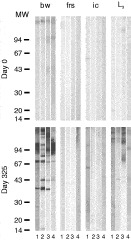
Fig. 1. Immunoblot analysis of Anguillicola crassus antigens with sera from 4 experimentally and repeat-infected eels (lanes 1–4), taken prior to infection (day 0) and 325 days after the first infection. bw, Body wall from adults; frs, female reproductive system; ic, intestinal content, (L3) 3rd-stage larvae. Molecular weight markers (MW) are indicated in kDa.

Fig. 2. Time-course of the antibody response of eels inoculated with 10 L3 on day 27 as measured by ELISA using a crude antigen from the body wall of adult Anguillicola crassus. Closed symbols: significant difference from controls (U-test, P[les ]0·05); open symbols: no significant difference from controls.

Table 3. Levels of Anguillicola-specific antibodies in the eels (mean±S.D.) in relation to initial values at the beginning of the experiment
 You have
Access
- 47
- Cited by