Introduction
Chickpea (Cicer arietinum L.) and lentil (Lens culinaris medik) are annual grain legumes that emanated from west Asia and are widely consumed in human daily food. Chickpeas and lentils are the most important legumes that grow in marginal areas and saline soils (Rao et al., Reference Rao, Giller, Yeo and Flowers2002). The high protein content (25–25%) of chickpea and lentil makes it widely used in human and animal diets (Yousefi and Damghani, Reference Yousefi and Damghani2012). The cultivation area of lentil in Iran is 140,000 ha, which ranked the sixth most cultivated area in the world. Total chickpea production in Iran is 200,000 tons/year from a cropping area of 56,000 ha (Anonymous, 2010). Based on the Food and Agriculture Organization (FAO) statistics (FAO, 2008), Iran was the seventh largest producer of chickpea after India, Australia, Pakistan, Turkey, Myanmar and Ethiopia, respectively.
Due to the increasing population, energy consumption in agriculture has been increased. Energy analysis studies commonly answer questions about how energy efficiency is and how energy affects the environment. Also, environmental awareness of people increased the demand for the environmentally friendly product that caused agro-scientists to give more attention to cleaner production (Khoshnevisan et al., Reference Khoshnevisan, Bolandnazar, Shamshirband, Shariati, Anuar and Mat Kiah2015). Many types of research in Table 1 have investigated the energy input–output auditing in different agricultural products from 2004 in different countries. The primary studies on the pattern of energy consumption in the agricultural sector began in 2008 in Iran. Gradually, Artificial Intelligence and new indices entered in the analysis of agricultural systems to find how to achieve sustainable agriculture (Banaeian et al., Reference Banaeian, Zangeneh and Clark2020).
A summary of the previous research done on energy and environmental management

a Data envelopment analysis.
Ecological footprint analysis (EFA) is a scientifically reviewed tool that measures life-supporting natural capital (Tusher et al., Reference Tusher, Pondit, Hasan, Latif, Binyamin, Singh, Srinagesh and Anand2020). The role of the EFA as a sustainability indicator has been widely acknowledged (Kissinger and Gottlieb, Reference Kissinger and Gottlieb2012). The global hectare (gha) is a measurement unit for the EFA that is defined as ‘the annual productivity of one hectare of biologically productive land or sea with world-average productivity’ (GFN, 2009).
Commonly, CO2 emissions are the largest origin of global greenhouse gas (GHG) emissions in the world. Iran as a non-industrial country has always been included among the most polluting countries regarding CO2 emission and the agriculture section is the most blameful (Taghavifar and Mardani, Reference Taghavifar and Mardani2015). In this regard, the assessment tools for the prediction of optimum energy consumption in agriculture section have been investigated in different researches.
Genetic algorithm (GA) is generally applied to generate high-quality solutions to optimization and search problems. Aghili nategh et al. (Reference Aghili nategh, Banaeian, Gholamshahi and Nosrati2020) used a multi-objective genetic algorithm (MOGA) optimization to consider economic, energy and environmental indices at the same time. Cellura et al. (Reference Cellura, Longo, Marsala, Mistretta, Pucci and Cavallaro2013) used GA optimization to determine solutions for the multi-output systems.
For the first time, this paper aims to discuss relevant legumes cultivation with different mechanization production systems in Sonqor and compare the indicators of sustainability in two different lentil and chickpea production systems. Although energy consumption in chickpea and lentil production is investigated separately by Elhami et al. (Reference Elhami, Akram and Khanali2016, 2017) in Isfahan province of Iran, the current paper is a comparative study that investigates some of the environmental indicators that lead to sustainability and also discuss straw management and social costs for different scenarios.
Other contributions of this paper are applying MOGA optimization procedure to compare the results and find the best combination of energy, CO2 emissions and ecological footprint parameters for lentil and chickpea production. That is why in this study, energy, CO2 emission and EFA analyses of lentil and chickpea were performed, common indices calculated and compared by ANOVA test. Consequently, regression models were extended to estimate output energy, EFA and CO2 emissions. Finally, MOGA was used to forecast how much the input energy has the potential to decrease.
Methodology
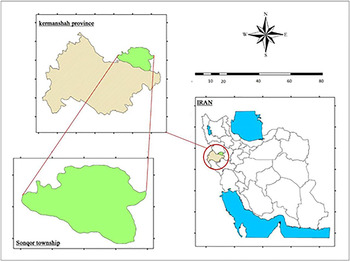
This research was conducted in Sonqor town in Kermanshah province in the west of Iran, located between 47 degrees and 36 min east longitudes and 49 degrees and 36 min north latitudes, and its altitude is 1681 m above sea level. The area under cultivation of chickpea and lentil in Sonqor is about 25,000 hectares. The sample size was calculated based on a simple random sampling method (Zangeneh et al., Reference Zangeneh, Omid and Akram2010). Fifty-two fields after preliminary evaluation were selected and data collected by using a face-to-face questionnaire method in 2018 work season (Fig. 1).
Location of the studied area in western Iran.

Nitrogen is used as a chemical fertilizer in chickpea production. Pyramide and bentazone are selective contact post-emergence herbicides, which are applied in chickpea production and control weeds and unwanted plants. Lentil production is completely organic with no chemicals and fertilizer. Mechanization process in lentil production limited just to the application of moldboard, while in chickpea production it used moldboard, disk, row planter and combine (Table 2).
Different legumes production systems and straw management in Sonqor

Fx1 Mechanized, Fx2 semi-mechanized, Fx3 manual.
Energy and CO2 emission
To investigate and analyze energy consumption optimization in a production system, it is necessary to compute the input–output, and then convert all inputs and outputs consumed in agricultural activity to energy, and CO2 emission by multiplication of related coefficients. Table 3 shows the energy and CO2 coefficients in legumes production.
Energy and CO2 emission coefficients in the legumes production system

Ecological footprint
The model of ecological footprint for sustainability assessment of the agricultural environment has been provided by Kissinger and Gottlieb (Reference Kissinger and Gottlieb2012) and Solís-Guzmán et al. (Reference Solís-Guzmán, Marrero and Ramírez-de-Arellano2013). A simplified equation based on energy consumption and location-based approach for the calculation of the legumes production footprint following this approach is displayed below:


where each of the considered factors would be: EFt is the ecological footprint index (gha), Ec is the capability of energy generation by one gram of coal (20 KJ), Ei is the energy of the ith factor (KJ), C 0 is the capability of one hectare farm for carbon absorption (ton) [1.8 ton for Iran (Gharakhlou et al., Reference Gharakhlou, Abdi and Shahraki2009), Fi is the energy of ith factor, EQF is the equivalence factor of the ith factor for converting productive land to global hectare (Anielski and Wilson, Reference Anielski and Wilson2010), Pc is the percent of the carbon in coal (g) (0.85%)], Oc is the percent of coal-derived from plants (g) (0.314%), the constant coefficient for converting gram to tone (1,000,000) (Solís-Guzmán et al., Reference Solís-Guzmán, Marrero and Ramírez-de-Arellano2013).
Straw management and social costs
There is a major difference in straw management of legumes in the Sonqor region (Table 1). In chickpea production, straw is harvested, baled and transferred to storehouses, then is used for animal feed in winter. While farmers who produce lentil burn crop residue in the field.
The social cost of the emission is estimated by using a standard coefficient. The table shows the cost of environmental emissions ($/kg of CO2eq.) and other emission indices (Table 4).
Emission-cost coefficients for background emission indices in the production system

Multi-objective genetic algorithm
GA is an adaptive heuristic search algorithm that belongs to the larger category of evolutionary algorithms and generates solutions optimizing problems. The MOGA is available for all types of input parameters and can handle multiple goals. The problem of optimization in the production of chickpeas and lentils was done by considering energy output, ecological footprint and CO2 emission as three objective functions according to Aghili nategh et al. (Reference Aghili nategh, Banaeian, Gholamshahi and Nosrati2020).
Minimum and maximum values for energy inputs are mentioned based on data confirmed in the Sonqor (Table 5).
Lower and upper bounds for the optimization problem of lentil and chickpea

Assuming the output energy (F), benefit to cost ratio (G) and GHG emissions (H) as a function of energy inputs the following equations to obtain mathematical models for inputs and outputs were developed:


where energy inputs were including machinery (X 1), human labor (X 2), diesel (X 3), seed (X 4), fertilizers (X 5), chemical (X 6). The criteria for stopping the MOGA method was considered as Aghili nategh et al. (Reference Aghili nategh, Banaeian, Gholamshahi and Nosrati2020). The data analysis was done with the Excel 2013 spreadsheet, SPSS 16.0 and MATLAB software 2015a.
Result
Input/output analysis
The results of Table 6 showed that chickpea production due to mechanized cultivation consumed higher energy in machinery and diesel fuel. Traditional harvesting operation in lentil production requires 147.52 h of human labor per hectare, while mechanized harvesting in chickpea production consumed just 24.9. One of the main advantages of lentil production is to support organic farming. No chemical fertilizer (urea) and herbicides are applied in lentil production. Therefore, lentil production has no chemical energy consumption too.
Inputs and outputs in three different scenarios of the legumes production system

Energy, ecological footprint and CO2
Emission analysis
Table 7 shows the share of major inputs of lentil and chickpea production systems in total energy consumption, ecological footprint and CO2 emission. Chemical fertilizer (urea), herbicide and machinery were the most energy-consuming inputs in chickpea production, while the results in lentil production were different from an organic production system (no fertilizer and chemicals). Seed and fuel consumption was the most energy-consuming inputs in lentil production. Chickpea and lentil production consumed 11,611 and 2080 MJ energy per hectare, respectively. Applying more machines and fertilizer and chemicals consumption in semi-mechanized chickpea production has increased the energy consumption per hectare of chickpea.
Energy, ecological footprint and CO2 emission in the legumes production system of Sonqor

CO2 emission in chickpea and lentil production was 484 and 173 kg CO2−eq, respectively; the most effective inputs in CO2 emission were machinery and fertilizer in chickpea production and human labor in lentil production. Of course, there is a disagreement among researchers here, some publications disregard human calculus (Khoshnevisan et al., Reference Khoshnevisan, Rafiee, Omid and Mousazadeh2013; Mobtaker et al., Reference Mobtaker, Taki, Salehi and Shahamat2013; Nabavi-Pelesaraei et al., Reference Nabavi-Pelesaraei, Hosseinzadeh-Bandbafha, Qasemi-Kordkheili, Kouchaki-Penchah and Riahi-Dorcheh2016), but some researchers believe that human activity should also be considered in computation (Houshyar et al., Reference Houshyar, Mahmoodi-Eshkaftaki and Azadi2017). In any case, with the increasing agricultural mechanization, human-induced emissions reduced. As in chickpea cultivation, human-induced emissions have decreased; instead, emissions from machine use have increased several times. The machine is an input that produces a lot of carbon emissions, according to increasing mechanized farms so it is advisable to reduce carbon dioxide and resource utilization by serious repair and maintenance of the farm machinery and also remanufacture them after the machine's useful life (Yang et al., Reference Yang, Yuan, Zhuang and Tian2019).
The ecological carbon footprint of legumes reported about 0.15 and 0.87 global hectares for lentil and chickpea production, respectively. Therefore, the environmental aspects of lentil production are more stable. According to Gharakhlou et al. (Reference Gharakhlou, Abdi and Shahraki2009) capability of one hectare of Iranian farm for carbon, absorption is 1.8 ton, and according to this study, during the process of lentil and chickpea production, 0.27 and 1.56-ton carbon produce. This implies that during the process of lentil and chickpea production, 1.53 and 0.24-ton carbon will absorb. So from the ecological viewpoint, both legumes are environmentally sustainable and there is no need for productive land to offset the decline in biological capacity.
Energy use efficiency, energy productivity and net energy of chickpea and lentil are shown in Table 8. Energy use efficiency in both legume production is more than 1, indicating that energy consumption in chickpea and lentil production in the surveyed region is efficient; in other words, energy production (output energy) was greater than energy consumption (input energy). Mishra et al. (Reference Mishra, Tripathi, Tripathi and Moses2017) observed energy use efficiency of 2.29 and 2.59 in the traditional and partially mechanized farming system of lentil production in India, respectively. Energy productivity and net energy for chickpea and lentil production were calculated at 0.036, 0.161 and 2373 and 5900 MJ per hectare, respectively. Yousefi and Damghani (Reference Yousefi and Damghani2012) reported the energy use efficiency, energy productivity and net energy of 3.04, 0.13 kg/MJ and 9836 MJ/ha, respectively, for chickpea production in Kangavar region of Kermanshah province of Iran.
Energy input–output ratio in legume production of Sonqor

a Includes human labor, farmyard manure, water for irrigation.
b Includes diesel fuel, electricity, chemicals, chemical fertilizer, machinery.
Energy indices in lentil production are more than chickpea, which shows that lentil production is more energy-efficient. Koocheki et al. (Reference Koocheki, Ghorbani, Mondani, Alizade and Moradi2011) showed similar results of energy use efficiency as 1.79 and 1.21 for lentil and chickpea production, respectively.
The distribution of input energy in legume production according to renewable and non-renewable energy forms is presented in Table 8. The share of renewable energy in lentil production is 56%, while due to the application of fertilizers and chemicals in chickpea production, the share of renewable energy forms decreased to 8%.
Straw management and social costs analysis
The main difference between lentil and chickpea production systems was straw management. Burning is one way to dispose of the straw left after harvest which lentil producers selected. But in this region, chickpea producers are faced with more straw and prefer to collect, bale and use it for animal feed. Legumes crop residue is a rich source of animal feed.
Open-field burning of straw has become the key factor hampering sustainable management in intensive cultivation systems and also burning brings losses in nutrients (Nguyen et al., Reference Nguyen, Nguyen, Tran, Hau, Nguyen and Gummert2016). Therefore, limiting crop residue burning in the field is a recommended option to ensure more environmental-friendly legumes farming systems in the region.
Table 9 shows the details of pollutant emissions from two different scenarios in straw management of lentil (burning) and chickpea (baling) production. The results revealed that lentil farms that burnt crop residue in the field generate significantly less GHG emissions than chickpea farms. Social costs are calculated by multiplying the coefficients of the emission index in Table 4 by the amount of emissions in Table 9. CO2 emission cost from diesel consumption for baling straw in chickpea production is $9.921, while in straw burning of lentil production is $1.629 (Fig. 2). The social cost of emission from straw baling in chickpea production was 27.65 dollars per hectare while burning straw in lentil production was 8.77. This means that the straw collection which seems the rational scenario is not properly managed and extreme fuel consumption has imposed higher social costs. For example, fuel consumption reduction can be possible by avoiding unused machine capacity, timely maintenance, machine adjustments, etc., and also the distance from the warehouse to the farm should be reduced as much as possible.
Social costs ($/kg) of straw management in different legume production of lentil and chickpea in Sonqor.

Pollutant gases in straw management of one hectare of legumes production

Optimization results
According to Equations (4), (5) and (6), the objective functions are fitted by linear correlation analysis among inputs and output for chickpea and lentil production. Therefore, three regression models for both legume crops are developed by SPSS software and coefficients are shown in Table 10 for chickpea and lentil, respectively. Data include machinery, human labor, diesel fuel, seed, fertilizer and chemicals as input and output energy, CO2 emission and carbon footprint as output.
Coefficient of independent variables for objective functions

a Output energy.
b Ecological footprint.
MATLAB software is applied to accomplish the optimized recipe with MOGA. MOGA results generated 70 and 18 Pareto optimal solutions that achieved as optimum solutions for chickpea and lentil production, some of them are shown in Tables 11 and 12, respectively. Numbers 1 and 12 for chickpea and lentil were characterized as the best generation based on the criteria found in Nabavi-Pelesaraei et al. (Reference Nabavi-Pelesaraei, Rafiee, Mohtasebi, Hosseinzadeh-Bandbafha and Chau2017). Total output energy, ecological footprint and CO2 emission for these generations were about 7825.53 MJ ha−1, 0.14 gha and 97.06 ton CO2eq. ha−1 and 4550.26 MJ ha−1, 0.04 gha and 47.15ton CO2eq. ha−1 for chickpea and lentil production respectively.
Multi-objective genetic algorithm results for chickpea production

Multi-objective genetic algorithm results for lentil production

According to the results of MOGA optimization, the optimum energy requirement for each input was identified while energy output maximized and CO2 and ecological footprint minimized. Table 13 shows that diesel fuel has the greatest potential to save input energy in both lentils (99.27) and chickpea (97.39) production, which confirms the results of straw management too. Therefore, the results of this study emphasize excessive consumption and lack of proper management of diesel fuel as a major source of non-renewable energy. Other inputs that have a high potential to reduce energy content in chickpea production are chemical fertilizers and pesticides. MOGA results support minimizing fertilizer consumption and reducing chemicals to zero for chickpea production (Fig. 3).
Comparison between chickpea and lentil production for inputs energy savings.

Optimum energy requirement and saving for chickpea and lentil production based on MOGA

Optimization results show that seed input has less energy-saving potential in the production of lentil and chickpea (Fig. 3), which means that seed input has been properly applied. On the other hand, the results of Table 10 confirm that seed energy is the most effective energy input on output energy (yield).
Conclusion
The implementation of ecological agricultural practices can contribute to more sustainable production systems. For the first time, this paper investigates and compares some sustainability aspects in two common lentil and chickpea production in the Kermanshah region of Sonqor. Another contribution of this paper is applying MOGA optimization procedure to compare the results and discover the best combination of energy, CO2 emissions and ecological footprint parameters of lentil and chickpea production with two different cultivation systems. Lentil production is traditionally cultivated while chickpea is semi-mechanized. While in the straw management sector, chickpea residues will be burnt and lentil residues are collected for animal feed.
Results revealed that machines, fertilizers and chemicals are extensively consumed per hectare in semi-mechanized chickpea production which leads to higher energy consumption, ecological and carbon footprint indices. Energy use efficiency, energy productivity and net energy in lentil production are higher than chickpea, which shows that traditional lentil production is more energy-efficient.
Assessment of social costs in two scenarios of straw management (burning straw vs bale and collection) showed that traditional lentil cultivation paid less social costs by burning straw. While chickpea semi-mechanized production pays much more for baling and collecting due to excessive fuel consumption. Optimization results of energy use in legume production according to the reduction of CO2 and ecological footprint and maximizing energy output will lead to more economic benefits and achieving social and environmental sustainability. Energy consumption, GHG emission and ecological footprint can be saved if all farmers operate according to the suggested value. Optimization results also showed that fuel input has the greatest potential for energy savings. While seed inputs were the most effective inputs on the output energy and managed perfectly well than other inputs and showed the least potential for energy savings.
The overall comparison of legume cultivation in the Sonqor region shows that the traditional lentil production system has more sustainable conditions than semi-mechanized chickpea cultivation. The results of this study have demonstrated that modern agricultural practices are not enough to achieve sustainability. The important point is that farmers lack effective knowledge of management. With the advancement of technology, farmers need to increase their awareness simultaneously. Department of Extension and Development of Agricultural Ministry transmit the knowledge and should establish a better relationship and social networks with local farmers so that the concepts convey correctly. Also, wrong government policies such as fuel, fertilizers and chemical subsidies have exacerbated unwise input consumption problems. Due to the outcomes of this study, optimization investigations can be extended to identify weaknesses and inefficient resources and drive the agricultural systems to sustainability. According to Banaeian et al. (Reference Banaeian, Zangeneh and Clark2020), it is suggested that in future, sustainability studies and other sustainability indicators, such as economic and social indicators, examine and optimize along with environmental indicators.