Introduction
Obesity is a major public health problem, and is well recognized as a risk factor for cardiovascular morbidity and mortality in adult populations. Obesity prevalence in middle-aged and older adults continues to rise over time and has almost doubled worldwide since 1980. 1,2 Obesity prevalence is also increasing with age and this may be particularly important in terms of added burden on healthcare services in an ageing population. For example, in England the vast majority of older adults, 85% of men and 75% of women aged 65–74 years, are overweight or obese. Reference Scarborough, Bhatnagar and Wickramasinghe3 Important changes to body composition occur with age, including a relative increase in fat tissue and a gradual decline in muscle mass, meaning that overall body weight and body mass index (BMI) may remain relatively unchanged. Reference Zamboni, Mazzali, Fantin, Rossi and Di Francesco4–Reference Zamboni, Mazzali and Zoico6 Several mechanisms underlying age-related muscle loss have been recognized, including neuronal and hormonal changes, poor nutrition, physical inactivity and inflammation. Reference Zamboni, Mazzali, Fantin, Rossi and Di Francesco4
Sarcopenia, the age-associated loss of muscle mass and function, is often associated with visceral obesity. Reference Zamboni, Mazzali, Fantin, Rossi and Di Francesco4,Reference Choi7–Reference Stenholm, Harris and Rantanen9 A new concept of sarcopenic obesity has recently emerged, which refers to sarcopenia coupled with high levels of adipose tissue. Reference Zamboni, Mazzali, Fantin, Rossi and Di Francesco4,Reference Baumgartner10 It is well established that visceral fat is an important factor in the development of metabolic disorders (e.g. hypertension, dyslipidemia and insulin resistance) and cardiovascular disease (CVD). Sarcopenia is known to be associated with metabolic impairments including insulin resistance and risk of adverse outcomes such as physical disability and mortality. Reference Choi7,Reference Baumgartner, Koehler and Gallagher11,Reference Filippin, Teixeira, MP, Miraglia and da Silva12 Low muscle mass has also been associated with CVD risk factors including arterial stiffness and high blood pressure. Reference Han, Park and Kwon HS13,Reference Snijder, Henry and Visser14 In addition, obesity and sarcopenia are reported to share common inflammatory pathways. Reference Zamboni, Mazzali, Fantin, Rossi and Di Francesco4 Therefore obesity and sarcopenia may act synergistically; sarcopenic obesity may have greater effect on metabolic disorders, CVD and mortality than either obesity or sarcopenia alone. Reference Zamboni, Mazzali, Fantin, Rossi and Di Francesco4,Reference Choi7–Reference Stenholm, Harris and Rantanen9 Recent reviews have highlighted the impact of sarcopenic obesity on general health outcomes and metabolic risk. Reference Choi7,Reference Stenholm, Harris and Rantanen9,Reference Prado, Wells, Smith, Stephan and Siervo15,Reference Waters and Baumgartner16 This review will focus especially on studies that have measured the combined effects of sarcopenia and obesity on the risk of CVD or mortality in older adults.
Search methods
Publications were identified by searching the MEDLINE database. The search terms (mapped to Medical Subject Headings – MeSH) included a combination of the following: ‘obesity’, AND [‘sarcopenia’ OR ‘skeletal muscle’] AND [‘cardiovascular diseases’ OR ‘mortality]. The search was restricted to English-language papers and older human populations. Selected embedded references were also reviewed and the search was supplemented by inclusion of references from the author's personal library.
Defining sarcopenic obesity
Although it is widely accepted that four body composition phenotypes exist in older age (normal, sarcopenic, obese and sarcopenic obese), there is no consensus on their definition or classification. Reference Waters and Baumgartner16,Reference Cruz-Jentoft, Baeyens and Bauer17 The most commonly used measure of overweight and obesity is body mass index (BMI), defined by the World Health Organisation as cut-points of ≥25 and ≥30 kg/m 2 , respectively. 18 However, the relationship between BMI and mortality is controversial in older age. A systematic review of older adults aged ≥65 years found that BMI in the overweight range is not associated with a significantly increased mortality risk, and BMI in the moderately obese range is only associated with a modest increase in mortality risk. Reference Janssen and Mark19 Similarly, a more current large meta-analysis of nearly 200,000 individuals aged 65 years or older showed that being overweight was not associated with an increased mortality risk, and risk only began to increase when BMI exceeded 33 kg/m 2 . Reference Winter, MacInnis, Wattanapenpaiboon and Nowson20 More recently there has been a focus on defining obesity using measures of central adiposity. Obesity can be classified as a waist circumference (WC) >102 cm for men and >88 cm for women, or a waist-to-hip ratio (WHR) ≥0.9 for men and ≥0.85 for women. 21 The general consensus in the literature is that central adiposity may be more useful at assessing body composition than BMI in older adults, as it is better at predicting CVD and mortality. Reference Zamboni, Mazzali and Zoico6,Reference Czernichow, Kengne, Stamatakis, Hamer and Batty22–Reference de Hollander, Bemelmans and Boshuizen26
Several different definitions of sarcopenia have been used in the literature, but to date no consensus definition has been adopted universally. Reference Choi7,Reference Cruz-Jentoft, Baeyens and Bauer17 Measurement methods such as computerized tomography (CT), dual energy X-ray absorptiometry (DXA) and bioelectrical impedance analysis (BIA) have been used to assess total or skeletal muscle mass. Reference Zamboni, Mazzali, Fantin, Rossi and Di Francesco4 Sarcopenia was originally defined as appendicular skeletal muscle mass (ASM), assessed by DXA and adjusted for height, two standard deviations below the reference for healthy younger people. Reference Baumgartner, Koehler and Gallagher11 Recently, a definition of sarcopenia has been suggested by The European Working Group on Sarcopenia in Older People which proposed the presence of both low muscle mass and low muscle function (strength or performance). Reference Cruz-Jentoft, Baeyens and Bauer17 The term sarcopenic obesity was first coined by Baumgartner Reference Baumgartner10 and is defined by the combination of sarcopenia and obesity. However, the lack of agreement on a definition to identify sarcopenic obese individuals presents major drawbacks both clinically and for research. Reference Prado, Wells, Smith, Stephan and Siervo15
The effects of sarcopenic obesity on cardiovascular disease and mortality
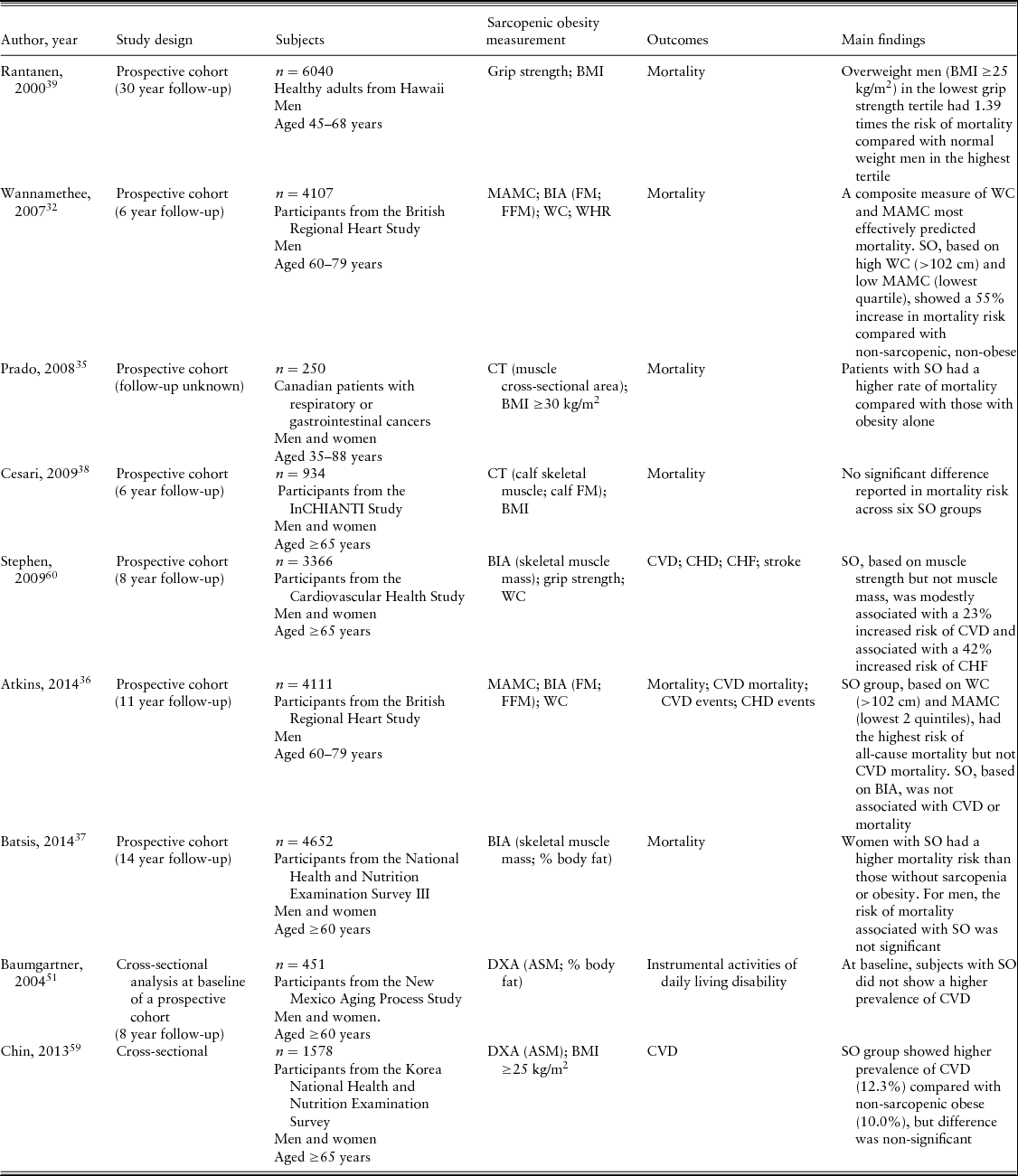
There is considerable literature on the effects of obesity in older adults Reference Janssen and Mark19,Reference Winter, MacInnis, Wattanapenpaiboon and Nowson20,Reference Decaria, Sharp and Petrella25,Reference Dorner and Rieder27,Reference Donini, Savina and Gennaro28 and several prospective studies have shown consistent associations between sarcopenia and an increased risk of mortality.29–Reference Wijnhoven, van Bokhorst-de van der Schueren and Heymans33 However, there are limited studies that have investigated the joint effect of sarcopenia and obesity on CVD and mortality, the majority of which have been cross-sectional studies or have focused on disability or physical function as outcomes. Reference Zamboni, Mazzali, Fantin, Rossi and Di Francesco4,Reference Prado, Wells, Smith, Stephan and Siervo15,Reference Waters and Baumgartner16,Reference Dominguez and Barbagallo34 Table 1 summarises relevant studies that investigate the associations of sarcopenic obesity with CVD and mortality in older people. Studies are grouped by the type of evidence presented: prospective and cross-sectional.
Summary of studies investigating the association between sarcopenic obesity and cardiovascular disease and mortality in older people

ASM, appendicular skeletal muscle mass; BIA, bioelectrical impedance analysis; BMI, body mass index; CHD, coronary heart disease; CHF, congestive heart failure; CT, computerized tomography; CVD, cardiovascular disease; DXA, dual energy X-ray absorptiometry; FM, fat mass; FFM, fat-free mass; MAMC, mid-arm muscle circumference; SO, sarcopenic obesity; WC, waist circumference; WHR, waist-to-hip ratio.
Sarcopenic obesity and mortality
Only a few prospective studies have examined the association between sarcopenic obesity and the risk of all-cause mortality. A small study in a disease-specific population, 250 patients with respiratory or gastrointestinal cancers, found that sarcopenic obese patients had a significantly higher risk of mortality compared with those with obesity alone. Reference Prado, Liefers and McCargar35 Similarly, an increased risk of all-cause mortality in sarcopenic obese patients has also been found in a large community-based population. Over 4000 older men, aged 60–79 years, from the British Regional Heart Study with a high WC (>102 cm) and in the lowest quartile of mid-arm muscle circumference (MAMC), showed a 55% increase in mortality risk compared with non-sarcopenic, non-obese individuals over 6 years of follow-up. Reference Wannamethee, Shaper, Lennon and Whincup32 This cohort was examined again after 11 years of follow-up, and sarcopenic obese men (WC >102 cm and in the lowest two quintiles of MAMC), had the highest risk of all-cause mortality with a 72% increase in risk independent of lifestyle and cardiovascular risk factors. Reference Atkins, Whincup and Morris36 In comparison, a 14-year prospective study on participants from the National Health and Nutrition Examination Survey III found a similar association in sarcopenic obese women (based on skeletal muscle mass and body fat measurement from BIA), with a 29% increase in mortality risk compared with those without sarcopenia or obesity. Reference Batsis, Mackenzie, Barre, Lopez-Jimenez and Bartels37 However, no significant association was seen in this cohort between sarcopenic obesity and mortality in men. In the InCHIANTI study, 934 male and female participants aged 65 years and over were followed for 6 years and no significant difference in mortality risk was reported across six sarcopenic obesity groups (defined using calf skeletal muscle and BMI). Reference Cesari, Pahor and Lauretani38 A study that defined sarcopenic obesity using a measure of muscle strength instead of muscle mass showed a significant association between sarcopenic obesity and risk of mortality; adult men who were overweight (BMI ≥ 25 kg/m2) and in the lowest grip strength tertile had 1.39 times the risk of mortality compared with normal weight men in the highest grip strength tertile, over 30 years of follow-up. Reference Rantanen, Harris and Leveille39
Sarcopenic obesity and cardiovascular risk factors
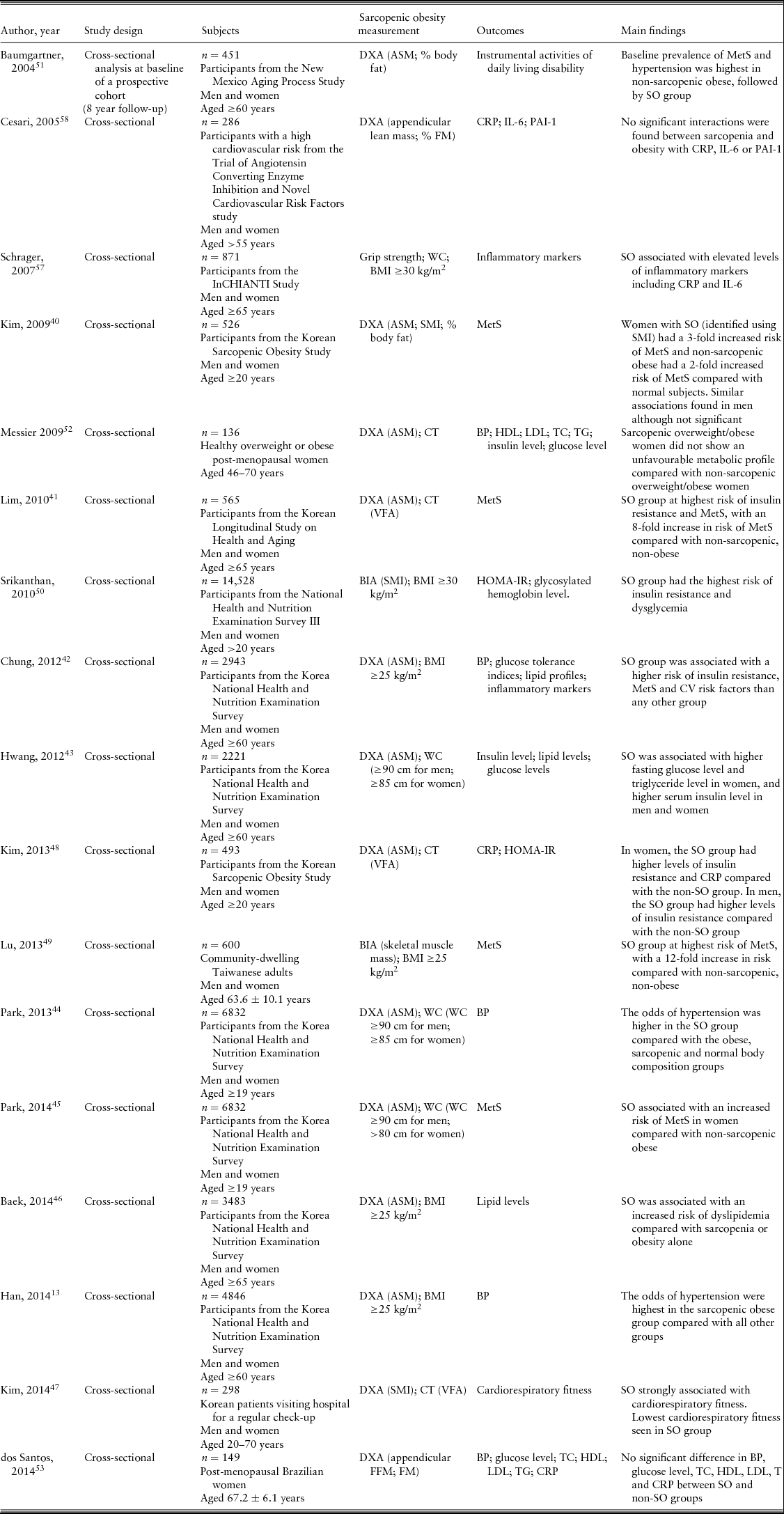
Numerous studies have examined the association of sarcopenic obesity with established cardiovascular risk factors, although not all have shown the sarcopenic obese group to have the worst cardiovascular and metabolic risk profile. The main findings are summarized in Table 2. Several cross-sectional studies in Korean populations of older adults have found that sarcopenic obese individuals had the worse cardiovascular risk profile. Sarcopenic obesity (based on skeletal muscle assessed by DXA and obesity measured by either CT, DXA, BMI or WC) was associated with lower cardiorespiratory fitness, higher fasting glucose levels, a higher risk of hypertension, dyslipidemia and insulin resistance, and up to an 8-fold increase in risk of the metabolic syndrome (MetS) compared with non-sarcopenic, non-obese subjects. Reference Han, Park and Kwon HS13,Reference Kim, Yang and Yoo40–Reference Kim, Park and Lim48 Similarly, community-dwelling Taiwanese older adults with sarcopenic obesity (defined by BIA measured muscle mass and BMI) also had the highest risk of MetS, with a 12-fold increase in risk compared with non-sarcopenic, non-obese subjects. Reference Lu, Yang and Chang49 In a large cross-sectional analysis of over 14,000 adults from the National Health and Nutrition Examination Survey III, the sarcopenic obese group (defined by BIA measured muscle mass and BMI) had the highest risk of insulin resistance and dysglycemia. Reference Srikanthan, Hevener and Karlamangla50
Summary of studies investigating the association between sarcopenic obesity and cardiovascular risk factors in older people
ASM, appendicular skeletal muscle mass; BIA, bioelectrical impedance analysis; BMI, body mass index; BP, blood pressure; CRP, C-reactive protein; CT, computerized tomography; DXA, dual energy X-ray absorptiometry; FM, fat mass; FFM, fat-free mass; HDL, high-density lipoprotein; HOMA-IR, homeostatic model assessment insulin resistance; IL-6, interleukin 6; LDL, low-density lipoprotein; MetS, metabolic syndrome; PAI-1, plasminogen activator inhibitor; SMI, skeletal muscle mass index; SO, sarcopenic obesity; TC, total cholesterol; TG, triglyceride; VFA, visceral fat area; WC, waist circumference.
However, not all studies have shown sarcopenic obese subjects to have the worst profile, and some cross-sectional studies have suggested that obese older adults may have higher cardiovascular risk factors than sarcopenic obese. Older adults (aged ≥60 years) from the New Mexico Aging Process Study found that the prevalence of MetS and hypertension was highest in non-sarcopenic obese, followed by the sarcopenic obese group (based on DXA measurements). Reference Baumgartner, Wayne and Waters51 Two studies in post-menopausal women also showed that sarcopenic obese women did not show an unfavourable metabolic profile compared with non-sarcopenic obese women, Reference Messier, Karelis and Lavoie52 and that no significant difference was seen in glucose level, lipid profile and blood pressure between sarcopenic obese and non-sarcopenic, non-obese individuals. Reference dos Santos, Gadelha and Safons53
Inflammatory and haemostatic markers have been shown to be associated with increased CVD in older adults. Reference Helfand, Buckley and Freeman54 Inflammation in particular is strongly associated with both obesity and sarcopenia. Reference Jensen55,Reference Gregor and Hotamisligil56 However, conflicting results have also been shown regarding the relationship between inflammatory and haemostatic markers and sarcopenic obesity. Cross-sectional analysis of participants aged 65 years and older from the InCHIANTI study showed that sarcopenic obesity (based on WC and grip strength) was associated with elevated levels of inflammatory markers including C-reactive protein (CRP) and interleukin 6 (IL-6). Reference Schrager, Metter and Simonsick57 Similarly, sarcopenic obese adult Korean women exhibited the highest levels of CRP, Reference Kim, Park and Lim48 and elevated levels of CRP, D-dimer and von Willebrand factor have been shown in older British men with sarcopenic obesity. Reference Atkins, Whincup and Morris36 However, baseline data from the Trial of Angiotensin Converting Enzyme Inhibition and Novel Cardiovascular Risk Factors study found no significant interactions between sarcopenia and obesity with CRP, IL-6 or plasminogen activator inhibitor, Reference Cesari, Kritchevsky and Baumgartner58 and another study found no significant difference in CRP levels between sarcopenic obese and non-sarcopenic, non-obese post-menopausal women. Reference dos Santos, Gadelha and Safons53
Sarcopenic obesity and cardiovascular disease
Despite evidence on the relationships between sarcopenic obesity and cardiovascular risk factors, the association between sarcopenic obesity and CVD has been less studied. Cross-sectional analysis of baseline data from participants aged ≥60 years from the New Mexico Aging Process Study reported that older adults with sarcopenic obesity (based on ASM and per cent body fat from DXA) did not show a higher prevalence of CVD compared with non-sarcopenic, non-obese subjects. Reference Baumgartner, Wayne and Waters51 Similar results were found in participants aged ≥65 years from the Korea National Health and Nutrition Examination Survey. Although the sarcopenic obesity group (based on ASM from DXA and BMI ≥ 25 kg/m2) showed a slightly higher prevalence of CVD (12.3%) compared with non-sarcopenic obese (10.0%), this difference was non-significant. Reference Chin, Rhee and Chon59
Prospective studies examining the association between sarcopenic obesity and CVD are limited and we have identified only two such studies to date. A large prospective study of community-dwelling older men and women (aged ≥65 years) from the Cardiovascular Health Study found that sarcopenic obesity, based on WC and muscle strength, was associated with a 23% increased risk of CVD and a 42% increase in risk of congestive heart failure over 8 years of follow-up. Reference Stephen and Janssen60 However, the risk of CVD events was not significantly greater in the sarcopenic obese group, when defined using BIA-measured muscle mass, implying that muscle strength may be more important than muscle mass. These results are broadly comparable to a prospective study of older men (aged 60–79 years), from the British Regional Heart Study which showed no significant association between sarcopenic obesity (defined by WC and MAMC) and CVD events or CVD mortality, over 11 years of follow-up. Reference Atkins, Whincup and Morris36 However, this study did not consider muscle strength in defining sarcopenic obesity. Overall, findings from cross-sectional and prospective studies do not provide strong evidence for an association between sarcopenic obesity and CVD.
Conclusions
Sarcopenic obesity is a new category of obesity in older adults and there is some evidence that it is associated with higher levels of cardiovascular risk factors and an increased risk of mortality. This highlights the need to also take muscle mass and function into account when assessing the effects of obesity in older adults. Efforts to promote healthy ageing and to reduce the risk of morbidity and mortality should focus not just on preventing obesity, but also on maintaining muscle mass and strength.
However, there are inconsistencies in the observed associations of sarcopenic obesity with cardiovascular risk and mortality risk that may be explained by the large variability between studies in their sample size and population characteristics, and also due to the heterogeneity in the definition and classification of sarcopenic obesity. Furthermore, the majority of studies examining the association between sarcopenic obesity and cardiovascular risk have been cross-sectional in design and hence the causality of observed associations cannot be established. To further assess the association between sarcopenic obesity and risk of CVD, especially, and mortality there is a need for larger, prospective studies to be carried out which use a standardized sarcopenic obesity definition.
Financial support
J.L.A. is funded by a PhD studentship from the National Institute for Health Research School for Primary Care Research (NIHRSPCR).
Conflicts of interest
None.