


1. Introduction
The bankruptcy of FTX, the third largest cryptocurrency exchange by volume, presented characteristics inherent to unregulated financial markets: power concentration, lack of transparency, related lending, fraud and, eventually, a run.Footnote 1, Footnote 2 The growth of unregulated financial markets highlights the need for a better understanding of their shortcomings, their mechanisms of self-regulation and their role as propagators of macroeconomic turmoil. Such understanding requires detailed information about market intermediaries over long periods of time, but this information is often difficult to obtain in unregulated markets. In this paper, we study a banking sector with lax regulations against tunnelling – ‘the transfer of assets and profits out of firms for the benefit of those who control them’ (Johnson et al., Reference Johnson, La Porta, López-De-Silanes and Shleifer2000b, p. 22). We show that tunnelling led to a banking crisis in Colombia during the 1980s.
The Colombian banking crisis of the 1980s resulted in the liquidation or nationalisation of six banks, the rescue of two banks through rediscounted loans and the relief of two financial groups through stock acquisitions. The crisis began in 1981 and exploded in 1983 when the government took over the largest bank. By 1985, non-performing loans in the banking system had reached 17 per cent of assets. Consequently, the banking system’s return on assets (ROA) plummeted from 1 per cent in 1980 to −5 per cent in 1985. By the end of the crisis, the Colombian government had spent between 3 and 6 per cent of gross domestic product (GDP) on bailouts (Klingebiel and Honohan, Reference Klingebiel and Honohan2003; Urrutia et al., Reference Urrutia, Caballero-Argáez, Lizarazo, Urrutia and Caballero-Argáez2006, p. 120). The crisis prompted new restrictions to related lending, increased penalties for tunnelling, a new deposit insurance system and new procedures for seizing and administering banks in distress.
We show that unsound practices by local private banks, such as loan concentration, accounting fraud and related lending for company acquisitions, worsened the crisis. These practices were used to tunnel resources from depositors to controlling shareholders, especially when the latter were business groups with concentrated ownership. The expectation of bailouts – tunnelling from taxpayers to controlling shareholders – also induced risky behaviour. Our evidence for these mechanisms results from the comparison of the local banks and business groups that failed during the crisis, the local banks and business groups that survived the crisis and the former foreign banks.
We use qualitative and quantitative comparisons, including an econometric event study that shows that foreign banks, on average, performed better than local banks. Overall, differences in ownership and bailout expectations explain the differences in tunnelling behaviour, loan portfolio quality and performance. The regulatory changes implemented by the Colombian government in response to the crisis are also consistent with the role of power concentration, bailout expectations, related lending, loan concentration and accounting fraud in the banking crisis.
Three sources support our analysis. First, the balance sheets of every private bank in the Colombian market from 1965 to 1990.Footnote 3 We use these balance sheets to compare the banks’ performance during the crisis. Second, annual reports published by the banks during the crisis. These reports provide information on the board composition, conduct and performance of each bank. Third, multiple qualitative sources: (i) laws and decrees with their explanatory memoranda; (ii) rulings by courts and regulators; (iii) post-mortem reports by bank regulators, bank liquidators, government bureaus and business associations and (iv) newspaper articles. These qualitative sources are crucial for detecting tunnelling and illegal behaviours that, by their very nature, do not explicitly appear in balance sheets and bank reports.
Lending to shareholders, board members and sister companies was an important mechanism for tunnelling resources from depositors, minority shareholders and, eventually, taxpayers. While the effect of related lending in the Colombian context of the 1980s was negative – unpaid loans suggest mis-allocation – it may be advantageous in other contexts because it reduces informational asymmetries and transaction costs (Hoshi et al., Reference Hoshi, Kashyap and Scharfstein1991; Rajan, Reference Rajan1992; Lamoreaux, Reference LaMoreaux1994; Maurer and Haber, Reference Maurer and Haber2007). This positive effect tends to dominate in countries with legal controls on tunnelling (Johnson et al., Reference Johnson, Boone, Breach and Friedman2000a; Cull et al., Reference Cull, Haber and Imai2011; Masulis et al., Reference Masulis, Pham and Zein2011; Buchuk et al., Reference Buchuk, Larrain, Muñoz and Urzúa2014). In the absence of legal controls, strong institutions of corporate governance can still prevent tunnelling, as in the Mexican banking system between 1888 and 1970, but not in the 1990s (La-Porta et al., Reference La-Porta, López-De-Silanes and Zamarripa2003; Maurer and Haber, Reference Maurer and Haber2007; Del Angel, Reference Del Angel2016). Yet, corporate governance is endogenous to firm and business group characteristics. We analyse tunnelling at the level of banks and business groups, rather than at the country level, because tunnelling took place at banks experiencing power concentration or bailout expectations.
Some scholars had already identified related lending and mis-management as features of the 1980s Colombian crisis (Montenegro, Reference Montenegro1983; Kalmanovitz and Tenjo, Reference Kalmanovitz and Tenjo1986; Misas, Reference Misas, Misas and Avella1987; Urrutia et al., Reference Urrutia, Caballero-Argáez, Lizarazo, Urrutia and Caballero-Argáez2006, pp. 101–123; Ocampo, Reference Ocampo2015, pp. 86–88; Caballero-Argáez, Reference Caballero-Argáez2019). However, this literature does not link related lending and mis-management with tunnelling, nor tunnelling with ownership, as we do here. Furthermore, the literature focuses on aggregate factors – such as export prices, capital flows, fiscal policy and regulations – as explanations for the crisis.Footnote 4 We show that these aggregate factors had a disparate impact across banks, largely due to differences in incentives and tunnelling capabilities between banks.
More generally, scholars have long tried to explain why the debt crisis was milder in Colombia than in the rest of Latin America: Colombia experienced no hyper-inflation, no public debt default and no annual GDP contraction (Hernández and López, Reference Hernández, López and Hsu2023). The existing literature has identified several factors that explain why Colombia weathered the crisis better than other countries. These factors include capital controls during the 1970s, international political support, lower net external debt and reputational benefits from uninterrupted payments of sovereign debt (Ocampo, Reference Ocampo, Thorp and Whitehead1986, Reference Ocampo, Stiglitz and Heymann2014; Devlin, Reference Devlin1989, pp. 53, 101, 180; Garay, Reference Garay1991, pp. 613–620; Luzardo-Luna, Reference Luzardo-Luna2019, pp. 110–111; Caselli et al., Reference Caselli, Faralli, Manasse and Panizza2021).
These advantages suggest that, without tunnelling, the Colombian crisis would have been even milder, perhaps avoiding a financial crisis altogether. While the foreign subsidiaries of important banks were currency mis-matched – as shown by Avella and Caballero-Argáez (Reference Avella and Caballero-Argáez1986), Caballero-Argáez (Reference Caballero-Argáez1988) and Álvarez (Reference Álvarez2023) – such mis-match resulted from tunnelling. More generally, we show that tunnelling was the most important propagator of macroeconomic turmoil in the Colombian banking sector. Given the limited evidence on the role of tunnelling in other Latin American countries during the 1980s, we argue that this mechanism warrants further investigation as a channel of crisis propagation.Footnote 5
2. Banking before the crisis
In 1980, before the crisis began, there were three types of banks: (i) public banks focused on agriculture, housing and retail banking, (ii) parastatal banks focused on coffee and cattle farming and (iii) private banks, which accounted for 73 per cent of the banking system’s assets.Footnote 6 We classify private banks into local and mixed, which we define below.
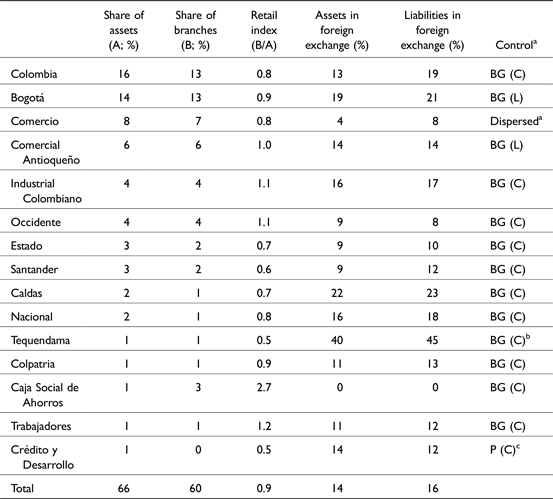
Local banks – that is, those controlled by Colombian nationals and companies since the early 1970s – varied in size, control and retail focus (Table 1). Eleven were controlled by business groups, while two had business groups as large shareholders. Related lending had become an important source of financing for business groups since the 1960s (Rodríguez-Satizabal, Reference Rodríguez-Satizabal2021). As a result, by 1975, 67 per cent of firms affiliated with business groups shared common board members with financial institutions (Rodríguez-Satizabal, Reference Rodríguez-Satizabal2021).
Local private banks in 1980

BG, business group; P, single person; C, controlling shareholder; L, large, but not controlling shareholder.
a Chase Manhattan Bank of New York owned a 34% stake and had one director on the board. The other six directors were shareholders of three investment companies that owned 36% of the bank.
b A Colombian–Venezuelan business group, led by a Colombian family, controlled the bank. Nine of the ten bank branches were in Colombia.
c An individual person owned 90% of the bank.
Sources: Assets: balance sheets, branches: DANE (1981, p. 193), control: Herrera (Reference Herrera1983), Table 2, and Appendix.
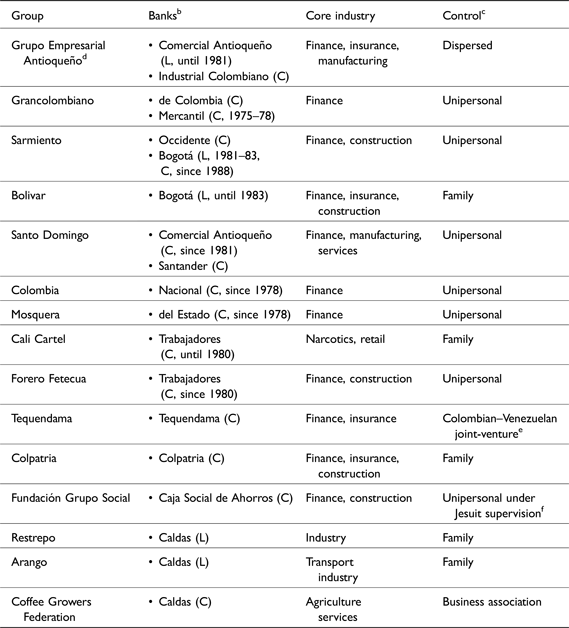
Governance within business groups was heterogeneous (Table 2). For example, Grupo Empresarial Antioqueño was a conglomerate of companies with reciprocal cross-holdings and interlocked boards of directors in which decisions were reached by consensus (Acosta and Londoño, Reference Acosta and Londoño2003; Álvarez, Reference Álvarez and Dávila2003; Londoño, Reference Londoño2004). In contrast, five business groups were controlled by a single person (Table 2).
Private business groups that owned banksa

a A business group is a set of independent firms operating in multiple industries and bound together by persistent formal and informal ties (Khanna and Yafeh, Reference Khanna and Yafeh2007). Colombian Law defined business groups in 1995, after the crisis (Law 222 of 1995).
b C, controlling shareholder; L, large, but not controlling shareholder.
c Dispersed: no single person, family or company has control over the group. Unipersonal: a single person has control over the group. We focus on control rather than nominal ownership. For example, shares of Santo Domingo Group’s companies were owned by multiple members of the Santo Domingo family, but Julio Mario Santo Domingo exercised control.
d Also known at the time as Sindicato Antioqueño. Grupo Empresarial Antioqueño evolved from increasing cross-holdings, interlocking directorates and joint foundations in Antioquia since 1920. Collective decision-making by 12 companies was formalised in 1978. No single person or company controlled the group, although there was a regional perspective on decision-making.
e See footnotes in Table 1.
f The Fundación Grupo Social was founded by the Jesuit order and managed by Adán Londoño, SJ, a member who had ‘considerable influence in naming managers and making decisions’ through his personal relationships with each manager (Dávila et al., Reference Dávila, Dávila, Grisales and Schnarch2014, p. 8).
Sources: Herrera (Reference Herrera1983), Castrillón (Reference Castrillón1983, pp. 15–65), Ogliastri (Reference Ogliastri1990), Rodríguez (Reference Rodríguez1993), Álvarez (Reference Álvarez and Dávila2003), Acosta and Londoño (Reference Acosta and Londoño2003), Londoño (Reference Londoño2004), Rodríguez and Duque (Reference Rodríguez and Duque2008), Reyes (Reference Reyes2012), Dávila et al. (Reference Dávila, Dávila, Grisales and Schnarch2014, pp. 1–9, 73–84, 175), Rodríguez-Satizabal (Reference Rodríguez-Satizabal and Monsalve2014), Rodríguez-Satizabal (Reference Rodríguez-Satizabal2020), Banking Superintendency’s Memorandum 102 of 1983, and primary sources cited in the Appendix.
Since the 1970s, local private banks in Colombia had been establishing overseas subsidiaries, particularly in the Caribbean and Panama (Avella and Caballero-Argáez, Reference Avella and Caballero-Argáez1986, p. 33). Between 1971 and 1982, ten Colombian banks opened subsidiaries in Panama (Caballero-Argáez, Reference Caballero-Argáez1988). Subsidiaries allowed Colombian banks to access international liquidity, circumvent domestic capital-reserve requirements and avoid regulations on foreign exchange transactions (Caballero-Argáez, Reference Caballero-Argáez1988). In fact, the liabilities of the subsidiaries in Panama were often backed by Colombian headquarters, becoming a potential source of currency mis-matches (Avella and Caballero-Argáez, Reference Avella and Caballero-Argáez1986; Álvarez, Reference Álvarez2023). By 1982, Panamanian subsidiaries had intermediated most of the foreign debt owed, directly or indirectly, by Colombian banks (Avella and Caballero-Argáez, Reference Avella and Caballero-Argáez1986, p. 35).
Foreign investors had a minority stake in two banks that we classify as local. Banco del Comercio, with Colombian origins, had Colombian shareholders occupying six out of seven positions on the board – Chase owned 34 per cent of the bank and had just one representative on the board.Footnote 7 Banco Tequendama was owned by Colombian and Venezuelan investors, with Colombians owning a 52 per cent stake.Footnote 8 The bank’s headquarters and nine of its ten branches were in Colombia.Footnote 9
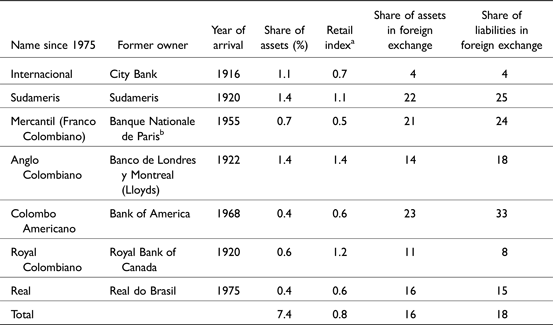
We define a bank as mixed if foreign, non-Andean entities owned more than 50 per cent of the bank in 1975. Foreign-owned banks had operated in Colombia since the early 20th century, when a boom in coffee exports increased the demand for credit by coffee growers and distributors (Table 3). There were seven foreign-owned banks in 1975. These institutions accounted for 7 per cent of assets, 8 per cent of equity, 7 per cent of loans, 8 per cent of deposits and 4 per cent of the branches of the banking system in that year.
Mixed (previously foreign) banks in 1980

a We define the retail index for each bank as its share of branches in the banking system divided by its share of assets in the banking system.
b Opened as a branch that later became a subsidiary of Banque Nationale pour le Commerce et L’industrie (Bonin, Reference Bonin, Cassis and Bussière2005, p. 197).
Sources: Assets and liabilities: balance sheets; branches: DANE (1981, p. 193); arrival: Granados (Reference Granados2019a) and Bonin (Reference Bonin, Cassis and Bussière2005, p. 197).
In 1975, the government adopted a nationalist banking policy to compel domestic ownership of the country’s banks.Footnote 10 To this end, the government created a commission to negotiate with foreign-owned banks their transformation into companies owned by Colombian private nationals, leveraging its authority over the licenses required for banks to operate in Colombia (López Michelsen, Reference López Michelsen1976, pp. xvi–xvii).Footnote 11 Negotiations concluded when six of the seven foreign-owned banks agreed to transform into mixed companies, where Colombian shareholders would own at least 51 per cent of each bank, by 1978 (López Michelsen, Reference López Michelsen1976, pp. xvi–xviii). Since no agreement was reached with the City Bank of New York, the government presented a bill to Congress that resulted in the enactment of Law 55 in 1975, which forced a change in ownership.
Law 55 prohibited new foreign and non-Andean investments in the financial sector. The law also required financial intermediaries to transform into mixed companies – that is, with at least 51 per cent Colombian ownership – by 1976. Foreigners from Andean countries, such as Venezuela, were exempted from this requirement. This transformation from foreign to mixed banks was known at the time as the ‘Colombianisation’ of the banking system.
In six out of the seven banks affected, the Colombianisation process occurred through the sale of stocks from foreign banks to Colombian nationals. Crucially, these stocks were not sold to other banks or financial groups, but rather, to individuals and companies connected to the real sector (Herrera, Reference Herrera1983). In fact, foreign banks remained the largest shareholders, even though their stake was less than 49 per cent (Herrera, Reference Herrera1983). The only exception to this ownership structure was Banco Franco Colombiano, which was renamed Banco Mercantil in 1978. Banque Nationale de Paris and its subsidiaries owned 80 per cent of the bank in 1975,Footnote 12 but their participation fell to 52 per cent after the Grancolombiano financial group acquired 48 per cent of the shares that same year. Ownership remained split until 1978, when an industrialist acquired a 55 per cent stake that reached 91 per cent by 1983.Footnote 13 Banco Provincial, a Venezuelan bank partially owned by Credit Lyonnais, maintained a minority 8 per cent stake since 1979.Footnote 14
As shown by the retail index in Table 3, mixed banks primarily focused on the corporate market – a pattern also observed among several local banks in Table 1.Footnote 15 Some mixed banks were also involved in consumer banking, with retail indexes well above 1. For example, Banco Royal Colombiano, formerly the Royal Bank of Canada, had a branch in Corabastos, the largest wholesale perishable food market in Bogotá.Footnote 16 Corporate customers of mixed banks were both local and foreign. Banco Internacional, formerly City Bank, described its market segment as follows: ‘Multinational and local corporations that need sophisticated banking services, both international and local’.Footnote 17
3. The banking crisis of the 1980s
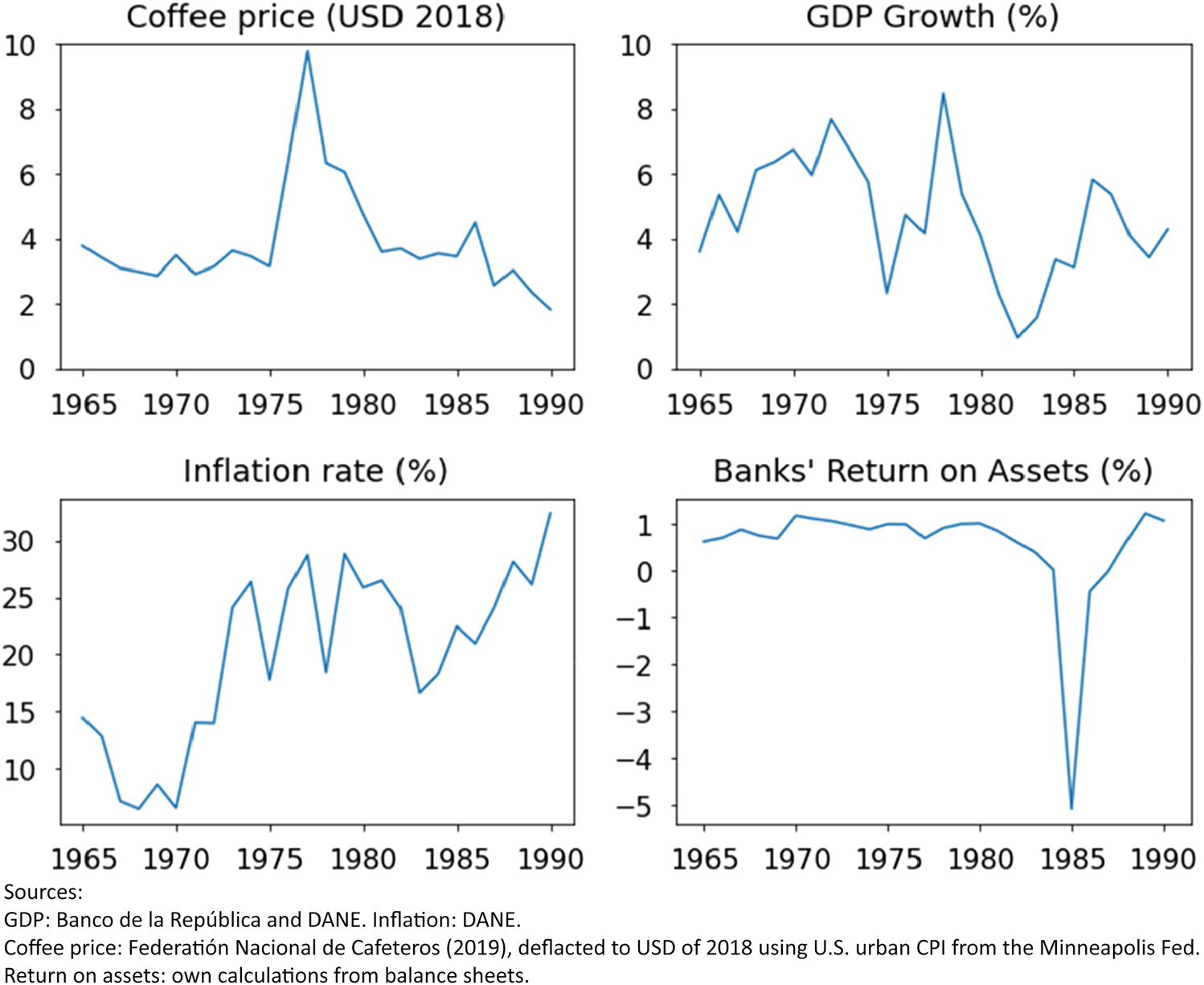
Colombia experienced an economic boom in 1976 due to a rise in the price of coffee, the main Colombian export (Figure 1).Footnote 18 The increase in exports led to economic growth, foreign exchange inflows and higher foreign exchange reserves at the central bank. This economic boom reinforced the high inflation rate that Colombia had experienced throughout the 1970s (Figure 1). In contrast to these macroeconomic variations, the banks’ ROAs did not experience major changes in the aggregate during the 1970s (Figure 1).
Macroeconomic indicators and ROA for the banking sector.

Policymakers attempted to control inflation and exchange rate appreciation by raising the marginal reserve requirements on checking accounts to 100 per cent, increasing the average reserve requirements on other liabilities, imposing new controls to foreign indebtedness and expanding existing interest rate controls (Garay et al., Reference Garay, Quintero, Villamil, Tovar, Fatat, Gómez, Restrepo and Yemail1998, p. 40; Ocampo, Reference Ocampo2015, pp. 70–80). These measures were implemented in addition to previously existing regulations that increased lending costs, such as forced investments in central bank bonds that were a fixed share of bank loans (Caballero-Argáez, Reference Caballero-Argáez1988).
These regulations reduced the profitability of borrowing and lending money through standard channels. While savers and borrowers responded by using informal financial channels, banks reacted by adopting new financial instruments and practices that enabled them to elude the new regulations, such as opening subsidiaries overseas (Ortega, Reference Ortega and Caballero-Argáez1979; Avella and Caballero-Argáez, Reference Avella and Caballero-Argáez1986, pp. 33–35; Villegas, Reference Villegas1990, p. 14).
In the early 1980s, two factors reduced economic growth. First, the price of coffee fell 63 per cent in real terms between 1977 and 1981 (Figure 1). Second, international interest rates increased in response to U.S. monetary policy and debt defaults in other Latin American countries (Caballero-Argáez, Reference Caballero-Argáez2019; Luzardo-Luna, Reference Luzardo-Luna2019, p. 110; Hernández and López, Reference Hernández, López and Hsu2023). GDP growth in 1982 was a meagre 1 per cent – much lower than the 8 per cent growth rate experienced in 1977. Low economic growth reduced the ability of companies and households to service their debts, worsening loan portfolio quality and lowering bank revenues. A banking crisis ensued.
The first bank to fail was Banco Nacional in 1981. The government seized the bank and forced its liquidation on grounds of insolvency.Footnote 19 That same year, the government bailed out and nationalised Banco del Estado.Footnote 20 Four more banks, including the largest one, were bailed out and nationalised in 1986 and 1987.Footnote 21 By the end of the crisis in 1987, the government had nationalised 29 per cent of the assets held by the banking system in 1980. Yet, bank performance during the crisis varied widely. We propose a tunnelling mechanism to explain this heterogeneity.
4. Mechanism
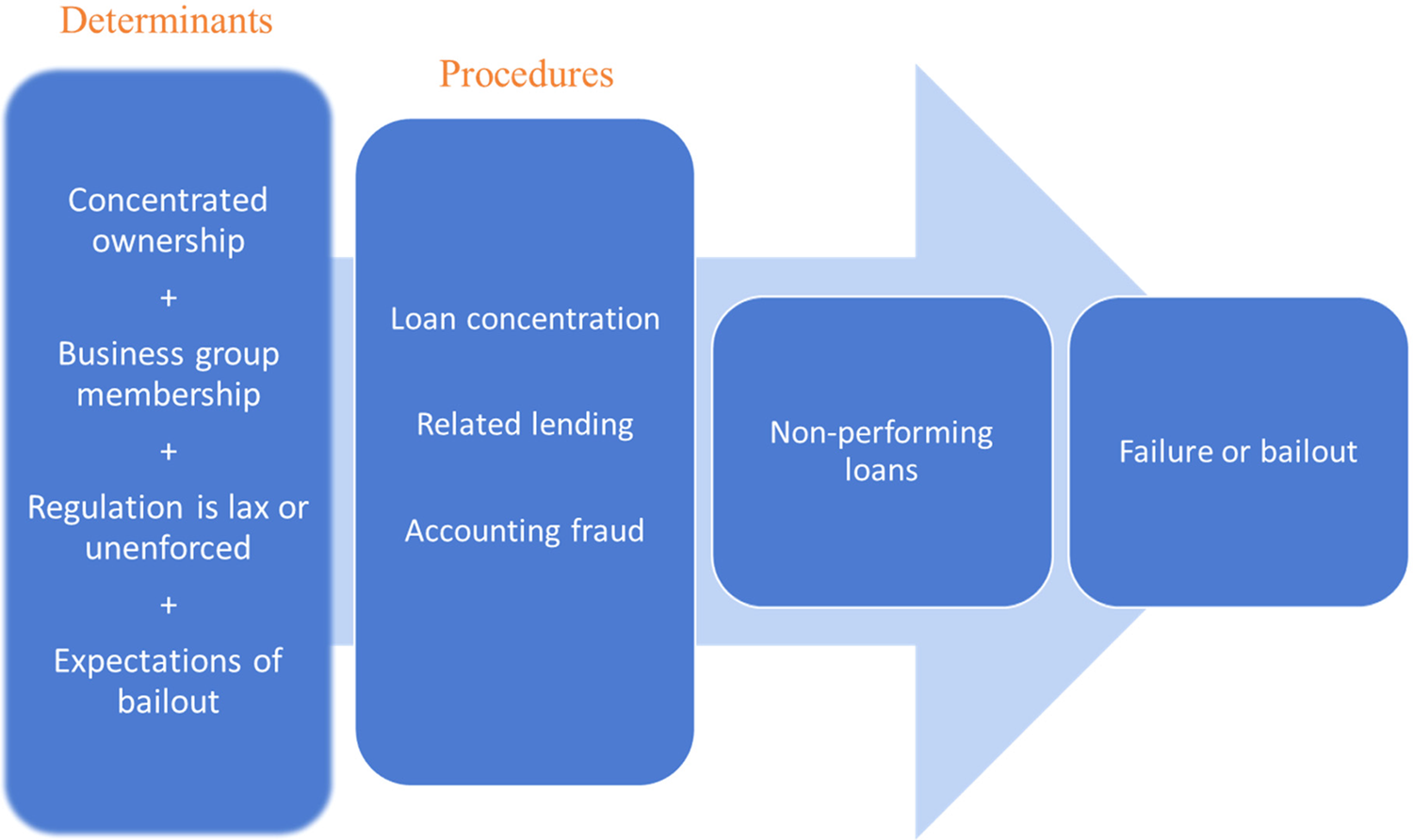
Figure 2 summarises our proposed mechanism for the crisis. Power concentration in banks and business groups, combined with lax and unenforced prudential regulations, enables tunnelling from depositors and taxpayers to bank owners. Such tunnelling is more likely to occur if bank owners have reasonable expectations of a bailout – for example, if bank owners have political connections. Tunnelling can occur through loan concentration on shareholders and accounting fraud. These practices undermine loan portfolio quality, particularly when interest rates rise and economic activity slows, ultimately leading to bank failures or bailouts.
Mechanism for tunnelling.

5. Evidence for the mechanism
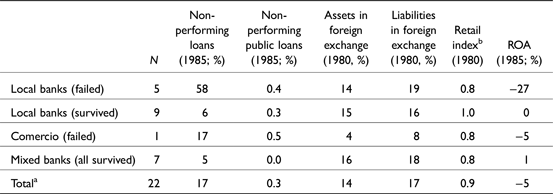
We provide evidence of this mechanism by comparing three types of banks and business groups: banks and business groups that failed during the crisis, banks and business groups that survived the crisis and mixed (previously foreign) banks. In Table 4, we present indicators for four potential factors related to the crisis: retail focus, currency mis-match, government debt and loan portfolio quality. We compare these variables across bank categories, leaving Banco del Comercio as a separate category because Chase, a foreign conglomerate, was a minority but large shareholder in the bank.
Potential mediator variables of the crisis

a Excluding public and parastatal banks.
b Share of branches/Share of assets.
Data for 1985 does not include Banco Nacional and Banco del Estado, which failed in 1982.
Source: Own calculations from balance sheets.
The most significant difference across bank categories is, by far, the share of non-performing loans (column 3, Table 4). Local banks that failed after 1985 had 58 per cent of loans non-performing in that year.Footnote 22 The same indicator was 6 per cent for local banks that survived the crisis and 5 per cent for mixed banks, all of which survived the crisis. We now show that other potential mediators of the crisis are not as important as non-performing loans.
Exposure to government debt was not an issue by 1985, as the ratio of non-performing public loans to assets was less than 0.8 per cent for every bank (column 4, Table 4). A single public institution, IDEMA, had been responsible for 13 per cent of non-performing debt in 1984 (Palacios, Reference Palacios1985).Footnote 23 However, the government took out a foreign loan in 1985 through local and international banks in order to pay for IDEMA’s debt (Palacios, Reference Palacios1985).
Currency mis-match was larger for failing banks than for surviving banks (columns 5 and 6, Table 4). This difference comes mostly from the largest bank: Banco de Colombia used its Panamanian subsidiary to tunnel resources towards its controlling business group by issuing loans that were not repaid (see section 5 and the Appendix). Retail focus was slightly larger for surviving local banks than for failing banks and mixed banks, which is consistent with failing banks lending to their shareholders, and mixed banks facilitating international trade (column 7, Table 4).
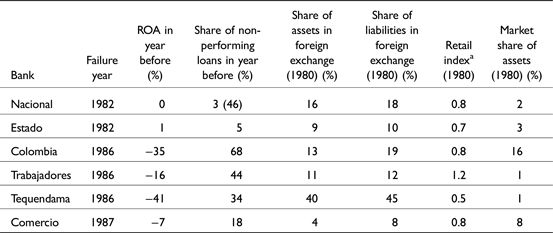
Table 5 repeats the analysis for each bank that failed during the crisis, including the banks that failed before 1985. Non-performing loans were above 18 per cent of total loans for five of the six banks that failed during the crisis (column 4). The financial statements for the remaining bank, Banco del Estado, were never approved by regulators and hence are unreliable.
Banks liquidated or bailed out during the crisis

Every bank included in this table engaged in accounting fraud, earnings overreporting and underreporting of non-performing loans before regulators took control. Financial reports were particularly unreliable for Banco Nacional and Banco del Estado because their statements were not audited by regulators before 1982. Banco Nacional reported 3% of non-performing loans, even though the actual ratio was 46%. The financial statements by Banco del Estado were later rejected by regulators due to ‘delays’, ‘irregularities’ and ‘failures’. See the Appendix for details.
a Share of branches/Share of assets.
Source: Own calculations from balance sheets and DANE (1981).
Currency mis-match was a smaller factor in bank failure than non-performing loans. In total, 45 per cent of the liabilities and 40 per cent of the assets of Banco Tequendama were in foreign currency due to the bank’s Venezuelan branch. Non-performing loans, 34 per cent of the loan portfolio in 1985, were a larger issue for the bank. However, currency mis-match was important for Banco de Colombia, as foreign exchange represented 19 per cent of liabilities and 13 per cent of assets in 1980. Currency mis-match itself was a consequence of tunnelling; when the crisis started, the bank used its subsidiary in Panama to bail out investment funds and companies managed by its business group. Later, the headquarters in Colombia had to bail out the Panamanian subsidiary. As a result, the headquarters’ share of liabilities in foreign exchange increased to 51 per cent in 1985. That same year, 64 per cent of the bank’s loan portfolio was non-performing.Footnote 24
Having established that non-performing loans were the primary mediator of the banking crisis, we now argue that tunnelling was the main mechanism for non-performing loans. We start by showing that banking regulation evolved in response to the mechanism described in Figure 2.
5.1. Regulatory change
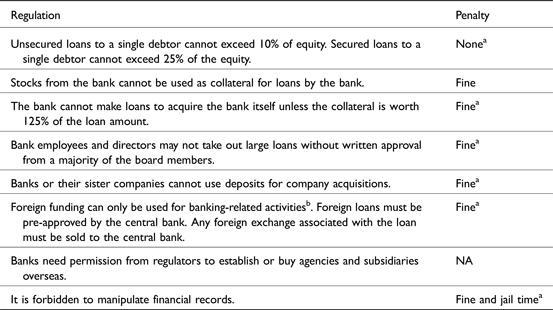
Prior to the crisis, tunnelling regulations focused on loan concentration, related lending, bookkeeping and foreign loans (Table 6). Loans to employees and bank directors were limited to 25 per cent of the bank’s equity. Foreign loans had to be pre-approved by the central bank, which mainly sanctioned loans to finance foreign trade (Avella and Caballero-Argáez, Reference Avella and Caballero-Argáez1986, pp. 7, II.2). Directors, employees and banks themselves faced fines for violating regulations. Additionally, the banking superintendent could, at their discretion, take control of banks that persistently failed to comply with the regulations.Footnote 25
Regulations before the crisis

a If the violation is persistent, regulators can discretionally take control of the bank (Law 45 of 1923, art. 48). In addition, directors and executives are personally liable for losses incurred by third parties as a result of knowingly violating regulations (Law 57 of 1931, art. 5).
b In Spanish: ‘para los fines propios de su actividad’. In the context of foreign exchange regulations, ‘banking purposes’ was usually interpreted as financing foreign trade; nevertheless, the term was ambiguous and open to controversy at the time (Avella and Caballero-Argáez, Reference Avella and Caballero-Argáez1986, p. II.2).
Sources: Law 45 of 1923, Law 57 of 1931, Decree 3233 of 1965, Decree 444 of 1967, Decree 2388 of 1976, Decree 410 of 1971 and Decree 100 of 1980. Cancino (Reference Cancino1979) provides a detailed explanation of most of these regulations.
In practice, regulatory enforcement was discretionary and lax. From 1978 to 1982, the Banking Superintendency failed to properly enforce rules on lending, bookkeeping and reserves.Footnote 26 After leaving office, the former superintendent defended this inaction by arguing that both intervention and its timing were discretionary.Footnote 27 For example, the superintendent allowed Banco Nacional to acquire bank stocks in the United States, despite both regulatory restrictions and the objections of his subordinates. Furthermore, the Superintendency’s employees in charge of monitoring Banco del Estado had received loans from the same bank – a conflict of interest.Footnote 28
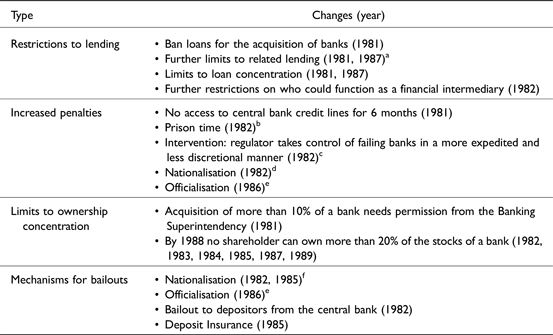
The government responded to early signs of the banking crisis by implementing stricter prudential regulations since 1981; these regulations became tougher as the crisis worsened (Table 7).
Regulations implemented during the crisis

a Since 1981, loans to shareholders who control more than 10% of the bank’s stocks need the board’s unanimous approval. These loans were completely forbidden in 1987.
b For directors and employees responsible for using the public’s deposits for acquiring companies, violating limits to related lending, or acting as financial intermediaries without a permit. Hernández (Reference Hernández2000) explains these penalties in detail.
c Intervention: the regulator takes control, not the bank’s ownership.
d Nationalisation: the government injects equity in the bank, diluting the current shareholders’ stake. The nationalisation process involved the government’s takeover of the bank’s administration and the suspension of dividend payments. In addition to diluting the existing shareholders’ stake, the government was allowed to buy the bank from existing shareholders before injecting equity. Decree 2920 of 1982, chapter 2.
e Officialisation: a nationalisation process that reduces share prices to their nominal value preventing existing shareholders from receiving any financial gain from the infusion of capital. If the bank’s cumulative losses exceed shareholders’ equity, the share prices are reduced to one cent.
Sources: Decree 3604 of 1981, decrees 2216, 2527, 2920 and 3227 of 1982, resolutions 39, 42 and 47 of 1982, resolutions 42, 55 and 61 of 1983, law 117 of 1985, decree 35 of 1985, decrees 32 and 2476 of 1986, decrees 356, 415 and 365 of 1987, resolution 14 of 1988. All resolutions are from the central bank.
Consistent with efforts to curb tunnelling through related lending, the government imposed new restrictions on loan usage, loan concentration and related lending itself. More significantly, violators of financial regulations faced stricter penalties, including prison time.
Consistent with efforts to curb tunnelling enabled by power concentration within banks, the government limited ownership concentration (Table 7). Decree 3227 of 1982 mandated that by 1988 no shareholder could own more than 20 per cent of a bank’s shares. As planned, shareholdings would be reduced through public offerings financed by a credit line from the central bank.Footnote 29 If the original shareholders transferred their stocks to a trust, the central bank would pay 80 per cent of the stock prices in advance. After the advance payment, the actual sale of stocks could take up to 7 years.Footnote 30 In practice, the reduction in ownership concentration never materialised: the deadlines for meeting ownership caps were postponed in 1984, 1985 and 1987; the caps were ultimately lifted in 1989.Footnote 31
Consistent with efforts to curb tunnelling facilitated by bailout expectations, the government introduced new mechanisms to shield depositors without bailing out bank owners. The main mechanism was the nationalisation of failing banks, which was implemented in 1982 by injecting equity in distressed banks until it diluted the current shareholders’ stake. After 1985, congress enacted a new nationalisation process, known as officialisation, which guaranteed that shareholders lost their stake in the bank and, hence, did not benefit from the bailout. Congress also created FOGAFIN, an institution in charge of providing deposit insurance and administering the banks nationalised by the government.
5.2. Banks that failed during the crisis
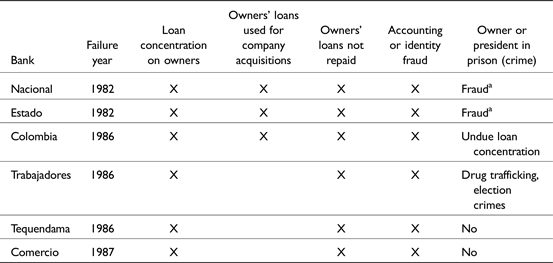
Non-performing loans resulted from practices that transferred assets and profits out of local banks for the benefit of their controlling shareholders, that is, tunnelling. Table 8 lists the practices undertaken by each bank and its owners, as described in the Appendix.
Tunnelling practices by failing banksFootnote 34

a Before 1982, violating regulations on related lending was only punished with fines rather than prison time.
Sources: Explanatory memorandum for Resolución 3259 de 1982, Banking Superintendency. Resolución 5387 de 1982. Resolución Ejecutiva 203 de 1982. Sentencia 1443 del Consejo de Estado, 1995. Decisión sobre recurso de casación. Supreme Court, Sala Civil, expediente 4370, 1995. La Comisión Nacional de Valores y sus actuaciones frente al Grupo Grancolombiano, Comisión Nacional de Valores, 1986. Supreme Court, Sala de Casación Penal, Decisión sobre recurso de casación. Delito: Concentración indebida de créditos. Radicado 6114, 1992. Letter DAB-0780 from the Banking Superintendency’s first delegate to the FOGAFIN chair, 1986. Resolución 12 de 1986. Letter DAB-0570 from the Banking Superintendency’s first delegate to the director de FOGAFIN, 1986. Informe de Labores. Banking Superintendency, 1987. Statement by the FOGAFIN chair during a House of Representatives debate, 10–30 August 1988, cited by Child and Arango (Reference Child and Arango1988, p. 267). Banks’ Annual Reports. Newspaper articles cited in the Appendix. Castrillón (Reference Castrillón1983, pp. 56, 61–63, 65), Donadio (Reference Donadio1983, pp. 18–20, 33, 35, 39–79, 83, 128–129), Echavarría (Reference Echavarría1983, pp. 5–34, 245–270), Donadio (Reference Donadio1984, pp. 20, 65), Lernoux (Reference Lernoux1984, pp. 138–139), Misas (Reference Misas, Misas and Avella1987), Caballero Argáez (Reference Caballero-Argáez1988), Ordóñez (Reference Ordoñez1989, pp. 25–26, 154–155), Superintendencia de Sociedades (2012, p. 26) and Rodríguez Olarte (Reference Rodríguez Olarte2013).
Accounting or identity fraud occurred at every failed bank. In addition, at every failed bank, the loan portfolio was concentrated on owners, board members or their companies.Footnote 32 Before the regulatory reforms of 1982, these loans were often used for company acquisitions. Eventually, insider loans went unpaid, leading to bank failure.
Before 1982, violating regulations on related lending was not a crime; some bank owners and executives were eventually sent to prison because of fraud, but only received fines for concentrating loans on shareholders. After 1982, significant breaches of regulations on related lending, loan concentration and deposit usage became criminal offences – ‘Undue loan concentration’ became a specific criminal offense, leading to the imprisonment of Banco de Colombia’s owners and executives.Footnote 33 The owners of Banco de los Trabajadores were sent to prison on different charges: drug trafficking and election-related crimes. The president of Banco del Comercio was fined, but not sent to prison, for approving larger and riskier loans than regulations allowed.
Power concentration was the main factor enabling tunnelling at failed banks. As shown in Tables 1 and 2 and the Appendix, four of the six banks were part of a business group that was in turn controlled by a single person (Nacional, Estado, Colombia and Trabajadores). Banco Tequendama was a joint venture of Colombian and Venezuelan families, with the Colombian family owning 52 per cent of the bank.
Banco del Comercio is a partial exception to the pattern described above, as power concentration was lower: 35 per cent of the bank was under the control of Chase Manhattan Bank and 36 per cent was under the control of three companies with five shareholders in common, including the Chase Manhattan Bank representative (Herrera, Reference Herrera1983). Nevertheless, the bank had been a local private bank for 19 years before Chase acquired its stake (Granados, Reference Granados2019b). As a minority shareholder, Chase had to adapt to existing governance regulations. For example, when a whistle-blower denounced the loan concentration and corruption at Banco del Comercio in a U.S. court, the judge concluded that lending money to members of the board ‘might be something that Chase has to accept given the customs and practices [of Colombia] and the needs of doing business overseas’.Footnote 35 Unlike the rogue trader at the Lugano branch of Lloyds bank in 1974 studied by Schenk (Reference Schenk2017), the single Chase representative was not an isolated case within Banco del Comercio; rather, he was colluding with the Colombian members of the board. In fact, all board directors, including the representative of Chase, were equity partners at companies that received loans from the bank (see appendix for details).
Bailout expectations most likely played a role in prompting tunnelling at Banco de Colombia, Banco del Comercio and Banco Tequendama. Banco de Colombia, with 16 per cent of assets in the banking system, was probably considered too big to fail. Furthermore, the bank had strong links with the government, as the bank president was the cousin of the president of Colombia between 1974 and 1978, and the superintendent of companies was the son of an important director at Grupo Grancolombiano (Echavarría, Reference Echavarría1983, pp. 245–270). Likely as a result, the government prevented regulators from informing the public of improper transactions at the bank’s business group, even though regulators had detected such practices since 1980 (Echavarría, Reference Echavarría1983, pp. 5–34, 245–270). Banco del Comercio also had political connections, as a former board director was a high-ranking government official. This relationship possibly enabled a bailout attempt through toxic asset acquisitions in 1987, which failed due to pressure from Congress and the press.Footnote 36 Banco Tequendama was indirectly bailed out in 1984 through loans rediscounted by the central bank (Misas, Reference Misas, Misas and Avella1987).
In contrast, bailout expectations were likely non-existent at Banco Nacional, Banco del Estado and Banco de los Trabajadores. The owners of Banco Nacional and Banco de los Trabajadores were outsiders to the political and financial elite. The owner of Banco del Estado was part of a regional elite but had been raised overseas and was not well-connected with the national elite. In fact, commentators at the time partially attributed the start of the crisis to the inexperienced management at Banco Nacional, which was the first bank to fail (Montenegro, Reference Montenegro1983).
5.3. Local banks that survived the crisis
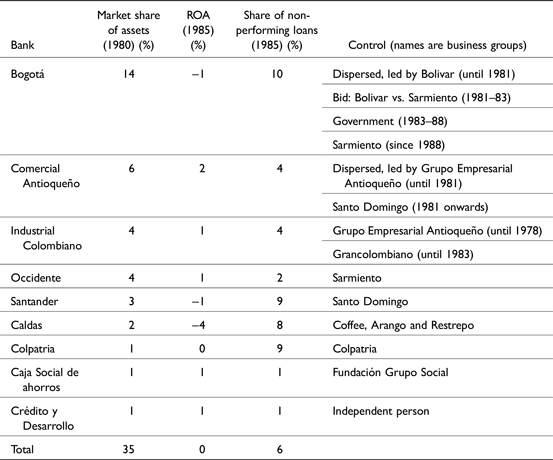
Of the 15 local private banks, nine survived the crisis (Table 9). The performance of the surviving banks was heterogeneous in a manner consistent with our proposed mechanism. The best-performing banks shared one or more of the following characteristics: (i) fragmented shareholdings, (ii) independent owners, (iii) affiliation with business groups that had fragmented control or (iv) affiliation with business groups that controlled companies with large revenue or financing streams (Table 9). In the latter case, these companies served as an alternative source of resources for the group. Such is the case of the Bolívar, Sarmiento and Santo Domingo groups discussed below.

The Bolívar and Sarmiento groups competed for the control of the largest surviving bank, Banco de Bogota, during the 1980s. Shareholdings of the bank were dispersed in 1979 – the largest shareholder, the Bolívar business group, had a stake of 15 per cent (Eslava, Reference Eslava1985, p. 380). Consistent with ownership dispersion, only 1 per cent of the bank portfolio was non-performing in 1979 – this percentage is lower than the banking sector’s average for that year.
Ownership concentration increased as the two financial groups competed in the stock market to control the Banco de Bogotá. The Sarmiento business group funded share acquisitions with surpluses from construction companies and cash from selling off other companies (Montenegro, Reference Montenegro2009, p. 154). The Bolívar business group financed share acquisitions through a loan from its own cement company, which was already under financial stress and was a debtor to the bank.Footnote 37 The group also used an international loan to fund share acquisitions, even though regulators had approved the loan for a mining project (Misas, Reference Misas, Misas and Avella1987). Hence, both groups had access to alternative sources of financing or tunnelling.
As a result of the bid, the share price of Banco de Bogotá increased from 50 pesos to 500 pesos in 1981 (Montenegro, Reference Montenegro2009, p. 155). By then, the groups owned 74 per cent of the bank, but none had obtained a controlling stake (Eslava, Reference Eslava1985, p. 381). Both groups were on the brink of a liquidity crisis. In our proposed mechanism, such risky conduct is more likely if business groups can expect a bailout.
Indeed, both business groups were eventually bailed out by the government. Specifically, both groups entrusted their shares to Banco Cafetero, a parastatal bank (Eslava, Reference Eslava1985, p. 382; Montenegro, Reference Montenegro2009, p. 160).Footnote 38 The central bank funded advance payments of 93 of 150 pesos per share, alleviating the liquidity problems (Eslava, Reference Eslava1985, p. 382). This procedure had been created in 1982 to decrease ownership concentration in the banking sector (Table 7). Instead, the procedure allowed further concentration in this case: in 1988, after the financial crisis had ended and regulatory caps on ownership concentration had been postponed, the Sarmiento group acquired the stocks from the trust, taking control of Banco de Bogotá (Montenegro, Reference Montenegro2009, p. 161).
Ultimately, the government also intervened to bail out the bank. Bolívar’s cement company suspended debt payments to Banco de Bogotá in 1984, raising the bank’s non-performing loan ratio to 10 per cent in 1985 – the largest among the banks that eventually survived the crisis.Footnote 39 Banco de Bogotá received a controlling stake in the company as a repayment in 1986, but this repayment did not bring liquidity to the bank. To keep the bank afloat, both business groups provided loans that were later rediscounted by the central bank, resulting in an indirect bailout (Montenegro, Reference Montenegro2009, p. 160).
The best performer in Table 3, Banco Comercial Antioqueño, also illustrates our mechanism. The bank’s good performance during the crisis is consistent with its fragmented shareholdings until 1981.Footnote 40 In that year, the Santo Domingo group made a hostile takeover of the bank.Footnote 41 The group, controlled single-handedly by Julio Mario Santo Domingo, funded most of the takeover through two companies: Colinsa – a holding – and Bavaria – the core company of the group, a beer near-monopoly with cash surpluses from increasing profits and debt, including debt from companies under its control (Junguito, Reference Junguito1980, pp. IX.31–X.36; Ogliastri, Reference Ogliastri1990, p. 34). Like the Sarmiento and Bolivar groups, the Santodomingo group had access to alternative sources of financing.
In 1982, the Santo Domingo group tried to sell the bank to the Mosquera group, owner of Banco del Estado. The sale occurred in two steps. First, Bavaria sold its stock to Colinsa at 170 pesos per share. Secondly, Colinsa sold its stock to Mosquera at 60 pesos, losing 110 pesos per share in a week.Footnote 42 Regulators reversed the sale after nationalising Banco del Estado that same year.Footnote 43 Regulators discovered that Mosquera had deposited 110 pesos per share into a Swiss bank – the same amount lost by Colinsa. Since such a transaction was against foreign exchange regulations, several Mosquera group executives were fined. Nevertheless, despite multiple testimonies linking the transaction to the Santo Domingo group, the regulators ruled that there was insufficient evidence to link the transaction to Santo Domingo.Footnote 44 A ruling in the opposite direction would have implied that Santo Domingo had tunnelled resources from Colinsa, to the detriment of taxpayers and minority shareholders.
Multiple journalists denounced at the time that regulators were subjected to undue pressures to prevent a ruling against Santo Domingo, with whom the government had strong links (Reyes, Reference Reyes2012, pp. 218–240, 248). Most notably, the government replaced the head regulator of the case on the day she called a press conference to announce her ruling, after 2 years of investigations.Footnote 45 Three days later, her replacement exonerated Santo Domingo.
In summary, the conduct and performance of the surviving banks were consistent with our proposed mechanism. An exception is Caja Social de Ahorros, which performed well during the crisis despite being controlled by a business group with considerable political influence (Dávila et al., Reference Dávila, Dávila, Grisales and Schnarch2014, pp. 1–9, 73–84). At the time, the Jesuit Order indirectly controlled Caja Social de Ahorros through their Fundación Grupo Social. The goal of Fundación Grupo Social was to promote the common good principles of the Catholic Social Doctrine, rather than prioritising individual profits (Dávila et al., Reference Dávila, Dávila, Grisales and Schnarch2014, pp. 1–9, 30–75).Footnote 46 Since our theoretical framework does not include corporate social responsibility as a motivation for businessmen and entrepreneurs, our framework does not apply to Caja Social de Ahorros.
5.4. Mixed (previously foreign) banks
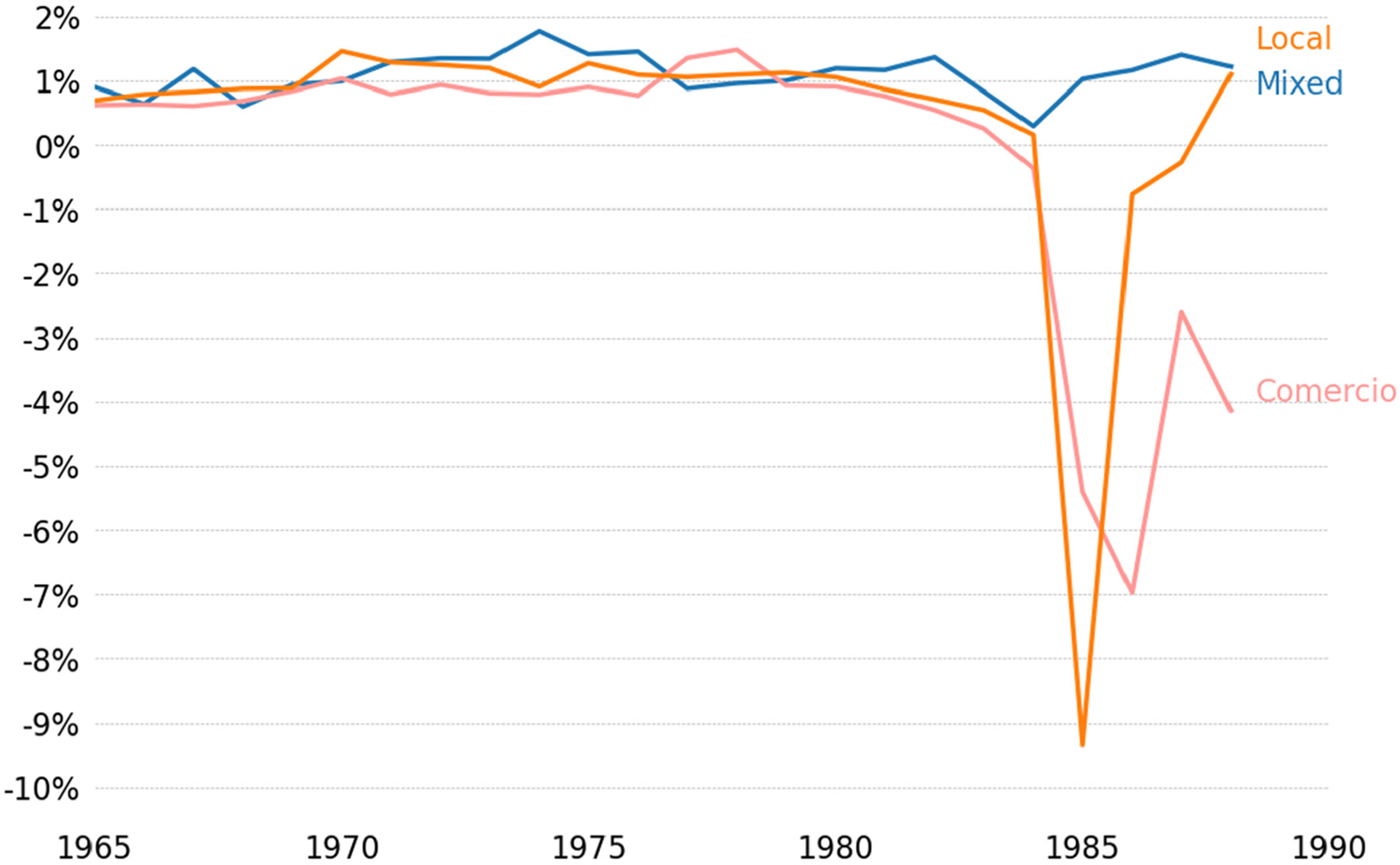
No mixed (previously foreign) bank was liquidated or nationalised during the banking crisis. In this section, we compare the conduct and performance of mixed banks to that of local private banks. Figure 3 shows the ROA ratio of mixed and local banks, with Banco del Comercio as a separate category. Before the crisis, in 1980, the ROA was nearly 1 per cent for all bank categories. In the middle of the crisis, in 1985, the ROA was 1 per cent for foreign-owned banks, −5 per cent for Banco del Comercio and −10 per cent for local banks. As a share of equity, returns were 13 per cent for foreign-owned banks, −57 per cent for Banco del Comercio and −125 per cent for local banks. In other words, losses were greater than equity for Banco del Comercio and for local private banks.
ROAs by bank type. Net income/assets. Comercio, Banco del Comercio. Source: own calculations from balance sheets.

We use a difference-in-differences strategy at the bank level to quantify the differential performance of mixed banks during the crisis. A standard assumption of the difference-in-differences approach – the parallel trends’ assumption – is that differences in performance would have remained constant had the crisis not occurred. While it is not possible to formally test this assumption, Figure 3 suggests that the assumption holds as pre-existing trends do not explain the gap between local private banks and foreign-owned banks during the crisis. For our estimation, we use an event study specification at the bank-year level:

where ROA it is the return on assets for bank i in year t, η i is a fixed effect by bank, γ t is a fixed effect by year and Local i takes the value of 1 if the bank is local and zero if the bank was mixed – that is, foreign-owned before the Colombianisation of 1975. In our robustness tests, we include Banco del Comercio as a separate category. The base category of our estimation consists of mixed banks. Our base year is 1980 because the system’s ROA began to decrease in 1981 (Figures 1 and 3). Our difference-in-differences coefficient is β t: the difference in performance between local banks and mixed banks in that year relative to the difference before the crisis.
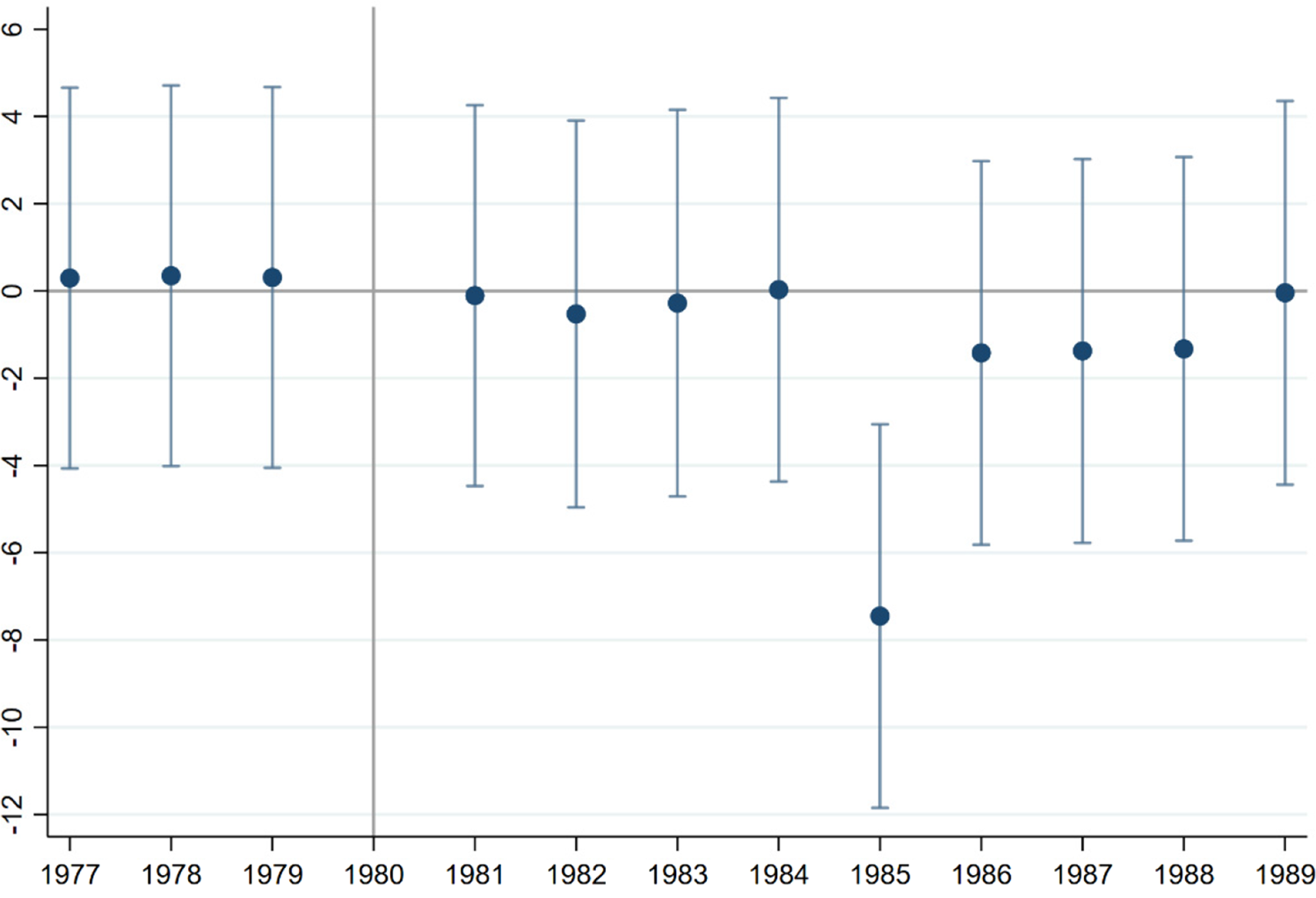
Figure 4 shows our difference-in-differences estimates (β t). On average, the ROA fell 8 percentage points more for local banks than for mixed banks in 1985. Figures 3 and 4 show that the crisis had the largest impact on balance sheets in 1985, once the government had strengthened regulation and supervision, forcing banks to write off loans that had been non-performing since the start of the crisis. This result is surprising because the government liquidated Banco Nacional in 1982, nationalised Banco del Estado in 1982 and seized Banco de Colombia in 1983. Indeed, all three banks reported profits in 1981, whereas Banco de Colombia reported profits in 1982 and 1983. The lack of effects before 1985 shown in Figure 4 is further evidence of the accounting tricks and fraudulent transactions that plagued the balance sheets of failing banks before the government interventions and regulatory changes in 1982 and 1983. For the remainder of this section, we focus on 1985.
Difference-in-differences estimates. ROAs. Each point is the difference-in-differences coefficient for local banks each year, relative to foreign banks. The base year is 1980. 95% confidence intervals.

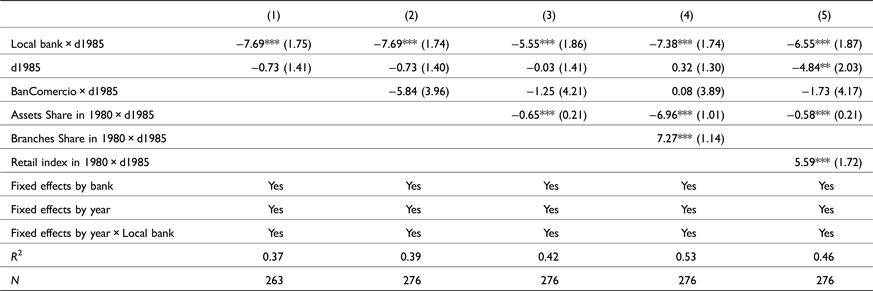
Table 10 presents robustness checks for the results displayed in Figure 4. While we include separate coefficients for every year between 1981 and 1989, the table only shows the 1985 coefficients. Column 1 uses the same specification as Figure 4, but pooling 1977–80 as a single pre-treatment period and excluding Banco del Comercio from the sample. Column 2 includes Banco del Comercio as a separate category. Column 3 uses market share by assets in 1980 to control for the smaller size of foreign-owned banks. Column 4 uses market share by branches in 1980 to control for retail focus. Column 5 uses our retail index – the ratio between the market shares of branches and assets – as an alternative control for retail focus. Regardless of specifications, the differential effect of the crisis in local banks is still large and statistically significant: the ROA fell, on average, 7 percentage points more for local banks than for mixed banks.
Difference-in-differences estimation on ROAs

Notes: Standard errors in parentheses. The base category is foreign hanks between 1977 and 1980. Retail index = Branches share/Assets share.
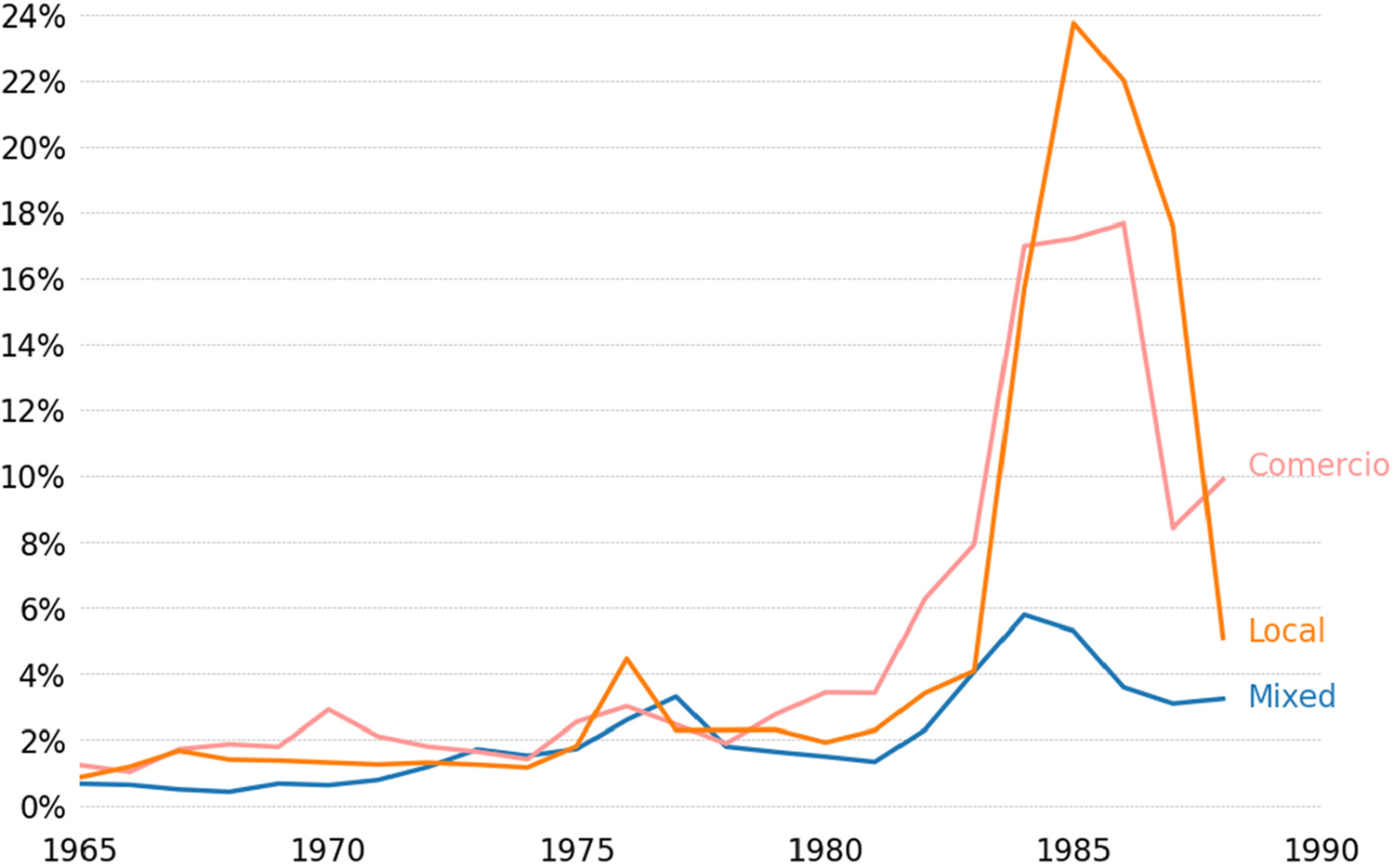
The difference in performance between mixed and local banks was driven by non-performing loans. Figure 5 shows the share of non-performing loans by bank category. In 1985, the share of non-performing loans was 5 per cent for foreign-owned banks and 24 per cent for local banks.
Share of non-performing loans. Non-performing loans/Total loans. Comercio, Banco del Comercio. Last year is 1988 because accounting rules changed in 1989. Source: own calculations from balance sheets.

We do not claim that foreign banks are intrinsically virtuous relative to local banks. Indeed, the practices of Mosquera at Banco del Estado were likely a replica of similar practices in World Finance Corporation, a U.S.-based company where he had worked in the 1970s (see Appendix for details). Furthermore, foreign banks overlent to Latin American governments during the 1970s, partially because they expected their home governments or the International Monetary Fund to bailout their borrowers in the event of a macroeconomic crisis (Devlin, Reference Devlin1989; Altamura and Zendejas, Reference Altamura and Zendejas2020).
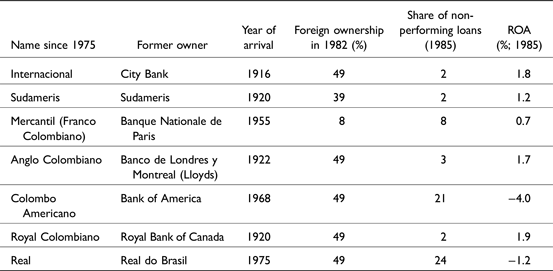
Instead, we propose four explanations for the lack of tunnelling practices among foreign-owned banks in Colombia, relative to local banks. First, foreign banks had transferred practices and technologies to their Colombian subsidiaries. Banco Internacional was still using Citibank’s credit handbooks in 1981, 6 years after Colombianisation. Banco Mercantil had a cooperation agreement with Credit Lyonnais that included ‘advice on banking techniques’ and a programme to ‘change the management of information systems within the bank’ in 1979.Footnote 47 Insofar as these imported practices replaced discretion with rules, or facilitated the implementation of rules through better information, they may have reduced tunnelling. This explanation is consistent with the literature’s finding that foreign banks use design contracts and score credits to overcome their lack of familiarity with local institutions and firms (Dell’Ariccia et al., Reference Dell’Ariccia, Friedman and Marquez1999; Stein, Reference Stein2002; Sengupta, Reference Sengupta2007; Beck et al., Reference Beck, Ioannidou and Schäfer2018). In fact, recent arrivals to the Colombian market performed poorly during the crisis (Table 11). The best performers had time to import banking practices, grow in the Colombian market and build a diversified loan portfolio before the implementation of Colombianisation and the start of the banking crisis.
Performance of mixed banks during the crisis

Sources: assets and liabilities: balance sheets; arrival: Granados (Reference Granados2019a) and Bonin (Reference Bonin, Cassis and Bussière2005, p. 197); ownership: Herrera (Reference Herrera1983).
Our second explanation is consistent with the proposed mechanism for the crisis: ownership was dispersed at mixed banks. After Colombianisation, most foreign banks remained the largest shareholders although their stake was less than 49 per cent (Table 11). Hence, the largest shareholders had less decision-making power within foreign-owned banks than within failed local banks.
The only mixed bank with concentrated ownership was Banco Mercantil, where a Colombian industrialist acquired a 55 per cent stake in 1978 that grew to 92 per cent in 1983.Footnote 48 Concurrently, the ratio of non-performing loans increased from 2 per cent in 1979 to 10 per cent in 1983. Facing financial difficulties, the industrialist was unable to inject capital into the bank. In response, the government waived the prohibition on foreign investments and acquisitions, under the condition that the sale proceeds were used to pay for the industrialist’s debts.Footnote 49 BCCI, an international bank, injected capital in exchange for equity, reaching a 44 per cent stake in 1983.Footnote 50 In addition, BCCI acquired the industrialist’s stake in the bank by paying off his debts throughout 1984 and 1985. After acquiring the stocks of minoritarian stakeholders, BCCI reached a stake of 99.8 per cent in 1985.Footnote 51 In 1988, the bank was indicted in Miami for money laundering for the Medellín Cartel.Footnote 52 In 1989, the Banking Superintendency fined the bank’s management for violating banking and foreign exchange regulations.Footnote 53 Power concentration at Banco Mercantil is consistent with the bank’s underperformance during the crisis, as well as the bank’s connections with money laundering and the violation of regulations.
Third, mixed banks experienced lower gains from tunnelling than local banks. Mixed banks were not part of local business groups that could use the public’s deposits to fund company acquisitions within Colombia. Furthermore, due to capital controls, it would have been difficult to transfer the public’s savings out of the country to acquire foreign companies. A similar mechanism explains the good performance of housing-focused financial institutions during the crisis.Footnote 54 Due to government regulations, these institutions could only make loans for building, developing or acquiring housing.Footnote 55 Hence, they could not tunnel the resources of the public towards company acquisitions or towards sister companies not related to the construction sector. Therefore, these institutions performed much better during the crisis than other financial institutions, including banks. In 1985, the share of non-performing loans for housing-focused institutions was lower than at the start of the crisis and 20 percentage points lower than for banks (Lora and Salazar, Reference Lora and Salazar1995).
Fourth, mixed banks were less likely, ex-ante, than local banks to receive a bailout in case of financial difficulties. A bailout from the foreign headquarters was unlikely, as foreign investment had been prohibited since 1975. The government only waved the foreign investment prohibition for Banco Mercantil, whose Colombian owner had a 92 per cent shareholding and strong political connections.Footnote 56 For the remaining mixed banks, Colombian shareholders were a minority (Herrera, Reference Herrera1983).
6. Epilogue
Four of the five banks that had been nationalised throughout the 1980s were privatised during the 1990s: Banco de los Trabajadores and Banco Tequendama were sold to Venezuelan banks, whereas Banco del Comercio and Banco de Colombia were sold to Colombian financial groups (Ocampo, Reference Ocampo2015, p. 124). Banco del Estado merged with another public bank that was sold to a Colombian financial group in 2006.Footnote 57
Restrictions on foreign investment in the banking sector were lifted in 1991. Law 9 prohibited ‘discriminatory treatment against foreigners’ and removed the controls on foreign exchange flows that had been in place since 1967. Moreover, CONPES Resolution 40 of 1990 ‘authorized foreigners to invest in Colombian banks without any limit and dropped the restrictions that had forced foreign investors to share ownership of the banks with national investors’ (Hommes et al., Reference Hommes, Montenegro and Roda1994, pp. 56, 65–66). Law 9 of 1991 effectively eliminated the policy of Colombianising foreign-owned banks.
Five out of the seven Colombianised banks were reacquired by their former foreign owners (Barajas et al., Reference Barajas, Steiner and Salazar2000). Other foreign banks entered the Colombian market throughout the 1990s and 2000s (Barajas et al., Reference Barajas, Steiner and Salazar2000). Foreign ownership increased operational efficiency and competition in the banking sector during the financial liberalisation period that bridged the 1980s and 1999 crises (Barajas et al., Reference Barajas, Steiner and Salazar2000).
7. Conclusions
This article studied the role of insider lending, loan concentration and accounting fraud in the Colombian banking crisis of the 1980s. These practices allowed bank owners to tunnel resources from depositors, minority stakeholders and eventually taxpayers. The effect of tunnelling on bank performance was not evident while interest rates were low. However, when international interest rates rose and the price of coffee fell in the early 1980s, the effects of tunnelling became evident: one bank was liquidated, five banks were bailed out and nationalised and two banks and two financial groups were bailed out while remaining private. Bank failure is mostly explained by non-performing loans that were highly concentrated on bank owners. By the end of the crisis, the government owned most of the banking system, as measured by assets.
A common denominator among failed banks was power concentration within banks and within business groups. Power concentration enabled tunnelling. In addition, links with political power delayed government intervention and increased the ex-ante probability of a bailout. We provide evidence for these factors by comparing local failed banks with local surviving banks and former foreign banks. The evolution of government regulations in response to the crisis is also consistent with our proposed mechanism.
Central to the banking crisis was the lax regulation on tunnelling and related lending before 1982. Lax regulation still takes place in the 21st century in relevant financial markets, such as cryptocurrency exchanges. Our results suggest the need for microprudential regulations that prevent accounting fraud, loan concentration and insider lending abuse. These regulations are particularly important to prevent and alleviate banking crises.
Our results also suggest that the restrictions to foreign investment enacted in 1975 were detrimental to the Colombian banking system for two reasons: (i) they delayed the introduction of institutional practices that were successful during the crisis ahead, and (ii) they obstructed the capitalisation of the system after the crisis. In a context of lax regulations against tunnelling and strong links between business groups, politicians and regulators, the presence of foreign-owned banks in the local market has the potential to reduce systemic risk.
Supplementary material
The supplementary material for this article can be found at https://doi.org/10.1017/S0212610925000072.
Acknowledgements
We thank Soraya Quiroga, Daniel Zarama, Juan Agudelo, Andrés Rengifo, Sofía Acosta and Mateo Barrera for their excellent research assistance. We also appreciate Edna Carolina Sastoque, Sebastián Álvarez, Jorge Saza, the Business History Group at Universidad de los Andes, the participants of the Colombian Economic History Seminar at Universidad Jorge Tadeo Lozano, the Macro seminar at Banco de la República and the 2nd Colombian Congress of Economic History, as well as three anonymous referees for their insightful comments. We are also grateful to multiple employees at Superintendencia Financiera, Fogafín, Biblioteca Luis Ángel Arango, Biblioteca Externado de Colombia and Archivo General de la Nación for their help in accessing documents and archives.