Introduction
During work on the Urticaceae for the Flora of China project (Chen et al., Reference Chen, Friis, Wilmot-Dear, Wu Zheng-yi and Raven2003) it became evident that the name ‘Boehmeria nivea’ as applied to indigenous Australian material was different to material under this name from elsewhere. Upon closer examination the Australian material was found to be of an undescribed species of Debregeasia Gaudich., here described as D. australis. After comparing the characters of the stem and leaf indumentum of the Australian taxon with those of Debregeasia squamata, a morphologically very similar species, it became necessary to reassess earlier treatments of the genus (namely, Chen, Reference Chen1983, Reference Chen1991; Wilmot-Dear, Reference Wilmot-Dear1988, Reference Wilmot-Dear1989, Reference Wilmot-Dear1994; Chen et al., Reference Chen, Friis, Wilmot-Dear, Wu Zheng-yi and Raven2003). In the account of Debregeasia for the Flora of China, D. elliptica C.J.Chen was resurrected as a species from the synonymy of D. longifolia (Burm.f.) Wedd. (D. longifolia was named D. velutina Gaudich. in Wilmot-Dear (Reference Wilmot-Dear1988)). Debregeasia dentata Hook.f., from Bangladesh and NE India (Tripura), is here reinstated as a distinct species of very restricted distribution after having been previously reduced to the rank of form as D. squamata f. etuberculata Wilmot-Dear (Wilmot-Dear, Reference Wilmot-Dear1988).
A revised key to the species of Debregeasia and a synopsis of all species currently recognised are provided.
Material and Methods
Specimens at the herbaria listed in the Acknowledgements were used in the studies. The methods used for this paper are those of classical herbarium taxonomy with special attention given to minute morphological details of leaves, inflorescences, flowers, fruiting perianths and fruits.
Species Description
Debregeasia australis Friis, Wilmot-Dear & C.J.Chen, sp. nov.Figs 1, 2.
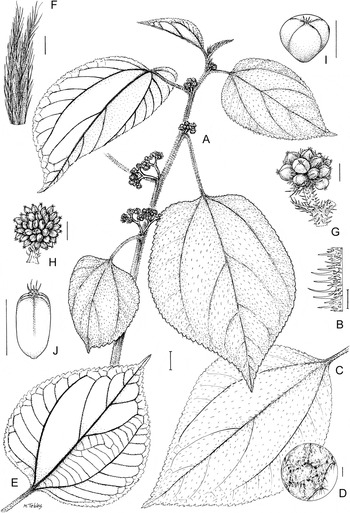
Fig. 1.Debregeasia australis Friis, Wilmot-Dear & C.J.Chen. A, habit; B, detail of stem indumentums; C, leaf, upper surface; D, leaf, detail of lower surface; E, leaf, lower surface; F, pair of partly fused stipules, dorsal view; G, branch of male inflorescence with flower cluster; H, apex of branch of female inflorescence with flower cluster; I, male flower; J, fruiting perianth. Scale bars: A, C & E = 10 mm; D, F–I = 1 mm; B & J = 0.5 mm. A–D, G & I drawn from Clemens s.n. (1947) (K); E from Smith 4996 (L); F, H & J from Forster 8139 (QRS). Drawn by Margaret Tebbs.
 Fig. 2.
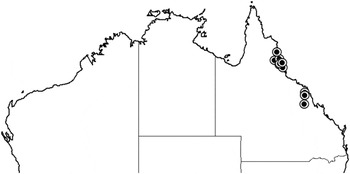
Map of northern part of Australia, showing the distribution of Debregeasia australis (‘bird eyes’) in Queensland, Australia. Collecting localities have been indicated where geographical coordinates are given on the collecting label or where the locality can be unambiguously identified.
Debregeasia squamatae King ex Hook.f. atque D. dentatae Hook.f. similis sed caulibus pilos patentes robustos conicos c.0.4 mm longos ferentibus nec verrucis nec tuberculis (ut in D. squamata) nec pilis gracilibus (ut in D. dentata) ornatis differt; ab ambabus foliis infra candidis nec albido-griseis etiam distinguenda. – Type: Australia, Queensland, South Kennedy, Cawley State Forest, 900 m, 27 iv 1991, Forster PIF8139 (holo K!; iso L!, MEL, QRS).


Shrub, laxly branched, or tree, 1.5–5 m high; terminal branches c.1 mm diameter at apex, with dense spreading hairs of two distinct kinds, fine and minute, < 0.1 mm, and longer and much coarser, ± conical, c.0.4 mm. Stipules 4.5–7 × 1–1.5 mm, connate to a quarter or third length, chartaceous, reddish brown, long-hairy dorsally and on margins. Leaves alternate; lamina broad-ovate(–elliptic-ovate), 4–17 × 3–14 cm, length 1.1–1.2(–1.4) × width; margin uniformly shallow-toothed throughout, teeth acute, antrorse, 1–2 × 1.5–5 mm, teeth broader and relatively shallower on larger leaves; apex acuminate, a single tooth 2–5(–10) mm long; base broadly cuneate to broadly rounded or subcordate; basal veins extending into distal half or third, upper veins (2–)3 either side, lowermost arising at or just above middle of lamina, inconspicuous on adaxial surface, fine-prominent on abaxial surface but not markedly distinct from coarser tertiary venation; fairly thin-chartaceous; adaxial surface with dense fine cystoliths giving greyish tinge and sparse to abundant shiny curved hairs of varying lengths up to 1 mm giving rough feel to surface; abaxial surface with shining white tomentum, completely obscuring surface but absent from all venation including fine reticulation; indumentum on venation like that of the adaxial surface. Petiole 2.5–9 mm, relatively long for size of lamina, 0.5–0.8 × lamina length, hairy like the stem. Inflorescences in the axils of existing or fallen leaves, 4–20 mm long, dichotomously branched once to several times with 4–> 30 clusters borne in pairs at apex of branchlets; peduncles robust, basal common peduncle c.1 mm diameter, terminal branchlets 0.7–1 mm diameter and rather short, 2–3 mm long; clusters 2–2.5(–3) mm diameter, with > 50 densely crowded flowers, lower inflorescences entirely male, upper ones entirely female. Male flowers 4-merous, buds depressed-globose, c.0.7 mm diameter, glabrous but often partly obscured by conspicuous subtending bracteoles up to 2/3 flower length with long hairs on their margins. Fruiting perianth broad-ellipsoid, c.0.5 × 0.5 mm, markedly laterally flattened with long hairs at apex; somewhat fleshy and tightly adnate to the achene, opening with a short, mouth-like slit, through which the short stigma projects and the top of the achene can be seen.
Distribution. Australia (E Queensland) (Fig. 2).
Habitat. Along mountain streams or in swampy areas in rainforest, at rainforest margins or in notophyll vine forest; (20–)400–1000 m.
Conservation assessment. Least Concern. Although this plant is known from only two populations separated by more than 200 km, rainforest and notophyll vine forest in eastern Australia is a naturally fragmented habitat now well protected and not greatly subject to disturbance (except for forest fires, which are a natural phenomenon in the ecosystem). Several recent collections of this plant exist and it is reasonable to assume that its populations remain fairly stable. Several collections are stated as having been made within, or must be assumed to have been made within, forest reserves, as these are shown on the IUCN World Database on Protected Areas (IUCN, 2010).
Discussion. Debregeasia australis has the following morphological features which are characteristic of the genus Debregeasia: capitate-penicillate stigma and tubular (? slightly fleshy) perianth completely enveloping the achene and tightly adnate to it. This new species is morphologically similar to the allopatric species Debregeasia squamata and D. dentata, differing from both in shining white (rather than greyish or dirty white) tomentum on the abaxial leaf surface, stem indumentum of two distinct kinds, and female perianth so tightly adnate to the achene as to be hard to distinguish in the dry state. Debregeasia squamata differs also in the presence of fleshy tubercles on the stem and D. dentata differs in adpressed rather than spreading stem indumentum. Debregeasia elliptica has leaves similar to those of D. australis, but differs in having much more slender peduncles, the terminal branchlets being only c.0.25 mm diameter and even the basal common peduncle only up to 0.5 mm diameter; the female perianth is also of markedly different appearance, only very loosely enveloping the achene, not at all adnate.
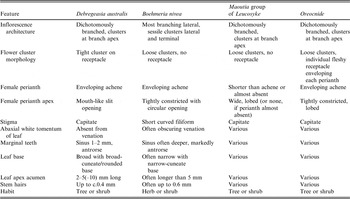
Certain species in the Leucosyke Zoll. & Moritzi group, which was formerly known as Maoutia Wedd. (another taxonomic group with capitate stigma), have discolorous leaves and are superficially very similar to Debregeasia australis. The species of Oreocnide Miq., yet another genus with capitate stigmas, have similar inflorescence architecture to Debregeasia australis. One species of Boehmeria Jacq., B. nivea (L.) Gaudich., is often almost indistinguishable vegetatively from this new species and superficially so similar in having a much-branched inflorescence that most of the collections of Debregeasia australis were hitherto identified as B. nivea. Distinguishing characters from Debregeasia australis are tabulated in Table 1.
Comparison of morphological features of Debregeasia australis, Boehmeria nivea, the Maoutia group of Leucosyke and Oreocnide

Specimens examined. Australia. Queensland: Cook: Forest reserve 185, Kalorama, ii 1961, Dansie 2018 (NSW!, QRS!), & 9 i 1995, Gray 5896 (QRS!); Forest reserve 185, Dinden, 9 i 1995, Gray 5891 (QRS!); Forest reserve 185, near Mt. Edith, 5 xi 1995, Ford 1641 (QRS); 6 km SSW of Millaa Millaa, end of Whiting Road, 880 m, 7 xii 2000, Forster 26533 & Booth (A, BRI, K!, L!, MEL); Davies Creek state forest, 29 ix 1974, Moriarty 1599 (BRI, CANB!); Davies Creek, 18 i 1962, Hyland AFO2281 (QRS!). McDowall range, 16 xi 1996, Ford 1815 (QRS!); Tarzali, 1 iii 1998, Cooper et al. 1190 (QRS); Jordan, McMillan, 18 x 1994, Gray 5799 (QRS); Lower Downey, 30 i 1992, Hyland 14433 (BRI, QRS!); Babinda, Weinert Creek, 20 iii 1978, R.L. Jago 23 (QRS) & 10 ii 1980, ibid. 396 (QRS!); 30 ix 1978, B. Jago 23; 20 i 1991 & 11 x 1998, ibid. 944 (QRS!). North Kennedy: Tully and vicinity, Jarrah River, i 1950, Clemens s.n. (NY!); Jarra Creek, W of Tully, 30 m, 9 xi 1951, Smith 4996 (BRI, L!). South Kennedy: Dalrymple Creek road, 15 iv 2002, Bean 18663 (BRI, CANB!, L!, MEL); Dalrymple Heights and vicinity, ix & xi 1947, Clemens s.n. (F!, G!, GH!, K!, UC!); Gorge Creek, Netherdale, 29 xi 1981, Rodd 3777 (CANB, NSW!). – Cultivated (seeds from ‘North Queensland’), cultivated at Royal Botanic Garden Sydney, 4 ii 1986, Coveny 12192 (BRI, K!, L, MO, NSW!).
A New Key to and a New Synopsis of Debregeasia
The position of the new species, Debregeasia australis, in the genus Debregeasia has been discussed above. The genus Debregeasia was previously revised by one of us (Wilmot-Dear, Reference Wilmot-Dear1988). However, so many taxonomic changes have been proposed since that it seems appropriate to present a new key to, and a new synopsis of, the species. A combination of characters places the genus Debregeasia within the tribe Boehmerieae: punctiform rather than linear cystoliths together with absence of stinging hairs and of any involucre surrounding the flower cluster. The characters of the genus still stand: subsessile capitate-penicillate stigma, succulent perianth completely enveloping the ovary and the mature achene, which may be somewhat asymmetrically swollen, but not flattened (Wilmot-Dear, Reference Wilmot-Dear1988), and the slit-like opening of the fruiting perianth, not narrowly constricted around the base of the short style.
Key to the species of Debregeasia
1a. Lamina narrowly ovate to linear ovate or linear-elliptic with length 3–10 × width, tapering gradually to cuneate or narrowly rounded base; female perianth succulent and tightly adnate to achene 2
1b. Lamina more broadly ovate, elliptic or ± orbicular with length 1–1.5(–1.8) × width or, if up to 2.5 × width, then female perianth thin-membranous very loosely enveloping achene; lamina base broad-cuneate to broadly rounded or truncate to cordate; female perianth always membranous or slightly fleshy 4
2a. Inflorescences sessile or with indistinct peduncles hardly visible beneath the congested flowers arranged in 1–8 subglobose clusters often so closely crowded as to form a misshapen mass completely surrounding the stem; mature male buds large, (1–)2–2.5 mm diameter with distinct white tomentum contrasting strongly with red bracts; leaves with shining white tomentum beneath obscuring finer and often also coarse veins 1. D. saeneb
2b. Inflorescences with distinct and easily visible peduncles branched dichotomously 1–5 times; mature male buds up to 1.5 mm diameter, sparsely pubescent; leaves greyish tomentose or greenish beneath, veins and reticulation clearly visible 3
3a. Plant flowering August–December with at least some inflorescences on current year’s growth; branches spreading-pubescent; lamina length mostly < 4.5 × width, petioles mostly > 1 cm 3. D. longifolia
3b. Plant flowering February–April, all inflorescences on previous year’s growth; branches usually adpressed-pubescent; lamina length 5–7 × width, petioles 0.3–1 cm 2. D. orientalis
4a. Ultimate branchlets thick, 5–10 mm diameter (in dry state) with prominent leaf scars 4–5 mm wide and leaves crowded especially towards the apex, pubescent but always without scales and protuberances; stipules large, usually 1–2.5 cm long; leaf margin coarsely dentate to shallowly irregularly crenate-undulate, vein pairs 5–8; inflorescence large, 5–9 cm long, common basal peduncle 3–5 cm long; leaves drying rather dark greenish black above, with shining white thick tomentum beneath, base always cordate, truncate or broadly rounded 5
4b. Ultimate branchlets up to 3.5 mm diameter (in dry state) with small (± 2 mm) leaf scars and evenly disposed leaves, pubescent, with or without abundant fleshy scale-like protuberances or warts; stipules ≤ 1.1 cm long; leaf margin regularly crenate-dentate or serrate-dentate, vein pairs 3–5; inflorescences small, up to 3 cm long, common basal peduncle up to 1.3 cm; leaves never drying blackish green above, tomentum beneath thin but covering the surface, shining white or greyish or dirty white, base sometimes cuneate rather than always cordate to broadly rounded 6
5a. Leaves with margin regularly coarsely dentate to shallowly crenate or (rarely) less regularly but distinctly undulate; peduncles comparatively thin, rarely over 1 mm diameter; female flower clusters up to 7 mm diameter 8a. D. wallichiana subsp. wallichiana
5b. Leaves almost entire, margin at most with indistinct irregular shallow undulations, sometimes also with occasional indistinct shallow teeth; peduncles stout, c.1.5 mm diameter; female flower clusters up to 12 mm diameter 8b. D. wallichiana subsp. ceylanica
6a. Lamina narrowly elliptic with length 1.8–2.5 × width, base narrowly cuneate to narrowly rounded; terminal branchlets of inflorescence slender, c.0.25 mm diameter and relatively long, c.5 mm; female perianth very loosely enveloping achene 4. D. elliptica
6b. Lamina broader, length 1–1.5 × width, base broadly cuneate to broadly rounded or subcordate; ultimate dichotomies of inflorescence robust, 0.8–1 mm diameter and often very short, 2–3 mm long; female perianth closely enveloping achene and sometimes tightly adnate to it 7
7a. Branchlets with tubercules usually 2–3 mm long, sometimes reduced and wart-like, and usually also spreading 2–3 mm long, fine hairs; indumentum on leaves beneath always greyish or dirty white 7. D. squamata
7b. Branchlets without tubercules or wart-like protuberances; hairs either adpressed or, if spreading, then of two distinct kinds, fine and minute, less than 0.1 mm, and long and coarse, c.0.4 mm; indumentum on leaves beneath greyish or shining white 8
8a. Indumentum on terminal branchlets dense and of two distinct kinds, fine and minute, less than 0.1 mm, and long and coarse, c.0.4 mm; indumentum on leaves beneath usually shining white 5. D. australis
8b. Indumentum on ultimate branchlets often sparse, often adpressed, with fine ± uniform hairs c.0.2 mm long; indumentum on leaves beneath greyish 6. D. dentata
Synopsis of the species of Debregeasia
1. Debregeasiasaeneb (Forssk.) Hepper & Wood, Kew Bull. 38(1): 86 (1983). – Rhus saeneb Forssk., Fl. Aegypt. Arab. 206 (1775). – Type: N Yemen, Hadie, Forsskål s.n. (holotype missing); Jebel Barad, 4 i 1889, Schweinfurth 436 (neo K!, designated by Hepper & Wood, Kew Bull. 38(1): 86 (1983); isoneo ?P).
Further synonymy as in Wilmot-Dear (Reference Wilmot-Dear1988).
Distribution. Ethiopian highlands, moist mountainous region of Yemen and Saudi Arabia, E Afghanistan through western Himalayan region to Bhutan.
2. Debregeasiaorientalis C.J.Chen, Novon 1(2): 56–57 (1991). – Type: China, Southeastern Sichuan, Nanchuan Co., Sanquan, Longguxi, 550 m, G.F. Li 60238 (holo PE; iso SZ).
Distribution. N India, Nepal, Bhutan, E and S China, Taiwan and Japan.
3. Debregeasia longifolia (Burm.f.) Wedd., Monog. Urt. 462 (1857). – Urtica longifolia Burm.f., Fl. Ind. 197 (err. typog. 297) (1768). – Type: Java, Kleinhoff s.n. (possible holo G!).
Further synonymy as in Wilmot-Dear (Reference Wilmot-Dear1988), with the exception of the re-established Debregeasia elliptica C.J.Chen. This species was referred to as Debregeasia velutina Gaudich. (1844) in Wilmot-Dear (Reference Wilmot-Dear1988), and later corrected to the name accepted here (Wilmot-Dear, Reference Wilmot-Dear1989).
Distribution. India, Sri Lanka, Bangladesh, Burma, Bhutan, SW China, Thailand, Vietnam, Malaysia, Indonesia, Philippines.
4. Debregeasia elliptica C.J.Chen, Acta Phytotax. Sin. 21: 476 (1983). – Type: Yunnan, Pingbian, 26 x 1954, K.M. Feng 5177 (holo KUN).
Distribution. S China, Vietnam.
5. Debregeasia australis Friis, Wilmot-Dear & C.J.Chen, sp. nov. – Type: Australia, Queensland, South Kennedy, Cawley State Forest, 900 m, 27 iv 1991, Forster PIF8139 (holo K!; iso L!, MEL, QRS).
Distribution. Australia (E Queensland).
6. Debregeasia dentata Hook.f., Fl. Brit. India 5: 591 (1888). – Debregeasia squamata f. etuberculata Wilmot-Dear (Reference Wilmot-Dear1988: 687). – Types: Bangladesh, Chittagong, 12 vii 1857, Hooker & Thomson 606 (syn K!) & 13 ii 1873, Clarke 19714 (syn K!; isosyn BM!).
Distribution. NE India (Tripura), Bangladesh.
Discussion. The differences previously used to delimit Debregeasia dentata and D. squamata consisted only of the presence or absence of tubercules (Wilmot-Dear, Reference Wilmot-Dear1988, fig. 3B & L). The two taxa can also be distinguished by differences in stem indumentum, that of Debregeasia squamata being adpressed while that of D. dentata is spreading. Moreover, the distributions of Debregeasia dentata and D. squamata meet, or slightly overlap, only in the extreme northeastern part of India, a distribution not compatible with considering the range-restricted D. dentata as merely a form of the very widespread D. squamata – see map 3 in Wilmot-Dear (Reference Wilmot-Dear1988).
7. Debregeasia squamata King ex Hook.f., Fl. Brit. India 5: 591 (1888). – Types: Malaysia, Perak, Larut, King’s Collector 2504 (syn K!; isosyn E!, P!) & 5185 (syn K!; isosyn BM!, G!) & 8364 (syn K!).
Distribution. NE India (W Bengal, Assam), ?Bangladesh (although we do not have evidence, we assume that not all plants from Bangladesh represent Debregeasia dentata), Burma, Thailand, Malaysia (several provinces on Malay Peninsula, Sabah), Indonesia (Kalimantan), Vietnam, S China.
Discussion. An additional detail, that the stem indumentum in this species is adpressed, should be added to the description in Wilmot-Dear (Reference Wilmot-Dear1988: 686).
8. Debregeasia wallichiana Wedd., Arch. Mus. Hist. Nat. Paris 9: 464 & t. 14 (1857). – Type: Bangladesh, Sillet [Sylhet], Wallich 4607 (lecto P!, designated here; iso CAL!, G!, K!, K-W).
Wilmot-Dear (Reference Wilmot-Dear1988: 689) cited the authority of this species as ‘(Wedd.) Wedd.’ and Missiessya wallichiana Wedd. (Weddell, Reference Weddell1854: 195) as the basionym. However, Weddell (Reference Weddell1854) provides no description and only cites the nomen nudum Urtica leucophylla Wall. and the collection Wallich 4607 as reference. Wilmot-Dear (Reference Wilmot-Dear1988: 690) cited Morocarpus wallichianus (Wedd.) Bl. (Blume, Reference Blume1856: 155), but Blume considered this an incompletely known species and provided no description; hence, Blume’s name is also a nomen nudum. The epithet has priority only from Weddell (Reference Weddell1857), where more collections than just Wallich’s material are cited, including material from Sri Lanka which is here considered a different subspecies from that to which Wallich 4607 belongs. Therefore, the Paris collection of Wallich 4607, originally studied by Weddell before 1854, is here designated lectotype.
Wilmot-Dear (Reference Wilmot-Dear1994: 468) divided this species into two subspecies:
8a. subsp. wallichiana
Distribution. E of Indian subcontinent to Burma, SW China, Thailand and Cambodia.
8b. subsp. ceylanica (Hook.f.) Wilmot-Dear (Reference Wilmot-Dear1994), Kew Bull. 49(3): 468. – Debregeasia ceylanica Hook.f., Fl. Brit. India 5: 592 (1888). – Type: Sri Lanka, C Province, Hantane, Thwaites 2201 (lecto K!; isolecto BM!, G!, P!, PDA, chosen by Wilmot-Dear (Reference Wilmot-Dear1994)).
Distribution. S India (W Ghats), Sri Lanka.
Acknowledgements
The authors are indebted to the directors and curators of the herbaria for access to the material used for this study (BM, BRI, CAL, CANB, F, G, GH, K, L, NSW, P, QRS, UC). We especially thank Dr Barry Conn, Frank Zich and Kirsten Cowley for taking digital photographs of various Australian collections and Prof. C. J. Chen (PE) for many helpful discussions on Urticaceae taxonomy, including some of the subjects of this paper. The illustration was provided by Margaret Tebbs.