1 Introduction
The elastic and inelastic atomic collision processes (Shevelko & Tawara Reference Shevelko and Tawara1995; Shevelko Reference Shevelko1997; Shevelko & Tawara Reference Shevelko and Tawara1998; Ramazanov, Dzhumagulova & Gabdullin Reference Ramazanov, Dzhumagulova and Gabdullin2006; Chang & Jung Reference Chang and Jung2007; Smirnov Reference Smirnov2007; Song et al. Reference Song, Litsarev, Shevelko, Tawara and Yoon2009; Ramazanov, Dzhumagulova & Gabdullin Reference Ramazanov, Dzhumagulova and Gabdullin2010; Pandey, Lin & Ho Reference Pandey, Lin and Ho2012, Reference Pandey, Lin and Ho2013) have received considerable attention since these processes have applications in many areas of physics such as astrophysics, atomic physics, chemical physics, condensed matter physics and surface physics. In addition, it has been shown that the atomic collision processes can be used as diagnostic tools for investigating the plasma parameters in various astrophysical and laboratory plasmas. The electron–atom collisions (Shevelko Reference Shevelko1997; Ramazanov et al. Reference Ramazanov, Dzhumagulova and Gabdullin2006) in plasmas have been of a great importance since they are useful for understanding the diffusion and transport phenomena in plasmas as well as physical information regarding the polarization interactions. Especially, the mechanism of the collision of a heavy neutral atom by an electron is quite interesting due to the screening effects of the bound electrons in a heavy target atom. Moreover, most of literature has dealt with the collisions of few-electron atoms (Bethe & Salpeter Reference Bethe and Salpeter1957) by using an analytic method with a projectile electron. Recently, more sophisticated computational methods such as close coupling, R-matrix and the Kohn variational methods have been developed and applied to electron collisions with many-electron atoms (Bartschat Reference Bartschat2013; Zatsarinny & Bartschat Reference Zatsarinny and Bartschat2013). However, it is obvious that the simple analytic method of the atomic collision with many-electron atoms would be extremely useful for physical modelling of astrophysical and laboratory plasmas. Thus, in this paper, we investigate the screening effects of the bound electrons on the electron–heavy atom collision in the non-relativistic limit since the non-relativistic electron–heavy atom collision is known to be an important atomic process in astrophysical environments such as the interstellar medium and gaseous nebulae (Osterbrock & Ferland Reference Osterbrock and Ferland2006) as well as in controlled fusion plasmas (Chen Reference Chen2016). In this paper, we employed the eikonal-Glauber method (Joachain Reference Joachain1983; Burke & Joachain Reference Burke and Joachain1995; Weinberg Reference Weinberg2015) to obtain the analytic universal expressions of the effective atomic charge, the scattering phase shift and the atomic cross-section in terms of the atomic form factor and the Mott–Massey screening parameter. The interaction potential between the electron and the many-electron neutral atom is given by an analytic solution of the Thomas–Fermi model suggested by Mott & Massey (Reference Mott and Massey1987). Our results would be useful and can readily be applied to a number of associated collision and radiation problems in astrophysics, atomic physics and plasma physics since we obtain the simple closed expression of the collision cross-section in terms of the atomic parameters.
2 Theory and calculations
For the interaction potential
 $V_{\text{int}}(\boldsymbol{r})$
, the closed form of the solution
 $\unicode[STIX]{x1D6F9}(\boldsymbol{k},\boldsymbol{r})$
of the Schrödinger equation,
 $(\unicode[STIX]{x1D6FB}^{2}+,k^{2})\unicode[STIX]{x1D6F9}(\boldsymbol{k},\boldsymbol{r})=(2\unicode[STIX]{x1D707}/\hbar ^{2})V_{\text{int}}(\boldsymbol{r})\unicode[STIX]{x1D6F9}(\boldsymbol{k},\boldsymbol{r})$
, is given by the following integral expression of the Lippmann–Schwinger equation (Joachain Reference Joachain1983):
 $$\begin{eqnarray}\unicode[STIX]{x1D6F9}(\boldsymbol{k},\boldsymbol{r})=\unicode[STIX]{x1D711}(\boldsymbol{k},\boldsymbol{r})+\frac{2\unicode[STIX]{x1D707}}{\hbar ^{2}}\int \text{d}^{3}\boldsymbol{r}^{\prime }\,\unicode[STIX]{x1D6F9}(\boldsymbol{k},\boldsymbol{r}^{\prime })G(\boldsymbol{k},\boldsymbol{r}-\boldsymbol{r}^{\prime })V_{\text{int}}(\boldsymbol{r}^{\prime }),\end{eqnarray}$$
where
 $\boldsymbol{k}$
is the wave vector,
 $\boldsymbol{r}$
is the position vector,
 $\unicode[STIX]{x1D711}(\boldsymbol{k},\boldsymbol{r})$
and
 $G(\boldsymbol{k},\boldsymbol{r}-\boldsymbol{r}^{\prime })$
are, respectively, the solutions of the homogeneous equation and Green’s function for the Helmholtz operator
 $H_{op}\;(=\unicode[STIX]{x1D6FB}^{2}+k^{2})$
,
 $k\;(=\sqrt{2\unicode[STIX]{x1D707}E}/\hbar )$
is the wavenumber,
 $\unicode[STIX]{x1D707}$
is the reduced mass of the collision system,
 $E$
is the collision energy and
 $\hbar$
is the rationalized Planck constant. Using the cylindrical coordinate system such that
 $\boldsymbol{r}=\unicode[STIX]{x1D746}+z\hat{\boldsymbol{n}}$
with the expansion technique with the outgoing Green function (Joachain Reference Joachain1983),
 $G^{(+)}(\boldsymbol{k},\boldsymbol{r}-\boldsymbol{r}^{\prime })\;(=-\text{e}^{-\text{i}k|\boldsymbol{r}-\boldsymbol{r}^{\prime }|}/4\unicode[STIX]{x03C0}|\boldsymbol{r}-\boldsymbol{r}^{\prime }|)$
, the eikonal wave function
 $\unicode[STIX]{x1D6F9}_{E}(\boldsymbol{k}_{i},\boldsymbol{r})$
can be expressed in the form:
 $$\begin{eqnarray}\unicode[STIX]{x1D6F9}_{E}(\boldsymbol{k}_{i},\boldsymbol{r})\cong \frac{1}{(2\unicode[STIX]{x03C0})^{3/2}}\exp \left[\text{i}\boldsymbol{k}_{i}\boldsymbol{\cdot }\boldsymbol{r}-\frac{\text{i}\unicode[STIX]{x1D707}}{\hbar ^{2}k_{i}}\int _{-\infty }^{z}\,\text{d}z^{\prime }\,V_{\text{int}}(\boldsymbol{r}^{\prime })\right],\end{eqnarray}$$
where
 $\unicode[STIX]{x1D746}$
is the impact parameter and
 $\hat{\boldsymbol{n}}$
is the unit vector perpendicular to the transfer of the wave vector
 $\unicode[STIX]{x0394}\boldsymbol{k}\;(\equiv \boldsymbol{k}_{i}-\boldsymbol{k}_{f})$
, and
 $\boldsymbol{k}_{i}$
and
 $\boldsymbol{k}_{f}$
are the incident and final wave vectors, respectively.
In (2.2), the integration in the phase term is along a straight line parallel to
 $\boldsymbol{k}_{i}$
, and the typical strength of the interaction potential
 $|V_{\text{int}}|$
would be restricted by the eikonal constraint such as
 $|V_{\text{int}}|/E<1$
(Burke & Joachain Reference Burke and Joachain1995). After some mathematical manipulations, the eikonal scattering amplitude
 $f_{E}(\unicode[STIX]{x0394}\boldsymbol{k})$
is then represented by the following expression:
 $$\begin{eqnarray}f_{E}(\unicode[STIX]{x0394}\boldsymbol{k})=-\frac{\unicode[STIX]{x1D707}}{2\unicode[STIX]{x03C0}\hbar ^{2}}\int \text{d}^{3}\boldsymbol{r}\,V_{\text{int}}(\boldsymbol{r})\exp \left[\text{i}\unicode[STIX]{x0394}\boldsymbol{k}\boldsymbol{\cdot }\boldsymbol{r}-\frac{\text{i}\unicode[STIX]{x1D707}}{\hbar ^{2}k_{i}}\int _{-\infty }^{z}\text{d}z^{\prime }\,V_{\text{int}}(\boldsymbol{r}^{\prime })\right].\end{eqnarray}$$
From the relation between the differential collision cross-section
 $\text{d}\unicode[STIX]{x1D70E}_{E}$
and the scattering amplitude
 $f_{E}(\unicode[STIX]{x0394}\boldsymbol{k}):\text{d}\unicode[STIX]{x1D70E}_{E}/\text{d}\unicode[STIX]{x1D6FA}=|f_{E}(\unicode[STIX]{x0394}\boldsymbol{k})|^{2}$
, where
 $\text{d}\unicode[STIX]{x1D6FA}$
is the differential solid angle, the total eikonal collision cross-section
 $\unicode[STIX]{x1D70E}_{E}$
is then obtained by
 $$\begin{eqnarray}\unicode[STIX]{x1D70E}_{E}(k)=\int \text{d}^{2}\unicode[STIX]{x1D746}|\exp [\text{i}\unicode[STIX]{x1D712}_{E}(\unicode[STIX]{x1D746},k)]-1|^{2},\end{eqnarray}$$
since the volume elements
 $\text{d}^{3}\boldsymbol{r}$
in the cylindrical coordinates can be written as
 $\text{d}^{3}\boldsymbol{r}=\text{d}^{2}\unicode[STIX]{x1D746}\,\text{d}z$
and the position vector is given by
 $\boldsymbol{r}=\unicode[STIX]{x1D746}+z\hat{\boldsymbol{n}}$
and the eikonal scattering amplitude
 $f_{E}(\unicode[STIX]{x0394}\boldsymbol{k})$
is given by
 $$\begin{eqnarray}f_{E}(\unicode[STIX]{x0394}\boldsymbol{k})=\frac{k}{2\unicode[STIX]{x03C0}\text{i}}\int \text{d}^{2}\unicode[STIX]{x1D746}\exp (\text{i}\unicode[STIX]{x0394}\boldsymbol{k}\boldsymbol{\cdot }\unicode[STIX]{x1D746})\{\exp [\text{i}\unicode[STIX]{x1D712}_{E}(\unicode[STIX]{x1D746},k)]-1\},\end{eqnarray}$$
where
 $|\boldsymbol{k}_{i}|=|\boldsymbol{k}_{f}|\equiv k$
,
 $\unicode[STIX]{x1D712}_{E}(\unicode[STIX]{x1D746},k)\;[=\unicode[STIX]{x1D712}_{1E}(\unicode[STIX]{x1D746})/k+\unicode[STIX]{x1D712}_{2E}(\unicode[STIX]{x1D746})/k^{3}]$
is the total eikonal phase shift (Joachain Reference Joachain1983), and
 $\unicode[STIX]{x1D712}_{1E}(\unicode[STIX]{x1D746})$
and
 $\unicode[STIX]{x1D712}_{2E}(\unicode[STIX]{x1D746})$
are the first- and second-order eikonal phases, respectively:
 $$\begin{eqnarray}\displaystyle & \displaystyle \unicode[STIX]{x1D712}_{1E}(\unicode[STIX]{x1D746})=-\frac{\unicode[STIX]{x1D707}}{\hbar ^{2}}\int _{-\infty }^{\infty }\text{d}z\,V_{\text{int}}(\boldsymbol{r}), & \displaystyle\end{eqnarray}$$
 $$\begin{eqnarray}\displaystyle & \displaystyle \unicode[STIX]{x1D712}_{2E}(\unicode[STIX]{x1D746})=\frac{1}{2}\left(\frac{\unicode[STIX]{x1D707}}{\hbar ^{2}}\right)^{2}\int _{-\infty }^{\infty }\text{d}z\,\unicode[STIX]{x1D735}\unicode[STIX]{x1D709}_{+E}(\boldsymbol{r})\boldsymbol{\cdot }\unicode[STIX]{x1D735}\unicode[STIX]{x1D709}_{-E}(\boldsymbol{r}), & \displaystyle\end{eqnarray}$$
with
 $$\begin{eqnarray}\displaystyle & \displaystyle \unicode[STIX]{x1D709}_{+E}(\boldsymbol{r})=-\int _{-\infty }^{z}\text{d}z^{\prime }\,V_{\text{int}}(\boldsymbol{r}^{\prime }), & \displaystyle\end{eqnarray}$$
 $$\begin{eqnarray}\displaystyle & \displaystyle \unicode[STIX]{x1D709}_{-E}(\boldsymbol{r})=-\int _{z}^{\infty }\text{d}z^{\prime }\,V_{\text{int}}(\boldsymbol{r}^{\prime }). & \displaystyle\end{eqnarray}$$
For the electron–atom collision process, the electron–atom interaction potential
 $V_{e-a}(\boldsymbol{r})$
is then given by
 $$\begin{eqnarray}V_{e-a}(\boldsymbol{r})=-\frac{Ze^{2}}{r}-e\int \text{d}^{3}\boldsymbol{r}^{\prime }\frac{\unicode[STIX]{x1D70C}_{e}(\boldsymbol{r}^{\prime })}{|\boldsymbol{r}-\boldsymbol{r}^{\prime }|},\end{eqnarray}$$
where
 $\unicode[STIX]{x1D70C}_{b}(\boldsymbol{r}^{\prime })[=-en_{b}(\boldsymbol{r}^{\prime })]$
is the charge density of the bound electrons in the target atom,
 $-e$
is the charge of the electron,
 $n_{b}(\boldsymbol{r}^{\prime })$
is the number density of the bound electrons and
 $\boldsymbol{r}^{\prime }$
is the position of the bound electron. The Fourier transformation
 $\tilde{V}_{e-a}(\boldsymbol{q})$
of the atomic interaction potential
 $V_{e-a}(\boldsymbol{r})$
in the momentum space
 $\boldsymbol{q}$
is then found to be
 $$\begin{eqnarray}\displaystyle \tilde{V}_{e-a}(\boldsymbol{q}) & = & \displaystyle \int \text{d}^{3}\boldsymbol{r}\,\text{e}^{-\text{i}\boldsymbol{q}\boldsymbol{\cdot }\boldsymbol{r}}V_{e-a}(\boldsymbol{r})\nonumber\\ \displaystyle & = & \displaystyle -\frac{4\unicode[STIX]{x03C0}e^{2}}{q^{2}}[Z-F_{a}(\boldsymbol{q})],\end{eqnarray}$$
where
 $F_{a}(\boldsymbol{q})$
stands for the atomic form factor:
 $F_{a}(\boldsymbol{q})=\int \text{d}^{3}\boldsymbol{r}^{\prime }\text{e}^{-\text{i}\boldsymbol{q}\boldsymbol{\cdot }\boldsymbol{r}^{\prime }}n_{b}(\boldsymbol{r}^{\prime })$
. In the electron–ion bremsstrahlung case, the atomic form factor would be zero. It has been known that the Thomas–Fermi model (Mott & Massey Reference Mott and Massey1987) is quite reliable in describing the physical properties of many-electron atoms and is useful to investigate the atomic dynamics, including that of neutral many-electron atoms. Using the conventional parameters in the Thomas–Fermi model, the atomic form factor
 $F_{a}(\boldsymbol{q})$
is given by
 $$\begin{eqnarray}\displaystyle F_{a}(\bar{q}) & = & \displaystyle \frac{4\unicode[STIX]{x03C0}}{q}\frac{b^{2}}{Z^{2/3}}\int _{0}^{\infty }\text{d}x\,n_{b}(x)x\sin (\bar{q}x)\nonumber\\ \displaystyle & = & \displaystyle Z[1-\bar{q}K(\bar{q})],\end{eqnarray}$$
where
 $b\equiv (1/2)(3\unicode[STIX]{x03C0}/4)^{2/3}a_{0}$
,
 $a_{0}\;(=\hbar ^{2}/me^{2})$
is the Bohr radius of the hydrogen atom,
 $\bar{q}\;(\equiv qb/Z^{1/3})$
is the dimensionless momentum transfer,
 $m$
is the mass of the electron,
 $x\;(\equiv r^{\prime }Z^{1/3}/b)$
is the dimensionless distance,
 $n(x)$
is the Thomas–Fermi number density:
 $$\begin{eqnarray}n_{b}(x)=\frac{Z^{2}}{4\unicode[STIX]{x03C0}b^{3}}\left[\frac{X(x)}{x}\right]^{3/2},\end{eqnarray}$$
 $K(\bar{q})$
is the screening function of the atomic electrons:
 $$\begin{eqnarray}K(\bar{q})=\int _{0}^{\infty }\text{d}x\,X(x)\sin (\bar{q}x)\end{eqnarray}$$
and
 $X(x)$
is the solution of the Thomas–Fermi equation,
 $\text{d}^{2}X(x)/\text{d}x^{2}=X^{3/2}(x)/x^{1/2}$
. The approximate Thomas–Fermi solution has been widely used in the single-exponential Mott–Massey form such as
 $X_{MM}(x)\cong \text{e}^{-sx}$
(Mott & Massey Reference Mott and Massey1987; Jung & Lee Reference Jung and Lee1995) where
 $s\;(=0.66)$
is the Mott–Massey screening constant.
3 Mott–Massey form factor and eikonal-Glauber cross-section
After some algebra using the impact parameter analysis and Mott–Massey’s Thomas–Fermi solution and (2.6), (2.10) and (2.11), the first-order eikonal phase shift
 $\unicode[STIX]{x1D712}_{E}(\bar{\unicode[STIX]{x1D70C}},\bar{E})$
for the collision of the many-electron atom by the electron is then found to be
 $$\begin{eqnarray}\displaystyle \unicode[STIX]{x1D712}_{E}(\bar{\unicode[STIX]{x1D70C}},\bar{E}) & = & \displaystyle \frac{2}{\unicode[STIX]{x03C0}\bar{E}}\int _{0}^{\infty }\text{d}\bar{z}\int _{-\infty }^{\infty }\text{d}\bar{q}_{\Vert }\,\text{e}^{\text{i}\bar{q}_{\Vert }\bar{z}}\int _{0}^{\infty }\text{d}\bar{q}_{\bot }\,\bar{q}_{\bot }\text{J}_{0}(\bar{q}_{\bot }\bar{\unicode[STIX]{x1D70C}})\frac{[Z-F_{MM}(\bar{q}_{\Vert },\bar{q}_{\bot })]}{\bar{q}_{\Vert }^{2}+\bar{q}_{\bot }^{2}}\nonumber\\ \displaystyle & = & \displaystyle \frac{2}{\bar{E}}\int _{0}^{\infty }\text{d}\bar{q}_{\bot }\,\text{J}_{0}(\bar{q}_{\bot }\bar{\unicode[STIX]{x1D70C}})\frac{Z_{\text{eff}}(Z,\bar{q}_{\bot })}{\bar{q}_{\bot }},\end{eqnarray}$$
since
 $\int _{-\infty }^{\infty }\text{d}\bar{z}\,\text{e}^{\text{i}\bar{q}_{\Vert }\bar{z}}=2\unicode[STIX]{x03C0}\unicode[STIX]{x1D6FF}(\bar{q}_{\Vert })$
,
 $V_{e-a}(\boldsymbol{r})=(2\unicode[STIX]{x03C0})^{-2}\int _{-\infty }^{\infty }\text{d}q_{\Vert }\,\text{e}^{\text{i}q_{\Vert }z}\int _{0}^{\infty }\text{d}q_{\bot }\,q_{\bot }\text{J}_{0}(q_{\bot }\unicode[STIX]{x1D70C})\tilde{V}_{e-a}(q_{\Vert },q_{\bot })$
, where
 $\bar{q}_{\Vert }\;(\equiv q_{\Vert }b/Z^{1/3})$
is the scaled parallel momentum transfer,
 $\bar{q}_{\bot }\;(\equiv q_{\bot }b/Z^{1/3})$
is the scaled perpendicular momentum transfer,
 $\bar{\unicode[STIX]{x1D70C}}\;(\equiv \unicode[STIX]{x1D70C}/a_{0})$
is the scaled impact parameter,
 $\bar{E}\;(\equiv E/Ry)$
is the scaled collision energy,
 $Ry\;(=me^{4}/2\hbar ^{2}\cong 13.6~\text{eV})$
is the Rydberg constant
 $\bar{z}\equiv z/a_{0},\text{J}_{0}(\bar{q}_{\bot }\bar{\unicode[STIX]{x1D70C}})$
is the zeroth-order Bessel function,
 $F_{MM}(\bar{q}_{\Vert },\bar{q}_{\bot })$
is the Mott–Massey atomic form factor:
 $$\begin{eqnarray}F_{MM}(\bar{q}_{\Vert },\bar{q}_{\bot })=\frac{Z(Z^{1/3}\unicode[STIX]{x1D702}_{MM})^{2}}{\bar{q}_{\Vert }^{2}+\bar{q}_{\bot }^{2}+(Z^{1/3}\unicode[STIX]{x1D702}_{MM})^{2}},\end{eqnarray}$$
 $\unicode[STIX]{x1D702}_{MM}\;(=sa_{0}/b\cong 0.7455)$
is the screening parameter determined by Mott–Massey’s Thomas–Fermi solution and
 $Z_{\text{eff}}(Z,\bar{q}_{\bot })\;[\equiv Z-F_{MM}(\bar{q}_{\bot })]$
is the effective charge of the target atom including the atomic screening effects. The detailed derivation of the eikonal phase shift
 $\unicode[STIX]{x1D712}_{E}(\bar{\unicode[STIX]{x1D70C}},\bar{E})$
is given in appendix A. It is also shown that the Glauber scattering amplitude (Joachain Reference Joachain1983)
 $f_{G}(\unicode[STIX]{x0394}\boldsymbol{k})$
for a direct collision from an initial target state
 $\left.\left|i\right\rangle \right.$
to a final state
 $\left|\left.f\right\rangle \right.$
is represented by
 $$\begin{eqnarray}f_{G}(\unicode[STIX]{x0394}\boldsymbol{k})=\frac{k}{2\unicode[STIX]{x03C0}\text{i}}\int \text{d}^{2}\unicode[STIX]{x1D746}\exp (\text{i}\unicode[STIX]{x0394}\boldsymbol{k}\boldsymbol{\cdot }\unicode[STIX]{x1D746})\left\langle \left.f\right|\right.\{\exp [\text{i}\unicode[STIX]{x1D712}_{E}(\unicode[STIX]{x1D746},k)]-1\}\left|\left.i\right\rangle \right..\end{eqnarray}$$
For the elastic collision for the ground state
 $\left|\left.0\right\rangle \right.$
, the Glauber scattering amplitude (Joachain Reference Joachain1983)
 $f_{G}(\unicode[STIX]{x0394}\boldsymbol{k})$
would then be
 $$\begin{eqnarray}f_{G}(\unicode[STIX]{x0394}\boldsymbol{k})=\frac{k}{2\unicode[STIX]{x03C0}\text{i}}\int \text{d}^{2}\unicode[STIX]{x1D746}\exp (\text{i}\unicode[STIX]{x0394}\boldsymbol{k}\boldsymbol{\cdot }\unicode[STIX]{x1D746})\left\langle \left.0\right|\right.\left\{\exp [\text{i}\unicode[STIX]{x1D712}_{E}(\unicode[STIX]{x1D746},k)]-1\right\}\left|\left.0\right\rangle \right..\end{eqnarray}$$
Hence, in the Thomas–Fermi model, the Glauber scattering amplitude
 $f_{G}(\unicode[STIX]{x0394}\boldsymbol{k})$
is identical to the eikonal scattering amplitude
 $f_{E}(\unicode[STIX]{x0394}\boldsymbol{k})$
. The current method using the eikonal analysis with the Thomas–Fermi model can be then named the eikonal-Glauber Thomas–Fermi model for the atomic collision cross-section. Hence, the scaled differential eikonal-Glauber collision cross-section
 $\unicode[STIX]{x2202}\bar{\unicode[STIX]{x1D70E}}_{E,a}(\bar{\unicode[STIX]{x1D70C}},\bar{E})\;[\equiv (\unicode[STIX]{x2202}\unicode[STIX]{x1D70E}_{E}/\unicode[STIX]{x2202}\bar{\unicode[STIX]{x1D70C}})/\unicode[STIX]{x03C0}a_{0}^{2}]$
in units of
 $\unicode[STIX]{x03C0}a_{0}^{2}$
for the electron–heavy atom collision including the influence of the screening by the abound atomic electrons is then represented by the following closed form:
 $$\begin{eqnarray}\unicode[STIX]{x2202}\bar{\unicode[STIX]{x1D70E}}_{E,a}(\bar{\unicode[STIX]{x1D70C}},\bar{E})=2\bar{\unicode[STIX]{x1D70C}}\left|\exp \left[\frac{2Zi}{\bar{E}}\int _{0}^{\infty }\text{d}\bar{q}_{\bot }\frac{\text{J}_{0}(\bar{q}_{\bot }\bar{\unicode[STIX]{x1D70C}})}{\bar{q}_{\bot }}\left(1-\frac{(Z^{1/3}\unicode[STIX]{x1D702}_{MM})^{2}}{\bar{q}_{\bot }^{2}+(Z^{1/3}\unicode[STIX]{x1D702}_{MM})^{2}}\right)\right]-1\right|^{2}.\end{eqnarray}$$
As is seen in (3.2), the effects of the screening by the bound atomic electrons are included through Mott–Massey’s screening parameter
 $\unicode[STIX]{x1D702}_{MM}$
. Hence, the scaled total eikonal-Glauber collision cross-section
 $\bar{\unicode[STIX]{x1D70E}}_{E,a}(\bar{E})\;(\equiv \unicode[STIX]{x1D70E}_{E}/\unicode[STIX]{x03C0}a_{0}^{2})$
in units of
 $\unicode[STIX]{x03C0}a_{0}^{2}$
for the electron–heavy atom collision including the screening effects by the abound atomic electrons is found to be
 $$\begin{eqnarray}\bar{\unicode[STIX]{x1D70E}}_{E,a}(\bar{E})=2\int _{0}^{\infty }\text{d}\bar{\unicode[STIX]{x1D70C}}\,\bar{\unicode[STIX]{x1D70C}}\left|\exp \left[\frac{2Zi}{\bar{E}}\int _{0}^{\infty }\text{d}\bar{q}_{\bot }\frac{\text{J}_{0}(\bar{q}_{\bot }\bar{\unicode[STIX]{x1D70C}})}{\bar{q}_{\bot }}\left(1-\frac{(Z^{1/3}\unicode[STIX]{x1D702}_{MM})^{2}}{\bar{q}_{\bot }^{2}+(Z^{1/3}\unicode[STIX]{x1D702}_{MM})^{2}}\right)\right]-1\right|^{2}.\end{eqnarray}$$
However, for the electron–ion collision, the scaled differential eikonal-Glauber collision cross-section
 $\bar{\unicode[STIX]{x1D70E}}_{E,i}(\bar{E})$
for the electron–ion interaction potential would then be represented by
 $$\begin{eqnarray}\bar{\unicode[STIX]{x1D70E}}_{E,i}(\bar{E})=2\int _{0}^{\infty }\text{d}\bar{\unicode[STIX]{x1D70C}}\,\bar{\unicode[STIX]{x1D70C}}\left|\exp \left[\frac{2Zi}{\bar{E}}\int _{0}^{\infty }\text{d}\bar{q}_{\bot }\frac{\text{J}_{0}(\bar{q}_{\bot }\bar{\unicode[STIX]{x1D70C}})}{\bar{q}_{\bot }}\right]-1\right|^{2}\end{eqnarray}$$
since the electron–ion interaction potential
 $V_{e-i}(\boldsymbol{r})$
is then given by
 $V_{e-i}(\boldsymbol{r})=-Ze^{2}/r$
and the Fourier transformation
 $\tilde{V}_{e-i}(\boldsymbol{q})$
in the momentum space
 $\boldsymbol{q}$
is obtained by
 $\tilde{V}_{e-i}(\boldsymbol{q})=-4\unicode[STIX]{x03C0}e^{2}/q^{2}$
, i.e. without the influence of atomic electrons. In this work, we have introduced the scaled expressions of the impact parameter, energy and cross-sections in order to represent the universal expression for the cross-section for all values of the charge number. The electron–atom collisions have been extensively investigated by sophisticated methods, like close coupling, R-matrix and the Kohn variational methods (Joachain Reference Joachain1983; Bartschat Reference Bartschat2013; Zatsarinny & Bartschat Reference Zatsarinny and Bartschat2013) which have been developed and applied to many-electron atoms. However, the universal eikonal-Glauber model for atomic collision cross-sections with many-electron atoms has not been obtained for plasma applications. In addition, the current eikonal-Glauber model provides the general trend in behaviour of the eikonal-Glauber phases and cross-sections as functions of
 $Z$
, the momentum transfer and energy. Moreover, the general expressions for the atomic form factor and the effective charge of the target atom have been obtained for many-electron atoms including the atomic screening effects. Hence, it would be expected that the analytic expressions of our results for the eikonal-Glauber phase shift (3.1), the atomic form factor (3.2), the differential eikonal-Glauber collision cross-section (3.5) and the total eikonal-Glauber collision cross-section (3.6) provide physical insights as well as the construction of a physics structure of the collision dynamics including atomic screening effects in many-electron atoms. There is an important relation (Joachain Reference Joachain1983):
 $f_{B1}=f_{E1}$
, where
 $f_{B1}$
is the scattering amplitude obtained by the first Born approximation and
 $f_{E1}$
is the scattering amplitude obtained by the first-order eikonal-Glauber method. Since it is well known that the scattering amplitude
 $f_{B1}$
obtained by the first Born approximation is equal to the scattering amplitude
 $f_{E1}$
obtained by the first-order eikonal-Glauber method for all potentials and all scattering angles in the Born limits, the total eikonal-Glauber collision cross-section
 $\bar{\unicode[STIX]{x1D70E}}_{E,a}(\bar{E})$
(3.6) would be quite reliable to investigate the total collision cross-section obtained in a wide range of the collision energies. Recently, excellent works have provided the effective potentials taking into account the plasma shielding and quantum effects in dense plasmas (Ramazanov et al.
Reference Ramazanov, Moldabekov, Dzhumagulova and Muratov2011; Jamil et al.
Reference Jamil, Shahid, Zeba, Salimullah, Shah and Murtaza2012; Akbari-Moghanjoughi Reference Akbari-Moghanjoughi2013, Reference Akbari-Moghanjoughi2014a
,Reference Akbari-Moghanjoughi
b
; Ramazanov et al.
Reference Ramazanov, Moldabekov, Gabdullin and Ismagambetova2014; Akbari-Moghanjoughi Reference Akbari-Moghanjoughi2015). Hence, the investigation of the universal Thomas–Fermi eikonal-Glauber model of elastic atomic collisions with the screened atomic form factor in quantum plasmas will also be treated elsewhere.
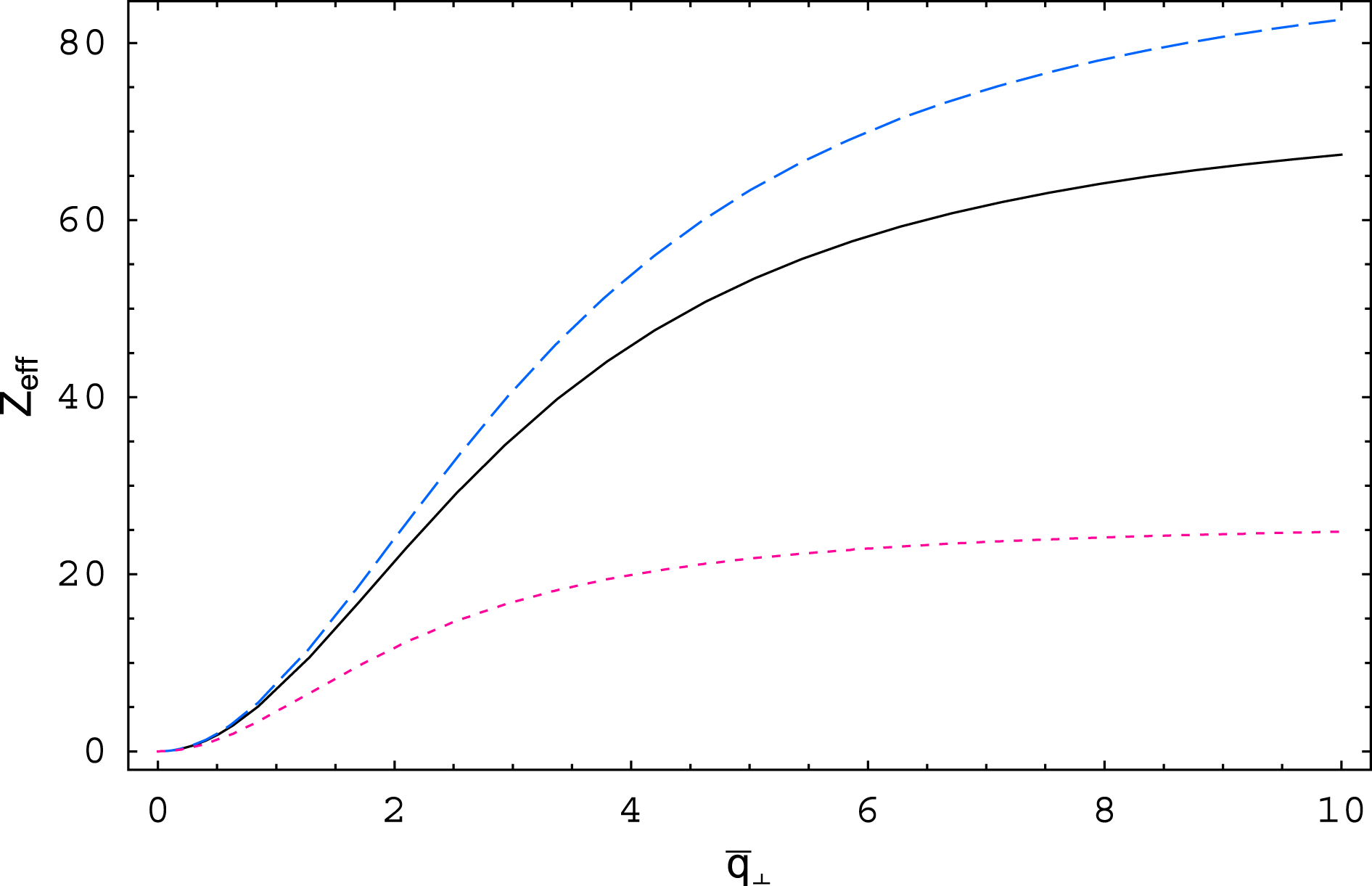
The effective charge
 $Z_{\text{eff}}$
as a function of the scaled transverse momentum transfer
 $\bar{q}_{\bot }$
in the electron–heavy atom collision. The dotted line represents the case of an iron atom (Fe). The solid line represents the case of a tungsten atom (W), and the dashed line represents the case of a uranium atom (U).

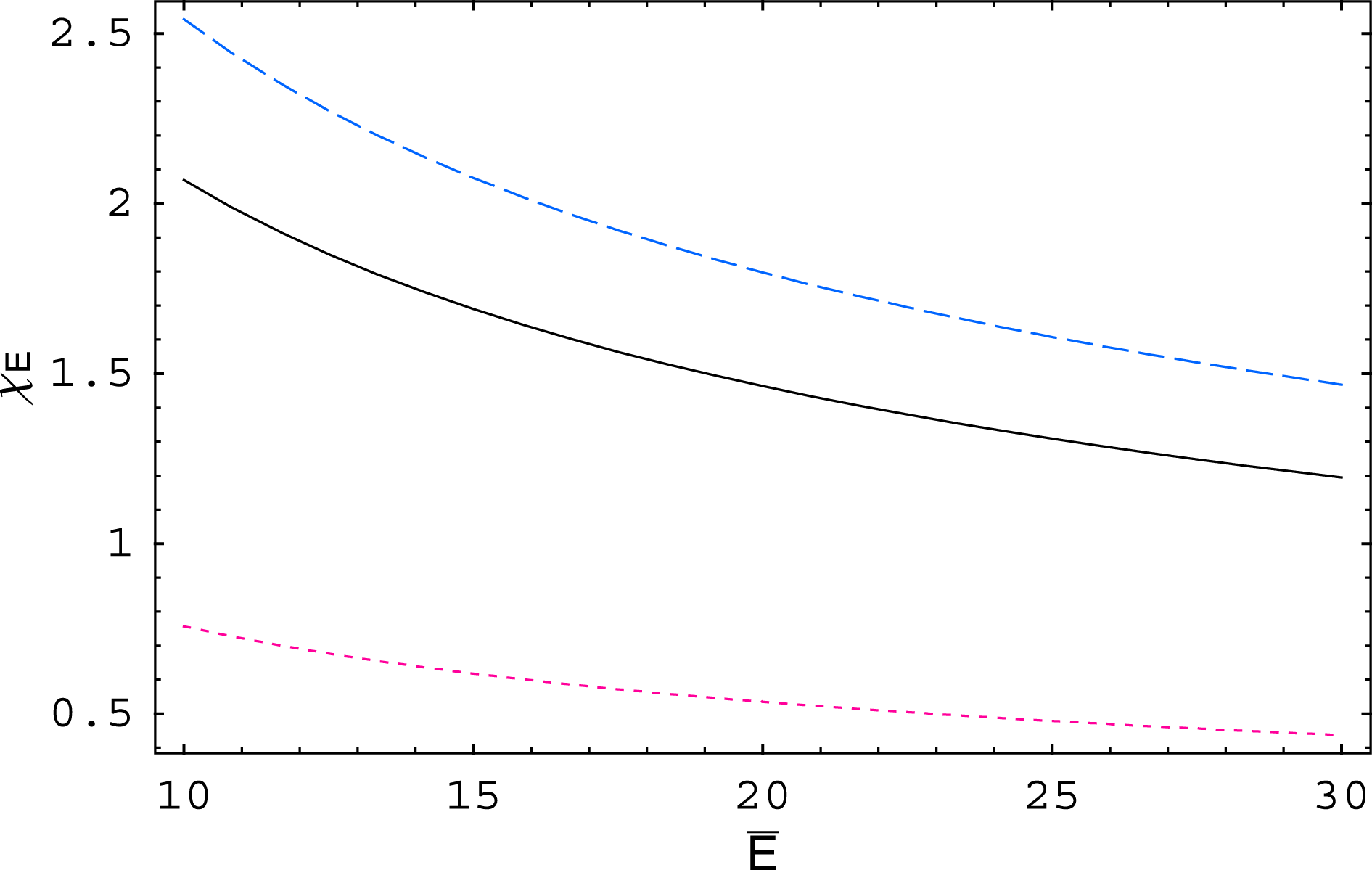
The eikonal scattering phase shift
 $\unicode[STIX]{x1D712}_{E}$
for the electron–heavy atom collision as a function of the scaled collision energy
 $\bar{E}$
at
 $\bar{\unicode[STIX]{x1D70C}}=10$
. The dotted line represents the case of an iron atom (Fe). The solid line represents the case of a tungsten atom (W), and the dashed line represents the case of a uranium atom (U).

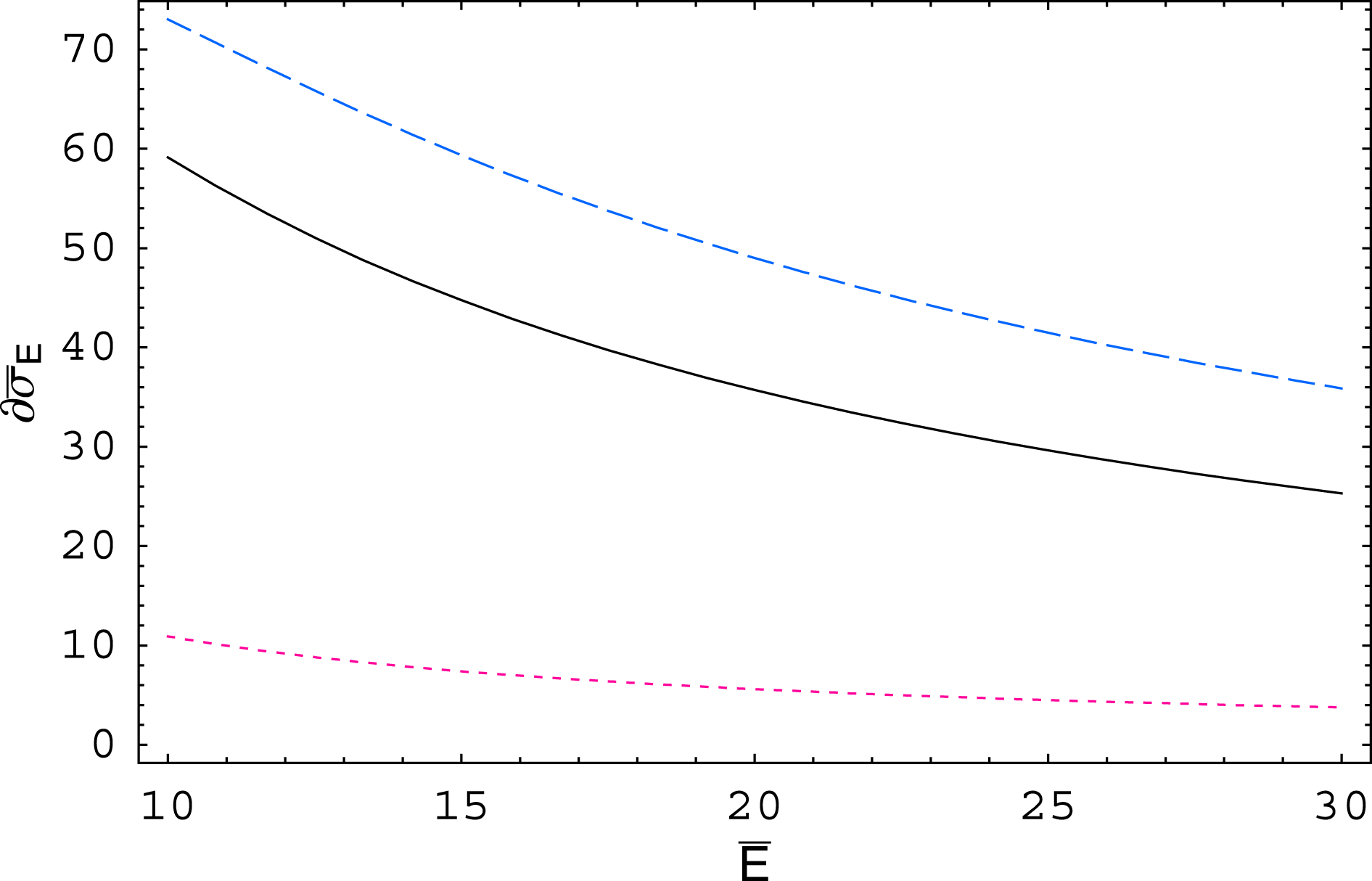
The scaled differential eikonal-Glauber scattering cross-section
 $\unicode[STIX]{x2202}\bar{\unicode[STIX]{x1D70E}}_{E}$
for the electron–heavy atom collision as a function of the scaled collision energy
 $\bar{E}$
at
 $\bar{\unicode[STIX]{x1D70C}}=10$
. The dotted line represents the case of an iron atom (Fe). The solid line represents the case of a tungsten atom (W), and the dashed line represents the case of a uranium atom (U).

4 Results and discussion
In order to explicitly investigate the atomic screening effects on the elastic collisions of many-electron atoms by electrons, we consider three heavy neutral atoms: iron atom (Fe,
 $Z=26$
), tungsten atom (W,
 $Z=74$
) and uranium atom (U,
 $Z=92$
) with collision energies
 $\bar{E}>1$
, since the constraint condition for the eikonal analysis is given by
 $E>|V_{\text{int}}|$
. It is well known that the standard eikonal analysis is known to be equivalent to the Glauber approximation in the potential scattering (Pavlov Reference Pavlov2000). The relation between the Glauber method and other methods such as the Born and classical methods can be considered using the Glauber parameter (Pavlov Reference Pavlov2000),
 $|V|R/\hbar v$
, for the potential scattering, where
 $|V|$
a typical strength of the interaction potential,
 $R$
is the effective potential action range and
 $v$
is the collision velocity. Since the Glauber parameter can be either a greater or smaller than unity in the Glauber approximation, the Glauber method provides a wide range of applicability in the potential scattering process (Pavlov Reference Pavlov2000). Therefore, the eikonal-Glauber Thomas–Fermi method ((3.6) and (3.7)) in this work can also be applied for the investigation of atomic collision processes in various plasma conditions such as weakly coupled classical plasmas as well as strongly coupled dense plasmas. Figure 1 represents the effective charge
 $Z_{\text{eff}}$
as a function of the scaled transverse momentum transfer
 $\bar{q}_{\bot }$
for various heavy target atoms in the elastic electron–heavy atom collision. It is found that the effective charge
 $Z_{\text{eff}}$
increases with an increase of the scaled transverse momentum transfer
 $\bar{q}_{\bot }$
. It is also shown that the atomic screening effects on the effective charge
 $Z_{\text{eff}}$
are found to be more significant in small momentum transfer
 $\bar{q}_{\bot }$
domains. In addition, the influence of the atomic screening effects on the effective charge
 $Z_{\text{eff}}$
decreases with an increase of the scaled transverse momentum transfer
 $\bar{q}_{\bot }$
. Figure 2 shows the eikonal-Glauber scattering phase shift
 $\unicode[STIX]{x1D712}_{E}$
for the elastic electron–heavy atom collision as a function of the scaled collision energy
 $\bar{E}$
for various heavy target atoms for a given impact parameter
 $\bar{\unicode[STIX]{x1D70C}}=10$
. As shown in figure 2, it is found that the eikonal-Glauber scattering phase shift
 $\unicode[STIX]{x1D712}_{E}$
decreases with an increase of the collision energy
 $\bar{E}$
. It is also found that the eikonal-Glauber scattering phase shift
 $\unicode[STIX]{x1D712}_{E}$
increases with an increase of the charge number
 $Z$
of the nucleus of the target atom. It is also found that the dependence of the charge number on the eikonal-Glauber scattering phase shift is almost independent of the collision energy
 $\bar{E}$
. Figure 3 shows the differential eikonal-Glauber scattering cross-section
 $\unicode[STIX]{x2202}\bar{\unicode[STIX]{x1D70E}}_{E}$
for the elastic electron–heavy atom collision as a function of the scaled collision energy
 $\bar{E}$
for various heavy target atoms for a given impact parameter
 $\bar{\unicode[STIX]{x1D70C}}=10$
. As is seen, it is found that the differential eikonal-Glauber scattering cross-section
 $\unicode[STIX]{x2202}\bar{\unicode[STIX]{x1D70E}}_{E}$
decreases with an increase of the collision energy
 $\bar{E}$
. It is also found that the differential eikonal-Glauber scattering cross-section
 $\unicode[STIX]{x2202}\bar{\unicode[STIX]{x1D70E}}_{E}$
increases with an increase of the charge number
 $Z$
of the nucleus of the target atom. It is interesting to find that the energy dependence of the differential eikonal-Glauber scattering cross-section
 $\unicode[STIX]{x2202}\bar{\unicode[STIX]{x1D70E}}_{E}$
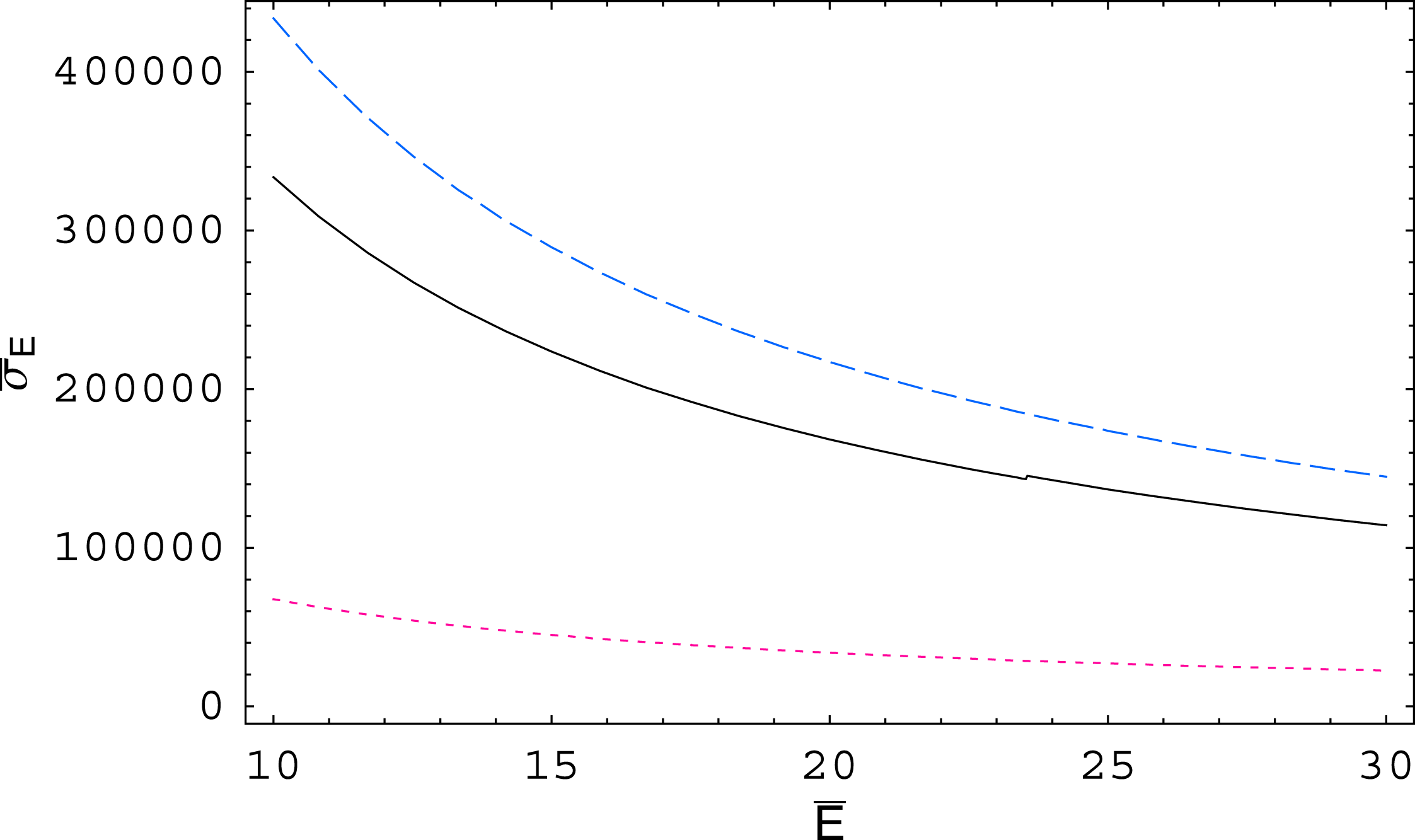
is less important for a target atom with small charge number. Figure 4 shows the total eikonal-Glauber scattering cross-section
 $\bar{\unicode[STIX]{x1D70E}}_{E}$
for the elastic electron–heavy atom collision as a function of the scaled collision energy
 $\bar{E}$
for various heavy target atoms. As shown in figure 4, it is found that the total eikonal-Glauber scattering cross-section
 $\unicode[STIX]{x2202}\bar{\unicode[STIX]{x1D70E}}_{E}$
also decreases with an increase of the collision energy
 $\bar{E}$
as with the case of the differential eikonal-Glauber scattering cross-section
 $\unicode[STIX]{x2202}\bar{\unicode[STIX]{x1D70E}}_{E}$
. However, the energy dependence of the total eikonal-Glauber scattering cross-section
 $\bar{\unicode[STIX]{x1D70E}}_{E}$
is quite different from that of the differential eikonal-Glauber scattering cross-section
 $\unicode[STIX]{x2202}\bar{\unicode[STIX]{x1D70E}}_{E}$
since the integration over the impact parameter
 $\bar{\unicode[STIX]{x1D70C}}$
produces the additional dependence on the transverse momentum transfer
 $\bar{q}_{\bot }$
. It is also found that the charge dependence of the total eikonal-Glauber scattering cross-section
 $\bar{\unicode[STIX]{x1D70E}}_{E}$
decreases with an increase of the scaled collision energy
 $\bar{E}$
since
 $[Z-F_{MM}(\bar{q}_{\bot })]/\bar{q}_{\bot }$
and the Mott–Massey atomic form factor
 $F_{MM}(\bar{q}_{\bot })$
are small for large collision energies. Hence, we have found that the atomic screening effects play crucial roles in the collision of a heavy neutral atom with an electron. Since the result of the atomic screening factor in this work is obtained by the analytic universal term,
 $[1-(Z^{1/3}\unicode[STIX]{x1D702}_{MM})^{2}/(\bar{q}_{\bot }^{2}+(Z^{1/3}\unicode[STIX]{x1D702}_{MM})^{2})]$
, based on the Thomas–Fermi model (Schwinger Reference Schwinger2001; Friedrich Reference Friedrich2017), the expressions for the eikonal-Glauber phase shift (3.1), the atomic form factor (3.2), the differential eikonal-Glauber collision cross-section (3.5) and the total eikonal-Glauber collision cross-section (3.6) can be applied to a collision process involving many neutral atoms. In recent years, excellent investigations have provided a useful expression for the effective potential (Baimbetov, Nurekenov & Ramazanov Reference Baimbetov, Nurekenov and Ramazanov1995) for a semi-classical plasma including a short range quantum effect as well as the density dependence. In addition, the effective polarization interaction potential (Ramazanov et al.
Reference Ramazanov, Dzhumagulova, Omarbakiyeva and Röpke2006) between charged and neutral particles is obtained for a partially ionized plasma taking into account quantum effects at short distances as well as the plasma shielding effects at large distances. Moreover, the extremely useful expression for the electron–atom interaction has been obtained in dense partially ionized plasmas including Pauli blocking and plasma screening effects (Omarbakiyeva, Ramazanov & Röpke Reference Omarbakiyeva, Ramazanov and Röpke2009). In these dense plasmas, the number density
 $n_{e}$
and plasma temperature
 $T$
are known to be approximately
 $10^{20}{-}10^{24}~\text{cm}^{-3}$
and
 $5\times 10^{4}{-}10^{6}~\text{K}$
, respectively (Ramazanov et al.
Reference Ramazanov, Dzhumagulova and Gabdullin2010). Hence, the physical characteristics of the Thomas–Fermi model for the atomic collision cross-section with many-electron atoms including the influence of plasma screening and quantum mechanical effects will be investigated elsewhere. It is also shown that the physical properties of dense plasmas can be recognized by the plasma coupling parameter (Ramazanov et al.
Reference Ramazanov, Dzhumagulova and Gabdullin2010)
 $\unicode[STIX]{x1D6E4}\;[=(Ze)^{2}/ak_{B}T]$
, density parameter
 $r_{s}\;(=a/a_{0})$
, degeneracy parameter
 $\unicode[STIX]{x1D703}\;(=k_{B}T/E_{F})$
, where
 $Z$
is the charge number of the ion,
 $a$
is the average distance between plasma particles,
 $k_{B}$
is the Boltzmann constant,
 $T$
is the plasma temperature and
 $E_{F}$
is the Fermi energy. As shown in figures 2–4, the influence of atomic screening is important at energies from
 $10Ry$
to
 $30Ry$
. However, at extremely high energies, the influence of atomic screening can be neglected since the atomic screening factor
 $[1-(Z^{1/3}\unicode[STIX]{x1D702}_{MM})^{2}/(\bar{q}_{\bot }^{2}+(Z^{1/3}\unicode[STIX]{x1D702}_{MM})^{2})]$
becomes unity for
 $\bar{q}_{\bot }\gg Z^{1/3}\unicode[STIX]{x1D702}_{MM}$
. In addition, the scaled total eikonal-Glauber collision cross-section
 $\bar{\unicode[STIX]{x1D70E}}_{E,a}(\bar{E})$
(3.6) would also be useful in deducing the atomic shape and structure factors (Sivia Reference Sivia2011) from the atomic collision data for many-electron atoms. These results would be very useful for describing general trends in the properties of electron–heavy atom collisions and provide useful information on the influence of atomic screening in various astrophysical and laboratory plasmas.
The total eikonal-Glauber scattering cross-section
 $\bar{\unicode[STIX]{x1D70E}}_{E}$
for the electron–heavy atom collision as a function of the scaled collision energy
 $\bar{E}$
. The dotted line represents the case of an iron atom (Fe). The solid line represents the case of a tungsten atom (W), and the dashed line represents the case of a uranium atom (U).

Acknowledgements
This paper is dedicated to the late Professor P. K. Shukla in memory of exciting and stimulating collaborations on physical processes in strongly coupled plasmas. One of the authors (Y.-D.J.) gratefully acknowledges Dr M. Rosenberg for useful discussions and warm hospitality while visiting the Department of Electrical and Computer Engineering at the University of California, San Diego. This research was initiated while one of the authors (Y.-D.J.) was affiliated with UC San Diego as a visiting professor. The work was supported by the National Research Foundation of Korea (NRF) grant funded by the Korean Government (MISP) (NRF-2016R1A2B4011356).
Appendix A
After some algebra using the impact parameter analysis and Mott–Massey’s Thomas–Fermi solution and (2.6), (2.10), and (2.11), the first-order eikonal phase shift
 $\unicode[STIX]{x1D712}_{E}(\bar{\unicode[STIX]{x1D70C}},\bar{E})$
for the collision of the many-electron atom with the electron is then found to be
 $$\begin{eqnarray}\displaystyle \unicode[STIX]{x1D712}_{E}(\bar{\unicode[STIX]{x1D70C}},\bar{E}) & = & \displaystyle \frac{1}{\unicode[STIX]{x03C0}\bar{E}}\int _{-\infty }^{\infty }\text{d}\bar{z}\int _{-\infty }^{\infty }\text{d}\bar{q}_{\Vert }\,\text{e}^{\text{i}\bar{q}_{\Vert }\bar{z}}\int _{0}^{\infty }\text{d}\bar{q}_{\bot }\,\bar{q}_{\bot }\text{J}_{0}(\bar{q}_{\bot }\bar{\unicode[STIX]{x1D70C}})\left(\frac{Z-F_{MM}(\bar{q}_{\Vert },\bar{q}_{\bot })}{\bar{q}_{\Vert }^{2}+\bar{q}_{\bot }^{2}}\right)\nonumber\\ \displaystyle & = & \displaystyle \frac{1}{\unicode[STIX]{x03C0}\bar{E}}\int _{-\infty }^{\infty }\text{d}\bar{q}_{\Vert }\,2\unicode[STIX]{x03C0}\unicode[STIX]{x1D6FF}(\bar{q}_{\Vert })\left(\frac{Z-F_{MM}(\bar{q}_{\Vert },\bar{q}_{\bot })}{\bar{q}_{\Vert }^{2}+\bar{q}_{\bot }^{2}}\right)\int _{0}^{\infty }\text{d}\bar{q}_{\bot }\,\bar{q}_{\bot }\text{J}_{0}(\bar{q}_{\bot }\bar{\unicode[STIX]{x1D70C}}).\end{eqnarray}$$
Using the Dirac delta function
 $\unicode[STIX]{x1D6FF}(\bar{q}_{\Vert })$
in the
 $\bar{q}_{\Vert }$
-space, equation (A 1) can be written as
 $$\begin{eqnarray}\unicode[STIX]{x1D712}_{E}(\bar{\unicode[STIX]{x1D70C}},\bar{E})=\frac{2}{\unicode[STIX]{x03C0}\bar{E}}\int _{0}^{\infty }\text{d}\bar{q}_{\bot }\,\bar{q}_{\bot }\text{J}_{0}(\bar{q}_{\bot }\bar{\unicode[STIX]{x1D70C}})\left(\frac{Z-F_{MM}(0_{\Vert },\bar{q}_{\bot })}{\bar{q}_{\bot }^{2}}\right).\end{eqnarray}$$
Since the Mott–Massey atomic form factor
 $F_{MM}(0_{\Vert },\bar{q}_{\bot })$
is found to be determined by
 $$\begin{eqnarray}F_{MM}(0,\bar{q}_{\bot })=\frac{Z(Z^{1/3}\unicode[STIX]{x1D702}_{MM})^{2}}{\bar{q}_{\bot }^{2}+(Z^{1/3}\unicode[STIX]{x1D702}_{MM})^{2}},\end{eqnarray}$$
the first-order eikonal phase shift
 $\unicode[STIX]{x1D712}_{E}(\bar{\unicode[STIX]{x1D70C}},\bar{E})$
for the collision of the many-electron atom with the electron is then represented by
 $$\begin{eqnarray}\unicode[STIX]{x1D712}_{E}(\bar{\unicode[STIX]{x1D70C}},\bar{E})=\frac{2}{\bar{E}}\int _{0}^{\infty }\text{d}\bar{q}_{\bot }\,\text{J}_{0}(\bar{q}_{\bot }\bar{\unicode[STIX]{x1D70C}})\frac{Z_{\text{eff}}(Z,\bar{q}_{\bot })}{\bar{q}_{\bot }},\end{eqnarray}$$
where the effective charge of the target atom
 $Z_{\text{eff}}(Z,\bar{q}_{\bot })\;[\equiv Z-F_{MM}(0,\bar{q}_{\bot })]$
including the influence of the atomic screening is given by
 $$\begin{eqnarray}Z_{\text{eff}}(Z,\bar{q}_{\bot })=Z-\frac{Z(Z^{1/3}\unicode[STIX]{x1D702}_{MM})^{2}}{\bar{q}_{\bot }^{2}+(Z^{1/3}\unicode[STIX]{x1D702}_{MM})^{2}}.\end{eqnarray}$$
These expressions for the eikonal phase shift
 $\unicode[STIX]{x1D712}_{E}(\bar{\unicode[STIX]{x1D70C}},\bar{E})$
and the effective charge
 $Z_{\text{eff}}(Z,\bar{q}_{\bot })$
would be quite useful for modelling of collision and radiation processes including many-electron atoms.