Introduction
Prairie as pasture
In proportions similar to those recorded across the US Corn Belt, pasturelands occupied approximately 10% of Iowa's surface area in 2002, and 14% of south central Marion County, Iowa1, the location of this study from 2003 to 2005. Iowa lies within the natural boundaries of the tallgrass prairie region, a bounteous zone supporting more than 450 species of plants through climatic, fire and grazing cyclesReference Frisina and Mariani2. The pattern adopted by early settlers of replacing native, perennial warm-season grasses, legumes and forbs with introduced plant species, such as tall fescue (Festuca arundicacea Schreb.) and smooth bromegrass (Bromus inermis Leyss), led to an expansion of cattle enterprises, with limited concern for effects on soil and plant productivity. In the 1950s, agricultural researchers, after noting the negative environmental consequences from decades of continuous grazing of introduced cool-season grasses, recommended soil fertility programs for pastures and planting diverse pasture mixes that included leguminous species. Improvements based on these methods led to a twofold increase in animal weight gains over unimproved pasturesReference Scholl, Hughes and McWilliams3.
More recently, researchersReference Hart and Collinson4 have argued that pasture system performance should be based on stability and system/existing resource interactions in contrast to productivity alone. Some argue that native species have been overlooked as a potential forage source in the tallgrass prairie region, because these species are typically found on the sites that have little opportunity for high yieldsReference Stubbendieck, Nielsen, Bragg and Stubbendieck5, as native prairie species may be favored on soils with low nutrient availabilityReference Biondini and Redente6–Reference Wilson and Tilman8. Other studies suggest that warm-season grasses use phosphorus more efficiently than cool-season, introduced species such as smooth bromegrassReference Panciera and Jung9. Extant, native warm-season plant species have frequently been observed in cool-season pastures on resource-poor sites. FosterReference Foster10 found communities of native grasses restricted to low-productivity habitats and a strong competitive interference with establishment from the existing vegetation in more productive sites. These results and othersReference Goldberg and Novoplansky11 suggest that the establishment and survivorship of native species may be at a competitive disadvantage in high-productivity gradients.
RosburgReference Rosburg12, Reference Rosburg, Glenn-Lewin, Smith and Jacobs13 inventoried ten pastures with similar soil and topographic conditions near the Marion County study site and enumerated seven native, warm-season grasses and 11 native forbs among seeded cool-season species, consistent with earlier work identifying various frequencies of native grasses, forbs and legumesReference Pammel and King14. Native, perennial warm-season grasses have been found to be drought tolerant and are highly productive during the summer seasonReference Hall, George and Riedl15–Reference Krueger and Curtis17. The native, warm-season grasses are C4 grasses, which have a reduced photorespiration rate and a CO2 uptake that is up to 40% higher than C3 grasses, resulting in rapid sugar production and plant growth at high temperaturesReference Nelson, Moser, Barnes, Miller and Nelson18. Because their productivity increases during the hot summer months when the cool-season species growth rates decline, native warm-season species are desirable candidates for integration into existing pastures. A Nebraska grazing study showed that rotating animals from cool-season to warm-season and back to cool-season paddocks resulted in higher average gain than leaving animals on cool-season grasses during the entire periodReference Conard and Clanton19. Experiments rotating herds between native and introduced species in Iowa and other locations bore similar resultsReference Samson and Moser20, Reference Wedin and Fruehling21. Alternatively, the use of warm-season species in ‘prairie pastures’ or ‘prairie paddocks’ on marginal sites may match summer forage needs and serve landscape conservation functions as well.
Native plant species establishment
Studies have suggested events occurring during seed dispersal, germination and seedling establishment determine the fates of individual plantsReference Foster and Gross22–Reference Harper24, and the environment and neighboring species immediately surrounding a seedling are critical in determining the composition of plant communitiesReference Foster10, Reference Fowler25. Thus, facilitating the conditions most amenable to native species germination and emergence is likely to facilitate successful establishment. Kemp and WilliamsReference Kemp and Williams26 found that introduced cool-season grasses exploited resources more efficiently than native warm-season species, preventing the establishment of native grasses. In situations marked by such site preemption, dominant species may remain competitive under tolerance or suppression conditionsReference MacDougall and Turkington27, which suggests that changing competitive conditions through burning, tilling, mowing or grazing can shift competitive factorsReference MacDougall and Turkington27, Reference Kleijin28. Suppression can include cultivating pastures and seeding the desired native species to facilitate establishment before cool-season species regrowReference Wilson and Tilman8, Reference Cox and McCarty29, or using a non-selective herbicide, such as glyphosate, sprayed on germinating or newly emerging vegetation to provide a clean seedbed before seeding the warm-season speciesReference Malik and Waddington30, Reference Wilson and Gerry31.
While both approaches rapidly prepare pastures for desired species establishment, each method has drawbacks: the use of tillage methods on marginal pastureland slopes may contribute to erosion, compromise soil quality and kill desired native species. When non-selective herbicides are used in pastureland, all species are reduced or eliminatedReference Rosburg, Glenn-Lewin, Smith and Jacobs13, Reference Bragg and Sutherland32, Reference Seguin, Peterson, Sheaffer and Smith33 and residual herbicide may compromise the establishment of some seeded speciesReference Bragg and Sutherland32. Use of herbicides also limits marketing options for operators interested in raising and marketing their livestock as certified organic, as all land used for forage production must be free from prohibited substances such as synthetic herbicides for at least 3 years immediately prior to certification34. Mowing or grazing can serve as a substitute for herbicides. Davison and KindscherReference Davison and Kindscher35 suggested that mowing or vegetation removal mimicked the effects of fire in decreasing plant competition. DibollReference Diboll, Glambey and Pemble36 and OldReference Old37 showed a significant decrease in Kentucky bluegrass with mowing, and JohnsonReference Johnson38 diminished tall fescue populations with strategic mowing, but warm-season species may be susceptible to depleted carbohydrate reserves with untimely or repeated defoliationReference White39, Reference Willson and Stubbendieck40. In general, forbs and many native legumes have an elevated apical meristem and are more susceptible to injury by defoliationReference Ehrenreich and Aikman41.
Numerous studies have determined that good grazing management can transform poor grazing land into productive pastureReference Turner42, particularly if site suitability is emphasizedReference Elmore and Naiman43. The optimum grazing time for maximal forage quality, quantity and health for cool- and warm-season plant species has been determined to be the period between rapid growth and stem elongation/floweringReference MacAdam, Nelson, Barnes, Nelson, Collins and Moore44. Thus, grazing regimes can be successfully used for prairie establishment and maintenance if informed by forage phenology. In addition to competitive plant effects, abiotic conditions can influence prairie plant seedling establishmentReference Callaway and Walker45. Adult, warm-season plant productivity was found to be strongly influenced by soil temperatureReference Damhoureyeh and Hartnett46–Reference Tix and Charvat48. Briggs and KnappReference Briggs and Knapp49 and PetersReference Peters50 found precipitation to be a key factor in prairie seeding efforts.
Agroecological research problem and objectives
In the Marion County, Iowa, cow–calf operator group, a common theme repeated by the majority of participants was their belief in rotational grazing systems, where pastures are subdivided into paddocks and animals are moved from one paddock to another at appropriate intervalsReference Beetz51. Rotational grazing systems ideally are designed to match the site specificity and carrying capacity of the land. In the course of the sociocultural analysis, one member of the study group presented the opportunity to examine a rotational grazing system on his farm that would include native prairie plants (prairie pasture), thereby contributing to ecosystem servicesReference Altieri52, Reference Sanderson, Skinner, Edwards, Tracy and Wedin53.
The agroecological research component at the farm and field level of this interdisciplinary project was based on the farmer's hypothesis that native prairie pastures could be developed to match site specificity while adhering to the family's farming system goals of protecting wildlife habitat and water quality, and nurturing plant diversity. They explained: ‘We like to see a pasture with 40-plus species, because many plants take different minerals, grow at diverse times of the year. We want to graze year-round, and native warm season grasses and forbs are part of that mix.’ With the farm family, we developed the objectives of the agroecological study: (1) establish and monitor the growth and productivity of a prairie pasture system, with a goal of increasing biodiversity and sustainability in existing grasslands; and (2) determine which strategies—grazing, mowing or no management (control)—most effectively fostered native seeded species’ growth relative to existing species suppression. Conventional protocols were replaced with ecologically based organic management practices to suppress undesired existing pasture vegetation while optimizing conditions for native species establishment. The on-farm site incorporated aspects affecting the whole farm management and farming system objectivesReference Shaner, Philipp and Schmehl54 in order to develop recommendations that would be representative of regional dynamics with location specificityReference Tripp and Tripp55. Such recommendations could be incorporated into existing or new USDA-NRCS (Natural Resources Conservation Services) programs supporting biodiversity and environmental quality on agricultural lands.
Study Area and Methodology: Agroecological Study
Experimental site
The prairie pasture experiment was conducted from 2003 to 2005 on a farm in southern Marion County that was in the USDA hardiness zone 5a56; located at 41°10′ latitude, 93°00′ longitude. The farm is characterized by the Gosport–Pershing–Gara soil association with gentle to steep slopes, and well drained to somewhat poorly drained soils formed in residuum from shale, glacial till and loess on uplandsReference Russell and Lockridge57. The experimental area consisted of a 40° northeast aspect and a 12% mean slope with dominant soils in the silty loam Clinton (alfisol) and Gosport (inceptisol) series. Prior to the experiment, the site was a fallow pasture dominated by tall fescue and other introduced pasture grasses and broadleaf species. No records or recollections of the site being plowed or row cropped were referenced, although portions of the land were severely eroded, suggesting previous soil disturbance. Infrequent native grasses, composites and legumes were present prior to the experiment. The site was surrounded by a deciduous forest and located near a first-order stream.
Site preparation
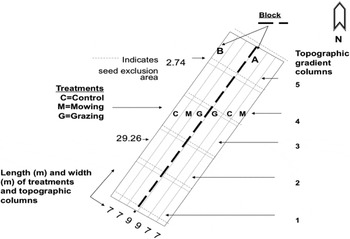
The experimental site covered an area of 46×160 m (Fig. 1). A prescribed burn was applied to the entire experimental area on April 24, 2003, when the majority of the dominant fescue was in mid- to late elongation, as per recommendations by Willson and StubbendieckReference Willson and Stubbendieck58. Vegetation on the experimental site and surrounding area (a perimeter of 10 m) was burned under a ring-firing techniqueReference Pauly, Packard and Mutel59. Soil samples were collected from each experimental unit on April 30, 2003, and on May 24–25, 2005, following standard soil sampling procedures60. Soils were analyzed for phosphorus (Bray-1), potassium (Mehlich-3), calcium (Mehlich-3), pH (1:1) and organic matter at the Soil Testing Laboratory at Iowa State University (Ames, IA). VolcanaPhos™ (Midwestern Bio-Ag, Blue Mounds, WI), an organic-compliant phosphorous source and lime (CaCO3) were applied with a fertilizer spreader at a rate of 336 and 2242 kg ha−1 ECC, respectively, on June 18, 2003, based on the soil analysis results and farmer recommendations.
Prairie pasture experimental site with specified treatments in Marion County, Iowa.

Prairie species seeding
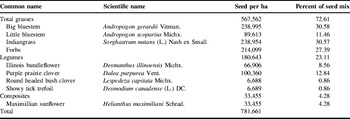
A southern Iowa, local-ecotype, native species seed mixture (Osenbaugh Seed Company, Chariton, IA) was planted on May 15, 2003 with a 2.4-m Truax™ no-till drill in 0.64 cm deep furrows and covered with soil. A designated area (2.73×46 m each) at six topographic positions along the slope of the experimental site was excluded from seeding to permit sampling of existing vegetation for prior existence of native species in the seed mixture. The seed mixture was composed of big bluestem (Andropogon gerardii Vitman), little bluestem (Andropogon scoparius Michx.), indiangrass (Sorghastrum nutans (L.) Nash ex), Illinois bundleflower (Desmanthus illinoensis Michx.), purple prairie clover (Dalea purpurea Vent.), round headed bush clover (Lespedeza capitata Michx.), showy tick trefoil (Desmodium canadense (L.) DC) and Maximillian sunflower (Helianthus maximiliani Schrad.) (Table 1). The seed composition was selected on the basis of farmer preference, functional group diversityReference Tilman, Wedlin and Knops61, Reference Tilman, Knops, Wedlin, Peich, Ritchie and Siemann62, documented mid- to late-summer palatability, life-cycle traits and historic presence in south–central Iowa. Seeding volume per species and in total reflected guidelines by NRCS63.
Native seed mix and seeding rate of certified southern Iowa local-ecotype varieties in prairie pasture planting, Marion County, IA.

Experimental design
An individual pasture of sufficient size to contain nine management plots was selected by the rancher–cooperator to serve as the experimental site. The site was delineated into two blocks measuring 23×160 m each; with each block containing three randomly assigned treatments of grazing, mowing or no management (Fig. 1). Superimposed on the treatments were five plots in a contiguous column from the base of the site to the apex of the slope, designed to determine trends at five topographic positions in each block. Plots receiving the mowing treatment or no management were 7×32 m, and plots receiving the grazing treatment were 9×32 m. Each plot included a 2.74×7 or 9 m (relative to treatment received) control non-seeded strip that was not seeded but received the treatment. Each non-seeded strip was separately sampled for the presence of extant native species and served as a visual comparator to the seeded areas.
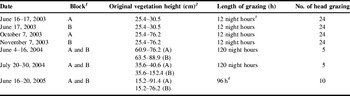
Grazing management. The grazing treatment was designed to balance on-farm cattle management decisions with a management tactic. Cattle utilized in this experiment included Angus cows from the cow–calf operation. Cattle numbers varied from 5 to 24, based on the size of paddocks and pasture productivity (Table 2). A high-tensile, PVC-wire electric fence formed the perimeter of the grazing treatment area with polywire gates to regulate cattle entry. Flash grazing, a short-term grazing event at a high stocking density that improves the distribution of animalsReference Schacht, Volesky and Waller64, and reduces animal selectivity, resulting in low defoliation heights and homogeneous grazing, was used. The grazing management decisions were predicated by water and time availability. Grazing intensity varied each year based on vegetation growth (Table 2).
Grazing dates and management information in prairie pasture experiment during the 2003, 2004 and 2005 grazing seasons.

1 A and B=Blocks A and B on northern and southern portions of the site, respectively.
2 Immediate post-grazing plant height was not measured, due to high variability and heterogeneity within and among blocks and topographic positions.
3 ‘Night’ indicates the time between 21.00 h and 9.00 h when cows were moved to experimental plots; cows were retained on surrounding pasture during the day.
4 Block choice was not restricted and cows could enter any grazing treatment plots at any time (during the day or night).
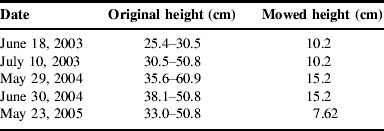
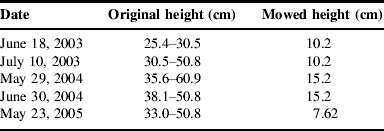
Mowing management. The mowing treatment was designed and implemented with guidance from the local NRCS office. Mowing was conducted during rapid vegetative growth periods to avoid impairing plant healthReference Probasco and Bjugstad65. A combination of tractor-pulled and self-propelled rotary mowers was used to apply mowing treatments. The date and frequency of mowing was determined by observation and guided by NRCS literature. Mowing occurred when vegetation averaged 30–50 cm in height; mowed heights were reduced to 8–18 cm, depending on conditions and year (Table 3). The mowed cuttings were left on the plots.
Prairie pasture mowing dates and vegetation heights in prairie pasture experiment, 2003–2005.
No management. After burning on April 24, 2003, the no-management treatment (control) remained unmanaged during the first 2 years of the experiment (2003–2004). On May 1, 2005, a prescribed burn following a ring-firing technique was executed to control unwanted species, according to the farmer–cooperator's specifications, but the area remained ungrazed and unmowed during the course of the experiment.
Data collection
Presence–absence and community inventory
Data collection included recording the presence or absence of a particular plant species, according to methods described by Vogel and MastersReference Vogel and Masters66 by placing a 1 m2 frequency grid in five random locations (matching topographic positions down the slope) within each treatment. Samples were taken within five 0.04 m2 sub-quadrats per quadrat placement. Vegetative height was recorded for plants within each quadrat. The presence or absence (denoted as a 1 or 0, respectively) for each identifiable seeded species was recorded for each 0.04 m2 sub-quadrat. In 2003, five observations (five sub-quadrats) were made within a one-quadrat sample for each of the five topographic positions within each treatment (total of 25 observations). In 2004, two quadrat samples yielded ten observations for each of the five topographic positions within each treatment (total of 100 observations), and in 2005, four quadrat samples yielded 20 observations for each of the five topographic positions within each treatment (total of 200 observations). The presence of each seeded species was analyzed as a percentage of total observations.
All species present in each of the five samples per quadrat were recorded in the July 2005 sampling period, yielding 20 inventories per topographic position. Species were identified using procedures developed by Stubbbenbieck et al.Reference Stubbendieck, Friisoe and Bolick67, Christiansen and MüllerReference Christiansen and Müller68 and Barnes et al.Reference Barnes, Miller and Nelson69, and were verified using taxonomic keys in SteyermarkReference Steyermark70 and RydbergReference Rydberg71. The frequency of each identified species per sample was also recorded.
Biomass assessments
In August of each year, the existing vegetation height and biomass was measured. A 25×25 cm (0.1 m2) quadrat was randomly placed within each topographic position, and all living and dead vegetation was cut within the quadrat at the ground level. Data were recorded from one quadrat per topographic position per treatment in 2003 and 2004, and four quadrats per topographic position per treatment were acquired in 2005. Biomass samples were dried for 72 h at 67°C and weighed. The mean dry weight was recorded for each sample.
Non-seeded topographic position measurements
For each non-seeded area, the presence or absence of seeded native species was measured within one randomly placed 1 m2 quadrat per topographic position per treatment area. Five randomly placed 0.04 m2 sub-quadrats were sampled for each seeded species. Each experimental site was surveyed in August 2003 and in August 2004. The percentage of each seeded species present in each experimental unit was recorded.
Radiation measurements
Solar radiation penetration through the vegetative canopy was measured with a LAI-2000 Plant Canopy Analyzer™ (LI-COR, Inc., Lincoln, NE). By using diffuse non-interceptance (DIFN), values between 0 and 1 were assigned, based on the probability of diffuse radiation from the upper hemisphere penetrating the canopy to a particular location. Four replications per topographic position were taken on days when the sun was obscured by cloud cover with a 90° view cap. This DIFN measurement was averaged by LAI-2000 software and recorded for each topographic position.
Weather conditions
Monthly mean precipitation and temperatures from the Knoxville, Iowa, NWS COOP Network climate station were acquired from Iowa Environmental Mesonet72. The Knoxville station was the closest location to the experimental site.
Data Analysis
All field data were analyzed using analysis of variance with mixed modelsReference Littell, Milliken, Stroup and Wolfinger73. Differences among treatments were obtained through least square means and statistically separated using Tukey's studentized range (HSD) means comparison test at P⩽0.05 significance level.
Results and Discussion
Soil characteristic effects
Soil analysis determined low P content, averaging 2.9 ppm, and low K content, averaging 107 ppmReference Sawyer, Mallarino, Killorn and Barnhart74. Compared to the more fertile soils in Iowa, soils at the experimental site were considered to be low in organic matter, averaging 3.7%Reference Russell and Lockridge57, and signifying marginal grain crop suitability.
Weather effects
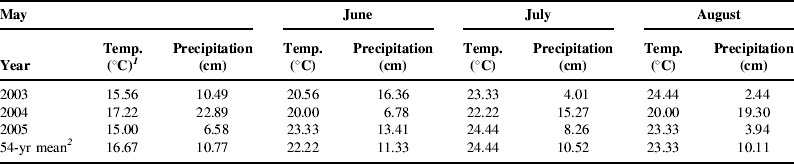
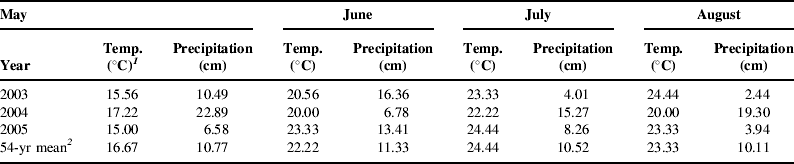
During the 2003 season, above average precipitation occurred in June, followed by a drought period in July and August with rainfall substantially below the 54-year (1951–2005) mean precipitation (Table 4). This low-rainfall period might have impacted native seedling establishment, as previous studies have determined that soil moisture is critical to successful species emergence and establishmentReference Ambrose and Wilson75, Reference Wilsey and Polley76. Low moisture also may have caused significant stress and mortality among the newly emerged species, and may have favored individuals in microsites that conserved moisture through shade or litterReference Fowler77, Reference Wilson, Bakker, Christian, Li, Ambrose and Addington78. During the months of May, July and August 2004, precipitation was above 54-year mean levels, but in May, July and August 2005, precipitation was again below average levels. Temperatures throughout the experimental years were generally equivalent to the 54-year average temperature and suitable for native plant growth (Table 4).
Monthly mean temperature and precipitation totals during prairie pasture growing seasons in Knoxville, Marion County, Iowa, 2003–2005.
1 Iowa Environmental Mesonet, 2003–2005.
2 Fifty-four-year mean:1951–2005.
Native plant establishment and community inventory
Seeded native grass and forb species were successfully incorporated into existing pasture in all treatments in this experiment. Identifiable species in the prairie pasture in the first year (2003) included only native grasses, Illinois bundleflower and purple prairie clover. In 2004 and 2005, all seeded species were observed. As previously mentioned, several months of low rainfall accompanied by high temperatures appeared to impact the establishment and survival of native species, with variable responses, based on species and year, described in the next section.
Extant native prairie species populations. Background presence of native species in experimental plots prior to treatment application was not significant in all years of the experiment (data not shown). Of all the native species, native grasses (specifically big bluestem and indiangrass) predominated, but were present in only 4% of samples in control strips, with other species similarly absent or sparse across all treatments and topographic positions. Thus, extant native populations did not impact the evaluation of experimental management techniques.
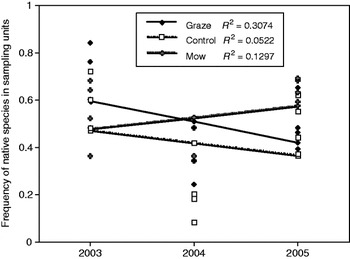
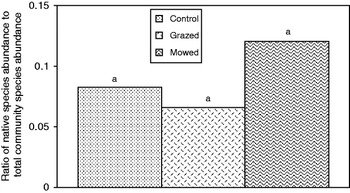
Seeded native prairie species populations. Seeded prairie species successfully established in all three treatments in 2003, but the frequency of seeded native species declined in the grazing and control treatments from 2003 to 2005, with a numerical, but not statistical, increase in the mowing treatment (Fig. 2). By the end of the third year of the experiment, native species were observed in 65% of samples in the mowing treatment and ≈50% in the control and grazing treatments. The overall frequency of seeded legume species was ≈55% in July 2003, and by August 2005, native legumes were present in 22% of control treatment samples, 10% of mowing treatment samples and 7% of grazing treatment samples. The seeded native grasses increased from 2003 and 2005 in the grazed and mowed plots, and by August 2005, native grasses were present in 61% of mowing treatment samples, 46% of grazing treatment samples and 36% of control treatment samples. Although the native species were a small part of the total pasture community, with no significant differences in this ratio among the three treatments (Fig. 3), their presence was notable, particularly during July and in blooming periods.
Frequency of total native species presence under three management treatments in the prairie pasture experimental site in Marion County, Iowa, 2003–2005.

Native species relative abundance under three management treatments in the third year after seeding in the prairie pasture experimental site in Marion County, Iowa, 2003–2005.

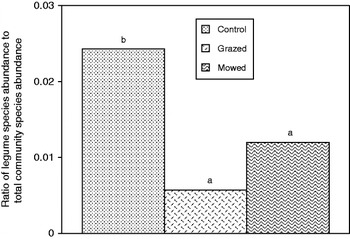
Grazing treatment. In the grazing treatment, seeded native species declined over the 3 years of the experiment (Fig. 2), varying in population size over the months and years of the experiment. Native species populations were lower in the grazing treatment compared to the control in all months, except in July 2004 (Fig. 4), and native legumes were specifically diminished. Specific legume and forb species varied in their response to treatments, with Illinois bundleflower and purple prairie clover initially at the highest frequency in the grazed treatment in the first year, but declining to negligible levels by the third year (data not shown). Bush clover populations were consistently lower in grazed plots compared to the other treatments. Similar populations of tick trefoil and Maximillian sunflower were found in the grazed and mowed plots throughout the years of the experiment.
Native legume species relative abundance under three management treatments in the third year after seeding in the prairie pasture experimental site in Marion County, Iowa, 2003–2005.

In the pasture community structure census, the relative abundance of introduced agricultural grasses in the grazing treatments was significantly higher than all other treatments (Table 5). Abundance of the total legume species (Table 5) and species richness (Table 6) were intermediate to the control and mowed treatments, with no significant differences noted among treatments. The grazing treatment had the highest DIFN, representing the most open canopy among treatments in 2004 and in 2005, when it was significantly greater than the other treatments (Table 6). The overall vegetative biomass was not significantly different among the treatments (Table 6).
Plant community components in the third year after seeding native prairie species in the pasture prairie experiment, Marion County, Iowa, 2005.

1 Introduced grasses defined as tall fescue, smooth brome, Kentucky bluegrass and orchardgrass.
2 Introduced species defined as tall fescue, smooth brome, Kentucky bluegrass, orchardgrass, white clover, red clover, birdsfoot trefoil and alfalfa.
3 Introduced legumes defined as white clover, red clover, birdsfoot trefoil and alfalfa.
4 Total legumes defined as Illinois bundleflower, purple prairie clover, bush clover, tick trefoil, white clover, red clover, birdsfoot trefoil and alfalfa.
5 Means within each column not followed by the same letter are significantly different according to Tukey's difference of the least square means at P⩽0.05; P value stated otherwise.
Vegetative cover characteristics and species richness in prairie pasture experiment in 2003, 2004 and 2005, Marion County, Iowa.

1 Diffuse non-interceptance measurement (higher values indicate greater light penetration).
2 Mean species richness per 0.04 m2 quadrat sample.
3 Means within each column not followed by the same letter are significantly different according to Tukey's difference of the least square means; NS, Not significant at P>0.05; P value stated otherwise.
Mowing treatment. In the mowed plots, total seeded native species populations remained stable throughout the experiment compared to declining populations in the other treatments (Fig. 2), but the relative abundance of native species did not differ from the other treatments. The mowing treatment tended to have the highest relative abundance of native grasses in the pasture community among all treatments, with a trend (P⩽0.12) toward higher populations than the control treatment. The frequency of native grass species was significantly greater in the mowing and grazing treatments compared to the control treatment in July 2004 and in August 2005, as grasses were observed most frequently in the final sampling periods.
Seeded native legume species, however, declined under the mowing regime. The frequency of seeded legume species was similar to the grazing treatment and significantly lower than the control at the June 2003 and July 2005 sampling periods, and lower than the grazed treatments in August 2003 (P⩽0.09) (data not shown). The abundance of native legume species was significantly lower in mowed plots than in the control after 3 years (Fig. 4). In the pasture community structure census, the relative abundance of native legume species was significantly lower than the control treatment. The relative abundance of introduced agricultural grasses was significantly greater than the control, but lower than the grazing treatment (Table 5). The mowing treatment had the same species richness as grazed plots. The mowing treatment had the highest DIFN in 2003, and a DIFN intermediate to the grazing and control treatments in 2004 and 2005 (Table 6).
Control treatment. When plots were left unmanaged, with the exception of controlled burns in 2003 and 2005, seeded native species, particularly native grasses, declined over the 3 years of the experiment, tending to occur at the lowest frequency compared to the other treatments in 2004 and in August 2005 (data not shown). Native legume species, however, tended to appear most frequently in the control treatment. The frequency of legume species was significantly higher than all treatments in June 2003 and July 2005. Native legume species’ relative abundance was significantly greater (P⩽0.05) compared to the mowing and grazing treatments by the end of the third year (Fig. 4). In the pasture community structure census, the abundance of introduced agricultural grasses was significantly lower than all treatments (Table 5).
Integration of treatment effects. The establishment of native prairie plants in an existing pasture was mitigated by several biotic and abiotic factors. Interspecific competition among diverse community members, including preemptive or overgrowth competitionReference Morin and Morin79, may have impacted native species establishment, as neighboring species competed for radiation and soil resources, leading to reduced photosynthetic capacity and growth. The native legumes experienced preemptive and overgrowth competition, with morphological and physiological features limiting opportunity to overcome competition. Their determinate growth trait, in which stem growth ceases upon shoot apices developing into inflorescences, prevents strong persistence under defoliationReference Mitchell, Nelson, Barnes, Nelson, Collins and Moore80. In addition, in upright perennial forbs, the shoot apex is located at the top of plant and, when removed, the plant must regrow from axillary buds at the base of the stems, at significant energetic cost to the plantReference Mitchell, Nelson, Barnes, Nelson, Collins and Moore80. In the mowing and grazing treatments, the legumes consistently experienced defoliation, whereas in the control treatment, the overgrowth and competition of the surrounding vegetation may have been less prohibitive to survivorship than the stresses of the vegetative removal treatments. The stress was great enough, however, to prevent high native legume or grass species abundance in the control.
Bush clover, tick trefoil and Maximillian sunflower populations were not visible in quadrat samples in the first year after seeding. By 2005, bush clover appeared in 8% of sampling units in the control, 3% in the mowing and 1% in the grazing treatments, and tick trefoil appeared in 13% of all sampling units in the control and 4% of grazing and mowing treatments’ samples. Maximillian sunflower was located in 10% of the control, 1% of the grazing and 2% of the mowing treatments’ sampling units by the third year. The increased abundances of these seeded native plants from 2003 to 2005 may have been related to delayed germination until the second season, as Maximillian sunflower and tick trefoil typically undergo germination after successive cold–dry and warm–moist stratification periodsReference Steffen, Packard and Mutel81, establishing several years after seedingReference Berg, Smith and Jacobs82. Bush clover also germinates after a combination of cold–dry stratification and acidic scarificationReference Steffen, Packard and Mutel81 and may have survived better in this experiment due to its ability to compete with grassesReference Brewer83.
In the prairie pasture system, cattle grazed both native and introduced plant species, but seemed to prefer introduced, cool-season grasses. Community richness in the grazing treatment was intermediate to the control and mowing treatments, similar to other studies on the effect of grazing on plant community composition. Damhoureyeh and HartnettReference Damhoureyeh and Hartnett46 observed a competitive release of subdominant species from grazing of dominant species, leading to heterogeneous patches with fewer dominant species, increased light penetration and warmer soil temperatures. Hartnett et al.Reference Hartnett, Hickman and Fischer Walter84 also found greater micro-site diversity as a result of preferential cattle grazing behavior, although in our experiment, the overall low community richness was associated with high DIFN and an open plant canopy in the grazed plots.
Native grasses, however, were the most abundant in the grazing and mowing treatments compared to the unmanaged control. Numerous studies have correlated high light penetration to greater germinationReference Olff, Pegtel, Van Groenendael and Bakker85 or emergence of grass seedlingsReference Gibson, Bragg and Stubbendieck86, as well as successful grass seedling establishment associations with low leaf litter and lack of neighbor presenceReference Foster and Gross22, Reference Bargelson87, Reference Potvin88, as observed in the prairie pasture.
Although studies have correlated the light penetration facilitated by mowing to increased community richnessReference Collins, Knapp, Briggs, Blair and Steinauer89, our results suggested that the non-selective elimination of biomass through mowing pushed the system toward lower community richness. Mowing plants at or below 24 cm, the average height of the native legumes’ apical meristems, may have been detrimental when applied during pre-bud and early reproduction stages and, thus, reduced the absolute and relative abundance of native legume species in this treatment. The creeping stolons and prostrate morphology of several introduced agricultural legumes, alternatively, may have persisted under mowing conditions contributing to high total legume abundance in the mowing treatmentReference MacAdam, Nelson, Barnes, Nelson, Collins and Moore44.
The highest absolute and relative abundance of legume species in the control treatment corresponded with low DIFN, greater community richness and low relative abundance of introduced agricultural grasses. Wilson et al.Reference Wilson, Bakker, Christian, Li, Ambrose and Addington78, and othersReference Fowler77 have suggested that vegetation and litter ameliorated moisture stress, outweighing light availability for successful establishment of seedlings under stressful abiotic conditions. The community richness observed in control plots was consistent with some studies but contrasted with others. Foster and GrossReference Foster and Gross22 and TilmanReference Tilman90 determined that decreased light penetration caused by litter increased mortality and decreased species richness. However, Wilsey and PolleyReference Wilsey and Polley76 found that litter removal affected seedling emergence but that decreasing light availability did not decrease plant diversity, as we observed in our experiment.
Conclusions from the Agroecological Study
Establishment of native plant species and prairie pastures in an organic setting
Researchers generally view native species dynamics: (1) as components of natural native species communities exhibiting reactions and interactions with plant neighbors, disturbances and biophysical events; (2) as extant individuals within hostile environments, sustained by niches or disturbances; or (3) as seeded species establishing in sterile environments under substantial experimental control, mandating sowing in a competition-free and clean seedbed obtained through herbicide application or tillageReference Wilson and Gerry31, Reference Wilson, Bakker, Christian, Li, Ambrose and Addington78. This experiment contributes to a new view for native species community dynamics under management tactics that are feasible for farmers in working agricultural landscapes. The results presented here suggest that the establishment of native species, sown into existing mixed pasture, can be achieved without the use of herbicides. Burning the pasture prior to sowing native species, however, was shown to be critical for successful establishment, following results from previous researchReference Wedin and Fruehling21, Reference Willson and Stubbendieck40, Reference Willson and Stubbendieck58. While native species thrived in the control treatment, grazing and mowing also were shown to suppress cool-season grasses, allowing the native warm-season species to survive. These results suggest that in a low-productivity, partially stressed and frequently managed pasture community, existing dominant species can be adequately suppressed to allow establishment of new species. Weather factors, however, including the initial drought period following prairie seed planting, most likely led to a reduced establishment rate for the native species. With the abundance of native grasses and total native species equivalent among treatments, all treatments similarly affected the pasture community in relation to native grass and total native species establishment. Legume species relative abundance, however, differed among treatments, with the control treatment exhibiting higher legume relative abundance compared to the other treatments.
This research initiated an understanding of the potential for seeding native species into existing pasturelands without herbicides. Future research, as articulated by the farmer–cooperator, could include the impact of irrigation on native species establishment and growth in prairie pastures; the potential of ‘fallowing’ first-year prairie pastures to facilitate maximum native species establishment before grazing; and an analysis of the feed value of native species present in these systems.
Project conclusions and recommendations
Innumerable pasture acres throughout Iowa yield multiple benefits on the farm and community level, in terms of livestock production, resource conservation, biodiversity enhancement and native ecosystem preservation. Such pasture systems are strong candidates for native species preservation, due to soil and site characteristics, as soils under native prairie have low nutrient availability relative to modified systems dominated by introduced species. Despite encroaching urbanization in the Marion County, Iowa, cow–calf systems and their pasture base continue to provide significant opportunities to contribute to native habitat diversity. Factors affecting grassland implementation and improvement are multifaceted, however. According to the Marion County agricultural agency officials, matching site conditions with appropriate pasture management was viewed as a challenge for most producers, requiring additional educational and program supportReference Mayer and Mensching91. Additionally, the idea of prairie pastures was novel and untested in their estimation. Although economic analysis was not a component of this specific prairie pasture establishment research, we can extrapolate potential economic benefits from a review of the organic and grass-based cattle literature. According to Acevedo et al.Reference Acevedo, Lawrence and Smith92, annual costs for organic grass-legume pastures averaged $281 ha−1, which were greater than conventional feed costs. Selling organic hay, after herd needs are met, however, was found to garner organic operators a 10–30% premium over conventional hay prices. Provided certified organic regulations are followed from the last third of the cow's gestation period and herd health is maintained through organic-compliant treatments, organic beef sales combined with organic hay sales from cattle raised in a prairie pasture system could add to the farm's overall economic viability. The proposed system also offers risk reduction by diversification of product sales and timing of income.
Cow–calf operators identified through the sociocultural study, who were interested in protecting remnant species on their land and practicing environmental stewardship by avoiding plowing or herbicides would be ideal candidates for prairie pasture systems. In pursuing the organic, grass-finished beef market, the farmer–cooperator in the prairie pasture experiment reiterated his motivation, ‘Our first priority is to keep our farm wild. Our second priority is to get an ecological profit.’ He concluded, ‘Farmers with a land ethic are hidden…but they're growing.’ A better understanding of these diverse farming systems and farmers’ motivations for protecting biodiversity, and documentation of the economic value of environmental services obtained from grass-based and organic cow–calf operations can contribute to the formulation of more effective agricultural policies. Incorporating native grasses and forbs into otherwise marginal rangeland or pasture falls within the mandate of the Conservation Stewardship Program (formerly the Conservation Security Program) (‘CSP’) as authorized in the US Farm Bill (Food, Conservation and Energy Act of 2008). Government programs, such as the CSP and EQIP, can provide incentives for sustaining a farm landscape consisting of diverse, grass-based agricultural systems that support rural livelihoods and environmental quality. Plans for repeating this study on other farms in Marion County are underway in order to develop additional recommendations for ecologically based, organic cow–calf operations.