Introduction
Bipolar disorder is a chronic and devastating major mental illness that may affect up to 5% of the population Reference Berk, Dodd and Berk(1). Substance abuse or dependence is highly prevalent in bipolar disorder Reference Regier, Farmer and Rae(2) and is associated with an increased rate of relapse and number of hospitalisations (Reference Goldberg, Garno, Leon, Kocsis and Portera3–Reference Cassidy, Ahearn and Carroll5).
The role of oxidative biology in substance use disorders in not fully understood, but some agents such as amphetamines robustly increase oxidative stress, and have been used as animal models of oxidative stress in psychiatric disorders Reference Castro, Moretti, Casagrande, Martinello, Petronilho, Steckert, Guerrini, Calo, Dal Pizzol, Quevedo and Gavioli(6). In addition, there has been strong evidence that oxygen-free radicals may play an important role in the pathophysiology of major mental illnesses like bipolar disorder and schizophrenia Reference Reddy and Yao(7).
Much of the focus on antioxidant defence mechanism has been on the key scavenging antioxidant enzymes; superoxide dismutase (SOD), catalase (CAT) and glutathione peroxidase (GPx) that are altered in bipolar disorder and schizophrenia Reference Reddy and Yao(7). GPx catalyses the scavenging of hydrogen peroxide and other radicals by glutathione. Decreased peripheral GPx activity has been described in bipolar disorder, which normalised with treatment Reference Ozcan, Gulec, Ozerol, Polat and Akyol(8). Several plasma lipid peroxides like malondialdehyde (MDA) and thiobarbituric acid reactive substances (TBARS) have recently been studied in bipolar disorder (Reference Machado-Vieira, Andreazza and Viale9–Reference Frey, Andreazza and Kunz11) and schizophrenia (Reference Grignon and Chianetta12–Reference Gama, Salvador and Andreazza15), providing evidence of increased levels of lipid peroxidation products in the plasma of people with bipolar disorder and schizophrenia.
Glutamate is thought to have a critical role in the neurobiology of addiction Reference Kalivas and O'Brien(16). In addition, magnetic resonance spectroscopy studies of patients with bipolar disorder have found an increase in the glutamine /glutamate combined signal in frontal lobes, basal ganglia and left dorso-lateral prefrontal cortex Reference Stork and Renshaw(17). The nucleus accumbens (NA) is a key neural substrate underpinning drug reward. In the NA, basal levels of extracellular glutamate are maintained primarily by the exchange of extracellular cysteine for intracellular glutamate, through the cysteine glutamate exchange system. This exchange system is ubiquitous in the brain, and also has a role in protecting against oxidative stress by providing cysteine, the rate-limiting factor, for glutathione synthesis. Glutathione is the brain's principal oxidative free radical scavenger and substance use has been associated with increased oxidative stress Reference Wozniak, Musialkiewicz and Wozniak(18) In addiction, there is a persistent reduction in cystine–glutamate exchange in the NA, which may contribute to pathological glutamate signalling. Drug withdrawal is further associated with reduced glutamate, as a result of decreasing the exchange of extracellular cysteine for intracellular glutamate Reference Baker, McFarland and Lake(19). The effects of glutamate in the NA are mediated by group II metabotropic glutamate autoreceptors.
N-acetylcysteine (NAC) increases extracellular levels of glutamate and thereby stimulates group II metabotropic glutamate receptors Reference Moran, McFarland, Melendez, Kalivas and Seamans(20). Increasing glutamate in the NA blocks craving and the re-instatement of compulsive drug-seeking behaviours. In a rat model of cocaine addiction, McFarland et al. Reference McFarland, Lapish and Kalivas(21) reported that drug-seeking behaviour was mediated by prefrontal glutamate release into the NA. Concordant with this, NAC prevented escalation of drug intake and behavioural sensitisation in an animal model of cocaine addiction Reference Madayag, Lobner and Kau(22). Baker et al. Reference Baker, McFarland and Lake(19) have also shown that NAC prevented re-instatement of drug-seeking behaviour through stimulating cysteine glutamate exchange, in a cocaine model of addiction. NAC also blocks heroin-induced re-instatement behaviour and cue responsivity, suggesting that this mechanism plays an important role in the reward circuitry in addictive states Reference Zhou and Kalivas(23). Thus, NAC treatment may be able to restore extracellular glutamate in NA, which may inhibit compulsive behaviours and reduce cravings Reference Grant, Kim and Odlaug(24). The ability of NAC to increase the activity of the cysteine glutamate exchange system, and thus increase glutamate through restoring exchanger activity is mediated through metabotropic glutamate receptors, which regulate the release of vesicular dopamine and glutamate Reference Moran, McFarland, Melendez, Kalivas and Seamans(20). Dopamine is also a key component in reward and re-instatement behaviour Reference Baker, McFarland and Lake(19), and might be one key pathway whereby NAC might be active in the treatment of addiction.
Brain glutathione (GSH) is readily replenished by elevating plasma levels of its rate-limiting precursor, cysteine. Oral NAC is bioavailable, and is de-acetylated in the liver Reference Burgunder, Varriale and Lauterburg(25,Reference Holdiness26), and is a viable method for replenishing brain GSH. Animal models have confirmed that administration of NAC protects against GSH depletion Reference Dean, Van Den Buuse, Copolov, Berk and Bush(27). A neuroprotective effect of NAC has been suggested by protection in a variety of neurodegenerative disease models (Reference Andreassen, Dedeoglu, Klivenyi, Beal and Bush28–Reference Ferrari, Yan and Greene34). In randomised, double-blind, placebo-controlled clinical trials, NAC adjunctive to treatment as usual has been demonstrated to be efficacious for the treatment of schizophrenia Reference Berk, Copolov and Dean(35) and bipolar disorder Reference Berk, Copolov and Dean(36). Substance use is an important comorbidity in bipolar disorder. Oxidative stress has been found in both bipolar disorder and addiction, suggesting that NAC may be worth investigating for the treatment of both of these disorders.
In this study, data on substance use were collected from a 24-week, double-blind, randomised, placebo-controlled efficacy trial of NAC in bipolar disorder Reference Berk, Copolov and Dean(36).
Material and Methods
Full methodological details of the primary trial are published elsewhere Reference Berk, Copolov and Dean(36). Participants had a diagnosis of bipolar disorder (I or II) with at least one documented episode of illness in the past 6 months. Exclusion criteria were an episode of illness in the previous 1 month, pregnancy or lactation, or a relevant medical disorder. Eligible participants were assigned randomly and consecutively to either two 500 mg capsules b.i.d. (twice daily) to a total of 2 g daily of NAC (n = 38) or placebo (n = 37) in a double-blind fashion for 24 weeks. Participants were assessed by a trial clinician at baseline (week 0), and weeks 2, 4, 8, 12, 16, 20 and 24, and for a final visit after discontinuation and washout at week 28.
Withdrawal from the trial occurred if participants ceased taking their trial medication for 7 consecutive days, ceased effective contraception or became pregnant. Dose changes to existing medications (either increases or decreases in dose), or addition or removal of an agent were accepted and participants were allowed to continue with the trial. Participants were withdrawn from the study if they decided to withdraw their consent.
Information regarding the participant's initial substance use was obtained. These data were collected at baseline prior to dispensing the trial medication to measure substance use. The questionnaire used provided a quantified measure of ethanol (alcohol ), caffeine, nicotine (tobacco), alpha-methyl-phenethylamine (amphetamine), delta-9-tetrahydrocannabinol (marijuana), methylene-dioxy-meth-amphetamine (ecstasy), opiates and benzodiazepines and was used as a reference in determining whether the use of substances had increased or decreased.
The Clinical Global Impression—Substance Use (CGI-SU) (Appendix A), was a modification of the CGI Reference Guy(37), and was used to measure change in substance use during the trial. It was administered at all study visits after commencing treatment (weeks 2 to 28) by a trained clinician. The CGI-SU rates change from baseline in substance use for alcohol, tobacco, caffeine, cannabis and up to two ‘other’ substances. The CGI-SU asks participants to rate on a 7-point Likert scale their change in substance use for each substance, where 1 = don 't use at all now, 2 = using much less, 3 = using slightly less, 4 = unchanged , 5 = using slightly more, 6 = using much more and 7 = using very much more.
Statistical analyses were performed using Minitab Statistical Package Release 14 and Statistical Package for the Social Sciences (SPSS) for windows version 14 software. A blinded code for NAC treatment and placebo was used during the analyses. Between-group comparisons were Student's t-test, for parametric data. Fisher's exact test was used to compare dichotomy variables between groups. A General Linear Model adjusted for treatment and pooled investigator was used to determine changes between treatment and placebo groups.
Between-group comparisons for age, gender and treatment sector (private or public) was conducted using data collected at baseline. Between-group comparisons for current mood status were conducted using Montgomery Åsberg Depression Rating Scale (MÅDRS) and Young Mania Rating Scale (YMRS). Data were collected at visit 2 (week 2), as visit 2 was the first occasion that the MÅDRS and YMRS scales were administered to study participants. Participants with an MÅDRS score of 10 or higher were classed as currently depressed and participants with a YMRS score of 12 or higher were classed as currently manic. These scores were used to determine a ‘yes/no’ classification for current depression or mania.
Substance use recorded from the Habits instrument Reference Guy(37) at baseline was also dichotomised into a ‘yes/no’ classification, where 0 = doesn 't usually drink/smoke/use was classified as ‘no’. The remaining 1–5 responses were classified as ‘yes’. Similarly, scores for change in substance use measured using the CGI-SU were also dichotomised for statistical analysis: 1–4 = improvement or no change and 5–7 = slightly to very much worse.
This study protocol was approved, by the by, the Barwon Health Research and Ethics Advisory Committee and the Bendigo Health Care Group Human Research Ethics Committee. In accordance with the Declaration of Helsinki, all participants were advised about the procedure and they signed the informed consent prior to participation in the study.
Results
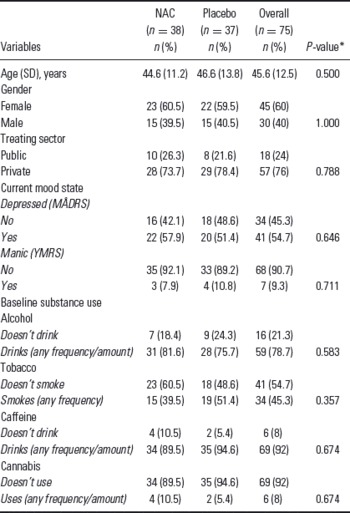
Comparisons at the baseline visit between NAC- and placebo-treated participants for age, gender, treating sector and substance use or at visit 2 for mood state, suggested that the two groups were not significantly different (Table 1). Fifty-eight (77.3%) participants completed the trial.
Participant characteristics at baseline

* Continuous data analysed using the 2-sample t-test, categorical data analysed using the Fisher's exact test. Data are given as mean (standard deviation) or number (percentage).
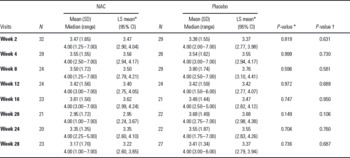
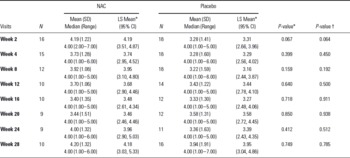
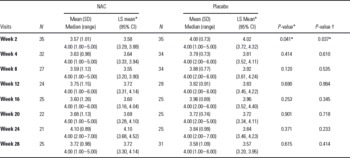
Comparisons for change in substance use between NAC- and placebo-treated participants was calculated for alcohol, caffeine and tobacco use only, as there were not enough participants who used other substances to permit statistical comparisons. No significant difference was observed between NAC- and placebo-treated participants for change from baseline in alcohol or tobacco at any of the study visits. A significant decrease (p < 0.05) in caffeine use was observed for NAC-treated participants, compared to placebo-treated participants, at study visit 2 (2 weeks); however, this difference did not remain statistically significant at any of the other study visits (Tables 2–4).
Mean alcohol (observed cases) scores by NAC and placebo groups for each visit

SD, standard deviation; LS mean, least squares mean; CI, confidence interval.
* General linear model (GLM) adjusting for treatment and pooled investigator,
† Wilcoxon rank-sum test.
Mean smoking (OC) scores by NAC and placebo groups for each visit

SD, standard deviation; LS mean, least squares mean; CI, confidence interval.
* General linear model (GLM) adjusting for treatment and pooled investigator,
† Wilcoxon rank-sum test.
Mean caffeine (observed cases) scores by NAC and placebo groups for each visit

SD, standard deviation; LS mean, least squares mean; CI = confidence interval. *P < 0.05.
* General linear model (GLM) adjusting for treatment and pooled investigator,
† Wilcoxon rank-sum test.
Discussion
This study provides negligible evidence to suggest that NAC may impact on substance use. NAC was superior to placebo for reducing caffeine use, but not for other substances, and the benefit was only observed at week 2 of treatment. The reduction in caffeine use may be mediated through a shared mechanism of drug re-instatement, mediated through glutamate or through the effects of glutathione and oxidative biology. These results need to be replicated in larger samples, with additional studies to investigate the mediating pathways.
The CGI-SU scale proved to be a useful and an easy-to-administer scale, which could easily be added as an outcome measure for inclusion in a clinical trial.
The principal limitation of this report is that the clinical cohort was selected on the basis of its meeting the criteria for bipolar disorder, not concomitant substance use, and hence the trial was powered for clinical parameters. The rates of substance use in the cohort were low, which did not lend the statistical power to detect clear between-group differences. A larger sample size would be necessary to increase the statistical power. The fact that the impact on substance use was not a primary outcome of the trial might serve to reduce clinician or subject expectations and hence bias the results.
The clinical utility of NAC as a treatment for substance use is still to be fully defined. Further studies will be required to determine if NAC can be a useful treatment for substance use, either as monotherapy or as an adjunct to other therapies. It would be particularly useful to conduct a trial of NAC in a substance-using population.
Appendix A: Clinical Global Impression Scale for Substance Use