INTRODUCTION
The provision of high-quality patient care at the end of life is essential, yet poor practice in the United Kingdom has provoked media coverage, public concern, and government enquiries (Department of Health, 2008; Francis, Reference Francis2013). Effective clinical communication is fundamental to compassionate care for dying patients, and healthcare professionals need the skills and confidence to communicate openly and sensitively with patients and their families (NHS, 2011). End-of-life care can be challenging, and many nursing students feel unprepared and uncomfortable, and lack confidence in communicating with dying patients and their families (Cooper & Barnett, Reference Cooper and Barnett2005; Allchin, Reference Allchin2006; Parry, Reference Parry2011). Medical students report that a loss of confidence and a lack of exposure to dying patients limit their opportunity to develop appropriate communication skills (Billings et al., Reference Billings, Engelberg and Curtis2010; Gibbins et al., Reference Gibbins, McCoubrie and Forbes2011). Healthcare professionals' lack of confidence and competence in communicating can negatively affect the quality of care given to dying patients, and this aspect of health professional education certainly requires attention.
The current paper reports a pilot study undertaken collaboratively by academics in two London institutions: a school of nursing and midwifery and a medical school at a university. The study evaluated the effectiveness of simulation using patient actors to enhance the self-perceived skills and confidence of nursing and medical students when communicating with dying patients and their families. Focus groups with students informed the development of an intervention, and we report on the key findings obtained with that instrument. We also discuss findings from questionnaires completed by students to evaluate the effect on self-perceived confidence and competence. Additionally, the acceptability and feasibility of introducing the intervention into the wider nursing and medical curricula are considered, with recommendations for future developments and research.
BACKGROUND
More than half a million people die each year in England, the majority in National Health Service (NHS) hospitals (NICE, 2011). Recent national policy initiatives such as the End of Life Care Strategy (Department of Health, 2008) and the National End of Life Care program (NHS, 2011) emphasize the importance of effective communication between healthcare professionals and the people they care for. Good communication improves the overall well-being of those facing death and the support provided to their family and friends (NICE, 2011). Open communication can empower people to make choices and express their wishes regarding end-of-life decisions and contributes to the provision of patient-centered care by enabling identification and management of specific care needs (Ahrens et al., Reference Ahrens, Yancey and Kollef2003; NHS, 2011). Communication potentially optimizes the chances of the patient experiencing a “good death,” a concept that is increasingly viewed as the benchmark for high-quality end-of-life care (Kehl, Reference Kehl2006; NHS, 2011).
Within modern Western society, open discussion about death and dying is limited, with death still considered a taboo subject. Many health professionals, despite regularly facing the reality of dying, find discussing death with patients challenging and stressful (Costello, Reference Costello2011). Empirical evidence suggests that nurses also experience apprehension, discomfort, and anxiety when caring for patients at the end of life (Peterson et al., Reference Peterson, Johnson and Halvorsen2010). Anxiety about communicating with dying patients can impede the provision of effective end-of-life care and make it difficult to learn communication skills in practice. Given the challenging nature of the subject, it is important to provide students with a safe and supportive learning environment combined with the most effective teaching strategies. Developing an educational intervention using simulation potentially provides students with an engaging and innovative opportunity to develop the skills and confidence necessary to communicate effectively with dying patients and their families, and the effectiveness of this approach is the focus of the present study.
In the United Kingdom, both the Nursing and Midwifery Council (2010) and the General Medical Council (2009) recommend simulation as an educational approach to preparing students for practice. Other countries—including the United States, Canada, and Australia—are increasingly using simulation as part of medical and nursing education. There are many types of simulation. Bradley (Reference Bradley2006. p. 254), for one, describes it as spanning
a spectrum of sophistication, from the simple reproduction of isolated body parts through to complex human interactions portrayed by simulated patients or high-fidelity human patient simulators replicating whole-body appearance and variable physiological parameters.
Simulation is achieving prominence in healthcare education as a way of providing students with a safe and realistic learning experience in which to develop competence and confidence (Berragan, Reference Berragan2011). Notably, research suggests positive correlations between clinical simulation and students' confidence in their ability to perform clinical skills such as communication in the clinical setting (Lauder et al., Reference Lauder, Roxburgh and Holland2008; Pike & O'Donnell, Reference Pike and & O'Donnell2010). It is an established method in the clinical communication strand of the undergraduate medical curriculum at the study site and is also evident within the prequalification nursing curriculum. This pilot study provided an opportunity to expand this approach to an interprofessional student group and to evaluate the effectiveness and feasibility of simulations, using simulated patients, for provision of end-of-life education with a specific focus on communication.
STUDY AIM AND OBJECTIVES
Our study aimed to evaluate the effectiveness of simulation to enhance the skills and confidence of nursing and medical students when communicating with dying patients and their families. Further objectives were to
-
• identify the main concerns of nursing and medical students when communicating with dying patients and their families, and
-
• develop an educational intervention to enhance the skills and confidence of students when communicating with dying patients and their families.
The study also sought to gain a broader understanding of the potential application of simulations within nursing and medical education, particularly for development of the communication skills required for end-of-life care. It was anticipated that this would facilitate a better understanding of nursing and medical students' views about interprofessional learning in relation to this topic and provide insights into the acceptability and feasibility of incorporating simulations into the curricula.
SETTING AND PARTICIPANTS
The study took place at a large London university. Participants were recruited from a cohort of second-year pre-registration B.Sc. nursing students (n = 180) and fourth-year medical students (n = 450) enrolled in the M.B.B.S. degree program. Faculty deans gave permission for access and students received information about the study during discipline-specific main-hall lectures. Students expressing interest in the study received written information and returned a signed consent form if they wished to participate in the focus group, the simulated teaching session, or both. It was explained that the first 10 students returning signed consent forms from each discipline would be invited to participate in the focus groups, and that the first 48 would be asked to participate in the simulation.
A total of 67 students (medical, n = 20; nursing, n = 47) consented to participate in the focus groups and 75 (medical, n = 24; nursing, n = 51) in the simulated teaching sessions. Approval was obtained from the university ethics committee prior to recruitment. Codes were utilized for all written data to ensure anonymity.
METHODS
Study Design
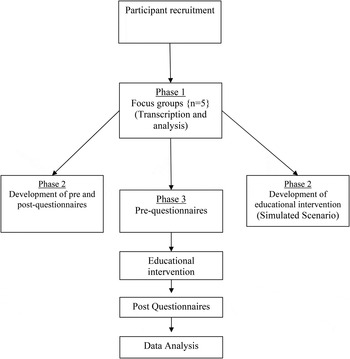
A mixed-methods design was employed including both a qualitative and a quantitative component (Figure 1). Data collection involved the use of focus groups (phase 1) and pre and post questionnaires (phase 3). Development of the educational intervention (phase 2) formed a further component of the study design.
Study design.

Phase 1: Focus Groups
Conducting focus groups with students during educational development work allows their experience and perceptions to inform the development of subsequent educational interventions (Webb & Kevern, Reference Webb and Kevern2000; Lefroy at al., Reference Lefroy, Brosnan and Creavin2011). In our study, the purpose of the focus groups was to explore medical and nursing students' experience of communicating with dying patients and their families. Identifying the aspects of concern to the students facilitated the development of a tailored educational intervention related to communicating at the end of life.
Several focus groups were conducted: 3 with medical students (n = 10) and 2 with nursing students (n = 9). Conducting single-discipline focus groups allowed each to identify issues of particular concern to them. Additionally, it was assumed that students might feel more comfortable in discussions with their peer group than they would in a mixed group (Barbour, Reference Barbour2005).
The focus groups were held on campus and lasted between 32 and 64 minutes. The nursing students knew the moderator (KG) and assistant moderator (JB), but neither had a role in student assessments. Issues presented for discussion included their experience of communicating with dying patients and their families, which incorporated exploration of what students found challenging and their levels of confidence.
Discussions were digitally recorded and transcribed verbatim. Both investigators (JB and KG) undertook thematic analysis of the data independently, reading, rereading, and coding the data into common themes. To maximize rigor, key themes agreed upon at a consensus meeting were used to describe the data. Analysis of data generated from the focus groups confirmed that students found dealing with emotions such as grief and anger to be challenging. The analysis also confirmed that both medical and nursing students lacked confidence in communicating with dying people and their relatives. Students in all focus groups viewed simulation as an opportunity to develop their communication skills without the risk of distressing dying patients or their families.
Phase 2: Development of the Educational Intervention
Experiential learning is the most effective way of developing communication skills (Aspegren, Reference Aspegren1999; Lane & Rollnick, Reference Lane and Rollnick2005). As an active process, experiential learning provides students with the opportunity to link new information and experiences with their existing knowledge and understanding (Maran & Glavin, Reference Maran and Glavin2003). Gillan and colleagues (Reference Gillan, van der Riet and Jeong2014) proposed that end-of-life care simulation may help prepare students to provide quality end-of-life care,, and an interprofessional pilot study involving role-play, videos, and discussion has been positively evaluated (Efstathiou & Walker, Reference Efstathiou and Walker2014). A limitation of role-play involving only students or faculty is that students can find the situation unrealistic due to the distraction of seeing a friend or lecturer playing a role (Koponen et al., Reference Koponen, Pyörälä and Isotalus2012). There is also a potential emotional cost for a student or faculty member in taking on the role of a dying patient or relative.
The fidelity of an educational simulation relates to how closely it reproduces a real-life situation and therefore how much participants can behave as if they were engaged in an actual healthcare activity and might relate to the environment, equipment, and/or emotion (Meakim et al., Reference Meakim, Boese and Decker2013). In this project, emotional fidelity was the most important consideration, with the aim being to emulate real end-of-life conversations. Maran and Glavin (Reference Maran and Glavin2003, p. 25) suggested that simulated patients are the highest-“fidelity” simulators and that they are particularly appropriate for teaching communication and interpersonal skills. Using simulated patients reduces the risks for students and avoids any risk to real patients, which was a concern expressed by the students in the focus groups. The actors involved in this pilot study were members of the medical school acting troupe, trained to give structured feedback to students from their character's perspective. Compared to role-play with peers/faculty, simulated patients increase credibility and decrease the emotional cost of “volunteering” to play the patient or relative. Professional training enables actors to come out of a role easily, which can be reassuring for students to witness.
The two clinical scenarios developed for the simulation represented encounters students might be involved with during their education (rather than expecting them to imagine how they might behave when qualified). One scenario related to a man with advanced cancer and the other involved his wife with concerns about caring for her dying husband at home. Both scenarios provided an opportunity for students to explore and respond to concerns and emotions. The intention was to facilitate dynamic and open communication, with a focus on active engagement with the patient/relative.
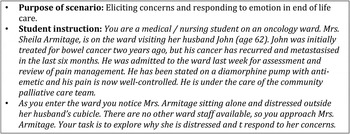
The scenarios addressed the concerns raised by students involved in the focus groups about dealing with challenging emotions and provided an opportunity to address issues such as disclosure of feelings and concerns, sensitivity to patient cues, and expression of empathy. There were no specific “content” expectations, and the aim was to focus the conversation on psychosocial issues rather than “practical” problems. The overall goal was for students to manage being with someone who is experiencing strong emotions, rather than there being an expectation that they would resolve the cause of those emotions. Another aim was to counter the belief that there was a definite “right” thing to say. (See Figure 2 for a sample scenario outline and student tasks.)
Simulated scenario details.

Phase 3: Implementation of the Educational Intervention and Questionnaires
The pilot study for the educational intervention took place with five groups of volunteer students. Each group had two facilitators, one experienced in working with simulated patients and the other in teaching end-of-life care. The groups of five or six students (n = 27) consisted of approximately even numbers of nursing and medical students. Given the potentially challenging nature of the topic, the small group size was advantageous, and students commented on this in their anonymous evaluations:
It was great to get feedback in small groups. Other simulations have been intimidating due to the number of people in the room.
I think for scenario learning to work the groups need to remain small, as the group was today. Any larger, and shy group members, such as myself, would not feel safe to put themselves forward.
However, even with small groups some people found it difficult. One student would have preferred to do this alone:
Individual, [where] everyone has the opportunity without the group, just examiner and actor with personalized marks and feedback.
The session was structured and timed, lasting for 45 minutes. It started with a pre-briefing to orientate students to the environment, roles, timing, and patient situation. Pre-briefing was aimed at developing students' ability to appraise the simulated clinical situation and assess patient needs, and to apply their existing knowledge (Page-Cutrara, Reference Page-Cutrara2014). Participants agreed to follow established ground rules (developed for use in simulations by the medical school). The aim was to create a comfortable and safe atmosphere through respect for the contributions of all group members and by giving constructive feedback. All groups participated in both the “patient” and “wife” scenarios.
Two volunteers from each group practiced their skills by directly interacting with the simulated patient/relative from the perspective of a student. The remaining members of the group and the facilitators were present in the room. Students had the option of taking “time out” at any point in the interaction. This provided the opportunity to gain support and suggestions from other members of the group. The interaction was limited to 10 minutes, so as to provide a time boundary for the students to work within.
Following the interaction, the student had the opportunity to debrief and reflect, followed by feedback from the actor, the students, and the facilitators. The student was encouraged to reflect on what they aimed to do, to what extent they achieved that, what helped, and what they found challenging. Given the issues raised in the focus groups, it was important to consider how the student's own emotional response to the scenario might have affected the interaction. During the feedback process, it was possible to refer back to the simulated patient at any point to get their perspective, and students appreciated this:
The actors were a great resource because they had some interesting insights into ways of communicating.
Effective simulation debriefing should be supportive but balanced, identifying areas that call for further development as well as what the student has done effectively. One student expressed concerns that the focus of feedback was too heavily on the positive aspects of the encounter:
Often too much focus on the positives that are drawn out of these simulated communications and not enough feedback on what could have been done and what was actually bad.
Facilitated structured and specific feedback enables students to reflect on their experience as a resource for learning (Maran & Glavin, Reference Maran and Glavin2003). The session ended by identifying the existing skills of the students, the objective being to increase their confidence in communicating with dying people and their relatives and to identify areas in need of further development:
I found it useful in that for once it was most beneficial to not give solutions [and listen] than it was to bombard someone with many solutions.
I learned a lot about myself and my feelings, which will help me deal with difficult situations.
Evaluation
The effectiveness of the educational intervention was evaluated by comparing pre- and post-intervention participant questionnaires.
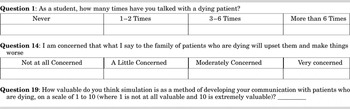
The pre-simulation questionnaire was organized into five sections. Section A sought information about students' experiences communicating with dying patients and their families. Section B was aimed at obtaining students' views about their self-perceived levels of confidence and competence in this area, and section C contained items related to their levels of self-rated confidence responding to the emotional distress of patients, family members, and colleagues. Likert-type scales were utilized, with students being asked to select one response from a choice of five to indicate their level of agreement with a series of statements. Examples of these items are given in Table 1.
Examples of items from the pre and post questionnaires

In section D, students rated on a scale from 1 to 10 how well supported they felt when involved in the care of dying patients and their families. Sections E and F contained further questions that addressed the demographic attributes of the students and how well their educational programs were preparing them to communicate with dying patients. Students' expectations of interprofessional education using simulation were also obtained.
The post-intervention questionnaire evaluated students' perceptions of the effect of the simulated session on their levels of confidence and competence when communicating with dying patients and their families. Additionally, the questionnaire sought to determine students' confidence in responding to emotional distress and their level of concern about causing upset or distress. Items pertaining to the perceived value of simulated scenarios and interprofessional learning were included, and there were two free-text spaces for further comments.
Both questionnaires were subject to peer review prior to use so as to ensure ease of comprehension, clarity, and timeliness. Students were assured that completion of questionnaires was voluntary and that their participation would remain anonymous.
Analysis of numerical data generated from the questionnaires was carried out using the Statistical Package for the Social Sciences (SPSS) for Windows (v. 17, SPSS Inc., Chicago). Following the advice of a statistician, descriptive statistics were employed to summarize the data as well as inferential statistical tests (i.e., the Wilcoxon test). Thematic analysis was utilized to analyze the free-text comments.
FINDINGS FROM QUESTIONNAIRES
The pre and post questionnaires were completed by 28 students (medical students, n = 13; nursing students, n = 15), more than half (52%) of whom were under the age of 25 years. In addition, both genders were represented in our sample (males, n= 7; females, n = 21).
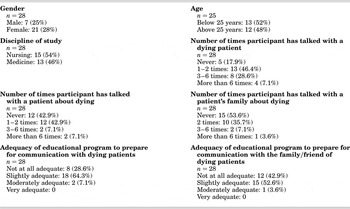
Pre-simulation questionnaire findings showed that the students had had little experience communicating with dying patients and their families. Some 18% of respondents (n = 5) reported that they had never talked with a dying patient, and 4 of these were medical students. Furthermore, 43% (n = 12) indicated that they had never talked with a patient about dying, and, again, the majority of these were medical students (n = 7). In relation to communicating with a patient's family about dying, less than half (47%, n = 15) the respondents stated that they had such experience, but most of the medical students (n = 9) and 6 of the nursing students reported never having had such experience. In total, 65% (n = 18) of students felt that their educational program had prepared them “only a little” to communicate with dying patients, whereas 29% (n = 8) felt it had not prepared them at all, and 5 of these respondents were medical students. A summary of these data is presented in Table 2.
Summary of key baseline participant data from the pre-simulation questionnaire

Levels of Confidence Communicating with Dying Patients and Their Families
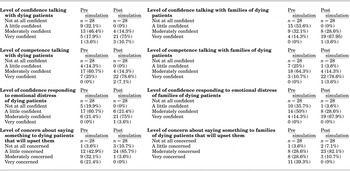
Prior to participating in the simulated scenario, 79% (n = 22) of participants reported feeling not at all confident or only a little confident about communicating with dying patients. When analyzed using the Wilcoxon rank test, self-perceived confidence levels increased significantly (Z = –4.420, p < 0.05) after the simulation session, with 86% (n = 24) reporting that they felt either moderately or very confident. Similar findings emerged from data pertaining to levels of confidence when communicating with the family and friends of dying patients. Again, significant differences were found between pre- and post-questionnaire data (Z = –4.407, n = 26, p < 0.05). Prior to the simulated scenario, the majority (86%, n = 24) of students reported that they felt not at all confident or only a little confident, while afterwards 71% (n = 20) reported feeling either moderately or very confident.
Levels of Competence Communicating with Dying Patients and Their Families
Pre-simulation questionnaire findings showed that 75% (n = 21) of participants did not feel at all competent or felt only a little competent regarding their ability to communicate with dying patients. After the simulation, the majority of students reported increased levels of competence, with 85% (n = 24) reporting being either moderately competent or very competent (Z = –3.984, p < 0.05). Similar findings emerged regarding self-perceived competence when talking with the family of dying patients. Before the simulation, 89% (n = 25) of respondents reported either feeling not at all competent or only a little competent. After the simulation session, 82% (n = 23) of students perceived themselves as being either moderately or very confident, and this represented a statistically significant finding (Z = –3.951, p < 0.05).
Responding to Emotional Distress
Prior to the simulated scenario, 79% (n = 22) of participants reported feeling not at all confident or only a little confident in their ability to respond to the emotional distress of dying patients. The Wilcoxon rank test showed that these confidence levels increased significantly (Z = –3.947, p < 0.001) following the simulation session, with the majority (n = 27, 91%) reporting that they felt moderately or very confident.
Causing Upset
When questioned prior to taking part in the simulated scenario, most participants (n = 27, 96%) reported being concerned about saying something to dying patients that would upset them, with 53% (n = 15) identifying the level of concern as moderate or higher. Although most (n = 25) still felt concerned about this after the simulation, the level of concern had fallen significantly, with the majority (n = 24, 86%) feeling only a little concerned (Z = –3.787, p < 0.001) (Table 3).
Summary of students' perceived levels of confidence, competence, and concern when speaking with dying patients and their families from pre- and post-intervention questionnaire

Analysis of the free-text comments suggested that students viewed the simulated experience positively. Many respondents commented on its value in terms of the impact it would have on their future practice:
Was a good experience to watch my peers navigate very difficult interactions. It has been a positive experience for my own future.
A really helpful experience. I learned a lot about myself and my feelings, which will help me deal with difficult future situations.
Others indicated that they felt it should be a compulsory part of the curriculum:
I found it a very useful and valuable experience. Thank you. I think that something like this should be compulsory in the curriculum.
Excellent session! Please, can we have these on the timetable for nursing?
Students had mixed views regarding the interprofessional nature of the simulated teaching session, with most viewing it as a positive opportunity; however, a number of nursing students were less than enthusiastic about working with medical students:
It was very useful to undertake the simulation with nursing students and to hear from their perspectives
Although it was nice to meet medical students, we did not really interact. They were more forthcoming in volunteering, which was a shame, as it would have been nice for a nurse to give it a go
DISCUSSION
The pilot study set out to evaluate the effectiveness and feasibility of using simulated patients to enhance the skills and confidence of nursing and medical students when communicating with dying patients and their families. There is currently limited research about the use of simulations for end-of-life care education (Hamilton, Reference Hamilton2010). The findings of our study support existing evidence suggesting that simulation is an effective educational strategy to alleviate anxiety and assist in the development of the skills and confidence required for this crucial aspect of patient care (Bremner et al., Reference Bremner, Aduddell and Amason2008; Hamilton, Reference Hamilton2010; Sanford, Reference Sanford2010). Simulation allows students to develop skills in a safe, structured, and supportive environment (Berragan, Reference Berragan2011), and also facilitates exposure to realistic challenging patient care scenarios designed to reflect what students may confront in a clinical setting (Sanford, Reference Sanford2010). Additionally, it provides the opportunity for nursing and medical students to face their anxieties about their level of preparation for this specific facet of practice (Berragan, Reference Berragan2011), thereby potentially increasing confidence, as reflected in our findings.
Notably, the findings from this study revealed that all students reported limited exposure to dying patients and their families, although this was more pronounced in medical students. This finding is similar to that of Gibbins et al. (Reference Gibbins, McCoubrie and Forbes2011), who also reported medical students having concerns about their limited contact with dying patients during medical school training. Nursing students also identified a need for more experience communicating with patients who are facing death.
All students highlighted anxieties about talking to patients and families about dying and expressed a fear of upsetting them, and it was apparent that they felt inadequately prepared for this aspect of their future professional roles. This finding supports the existing literature suggesting that academic programs fail to prepare healthcare students to provide effective end-of-life care (Allchin, Reference Allchin2006; Meyers & Raspa, Reference Meyers and Raspa2007). There is clearly a need for a greater emphasis on communication at the end of life to be integrated into both pre-registration nursing and medical curricula. This is particularly pertinent given the impact communication has on the quality of care provided by nurses and doctors, and the current concern within the United Kingdom regarding care of the dying (NHS, 2011; Francis, Reference Francis2013).
Interprofessional education prepares graduates to work effectively and collaboratively in complex healthcare teams. It also increases students' understanding of the contributions made by each discipline to patient care (Lapkin et al., Reference Lapkin, Levett-Jones and Gilligan2013). One key success of this pilot study was the development and implementation of an interprofessional educational strategy, as this is not always easily accomplished (Schim & Raspa, Reference Schim and Raspa2007). A particular problem was timetabling and resourcing sessions to allow both medical and nursing students to attend at the same time.
Not all participants appreciated working with students from another discipline, with nursing students being less enthusiastic about learning collaboratively alongside their medical school colleagues. Medical students were more familiar with the simulated teaching approach than nursing students, which possibly contributed to them being keener to volunteer for the interactions, and this may have also influenced our findings.
STUDY LIMITATIONS AND FUTURE RECOMMENDATIONS
The findings from this study cannot provide information about the quality of the learning achieved with simulation or its impact on patient care in clinical practice. They do, however, provide useful insights into medical and nursing students' perceptions of their preparedness for communicating with dying patients and their families, and the value of simulations in developing their confidence and competence in this area. The small sample size and single site in which it was conducted are limitations, but this was a pilot study, and the study design can be replicated elsewhere. There is also a potential for participant bias due to self-selection, as, for example, students who volunteered to participate in the study may have been particularly interested in simulation or end-of-life care.
Several practical issues emerged from the pilot study that warrant consideration prior to implementing an interprofessional simulation approach within an entire pre-registration cohort. Detailed planning across disciplines is required to ensure designated timetabling for all participating disciplines. Funding is required to ensure that adequate resources are available to conduct the simulated sessions effectively, including academic staff, simulated patients, equipment, and facilities. Engagement of academic staff from all participating disciplines who not only support simulation as an educational method but also recognize the necessity of end-of-life care education in prequalification curricula is essential.
Due to the pilot nature of our study, replication with larger numbers of participants would be necessary to confirm our findings. It is also recommended that this educational strategy be extended to students from other health-related disciplines involved in communication with patients at the end of life. It would have been useful to follow up with students after the intervention so as to establish whether the perceived increase in confidence and competence lasted beyond the day of the intervention, and to establish if there was any effect on practice. One student provided some positive feedback after completion of the project:
I wanted to tell you all that today in my geriatric placement I had a situation very similar to one of the simulations we did . . . with a distressed partner of a very unwell patient. Thanks to the simulation, I felt able to talk to her and was comfortable to do this, even without knowing exactly what to say.
CONCLUSION
Our study provides important insights into the perceived needs of medical and nursing students regarding communication in end-of-life care and highlights the need to place greater emphasis on this in prequalification curricula. A goal of end-of-life education is to prepare students for their future role as healthcare professionals, and it is imperative to employ effective educational strategies that decrease fear and anxiety and develop confidence and competence (Hamilton, Reference Hamilton2010). Experiential learning using actors as simulated patients potentially offers an effective means of providing this preparation through exposure to realistic scenarios, with the opportunity for students to practice key communication skills without risk to actual patients. More research is required to ensure widespread engagement, not only in nursing and medical school curricula, but also for such other health professions as pharmacy, dietetics, and allied fields. Ultimately, this will have a positive impact on the provision of quality care for patients and family members facing death and dying.