1 Introduction
1.1 Irish initial mutation processes
Irish, like all the Celtic languages, has a system of initial mutations, in which the initial sound of a word alternates depending on the context in which it appears. For example, the Irish word croí [kɾɣ i] ‘heart’ has three forms in the singular, each of which appears in specific lexical or morphosyntactic environments: croí [kɾɣ i], chroí [xɾɣ i], and gcroí [ɡɾɣ i].
These initial mutations are pervasive, in both the written and the spoken language, affecting about one out of six words.Footnote 1 They appear in dozens of environments, affecting not only nouns, but also verbs and adjectives, and involve almost all initial consonants, as well as all initial vowels. The most common of the initial mutation types are séimhiú-lenitionFootnote 2 and urú-eclipsis (eclipsis).
Historically, the initial mutations were sandhi processes conditioned by the preceding phonetic context. Séimhiú - lenition was triggered by vowel-final proclitics and eclipsis by proclitics ending in a nasal (Thurneysen Reference Thurneysen1946). At some point during the Primitive Irish period (5th and 6th centuries), the initial mutations became part of the morphosyntax and began to constitute grammatically significant phonemic alternations (McCone Reference McCone1996). In the modern Celtic languages, the initial mutations are clearly no longer phonetically or phonologically conditioned, as we will see shortly.
To date there have been very few experimental studies examining initial mutations, and we therefore know very little about the phonetic properties of mutation consonants. For example, is the [ɡ] of a gcroí [ɡɾɣ i] ‘their heart’, an eclipsis form, acoustically different from the initial [ɡ] of gruig [ɡɾɣɪɟ] ‘(a) frown, scowl’, a radical form? Does the [ɡ] of the eclipsis form gcroí ‘heart’ reflect any of the properties of the [k] of the radical form croí? In other words, is there a complete or incomplete neutralization — a total or a partial eclipse? To our knowledge, these questions have not yet been addressed. Our first goal in this study was to examine whether there are measurable acoustic differences between the ‘same’ consonant in radical contexts and in eclipsis contexts. Our second goal was to examine the variability of patterns of initial mutation in the speech of present-day speakers of Irish, a topic that has received little attention outside of the prescriptivist literature.
1.1.1 The environments of the mutations
We start with a brief overview, first of the environments or contexts in which the radical and mutation forms appear, then of the nature of the sound alternations involved. The examples in (1) illustrate radical (base or citation) forms and the corresponding séimhiú-lenition and eclipsis forms for words beginning with a small sample of sounds in a few different environments.
-
(1)


The form of the word that appears depends on the context or environment, which can be either lexical or morphosyntactic. The examples in (1) illustrate lexical contexts: the homophonous possessive adjectives a ‘his’ and a ‘their’ (both [ə]) are followed by the séimhiú-lenition form (1b) and the eclipsis form (1c), respectively. Examples of morphosyntactic contexts are given in (2).
-
(2)

Irish attributive adjectives appear in the radical form if they modify a masculine noun and in the séimhiú-lenition form if they modify a feminine singular noun, as illustrated in (2a). Past tense verbs appear in the séimhiú-lenition form, as illustrated in (2b).
Note that in Irish, and indeed in all the modern Celtic languages, initial mutations are clearly not phonologically conditioned, as a comparison between the forms in (1b) and (1c) shows: the phonological context preceding the initial phoneme is identical ([ə]), but the mutation differs depending on the lexical context. In (2b), both verb forms cuir and chuir are in sentence-initial position.
As Green (Reference Green2003, Reference Green2006) notes, ‘[t]he environments for the mutations are extremely varied, arbitrary, and unpredictable, and are often subject to dialectal variation’ (Reference Green2006: 1951). To take the example of just one mutation type, historically and according to traditional grammars, eclipsis is found in seven specific contexts (Translation Section 1958 [revised 2012], Mac Congáil Reference Mac Congáil2004). In Connemara Irish (the dialect under consideration here), nouns appear in their eclipsis forms in the contexts given in (3).
-
(3)
-
a. After the definite article in the dative singular
leis [ l j ɛʃ] an [ə
ɣ] gcasúr [ɡɑs
ɣ
uɹɣ]‘with the hammer’
(Nouns beginning with [d ɣ], [t ɣ], [ d j ], [ t j ] appear in the radical form in this context.)
-
b. In the genitive plural
praghas [p ɣɾɣ
s
ɣ] na [
ɣə] gcapall [ɡɑp
ɣə
ɣ]‘the price of the horses’
-
c. After the prepositions i [ɪ] ‘in’ and sa ‘in the’
i bPáras [b ɣɔɾɣəs ɣ]
‘in Paris’
-
d. In a few fixed expressions
ar [ɛɹ j ] gcúl [ɡu
ɣ]‘behind’
-
e. After the possessive adjectives ár [ɔɹɣ] ‘our’, bhur [w uɹɣ] ‘your ( pl )’, a [ə] ‘their’
a n-athair [
ɣɑhɪɹ
j
]‘their father’
-
f. After the numbers seacht [ʃa x
ɣ] ‘seven’, ocht [ʌx
ɣ] ‘eight’, naoi [
ɣ
i] ‘nine’, and deich [
d
j
ɛ(ç)] ‘ten’
deich n-uaire [
ɣ
uəɾ
j
ə]‘ten times’
-


Verbs appear in eclipsis form in the contexts listed in (4).
-
(4)
-
a. After certain particles and conjunctions: go [ɡə] ‘that’, cá [kɔ] ‘where’, an [ə
ɣ] or [ə
n
j] (interrogative particle), etc.An nglacann [ŋ
ɣɑkə
ɣ] tú siúcra?‘Do you take sugar?’
-
b. After the indirect relative particle a [ə]
an fear a dtáinig [
ɣɔ
n
j
ɪɟ] mé leis‘the man who I came with’
-
1.1.2 The sound alternations of the initial mutations
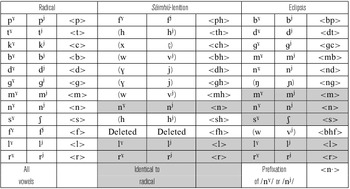
Table 1 shows the initial mutation alternations of Connemara Irish and their orthographic representations. Under each of the three main categories there are pairs of phonemically contrastive consonants, one that is often (but not always) produced with a velar secondary articulation (a ‘broad’ consonant according to the traditional Celticist description) and one that is often (but not always) produced with a palatal secondary articulation (a ‘slender’ consonant). The realization of the phonemic contrast is determined by factors that are not relevant to the aims of this study (primary articulation, adjacent vowel), and some phonetic transcriptions therefore do not include secondary articulations. For more details, see Ní Chiosáin (Reference Ní Chiosáin1991), Ní Chasaide (Reference Ní Chasaide1999), and Bennett et al. (Reference Bennett, McGuire, Chiosáin and Padgett2014). For transcription conventions for Connemara Irish, see Ó Raghallaigh (Reference Ó Raghallaigh2014). Example minimal pairs illustrating lexical and grammatical contrasts include those given in (5).
The initial mutation alternations of Connemara Irish.

Note: The three main columns represent the radical consonants and corresponding séimhiú-lenition and eclipsis consonants. Each main column contains a pair of phonemically contrastive consonants, followed in angled brackets by the grapheme used to orthographically represent these consonants. We use phonemic representation here in order to represent the opposition of the secondary articulations in Irish. A shaded cell indicates that a radical consonant and its corresponding séimhiú-lenition or eclipsis consonant are identical. Consonants in parentheses appear word-initially only in mutation contexts (with very few exceptions, such as loan words, e.g. hata ‘hat’).
-
(5)
-
a.
-
i. naoi /n ɣ iː/ [
ɣ
i]‘nine’
-
ii. ní /n j iː/ [ n j i]
negative particle
-
-
b.
-
i. scéal /s j k j eːl ɣ/ [ʃk j e
ɣ]story.nom.sg
-
ii. scéil /s j k j eːl j / [ʃk j eḻ j ]
story.gen.sg
-
-
Irish initial mutations are always marked in the orthography: séimhiú-lenition is marked by adding an <h> after the first letter (see examples in (1b) and (2b)), eclipsis by adding before the first letter the letter (or two letters in the case of /f/) corresponding to the eclipsis consonant (see examples in (1c)). Note for some consonants, the eclipsis form and/or the séimhiú-lenition form is identical to the radical form (the shaded cells in Table 1).
As the name suggests, in séimhiú-lenition, the initial consonant is weakened. The sound alterations of séimhiú-lenition are given in (6).
-
(6) The sound alterations of séimhiú-lenition
-
a.
-
i. Oral stops and the bilabial nasal stops [m ɣ] and [m j ] become fricatives or glides.
bó [b ɣ o] ‘(a) cow’, an [ə
ɣ] bhó [w
o] ‘the cow’muc [m ɣʊk] ‘(a) pig’, an mhuc [wʊk] ‘the pig’
-
ii. The voiced coronal stop [
ɣ] also changes in place of articulation.dobharchú [
ɣ
ɹɣ
x
u] ‘otter’, dhá [ɣɔ] dhobharchú [ɣ
ɹɣ
x
u] ‘two otters’ -
iii. The voiceless coronal stops [
ɣ] and [
t
j
] are debuccalized.turtar [
ɣʌɹɣ
ɣəɹɣ] ‘turtle’, dhá thurtar [hʌɹɣ
ɣəɹɣ] ‘two turtles’
-
-
b. The sibilant fricatives [s ɣ] and [ʃ] are debuccalized.
Sadhbh [s ɣ
v
ɣ] (girl's first name), a [ə] Shadhbh! [h
v
ɣ] (voc first name) -
c. The labial fricatives [f ɣ] and [f j ] are deleted.
fia [f j iə] ‘(a) deer’, ar [ɛɹ j ] fhia [iə] ‘on a deer’
-

The sound alternations of eclipsis are given in (7).
-
(7) The sound alterations of eclipsis
-
a.
-
i. Voiceless stops and the labial fricatives [f ɣ] and [f j ] become voiced.
cat [kʌ
ɣ] ‘(a) cat’, seacht [ʃa
x
ɣ] gcat [ɡʌ
ɣ] ‘seven cats’faoileán [f ɣ i l ʲɔ
ɣ] ‘(a) seagull’, seacht bhfaoileán [w
i
l
ʲɔ
] ‘seven seagulls’ -
ii. The labial fricative [f ɣ] also often changes in manner: [w].
-
-
b. Voiced stops become nasals.
bó [b ɣ o] ‘(a) cow’, seacht mbó [m ɣ o] ‘seven cows’
-
c. The nasal [
ɣ] or [
n
j
] is prefixed to vowels.oisín [ʌʃi n j ] ‘(a) fawn’, seacht n-oisín [
ɣʌʃi
n
j
] ‘seven fawns’
-
As Table 1 shows, there is often not a one-to-one relationship between a séimhiú-lenition or eclipsis consonant and the corresponding radical consonant. For example, [ɣ], a consonant that only appears in initial position in séimhiú-lenition contexts, may correspond to either radical [
 ɣ] or radical [ɡ], and [h] may correspond to radical [
 ɣ], radical [s
ɣ], or in a few loan words (e.g. hata ‘hat’) radical [h].
1.1.3 Accounts of the initial mutations
The sound alternations described above clearly show a certain ‘phonetic unity’ (see Ewen (Reference Ewen and Anderson1982: 78) on the ‘phonetic unity’ of the Welsh initial consonant mutations). For example, in séimhiú-lenition, there is a weakening, and the place of articulation/active articulator is almost always preserved, i.e. labial remains labial, dorsal remains dorsal, etc. For consonants, this is always the case in eclipsis and often the case in séimhiú-lenition (e.g. for all labial oral stops and nasals). This synchronic phonetic unity, together with the history of the mutations as phonetically triggered sandhi processes, has motivated many researchers to seek an explanation for the mutations in the phonology. There are, however, many complications to this apparent phonetic unity that require additional explanation (change in place of articulation for [
ɣ], deletion of labial fricatives, prefixation of [
 ɣ] or [
n
j
] to vowels, etc.). Many phonological (or partially phonological) accounts of the initial mutations of Irish and the other Celtic languages have been proposed, grounded in a number of theoretical frameworks and spanning several decades; e.g. Hamp (Reference Hamp1951), Rogers (Reference Rogers1972), Lieber (Reference Lieber1983), Ní Chiosáin (Reference Ní Chiosáin1991), Swingle (Reference Swingle1993), Grijzenhout (Reference Grijzenhout1995), Pyatt (Reference Pyatt1997), and Wolf (Reference Wolf, Bateman, O'Keefe, Reilly and Werle2007). For example, Ní Chiosáin (Reference Ní Chiosáin1991) proposes the set of rules in (8) to account for eclipsis:
-
(8) [–voice] → [+voice]; [–son, +voice] → [+nasal]
An alternative formulation is subsequently adopted that reflects the minimal increase in sonority (voiceless obstruents < voiced obstruents < nasals).
Another longstanding and growing body of scholarship, however, argues that the initial mutations belong, at least in part, to the morphology or to the lexicon, e.g. Hamp (Reference Hamp1951),Footnote 4 Oftedal (Reference Oftedal1962), Green (Reference Green2003, Reference Green2006, Reference Green2007), Stewart (Reference Stewart2004), Mittendorf & Sadler (Reference Mittendorf, Sadler, Butt and King2006), Iosad (Reference Iosad2008, Reference Iosad, Wohlgemuth and Cysouw2010, Reference Iosad2014), Hannahs (Reference Hannahs2013). In lexical accounts like the Green or Iosad models, the forms croí [kɾɣ i] (radical), chroí [xɾɣ i] (séimhiú-lenition), and gcroí [ɡɾɣ i] (eclipsis), for example, are all listed in the lexicon. This contrasts with traditional phonological accounts, in which mutation consonants are derived from an underlying base or radical consonant (e.g. radical: croí [kɾɣ i] ‘(a) heart’, séimhiú-lenition: [k] → [x], eclipsis: [k] → [ɡ]). The reader is referred to the original sources, as well as to the summaries and discussions in Stewart (Reference Stewart2004) and Hannahs (Reference Hannahs, van Oostendorp, Ewen, Hume and Rice2011), for details of the different models and the ongoing debate on the locus of the initial mutations. While evidence from phonetic studies is certainly relevant to that debate, our current data do not provide evidence for one type of model over another.
1.1.4 Stability and variability in the initial mutations
We examined variability in the patterns of initial mutation in the speech of present-day speakers of Irish using data both from a novel card game task developed for the study and from a reading task.
According to prescriptive grammars of Irish and pedagogical materials, all initial mutations, including eclipsis and séimhiú-lenition, are obligatory in both the spoken language and the written language. Any variability in the realization of the initial mutations is generally discussed in the context of language decline or language death (Dillon Reference Dillon1973, Stockman Reference Stockman and MacLennan1988, McGahan Reference McGahan2009, inter alia). Ó Broin (Reference Ó Broin2014) compares the Irish of urban (Dublin and Belfast) and Gaeltacht (official Irish-speaking district) radio broadcasters, including their realization of the initial mutations, although these figures are not reported separately. He reports low vs. high ‘error’ (non-realization) rates in Gaeltacht and urban broadcasters, respectively.
The traditional dialect descriptions follow a template that generally does not include a description of the reflexes and conditioning environments of the initial mutations. Exceptions to this generalization include de Bhaldraithe (Reference de Bhaldraithe1953) and Mhac an Fhailigh (Reference Mhac an Fhailigh1968). More recently, Ó Curnáin (Reference Ó Curnáin2007) includes a detailed description of the application and variation of initial mutations in one Connemara dialect (Iorras Aithneach, Co. Galway). Only a few authors mention factors that might condition variability in the realization of the initial mutations. For example, Thurneysen (Reference Thurneysen1946: 140) writes:
The initial mutations occur most consistently within a word-group the members of which, closely connected in speech, form a notional unit. The looser the connexion, the less frequently and regularly do the mutations appear.
Ó Siadhail (Reference Ó Siadhail1989: 115,116) observes variability after certain mutation ‘triggers’; he writes that the preposition as ‘lenites sporadically’ and that the verbal form ba ‘also sometimes lenites’. Ó Sé (Reference Ó Sé2000) writes of the optional nature of séimhiú-lenition in the past tense passive and the conditional.
The extent to which speaking style or register affects the realization of Irish initial mutations has rarely been addressed in the literature. The literature on Irish, including the accounts discussed above, typically distinguishes only between the obligatory presence and the obligatory absence of a mutation; optional or variable mutation is rarely described. To our knowledge, there has been almost no discussion of the possible influence of style or register. As Hamp (Reference Hamp1951: 244) notes for Breton, ‘Most of the standard grammatical works are based on the ‘written’ language. No wonder the phonological facts of Breton have remained so obscure’. The same could be said for Irish – almost all accounts assume the all-or-nothing mutation prescribed by the official standard (An Caighdeán Oifigiúil, Translation Section 1958 [revised 2012]): they do not take into account or even note the variability in mutation in the spoken language. The assumption that speakers who depart from this official standard, which predicts 100% realization of mutations in licensed environments, are not good speakers is particularly common in academic circles.
1.2 Incomplete neutralization processes in other languages
Research on apparent neutralization processes in other languages have uncovered subtle but systematic differences between different types of consonants. These studies include phonetic and psycholinguistic studies on production and perception, as well as corpus studies.
There is a large body of research on the acoustic characteristics of French resyllabification processes (liaison, as well as enchaînement and elision) and their effects on perception. A number of studies have shown systematic differences or incomplete neutralization between these ‘resyllabified’ consonants and corresponding base consonants, such as the [t] of petit tamis [pət i.t a m i] ‘little sieve’ and the [t] of petit ami [pət i.t a m i] ‘boyfriend’ (see e.g. Fougeron et al. Reference Fougeron, Bagou, Content, Stefanuto and Frauenfelder2003, Spinelli, McQueen & Cutler Reference Spinelli, McQueen and Cutler2003, Fougeron Reference Fougeron, Cole and Hualde2007, Spinelli, Welby & Schaegis Reference Spinelli, Welby and Schaegis2007, inter alia), although these differences may not be present in all contexts (Gaskell, Spinelli & Meunier Reference Gaskell, Spinelli and Meunier2002, Nguyen et al. Reference Nguyen, Wauquier, Lancia, Tuller, Prieto, Mascaró and Solé2007, inter alia).
Similarly, many studies of the apparent neutralization of the voicing contrast in word- or syllable-final obstruents in German, Dutch, and other languages have shown subtle phonetic differences between the final stops of apparently homophonous words like Rad [ʁaːt] ‘wheel’ and Rat [ʁaːt] ‘council’ (Dinnsen & Garcia-Zamor Reference Dinnsen and Garcia-Zamor1971, Charles-Luce Reference Charles-Luce1985, Port & Crawford Reference Port and Crawford1989, and many others; see Roettger et al. Reference Roettger, Winter, Grawunder, Kirby and Grice2014 and references therein for an exhaustive list and discussion), while a few other studies have failed to find differences (Fourakis & Iverson Reference Fourakis and Iverson1984, inter alia).
Closer to home, in the literature on the Celtic languages, we rarely find mention of differences between mutation consonants and their corresponding radical consonants. One exception is Falc'hun (Reference Falc'hun1951), who recorded and examined Breton minimal pairs such as (9).
-
(9)

Falc'hun reports that voiced stops with voiceless radicals (9a) are longer and have stronger release bursts than their corresponding radical voiced stops (9b). He states that this pronunciation distinction between ‘strong’ (fort) and ‘weak’ (doux) consonants is only possible before vowels and ‘plays only a negligible role in the language’ [our translation] (p. 65), but specifies that the distinction is clearly perceptible to native speakers.
For (Scottish) Gaelic, a sister language of Irish, Ó Maolalaigh (Reference Ó Maolalaigh1995/Reference Ó Maolalaigh1996: 160) reports that ‘[t]he non-radical nasals in [the] Type C [initial mutation] apparently differ phonetically from radical nasals in that the former are denasalized towards the end of their articulation. . .’, referring to the work of Borgstrøm (Reference Borgstrøm1940) and Oftedal (Reference Oftedal1956). According to Ó Maolalaigh, mutation ‘involves the nasalisation (or partial nasalisation) of all stops without resultant neutralization between both sets of stops as the post-aspirated stops retain their aspiration’ (p. 159). Borgstrøm (Reference Borgstrøm1940: 22) writes:
The non-radical nasals . . . may occasionally give the same acoustic impression as the radical ones, but in principle they are different: at the end of the nasal one usually hears a very short and soft occlusive. What actually happens must probably be that the velum is raised to close the nasal passage a little earlier than the clusion of the lips (for m) or of the tongue against its place of articulation (for N, N', ŋ, ŋ') is loosened, so that the end of the nasal is denasalized; this is in any case what I think I must do to imitate the pronunciation.
Given this cross-linguistic evidence of incomplete neutralization, we expected that we might find similar kinds of differences in Irish between radical and mutated consonants. To address this issue, we compared the initial stop consonants of radical and eclipsis forms, examining measures relevant to the phonological voiced/voiceless contrast.
2. Methods
2.1 Connemara Gaeltacht
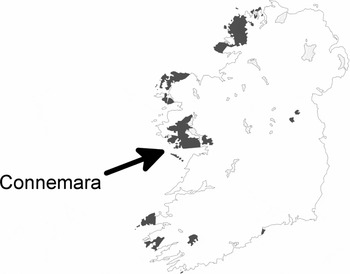
We focused on the Irish spoken in Connemara, County Galway in the west of Ireland, in the province of Connaught (see Figure 1). Once spoken throughout Ireland, today Irish is spoken as a community language in a number of largely rural areas predominately along the western seaboard. In all of the Gaeltachtaí (officially designated Irish-speaking districts), Irish is under severe pressure from English. For example, it is not the case that all or even most members of Gaeltacht communities speak Irish. The Connemara Gaeltacht, however, is considered to be a relatively strong Gaeltacht (Ó Giollagáin et al. Reference Ó Giollagáin, Donnacha, Chualáin, Shéaghdha and O'Brien2007).
Map of Ireland with the official Irish-speaking regions (Gaeltachtaí) shaded.

2.2 Participants
Seven native speakers of Connemara Irish participated in the experiment, three women (Participants 1, 2, 3) and four men (Participants 4, 5, 6, 7). Six of the participants ranged in age from the late teens to mid-20s, with an average age of 20.2 years. The last participant (Participant 2) was 43 years old. All participants were raised in the Connemara Gaeltacht (official Irish-speaking district), grew up speaking Irish at home with at least one parent, completed their primary and secondary education in Irish-medium schools and at the time of the recordings were students at Acadamh na hOllscolaíochta Gaeilge, an Irish-medium university campus in An Cheathrú Rua in the Connemara Gaeltacht of County Galway. Most (6 of 7) were currently living in the Gaeltacht community where they were recorded. One (Speaker 1) was living in Galway city, the closest city to An Cheathrú Rua, about an hour's drive away. Like all Irish cities, Galway city is largely English-speaking, although a fair number of Galway residents speak both Irish and English. Most of the participants (5 of 7) had lived in the community their entire lives and had never lived outside the Gaeltacht. The oldest participant (Participant 2) had lived in England for many years before returning to the Gaeltacht. All participants also have native-language competence in English. Speakers received €15 for their participation, which lasted approximately one hour.
2.3 Materials
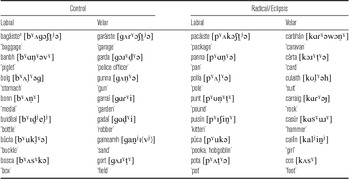
We constructed sets of word triplets: 7 sets for each of 2 consonant types, the labial stops [p ɣ] and [b ɣ], and the velar stops [k] and [ɡ] (see the appendix). To build the materials we conducted pattern searches on an electronic version of the Irish dictionary Foclóir Póca (Ó Baoill Reference Ó Baoill1986), to select common,Footnote 5 picturable nouns meeting the required characteristics. These target nouns were inserted into three types of contexts, as shown in (1): (1a) – a no-mutation context consistent with the radical form of the initial (phonologically) voiced stop ([b ɣ], [ɡ]), (1b) – a context consistent with eclipsis of an initial (phonologically) voiceless stop ([p ɣ], [k]), and (1c) – a control context with an initial (phonologically) voiceless stop ([p ɣ], [k]) in the radical form. This control condition allowed us to measure acoustic characteristics of voiceless stops and see whether any of these characteristics were present in the eclipsis consonants. Note that Irish uses VOT (voice-onset time) in a two-way phonological voicing contrast between voiceless aspirated (long-lag VOT) and voiceless unaspirated stops (short-lag VOT). The pattern is similar to that of English and German.
For clarity, the target nouns are underlined in the examples in (10); there was no underlining in the sentences presented to participants.
-
(10)

The experimental sentences formed the ‘moves’ of the card game described in Section 2.4.1. All three contexts were designed to place the target nouns in prosodic phrase-final position where they were likely to be pronounced with a pitch accent, since these factors have been shown to affect production in many languages (Fougeron & Keating Reference Fougeron and Keating1997, Turk & Shattuck-Hufnagel Reference Turk and Shattuck-Hufnagel2007, inter alia).
We chose not to use minimal sets (of the type ar an gcasúr [ɡɑs ɣ uɹɣ] ‘on the hammer’/gasúr [ɡɑs ɣ uɹɣ] ‘child’), which might induce unnatural disambiguation strategies (‘hyperarticulation due to minimal pair awareness’ discussed by Roettger et al. Reference Roettger, Winter, Grawunder, Kirby and Grice2014). Rather, target nouns had the structure C1V1C2* (the Kleene star represents optional additional material after the first three segments); within a set, words were matched in number of syllables (1, 2 or 3), with the initial consonant C1 differing only in voicing, and the same following vowel V1. For example, the words in the set bagáiste [b ɣʌɡɔʃ t j ə], pacáiste [p ɣʌkɔʃ t j ə], bpacáiste [b ɣʌkɔʃ t j ə] have three syllables and begin with a labial stop followed by the vowel [ʌ]. To control for coarticulation, the following consonant C2 was matched in terms of primary articulator and the broad/slender phonemic distinction characteristic of Irish consonants (see Section 1.1.2) (in the example set above, [k] or [ɡ], both broad velars). Note that the C1 is in medial position of a prosodic word (e.g. an gadaí ‘the robber’).
There were a total of 42 critical items (7 sets × 2 consonant types × 3 conditions) and an additional 14 filler items, which were included to introduce more variety in the potential initial mutations present (e.g. t-prefixation: seamróg [ʃa m ɣɾɣ oɡ] ‘(a) shamrock’, an tseamróg [ t j a m ɣɾɣ oɡ] ‘the shamrock’).
2.4 Procedures
Participants completed two tasks, a card game task and a reading task. Each task was performed twice. All participants first completed two ‘rounds’ of the card game, then moved on to the reading task.
2.4.1 Card game task
As mentioned, we developed a novel card game for the study. The game was designed to induce speech that was unprepared and spontaneous but constrained along a number of dimensions, and contained multiple tokens of the targets in the experimental conditions (in the tradition of the tasks developed by Anderson et al. Reference Anderson, Bader, Bard, Boyle, Doherty, Garrod, Isard, Kowtko, McAllister, Miller, Sotillo, Thompson and Weinert1991, Schafer et al. Reference Schafer, Speer, Warren and White2000, Ito & Speer Reference Ito, Speer, Sudhoff, Lenertova, Meyer, Pappert, Augurzky, Mleinek, Richter and Schließer2006, inter alia).
In the game, two players sit near each other at a table. One player, the Director (a study participant) sees card moves displayed on a computer screen (via a Microsoft PowerPoint presentation with timed transitions to create animation). The Director then describes out loud the move he or she sees, guiding the Mover (a confederate, author BÓR), in placing cardboard game cards to match the move displayed on the screen.
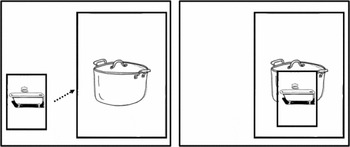
The game moves exploit the fact that, in the traditional grammar, eclipsis of a word-initial consonant is expected after the definite article in the dative singular when preceded by one of a closed class of 11 common prepositions (ar ‘on’, le(is) ‘with’, etc.). There were five possible moves, given in (11), where X and Y stand for the names of pictures displayed on the game cards. Target nouns in the eclipsis condition always appeared in the context ar an <target noun> ‘on the <target noun>’ (move 11a). Example screen displays are given in Figure 2.
-
(11)
-
a. Cuir an X ar an Y.
‘Put the X on the Y.’
-
b. Cuir an X os cionn an Y.
‘Put the X above the Y’
-
c. Cuir an X in aice leis an Y.
‘Put the X next to the Y.’
-
d. Cuir an X faoin Y.
‘Put the X under the Y.’
-
e. Cuir an X agus an Y le chéile.
‘Put the X and the Y together.’
-
Screens corresponding to the move Cuir an folcadán ar an bpota [b
ɣʌ
ɣə] ‘Put the bathtub on the pot’. The arrow indicates motion in the PowerPoint presentation.

Before the recordings, each participant completed two training sessions. In the first session, pairs of cards were presented on the screen and one of the cards was named by a recorded voice (a female native speaker of Connemara Irish). Participants were asked to point to the named card. In the second session, 10 practice instructions (moves) were presented visually via PowerPoint presentation, with accompanying oral instructions given by the same recorded voice. These practice sessions familiarized participants with the names of the cards and the moves and allowed them to practice playing the game.
The game proceeded at a self-selected, untimed pace. A second experimenter (author PW) confirmed the successful completion of each move by the Mover (Sin é ‘That's it.’ Go maith ‘Good’, etc.), before continuing on to the next move.
2.4.2 Reading task
After playing two rounds of the card game, participants read a list of sentences corresponding to the canonical form of the instructions from the card game (that is, with either radical or mutation forms, as called for by the traditional grammar). As discussed in Section 1.1.2, Irish initial mutations are always reflected in the orthography; the eclipsis of the target nouns in the eclipsis context was therefore always orthographically marked. The sentences were presented one-by-one on a computer screen, and each participant read the list twice, at a self-selected, untimed pace.
2.4.3 Recording
Each participant was recorded individually in September 2010 in a quiet classroom on the campus of Acadamh na hOllscolaíochta Gaeilge, a university campus in Connemara where the language of instruction is Irish. The one exception was the reading task of Participant 1, which took place in June 2013 in Dublin. Recordings were done using a Shure SM10A headworn microphone and a Marantz PMD 660 digital recorder at a sampling rate of 48 kHz.
2.5 Data analysis
Each sentence was saved as an individual sound file, using a Praat (Boersma & Weenink Reference Boersma and Weenink2011) script to semi-automate the task. For each task (card game, reading), there were two repetitions of 42 critical items (7 sets × 2 consonant types × 3 conditions), for a total of 84 critical tokens for each of the 7 participants (588 in total). All labeling and acoustic analyses were performed in Praat, with label positions determined by hand and scripts used to semi-automate the process.
2.5.1 Reading task
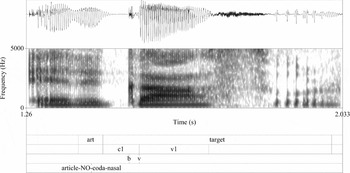
An example label file is given in Figure 3. For the critical items in the reading task, the following segment boundaries of the target noun were labeled, using standard segmentation criteria (Peterson & Lehiste Reference Peterson and Lehiste1960): beginning of the target noun (beginning of the stop closure), end of the target noun, end of the first consonant (C1, always a stop), beginning and end of the first vowel (V1), stop release burst (b), and onset of voicing (v). The beginning of the closure was marked by an abrupt cessation of formant structure and the end of the stop closure at the onset of a release burst. Onset of voicing was defined, as in Cho & Ladefoged (Reference Cho and Ladefoged1999: 215) as the ‘first complete vibration of the vocal folds’ (see discussion in Di Paolo & Yaeger-Dror Reference Di Paolo and Yaeger-Dror2011). The release burst was usually clearly visible as a transient in the waveform. In cases where there was more than one release burst (particularly common for the velars, as has been often observed in the literature), we labeled both the first and the last burst.
Praat TextGrid file with example labels. Zoom on ar an gcasúr from the carrier sentence Cuir an oifig ar an gcasúr (Speaker 1, eclipsis condition, see example (10b)).

The boundary between vowel and a following [ɹɣ] was difficult to determine. We therefore decided to systematically place the boundary after the voiced portion of the [ɹɣ]. This was an acceptable decision, since vowel duration was only used in the calculation of relative intensity of the stop burst. Another segmentation difficulty was posed by the boundary between two vowels (e.g. in Cuir an cárta
[kɔɹɣ
ɣə] os [ʌs
ɣ] cionn an tseangáin ‘Put the card over the ant’). In these cases, we relied on formant transitions, marking the boundary at the end of a steady state region; when this was not possible, we took the end of the first vowel to be the midpoint of the vocalic region.
A total of 106 tokens were excluded from the phonetic analyses, leaving a total of 482 tokens. There were several types of exclusions: tokens with dysfluencies or hesitations in the target region (20 items), one token in which a speaker mispronounced the article in the target region, tokens in which C1 was produced not as a stop, but with another manner of articulation, such as fricative, glide, or nasal (a further 61 items). The vast majority of exclusions of this type (41 of the 61) were due to an oversight in the design of the experimental materials. The target noun in these cases was feminine and the initial consonant of feminine nouns appears in séimhiú-lenition form after the nominative definite article. For these items, séimhiú-lenition was therefore indicated in the orthography (e.g. an charraig [xɑɾɣəɟ] ‘the rock’) and a fricative was produced. Tokens where there was no clear release burst visible, either in the waveform or the spectrogram, were also excluded from the analyses (a further 23 cases), as was 1 token in which there was no clear distinction between the closure for the coda nasal of the article and the following oral plosive closure. These last two types of tokens were excluded not because they would not be judged as acceptable productions of the target consonants, but because of the difficulty (or impossibility) of taking the relevant measurements for the phonetic analyses (e.g. intensity of the stop burst or VOT). We further address the distribution of tokens without a clear release burst in the discussion section.
We took the following measurements: duration of the initial consonant of the target noun (C1), duration of the C1 closure, C1 voice onset time (VOT), and relative intensity of the C1 stop burst. These measures are all relevant to the phonological voiced/voiceless contrast and are among the measures for which differences have been found in cases of incomplete neutralization in other languages (see Section 1.2). All target nouns were preceded by the definite article an. We coded whether or not the [
ɣ] of this definite article was elided (i.e. whether the definite article was pronounced with a coda [
ɣ] or as [ə]). The presence or absence of this coda [
ɣ] was clear, both auditorily and visually (on the spectrogram: see Figure 3 above). For more details about this coding, see Section 3.1.3.
2.5.2 Game task
Most participants produced relatively few (or no) eclipsis consonants in the mutation (eclipsis) contexts. It was evident from the first experimental sessions that we would not have enough tokens for the type of acoustic analyses performed for the reading task. Unsurprisingly, the semi-spontaneous speech collected in this task was more variable in many respects than the more controlled read speech.
We therefore adopted different labeling conventions for the game task data. We performed three types of binary coding. We coded each target consonant according to whether it was produced as 1. an eclipsis consonant or 2. a séimhiú-lenition consonant,Footnote
6
and 3. we coded the elision of the [
ɣ] of the definite article an. Note that given that our target consonants were stops ([p
ɣ] and [k]), the first two coding decisions could be reduced to the question of whether the target consonant was voiced and whether it was realized phonetically as a fricative. In the game task, participants sometimes used a term other than expected target noun (e.g. caitín or cat rather than puisín ‘kitten’). We excluded these items from the analyses (14 total exclusions), except in cases where the unexpected and expected terms had the same initial consonant, e.g. puiscín rather than puisín ‘kitten’, gairdín for garraí ‘garden’ (38 total exclusions). In addition, in the game task, the mutation context was occasionally not preserved. For example, rather than the expected Cuir an gaineamh faoin nathair ‘Put the sand under the snake’ (where the target gaineamh is in a non-mutation (radical) context), one participant said Cuir an nathair os coinn an ngaineamh
‘Put the snake over the sand’. Of course, the two moves achieve the same goal in the context of the game, but the version produced by the participant puts the target noun in an unexpected eclipsis context. In addition, on a few occasions, participants chose to ‘pass’ or skip an item or move.
2.5.3 Statistical procedures
For the reading task, voice onset time (VOT), C1 duration, C1 closure duration, and relative stop burst intensity results were analyzed in R (R Core Team 2013) using linear mixed effects models (LMEMs) with the package lme4 (Bates, Maechler & Bolker Reference Bates, Maechler and Bolker2013). For the duration and relative stop burst intensity analyses, there were 482 observations. For the VOT analyses, we removed 50 tokens in which the stop closure was partially or fully voiced, since we cannot average positive and negative VOT values. After the exclusion of these items, there were 432 observations for the VOT analysis (i.e. 482–50 = 432).
For all LMEMs, the two fixed effects were: Place of Articulation (two-level factor: Labial, Velar) and Mutation (three-level factor: Radical, Eclipsis, Control). In order to test whether the two fixed effects were significant we first built the model with the maximal random structure. Since this model never converged, we simplified it step-by-step, following the Barr et al. (Reference Barr, Levy, Scheepers and Tily2013) guidelines as closely as possible. We first removed correlation parameters for the random effects, then the random intercepts for our two fixed effects (which were both within-subject effects). If necessary we then removed another term (an interaction term). Following Barr et al., we always retained random slopes for the fixed effects. For all the LMEMs, we used the default settings of the lmer() function.
3 Results
3.1 Reading task
3.1.1 Durations
In the reading task, items were almost always read as expected. That is, target consonants were produced as stops (over 95% of the time) and words orthographically marked for an initial mutation (eclipsis and other mutations (for some non-target nouns)) were produced as spelled, with the expected mutation.
VOT
Fifty tokens in which the stop closure was partially or fully voiced were removed from the VOT analyses, since we cannot average positive and negative VOT values. These tokens are discussed further at the end of the current section.
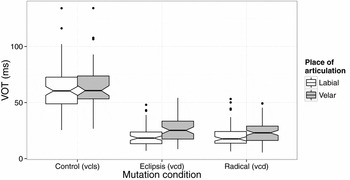
The pattern of results for VOT is illustrated in Figure 4. As described in Section 2.5.3, we first built the LMEM with the maximal random structure:Footnote 7
-
VOT ~ PlaceArt * Mutation + (1 + PlaceArt|Speaker) + (1 + Mutation|Speaker)
+ (1 + PlaceArt * Mutation|Speaker) + (1 + PlaceArt|Item) + (1 + Mutation|Item)
+ (1 + PlaceArt * Mutation|Item).
Voice onset time (VOT) by Mutation and Place of Articulation (reading task).

Since this model did not converge, we simplified the model step-by-step, as described in Section 2.5.3. The model retained was:
-
VOT ~ PlaceArt * Mutation + (1 + PlaceArt|Speaker) + (1 + Mutation|Speaker)
+ (1 + PlaceArt|Item) + (1 + Mutation|Item)
In order to test whether there was an interaction between the two fixed factors, we performed a likelihood ratio test (LRT) between the models with and without the interaction Place of Articulation × Mutation. The results showed that the interaction was not significant (χ = 2.0946, df = 2, p = .3509).
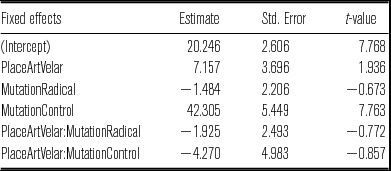
To test whether the fixed factor Mutation had a main effect, we performed an LRT between models with and without the factor Mutation. There was a significant effect of this factor (χ 2= 530.69, df = 2, p < .001). An examination of the model (Table 2) showed that the contrast between Labial Eclipsis and Labial Control consonants was highly significant (t = 7.763),Footnote 8 but that the contrast between Labial Eclipsis and Labial Radical consonants was not (t = −0.673). Given that the interaction between the two fixed factors is not significant (PlaceArtVelar × MutationControl: t = −0.857; PlaceArtVelar × MutationRadical: t = −0.772), we obtain the same patterns of results for the contrasts between Velar Eclipsis and Velar Control consonants and between Velar Eclipsis and Velar Radical consonants. Recall that Control consonants are voiceless and aspirated, while Radical and Eclipsis consonants are phonetically voiceless and unaspirated, as reflected by these VOT patterns. The aspiration of the initial consonant of the Radical form (e.g. the [k] of casúr ‘hammer’) is not present in the initial consonant of the Eclipsis form (e.g. the [ɡ] of (ar an) gcasúr ‘(on the) hammer’).
The LMEM retained for VOT (reading task).

The effect of the fixed factor Place of Articulation is only marginally significant (t = 1.936), although in the direction predicted, given the results in the literature for other languages, where velars have been found to have longer VOTs than labials (see Cho & Ladefoged Reference Cho and Ladefoged1999).
Voicing in the target stop closure
We examined the data to see whether the voicing in the closure of the target stop produced in 50 tokens was related to speaker, mutation condition or production of the coda [
ɣ] of the preceding definite article. It was not possible to draw firm conclusions from so few tokens, so we report the general patterns observed. There is some evidence of inter-speaker variability: four participants (Speakers 3, 4, 5, and 6) accounted for 92% of tokens with voicing in the stop closure. Unsurprisingly, very few (two) cases of voicing were found in the Control conditions, since these stops are voiceless and aspirated. Considering the two conditions with short-lag VOT in the target stop, there were fewer tokens with voicing in the stop closure (17) in the Eclipsis condition than in the Radical condition (31). Nine of 17 tokens in the Eclipsis condition and 28 of 31 in the Radical condition were produced with a coda [
ɣ] in the preceding definite article, reflecting the general unbalanced pattern in the elision of this [
ɣ] across conditions (see Section 3.1.3). Both elision of the [
ɣ] of the definite article and the production of this [
ɣ] are likely to lead to the pressure differential across the glottis necessary for maintaining voicing (see e.g. Kong, Beckman & Edwards Reference Kong, Beckman and Edwards2012 and references therein). However, the vast majority of both Eclipsis and Radical tokens (short-lag tokens) in the larger data set of 482 tokens are produced with no voicing in the closure. That is, although the conditions are present for this acoustic difference (voicing vs. no voicing in the closure) to be exploited, prevoicing is not generally employed by speakers to distinguish Eclipsis consonants from their Radical counterparts.
C1 duration
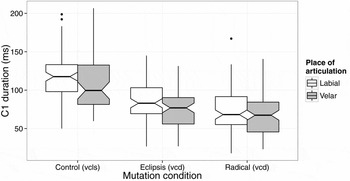
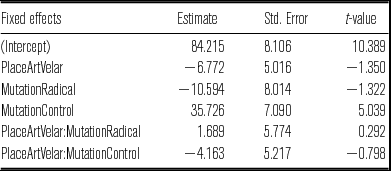
Figure 5 shows the pattern of results for the duration of the initial consonant (C1). Following the procedures described in Section 2.5.3, we built and retained the model given in Table 3.
C1 duration by Mutation and Place of articulation (reading task).

The LMEM retained for C1 duration (reading task).

In order to test whether there was an interaction between the two fixed factors, we performed a likelihood ratio test (LRT) between the models with and without the interaction (Place of Articulation × Mutation). This interaction was not significant (χ 2 = 1.2137, df = 2, p = .5451).
To test for a main effect of the fixed factor Mutation, we performed an LRT between models with and without this factor. There was a significant effect of Mutation (χ 2 = 252.56, df = 2, p < .001). This effect was due to the contrast between Labial Eclipsis and Labial Control consonants, which was highly significant (t = 5.039) (Table 3). The contrast between Labial Eclipsis and Labial Radical consonants, however, was not significant (t = −1.322). Given that the interaction between the two fixed factors is not significant, we obtain the same patterns of results for the contrast between Velar Eclipsis and Velar Control consonants which was significant (PlaceArtVelar × MutationControl: t = −0.798) and between Velar Eclipsis and Velar Radical consonants which was not significant (PlaceArtVelar × MutationRadical: t = 0.292). Finally, the effect of Place of Articulation was not significant (t = −1.350).
C1 closure duration
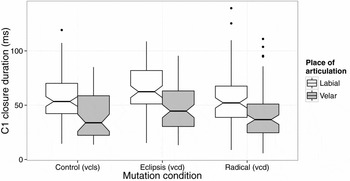
Figure 6 shows the pattern of results for duration of closure of the initial consonant (C1).
Duration of C1 closure by Mutation and Place of articulation (reading task).

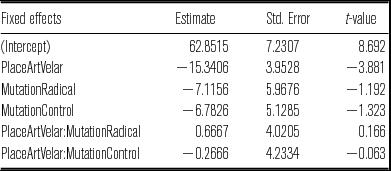
Following the procedures described in Section 2.5.3, we built and retained the model given in Table 4.
The LMEM retained for C1 closure duration (reading task).

In order to test whether there was an interaction between the two fixed factors, we performed a likelihood ratio test (LRT) between the models with and without the interaction (Place of Articulation × Mutation). The results showed that the Place of Articulation × Mutation was not significant. The difference between the two models is so small that R returns the statistics χ 2 = 0, df = 2, p = 1, presumably due to rounding.
Neither the contrast between Labial Eclipsis and Labial Control consonants (t = −1.323) nor the contrast between Labial Eclipsis and Labial Radical was significant (t = −1.192) (Table 4). Given that the interaction between the two fixed factors was not significant, we obtain the same pattern of results for the contrast between Velar Eclipsis and Velar Control consonants and between Velar Eclipsis and Velar Radical consonants (neither of which was significant: PlaceArtVelar × MutationControl, t = 0.063, PlaceArtVelar × MutationRadical t = −0.166).
There was a significant effect of Place of Articulation (t = −3.881). The difference in Labial and Velar closure duration (mean = 58 ms, mean = 43 ms, respectively) was in the direction found in the literature across languages, with longer closures for labials (see Maddieson Reference Maddieson, Hardcastle and Laver1997).
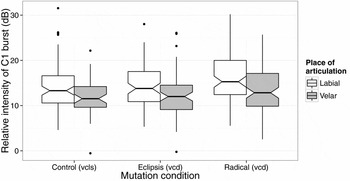
3.1.2 Relative intensity of the C1 stop burst
The pattern of results for relative intensity of the C1 stop burst is illustrated in Figure 7. Cross-linguistically, voiceless stops have been reported to have more intense bursts than their voiced counterparts (Lisker & Abramson Reference Lisker and Abramson1964, Sils & Cohen Reference Sils and Cohen1969, inter alia). If eclipsis consonants reflect characteristics of the corresponding voiceless consonants, for relative intensity of the stop burst, we would expect the pattern Control (voiceless) ≥ Eclipsis (voiced) > Radical (voiced).
Relative intensity of C1 stop burst by Mutation and Place of articulation (reading task). Intensity relative to that of following vowel: a larger value therefore corresponds to a less intense burst.

We measured the intensity of the stop burst with respect to that of the following vowel. We calculated the intensity of the burst (dB) over a 10 ms window centered on the burst release. In cases of multiple bursts, we used the first burst. For cases in which there was prevoicing throughout the closure we applied a 200 Hz high pass filter (Hann window). We then subtracted the intensity of the burst from the maximum intensity of the vowel (dB) (Stoel-Gammon, Williams & Buder Reference Stoel-Gammon, Williams and Buder1994). A larger relative intensity value therefore indicates a larger difference with respect to the vowel and a less intense burst.
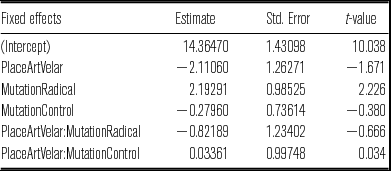
Following the procedures described in Section 2.5.3, we built and retained the model given in Table 5.
The LMEM retained for relative intensity of the C1 stop burst (reading task).

In order to test whether there was an interaction between the two fixed factors, we performed a likelihood ratio test (LRT) between the models with and without the Place of Articulation × Mutation interaction. The results showed that this interaction was not significant (χ 2 = 0.6498, df = 2, p = .7226).
To test whether the fixed factor Mutation had a main effect, we performed an LRT between models with and without the factor Mutation. An LRT between models with and without the factor Mutation showed a significant effect of this factor (χ 2 = 23.357, df = 2, p < .001).
The contrast between Labial Eclipsis and Labial Radical consonants was significant (t = 2.226, Table 5), with Labial Eclipsis consonants having stronger bursts, but the contrast between Labial Eclipsis and Labial Control consonants was not significant (t = −0.380). Given that the interaction between the two fixed factors is not significant, we obtain the same pattern of results for the contrast between Velar Eclipsis and Velar Radical consonants, which was significant (PlaceArtVelar × MutationRadical, t = −0.666) and between Velar Eclipsis and Velar Control consonant (PlaceArtVelar × MutationControl, t = 0.034). This pattern (Control (voiceless) ≥ Eclipsis (voiced) > Radical (voiced)) is the predicted pattern of results: the relative burst intensity of Eclipsis consonants resembles that of Control consonants.
There was no main effect of Place of Articulation (t = −1.671), although the results were in the direction expected given observations in the literature for other languages (Repp Reference Repp1984, inter alia), where labial bursts have been found to be softer than velar bursts (and so to have lower relative intensity), due to the absence of a front cavity.
To summarize the main results thus far: for C1 closure duration, we found a main effect of Place of Articulation, with longer closures for Labials than for Velars, in line with reports in the literature for other languages. For VOT, the effect of Place of Articulation, also in the expected direction, was only marginally significant. For C1 duration and relative intensity of C1 burst, there were no main effects of Place of Articulation. It is the main effect of Mutation that is crucial to testing our hypothesis that Eclipsis consonants differ from Radical consonants and reflect characteristics of Control (voiceless) consonants. For VOT and C1 duration, there were main effects of Mutation; these effects, however, were due to differences between the Control condition and the other two conditions. We did not find the critical duration differences expected between Eclipsis and Radical consonants; in particular, we did not find longer C1 duration, C1 closure duration or VOT for Eclipsis consonants than for Radical consonants. For the relative intensity of C1 burst, we did find the expected pattern of results: the relative burst intensity of Eclipsis consonants was greater than that of Radical consonants and comparable to that of Control consonants. Surprisingly, there was no main effect of Place of Articulation for relative burst intensity.
3.1.3 Elision of the [
ɣ] of the definite article an preceding the target noun (reading task)
Although the targets were inserted in segmentally and prosodically controlled carrier contexts, we observed that for most speakers the coda nasal of the definite article preceding the noun (e.g. an [ə
ɣ] pota ‘the pot’) was sometimes elided, with the rate of elision depending on the Mutation condition. While the elision itself was not unexpected, the variation across conditions was unanticipated. It is important, however, to take into account this difference across conditions in the realization of the definite article, because it often creates different phonetic environments across conditions.
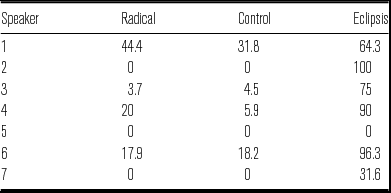
Table 6 presents the rate of elision of this [
ɣ] in the three Mutation conditions for each speaker for the 482 tokens included in the phonetic analyses. One speaker (Speaker 5) never elided the [
ɣ] for any item in any of the three conditions. The other participants systematically elided the [
ɣ] more often in the Eclipsis condition (31.6–100% of cases) than in the Radical and Control conditions (0–44.4 % of cases). It is unlikely, however, that this difference is directly linked to eclipsis itself, since we also observe it in filler items with the same structure (prepE + definite article + C), where there is no eclipsis since the initial consonant is identical in Radical and Eclipsis environments (e.g. the [m
ɣ] in ar an madra [m
ɣɑ
ɣə] ‘on the dog’, see Table 1 above).
Rate of elision (%) of the [
ɣ] in the definite article an preceding the target noun according to Mutation condition (reading task).

Therefore, in the reading task, the target nouns in the Radical and Control conditions are often directly preceded by a nasal consonant (because the definite article is pronounced [ə
ɣ], e.g. an pota [ə
ɣ
p
ɣʌ
ɣə] ‘the pot’), while the target nouns in the Eclipsis condition are often preceded by a vowel (because the definite article is pronounced [ə], e.g. ar an bpota [ɛɾ
j
əb
ɣʌ
ɣə] ‘on the pot’).
To control for this unexpected variability, we attempted to perform the analyses excluding items produced with elision of the [
ɣ] of the definite article. This, however, proved impracticable. While only 8.9% of items in the Control condition and 12.6% of items in the Radical condition are realized with elision of the coda nasal of the preceding article, this is the case for 63.0% of Eclipsis items. Elision in the Control and Radical conditions is not the typical realization. In addition, most 86.0% (49 of 57 cases) of the elision realizations in the Eclipsis condition are due to only three speakers (Speakers 1, 5, and 7). We come back to this point in the discussion.
3.2 Card game task
3.2.1 Production of mutations
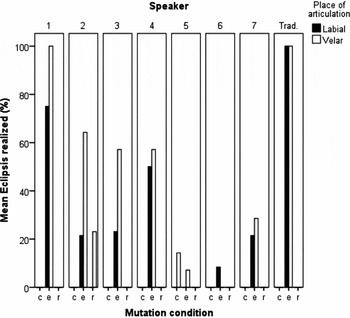
In the card game task, we observed a great deal of variability in the realization of the initial mutations (Figure 8). Only one speaker, Speaker 1 produced a pattern approaching that predicted by the traditional grammar, i.e. 100% mutation in the Eclipsis condition, with no difference according to place of articulation. This speaker produced 88% of items in the Eclipsis condition with eclipsis. In this same condition, three speakers (2, 3, and 4) produced eclipsis in about 40–50% of items. Speaker 7 produced eclipsis in about 25% of eclipsis contexts, while two speakers (5 and 6) almost never produced eclipsis. For Speaker 7, eclipsis was markedly more frequent in the second round (block) of the card game (43% of items) than in the first round (7%). We discuss this pattern further in the discussion section. Two speakers (Speakers 2 and 5) also produced eclipsis in the Radical or Control conditions, although there was no environment triggering eclipsis.
Realization of eclipsis in the card game task by Speaker and Mutation (radical, eclipsis and control). The panel on the right shows the predictions of the traditional grammar.

In most cases where speakers did not produce eclipsis in the Eclipsis condition, they produced a Radical consonant (producing, for example, ar an casúr ‘on the hammer’ with no mutation). Speakers 1–6 all very occasionally produced séimhiú-lenition in the Radical and/or Eclipsis Conditions (1–3 items total for each speaker), although there was no eclipsis environment. Speaker 7 produced séimhiú-lenition in these unexpected contexts in 30% of his productions for these conditions (12 times total), with more in the second round than in the first (8 vs. 4 items).
A number of speakers produced eclipsis in the Eclipsis condition more often for velar stops than for labial stops (compare the white and black bars of Figure 8 above). This difference is particularly striking for Speakers 1, 2, and 3. We examined whether this difference in the realization of eclipsis across consonant types could be due to an effect of lexical frequency. The seven /k ɣ/-initial words and the seven /p ɣ/-initial target nouns do not differ in lexical frequency, no matter what measure of frequency we use (for lemma frequency: t = 1.836, df = 12, p = .091, for token frequency of the eclipsed form: t = 1.129, df = 12, p = .281, for eclipsis realizations/lemma realizations: t = 0.498, df = 12, p = .627). However, in the Irish lexicon, there is a marked difference in the frequency of words beginning with these consonants. In the Foclóir Póca dictionary (Ó Baoill Reference Ó Baoill1986), there are 6.8 times more words beginning with /k ɣ/ than with /p ɣ/. The pattern also holds more generally, independent of the phonemic distinction between so-called broad and slender consonants (see Section 1.1.3): there are 5.9 times more words beginning with velar stops (/k ɣ/ and /k j /) than with labial stops (/p ɣ/ and /p j /). This imbalance is due to the history of the Celtic languages: Proto-Indo-European *p was lost in the proto-Celtic period and re-entered the consonant inventories much later (McCone Reference McCone, McCone, McManus, Háinle, Williams and Breatnach1994).
3.2.2 Elision of the [
ɣ] of the definite article an preceding the target noun (card game task)
As for the reading task, for the card game task, we coded the presence or absence of the definite article preceding the target noun. Since we did not perform acoustic analyses for the card game task (see Section 2.5.2), this coding is not directly related to the primary goals of the present paper. It is, however, related to the broader question of differences between the speaking styles, so we briefly report the results here. To enable a comparison between speaking conditions, we first coded the presence or absence of a hesitation or pause in the critical region (between the definite article and the noun). As expected for this speaking style, hesitations were quite common: across speakers and across Mutation conditions, 30% of items were produced with hesitations in the critical region, with considerable variation across speakers (from only 7.6% of items for Speaker 3 to 74.3% of items for Speaker 1).
Elision of the [
ɣ] of the definite article after an immediately preceding hesitation was extremely rare, accounting for only 0.7% of items. Two speakers (Speaker 2 and Speaker 6) accounted for all of these occurrences. Prosodic factors likely account for part of the variation in the elision of this [
ɣ].
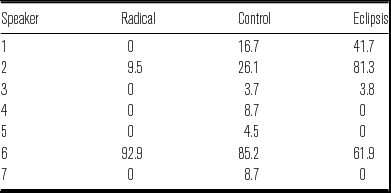
Table 7 presents the rate of elision of [
ɣ], considering only items where there was no pause or hesitation in the critical region. We do not consistently find the same pattern of elision for the same speaker between the two tasks, as a comparison of Tables 6 and 7 shows.
Rate of elision (%) of the [
ɣ] in the definite article an preceding the target noun according to Mutation condition for items with no hesitation or pause in the critical region (game task).

4 Discussion and conclusions
4.1 Phonetic characteristics of eclipsis consonants
One of the two main goals of our study was to provide evidence about the phonetic characteristics of eclipsis consonants. We examined whether eclipsis consonants (like the [ɡ] of a gcroí ‘their heart’) differ from the corresponding radical consonants (like the [ɡ] in gruig ‘(a) frown, scowl’), in particular whether these eclipsis consonants reflect characteristics of their voiceless counterparts (like the [k] of croí ‘(a) heart’). Eclipsis, radical, and control (voiceless) consonants were compared in terms of VOT, C1 duration, C1 closure duration, and relative intensity of the C1 burst.
Our analyses offer limited evidence that there may indeed be phonetic differences between radical and corresponding eclipsis consonants, in the direction predicted by the hypothesis. The analysis of the relative intensity of the stop burst showed that eclipsis stops have stronger bursts than corresponding radical stops, and also the bursts of eclipsis stops and those of control stops do not differ, in line with an incomplete neutralization hypothesis that eclipsis stops will share some characteristics of their corresponding voiceless control stops. These results are incompatible with models that predict no difference between ‘underlying’ [ɡ] and [ɡ] arising from eclipsis.
It is possible that this observed difference in the relative intensity of the stop burst reflects a real difference between eclipsis and radical consonants. There are, however, a number of alternative explanations that need be considered. For example, frequent words are known to be phonetically reduced and less frequent words to be more carefully articulated (see e.g. Bybee Reference Bybee2001, Reference Bybee2007 and references therein), and frequency measures show that the /b
ɣ/- and /ɡɣ/-initial radical forms used in the current study are more frequent than their eclipsis counterparts. At least in some environments, initial mutations may be part of a speaking style that is more formal and less familiar (at least in production). The observed differences in relative intensity of the stop burst may be due to hyperarticulated pronunciation of the radical consonants in our dataset. Two patterns in the data make this explanation less plausible: careful pronunciations are likely to have longer segmental durations and to be produced with release bursts. Yet we do not observe longer C1 durations or C1 closure durations in the eclipsis condition, and there are more tokens released without a clear release burst in the eclipsis condition than in the other two mutation conditions. (Recall that tokens without clear release bursts were excluded from the analyses; see Section 2.5.1.) In addition, as we caution above, since the [
ɣ] of the definite article is often elided in the eclipsis context used in our study, the preceding phonetic context varied somewhat across conditions. Another possibility is that the observed differences in relative intensity of the stop burst are due to an effect of orthography, since Irish mutations are represented with a digraph (e.g. <gc> ~ [ɡ] in a gcroí [ɡɾɣ
i] and radical consonants by a single letter (e.g. <g> ~ [ɡ] in
gruig [ɡɾɣɪɟ]). In their study of Dutch, for example, Warner et al. (Reference Warner, Good, Jongman and Sereno2006) report an influence of orthography on the production of homophones. Given the growing evidence on interactions between orthographic and phonological knowledge, we expect such an effect to be present even in a non-reading task. We predict that this influence of orthography should be weaker in non-reading tasks, in line with Winter & Röttger (Reference Winter, Röttger and Roettger2011: 67), who predict that effects of incomplete neutralization in German should be stronger in tasks in which ‘participants are thinking actively about the formal written language (e.g. when dictating a text)’ than in ‘regular’ incomplete neutralization (where there is no reading and attention is not drawn to the written language).
The VOT and segmental duration analyses revealed no differences in the critical comparisons. Voiceless consonants are known to be typically longer than their corresponding voiced consonants, and we had hypothesized that if eclipsis consonants reflect characteristics of the corresponding radical consonants, this difference might be present. In this case, the [ɡ] of a gcroí ‘their heart’ would be more /k ɣ/-like. While certain duration results are in the predicted direction (for example, the C1 duration in the eclipsis condition lies between that of the control and radical conditions), these critical duration comparisons are not significant. For VOT, C1 duration and C1 closure duration, eclipsis consonants did not differ from radical consonants. In particular, it was not the case that eclipsis consonants had values intermediate between control and radical consonants, as would be expected if eclipsis consonants reflect properties of the corresponding voiceless consonants.
The very little experimental work that has been done on the question of incomplete neutralization of distinctions in Irish initial mutation has been done with small samples of speakers (seven in this study, four in an earlier pilot study, Welby, Ní Chiosáin & Ó Raghallaigh Reference Welby, Chiosáin and Raghallaigh2011), with somewhat conflicting results. Roettger et al. (Reference Roettger, Winter, Grawunder, Kirby and Grice2014) raise concerns about the small sample sizes used in many studies of incomplete neutralization in German word-final devoicing, concerns that are also relevant here. For example, one participant in the pilot study showed a clear difference in duration with longer C1 duration for eclipsis than radical consonants, and longer C1 closure duration. In our analyses in Welby, Ní Chiosáin & Ó Raghallaigh (Reference Welby, Chiosáin, Raghallaigh, Soum-Favaro, Coquillon and Chevrot2014) of a subset of the data presented here, we also found significant differences in the direction predicted by the hypothesis for VOT and C1 duration. In that study, however, we used linear mixed-effects models with random intercepts only, which have since been criticized by Barr et al. (Reference Barr, Levy, Scheepers and Tily2013) as being prone to type II errors (incorrect rejection of the null hypothesis). We now use more conservative statistical tests (LMEMs with random slopes).
Our current results do not allow us to decide whether we are dealing with a partial or total eclipse. Additional production studies designed to correct the issues identified above (number of speakers, lexical frequency, etc.) might shed light on this question.
4.2 Variability of initial mutation patterns in present-day Irish
Our second main goal was to examine variability in patterns of initial mutation. The realization of these mutations appears to be style- or register-dependent, similar in some ways to that of French liaison. It was clear from our pre- and post-experiment discussions with our participants that some initial mutations are present in their spontaneous speech. In addition, although most participants do not produce mutations consistently in the semi-spontaneous speech of the card game task, they were fully comfortable reading sentences containing initial mutations, consistently producing the mutations specified by the orthography, even when they were immediately preceded by a pause or a hesitation. Participants also did not have any difficulty in understanding the speech of the experimenters BÓR and PW, who have more conservative patterns of initial mutations.
The realization of initial mutations in semi-spontaneous speech differed dramatically from the expectations of the traditional grammar. The following observation of Ball & Müller (Reference Ball and Müller1992: 221) for Welsh holds also for Irish: ‘Teachers lay great stress on “correct” (i.e. standard) mutation usage; however . . . first-language speakers consistently replace certain mutation contexts by non-mutation’. The only participant who produced eclipsis in most (88%) of the eclipsis contexts in the game task (Speaker 1) was working as an Irish–English interpreter, in addition to studying for a master's degree. To obtain certification as an interpreter, one needs to demonstrate mastery of the prescriptive grammar, including the system of initial mutations. Another participant (Speaker 7) was clearly influenced by the prescriptive grammar. As discussed in Section 3.2.1, his pattern of mutations changed mid-way through the game task. He produced more eclipsed consonants in expected contexts, but he also produced séimhiú-lenition consonants in unexpected contexts. In the post-recording discussion, this participant volunteered without prompting that his non-native speaker classmates from Dublin had better Irish than he and his native speaker friends from his Gaeltacht community, explicitly referring to knowledge of the official standard grammar (An Caighdeán Oifigiúil, Translation Section 1958 [revised 2012]). That said, explicit corrections in the game task were exceedingly rare; there were only two cases in which participants ‘corrected’ themselves to produce the eclipsed form called for by the prescriptive grammar.
In the card game task, we found some evidence that eclipsis may vary by consonant type. A number of speakers produced more eclipsis forms for velars than for labials, a pattern that may be in part due to the much greater frequency of /k ɣ/- and /k j /-initial words in the language. We are not aware of any mention in the literature of a tendency to produce more eclipsis forms for velar-initial than for labial-initial words, although there is some discussion about the reluctance of Irish speakers to séimhiú-lenite /f ɣ/ and /f j / (which are deleted in séimhiú-lenition, see Stenson Reference Stenson1990, Frenda Reference Frenda2012 and references therein). In the literature on other Celtic languages and other contexts, there is some discussion of the effect of lexical frequency. For example, working on the then moribund East Sutherland dialect of Scottish Gaelic, Dorian (Reference Dorian1973: 417–418) notes that since most irregular verbs are very frequent and begin with mutatable consonants, there is ‘inordinately heavy reinforcement of its mutational phenomena’. She makes a similar argument about the stability of mutation in ‘obligatory-lenition adjuncts’, commenting that it is ‘difficult to understand why the variability is not further advanced . . . unless the sheer statistical frequency of these morphemes has a braking effect on the process of change’.
Spontaneous speech corpora will be essential to advancing our understanding of the variability in the realization of initial mutations. For example, we will be able to look beyond the limits of the experimental materials of the current study, which included only one eclipsis context. We therefore do not have the data to examine variation potentially due to factors such as linguistic structure, functional load, and prosodic phrasing. For example, in most contexts, eclipsis and the other initial mutations have very little functional load: they rarely convey semantic or syntactic information. One exception is the third person pronouns, which are segmentally identical (a ‘his’, a ‘her’, a ‘their’: all [ə]), but distinguished by the initial mutations that follow them (e.g. a dheirfiúr [jɾ j ɪf j uɹɣ] ‘his sister’ (séimhiú-lenition), a deirfiúr [ d j ɾ j ɪf j uɹɣ] ‘her sister’ (no mutation), a ndeirfiúr [ n j ɾ j ɪf j uɹɣ] ‘their sister’ (eclipsis)) (see Frenda Reference Frenda2012, also Thomas & Gathercole Reference Thomas and Gathercole2007 on the acquisition of the comparable pronominal/mutation system in Welsh). Corpus studies will also allow us to examine whether the imbalance in eclipsis observed in the current study is due to the consonant type (velar vs. labial) or to the experimental items themselves. A similar phenomenon, French liaison, is known to be in part item-dependent. Corpora available for future investigations include the GaLa/Comhrá corpus of spoken Irish (Uí Dhonnchadha, Frenda & Vaughan Reference Dhonnchadha, Elaine and Vaughan2012) and the GaelChaint corpus of conversations between pairs of native speakers of Connemara Irish (Ó Raghallaigh, Ní Chiosáin & Welby Reference Ó Raghallaigh, Chiosáin and Welby2014).
Acknowledgments
We are grateful to the staff of Acadamh na hOllscolaíochta Gaeilge, An Cheathrú Rua, Connemara for hosting the recordings and to our speakers for their participation. We thank Kevin Scannell for the written corpus statistics, participants of the Celtic Linguistics 6 (Dublin) and PhonLex (Toulouse) conferences for their helpful feedback, and Amandine Michelas for her advice on the LMEMs. We also thank three anonymous reviewers and JIPA editor Amalia Arvaniti for their critical reading of previous versions of the manuscript and their constructive comments. All remaining errors are, of course, our own. This work was funded under the Ulysses France–Ireland research scheme. Partial results of this study were presented in Welby et al. (Reference Welby, Chiosáin, Raghallaigh, Soum-Favaro, Coquillon and Chevrot2014).
Appendix. Critical items sets