I. The spatial setting of the Propylaia: framing an entrance to the city’s sacred core
The entrance to the Acropolis rock had been of major importance since the beginning of human activities at the site, comprising a fortified settlement with neighbouring burials. Indications for habitation exist already in LH I.Footnote 2 The later fortification wallsFootnote 3 had their opening on the western side of the hill. This access was kept in use until modern times, since the terrain structure facilitated the easiest ascent (Supplementary fig. 1). Fortification needs led to the construction of the western gate running north–south, which was guarded by the tower-like promontory of the later purgos of Athena Nike.Footnote 4 As no indications for ritual practice in the area of the passageway through the wall can be identified for this early phase,Footnote 5 due to the many later phases and alterations of the Acropolis and the difficult excavation history, no hypotheses regarding cult continuity reaching back to the Bronze Age will be attempted.Footnote 6
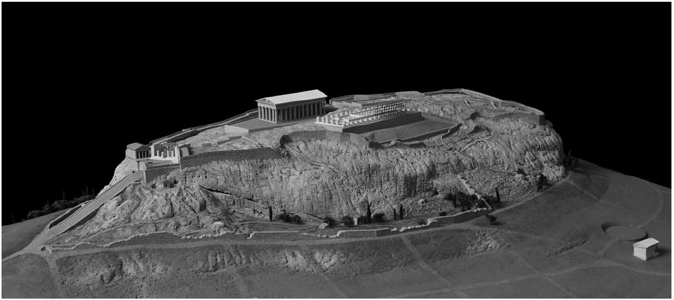
Even with the conversion of the Acropolis rock into the religious centre of the developing polis in the eighth century BC, the Acropolis kept its citadel-like character with a closed fortification wall.Footnote 7 On the southwest corner of the rock, the remains of the massive Cyclopean wall were kept visibleFootnote 8 and contemporary buildings were integrated. The Archaic entrance building, here termed the pre-Mnesiklean PropylonFootnote 9 (fig. 2), lay embedded in the Mycenaean wall and consisted of a broader central passageway, which could be used for processions. The passage followed a northeast–southwest alignment and was flanked by two halls. The inner part was set off by pillars.Footnote 10
The Pre-Mnesiklean Propylon with the slightly rotated entrance axis viewed from southwest (plaster model © Acropolis Museum, 2013, photo: Socratis Mavromatis).

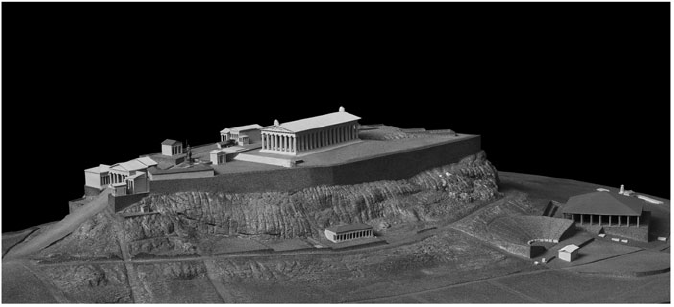
After the Persian destruction of the Acropolis, building activity at the site concentrated at first on the wall structures and repairsFootnote 11 and resumed with new buildings, notably the construction of the Parthenon, only after several decades. With the latter’s completion for the most part in 438 BCFootnote 12 (the finalization of the sculptures and other decorative parts was not concluded until 432 BC), the reshaping and restructuring of the Acropolis concentrated on the entrance situation under new spatial and aesthetic premises: the newly established temple buildings and colossal statuesFootnote 13 called for adjustments to the building axes that highlighted the Acropolis’ new aesthetics. Thus, for the erection of the Mnesiklean Propylaia (fig. 3) from 437 to 432/1 BC, the passageway was again rotated, now further to the east. A spatial relation between the Parthenon, which was visible from the inside of the new entrance building and the statue of Athena Promachos, which was positioned in the axis of the entrance, is highly plausible, although the exact chronological interrelations of the respective monuments are still under discussion (Supplementary fig. 4).Footnote 14
The entrance building of Mnesikles viewed from the southwest (plaster model © Acropolis Museum, 2013, photo: Socratis Mavromatis).

The building concept of the entrance also comprised the aforementioned Tower of Athena Nike, where her cult had been located since the Archaic period.Footnote 15 In connection with the construction of the new entrance, the originally separate hill promontory underwent major changes, as its street level was raised by almost 2 m (Supplementary figs 5 and 6). This measure led to a spatial incorporation of the tower into the building’s ambitious conception: the now elevated platform of the tower was annexed to the south wing of the Propylaia.Footnote 16
Gates/gateways were per se generally adorned with specific cults for transitory deities due to their sacred character,Footnote 17 especially those of major sanctuaries, and the Propylaia was no exception, since it housed several cults. The place-bound nature of cultic veneration raises the question of how cults reacted to changes of their attributed places and spaces.Footnote 18 The development of the Propylaia offers insight into the adaptability of cults, as changes can be tracked and even explained, when all available testimonies are read against each other.
II. How to detect cult: testimonies for cult in the Propylaia area
Cult practice at and in the entrance area of the Athenian Acropolis can be deduced from different types of evidence. However, only by a close reading of the entirety of all potential sources is it possible to understand their placement in this area and identify the actual cult recipient. Therefore, a thorough analysis of the actual literary, epigraphic and material testimonies ranging from the Archaic to the Roman period is indispensable, since even individual pieces of evidence already present difficulties and uncertainties regarding the respective time-bound content. Epigraphical sources for cults do not refer to their location on the Acropolis Hill and, like the statuary evidence, the script-bearing materials were likely relocated during the manifold modifications of the architectural units.Footnote 19 Literary sources that describe the setting of the Propylaia will thus provide the starting point for this investigation even if they were written long after the time frame in question and despite their inaccuracy regarding actual cult practice.
Several ancient authors, mainly from the Roman Imperial period,Footnote 20 are relevant to this case study, since they describe the Propylaia, including the statues and images which were visible in their time. This temporal gap is problematic, since the statues could have been moved to the Propylaia at a later stage.Footnote 21 The following are known from written testimony: several equestrian statues,Footnote 22 in the immediate vicinity to the west of Athena Nike,Footnote 23 the Artemis Hekate/Hekate Epipyrgidia/Artemis Epipyrgidia,Footnote 24 the Hermes Propylaios,Footnote 25 the Charites of Socrates,Footnote 26 a bronze lioness,Footnote 27 the Aphrodite Sosandra,Footnote 28 a statue of Diitrephes,Footnote 29 less distinguished portraitsFootnote 30 and Athena Hygieia.Footnote 31 Beside a bronze statue of a boy made by Lykios and a Perseus,Footnote 32 just behind the Propylaia lay the sanctuary of Artemis Brauronia with two cult statues.Footnote 33 Since all these statues were regarded as highly esteemed opera nobilia, they have long been the focus of sculpture research and consequently, various statue types have been proposed.Footnote 34 Regular ritual practice or an administered cult, which is, for example, attested in cult calendars and treasury lists,Footnote 35 can only be substantiated for Athena Nike,Footnote 36 Artemis-Hekate-Epipyrgidia,Footnote 37 Hermes,Footnote 38 the Charites,Footnote 39 Athena HygieiaFootnote 40 and Artemis Brauronia.Footnote 41 The known placements of these cults after the erection of the Mnesiklean Propylaia shows that some were located in the vicinity of the building, but definitely not inside it. Athena Nike’s altar and temple were situated on the purgos, Athena Hygieia’s altar was attached to the outer surface of one of the Propylaia columns and the temenos of Artemis Brauronia was clearly distinguished by its surrounding walls. Before proposing that the images of Hermes, Artemis-Hekate-Epipyrgidia and the Charites were located inside the wings of the Propylaia building, the complex evidence for these cult recipients, starting already in the late Archaic period, needs to be reassessed, since the textual testimonies reveal discrepancies in the proposed denomination of the interlinked image types. The clarification of these inconsistencies between cult actually practised and locally specific image concepts is the first step for tracing the shift in imagery analysed here.
III. Iconographic evidence: securing identifications
Iconographic evidence linked to the cults on the Acropolis is generally affected by the problem of dislocation.Footnote 42 This is also the case for objects in relation to the three respective cult recipients. Sculpture fragments from the sixth century BC found on the Acropolis and predating the erection of the Mnesiklean Propylaia are only attested for Hermes and the Charites. Their original location on the hill is unknown, since they came to light in secondary contexts. Footnote 43
The oldest example is an Archaic relief fragment of a young beardless Hermes wearing a pilos and carrying a syrinx (Supplementary fig. 7).Footnote 44 This depiction is comparable to the so-called Aglauridenrelief (Supplementary fig. 8),Footnote 45 in which Hermes is depicted as an aulos player leading three female dancers and a young boy. Nikolaus Himmelmann-Wildschütz identified the scene as a depiction of Hermes with the Nymphs,Footnote 46 who have included a young boy in their dance as a numpholeptos. Taking the specific setting of the Auglauridenrelief into account, Himmelmann-Wildschütz’s specific identification of the three females has to be questioned, since the Nymphs are not elsewhere attested on the Acropolis; moreover, the Archaic Athenian iconography of ‘weibliche Dreivereine’ Footnote 47 is highly vague.Footnote 48 Instead, a sacrificial calendar from the Acropolis,Footnote 49 dating to 480–460 BC, accounts unequivocally for the worship of the Charites at the site. This slightly later epigraphic evidence makes it plausible to identify the three maidens as the Charites and further allows the identification of another late Archaic fragmentary relief depicting a frontally positioned woman dressed in a peplos (Supplementary fig. 9) as a Charis.Footnote 50 The young boy could be interpreted as the dedicant.Footnote 51
A third monument to the Charites, the so-called Charites of Socrates, provides a complex and intriguing set of material and literary evidence. According to literary testimonia, the relief depiction of the Charites of Socrates was situated in the entrance area of the Acropolis.Footnote 52 Ancient authors identified the sculptor Socrates as the Athenian philosopher, who was the son of a sculptor.Footnote 53 Considering when the famous Socrates lived, the identification of a series of reliefs showing three dressed young maidens (Supplementary fig. 10) as the Charites of SocratesFootnote 54 seemed problematic, since the stylistic traits shown in the reliefs, such as heavy drapery, heavy chins and typical hairstyles, point to a dating in the period of the Severe Style.Footnote 55 Although this chronological problem was solved by identifying this Socrates with a Theban sculptor who had actually worked during the early Classical period, a connection of the relief to the Acropolis has to be regarded with caution. Since the fragments found in the area of the AcropolisFootnote 56 are Roman copies and not the actual ‘Urbild’, Olga Palagia argued that these fragments could have been transferred to the Acropolis as building material in medieval times.Footnote 57 Stressing the de facto unspecific iconographic traits of the three women depicted, she proposes an identification as Nymphs. According to Palagia, the Charites of Socrates, which were executed as cult images, are shown instead as half-figure miniatures with a chthonic implication, depicted in other votive reliefs with archaistic traits dating to the last quarter of the fifth century BC.Footnote 58 Palagia’s assumption that actual sculptures or specific sculpture types are shown in the background of votive reliefs has to be questioned: depictions of other deities in the background as references to location indicating neighbouring cults of the recipient deity of the relief are attested for several votive reliefs.Footnote 59 Yet the depictions of specific statues, for example, through the depiction of statue bases, which also coincide with known statuary, are not retraceable in the Classical votive reliefs.Footnote 60 Moreover, the half-figured depiction would fit the presentation through a ‘window’, providing an outlook to the background. The actual frame is more clearly worked in comparable votive reliefs and emphasizes the spatial relation beside, but clearly separated from, the divinities shown in the foreground; a distinction through colouring could have been used instead. The complexity of the evidence makes an unambiguous identification of the Charites of Socrates impossible. If the identification of the ‘Urbild’ of the Severe Style relief series, dating to 480–460 BC, as the Charites of Socrates is correct,Footnote 61 it would antedate the Mnesiklean Propylaia and thus provide another example of a depiction of one of the attested cult recipients.
Regarding their function, these relief depictions seem more likely to have served as votives than as cult images, since reliefs are less commonly used for this purpose.Footnote 62 Nevertheless, the images refer to the local cults of the Acropolis and the ʻAglauridenreliefʼ in particular represents a specific Acropolis-bound understanding of a cultic community, since the depiction was especially conceptualized for this context.Footnote 63 The relation visualized between Hermes and the Charites is iconographically documented for the late Archaic period. In the respective cult decrees, which date to a few decades later, the two cults are never jointly attested.
The imagery of Hermes drastically changes around the time of the erection of the Mnesiklean Propylaia. With the statue type of Hermes Propylaios,Footnote 64 explicitly linked to the entrance gates by Pausanias and attributed to the sculptor Alkamenes thanks to other testimonies,Footnote 65 Hermes adopts a completely different iconography from the Archaic examples from the Acropolis.Footnote 66 The complex information gained from the different copies, more or less directly dependent on the Alkamenian original,Footnote 67 securely documents the following elements in the ‘Urbild’.
On top of a pillar-like, aniconic body is positioned the anthropomorphic bearded male head with features of Archaic hairstyle (fig. 11). The mode of depiction is not a new one, since herms are certainly known from the Archaic period.Footnote 68 However, the creation of Alkamenes dating to the last quarter of the fifth century BC, and thus close to the erection of the Mnesiklean Propylaia, was considered unique and a masterpiece already in antiquity, a perception which led to copies explicitly referring to the Alkamenian original.Footnote 69 In contrast to the earlier images from the Acropolis, the Alkamenian Hermes lacks the Charites as shown in the ‘Aglauridenrelief’, since he is depicted as a single figure in semi-anthropomorphic mode.
Schematic drawing of the Alkamenian Hermes Propylaios with its core concept combining aniconic and anthropomorphic traits (C. Graml).

The evidence for the third cult recipient, Artemis-Hekate-Epipyrgidia, is strongly dependent on the chronology of the individual testimonies, ranging from the late Archaic to the Roman Imperial period. Material evidence predating the Mnesiklean building is difficult to pin down. Based on the finds of several late Archaic krateriskos fragmentsFootnote 70 with depictions relating to the Arkteia ritual (Supplementary fig. 12) practised by young girls for Artemis at Brauron and Mounichia,Footnote 71 cult activity for this deity seems plausible in the late sixth century BC,Footnote 72 yet the deity’s appearance and attributes on the Acropolis remain unclear.Footnote 73 For the Classical period, a colossal female head was proposed with good arguments by Giorgos Despinis to be that of a statue for Artemis Brauronia; however, it does not bear any specific features that secure this identification.Footnote 74
The second iconographic attestation for Artemis, which like the Hermes Propylaios marks a significant change in concept, needs a more detailed explanation. I propose that it is the original of the image type of the three-figured Hekateion,Footnote 75 also created by the sculptor Alkamenes. Comparable in concept to the Hermes Propylaios, it combines aniconic and anthropomorphic elements: the aniconic, column-shaped depiction of Artemis surrounded by the three maidens identifiable as the Charites.
IV. Pausanias’ iconatrophy,Footnote 76 research history and the renaming of the Hekateion typeFootnote 77
The identification of the three-figured statue from the Acropolis as Hekate, which is only known to us through copies and variations, is based on the singular testimony of the second-century AD writer Pausanias, who briefly describes it as follows: ‘It was Alkamenes, in my opinion, who first made three images of Hecate attached to one another, a figure called by the Athenians Epipyrgidia (on the tower); it stands beside the temple of the Wingless Victory’ (2.30.2). Footnote 78 The mention of Hekate drew scholarly attention to this Alkamenian statue, because the goddess was well known from a famous passage in Hesiod’s Theogony Footnote 79 as well as from the Homeric Hymn to Demeter, Footnote 80 and many later sources, ranging from Classical plays Footnote 81 and curse tablets Footnote 82 to magical papyri. Footnote 83 The characterization of Hekate based on the written sources shows an ambivalent goddess: benevolent in the Archaic period, Footnote 84 she was often linked to Artemis from Classical times on, acquiring a sinister touch and an association with magical rituals. Footnote 85 These varying traits and spheres of power were related to this peculiar image type, which was interpreted as a three-bodied goddess already in antiquity. Footnote 86 Early art-historical classical archaeology relied on Pausanias’ words uncritically. Footnote 87 These approaches focused on the possible formal appearance and style of the three-bodied statue made by Alkamenes and on identifying the copy closest to the archetype. Footnote 88 Research was also conducted regarding the provenance and development of the figure of Hekate by collecting all available material, including literary records, inscriptions, vase paintings and sculpture. Footnote 89 Inscribed statues attesting the use of different names for the same type, such as Artemis, Artemis Soteira, Hekate, Hekate Soteira, Artemis Hekate Epekoos or Artemis Phosphoros, Footnote 90 did not lead to doubts regarding Pausanias’ testimony. Both fields of research tried to link all existing data, on Hekate as well as the three-bodied statue type, and often neglected the chronological and geographical spread of these sources. Therefore, many ‘specifics’ were recognized and led to the image of a unique, strange goddess. Footnote 91 A strict focus on the time of the establishment with regard to the specific place of the erection and the relevance for the cult on the Athenian Acropolis, Footnote 92 however, allows for a re-evaluation of Pausanias’ testimony and, moreover, a renaming of the statue.
Pausanias states that Alkamenes was the inventor of the three-bodied depiction of Hekate, which was made by combining three agalmata together. Footnote 93 Pausanias also knew other image types used for Hekate, such as the single-figure xoanon from Aegina. Footnote 94 In referring to the statue as being composed of agalmata, he uses a term (agalma) that is not clearly specifiable, and could have different meanings, such as ornament or even cult statue. Footnote 95 Therefore, the actual function of the Alkamenian statue cannot simply be deduced from Pausanias’ identification. The use of προσϵχόμϵνα ἀλλήλοις to describe the appearance of the three figures can be clarified by another passage in Pausanias, where he uses the same expression for the description of the three-bodied giant Geryon on the Kypselos chest in Olympia. Footnote 96 Therefore, the three agalmata seem to have been merged together to a certain extent, in the way familiar from the different depictions of Geryon. The statue stood in the vicinity of the Tower of Athena Nike. Based on Alkamenes’ creative period Footnote 97 and the assumed stylistic development, a date around 430–420 BC seems most plausible for the statue’s erection. Footnote 98
So far, modern scholarship, relying on the accuracy of Pausanias’ identification of Alkamenes’ statue, has tried to challenge his account by suggesting the possibility of examples antedating the three-figured character of the statue. Regarding the ʻxoanonʼ Footnote 99 shape of the marble Hekateia, Erika Simon proposed wooden antecedents, which could have existed on the Greek mainland but long since decayed. Footnote 100 Instead of a statuary antecedent, Semni Karouzou assumed from the uninscribed depiction on an Athenian black-figure lekythos Footnote 101 that the idea of Hekate’s triplicity was already established at the beginning of the fifth century BC. Footnote 102 This idea has convincingly been proven wrong by Nicola Serafini, who was able to show that the depiction follows a common arrangement of figures, which had been clumsily executed on the lekythos. Footnote 103 Both propositions merely assume that the idea of a three-figured Hekate can be traced back in time and both lack sufficient material proof. No material evidence for the three-figured depiction of Hekate is yet known from Greek culture prior to the late fifth century BC; provided of course that it was indeed Alkamenes’ intention to depict Hekate!
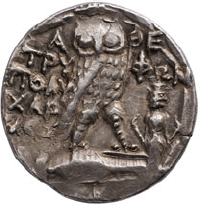
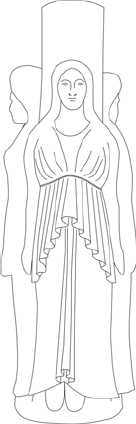
Based on the analysis of copiesFootnote 104 including the statue’s depiction in ʻofficialʼ media closely linked to the Athenian polis, namely numismatic evidence (fig. 13), the following traits are highly plausible and reveal its core concept (fig. 14): it consisted of a central pole or pillar. This pillar was surrounded by three frontally oriented female figures, standing shoulder to shoulder. The female figures were each dressed in a girdled peplos. The style of the drapery referred to Archaic korai. It is highly plausible that torches were held by the female figures. Footnote 105
Athenian tetradrachm of the New Style Silver coinage, by Tryphon and Polycharmos 91/90 BC with a depiction of the three-figured statue holding torches (Staatliche Münzsammlung München, photo: Nicolai Kästner).

Schematic drawing of the Alkamenian statue group of Artemis and the Charites with its core concept of combining aniconic and anthropomorphic traits (C. Graml).

The connection of Pausanias’ description to the widespread three-bodied image type was made in the 19th century without in-depth source criticism. Footnote 106 Written testimonies with references to regions other than Attica were intertwined with the image type and the resulting, apparently vast amount of textual and pictorial attestations was interpreted as an indication of the great importance of the goddess in antiquity. Scholarship tends to argue that a Hekate cult existed from the Archaic period Footnote 107 onwards due to mentions of her in the Theogony of Hesiod Footnote 108 and in the Homeric Hymn to Demeter, Footnote 109 but in doing so disregards the informative value of the testimonies and their regional, non-Attic nature. When it comes to concrete cult practice, neither of these literary sources are of help regarding Hekate, as she is not a major figure in them. Footnote 110 The alleged oldest known attestation of cult practised in Attica, a late Archaic terracotta statuette depicting an enthroned female figure with a votive inscription on the back, Footnote 111 however, has to be excluded, since the inscription is a modern forgery.Footnote 112
In search of the earliest attestation of an actual Hekate cult in Attica, one might consider Athenian red-figure vase painting with named depictions of Hekate as an independent figure dating from the first half of the fifth century BC onwards. Footnote 113 Nevertheless, these iconographic sources only testify to knowledge of her existence. Definite veneration and cult practice, however, are not inferable. The name Hekate is quite rare in epigraphic sources from Attica. The first attestation, from the Attic deme Paiania, dates to the third quarter of the fifth century BC and refers to a priesthood of Hekate (IG I3 250) Footnote 114 that is closely related to the Eleusinian rites. This would strengthen the relation to Demeter and Kore, which is attested in the Homeric Hymn to Demeter. More immediately related to the Acropolis is the reference in the treasury lists for the Other Gods for the year 429/8 BC (IG I³ 383). Footnote 115 Lines 124–26 list the property of the gods Hermes and Artemis Hekate, a coin. However, in the context of the Athenian Acropolis, ‘Hekate’ is used only as an epithet for Artemis. This fact has to be emphasized: the Hekate on the Acropolis is not an independent goddess, as is attested for other regions such as Caria; Footnote 116 instead the name is used as a descriptor for Artemis.Footnote 117 Hermes and Hekate are probably also recorded together in several fragmentary lists from the Athenian Agora, more precisely the area of the Tholos (IG I³ 406 Footnote 118 and 409, Footnote 119 420–405 BC). Unfortunately, the very fragmentary state of the inscriptions makes it impossible to clarify whether the name is being used as an epithet. Later cult calendars from demes of Attica, namely Erchia (SEG 21:541, Footnote 120 375–350 BC) and Thorikos (SEG 33:147, Footnote 121 380–375 BC), also refer to Hekate but for Erchia the use as an epithet is unequivocal, Footnote 122 while the Hekate passage in the inscription from Thorikos is too fragmentary to verify its exact use. This is also the case for a dedication from Koroni (SEG 21:780, Footnote 123 end of the fourth century BC), where the reading proposed by Oikonomides is disputed. Footnote 124 If the inserted form Hekate is correct, the inscription would be a further attestation of the use of the name as an epithet of Artemis.
The impression given by the use of the name Hekate in literary sources referring to Athens and Attica is different. In the work of the Athenian playwrights Aeschylus, Sophocles and Euripides, Hekate is mentioned with different characteristics, Footnote 125 but most of the references lack precision compared to official records of ritual norms. Some of them clearly show possible use as an epithet and therefore an immediate connection to Artemis, Footnote 126 but none of these refers to the Alkamenian statue. Footnote 127 Deciding if Hekate is conceived of as an independent goddess or as related to Artemis is often difficult. Thus, the evaluation of literary sources with regard to actual cult practice is less accurate than epigraphically attested ritual norms.Footnote 128 Literary testimonies do not generally clarify what the cult as practised constituted, and are difficult to interpret due to their ambiguity and often subjective distance from the events they describe. Footnote 129 The most important observation, though, is that none of these passages refers to the sculpture of Alkamenes. Footnote 130 Therefore, these sources do not seem sufficient for a reappraisal of Pausanias’ naming of the three-figured statue on the Acropolis.
The literary sources of the third century BC differ from the older ones, as they refer to Hekate autonomously and, moreover, mention the goddess with her triple aspect, relating to the three faces or three bodies and her connection to forks in the road. Footnote 131 When mentioning Athenian cult places for Hekate, later written testimonies refer to known sanctuaries for Artemis Footnote 132 and complicate the distinction between the two goddesses. Footnote 133 The archaeological records for sanctuaries of Hekate in Athens and Attica show no unambiguous evidence for their often hypothetical attribution. Footnote 134 So, apart from the Eleusinian Hekate known from literary, epigraphic and iconographic evidence, it seems plausible that there was a development of Hekate at Athens into an independent goddess from an epithet of Artemis that referred to a split-off character trait of the main deity. Footnote 135
The denomination EpipyrgidiaFootnote 136 is even more rarely attested in epigraphical sources from Attica. Only two references, in inscriptions dating from the first century BC from Eleusis and the first century AD from the theatre of Dionysus in Athens, mention the term in relation to an Athenian priesthood for Artemis Epipyrgidia and the Charites. Footnote 137 Therefore, Epipyrgidia is also an epithet for the goddess Artemis and both inscriptions prove, due to their joint mention and the composition of the inscription on the theatre seats, Footnote 138 the existence of a shared cult for Artemis and the Charites in Attica. In literary sources, Pausanias is the only writer who uses this epithet. Footnote 139 Its meaning refers, he claims, to the location of the Alkamenian statue on the purgos of Nike, the southwestern rock promontory of the Acropolis. Footnote 140 Pausanias admittedly is writing over 600 years after the erection of the statue, and he is the only one to connect Hekate to this epithet. Footnote 141 Due to this time span and developments in cultural and religious traditions, the accuracy of Pausanias’ transmission of cult names has to be regarded with suspicion. Footnote 142 The distinct epigraphic sources referring to Epipyrgidia in Attica securely attest a joint cult for Artemis and the Charites, at least in the first century BC. Although there is also a time span of 400 years between the establishment of the Alkamenian statue and the attested cult for Epipyrgidia, these epigraphic sources clearly preserve a ritual norm, which is a rather conservative element in religious practice. The potential reference to the cult of Artemis Epipyrgidia in IG II³ 1 531 would bridge the gap and make it more plausible that the Alkamenian statue depicts Artemis Hekate Epipyrgidia. Footnote 143 Since the epigraphical cult attestation from Attica refers to two cult recipients, Artemis and the Charites, and the iconographical analysis highlighted two main components of Alkamenes’ work, namely the three female figures draped in archaizing clothing and the central pole or pillar, the depiction might refer to all attested cult recipients by combining anthropomorphic with aniconic elements. Footnote 144
Depictions of three female figures, often in straight seriality, are known in Greek art since Archaic times. Footnote 145 Named depictions of groups of three females attest their identification as Nymphs, Moirai, Horai or the Charites. In Archaic Athens, the iconographic scheme of the three Charites is in evidence, for example, through the named depiction on the black-figure dinos painted by Sophilos. Footnote 146 In general, the Charites are only depicted in two different ways in Athenian art. They are shown in movement, Footnote 147 holding each other’s hands while dancing, or standing hieratically. Footnote 148 No early statue of the Charites sculpted in the round is known, Footnote 149 but all existing reliefs with provenance from Attica show rather unspecific traits: Footnote 150 the Charites are presented as three beautiful young women in elaborate clothing. Regarding the previously analysed traits of the Alkamenian statue, no difference can clearly refute the possible naming of the three females as Charites. Moreover, the Charites are clearly attested as cult recipients on the Athenian Acropolis by the fifth-century BC inscription IG I³ 234, Footnote 151 whereas no other ‘weiblicher Dreiverein’ is epigraphically attested to have received cult on the Acropolis. Artemis is also listed in this pre-Mnesiklean cult calendar separately.
If the connection of the Alkamenian statue concept to the cult of Artemis Epipyrgidia and the Charites is correct, the second component, the central pillar-like structure, which was already recognized by Georg Rathgeber as meaningful, Footnote 152 must allude to the second cult recipient, Artemis. This meaningfulness becomes evident in contrast to the often-compared Archaic perirrhanteria with female figures.Footnote 153 These purely formal predecessors as well as formal, and partially monumental, successors, such as the Acanthus Column with three dancing maidens at Delphi, have a specific function, differing from the Alkamenian statue: they were aesthetically configured pedestals bearing objects of focal interest.
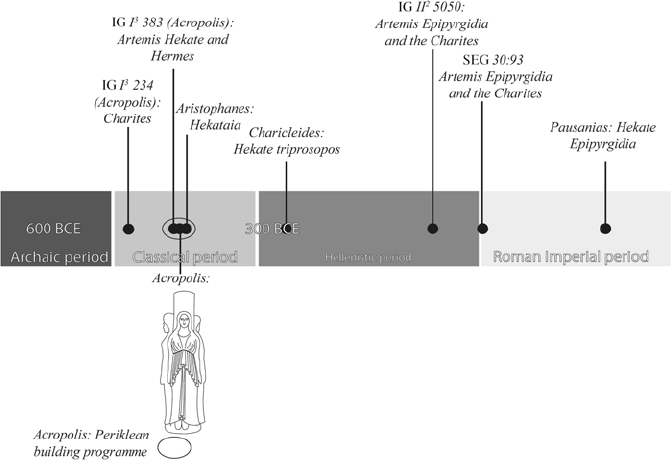
Since the Alkamenian statue certainly had no such function, the central pole’s meaning was explained as a relic of the evolution of depictions of Hekate. As the goddess is, according to written sources, the guardian of crossroads, the existence of a primitive proto-Hekateion Footnote 154 was assumed. Theodor Kraus reconstructed from a Late Antique source (without any clear reference to Hekate) that the first Hekateia were wooden pillars with masks hanging from them, looking towards the different paths meeting at the crossing. Footnote 155 This reconstruction relies strongly on the later literary tradition, where Hekate appears as triodotis, goddess of the three ways. Footnote 156 Due to the missing link to Hekate and, moreover, the inconclusive identity of Alkamenes’ statue as an independent Hekate, this interpretation seems unconvincing. Erika Simon tried to identify the central pillar as a round altar, around which the three females danced. Footnote 157 This observation of the central element being framed by the female statues is highly important, but has not been associated with the attested cults of the Acropolis. The meaningfulness of the pillar is deducible from its specific reproduction in all media, be it two- or three-dimensional. Instead of seeing this pole or pillar as the depiction of a meaningful object, the possibility of an aniconic, namely a non-anthropomorphic, depiction of the goddess Artemis seems promising. Footnote 158 By taking into account the statue’s possible concept with two main components and relating those to the attested shared cult for Artemis Epipyrgidia and the Charites, it could be hypothesized that the pole functions as the iconographical, yet aniconic, element referring to Artemis. Several studies have convincingly shown that non-anthropomorphic depictions are attested for many divinities; Footnote 159 there seem to be regions, like Arcadia, where the aniconic cult image was more favoured than in others Footnote 160 and where aniconic depictions of Artemis are actually preserved. Footnote 161 Nevertheless, Attica was also conversant with aniconic cult images, as depictions on red-figured vases plausibly attest. Footnote 162 Although, in Attica, an aniconic Artemis is documented neither in vase paintings nor in sculpture, this should not be seen as proof of general non-existence. Instead, the choice of an aniconic marker, which was highly dependent on the context, might have been strengthened in the later variations of the three-figured image type by emphasizing the pillar shape and by reducing the three full-bodied females to three heads attached to the pillar. Footnote 163 The original significance of Alkamenes’ initial image concept was strictly bound to its setting on the Acropolis. Only with the spread of the image type were other meanings added, such as the three-figured Hekate. By separately analysing the sole textual attestation of the triple-bodied sculpture made by Alkamenes and the vast iconographic evidence for this statue type, it becomes evident that the presence of an independent Hekate in Athens may have been overestimated. This impression was created by the uncritical combination of Pausanias’ reference with the passage from Hesiod that cannot be applied to Athenian cult and, moreover, the highly complex iconographical data. Archaic literary sources with no tie to Athens should not be uncritically brought together with the impression of a second-century AD traveller, whose cultural imprint and understanding of religion is not congruent with that of Classical Athens. Pausanias’ perception of the triple-bodied statue was certainly coloured by contemporary religious beliefs and not by the knowledge of the religious Zeitgeist of late fifth-century BC Athens. For Athens at this time, no institutionalized cult for an independent figure called Hekate is detectable on the Acropolis. The statue of Alkamenes, standing in the most prominent sacred area of Athens, probably frequently viewed by the inhabitants and visitors of the city, and most certainly in use as a cult statue, had no connection to an independent Hekate at the time of its erection.Footnote 164 More plausibly, in view of the conservativism of cult, is the connection to the attested cult of Artemis Epipyrgidia and the Charites. Only later adaptations of the image, initially created for the specific Athenian context, tend to confuse the three Charites with the triple-bodied Hekate. Footnote 165 Eventually the often-copied three-bodied image shaped the literary record of the goddess, who became trimorphos and triprosopos in the Hellenistic literary tradition. The fragment attributed to Charikleides Footnote 166 provides the oldest attestation known so far (fig. 15).
Timeline of the epigraphical and literary sources with their temporal relation to the Alkamenian image. IG II3 1 531 has not been included due to its ambiguous relation to Artemis Epipyrgidia (C. Graml).

The statuary concept of Alkamenes was such a success that both his works, the Hermes Propylaios and the Artemis Epipyrgidia with the Charites, were immediately reproduced, including outside of Athens and Attica. With this translocation of the Propylaia-based image concept, the successive adaptation and reinterpretation of the images began,Footnote 167 ultimately ending in Roman iconatrophy.
V. Coming back to iconographic testimonies for cults in the area of the Propylaia
With regard to the previously identified cults in the area of the entrance of the Acropolis, images of Athena Nike, like the first image of Artemis Brauronia, are only known from written testimony and due to non-specific description, no statue type can plausibly be tied to her. Pausanias describes Athena Nike’s and Artemis Brauronia’s earliest images as xoana,Footnote 168 a term that offers no indication of their actual appearance, but certainly evokes their old age and the long tradition of their cults.Footnote 169
With this overview on the interdependence of literary, epigraphic and iconographic attestations, it becomes evident that cult was practised for Athena Nike and Artemis Brauronia already prior to the erection of the Mnesiklean Propylaia in the areas around the entrance of the Acropolis. Athena Hygieia received a cult image only after the erection of the entrance building, although her cult was likely practised there earlier.Footnote 170 Artemis, Hermes and the Charites were put together in two groups; this is detectable in the peculiarity of the images of these three deities on the Acropolis: the Archaic, pre-Mnesiklean cult concept related them to Hermes while after the erection of the Propylaia they were attached to Artemis-Hekate. This means that after the erection of the new entrance building, the Charites ‘wandered’ from Hermes to Artemis.Footnote 171 The placement of the cults can be inferred from Artemis’ epithet Epipyrgidia. The area near the Tower of Nike, commonly associated with a placement of the Alkamenian statue on the purgos,Footnote 172 would be applicable also to the south wing of the Propylaia, which was close to the purgos. The promontory was architecturally emphasized by reducing the south wing, presumably rejecting the idea of a counterpart space to the south, which would have mirrored the Pinakotheke of the north side. The statue of Artemis and the Charites was likely erected in the south wing next to the tower, while Hermes could have been placed as a counterpart in the north wing.
VI. The ‘story’Footnote 173 of the wandering Charites
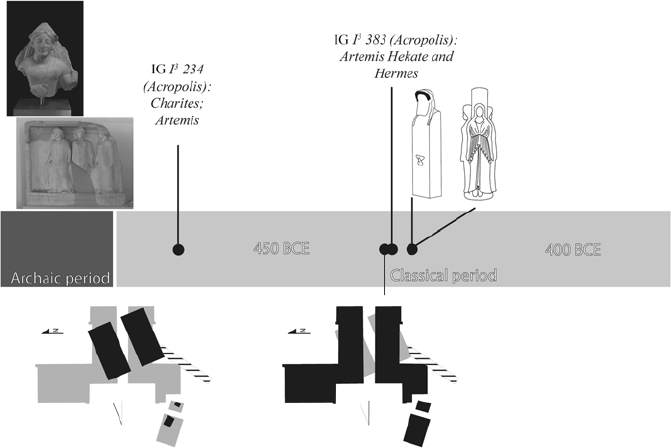
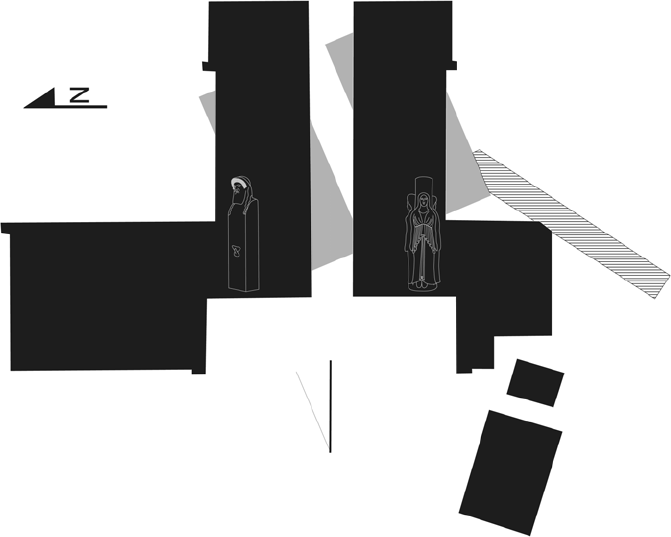
Based on the testimonies assembled so far, the erection of the Mnesiklean Propylaia seems to have stimulated the development of the cults they housed and their cult images (fig. 16). Already the wings of the pre-Mnesiklean Propylon were likely divided among the three cult recipients, with the north wing initially attached to Hermes and the Charites,Footnote 174 and the south wing to Artemis and the neighbouring Brauronion. With the rotation of the new entrance building, the Charites became part of her cult.Footnote 175 The position of the statue of Artemis and the Charites is not known, but, with regard to the later reading of it as Hekate Epipyrgidia, has always been connected to the purgos, the Tower of Nike, Footnote 176 which had undergone massive changes as the level of the hilltop was raised and the entire promontory joined to the Mnesiklean building complex (fig. 17). The statue group therefore was likely placed in the south wing, keeping the assumed previous relation to Artemis and additionally establishing a new spatial connection to the adjoining purgos.
Timeline of the iconographic evidence relating to the cult concepts of Artemis, Hermes and the Charites with regard to the likely spatial setting of the cults (C. Graml).

Schematic drawing of the Mnesiklean Propylaia with proposed location of the Alkamenian statues (C. Graml).

The post-Mnesiklean statues of Hermes and Artemis with the three Charites were all executed by the sculptor Alkamenes, who had previously worked on the Parthenon sculptures. Footnote 177 Mark Fullerton and Nina Werth have already argued for a correlation of the erection of the Epipyrgidia in the 430/20s BC Footnote 178 with the remodelling phase of the Propylaia and the Nike purgos all going back to the Periklean programme for the entire Acropolis. Footnote 179 This background is of great importance for the embedding of the concepts embodied in the statues of Alkamenes. With regard to their congenial concept of mixing aniconic with anthropomorphic elements and including archaic traits, Footnote 180 it seems plausible that Alkamenes was commissioned by the authorities in charge of the Acropolis refurbishment to equip the cult places of the newly erected Mnesiklean Propylaia with new cult images of old, long-established cults. In the course of the remodelling phase, the spatial coherence of the sacred precincts of several deities was impacted by the rotation of the building, which most likely led to alterations. Footnote 181 The Alkamenian statues marked the newly established sacred areas for the three cult recipients and eventually symmetrically framed the passage. By choosing archaizing and aniconic elements, Alkamenes created visual allusions to antiquity and tradition, which generated visual tension in juxtaposition to the progressive architectural setting of the Propylaia: the innovative architectural elements alluded to change overcoming the Persian destruction, while the divine images appeased the longing for continuity, tangibly experienced by allusions to religious tradition.Footnote 182
Supplementary material
To view supplementary material for this article, please visit https://doi.org/10.1017/S007542692200009X
Acknowledgements
Parts of this paper have been presented on several occasions, such as the research seminars at Bochum University and Hamburg University, the EASR conference 2019 in Tartu and the Kommission für Alte Geschichte und Epigraphik in Munich. I am grateful to the audiences for their interest and helpful suggestions. Special thanks go to Soi Agelidis for discussing the idea of shared image concepts, to Elisavet Sioumpara for her precious comments on the monuments of the Acropolis, to Ralf Krumeich for his manifold suggestions, which helped clarify the argument and prevented me from errors, and to the two anonymous reviewers for indicating to me several unclear points. Last, but certainly not least, I thank Henry Heitmann-Gordon for accompanying the development of the idea to writing and for making this text readable. For all remaining errors, I of course remain solely responsible.