

1. Introduction
In recent years, the Subcommission for Carboniferous Stratigraphy (SCCS) of the International Commission of Stratigraphy has been working towards the realization of an international scheme of chronostratigraphic divisions of the Carboniferous System (Heckel & Clayton, Reference Heckel and Clayton2006) which are anchored by formally defined and internationally agreed Global Boundary Stratotype Sections and Points (GSSPs; Cowie, Reference Cowie1986). The Carboniferous now comprises the Mississippian and Pennsylvanian subsystems; a GSSP has been selected and ratified for the base of the Pennsylvanian. The subsystems have themselves been divided into stages: the Tournaisian, Viséan and Serpukhovian stages in the case of the Mississippian. The GSSP for the base of the Carboniferous (and thus for the Tournaisian Stage) has been ratified, although this boundary is currently under review (Kaiser, Reference Kaiser2009). The GSSP for the base of the Viséan has also been ratified (Work, Reference Work2008). Considerable progress has been made in the selection of a GSSP for the base of the Serpukhovian, a horizon of particular relevance to palaeoclimatic studies because of the onset of, or at least significant expansion of, a major cooling phase of the Late Palaeozoic Ice Age believed to have occurred at that time (Rygel et al. Reference Rygel, Fielding, Frank and Birgenheier2008). In addition, it has been claimed that the Serpukhovian coincides with one of the most severe (in terms of ecological impact) biodiversity crises of the Phanerozoic (McGhee et al. Reference McGhee, Sheehan, Bottjer and Droser2012, Reference McGhee, Sheehan, Bottjer and Droser2013).
2. The Serpukhovian Stage
The Serpukhovian Stage was proposed by Nikitin (Reference Nikitin1890) for rocks in the vicinity of the city of Sepukhov, south of Moscow. The stage became formally incorporated in the Russian stratigraphical lexicon in 1974. The Zaborie Quarry section, south of Moscow, was historically generally regarded as the lectostratotype section (Gibshman, Reference Gibshman2003; Kabanov, Reference Kabanov2003). When the decision was taken by the SCCS to adopt the Russian stages from the Serpukhovian to Gzhelian as the international divisions of the younger part of the Carboniferous and to relegate the Namurian, Westphalian and Stephanian to the status of regional stages, applicable only in western Europe, the base of the Serpukhovian was considered to be equivalent to or close to the base of the Namurian (e.g. Heckel & Clayton, Reference Heckel and Clayton2006, table 1). It is now known that this is not the case (see Section 5).
Zaborie Quarry is not an appropriate section in which to establish the GSSP because the base of the Serpukhovian is represented there by an unconformity; in addition, the boundary beds are now flooded (Nikolaeva et al. Reference Nikolaeva, Gibshman, Kulagina, Barskov and Pazukhin2002; Kabanov, Reference Kabanov2003). Other, currently unofficial, functional stratotype sections such as the Novogurovskii Quarry section (Kabanov, Alekseeva & Alekseev, Reference Kabanov, Alekseeva and Alekseev2012) will become obsolete since they are not currently being considered as candidates for the new GSSP. A Task Group of the Subcommission of Carboniferous Stratigraphy was created in 2002 to establish a GSSP for the base of the Serpukhovian as close as possible to the Viséan–Serpukhovian boundary, as it was then understood (Richards, Reference Richards2003). Before evaluating potential GSSPs, the Task Group had to decide on the biostratigraphical tool (or tools) with which to identify the boundary. Candidate fossil groups were ammonoids, conodonts and foraminiferans. By 2005, the most-favoured group was conodonts; in particular, an evolutionary lineage within the genus Lochriea was considered to offer the best possibility of providing a tool to identify the boundary.
3. The conodont genus Lochriea
The genus Lochriea contains at least ten species. The multi-element composition of Lochriea commutata (Branson & Mehl, Reference Branson and Mehl1941), the type species of the genus, is known (R.D. Norby, unpubl. PhD thesis, University of Illinois at Urbana-Champaign 1976; Varker, Reference Varker1993; Purnell & Donoghue, Reference Purnell and Donoghue1998). Diagnoses of all the species are based on the character of the P1 elements. As far as is known, the other elements are shared vicariously by different species.
The ranges of the following species which have an ornamented platform jointly span the Viséan–Serpukhovian boundary, irrespective of at what level (within the range being considered) the boundary is defined: Lochriea costata Pazukhin & Nemirovskaya, Reference Pazukhin, Nemirovskaya, Kulagina, Rumiantseva, Pazukhin and Kotchetova1992; L. cruciformis (Clarke, Reference Clarke1960); L. monocostata Pazukhin & Nemirovskaya, Reference Pazukhin, Nemirovskaya, Kulagina, Rumiantseva, Pazukhin and Kotchetova1992; L. mononodosa (Rhodes, Austin & Druce, Reference Rhodes, Austin and Druce1969); L. multinodosa (Wirth, Reference Wirth1967); L. nodosa (Bischoff, Reference Bischoff1957); L. senckenbergica Nemirovskaya, Perret & Meischner, Reference Nemirovskaya, Perret and Meischner1994; and L. ziegleri Nemirovskaya, Perret & Meischner, Reference Nemirovskaya, Perret and Meischner1994.
To date there has not been an explicit study of the evolutionary relationship of all these species. However, Meischner (Reference Meischner1970) indicated the potential use of species now assigned to Lochriea in biostratigraphy and since then various authors (e.g. Nemyrovska, Reference Nemyrovska2005) have suggested that L. commutata, an unornamented and long-ranging form, gave rise to progressively more ornamented Lochriea such as L. mononodosa with a single node on the caudal side of the platform and L. nodosa with a node on each side. L. nodosa in turn gave rise to L. ziegleri, in which rows of large discrete nodes are located on thick ridge-like elevations on both sides of the platform close to its posterior margin. L. multinodosa, which is characterized by a wide, large platform ornamented by numerous small nodes, is also likely to have been derived from L. nodosa. L. senckenbergica, which is characterized by large, high nodes or bars located on both sides of the central part of the platform and L. cruciformis, characterized by thin, straight ridges on both sides of the platform that connect to the carina, were probably both derived from L. ziegleri. L. monocostata is similar to L. mononodosa with the single node replaced by a ridge, typically perpendicular to the carina; similarly, L. costata has two ridges replacing the two nodes of L. nodosa. Intermediates between several of these taxa have been referred to and illustrated: for example, between L. senckenbergica and L. cruciformis (Nemyrovska et al. Reference Nemyrovska, Wagner, Winkler Prins and Montañez2011); L. nodosa and L. ziegleri (Qi et al. Reference Qi, Wang, Richards, Groves, Ueno, Wang, Wu, Hu, Wang, Qi, Groves, Barrick, Nemirovskaya and Ueno2010); L. nodosa and L. senckenbergica (Skompski et al. Reference Skompski, Alekseev, Meischner, Nemirovskaya, Perret and Varker1995; Qi et al. Reference Qi, Wang, Richards, Groves, Ueno, Wang, Wu, Hu, Wang, Qi, Groves, Barrick, Nemirovskaya and Ueno2010); and L. ziegleri and L. cruciformis (Skompski et al. Reference Skompski, Alekseev, Meischner, Nemirovskaya, Perret and Varker1995; Qi et al. Reference Qi, Wang, Richards, Groves, Ueno, Wang, Wu, Hu, Wang, Qi, Groves, Barrick, Nemirovskaya and Ueno2010).
4. Correlation of the base of the Serpukhovian
4.a. The Lochriea nodosa – L. ziegleri lineage
The favoured biostratigraphical tool for the definition and subsequent correlation of the base of the Serpukhovian is the evolutionary (or global) first occurrence (First Appearance Datum or FAD) of Lochriea ziegleri in the lineage Lochriea nodosa – L. ziegleri. Detailed investigations of two candidate sections for the GSSP, the Naqing (formerly Nashui) section in Guizhou Province, China (Qi et al. Reference Qi, Wang, Richards, Groves, Ueno, Wang, Wu, Hu, Wang, Qi, Groves, Barrick, Nemirovskaya and Ueno2010) and the Verkhnyaya Kardailovka section in the southern Urals, Russia (Nikolaeva et al. Reference Nikolaeva, Kulagina, Pazukhin, Kochetova and Konovalova2009; Pazukhin et al. Reference Pazukhin, Kulagina, Nikolaeva, Kochetova and Konovalova2010), have been based on this premise.
For stability of the Serpukhovian as a chronostratigraphical unit, it is important to establish that the first occurrence of L. ziegleri in different basins is penecontemporaneous in a practical stratigraphic sense. It is commonly assumed that the first appearance of a taxon in two or more sections, in each of which an ‘evolutionary lineage’ has been demonstrated, is necessarily penecontemporaneous. However, as discussed by Sevastopulo & Nudds (Reference Sevastopulo, Nudds, Brenckle, Lane and Manger1987), this is not always the case. Where there is little or no overlap in the stratigraphical range of the putative ancestral and descendant taxa (e.g. the evolution of Dollymae bouckaerti Groessens, Reference Groessens1971 from Eotaphrus bultyncki (Groessens, Reference Groessens1971) was used by Sevastopulo & Nudds Reference Sevastopulo, Nudds, Brenckle, Lane and Manger1987), it is reasonable to regard the first occurrence of the daughter taxon within the lineage as a near isochronous marker. In many evolutionary lineages however, an ancestral taxon does not become extinct at the inception of its daughter taxon; the two taxa and intermediates between them may co-exist for some time. This is the case in the lineage L. commutata – L. mononodosa – L. nodosa – L. ziegleri; both in the Nashui section (Qi et al. Reference Qi, Wang, Richards, Groves, Ueno, Wang, Wu, Hu, Wang, Qi, Groves, Barrick, Nemirovskaya and Ueno2010, fig. 1) and in the Verkhnyaya Kardailovka section (Pazukhin et al. Reference Pazukhin, Kulagina, Nikolaeva, Kochetova and Konovalova2010, fig. 2), all four of the taxa listed above occur together at several horizons. This can lead to a situation in which the First Occurrence Datum (FOD: the lowest occurrence of the taxon in a stratigraphical section) of the daughter taxon is not its evolutionary earliest occurrence (FAD: globally earliest occurrence of the taxon), even where an ‘evolutionary lineage’ has apparently been demonstrated. An obvious way in which this can happen is through collection failure below the FOD. More intractable cases arise from ecological/biogeographical causes, where the daughter taxon has migrated from the region of origin to the region in which the section under study is situated. The consequence for biostatigraphers will be diachronous correlations. What are needed are additional tools with which to check the consistency of correlations. These will generally be biostratigraphical, but chemostratigraphy, magnetostratigraphy and particularly radiometric dating (e.g. Schmitz & Davydov, Reference Schmitz and Davydov2012) may also be useful.
4.b. Other biostratigraphical tools
In the Naqing section in China (Qi et al. Reference Qi, Wang, Richards, Groves, Ueno, Wang, Wu, Hu, Wang, Qi, Groves, Barrick, Nemirovskaya and Ueno2010), which consists largely of deep-water slope deposits, the only other potential biostratigraphical tools are foraminiferans, which according to Groves et al. (Reference Groves, Wang, Qi, Richards, Ueno and Wang2012) are relatively rare and do not include any of the basal Serpukhovian index species. In an attempt to overcome these difficulties, Groves and co-workers also examined the Yashui section, c. 90 km NNE of Naqing where a shallower-water sequence is exposed. Although the Viséan–Serpukhovian boundary beds at Yashui contained more diverse and abundant calcareous microfaunal assemblages, the paucity of conodonts precluded identification of the FOD of L. ziegleri; correlation to the Naqing section was consequently not possible. At the current state of knowledge, it is therefore not possible using foraminiferans to assess whether the FOD of L. ziegleri in SW China is at the same horizon as in other regions.
The Verkhnyaya Kardailovka section in the Urals is faunally much richer than the Naqing section and contains ammonoids, foraminiferans and ostracodes, in addition to conodonts (Pazukhin et al. Reference Pazukhin, Kulagina, Nikolaeva, Kochetova and Konovalova2010). Ammonoid biozones provide high-resolution biostratigraphy in the Late Mississippian and an ideal test of the degree of diachroneity of the FODs of L. ziegleri in different basins would be to compare their position against a global ammonoid biozonal scheme. Unfortunately, ammonoids around the base of the Serpukhovian are strongly provincial in their distribution (Korn et al. Reference Korn, Sudar, Novak and Jovanović2010). For example, the ammonoid faunas of the Urals are totally different at the level of species and largely different at the level of genus from those of NW Europe. At the present state of knowledge of both the conodont and ammonoid stratigraphical records, it is possible to make detailed comparisons of the FOD of L. ziegleri against a biozonation based on ammonoids only within a single ammonoid faunal province. Here, we assess the levels of diachronism of the FOD of L. ziegleri in widely separated sections in NW Europe using the existing high-resolution ammonoid biozonal scheme and also establish the level of the FOD of L. ziegleri with relation to the base of the Namurian Regional Stage.
5. The ranges of Lochriea spp. in terms of ammonoid biozones in NW Europe
A high-resolution ammonoid biozonal framework has been developed in the Rhenish Mountains in Germany (summarized in Korn, Reference Korn1996, Reference Korn2010) and in Britain and Ireland (summarized in George et al. Reference George, Johnson, Mitchell, Prentice, Ramsbottom, Sevastopulo and Wilson1976; Riley, Reference Riley1993). Korn & Titus (Reference Korn and Titus2011, fig. 11) have provided a correlation of the two biozonal schemes, which is used here to compare the ranges of Lochriea spp. in Germany, Britain and Ireland.
5.a. The Rhenish Slate Mountains (Rheinisches Schiefergebirge), Germany
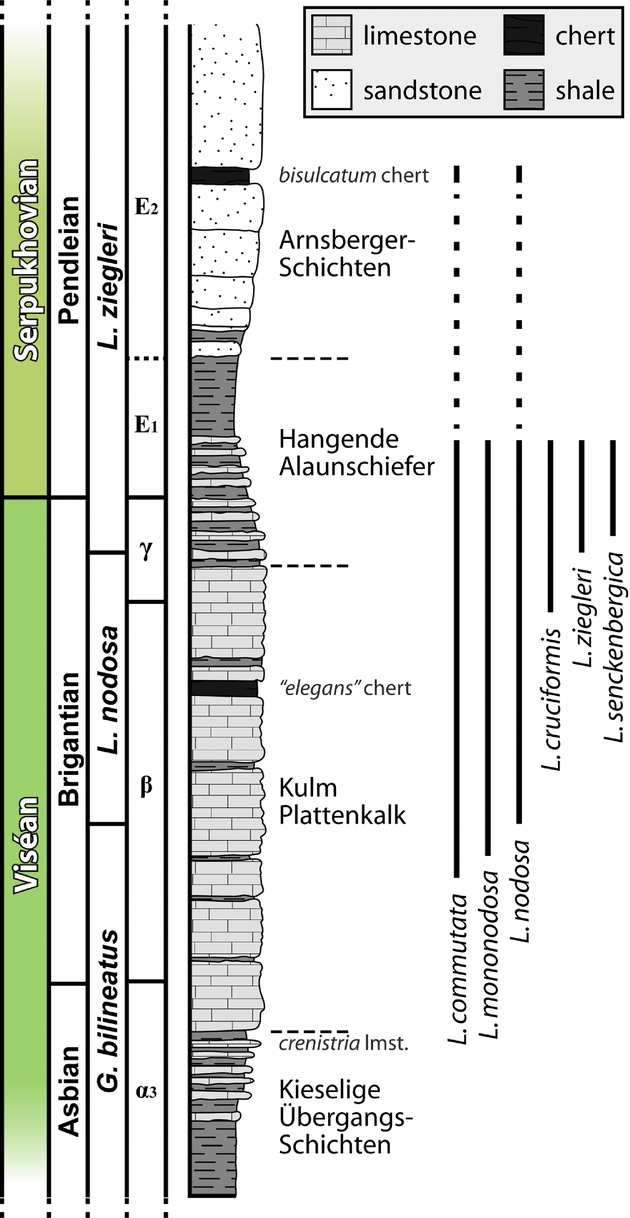
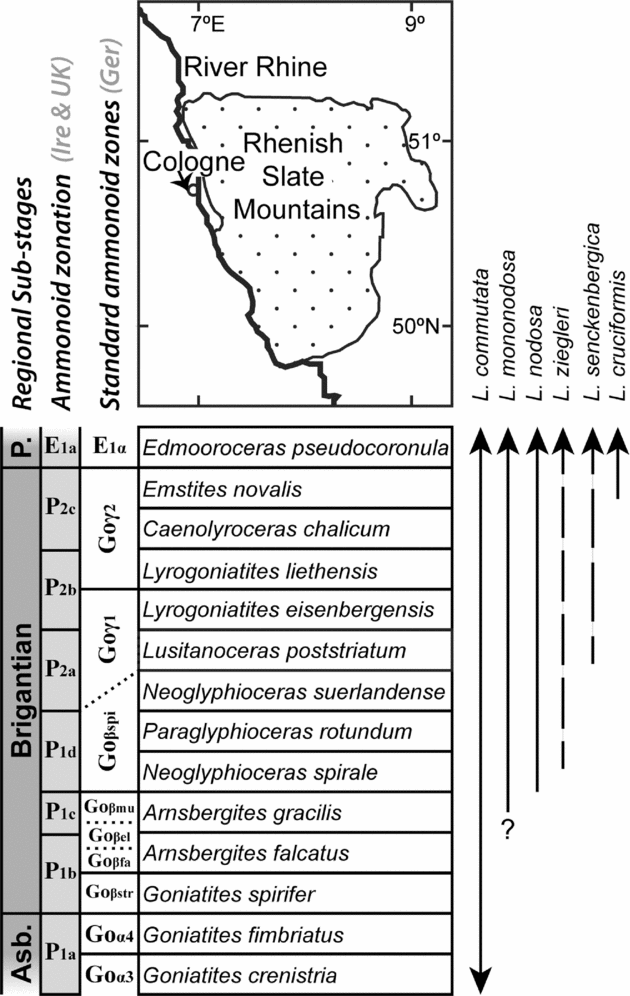
The ranges of Lochriea spp. in the Rhenish Slate Mountains (Fig. 1) have been documented by Meischner (Reference Meischner1967, Reference Meischner, Skompski, Alekseev, Meischner, Nemirovskaya, Perret and Varker1995) and Nemirovskaya, Perret & Meischner (Reference Nemirovskaya, Perret and Meischner1994), which are the sources of the data presented here. In Meischner (Reference Meischner, Skompski, Alekseev, Meischner, Nemirovskaya, Perret and Varker1995, fig. 3), reproduced here in slightly amended form (Fig. 1), the entry of L. mononodosa was shown as preceding that of L. nodosa; the latter was stated to be at the base of the Neoglyphioceras spirale Biozone. The entry of L. cruciformis was shown as preceding those of L. ziegleri and L. senckenbergica. The entry of all three species was stated to be within the Emstites schaelkensis Biozone, the name-giving taxon which, according to Korn (Reference Korn1996), first occurs in the Edmooroceras pseudocoronula Biozone at the base of the Namurian Regional Stage. However, Nemirovskaya, Perret & Meischner (Reference Nemirovskaya, Perret and Meischner1994) reported rare L. ziegleri from the Neoglyphioceras spirale Biozone and the earliest L. senckenbergica was stated to be from the Lusitanoceras poststriatum Biozone. Korn (Reference Korn2010, fig. 2) showed the base of the L. ziegleri Biozone corresponding to the base of the Edmooroceras pseudocoronula Biozone and the base of the L. nodosa Biozone corresponding to that of the Neoglyphioceras spirale Biozone. Korn & Titus (Reference Korn and Titus2011, fig. 11) correlated the base of the L. ziegleri Biozone with a horizon within the Emstites novalis Biozone. There is an urgent need to restudy the range of L. ziegleri relative to the ammonoid zones in Germany. The degree of the existing uncertainty is illustrated in Figure 2.
Distribution of Lochriea spp. in the Rhenish Slate Mountains, Germany. Lithostratigraphy and conodont ranges modified from Meischner (Reference Meischner, Skompski, Alekseev, Meischner, Nemirovskaya, Perret and Varker1995). Columns from left to right record the stage, regional substage, conodont biozone and standard ammonoid biozone. lmst – limestone.

Location of the Rhenish Slate Mountains and correlation of the various FODs (reported in the texts discussed) of important Lochriea species with relevant ammonoid biozonation schemes. Conodont ranges predominantly derived from Meischner (Reference Meischner, Skompski, Alekseev, Meischner, Nemirovskaya, Perret and Varker1995) with extensions and disagreements of ranges, shown as dashed lines, from Nemirovskaya, Perret & Meischner (Reference Nemirovskaya, Perret and Meischner1994), Korn (Reference Korn2010) and Korn & Titus (Reference Korn and Titus2011). Standard ammonoid biozones derived from Korn (Reference Korn1996), correlation with British and Irish ammonoid biozation schemes taken from Korn & Titus (Reference Korn and Titus2011).

5.b. Northern England
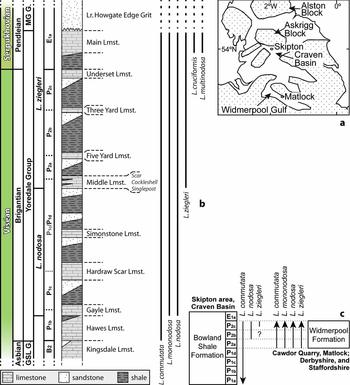
The most complete published information on the occurrences of stratigraphically important species of Lochriea in northern England is contained in Varker (Reference Varker, Skompski, Alekseev, Meischner, Nemirovskaya, Perret and Varker1995) and is derived from limestones within the shallow-water cyclothemic limestones, shales and sandstones of the Yoredale Group (Fig. 3). Lochriea spp. were obtained from all the limestones, most of which can be correlated with the ammonoid biozonation through the occurrence of rare ammonoids in the intervening shales (Ramsbottom, Reference Ramsbottom, Rayner and Hemingway1974, fig. 25). The FODs of both L. mononodosa and L. nodosa are in the Gayle Limestone, which lies between shales containing Arnsbergites falcatus of P1b age and Goniatites sphaericostriatus of P1c age (Rayner, Reference Rayner1953). The FOD of L. ziegleri is within the Middle Limestone. As the Middle Limestone is traced laterally from the locality on the Askrigg block studied by Varker to the Alston Block, it divides into three distinct units. In ascending order, these are: the Single Post, the Cockleshell and the Scar Limestone (Ramsbottom, Reference Ramsbottom, Rayner and Hemingway1974, fig. 24). M. Dean (pers. comm., 2010) has confirmed that the FOD of L. ziegleri is in the lower part of the Middle Limestone, which is correlated with the Single Post Limestone. This horizon lies below a level which has yielded Paraglyphioceras rudis (Hicks, Reference Hicks1959), assigned by Ramsbottom (Reference Ramsbottom, Rayner and Hemingway1974, fig. 25) to the P1d Biozone but stated by Korn (Reference Korn1996) to indicate the Arnsbergites gracilis Biozone of the Rhenish Slate Mountains, which is correlated with P1c of the British/Irish ammonoid biozonal scheme (Korn & Titus, Reference Korn and Titus2011). This discrepancy is clearly important in the context of the FOD of L. ziegleri and needs to be resolved. The Scar Limestone is overlain by shales with Lusitanoceras granosum, indicating the P2a Biozone. The FOD of both L. cruciformis and L. multinodosa are in the Main Limestone, which lies above shales with Edmooroceras tornquisti, indicating the E1a Biozone.
Distribution of Lochriea spp. in sections in N England. (a) Geographic location of discussed sections in N England. Stippled areas on the location map represent highs; unornamented areas represent basins. (b) Distribution of Lochriea spp. in the Yoredale Group, Alston and Askrigg blocks, N England (from Varker, Reference Varker, Skompski, Alekseev, Meischner, Nemirovskaya, Perret and Varker1995). Generalized lithostratigraphy of the Alston and Askrigg blocks modified from Varker (Reference Varker, Skompski, Alekseev, Meischner, Nemirovskaya, Perret and Varker1995) and Davies, Austin & Moore (Reference Davies, Austin and Moore1993). GSL G. – Great Scar Limestone Group and MG G. – Millstone Grit Group. Correlation of the ammonoid biozones with the named limestone units is from Rayner (Reference Rayner1953) and Ramsbottom (Reference Ramsbottom, Rayner and Hemingway1974). The correlation of the Single Post Limestone with the ammonoid biozones is discussed in the text. (c) Distribution of Lochriea spp. in the basinal facies of the Craven Basin near Skipton, Yorkshire (from Metcalfe, Reference Metcalfe1981) and on the margins of the Widmerpool Gulf at Matlock, Derbyshire (from Higgins, Reference Higgins1975).

The information from the basinal areas, where the ammonoid biozonation was first established, is surprisingly sparse. Higgins (Reference Higgins1975) did not sample below the P2 Biozone. However, he did record Lochriea spp. (under the generic name Paragnathodus) including L. commutata, L. mononodosa, L. nodosa and L. cruciformis from a section of P2 age at Cawdor Quarry, Matlock, Derbyshire. M. Dean (pers. comm. 2010) has confirmed that the specimen figured by Higgins (Reference Higgins1975, pl. 7, fig. 10) as L. cruciformis is L. ziegleri, as suggested by Nemirovskaya, Perret & Meischner (Reference Nemirovskaya, Perret and Meischner1994, p. 312). Metcalfe (Reference Metcalfe1981) did not record ornamented Lochriea spp. (all referred by him to Gnathodus nodosus) below the P2b Biozone in the section at Bank's Gill, near Skipton, Yorkshire in the Craven Basin.
5.c. Ireland
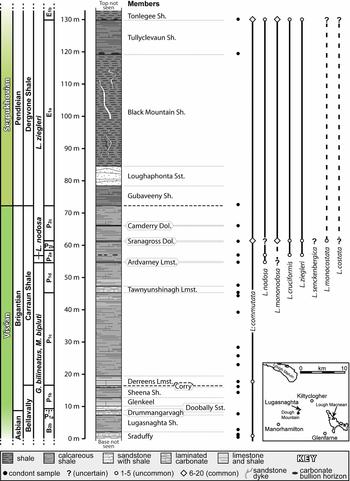
Important information on the range of ornamented Lochriea spp. is available in NW Ireland. Brandon & Hodson (Reference Brandon and Hodson1984) summarized the distribution of ammonoids in the upper Viséan and Serpukhovian Leitrim Group and additional information has been added by Korn (Reference Korn1990). The Leitrim Group, exposed throughout large parts of the Lough Allen Basin, consists of several primarily terrigenous formations of which the Carraun Shale Formation, ranging in age from P1b to P2c, is most relevant to the current investigation. The Carraun Shale Formation is composed predominantly of dark grey, occasionally pyritic, commonly fossiliferous, calcareous shale. Five carbonate-rich members have been identified and can be correlated throughout the basin (Fig. 4). Fossils are common throughout the formation, predominantly as flattened, crushed or impressed specimens, although three-dimensional fossils may also be recovered. The Carraun Shale is interpreted as having been deposited in an overall deepening environment (with the exception of the shallow-water Tawnyunshinagh Member) with limestone becoming more infrequent and the fauna becoming dominated by pelagic taxa, such as orthoconic nautiloids, ammonoids and associated bivalves such as Posidonia and Dunbarella, up sequence. Conodonts from late Viséan and Serpukhovian levels in NW Ireland have previously been described by Aldridge, Austin & Husri (Reference Aldridge, Austin and Husri1968) and Austin & Husri (Reference Austin, Husri, Bouckaert and Streel1974), but new detailed sampling carried out in the Carraun Shale Formation in the Lugasnaghta stream section on the NE side of Dough Mountain, Co. Leitrim (M. Barham, unpubl. Ph.D. thesis, National University of Ireland, Galway, 2010) has augmented the previous records. The sequence (c. 130 m thick) is exposed in the stream cut of a small tributary of the Sraduffy River over a distance of c. 1 km on the NW side of Dough Mountain, Co. Leitrim. The locality represents the type section of the Carraun Shale Formation and, despite some minor gaps in exposure and local faulting, it is thought the measured section (Fig. 4) provides an accurate temporal record. Samples of carbonate rock typically weighing 2 kg (but up to 4 kg where microfossil yields were low) were dissolved in dilute formic acid and conodonts picked from the insoluble residues.
Distribution of Lochriea spp. in the Carraun Shale Formation, Lugasnaghta stream section (Irish Grid GR G95578 43058 to GR G95105 42710, see also inset location map), County Leitrim, Ireland. Information from M. Barham, unpublished Ph.D. thesis, National University of Ireland Galway (2010). Ammonoid zones from Brandon & Hodson (Reference Brandon and Hodson1984). Dashed line represents an extension of range based on tentative identifications. Conodont abundances per 2 kg sample are shown; other conodont genera were also recovered.

A range chart showing the distribution of Lochriea spp. is shown in Figure 4. The Derreens Limestone Member, which contains Arnsbergites sphaericostriatus and Goniatites lepidus of P1c Biozonal age, has yielded L. commutata transitional to L. mononodosa. The shale-rich succession between the Derreens Limestone Member and the Ardvarney Limestone Member, which contains a rich ammonoid fauna assigned to the P1d Biozone, has yielded small numbers of conodonts but no specimens of Lochriea spp. The Ardvarney Limestone Member contains Lusitanoceras granosum and Sudeticeras crenistriatus of P2a age and marks the FOD of L. nodosa and L. cf. cruciformis. The FOD of undoubted L. ziegleri occurs 2.2 m higher and L. cf. senckenbergica first occurs 6.7 m higher, both within the P2a Biozone.
6. Discussion and conclusions
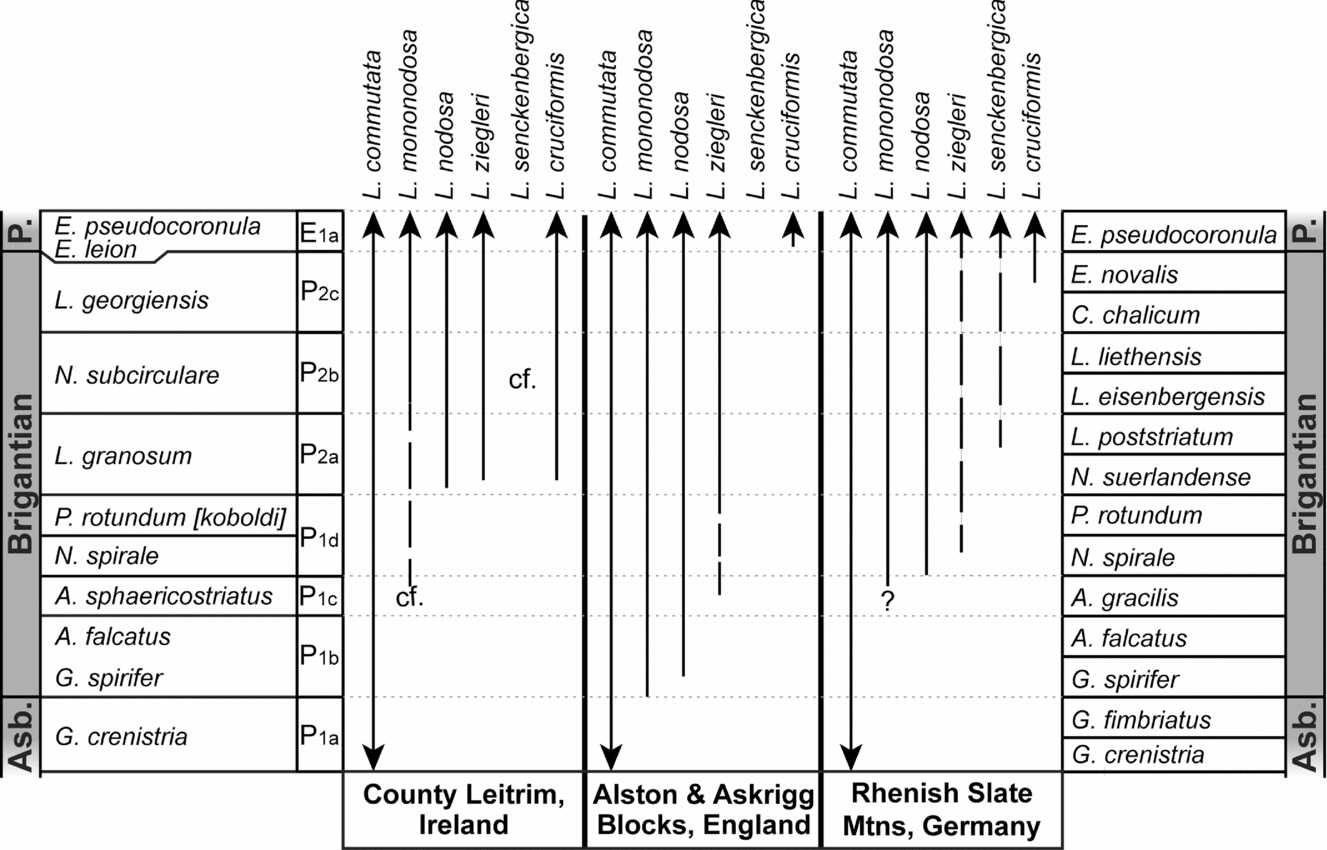
A comparison of the ranges of Lochriea spp. in the Rhenish Slate Mountains, N England and NW Ireland is shown in Figure 5. The FODs of L. nodosa are within P1c of the British and Irish ammonoid biozonal scheme in the Yoredale sequence in N England, in the equivalent of P1d in the Rhenish Slate Mountains and at the base of P2a in NW Ireland.
Comparison of the distribution of Lochriea spp. in County Leitrim, Ireland, the Alston and Askrigg blocks, N England and the Rhenish Slate Mountains, Germany. Dashed lines represent extensions of range that require confirmation. Correlation of the German and Irish/British ammonoid zonal schemes is from Korn & Titus (Reference Korn and Titus2011). Asb. – Asbian; P. – the Pendleian regional substages.

The FODs of L. ziegleri are comparable, but not exactly the same, in the Yoredale sequence of N England and in NW Ireland (within P1d or possibly P1c in the former and at the base of P2a in the latter). Given the poor conodont record in P1d in NW Ireland, it will not be surprising if further collecting lowers the FOD of L. nodosa and L. ziegleri there. The situation in the Rhenish Slate Mountains is confusing with the FOD of L. ziegleri variously reported as being within the equivalents of P1d, P2c or E1a. It is essential that these contradictions be resolved.
The FOD of L. senckenbergica is either in the equivalent of the upper part of P2a or P2c in the Rhenish Slate Mountains and possibly in P2b in NW Ireland. Varker (Reference Varker, Skompski, Alekseev, Meischner, Nemirovskaya, Perret and Varker1995) did not record L. senckenbergica from N England.
The FOD of L. cruciformis appears to be the most variable, as high as E1a in N England and possibly as low as P2a in NW Ireland. The FOD in the Rheinisches Schiefergebirge was shown by Meischner (Reference Meischner, Skompski, Alekseev, Meischner, Nemirovskaya, Perret and Varker1995, fig. 3) to be below that of L. ziegleri. Different authors may have different taxonomic concepts of L. cruciformis.
In conclusion, based on the FAD of L. ziegleri the lower boundary of the Serpukhovian is at a substantially lower horizon than the lower boundary of the Namurian Regional Stage, approximately in the middle of the Brigantian Regional Substage. The FOD of L. ziegleri in sections in NW Europe may be close to isochronous, but conflicting information from the Rhenish Slate Mountains and sections in Britain and Ireland needs to be resolved to confirm this.
Acknowledgements
M. B. was supported by an IRCSET (Irish Research Council for Science, Engineering and Technology) postgraduate scholarship, which is gratefully acknowledged. The authors thank Mark Dean, formerly of the British Geological Survey, Edinburgh for information regarding conodonts; Dr Dieter Korn, Museum für Naturkunde, Leibniz Institute at the Humboldt University, Berlin for information regarding ammonoids; and Dr Colin Waters, British Geological Survey, Keyworth for information on Carboniferous lithostratigraphical units. Reviews by Dr Barry Richards and an anonymous referee are gratefully acknowledged.