Introduction
Behavioral modeling is a well-known and popular technique often applied to radio frequency (RF) power amplifiers (PAs) in order to establish a relationship between device input and output signals, without prior knowledge of the PA internals [Reference Cripps1]. Over the past few decades, several methods have been proposed to analyze and describe the behavior of RF PAs [Reference Schreurs, O'Droma, Goacher and Gardringer2–6].
Increasingly, stringent efficiency requirements have led to the present abundance of advanced PA architectures, such as the envelope tracking (ET), outphasing, and multi-way/multistage Doherty [Reference Cripps1] techniques. These PAs consist of multiple transistors and/or building blocks in different combinations, leading to distinctly non-linear behavior, such as, for example, AM/AM characteristics typified by a visible (horizontal and elongated) “S” shape, as well as strong, non-linear, memory effects, arising due to internal interactions between multiple active devices [Reference Grebennikov and Bulja7]. The existing modeling techniques based on the Volterra series are facing significant challenges for such systems. The decomposed vector rotation model [Reference Zhu8], derived from a modified form of the canonical piecewise linear functions, shows promise as a potential new modeling option. So far, however, the reported accuracy improvement remains modest [Reference Cai, Yu, Sun, Chen and King9]. A similar situation applies to methods based on artificial neural networks [Reference Liu, Boumaiza and Ghannouchi10].
Recently, applications of machine learning methods to RF modeling have gained popularity. In [Reference Zhu8], a time-domain version of the support vector regression (SVR) method is used to create dynamic models for several PA prototypes, showing improved prediction when compared with traditional techniques. However, when modeling the multiple device Doherty PA, the accuracy remains insufficient. In [Reference Zhu, Draxler, Chin, Brazil, Kimball and Asbeck11], a vector decomposition technique is presented and applied, as part of an ET PA model based on the Volterra series, with a significant improvement in modeling efficacy reported.
In this paper, the SVR method, from the field of machine learning, is combined with the decomposed piecewise technique, thus providing a new modeling methodology for multi-device PAs that exhibit strongly non-linear behavior that is additionally compounded by non-linear memory effects.
The paper is organized as follows. The basic theory of the vector decomposition technique and the SVR modeling methodology is provided in section “Basic theory of proposed modeling methodology”, while in section “Model validation”, experimental validation results are provided. Conclusions are presented in section “Conclusion”.
Basic theory of proposed modeling methodology
In order to deal with the distinct non-linearity and memory effects inherent in multi-device PA architectures, we first decompose the input complex envelope signal into several subsignals, using a vector threshold decomposition technique. Each subsignal is then processed using the SVR method. The concept is presented in detail below.
Vector threshold decomposition
As described in [Reference Liu, Boumaiza and Ghannouchi10], the PA behavior depends strongly on the input power level. To model effectively this non-linear behavior, we define a set of thresholds as

where α S is the magnitude of the input envelope, the values α s are monotonically increasing, i.e. α 1 < α 2 < ⋅ ⋅ ⋅ < α S, and S is the total number of thresholds.
By using these threshold values, the signal space is divided into several interval zones, and the original input signal is then decomposed into several subsignals, located in the corresponding interval zones. For instance, the sth subsignal can be obtained from

where $\vert {{\tilde{x}}_s\lpar n \rpar } \vert$ returns the magnitude of the complex-valued envelope $\tilde{x}_s\lpar n \rpar$
 , and φ(n) is the phase of $\tilde{x}_s\lpar n \rpar$
 . Note that the signal above is represented in discrete-time, where the lengths of all subsignals are equal to that of the original signal. For example, assume that the input signal in the discrete-time domain has L samples, the decomposed subsignals can then be represented by the matrix

where every original signal sample is decomposed into S + 1 subsamples, represented by each row of the matrix.
Support vector regression theory
SVR, developed by Cortes and Vapnik [Reference Cortes and Vapnik12], represents a promising method for solving high-dimensional optimization problems. This method is introduced below.
Suppose that the training data are given as $\lcub {{\bf x}_i\comma \;{\rm \;}y_i} \rcub _{i = 1}^n$ , where the column vector ${\bf x}_i\in {\bf R}^M$
 denotes M real-valued input variables with output value $y_i\in {\bf R}$
 . As described in [Reference Cai, Yu, Sun, Chen and King9], for applications to PA modeling, the unknown non-linear function can be expressed as

where β i are the model weights, b is a bias term, and k( ⋅ ) is the kernel function. The kernel implemented in this paper is based on the radial basis functions (RBFs), which depend on the training data independent variable$\;{\bf x}_i$ (the dependence is captured in the coefficients β i). The RBFs are chosen over the alternative option of linear or polynomial kernels since the former provide a larger function space. Intuitively, the RBFs, which are based on squared exponential functions, can act as function approximators for arbitrary analytic functions, while kernels based on polynomial functions must necessarily have vanishing derivatives beyond a fixed order. This makes the RBF-based kernels more general, and thus RBF-based RF SVR models tend to be more accurate – see [Reference Cai, Yu, Sun, Chen and King9] for a detailed analysis.
Once the optimal hyper paramy ieters are fixed, using the grid-search method [Reference Cai, Yu, Sun, Chen and King9], the model is trained and the final model can be obtained. The total number of model parameters are separated into two different sets, the first set consists of the hyper parameters, i.e. the margin ɛ, the regularization term C, and γ; the second set consists of the coefficients required to fit the non-linear functions – the support vectors, N SV. Thus, the total number of model parameters for the RBF-based SVR method is given by [Reference Cai, Yu, Sun, Chen and King9]

RF PA modeling description
The objective in PA modeling is to find an explicit function that relates the input and output signals. Due to the memory effect, the model should not only take into consideration the present value of the input signal, but also some of its past history, as described below

The non-linear function, as described in (4), is written as a real-valued function of one real variable. However, the input and output signals in (6) are complex-valued. As described in [Reference Zhu8], in order for the SVR technique to be applicable to the modeling problem in (6), both the input and the output values are separated into real and imaginary parts, i.e. only real-valued inputs and outputs are permitted.
A key aspect that distinguishes this work from previous modeling efforts is that, here, the input signal is decomposed into several sub-signals as described in section “Vector threshold decomposition”. Thus, the model equations for the real part and imaginary part are given as in (7) and (8) below,


where$\;\tilde{x}_s^R \;$ and ${\rm Re\;}\tilde{y}\lpar n \rpar \;$
 refer to the real part of the input and output signals, $\tilde{x}_s^I \;$
 and ${\rm Im\;}\tilde{y}\lpar n \rpar \;$
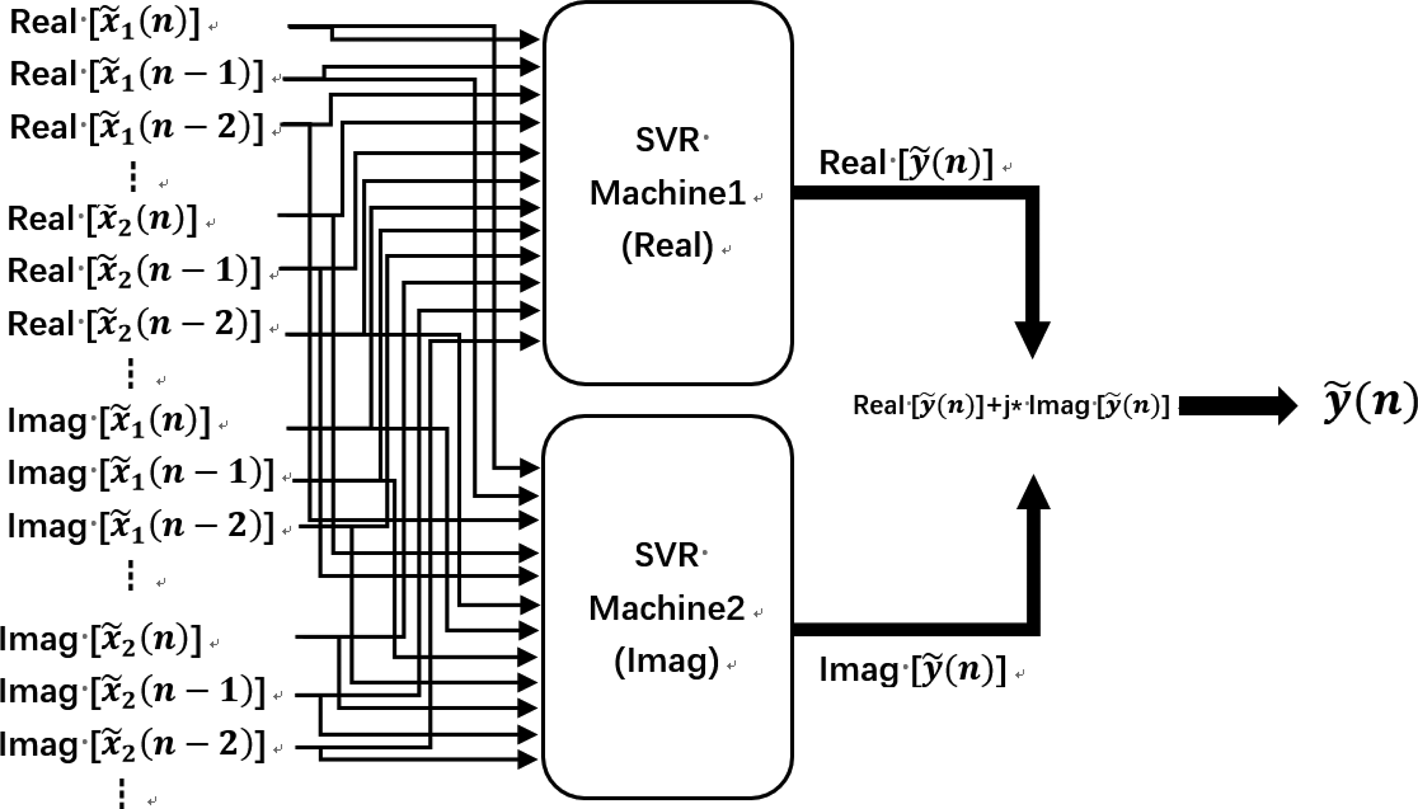
 refer to the imaginary part of the input and output signals, respectively. The modeling topology is described in Fig. 1.
Block diagram of the proposed behavioral model.

As can be seen from the figure, this new model includes two different SVR machines. The real and imaginary parts of the input subsignals $\tilde{x}_s\lpar {n-m} \rpar$ are separated and taken as the inputs of the two SVR machines. The modeling procedure of the new methodology is similar to the conventional method. The model is trained with the training data $\lsqb {\lcub {{\tilde{x}}_s\lpar {n-m} \rpar {\rm }} \rcub_{m = 0}^M \comma \;\;\tilde{y}\lpar n \rpar } \rsqb .$
 Once the model training is completed, it can be used for behavioral prediction of the response of the PA when subjected to waveforms under similar conditions.
Model validation
In this section, experimental tests are used to validate the proposed modeling method when applied to both a single-transistor PA and multi-transistor PA. Both PAs are designed in-house, and are modeled based on the proposed decomposed piecewise SVR technique. The models are extracted using the MATLAB software.
Single transistor GaN PA without “S” shape
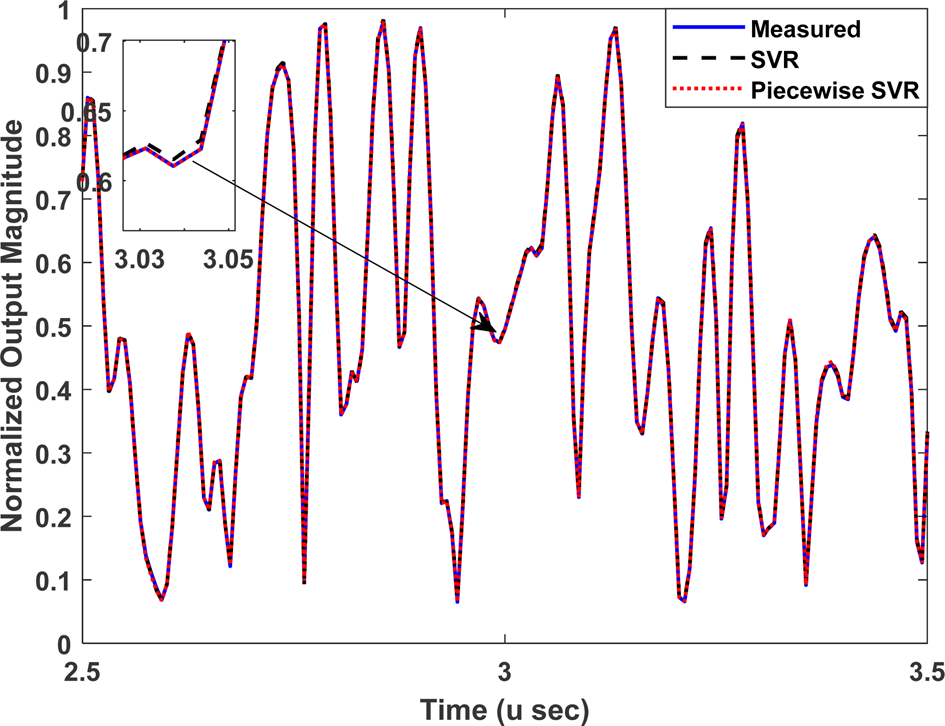
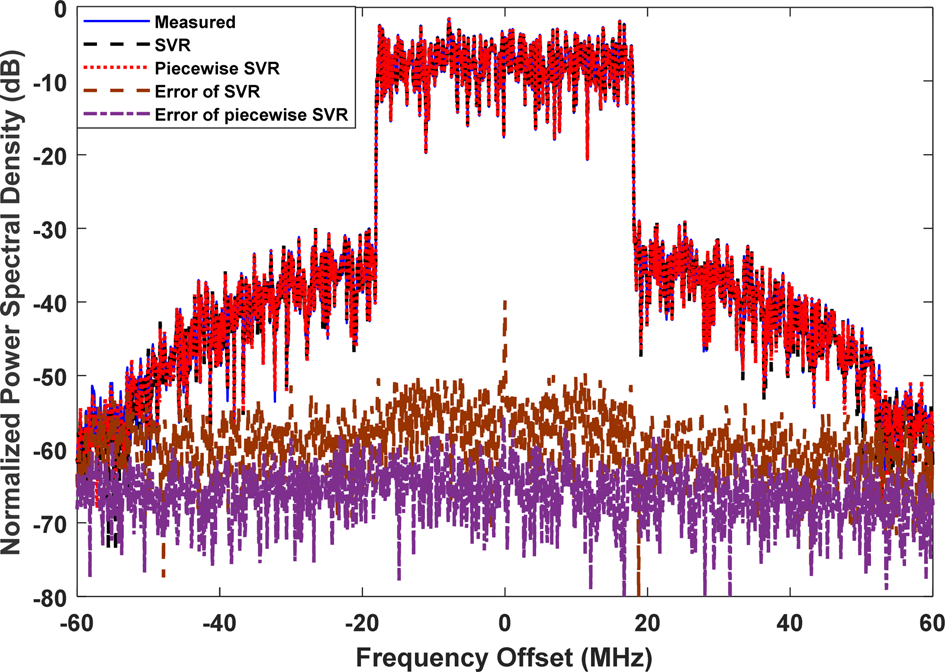
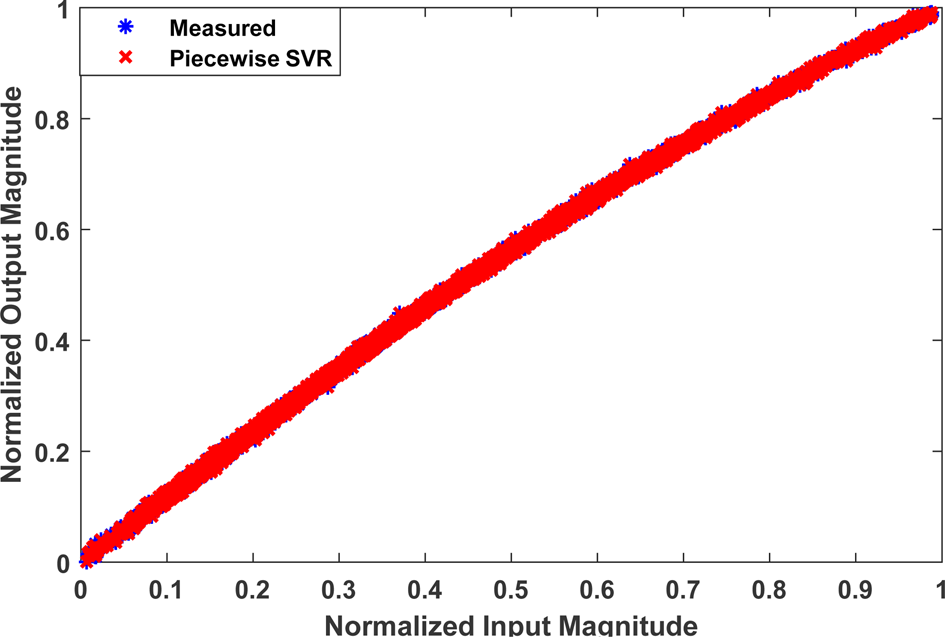
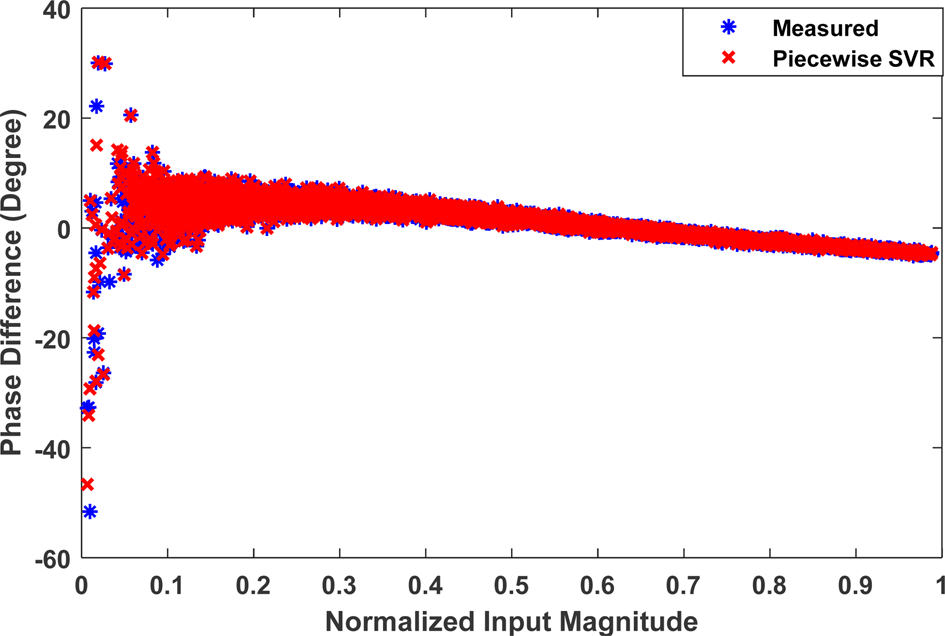
In the first experimental validation, a PA, based on a 10 W GaN transistor, is used to verify the efficacy of the proposed decomposed SVR model. The PA used here does not show the “S” shaped AM/AM characteristic that would be typical of strongly non-linear PAs, e.g. Doherty-based PAs. A single carrier 40 MHz long-term evolution (LTE) signal, centered at 2.15 GHz, with 6.2 dB PAPR, is used as the driving signal. The sampling rate is set to 160 megasamples/s. Around 5000 samples are recorded, with 3000 samples used for model training, while the remainder of the data are used for model validation. The performance of the proposed model when applied to the GaN PA is presented in Figs 2–5, with the threshold set as α = {0.5}, and the memory length in this model set to four.
Measured and modeled time-domain waveforms for GaN PA.
Output power spectra from measurement, the standard SVR-based model and the proposed piecewise SVR model for the GaN PA driven by LTE signal.

AM/AM behavioral of the GaN PA from measurement and piecewise SVR model.

AM/PM behavioral of the GaN PA from measurement and piecewise SVR model.

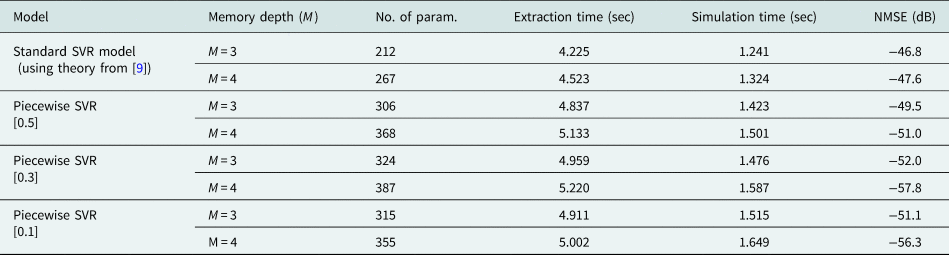
From the results in the figures, it is seen that the proposed piecewise SVR model provides for a more accurate prediction of the behavior of the single device GaN PA when compared with standard SVR model. A detailed model comparison is given in Table 1. The proposed model provides more than a 3 dB improvement when the threshold is set equal to 0.5, with memory depth equal to four. The performance of the proposed model with various threshold values is also shown in Table 1. As can be seen from the table, for the PA in question, when the threshold is set to 0.3, the best prediction is obtained at an NMSE close to −58 dB.
Performance of models for single transistor GaN PA

The validation of the proposed model with two partitions is also given here. Figure 6 shows the performance of the piecewise SVR models when α = {0.5} and α = {0.1, 0.3}. As can be seen from the results, the model with more partitions shows better performance, as expected. A detailed model performance overview is provided in Table 2. In the table, two different sets of threshold values are used, with the set corresponding to α = {0.1, 0.3} achieving better prediction than the set with α = {0.3, 0.6}. This is mainly due to the fact that the first threshold set more evenly separates the data when compared with the second set. A similar situation occurred in the previous case.
Output power spectra from measurement, the piecewise SVR model with one partition (α = {0.5}), and with two partitions (α = {0.1, 0.3}) for the GaN PA driven by an LTE signal.

Performance of models for single transistor GaN PA, with two partitions

Multi-transistor GaN Doherty PA with “S” shape
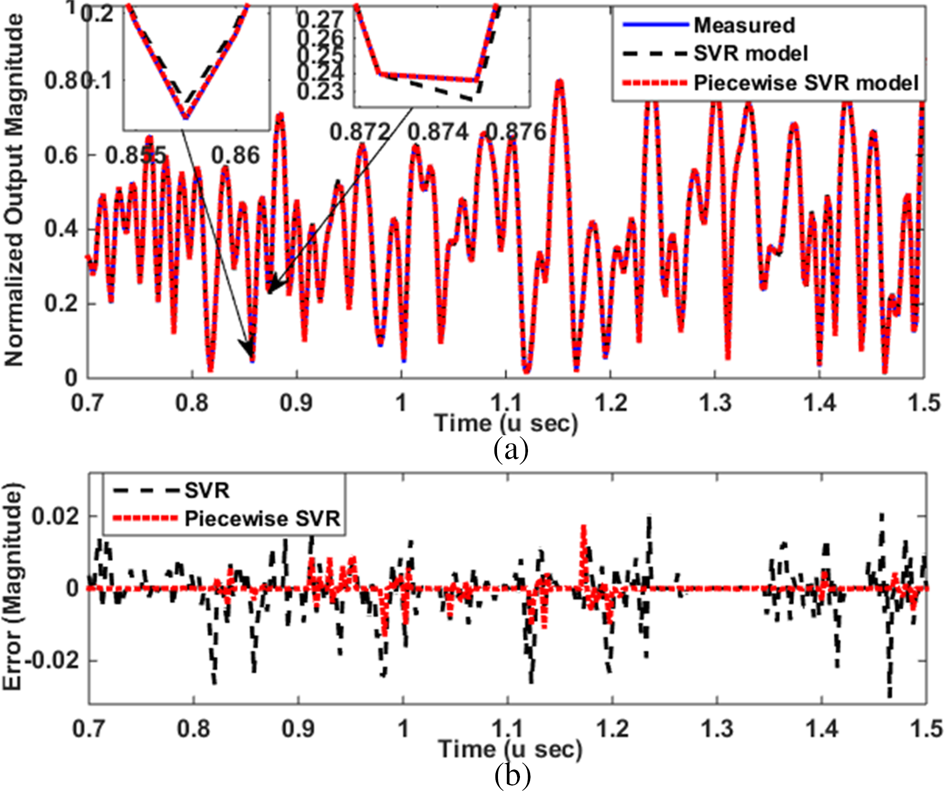
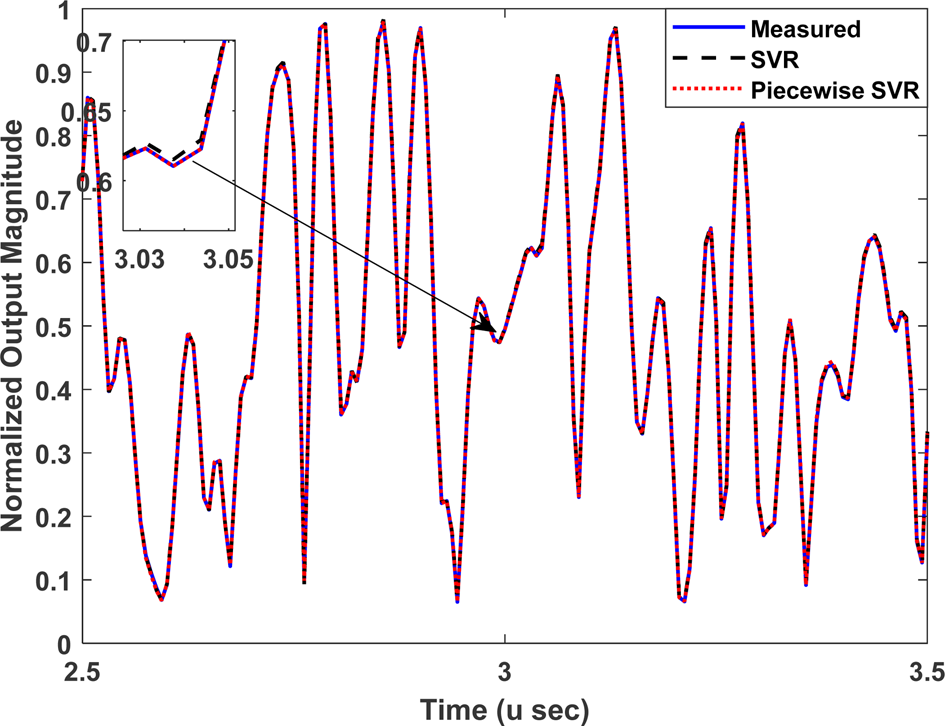
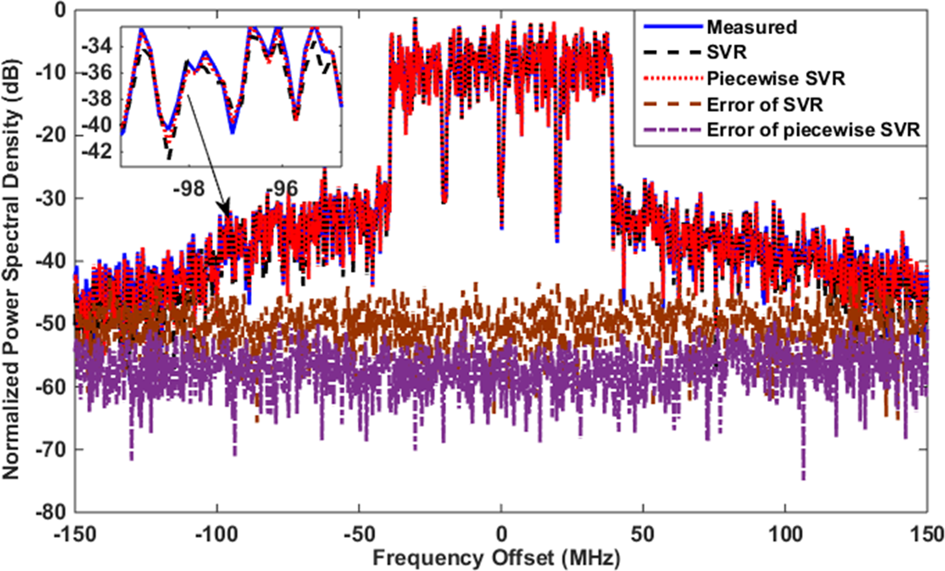
In the second test example, the PA is operated at 3.5 GHz, with IDS = 50 mA for the main amplifier and VGS = −6 V for the auxiliary amplifier. The PA is driven by a four-carrier 80 MHz LTE signal, with 7.5 dB PAPR, and the average output power of the PA is 35 dBm. The sampling rate is set at 400 megasamples/s. For this experimental test, the magnitude threshold is set as α = {0.3, 0.6} for normalized measurement data, i.e. where the maximum input magnitude is normalized to unity. Similar to the previous example, around 5000 samples are measured, with 3000 of these samples used for model training, and the remainder withheld for validation. The performance of the decomposed piecewise SVR model is presented in Figs 7–9 below, with the memory length of the model, M, set equal to 5. As can be seen from the results, the proposed piecewise SVR model gives an extremely good performance, providing excellent prediction capabilities in both time- and frequency-domains (Figs. 7 and 8, respectively).
Measured and modeled time-domain waveforms (a), and errors of the models (b) relating to the GaN Doherty PA.

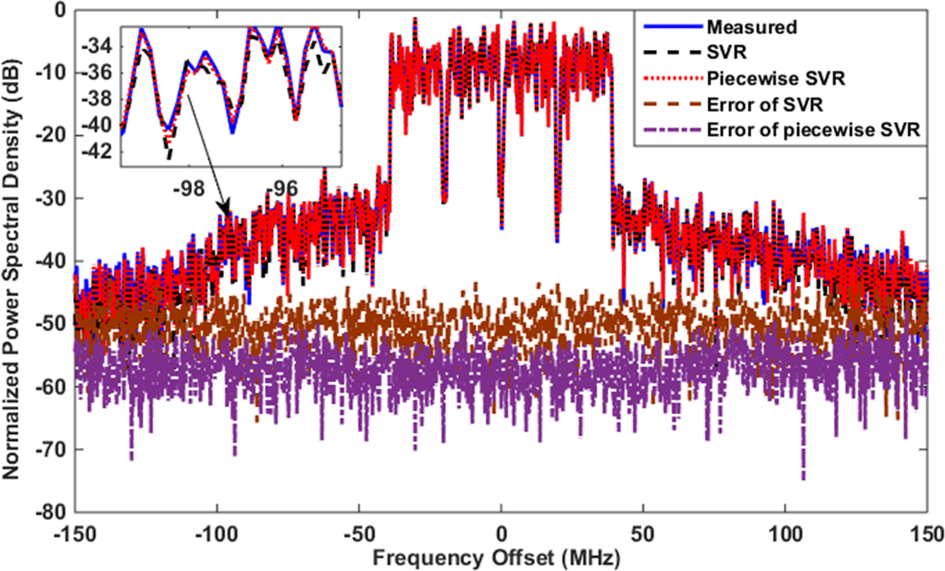
Output power spectra and spectra error of the normal SVR model and the piecewise SVR model compared with the measurement results on the GaN Doherty PA driven by a four-carrier LTE signal, with 7.5 dB PAPR.
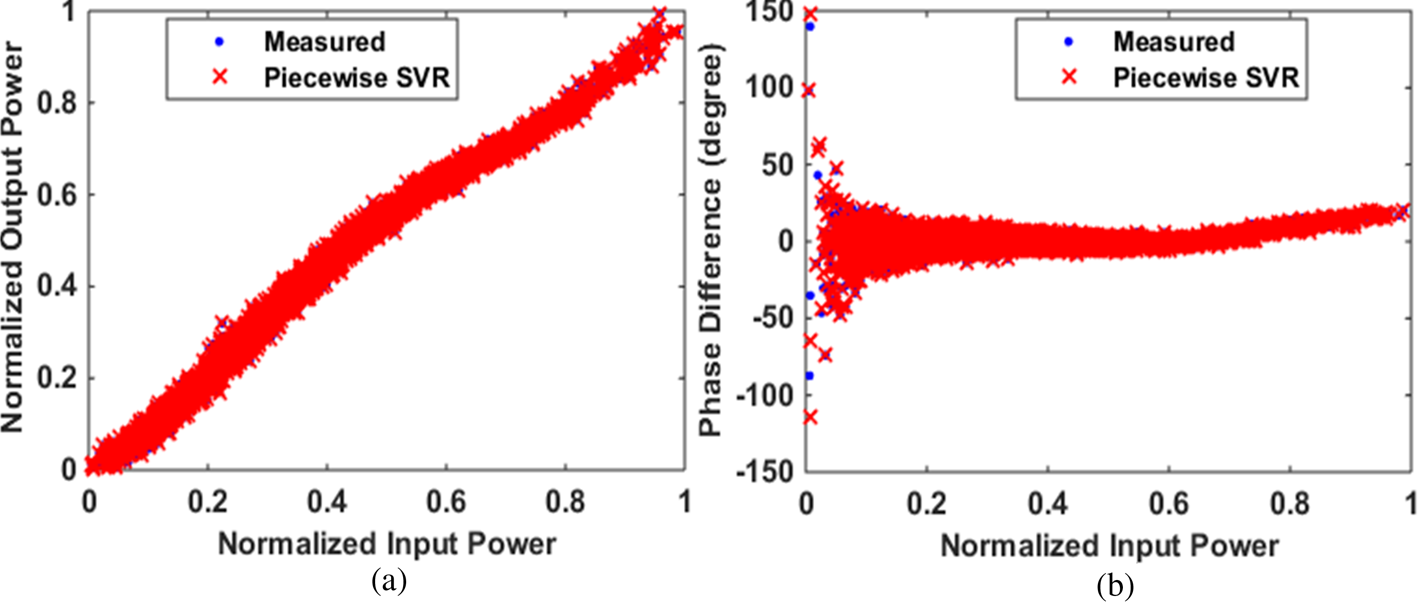
AM/AM (a) and AM/PM (b) characteristics of the GaN Doherty PA from measurements and from the piecewise SVR model.

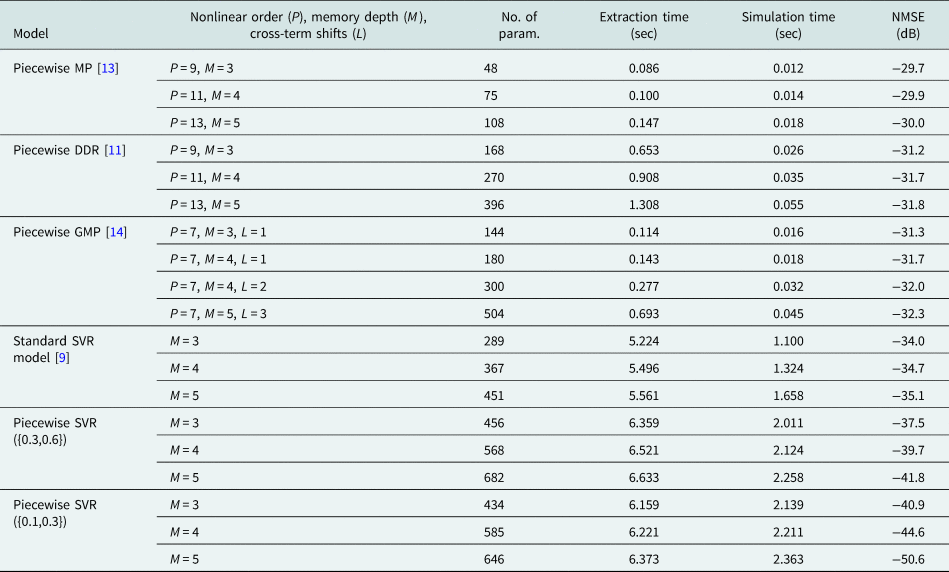
In addition to the comparison of the above measurements with the proposed piecewise SVR model, a comparison is also provided with the conventional SVR behavioral model, i.e. with an SVR model that does not employ the decomposed piecewise technique. From the results, we can see that the proposed model shows significant improvement. The modeled and measured AM/AM and AM/PM characteristics of the Doherty PA are shown in Fig. 4. The normalized mean square error (NMSE) is used in Table 3 to compare the performance of the proposed model to the state-of-the-art, across different model orders and memory lengths. To facilitate a reasonably fair comparison, a greedy algorithm is employed to find the optimal piecewise GMP model. It can be seen that the proposed piecewise SVR model provides a significant improvement compared with the traditional method. It also delivers a more than 6 dB improvement compared with the normal SVR model when the memory length of both methods is set to five (M = 5), without adding significant model complexity.
Performance of models for multi-transistor PA

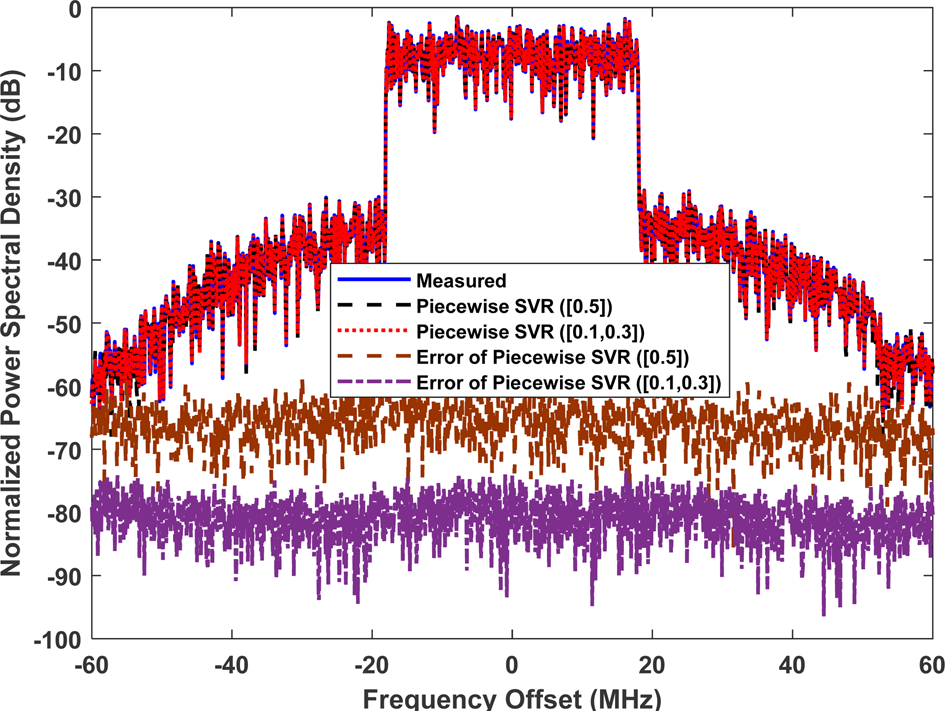
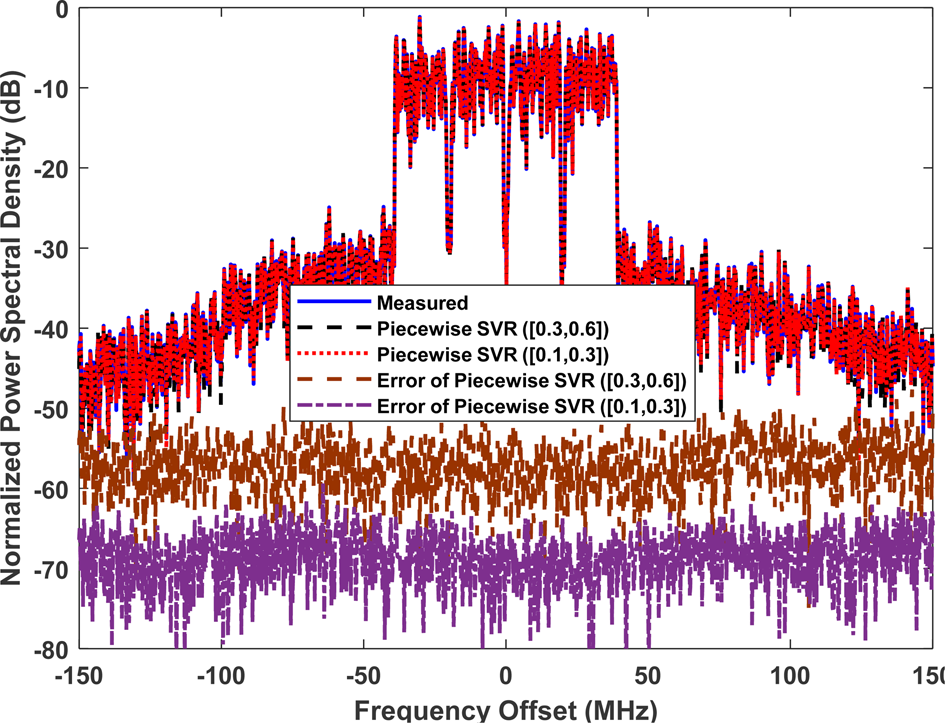
The results of piecewise SVR model when the magnitude threshold α = {0.1, 0.3} are also given in Table 3. The power spectral density comparison is given in Fig. 10, as can be seen from the results, the model corresponding to α = {0.1, 0.3} provides a large improvement when compared with the model with α = {0.3, 0.6}. The reason is given as before: the first model separates the data in three evenly space partitions.
Output power spectra from measurement, the piecewise SVR model with α = {0.3, 0.6}, and with α = {0.1, 0.3}, for the multi-device GaN Doherty PA driven by an LTE signal.

Conclusion
In this paper, a new behavioral model for RF power transistors, based on decomposed piecewise SVR, is presented. Compared with existing SVR modeling techniques, the presented approach gives a significant reduction in model error when applied to multi-device PAs. Experimental results show that, by employing this new piecewise SVR modeling method, the distinct characteristics of the multi-device system in different power levels can be modeled accurately, and the distortion caused by the inherent behavior of the non-linear system can effectively be predicted. The ability of the model to predict across input power levels is also examined with positive results indicated.
Acknowledgement
This work was supported by the National Natural Science Foundation of China (NSFC) under Grants 61971170, 61701147, 61861136002, and 61827806, Key Lab Foundation of Science and Technology on Monolithic Integrated Circuits and Modules Laboratory under Grants 6142803180206, it was also supported by the Foundation of the State Key Laboratory of Millimeter Waves under Grant No. K202011, the Foundation of the Key Laboratory of RF Circuit and System, Ministry of Education under Grant GK198800299030-003.
 Jialin Cai (S'10, M'15, SM’20) received the B.E. degree and M.E. degree both in electronic engineering, from Zhejiang University in 2007 and Southeast University in 2010, respectively, and the Ph.D. degree in electronic engineering from University College Dublin in 2015. From 2015 to 2016, he was a Post-doctor researcher at the University of Aveiro, Portugal. Currently, he is an Associate Professor with the Key Laboratory of RF Circuit and System, Ministry of Education, Hangzhou Dianzi University, Zhejiang, China. His main research interests include active device, circuit and system-level modeling, the analysis and design of non-linear microwave circuits, in particular, the RF power amplifiers.
 Justin B. King (StM’04, M’12, SM’18) received the B.E. degree in electronic engineering from University College Dublin (UCD), Dublin, Ireland. He received the Ph.D. degree for his work on Device Modeling in 2012, after studying at the UCD RF and Microwave Research Group in the School of Electrical and Electronic Engineering under the supervision of Prof. Thomas Brazil. He is currently Head of the Trinity RF and Microwave Research Group in Trinity College, Dublin, Ireland. He has served on the TPC for both national and international conferences, and is a member of the MTT-S Young Professionals Committee. His current research interests include non-linear electrothermal device characterization, with emphasis on high-power GaN transistor modeling for modern PA design. He is also interested in device physics, non-linear circuit simulation algorithms, and modeling for antenna arrays.
 Chao Yu (S’09–M’15) received the B.E. degree in information engineering and M.E. degree in electromagnetic fields and microwave technology from Southeast University (SEU), Nanjing, China, in 2007 and 2010, respectively, and the Ph.D. degree in electronic engineering from University College Dublin (UCD), Dublin, Ireland, in 2014. He is currently an Associate Professor with the State Key Laboratory of Millimeter Waves, School of Information Science and Engineering, Southeast University. His research interests include microwave and millimeter-wave power amplifier modeling and linearization, and 5G massive MIMO RF system design.
 Baicao Pan received the Ph.D. degree in electrical engineering from Southeast University, Nanjing, China in 2018. He joined the College of Electromagnetics and Information Engineering, Hangzhou Dianzi University, where he is currently an Associate Professor. His research interests include engineered electromagnetic structures, metamaterials, spoof surface plasmon polaritons, antennas, and microwave circuits.
 Lingling Sun (SM’01) received the B.S. degree from Nanjing University of Posts and Telecommunications, Nanjinag, China, in 1982, and the M.S. degree from the University of Electronic Science and Technology, Chengdu, China, in 1985. She then joined the Electronics and Information Department, Hangzhou Dianzi University (HDU), Hangzhou, China, as an Assistant Professor, and became a Professor in 1999. Since 1997, she has been with the Microelectronic Computer-Aided Design (CAD) Center, HDU, as Vice Director and Director. Her major research interests include the design and CAD of RF/microwave integrated circuits (ICs) and systems. She is also interested in the development of the smart hardware systems and medical electronic equipment areas. She was the principal investigator for over 40 national projects funded by national “863” and “973” projects, NSFC. She has published over 80 papers at international peer-reviewed journals and conferences. She is currently the Director at the Key Lab of RF Circuits and Systems (Hangzhou Dianzi University) Ministry of Education. Prof. Sun is a Senior Member of the IEEE Microwave Theory and Techniques Society (IEEE MTT-S) and the IEEE Circuits and Systems Society (IEEE CAS).
 Jun Liu received the M.S. degree in circuit and system from the Hangzhou Dianzi University, Hangzhou, China, in 2006, and the Ph.D. degree in electronic engineering from the Dublin City University, Dublin, Ireland in 2011. He is currently a Professor with the Institute of Microelectronics, Hangzhou Dianzi University, Hangzhou, China. His major research interests include the compact device modeling, RF/MMIC design, and CAD/EDA tools.