INTRODUCTION
The neon flying squid, Ommastrephes bartramii, is one of the dominant large pelagic nekton in the North Pacific (Roper et al., Reference Roper, Sweeney and Nauen1984; Murata, Reference Murata1990; Murata & Hayase, Reference Murata and Hayase1993; Seki, Reference Seki1993). The main habitat of this squid is the so-called transition region of the North Pacific, situated between subtropical and subarctic fronts (Pearcy, Reference Pearcy and Wetherall1991). Ommastrephes bartramii migrates to feed, moving between its spawning grounds in subtropical waters and the northern transition region, which is highly productive during the summer months (Taniguchi, Reference Taniguchi1981; Murata & Hayase, Reference Murata and Hayase1993). In the North Pacific, the O. bartramii population comprises the autumn and winter–spring cohorts (Yatsu et al., Reference Yatsu, Midorikawa, Shimada and Uozumi1997). Of these, the winter–spring cohort follows a northward migration from spring until the early autumn; the southward migration occurs during the late autumn and early spring (Murata & Hayase, Reference Murata and Hayase1993). Previous studies have reported that O. bartramii plays an important role in connecting apex predators to the animals on the tertiary trophic level in oceanic ecosystems (Pearcy, Reference Pearcy and Wetherall1991; Seki, Reference Seki1993; Watanabe et al., Reference Watanabe, Kubodera, Ichii and Kawahara2004; Parry, Reference Parry2006). However, quantitative data for diet and other biological data for the winter–spring cohort are limited, especially for adults larger than 30 cm in dorsal mantle length (DML). Here we provide information on the diet and sexual maturation of the winter–spring cohort of adult O. bartramii in the Kuroshio–Oyashio transition region during the mid-autumn to early spring period. Our objective was to examine the feeding strategy of O. bartramii in relation to the southward migration and sexual maturation.
MATERIALS AND METHODS
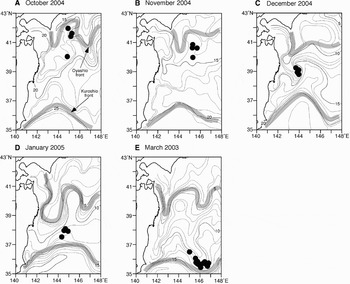
Ommastrephes bartramii were collected at a common squid-fishing site in the Kuroshio–Oyashio transition region of the western North Pacific on the following dates: 11–22 March 2003, 1–5 October 2004, 10–17 November 2004, 8–15 December 2004 and 25–28 January 2005 (Figure 1). The sampling localities shifted southward from November to March because of the winter spawning migration. To collect samples, we conducted jigging surveys at a depth of 0–100 m, which is the usual habitat depth of the squid at night (Nakamura, Reference Nakamura1991; Tanaka, Reference Tanaka2001). Samples were frozen at −20°C for further analysis in the laboratory. The sea surface temperature (SST) at the sampling position was approximately 11–13°C from December to March (Japan Coast Guard, 2003, 2004a, b, c, 2005; Figure 1), which corresponds to the lowest SST of the primary habitat of O. bartramii (Murata & Hayase, Reference Murata and Hayase1993). This indicates that the samples were taken from the northern limit of the main distribution area for O. bartramii.

The DML and wet body weight were measured. Zooplankton prey were counted and identified to the lowest taxonomic level possible, and the wet weights were measured for each taxon. All cephalopod and fish prey were identified to the lowest taxonomic level possible. Because these prey items were highly masticated, they were classified according to the morphology of lower beaks (cephalopods) and sagittal otoliths (fish) (Kubodera, Reference Kubodera1982; Clarke, Reference Clarke1986; Kubodera & Furuhashi, Reference Kubodera and Furuhashi1987; Kubodera & Shimazaki, Reference Kubodera and Shimazaki1989; Smale et al., Reference Smale, Watson and Hecht1995; Ohizumi et al., Reference Ohizumi, Watanabe, Moku and Kawahara2001; T. Kubodera, unpublished data; H. Watanabe, unpublished data). The number of eaten fish was estimated as the maximum number of right or left fish otoliths. The rostral length of the lower beak of cephalopods and the maximum diameter of sagittal otoliths (OD) were also measured, and then used to estimate the wet body weight (BW) and body sizes of the main prey items. DML was used to represent body size in cephalopods, and standard length (SL) was used for fish, based on relationships generated from intact specimens (Kubodera, Reference Kubodera1982; Clarke, Reference Clarke1986; Kubodera & Furuhashi, Reference Kubodera and Furuhashi1987; Kubodera & Shimazaki, Reference Kubodera and Shimazaki1989; Smale et al., Reference Smale, Watson and Hecht1995; Ohizumi et al., Reference Ohizumi, Watanabe, Moku and Kawahara2001). We focused on one of the main prey species, the myctophid fish Tarletonbeania taylori, to examine the relationship between OD (mm) and SL (cm), as well as OD and BW (g). The regression analyses were based on 34 individuals collected in the study area, calculated as follows:

These relationships could not be obtained for some of the minor prey species, such as the octopus Japetella diaphana or paralepidid fish like Lestidiops sphyraenopsis. For these species, the original wet weights were estimated based on values for similar-sized individuals. For each prey item (i), we calculated the proportion of each item among the total number of food items identified (Cn), the wet weight contribution of each food item to the total wet weight of the stomach contents (WW), and the frequency of the occurrence (F) of each food item in the total number of stomachs examined. These values were calculated as follows:

Using these three indices, an index of the relative importance (IRI; Pinkas et al., Reference Pinkas, Oliphant and Iverson1971) of each food item i was calculated using the equation:

This index is represented by the size of the rectangle resolved by plotting the three values on a three-way graph.
Maturity stages were classified using the standard criteria for the Japanese common squid Todarodes pacificus, which is closely related to O. bartramii in the family Ommastrephidae (Yatsu et al., Reference Yatsu, Tanaka, Mori and Okutani1998; Okutani, Reference Okutani and Nasu2002). The stages were classified as described by Ikeda et al. (Reference Ikeda, Sakurai and Shimazaki1991a, Reference Ikeda, Sakurai and Shimazakib):
Stage 1 (immature)
Male: spermatophores are absent from the spermatophore sac and the vas deferens is transparent. Female: eggs are absent from the oviduct.
Stage 2 (maturing)
Male: spermatophores are absent from the spermatophore sac and the colour of the vas deferens is white. Female: few eggs are present in the oviduct.
Stage 3 (mature)
Male: spermatophores are present in the spermatophore sac. Female: the oviduct is filled with eggs.
RESULTS
Size composition
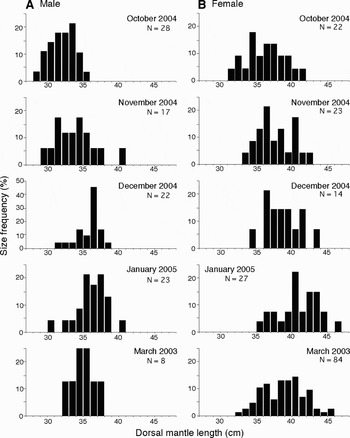
The values for DML in October showed a clear mode between 30 and 35 cm for males and 30 and 40 cm for females (Figure 2). In December, these values gradually shifted to 35–40 cm for males and 35–45 cm for females. In January and March, the frequency distribution of DML showed a clear mode between 35 and 40 cm for males and 35 and 45 cm for females, similar to December (Figure 2).
Size distribution of sampled Ommastrephes bartramii in March 2003, October–December 2004 and January 2005.

Prey species composition
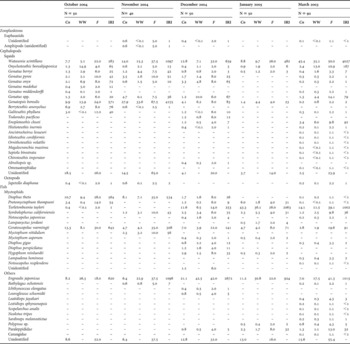
Because the stomach contents were similar in both sexes in terms of Cn and F (χ2 test, P > 0.05), we described the prey species composition based on combined data from males and females. Forty-four prey species belonging to 39 genera were identified in 282 stomachs (Table 1). Ommastrephes bartramii feeds primarily upon fish and other squid; planktonic crustaceans such as copepods, euphausiids, and amphipods were rarely found in the stomach contents. Among the prey species, the micronektonic squid Watasenia scintillans and the Japanese anchovy Engraulis japonicus were found in all study months. In terms of IRI, W. scintillans and E. japonicus ranked first to fifth and first to second, respectively, in each month, suggesting that these species were major prey of the squid from October to March (Table 1). In addition, the subarctic squid Gonatopsis borealis, the subarctic myctophid Diaphus theta and the subtropical myctophid Ceratoscopelus warmingii were also major prey from October to November or December. In terms of IRI, G. borealis and D. theta ranked first to fourth in October and November, and C. warmingii ranked first to fifth from October to December. After December or January, these three prey species were almost completely replaced by the subarctic myctophid T. taylori. In terms of IRI, this species ranked third in December and March (Table 1). In January, T. taylori was the most common prey species, with values of 43.3% (Cn), 36.1% (WW), 26.0% (F) and 2063 (IRI).
Prey species composition for Ommastrephes bartramii in the Kuroshio–Oyashio transition region. Prey species were ranked by abundance (Cn, %), wet wt (WW, %), and frequency of occurrence (F, %) in all stomachs examined.

IRI, index of relative importance (see Materials and Methods section for details); N, number of stomachs examined; –, no data available.
Prey size
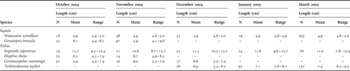
The estimated DML of the most common squid prey, Watasenia scintillans, ranged from 4.8–5.0 cm (mean ± SD = 4.9 ± 0.2) in DML (Table 2). From October to November, Gonatopsis borealis was also an important prey item, and its estimated DML ranged from 4.1–9.8 cm (5.9 ± 1.5 cm). This suggests that Ommastrephes bartramii mainly fed upon squid prey ranging from 4–10 cm in DML. The estimated SL of Engraulis japonicus ranged from 7.8–12.7 cm (11.3 ± 0.8 cm), which was generally larger than the estimated SL for the other main fish prey species such as Ceratoscopelus warmingii (3.4–0.5 cm, Table 2). These results indicate that the squid mainly fed upon fish prey ranging from 3–13 cm in SL.
Estimated size of the main squid and fish prey species of Ommastrephes bartramii in the Kuroshio–Oyashio transition region. Sizes are dorsal mantle length for squids and standard length for fish.

N, number of individuals examined.
Sex-ratio and maturation
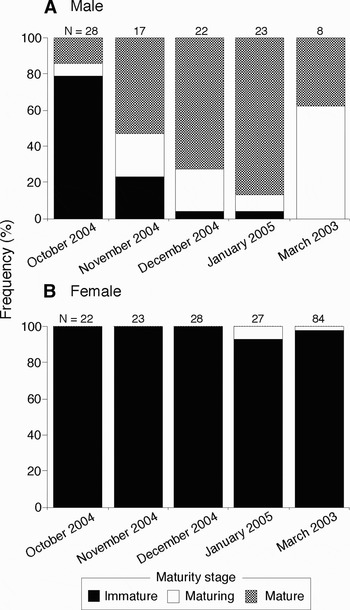
The sex-ratio of males to females was almost 1:1 from October to January but shifted to 1:11 in March (Figure 3). Males underwent gradual sexual maturation, although the maturity stage composition was biased in March because of the small sample size. In contrast, almost all females were immature, and we did not capture any copulated individuals throughout the study period, suggesting that females are slower to mature than males.
Maturity stage composition of Ommastrephes bartramii in the Kuroshio–Oyashio transition region in March 2003, October–December 2004 and January 2005.

DISCUSSION
Possible biases
According to Froerman (Reference Froerman1984) and Kitagawa et al. (Reference Kitagawa, Ishito, Okuyama, Sakurai and Inada1992), ommastrephid squids discard the heads of fish prey when the fish size exceeds 50–60% of the squid DML. In this study, the adult sizes of the main fish prey, such as Engraulis japonicus and myctophids, were less than 40% of the DML of the predator, suggesting that Ommastrephes bartramii is able to feed on these fish without rejecting the heads. The region sampled in this study is also populated by the Pacific saury (Cololabis saira), a small pelagic fish that undergoes a winter migration from the transition region to the Kuroshio region (Odate, Reference Odate1977). Arimoto & Kawamura (Reference Arimoto and Kawamura1998) reported that O. bartramii fed on Pacific saury in the subarctic frontal zone of the central North Pacific in summer. Although the distribution of this species and that of O. bartramii overlap in the transition region during the autumn (Odate, Reference Odate1977), we did not find otoliths from this species in the squid stomach contents. The body size of the adult Pacific saury is more than 60% of the squid DML, suggesting that the heads were rejected during feeding. However, we did not find saury scales and bones, which have a characteristic greenish colour, in the stomach contents. Therefore, our diet analysis may not have been heavily biased by eventual rejection of heads of Pacific saury by the predator.
Feeding habits
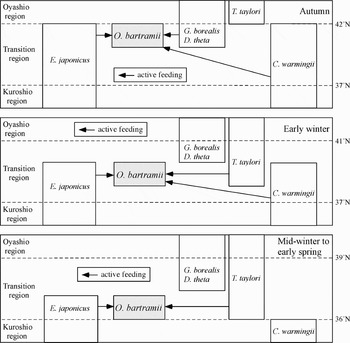
The Japanese anchovy, Engraulis japonicus, has been one of the most prevalent small pelagic fish off the coast of Japan since the 1990s. In recent years, its abundance has been estimated on the order of 1000000 metric tons (Fisheries Agency & Fisheries Research Agency, Japan, 2003). Before the spring spawning, these fish undertake a southward migration from their feeding grounds in the northern Kuroshio–Oyashio transition region to the Kuroshio region (Tsuruta & Takahashi, Reference Tsuruta and Takahashi1997; Aoki & Miyashita, Reference Aoki and Miyashita2000; Takahashi et al., Reference Takahashi, Watanabe, Kinoshita and Watanabe2001). The predator–prey relationship between Ommastrephes bartramii and E. japonicus was constant throughout October to March because their seasonal southward migration patterns are spatio-temporally similar (Figure 4). Watasenia scintillans was also a main prey item for squid throughout the study period. Although there is little information concerning the seasonal changes in the distribution of this species, our results indicate that W. scintillans may also have a migration pattern similar to O. bartramii. Alternatively, they may be widely distributed throughout the transition region during the autumn and early spring.
Predator–prey relationships between the expected seasonal southward migration patterns of Ommastrephes bartramii and their main prey species in the Kuroshio–Oyashio transition region during mid-autumn to early spring. The full species names of prey are listed in Table 1. Watasenia scintilans was also a major prey species from autumn to early spring, but these results were excluded from this figure due to lack of information about their seasonal migration patterns.

Seasonal dietary changes were also observed. This is most likely because of the differences in the seasonal north–south migration patterns of O. bartramii and the prey species. Ommastrephes bartramii frequently fed on the subtropical myctophid Ceratoscopelus warmingii in October and November, but this prey item almost disappeared from the stomach contents after November. Because the abundance of this species in the transition region is almost two orders of magnitude lower in the winter than in the summer and autumn (M. Moku, unpublished data), this would indicate their distribution in the transition region during the autumn and early winter, and their southward migration to the subtropical waters south of the Kuroshio front during the mid-winter and early spring (Figure 4). Diaphus theta and Gonatopsis borealis are typical subarctic species that O. bartramii fed upon during October and November, when the squid was distributed throughout the northern transition region near the Oyashio front (Wisner, Reference Wisner1976; Naito et al., Reference Naito, Murakami, Kobayashi, Nakayama and Ogasawara1977; Pearcy et al., Reference Pearcy, Krygier, Mesecar and Ramsey1977; Kubodera et al., Reference Kubodera, Pearcy, Murakami, Kobayashi, Nakata and Mishima1983; Willis et al., Reference Willis, Pearcy and Parin1988). These prey species rarely appeared in the stomach contents after December in the southern transition region. This might suggest that these prey species are mainly distributed in the northern transition and/or Oyashio regions, even in the winter (Figure 4). In contrast, the squid preyed mainly upon the subarctic myctophid Tarletonbeania taylori from December to March. Tarletonbeania taylori is a surface migratory species that is usually found in areas where the SST is less than 14°C, and it is commonly collected in neuston nets during nocturnal fishing in the transition region in the winter and early spring (Ogawa, Reference Ogawa1961; Hattori, Reference Hattori1964). The SST of the habitat of O. bartramii was generally higher than 14°C in October and November, and less than 13°C from December to March (Figure 1), suggesting that their habitats largely overlap during the mid-winter and early spring (Figure 4).
Although part of the O. bartramii winter–spring cohort has already migrated to subtropical waters in the winter (Yatsu et al., Reference Yatsu, Midorikawa, Shimada and Uozumi1997), the southward migration pattern of this population may be similar to that of E. japonicus and C. warmingii (M. Moku, unpublished data; A. Yatsu, unpublished data; Figure 4). Because all main prey species are abundantly distributed in the transition and/or Kuroshio regions during the autumn and winter (Ogawa, Reference Ogawa1961; Hattori, Reference Hattori1964; Naito et al., Reference Naito, Murakami, Kobayashi, Nakayama and Ogasawara1977; Kubodera et al., Reference Kubodera, Pearcy, Murakami, Kobayashi, Nakata and Mishima1983; M. Moku, unpublished data; A. Yatsu, unpublished data), a prey-rich environment might be assured for the winter–spring cohort during their southward migration period. Among the main prey species, W. scintillans and E. japonicus are endemic to the western North Pacific (Kuroda, Reference Kuroda1991; Tsuchiya, Reference Tsuchiya and Okutani2000; Takahashi et al., Reference Takahashi, Watanabe, Kinoshita and Watanabe2001), whereas the myctophid fish C. warmingii, T. taylori, and D. theta are widely distributed throughout the western and eastern North Pacific (Wisner, Reference Wisner1976; Willis et al., Reference Willis, Pearcy and Parin1988). Therefore, the importance of myctophid fish would increase in the eastern North Pacific, or another prey species endemic to the eastern North Pacific may dominate the diet there.
Sexual maturation
The spawning ground of the winter–spring cohort is located in subtropical waters, and spawning mainly occurs between February and May (Yatsu et al., Reference Yatsu, Midorikawa, Shimada and Uozumi1997). In the subtropical waters between 25–35°N and 142–151°E, which is the adjacent region south of our study area, most of the males from the winter–spring cohort become sexually mature between December and March (Yatsu et al., Reference Yatsu, Tanaka, Mori and Okutani1998). In the Kuroshio–Oyashio transition region, male sexual maturation gradually progressed from October to January, and most individuals matured after January. This suggests that males mature in this region before migrating into subtropical waters. We found that males became relatively scarce in March, suggesting that they migrate to subtropical regions during the spring. In contrast, almost all females were immature throughout the study period. Yatsu et al. (Reference Yatsu, Tanaka, Mori and Okutani1998) reported that most females were immature from December to January, but began to mature or reached maturity from February to March in the subtropical region. These results suggest that the females of the winter–spring cohort mature in the subtropical region after February. Therefore, the southward-migrating squid take advantage of the abundant prey in the transition region to provide energy for sexual maturation and, eventually, reproduction in the subtropical waters during the winter and spring.
ACKNOWLEDGEMENTS
We thank the captain, officers, and crew of the FRV ‘Kaiun-Maru’ of the Aomori Prefectural Fisheries Research Center for their assistance in field sampling. This research was supported by a grant from the Japanese Fisheries Agency.