1 Introduction
Japanese has two classes of two-place verbs whose objects can be marked with either accusative case -o or an oblique marker. Kuno (Reference Kuno1973: Chapter 5) notes that a group of verbs of inherently directed motion in Japanese allow their object to be marked with either accusative -o or the goal marker -ni.

Other verbs such as ik-u ‘go’, kaer-u ‘return’, agar-u ‘rise’, sagar-u ‘come down’, nagare-ru ‘flow’, and sawar-u ‘touch’ also participate in the alternation with various degrees of productivity. These verbs are called accusative–goal verbs in this study.
Independently of Kuno (Reference Kuno1973), Teramura (Reference Teramura1982: 106–108) discusses another group of verbs of inherently directed motion in Japanese that mark their object with either accusative case -o or the source marker -kara ‘from’.Footnote [2]

In addition to the two verbs in (2), hazure-ru ‘come off’, nuke-ru ‘remove’, sar-u ‘leave’, and shirizok-u ‘resign’ also participate in the alternations. These verbs are called accusative–source verbs in this study. Let us call these two classes of verbs together accusative–oblique alternation verbs, and the phenomenon accusative–oblique alternations. Previous studies have shown that the arguments of the accusative–oblique alternation verbs as well as the events they denote are interpreted differently depending on whether their objects are accusative-marked (the accusative structure) or oblique-marked (the oblique structure) (Kuno Reference Kuno1973, Sugamoto Reference Sugamoto, Hopper and Thompson1982, Teramura Reference Teramura1982). To the best of our knowledge, no formal analysis has been proposed to account for this behavior of these verbs.
This study presents the results of two sentence acceptability judgment experiments that examined phenomena in which the arguments of the accusative–oblique alternation verbs exhibit contrastive behaviors: (i) selectional restrictions on subjects and (ii) the ability of subjects to license ‘floating’ numeral quantifiers (FNQs). The results of these experiments show that (i) subjects of the accusative–source verbs impose selectional restrictions on their subjects only when they are in the accusative structure, and (ii) subjects of the same verbs readily license VP-internal FNQs only when they are in the oblique structure. I argue that these behaviors can be accounted for if the accusative–source verbs are analyzed as being mapped onto the transitive structure when their object is accusative-marked (3a), and onto the unaccusative structure when their object is oblique-marked (3b).

The same experiments also show that the interaction between selectional restrictions on subjects and the object marking is observed with only one accusative–goal verb, and none of the accusative–goal verbs shows a correlation between the object marking and subjects’ ability to license FNQs. These findings lead us to argue that the accusative–goal verbs have two different transitive structures, one with accusative case (4a) and the other with dative case (4b).

Therefore, according to the analyses of the accusative–oblique alternation verbs proposed in this study, the two classes of accusative–oblique alternation verbs are mapped onto two distinct sets of underlying structures, and those distinctive syntactic structures and the core meaning of the alternating verbs together determine the interpretation of their arguments and the events that these verbs denote. As such, the proposed analysis provides novel arguments for approaches to the lexical semantics–syntax interface according to which the meaning of verbs and their syntactic structures co-construct the interpretation of verbs’ arguments and the events they denote (e.g. Perlmutter Reference Perlmutter1978; Hale & Keyser Reference Hale and Keyser1986, Reference Hale and Keyser1992, Reference Hale, Keyser, Hale and Keyser1993, Reference Hale and Keyser2002; Miyagawa Reference Miyagawa1989a, Reference Miyagawab; Hoekstra & Mulder Reference Hoekstra and Mulder1990; Tsujimura Reference Tsujimura1990a, Reference Tsujimurab, Reference Tsujimura, Koizumi and Ura1994, Reference Tsujimura1996; Hoekstra Reference Hoekstra1992; Levin & Rappaport-Hovav Reference Levin and Rappaport-Hovav1995; Rappaport-Hovav & Levin Reference Rappaport-Hovav and Levin1998; Ritter & Rosen Reference Ritter and Rosen1998; Sorace Reference Sorace2000; McIntyre Reference McIntyre2004; Folli & Ramchand Reference Folli, Ramchand, Verkyul, de Swart and van Hout2005; Ramchand Reference Ramchand2008).
This paper is organized as follows. Section 2 introduces key observations concerning the two classes of accusative–oblique alternation verbs, some from previous studies and some original. These observations suggest that there is a systematic relationship between the two different object markings and the interpretation of the arguments of the alternating verbs and the events they denote. Section 3 introduces an initial hypothesis for the accusative–oblique alternation verbs, according to which they are mapped onto the transitive structure and the unaccusative structure depending on the object marking (the transitive–unaccusative alternation hypothesis). Sections 4 and 5 present the results of the two sentence acceptability judgment experiments that examined phenomena in which the arguments of the alternating verbs exhibit contrastive behaviors: (i) selectional restrictions on subjects (Section 4) and (ii) the ability of subjects to license FNQs (Section 5). Section 6 discusses implications of the results of Experiments 1 and 2 for the analysis of the two classes of accusative–oblique alternation verbs. The findings from Experiments 1 and 2 support the transitive–unaccusative alternation hypothesis as the right analysis for the accusative–source verbs, but not for the accusative–goal verbs. Given the conclusions in Section 6, Section 7 presents an alternative analysis for the accusative–goal verbs, according to which they are always transitive. Section 8 examines implications of the proposed analyses of the accusative–oblique alternations for the larger picture of the morpho-syntactic organization of Japanese verbs. In particular, it explores the relationship between the accusative–oblique alternations and a better-known verbal alternation in Japanese, the causative alternation, and shows that the relationship between morphology and syntax is transparent with some verbs, as with the accusative–source verbs, but not with others, as with the accusative–goal verbs. Section 9 concludes the paper.
2 Introducing accusative–oblique alternations
This section introduces empirical observations from previous studies and some original observations about the accusative–goal verbs and the accusative–source verbs, and identifies a set of contrastive morpho-syntactic, lexical-semantic, and aspectual properties of the alternating verbs to be accounted for.
2.1 The interpretation of objects
Kuno (Reference Kuno1973) argues that the object of an accusative–goal verb is interpreted differently with the two different object markings: as a path in the accusative structure and as a goal in the oblique structure. In the accusative structure, the motion designated by the alternating verbs is interpreted as covering the entire dimension of the referent of the object (path), while in the oblique structure the referent of the object is the destination (goal) of the motion designated by these verbs. Thus, the accusative structure is infelicitous in (5a) when ‘a helicopter’ is the means to get to the top of a mountain, because the motion of ascending does not cover the whole mountain. In contrast, both structures in (5) are felicitous with ‘a Jeep’ as the means of ascending, because, in addition to the mountain being compatible with a goal, the motion of ascending can be interpreted as covering the whole mountain.

Furthermore, when the referent of the object is a natural path but an unlikely goal, e.g. kaidan ‘stairs’, it is compatible only with the accusative structure (6a). In contrast, when the referent of the object is a natural goal but an unlikely path, e.g. choojoo ‘summit’, it is compatible only with the oblique structure (6b).

With the accusative–source verbs, the difference in interpretation of objects between the two structures seems subtle. However, the following naturally attested examples in (7) suggest that some NPs are compatible with being the object of the accusative–source verbs only in the accusative structure (7a) or only in the oblique structure (7b).

The difference between accusative-marked and oblique-marked objects with accusative–source verbs appears to be that the accusative object is interpreted as a location where the subject engages in some activity prior to moving away from it, while the oblique object simply refers to a location from which the subject moves away. Thus, (7a) with the oblique object is felicitous as the sentence denotes an event in which the suspect simply moved away from the hostage, yet the accusative marking of the same object is infelicitous presumably because an accusative-marking of hitojichi ‘hostage’ gives rise to the interpretation that it is a location of a prior activity, and such an interpretation is pragmatically odd. The situation is the opposite with (7b). (7b) with the accusative-marked object is felicitous because the object refers to a professional baseball team, which is interpreted as a location where the subject engaged in some activity, i.e. playing baseball professionally, prior to leaving it. The oblique marking of the same object is infelicitous because it would force an interpretation in which the subject left the professional team as a location, which is pragmatically implausible. Thus, while the object of the accusative–source verbs is always interpreted as a location from which subjects move away, the accusative-marked object seems to implicate the existence of a prior activity before the moving-away event that these verbs denote.
2.2 The interpretation of subjects
Unlike Kuno (Reference Kuno1973), who focuses on the interpretation of the objects of accusative–goal verbs, Teramura (Reference Teramura1982: 107) pays attention to the interpretation of the subjects of the accusative–source verbs. He notes that the accusative–source verbs can felicitously have inanimate subjects only when they are in the oblique structure.

Initial evidence suggests that at least one of the accusative–goal verbs, sawar-u ‘touch’, also imposes selectional restrictions on its subjects depending on the object marking. The examples in (9) show that sawar-u ‘touch’ is compatible with an inanimate subject only when it is in the oblique structure.

Thus, there is initial evidence that the accusative–oblique alternation verbs impose different selectional restrictions on their subjects depending on the object marking. In particular, at least some of the alternating verbs seem to require animate subjects when they are in the accusative structure.
2.3 Event types
Sugamoto (Reference Sugamoto, Hopper and Thompson1982) argues that the accusative–goal verbs denote different types of events with the two different object markings. While an accusative–goal verb in the accusative structure is compatible with an aspectual verb that indicates completion of events, such as -kir-u ‘finish’ (10a), Sugamoto notes that the same verbs in the oblique structure are infelicitous with the same aspectual verb (10b).

This contrast suggests that the accusative–goal verbs denote durative events, i.e. activity or accomplishment, when they are in the accusative structure, whereas the same verbs denote punctual events, i.e. achievement, when they are in the oblique structure. The contrast is further motivated by these verbs’ compatibility with durative adverbials (as in for two hours) and time-span adverbials (as in in two hours) (e.g. Dowty Reference Dowty1979) when they are in the two different structures. Compare the following two examples:

(11a) shows that the accusative–goal verb nobor-u ‘climb’ in the accusative structure is compatible with both a durative adverbial ni-jikan ‘for two hours’ and a time-span adverbial ni-jikan-de ‘in two hours’, with the adverbials modifying the event of the child climbing up the mountain. While the durative adverbial induces the activity reading of (11a), the time-span adverbial favors the accomplishment reading of the same sentence. In contrast, the same verb in the oblique structure is only compatible with the time-span adverbial.Footnote [3] This contrast is expected if the accusative–goal verbs denote durative events when they are in the accusative structure but punctual events when they are in the oblique structure.
Unlike the accusative–goal verbs, the accusative–source verbs appear to always denote punctual events. Thus, accusative–source verbs such as de-ru ‘come out’ are compatible only with a time-span adverbial such as go-fun-de ‘in five minutes’ and incompatible with a durative adverbial like go-fun ‘for five minutes’ regardless of the object marking.

2.4 Section summary
The observations from previous studies and our own original observations together show that the accusative–oblique alternation verbs in the two different structures exhibit the following similarities and differences in the interpretation of their arguments and the type of events they denote.
Interpretations of arguments and events with accusative–goal and accusative–source alternation verbs.

To the best of our knowledge, no formal account of these similarities and differences has been proposed.
3 Introducing a transitive–unaccusative alternation hypothesis
The correlation between selectional restrictions on subjects and the presence of an accusative-marked object observed with some of the accusative–oblique alternation verbs discussed in Section 2 is reminiscent of Burzio’s generalization, a well-known generalization about the correlation between the presence of an external argument and that of structural accusative case.

Burzio’s generalization was motivated by the contrastive behaviors exhibited by passivized transitive verbs and unaccusative verbs on the one hand, and active transitive verbs and unergative verbs on the other. Passivized transitive verbs and unaccusative verbs lack both an external argument theta-role and structural case. As such, they have an internal argument that becomes a (derived) subject. As an internal argument, the derived subject of passivized transitive verbs and unaccusative verbs receives a thematic role that is compatible with animate and inanimate referents, such as patient and undergoer. In contrast, active transitive verbs and unergative verbs have both an external argument theta-role, typically agent, and structural case. Thus, their subjects are subject to selectional restrictions, and they can license an accusative NP.
Now, if the accusative–oblique alternation verbs in the accusative structure are transitive verbs while the same verbs in the oblique structure are unaccusative verbs, the presence of selectional restrictions on subjects only with the alternation verbs in the accusative structure receives a straightforward account. Let us call this hypothesis the transitive–unaccusative alternation hypothesis:

In the Minimalist Program framework (Chomsky Reference Chomsky1995), the standard way to account for the link between the selection of an external argument subject and the presence of accusative case is to assume the presence of a semi-functional verbal head Voice, which licenses an external argument and structural case (Kratzer Reference Kratzer, Benedicto and Runner1994, Reference Kratzer, Rooryck and Zariing1996). Here, I adopt the recent hypothesis that a Voice head embeds another level of a semi-functional verbal projection, v (little v) (e.g. Pylkkänen Reference Pylkkänen2002; Cuervo Reference Cuervo2003; Collins Reference Collins2005; Alexiadou, Anagnostopoulou & Schäfer Reference Alexiadou, Anagnostopoulou, Schäfer and Frascarelli2006; Harly Reference Harly, Giannakidou and Rathert2009, Reference Harley2013; Legate Reference Legate2012, Reference Legate2014), whose sole function is to encode event types by introducing abstract predicates such as DO , CAUSE , and BECOME (Harley Reference Harley1995, Reference Harley2008; Folli & Harley Reference Folli, Harley, Kempchinsky and Slabakova2005, Reference Folli and Harley2007).
Under this analysis, a sentence with an alternating verb in the accusative structure, like (15a), has the structure in (15b).

In (15b), the subject is the specifier of a VoiceP, where an external argument is base-generated and thematically licensed with an agent theta-role by the Voice head, and the Voice head also provides accusative case to the NP inside VP. I assume that the active Voice head in Japanese is always phonologically null. The v head, on the other hand, is phonologically null with nobor-Ø-u ‘climb’ but is overtly realized as -e- with d-e-ru ‘come out’ (e.g. Harley Reference Harley2008).Footnote
[4]
The v head introduces the abstract predicate DO (v
 $_{\text{DO}}$
) with nobor-Ø-u ‘climb’, as it denotes a durative event, while the same v head introduces the abstract predicate BECOME (v
 $_{\text{BECOME}}$
) with d-e-ru ‘come out’, realizing the punctual interpretation of the sentence.Footnote
[5]
The accusative-marked object soko ‘there’ is interpreted as a path with nobor-Ø-u ‘climb’ and a location of some activity with d-e-ru ‘come out’, because of the lexical semantics of these verbs and the abstract predicates v
 $_{\text{DO}}$
and v
 $_{\text{BECOME}}$
. The verb nobor-Ø-u ‘climb’ and v
 $_{\text{DO}}$
together denote a durative event, with which the accusative object denotes the path that the subject moves along. With the verb d-e-ru ‘come out’ and v
 $_{\text{BECOME}}$
, the accusative-marked object is interpreted as a location of some activity from which the subject moves away.
When the same verbs are in the oblique structure, they are unaccusatives. Thus, a sentence with an alternating verb in the oblique structure, like (16a), has the underlying structure in (16b).

Since they are unaccusatives, the alternating verbs in the oblique structure lack the projection of Voice and therefore have no external argument or accusative case. They are embedded under a v that encodes the abstract predicate BECOME (v
 $_{\text{BECOME}}$
), which is null with nobor-Ø-u ‘climb’ but is overtly realized as -e- with d-e-ru ‘come out’ in (16b). This accounts for the punctual interpretation of the event that (16a) denotes. The verbs themselves in turn take the ‘object’ licensed by an oblique marker -ni or -kara, which I tentatively assume to be postpositions, as their PP specifier, and the subject as their internal argument. The latter is fronted to the sentence-initial position in (16a).Footnote
[6]
While the proposed transitive–unaccusative alternation analysis of the accusative–oblique alternation in (15) and (16) accounts for the properties of the alternation verbs discussed in Section 2, it paints a considerably complicated relationship between the alternating verbs and their underlying structures, where the alternating verbs are linked to two fundamentally different structures. As such, the hypothesis requires further empirical support. In what follows, I present the results of two acceptability judgment experiments that examined (i) selectional restrictions on subjects of the alternating verbs in the two different structures and (ii) the ability of subjects of the alternating verbs to license ‘floating’ numeral classifier phrases in the two different structures. The results of these experiments provide strong support for the transitive–unaccusative alternation analysis of the accusative–source verbs, while they suggest that the same analysis is not the right analysis for the accusative–goal verbs.
4 Selectional restrictions on subjects
One of the original motivations for the transitive–unaccusative alternation analysis of the accusative–oblique alternation comes from the observation that some of the alternating verbs appear to impose different selectional restrictions on subjects when they are in the two different structures. If the transitive–unaccusative alternation analysis of the accusative–oblique alternations is on the right track, it predicts a systematic correlation between the structure, the accusative vs. the oblique, and selectional restrictions on their subjects. When these verbs are in the accusative structure, referents that are incompatible with being an external argument, such as inanimate objects, should be disfavored compared to referents that are typical external arguments, such as human beings, due to the hypothesized presence of an external argument theta role. In contrast, no such preference is predicted when the same verbs are in the oblique structure and therefore unaccusatives. Experiment 1 tests these predictions.
4.1 Experiment 1: Animacy of subjects and object marking
4.1.1 Experimental design and predictions
Although external arguments cannot be reduced to their animacy or volitionality (e.g. vanValin & Wilkins Reference van Valin, Wilkins, Shibatani and Thompson1996, Folli & Harley Reference Folli and Harley2008, Ramchand Reference Ramchand2008), human referents are prototypical external arguments while inanimate objects that are construed as incapable of self-propelled movement typically cannot be external arguments. As such, the animacy of subjects would most clearly bring about the hypothesized difference in selectional restrictions on subjects imposed by the alternating verbs with the two different object markings. Therefore, the experimental sentences in Experiment 1 involved either a human subject or an inanimate object subject whose referent is construed as incapable of self-propelled movement.
A caveat about Experiment 1 is in order here. It is important to point out that the difference in acceptability of the alternating verbs in the two structures with animate (i.e. human) and inanimate subjects is expected to be a matter of degree, rather than a categorical difference. Across languages, animate subjects are preferred over inanimate subjects, especially with two-place verbs (e.g. de Swart, Lamers & Lestrade Reference de Swart, Lamers and Lestrade2008; see Kuno Reference Kuno1973 for a discussion of preference for animate subjects in Japanese). Thus, sentences with the alternating verbs with animate subjects are expected to be judged as more acceptable than their counterparts with inanimate subjects regardless of the object marking. However, what the transitive–unaccusative alternation analysis predicts is that the difference in acceptability between sentences with the alternating verbs with animate subjects and those with inanimate subjects would be greater with the accusative structure than with the oblique structure. Hence, what needs to be examined is whether there is an interaction between animacy of subjects and object markings in acceptability judgments of sentences with the alternating verbs.
4.1.2 Materials
Experiment 1 had a 2 × 2 design with structure (accusative vs. goal/source) and animacy (animate vs. inanimate). Four accusative–goal verbs (nobor-u ‘climb’, kudar-u ‘descend’, agar-u ‘rise’, and sawar-u ‘touch) and four accusative–source verbs (hazure-ru ‘come off’, de-ru ‘come out’, nuke-ru ‘remove’, and hanare-ru ‘separate’) were used to create the experimental sentences. Four lexicalizations of each verb were constructed for each of the four conditions (8
 $\times$
4
 $\times$
4 = 128) and distributed among four lists using a Latin Square design. Each list of 32 sentences was mixed with 38 filler sentences with various degrees of acceptability. Thus, each participant rated 70 sentences. The order of sentences in each list was pseudo-randomized, so that no two experimental sentences were presented in sequence. Examples of experimental sentences in the four conditions are provided in (17). The complete set of the experimental and filler sentences for Experiment 1 is available online, via https://multimediafluids.uam.elogim.com/core/journals/journal-of-linguistics, in the Supplementary Materials file alongside the present article.

4.1.3 Procedure and participants
Forty-five university students in Tokyo, Japan, participated in the experiment. The experiment was administered both in a university classroom using a paper-and-pencil format and online through a website designed to host psycholinguistic experiments (http://spellout.net/ibexfarm/). The participants were instructed to use a seven-point scale to judge the sentences, with 1 representing ‘unnatural’ and 7, ‘natural’. The data from two participants were removed before analysis because they failed to complete the task as instructed. The raw judgments collected from each participant were standardized (z-score transformed) to correct for possible scale biases among the participants (Cowart Reference Cowart1997, Schütze & Sprouse Reference Schütze, Sprouse, Podesva and Sharma2013). The data from the accusative–goal verbs and the accusative–source verbs were analyzed separately, because the results of a pilot study indicated that the alternation type is a significant factor. The data were analyzed using linear mixed-effects models with verb, structure, and animacy as fixed factors, and participants and items as random factors. These analyses were performed using the lmerTest package (Kuznetsova et al. Reference Kuznetsova, Brockhoff and Bojesen Christensen2016) in the statistical software R (R Core Team 2015).
4.1.4 Results
4.1.4.1 The accusative–goal alternation verbs
The results of the statistical analysis show that both animacy and structure are significant predictors of the acceptability judgments of the experimental sentences (animacy:
 $\unicode[STIX]{x03B2}$
= –0.50, SE = 0.22, p = .03; structure:
 $\unicode[STIX]{x03B2}$
= 0.43, SE = 0.22, p = .05). However, the interaction between structure and animacy is not significant (
 $\unicode[STIX]{x03B2}$
= 0.11, SE = 0.31, p = .72). In addition, the mean acceptability judgments with two of the verbs turn out to be significantly different (kudar-u ‘descend’:
 $\unicode[STIX]{x03B2}$
= –0.60, SE = 0.22, p < .01; agar-u ‘rise’:
 $\unicode[STIX]{x03B2}$
= –0.49, SE = 0.22, p = .03). Since some of the verbs are significant predictors, the results were analyzed for the four individual verbs.
Interaction plots for structure and animacy with the four accusative–goal verbs.

Figure 1 summarizes the mean z-scores and raw scores for the acceptability judgments for the sentences with the four accusative–goal verbs in the four conditions. The error bars in Figure 1 and all the following figures represent standard errors. A visual inspection of Figure 1 suggests that there is an interaction between animacy and structure with sawar-u ‘touch’, as there is a large difference between the two means within the inanimate condition while the two means within the animate condition overlap. With the other three verbs, the same two factors do not seem to interact with each other. The statistical analysis confirms the above observations. With sawar-u ‘touch’, the interaction between animacy and structure is significant (
 $\unicode[STIX]{x03B2}$
= 0.71, SE = 0.27, p = .02). Animacy is also a significant predictor (
 $\unicode[STIX]{x03B2}$
= –0.64, SE = 0.19, p < .01), while structure is not (
 $\unicode[STIX]{x03B2}$
= 0.01, SE = 0.19, p = .98). With the other three verbs, the interaction between animacy and structure is not significant (nobor-u ‘climb’:
 $\unicode[STIX]{x03B2}$
= 0.11, SE = 0.29, p = .71; kudar-u ‘descend’:
 $\unicode[STIX]{x03B2}$
= –0.31, SE = 0.42, p = .47; agar-u ‘rise’:
 $\unicode[STIX]{x03B2}$
= 0.40, SE = 0.23, p = .10). With agar-u ‘rise’ and nobor-u ‘climb’, both animacy (agar-u ‘rise’:
 $\unicode[STIX]{x03B2}$
= –0.66, SE = 0.17, p < .01; nobor-u ‘climb’:
 $\unicode[STIX]{x03B2}$
= –0.49, SE = 0.20, p = .03) and structure (agar-u ‘rise’:
 $\unicode[STIX]{x03B2}$
= 0.44, SE = 0.17, p < .01; nobor-u ‘climb’:
 $\unicode[STIX]{x03B2}$
= 0.43, SE = 0.20, p < .05) are significant predictors. With kudar-u ‘descend’, neither of the factors is significant (structure:
 $\unicode[STIX]{x03B2}$
= 0.20, SE = 0.30, p = .52; animacy:
 $\unicode[STIX]{x03B2}$
= –0.21, SE = 0.30, p = .50).
4.1.4.2 The accusative–source alternation verbs
With the four accusative–source verbs as a group, animacy is a significant predictor (
 $\unicode[STIX]{x03B2}$
= –0.57, SE = 0.18, p < .01) but structure is not significant (
 $\unicode[STIX]{x03B2}$
= –0.05, SE = 0.18, p = .80). Importantly, unlike the results with the accusative–goal verbs, the interaction between structure and animacy is significant (
 $\unicode[STIX]{x03B2}$
= 0.60, SE = 0.26, p = .02). None of the individual verbs is a significant predictor.
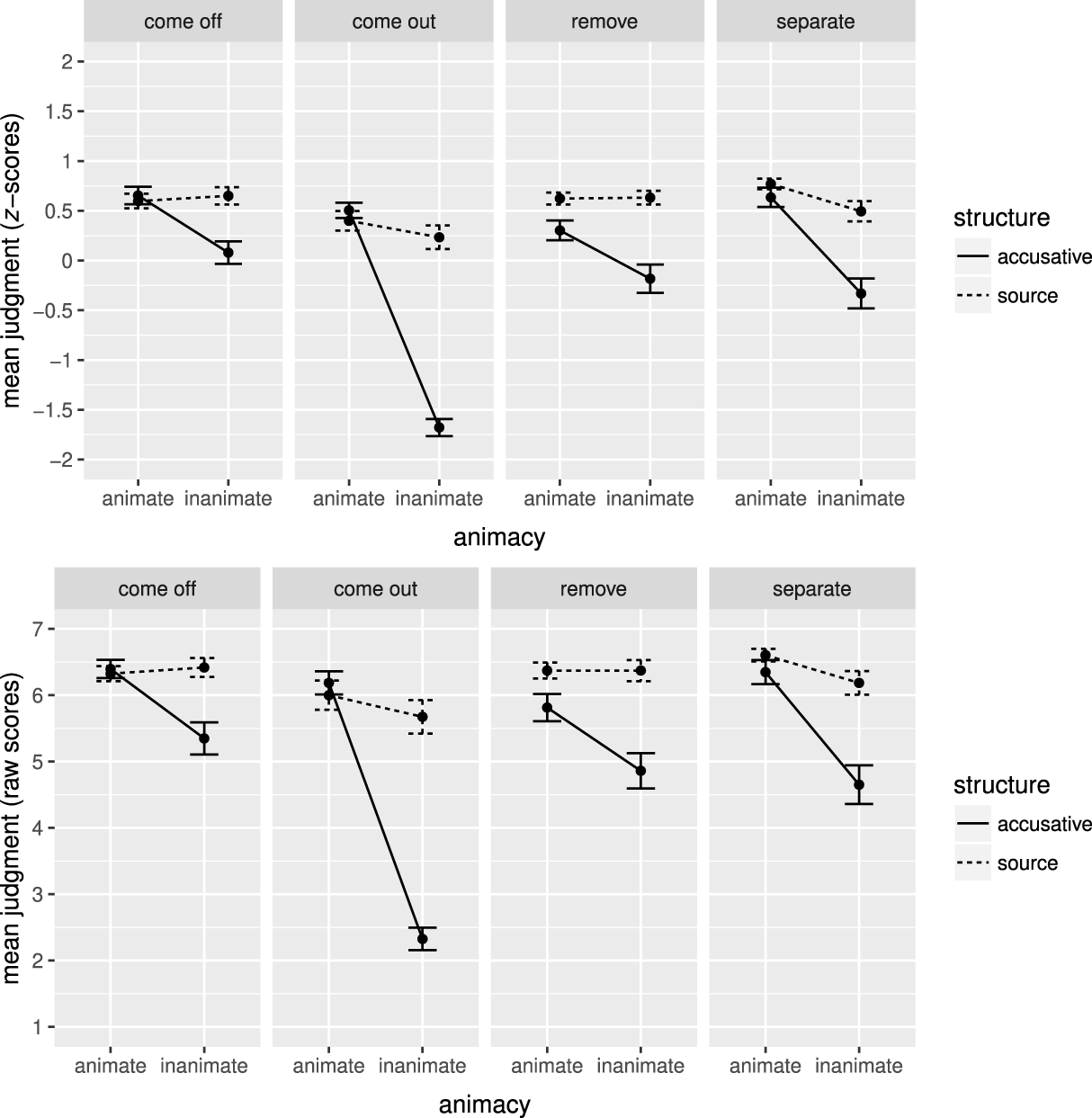
Interaction plots for structure and animacy with the four accusative–source verbs.

Figure 2 summarizes the mean z-scores and raw scores for the acceptability judgments for the sentences with the four accusative–source verbs in the four conditions. A visual inspection of Figure 2 suggests that there is an interaction between animacy and structure with all four verbs, as there is a large difference between the two means within the inanimate condition while the two means within the animate condition either overlap or are very close to each other. The statistical analysis largely confirms the above observations. With three of the four verbs, hazure-ru ‘come off’, de-ru ‘come out’, and nuke-ru ‘remove’, the interaction between structure and animacy is significant (hazure-ru ‘come off’:
 $\unicode[STIX]{x03B2}$
= 0.60, SE = 0.26, p = .04; de-ru ‘come out’:
 $\unicode[STIX]{x03B2}$
= 2.02, SE = 0.20, p < .01; nuke-ru ‘remove’:
 $\unicode[STIX]{x03B2}$
= 0.49, SE = 0.19, p = .01). With hanare-ru ‘separate’, the interaction between these two factors is only marginally significant (
 $\unicode[STIX]{x03B2}$
= 0.67, SE = 0.35, p = .07). Animacy is a significant predictor with all four verbs (hazure-ru ‘come off’:
 $\unicode[STIX]{x03B2}$
= –0.56, SE = 0.19, p < .01; de-ru ‘come out’:
 $\unicode[STIX]{x03B2}$
= –2.19, SE = 0.44, p < .01; nuke-ru ‘remove’:
 $\unicode[STIX]{x03B2}$
= –0.49, SE = 0.14, p < .01; and hanare-ru ‘separate’:
 $\unicode[STIX]{x03B2}$
= –0.96, SE = 0.25, p < .01). In contrast, structure is a significant predictor only with nuke-ru ‘remove’ (
 $\unicode[STIX]{x03B2}$
= 0.32, SE = 0.14, p = .02); it is not significant with the other three verbs (hazure-ru ‘come off’:
 $\unicode[STIX]{x03B2}$
= –0.04, SE = 0.18, p = .81; de-ru ‘come out’:
 $\unicode[STIX]{x03B2}$
= –0.10, SE = 0.14, p = .47; hanare-ru ‘separate’:
 $\unicode[STIX]{x03B2}$
= 0.13, SE = 0.25, p = .60).
4.1.5 Discussion
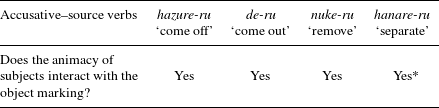
The results of Experiment 1 show that the accusative–source verbs generally exhibited the predicted interaction between the animacy of subjects and the object markings. In particular, the findings with three of the four accusative–source verbs, hazure-ru ‘come off’, de-ru ‘come out’, and nuke-ru ‘remove’, are exactly what the transitive–unaccusative alternation analysis predicted, with the dispreference for inanimate subjects with the accusative structure contributing to the significant interaction between structure and animacy. Although the interaction between these two factors did not reach significance with hanare-ru ‘separate’, the mean acceptability judgments for the sentences with hanare-ru ‘separate’ show a tendency that is consistent with the other accusative–source verbs: the difference between the means for the sentences in the accusative and oblique structures is larger within the inanimate condition than within the animate condition. Table 2 summarizes the findings with the accusative–source verbs from Experiment 1.
Findings with the accusative–source verbs from Experiment 1.

*The interaction was only marginally significant (p = .07).
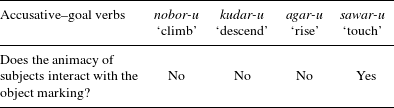
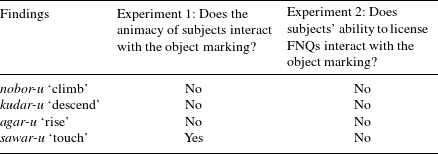
Among the four accusative–goal verbs, the results of only one of them, sawar-u ‘touch’, show a significant interaction between structure and animacy, as predicted by the transitive–unaccusative alternation hypothesis. With the other three accusative–goal verbs, either only animacy affected the mean acceptability judgments so that the means for the sentences within the inanimate condition are lower, as with nobor-u ‘climb’ and agar-u ‘rise’, or neither of the factors affected the mean acceptability judgments, as with kudar-u ‘descend’. Table 3 summarizes the findings with the accusative–goal verbs from Experiment 1.
Findings with the accusative–goal verbs from Experiment 1.

In sum, the findings with the accusative–source verbs are consistent with the prediction of the transitive–unaccusative alternation hypothesis, while the same prediction was borne out with only one of the accusative–goal verbs. Thus, our findings in Experiment 1 provide clear support for the transitive–unaccusative alternation analysis only with respect to the accusative–source verbs. As for the results with the accusative–goal verbs, there are two possible interpretations. One is that sawar-u ‘touch’ is a transitive–unaccusative alternation verb, while the other three accusative–goal verbs belong to a different type of verb that is not yet identified. The other possibility is that none of the four accusative–goal verbs are transitive–unaccusative alternation verbs, and the interaction between the animacy of subjects and the object markings found with sawar-u ‘touch’ has an independent explanation. In order to obtain further evidence for the transitive–unaccusative alternation analysis for the accusative–source verbs, and additional data that inform us about the underlying structure of the accusative–goal verbs, we examined another diagnostic that makes direct reference to the alleged structural difference between the two hypothesized underlying structures: subjects’ ability to license floating numeral quantifiers.
5 Licensing of floating numeral quantifiers
The transitive–unaccusative alternation hypothesis makes a set of predictions concerning the ability of subjects of the alternating verbs in the two different structures to license floating numeral quantifiers (FNQs) inside VP. As a classifier language, Japanese uses a combination of a numeral (e.g. san ‘three’) and a classifier (e.g. -nin), which agrees with a semantic feature of the modified noun (e.g. [+human] with -nin), to express the quantity of NPs.

Following previous studies, I will call a combination of a numeral and a classifier a numeral quantifier (NQ). As is well known, NQs and the NPs they modify (the associates) may be non-adjacent in Japanese; that is, NQs can ‘float’. It has been noted that the ability of subjects to license floating NQs (FNQs) in preverbal positions depends on the type of verbs that select them. Preverbal FNQs are readily licensed by passive subjects (19a) and unaccusative subjects (19b) but not by active transitive subjects (20a) or unergative subjects (20b) (Miyagawa Reference Miyagawa1989b).

Miyagawa (Reference Miyagawa1989b) accounts for the contrasts in (19) and (20) with two assumptions: (i) an NQ and its associate must be in a syntactically local configuration in their base-generated positions, but the associate can ‘strand’ the NQ by undergoing syntactic movement, and (ii) passive and unaccusative subjects are base-generated as internal arguments inside VP and move to the sentence-initial position, while subjects of transitive and unergative verbs are base-generated external arguments. Under these assumptions, the FNQs in (19a–b) are licensed despite the presence of the intervening PPs, which are assumed to be inside VP, because their associates are base-generated as internal arguments inside VP, where they were in the required local configuration with the FNQs (21a). In contrast, (20a–b) are degraded because the subjects of these sentences were base-generated outside VP as external arguments, as specifiers of a functional head such as Pred (Bowers Reference Bowers1993), Voice (Reference Kratzer, Benedicto and Runner1994, Reference Kratzer, Rooryck and Zariing1996), or v (Chomsky Reference Chomsky1995), and they were never in the required local configuration with the FNQs (21b).

Following Miyagawa (Reference Miyagawa1989b) and subsequent studies on the distribution of FNQs (e.g. Terada Reference Terada1990; Kitahara Reference Kitahara and Choi1993; Kawashima Reference Kawashima1998; Yamashita Reference Yamashita2001, Reference Yamashita, Endo, Martin and Yamashita2002, Reference Yamashita and Yim2006; Fitzpatrick Reference Fitzpatrick2006; Miyagawa Reference Miyagawa, Vance and Jones2006; Ko Reference Ko2007; Miyagawa & Arikawa Reference Miyagawa and Arikawa2007), I assume the ‘stranding’ analysis for FNQs (see Mihara Reference Mihara1998; Ishii Reference Ishii, Muraki and Iwamoto1999; Nakanishi Reference Nakanishi2007, Reference Nakanishi2008, for arguments that FNQs in Japanese can also be base-generated VP-modifiers, and Miyagawa 2012 for an extensive review of non-stranding approaches to FNQs). Given the contrast in (19) and (20) and the stranding analysis of FNQs, the transitive–unaccusative alternation analysis makes the following predictions about the ability of subjects of the alternating verbs in the two different structures to license VP-internal FNQs. By hypothesis, the alternating verbs in the oblique structure are unaccusatives. As such, their subjects are predicted to license VP-internal FNQs just like subjects of canonical unaccusatives (22a). In contrast, the same verbs in the accusative structure are transitives; their subjects are predicted to be unable to license FNQs just like subjects of canonical transitives (22b).

5.1 Experiment 2: Licensing of FNQs
5.1.1 Experimental design and predictions
Experiment 2 was designed to compare the acceptability of sentences with the alternating verbs in the two different structures whose subjects are associates of NQs. In one condition, the associates are adjacent to the NQs ([adjacent]). In the other, the NQs and their associates are separated by a VP-internal element ([floating]). The transitive–unaccusative alternation hypothesis predicts that the difference in acceptability between the [adjacent] and the [floating] conditions should be significantly larger with the accusative structure than with the oblique structure. As such, the analysis predicts a significant interaction between the object marking (accusative vs. oblique) and the position of FNQs (adjacent vs. floating).
5.1.2 Materials
Experiment 2 had a 2
 $\times$
2 design of structure (accusative vs. goal/source) and fnq ([adjacent] vs. [floating]). The same four accusative–goal verbs (nobor-u ‘climb’, kudar-u ‘descend’, agar-u ‘rise’, and sawar-u ‘touch’) and four accusative-source verbs (hazure-ru ‘come off’, de-ru ‘come out’, nuke-ru ‘remove’, and hanare-ru ‘separate’) used in Experiment 1 were used to create the materials. As in Experiment 1, four lexicalizations of each verb were constructed for each of the four conditions (8
 $\times$
4
 $\times$
4 = 128) and distributed among four lists using a Latin Square design. Each of the resulting four lists of 32 sentences was combined with 38 filler sentences with various degrees of acceptability, resulting in 70 sentences per list. The order of each list was then pseudo-randomized. Example sentences of each condition are presented in (23). The complete set of the experimental and filler sentences for Experiment 2 is available online, via https://multimediafluids.uam.elogim.com/core/journals/journal-of-linguistics, in the Supplementary Materials file alongside the present article.

5.1.3 Procedure and participants
A different group of forty-six university students in Tokyo, Japan, participated. The data from three participants were removed before analysis because they failed to complete the task as instructed. The procedure for Experiment 2 was identical to that for Experiment 1. The raw scores obtained in Experiment 2 were standardized (z-score transformed) prior to linear mixed-effects models analysis with verb, structure, and fnq as fixed factors and subjects and items as random factors.
5.1.4 Results
5.1.4.1 The accusative–goal alternation verbs
The results of the statistical analysis show that structure is a significant predictor of the acceptability judgments of the sentences with the accusative–goal verbs (
 $\unicode[STIX]{x03B2}$
= 0.54, SE = 0.25, p = .03). Neither fnq nor the interaction between fnq and structure reached the level of significance (fnq:
 $\unicode[STIX]{x03B2}$
= –0.39, SE = 0.25, p = .12; fnq x structure:
 $\unicode[STIX]{x03B2}$
= –0.08, SE = 0.35, p = .81). None of the verbs is a significant predictor. Figure 3 summarizes the mean z-scores and raw scores for the acceptability judgments for the sentences with the four accusative–goal verbs in the four conditions.
Interaction plots for structure and fnq with the four accusative–goal verbs.

Figure 3 shows that, with all four verbs, the two lines that connect the means of the sentences in the accusative condition and the goal condition are more or less parallel to each other and both slanted downward from the adjacent condition to the floating condition. These observations indicate that (i) there was no interaction between fnq and structure and (ii) the sentences in the floating condition were rated less acceptable than their counterparts in the adjacent condition in general. The results of the statistical analysis confirm the above observations. First, the interaction between the two factors is a significant predictor of the acceptability of the sentences with none of the four accusative–goal verbs (nobor-u ‘climb’:
 $\unicode[STIX]{x03B2}$
= –0.08, SE = 0.30, p = .79; kudar-u ‘descend’:
 $\unicode[STIX]{x03B2}$
= 0.24, SE = 0.37, p = .53; agar-u ‘rise’:
 $\unicode[STIX]{x03B2}$
= 0.24, SE = 0.36, p = .51; and sawar-u ‘touch’:
 $\unicode[STIX]{x03B2}$
= –0.33, SE = 0.36, p = .37). Fnq is a significant predictor with agar-u ‘rise’ (
 $\unicode[STIX]{x03B2}$
= –0.61, SE = 0.25, p = .03) and sawar-u ‘touch’ (
 $\unicode[STIX]{x03B2}$
= –0.57, SE = 0.25, p = 0.04), but not with nobor-u ‘climb’ (
 $\unicode[STIX]{x03B2}$
= –0.39, SE = 0.22, p = .09) or kudar-u ‘descend’ (
 $\unicode[STIX]{x03B2}$
= –0.36, SE = 0.26, p = .19). Structure is a significant predictor with nobor-u ‘climb’ (
 $\unicode[STIX]{x03B2}$
= 0.55, SE = 0.22, p = .02) but not with the other three verbs (kudar-u ‘descend’:
 $\unicode[STIX]{x03B2}$
= –0.10, SE = 0.26, p = .70; agar-u ‘rise’:
 $\unicode[STIX]{x03B2}$
= 0.30, SE = 0.25, p = .25; and sawar-u ‘touch’:
 $\unicode[STIX]{x03B2}$
= 0.20, SE = 0.25, p =
.44).
5.1.4.2 The accusative–source alternation verbs
Structure is not a significant predictor of the acceptability of the sentences with the accusative–source verbs (
 $\unicode[STIX]{x03B2}$
= 0.28, SE = 0.2, p = .17), while fnq is a significant predictor (
 $\unicode[STIX]{x03B2}$
= –1.11, SE = 0.20, p < .01). Importantly, the interaction between fnq and structure is significant (
 $\unicode[STIX]{x03B2}$
= 0.76, SE = 0.28, p < .01). None of the verbs is a significant predictor. Figure 4 summarizes the mean z-scores and raw scores for the acceptability judgments for the sentences with the four accusative–source verbs in the four conditions.
Interaction plots for structure and fnq with the four accusative–source verbs.

Figure 4 suggests that there is an interaction between fnq and structure with all four verbs, albeit to different degrees, as the differences between the means for the oblique (source) condition and the accusative condition appear to be larger within the floating condition than within the adjacent condition. The results of the analysis of the individual verbs are largely consistent with the above observations. First, with hazure-ru ‘come off’, de-ru ‘come out’, and hanare-ru ‘separate’, the interaction between fnq and structure is significant (hazure-ru ‘come off’:
 $\unicode[STIX]{x03B2}$
= 0.76, SE = 0.18, p < .01; de-ru ‘come out’:
 $\unicode[STIX]{x03B2}$
= 1.21, SE = 0.37, p < .01; and hanare-ru ‘separate’:
 $\unicode[STIX]{x03B2}$
= 0.50, SE = 0.24, p = .05). The same interaction is only marginally significant with nuke-ru ‘remove’ (
 $\unicode[STIX]{x03B2}$
= 0.59, SE = 0.30, p = .07). Fnq is a significant predictor of the mean acceptability of the sentences with all four verbs (hazure-ru ‘come off’:
 $\unicode[STIX]{x03B2}$
= –0.86, SE = 0.26, p < .01; de-ru ‘come out’:
 $\unicode[STIX]{x03B2}$
= –0.86, SE = 0.26, p < .01; nuke-ru ‘remove’:
 $\unicode[STIX]{x03B2}$
= –0.52, SE = 0.21, p < .03; and hanare-ru ‘separate’:
 $\unicode[STIX]{x03B2}$
= –0.75, SE = 0.17, p < .01). With hazure-ru ‘come off’, structure is also significant (
 $\unicode[STIX]{x03B2}$
= 0.28, SE = 0.13, p = .03), but not with the other three verbs (de-ru ‘come out’:
 $\unicode[STIX]{x03B2}$
= 0.04, SE = 0.26, p = .88; nuke-ru ‘remove’:
 $\unicode[STIX]{x03B2}$
= 0.12, SE = 0.21, p = .58; and hanare-ru ‘separate’:
 $\unicode[STIX]{x03B2}$
= –0.03, SE = 0.17, p =
.85).
5.1.5 Discussion
The results of Experiment 2 show that there is a significant interaction between structure and fnq with the sentences with three of the accusative–source verbs, hazure-ru ‘come off’, de-ru ‘come out’, and hanare-ru ‘separate’, with the interaction marginally significant with nuke-ru ‘remove’. This is exactly what the transitive–unaccusative alternation analysis together with the stranding analysis of FNQ predicted. In clear contrast, the interaction between structure and fnq is not significant with the sentences with all four accusative–goal verbs, nobor-u ‘climb’, kudar-u ‘descend’, agar-u ‘rise’, and sawar-u ‘touch’.
6 Taking stock
We are now ready to discuss what the findings from Experiments 1 and 2 tell us about the syntactic structures of the accusative–oblique alternation verbs.
6.1 The accusative–source verbs
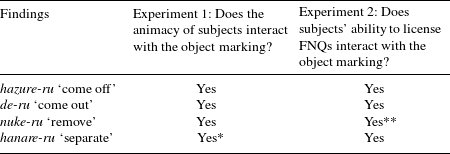
Table 4 summarizes the findings from Experiments 1 and 2 with the four accusative–source verbs.
Findings with the accusative–source verbs from Experiments 1 and 2.

*The interaction was only marginally significant (p = .07).
**The interaction was only marginally significant (p = .07).
The two predictions made by the transitive–unaccusative alternation hypothesis with respect to the interaction between the object marking and the animacy of subjects (Experiment 1) and subjects’ ability to license FNQs (Experiment 2) are clearly borne out by two of the accusative–source verbs, hazure-ru ‘come off’ and de-ru ‘come out’. With nuke-ru ‘remove’, the interaction between the object marking and the animacy of the subject is significant while the interaction between the object marking and subjects’ ability to license FNQs is only marginally significant, and the opposite pattern is observed with hanare-ru ‘separate’, with which the interaction between the object marking and subjects’ ability to license FNQs is significant while the interaction between the object marking and the animacy of the subject is only marginally significant. Overall, the means of the sentences with the four accusative–source verbs all show the right trend numerically. Thus, the findings from Experiments 1 and 2 provide strong support for the transitive–unaccusative alternation analysis of the accusative–source verbs. According to the analysis, sentences with the accusative–source verbs in the accusative structure have the underlying structure in (24).

The analysis accounts for the following properties of sentences with the accusative–source verbs in the accusative structure.

First, the Voice head introduces an external argument and case-licenses the object with accusative case in (24). This accounts for the presence of an animacy restriction on subjects of the accusative–source verbs in the accusative structure, originally observed by Teramura (Reference Teramura1982) and further confirmed by the results of Experiment 1 (25a), and it also accounts for the accusative marking of the object (25c). Moreover, the subject of an accusative–source verb in the transitive structure is introduced as the specifier of the VoiceP in (24). As such, it is not in the required local relation with an FNQ inside VP at any point of the derivation. This accounts for the inability of these subjects to license VP-internal FNQs observed in Experiment 2 (25b). The fact that sentences with the accusative–source verbs in the accusative structure denote punctual events is accounted for by the presence of the v
 $_{\text{BECOME}}$
head of the vP embedded under the VoiceP, which introduces the abstract predicate BECOME (25e). This leaves the interpretation of the object as a location as the only contribution of the lexical semantics of the accusative–source verbs. Since these verbs are directed motion verbs, the natural interpretation of the object is that it refers to a location from which the subject moves away.
The oblique counterparts of the accusative–source verbs, on the other hand, have the unaccusative structure as their underlying structure, as in (26).

The analysis in (26) accounts for the following properties of sentences with the accusative–source verbs in the oblique structure.

The lack of an animacy restriction on subjects of the accusative–source verbs in the oblique structure, again originally noted by Teramura (Reference Teramura1982) and confirmed by the results of Experiment 1, is due to the subject of the accusative–source verbs in the oblique structure being an internal argument. As an internal argument, it receives a thematic role that is compatible with both animate and inanimate referents, such as undergoer (27a). Since subjects of the accusative–source verbs in the oblique structure are internal arguments, they can be in the required local relation with a VP-internal FNQ at their base-generated position, accounting for the ability of subjects of the accusative–source verbs in the oblique structure to license VP-internal FNQs (27b). Furthermore, in (26), the oblique-marked ‘object’ is a PP headed by -kara ‘from’ (27c), and it is interpreted as a location from which subjects move away because of the combination of the lexical semantics of the accusative–source verbs and the postposition -kara ‘from’. Lastly, the vP in the oblique structure is analyzed as headed by v
 $_{\text{BECOME}}$
, accounting for the punctual interpretation of the accusative–source verbs in the oblique structure.
6.2 The accusative–goal verbs
Table 5 summarizes the findings from Experiments 1 and 2 with the four accusative–goal verbs.
Findings with the accusative–goal verbs from Experiments 1 and 2.

The interaction between the object marking and subjects’ animacy was observed only with sawar-u ‘touch’ (Experiment 1), and the interaction between the object marking and subjects’ ability to license FNQs was observed with none of the four accusative–goal verbs (Experiment 2). Thus, the results of Experiments 1 and 2 provide no support for the transitive–unaccusative analysis of three of the accusative–goal verbs, nobor-u ‘climb’, kudar-u ‘descend’, and agar-u ‘rise’. In fact, the results from the two experiments suggest that these accusative–goal verbs are always transitive verbs regardless of the object marking. Such an analysis can provide a straightforward account for the general dispreference for inanimate subjects with these verbs and their subjects’ inability to license VP-internal FNQs. However, a transitive analysis of the accusative–goal verbs faces two immediate challenges. First, it must account for the object marking alternation without the transitive–unaccusative alternation. Second, it must provide a non-syntactic account for the significant interaction between the object marking and the animacy of subjects with sawar-u ‘touch’ in Experiment 1, assuming that all four accusative–goal verbs share the same (transitive) structure.
In sum, the results from Experiments 1 and 2 provide strong support for the transitive–unaccusative alternation analysis of the accusative–source verbs, while they fail to support the same analysis for the accusative–goal verbs. Thus, despite the superficial similarities between the two types of accusative–oblique alternation verbs, we have come to the conclusion that only the accusative–source verbs are linked to the transitive and the unaccusative structures. The results of the two experiments further suggest the possibility that the accusative–goal verbs are always transitive regardless of the object marking. Such an analysis must account for the properties exhibited by the accusative–goal verbs without relying on the transitive–unaccusative alternation. This is the goal of Section 7.
7 The syntax of the accusative–goal verbs
In this section, I propose a transitive analysis of the accusative–goal verbs that accounts for (i) the object marking alternation and (ii) the finding from Experiment 1 that the animacy of subjects and the object marking interact with each other with sawar-u ‘touch’. To that end, I first present evidence that the goal marker -ni is best analyzed as a structural case, i.e. dative case (Section 7.1). I then argue that the interaction between the animacy of subjects and the object marking observed with sawar-u ‘touch’ is a consequence of two interacting factors: sawar-u ‘touch’ is compatible with animate and inanimate subjects, and accusative–goal verbs denote two types of events in the two different structures (Section 7.2). These arguments lead me to conclude that the accusative–goal verbs involve (i) two different Voice heads, one that assigns accusative case and another that assigns dative case, and (ii) vPs headed by two different vs: v
 $_{\text{DO}}$
and v
 $_{\text{BECOME}}$
.
7.1 The oblique marker -ni in accusative–goal alternations is dative case
It is well known that -ni in Japanese is ambiguous between a dative case marker and a postposition (e.g. Sadakane & Koizumi Reference Sadakane and Koizumi1995). Evidence that -ni with the accusative–goal verbs is a case marker comes from two standard diagnostic tests for the case marker-postposition distinction in Japanese. One of them has to do with the licensing of FNQs: while NPs with a case marker license FNQs when relevant conditions are met, NPs inside PPs do not (e.g. Shibatani Reference Shibatani1977, Miyagawa Reference Miyagawa1989b, Sadakane & Koizumi Reference Sadakane and Koizumi1995).

It turns out that the NPs in the oblique objects marked by -ni can license an FNQ, suggesting that they are NPs followed by a case marker.

The second diagnostic involves cleft sentences. When an NP followed by a case marker is in the focus position in a cleft sentence, overt realization of the case marker makes the sentence less acceptable (30b). In contrast, when a PP is in the focus position in a cleft sentence, omission of the postposition makes the sentence less acceptable (30c) (Sadakane & Koizumi Reference Sadakane and Koizumi1995).Footnote [7]

If the -ni with the accusative–goal verbs is a case marker, as the FNQ test indicates, it should be possible to omit it when a -ni complement is in the focus position of a cleft sentence, whereas overt realization of -ni in the same position should make the cleft sentence less acceptable. This is what we find.

Note that (31b) cannot be analyzed as deriving from the accusative object, as choojoo ‘summit’ is incompatible with accusative marking, presumably because it cannot be construed as a path (31a).
Thus, I conclude that -ni on the oblique object of the accusative–goal verbs is a dative case marker. This means that the objects of the accusative–goal verbs are always licensed with a structural case, whether it is the accusative case with -o or the dative case with -ni. In order to account for this observation, I propose that these verbs involve two types of Voice heads: one that assigns accusative case (32a) and another that assigns dative case (32b).

7.2 The animacy of subjects and event types
Our initial observation in (9), repeated below as (33), and the results of Experiment 1 show that inanimate subjects are not as acceptable as animate subjects with the accusative–goal verb sawar-u ‘touch’ in the accusative structure.

If the accusative–goal verbs are always transitive, where does this contrast with sawar-u ‘touch’ come from? I argue that the contrast in (33) is a result of an interaction between two factors.
First, following Grimshaw (Reference Grimshaw1993, Reference Grimshaw2005) and Rappaport-Hovav & Levin (Reference Rappaport-Hovav and Levin1998), I assume that the meaning of verbs consists of linguistically relevant information, e.g. that verbs like eat and drink denote activities (‘semantic structure’ in Grimshaw Reference Grimshaw1993, Reference Grimshaw2005), and linguistically irrelevant information, e.g. that eat must involve solid edible objects while drink must involve liquids (‘semantic content’ in Grimshaw Reference Grimshaw1993, Reference Grimshaw2005). In the approach to verb meanings that I adopt, the linguistically relevant information is structurally encoded with different combinations of the semi-functional verbal heads Voice and v with different specifications. The linguistically irrelevant information, on the other hand, comes from idiosyncratic differences among individual verbs. Under this assumption, what makes sawar-u ‘touch’ different from the other accusative–goal verbs is that, while these verbs are all associated with the same transitive structure with an external argument, sawar-u ‘touch’ is the only one whose idiosyncratic meaning, or semantic content, makes it compatible with having an inanimate subject. The observation that the other three accusative–goal verbs are never quite compatible with inanimate subjects regardless of the object marking suggests that their semantic content requires animate subjects.
Second, the accusative–goal verbs denote two different types of event in the two different structures. As discussed in Section 2, the accusative–goal verbs denote durative events when they are in the accusative structure, while they denote punctual events in the oblique structure (see Table 1). Therefore, when an accusative–goal verb is in the accusative structure, its subject is interpreted as engaged in a durative event. While an animate human referent such as Keiko in (33a) makes a natural subject for a durative event, an inanimate referent such as Keiko’s skirt in (33b) does not, as inanimate objects cannot sustain a continuous movement. This accounts for the dispreference for inanimate subjects with sawar-u ‘touch’ in the accusative structure. When the same verb is in the oblique structure, its subject is interpreted as engaged in a punctual event. Since punctual events do not require their subjects to sustain continuous movement, the animacy of the subjects does not matter. For the sake of concreteness, I propose that the accusative–goal verbs in the accusative structure involve a vP headed by v
 $_{\text{DO}}$
and therefore denote durative events, while the same verbs in the oblique structure have a vP headed by v
 $_{\text{BECOME}}$
, denoting punctual events. Combining these proposals with the partial structures in (32a–b), we have (34a) and (34b) as the underlying structures for the accusative–goal verbs in the accusative structure and the oblique structure, respectively.

The difference in the types of events that the accusative–goal verbs denote in the two different structures also accounts for the difference in the interpretation of objects discussed in Section 2.1. The object of the accusative–goal verbs is interpreted as a path when they are in the accusative structure because these verbs in the accusative structure denote durative events. Since the accusative–goal verbs are directed motion verbs, when they denote durative events, the natural interpretation of the object is that it is a path that the subject of these verbs moves along. In contrast, the object of the same verbs is interpreted as a goal when they are in the oblique structure because these verbs in the oblique structure denote punctual events. If motion events are interpreted as punctual achievement events, they require an end-point, and the dative-marked object provides it.
In sum, the proposed transitive analysis of the accusative–goal verbs in (34) accounts for the following properties of the accusative–goal verbs.

8 Accusative–oblique alternations and the morpho-syntax of Japanese verbs
Having proposed our analyses of the accusative–oblique alternations, in this section I explore their implications for the overall morpho-syntactic organization of Japanese verbs, by examining the relationship between the accusative–oblique alternations and a better-known alternation, the causative alternation. The examination shows that the relationship between the morphology and the syntax is transparent with the accusative–source verbs, but rather opaque with the accusative–goal verbs.
8.1 The accusative–source alternation and the causative alternation
One of the characteristics of the accusative–oblique alternations is that they involve no morphological change in the verb forms. In contrast, the better-known causative alternation involves morphological differences among the participating verbs (e.g. Jacobsen Reference Jacobsen1992, Haspelmath Reference Haspelmath, Comrie and Polinsky1993, Kitagawa & Fujii Reference Kitagawa, Fujii, Pylkkänen, van Hout and Harley1999, Harley Reference Harley2008).Footnote [9]

It turns out that all four accusative–source verbs that we examined also participate in the causative alternation.

Thus, these verbs have three different syntactic realizations: the unaccusative structure (38a), the transitive structure (38b), and the causative structure (38c).

The causative structure is different from the unaccusative/transitive structure in three important ways. First, as pointed out above, the unaccusative and the transitive structures share the same morphological forms, whereas the causative structure is different.Footnote [10] Second, both unaccusative and transitive structures involve two arguments, which differ in how they are syntactically encoded, while the causative structure involves an additional argument, the causer, e.g. Hanako in (38c). Third, only the causative structure entails causation. While (38c) entails that something or someone caused Taroo to undergo a change of location, nothing causes the change of location undergone by Taroo in (38a–b).
The transitive–unaccusative alternation analysis of the accusative–source verbs offers a transparent account of how the accusative–source verbs and their causative forms are related with each other syntactically and morphologically. Under the proposed analysis, the unaccusative structure of the alternating verbs involves v
 $_{\text{BECOME}}$
and lacks Voice (39a). The causative structure, on the other hand, involves v
 $_{\text{CAUSE}}$
, which introduces causation, and a Voice, which introduces the causer, Hanako (39b). Thus, while the internal argument Taroo is realized as a nominative-marked derived subject in the unaccusative structure (39a), it remains an internal argument and accusative-marked in the causative structure (39b).

Empirical support for the proposed underlying structure of the causative sentence in (39b) comes from two standard diagnostics for the internal structure of causative sentences in Japanese. Since Shibatani (Reference Shibatani1973, Reference Shibatani and Shibatani1976), it is widely accepted that causative sentences that involve lexically specific causative forms, lexical causatives, have a simple, mono-eventive structure, while causative sentences that are formed with the productive causative suffix -(s)ase, productive causatives, have a complex, bi-eventive structure (e.g. Miyagawa Reference Miyagawa1994, Reference Miyagawa1998; Harley Reference Harley1995, Reference Harley2008). The main arguments for the distinction come from the interpretation of the subject-oriented anaphor jibun ‘self’ and manner adverbials such as mugon-de ‘without a word’. The complex structure of productive causatives arguably makes the interpretation of these two elements ambiguous.

In (40a), the anaphor jibun can have either Taroo or Hanako as its antecedent. Under the assumption that the anaphor is subject-oriented, this suggests that productive causative sentences like (40a) have two subjects. In (40b), the manner adverb mugon-de ‘without a word’ can modify either Hanako’s or Taroo’s action. This has been taken to motivate the complex internal structure of productive causative sentences, e.g. two VPs. In contrast, with a lexical causative, the interpretation of the same elements is unambiguous.

This observation, among other things, has motivated the analysis that lexical causatives have a simple structure with one subject and one VP.
Now, the proposed lexical causative analysis in (39b) predicts that a sentence with the causative form of an accusative–source verb that has the subject-oriented anaphor jibun or the manner adverb mugon-de ‘without a word’ should be unambiguous. The prediction is borne out.

Thus, the syntactic relationship between the accusative–source verbs and their causative form appears to be exactly what their morphological forms suggest: the causative form of an accusative–source verb is the result of adding v
 $_{\text{CAUSE}}$
and a Voice to the structure of the accusative–source verb.
8.2 The accusative–goal alternation and the causative alternation
If we look at the four accusative–goal verbs that were examined in this study, we find that only two of them participate in the causative alternation.

In order to causativize nobor-u ‘climb’ and sawar-u ‘touch’, the productive causative suffix -(s)ase must be used.Footnote [11]

Under the assumption that the productive causative sentences involve a complex structure, (44b) must have the underlying structure in (45b).

In fact, if the structure in (44b) added the anaphor jibun or the manner adverbial mugon-de ‘without a word’ it would be ambiguous, as predicted by the structure in (45b).

The other two accusative–goal verbs, ag-ar-u ‘rise’ and kud-ar-u ‘descend’, have lexically specific causative forms, as in (47b) and (48b).

For reasons that are not clear, (48b) with the causative form kud-as-u ‘lower’ is unacceptable.Footnote [12] However, the causative version of (47a), (47b), is acceptable. Our analysis of the accusative–goal verbs as transitive verbs predicts that (47b) should have the same underlying structure as (45b), i.e. (49).

There are at least two problems in the analysis in (49), however. First, it is not clear why the head of the lower vP, v
 $_{\text{BECOME}}$
, realized as at in (47a), must disappear when the accusative–goal verb is embedded under v
 $_{\text{CAUSE}}$
-e in (49). Second, according to the analysis in (49), (47b) has a complex structure with an embedded VoiceP. As such, (49) wrongly predicts that (47b) with the anaphor jibun ‘self’ or the adverbial mugon-de ‘without a word’ should be ambiguous.

The lack of ambiguity in (50a–b) suggests that these sentences have the simple structure of lexical causative sentences and the structure in (49) is untenable.
Do the above observations mean that the transitive analysis of the accusative–goal verbs proposed in Section 7 is untenable? Here, it is important to point out that the lack of ambiguity in (50a–b) is problematic for the transitive analysis of the accusative–goal verbs only under the assumption that the morphological forms of these verbs and their syntactic structures are always transparently related with each other. There is independent evidence from Japanese that the relationship between the morphological form of verbs and their syntactic structures is not always transparent. The evidence comes from an intransitive–causative pair kae-r-u ‘return’ (51a) and kae-s-u ‘return’ (51b).

(51a) shows that an NP with an inanimate referent, such as hon ‘book’, cannot be the subject of the verb kae-r-u ‘return’, suggesting that the subject of kae-r-u ‘return’ must be agentive. In contrast, (51b) shows no such restriction on the object of the causative from kae-s-u ‘return’. This contrast in the animacy restriction of ‘what returns’ in (51a–b) would be unexpected if (51b) is derived from (51a) by v
 $_{\text{CAUSE}}$
embedding the structure of (51a). Rather, the contrast in (51a–b) argues that (51a) and (51b) are syntactically independent of each other, despite their morphological forms. I argue that the pair of sentences in (47) with ag-ar-u ‘rise’ and ag-e-ru ‘lift up’ represents a similar case. Specifically, I propose that these sentences have the underlying structures in (52a) and (52b), respectively, both involving a simple, mono-eventive clause structure.

Thus, our examination of the relationship between the accusative–oblique alternations and the causative alternation has revealed that the relationship between the morphological forms of Japanese verbs and their syntactic structures is not always transparent. While the relationship between morphology and syntax is transparent with the accusative–source verbs and their causative forms, the morphological forms and the syntactic structures are independent of each other with the accusative–goal verbs and their causative forms, if they exist.
9 Conclusion
This paper examined two classes of accusative–oblique alternation verbs in Japanese, the accusative–goal verbs and the accusative–source verbs, and argued that, despite their superficial similarities, they are linked to two fundamentally different sets of syntactic structures. While the accusative–source verbs are mapped onto the transitive and the unaccusative structures, the accusative–goal verbs are mapped onto two different transitive structures. The novel experimental data introduced in this study highlighted the systematic differences in the syntactic and semantic properties that the two classes of the accusative–oblique alternation verbs exhibit in the two different structures.
The proposed analysis of the accusative–oblique alternations paints a rather complex picture of the mapping between the alternating verbs and their syntactic structures, whereby the interpretation of their arguments and the events that they denote is largely determined by the syntactic structures onto which these verbs are mapped. As such, the proposed analyses provide novel arguments for approaches to the lexical semantics–syntax interface, according to which the core meaning of verbs and their syntactic structures together construct the interpretation of verbs and their arguments (e.g. Perlmutter Reference Perlmutter1978; Hale & Keyser Reference Hale and Keyser1986, Reference Hale and Keyser1992, Reference Hale, Keyser, Hale and Keyser1993, Reference Hale and Keyser2002; Miyagawa Reference Miyagawa1989a, Reference Miyagawab; Hoekstra & Mulder Reference Hoekstra and Mulder1990; Tsujimura Reference Tsujimura1990a, Reference Tsujimurab, Reference Tsujimura, Koizumi and Ura1994, Reference Tsujimura1996; Hoekstra Reference Hoekstra1992; Levin & Rappaport-Hovav Reference Levin and Rappaport-Hovav1995; Rappaport-Hovav & Levin Reference Rappaport-Hovav and Levin1998; Ritter & Rosen Reference Ritter and Rosen1998; Sorace Reference Sorace2000; McIntyre Reference McIntyre2004; Folli & Ramchand Reference Folli, Ramchand, Verkyul, de Swart and van Hout2005; Ramchand Reference Ramchand2008). Furthermore, our examination of the relationship between the accusative–oblique alternations and the causative alternation revealed that the relationship between the morphological forms of verbs and their syntactic structures is not always transparent even in Japanese, a fairly consistent agglutinating language.
It is our hope that the novel experimental data from the accusative–oblique alternations in Japanese presented in this study and the proposed analysis of the alternations as involving multiple productive one-to-many mappings between verbs and their syntactic structures contribute to a better understanding and further development of the research into the mapping between verbs’ meaning and their syntactic structures, and inspire more theoretical and experimental research into the topic.