Support for Latin America’s presidents is often conditional on their management of the economy (see Gélineau and Singer Reference Gélineau and Singer2015 for a review) and on levels of corruption in their country (see Manzetti and Rosas Reference Manzetti and Rosas2015 for a review), and there is some recent evidence that government support fluctuates with levels of crime as well (Pérez Reference Pérez2015; Ley Reference Ley2017; Carreras and Visconti Reference Carreras and Viscontin.d.). On average, presidents who perform well tend to be rewarded with high levels of popularity, while those who perform poorly usually see their support fall. Strong-performing presidents can leverage this popularity to enact their legislative agenda (Calvo Reference Calvo2007; cf. Alemán and Navia Reference Alemán and Navia2009) or to enact reforms that increase their power or remove term limits (Corrales Reference Corrales2018; Singer Reference Singer2018), while weak performance often results in reduced electoral support.
Yet one might argue that presidents should not always be held accountable for policy outcomes that occur while they are in office. Some outcomes have causes that are beyond politics or beyond the country’s borders. For those outcomes that have domestic political causes, presidents often share policymaking responsibility with other political actors (e.g., the legislature, courts, state and local governments), so citizens looking to hold the president accountable need to weigh whether the president, either unilaterally or with their party in the legislature, is responsible for the outcome of interest or if other political actors are to blame. As a result, the electoral response to performance outcomes should be muted when it is difficult to attribute responsibility to the incumbent. In particular, people should not hold the incumbent solely responsible for outcomes when a fragmented party system or minority status in the legislature has forced the president to bargain with other political parties to enact economic and governance policies. If government performance has the same effect across various contexts, then voters might not be holding politicians fully accountable.
While multiple studies provide evidence for a conditional accountability model, whereby voters take the political context into account, open questions remain about whether this is a regular empirical pattern. The evidence for this model is particularly mixed in presidential systems, in which electoral attention is often focused on the chief executive at the expense of other actors (Silva and Whitten Reference Silva, Whitten, Arzheimer, Evans and Lewis-Beck2017). This model receives contradictory support in studies focused on Latin America. Moreover, nearly all previous studies of conditional accountability have generally looked only at one form of performance accountability independently. Some studies look at what factors affect responses to the economy, others consider what factors affect responses to corruption, and no published studies to date systematically analyze how responses to insecurity vary across countries. Therefore, we do not know if voters consistently take the partisan context into account when evaluating government responsibility.
This study takes advantage of the large number of public opinion surveys in the region to estimate a unified model of conditional accountability that comprises factors that condition the political impact of the economy, insecurity, and corruption. Focusing on the period 2006–17, it specifically tests whether a common pattern emerges across these three performance areas, whereby politicians are held less accountable in fragmented party systems and when the president does not oversee a single-party majority. Finding a common pattern across different areas of government performance would constitute strong evidence that people approach accountability in a nuanced way. It also would identify conditions that either strengthen or undermine political accountability in the region.
Using pooled data from 103 country-years of the AmericasBarometer survey conducted between 2006 and 2016–17, this study first shows that the impact of the economy, crime, and corruption on government support varies significantly across the hemisphere over this time period, with these variables having larger effects in some countries than in others. It then models this variation and finds evidence of systematic conditional accountability, and also that performance accountability is attenuated in fragmented party systems where responsibility attributions are difficult. Taken together, these results provide both reassurance and caution for the democratic accountability model. Even in presidential systems, where so much political attention is often focused on the president at the expense of other branches of government, the public tries to take government control into account when assessing responsibility instead of engaging in blind retrospection, as some skeptics of democratic accountability argue.Footnote 1 But although the public tries to evaluate responsibility, in many countries in the hemisphere, the political context is sufficiently complex and convoluted that it is not fully amenable to strong accountability.
The Conditional Theory of Accountability
The theory of retrospective accountability starts with a simple premise: “In order to ascertain whether the incumbents have performed poorly or well, citizens need only calculate the changes in their own welfare” (Fiorina Reference Fiorina1981, 5)—and reward or punish the president accordingly. Meaningful accountability, however, is much more complicated than simply observing whether things are getting better or worse. Citizens who observe changes in various areas of their own welfare have to decide what area of government performance to emphasize to make sure that governments have incentives to tackle the most pressing problems (Singer Reference Singer2011). But they also need to consider how much credit or blame to give the incumbent for those changes (e.g., Powell and Whitten Reference Powell and Whitten1993; Marsh and Tilley Reference Marsh and Tilley2010). Doing so requires considering the other actors who may have contributed to the policy and dividing up responsibility accordingly. If voters cannot or do not do this, then political accountability becomes arbitrary, as voters’ punishing politicians for outcomes beyond their control would be “no more sensible than kicking the dog after a hard day at work” (Achen and Bartels Reference Achen and Bartels2016, 93). If voters blindly respond to policy outcomes without taking government responsibility into account in the ways that these skeptics of electoral accountability claim they do, elections neither reward good leaders nor punish poor ones, and the ability of elections to induce presidential effort or to sanction incompetence is undermined (Duch and Stevenson Reference Duch and Stevenson2008; Achen and Bartels Reference Achen and Bartels2016, 102–8).
Skeptics of democratic accountability have raised questions about whether voters accurately assess government responsibility. They argue that governments often end up being punished for things like falling commodity prices, poor weather, bad sporting event outcomes, or even high numbers of shark attacks, because people evaluate leaders in a knee-jerk, reactionary fashion without considering whether the leader actually had any role in the outcome occurring (e.g., Huber et al. Reference Huber, Hill and Lenz2012; Hayes et al. Reference Hayes, Imai and Shelton2015; Campello and Zucco Reference Campello and Zucco2016; Achen and Bartels Reference Achen and Bartels2016). Voters also often ignore the role that multiple policymakers have in shaping government policy; they focus instead on the chief executive (Norpoth Reference Norpoth2001), especially if they are not particularly sophisticated (Gomez and Wilson Reference Gomez and Wilson2006). This tendency might be especially pronounced in presidential systems in which the executive dominates public conceptions of the political process and media coverage (Samuels Reference Samuels2004). These documented unconditional responses to policy outcomes raise questions about citizen engagement and competence.
Yet although assessing political control in policymaking outcomes is difficult, an alternative perspective is that voters can and do try to look at the degree to which policymakers control outcomes, and adjudicate responsibility accordingly. The context in which policymaking occurs may make it more or less clear who is responsible for policy outcomes by either allowing policymakers to make policy without much input from other actors (clarifying responsibility) or forcing policymakers to negotiate with other actors and making it unclear which actor deserves the lion’s share of the credit or the blame for subsequent developments (diffusing responsibility). If voters are aware of these differences in control and try to account for the degree to which the incumbent is responsible, then the connection between policy outcomes and support for the incumbent leader should be attenuated in contexts where policymaking responsibility is shared.
Empirical work on the “clarity of responsibility” argument has focused on a wide variety of factors that potentially divide political control, including how thoroughly the domestic economy is integrated into the national economy and the potential role of international financial institutions or the EU (Duch and Stevenson Reference Duch and Stevenson2008; Alcañiz and Hellwig Reference Alcañiz and Hellwig2011; Hellwig Reference Hellwig2014; Hobolt and Tilley Reference Hobolt and Tilley2014). Yet most of the attention is to national-level political institutions like bicameralism, federalism, presidentialism, and committees in the legislature, which bring multiple actors into policymaking, with the assumption being that multiple veto points make responsibility weaker and less clear (e.g., Powell and Whitten Reference Powell and Whitten1993; Anderson Reference Anderson2006; Gélineau and Remmer Reference Gélineau and Remmer2006; Duch and Stevenson Reference Duch and Stevenson2008; Hellwig and Samuels Reference Hellwig and Samuels2008). However, the presence of multiple veto points should not necessarily diffuse responsibility from the incumbent party. Instead, responsibility is diffused when different partisan actors control these different institutions. Hobolt et al. (Reference Hobolt, Tilley and Banducci2013) find that party system variables have a larger effect on how voters respond to economic outcomes than do formal institutions.Footnote 2 Thus, much of the recent work on the clarity of responsibility hypothesis has focused on the party system.
Two main party system variables have received the most attention. First is the presence of coalition or minority governments. Incumbents who oversee singleparty majority governments should have more control over policy than those who oversee divided government or a minority government and have to negotiate with opposition parties, or who have coalition partners they need to negotiate with (Powell and Whitten Reference Powell and Whitten1993; Hobolt et al. Reference Hobolt, Tilley and Banducci2013). The second is the number of parties in the legislature. Clarity of responsibility should also decrease with party system fragmentation, as a larger number of parties not only makes coalition and minority governments more likely but also increases the complexity of the bargaining environment for the incumbent—incumbents in a fragmented legislature will have to negotiate with more parties than will those in countries with few parties.
A system with a large number of parties adds additional challenges for voters trying to monitor political actors, as “even with a majority government, voters might be confused by the presence of a large number of voices trying to make themselves heard at the same time” (Nadeau et al. Reference Nadeau, Niemi and Yoshinaka2002, 409); they will have a hard time determining which party played what role. All these factors should make it harder to determine which actors are responsible in a fragmented party system (Anderson Reference Anderson2000; Bengtsson Reference Bengtsson2004).
There is no guarantee, of course, that these differences in accountability will emerge across contexts. They will not have this effect if voters are not trying to account for government control. They will also not have this effect if people do not understand how these party system differences affect the policymaking process. Yet inasmuch as voters take the partisan makeup of the policymaking process into account, and discount policy outcomes in judging the incumbent when fragmented party systems diffuse policymaking control, voters are engaging in rational discounting instead of blind retrospection.
Differences in behavior across contexts thus potentially speak well for voter competence, and suggest that elections can potentially play the sanctioning role that is often ascribed to them. Yet these contextual theories of accountability also suggest that there are partisan and institutional contexts in which rational voters will be unable to hold any specific political actor accountable for policy outcomes, leaving accountability in those contexts quite attenuated.
The Evidence for the Conditional Accountability Model
A large and growing literature examines whether political accountability is diminished when the clarity of responsibility is low (see Silva and Whitten Reference Silva, Whitten, Arzheimer, Evans and Lewis-Beck2017 for a recent review). Yet the evidence for this proposition remains mixed. The evidence that accountability is conditional on the partisan context comes most strongly from economic voting studies that contrast systems with few parties to those with multiple parties and systems in which coalition governments are common (e.g., Powell and Whitten Reference Powell and Whitten1993; Anderson Reference Anderson2000; Nadeau et al. Reference Nadeau, Niemi and Yoshinaka2002; Duch and Stevenson Reference Duch and Stevenson2008; Maeda Reference Maeda2010). However, not all studies find that economic voting is enhanced in countries with frequent single-party majority governments or few parties (e.g., Chappell and Veiga Reference Chappell and Gonçalves Veiga2000; Royed et al. Reference Royed, Leyden and Borrelli2000; Dassonneville and Lewis-Beck Reference Dassonneville and Lewis-Beck2017). Studies that evaluate the electoral response to corruption are rarer, but also reach divided results: some studies find that corruption’s effect on government support is attenuated in fragmented party systems (Tavits Reference Tavits2007; Schwindt-Bayer and Tavits Reference Schwindt-Bayer and Tavits2016), while other studies do not find this pattern (Ecker et al. Reference Ecker, Glinitzer and Meyer2016; Xezonakis et al. Reference Xezonakis, Kosmidis and Dahlberg2016).
Yet the area in which the clarity of responsibility argument is most contested is whether voters in presidential systems take the political context into account to the same degree that voters in parliamentary systems do. Early studies of U.S. elections found mixed evidence that voters punished presidents differently for a weak economy under divided government than under unified government (Nadeau and Lewis-Beck Reference Nadeau and Lewis-Beck2001; Norpoth Reference Norpoth2001). These led Norpoth to conclude that under divided government, “the electorate solves the responsibility problem by singling out the President and absolving Congress” (2001, 414). Samuels’s comparative study also found few differences in how presidents were held accountable for the economy, arguing that in “executive elections the clarity of responsibility does not attenuate the economy’s impact on the vote” and “voters sanction presidents to a greater degree than legislators for the same phenomenon” (Reference Samuels2004, 1). Instead, Hellwig and Samuels (Reference Hellwig and Samuels2008) found that accountability for the economy was simply high in presidential regimes with direct election; they argue that the concentration of political attention and personalism makes the president easy to identify and tends to concentrate political blame.
Other studies on economic voting in presidential systems, in contrast, present more optimistic evidence that voters take the context into account. U.S. voters, for example, are more likely to disagree about who is responsible for the economy when power is shared by multiple actors (Rudolph Reference Rudolph2003). Some comparative studies have found that economic voting in presidential systems is weaker when divided government exists (e.g., Elgie Reference Elgie2017) or party system fragmentation is high (Singer and Carlin Reference Singer and Carlin2013). These divergent findings lead Silva and Whitten to recently conclude that
Clearly more work needs to be done on clarity of responsibility in presidential democracies…. There is some evidence, particularly from work in the United States, that this concept does not apply well to presidential systems. In the case of presidential democracies, the argument seems to be more about whether or not the status of the chief executive makes all such cases high in terms of clarity of responsibility. (2017, 88–89)
The presidential regimes of Latin America provide an ideal case for exploring these questions. On the one hand, presidents in the region are often seen as the dominant “proactive” actor while the legislature is at best “reactive” (Cox and Morgenstern Reference Cox and Morgenstern2001), and presidential control is so strong that many scholars have worried about “hyperpresidentialism” (Rose-Ackerman et al. Reference Rose-Ackerman, Desierto and Volosin2011) or “delegative democracy” (O’Donnell Reference O’Donnell1994) being the norm in the region. We might thus expect that voters will have a string tendency to ignore the partisan context and attribute responsibility to the incumbent. There is also substantial variation across the region in the degree of party system fragmentation, with some countries historically having relatively few parties (e.g., the Dominican Republic, El Salvador, Uruguay, and, since the opposition has coalesced, Venezuela) while other party systems are quite fragmented, with Brazil being the strong outlier.
As a result, the prevalence of presidents overseeing single-party majority governments, who thus do not have to negotiate with other parties, varies greatly. It occurs most frequently in Honduras, Argentina, Venezuela, and Uruguay, but never in Brazil, Chile, or Panama (Martínez-Gallardo Reference Martínez-Gallardo2014; Camerlo and Martínez-Gallardo Reference Camerlo and Martínez-Gallardo2017). This variation suggests that if voters think about accountability in a sophisticated way, the correspondence between government performance and presidential approval should be stronger in some countries than in others.
Yet the empirical record for the conditional accountability hypothesis in Latin America is mixed. Nearly all these studies have examined how voters respond to the economy. While several studies suggest that accountability for the economy is weaker in Latin America when the party system is fragmented (e.g., Singer and Carlin Reference Singer and Carlin2013; Gélineau and Singer Reference Gélineau and Singer2015), other studies find no evidence that divided government or party system fragmentation shapes economic voting in Latin America (e.g., Echegaray Reference Echegaray2005; Valdini and Lewis-Beck Reference Valdini and Lewis-Beck2018). Moreover, Johnson and Schwindt-Bayer (Reference Johnson and Schwindt-Bayer2009) find that the party system shapes accountability inconsistently; divided government leads voters to give the president smaller rewards during good times and more blame during bad times.
These divergent findings raise questions about whether or not accountability for the economy is conditional.Footnote 3 What’s more, relatively few studies have explored whether the context affects other forms of accountability in Latin America. Manzetti and Rosas (Reference Manzetti and Rosas2015) find that the effect of corruption on presidential vote intentions is smaller in fragmented party systems, but there are no other studies I am aware of that have looked at this question in Latin America. No published studies to date look at whether accountability for crime or insecurity varies across party systems in the hemisphere.Footnote 4 Furthermore, no published studies I am aware of look at whether presidents in the region who oversee minority or coalition governments are held less accountable than presidents leading single-party majorities. Thus, the degree to which Latin America’s voters attempt to discern responsibility for policy outcomes when evaluating government performance remains an open theoretical and empirical question, just as it is in the larger set of presidential countries.
Data
This study goes beyond previous analyses that have tended to focus on a single issue (e.g., the economy or corruption) and looks at the three areas that voters most consistently nominate as the largest problems in the region (the economy, corruption, and crime) to see if the same contextual variables affect accountability for all these problems. If voters are indeed taking into account the difficulty that a fragmented party system creates in negotiating policy, those considerations should reduce the weight they give all three of these areas of governance.
To explore whether government accountability varies across Latin American party systems, this study uses data from the 2006 and 2016–17 waves of the AmericasBarometer survey. That survey relies on national probability samples of roughly 1,500 respondents in each country, based on face-to-face interviews.Footnote 5 While the survey is conducted throughout the Americas, this study analyzes only the 18 Spanish and Portuguese-speaking countries, to hold the presidential regime constant.
The models are estimated from two samples of respondents. The first focuses on all respondents who answered the relevant questions. Yet individual-level models of accountability can be criticized for not controlling for endogeneity, whereby individuals who are predisposed to support the incumbent are more likely to say that performance outcomes have been good, while those who have preexisting dislike for the incumbent are likely to say that performance outcomes have been bad (e.g., Kramer Reference Kramer1983; Evans and Anderson Reference Evans and Andersen2006). While this study controls for proximity to the incumbent in the left-right space to control for this predisposition, it also follows Murillo and Visconti (Reference Murillo and Visconti2017) and estimates the model on a more limited sample, which includes only respondents who reported having voted for the president in the previous election, as a robustness check. If those individuals who are predisposed to support the incumbent change their evaluations of the incumbent, then this is strong evidence of retrospective accountability.Footnote 6
If governments are being held accountable for their performance in office, then government support should rise and fall with policy outcomes like the economy, insecurity, or corruption. The analysis measures government support using a standard measure of presidential approval, where high values represent approval. The question reads,
Speaking in general of the current administration, how would you rate the job performance of President [Incumbent]? Very good, Good, Neither good nor bad (fair), Bad, or Very bad.
Presidential approval provides presidents “a continuing monthly referendum” on their public support (Brace and Hinckley Reference Brace and Hinckley1992, 19), and scholars of political accountability often focus on leadership popularity fluctuations as an ongoing measure of how citizens hold the leader accountable (see Stegmaier et al. Reference Stegmaier, Lewis-Beck, Park, Arzheimer and Evans2017 for a review). This ordinal variable is measured at the individual level using ordinal logistic regression.
Previous work has shown that governments in Latin America generally list the economy, crime, and corruption as the most important problems facing their countries, and previous studies have shown that these variables affect voter behavior in the average Latin American country (e.g., Carlin et al. Reference Carlin, Singer and Zechmeister2015; Nadeau et al. Reference Nadeau, Bélanger, Lewis-Beck, Turgeon and Gélineau2017). Therefore this analysis focuses on these three areas of government performance. For the economy, Singer and Carlin (Reference Singer and Carlin2013) found that sociotropic economic perceptions of the national economy have a much stronger correlation with government support in Latin America than do egotropic perceptions. This question was used:
Do you think that the country’s current economic situation is better than, the same as, or worse than it was 12 months ago?
High values represent positive views about national economic trends.
For insecurity, the analysis follows Pérez (Reference Pérez2015), who found that fear of crime has a stronger effect on government support than crime victimization. Individuals who feel unsafe are less likely to vote for the incumbent president’s party because they conclude that the state has failed to fully enforce the rule of law. Insecurity is measured using the question,
Speaking of the neighborhood where you live and thinking of the possibility of being assaulted or robbed, do you feel very safe, somewhat safe, somewhat unsafe, or very unsafe?
To make it easier to compare this variable to the economic perceptions variable, it was coded such that high values represent feeling very safe and should be positively associated with government approval, if presidents are rewarded for fighting crime.Footnote 7
Corruption, the third variable, might also dampen support for the incumbent. Although sociotropic perceptions of corruption in government have a larger association with government support than corruption victimization does (Manzetti and Rosas Reference Manzetti and Rosas2015), the AmericasBarometer question wording changed before the 2016 wave of the survey, limiting the sample of country-years for the analysis. Therefore, both a sociotropic and an egotropic measure (which is available for all available survey years) were used for whether respondents were asked to pay a bribe in the last year, which is also significantly associated with government support in Latin America, on average (Carlin et al. Reference Carlin, Singer and Zechmeister2015, 366). The AmericasBarometer asked respondents,
Taking into account your own experience or what you have heard, is corruptionamong public officials very common, common, uncommon, or very uncommon?
(emphasis in the original)
This variable was coded such that high values represent a belief that corruption is rare, and we expect that this will be positively associated with government support. Respondents were also asked if they had been asked to pay a bribe by a police officer, a government employee, the municipal government, or the courts.Footnote 8 These answers were combined into a dummy variable that takes the value of 1 if the respondent was not asked to pay a bribe in the last 12 months, so that positive values should be positively associated with support for the incumbent, as the president is rewarded for fighting corruption.
These measures are interacted with party-system features that should shape responsibility. Fragmentation is modeled using the effective number of parties in the legislature in the year of the survey. The number of parties is interacted with economic perceptions, insecurity, and corruption victimization, and we expect in each case that it will have a negative interaction to counteract their effect. To measure divided and coalition governments, a measure of presidential control was generated, with a dummy variable that takes the value of 1 if the president leads a single-party majority government and 0 if the president’s party is a minority or is in coalition with other parties, using data compiled by Martínez-Gallardo (Reference Martínez-Gallardo2014).Footnote 9 This variable is interacted with the performance measures, and we expect that if voters recognize that these presidents are relatively less constrained than are those in minority situations, then these interaction terms will be positively signed.
Although this study focuses on accountability for economic and governance outcomes, Latin Americans also can evaluate presidents on the basis of their ideologies and hold them accountable for taking policy positions that correspond to their own. The respondent’s proximity to the incumbent is measured on a left-right scale, on which high values represent the respondent’s holding a self-described left-right position that is very similar to the incumbent’s.Footnote 10 Including this variable also allows us to control for ideological predispositions to support the incumbent, which might lead citizens to give positive (or negative) evaluations of economic and governance outcomes when a president they are similar to (or different from) on the left-right scale is in office.
The estimation proceeds in two steps. First, the model for each country-year is estimated separately to look at whether responses to performance outcomes vary across contexts, as the conditional accountability model implies it should. Then the survey years are pooled, and a hierarchical model is estimated that takes the party system context into account to test whether this variable explains some of the variation across contexts. In both sets of models, the analysis controls for various demographic factors that might predispose respondents to support the ruling party in their country (gender, income, age, and education) and that might be correlated with the various performance variables.Footnote 11 The specific measurements and descriptive statistics for these variables are in supplemental appendixes 1 and 2.
Because the specific association of these variables with government approval should vary across presidents in the pooled models (e.g., poor voters are more likely to approve of leftist presidents, while religious voters are more likely to approve of conservative ones), these variables are estimated with random slopes in the pooled analyses, and their coefficients are presented in appendix 3. The performance variables are also estimated with random slopes because that variation across country-years is what we are trying to model. The variance components for those performance variables capture other residual contextual factors that are beyond the scope of this study.Footnote 12
The model includes data measured at the individual and country-year levels. It is modeled as a hierarchical ordered logit model, nesting respondents inside country-years and then inside countries.
Results of Single Country-Year Models: Responses to Performance Vary Across and Within Countries
To explore whether the correlations between performance and government approval do indeed vary as the contextual model implies, I first model presidential approval for each of the available country-years in the AmericasBarometer as a function of the economic perceptions, insecurity, corruption victimization, or corruption perceptions (running the model with each variable separately), left-right proximity, and demographic variables described above. From each model, I then estimate the predicted probability that a respondent at the country mean on all the variables in the model except one would give the president one of the top two approval ratings when the remaining performance variable is one standard deviation above or below its mean, using Clarify.
On the basis of these estimates, I then calculate, for each performance variable, the predicted marginal change in government support that this variable generates. For example, in Mexico in 2006, an average respondent whose evaluation was one standard deviation below the overall survey mean had a predicted 0.197 probability of giving the president one of the two highest ratings, while that predicted probability rises to 0.469 if that respondent thought the economy was getting better, a difference of 0.272. I label this 0.272 difference in predicted approval the marginal effect of the economy for this country-year.
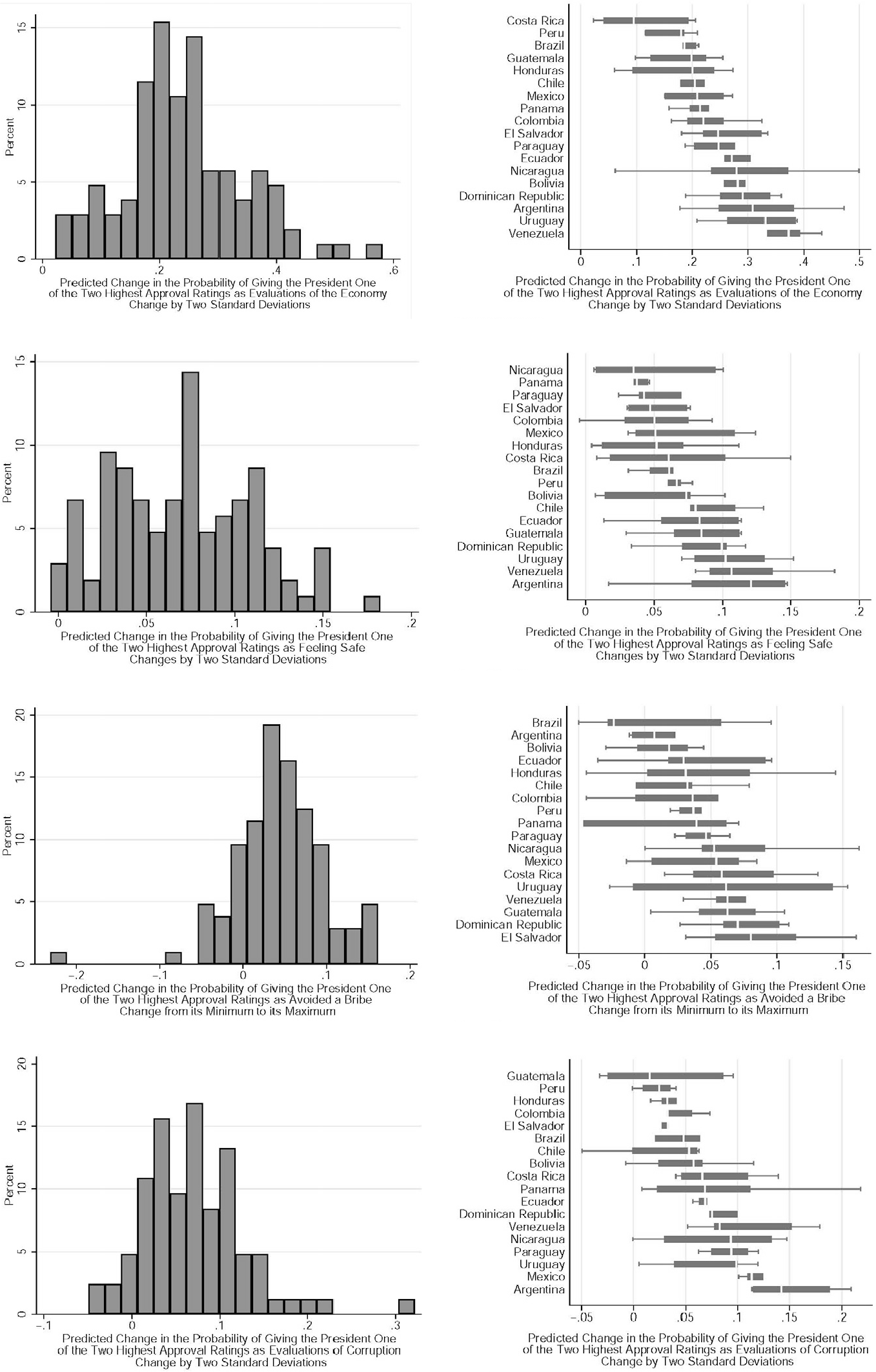
Figure 1 presents histograms of predicted marginal effects for economic perceptions, insecurity, corruption perceptions, and corruption victimization.Footnote 13 It also graphs the distribution of these marginal effects by country, sorted by countries’ median values. All four variables of interest have effects that vary across country-years and across countries.
Predicted Effects of Performance Variables by Country-year, 2016–2017

Sociotropic economic perceptions, for example, have a positive and statistically significant (p < 0.05) association with government approval in 99 percent of country-years. In the average country-year, those whose view of the economy is one standard deviation above the mean have a 0.24 higher predicted probability of giving the president one of the two highest ratings. Yet this effect varies greatly: in 9 of the 103 country-years, the predicted marginal effect of economic perceptions is less than 0.10, while in 7 country-years, it is greater than 0.40. This variation clusters by country. Venezuela, Uruguay, and Argentina, for example, have consistently large associations between economic perceptions and government support, while these variables tend to a much smaller effect in Costa Rica, Peru, and Brazil. Yet the wide bands around the country medians in the right-hand panels show that the effect of these variables also varies within countries over time. Government support in Latin America is thus generally tied to economic perceptions, but in an inconsistent way.
Latin American presidents are also often rewarded when voters feel safe. Feeling safe is significantly (p < 0.05) and positively associated with government approval in 78 percent of country-years. In the average country-year, increasing perceived security by two standard deviations increased predicted support for the incumbent by only 0.07, a smaller marginal effect than a similar change in the economic perceptions measure. Just as with the economy, however, marginal effect sizes vary substantially across and within countries, with an effect larger than 0.14 in some country-years and one close to 0 in others. Argentina, Venezuela, Uruguay, and the Dominican Republic have the largest average insecurity effects, while Panama, Paraguay, and Nicaragua have the smallest.
Avoiding corruption victimization has a much less consistent association with government approval than does the economy of insecurity, as this variable is significantly and positively correlated with government support in only 41 country-years (39.4 percent of cases), while in 18 country-years its estimated effect is negative (although in most of those cases that correlation cannot be distinguished from 0). Yet predicted difference between bribe victims and non-bribe victims varies significantly within the region, as voter responses to corruption are consistently larger in the Dominican Republic, El Salvador, Guatemala, or Venezuela than in Argentina, Bolivia, or Brazil.Footnote 14
In addition, the data in figure 1 suggest that presidential approval’s correlation with corruption perceptions is more consistent than its correlation with corruption victimization, as these variables are significantly correlated in 68.7 percent of country-years. The predicted marginal effect of improving corruption perceptions by two standard deviations is to increase the predicted probability of giving the president one of the two highest scores by 0.071, an amount that is roughly comparable to the predicted effect of feeling secure. Yet again, there is significant variation across and within countries in figure 1: Argentina, Uruguay, and Paraguay have the largest reactions to corruption perceptions in this time period, while Guatemala, Peru, and Honduras have the smallest. The divergence in how citizens in Guatemala or Argentina respond to corruption victimization compared to corruption perceptions suggests that these two variables tap into different elements of their political experience.
Approval More Strongly Tied to Performance in Countries with Little Electoral Fragmentation
Taken together, the results in figure 1 provide strong evidence that accountability for government performance is conditional in Latin America. Tables 1 and 2 thus pool the individual-level surveys and test if these variations across samples reflect differences in the party system and majority status of the government and the resulting clarity of responsibility for the policymaking process.
Party Fragmentation and Presidential Approval in Latin America, 2006–2017

°p < 0.10, *p < 0.05, **p < 0.01, ***p < 0.001 (two-tailed test) Multilevel ordered logistic regression, standard errors in parentheses Individual-level controls and the cut points are in appendix 3.
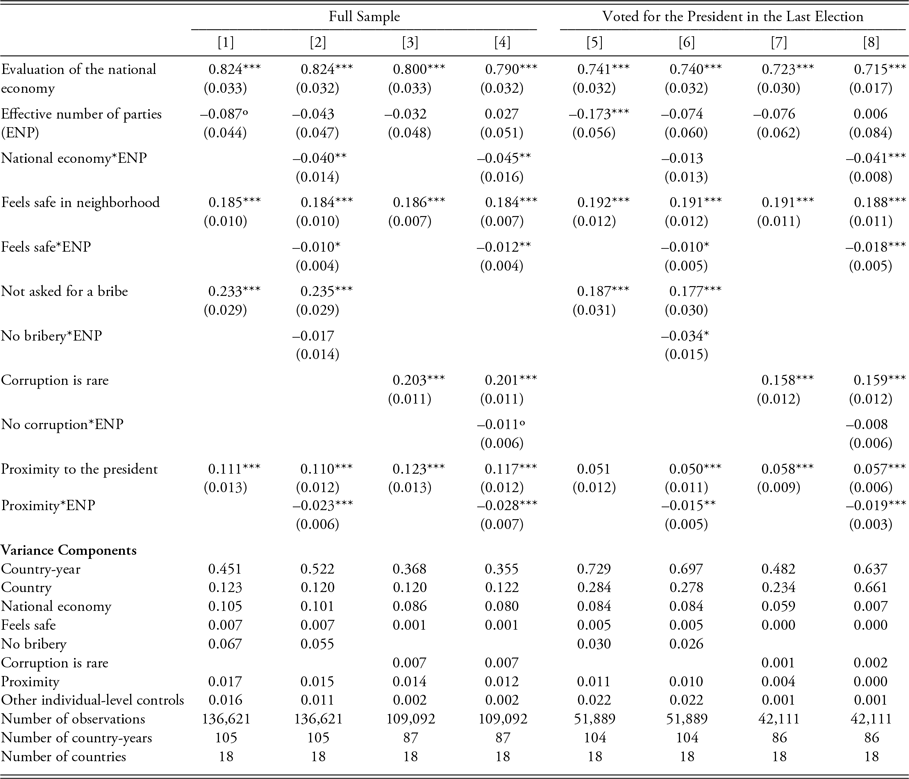
The results in table 1 confirm that citizen evaluations of government performance are strongly connected to their evaluations of recent economic and governance outcomes. The results in model 1 confirm that on average, citizens who think the economy is improving, who feel safe in their neighborhood, or who have not been asked to pay a bribe in the past year are more likely to approve of the incumbent president than are those who have more negative opinions of the economy and crime and who have been corruption victims. Then the same patterns hold if we restrict our attention only to voters who self-reported that they voted for the president in the previous election and who might be biased to see presidential performance positively (model 5), since presidential supporters who perceive that the economy and crime have suffered or who have been targeted for a bribe are less likely to express approval for the president, despite their previous support. This suggests that the results in model 1 are not being driven entirely by endogenous rationalizations but represent an attempt by voters to engage in retrospective accountability.
As suggested by the single-country models in figure 1, the average marginal effect is much larger for the economic perceptions measure than for the other performance measures. For example, a two-standard-deviation change in sociotropic evaluations (from one standard deviation below the mean to one standard deviation above it) increases the predicted probability of an otherwise average voter’s either approving or strongly approving of the president from 0.25 to 0.50, a 0.25 change, when we look at the whole sample. It also increases the same probability by 0.25 (from 0.40 to 0.65) among those who previously voted for the president. A similar two-standard-deviation increase in feelings of safety increases the predicted probability of supporting the president by 0.08 in the whole sample, while it is predicted to increase presidential support by 0.09 among those who voted for the president before. A two-standard-deviation increase in the belief that corruption is rare increases the predicted probability of supporting the president by 0.08 in the whole sample and by 0.07 among those who voted for the president before. Furthermore, someone who avoided paying a bribe in the last year has a 0.05 higher predicted probability of approving of the president than does someone who was asked to pay the bribe, among the whole sample and also among those who voted for the president previously.
Looking beyond performance variables, left-right congruence with the president is significantly associated with presidential approval. Even among respondents who voted for the president, those whose left-right self-placement differs from the president’s ideology are less likely to support the president than are those who are ideologically similar.Footnote 15 Then the results in appendix 3 show that support for the president tends to be higher among older voters, women, the poor, and the less educated, although the marginal effects of these variables “on average” are very small because they pool presidents from a variety of countries whose demographic bases vary.Footnote 16
Our primary interest, however, is in whether fragmented party systems end up blunting political accountability. The significant interaction terms between legislative fragmentation and the performance variables in models 2 and 4 confirm that the effect of these variables is significantly reduced as fragmentation increases.Footnote 17 For example, there is a negative interactive effect between legislative fragmentation and sociotropic economic perceptions, both among the entire sample and among those respondents who previously voted for the incumbent.
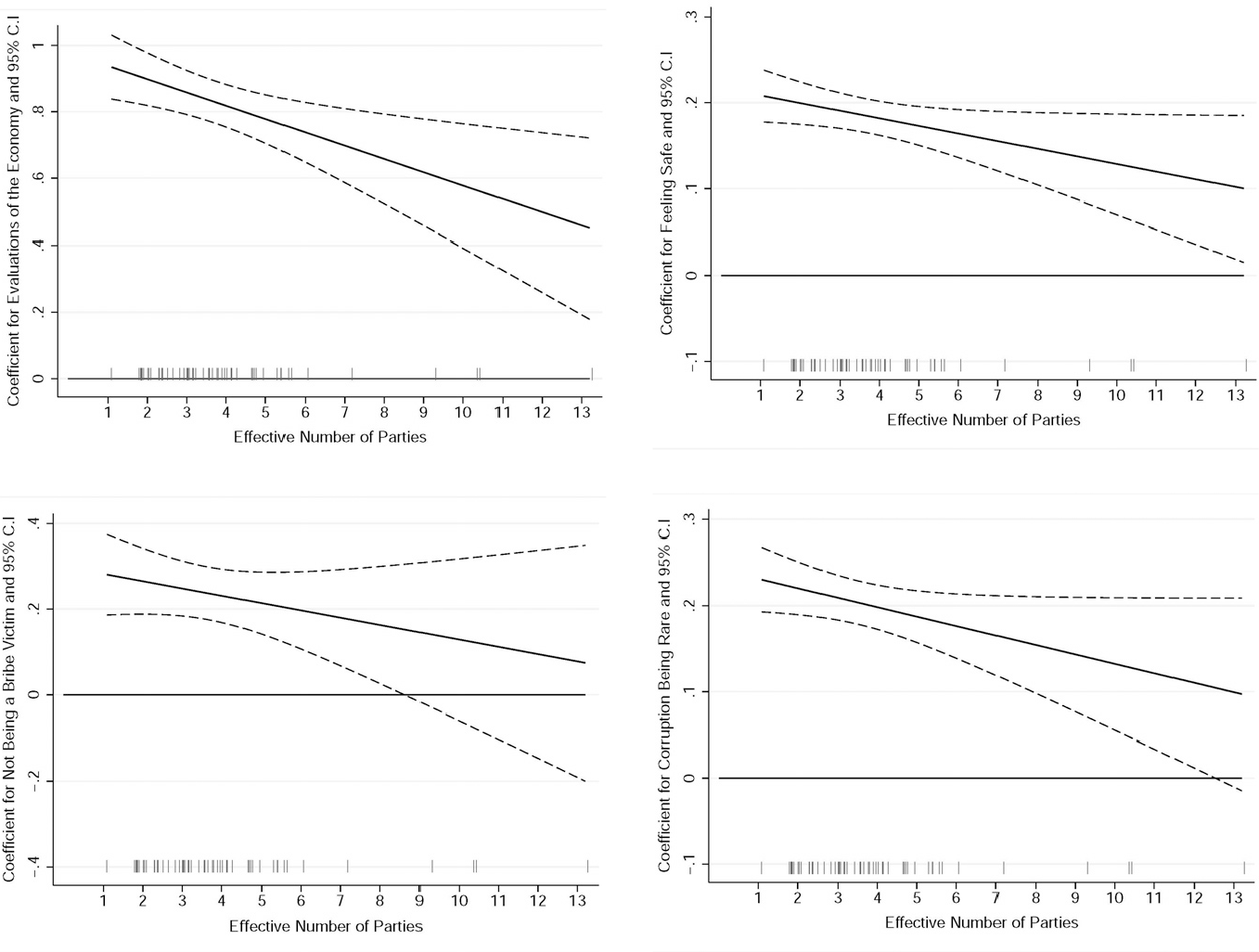
The top panel in figure 2 illustrates the implication of this interactive effect by graphing the conditional coefficient for economic perceptions among the entire sample across all levels of electoral fragmentation that are included in the model. The predicted coefficients for sociotropic evaluations are statistically significant at the p < 0.05 level for all values of the effective number of parties, but the coefficient drops as fragmentation increases. As a result, when the effective number of parties is 2, which is roughly one standard deviation below the sample mean, the predicted result of a two-standard-deviation change in sociotropic perceptions is to increase predicted support for the president by 0.28, while in contrast, that same change in sociotropic perceptions would increase predicted presidential approval by 0.23 when the effective number of parties is 5 (roughly one standard deviation above the mean) and by 0.21 when the effective number of parties is 7, which is roughly the maximum outside of Brazil. Thus, while the economy has a significant effect in highly fragmented samples, that effect is reduced relative to those countries where the party system is simpler.
Conditional Coefficients for Performance Variables Across Levels of Electoral Fragmentation

While previous studies in Latin America and elsewhere have suggested that fragmented party systems reduce the economy’s effect on government approval, the results in table 1 confirm that other forms of accountability are weakened when partisan fragmentation is high. For example, the negative coefficient for the interaction term between feeling safe and legislative fragmentation implies that as fragmentation increases, the positive effect of security shrinks, although the second panel in figure 2 implies that the effect of feeling safe remains significant for nearly all levels of electoral fragmentation. This is true both for the entire sample and for only the voters who previously supported the president (model 4), and it is also true if we drop the Brazilian samples or cap the most fragmented levels of fragmentation (appendix 4). Increasing feelings of security by two standard deviations increases the predicted probability of giving the president one of the two highest ratings by 0.088 if the effective number of parties equals 2, by 0.07 if the ENP equals 5.5, and by 0.063 if it equals 7. Accountability for insecurity is smaller, on average, than is accountability for the economy, but it, too, is reduced when the party system is fragmented.
A similar, albeit less consistent, pattern emerges for corruption in table 1, as the association between government approval and both perceptions of public corruption and personal experiences with bribery is reduced when the party system is fragmented—although these interaction terms achieve statistical significance only in one of the two specifications. The estimated coefficient for bribery becomes insignificant at the p < 0.05 level once the number of parties surpasses nine in the bottom panel of figure 2. To illustrate these effects, bribe avoiders are predicted to have a 0.068 higher probability of approving of the president when the effective number of parties equals 2, while it is 0.043 when the effective number of parties is 5. Corruption perceptions’ effect on government approval are also reduced as fragmentation increases, although they remain significant for nearly all levels of fragmentation. The predicted effect of corruption perceptions improving by two standard deviations is to increase the predicted probabilities of the respondent supporting the incumbent by 0.089 when the effective number of parties equals 2, by 0.071 when it equals 5.5, and by 0.064 when the effective number of parties equals 7.
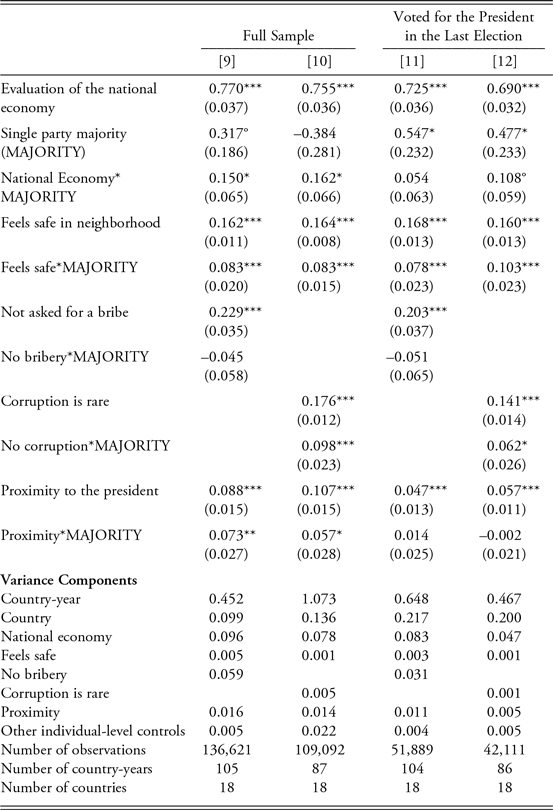
In general, the results in table 1 suggest that government approval becomes less connected to evaluations of recent outcomes in the country when the party system is fragmented. Table 2 then looks at whether governments that oversee a majority without forming a coalition are held more accountable, given their clear legislative control. Approval of an average president who does not have a single-party majority is significantly tied to perceptions of economic outputs, insecurity, and corruption. But the various interaction terms suggest that while there is no difference in how corruption victims respond to single-party majority presidents, nearly all the other interaction terms in table 2 are positive and significantly different from 0. For example, a two-standard-deviation increase in economic perceptions increases the predicted probability of approving of the president by 0.23 when the president does not have a single-party majority and by 0.29 when they do; a comparable change in feeling safe increases that probability by 0.07 when the president does not have a singleparty majority compared to 0.10 when they do; and a similar change in perceptions of corruption increases predicted presidential approval by 0.11 under a single-party majority compared to 0.07 under other partisan alignments. Thus, while assessments of recent national trends are associated with views of the president even when he or she does not oversee a single-party legislative majority, voters are more likely to hold presidents accountable when they do not have to negotiate with other parties to enact their legislative agendas.
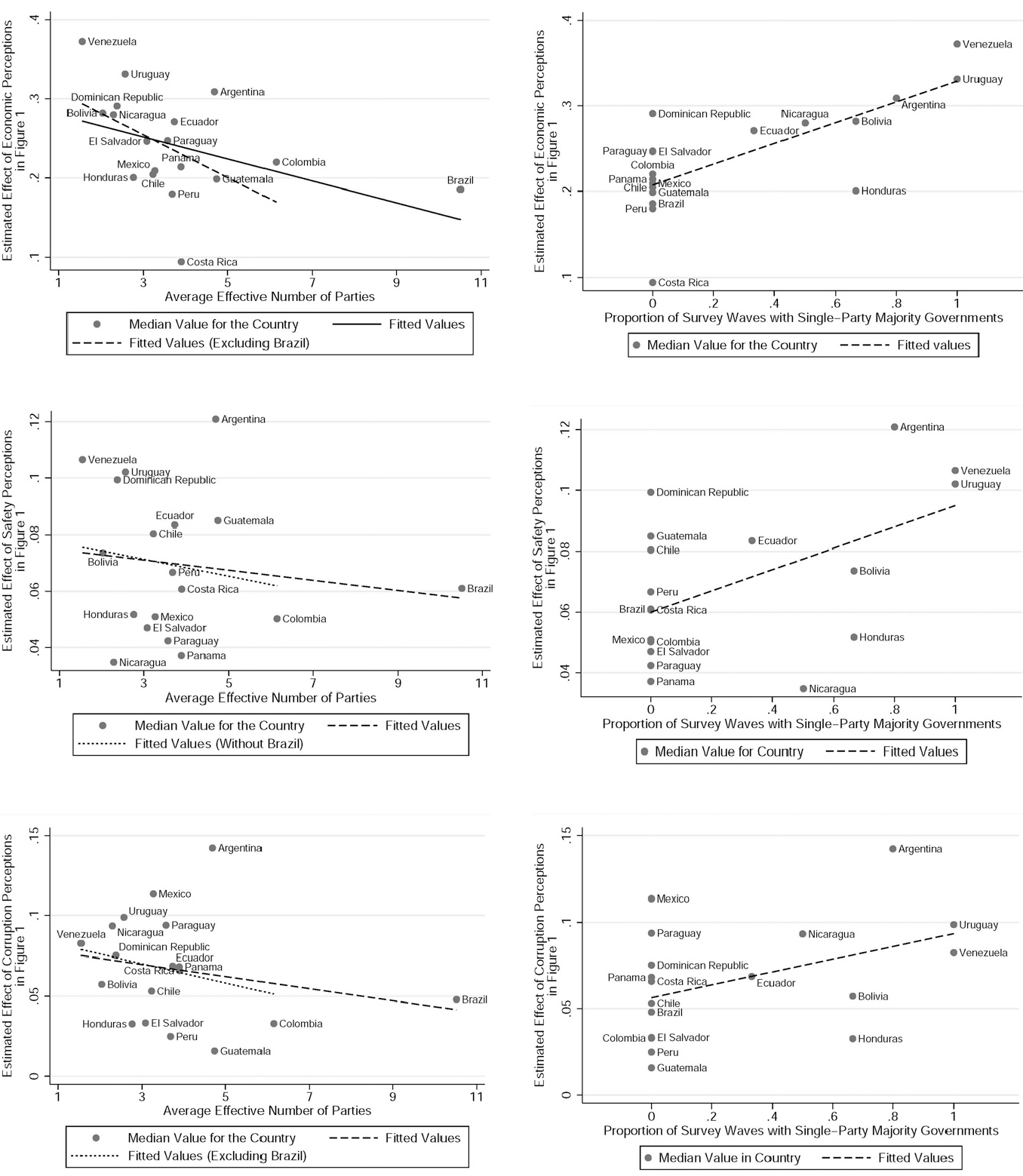
The results in tables 1 and 2 confirm that the connection between individual-level perceptions of government approval and government approval vary systematically with the party system and patterns of coalition building. These differences in political alignments explain some of the variation in perceived accountability across countries documented in figure 1. For example, in the top row of figure 3, we plot the median estimated marginal effect of a two-standard-deviation change in sociotropic economic perceptions for each country from figure 1 relative to their average amount of legislative fragmentation and the frequency of single-party majorities. Countries where very few parties and single-party majority governments are common, like Uruguay or Venezuela, tend to see the economy as having a larger effect than those like Brazil or Colombia, where fragmentation is higher. A similar pattern emerges when we look at the cross-national variation in how respondents weight feeling safe or an absence of corruption when judging the government. These figures also demonstrate that citizens hold the Argentine government more accountable for outcomes than one might expect, given its fragmented party system, because presidents in that country have routinely been able to form a single-party majority.
Coalition Status and Presidential Approval in Latin America, 2006–2017

°p < 0.10, *p < 0.05, **p < 0.01, ***p < 0.001 (two-tailed test) Multilevel ordered logistic regression, standard errors in parentheses Individual-level controls and the cut points are in appendix 3.
Median Predicted Effects of Perceived Performance Over Average Fragmentation and Single-Party Majority Government Status, 2006–2017

Changes in the party systems correspond to changes in accountability within countries over time as well. In this sample period, Bolivia, Ecuador, and Nicaragua all saw reductions in party system fragmentation and more frequent government by single-party majorities. In nearly every case, the result was a stronger connection between perceived performance and government support as the government’s partisan control was strengthened. For example, in Bolivia, the marginal effect of a two-standard-deviation increase in economic perceptions was to increase predicted support for Evo Morales by 0.31 under single-party majority government, compared to 0.22 in survey years during periods when he did not have a single-party majority. In Nicaragua, that same observed marginal effect under single-party majority governments was 0.37, compared to 0.20 when the president did not have this control, while in Ecuador, it was 0.29 under single-party majority governments and 0.23 otherwise. Similar patterns emerge for the effects of insecurity and corruption, as their effect in these countries has tended to be stronger under single-party majority rule. As presidential control has increased in these countries, voters’ willingness to credit or blame the president has also increased.
Yet the data in figure 3 remind us that there are other sources of cross-national variation in how respondents respond to the economy beyond the partisan ones captured in tables 1 and 2. There are countries, for example, that have much smaller responses to the perceived economy than we might expect, given their moderate degrees of fragmentation, like Honduras or Costa Rica for the economy, Nicaragua (and most of the other countries in Central America except Guatemala) for neighborhood insecurity, and Guatemala, Honduras, and Peru for corruption. These exceptions remind us that while clarity of responsibility makes accountability possible, it does not guarantee that voters will hold politicians accountable.
Then respondents in the Dominican Republic, where legislative fragmentation is low but governments still form coalition governments, respond to the economy in the same way that citizens do in countries where fragmentation is low and governments choose not to form a coalition. The implication is that respondents are discounting the Dominican presidents’ junior partners and concentrating responsibility in the executive, perhaps because the president’s party controls a majority of seats in the legislature, even without the support of its coalition partners. Yet on average, citizens in countries with few parties and typically single-party majority governments are more likely to hold the president accountable, as we would expect them to if they are taking presidential control into account.
Conclusions
For accountability to be meaningful, voters should try to consider whether the government had control over an outcome or not. Yet extant studies have questioned whether voters take government control into account, and in particular, have questioned whether voters in presidential regimes account for the concentration of presidents’ partisan control. The results in table 1 confirm that the connection between government performance and government support in Latin America is weakened when fragmentation is high. Fragmented party systems see voters discount government performance when evaluating the president. Presidential approval in these systems is still significantly tied to how citizens view government performance, but this connection is weaker than it would be if there were fewer parties or if the president had a legislative majority. Electoral accountability in Latin America is thus conditional on the party system.
This empirical finding has both positive and negative implications for observers concerned about voters’ ability to hold politicians accountable. On the one hand, there is an ongoing debate over whether elections act as meaningful mechanisms of accountability or if voters respond to changes in the national condition without considering whether or not politicians had any actual control over that outcome. Multiple recent studies show that voters often make mistakes in this process, and this dynamic might be particularly strong in presidential systems such as Latin America’s, where the president is powerful and regimes are personalized, and thus the default position for voters might be to blame the president.
The data in this study cannot evaluate whether voters are able to accurately perceive government performance or ignore all policy outcomes that are beyond the government’s control. Yet the results show that accountability is not as entirely capricious and random as many skeptics have claimed: voters seem to systematically reduce the weight they give performance in contexts where political fragmentation should make it hard to isolate which political actor had the most control, and to accentuate their response in those contexts where responsibility should be clearer. At the very least, this shows that voters are not simply engaging in the knee-jerk blame of the president across all contexts in the same way.
The question, however, is what explains the microlevel mechanism. A systematic reduction in accountability for outcomes in the most fragmented systems might suggest that voters are attempting to engage in accountability in a sophisticated and measured way. An alternative explanation, in contrast, is that the cognitive load for voters in these divided contexts is too strong, and they are simply confused or unable to pinpoint blame for performance outcomes. Both these conditions require voters to recognize that policymaking is shared, even in presidential systems, and not to focus simply on the president and speak to difficulties in holding presidents meaningfully accountable. Yet the two scenarios have divergent implications for how voters are likely to view this situation and for the degree of sophistication they require. Further individual-level survey data are needed on how voters assign responsibility in fragmented systems.
The more negative implication of these analyses is that they confirm that voters in the most fragmented countries and those where coalitions and minority governments are common face a difficult task in assessing which politicians are to blame for any specific outcome. If they want to hold politicians accountable, they might not have any specific actor to target. As a result, accountability in these systems is partially blunted. This situation may also create scenarios in which voters decide that the entire set of democratic actors are jointly to blame and turn instead to outsider politicians promising both improved policy outcomes and a more decisive political process.
In general, however, this study reminds us that democratic accountability is strongly shaped by the context in which voters live. Electoral fragmentation explains some of this variation, but the significant variance components in table 1, even after controlling for this variable and the divergent patterns in figure 3, suggest that other contextual variables are likely to affect accountability in the hemisphere. In the case of the economy, other studies have isolated additional factors that affect assignments of responsibility, such as the economic model (Carlin and Hellwig Reference Carlin and Hellwig2019), exposure to international financial shocks (e.g., Hellwig Reference Hellwig2014), and the powers of the president (Carlin and Singh Reference Carlin and Singh2015). Similar variables may affect how voters respond to other performance areas as well. Moreover, the salience of these performance concerns fluctuates over time, and voters thus hold politicians accountable for different things at different times (e.g., Singer Reference Singer2011). As we continue to study how voters form judgments about the degree of political control that politicians have, we need to take this complexity into account and focus on developing a more fully specified model of conditional accountability that recognizes the sophistication of the Latin American electorate.
Supporting Information
Additional supporting materials may be found with the online version of this article at the publisher’s website: Appendix. For replication data, see the author’s file on the Harvard Dataverse website: https://dataverse.harvard.edu/dataverse/laps