INTRODUCTION
The archaeology of early Roman Colchester can be dated by three historical points. First, the construction of the legionary fortress in the heart of Iron Age Camulodunum c. a.d. 44. Second, the foundation of the veteran colony, Colonia Victricensis, c. a.d. 49, in which many of the buildings of the fortress were reused rather than replaced by new houses. Third, the destruction of the new colony c. a.d. 60/1 by the British resistance under Boudica of the Iceni, a destruction that seems to have been deliberately systematic, leaving no building standing. In the years following the Boudican revolt the colony was gradually rebuilt. These events provide tight dates for the first two periods of Roman Colchester, Period 1, c. a.d. 44–9, and Period 2, c. a.d. 49–60/1, while Period 2 demolition, c. a.d. 61+, is more loosely defined because of the gradual pace of the Period 3 rebuild.Footnote 1
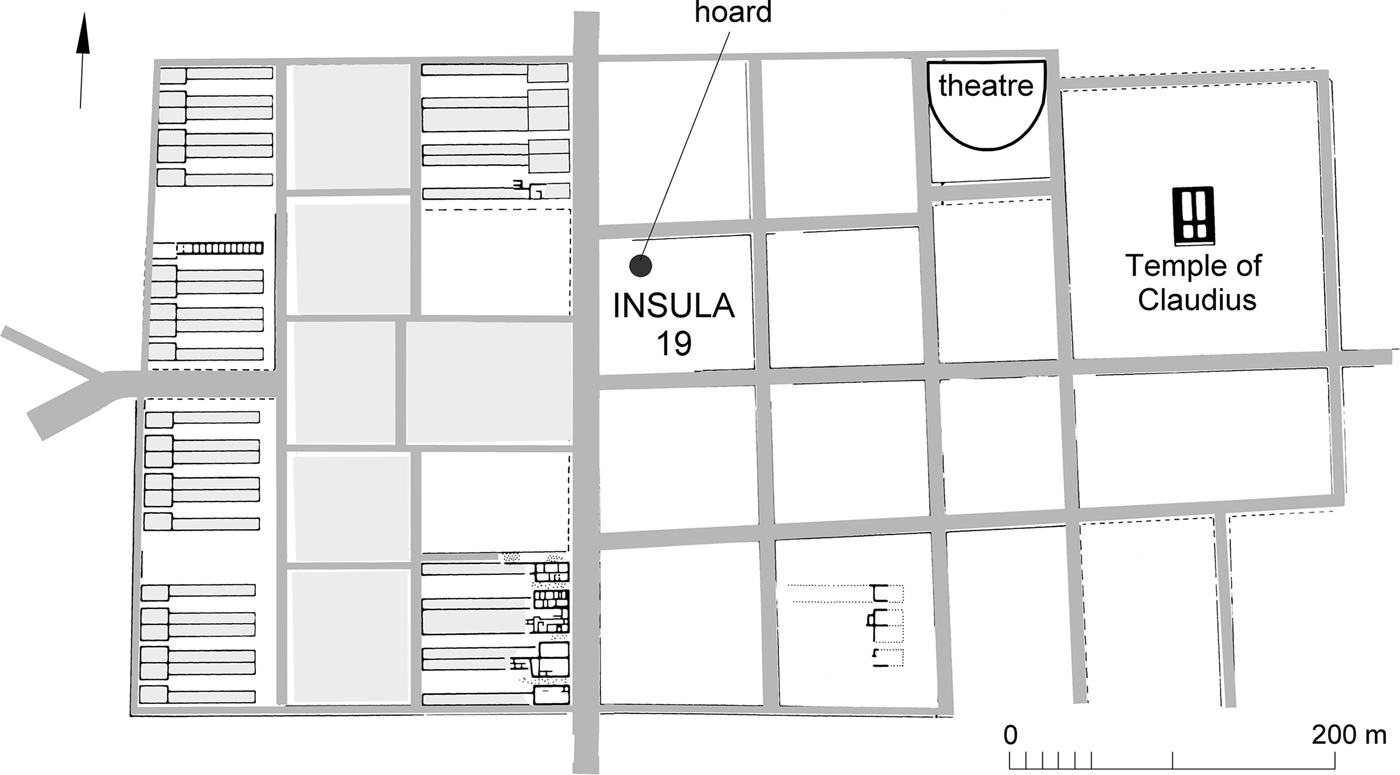
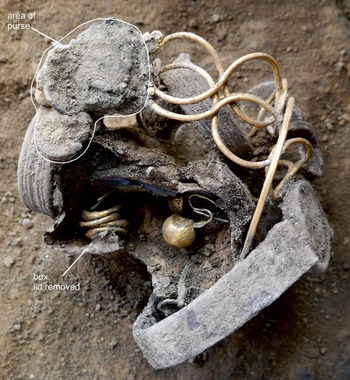
Excavations by Colchester Archaeological Trust funded by Fenwick, the developer, on the Williams and Griffin site on Insula 19 in 2014 uncovered a building burnt during the Boudican revolt (fig. 1).Footnote 2 Finds included carbonised fruit and vegetables, a long wooden shelf and a large quantity of burnt pellets of Egyptian blue frit, a pigment used in wall-painting. Frit pellets are occasionally found on urban excavations, but the quantity recovered from this site may perhaps derive from trade. Found buried in a shallow hole dug into the floor of the house was a remarkable group of personal items, including gold and silver armlets and other jewellery, a trinket box and a purse of silver and copper-alloy coins. They were not stacked neatly within the hole, but had almost certainly been contained within a bag (fig. 2). The digging of the hole and the burial of the objects must have coincided with the news of the imminent arrival of British warriors at the Roman colony.
The location of the hoard within the early colony. (Drawn by E. Holloway. Image © Colchester Archaeological Trust Ltd)

The hoard soil block under excavation, viewed from above with the lid of the box removed. (Image © Colchester Archaeological Trust Ltd)

Such a collection of precious metal objects and coins from a single archaeological context associated with the Boudican revolt has never before been found in Colchester. Usually metal items from contexts associated with the event are fragments of ordinary copper-alloy domestic or military artefacts, exceptions being two gold objects from Lion Walk: an aureus of Tiberius from a Period 2 (c. a.d. 49–60/1) floor in Building 8 and part of an earring from Period 2 demolition.Footnote 3 To these may perhaps be added a gold ball earring from Colchester in private hands which is very similar to a pair in the hoard, but has no context attached and may have been deposited either before or after the Boudican revolt.Footnote 4
Lifted as a soil block and excavated in the laboratory at Colchester and Ipswich Museums,Footnote 5 the objects were all covered by the small find number SF 240 and the site find/context number (254), with individual letters attributed to artefacts that could be separated on excavation or as conservation progressed. Catalogue numbers are used in the text below and shown in bold type, with the letters only referred to where necessary for clarity (Appendix 1).
This article represents preliminary work on the hoard and will be developed in the excavation report following detailed scientific analyses. The hoard has been given to the town of Colchester by the developer and is displayed in the Castle Museum.
CONTAINERS
Both bag and purse (1–2) had completely decayed but were probably of leather, as no trace of mineralised textile survived on any of the metal objects. Several of the bodies of people fleeing the eruption at Pompeii held leather or cloth bags of about the same size, with smaller boxes, purses and loose jewellery stored within them.Footnote 6 Such bags for portable wealth are one of the attributes of Mercury; figurines and painted depictions frequently show him with a weighty money bag measuring some 200–250 mm from top to bottom, with a gathered and tied neck.Footnote 7 Purses would have been of similar form but smaller, while several small coin hoards from Britain appear to have been contained in a cloth or leather purse.Footnote 8
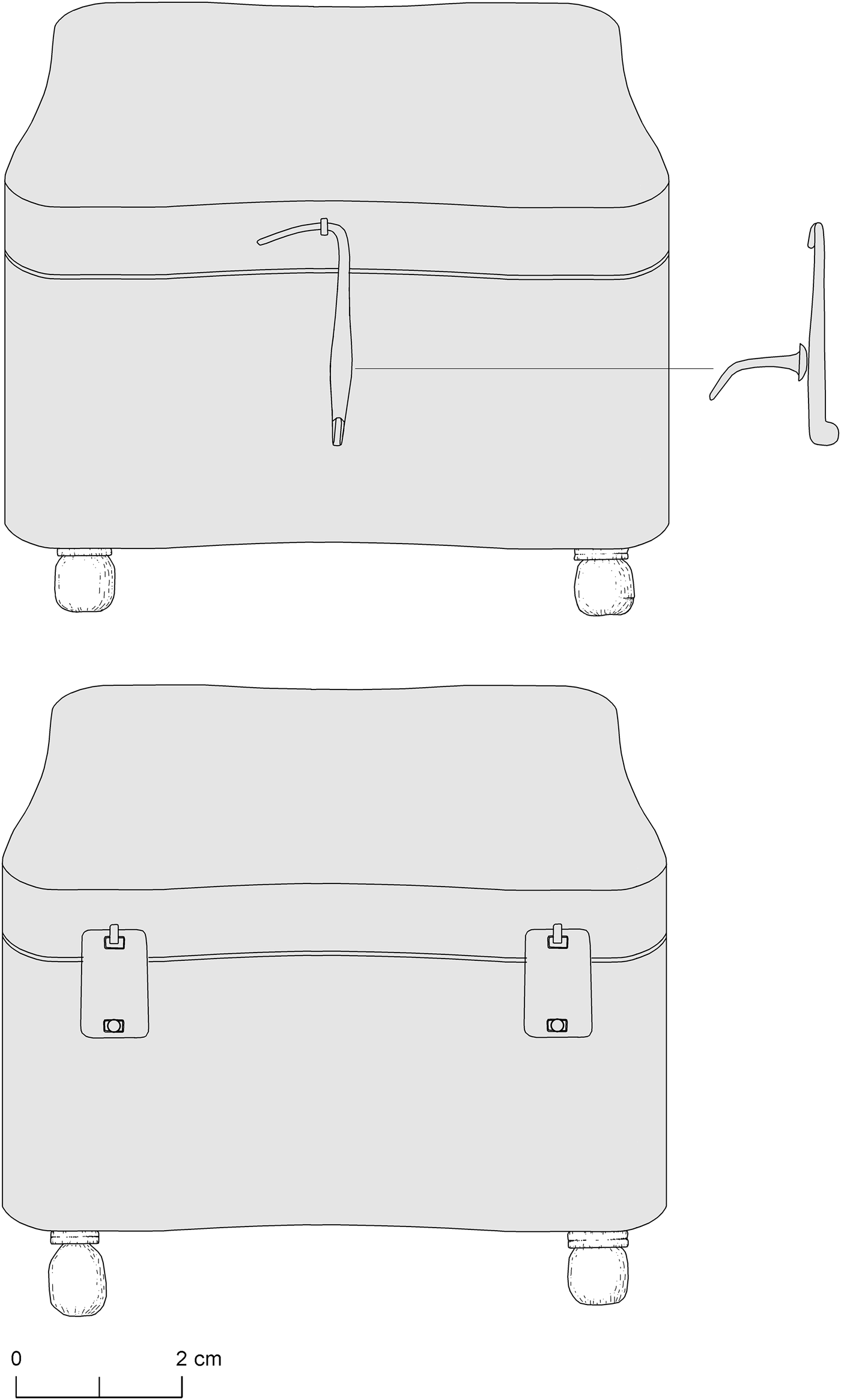
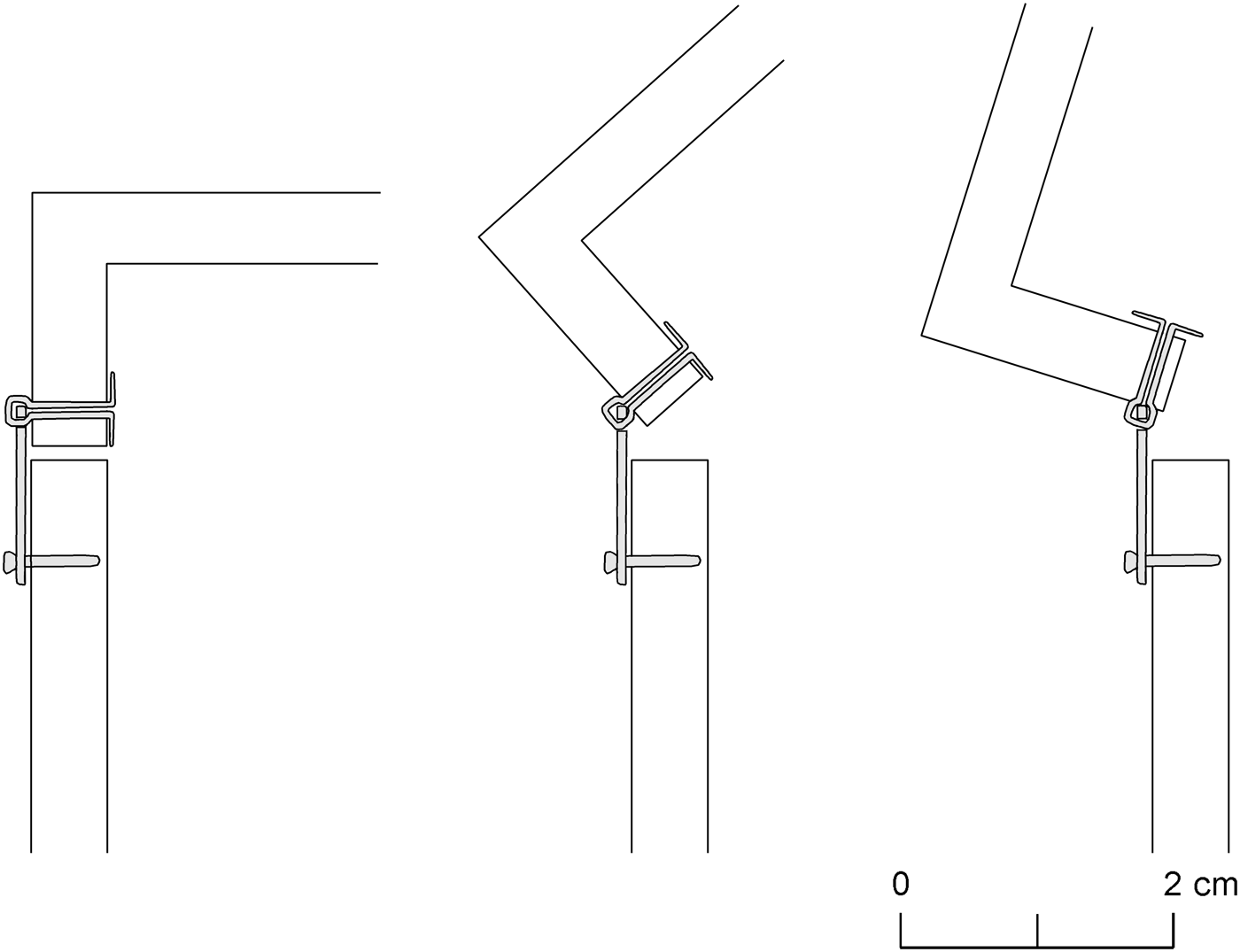
The small box (pyxis) was of wood covered with pieces of thin silver sheet and stood upon four ivory ball feet (3).Footnote 9 It was more or less rectangular but had rounded corners and was slightly waisted on each axis; it measured c. 80 by 55 mm and, depending on the depth of the lid, which could not be recorded, was 40–50 mm high without the feet, 50–60 mm with them (fig. 3). Post-depositional shrinkage and cracking of the wood has distorted the profiles of the walls somewhat, while the middle of the back has buckled inwards, but the centre of each wall was certainly gently concave. There was no evidence for silver sheet on the base. A few fragments of the wood survive but have not yet been identified (O, AN). No nails were found at the corners of the box or lid, both of which were probably hollowed out from a single piece of wood, as was a box from Herculaneum;Footnote 10 the alternative, that the corners were jointed and then trimmed to shape, seems unlikely. The fittings show that the wood was originally 5 mm thick when the box was new, but the largest fragment remaining has now shrunk to only c. 2 mm. The silver sheet survives only as corrosion products, resembling stiff and very friable black tissue; it was held in place by thin silver flat-headed nails (Q, T, U). All the ivory feet are slightly irregular but were turned, having lathe-centre marks on the underside. Each has a short projecting shank that would have been glued into a hole drilled into the base of the box (AP, AQ, AR, AS). Three are in the form of a knob beneath a grooved cordon and are very close in size at 15 or 16 mm long and up to 7 mm in diameter (AP, AQ, AR). The fourth (AS), from the front left-hand side of the box as viewed in fig. 3, is a knob beneath a very narrow cordon, only 13 mm long and up to 8 mm in diameter. Such variation is likely if feet were made and stockpiled in advance, but it may have been a replacement, or perhaps was used to compensate for a slight asymmetry in the base of the box. The lid was hinged on two small silver plates, each fixed to the back board by a single silver nail and to the back of the lid by a silver split-spike loop (fig. 4; C, L). On C both arms of the split-pin are clenched, giving a board thickness of 5 mm, but on L only one arm is clenched, again giving a board thickness of 5 mm, while the other projected into the box cavity. The catch consists of a split pin (P) and a hook operated by pressure on a small discoid terminal (S).
Reconstruction of the silver-clad box. Scale 1:1. (Drawn by E. Holloway. Image © Colchester Archaeological Trust Ltd)

A hinge in operation. Scale 1:1. (Drawn by E. Holloway. Image © Colchester Archaeological Trust Ltd)

No parallel for the box has been found, but the use of ivory for the feet points to continental manufacture. As the wood was completely clad in silver sheet apart from on the underside, it was probably not a hardwood with an attractive grain. In contrast, the box from Herculaneum mentioned above was made of polished wood inlaid with only a fine trail of silver.Footnote 11
Inside the box were an intaglio (13), five finger-rings (14–18), two pairs of earrings (19–20) and a denarius (21), which lay beneath one of the pairs of earrings (see below). Some of these items appear to have been curated for personal rather than intrinsic value (13, 18 and 21). That the box itself might have a replaced foot implies that it may also have been of some antiquity.
BULLA, SILVER CHAIN AND LOOP
A small copper-alloy bulla (fig. 5, 4) was found close to a silver loop-in-loop chain necklace and silver suspension loop (fig. 5, 5–6). At c. 325 mm long the chain is an appropriate length for a child,Footnote 12 while the loop found with it could have been used to suspend the bulla. The group can be compared to a small gold bulla found suspended on a light gold chain in a box found in the House of the Menander at Pompeii (I, 10, 4, Room B).Footnote 13
4: Copper-alloy bulla; 5: silver chain; 6: silver suspension loop. Scale 1:1. (Photos by P. Crummy and F. Lockwood. Image © Colchester Archaeological Trust Ltd)

Bullae were protective sac-shaped amulets given on the eighth day of their life to freeborn male children with Roman citizen status and were worn suspended around the neck throughout childhood.Footnote 14 Their size and material depended on the wealth and social status of the infant's family, from large gold examples to simple discs cut from leather.Footnote 15 When a boy reached the age of maturity he did not discard his bulla but put it aside, so this example can be presumed to belong to a Roman citizen who died in the Boudican sack of Colchester, almost certainly the owner of the house in which it was found.Footnote 16 If the three Colchester pieces are accepted as a group, then the mix of metals implies a rise in his economic fortunes from boy to man.
SILVER MILITARY AWARDS
Along with the bulla, a pair of silver bracelets and a large silver armlet or torc with hinged medallion can be identified as male armillae, military awards given for bravery in battle, and in this instance specifically for bravery during the conquest of southern Britain.
The pair of bracelets (fig. 6, 7–8) can be equated with a large number of fragments of copper-alloy military armillae, tinned to imitate silver, which have been found across mainly eastern Britain, with marked concentrations in Essex and Hertfordshire, many of them stratified in pre-Flavian or early Flavian contexts, usually in association with military equipment, early samian and coins of Claudius or Nero (fig. 7). Several examples come from Colchester, including one from the fill of the legionary fortress ditch, most of which consisted of material from the demolished rampart levelled by the early colonists in c. a.d. 50–5.Footnote 17 These armillae fall into broad groups based on the number of textured bands present.Footnote 18 With two such bands the pair from the Colchester hoard belong to the largest, Group A, but are distinguished from the penannular base-metal examples by having overlapping terminals secured by strap-guides.
Silver cuff armillae. Scale 1:1. (Photos by F. Lockwood. Image © Colchester Archaeological Trust Ltd)

White-metal-plated copper-alloy armillae. a: Balkerne Lane, Colchester, Essex, from fill of fortress ditch, end of Period 1; b: Culver Street, Colchester, from Period 3 redeposited Boudican destruction debris; c: Culver Street, Colchester, from Period 2 make-up; d: Haddon, Cambs., unstratified; e: Stansted, Essex, ditch fill dated c. a.d. 40–75. (Drawings by S. Crummy, from N. Crummy 2005, figs 1–2. Image © N. Crummy)

Military armillae were usually awarded in pairs and, according to Pliny, only to citizen soldiers, ‘armillas civibus dedere, quas non dabant externis (bracelets were given to [serving] citizens, but not to foreigners)’.Footnote 19 They took various forms depending on the campaign concerned, but are chiefly known only from contemporary historical sources and surviving continental reliefs, mostly tombstones.Footnote 20 Those of tight cuff form, as here, were worn on the wrists, rather than higher up the arms, as shown on the cenotaph of centurion Marcus Caelius, who died in the Varian disaster of a.d. 9.Footnote 21 Before the identification of the British assemblage, the only physical armilla identified was a fragment of a silver cable bracelet from the Augusto-Tiberian military camp at Aulnay-de-Saintonge, Charente-Maritime.Footnote 22 A flattened and folded gold armlet found in the conquest-period Alton, Hants., Hoard B along with a Roman gold finger-ring and over 200 Iron Age staters may perhaps be another, but it almost certainly pre-dates the conquest and is not related to the campaign in Britain.Footnote 23 It may be an armilla awarded to a Briton who had served in the Roman army, as Pliny noted that torques (another military award) were given to auxiliaries and foreigners, but only silver ones to Roman citizens.Footnote 24
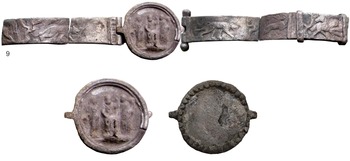
The third armilla (fig. 8, 9) is much larger than the other two and consists of a band with a hunt scene in low relief, the terminals fixed by two strap-guides as on 7 and 8, and with a large hinged medallion at the centre. It could have been worn on the upper arm, or, being a single item, it may rank as a torc, which were not always awarded in pairs, and could be suspended from the cuirass rather than worn around the neck.Footnote 25 Given its elaborate design it may even be a torquis maior, an award mentioned on an inscription from Dalmatia.Footnote 26 The internal diameter in its present ‘resting’ state is 85 mm, and even if fully expanded, with the two strap-guides pushed together, it remains too small to be a neck ornament.
Silver armilla or torc. Scale: top, full-length view, 3:4; bottom, front and rear of medallion (the latter before conservation), 1:1. (Photos by P. Crummy. Image © Colchester Archaeological Trust Ltd)

The medallion was made in two pieces, a thick plain disc onto which was fitted a gilded repoussé plate showing Jupiter enthroned, with Victory standing on his right and Fortuna on his left. On the reverse the edge of the plate is scalloped. The classical imagery of the armlet is emphasised by borders of ovolos at the hinge junctions. The scene on the medallion is resonant with both general and specific military associations. Jupiter as chief of the gods references the divine power and authority of the emperor, in this instance Claudius, who after the conquest of Britain was sculpted in the guise of Jupiter, wearing a military oak-leaf crown and with eagle and sceptre.Footnote 27 Fortuna with her bountiful cornucopia was perceived as closely bound up with the destiny of Rome, where one of her titles was Fortuna publica populi romani, and in this scene she refers to the city as much as Jupiter does to the emperor.Footnote 28 Victory, with a laurel wreath, represents success in battle, here one or more engagements in the conquest of Britain, perhaps even a celebration of the conquest itself, and has overtones of both Rome and the emperor.Footnote 29 That the owner of the award had settled in Colonia Victricensis, the first Roman colony in Britain and capital of the new province, founded within the Iron Age oppidum of Camulodunum, where Claudius took the submission of the tribes, adds further intensity to this image.Footnote 30
The hunt scene on the band, with panthers stalking deer, is also appropriate in a military context. In the classical world as well as later, hunting was an indication of high status, and in both Athens and Sparta it formed a major part of the institutionalised training of young men to prepare them for battle; images on both Archaic and Classical period figure vases closely link the two activities, while in The Iliad warriors in the ascendant are described as hunters or hounds and those under attack as their quarry (deer, boar or hare), with the emphasis on physical qualities and actions, pursuit and attack, flight and defence.Footnote 31 Among the cognomina given to or adopted by Roman soldiers are several names of aggressive beasts, such as Aper (boar), Aquila (eagle), Leo (lion), Lupus (wolf), Taurus (bull) and Ursus (bear),Footnote 32 and, most pertinently here, the tombstone of a standard bearer for a cohort of archer auxiliaries names him as Tiberius Iulius Abdes Pantera (panther) from Sidon, who died c. a.d. 40 at Bingen, Germany.Footnote 33 The House of T. Dentatius Panthera in Pompeii (IX, 2, 15–16) should also be mentioned, so called because of a seal found in the building.Footnote 34 The use of panthers rather than dogs on the armilla thus raises the hunt scene beyond a conventional reference to prowess in warfare to a hint that the owner of the Colchester armlet also bore the cognomen Pant(h)era, a hint reinforced by the intaglio found in the box (see below).
Along with the two silver cuff armillae, this can be seen as a commissioned piece made in Britain by a smith well versed in classical motifs (and perhaps attached to the army), all three having been presented to their owner sometime between c. a.d. 44 and 49, that is, between the invasion and the founding of Colonia Victricensis, or at the very broadest, c. a.d. 44–59, with the owner more recently retired and newly settled in the colony. Although a special and almost certainly unique commission with no close parallels, it belongs within a tradition dating back to the Hellenistic period,Footnote 35 while female armlets and necklaces sometimes had a central framed gem or similar ornament.Footnote 36 More or less contemporary pieces include a gold armlet found worn by a woman at Pompeii which has a medallion depicting Luna clasped between two snake heads,Footnote 37 but more pertinent to the military context of the Colchester piece is perhaps a second- to third-century armlet from Dalton (Cumbria); made of silver wire wrapped around an organic(?) core, its terminals were hinged to a silver box-setting holding a gemstone engraved with a seated Jupiter.Footnote 38
GOLD ARMLETS AND BANGLE
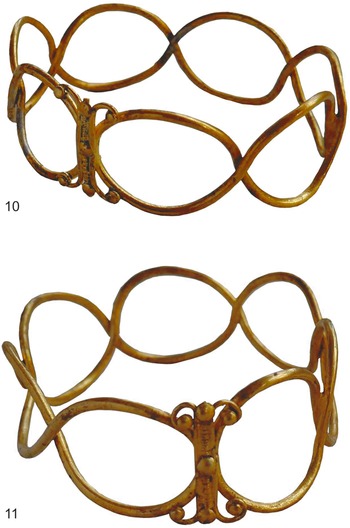
Two gold armlets from the hoard are a matching pair made from two lengths of wire shaped into seven large loops (fig. 9, 10–11). The crossing points and junction were soldered together and the latter masked by an elaborate appliqué. The form is present at Pompeii, where examples show that individuality could be added to this simple form by the various appliqués used.Footnote 39 The diameter suggests that they were worn pushed up onto the arm rather than around the wrist, although this example has only seven loops instead of the more usual eight.
Gold wire bracelets. Scale 1:1. (Photos by P. Crummy. Image © Colchester Archaeological Trust Ltd)

The third piece is a bangle with overlapping terminals, each formed into a coil and then wrapped around the hoop to form an expanding clasp (fig. 10, 12). There is a similar bangle from the Pompeii area and several others in both gold and silver from hoards found in Dacia, broadly dating from the first century b.c. to first century a.d. and into the second.Footnote 40 While the type with coils does not seem to be particularly common in the area around Vesuvius, wrapped terminals occur on several armlets, including snake armlets which have the head standing free but the thin tail coiled around the hoop, and the technique continued to be used into the late Roman period.Footnote 41
Gold bangle. Scale 1:1. (Image © Colchester Archaeological Trust Ltd)

INTAGLIO By Martin Henig and Nina Crummy
Found inside the trinket box was a blue glass intaglio, ovoid with a flat upper face, on which the moulded device is a pantheress walking to the left with a rounded ground line below (fig. 11, 13). This appears to be a fairly common subject on glass gems of the late first century b.c. probably into the early first century a.d.Footnote 42 The panther was par excellence the familiar of the wine god Bacchus as is emphasised by intaglios which portray the animal looking back at a thyrsus.Footnote 43 In a British context two first-century cornelian intaglios from contexts in western Britain may be noted, the first from Ham Hill, Somerset, depicting a panther with a thyrsus and the second, from Bath, with a cornucopia.Footnote 44 Other gems depict Bacchus himself pouring wine for a panther from a cantharus.Footnote 45
13: Intaglio; 14–18: finger-rings; 19–20: earrings. Scale 1:1; intaglio and engraved bezel, 2:1. (Photos by P. Crummy. Image © Colchester Archaeological Trust Ltd)

Between about 50 and 100 years older than the date of the hoard and stored unset in the trinket box, the gem can be identified as a curated item, valued for its design rather than any intrinsic worth. Collection of antique engraved gems is mentioned by both Pliny and Suetonius.Footnote 46 Given the use of the panther in the hunt scene on the largest armilla, in this context the association of its image with Bacchus was probably of minor consideration, and the gem's value was personal rather than religious.
FINGER-RINGS By Martin Henig and Nina Crummy
Five gold finger-rings lay in a row at one end of the trinket box, placed from left to right as illustrated here (fig. 11, 14–18). The order directly relates to their size, which would itself affect on which finger, or finger-joint, they were worn, implying that when last worn they were taken off in a particular order. Finger-rings 14 and 15 both measure 16 mm internally, 16 and 17 14 mm, and 18 13 mm. All have a rounded hoop, flattened at the bezel, a characteristic form of the first century a.d.Footnote 47 Three have emerald settings (14, 15, 17),Footnote 48 one has an engraved design of a dolphin (16) and the smallest has lost its setting and is the only ring with marked signs of wear (18). The last may, like the unset intaglio, have been a curated piece, perhaps inherited, or perhaps a first ring acquired by a juvenile.
Finger-rings of similar form and date might have plain bezels, or be set with gems, or carry engraved devices, and all these types are represented among the finds from the Campanian cities destroyed by the eruption of Mount Vesuvius in a.d. 79. There are a number of examples with emerald settings, other green gems or green glass imitating emerald, from Pompeii, Herculaneum and Oplontis which attest to the popularity of the stone.Footnote 49 A notable group was found in the box from the House of the Menander at Pompeii (see Bulla above), all with green glass-paste settings.Footnote 50 Other rings in the same group have red glass-paste settings imitating garnet and it may be that the small ring AM had a red rather than green setting.
Pliny was very enthusiastic in his discussion of emeralds on account of the refreshing effect on the eyes of their intense but mellow green colour and said that they were generally not engraved, although he was mainly commenting on stones of concave shape that were used to relieve the eyes from the glare of the sun. He mentioned that Nero employed emeralds in this way, and at least some of the Colchester rings were perhaps made in his reign.Footnote 51
Most Roman period emeralds probably came from the several mines of the Sikait-Zubara region of Egypt, but Pliny also mentioned Scythia as a source and there was a small emerald mine at Habachtal in Austria.Footnote 52 Although the gem in ring 17 has a slightly different composition to those in 14 and 15,Footnote 53 this need not imply that they came from geographically distant sources. Shaw and Bunbury have shown that the composition of emerald fragments from the Sikait-Zubara mines varied as much within a single fragment as between fragments from different mines and that earlier claims for distinguishing between antique sources were therefore suspect.Footnote 54
Gold finger-rings with engraved devices, such as 16, have also been found in some numbers at Pompeii, Herculaneum and Oplontis, while others are recorded in various collections and dated to the late first century b.c. or the first century a.d.Footnote 55 The devices are very varied and include birds and palm branches. Two such rings engraved with dolphins are recorded from Britain. One is from Nicholas Lane, London, and another from Wroxeter, Shrops., although in neither case is the animal anywhere near as carefully defined as the crisply engraved dolphin on the Colchester example.Footnote 56 A dolphin is also depicted on a gold ring of another form and with a raised circular bezel, but ascribed to the same date, in the Koch collection.Footnote 57
A marked characteristic of the Colchester finger-rings is that all are of solid gold, whereas some of the Campanian finds are hollow hoops of gold sheet wrapped around a core of some kind.Footnote 58 All may well have been worn at the same time (apart perhaps from 18), and four or five would not have seemed a remarkable number at that period. Pliny referred to the Gauls and Britons wearing rings on the middle finger while among the Romans that finger alone was left bare, the others being ‘loaded with rings, smaller rings even being separately adapted for the smaller joints of the fingers’, and he criticised the plundering of the earth so that the fingers could be loaded with gems.Footnote 59 Martial, writing slightly later, mocked the wearing of numerous rings by men, including one with six rings on each finger.Footnote 60
EARRINGS
At the opposite end of the box to the finger-rings lay two pairs of earrings (fig. 11, 19–20). One is a set of ball earrings consisting of hollow spheres made from gold sheet, recessed at the back to accommodate the lobes (19). The spheres were made in two hemispherical parts, with a slight seam visible around the vertical circumference and more marked in each recess, where a small flap, now bent closed, allowed access to the interior when the two parts were joined. The surface of each recess bears the marks of the small tools used to push it inwards. A small flat disc masks the junction of each S-hook and sphere. Other ball earrings are often more open at the back and some are only hemispherical, making a saving on the use of the gold sheet. Seneca, writing c. a.d. 58, commented that a woman might wear earrings that cost as much as the total value of a wealthy household.Footnote 61 As with the finger-rings there are many examples of this type, varying slightly in form, from the towns around Vesuvius,Footnote 62 with others from Egypt and Germany.Footnote 63 The ball earring from Colchester in private hands mentioned above (see Introduction) has a simple U-shaped hook; it was found to be packed with sulphur that presumably served both as a former for shaping the gold and as a support against denting.Footnote 64 No packing was found within earrings 19, but analysis showed them to have a higher (10–11 per cent) silver content than the other Colchester earring (4 per cent), presumably to make them more robust.Footnote 65
The second pair (20) is of barred form, consisting of a crossbar with two pendant knurled wires, each fitted with a pearl. The pearls on one earring were in very poor condition on excavation and have not survived intact. Again a small flat disc masks the junction of each S-hook and bar. These too occur in some numbers in Pompeii and the neighbouring towns, some with their pearls intact.Footnote 66 Pliny named such earrings crotalia, suggesting that women were delighted by the way the pearls clattered against each other.Footnote 67
Both pairs of earrings are very likely to be of Italian manufacture, while the pearls may be from the seas around Arabia.Footnote 68 Caesar is said to have dedicated to Venus a corselet sewn with British pearls and Suetonius even suggested that he mounted his expeditions to Britain in search of the gems, but those from the waters around this island appear to have been small, dull and discoloured, lacking the whiteness prized by the Romans.Footnote 69
COINS
Twenty-four coins were in the purse and one in the box. The latter (21) is a worn denarius of Augustus with a reverse of Victory flying right, an appropriate image in the contexts of the conquest of Britain, the scene on the medallion and in Colonia Victricensis. It had clearly been in circulation for some time and may have been acquired as a good-luck charm shortly before, or during, the conquest.
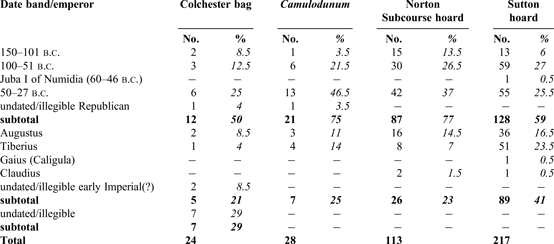
The legible purse coins range in date from a Republican denarius of c. 109–108 b.c. to low denomination issues of Claudius (22–49). Only four aes coins are present, three at least being Claudian issues (46–49). The remainder are denarii, summarised in Table 1. Due to the poor preservation of the silver in the hoard, seven of the denarii (39–45) remain corroded together in a lump with no legible visible surfaces and the metal of one is so severely depleted that it is difficult to be certain that it represents a coin rather than an accretion of corrosion deposits.
GROUPS OF DENARII FROM COLCHESTER, CAMULODUNUM (SHEEPEN), NORTON SUBCOURSE, AND SUTTON. (Data from Sutherland 1947, Burnett and Gregory Reference Burnett, Gregory, Bland and Burnett1988, Burnett Reference Burnett1992, Burnett et al. Reference Burnett, Plouviez and Tuckett1992.)

Even though classification of hoards is now approached more circumspectly than Grierson's original four types (accidental losses, emergency, savings and abandoned hoards),Footnote 70 the circumstances of the Colchester group's burial clearly provide a classic example of his ‘emergency hoard’, with the coins all taken from circulation at a single critical moment and buried with the intent of recovery.Footnote 71 The four aes are no doubt the small change associated with daily transactions, while the denarii too could all have been in circulation in the early colony, with many of the coins acquired in Britain.
Republican and early Imperial denarii, and sometimes aureii, form part of coin hoards found in eastern Britain that date to the short period from the conquest to before a.d. 64, such as a group of 113 denarii from Norton Subcourse, Norfolk, and 217 denarii from Sutton, Suffolk (Table 1).Footnote 72 Some of these hoards may have been deposited at the time of the Boudican revolt, perhaps by Roman settlers hiding their wealth, as at Colonia Victricensis, or perhaps by Britons either doing the same, or burying loot to be recovered later, or making votive offerings. Early silver coins also occur as site finds. Nearly 30 Republican and early Imperial denarii were found at Camulodunum (Sheepen) during the 1930s excavations and as casual finds there up to c. 1940 (Table 1).Footnote 73 More came from the early Roman industrial settlement at Sheepen excavated in 1970 and from excavations in Colonia Victricensis, its western suburb and Gosbecks since 1971; pre-Claudian aes were also present at Sheepen and in the town, while an aureus of Tiberius from the town has been mentioned above (see Introduction).Footnote 74 While some of these coins may have reached Camulodunum before the conquest, the majority would have arrived with the legions or early colonists and their scattered findspots indicate that they were used as currency rather than hoarded. Comparison between the contents of the Colchester bag and the Camulodunum finds suggests that there is little reason to suppose that any of the Republican coins were not considered as legal tender in a.d. 60. Republican silver occurs more frequently as site finds and in hoards than early Imperial silver, while both continued to appear in hoards up until the late third century, sometimes in considerable numbers.Footnote 75 This emphasis on Republican silver is clearly reflected in all four groups in Table 1 (many, probably most or all, of the seven coins in the corroded lump are likely to be Republican), while issues of the period 50–27 b.c. are consistently more numerous in all four groups.
Set in this context, while there may be an element of ‘savings’ in the purse group, most if not all of the denarii were probably acquired in Britain from a legionary pay chest.Footnote 76 Many have a military connection, as would be expected where issues of 50–27 b.c. predominate, with three minted by or for Julius Caesar in Gaul, Africa and Sicily, two Mark Antony legionary issues and one struck by Octavian to commemorate the Battle of Actium in 31 b.c. None of these issues is rare and Mark Antony legionary denarii occur frequently in Britain as both site and hoard finds, forming some 35 per cent of the Republican issues in Wales and continuing in circulation into the third century.Footnote 77
Use of Republican and early Imperial silver is not confined to Britain or to the military. With reference to groups of denarii from Pompeii and Oplontis, Hobbs has pointed out that Republican denarii were made of high purity silver and so had an intrinsic value.Footnote 78 They have been estimated as forming 79 per cent of the silver in circulation at Pompeii,Footnote 79 although many of the coins found with people fleeing the eruption would have been in storage before then rather than actively circulated.Footnote 80 Individual Campanian groups give similar figures: 76 per cent of the 33 denarii in the box in the House of the Menander at Pompeii were Republican,Footnote 81 as were 73 per cent of 172 denarii found with female Skeleton 7 from the House of L. Tertius Crassus at Oplontis.Footnote 82 Early Imperial silver presents a rather different picture. Augustan and Tiberian denarii form a consistent presence in the British hoards and site finds, indeed a strong presence in the Sutton hoard (Table 1),Footnote 83 but there are very few in Campanian groups as they would have been driven out of circulation by Vespasian's reform of the currency.Footnote 84
Even though it does not compare with the Norfolk and Suffolk hoards in Table 1, set against other coin hoards from Colchester associated with the Boudican fire the sum in the purse is comparatively large. Hoard 8, found in 1926 on the Telephone Exchange site on Insula 11, just to the north of the Williams and Griffin excavation, was composed of 27 burnt asses and dupondii of Claudius and Agrippa found in a pot; Hull suggested that they had been hidden immediately prior to the destruction of the colonia in a.d. 60/1.Footnote 85 Hoard 19, found at Balkerne Gardens on Insula 17a in 1965, consisted of just four asses of Claudius lying together on the surface of a Period 2 occupation layer.Footnote 86 Colchester Hoard 24 consisted of five asses of Claudius and one of Agrippa found together in Period 2 destruction debris on Insula 34 at Culver Street in 1984, probably associated with a wooden box from the same layer.Footnote 87 In terms of the basic legionary pay of 300 asses a month, 225 denarii a year,Footnote 88 Hoards 19 and 24 represent about half-a-day's income and Hoard 8 less than a week's. The purse group is about 5½ weeks’ pay, slightly less than 11 per cent of a legionary's total income for a year; had the owner ranked above a legionary, it could represent considerably less than that. As Augustus had determined that discharge pay on quitting the service should be enough to prevent discontent among former soldiers,Footnote 89 it is very probable that far more cash may have been stored in a strong-box elsewhere in the house or lodged with a banker.Footnote 90
GENDER AND PRECIOUS METAL JEWELLERY By Courtney Ward
As noted above, the gold jewellery found in the Colchester hoard is so similar to forms, styles and most of all the quality of craftsmanship present in Rome and Campania that it can reasonably be identified as coming from Roman Italy. In addition to the nearly identical forms, it seems that the use of different materials and accessories by both different sexes and social groups is also similar to those in Roman Italy. The customs of giving silver military torques to citizens and gold ones to non-citizens, and only giving armillae to citizens, have already been mentioned above,Footnote 91 providing, along with the bulla, evidence that the Colchester veteran granted the armillae was a citizen. The association of females with gold jewellery is also characteristic of the period, as an examination of the jewellery carried and worn by those fleeing the eruption of Mount Vesuvius in Campania has identified a pattern in material use based on sex.Footnote 92
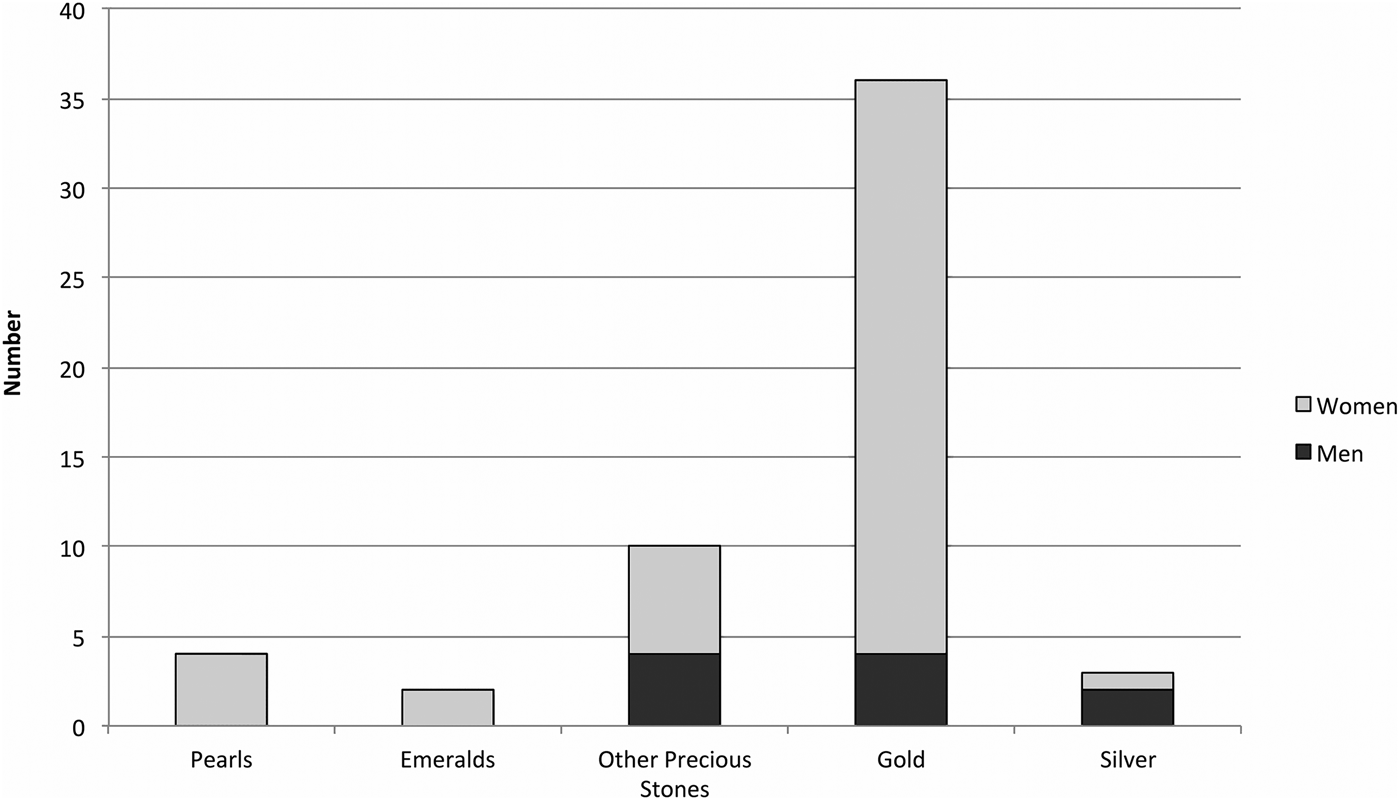
At Herculaneum women were found almost exclusively with gold jewellery, even though this does not translate into uniformity in design or quality, as noted above in the discussion of gold ball earrings and their construction.Footnote 93 In contrast, as shown in fig. 12, which excludes skeletons of uncertain sex,Footnote 94 men were discovered with a greater variety of metals, including gold, silver, iron and bronze.Footnote 95 This is best demonstrated through an analysis of finger-rings, as they are artefacts used by both men and women of varying age and socio-economic status. At Herculaneum, only gold finger-rings were associated with women, whereas those associated with men were generally, but not exclusively, of silver and iron, in relatively equal proportions.Footnote 96 It does seem that female identity was closely associated with the material used in adornment, whatever the item of jewellery concerned, while white metals played a much greater part in the expression of male identity and were also more closely bound up in form, with finger-rings being the predominant male dress accessory at Herculaneum.Footnote 97
Materials used for the jewellery worn by a sample of men and women from Herculaneum, Oplontis and Pompeii. (Drawn by and image © Courtney Ward)

While it is understandable that men and women would have had different priorities in purchasing items of adornment,Footnote 98 it is interesting to note the close connection between female identity and the use of gold, and the tendency for males to be associated with silver and iron. The jewellery from Colchester thus follows a broader trend of gendered material use that is visible in the Roman world, with three silver military (male) awards, and earrings, finger-rings and bracelets composed of gold that would have belonged to the female of the household.Footnote 99 The hoard may have been in a provincial context, but the colony at Colchester was only a decade or so old when it was destroyed, so her jewellery is unlikely to have been acquired in Britain, but in Italy or some other more fully Romanised province.
CONCLUSION
The circumstances of the deposition of the Colchester hoard and its components all render it remarkable not only within the colony but also in the wider context of the early province. While most objects from the colony's Boudican destruction levels can be assumed to have been the possessions of veterans and the members of their households, never before has this ownership been so explicitly defined by well-preserved items rich with information about the biography and character of their owners. The group is unique in containing both male and female items of thoroughly Roman style:Footnote 100 a man's childhood bulla (and perhaps its chain), a suite of intact silver and silver-gilt military awards, a group of intact female precious-metal jewellery, an unusual silver-clad box and the largest group of coins found in Colchester's Boudican destruction layer. The two pairs of earrings, five finger-rings and three armlets among the female jewellery are composed of jewellery types and materials — gold, pearl and emerald — which were highly fashionable at that period. The military awards mark their owner out as a distinguished veteran of the conquest of Britain. The most elaborate suggests that he achieved a rank above that of legionary, and, together with a curated intaglio, informs speculation about his cognomen. Above all, the hoard came from a context resonant with the dramatic circumstances of its burial.
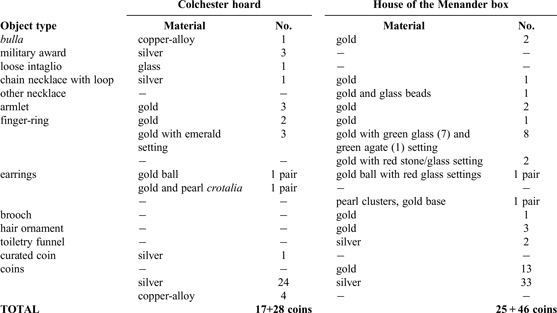
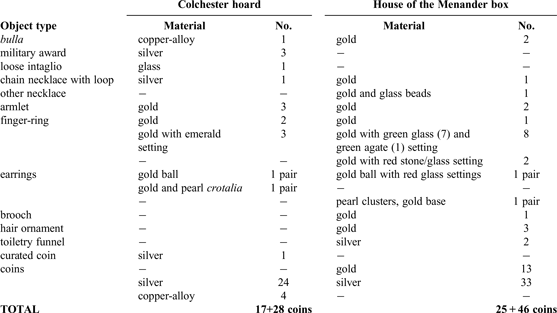
The information embedded within the Colchester hoard can be enhanced by comparison with the jewellery and coins stored in the box from Room B in the House of the Menander at Pompeii, a collection which is not only strikingly similar in general composition but also lost in a catastrophic event.Footnote 101 There is no way of determining precisely how many individuals made up each family group, nor is it possible to determine if the jewellery represented the total owned in each case, or if more pieces were being worn at the time of each disaster.Footnote 102 Even so, the presence of only two pairs of earrings in each collection provides some basis for the assumption that in each case the female-gendered pieces represent only one adult female. Were this the case, in social and economic terms the owners of the Colchester group might seem to be rather less wealthy and of lower status than the Pompeians. Not only did the House of the Menander box hold a greater number and variety of items, including only high-value coins and two gold bullae as opposed to a small one of copper alloy (Table 2), but it was stored inside a chest that also contained 88 pieces of silver plate.Footnote 103 The collection as a whole represents a considerable investment of money in conspicuous consumables and would have been owned by a family of high social rank with the economic means to demonstrate it.
THE CONTENTS OF THE COLCHESTER HOARD AND THE HOUSE OF THE MENANDER BOX. THE TOTAL NUMBER OF COINS FROM COLCHESTER EXCLUDES THE CURATED DENARIUS.
The household of a veteran in a new colony is unlikely ever to have matched this, but the difference may not be as great as first appears. There is good reason to suppose that the owners of such good quality jewellery and awards as those in the hoard would have possessed other equally valuable but more bulky items, not only more cash but also table wares, perhaps including high-quality metal pieces such as the silver cups from Hockwold, Norfolk.Footnote 104 Even if the veteran and his household had had the time to hide other possessions in various locations within the building, perhaps grouped by type, effectively forming a hoard which had been dispersed by the depositor(s) rather than by later activity, the rarity of coin hoards and precious metal items in Colchester's Boudican destruction levels implies that only the small and seemingly insignificant escaped attention; bulky valuables, hidden or not, would have been looted by British warriors or removed when the colony was cleared and rebuilding began. Further assessment of the economic wealth of the owners of the Insula IX hoard will need to be considered in the light of future work on the pottery and other finds from the building.
APPENDIX 1: CATALOGUE
The objects are all covered by the small find number SF 240 and site find/context number (254). They are listed below in the order in which they are described above. Letters used in the catalogue are those assigned on excavation or during post-excavation work to distinguish individual finds or, in the case of the wooden box, component parts. The site archive will be deposited in the Colchester branch of Colchester and Ipswich Museums.
1. Leather bag, postulated as containing the hoard. No surviving remains.
2. Leather purse, postulated as containing the coins. No surviving remains.
3. Wooden box covered with silver sheet, with silver fittings and ivory feet. (J) silver sheet fragments from lid. (K, N, O, AN, AT) silver sheet and wood fragments. (C) hinge-plate, 16 by 10.5 mm, with split-spike loop, clenched to give wood thickness of 5 mm, fixing nail missing. (L) hinge-plate, 17 by 10.5 mm, with fixing nail and split-spike loop 18 mm long, one arm clenched to give wood thickness of 5 mm, the other straight. (AP–AR) three ivory ball feet, all with slightly flattened base with lathe-centre mark below a grooved cordon and short shank, centre mark on AQ large: AP total height 15 mm, shaft height 5 mm, knob diameter 7.5 mm; AQ 15 mm, 5.5 mm, 5–7 mm; AR 16 mm, 5 mm, 6–7 mm. (AS) ivory ball foot, flattened base with lathe-centre mark below a narrow cordon; 13 mm, 4.5 mm, 7–8 mm. (Q) flat-headed nail, incomplete, 9 mm; clenched shank fragment, 10 mm; bent shank fragment, L 14 mm; four shank fragments, 10, 10, 7 and 5 mm. (T) flat-headed nail in two pieces, 5 and 7 mm. (U) shank fragment, 8 mm. (P) broken split-spike loop, 11 mm; shank fragment, 6 mm; clenched and slightly twisted shank fragment, arms 7 and 9 mm. (S) catch, with a hook at one end, thumb-rest at the other, and expanded centre, 27 mm; a flat-headed nail, clenched to give a wood thickness of 5–6 mm, is attached to the underside of the centre.
4. (A–B). Copper-alloy bulla, in poor condition. A short length of copper-alloy ?tubing (diameter 3 mm) remains fixed in the suspension loop. Width 20 mm, length including suspension loop 23 mm.
5. (AFi). Silver loop-in-loop chain, with very little metal surviving. Section 5 by 5 mm, length uncertain due to condition, estimated minimum 325 mm.
6. (AFii). Silver oval round-section penannular ring with overlapping pointed terminals. Length 14 mm, width 11 mm, section diameter 1 mm.
7. (X). Silver armilla. Internal diameter 52.5 mm, height 14 mm, thickness 2 mm.
8. (AD). Silver armilla. Internal diameter 53 mm, height 13.5 mm, thickness 2 mm.
9. (AA). Large silver armilla with hunt scene and medallion with gilded face. Internal diameter 80 mm, height 17–18.5 mm (widens towards hinges), thickness 1.5–2 mm; diameter of medallion 39 mm, thickness 6 mm.
10. (AB). Gold armlet of two strands of gold wire intertwined to form seven large loops. The crossing points and junction are soldered together, and a decorative appliqué is soldered over the junction to mask it. Maximum internal diameter 77 mm, maximum height 28 mm, wire thickness 2 mm; weight 53.5 g.
11. (AC). As 10 above. Maximum internal diameter 76 mm, maximum height 28 mm, wire thickness 2 mm; weight 54.68 g.
12. (AE). Gold bangle-type armlet, polygonal in section, with coiled and twisted clasp. Internal diameter 73 mm, section 2.5 mm, height of coil 7.5 mm; weight 26.91 g.
13. (AO). Ovoid blue glass intaglio with flat face; now mostly greenish-yellow on the surface with iridescence. Length 11 mm, width 10 mm, thickness 2 mm.
14. (AI). Gold finger-ring with ovoid hoop and flattened bezel, with a chamfered oblong setting of emerald. Internal diameter 16 mm, minimum height of hoop 1.5 mm, width of bezel 5 mm, height 4 mm, setting 6 by 3 by >2 mm; weight 5.14 g.
15. (AJ). Gold finger-ring with ovoid hoop and flattened bezel, with a chamfered rectangular setting of emerald. Internal diameter 16 mm, minimum height of hoop 1.5 mm, width of bezel 8 mm, setting 8 by 6 by <3 mm; weight 7 g.
16. (AK). Gold finger-ring with ovoid hoop, flattened at the top, the oval bezel engraved with a dolphin. Internal diameter 14 mm, minimum height of hoop <2 mm, width of bezel 7 mm, thickness 1.5 mm.
17. (AL). Gold finger-ring with ovoid hoop and flattened bezel, with a chamfered square setting of emerald. Internal diameter 14 mm, minimum height of hoop 1.5 mm, width of bezel 6 mm, setting 5 by 5 by >1 mm; weight 4.71 g.
18. (AM). Gold finger-ring with ovoid hoop and flattened bezel, missing its round setting. Internal diameter 13 mm, minimum height of hoop 1 mm, width of bezel 4 mm; weight 1.1 g.
19. (AG). Pair of hollow gold ball earrings, recessed at the back. On each the junction of the wire S-hook and the ball is masked by a small flat disc. (i) Maximum ball diameter 16 mm, weight 2.89 g. (ii) Maximum ball diameter 15 mm, weight 2.67 g. Diameter of discs 5.5 mm; hooks 13.5 mm long, 17 mm high.
20. (W). Pair of gold earrings with pearls (crotalia). On each the wire S-hook is attached to a plain trapezoidal crossbar and the junction between the two is masked by a flat disc. Two loops at the ends of the bar hold knurled wires, each fitted with a pearl held in placed by a small washer. Only two pearls now survive, both on one earring. Crossbars 9–12 by 2 mm, diameter of discs 6 mm, length of pendants 15 mm from centre of loop, diameters of surviving pearls 6 and 6.5 mm, hooks 15 mm long, 15 mm high; weight of earring missing its pearls 2.11 g.
21. (AH). In box, beneath the crotalia. Augustus, worn and corroded denarius, c. 19 b.c. Obv. legend worn away, laureate head of Augustus right. Rev. Victory flying right, ends of wings only remain. Diameter 15 mm. Weight 2.69 g. Similar to RIC (Augustus) 89, 91–2, 94–5, minted at Colonia Patricia(?).
22. (H). Republican denarius, Manius Aquillius, c. 109–108 b.c. Obv. radiate head of Sol right. Rev. legend obscured [MN AQVIL below, in ex. ROMA], Luna in biga right, crescent moon and two stars above, one star below. Diameter 19 mm. Weight 2.88 g. RRC 303/1, Syd. 557.
23. (I). Republican denarius, M. Herennius, c. 108–107 b.c. Obv. [PIE]TAS left, diademed head of Pietas right. Rev. legend obscured [M. HERENNI left], Amphinomus carrying his father right. Diameter 18 mm. Weight 3.10 g. RRC 308/1b, Syd. 567a.
24. (BF). Worn Republican denarius, L. Calpurnius Piso Frugi, 90 b.c. Obv. laureate head of Apollo right, punch-mark (?star) behind. Rev. very worn, horseman galloping (left or right). Diameter 17 mm. Weight 3.39 g. RRC 340/1, Syd. 650–71.
25. (BH). Republican denarius, Q. Titius, 90 b.c. Obv. ivy-wreathed head of Liber right, punch-mark in front (cross with open centre forming pellet) and large pellet in ring punch-mark on the cheek. Rev. Pegasus right, hind feet on framed inscription Q TITI to left; large pellet in ring punch-mark to right of, and slightly over, frame. Diameter 18 mm. Weight 3.77 g. RRC 341/2, Syd. 692.
26. (D). Republican denarius, L. Censorinus, P. Crepusius and C. Limetanus, c. 82 b.c. Obv. [L CENS]ORIN, veiled bust of Venus right. Rev. C LIME[AT], Venus in biga right; in ex. P CREPV[SI]. Diameter 16 mm. Weight 2.77 g. RRC 360/1b, Syd. 736a.
27. (BE). Illegible Republican denarius. Obv. head right. Rev. illegible legend across field. Diameter 15 mm. Weight 3.18 g.
28. (AV). Attached to AW. Julius Caesar, denarius, c. 49–48 b.c. Obv. elephant right, trampling on snake, in ex. CAESAR. Rev. obscured [simpulum, sprinkler, axe and priest's hat]. Diameter 16 mm. Weight unobtainable as corroded to AW below. RRC 443/1, Syd. 1006, military mint moving with Caesar.
29. (AW). Attached to AV. Julius Caesar, denarius, 40s b.c. Obv. head of Venus right. Rev. obscured. Diameter 18 mm. Weight unobtainable as corroded to AV above. Possibly RRC 458/1, Syd. 1013, minted in Africa, with diademed head of Venus on obverse and Aeneas carrying Anchises on reverse.
30. (AY). Julius Caesar, denarius, 47 b.c., issued for Caesar by A. Allienus. Obv. [C·CAESAR IMP·] COS·ITER, diademed head of Venus right. Rev. encrusted with corrosion; probably RRC 457/1, Syd. 1022, minted in Sicily with Trinacrus standing left, cloak over left arm, foot on prow, holding triskelis and legend A·ALLIENVS PRO·COS. Diameter 17 mm. Weight 3.37 g.
31. (AX). Mark Antony, denarius, 32–31 b.c. Obv. ANT·[AVG] III·VIR·R·P·C, galley right, sceptre tied with fillet on prow. Rev. LEG·XVII·CLASSICAE, aquila between two standards. Diameter 18 mm. Weight 3.29 g. RRC 544/10, Syd. 1238, military mint.
32. (Z). Mark Antony, denarius, very worn, 32–31 b.c. Obv. ANT AVG/-, galley right. Rev. -/XV/-, aquila between two standards. Diameter 17.5 mm. Weight 2.89 g. As RRC 544, Syd. 1235–41, military mint.
33. (AZ). Octavian, denarius, c. 31–30 b.c. Obv. bust of Victory right, wings spread. Rev. [CAESAR DIVI F across field], male figure (Octavian as Neptune?) standing left, right foot on globe, holding an aplustre in right hand, vertical sceptre in left. Diameter 19 mm. Weight 2.73 g. RIC (Augustus) 256, minted in Italy.
34. (E). Augustus, denarius, 9–8 b.c. Obv. AVGVSTVS DIVI·F, laureate head right. Rev. C CAES, Gaius Caesar galloping right, eagle between vexilla behind; in ex. AVGVS·F. Diameter 20 mm. Weight 3.19 g. Lyons mint, RIC (Augustus) 199.
35. (F). Augustus, denarius, 7–6 b.c. Obv. [CAESAR AVGVSTVS] DIVI F PATER PATRIAE, laureate head right. Rev. [AVGVSTI F COS DESIG PRIN]C IVVENT, Gaius and Lucius standing front, each with shield and spear, in field above a lituus left and simpulum right (as ‘b9’); in ex. C L CAESARE[S]. Diameter 17 mm. Weight 3.38 g. Lyons mint, RIC (Augustus) 207.
36. (Y). Tiberius, denarius, c. a.d. 14–37. Obv. TI CAESAR DIVI [AVG F AVGVSTVS], laureate head right. Rev. [PONTIF] MAXIM, female figure (Livia as Pax?) seated right on chair with ornamented legs, with sceptre and branch. Diameter 17 mm. Weight 3.02 g. Lyons mint, undated, RIC (Tiberius) 30.
37. (G). Worn early Imperial denarius (Augustus?). Obv. laureate head right. Rev. illegible. Diameter 19 m. Weight 3.08 g.
38. (BG). Worn early Imperial denarius(?). Obv. laureate head right. Rev. illegible. Diameter 18 mm. Weight 3.04 g.
39–45. (AU). Seven denarii still corroded together, all visible faces illegible. Total weight 20.43 g, average 2.92 g, but as the metal of one coin is very depleted and consists only of a thin layer of corrosion (and may merely be an accretion of corrosion deposits rather than a decayed coin), the average is likely to be >3 g.
46. (BA). Claudius I, as, a.d. 41–54. Obv. TI CLAVDIVS CAESAR AVG P M TR P IMP, Claudius, head left. Rev. S C, Minerva advancing right, holding shield and spear. Diameter 27 mm. Weight 7.52 g. RIC (Claudius) 100.
47. (BB). Claudius I, as, a.d. 41–54. Obv. [TI CL]AV[DIVS CAESAR AVG P M TR P IMP], Claudius, head left. Rev. S C, Minerva advancing right, holding shield and spear. Diameter 26.5 by 23 mm. Weight 5.44 g. RIC (Claudius) 100.
48. (BC). Claudius I, dupondius, a.d. 41–54. Obv. encrusted with corrosion. Rev. Ceres seated left holding corn ears in right hand and long torch on left; in ex. S C. Diameter 25 mm. Weight 7.61 g. RIC (Claudius) 94. Although small and light for a dupondius, comparable examples have been found in the town.Footnote 105
49. (BD). Illegible as/dupondius, encrusted with corrosion. Diameter 30 mm. Weight 9.30 g.
50. (M). Iron nail, length 42 mm. Residual.
51. (V). Clenched iron nail shank fragment, length 21 mm. Residual.
ACKNOWLEDGEMENTS
Thanks are due to Fenwick for funding the excavation and post-excavation work on the site, and for supporting the conservation, analysis and publication of the hoard and its display; to Adam Wightman, Emma Holloway, Philip Crummy and Frank Lockwood of Colchester Archaeological Trust for all their work on the hoard; to Martin Henig and Courtney Ward for their contributions. Stephen Yates and Paul Sealey, now or formerly of Colchester and Ipswich Museums, Richard Hobbs, Ralph Jackson and Catherine Johns, now or formerly of the British Museum, Susan Walker, formerly Ashmolean Museum, and Emma Durham, Michael Fulford, John Allen, Chris Speed and Hella Eckardt of the University of Reading all facilitated various aspects of this study, and I greatly appreciate their kind interest. Richard Hobbs also kindly read through the text and I am grateful for his comments, and for those of the two referees. Particular thanks are due to Emma Hogarth, Senior Conservator of Colchester and Ipswich Museums, for her careful excavation of the soil block, conservation of the group and discussions of various aspects of the objects.
ABBREVIATIONS
CAR 2: N. Crummy, The Roman Small Finds from Excavations in Colchester 1971–9, Colchester Archaeological Report 2, Colchester (1983)
CAR 3: P. Crummy, Excavations at Lion Walk, Balkerne Lane, and Middleborough, Colchester, Essex, Colchester Archaeological Report 3, Colchester (1984)
CAR 4: N. Crummy (ed.), The Coins from Excavations in Colchester 1971–9, Colchester Archaeological Report 4, Colchester (1987)
CAR 6: P. Crummy, Excavations at Culver Street, Gilberd School, and Other Sites in Colchester 1971–85, Colchester Archaeological Report 6, Colchester (1992)
CIL: Corpus Inscriptionum Latinarum
RIC: Roman Imperial Coinage
RRC: M.H. Crawford, Roman Republican Coinage, London (1974)
Syd.: E.A. Sydenham, The Coinage of the Roman Republic, London (1952)