Introduction
Wheat starch is of major importance in newly weaned piglet diets since it is the most abundant (by weight) and the principal energy-yielding feed component. Native unprocessed starches, however, are relatively indigestible to piglets because of their semi-crystalline structure, low dissolution characteristics and low susceptibility to enzyme activity. These properties pose challenges to the weaned animal when its digestive system is poorly prepared for handling a dry, carbohydrate-rich diet. For instance, a reduction in starch digestibility in both the mid and distal regions of the small intestine has been observed in newly weaned piglets fed a diet based on unprocessed cereals (White et al., 2008). The post-weaning growth check typically results in reduced feed intake (FI) (Kelly et al., Reference Kelly, Smyth and McCracken1991), which can lead to negative effects on growth and performance. Until recently, the growth check was under partial control through the use of in-feed antibiotics. However, European legislation now bans the use of these substances, and the quality and digestibility of the ingredients used in the post-weaning diet has now assumed a much more fundamental role.
Processing of wheat prior to inclusion into diets for weaned piglets is widely practiced with the objective of inducing adequate physical changes to insoluble starch granules, increasing their water-holding capacity and enzyme susceptibility (Kulp and Lorenz, Reference Kulp and Lorenz1981; van den Einde et al., Reference van den Einde, Akkermans, van der Goot and Boom2004; Anguita et al., Reference Anguita, Gasa, Martin-Orue and Perez2006). This in turn is believed to provide the animal with starch in a form more readily susceptible to amylolytic digestion, thereby increasing the energy-yielding potential (Rowe et al., Reference Rowe, Choct and Pethick1999). Many piglet trials have been undertaken to evaluate the benefits of using thermal (e.g. micronisation) and thermo-mechanical (e.g. extrusion) processing techniques for the improvement of in vivo starch digestibility. However, there is little consensus concerning the extent to which processing actually benefits animal performance. Some studies have reported improved performance and digestibility following cereal processing (Skoch et al., Reference Skoch, Binder, Deyoe, Allee and Behnke1983; Huang et al., Reference Huang, Sauer, Pickard, Li and Hardin1998), whereas others failed to identify any significant benefits (van der Poel et al., Reference van der Poel, Den Hartog, Van Stiphout, Bremmers and Huisman1990; Thacker, Reference Thacker1999; Zarkadas and Wiseman, Reference Zarkadas and Wiseman2001 and Reference Zarkadas and Wiseman2002). This discrepancy may originate from a fundamental misconception about the concept of cooking or, more precisely, starch conversion (Mitchell et al., Reference Mitchell, Hill, Paterson, Valles, Barclay and Blanshard1997).
Cooked starch will have different physical properties depending on the processing techniques and variables used (Frazier et al., Reference Frazier, Donald and Richmond1996). The intrinsic properties of the processed starch will impact on its digestibility. For instance, micronisation or infrared processing, which is an intensive, short-time, high-temperature heat treatment (Ginzburg, Reference Ginzburg1969), causes rapid surface and internal heating of cereal grains, with subsequent swelling, rupture and gelatinisation (conversion) of starch within the grains (Lawrence, Reference Lawrence1973). However, the proportion of starch conversion has been shown to be dependent upon several processing factors including initial moisture content of the grains and the exit temperature after processing (Fasina et al., Reference Fasina, Tyler, Pickard and Zheng1999).
Descriptions of processing in the animal science literature are invariably limited to the name of the process itself with no regard whatsoever of the variables (e.g. temperature, time, moisture, shear force, etc.); frequently only the term ‘cooked’ is used, which is completely inaccurate as a descriptor of nutritional value. If biological responses of animals in nutritional studies are to be correctly interpreted, then primary information about the physicochemical properties of the raw starchy materials and the changes they undergo on processing should be collected beforehand. After more than two decades of research on the possible beneficial effects of the inclusion of ‘cooked’ starch in animal feeds, crucial information such as the optimum processing conditions necessary for post-weaned piglet diets and questions as to whether wheat with varying endosperm textures are equally affected by different processing methodologies remain largely unanswered.
An accurate and quantitative representation of the physicochemical properties of raw materials (and the changes they undergo upon processing) can be easily achieved by means of reliable in vitro methodologies that are commonly used by food scientists (Doucet et al., Reference Doucet, White, Wiseman and Sandra2007). Variation between and within processing techniques are known to affect the physicochemical properties of starch differently. Therefore the choice of processing technique is a fundamental consideration as it can have a marked effect on the properties of starch, and also on in vivo starch digestibility (Doucet et al., Reference Doucet, White, Wiseman and Sandra2007).
The current trials adopted a similar experimental approach to a previous study that examined raw cereals (White et al., 2008) whereby physicochemical properties of the dietary cereals were measured and related to the biological responses of post-weaned piglets. The current study aimed to examine the effects of precisely controlled micronisation (Trial 1) and extrusion (Trial 2) processing variables on the nutritional value of the same two wheats (varying in endosperm texture) used in the previous study. The objectives of the trials were to confirm that varying processing techniques (and processing conditions for a specific technique) affect the physicochemical properties of wheat starch to different extents, which in turn affect in vivo starch digestibility in newly weaned piglets.
Material and methods
Diets
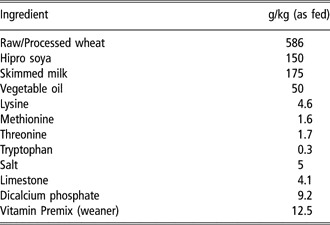
Several experimental diets were evaluated in each trial and contained one of two near-isogenic wheat samples with endosperm hardness of 11.2 and 6.3, respectively, which were incorporated at the same rate of 586 g/kg. These two wheats were used in a previous study (White et al., 2008), during which their physicochemical properties were thoroughly characterised. The trials quantified hardness in contrast to previously published reports that relied only on an official ‘hardness’ description by breeders/UK National Institute of Agricultural Botany as an aid to growers. The wheats used in Trials 1 and 2 were supplied by Nickerson (UK) Ltd as a single batch, were of identical chemical composition (including protein levels), and were grown under the same agronomic conditions. Diet specification is given in Table 1 and they did not contain antibiotic growth promoters or zinc oxide. The two wheat samples were either micronised (Trial 1) or extruded (Trial 2) under different processing conditions, to give samples with a wide range of physicochemical properties.
Diet specification (experimental diets) used in Trials 1 and 2
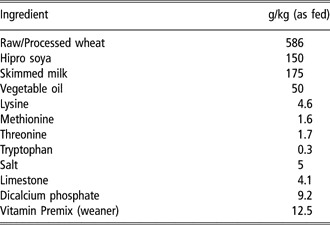
Dietary crude protein/starch values (g/kg) for Trial 1: Soft Wheat High Cook; 209/399, Hard Wheat High Cook; 205/380, Hard Wheat Low Cook; 191/366.
Dietary crude protein/starch values (g/kg) for Trial 2: Raw Soft Wheat; 209/312, Soft Wheat Low Cook; 199/311, Soft Wheat High Cook; 214/325, Hard Wheat High Cook; 211/348.
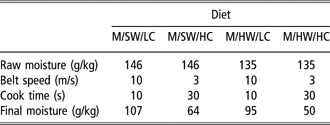
For Trial 1, micronisation was conducted with a cereal microniser with a burner temperature of 250°C by I’Anson Bros (Masham, North Yorkshire, UK). The soft and hard wheats were not steeped beforehand. Micronising was under short (dwell time: 10 s; Low Cook (LC)) and long (dwell time: 30s; High Cook (HC)) cook conditions by varying the belt speed, giving four treatments combinations: Soft Wheat/Low Cook (M/SW/LC), Soft Wheat/High Cook (M/SW/HC), Hard Wheat/Low Cook (M/HW/LC) and Hard Wheat/High Cook (M/HW/HC) (Table 2). The final exit temperature was kept constant at 100°C, and the micronisation bed was held in a horizontal position at all times.
Micronisation processing variables used in Trial 1
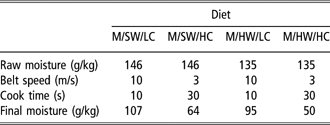
M/SW/LC = Soft Wheat/Low Cook; M/SW/HC = Soft Wheat/High Cook; M/HW/LC = Hard Wheat/Low Cook; M/HW/HC = Hard Wheat/High Cook.
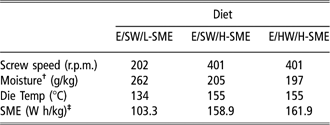
For Trial 2, extrusion was with a single-screw extruder by the Campden and Chorleywood Food Research Association Group (Chipping Campden, Gloucestershire, UK). The wheats were subjected either to mild or severe extrusion conditions by varying the degree of mechanical input (termed specific mechanical energy (SME)). Three treatment combinations (Soft Wheat/Low SME (E/SW/L-SME), Hard Wheat/High SME (E/HW/H-SME), and Soft Wheat/High SME (E/SW/H-SME)) were produced (Table 3). A control diet containing raw wheat of soft endosperm (R/SW) was used as a fourth treatment.
Extrusion processing variables used in Trial 2
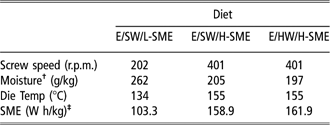
E/SW/L-SME = Soft Wheat/Low SME; E/SW/H-SME = Soft Wheat/High SME; E/HW/H-SME = Hard Wheat/High SME.
†During processing (water added).
‡
The raw and processed wheat samples were ground through a 1.5-mm screen using a hammer mill and mixed with the basal diet. Diets were manufactured in the University of Nottingham experimental animal feed mill.
In vitro feed characterisation
The moisture content of wheat samples and diets was determined by oven drying at 105°C for 18 h and calculated as an average value of triplicates.
Structural properties
All wheat samples were examined under an optical microscope (Leitz Diaplan, Wild Leitz GmbH, Germany) under polarised light in order to distinguish between intact and disrupted starch granules.
X-ray diffraction (XRD) measurements were performed to obtain information on the long-range crystalline order of raw and processed wheat starches. A Siemens D5005 diffractometer (AXS GmbH, Germany) equipped with an X-ray generator consisted of a copper tube operating at 40 kV and 50 mA. Diffractograms, over an angular range of 4° to 38° at 0.2° intervals and acquired at ambient temperature, were used to estimate the amount of crystalinity (%). This was calculated as the ratio of the areas of the sharp peaks (crystalline) to the total area.
To estimate helical order in the starches, wheat samples in excess water were sealed in aluminium pans and their gelatinisation behaviour was studied using a Perkin-Elmer DSC-7 differential scanning calorimeter. An empty aluminium pan was used as the reference. After sealing, the pans were equilibrated for 12 h, and the samples were heated in the calorimeter from 30°C to 90°C at 10°C/min. The samples contained in the aluminium pan were weighed before and after each treatment to check for potential moisture loss. The enthalpy (ΔH) of transition was expressed in J/g on a dry weight basis.
Hydration properties
The pasting of wheat flours and diets was analysed using a Rapid Visco Analyser Series 4 (RVA) equipped with Thermocline for Windows Version 2.0 (Newport Scientific, NSW, Australia). This measures the viscosity of materials while being sheared under defined hydration and temperature regimes (Becker et al., Reference Becker, Hill and Mitchell2001). The RVA provides a number of pasting parameters (e.g. cold swelling peak, gelatinisation peak, trough and final viscosity), which represent a relative measure of starch gelatinisation, disintegration, swelling and gelling ability (Ruy et al., Reference Ruy, Neumann and Walker1993; Ravi et al., Reference Ravi, Sai Manohar and Haridas Rao1999). RVA measurements were performed using 3 g of wheat flour (dry weight) and 25 g of distilled water, whereas 5.17 g of diet sample (dry weight) were used to compensate for the amount of starch. Sample and water were weighed separately to ±0.001 g, mixed and then measurements were started within 20 s. The pasting profile used started at 25°C and held for 10 min, ramped to 95°C over 6.5 min, held at 95°C for 6.5 min, cooled back to 25°C over 10 min, and finally held at 25°C for 7 min. Each analysis took 40 min and was done in duplicate. No detectable endogenous amylase was present in the wheat samples when assessed by the RVA method.
Water Absorption (WAI) and Water Solubility (WSI) Indices of raw and processed wheats were also determined; they are commonly used to assess the swelling and solubility behaviour of the starch component of cereals in excess water. WAI represents the volume occupied by the hydrated starch following swelling in excess water, whereas WSI denotes the amount of soluble materials released from the granules to the aqueous phase. Both indices were determined by mixing 0.3 g of powdered sample (dry weight) with 10 ml of distilled water using a roller shaker at constant rate and at room temperature for 18 h. The suspensions were then centrifuged at 3000 r.p.m. for 10 min. WAI was expressed as the weight of the wet pellet per gram of sample (g/g). WSI was expressed as the weight of dry solids in the supernatant (following evaporation to dryness at 105°C) and was reported as the percentage of the original sample weight.
In vitro amylolytic digestion
In vitro starch digestibility of raw and processed wheats was determined by monitoring the hydrolysis of each sample (over a 120 min period), after addition of a commercial pancreatic α-amylase solution at 37°C. The colorimetric phenol-sulphuric acid method was used to determine the total amount of glucose released over time (Englyst and Cummings, Reference Englyst and Cummings1987). In particular, 60 mg (dry weight) of wheat flour were incubated in a 30 ml citrate phosphate buffer solution (0.06 mol/dm3; pH 6.9) to which was added 30 μl of commercial pancreatic α-amylase (1370 units; Sigma, UK) at 37°C. One unit of enzyme was defined as liberating 1 mg of maltose from starch in 3 min at 20°C.
Piglet trials
Animals, housing and management
Entire male piglets weaned at 28 days of age (8 to 12 kg live weight) and of uniform genotype (Large White × Landrace) were employed for two trials. Animals (n = 44 for each trial) were individually weighed and transferred to an environmentally controlled (28°C to 32°C; 16L : 8D lighting regime) experimental unit on the day of weaning. Animals were housed in individual pens with semi-slatted floors, two nipples drinkers and a feed trough. The piglets were randomly allocated to one of four experimental diets, which were fed in meal form and on an ad libitum basis. Fresh water was also available ad libitum. In each of the two trials, four piglets (control) were slaughtered on day 0, with two piglets from each dietary group slaughtered at days 2, 4, 6, 10 and 14 post-weaning (n = 8 on each day, 2 per diet). For each study, the experimental period was for 14 days and experimental procedures were conducted under the official code of practice and ethical procedures relating to animal trials.
In vivo analysis
FI was calculated individually on a daily basis as the total feed offered, minus any refusals. Determination of daily live-weight gain (DLWG) was achieved by the linear regression of live weight over time. This is a more accurate procedure than relying only on start and end weights and also allows a precise calculation of the number of days that an animal takes to grow over a specific weight range (Zarkadas and Wiseman, Reference Zarkadas and Wiseman2001). General procedures post-slaughter involving the collection of digestive tract digesta, along with the removal, embedding and measuring of intestinal tissue sections have been described elsewhere (White et al., 2008). Fresh faecal samples from eight piglets were collected over two time periods (5 days each) of the trial. The first collection period was from days 1 to 5 inclusive, the second, from days 9 to 13. Upon collection (pens were checked several times a day), faecal samples were stored in a plastic bag and immediately frozen at −20°C until analysed.
Details of all the chemical analyses conducted on diets, digesta and faecal samples are described in White et al. (2008). At slaughter, it was found that there was insufficient digesta for collection from the 0.25 region of the small intestine in several of the animals. This meant that some of the laboratory analyses (principally for the determination of starch and nitrogen digestibility coefficients) from this tract region could not be performed.
Data were subjected to analysis of variance (ANOVA) using a fully randomised design (Genstat 8.1, Lawes Agricultural Trust, 2005). For Trial 1, the effect of wheat endosperm texture, level of cook (degree of micronisation) and the interaction between these two factors were analysed in a 2 × 2 factorial design. In Trial 2, wheat endosperm texture (highly extruded hard wheat v. highly extruded soft wheat) and degree of extrusion (raw soft wheat v. mildly extruded soft wheat v. highly extruded soft wheat) were investigated in separate analyses.
Results
In vitro characterisation of raw and processed wheats and their corresponding diets
The gross composition (including protein content) and grain surface area of the raw hard and soft wheats used in the two trials were identical and were reported previously (White et al., 2008).
Trial 1
Structure of raw and micronised wheat starches
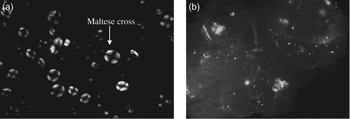
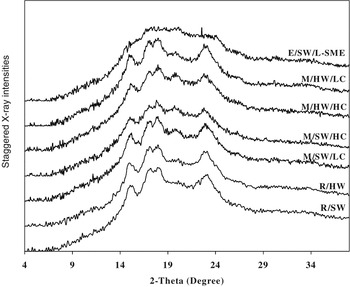
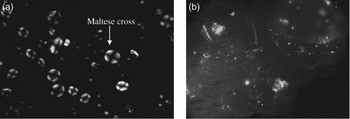
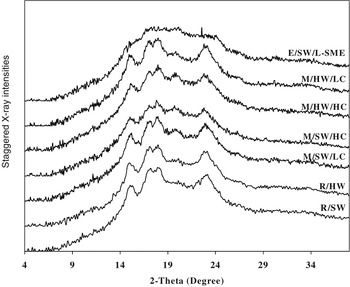
The polarised optical micrographs of starch granules of both raw (Figure 1a) and micronised (results not shown) wheat samples were indistinguishable and displayed clear ‘Maltese Crosses’. Their X-ray diffractograms showed clear A-type diffraction patterns typical of raw wheat starch. These diffractograms were also undistinguishable, except for the spectrum of M-SW-HC, which indicated a decrease in its degree of crystallinity of approximately 26% (Figure 2). Similar observations were made using DSC, where the starch gelatinisation enthalpy ΔH was similar for all raw and micronised samples at approximately 6 to 7 J/g, except for M/SW/HC, which exhibited a lower ΔH (4.19 ± 0.88 J/g). This indicated that 36% of the starch in M/SW/HC was converted. However, in contrast to optical microscopy and XRD, DSC also reported a lower ΔH value (5.25 ± 0.74 J/g) for M/HW/HC, which suggested the presence of around 20% of converted starch in this sample. The onset temperature was identical for all raw and micronised samples.
Polarised optical micrographs of (a) raw and (b) extruded wheat samples.
Wide-angle X-ray diffractograms of raw, micronised and extruded wheat samples (R/SW: raw soft wheat; R/HW: raw hard wheat; M/SW/LC: soft wheat micronised at low cook level; M/SW/HC: soft wheat micronised at high cook level; M/HW/LC: hard wheat micronised at low cook level; M/HW/HC: hard wheat micronised at high cook level; E/SW/L-SME: soft wheat extruded at low SME).
Hydration properties of raw and micronised wheat flours
In spite of the similarities in gross composition and grain surface area between the two wheat grains, their RVA pasting profiles were significantly different (see R/HW and R/SW in Figure 3; P < 0.05). The differences between these hard and soft wheat samples were the subject of a previous paper (White et al., 2008). The RVA pasting profiles of raw and all micronised wheats showed no cold swelling peak (i.e. no increase in viscosity in excess water at 25°C). The pasting profile of M/SW/LC was very similar to that of R/SW, whereas M/SW/HC was characterised by significantly lower peak viscosity and final viscosity values than those of R/SW. In contrast, the peak and final viscosity values of M/HW/LC and M/HW/HC were higher than those of their raw counterparts.
Rapid Visco Analyser (RVA) pasting profiles showing the temperatures and the viscosity of the pasted materials used in Trials 1 and 2 (R/SW: raw soft wheat; R/HW: raw hard wheat; M/SW/LC: soft wheat micronised at low cook level; M/SW/HC: soft wheat micronised at high cook level; M/HW/LC: hard wheat micronised at low cook level; M/HW/HC: hard wheat micronised at high cook level; E/SW/L-SME: soft wheat extruded at low SME; E/SW/H-SME: soft wheat extruded at high SME; E/HW/L-SME: hard wheat extruded at low SME; E/HW/H-SME: hard wheat extruded at high SME).

The water-holding capacity of raw and most micronised wheats was very similar. In particular, the wheats exhibited similar low WSI values (9.0% to 12.8%) that are characteristic of those of raw wheats, except for M/SW/HC, which had a higher WSI value (22.7 ± 0.36%). Their WAI were also similar (1.94 to 2.07 g/g) and their low values were typical of those of raw wheats.
In vitro digestibility
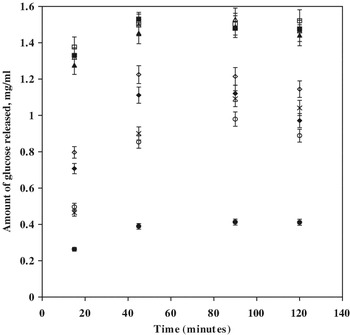
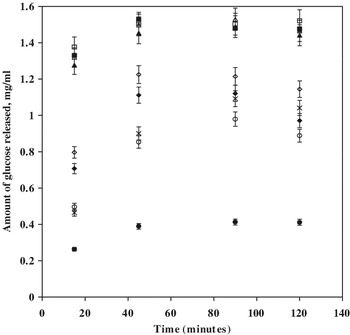
The rate of α-amylase hydrolysis for all wheats followed two distinct phases (Figure 4): an initial rapid phase with a subsequent slow phase. The rate and extent of hydrolysis of native starch granules from raw hard and soft wheat was identical. The rate at which reducing sugar was released from micronised wheats was higher than that from raw wheat and depended on the level of cook. For example, after 15 min incubation, the amounts of released sugar from Low Cook and High Cook wheats were approximately 0.30 and 0.40 of the total starch compared to 0.15 of the unprocessed wheats. However, the amount of reduced sugar released from micronised hard and soft wheat samples was found not to differ for the same cooking conditions and incubation times.
In vitro digestibility, as measured by the enzymatic release of glucose from the hard and soft wheat flours used in Trials 1 and 2 (closed circle: R/SW; open circle: M/SW/LC; closed lozenge: M/SW/HC; cross: M/HW/LC; open lozenge: M/HW/HC; closed square: E/SW/L-SME; open triangle: E/SW/H-SME; open square: E/HW/L-SME; closed triangle: E/HW/H-SME; n = 3).
Trial 2
Structure of extruded wheat starches
In contrast to raw and micronised wheats, the polarised optical micrographs of starch granules of all extruded wheat samples did not show ‘Maltese Crosses’ and were similar, regardless of the extrusion conditions (Figure 1b). The X-ray diffractograms of extruded wheats were identical, regardless of the SME. They showed no identifiable A-type diffraction patterns that are generally typical of raw wheat starch (Figure 2). This was indicative of the amorphous structure of the extruded samples. No crystallinity was identified using DSC and no ΔH value could therefore be calculated for these samples.
Hydration properties of raw and micronised wheat flours
The RVA pasting profiles of extruded wheats were significantly different from those of raw and micronised samples since a clear cold swelling peak was identified immediately upon having immersed the extruded samples in excess water at ambient temperature (25°C; Figure 3). The cold swelling peaks were identical for hard and soft wheats, but were largely influenced by the SME conditions used during extrusion, as indicated by the higher peaks observed for samples processed at low SME compared to high SME. No gelatinisation peak was identified in the pasting profiles of extruded samples, and the end viscosities of the extruded pastes was 6 to 10 times lower than those of their raw counterparts.
WSI was elevated for all extruded samples and varied in the following order: E/HW/L-SME (18.4 ± 0.6%) < E/SW/L-SME (23.5 ± 2.5%) < E/HW/H-SME (27.8 ± 0.9%) < E/SW/H-SME (43.5 ± 0.4%). Their WAI were greater than those of raw wheat (1.9 to 2.1 g/g), with values for E/HW/H-SME (9.0 ± 0.2 g/g), E/HW/L-SME (10.6 ± 0.2 g/g) and E/SW/L-SME (10.6 ± 0.6 g/g) being about twice higher than that for E/SW/H-SME (4.5 ± 0.1 g/g).
In vitro digestibility
The rate at which reducing sugar was released from extruded wheats was more rapid than for both raw and micronised samples. This was indicated by the immediate release (i.e. less than 5 min) of 0.8 of the estimated maximum possible level of glucose from these samples. No difference between wheats of different endosperm texture and between processing conditions was identified.
In vivo responses of weaned piglets to processed wheat diets
Trial 1
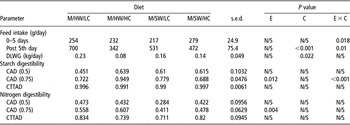
Piglet responses to the micronised wheat-based diets used in Trial 1 are shown in Table 4. For the initial 5 days of the trial, there was no significant effect of either wheat endosperm texture or level of cook on FIs. However, a significant dietary interaction between these two factors was apparent over this period of time (P = 0.018) with animals fed the M/SW/HC dietary combination exhibiting the highest FIs and those on the M/SW/LC diet having the lowest. Intakes after day 5 were unaffected by wheat endosperm texture, although the amount of cook was highly significant with pigs on LC micronised diets having significantly greater intakes than those fed an HC micronised diet (616 v. 407 g/day; P < 0.001). A highly significant interaction between endosperm texture and cook level was also observed with piglets fed the M/HW/LC diet exhibiting the highest intakes of all animals (P = 0.010). There was no observed effect of wheat endosperm texture on DLWG values, although there was a significant difference between cook levels (low cook 0.19 v. 0.11 kg/day; P = 0.022). There was no interaction between wheat endosperm texture and cook level.
Effect of wheat endosperm texture and severity of micronisation regime on mean piglet responses
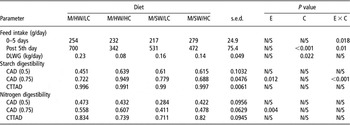
M/SW/LC = Soft Wheat/Low Cook; M/SW/HC = Soft Wheat/High Cook; M/HW/LC = Hard Wheat/Low Cook; M/HW/HC = Hard Wheat/High Cook.
n = 10 pigs per diet; N/S = P > 0.05.
E = endosperm effect; C = cook level effect; E × C = endosperm × cook level.
The coefficient of apparent digestibility (CAD) of starch in the small intestine was significantly affected by intestinal region, with CAD values increasing from the mid to the distal section (P < 0.001). CAD in the 0.5 region of the small intestine was unaffected by endosperm texture or cook level, and no interaction was found between these two factors. In the 0.75 region, a highly significant effect of diet was found (P < 0.001) with highest CAD values for starch seen in animals on the M/HW/HC diet. Level of cook was found to have no significant effect on apparent starch digestion at the 0.75 region; however, higher coefficients were found for wheat of hard endosperm texture in this part of the tract, compared to soft wheat (0.835 v. 0.734; P = 0.012). The coefficient of total tract apparent digestibility (CTTAD) for starch for all animals was found to be at least 0.99 and no significant effect of either diet or collection period was observed. CAD for nitrogen was unaffected by either wheat endosperm texture or cook level within the 0.5 region of the small intestine. However, at the 0.75 intestinal site, a significant effect of endosperm texture revealed higher CAD values for nitrogen for a diet based on hard endosperm wheat, compared to one containing soft endosperm wheat (0.583 v. 0.445; P = 0.004). CTTAD for nitrogen over the total tract was unaffected by either wheat endosperm texture or cook level. Molar proportions of acetic, propionic, n-butyric, iso-butyric, iso-valeric and valeric acids within the caecum were not significantly affected by either endosperm texture or micronisation cook level, and no interaction was found between these two factors (data not shown). Assessments of faecal consistency were undertaken but no effects of treatment were observed.
Trial 2
Effect of wheat endosperm texture
Animal responses are shown in Table 5. For the initial 5 days of the study, piglets fed a diet based on hard endosperm wheat exhibited significantly greater intakes than animals fed a soft wheat diet (P = 0.017). This significant dietary effect on FI was no longer apparent after 5 days (P = 0.175) and DLWG was similar between the groups fed wheat extruded at high SME (P = 0.588) over the experimental period. CAD for starch at the 0.5 region was significantly greater (P = 0.001) for piglets fed a diet based on soft endosperm wheat. Apparent starch digestibility was not influenced by diet at the 0.75 site and CTTAD values for starch were unaffected by treatment groups. CAD for nitrogen at the 0.5 and 0.75 regions of the small intestine, along with CTTAD, were unaffected by dietary treatment. The caecal data revealed no significant effect of wheat endosperm texture on the molar proportions of volatile fatty acids (VFAs) studied (data not shown).
Effect of wheat endosperm texture and severity of extrusion regime on mean piglet responses

R/SW = Raw Soft Wheat; E/SW/L-SME = Soft Wheat/Low SME; E/SW/H-SME = Soft Wheat/High SME and E/HW/H-SME = Hard Wheat/High SME.
n = 10 pigs per diet; N/S = P > 0.05.
Effect of level of cook (extrusion)
Piglet responses are shown in Table 5. Throughout the duration of the trial, average FIs were greater for the pigs fed the raw soft wheat diet than for animals given a diet containing extruded soft wheat (0 to 5 days, P < 0.001; after 5 days, P = 0.001). Average DLWG was also significantly greater for piglets fed the raw soft wheat diet (P = 0.048). Extruding the wheat significantly improved CAD for starch at both the 0.5 and 0.75 regions of the small intestine (P = 0.017 and P = 0.009, respectively), compared with animals on the raw wheat diet. However, when analysed over the total tract, CTTAD for starch was not significantly affected by dietary treatment although there was a trend (P = 0.071) for digestibility to increase in response to severity of extrusion. CAD for nitrogen was not affected by diet, regardless of the region of the small intestine sampled. CTTAD for nitrogen were not significantly different between treatment groups (P = 0.116). Similarly there were no clear patterns in caecal VFA data between dietary treatments (data not shown). Assessments of faecal consistency revealed no effect of dietary treatment.
Discussion
Effect of endosperm texture
The partial loss of the starch semi-crystalline structure in soft wheat when micronised under high cook conditions, but not under low cook conditions, indicated the possible importance of endosperm texture in micronisation, although this did not seem to be reflected in the piglet data. The significance of endosperm texture of cereals during micronisation has already been reported for sorghum (Hinders and Eng, Reference Hinders and Eng1970; Rusnak et al., Reference Rusnak, Chou and Rooney1980). The higher degree of starch conversion in soft wheat during micronisation was further supported by the DSC data. The increases in end viscosities in the pasting profiles of hard wheat following micronisation was unusual, although it might have promoted the formation of gluten coating at the surface of the granules, making them more resistant to water infiltration and diffusion.
The identical surface area (21 ± 2.8 and 21 ± 3.4 mm2; n = 500) strongly suggested that the difference in sensitivity to micronisation between the two wheats had been a genuine feature of their endosperm characteristics. Principle differences between hard and soft wheat include the presence of friabilin (composed of puroindoline a and b proteins; Jolly et al., Reference Jolly, Rahman, Kortt and Higgins1993), in a higher amount in soft wheat than in hard wheat. The ‘anti-adhesive’ properties of friabilin weaken the link between the starch and protein layer, and the endosperm cells (which are more closely packed in hard wheat; Hoseney, Reference Hoseney1994). These characteristics of hard wheat are known to act as barriers to water molecules reaching the starch granules, and may therefore explain the differences in sensitivity to micronisation between the two wheats. The higher sensitivity of soft wheat to oven cooking has already been reported using DSC (Turhan and Gunasekaran, Reference Turhan and Gunasekaran2002). However, the current study is the first to provide evidence of the possible higher sensitivity of soft wheat to micronisation, although this will need to be confirmed.
From an economic perspective, a better understanding of how cereal starches are affected by micronisation is essential since infrared-sensitive soft wheat may require lower heat and duration of processing to achieve similar cooking levels than less-sensitive hard wheat. That the degree of disruption of starch granules and the hydration characteristics following extrusion were identical for both wheats, but that the hydration properties had been dependent on the SME used during processing, may indicate that the choice of SME (and possibly of other extrusion variables) may be more important considerations when extruding wheat than endosperm texture.
Effect of micronisation
Micronisation only had a minor influence on animal performance when compared to raw wheat. This assumption is supported by the in vitro comparative assessment of the raw and micronised wheat samples, which indicated little disruption caused by micronisation to the structure and hydration properties of the wheats. Thus, the observation of undisturbed ‘Maltese Crosses’ under the polarised optical microscope and the complete A-type diffraction patterns depicted in the X-ray diffractograms for all raw and micronised wheats (except M/SW/HC) provided a semi-quantitative indication that micronisation under the present experimental conditions had not challenged the semi-crystalline starch structure.
Analysis of the hydration properties of the micronised wheats supported the observation that little disruption had been caused to starch granules during micronisation. Indeed, the absence of a cold swelling peak in the RVA pasting profiles of all micronised samples demonstrated that no swelling of granules occurred. In addition, the low WSI values indicated that little, if any, amylose had solubilised from the starch granules when immersed in excess water, implying that micronisation had failed to cause rupture of the starch granules within the wheat grains. This may have been due to a combination of the relatively low micronisation temperature and the low initial moisture content. However, to the best of our knowledge, the literature does not provide any circumstantial or direct evidence that micronisation can in actual fact ‘fracture’ starch granules within cereal grains, although such a claim has been made (Lawrence, Reference Lawrence1973). Clear evidence has, however, been provided that, for barley, significant kernel expansion can be caused by micronisation, when severe heating conditions (i.e. exit temperature >115°C) are applied (Fasina et al., Reference Fasina, Tyler, Pickard and Zheng1999), although barley may be more easily disrupted by micronisation than wheat (Zarkadas and Wiseman, Reference Zarkadas and Wiseman2001 and Reference Zarkadas and Wiseman2002).
Other explanations include the possible mobility of amylopectin chains within the starch granules during micronisation, inducing greater rigidity of amorphous regions, similar to annealing (Hoover and Vasanthan, Reference Hoover and Vasanthan1994). However, if real, the extent of this process was most probably low since it did not cause an increase in the onset temperature and/or in the gelatinisation enthalpy (as indicated by DSC), which are common effects of annealing on gelatinisation characteristics (Jacobs et al., Reference Jacobs, Eerlingen, Rouseu, Colonna and Delcour1998).
The selected micronisation variables appeared to affect piglet FI, but only after the initial 5 days following weaning. Although the data revealed a significant interaction between endosperm texture and cook level, dietary preference changed from the M/SW/HC diet (0 to 5 days) to the M/HW/LC diet (after 5 days). This change was most probably an indication of the highly variable voluntary FI of piglets during the immediate post-weaning period (Bark et al., Reference Bark, Crenshaw and Leibbrandt1986), and therefore probably not a feature of micronisation. Other biological responses revealed little, if any, significant effects of micronisation although DLWG was greater (P < 0.05) for the micronised low cook samples. This latter observation does not support findings of another study (Zarkadas and Wiseman, Reference Zarkadas and Wiseman2001) where micronisation temperatures did not affect piglet performance, regardless of the loss of crystallinity undergone by the starch component. Factors including animals used (age, live weight), type of cereal and formulation of the diets, type of microniser and micronising conditions may be responsible for these differences. One area of agreement, however, between the current study and that of Zarkadas and Wiseman (Reference Zarkadas and Wiseman2001) was that CTTAD values for nitrogen were not affected by micronisation cook level.
There was no dietary effect on starch digestibility in the 0.5 region of the small intestine, but for the 0.75 region the significant interaction between endosperm texture and cook level suggested that the M/SW/HC was the least well-digested of the analysed diets. Although starch digestion appeared to be nearly complete by the end of the large intestine (as reflected in the CTTAD values), with no difference between diets, there remained a significant proportion of undigested starch in the 0.75 region for all treatments (as indicated by the CAD values), except for the M/HW/HC, which was almost completely digested. The piglets may have been less sensitive to cook levels than the in vitro digestibility test, since the latter identified differences in the rate of starch hydrolysis and the amount of digested starch between cook levels. Further experiments are required using this in vitro test in order to determine the minimum differences that are required to become significant for the animal.
Although the in vitro analysis showed that soft wheat, micronised under high cook conditions, had been the most efficient processing scenario in Trial 1, it also strongly indicated that all wheat samples had essentially retained their original physicochemical properties in spite of having been micronised. This suggests that the differences in processing conditions had been too subtle for the piglets to be able to differentiate. This raises the important question of whether micronisation can be significantly beneficial to post-weaned piglets in a reproducible manner. Thus optimal micronising conditions that will disrupt the starch granules the most efficiently for inclusion in animal trials need to be established through in vivo animal responses and in vitro food science tests.
Effect of extrusion
In contrast to micronisation, extrusion involves a thermo-mechanical process combining the effect of high shear forces and temperature. Based on the extensive food science literature (Guha et al., Reference Guha, Ali and Bhattacharya1998; Sriburi and Hill, Reference Sriburi and Hill2000), it is evident that this thermo-mechanical treatment can cause significant changes through melting of crystallites, disruption of starch granules and macromolecular degradation of starch polysaccharides (van den Einde et al., Reference van den Einde, van der Goot and Boom2003). Thus, changes in starch properties during extrusion may also be reflected in the responses of animals fed extruded diets compared to raw diets.
The disparity concerning the effectiveness of extrusion processing in piglet studies (Hongtrakul et al., Reference Hongtrakul, Goodband, Behnke, Nelssen, Tokach, Bergstrom, Nessmith and Kim1998; Sauer et al., Reference Sauer, Mosenthin and Pierce1990; van der Poel et al., Reference van der Poel, Den Hartog, Van Stiphout, Bremmers and Huisman1990) is probably due to an insufficient assessment of the effects of processing on the dietary ingredients used. In addition, the lack of description of processing variables in the literature makes evaluation of the process difficult. Trial 2 was therefore designed to quantify the effects of specific extrusion variables on the physicochemical properties of wheats and to test whether these effects had a detectable influence on the nutritional value of the wheats when fed to newly weaned piglet diets.
In contrast to micronisation, which failed to damage extensively the structure of starch granules, the analysis of extruded wheat illustrated major disruption to the structure of the starch granules. For instance, the absence of ‘Maltese Crosses’ and the disappearance of A-type diffraction patterns in the X-ray diffractograms for all extruded samples indicated that extrusion had considerably damaged the semi-crystalline starch structure. Further evidence of a high degree of starch conversion was confirmed by the DSC data showing the complete absence of crystalline structures in the studied materials. Analysis of the hydration properties supported the structural findings. Indeed, the rapid formation of a cold swelling peak in the RVA pasting profiles of all extruded samples demonstrated the occurrence of immediate swelling of granules when immersed in excess cold water (implying that extruded wheat starch granules absorbed water rapidly upon immersion). The observation of a decrease in end viscosities in the pasting profiles of all extruded wheats when compared to those of raw and micronised wheats indicated that the pastes contained low molecular weight macromolecules, due to the depolymerisation of amylose and amylopectin molecules in starch caused by extrusion. Highly and rapidly solubilised extruded starch components are expected to undergo rapid enzymatic degradation, and in the current study these in vitro data related well to the higher in vivo starch digestibility values.
Piglets fed the extruded wheat diets consumed less feed than the animals fed the raw wheat diet. Performance appeared to suggest little beneficial effects of feeding piglets with extruded wheat rather than raw wheat, an observation that has been previously reported (Lynch and Zoccarato, Reference Lynch and Zoccarato1992). However, the major beneficial effect was that CAD for starch within the 0.5 and 0.75 regions of the small intestine was much higher for the extruded samples than for the raw and micronised samples. This was supported by the elevated WSI values of all extruded diets measured in vitro, which indicated the rapid solubilisation of low molecular weight starch macromolecules that had become rapidly available for amylolytic degradation. Further support was provided by the in vitro digestibility data, which revealed a significantly higher rate of hydrolysis for extruded wheat than for raw and micronised wheats.
The importance of carefully selecting processing parameters was highlighted in the extrusion data showing different extrusion variables (low v. high SME) and CAD of soft endosperm wheat. For instance, within the 0.5 region, there was a positive relationship between SME and starch digestibility. This difference, however, became insignificant in the 0.75 region. The higher digestibility coefficient found within the 0.5 region for the high SME diet suggests enhanced digestion and a more rapid release of starch, which appeared to be associated with a higher depolymerisation of the polysaccharides in starch granules. The lower cold swelling peak and end viscosity depicted in the RVA pasting profiles for wheats extruded at high SME indicated that a high extrusion regime had caused greater macromolecular breakdown of starch polysaccharides than low SME processing. Indeed a lower molecular weight is known to decrease the cold paste viscosity of the extrudate (Bindzus et al., Reference Bindzus, Fayard, van Lengerich and Meuser2002).
However, it is unclear whether a diet containing rapidly, in contrast to slowly, digestible starch is more beneficial for the piglet, although there is some evidence that the latter may lead to better overall performance in broiler chickens (Weurding et al., Reference Weurding, Enting and Verstegen2003). The use of processing could reduce the range of CAD for starch, in such a way that the more severe the processing method, the more uniform the coefficients obtained at each tract region (Figure 5). In addition, the current work showed that extrusion can significantly overcome (to a greater extent than micronisation) the reduction in starch digestibility commonly observed post-weaning (Figure 5). The rate of starch breakdown in the young piglet is an important area of interest, which may have implications in helping to alleviate the post-weaning growth check. This could be a particularly important and timely finding, in light of recent legislation within the European Union banning the inclusion of all antibiotic growth promoters at sub-therapeutic levels in animal feed. It is possible that benefits of processing on performance would have been apparent in the current trial had they been challenged with enterotoxigenic Escherichia coli (e.g. Wellock et al., Reference Wellock, Fortomaris, Houdijk and Kyriazakis2007) as is moderately common in the commercial sector. However, in the current trial there were no effects of treatment on the incidence of diarrhoea.
Effect of processing treatment of raw (cross symbol; data from White et al., 2008), micronised (open circle) and extruded (closed circle) wheat on in vivo apparent starch digestibility within the 0.5 region of the small intestine over 14 days post-weaning (error bars represent standard error of the mean values).

Conclusion
The extent to which starch digestibility within the small intestine of weaned piglets can be affected by the processing technique, and the severity of the regime used, demonstrated that the labelling of dietary ingredients as ‘cooked’ is wholly inadequate as a descriptor of their nutritional value. Moreover, precise processing variables (e.g. processing name, moisture content, temperature, SME, screw speed, drying conditions) must be stated in all animal trials involving the use of processed ingredients. The extent to which micronisation and extrusion can affect the structural and hydration properties of wheat starch is an important variable in all animal trials involving the use of processed ingredients. This variable can be controlled by carrying out a thorough in vitro assessment of all starchy ingredients, using well-established in vitro food science tests prior to their inclusion in animal diets.
For the conditions used extrusion, in contrast to micronisation, was found to disrupt drastically starch granules in wheat. Changes in the physicochemical properties of starch during processing were associated with improved CAD for starch digestibility. Although micronising or extruding wheat was not found to offer any benefit over unprocessed wheat with regard to CAD for nitrogen, processing often improved the CAD for starch at the 0.5 tract region, compared with animals fed an unprocessed wheat diet. More importantly, extrusion, and to a lesser extent micronisation, can lessen the reduction in starch digestibility on day 4 post-weaning, typically seen at the 0.5 intestinal region in piglets fed an unprocessed wheat diet.
Acknowledgements
This research was financially supported by ABNA Ltd, Frank Wright Ltd, Home-Grown Cereals Authority, Meat and Livestock Commission/British Pig Executive, Primary Diets Ltd and Provimi Ltd with match funding from Defra, through the Sustainable Livestock Production LINK programme.