Introduction
Obesity is arising as one of the most common health burdens in most countries, being associated to diseases such as type 2 diabetes, cardiovascular events or non-alcoholic fatty liver disease.Reference Guh, Zhang, Bansback, Amarsi, Birmingham and Anis1 The excessive body weight and fat mass accumulation is based mainly on the interaction between genetic background and inappropriate lifestyles, including physical inactivity and unhealthy dietary habits.Reference Abete, Navas-Carretero, Marti and Martinez2 The Developmental Origins of Health and Disease theory suggests that there are critical periods during the perinatal life in which maternal nutrition and other environmental factors can program changes in offspring metabolism and influence the susceptibility of metabolic disease at adult age.Reference Martinez, Cordero, Campion and Milagro3–Reference Blackmore and Ozanne5 Pioneer epidemiological studies in this area reported higher rates of obesity and chronic diseases in adult life for individuals born after the Second World War Dutch famine, when Dutch pregnant women dramatically decreased nutrient intake, thus affecting offspring normal development.Reference Roseboom, de Rooij and Painter6 Moreover, other maternal environmental cues could also affect intrauterine fetal growth or program offspring metabolism for later obesity. Thus, maternal stress originated by New York terrorist attacks has been related with lower weight at birthReference Ohlsson and Shah7 and maternal smoking during pregnancy with offspring obesity metabolic programming.Reference Behl, Rao and Aagaard8
A mouse model receiving an obesogenic diet during pregnancy and lactation showed alterations in the offspring’s DNA epigenetic profile, which is a potential key regulator of gene expression patterns.Reference Vucetic, Kimmel, Totoki, Hollenbeck and Reyes9 Methyl donors, molecules implicated in the one carbon metabolism pathway, could affect the DNA methylation processes.Reference Waterland, Travisano, Tahiliani, Rached and Mirza10 In this way, a study focused on maternal folic acid supplementation during pregnancy reported changes on liver gene expression profiles in adult rats.Reference Lillycrop, Phillips, Jackson, Hanson and Burdge11 Other investigation described that a methyl donor supplementation such as multivitamin mixture during pregnancy predisposed to an obesity phenotype when adult rats were fed an obesogenic diet.Reference Szeto, Das, Aziz and Anderson12 Furthermore, a cocktail including choline, betaine, folic acid and vitamin B12 prevented the transgenerational amplification of obesity by epigenetically silencing agouti transposon.Reference Waterland, Travisano, Tahiliani, Rached and Mirza10 Other studies reported a protective effect of a similar pro-methylation dietary supplement on obesogenic diet-related liver fat accumulation.Reference Cordero, Campion, Milagro and Martinez13, Reference Cordero, Gomez-Uriz, Campion, Milagro and Martinez14 These changes over genomic DNA, mainly cytosine methylation, are regulated by DNA methyltranferase (Dnmt) enzymes according to the availability of methylating compounds.Reference Ding, He, Liu, Chen, Long and Wang15
In this context, the rationale of this design was based on previous experiments that revealed a protective effect of methyl donor supplementation against hepatic steatosis in adult ratsReference Cordero, Gomez-Uriz, Campion, Milagro and Martinez14, Reference Cordero, Campion, Milagro and Martinez16 and the maternal programming induced by perinatal diet.Reference Zou, Arentson, Teegarden, Koser, Onyskow and Donkin4, Reference Lillycrop, Phillips, Jackson, Hanson and Burdge11, Reference Cordero, Gomez-Uriz, Milagro, Campion and Martinez17 Thus, we hypothesized that maternal obesogenic diet during lactation programs an obese phenotype and obesogenic diet response in adult offspring, while maternal methyl donor supplementation during the lactating period could prevent these features, mainly by affecting liver transcriptomic profile and regulating body and hepatic fat accumulation. Therefore, the aim of the study was to assess the responses to an obesogenic diet during adulthood depending on the maternal diet during lactation, particularly depending on the amount of fat and sucrose (HFS diet) and the dietary supply of methyl donors.
Methods
Animals and diets
In all, 32 female 12-week-old Wistar rats (initial body weight 255±5 g) supplied by the Applied Pharmacobiology Center (CIFA, Pamplona, Spain) were housed at 22°C with 12-hlight cycle (8am–8pm) and were mated with adult age-matched male Wistar rats (CIFA). In order to diminish parental genetic influences, all the initial female animals came from the same pool of litters, and all the male rats for mating were siblings between them. After delivery, excess pups in each litter were removed to keep eight pups per dam (four males and four females, when possible)Reference Faust, Johnson and Hirsch18 and mothers were re-assigned to four different dietary groups (Fig. 1): control diet (C, n=8); control diet supplemented with methyl donors (C-supp, n=8); high-fat-sucrose diet (HFS, n=8); and high-fat-sucrose diet supplemented with methyl donors (HFS-supp, n=8).Reference Cordero, Campion, Milagro and Martinez16 These groups were homogeneously adjusted by maternal pre-pregnancy weight and fat mass percentage, intrauterine number of pups, gestational weight gain and offspring weight at birth. Control diet groups were fed a standard chow diet (2014 Teckland Global 14% Protein Rodent Maintenance Diet; Harlan Iberica, Barcelona, Spain) containing 20% of energy as protein, 67% as carbohydrate and 13% as lipid, whereas HFS groups were fed an obesogenic diet (D12451; Research Diets, New Brunswick, NJ, USA) containing 20% of energy as protein, 35% as carbohydrates (17% as sucrose) and 45% as lipid. A methyl donor supplementation cocktail was added to C-supp and HFS-supp groups containing betaine (5 g/Kg diet; Sigma Aldrich, Saint Louis, MO, USA), choline (5.37 g/Kg diet; Sigma Aldrich), folic acid (5.5 mg/Kg diet; Sigma Aldrich) and vitamin B12 (0.5 mg/Kg diet; Sigma Aldrich) as previously described.Reference Cordero, Gomez-Uriz, Campion, Milagro and Martinez14, Reference Cordero, Campion, Milagro and Martinez16 Dams were fed ad libitum with these diets during 21 days of lactation and pups from the same litters were maintained with the same dams. After weaning, dams and female rats were sacrificed, and of a total of 127 male offspring, 96 were fed a control diet until 12 week of age. At this time, animals were weighed and total fat mass was measured. Then, the male offspring were randomly assigned to two dietary groups: control diet or HFS diet (n from 10 to 14 rats per group) generating eight different dietary groups (Fig. 1). Animals were fed ad libitum for 8 weeks and, at the end of the experimental period, total fat mass percentage was measured. After the dietary treatment, 12-h fasted animals were euthanized by decapitation: blood was collected and plasma was stored at −20°C. Liver, gastrocnemius muscle and adipose depots (mesenteric, retroperitoneal, epididymal and subcutaneous) were dissected, weighed and stored at −80°C for further analysis. All the procedures concerning animals were performed in agreement with the current National and Institutional guidelines of the Animal Care and the Use Committee at the University of Navarra (Pamplona, Spain).
Experimental model design. n=8 dams/experimental group during lactation. n from 10 to 13 animals per group of 20-week-old adult male offspring (c-C, maternal control diet with offspring control diet; c-HFS, maternal control diet with offspring HFS diet; c-supp-C, maternal control diet supplemented with methyl donors with offspring control diet; c-supp-HFS, maternal control diet supplemented with methyl donors with offspring HFS diet; hfs-C, maternal high-fat-sucrose diet with offspring control diet; hfs-HFS, maternal high-fat-sucrose diet with offspring HFS diet; hfs-supp-C, maternal high-fat-sucrose diet supplemented with methyl donors with offspring control diet; hfs-supp-HFS, maternal high-fat-sucrose diet supplemented with methyl donors with offspring HFS diet).

Total body, liver and muscle fat content
Total fat mass was measured by magnetic resonance using an EchoMRI analyzer (Echo Medical Systems, Houston, TX, USA), as previously described.Reference Nixon, Zhang and Wang19 Liver and gastrocnemius muscle fat content were also measured at the end of the dietary treatment with the EchoMRI analyzer with a specific adaptor for tissue samples scanning, as described by the manufacturer.
Plasma analysis
Total plasma cholesterol (Cholesterol-CP; ABX Diagnostics, Montpellier, France), HDL (high density lipoprotein) cholesterol (HDL direct-CP; ABX Diagnostics), triglycerides (Triglycerides; Randox Laboratories Ltd, Crumlin, UK) and free fatty acids (FFA) (NEFA-HR-2 kit; WAKO Chemicals GmbH, Neuss, Germany) were measured using an automated ABX Pentra C200 equipment according to manufacturer’s instructions (Horiba ABX Diagnostics). LDL (low-density lipoprotein) cholesterol levels were estimated by the Friedewald equation (LDLc=Total cholesterol−HDLc−TG/5).Reference Friedewald, Levy and Fredrickson20
RNA isolation and real-time qPCR
Liver RNA (n=8 for each experimental dietary group) was extracted using the QIAamp DNA and RNA mini Kit (Qiagen GmbH, Hilden, Germany), and quantified with a Nanodrop 1000 Spectrophotometer (Thermo & Scientific, DE, USA), as described elsewhere.Reference Desjardins and Conklin21 Each sample was treated with DNase using RNeasy Micro Kit (Qiagen GmbH) and retrotranscripted to cDNA with Ambion WT Expression Kit (Ambion, Carlsbad, CA, USA).
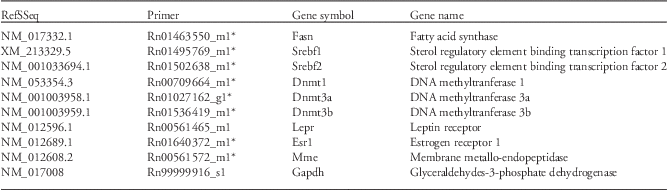
Quantitative real-time PCR was performed in triplicates using ABI PRISM 7900 HT fast real-time qPCR system (Applied Biosystems, Austin, TX, USA) and Taqman primers (Applied Biosystems) for Fasn, Srebf1, Srebf2, Dnmt1, Dnmt3a, Dnmt3b, Lepr, Esr and Mme were used (Table 1). Fold change between groups was calculated using the 2−ΔΔC t method.Reference Livak and Schmittgen22 cDNA integrity was checked with a 18 S probe and gene expression levels were normalized with respect to Gapdh amplification value from each sample.
Genes and primer references for quantitative real-time PCR
Statistical analyses
Results were expressed as means±standard error. The sample size was based on previous experiments about maternal perinatal nutrition.Reference Cordero, Gomez-Uriz, Milagro, Campion and Martinez17, Reference Paternain, de la Garza, Batlle, Milagro, Martinez and Campion23 Indeed, with the expected differences (d) and dispersion (SD) for such trials, a P<0.05 and a statistical power of 80%, the required number was six to seven animals per experimental group. Data were analyzed using one-way ANOVA test followed by minimal significant difference (DMS) post-hoc test, when applicable. In order to separately assess the influence of the maternal HFS diet, the effects of maternal supplementation with methyl donors, and the effects of the adult offspring response to the HFS diet according to maternal nutrition during suckling, analyses were devised ‘ad hoc’ to separately underline these issues. The significant probability was set at P<0.05. Spearman’s rank correlation test was also used for investigating the relation between the gene hepatic expression levels of the three epigenetic modulator measured (Dnmt1, Dnmt3a and Dnmt3b). All the statistical analyses were performed with SPSS 15.0 program for Windows (SPSS, Chicago, IL, USA).
Results
Effect of maternal HFS diet and supplementation with methyl donors during lactation
At 12 weeks of age, male offspring presented higher body weight (9%, P<0.01) and fat mass percentage (19%, P<0.001) when their mothers were fed the HFS diet during lactation compared with those from mothers fed the control diet (Fig. 2a and 2b). When male offspring were 20 weeks of age, the fat mass content was higher (21%, P<0.05) when dams were fed the HFS diet in comparison with those fed the control diet (Fig. 2b). However, there was an increase in plasma triglyceride levels in the hfs-supp-C group when compared with c-C and c-supp-C (29% and P<0.05 in both comparisons) (Table 2).
Control-fed male offspring body weight (a) and body fat mass (b) at 12 and 20 weeks of age depending on the maternal diet during lactation. Distinct letters indicate significant differences between groups from at least P<0.05 using a minimal significant difference post-hoc test after one-way ANOVA test. n from 10 to 13 animals per group (c-C, maternal control diet with offspring control diet; c-supp-C, maternal control diet supplemented with methyl donors with offspring control diet; hfs-C, maternal high-fat-sucrose diet with offspring control diet; hfs-supp-C, maternal high-fat-sucrose diet supplemented with methyl donors with offspring control diet).
Plasma lipid profile of 20-week-old control-fed male Wistar rats

HDL, high-density lipoprotein; LDL, low-density lipoprotein; c-C, maternal control diet with offspring control diet; c-supp-C, maternal control diet supplemented with methyl donors with offspring control diet; hfs-C; maternal high-fat-sucrose diet with offspring control diet; hfs-supp-C, maternal high-fat-sucrose diet supplemented with methyl donors with offspring control diet; DMS, minimal significant difference.
Different letters indicate significant differences between groups from at least P<0.05 using a DMS post-hoc test if applicable after one-way ANOVA test.
n from 10 to 13 animals per group.
Programming of offspring response to adult HFS diet by maternal diet during lactation
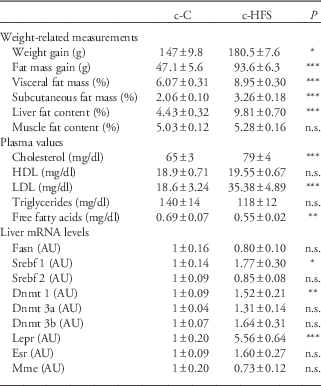
Those pups whose mothers were fed a chow diet showed higher body weight (23%, P<0.05) and fat mass gain (99%, P<0.001), visceral and subcutaneous fat mass content (47 and 58% respectively, P<0.001), and liver fat content (121%, P<0.001) when fed the HFS diet in adult life compared with those fed the control diet (Table 3). Regarding plasma biochemical measurements, the HFS diet in the adulthood increased total and LDL cholesterol levels (21 and 90%, respectively, P<0.001) and decreased FFA concentrations when compared with the offspring fed the control diet (−22%, P<0.01) (Table 3). Finally, the c-HFS group presented a significant increase in the gene expression levels of hepatic Dnmt1 (52%, P<0.01), Srebf1 (77%, P<0.05) and Lepr (556%, P<0.001) when compared with the c-C group (Table 3).
Weight-related meassurements, plasma values and hepatic mRNA levels of 20-week-old C and HFS-fed male offspring with mothers fed control diet
HDL, high-density lipoprotein; LDL, low-density lipoprotein; n.s., non-statistically significant; c-C, maternal control diet with offspring control diet; c-HFS, maternal control diet with offspring high-fat-sucrose diet; AU, arbitrary units.
Statistical analysis using Student’s t-test. n from 8 to 13 depending on the group and the variable.
*P<0.05; **P<0.01; ***P<0.001.
Adult HFS-fed animals resulted in higher body weight when the offspring was fed a HFS diet during lactation (16%, P<0.001 for c-HFS v. hfs-HFS and 15%, P<0.001 for c-supp-HFS v. hfs-supp-HFS) (Fig. 3a). This effect was independent of maternal methyl donor supplementation. Total body fat mass was increased due to maternal HFS, but this effect was only significant in the group with maternal supplementation (15%, P<0.05) (Fig. 3b). There was an interaction between maternal HFS and supplementation, because maternal supplementation resulted in an increased amount of visceral fat when combined with maternal HFS (23%, P<0.001), but not in combination with maternal C diet (Fig. 3c). In contrast, ectopic hepatic fat was reduced due to maternal supplementation combined with maternal HFS (−18%, <0.01), but supplementation did not affect hepatic fat under a maternal C diet (Fig. 3d). There were no effects of maternal nutrition on offspring subcutaneous and ectopic gastrocnemious muscle fat content.
Body weight (a) and body fat mass (b), visceral and subcutaneous adipose depots (c) and liver and gastrocnemius muscle fat mass (d) of high-fat-sucrose-fed 20-week-old mate Wistar rats. Different letters indicate significant differences between groups from at least P<0.05 using a minimal significant difference post-hoc test if applicable after one-way ANOVA test. n from 10 to 13 animals per group (c-HFS, maternal control diet with offspring HFS diet; c-supp-HFS, maternal control diet supplemented with methyl donors with offspring HFS diet; hfs-HFS, maternal high-fat-sucrose diet with offspring HFS diet; hfs-supp-HFS, maternal high-fat-sucrose diet supplemented with methyl donors with offspring HFS diet).
Adult HFS-fed animals whose mothers consumed c-suppl diet showed lower total (−15%, P<0.01) and LDL cholesterol levels (−39%, P<0.001) than those whose mothers were fed a control diet (Table 4). Plasma triglyceride levels were higher and HDL concentration lower by methyl donor supplementation in case of concurrent exposure to the HFS diet (32%, P<0.05 and −21%, P<0.01, respectively).
Plasma lipid profile of 20-week-old HFS-fed male Wistar rats

HDL, high-density lipoprotein; LDL, low-density lipoprotein; c-HFS, maternal control diet with offspring high-fat-sucrose diet; c-supp-HFS, maternal control diet supplemented with methyl donors with offspring high-fat-sucrose diet; hfs-HFS, maternal high-fat-sucrose diet with offspring high-fat-sucrose diet; hfs-supp-HFS, maternal high-fat-sucrose diet supplemented with methyl donors with offspring high-fat-sucrose diet; DMS, minimal significant difference.
Different letters indicate significant differences between groups from at least P<0.05 using a DMS post-hoc test if applicable after one-way ANOVA test.
n from 10 to 13 animals per group.
The maternal obesogenic diet decreased Dnmt1 (−27%, P<0.05) and Lepr (−56%, P<0.001) gene expression levels in liver when comparing c-HFS and hfs-HFS groups (Fig. 4b and 4c). However, methyl donor supplementation during lactation inhibited the expression of Lepr when the dams were fed a control diet, whereas Lepr was upregulated when the dams followed a HFS diet (Fig. 4c). Gene expression of Dnmt1, Lepr and Mme was significantly affected by maternal diet (Fig. 4). There was an interaction between maternal HFS and suppl in Dnmt1 and Lepr expression. Dnmt1 was reduced due to maternal HFS diet (−27%, P<0.05), but this effect was blunted due to maternal suppl. Maternal HFS reduced Lepr expression without maternal suppl (−56%, P<0.001), whereas maternal HFS with suppl increased Lepr expression (−61%, P<0.05). The supplementation of control-fed dams induced higher hepatic Mme mRNA levels than in those animals whose mothers were fed the HFS diet (101%, P<0.05). Interestingly, Dnmt1, Dnmt3a and Dnmt3b mRNA concentrations were positively correlated between them (r from 0.566 to 0.848, P<0.001) (Fig. 5).
Expression levels (mRNA) by real-time qPCR of genes related to DNA methylation homeostasis (a), lipid metabolism (b) and other obesity-related genes (c) in liver from 20-week-old male adult Wistar rats after high-fat sucrose (HFS) dietary intake depending on maternal nutrition during lactation. Different letters indicate significant differences between groups from at least P<0.05 using a minimal significant difference post-hoc test if applicable after one-way ANOVA test. n=8 animals per group (c-HFS, maternal control diet with offspring HFS diet; c-supp-HFS, maternal control diet supplemented with methyl donors with offspring HFS diet; hfs-HFS, maternal high-fat-sucrose diet with offspring HFS diet, hfs-supp-HFS; maternal high-fat-sucrose diet supplemented with methyl donors with offspring HFS diet).
Spearman’s correlation analysis between DNA methyltransferases hepatic expression levels in 20-week-old male Wistar rats in c-C, c-HFS, c-supp-HFS, hfs-HFS and hfs-supp-HFS groups, as measured by real-time qPCR. n=40 animals (AU, arbitrary units).
Discussion
Previous programming studies have shown detrimental effects of maternal obesogenic diet on metabolic health in later life, including increased incidence of obesity features and non-alcoholic fatty liver disease (NAFLD), the first hepatic manifestation of metabolic syndrome.Reference Zou, Arentson, Teegarden, Koser, Onyskow and Donkin4, Reference Blackmore and Ozanne5, Reference Cordero, Gomez-Uriz, Milagro, Campion and Martinez17 In addition, maternal methyl donor supplementation during perinatal periods has been previously described by Waterland et al.,Reference Waterland, Travisano, Tahiliani, Rached and Mirza10 being able to regulate agouti transposon expression by DNA methylation. Other studies have also described the regulation of hepatic gene expression and DNA methylation in offspring of dams supplemented with folic acid during pregnancy,Reference Lillycrop, Phillips, Jackson, Hanson and Burdge11 or alterations in fetal DNA methylation machinery depending on maternal choline intake.Reference Kovacheva, Mellott and Davison24 Furthermore, dietary depletion of these molecules, mainly choline and betaine, has been used to achieve animal models of NAFLD and advanced states of non-alcoholic steatohepatitis (NASH), cirrhosis and even hepatocellular carcinoma.Reference Hebbard and George25, Reference Starlard-Davenport, Tryndyak and Kosyk26 In contrast, dietary supplementation with methyl donors in adult animals protected against obesogenic diet-induced NAFLD.Reference Cordero, Campion, Milagro and Martinez13, Reference Cordero, Gomez-Uriz, Campion, Milagro and Martinez14, Reference Cordero, Campion, Milagro and Martinez16 Therefore, we hypothesized that supplementation of methyl donors in early life would protect against adverse programming effects on metabolic health of the adult offspring due to maternal HFS. In this context, the exposure of the dams to an obesogenic diet during lactation increased weight and fat mass in the adult offspring. A similar increase in adiposity has been previously described in mice whose mothers were fed a high fat diet.Reference Khan, Dekou and Douglas27 Until now, most of perinatal nutrition studies are focused on the in utero period. However, lactation time has been also described as a crucial stage of development with important implications for offspring growth and adult development.Reference Flynn, Alexander, Lee, Hutchens and Maric-Bilkan28, Reference Alzamendi, Castrogiovanni, Gaillard, Spinedi and Giovambattista29 This research was focused on the lactation period because, as well as pregnancy, it is one of the most important stages of development. Maternal nutrition and metabolism define milk characteristics, which during this period is the only source of nutrients until the start of independent feeding. Thus, maternal nutrition during lactation has a key role in metabolism and offspring programing.Reference Martinez, Cordero, Campion and Milagro3, Reference Flynn, Alexander, Lee, Hutchens and Maric-Bilkan28, Reference Palou, Priego, Sanchez, Torrens, Palou and Pico30 On the other hand, although there is a lack of exhaustive description of rat milk micronutrient analyses, data from USDA National Nutrient Database for Standard Reference described the presence in commercial milks of all the supplemented methyl donors used in this research.31 These substrates were supplied through maternal milk to the offspring since the very early period of nutrition, although the amount of methyl donors that is really absorbed by the offspring is not well known. At the moment, the offspring start to change from milk to solid food, they could have a double source of macro and micronutrients.
The most relevant result of the current research is that, when the maternal HFS diet was supplemented with methylating compounds, liver fat accumulation induced by adult offspring HFS diet was prevented. This hepatoprotective effect on lipid deposition of methyl donors administration has been previously described in adult Wistar rats.Reference Cordero, Campion, Milagro and Martinez13, Reference Cordero, Gomez-Uriz, Campion, Milagro and Martinez14 The current research demonstrates that methyl donor supplementation during suckling could protect against hepatic steatosis in adulthood when offspring are fed an obesogenic diet, being this effect dependent on maternal HFS diet intake. Thus, it could be hypothesized that the excess of fat that has not been ectopically stored in the liver, has been accumulated in the body’s natural storage site, mainly in the visceral adipose depots.Reference Perseghin32 In this way, Fabbrini et al. Reference Fabbrini, Magkos and Mohammed33 demonstrated that intrahepatic triglyceride content, but not visceral adipose tissue, is involved in some of the metabolic features associated with obesity. Thus, the prevention of liver fat accumulation could increase adiposity and obese phenotypes, but help to avoid some of the associated complications. This effect of methyl donor supplementation on the increase of visceral adipose depots could be attributed to an indirect effect on hepatic lipid-related metabolism or also by a direct effect on adipose tissue. In this way, a maternal deficit of methyl donors is associated with offspring weight reduction, steatosis and hepatic epigenomic deregulation of energy metabolism in rats.Reference Pooya, Blaise and Moreno Garcia34 On the other hand, maternal perinatal folic acid supplementation in mice was associated with increased offspring adipose tissue storages after adult offspring obesogenic feeding, which was linked with changes in adipose tissue adiponectin DNA methylation patterns, as well as transcription and secretion to plasma.Reference Huang, He, Sun, He, Li and Sun35 Such data partially fulfilled our hypothesis, since we were able to evidence that the protective effect of the methyl donor supplementation against liver fat accumulation could be mediated by perinatal nutrition, but we did not demonstrate a global protective effect against obesity due to the increase of the adipose tissue fat stores.
Concerning plasma biochemical features, maternal obesogenic diet during lactation in rats has been previously associated with the absence of changes in total cholesterol, HDL cholesterol, triglycerides or FFA in male and female offspring.Reference Alzamendi, Castrogiovanni, Gaillard, Spinedi and Giovambattista29, Reference Huang, He, Sun, He, Li and Sun35 However, although maternal diet and supplementation did not present changes separately, there was a synergistic effect between maternal diet and methyl donor supplementation in triglyceride plasma levels, which could be associated with higher adipose depots, but also with a maternal programing of plasma clearance by membrane transporters or with disorders in fatty acid oxidation pathway or in the synthesis of these substrates.Reference Wells36–Reference D’Alessandro, Oliva, Fortino and Chicco38 On the other hand, the intake of the HFS diet in adult rats induced a decrease of FFA, which is usual in control-fed rats in fasting conditions,Reference Palou, Priego, Sanchez, Torrens, Palou and Pico30 meanwhile total cholesterol levels were increased probably as a result of the higher LDL cholesterol concentration, as observed in other animal models of obesity.Reference Speakman, Hambly, Mitchell and Król39
Finally, both maternal obesogenic diet and the supplementation did not induce a clear pattern of changes in the offspring when fed a HFS diet during adulthood. Indeed, the effect of maternal control diet supplementation in the offspring cholesterol plasma profile when fed the HFS diet during adulthood seemed to be improved, which could be related with previous studies that demonstrated a choleretic effect of folic acid supplementation and the influence of this molecule on HMG-CoA reductase enzyme activity, implicated in cholesterol biosynthesis.Reference Ojeda, Delgado-Villa, Llopis, Murillo and Carreras40 But, surprisingly, there was a synergistic effect between maternal obesogenic diet and methyl donor supplementation with negative effects on HDL cholesterol and plasma triglyceride levels, which could be associated with higher amount of fat depots in which energy substrates are stored.Reference Speakman, Hambly, Mitchell and Król39 Furthermore, maternal obesogenic diet improved HDL cholesterol values when offspring were fed the obesogenic diet, suggesting a protective effect by maternal obesogenic intake that could be based on an adaptive programming against an adverse situation during early ages.Reference Wells36 This effect should be considered carefully and further studied in future experiments. Thus, as previously remarked, the cluster of changes concerning plasma biochemical profile is not clear and has to be carefully treated.
In this context, Srebf1 is a regulatory enzyme involved in lipid synthesis that is usually upregulated in the liver of rats fed a HFS diet,Reference Aragno, Tomasinelli and Vercellinatto41 which has also beendescribed in this study in the offspring of mothers that were fed a control diet. Unfortunately, although other studies have described a trend to increase in the mRNA levels of Srebf1 when combining HFS and methyl donor supplementation in adult male Wistar rats,Reference Cordero, Gomez-Uriz, Campion, Milagro and Martinez14 we did not find an effect of the maternal diet during lactation. In this sense, it must be taken into account that, although maternal environment could predispose to future offspring events, the direct influence of the offspring’ adult environment is usually more determinant. These data, together with the lack of expression changes in other genes related to lipid biosynthesis, such as Fasn and Srebf2,Reference Strable and Ntambi42, Reference Oliveira, de Jesús, Freire, Oliveira, Castro Lyra and Lyra43 suggest that the metabolic changes potentially programmed by the maternal perinatal environment in the offspring at hepatic level could modulate other metabolic pathways, such as those related with fatty acid oxidation, substrate uptake, and insulin secretion or resistance.Reference Koo37 Liver Dnmts promote DNA methylation processes and regulate gene expression patterns.Reference Majumder, Ghoshal and Datta44 Hence, Dnmt3a and Dnmt3b are the main enzymes implicated in de novo DNA methylation, while Dnmt1 maintains the cellular methylation profile.Reference Jurkowska, Jurkowski and Jeltsch45 Nutritional models using dietary depletion of methyl donors have reported an increase of hepatic Dnmt1 and Dnmt3a mRNA levels with no changes in Dnmt3b.Reference Gong, Pan and Chen46 We have found that the HFS diet during adult life slightly upregulates Dnmt1 in liver. This effect could be linked to an increase of hepatic fat accumulation, as a first step in the pathogenesis of NAFLD and evolution to NASH, cirrhosis and hepatocellular carcinoma.Reference Starley, Calcagno and Harrison47 However, obesity-related inflammation in adipose tissue is usually accompanied by an increased expression of Dnmt3a.Reference Kamei, Suganami and Ehara48 In this sense, one of the limitations in the study of epigenetic modifiers is that Dnmt expression levels are much higher in liver at perinatal stages than during adult life,Reference Lu, Cui, Gunewardena, Yoo, Zhong and Klaassen49 making easier to find differences in the mRNA profile at early stages, as previously described in animals with this diet at weaning.Reference Cordero, Milagro, Campion and Martinez50 It is also interesting to note that these three main epigenetic-related enzymes were strongly correlated between them, which suggests that the intake of a HFS diet during adult life stimulates DNA methylation processes in the liver. However, as a limitation of this study, the lack of global or specific DNA methylation analyses prevented to confirm that Dnmt expression changes were associated with DNA methylation changes.
Many animal models of obesity are based on specific mutations in Lepr.Reference Panchal and Brown51 Enhanced expression levels of Lepr could be related with increased values of leptin plasma levelsReference Garcia, Palou, Priego, Sanchez, Palou and Pico52 and be a consequence of obesity-induced leptin resistance. As leptin is mainly synthesized by the adipocytes, the increase in Lepr expression found in the group hfs-supp-HFS could be related with the higher amount of adipose depots.Reference Gomez-Ruiz, Milagro, Campion, Martinez and de Miguel53 Studies in mice have also described an increase of hepatic Lepr expression associated with an improvement of the NAFLD situation.Reference Tsuchiya, Ikeda and Ebata54 Furthermore, a previous experiment showed increased hepatic Lepr mRNA concentration in adult male rats fed a HFS diet as effect of methyl donor supplementation.Reference Cordero, Campion, Milagro and Martinez16 On the contrary, to explain the decrease of Lepr expression in the c-supp-HFS group in comparison with the c-HFS, it would be necessary to analyze leptin expression in different fat depots. In addition, lower expression of Lepr has been previously described in the hypothalamus of rodents whose mothers were fed a fructose-enriched diet during lactation.Reference Alzamendi, Castrogiovanni, Gaillard, Spinedi and Giovambattista29
We also studied Esr1 hepatic expression because it has been recently considered a marker of hepatocellular carcinoma and has been implicated in the epigenetic regulation of obesity.Reference Cordero, Campion, Milagro and Martinez16, Reference Tsiambas, Georgiannos and Salemis55 These previous studies have been focused on adult animals, which could explain the lack of changes observed with the maternal perinatal diet. Finally, Mme, also known as CD10 or neprilysin, is implicated in peptide degradation and has been associated with the Alagille Syndrome at hepatic level. This human genetic disease is characterised by liver damage and a decrease in liver Mme gene expression, which seems to be regulated by epigenetic mechanisms.Reference Byrne, Meara, Rayner, Thompson and Knisely56 In our study, the high deviation of the data could explain the lack of statistical changes for the main comparisons.
Although we have tried to control all the possible confounding factors in this transgenerational model, there could be some factors that limit this study, like the genetic background of the dams. Other limitation could be the lack of data from female animals, and a potential higher influence of one of the supplemented agents and lower of the other ones. Furthermore, type 1 and type 2 errors cannot be discarded. Finally, it is difficult to extrapolate the results of this experimental model to humans.
In conclusion, this study has evidenced the influence of maternal diet and methyl donor supplementation during lactation on the metabolic response of adult offspring. It was also highlighted that most of the phenotypic and biochemical differences between the offspring were found under the obesogenic diet stimulus during adulthood. Maternal perinatal programming was therefore focused on the response against an aggressive environmental factor. The main result of this study is that the dietary supplementation with methyl donors in lactating mothers fed an obesogenic diet reduced liver fat accumulation but increased adipose tissue mass in male adult offspring fed the obesogenic diet. Interestingly, complex interactions between maternal diet and methyl donor supplementation, and adult diet as well, were found in hepatic lipid metabolism-related genes and in Lepr gene expression. Finally, Dnmt gene expression alterations, as a result of adult and maternal obesogenic diet intake, could potentially implicate epigenetic processes controlling the liver transcriptome profile and metabolism.
Acknowledgments
Technical assistance of Veronica Ciaurriz, Jose Antonio Ayala and Ana Maria Gomez-Uriz is gratefully acknowledged, as well as Massimiliano Marinoni for the English corrections. Also, RETICS and CIBERobn schemes from Carlos III Institute are gratefully acknowledged.
Financial Support
This research was supported by the Linea Especial (University of Navarra; LE/97) and CIBERobn. Furthermore, Paul Cordero was supported by the Association of Friends of the University of Navarra fellowship.
Conflicts of Interest
None.
Ethical Standards
The authors assert that all the procedures concerning animals were performed in agreement with the current National and Institutional guidelines of the Animal Care and the Use Committee at the University of Navarra (Pamplona, Spain).