The focal article by Bergman and Jean (Reference Bergman and Jean2016) raises an important issue by documenting the underrepresentation of nonprofessional and nonmanagerial workers in industrial and organizational (I-O) research. They defined workers as, “people who were not executive, professional or managerial employees; who were low- to medium-skill; and/or who were wage earners rather than salaried” (p. 89). This definition encompasses a wide range of employee samples: from individuals working in blue-collar skilled trades like electricians and plumbers to police officers, soldiers, and call center representatives to low-skill jobs such as fast food, tollbooth operators, and migrant day workers. Because there is considerable variability in the pay, benefits, skill level, autonomy, job security, schedule flexibility, and working conditions that define these workers’ experiences, a more fine-grained examination of who these workers are is necessary to understand the scope of the problem and the specific subpopulations of workers represented (or not) in existing I-O research.
In this commentary we examined the samples included in the focal article and coded each in terms of a wide range of job, occupational, wage, sociodemographic, and family characteristics. This analysis provides a more nuanced understanding of who these workers really are, highlights the specific types of workers that are underrepresented in I-O research, and allows for a more pointed discussion of the implications of this underrepresentation for the work we do as I-O psychologists.
Method and Results
We obtained the original data from Bergman and Jean on the samples included in the focal article.Footnote
1
We reviewed the 67 articles from which the original 75 worker samples were derived and identified eight additional samples from those articles that were not included in the focal article analysis. This brought the total number of potential worker samples to 83. We first verified that each sample included at least some “workers.” Consistent with Bergman and Jean, we classified workers as individuals who held nonprofessional and nonmanagerial jobs and were characterized as blue collar, unskilled, or wage earners. If specific information was not provided, we examined contextual information such as education and/or the description of the job(s). This led to the exclusion of 12 samples, leaving us 71 worker samples from 58 published articles for further analysis.Footnote
2
Next, for each sample we indicated whether workers were the focal population (i.e., whether the research was designed to answer questions specific to the population under study).
Job and Wage Information
We coded for job type (mix of professionals/managers and workers, blue collar/skilled, unskilled), unionization, and temporary job/contract work. Building on the categories proposed by Bergman and Jean, we coded common occupational categories for U.S. wage earners (Bernstein, Reference Bernstein, Crouter and Booth2004). When this information was not specified in the article, the industry under study often provided clues. We also coded for organizational tenure, whether individuals held more than one job, full-time versus part-time status, shift work, and irregular work schedules (indicating a predictable vs. a variable or rotating schedule). Central to the definition of a worker is that individuals are in nonsalaried, wage paying jobs. Therefore, we coded average hourly wage and/or average annual earnings. We also attempted to classify samples in terms of whether or not they were low wage, based on the definition by the U.S. government (i.e., poverty level annual income, assuming a worker is supporting a family of four; HHS Poverty Guidelines, 2012; HHS Poverty Guidelines, 2013; HHS Poverty Guidelines, 2014).
Sociodemographic and Family Information
We coded for race/ethnicity, age, gender, modal education level, whether individuals held less than a 12th grade education, and the highest level of education reported. We also coded for immigrant status and English as a second language. Because family-related variables may influence total income available (i.e., spouse may work) and financial obligations (i.e., support for children and nonworking spouse), we coded for total household income, marital status, parental status, single parent status, and the average number of children.
Findings
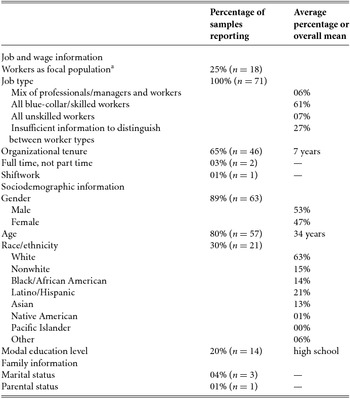
The percentage of samples reporting the information described above is shown in the second column of Table 1. For studies that included relevant data, the third column of Table 1 provides the average percentage (for categorical variables) or the overall mean (for continuous variables). Interestingly, none of the 71 samples provided information on the following sample characteristics: temporary/contract status, employees working more than one job, irregular work schedule, annual income, hourly wage, immigrant status, English as a second language, total household income, and single parental status.
Table 1.
Characteristics of Worker Samples in the Top Five I-O Psychology Journals From 2012–2014
As shown in Table 1, although some workers were included in all 71 samples, the research questions were framed to examine workers as the focal population in only 25% of these samples. With regard to job type, 61% of samples were all blue-collar/skilled trades workers, 7% were all unskilled workers, 6% were mixed samples of professionals and nonprofessional workers, and 27% of samples did not provide sufficient information on jobs to characterize skill level further (e.g., employees of a parts manufacturer, warehouse workers, employees of a university hospital). The most commonly reported occupational categories were customer service (18%), military (15%), and manufacturing (15%). Organizational tenure (M = 7 years) was reported in 65% of the studies, which as Bergman and Jean note, provides a rough index of job stability. Only seven of the samples provided information about full-time versus part-time work status, and one sample mentioned shift work. Although gender and age were commonly reported (89% and 80% of the samples, respectively), other sociodemographic information was not frequently reported. Race/ethnicity was included with only 30% of the samples, modal education level was included in 20% of the samples, marital status was reported for only three samples, and parental status was reported in only one sample.
Which Types of Workers Are Truly Underrepresented?
The basic conclusion reached in the focal article regarding the underrepresentation of workers in top I-O journals is supported by our further examination relevant samples. However, a deep dive into the sample characteristics of workers included in the Bergman and Jean article indicates that we actually know very little about the workers that we are studying. Surprisingly, neither earnings data (i.e., hourly wage, annual pay) nor job level were provided for a single sample (except for two samples of military personnel who were classified as low, middle, or high levels or officers vs. soldiers, and one sample of firefighters for which some employees were at the lieutenant level). Moreover, although education can provide valuable clues about worker skill and earning potential, this was not frequently reported and, perhaps more telling, when it was reported a high school degree or equivalent was most common.
This leads us to conclude that by lumping all nonprofessional workers together, Bergman and Jean may have underestimated the problem of underrepresentation of workers in I-O research. Our analysis indicates that the worker samples studied in I-O are actually closer to the low- to middle-skilled end of the worker spectrum and that the most neglected worker groups are lower wage unskilled workers, who are characterized by work that requires little to no training to perform (e.g., food preparation, dishwasher, farm worker, grocery bagger, day laborer). Unskilled workers make up a significant part of the labor market, making them a critical part of our economy. The lack of attention to the arguably unique needs of this large segment of the working population is a missed opportunity for I-O psychology to have a positive impact on their quality of work life and to influence social policies for this large and vulnerable segment of the workforce.
Weaknesses and Opportunities
The general failure to provide detailed information on worker samples represents a critical omission, which in turn affects the generalizability of our findings and the confidence we can place in theoretical models used to study workers. There are many subgroups within the worker population (e.g., skilled and blue-collar workers, minimum wage earners, low-income workers), who may have qualitatively different work experiences. For example, lower skilled jobs, like food preparation, are often characterized by repetitive, routinized tasks, low variety, high physical and emotional labor demands, and little discretion over how and when the work is completed. By contrast, skilled blue-collar jobs such as plumbers are characterized by more interesting work, and such jobs typically allow more flexibility and autonomy in how the work is performed. Across nonprofessional jobs there is also a great deal of diversity in job demands, including physical working conditions, safety, job security, and job stress, as well formal benefits and resources available to cope with those demands. In addition, beyond the work context, family and nonwork contextual variables can tell us much about the worker experience. For instance, relatively skilled teenagers from high income families may enter the labor force and begin at minimum wage, but their opportunities for advancement and work challenges differ from those of a single parent who is the sole breadwinner for their low-income family and earning minimum wage. By ignoring these differences, we fail to appreciate how sample characteristics affect many worker outcomes.
Recommendations for Reporting
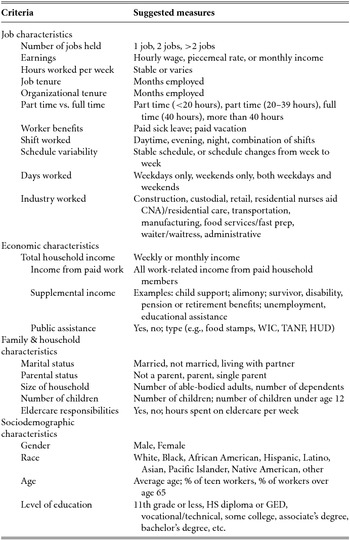
On the basis of our findings, we suggest that researchers interested in understanding workers should engage in better sample reporting in terms of job, economic, family and household, and sociodemographic characteristics (see Table 2). More specifically, we cannot rely on broad variables such as industry or job family to make inferences about the work that individuals do; more specific information is needed about the actual work itself. We also cannot make assumptions about whether workers in a particular industry are in low wage jobs. As an illustration, in the construction industry someone could be a foreman (manager), shift supervisor (low level manager), plumber or electrician (skilled craftsman), or manual laborer (often immigrants). We recommend reporting both the job level and job type, where job level is defined along a continuum of managerial to subordinate and job type is defined along a continuum of skilled to unskilled. Just as professional employees may be entry level, intermediate, middle managers, upper level managers, or executives, nonprofessional workers may also be defined along a continuum of job types and levels, including entry level unskilled to intermediate skilled work, where skilled workers are paid more for their experience and expertise. Whenever relevant, working conditions should also be reported to provide greater context.
Table 2.
Suggested Reporting Criteria for Worker Samples
Finally, we are struck by the fact that no studies included information about the broader family context, including variables related to household income and number of dependents. This is an important omission because financial variables can influence one's ability to cope with life's challenges. In addition, household income and family characteristics are important to consider when studying workers because many families have two wage earners, and family size is related to financial need.
Implications for the Field of I-O and for Society
One issue we must decide on is whether studying workers, and particularly low-income workers, is within the purview of I-O psychology. Historically fields outside of our own (e.g., sociology, social work) have focused on these workers. However, we contend that I-O psychologists can play an important role in helping organizations and policy makers understand the importance of investing in and supporting these workers. This is in line with President Obama's executive order Using Behavioral Science Insights to Better Serve the American People, which was passed in September 2015 and which encourages applied psychologists and other behavioral scientists to “play a role in the identification of policies, programs, and operations where applying behavioral science insights may yield substantial improvements in public welfare, program outcomes, and program cost effectiveness” (Executive Order No. 13,707, 2015). It is encouraging that the Society for Industrial and Organizational Psychology (SIOP) is well represented on the president's appointed committee, and we hope that this is an indication that SIOP is committed to becoming a stronger advocate for all American workers.
In conclusion, despite making up a large segment of the U.S. workforce, we know very little about worker populations. When we do study these workers, such little information is provided that it is difficult to draw firm conclusions about their unique needs, their challenges, and the factors that may improve quality of work life. Better representing the U.S. workforce in our research is an essential step to bridging this gap and improving life for all U.S. workers.





The focal article by Bergman and Jean (Reference Bergman and Jean2016) raises an important issue by documenting the underrepresentation of nonprofessional and nonmanagerial workers in industrial and organizational (I-O) research. They defined workers as, “people who were not executive, professional or managerial employees; who were low- to medium-skill; and/or who were wage earners rather than salaried” (p. 89). This definition encompasses a wide range of employee samples: from individuals working in blue-collar skilled trades like electricians and plumbers to police officers, soldiers, and call center representatives to low-skill jobs such as fast food, tollbooth operators, and migrant day workers. Because there is considerable variability in the pay, benefits, skill level, autonomy, job security, schedule flexibility, and working conditions that define these workers’ experiences, a more fine-grained examination of who these workers are is necessary to understand the scope of the problem and the specific subpopulations of workers represented (or not) in existing I-O research.
In this commentary we examined the samples included in the focal article and coded each in terms of a wide range of job, occupational, wage, sociodemographic, and family characteristics. This analysis provides a more nuanced understanding of who these workers really are, highlights the specific types of workers that are underrepresented in I-O research, and allows for a more pointed discussion of the implications of this underrepresentation for the work we do as I-O psychologists.
Method and Results
We obtained the original data from Bergman and Jean on the samples included in the focal article.Footnote 1 We reviewed the 67 articles from which the original 75 worker samples were derived and identified eight additional samples from those articles that were not included in the focal article analysis. This brought the total number of potential worker samples to 83. We first verified that each sample included at least some “workers.” Consistent with Bergman and Jean, we classified workers as individuals who held nonprofessional and nonmanagerial jobs and were characterized as blue collar, unskilled, or wage earners. If specific information was not provided, we examined contextual information such as education and/or the description of the job(s). This led to the exclusion of 12 samples, leaving us 71 worker samples from 58 published articles for further analysis.Footnote 2 Next, for each sample we indicated whether workers were the focal population (i.e., whether the research was designed to answer questions specific to the population under study).
Job and Wage Information
We coded for job type (mix of professionals/managers and workers, blue collar/skilled, unskilled), unionization, and temporary job/contract work. Building on the categories proposed by Bergman and Jean, we coded common occupational categories for U.S. wage earners (Bernstein, Reference Bernstein, Crouter and Booth2004). When this information was not specified in the article, the industry under study often provided clues. We also coded for organizational tenure, whether individuals held more than one job, full-time versus part-time status, shift work, and irregular work schedules (indicating a predictable vs. a variable or rotating schedule). Central to the definition of a worker is that individuals are in nonsalaried, wage paying jobs. Therefore, we coded average hourly wage and/or average annual earnings. We also attempted to classify samples in terms of whether or not they were low wage, based on the definition by the U.S. government (i.e., poverty level annual income, assuming a worker is supporting a family of four; HHS Poverty Guidelines, 2012; HHS Poverty Guidelines, 2013; HHS Poverty Guidelines, 2014).
Sociodemographic and Family Information
We coded for race/ethnicity, age, gender, modal education level, whether individuals held less than a 12th grade education, and the highest level of education reported. We also coded for immigrant status and English as a second language. Because family-related variables may influence total income available (i.e., spouse may work) and financial obligations (i.e., support for children and nonworking spouse), we coded for total household income, marital status, parental status, single parent status, and the average number of children.
Findings
The percentage of samples reporting the information described above is shown in the second column of Table 1. For studies that included relevant data, the third column of Table 1 provides the average percentage (for categorical variables) or the overall mean (for continuous variables). Interestingly, none of the 71 samples provided information on the following sample characteristics: temporary/contract status, employees working more than one job, irregular work schedule, annual income, hourly wage, immigrant status, English as a second language, total household income, and single parental status.
Characteristics of Worker Samples in the Top Five I-O Psychology Journals From 2012–2014
Note. We used the total number of worker samples (N = 71) to determine percentages. Percentages may not equal 100% due to rounding. Dashed line indicates insufficient information provided to compute an average.
a Indicates that the research was framed to answer questions specific to worker populations.
As shown in Table 1, although some workers were included in all 71 samples, the research questions were framed to examine workers as the focal population in only 25% of these samples. With regard to job type, 61% of samples were all blue-collar/skilled trades workers, 7% were all unskilled workers, 6% were mixed samples of professionals and nonprofessional workers, and 27% of samples did not provide sufficient information on jobs to characterize skill level further (e.g., employees of a parts manufacturer, warehouse workers, employees of a university hospital). The most commonly reported occupational categories were customer service (18%), military (15%), and manufacturing (15%). Organizational tenure (M = 7 years) was reported in 65% of the studies, which as Bergman and Jean note, provides a rough index of job stability. Only seven of the samples provided information about full-time versus part-time work status, and one sample mentioned shift work. Although gender and age were commonly reported (89% and 80% of the samples, respectively), other sociodemographic information was not frequently reported. Race/ethnicity was included with only 30% of the samples, modal education level was included in 20% of the samples, marital status was reported for only three samples, and parental status was reported in only one sample.
Which Types of Workers Are Truly Underrepresented?
The basic conclusion reached in the focal article regarding the underrepresentation of workers in top I-O journals is supported by our further examination relevant samples. However, a deep dive into the sample characteristics of workers included in the Bergman and Jean article indicates that we actually know very little about the workers that we are studying. Surprisingly, neither earnings data (i.e., hourly wage, annual pay) nor job level were provided for a single sample (except for two samples of military personnel who were classified as low, middle, or high levels or officers vs. soldiers, and one sample of firefighters for which some employees were at the lieutenant level). Moreover, although education can provide valuable clues about worker skill and earning potential, this was not frequently reported and, perhaps more telling, when it was reported a high school degree or equivalent was most common.
This leads us to conclude that by lumping all nonprofessional workers together, Bergman and Jean may have underestimated the problem of underrepresentation of workers in I-O research. Our analysis indicates that the worker samples studied in I-O are actually closer to the low- to middle-skilled end of the worker spectrum and that the most neglected worker groups are lower wage unskilled workers, who are characterized by work that requires little to no training to perform (e.g., food preparation, dishwasher, farm worker, grocery bagger, day laborer). Unskilled workers make up a significant part of the labor market, making them a critical part of our economy. The lack of attention to the arguably unique needs of this large segment of the working population is a missed opportunity for I-O psychology to have a positive impact on their quality of work life and to influence social policies for this large and vulnerable segment of the workforce.
Weaknesses and Opportunities
The general failure to provide detailed information on worker samples represents a critical omission, which in turn affects the generalizability of our findings and the confidence we can place in theoretical models used to study workers. There are many subgroups within the worker population (e.g., skilled and blue-collar workers, minimum wage earners, low-income workers), who may have qualitatively different work experiences. For example, lower skilled jobs, like food preparation, are often characterized by repetitive, routinized tasks, low variety, high physical and emotional labor demands, and little discretion over how and when the work is completed. By contrast, skilled blue-collar jobs such as plumbers are characterized by more interesting work, and such jobs typically allow more flexibility and autonomy in how the work is performed. Across nonprofessional jobs there is also a great deal of diversity in job demands, including physical working conditions, safety, job security, and job stress, as well formal benefits and resources available to cope with those demands. In addition, beyond the work context, family and nonwork contextual variables can tell us much about the worker experience. For instance, relatively skilled teenagers from high income families may enter the labor force and begin at minimum wage, but their opportunities for advancement and work challenges differ from those of a single parent who is the sole breadwinner for their low-income family and earning minimum wage. By ignoring these differences, we fail to appreciate how sample characteristics affect many worker outcomes.
Recommendations for Reporting
On the basis of our findings, we suggest that researchers interested in understanding workers should engage in better sample reporting in terms of job, economic, family and household, and sociodemographic characteristics (see Table 2). More specifically, we cannot rely on broad variables such as industry or job family to make inferences about the work that individuals do; more specific information is needed about the actual work itself. We also cannot make assumptions about whether workers in a particular industry are in low wage jobs. As an illustration, in the construction industry someone could be a foreman (manager), shift supervisor (low level manager), plumber or electrician (skilled craftsman), or manual laborer (often immigrants). We recommend reporting both the job level and job type, where job level is defined along a continuum of managerial to subordinate and job type is defined along a continuum of skilled to unskilled. Just as professional employees may be entry level, intermediate, middle managers, upper level managers, or executives, nonprofessional workers may also be defined along a continuum of job types and levels, including entry level unskilled to intermediate skilled work, where skilled workers are paid more for their experience and expertise. Whenever relevant, working conditions should also be reported to provide greater context.
Suggested Reporting Criteria for Worker Samples
Note. CNA = certified nursing assistant; WIC = Women, Infants, and Children; TANF = Temporary Assistance for Needy Families; HUD = Housing and Urban Development; HS = high school; GED = general education diploma.
Finally, we are struck by the fact that no studies included information about the broader family context, including variables related to household income and number of dependents. This is an important omission because financial variables can influence one's ability to cope with life's challenges. In addition, household income and family characteristics are important to consider when studying workers because many families have two wage earners, and family size is related to financial need.
Implications for the Field of I-O and for Society
One issue we must decide on is whether studying workers, and particularly low-income workers, is within the purview of I-O psychology. Historically fields outside of our own (e.g., sociology, social work) have focused on these workers. However, we contend that I-O psychologists can play an important role in helping organizations and policy makers understand the importance of investing in and supporting these workers. This is in line with President Obama's executive order Using Behavioral Science Insights to Better Serve the American People, which was passed in September 2015 and which encourages applied psychologists and other behavioral scientists to “play a role in the identification of policies, programs, and operations where applying behavioral science insights may yield substantial improvements in public welfare, program outcomes, and program cost effectiveness” (Executive Order No. 13,707, 2015). It is encouraging that the Society for Industrial and Organizational Psychology (SIOP) is well represented on the president's appointed committee, and we hope that this is an indication that SIOP is committed to becoming a stronger advocate for all American workers.
In conclusion, despite making up a large segment of the U.S. workforce, we know very little about worker populations. When we do study these workers, such little information is provided that it is difficult to draw firm conclusions about their unique needs, their challenges, and the factors that may improve quality of work life. Better representing the U.S. workforce in our research is an essential step to bridging this gap and improving life for all U.S. workers.