Introduction
The popularity of ecstasy (3,4-methylenedioxymethamphetamine; MDMA) seems to be slightly decreasing in both Western Europe and the USA (Compton et al. Reference Compton, Thomas, Conway and Colliver2005; Huisman, Reference Huisman2005; Nabben et al. Reference Nabben, Quaak and Korf2005), but ecstasy is still an extensively used recreational drug. Serious neurotoxic effects of ecstasy on the serotonin system have been shown in animals (Ricaurte et al. Reference Ricaurte, Yuan and McCann2000) and these effects were repeatedly confirmed in humans (Reneman et al. Reference Reneman, de Win, van den Brink, Booij and den Heeten2006). Since serotonin is involved in cognitive processes (Meneses, Reference Meneses1999), it is not surprising that many studies also revealed neuropsychological deficits in ecstasy users (Gouzoulis-Mayfrank & Daumann, Reference Gouzoulis-Mayfrank and Daumann2006a). The most consistent finding is a negative effect of ecstasy use on verbal memory. Also deficits in executive functions, visuospatial memory and visuospatial ability have been reported, but these findings are less consistent.
A problem in investigating the potential neurotoxic effects of ecstasy is that most ecstasy users are polydrug users (Fox et al. Reference Fox, Toplis, Turner and Parrott2001; Gouzoulis-Mayfrank & Daumann, Reference Gouzoulis-Mayfrank and Daumann2006b). Besides cannabis, also amphetamine and cocaine are commonly used by people using ecstasy (Pedersen & Skrondal, Reference Pedersen and Skrondal1999; van Ours, Reference van Ours2005), leaving open the question whether the observed cognitive deficits are attributable to the use of ecstasy, to other drugs, or to a combination of ecstasy and other drugs. Indeed, several studies have reported negative effects of cocaine or amphetamine on executive functioning, attention and memory (McKetin & Mattick, Reference McKetin and Mattick1998; Bolla et al. Reference Bolla, Rothman and Cadet1999). It has also been argued that neuropsychological deficits in ecstasy users are caused by cannabis rather than by ecstasy (Montgomery et al. Reference Montgomery, Fisk and Newcombe2005a). For example, two studies failed to find significant differences on cognitive tests between combined ecstasy–cannabis users and users of cannabis only, and both groups performed worse on verbal memory tests than non-using controls (Croft et al. Reference Croft, Mackay, Mills and Gruzelier2001; Dafters et al. Reference Dafters, Hoshi and Talbot2004). However, it has also been suggested that cannabis attenuates the effect of ecstasy (Parrott et al. Reference Parrott, Gouzoulis-Meyfrank, Rodgers and Solowij2004).
Although some studies tried to control for polydrug use (Fox et al. Reference Fox, Toplis, Turner and Parrott2001; Medina et al. Reference Medina, Shear and Corcoran2005), the question is still not settled because high correlations between the drug-use variables and the related problems of multicollinearity in the statistical analyses resulted in findings that were difficult to interpret (Montgomery et al. Reference Montgomery, Fisk and Newcombe2005a, Reference Montgomery, Fisk, Newcombe and Murphyb).
Therefore, the present study investigated the sustained effects (after at least 2 weeks of abstinence) of ecstasy use on cognition in a study population with such a variation in type and amount of drug use that correlations between the use of ecstasy and other substances were relatively low allowing a valid interpretation of the results of multiple linear regression models. Consistent with the literature, we hypothesized that high-dose ecstasy use has a significant negative effect on verbal memory, independent of the effects of the use of other substances. In addition, no clear hypotheses can be formulated about the effects of ecstasy on attention, working memory, visuospatial memory and visuospatial performance.
Method
The present study is part of the Netherlands XTC Toxicity (NeXT) study, a larger study investigating causality, course and clinical relevance of ecstasy neurotoxicity. A detailed description of the NeXT study can be found in a special design paper (de Win et al. Reference de Win, Jager, Vervaeke, Schilt, Reneman, Booij, Verhulst, den Heeten, Ramsey, Korf and van den Brink2005).
Participants and design
Between October 2002 and January 2005, 71 subjects (aged 18–35 years) were included. Recruitment took place by means of a combination of targeted site sampling at locations such as dance events, discotheques, youth fairs, universities, colleges and parks, advertisements on dance and drug-related Internet sites and in newspapers, and snowball sampling. We composed a single sample of subjects with varying histories of drug use, keeping correlations between the substances as low as possible, in order to be able to distinguish the effect of ecstasy from the effects of other drugs. Exclusion criteria were: a major systemic, neurological or neuropsychiatric disorder, the use of psychotropic medications that may influence cognitive functioning such as serotonin (5-HT) reuptake inhibitors, pregnancy, and the use of intravenous drugs. Subjects had to abstain from the use of psychoactive drugs for at least 2 weeks prior to examinations and from alcohol for at least 1 week prior to examinations. Drug use during the days before assessment was checked through urinalysis (enzyme-multiplied immunoassay for amphetamines, MDMA, opiates, benzoylecgonine, benzodiazepines, 11-nor-Δ9-THCCOOH, ethanol). Previous ecstasy use was checked through hair analysis (gas chromatography/mass spectroscopy).
After inclusion, all subjects underwent neuropsychological assessment. The examiner was blind to the type and amount of substance use of the subject. Lifetime use of ecstasy (number of tablets), cannabis (number of joints), amphetamines (number of occasions), cocaine (number of occasions), and use of alcohol (units/week) and tobacco (cigarettes/week) were assessed with substance-use questionnaires and the substance abuse scales of the Mini International Neuropsychiatric Interview for Diagnostic and Statistical Manual of Mental Disorders (DSM)-IV clinical disorders (Sheehan et al. Reference Sheehan, Lecrubier, Sheehan, Amorim, Janavs, Weiller, Hergueta, Baker and Dunbar1998). An estimate of verbal intelligence was made using the Dutch version of the National Adult Reading Test (Nelson & O'Connell, Reference Nelson and O'Connell1978), the Dutch Adult Reading Test (DART), as it is relatively insensitive to cognitive impairments caused by neurological disorders (Schmand et al. Reference Schmand, Bakker, Saan and Louman1991).
Subjects were paid for their participation (€100 or €150 per session depending on number of assessments). The study was approved by the local medical ethics committee. After complete description of the study, each subject gave written informed consent. Besides neuropsychological testing, the subjects underwent brain imaging; results of these studies will be described elsewhere.
Assessments
Attention, working memory and executive functioning
Paced Auditory Serial Addition Test (Gronwall, Reference Gronwall1977)
Subjects have to add numbers to a preceding number presented by a recorded male voice to a preceding number. Numbers are presented in two trials at a speed of 2.4 s and 1.6 s per digit respectively. The outcome parameter is the total number of correct calculations per trial (maximum 60 points each).
Digit span (Wechsler, Reference Wechsler1981; Lindeboom & Matto, Reference Lindeboom and Matto1994)
Subjects have to repeat a series of digits read aloud by the examiner, first in forward order, than in backward order. The outcome parameter is the number of correctly reproduced series of digits per order (maximum 21 each).
Verbal memory
A Dutch version of the Rey Auditory Verbal Learning Test (RAVLT) (Rey, Reference Rey1964; Van der Elst et al. Reference Van der Elst, Van Boxtel, Van Breukelen and Jolles2005)
Subjects have to memorize a series of 15 nouns in five learning trials. Immediate recall is tested after each trial. The outcome parameter is the sum of correctly reproduced words over five trials (maximum 75). Delayed recall and recognition are measured after 20 min. Outcome parameters are total number of correctly reproduced words (maximum 15) and the total number of incorrect words that are mentioned by the subject during the learning trials and the delayed recall trial (confabulations).
Visual memory
The Memory for Designs test (Graham & Kendall, Reference Graham and Kendall1960)
The original test with 14 geometrical figures was split into two separate tests to obtain two parallel versions. Also the mode of administration was adapted to mimic the RAVLT. After presentation of seven figures during 5 s each, subjects have to draw the figures from memory. This is repeated five times. The outcome parameter is the number of correctly reproduced elements in five learning trials (maximum 105). Delayed reproduction is measured after 15 min; the outcome parameter is the number of correctly reproduced elements (maximum 21).
Visuospatial functioning
The Mental Rotation Task (MRT) (Shepard & Metzler, Reference Shepard and Metzler1971)
Participants are presented with 20 pairs of block designs drawn from different points of view. They have to judge whether pairs of designs are identical or different. The outcome parameter is the total number of correct answers in 6 min (maximum 40).
A computerized and adapted version of the Judgment of Line Orientation (JoLO) (Benton et al. Reference Benton, Varney and Hamsher1978)
The JoLO requires subjects to identify which two of 11 lines presented in a semicircular array have the same orientation in a two-dimensional space as two target lines. The original JoLO was made more difficult to reduce its ceiling effect and to increase its sensitivity to brain dysfunction. The target lines in our assessments were only shown for 1 s, directly followed by the 11 lines. The outcome parameter is the number of correctly judged pairs of lines (maximum 30).
Statistical analyses
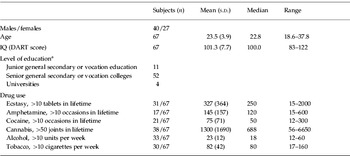
Drug-use variables were right-skewed, even after log-transformation. Also, self-report histories of drug use may be inaccurate and the amount of MDMA in ecstasy tablets varies. Therefore, substance variables were dichotomized using a cut-off score to maximize contrast between users and non-users of a particular drug. Table 1 shows cut-off values, frequency distributions, mean values and s.d. and median scores for the substance variables. The associations between the dichotomized substance-use variables were expressed as Phi statistics, and significance was tested using a χ2 test.
Demographics and classification of drug use (n=67)

s.d., Standard deviation; IQ, intelligence quotient; DART, Dutch Adult Reading Test.
a Junior, approximately 12 years of full-time education; senior, approximately 12–16 years of full-time education; university, approximately 20 years of full-time education (Central Bureau of Statistics, The Netherlands).
The effect of ecstasy on the outcome parameters was estimated with two different stepwise linear regression models. Model 1 concerned the upper bound estimate for the effect of ecstasy on cognition. In this model, the covariates gender, intelligence quotient (IQ) and age were entered in the first step, followed by ecstasy in the second step. The added effect of ecstasy was quantified as the R 2 change between the first and the second step. It should be noted, however, that the effect of ecstasy in the second step is likely to be an overestimation of the real independent effect of ecstasy on the neuropsychological outcome, due to a lack of correction for the potential effect of other drugs that were used. To assess whether ecstasy use had an effect on cognition independently of the effects of all other drugs, we used a second regression model (model 2) in which the first step involved the entering of all dichotomous substance-use variables other than ecstasy use, together with gender, IQ and age as covariates. In the second step ecstasy use was added to the model. Model 2 gives a lower bound estimate for the effect of ecstasy on cognition, adjusted for the effect of all other substances, gender, IQ and age. This second model probably results in an underestimation of the real independent effect of ecstasy, due to an overcorrection for the potential effects of other drugs correlated with the use of ecstasy. Potential collinearity problems were tested using the tolerance factor (TF) and the variance inflation factor (VIF).
To explore the dose–response relationship, correlation analyses were performed within the group of ecstasy users, with total amount of ecstasy use (log-transformed) and cognitive test parameters as variables, followed by partial correlations taking other substances, gender, IQ and age into account as potential confounders. In the same way the correlation between cognitive test parameters and time since last ecstasy tablet and duration of ecstasy use was analysed.
Analyses were performed using SPSS version 12.0.1 (SPSS Inc., Chicago, IL, USA). P values <0.05 were considered statistically significant. Mean values reported in the results and discussion sections are followed by their standard deviations.
Results
Sample characteristics and substance use
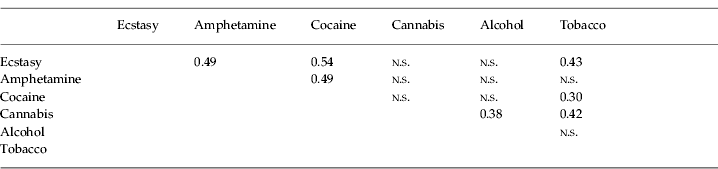
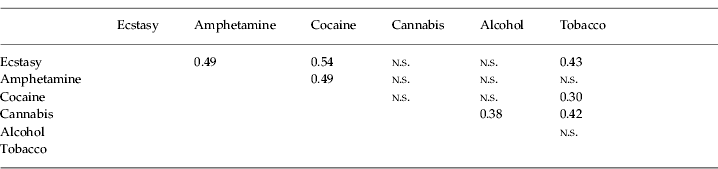
Two subjects were excluded because of dyslexia and attention deficit disorder; two subjects were excluded because they used ecstasy less than 2 weeks before assessment, leaving 67 subjects for analyses. Sociodemographic data of the total sample and patterns of drug use, including cut-off values for classification as ‘user’ of a specific drug, are presented in Table 1. No significant differences in age, gender and IQ were found between ecstasy users and non-ecstasy users (data not shown). Hair analysis confirmed past ecstasy use in 85% of the subjects. In almost all subjects that reported to be ecstasy-naive, results from hair analysis were congruent (96%). Last use of ecstasy was on average 8.7 (s.d.=9.9, range 2–46) weeks before examination. Duration of ecstasy use was on average 73.7 (s.d.=38.0, range 16–158) months. Although we aimed to keep the associations between the substances as low as possible, still some significant associations between the use of different substances were present (Table 2). However, because all associations were less than 0.55, multicollinearity was not a problem (TF 0.55–0.86, VIF 1.2–1.8), and it was decided that all substances could be entered separately into the different regression models. There were no significant correlations between substance use and demographic variables, except that there were more cigarette smokers in lower educated subjects (data not shown).
Association between the categorical drug variables (n=67)Footnote a
n.s., Non-significant.
a Correlations (Phi, Pearson χ2, p<0.05, two-tailed) between the dichotomized drug-use variables.
Neuropsychological testing
Ecstasy and cognition
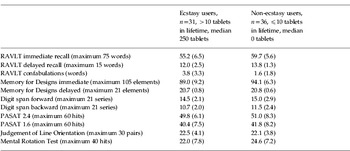
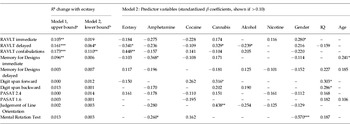
Table 3 shows the raw scores on all cognitive tests for ecstasy users and non-ecstasy users. Linear multiple regression analyses with neuropsychological test parameters as dependent variables showed that ecstasy use, adjusted for gender, age and IQ (model 1), was significantly associated with RAVLT immediate recall, delayed recall, confabulations, and Memory for Designs immediate reproduction. After adjusting for other substances (model 2), ecstasy use was still significantly associated with RAVLT delayed recall and confabulations, but not for RAVLT immediate recall and Memory for Designs immediate reproduction (Table 4). The ecstasy-related variance in RAVLT delayed recall, adjusted for gender, age and IQ (model 1), amounted to a maximum of 16.1% (F change=13.3, df=1, 62, p=0.001) of the total variance (upper bound); adjusted for other substances (model 2), ecstasy use accounted for at least 6.4% (F change=5.8, df=1, 57, p=0.02) of the total variance (lower bound). For RAVLT confabulations this was 17.3% (F change=13.9, df=1, 62, p<0.001) and 11.0% (F change=8.8, df=1, 57, p=0.004), respectively. The effect of ecstasy use on the other neuropsychological tests was not significant (see Table 4). Gender had no significant modifier effect on the results.
Cognitive performance (raw scores)

RAVLT, Rey Auditory Verbal Learning Test; PASAT, Paced Auditory Serial Addition Test.
Values are means (standard deviations).
Relationship between different drug use and neuropsychological performance (n=67)

IQ, Intelligence quotient; RAVLT, Rey Auditory Verbal Learning Test; PASAT, Paced Auditory Serial Addition Test; DART, Dutch Adult Reading Test.
a Model 1 (upper bound): R 2 Change with ecstasy as predictor, corrected for age, gender, DART-IQ.
b Model 2 (lower bound): R 2 Change with ecstasy, corrected for other substances, age, gender, DART-IQ.
* p<0.05, ** p<0.01, *** p⩽0.001.
Correlation analysis within the group of ecstasy users showed a significant negative correlation between amount of lifetime ecstasy use (log-transformed) and RAVLT delayed recall (r=−0.37, p=0.02, one-tailed). This association remained significant after adjusting for other substances, gender, age and IQ (r=−0.40, p=0.03, one-tailed). No significant correlation was found between the amount of ecstasy use and RAVLT confabulations. Also no significant correlations between abstention period of ecstasy or duration of ecstasy use with RAVLT delayed recall or confabulations were found.
Other substances and cognition
Amphetamine use had a significant negative effect on Memory for Designs immediate reproduction and the MRT. Cannabis use showed a significant positive effect on RAVLT delayed recall, Digit Span forward and JoLO (more cannabis use led to better results). When all combined cannabis–ecstasy users were excluded from the analysis, the positive effect of cannabis use on RAVLT delayed recall was not significant anymore [β decreased from 0.33 (p=0.02) to 0.24 (p=0.14)]. Alcohol use showed a significant negative effect on RAVLT delayed recall. No significant effects of cocaine and nicotine on the cognitive test parameters were observed.
Discussion
The objective of this study was to assess the sustained specific effects of ecstasy use on cognition independent of the use of other substances. Multiple regression analyses revealed that ecstasy independently accounted for a significant part of the variance in verbal memory test outcome: after correction for the potential effect of the use of other substances, ecstasy was still significantly and dose-related associated with verbal memory impairments, i.e. ecstasy users recalled fewer words and made more confabulation errors than non-users.
Both dose-related subjective experiences of memory impairment reported by ecstasy users (Parrott et al. Reference Parrott, Buchanan, Scholey, Heffernan, Ling and Rodgers2002; Rodgers et al. Reference Rodgers, Buchanan, Scholey, Heffernan, Ling and Parrott2003) and dose-related objective neuropsychological indicators of decreased verbal memory (Fox et al. Reference Fox, Toplis, Turner and Parrott2001; Gouzoulis-Mayfrank & Daumann, Reference Gouzoulis-Mayfrank and Daumann2006a) have repeatedly been reported in the literature. However, because most of the earlier investigations suffered from methodological problems due to inadequate control for polydrug use, until now the independent contribution of ecstasy to the decrease of cognitive performance remained unclear. A higher rate of confabulation errors in long-term ecstasy users compared with polydrug controls was also observed in one previous study (Fox et al. Reference Fox, Toplis, Turner and Parrott2001). Confabulation errors could be due to an incapacity to correctly evaluate the retrieved information and might imply a failure of memory control processes (Burgess & Shallice, Reference Burgess and Shallice1996; Fox et al. Reference Fox, Toplis, Turner and Parrott2001) or a failure in strategic retrieval (Moscovitch & Melo, Reference Moscovitch and Melo1997). Another explanation could be that confabulation errors are a consequence of impaired executive functioning, for example a lack of response inhibition. Unfortunately, the literature on executive problems in ecstasy users is inconclusive, reporting executive function deficits in some studies but not in others (Gouzoulis-Mayfrank & Daumann, Reference Gouzoulis-Mayfrank and Daumann2006a).
In the present study, cannabis users who were also using ecstasy showed a significant sustained positive effect on verbal memory. However, this effect was not present in ecstasy-naïve cannabis users. This finding is at odds with two other studies in ecstasy users, in which a negative effect of cannabis use was observed on memory and learning, suggesting that deficits found in ecstasy users were actually related to cannabis use (Croft et al. Reference Croft, Mackay, Mills and Gruzelier2001; Dafters et al. Reference Dafters, Hoshi and Talbot2004). However, in both studies the period of abstinence for cannabis was only 48 h, and therefore acute pharmacological effects (intoxication) could not be fully excluded, while this effect was excluded in the current study with a period of abstinence of at least 2 weeks. Since our study demonstrated opposing effects of ecstasy and cannabis on cognition, this may imply that cannabis attenuates the neurotoxic effects of ecstasy. It has been suggested that ecstasy and cannabis may have opposite effects on oxidative stress (Parrott et al. Reference Parrott, Gouzoulis-Meyfrank, Rodgers and Solowij2004). Ecstasy leads to increased oxidative stress, probably resulting in serotonergic neurotoxicity (Green et al. Reference Green, Mechan, Elliott, O'Shea and Colado2003), whereas cannabis may act as an antioxidant (Hampson et al. Reference Hampson, Grimaldi, Lolic, Wink, Rosenthal and Axelrod2000) with possibly some neuroprotective effect (Sinor et al. Reference Sinor, Irvin and Greenberg2000). Another hypothesis refers to the different neurotransmitter systems that are affected by ecstasy and cannabis. Cannabis affects dopamine function whereas MDMA-induced serotonergic toxicity only occurs in the presence of dopaminergic integrity (Sprague et al. Reference Sprague, Everman and Nichols1998). Consequently cannabis-induced dopaminergic downregulation may protect the ecstasy user against serotonergic damage (Croft et al. Reference Croft, Mackay, Mills and Gruzelier2001).
In the present study, amphetamine had a negative effect on visual learning and visuospatial functioning. It is therefore possible that the non-verbal memory deficits found in some other studies are (at least partly) caused by concomitant use of amphetamine rather than by ecstasy. In some studies that reported visual memory deficits, it was shown that ecstasy use was accompanied by amphetamine use (Bolla et al. Reference Bolla, McCann and Ricaurte1998; Gouzoulis-Mayfrank et al. Reference Gouzoulis-Mayfrank, Thimm, Rezk, Hensen and Daumann2003), and consequently the deficits might not be ascribed to ecstasy alone.
The clinical relevance of the current study is not completely clear. Our data suggest that frequent ecstasy use is responsible for a drop of almost two out of 15 words in a verbal delayed memory task. This is a difference of more than half a standard deviation (Van der Elst et al. Reference Van der Elst, Van Boxtel, Van Breukelen and Jolles2005), which is not only statistically significant but also quite substantial. Nevertheless, this effect is probably too small to be readily noted in daily life of individual subjects, but if the effect is permanent, long-term consequences, like early-onset age-related memory decline, cannot be excluded.
We are well aware of the limitations of this study. Inherent to the cross-sectional design of our study, pre-existent differences cannot be fully excluded. Therefore, no final causal statements can be made. Even so, the current study demonstrates that ecstasy-related associations with delayed memory remain after adequate control for the effect of other substances, and the same is true for the observed dose–response relationship. The dose–response relationship strongly supports the notion that the observed association of ecstasy use and verbal memory is causal. This is also in keeping with our recently reported finding of negative effects on verbal memory after first ecstasy use (Schilt et al. Reference Schilt, de Win, Koeter, Jager, Korf, van den Brink and Schmand2007). A second limitation is that we had to rely on self-reported drug use in the past. The hair analyses performed in our study do not provide information about frequency or dosage, but the results support the plausibility of the self-reported data in the current study. Furthermore, there was no control on purity of the ecstasy tablets used by the subjects. However, results from pill-testing services in The Netherlands showed that in 95% of the tablets sold as ecstasy, MDMA was the main component (Drugs Informatie en Monitoring System, 2004). Third, we did not investigate environmental circumstances in which the drugs were used, like ambient heat and dehydration, nor did we investigate the simultaneous use of different drugs at the same time. Interaction effects between those factors and neuropsychological damage have been reported (Topp et al. Reference Topp, Barker and Degenhardt2004). However, it would be almost impossible to control for all these factors. Fourth, we tried to select the subjects in such a way that correlations between the use of different drugs were as low as possible. However, correlations could not fully be eliminated, which might have weakened the validity of the regression models. Fortunately, specific statistical analyses identified no serious multicollinearity problems. Also, a limitation might be that we were forced to dichotomize the substance-use variables because they were not normally distributed. However, repeating the regression analyses in the whole sample with lifetime substance use as variables (log-transformed) instead of using the dichotomous substance variables did not change the overall results (data not shown). The statistical legitimacy of using regression analysis could be argued, because our sample was relatively small (n=67) compared with the number of independent variables (n=9), and because a low respondent:variable ratio might result in unstable findings. In order to test the stability of our findings, we conducted a bootstrapping procedure (1000 samples of n=67) and a Ridge regression with a biasing constant of 0.05. Both assessments showed that the effect of ecstasy on memory was a stable finding. Finally, this study did not extensively assess executive functions, which hinders the interpretation of the increase of confabulation errors as a consequence of ecstasy use.
In conclusion, our data strongly suggest a specific negative effect of ecstasy use on verbal memory, independent of the use of other drugs. More research on the specific effects of ecstasy or possible interactions between ecstasy and other drugs, and the long-term course of verbal memory functioning in (ex)-ecstasy users is needed.
Acknowledgements
This study was supported by a grant of The Netherlands Organization for Health Research and Development, as part of their Addiction Programme (ZonMw 310-00-036). We thank Dirk Korf for his help on the design of the study, Hylke Vervaeke for subject recruitment and Ivo Bisschops and Sarah Dijkink for their assistance with the logistics and data collection. We also thank Koos Zwinderman for his assistance in analysing the stability of our findings.
Declaration of Interest
None.