1 Introduction
1.1 Downstep domains and reset phenomena
Intonational modulations in speech can be characterised as sequences of tonal events, modelled as H (high) and L (low) fundamental frequency (F0) targets. This view is espoused by the autosegmental-metrical model of intonation (Pierrehumbert Reference Pierrehumbert1980; see Ladd Reference Ladd2008 for a review). Within this framework, the F0 level (or scaling) of H and L tonal targets varies as a function of a number of variables, such as local emphasis, iterative downstep/upstep and final lowering, which can be active either in the phonological component or in the phonetic implementation process of the language under investigation. Studies on detailed scaling effects have been reported for a variety of languages (e.g. Liberman & Pierrehumbert Reference Liberman, Pierrehumbert, Aronoff and Oehrle1984, Ladd Reference Ladd1988 for English; Pierrehumbert & Beckman Reference Pierrehumbert and Beckman1988 for Tokyo Japanese; van den Berg et al. Reference Berg, Gussenhoven, Rietveld, Docherty and Ladd1992 for Dutch; Prieto et al. Reference Prieto, Shih and Nibert1996 for Mexican Spanish). However, work on the intonational phonology of French is still scarce, in particular regarding scaling (e.g. downstep, upstep and reset phenomena). In this paper we specifically address the issue of the downstep domain in French both within and across phrasal boundaries, as it relates to the presence of an intermediate phrase break.
Within the autosegmental-metrical model, downstep has been modelled either as a strictly local phenomenon, targeting immediately adjacent pitch accents, or as the result of a global lowering of the pitch range level for a specific phrase. On the first view, downstep is an iterative, exponential phenomenon (Liberman & Pierrehumbert Reference Liberman, Pierrehumbert, Aronoff and Oehrle1984), lowering the level of subsequent, non-initial, H targets within rising pitch accents. As a result of pitch reset, initial H peaks return to utterance-initial values for a specific speaker after a phrase break. Downstep can thus be blocked by the presence of a phrasal break, which can either be an Intonation Phrase (IP) edge or, as in the case of English, an intermediate phrase (ip) edge (Beckman & Pierrehumbert Reference Beckman and Pierrehumbert1986). Not all stress-accent languages seem to work in the same way in regards to downstep and reset constraints. For instance, we know that in German (Truckenbrodt Reference Truckenbrodt2002) complete reset of a rising pitch accent can occur before, but not after, an IP break.Footnote 1 French shows similar behaviour, in that there appears to be cases in which prefinal accentual peaks are scaled so as to reach a specific reference value for the prosodic phrase. For instance, in Fig. 1, the second LH* peak (H2) in the declarative utterance Le schéma du trois-mâts de Thomas devenait vraiment brouillon appears to be downstepped relative to H1 (which sets the pitch level of the phrase, i.e. the reference level for the phrase, indicated by the unbroken horizontal line in Fig. 1), though this is not true for H3. Rather, H3 is produced at the same level as H1, once declination has been taken into account. In other words, H3 appears to be completely reset relative to the reference level set by H1. This is unexpected, given that in French H peaks are predicted to be iteratively downstepped up to the end of an IP (Post Reference Post2000).
F0 track and spectrogram for the utterance Le schéma du trois-mâts de Thomas devenait vraiment brouillon. ‘Thomas's sketch of a square-rigger became a real scribble.’ The unbroken horizontal line represents the reference pitch level for the first phrase; the dashed horizontal line represents the reference pitch level for the second phrase.

Moreover, work on English, Dutch and German has shown that downstep can be ‘nested’, in the sense that it does not exclusively target phrase-internal tones, but also the pitch level of entire phrases. Evidence that a non-initial phrase level can be downstepped relative to the preceding phrase comes from scaling of initial postboundary peaks. For instance, note in Fig. 1 that the first H peak of the second phrase (the post-boundary H, or Hpb) appears to be scaled lower than H1, and hence does not undergo complete reset. This phenomenon has been labelled partial reset (Ladd Reference Ladd1988, van den Berg et al. Reference Berg, Gussenhoven, Rietveld, Docherty and Ladd1992, Truckenbrodt Reference Truckenbrodt2002). Partial reset can be modelled as the consequence of downstep among prosodic domains, targeting the pitch level for a specific prosodic unit. From the early work of O'Shaughnessy & Allen (Reference O'Shaughnessy and Allen1983) onwards, it has been noticed that in non-initial IPs the F0 level might not be reset at exactly the same level as the first peak in the utterance, yet still be higher than a previous downstepped accentual peak. This view allows register shifts to be modelled in terms of a return to a reference line (the dashed line in Fig. 1), which is itself downstepped relative to the level of the preceding phrase (the unbroken line). A reference line (or register level) can be conceptualised as the abstract reference pitch level for a prosodic phrase (Ladd Reference Ladd2008). This ‘tonal space’ would constrain the melodic implementation of actual L and H tonal targets within the same prosodic constituent. Interestingly, recent theoretical proposals concerning German (Féry & Truckenbrodt Reference Féry and Truckenbrodt2005) suggest that phrase-internal downstep would be greater than downstep across subsequent prosodic domains.
In this study, we focused on scaling phenomena concerning both complete and partial reset in French. Specifically, our main goal was to investigate scaling data (i.e. the domain of downstep both within and across prosodic phrases) showing the existence of an intermediate level of phrasing. This constituent was predicted to show different phonological and phonetic properties from constituents at the lower and higher levels, the Accentual Phrase (AP) and the IP. Our main hypothesis was that an intermediate phrase break would block recursive downstep of subsequent AP-final LH* rises in declarative utterances, causing the return of a preboundary H target to the pitch level set by the first accentual peak of the phrase (i.e. complete reset). Since duration cues (i.e. preboundary lengthening) can also be employed to mark the location of prosodic boundaries in French (e.g. Jun & Fougeron Reference Jun and Botinis2000, Astésano Reference Astésano2001, Michelas & D'Imperio Reference Michelas and D'Imperio2012) as well as in other languages (e.g. Lehiste Reference Lehiste1973, Klatt Reference Klatt1975, Beckman & Edwards Reference Beckman, Edwards, Kingston and Beckman1990, Wightman et al. Reference Wightman, Shattuck-Hufnagel, Ostendorf and Price1992), preboundary lengthening was also investigated, in order to test the presence of an ip boundary at the target-syllable location. Hence, both tonal-scaling and duration analyses were at the heart of our study, with the aim of testing whether an additional level of phrasing needs to be postulated in French. Secondly, it is widely acknowledged that prosodic phrasing is highly constrained by speech rate (e.g. for French Barthkova Reference Barthkova1991, Keller & Zellner Reference Keller, Zellner, Elenius and Branderud1995, Fougeron & Jun Reference Fougeron and Jun1998). Thus, as a secondary goal of our study, we tested how speech rate interacts with both tonal scaling and lengthening cues relative to the existence of an ip in French. But before discussing the instrumental study, we will review the basics of French intonational phonology.
1.2 French intonational grammar
Although there is an ongoing debate on French prosody, there is general agreement on a number of aspects.Footnote 2 Descriptions of French intonation generally agree on the existence of a high level of constituency, the Intonation Phrase (Jun & Fougeron Reference Jun and Botinis2000, Reference Jun2002, Post Reference Post2000). Moreover, most intonation models of French include a lower unit as well, although different terms and definitions are employed to describe it. In Jun & Fougeron's account of French intonation, this tonally defined unit is labelled the Accentual Phrase (Jun & Fougeron Reference Jun and Botinis2000, Reference Jun2002), which in Post's (Reference Post2000) model corresponds to the Phonological Phrase, a rhythmic constituent built on the basis of prosodic phonological rules referring to syntax. Thus, in Post's account, Phonological Phrases do not play a role in the tonal description, and only determine which metrically strong syllables receive a pitch accent. Here, in line with recent studies accounting for a tone specification of a unit smaller than the IP (Welby Reference Welby2006, Michelas & D'Imperio Reference Michelas and D'Imperio2012), we adopt Jun & Fougeron's definition of the AP. According to this view, non-final APs are typically marked by a final LH* rise associated to the last metrically strong syllable, i.e. the last full syllable of the phrase (Dell Reference Dell, Dell, Hirst and Vergnaud1984).Footnote 3 The AP domain might also be marked by an optional initial, non-accentual, LHi rise (see Welby Reference Welby2006 for its phonological and phonetic alignment properties). In this paper, we will generally discuss only accentual (final) LH* rises, marking primary stresses at the right edge of an AP.
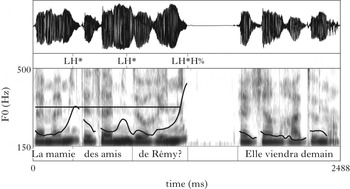
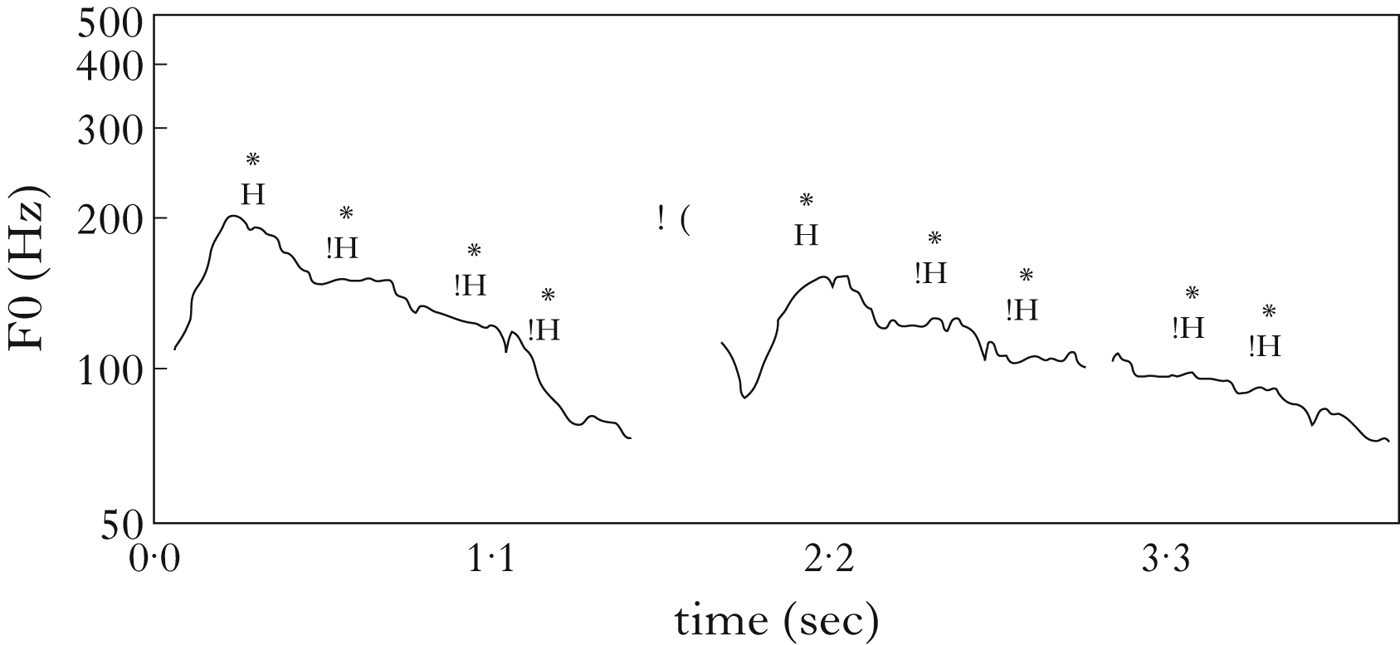
It is interesting that, regardless of the definition of a unit smaller than the IP, the level of subsequent H targets within the same IP is claimed to be lowered due to iterative downstep (Post Reference Post2000), while upstep is responsible for raising the level of an &Hpercnt; boundary tone relative to preceding accentual rises in both question and continuation contours. As shown in Fig. 2 for the utterance La mamie des amis de Rémy? Elle viendra demain, the &Hpercnt; at the right edge of a confirmation question is generally upstepped relative to the previous accentual H targets (see also Michelas Reference Michelas2011).
F0 track and spectrogram for the utterance La mamie des amis de Rémy? Elle viendra demain. ‘The grandmother of Remy's friends? She is coming tomorrow.’ The unbroken horizontal line represents the reference pitch level for the first phrase. Adapted from Michelas (Reference Michelas2011).

As shown in Fig. 1, downstep of phrase-internal subsequent LH* peaks is blocked before a prosodic boundary which appears to be weaker than an Intonation Phrase break, and is labelled as an intermediate phrase boundary in autosegmental-metrical models (Beckman & Pierrehumbert Reference Beckman and Pierrehumbert1986). Jun & Fougeron (Reference Jun and Botinis2000) first proposed the existence of an ip for French, but in their model this constituent is linked to marked syntactic constructions (e.g. left-dislocated sentences) in which either a low or a mid pitch plateau can be found after a LH* rise. More recent work has shown that an ip break can be found in unmarked syntactic constructions, i.e. at the boundary between major syntactic constituents such as a subject Noun Phrase and a Verb Phrase (the NP/VP break), when prosodic length constraints are satisfied (D'Imperio & Michelas Reference D'Imperio and Michelas2010, Michelas & D'Imperio Reference Michelas and D'Imperio2012).
Here we investigate the tonal scaling of H targets in unmarked SVO declaratives, to test whether the existence of an ip break is necessary to account for register level shifts within the French IP. The paper is organised as follows: in the following section we present our research questions, the details of the experimental study and the results, in §3 we offer some elements of discussion and §4 provides a brief conclusion.
2 Instrumental study
2-1 Background and experimental questions
The aim of our study was twofold: first, to determine whether systematic variation in pitch-scaling and final lengthening cues supports the hypothesis of the existence of an ip boundary in French, and second, to test how speech rate affects the presence of its phonological and acoustic-prosodic cues.
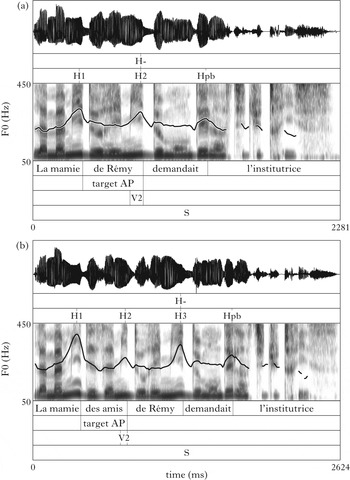
To test our hypotheses, we employed a set of highly controlled sentences, in which we manipulated the length of the subject NP in order to obtain either a sequence of two APs (as in sentence (1a); see Fig. 3a) or three APs (as in sentence (1b); see Fig. 3b). We predicted that the target syllable (in boldface in (1)), corresponding to the H2 position in Fig. 3, would be followed by a right ip boundary only in (1a), since both a syntactic alignment constraint and a prosodic length constraint would conspire to ensure its placement. Conversely, the placement of an ip boundary is not predicted in (1b), where the target syllable is contained within the subject NP. Note that this contrastive analysis concerns only the scaling of the second accent within the ip (i.e. H2).
-
(1)


F0 tracks and spectrograms for (a) La mamie de Rémy demandait l'institutrice and (b) La mamie des amis de Rémy demandait l'institutrice, produced by two female speakers and exemplifying (a) the 2-AP condition and (b) the 3-AP condition. Note that H2 precedes an ip boundary only in the 2-AP condition. V2 is the duration of the last full vowel of the second AP of the utterance, S the duration of the whole utterance and target AP the duration of the second AP of the first prosodic phrase.

The main goal of our study was to test whether an intermediate level of prosodic phrasing exists in French. Note that the presence of an ip boundary is predicted at the right edge of an XP (X-phrase or maximal projection; D'Imperio & Michelas Reference D'Imperio and Michelas2010), which in this case corresponds to the NP/VP boundary, when the syntactic phrase is produced as a sequence of at least two APs. We formulated two main hypotheses, the Complete Reset Hypothesis in (2) and the Partial Reset Hypothesis in (4).
-
(2)

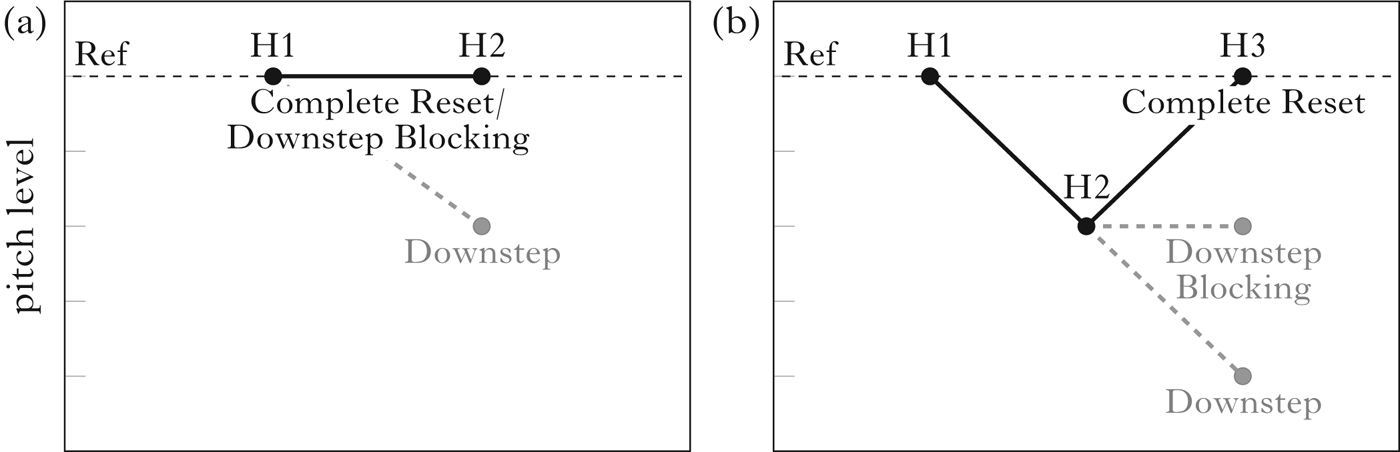
The Complete Reset Hypothesis concerns the tonal scaling of the last LH* rise before an NP/VP break (i.e. H2 in Figs 3a and 4a, and H3 in Figs 3b and 4b). Specifically, we predicted that when H2 and H3 immediately preceded an ip boundary they would have the same F0 value as H1. The first peak within the ip was therefore taken to set the reference level for the phrase. On the other hand, if the H peak did not precede an NP/VP break, and hence there was no ip boundary, it was predicted to be lowered relative to the preceding H. Given that only H2 could appear both in phrase-final and in phrase-internal position, we predicted this outcome only for phrase-internal H2 and not for H3, as it was always phrase-final in our material. In other words, H2 was predicted to be scaled lower than H1 in the 3-AP condition but not in the 2-AP condition.
Schematisation of the Complete Reset Hypothesis (in black) and of the alternative hypotheses (Downstep Blocking and Downstep; in grey) for utterances in (a) the 2-AP condition and (b) the 3-AP condition.

Note that two alternative hypotheses can be formulated, as in (3).
-
(3)
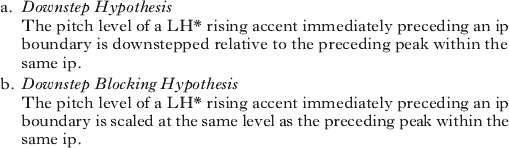
Our main hypothesis, the Complete Reset Hypothesis in (2), and the alternative hypotheses in (3) are illustrated in Fig. 4 for both the 2-AP and 3-AP conditions.Footnote 4 While the Downstep Hypothesis would predict iterative downstep on all H peaks following H1 up to the end of the Intonation Phrase, Downstep Blocking would predict H2 and H3 to be set at the same level as the preceding H target. Note that the tonal behaviour of H3 (in 3-AP utterances) is crucial for testing our Complete Reset Hypothesis. According to this hypothesis, H3 would be completely reset, and hence be scaled at the same level as H1 (not that of H2) in the 3-AP condition. Alternatively, H3 could either be lowered relative to H2 (in line with the Downstep Hypothesis) or be realised at the same height as H2 (in line with the Downstep Blocking Hypothesis).
We first compared the F0 level of the second LH* rise (H2) in both the 2-AP and the 3-AP conditions. Since we postulated that an ip boundary would be placed after H2 only in the 2-AP condition but not in the 3-AP condition, we predicted H2 to be lower in the 3-AP condition than in the 2-AP condition, due to downstep triggered by H1. This is because the Complete Reset Hypothesis predicts pitch reset to occur at the target syllable only when the latter is aligned with the right edge of an ip. The preboundary H was predicted to be completely reset, independent of the number of APs in the NP, so that we predicted complete reset to apply also to H3, which was always in potential ip-final position in our material.
Apart from predicting complete reset targeting the preboundary H, we also made specific predictions concerning the pitch level of the postboundary peak (Hpb). Specifically, we hypothesised that phrasal downstep is realised through partial reset, which is formulated as (4).
-
(4)

Following Féry & Truckenbrodt (Reference Féry and Truckenbrodt2005), we thus predicted that the downstep of two subsequent LH*s within an NP (i.e. between H1 and H2) would be greater than downstep across an ip boundary. As a consequence, the first LH* pitch accent of the second ip (Hpb) was predicted to be scaled lower than H1 in 2-AP phrases, but higher than H2. We therefore also measured the pitch level for Hpb, in order to test whether it would be affected by partial reset. We will also discuss whether this effect can be modelled as a return to a downstepped reference line for the second ip, as proposed by Féry & Truckenbrodt.
In order to provide additional evidence for the presence of an ip break, we also measured the duration of the stressed vowel of the target syllable, corresponding to the H2 position, in both the 2-AP and the 3-AP conditions. This is because the target syllable was predicted to be longer in the 2-AP condition (being ip-final) than in the 3-AP condition (being AP-final). Our third hypothesis is formulated as in (5).
-
(5)

We expected to find greater preboundary lengthening for the target syllable associated to H2 in the 2-AP condition than in the 3-AP condition.
The second aim of our study was to test how speech rate interacts with both phonological and acoustic-prosodic cues to ip boundary realisation. Speech rate is generally viewed as an important influence on prosodic phrasing (see for French Barthkova Reference Barthkova1991, Keller & Zellner Reference Keller, Zellner, Elenius and Branderud1995 and Fougeron & Jun Reference Fougeron and Jun1998). For instance, fast rate has been claimed to produce restructuring of prosodic phrases (i.e. prosodic boundary erasure and/or boundary demotion; Fougeron & Jun Reference Fougeron and Jun1998). Another possible outcome was that phonetic cues to phrasing would be reduced at fast speech rate. Hence, it was important to test whether the three hypotheses in (2), (4) and (5) are affected by an increase in speech rate. Thus speech rate was manipulated as a factor in our study by having our speakers produce the material at two speech rates (normal and fast). Following Michelas & D'Imperio (Reference Michelas and D'Imperio2012), who observed only minimal prosodic restructuring at fast rate, we formulated the hypothesis in (6).
-
(6)

Given this hypothesis, we predicted that both complete reset and preboundary lengthening would be realised on our target syllables (H2 in the 2-AP condition and H3 in the 3-AP condition), independent of speech rate. Additionally, we predicted that rate would not interact with scaling effects for Hpb, i.e. we expected partial reset to occur after the ip boundary, independent of speech rate.
2-2 Methodology
2.2.1 Corpus
Given that the goal of our experiment was to precisely evaluate both the F0 level of an H peak within an LH* and preboundary lengthening, it was crucial to employ test materials in which factors influencing prosodic phrasing – length of phrase, syntactic, discourse and speech-rate factors – were highly controlled. Thus our materials included a set of 16 pairs of SVO utterances, in which the structure of the subject NP was varied in order to obtain either a sequence of two or three APs, as exemplified in (1) above.
In order to avoid potential effects of AP length on phrasing (Astésano Reference Astésano2001, Welby Reference Welby2003), each AP contained only three syllables. For the example in (1b), each of the three APs composing the subject NP, la mamie, des amis and de Rémy, contained three syllables. Syntactically, the target syllable for H2 always preceded a major syntactic break corresponding to an NP/VP boundary (i.e. the right edge of an XP) in the 2-AP condition, while it only preceded a minor syntactic break (i.e. a boundary between a head and its complement) within the NP in the 3-AP condition. Like preboundary H2 in 2-AP phrases, H3 was always associated to a major syntactic break in 3-AP phrases.
We also know that prosodic boundary strength is affected by discourse position, with more substantial cues – such as greater preboundary lengthening, longer pauses and higher F0 peaks – at the beginning of a discourse segment than at its end (Hirschberg & Pierrehumbert Reference Hirschberg and Pierrehumbert1986, Crystal & House Reference Crystal and House1990, Swerts Reference Swerts1997, den Ouden et al. Reference Ouden, Noordman and Terken2009). To avoid any effect of discourse structure on prosodic phrasing, we therefore employed a set of isolated utterances, for which pragmatic structure was held constant (i.e. all-focus utterances).
In order to minimise possible microprosodic effects due to obstruent perturbations, voiceless gaps or intrinsic F0 perturbations, the segmental composition of the target syllables was kept constant for each utterance pair, so that the consonants preceding and following the target vowel would always be voiced. The set of 32 experimental sentences is given in the Appendix. Note that, in order to increase statistical power, each sentence was presented four times to each of the nine speakers. There were thus 2304 tokens in total: 32 sentences (with 2-AP and 3-AP subject NPs)×4 repetitions×2 speech rates×9 speakers. The experimental sentences were interspersed with 90 filler items, in the form of declarative sentences with a variety of syntactic structures. Two lists were created, such that each member of a pair of experimental sentences appeared in a different list. Each participant was presented with both lists, with half of the participants reading List 1 first and the other half reading List 2 first. Finally, in each list, the order of appearance was randomised by participant.
2.2.2 Experimental procedure
Speakers were recorded individually in a soundproof room at the Laboratoire Parole et Langage at Aix Marseille University, using a Shure SM10A head-mounted microphone. Speech samples were digitally recorded at 32,000 Hz, 16-bit. Participants were seated at a computer screen and were first asked to read aloud the set of sentences at a self-selected normal rate. They were also told to repeat the utterance if they misread part of the text. The experimenter instructed participants to read the sentences as if conveying new information. This allowed us to obtain all-focus utterances in reading style, avoiding possible effects of topic or focus intonation. In the second part of the experiment, speakers read the same set of utterances as in the first part, but at a fast, self-selected, speech rate. The instructions were given as follows: ‘You are going to see the same set of utterances as in the preceding part of the experiment. Your task is to read these sentences as fast as you can, as if you were talking with someone who is in a hurry’. Sentences appeared ten at a time on a computer screen; a metronome was not used to control for rate. Before the experiment began, participants read six sentences at both normal and fast speech rates, in order to test the material and become acquainted with the procedure. Post hoc measurements were performed in order to be sure that all participants had increased their speech rate from normal to fast (see §2.3.1 below).
Each individual utterance was then isolated and saved as a separate file. Phonetic segmentation was automatically carried out using EasyAlign (Goldman Reference Goldman2011) and subsequently hand-corrected by the second author after inspection of both waveforms and spectrograms. Nine native speakers of Southern French (three males and six females, aged 24 to 34) participated in the experiment. They were all born in Southern France, where they had spent most of their life. Most of the participants were graduate students at Aix Marseille University.
2.2.3 Measurements
The F0 values associated to target syllables were measured first, in accordance with the widely accepted view that F0 is a direct correlate of tonal variation, both for pitch accents and for boundary tones (Pierrehumbert Reference Pierrehumbert1980, Ladd Reference Ladd2008). The location for each target H tone (H1, H2, H3 or Hpb) was labelled, and F0 values were automatically extracted, using Praat scripts (Boersma & Weenink Reference Boersma and Weenink2009). Moreover, in order to evaluate the tonal target values not only in local terms but also in relation to the reference pitch level for the phrase, we also calculated the H2/H1, H3/H1 and Hpb/H1 ratios. This is because the first peak in the IP, i.e. H1, can be considered to set the reference level for the phrase. Note that ratios greater than or equal to 1 indicate that the tonal target is not downstepped relative to H1 (as for downstep blocking and/or complete reset). On the other hand, ratios smaller than 1 indicate that the tonal target is downstepped relative to H1. In order to test the Complete Reset Hypothesis, H3 was also labelled in 3-AP NPs, and its maximum F0 value was subsequently measured.
Finally, in order to test the Partial Reset Hypothesis in non-initial intermediate phrases, we labelled the H peak of the first LH* rise immediately following the ip boundary (Hpb) in both 2-AP and 3-AP conditions. The tonal labelling scheme was as in (7) (see also Fig. 3 above).
-
(7)
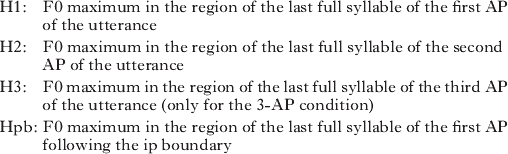
Recall that the first aim of our study was to provide additional evidence for the existence of an intermediate level in French by uncovering the role of scaling relationships among subsequent pitch accents. Note though that tonal scaling is not the only cue to phrasing, since duration is an additional robust cue to prosodic boundary marking in a variety of languages, including French (Vaissière Reference Vaissière, Cutler and Ladd1983, Jun & Fougeron Reference Jun and Botinis2000, Michelas & D'Imperio Reference Michelas and D'Imperio2012, among others). The duration of the vowel in the H2 location was also measured (it is labelled ‘V2’ in Fig. 3 and elsewhere), so that the 2-AP and 3-AP conditions could be compared in terms of potential preboundary lengthening. Since we know that lengthening preferentially affects the syllable rhyme in French (Astésano Reference Astésano2001), and given that we included only open syllables in our study, final vowel-duration measurements were taken to adequately reflect degree of preboundary lengthening. A Praat script was employed in order to automatically extract V2 duration in both conditions.
In order to evaluate whether speakers effectively modified speech rate from normal to fast, the duration of the entire utterance (labelled ‘S’ in Fig. 3) was also measured, as well as that of the target APs. Speech rate was then calculated as utterance duration divided by the total number of syllables produced.
2.2.4 Statistical analyses
Statistical analyses were carried out using linear mixed-effects models, which provide a powerful tool for the analysis of grouped data (Pinheiro & Bates Reference Pinheiro and Bates2000, Quené & van den Bergh Reference Quené and van den Bergh2004), although the question of degrees of freedom for these models continues to be a subject of controversy in the literature. Hence a Monte Carlo Markov Chain Technique (Baayen Reference Baayen2008, Bates & Maechler Reference Bates and Maechler2010) was used to obtain p-values (MCMC p-values). All data analyses were carried out using the R statistical package (R Development Core Team 2008).
2.3 Results
2.3.1 Speech rate
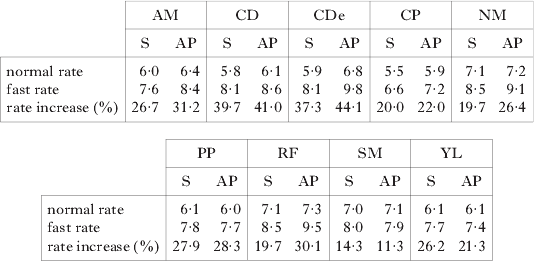
In order to test if speech rate would influence the prosodic cues under investigation, we instructed our speakers to read the sentences at two self-selected speech rates (normal and fast). To assess whether speakers successfully increased their speech rate from normal to fast, we calculated average rate in syllables per second for the entire utterance. Average rate was also calculated for target APs, to check whether whole utterances and APs were similarly affected by rate change. We first calculated the total duration of each utterance and each target AP. Subsequently, each utterance and each AP was assigned a phone count, which was then adjusted to reflect actual pronunciation, including the presence of word-final schwas or elisions.
As shown in Table I, speaking rate and the magnitude of the change from one rate to the other varied across speakers, depending on the size of the unit under investigation (entire utterances vs. target APs). For example, Speaker CP had the slowest rate for both entire utterances (5·5 syll/sec) and target APs (5·9 syll/sec). Speakers NM and RF had the fastest rate for entire utterances (8·5 syll/sec), while Speaker CDe showed the fastest rate for target APs (9·8 syll/sec). A series of t-tests confirmed that all speakers successfully increased their speech rate from normal to fast in both entire utterances and target APs (p values were always less than 0·05). These values are in line with previous work on speech rate for French (Fougeron & Jun Reference Fougeron and Jun1998, Welby Reference Welby2006, Welby & Lœvenbruck Reference Welby and Lœvenbruck2006, Michelas Reference Michelas2011).
Averages for normal and fast speaking rates (in syllables per second) for both entire utterances (S) and target Accentual Phrases (AP) for each speaker (AM, CD, CDe, CP, NM, PP, RF, SM, YL). The increase from normal to fast speaking rate is given as a percentage.

2.3.2 F0 results
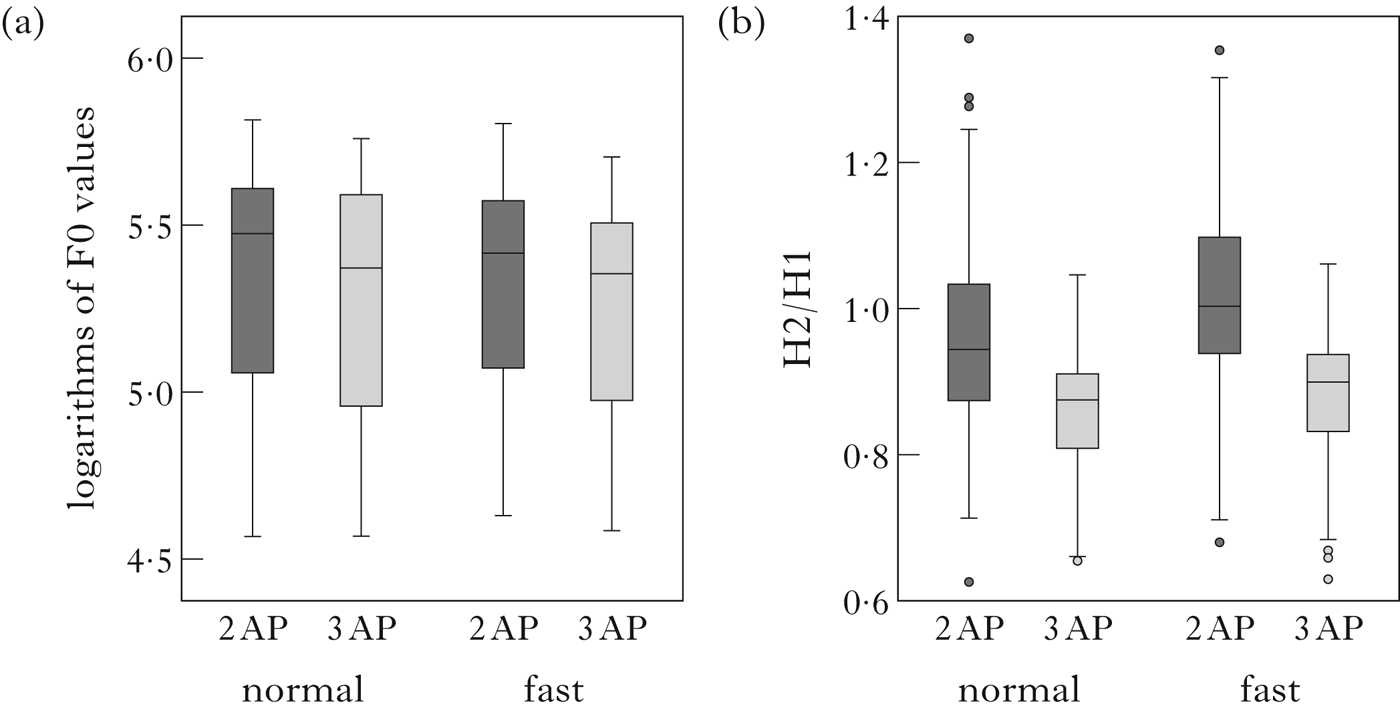
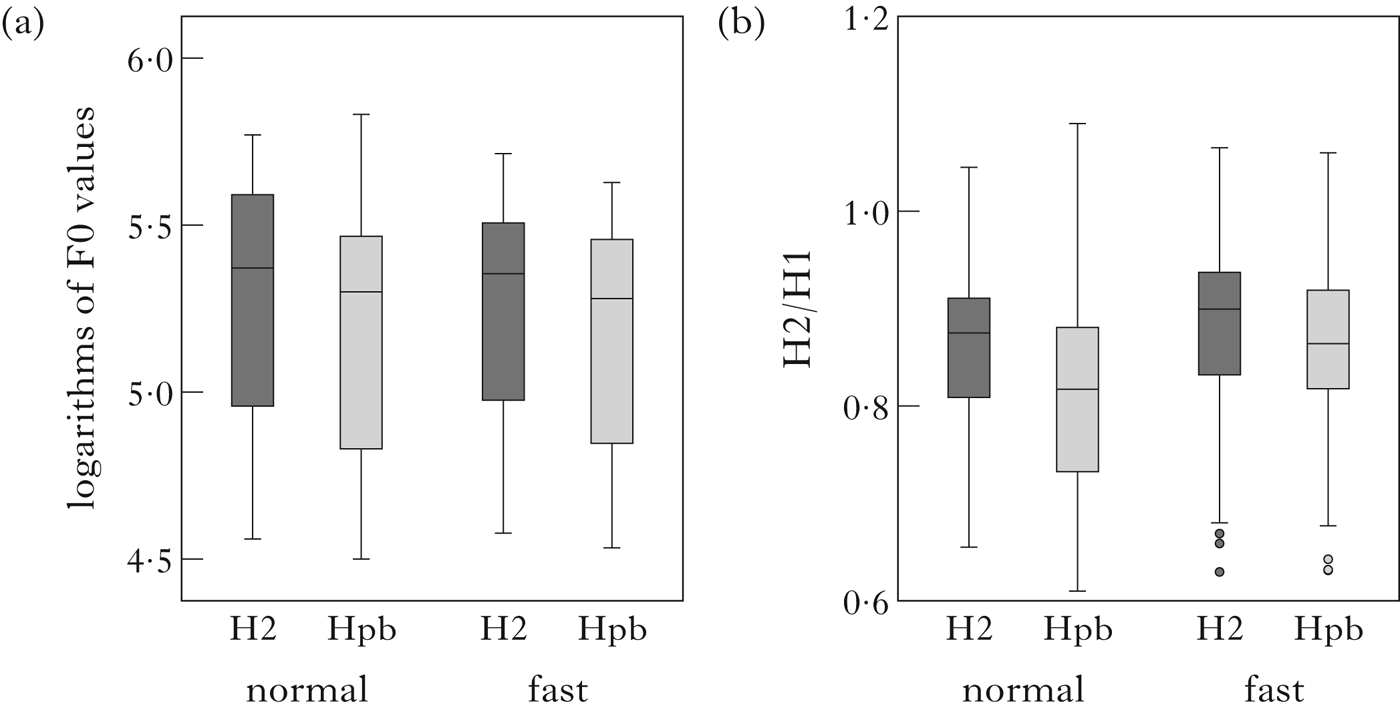
In order to test the Complete Reset Hypothesis for tonal values, a linear mixed-effects model was fitted to the logarithms of the F0 values for H2, including AP Number (2 vs. 3) and Rate (normal vs. fast) as fixed effects.Footnote 5 Random intercepts were also included for the effects of Speaker and Syllable. 2304 observations were included by the model. In line with both the Complete Reset Hypothesis and the Downstep Blocking Hypothesis, the results show a main effect of AP Number, independent of Rate (see Fig. 5a). At both normal and fast speech rates, F0 height was significantly lower for the 3-AP condition than for the 2-AP condition (normal speech rate: β=−0·066, se=0·006, t=−11·51, pMCMC<0·001; fast speech rate: β=−0·088, se=0·006, t=−15·36, pMCMC<0·001). Hence, in line with the Fast Speech Rate Hypothesis, rate did not influence phrasing effects in our corpus. It also did not influence F0 height (β=−0·0001, se=0·006, t=−0·02, pMCMC=0·9012), so that the effect of AP Number was observed at both rates.
Boxplots of (a) log-transformed F0 values for H2 and (b) H2/H1 ratios according to AP Number (2 vs. 3) and Rate (normal vs. fast).

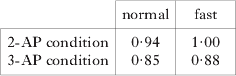
Recall that in order to evaluate pitch scaling within subject NPs, we also measured H2 as a ratio of the first target peak (H1). A linear mixed-effects model was fitted to the log of the H2/H1 ratios.Footnote 6 We retained AP Number and Rate as fixed factors and Speaker and Syllable as random factors. The model included 2304 observations. Results show a main effect of AP Number (see Fig. 5b), in that H2/H1 ratios were smaller in the 3-AP condition than in the 2-AP condition at both normal (β=−0·094, se=0·005, t=−17·98, pMCMC<0·001) and fast speech rates (β=−0·129, se=0·006, t=−22·036, pMCMC<0·001). Values estimated by the model are shown in Table II.Footnote 7
H2/H1 ratios estimated by the linear mixed-effects model for both 2-AP and 3-AP conditions, depending on Rate.

As shown in Table II, H2/H1 ratios for 2-AP utterances at fast rate, with values equal to 1, clearly support both the Downstep Blocking Hypothesis and the Complete Reset Hypothesis, but not the Downstep Hypothesis. At normal speech rate, H2/H1 ratios were lower than 1 (0·94), but higher than the values estimated for the 3-AP condition at the same rate (0·85). Hence, though the results do not lend support to the Downstep Hypothesis, they nevertheless do not allow us to distinguish between the Downstep Blocking Hypothesis and the Complete Reset Hypothesis at normal rate.
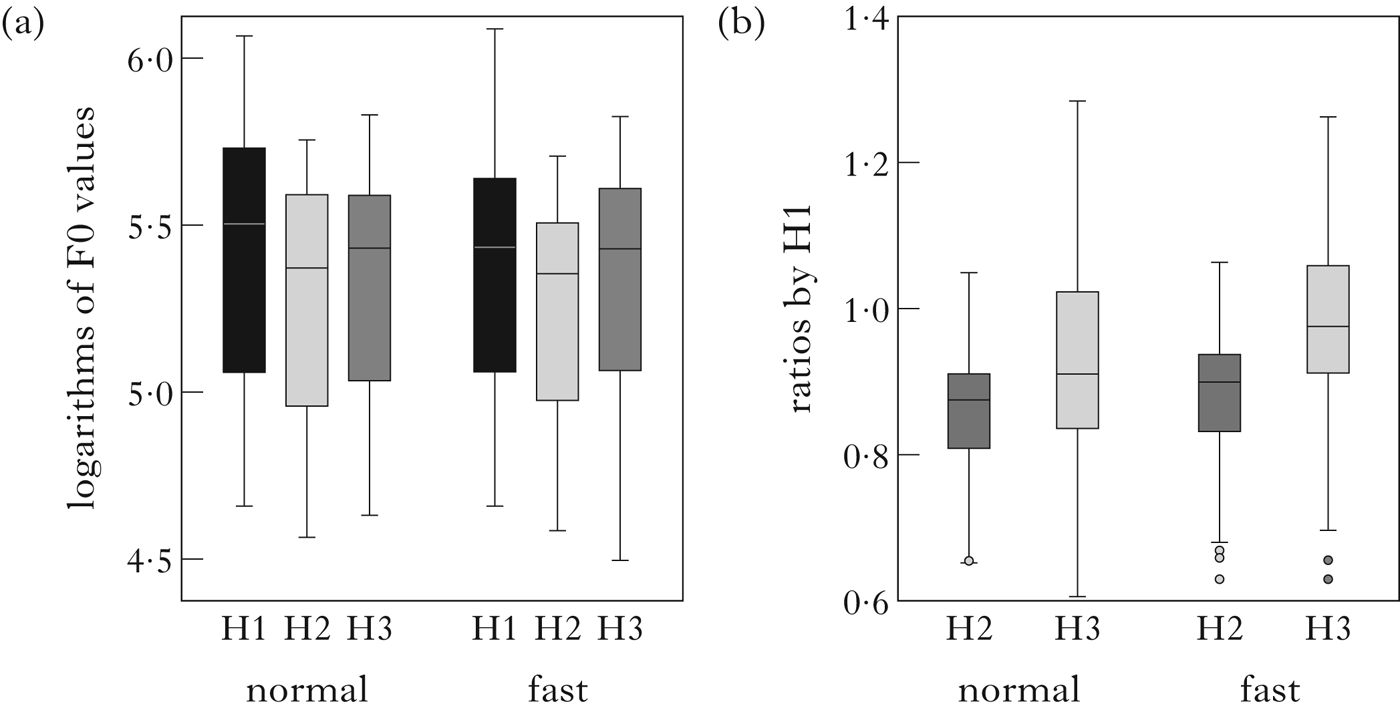
Supplementary analyses of H3 height in the 3-AP condition were then carried out in the 3-AP condition. A linear mixed-effects model was fitted to the log of the F0 values of H1, H2 and H3 for 3-AP utterances. H Target Type (H1, H2, H3) and Rate were included as fixed factors and Speaker and Syllable as random factors. There were 6912 observations. The model first showed that H3 was higher than H2 at both rates (normal: β=0·106, se=0·006, t=17·88, pMCMC<0·001; fast: β=0·110, se=0·006, t=18·63, pMCMC<0·001). This is in contrast with both the Downstep Hypothesis and the Downstep Blocking Hypothesis. However, although the difference is very small, the linear mixed-effects model fitted on the logarithms of F0 values (Fig. 6a) showed that H3 was lower than H1 at both rates (normal: β=−0·048, se=0·006, t=−8·03, pMCMC<0·001; fast: β=−0·012, se=0·006, t=−2·19, pMCMC<0·05).
Since the linear mixed-effects model reports a significant difference between H1 and H3, the results do not immediately appear to validate the Complete Reset Hypothesis (which predicts that F0 values for H3 should be equal to those for H1). However, the estimated difference between H1 and H3 at normal speech rate was only 2 Hz, and the estimated difference between H1 and H3 at fast speech rate was only 1 Hz. Given the magnitude of the difference, the results suggest that the Complete Reset Hypothesis is confirmed if a plausible declination effect is taken into account (see the discussion in §3 below).
Given that we predicted that the H3/H1 ratio would be equal to 1, we also fitted a linear mixed-effects model on the log of the ratios for utterances of the 3-AP condition, with H Target Type (H2 and H3) and Rate as fixed factors and Speaker and Syllable as random factors. The model included 4608 observations. The results showed that H1/H3 ratios were significantly greater (i.e. closer to 1) than H2/H1 ratios at both rates (see Fig. 6b). The estimated value for H3/H1 at normal speech rate was 0·91 (vs. 0·85 for H2/H1), whereas the estimated value for fast speech rate was closer to 1 (i.e. 0·93 for H3/H1 vs. 0·88 for H2/H1). Hence, the results disconfirm both alternative hypotheses (Downstep and Downstep Blocking), since H3 was always higher than H2 (which was in turn downstepped relative to H1 in the 3-AP condition). Again, as for log-transformed F0 values, it appears that the Complete Reset Hypothesis cannot be completely validated either at fast or at normal speech rate, given that a full return to the reference level set by H1 was not found. However, note that values for both rates were very close to 1 (0·93 for fast and 0·91 for normal rate). We will discuss these results in terms of a plausible declination effect.
Boxplots of (a) log-transformed F0 values and (b) ratios by H1 according to H Type and Rate (normal vs. fast) for the 3-AP condition.

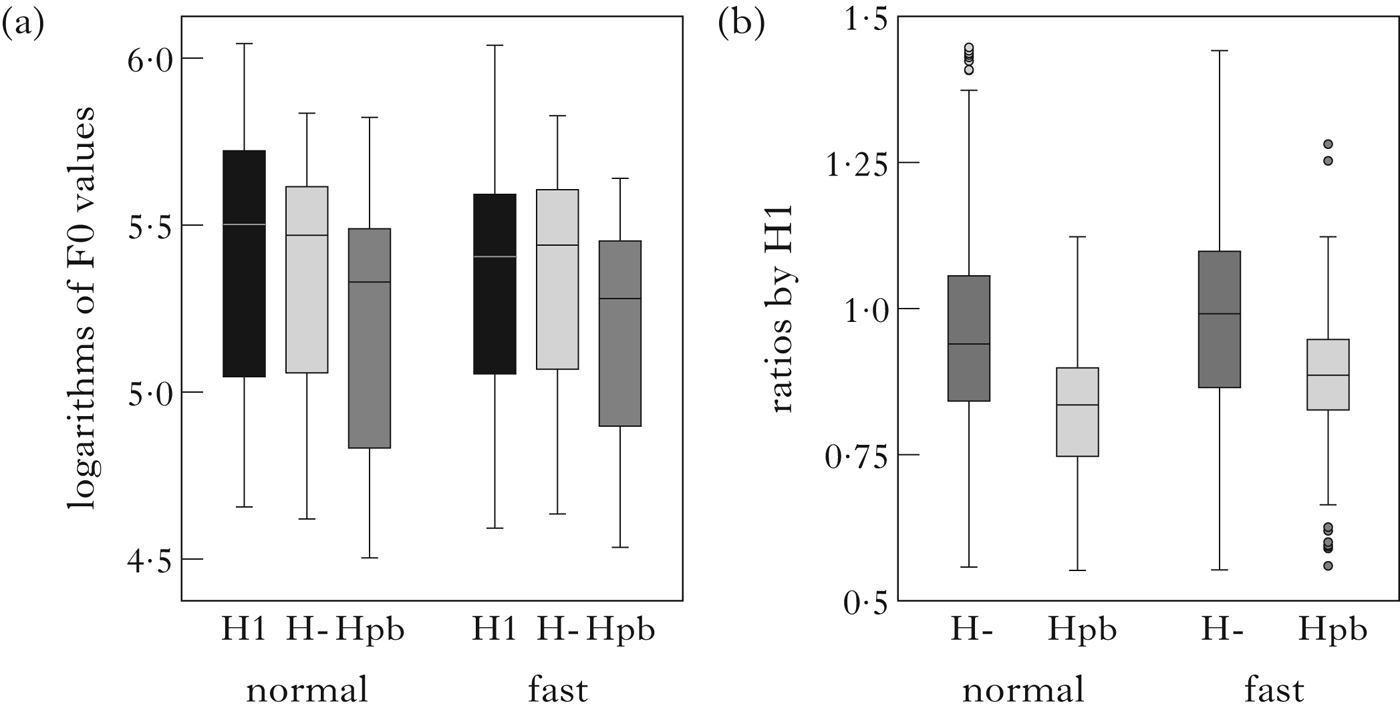
In order to test the Partial Reset Hypothesis, we also measured the height of the first rising LH* accent immediately following the ip boundary, i.e. Hpb. Log F0 values for H1, H- (which conflate values for preboundary H2 and H3) and Hpb are illustrated in Fig. 7a, while simple Hpb-/H1 ratios are shown in Fig. 7b. Note in Fig. 7a that Hpb is lower than both H1 and H-, showing that the amount of reset was not complete but only partial. A linear mixed-effects model was fitted to the log of F0 values as well as to the log of H-/H1 and Hpb/H1 ratios. As in the previous statistical analyses, H Target Type, AP Number and Rate were included as fixed factors, while Speaker and Syllable were included as random factors. The two models included 6912 and 4608 observations respectively. Results showed that Hpb values were significantly lower than H- at both rates and for both the 2-AP and the 3-AP conditions (pMCMC values were all less than 0·001), ranging from 0·78 for 3-AP utterances at normal rate to 0·87 for 2-AP utterances at fast rate. Both AP Number and Rate were also significant, with lower Hpb values for the 3-AP condition than for the 2-AP condition (β=−0·027, se=0·007, t=−3·84, pMCMC<0·05) and for fast speech rate relative to normal speech rate (β=−0·0241, se=0·007, t=−3·47, pMCMC<0·05).
Boxplots of (a) log-transformed F0 values and (b) ratios by H1 by H Type (H- conflates H2 in the 2-AP condition and H3 in the 3-AP condition) and Rate for both 2-AP and 3-AP conditions.

We then measured Hpb relative to H2 in the 3-AP condition. This test was intended to verify whether H2 downstep was greater than Hpb downstep, relative to H1 level. Log F0 values for H2 and Hpb, as well as for H2/H1 and Hpb/H1 ratios, are reported in Fig. 8. Note in Fig. 8 that, unexpectedly, Hpb is lower than H2 for both log F0 values and ratios, which does not confirm that downstep across phrase boundaries is weaker than phrase-internal downstep. A linear mixed-effects model was fitted on the log F0 values (with H Target Type and Rate as fixed factors and Speaker and Syllable as random factors). The model included 2304 observations. The results show that Hpb was significantly lower than H2 at both normal (β=−0·0801, se=0·006, t=−12·55, pMCMC<0·001) and fast speech rates (β=−0·227, se=0·006, t=−3·56, pMCMC<0·05). The same result was found for ratio values for which Hpb/H1 was significantly higher than H2/H1 at both speech rates.
Boxplots of (a) log-transformed F0 values and (b) ratios by H1 according to H Type (H2/Hpb) and Rate for the 3-AP condition.

2.3.3 Duration results
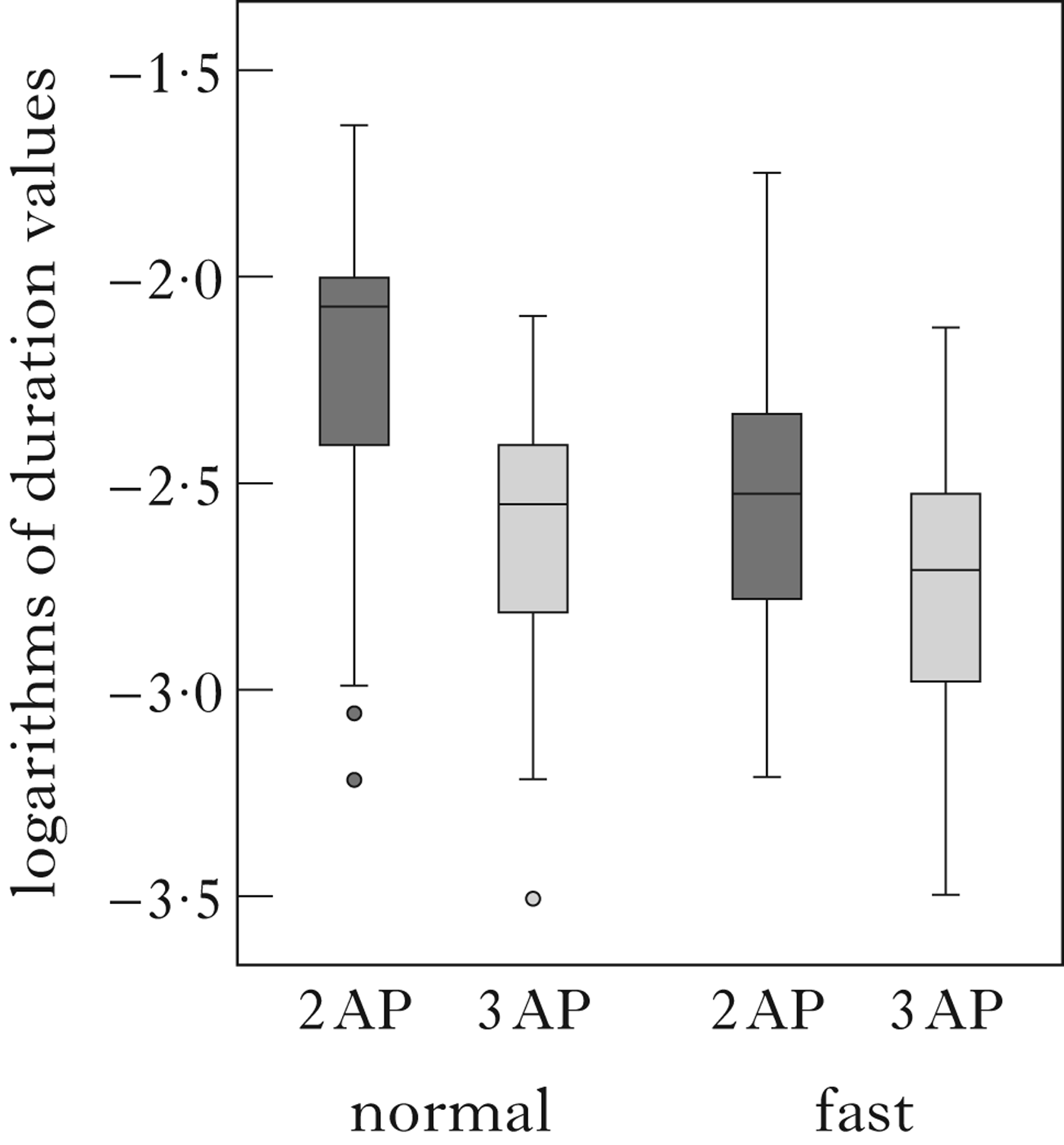
Finally, we examined the effect of the number of APs on V2 duration, in order to test the Preboundary Lengthening Hypothesis in (5) above. A linear mixed-effects model was fitted to the log of duration values for V2 (at the H2 location). The model included two fixed factors (AP Number and Rate) and two random factors (Speaker and Syllable). 2304 observations were included by the model. The linear mixed-effects model showed a main effect of the number of APs. In line with the Preboundary Lengthening Hypothesis, and as shown by the duration data in Fig. 9, target vowels in the H2 position (V2) were always longer in the 2-AP than in the 3-AP condition, for both normal (β=−0·405, se=0·020, t=−25·92, pMCMC<0·001) and fast speech rates (β=−0·22633, se=0·01964, t=−14·47, pMCMC<0·001). This confirms that the target syllable was immediately followed by an ip boundary in the 2-AP condition, but not in the 3-AP condition. Note that the estimated values were also greater at normal rate (2-AP condition: 109 ms; 3-AP condition: 74 ms) than at fast rate (2-AP condition: 79 ms; 3-AP condition: 55 ms). The effect of Rate was also significant (β=−0·323, se=0·020, t=−20·64, pMCMC<0·001).
Boxplot of the log of V2 duration by Number of APs (2 vs. 3) and Rate (normal vs. fast).

3 Discussion
Taken together, our scaling and duration data suggest that French speakers signal the presence of an intermediate phrase boundary by means of both preboundary lengthening and complete pitch reset. Specifically, the results of the tonal analysis for H2 in the 2-AP fast rate condition show that, in line with the Complete Reset Hypothesis and the Downstep Blocking Hypothesis, H2 targets were not downstepped relative to H1, since in this case H2 immediately preceded an ip boundary. Moreover, the pitch level of the preboundary H2 was completely equivalent to that of H1. On the other hand, H2 was downstepped in the 3-AP condition, given that in these sentences it was followed by an LH* accent (H3) occupying the preboundary position.
Note though that preboundary H2 was not completely reset at normal rate. In fact, the H2/H1 ratio was equal to 0·94 (rather than 1), which appears to disconfirm both the Complete Reset Hypothesis and the Downstep Blocking Hypothesis. However, the 6% ratio difference is in line with what has been argued as being upstepped values (i.e. completely reset in our terminology) by Truckenbrodt (Reference Truckenbrodt2002) for German, invoking an F0 declination effect (see also Pierrehumbert & Beckman Reference Pierrehumbert and Beckman1988 for Japanese and Audibert et al. Reference Audibert, Aubergé and Rilliard2010 for French) which gradually affects H targets from the beginning to the end of the utterance. The scaling difference between the two rates can hence be accounted for by the fact that at fast rate the 2-AP sequence was globally shorter (for APs the number of syllables per second was on average 2% higher at fast rate for the various speakers), hence the declination effect is expected to be weaker than for normal rate.
Results for H3 pitch level allowed us to discard both alternative hypotheses (Downstep and Downstep Blocking), while providing evidence in favour of the Complete Reset Hypothesis. Similar to preboundary H2 behaviour, the H3 level was not lowered (downstepped) relative to the preceding pitch accent (H2), which goes against the Downstep Hypothesis. Moreover, given that H3 was also always higher than H2, the Downstep Blocking Hypothesis can also be discarded. Similar to the H2 pitch values, a difference was found between the fast and the normal rate conditions for both the H3 log-transformed F0 data and the H3/H1 ratios. Unlike the H2 results, H3/H1 ratios were never equal to 1, either at normal (0·91) or at fast (0·93) speech rate. However, note that the actual F0 difference estimated by the model for both fast and normal rates was never greater than 2 Hz. Recall too that the values for medial peaks were always lower than the 0·90 threshold, showing that complete reset is never found away from the ip boundary.
Hence, the H3 results confirm our main hypothesis of a complete return to the reference level set by H1. This ‘return to the reference line’ for the prosodic phrase is a phonological process which also occurs in languages other than French, such as German (Truckenbrodt Reference Truckenbrodt2002, Reference Truckenbrodt, Gussenhoven and Riad2007) and Dutch (van den Berg et al. Reference Berg, Gussenhoven, Rietveld, Docherty and Ladd1992). Here, though, this scaling phenomenon concerns a prosodic domain that is lower in the hierarchy than the IP, i.e. the ip. We propose that the right edge of a non-final ip is marked in French by the presence of an H- phrase accent blocking the iterative downstep on ip-internal, AP-final LH* rises and raising the H target to the level established by the first peak of the IP (H1).
Apart from tonal cues related to the realisation of both preboundary H2 and H3, tonal values for the first postboundary pitch accent (Hpb) offer additional support to the existence of a prosodic break which is stronger than a simple AP right edge, but weaker than an IP break. Our results in fact partially confirm the Partial Reset Hypothesis in (4), in that partial reset affects Hpb, though its tonal value is lower, rather than higher, than downstepped phrase-internal H2. We propose that the right edge of an ip is additionally marked by a phenomenon of partial reset targeting the first accentual H peak within the following ip. These results are partially in line with what has been shown for English, Dutch and German (Ladd Reference Ladd1988, van den Berg et al. Reference Berg, Gussenhoven, Rietveld, Docherty and Ladd1992, Féry & Truckenbrodt Reference Féry and Truckenbrodt2005), suggesting the existence of different types of downstep: a local downstep, targeting subsequent H peaks, and a phrasal downstep, targeting reference lines within a larger IP. For English, Ladd (Reference Ladd1988) first accounted for this phenomenon as downstep among abstract register features assigned to sister nodes. The model of embedded downstep (the ‘wheels within wheels’ model) has since been empirically strengthened and theoretically modified, in particular by van den Berg et al. (Reference Berg, Gussenhoven, Rietveld, Docherty and Ladd1992) for Dutch and by Féry & Truckenbrodt (Reference Féry and Truckenbrodt2005) for German. In Dutch, as shown in Fig. 10, the fifth H target (the one beginning the second phrase, on Nelie) is lower than the first H, yet higher than the downstepped second H of the utterance.
F0 contour for the Dutch utterance Merel, Nora, Leo, Remy, en Nelie, Mary, Leendert, Mona en Lorna ‘Merel, Nora, Leo, Remy, and Nelie, Mary, Leendert, Mona and Lorna’. From van den Berg et al. (Reference Berg, Gussenhoven, Rietveld, Docherty and Ladd1992: 334).

Féry & Truckenbrodt, on the basis of the Dutch data and their own German data, propose that downstep must be greater among prosodic sister nodes which are lower in the hierarchical representation (‘the deeper, the steeper’). This hypothesis specifically predicts that downstep within an intermediate phrase would be greater than downstep among intermediate phrases, since in the latter case downstep would be internal to a higher-level domain, i.e. the IP.
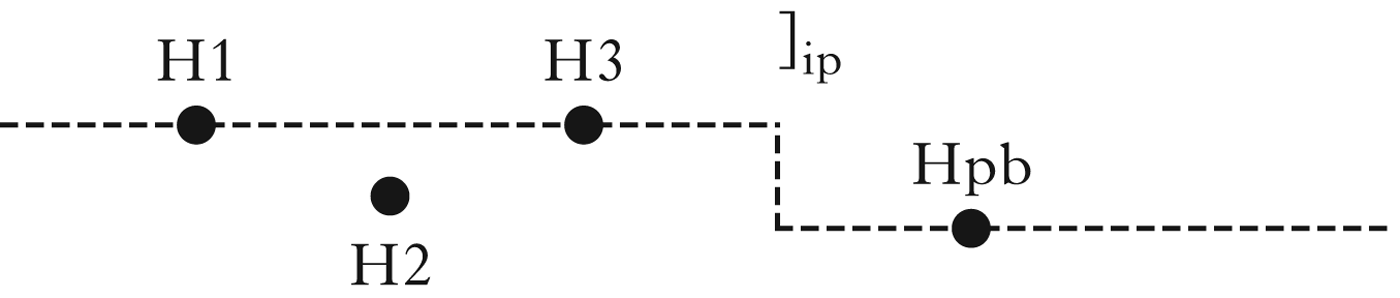
As opposed to both Dutch and German, in our data the Hpb was scaled lower than downstepped H2, indicating that downstep across phrases is greater than phrase-internal downstep, rather than less. The scaling effects observed are schematised in Fig. 11.
Schematisation of complete reset observed on the last accentual H target before the ip boundary (H3) and partial reset affecting the first accentual H target located after the ip boundary (Hpb) for French in the 3-AP condition.

Note, though, that Féry & Truckenbrodt's claim is based on the observation of mean target values pooled over the five speakers of Truckenbrodt's (Reference Truckenbrodt2002) original study, in which speaker-specific differences might have been present. Indeed, Truckenbrodt (Reference Truckenbrodt, Gussenhoven and Riad2007) later shows that, while some speakers displayed greater internal downstep, others either showed no difference between the two domains or displayed the opposite effect (e.g. Speaker 3 in that study). Our data appear to be generally in line with the idea of a partial reset in non-initial prosodic phrases as a consequence of phrasal downstep, though the effect appears to be greater (not smaller) among sister prosodic phrases than within the ip itself. It is therefore possible that the amount of downstep for the reference line of a non-initial ip is independently specified, and is a result neither of prosodic sisterhood relations nor of syntactic relations, as first proposed by Ladd (Reference Ladd1988). In other words, while internal phrase downstep might be more systematic and ‘grammaticalised’, downstep among phrases might be subject to other variables, such as individual differences or pragmatic enhancement.
Our analysis is also supported by duration data, showing that the rhyme of the preboundary syllable is longer than the rhyme of syllables that are phrase-internal. In fact, our Preboundary Lengthening Hypothesis in (5) predicted that target vowels in primary stressed syllables in H2 position would be longer in the 2-AP condition than in the 3-AP condition, giving additional evidence for the presence of an ip break. Though a global rate effect was found, the duration difference between preboundary and phrase-internal H2 was significant, independent of the rate effect. Since both locations are also AP-final, while not being IP-final, the difference can only be interpreted in terms of the presence of the right edge of a prosodic constituent intermediate between the AP and the IP levels.
These data add to the body of evidence on durational effects and phrasing in French, given that differential preboundary lengthening has been previously shown for unstressed AP-final and IP-final syllables (Jun & Fougeron Reference Jun and Botinis2000) but not for ip-final syllables (see also Michelas & D'Imperio Reference Michelas and D'Imperio2012). Furthermore, the crucial prosodic boundaries were not obliterated at fast rate, confirming our Fast Speech Rate Hypothesis in (6). This contradicts previous results (Fougeron & Jun Reference Fougeron and Jun1998), while supporting more recent work (Michelas & D'Imperio Reference Michelas and D'Imperio2012). In fact, a greater effect of tonal reset was found in the preboundary location at fast rate, accompanied by smaller preboundary lengthening. This result was unexpected, and could be explained by a compensatory phenomenon involving tonal cues, which might be enhanced to signal boundary location in the absence of adequate duration cues.
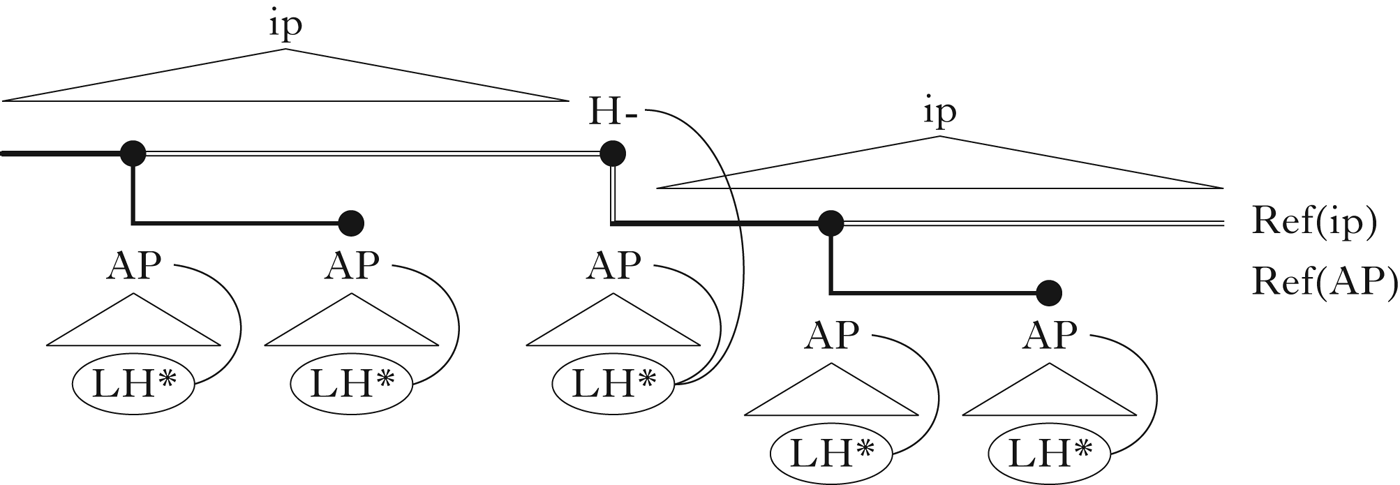
Note also that our data do not support the hypothesis that the target syllable might be variably upstepped relative to the previous peak (High Raising; see Laniran & Clements Reference Laniran and Clements2003), since H- values were not variably higher than H1, but rather targeted a specific tonal level. Our data are also compatible with the more recent model of tonal scaling proposed by Truckenbrodt (Reference Truckenbrodt, Gussenhoven and Riad2007: 371), who claims that ‘if a H tone is associated with prosodic level X, it is scaled to Ref(X)’, and reference lines are lowered for each new prosodic phrase. However, contrary to what happens in German, the targeted domain in French is the ip, not the IP. More generally, our study is in line with the claim that prosodic constituents affect the assignment of scaling reference lines to target tones. Hence our data are not incompatible with Truckenbrodt's model, in which tone scaling is determined by secondary association of a pitch accent to a phrasal domain, such as an ip. This is shown in Fig. 12, adapted from Truckenbrodt (Reference Truckenbrodt, Gussenhoven and Riad2007).
Schematisation of downstep between LH* rises within and across an ip boundary in French. Adapted from Truckenbrodt (Reference Truckenbrodt, Gussenhoven and Riad2007).

Taken together, our tonal scaling and lengthening results are not in line with the predictions of the French intonation model proposed by Post (Reference Post2000), which includes only two levels of phrasing, the Phonological Phrase and the Intonation Phrase. Moreover, in Post's model the domain of downstep is the IP, hence H targets are predicted to be iteratively lowered up to the end of the phrase, for which our results provide counterevidence. In her model, upstep is in fact only envisaged for &Hpercnt; edge tones (i.e. in yes/no questions and continuation rises). More specifically, the model incorrectly predicts iterative downstep on H2, H3 and Hpb, independent of the presence of an ip boundary, while predicting neither complete reset on H- nor preboundary lengthening at this location.
On the other hand, our results are consistent with a prosodic model of French which includes an intermediate level of phrasing between the IP and the AP, signalled by both local preboundary lengthening and global tonal structuring of pitch targets. In fact, the results of the tonal analysis indicate that F0 values are significantly greater for the target syllable (H2 or H3) when the latter is crucially placed at the end of an AP that is also ip-final, rather than merely AP-final. Our results also confirm that the presence of an ip break in French is not limited to specific syntactic or discourse structures, in contrast to what has been proposed in earlier accounts (see Jun & Fougeron Reference Jun and Botinis2000). Recall that in our data the crucial ip boundary co-occurs with a major syntactic break (i.e. the subject/predicate break), which indicates that a syntax/prosody constraint is active in French phrasing, and guides the placement of ip boundaries. In other words, an ip break can be placed in simple SVO utterances once both syntactic and prosodic constraints are satisfied.
4 Conclusion
Our results show an interesting structuring of subsequent accentual rises within complex subject NP phrases in French, which is analysed as the result of the presence of an intermediate phrase break at the NP/VP boundary. We have therefore claimed that an IP-internal boundary, i.e. the ip boundary, is signalled by phonological and phonetic cues which are crucially weaker than those associated with the IP boundary, but stronger than those found for the AP boundary. Specifically, target syllables were produced with lower F0 values when in non-final position within the ip, while they were fully reset when immediately preceding an ip right edge (complete reset). Moreover, as expected, greater lengthening values for the target vowel were found within ip-final syllables than within non-final ones. We hence propose that right-hand ip boundaries are signalled in French by a rising phrase accent (H-), characterised by a return to the pitch reference level set by the first H peak of the phrase (H1), as well as by preboundary lengthening. We also propose that partial reset in the initial H target after the ip-break (Hpb) is additional evidence for an internal structuring of the IP, though our data do not support the hypothesis of greater downstep within, rather than across, phrasal domains suggested for German (Féry & Truckenbrodt Reference Féry and Truckenbrodt2005). Finally, our data are also compatible with a local scaling model of the H- phrase accent, due to secondary association with a higher-level prosodic domain (i.e. the ip), while suggesting an independent scaling specification for the reference level of each separate intermediate phrase.