Introduction
Lung cancers are malignant primary lung tumours broadly categorised into non-small cell lung cancer (NSCLC) and small cell lung cancer (SCLC), which account for approximately 80 and 20% of all lung cancer cases, respectively. Reference Byers and Rudin1 NSCLC is associated with a high frequency of distant metastasis; in one study, such metastases were reported in 25% of 100 autopsied patients who died of NSCLC. Reference Nichols, Saunders and Knollmann2 Radiotherapy is often prescribed for patients with brain metastasis; such treatment is broadly categorised into whole-brain radiotherapy (WBRT) and stereotactic radiosurgery (SRS). WBRT can adversely affect cognitive function; one study found that cognitive deterioration was more common in patients receiving SRS alone up to 2 years post-treatment but become more common in patients receiving SRS plus WBRT beyond 2 years post-treatment. Reference Aoyama, Tago and Kato3 A meta-analysis of patients with 1–4 brain metastases found no significant difference in survival between those who received SRS alone and those who underwent SRS plus WBRT. Reference Sahgal, Aoyama and Kocher4 These data led to treatment with SRS alone being considered for patients with up to four brain metastases. Another study found reduced cognitive deterioration from WBRT when the conventional dose of 30 Gy/10 fractions administered via intensity-modulated radiotherapy to the hippocampal region was reduced to approximately 10 Gy. Reference Gondi, Pugh and Tome5 An association has also been reported between the dose volume to the hippocampal region and cognitive deterioration 6 months after irradiation. Reference Ma, Grimm and McIntyre6 However, the utility of reduced-dose intensity-modulated radiotherapy to the hippocampal region is shown in patients with a good prognosis. In other words, it is necessary to consider a patient’s prognosis when reducing the intensity-modulated radiotherapy dose to the hippocampal region.
Separately, a previous study of patients with brain metastases who were treated with WBRT revealed a poorer prognosis among those with lactate dehydrogenase (LDH) levels ≥300 IU/L. Reference Miyazawa, Shikama, Okazaki, Koyama, Takahashi and Kato7 However, that study did not categorise patients by cancer type and included those with lung cancer, breast cancer, melanoma and other cancers; moreover, WBRT was performed in patients with 1–3 metastatic brain tumours who are considered candidates for SRS. Hence, it is unclear whether data from that study are applicable to patients with NSCLC indicated for WBRT. Reference Miyazawa, Shikama, Okazaki, Koyama, Takahashi and Kato7 Hence, the purpose of this study was to identify prognostic factors in patients who were diagnosed with an initial brain metastasis arising from NSCLC and who underwent WBRT.
Methods
Study design and patient selection
We performed a single-site, retrospective, case-control study using electronic medical records and a radiotherapy patient database to identify subjects who received a pathologic diagnosis of NSCLC between 1 January 2010 and 30 September 2019, and who underwent WBRT as their first treatment after an initial brain metastasis was detected using contrast-enhanced head computed tomography (CT) and/or contrast-enhanced head magnetic resonance imaging (MRI). The exclusion criteria were (1) patients with an unknown clinical course, (2) patients in whom the number of brain metastases could not be properly evaluated, (3) patients with 1–4 brain metastases indicated for SRS and (4) with other active cancer.
WBRT
WBRT was performed with 6-MV X-rays delivered from a linear accelerator [either a Primus (Canon Medical Systems, Otawara, Japan) or Synergy (Elekta, Stockholm, Sweden) instrument] with multileaf collimator banks arranged in opposing directions. A Mevatron (Canon Medical Systems, Otawara, Japan) linear accelerator had been used until 2012. The field-in-field technique was used to shield high-dose regions. The gross tumour volume was defined as the area of brain metastasis seen on imaging, and the clinical target volume was defined the whole brain plus a margin of 1,5 −2 cm.
Imaging
Contrast-enhanced head CT and MRI findings were evaluated for (1) number of brain metastases, (2) presence of carcinomatous meningitis, (3) size of the brain metastasis/metastases and (4) presence of surrounding oedema.
Overall survival
Overall survival was calculated as the interval between the day the brain metastasis was diagnosed by contrast-enhanced head CT and/or contrast-enhanced head (MRI and death from any cause, and its association with the following factors was determined: (1) age; (2) sex; (3) interval between the first examination and brain metastasis detection; (4) staging at disease onset; (5) other metastases upon detection of the brain lesion; (6) blood test findings [white blood cells, red blood cells, haemoglobin, platelets, total protein, albumin, LDH, alkaline phosphatase, C-reactive protein, squamous cell carcinoma-related antigen, cytokeratin 19 fragments and carcinoembryonic antigen]; (7) brain metastasis symptoms; (8) WBRT dose; (9) whether WBRT was completed; (10) imaging data including the number of metastases; (11) therapeutic course of chemotherapy and/or radiotherapy; (12) histological type; and (13) gene mutation status in epidermal growth factor receptor (EGFR), anaplastic lymphoma kinase (ALK), KRAS and MET.
Statistical analysis
The final follow-up date was 30 September 2019. Statistical analyses were performed using EZR, which was developed by Jichi Medical University Saitama Medical Center (Omiya Hospital). Survival was analysed using the Kaplan–Meier method and the Cox proportional hazards model. A p-value <0·05 was considered statistically significant (two-tailed).
Results
Patient characteristics
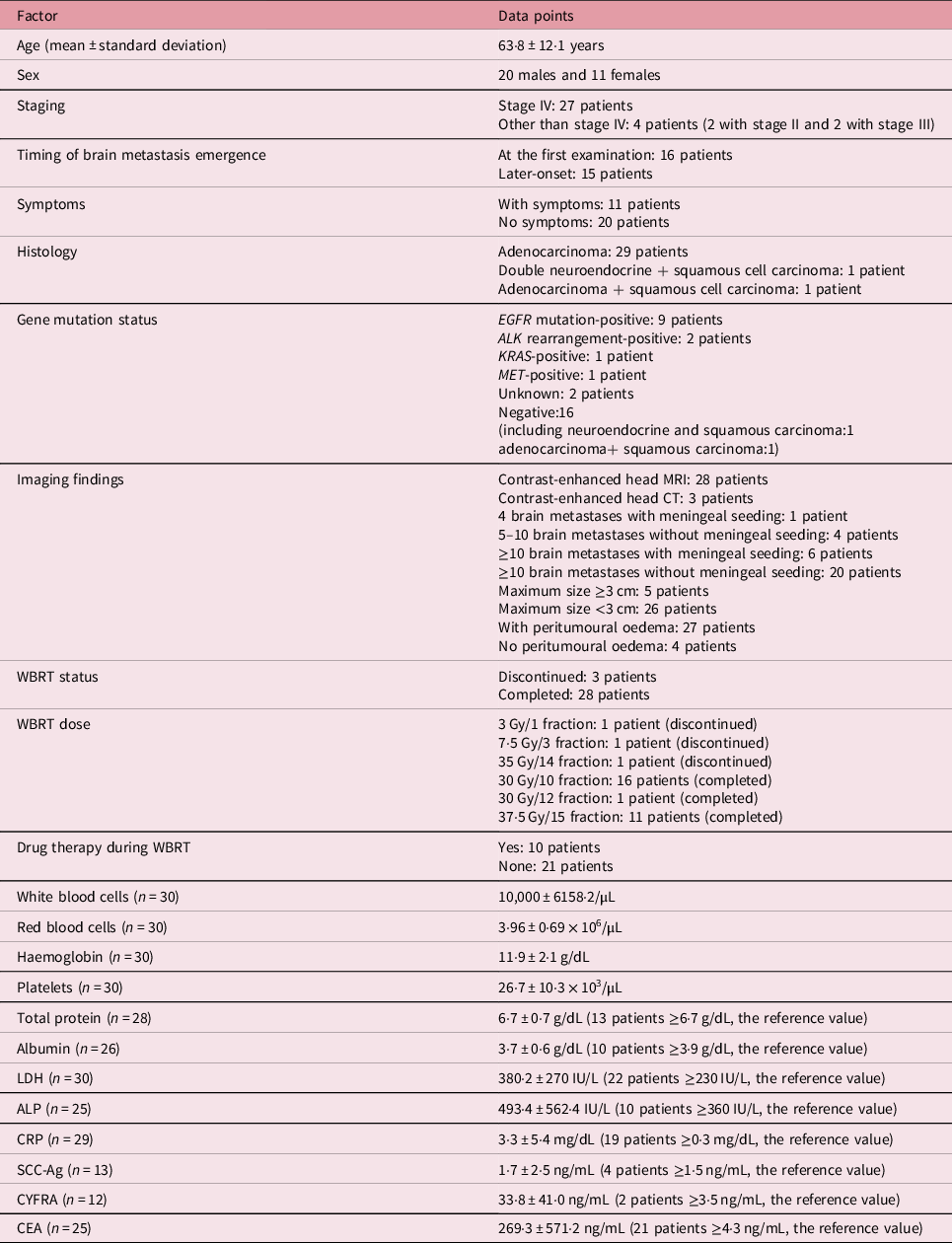
Sixty-three patients were initially selected for the study; however, 12 were excluded because of their unknown clinical course, 8 because the number of brain metastases could not be accurately determined and 12 because they had 1–4 brain metastases indicated for SRS. Hence, 31 consecutive patients were ultimately investigated; their characteristics are listed in Table 1.
Patient characteristics

Age and blood parameter data are shown as means ± standard deviations. ALP, alkaline phosphatase; CEA, carcinoembryonic antigen; CRP, C-reactive protein; CT, computed tomography; CYFRA 21-1, cytokeratin 19 fragments; LDH, lactate dehydrogenase; MRI, magnetic resonance imaging; SCC-Ag, squamous cell carcinoma-related antigen; WBRT, whole-brain radiotherapy.
Symptoms associated with brain metastasis were observed in only 11 of the patients. These were involuntary movement in one, difficulty walking in two, reduced finger function in one, headache in two, difficulty speaking in one, palsy in two, lightheadedness in one and double vision in one. Moreover, all 31 patients had other metastases in addition to their brain lesions (including intrapulmonary, pleural, lymph node, bone and liver). Contrast-enhanced head MRI was obtained in 28 patients. Contrast-enhanced head CT was obtained in 3 patients. 1 patient had 4 brain metastases with meningeal seeding. 4 patients had 5–10 brain metastases without meningeal seeding: 6 patients had ≥10 brain metastases with meningeal seeding: 20 patients had ≥10 brain metastases without meningeal seeding: 5 patients had maximum size ≥3 cm. 26 patients had maximum size <3 cm. 27 patients had peritumoural edema. 4 patients had no peritumoural edema.
Treatment
WBRT was discontinued in three patients for complication; moreover, one patient underwent SRS after completing WBRT (Table 1). Ten of the patients were administered therapeutic agents during WBRT: two received gefitinib, three received erlotinib, two received carboplatin plus pemetrexed, and one each received paclitaxel, cisplatin plus pemetrexed, and cisplatin plus paclitaxel.
Survival
The patients’ median survival was 129 days (range, 6–971 days); all patients died during the course of their disease. Kaplan–Meier analyses of the median survival in the gene mutation-positive group was 203 days [95% confidence interval (CI): 97–412 days] while that in the gene mutation-negative group was 112 days (95% CI: 38–156 days); the difference was statistically significant (p < 0·01).
The median survival in patients with LDH levels <230 IU/L group was 232·5 days (95% CI: 79–743 days), whereas that in patients with LDH levels ≥230 IU/L group was 96·5 days (95% CI: 38–156 days); this difference was also significant (p = 0·03). The median survival in patients who received a radiation dose <30 Gy group was 11·5 days (95% CI: 6 days to ‘not achieved’), that in patients who received a radiation dose between 30 Gy/10 fractions and 35 Gy/14 fractions group was 99·5 days (95% CI: 54–156 days), that in patients who received a radiation dose 37·5 Gy/15 fractions group was 200 days (95% CI: 60–297 days) (p < 0·01). The median survival in patients with non-stage IV group was 57·0 days (95% CI: 38–NA days), whereas that in patients with stage IV group was 152·0 days (95% CI: 96–203 days); this difference was also significant (p < 0·01)
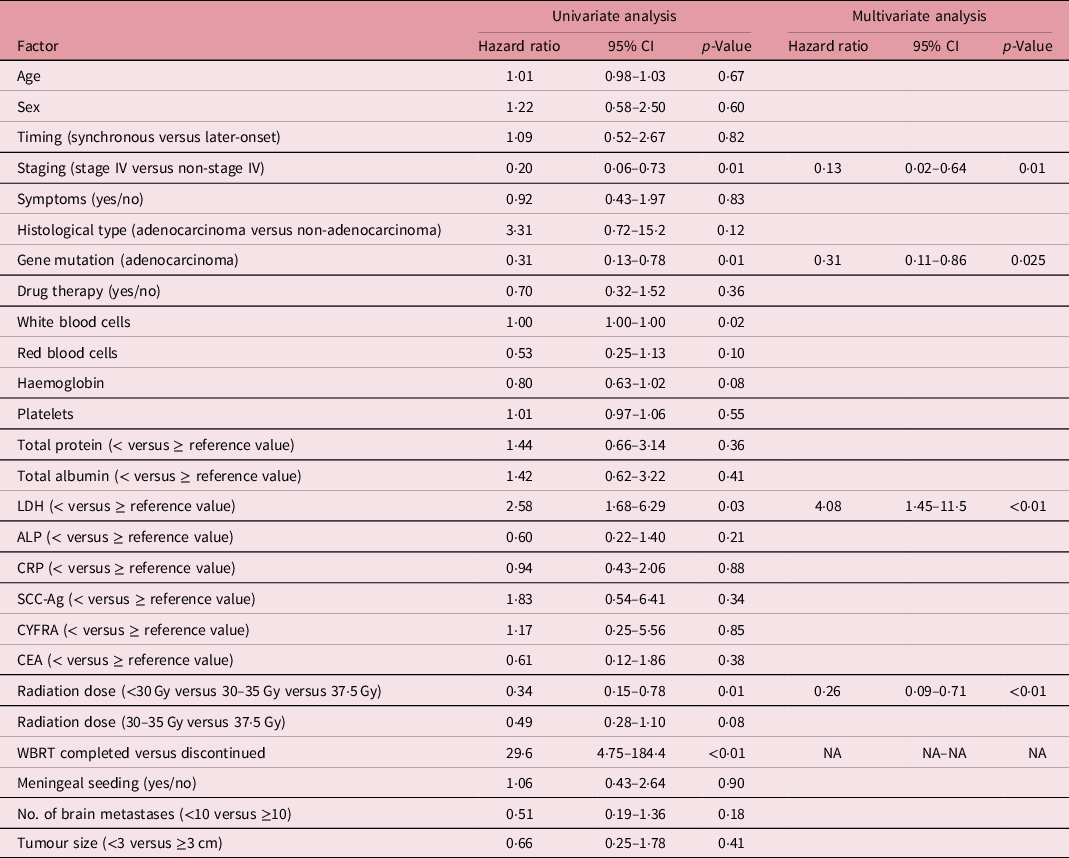
Univariate analysis using the Cox proportional hazards model revealed a statistically significant value according to the presence or absence of gene mutation status (hazard ratio: 0·31, 95% CI: 0·13–0·78, (p < 0·01), LDH levels of <230 versus ≥230 IU/L (hazard ratio: 2·58, 95% CI: 1·68–6·29, p = 0·03), radiation dose (<30 Gy, 30 Gy/10 fractions to 35 Gy/14 fractions and 37·5 Gy/15 fractions) (hazard ratio: 0·34, 95% CI: 0·15–0·78, p < 0·01), WBRT completion status (hazard ratio: 29·6, 95% CI: 4·75–184·4, p < 0·01) and stage IV versus non-stage IV (hazard ratio: 0·20, 95 CI:0·06–0·73, P <).The remaining factors were not significantly associated with survival.
Multivariate analysis with stepwise testing was performed to investigate differences in survival according to gene mutation status, LDH level, irradiation dose, WBRT completion and Stage status. Of these, a statistically significant difference in survival was observed in patients with gene mutation status (hazard ratio: 0·31, 95% CI: 0·11–0·86, p = 0·025), LDH levels <230 vs. ≥230 IU/L (hazard ratio: 4·08, 95% CI: 1·45–11·5, p < 0·01), radiation dose (30 Gy, 30 Gy/10 fractions to 35 Gy/14 fractions and 37·5 Gy/15 fractions) (hazard ratio: 0·26, 95% CI: 0·09–0·71, p < 0·01), and stage IV versus non-stage IV (hazard ratio: 0·13, 95 CI:0·02–0·64, p < 0·01). Data from these analyses are shown in Table 2.
Survival analysis using the Cox proportional hazards model

ALP, alkaline phosphatase; CEA, carcinoembryonic antigen; CRP, C-reactive protein; CT, computed tomography; CYFRA 21-1, cytokeratin 19 fragments; LDH, lactate dehydrogenase; MRI, magnetic resonance imaging; SCC-Ag, squamous cell carcinoma-related antigen; WBRT, whole-brain radiotherapy
Discussion
Several investigations of prognostic factors in patients with brain metastases arising from NSCLC have been performed to date. A study of patients with various primary tumour types found that patients who received 30 Gy of WBRT had longer survival than those who received best supportive care group. Reference Nieder, Norum, Dalhaung, Aandahl and Pawinski8 Our study also found that patients who discontinued WBRT (i.e., received <30 Gy/10 fractions) had very poor prognoses, which is consistent with previous studies. Another study of patients with several primary lesion types found that those who received 30 Gy of WBRT had longer survival than did those who received best supportive care group, whereas those who received 20 Gy WBRT did not. Reference Nieder, Norum, Dalhaug, Aandahl and Engljähringer9 Another study of patients with brain metastases from NSCLC found that those with four or more lesions who were administered WBRT doses of ≥30 Gy achieved improved intracranial tumour control and survival, although there was no difference in these parameters between patients who received 30–39 Gy and those who received ≥40 Gy. Reference Li, Shen and Zhang10
Our study found there were significant difference between <30 Gy/10 fraction, 30 Gy/10 fraction to 35 Gy/14 fraction and 37·5 Gy/15 fraction in survival. But, there were no significant difference in survival between either the ‘30 Gy/10 fraction to 35 Gy/14 fraction’ group and the 37·5 Gy/15 fraction group; as such, 30 Gy/10 fractions appeared to be an adequate WBRT dose. A study of 264 patients with NSCLC brain metastases identified recursive partitioning analysis RPA class I or II and adenocarcinoma histology as favourable prognostic factors. Reference Harada, Asakura and Ogawa11 The median survival in the present study was 129 days (6–971 days), which was slightly shorter than previously reported values; this may be attributable to differing patient characteristics.
The median survival times of patients with LDH levels <230 versus ≥230 IU/L in our study were 232·5 days and 96·5 days, respectively, and multivariate analysis revealed LDH to be a prognostic factor; this is consistent with other studies. In a study, LDH was found to be a predictor of progression-free and overall survival among patients with NSCLC who were treated with bevacizumab. Reference Li, Li and Guo12 One meta-analysis revealed an association between the high LDH levels and poor prognosis in patients with NSCLC and SCLC, Reference Deng, Zhang, Meng, Zhou and Li13 while a study of patients with stage IV NSCLC found that those with high LDH levels had poor prognoses. Reference Lee, Park and Kim14 Another meta-analysis of patients with NSCLC who were treated with immune checkpoint inhibitors also found that those with high LDH had poorer overall and progression-free survival. Reference Zhang, Li and Yan15 Several groups investigated whether LDH is a prognostic factor in patients with brain metastasis; one such study found that LDH >300 IU/L in patients who underwent WBRT had poorer prognoses, although that study included patients with various cancer types and with 1–3 brain metastases. Reference Miyazawa, Shikama, Okazaki, Koyama, Takahashi and Kato7 Another study of patients with NSCLC found a correlation between LDH-5 (i.e., LDH expressed by cancer cells) and hypoxia inducible factor-1, and that those with high LDH had poor prognoses. Reference Koukourakis, Giatromanolaki and Sivridis16 Conversely, other studies found LDH not to be a prognostic factor. One such investigation of patients with NSCLC accompanied by brain metastases found that adenocarcinoma, lymph node metastasis and high carcinoembryonic antigen levels were associated with a poor prognosis, while LDH was not a prognostic factor; however, that study utilised data from patients treated between 1990 and 2000. Reference Iwasaki, Shirakusa, Yoshinaga, Enatsu and Yamamoto17 Another study of brain metastases in patients with NSCLC did not investigate LDH but found that a neutrophil-to-lymphocyte ratio ≤5 and programmed cell death-ligand 1 (PD-L1) expression were favourable prognostic factors post-WBRT. Reference Doi, Nakamatsu and Anami18 Another study of brain metastases with EGFR-mutant NSCLC, a neutrophil-to-lymphocyte ratio of ≤2·99 was indicative of a better prognosis. Reference Li, Wang and Yang19 These studies suggest that a patient’s immunocompetency status may also be prognostic.
High LDH levels and neurologic symptoms have been associated with a poor prognosis in patients with brain metastases arising from SCLC. Reference Anami, Doi and Nakamatsu20 Our previous study of patients who received WBRT for initial brain metastases of SCLC found that neurologic symptoms and neuron-specific enolase expression were prognostic factors on multivariate analysis, while LDH was not. Reference Okada, Kobayashi, Shinozaki, Abe and Nakamura21 We also studied patients who received WBRT for initial brain metastases from breast cancer; while univariate analysis showed LDH to be a prognostic factor and multivariate analysis showed that only radiation dose and subtype were prognostic factors, whereas LDH showed borderline significant value. Reference Okada, Kobayashi and Shinozaki22 Another study aimed at predicting 1-year, 2-year and 3-year survival in patients with brain metastases from SCLC did not evaluate LDH. Taken together, LDH is a potential but yet unestablished prognostic factor. Reference Huang, Hu, Tong, Fan and Zhao23 Our study did not clarify certain aspects concerning the association between high LDH levels and poor prognoses. That patients with high LDH levels had poor prognoses could be due to a greater number of hypoxic cells and greater resistance to radiotherapy. Reference Koukourakis, Giatromanolaki and Sivridis16 An association between high LDH levels and positron emission tomography/CT findings has also been reported and raises the possibility that patients with high LDH levels have poor prognoses owing to larger tumour masses. Reference Lee, Park and Kim14 In our study, we did not categorise patients according to tumour mass or proportion of hypoxic cells
Our study found there were significant difference between gene mutation-positive group and negative group in survival. There are some reports about the patient’s prognosis with brain metastases and gene mutation. In SRS (gamma knife) research, the prognosis of EGFR-, KRAS- and ALK-positive patients with brain metastases is superior to the prognosis of EGFR-, KRAS- and ALK-negative patients with brain metastases. Reference Wang, Saad and Qureshi24 But, in this research, EGFR mutation itself is not a prognostic factor, KRAS mutation is not a prognostic factor and ALK mutation may be a prognostic factor, but it is not clear. Reference Wang, Saad and Qureshi24 In another study of brain metastasis with EGFR-mutant NSCLC, survival was longer in those administered radiotherapy combined with a tyrosine kinase inhibitor; moreover, SRS produced a greater improvement in survival than did WBRT. Reference Magnuson, Lester-Coll and Wu25 In other study, ALK rearrangements is a prognostic factor with brain metasitases, but, EGFR mutation is not a prognostic factor with brain metasitases. Reference Mak, Gainor and Niemierko26 But, in this study, targeted therapy, chemotherapy, number of brain metastasis, extracranial metastasis, age and performance status are prognostic factors. Reference Mak, Gainor and Niemierko26 Moreover, in cell line research, ALK inhibitor did not improve radiation sensitivity. Reference Fleschutz, Walter and Leistne27 . In our study, gene mutation status is a prognostic factor in whole-brain therapy. We think that targeted therapy between WBRT or after WBRT affects the brain metastases more than WBRT itself.
Our study had a number of limitations. First, it was retrospective and comprised a limited number of subjects, including those with unknown clinical courses. Furthermore, we did not evaluate recursive partitioning analysis Reference Gaspar, Scott and Rotman28 or the graded prognostic assessment score, which are widely used for predicting the prognoses of patients with brain metastases (the latter was developed specifically for lung cancer). Reference Sperduto, Yang and Beal29 This was because of inadequate evaluation of the Karnofsky performance status. The use of immune checkpoint inhibitors is also increasing; a previous meta-analysis revealed that such therapies prolong survival in patients with brain metastases originating from NSCLC, although that analysis included only 250 patients. Reference Yang, Li, Bai, Sun and Zhao30 However, we did not evaluate PD-1 or PD-L1 expression status in our patients. Although we did not avoid the hippocampus while delivering WBRT, doing so is expected to become common practice. Reference Gondi, Pugh and Tome5 A multi-institutional prospective clinical study of WBRT with hippocampal avoidance in a greater number of patients is warranted.
Conclusion
Gene mutation, LDH, radiation dose and Stage are prognostic factors for patients with initial brain metastases who are treated with WBRT.
Acknowledgements
No.
Financial support
No.
Conflicts of interest
No.
Ethical standards
This study was conducted with the approval of the St. Marianna University School of Medicine Ethics Committee (approval no. 4707). Patients were provided the opportunity to opt out on the hospital website and in the hospital.
Data availability
No.