Introduction
The mid-nineteenth century in Britain was a time of changing attitudes towards the past, not least because of the arrival from Scandinavia of the Three Age System based on the gradual typological change in artefacts and the contexts in which they were found—from stone to bronze to iron (Gräslund, Reference Gräslund1987: 24–28). The Three Age System made its appearance in Britain in the 1840s in the work of James Prichard (Morse, Reference Morse1999, Reference Morse2005: 98–103; Rowley-Conwy, Reference Rowley-Conwy2007: 89–99). The concept was debated, contested, and rejected in many London antiquarian circles (Rowley-Conwy, Reference Rowley-Conwy2007: 82–83). In Scotland, however, Daniel Wilson's Reference Wilson1851 publication, The Archaeology and Prehistoric Annals of Scotland, presented a long chronology of prehistoric material, organized in the stone–bronze–iron system. Importantly, Wilson included a chapter on craniology, the chronological sequencing of skulls by their shapes, correlating these with artefact typologies. A short time later, according to Peter Rowley-Conwy (Reference Rowley-Conwy2007: 127), the Derbyshire antiquarian Thomas Bateman presented a clear statement—the clearest of all English (as opposed to Scottish) writers of the time—in favour of the Three Age System in an article published in 1852 in the Journal of the British Archaeological Association (Bateman, Reference Bateman1852), where he employed a scientific examination of human remains, along with their associated finds. Skulls in particular were emphasized and these were described in terms coined by Wilson.
Rowley-Conwy (Reference Rowley-Conwy2007: 126–36) has argued that, after 1852, Bateman may have been under outside pressure to retrench. He sees Bateman as seemingly ambivalent and no longer committed to using cranial types as chronological evidence in his publications. Yet, a different picture emerges from unpublished letters to Bateman from the two authors of Crania Britannica, Joseph Barnard Davis and John Thurnam. Although Bateman was reserved, he actually resisted pressure to change his convictions after 1852. This article presents new evidence from archival sources on Bateman's role in the evolving discussions in ethnology and archaeological chronology and introduces more details of the history of the debates surrounding the Three Age System in England. First, some brief background information is necessary to appreciate the state of ethnology, craniology, and archaeological chronology in mid-nineteenth-century Britain.
Mid-nineteenth-Century Ethnology, Craniology, and Chronology
The late eighteenth to the mid-nineteenth centuries were a time of evolving attitudes in the study of humankind—a reflection on the place of humans both in the ‘modern’ world and in the past. The term ethnology, coined in the eighteenth century, was used to describe investigations into the origins and comparative differences of human populations, particularly in relation to the development of modern nations (Stocking, Reference Stocking1987: 47). In Britain, ethnological research in the early decades of the nineteenth century was conducted through The Aborigines Protection Society, which had its roots in the abolition movement, embedding a conflict between its original humanitarian aims and more scientific ‘anthropological’ goals that sought to define the variations in humankind. This conflict ultimately led to the re-naming of the society in 1842 as the Ethnological Society and its abandonment, for the most part, of the humanitarian element, although the notion that humankind was ‘of one blood’ was retained (Stocking, Reference Stocking1971: 369–72).
By the mid-nineteenth century, arguments arose over how best to define humanity's differences—linguistically, biologically, or culturally. There were debates as to whether the races of modern humans had diverged from a single race (monogenism) or were descended from multiple races (polygenism). The monogenist perspective was the traditional view, upheld by the Ethnological Society, and was primarily based on parallels in comparative linguistics. Physical differences in human forms were attributed to historical influences of the environment. The polygenist view, on the other hand, was on the rise. It tended to put more emphasis on physical differences and promoted the idea that the characteristics of a race—including the shape of the skull—were unchanged since the beginning of humankind and that no race could overcome its hereditary makeup (Stocking, Reference Stocking1987: 64, 68; Rowley-Conwy, Reference Rowley-Conwy2007: 120). By 1863, the Anthropological Society of London had formed out of the Ethnological Society to focus on the physical evidence of humankind, strongly adhering to the polygenist view, largely under the influence of James Hunt (Stocking, Reference Stocking1971: 376; Rainger, Reference Rainger1978: 56–60). It was Hunt who, at the 1863 British Association for the Advancement of Science meeting, announced that the classification of humankind came down to an understanding of anatomy and physiology—particularly the crania—and firmly stated that ‘language is no test of race’ (Hunt, Reference Hunt1864).
The systematic study of skull types or craniology was an analytical method by which such physical differences could be measured. The skull was considered to display racial features and thus became a focus for analysis (Meigs, Reference Meigs1858: 2–3). Both polygenists and monogenists employed the science of craniology, but tended to interpret the results differently—different immutable races versus different forms caused by external factors. For both groups, however, craniology carried with it a set of implicit assumptions. Nineteenth-century racial theory saw no clear distinctions between physical and social/cultural characteristics and often race was equated with national character (Montagu, Reference Montagu1962: 920; Stocking, Reference Stocking1994: 6). Additionally, ideas about cranial characteristics employed concepts from the earlier popular movements of phrenology and physiognomy that maintained that mental and moral qualities were expressed physically in the shape of the head and facial features respectively, a reductionist view that saw a continuous line of deduction from physical to cultural (Jorion, Reference Jorion1982: 10). Even later, in the late nineteenth century when phrenology and physiognomy had been demoted to the realms of quackery, these cultural assumptions were still deeply embedded and difficult to eradicate (Hunt, Reference Hunt1981: 343; van Wyhe, Reference van Wyhe2004: 202; Díaz-Andreu, Reference Díaz-Andreu2007: 349).
At the same time as ethnology was evolving in the early nineteenth century, so, too, was the concept of the Celts as a people. Ancient historical sources singled out the Celts as the pre-Roman aboriginal race of Britain. Linguistically Indo-European, the Celts were also assigned a biblical lineage, descended from Gomer, son of Japhet, who in turn was the son of Noah (Rowley-Conwy, Reference Rowley-Conwy2007: 89–90, Reference Rowley-Conwy and Melton2013: 2021). In keeping with current tradition in ethnology, by the mid-nineteenth century the definition of the Celts was shifting from one based on language to one founded on physical attributes of race (Morse, Reference Morse2005: 10). Changing cultural ideas of the Celts as an ancestral race—a people variously associated with the first bronze implements, the ancient megalithic monuments, romantic folktales, notions of Druids, and ‘noble savages’—were in the process of being formulated within British social and nationalist agendas (Dietler, Reference Dietler1994: 597; Morse, Reference Morse2005: 13; Díaz-Andreu, Reference Díaz-Andreu2007: 345–49).
Archaeology was seen as a way to validate ancestry by linking cranial sequencing to the question of archaeological chronology (Morse, Reference Morse1999, Reference Morse2005: 96–125; Rowley-Conwy, Reference Rowley-Conwy2007: 120–26). This procedure is often seen as the mechanism by which the Three Age System was initially received in Britain and Ireland (Morse, Reference Morse1999: 2). Ancient skulls were examined and measured, the quantification providing a veneer of scientific rigour. Antiquarians placed the skulls in the context of the burials and associated finds. This made it possible to place the skulls within a stone–bronze–iron sequence, the cornerstone of the Three Age System. However, cranial evidence from Britain did not match that coming out of Europe, despite similarities in material culture. Craniologists from the Scandinavian countries and France identified the bronze-bearing Celts—the original ‘civilized’ Europeans—as a long-headed group who supplanted a broad-headed indigenous population (Thurnam, Reference Thurnam1865: 122; Dietler, Reference Dietler1994: 592; Díaz-Andreu, Reference Díaz-Andreu2007: 348; Rowley-Conwy, Reference Rowley-Conwy2007: 253). This was in agreement with a polygenist scheme that embedded a racist view towards the ‘other’ beyond the European borders in an expanding colonial world. White western Europeans with long heads (dolicocephalic) were considered as intelligent, while ‘others’ with broad heads (brachycephalic) were considered inferior (Díaz-Andreu, Reference Díaz-Andreu2007: 347).
Craniologists in Britain, however, identified the Celts, with their bronze implements and round barrows, as having a broad head, later replaced by the long-headed Saxons. Additionally, a debate, determined by cranial sequencing in archaeology, began to question whether these broad-headed Celts were the original inhabitants of the British Isles or whether a long-headed primeval race had existed before them (Morse, Reference Morse2005: 95–96). This long-headed race was associated with flint implements, but also with elaborate barrows. The idea that complex burial forms should come before simplified ones, an inversion of the natural order of human progression, was considered wrong, if not impossible. This notion of progression prefigures the later nineteenth-century unilineal socio-cultural evolutionism of John Lubbock and E.B. Tylor (Stocking, Reference Stocking1963: 784, Reference Stocking1994: 13; Kuper, Reference Kuper2005: 17; Trigger, Reference Trigger2006: 175). The acceptance of the possibility of a long-headed primeval race also pushed the chronological framework back much earlier than that derived from ancient historical sources, something that would not be scientifically proven until the mid-nineteenth century, when evidence of humans was linked to the deep chronology of geological strata (Lubbock, Reference Lubbock1865b: 2–3; Trigger, Reference Trigger2006: 144–45).
Thomas Bateman (1821–1861)
Little is known about Thomas Bateman's engagement with mid-nineteenth-century antiquarian theory, including ethnology, chronology, and the use of craniology. Most of what we can deduce comes from his publications and from his correspondence with other scholars. Bateman is principally portrayed as a ‘barrow digger’ and antiquarian collector (Marsden, Reference Marsden1979), as in the contemporary poem Barrow-Digging by a Barrow-Knight (Isaacson, Reference Isaacson1850). A statement in Bateman's final publication of 1861, taken out of context, is often quoted to demonstrate his rejection of theory: ‘Theory, the bane of nearly all the older antiquarian works, has been avoided; and the very few deductions I have ventured to make from recorded facts, are either demonstrable, or such as may be fairly inferred’ (Bateman, Reference Bateman1861a: iv). Bateman is, indeed, distancing himself from ‘theory’, by which he means older, speculative antiquarian observations. This view of scientific approach versus antiquarian speculation is similar to that of the earlier antiquarian Richard Colt Hoare, whom Bateman admired (Morse, Reference Morse2005: 88–89).
It has been suggested that Bateman came late to the study of craniology and was influenced and eclipsed by Joseph Davis (Stocking, Reference Stocking1971: 66; Morse, Reference Morse2005: 115–16; Rowley-Conwy, Reference Rowley-Conwy2007: 135–36). This portrayal might be supported by the fact that he did not become a Fellow of the Ethnological Society until sometime between mid-1857, when Thomas Wright suggested in a letter to Bateman that he propose him for membership (Antiquarian Correspondence V, 29 August 1857), and the confirmation of membership in the title page of his last book, Ten Years Digging in the Celtic and Saxon Hills (hereafter, Ten Years Digging), published in Reference Bateman1861. Bateman thus became a member when the split within the society referred to above was underway to champion the use of physical evidence in the study of humankind.
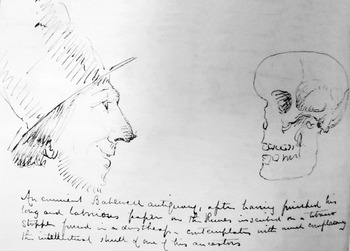
Portraying Bateman as a latecomer to craniology is, however, belied by Bateman's own excavations. He began these in 1843, carefully preserving physical human remains (particularly crania) and situating them within a relative chronology, stressing the significance of archaeological assemblages (Figure 1). In his early publications (e.g. Bateman, Reference Bateman1847, Reference Bateman1848), he tended to discuss the human remains in burials by recording the interment method—inhumation and the placement of the body, or cremation—but in later publications (e.g. Bateman, Reference Bateman1851, Reference Bateman1855a, Reference Bateman1861a), he began occasionally to include descriptions of head shapes. Bateman's chronological sequence was hinted at in an article on Kimmeridge coal ornaments published in 1847 which placed these in the context of the remote past, at a time of transition between stone and bronze, using the excavation at the Cow Lowe round barrow in Derbyshire as an example of multiple interments ‘during a long succession of ages’ (Bateman, Reference Bateman1847: 236–37). A book in Bateman's library by Worsaae, a major proponent of the Three Age System, might have provided him with the rationale for this chronological sequence (Worsaae, Reference Worsaae1847; Sale Catalogue, 1893: 121; Rowley-Conwy, Reference Rowley-Conwy2007: 111).
Caricature of Bateman that illustrates his interest in crania, sketched at the bottom of a letter from Thomas N. Brushfield to Thomas Bateman, 15 August 1857: ‘An eminent Bakewell antiquary, after having finished his long and laboroius paper on the runes inscribed on a tobacco stopper found in a dustheap—contemplating with much complacency the intellectual skull of one of his ancestors.’ By permission of Museums Sheffield.

This chronological sequence was laid out more fully in his first book, Vestiges of the Antiquities of Derbyshire (hereafter Vestiges). In Chapter III, ‘Various Ages of Tumuli’; he states that the comparative dates of the tumuli could ‘only be determined by the articles found within them’ (Bateman, Reference Bateman1848: 12–14) and placed interments with stone before those with bronze and those with bronze before those with iron. This apparent adoption of the Three Age System is even earlier than his 1852 article highlighted by Rowley-Conwy (Reference Rowley-Conwy2007: 126–36), where he supported the Three Age System and backed up that assertion with evidence from cranial sequencing.
By 1855, he had published a catalogue of his private museum at his home, Lomberdale House in Derbyshire (Bateman, Reference Bateman1855a). Although containing typical antiquarian acquisitions of (ethnographic) curiosities from around the globe and later Medieval and Old English antiquities largely inherited from his father, the greatest part comprised the finds from his excavations in the local area. His excavated material was organized into broad chronological periods: Celtic (Stone and Bronze), Romano-British, and Anglo-Saxon. The Celtic period had two lists that included descriptions of human remains, calcified and skeletal. An addendum in his last book, Ten Years Digging, added to those lists (Bateman, Reference Bateman1861a: 103–22).
A list of books and manuscripts in Bateman's library confirms that he possessed many volumes on ethnology, including Crania Americana and Crania Aegyptiaca (Morton, Reference Morton1839, Reference Morton1844; Sale Catalogue, 1893: 92, 100), Types of Mankind (Nott & Gliddon, Reference Nott and Gliddon1857; Sale Catalogue, 1893: 86), and the third edition of Researches into the Physical History of Mankind (Prichard, Reference Prichard1841–1847; Sale Catalogue, 1893: 90). Bateman's library also contained two large, undated folios with newspaper cuttings, printed documents, and engravings on ethnological subjects (Sale Catalogue, 1893: 57). Alongside his involvement with the production of Crania Britannica discussed more fully below, this evidence suggests that he maintained an active interest in ethnology throughout his short career.
Bateman's conviction that humans originated from one race branded him a monogenist. In 1855 he published on observations of universal similarities in burial forms among ancient and contemporary non-Western people across the globe, stating that ‘there is abundant evidence to shew that “all men are brethren”, or in other words, that the human family, however varied, sprang originally from one stock’ (Bateman, Reference Bateman1855b: 2–3). This conviction was repeated in the introduction to his final publication (Bateman, Reference Bateman1861a: iii–iv). Like Daniel Wilson (another monogenist), Bateman placed less stress on the physical indicators of race in crania and tended to look at variations in skull forms typologically in the context of the burial as part of the entire assemblage (Rowley-Conwy, Reference Rowley-Conwy2007: 163). He was detailed in his description of skeletal material with respect to burial types—whether it was cremation (‘calcified bones’) or inhumation and the placement of the body (‘contracted’, ‘extended’).
A possible reason for the uncertainty surrounding Bateman's stance within the ethnological community stems from his reticence to participate in national and international meetings or even his late move to become a member of the Ethnographical Society. He attended, as a very young man, the first congress in Canterbury of the British Archaeological Association (BAA) in 1844, at which he made a favourable impression (Wright, Reference Wright1845: 2, 8). There, he presented (through the proxy of Charles Roach Smith) the results of some of his earliest excavations (MS Derbyshire Tumuli, 1843). Thereafter he seems to have declined to attend such gatherings (Marsden, Reference Marsden1979: 306). In fact, Bateman did not even attend the 1851 BAA congress that was held in Derby near his home even though this was the occasion for the presentation of his significant paper on crania and chronology (Bateman, Reference Bateman1852). Thomas Pettigrew, the Association's secretary, presented his paper (JBAA, 1852: 343). Bateman did, however, host an event during the congress in his private museum at Lomberdale House (Derby Mercury, 1851; Marsden, Reference Marsden1979: 306–07). Additionally, with the exception of his two books and his loyalty to the BAA's journal, he supported local periodicals such as Reliquiae Antiquiae Eboracenses (Bateman, Reference Bateman1855b), edited by William Bowman, and The Reliquary (Bateman, Reference Bateman1861b), edited by Llewellyn Jewitt. Bateman had a personal connection with both Bowman and Jewitt, who, in their role as illustrators, provided numerous images for his publications. Thus Bateman's readership would not necessarily have been international. He tended to interact with other scholars through his correspondence and by inviting those interested to view his private museum.
Crania Britannica
A more detailed examination of one set of correspondence, dating from 1848 to 1859, regarding his collaboration with the authors of Crania Britannica, Joseph Barnard Davis and John Thurnam, and relating to its origins and production, offers a few more insights into Bateman's role in discussions about chronology and the classification of crania (Stocking, Reference Stocking1987: 66). Published between 1856 and 1865, Crania Britannica was the first publication of British national skull types detailing the successive inhabitants of the British Isles from ancient times to the Anglo-Saxon period, setting them in their archaeological context. The work was modelled on the earlier publication of Crania Americana (Morton, Reference Morton1839; Davis & Thurnam, Reference Davis and Thurnam1856–65: vi). It was part of a wider nationalist phenomenon among mid-nineteenth-century ethnologists, particularly in Western Europe, who sought to characterize national skull types, summarized in Crania Britannica’s introduction (Davis & Thurnam, Reference Davis and Thurnam1856–65: vi).
Bateman's correspondence with Davis and, to a lesser degree, with Thurnam began just after his 1848 publication of Vestiges, when he was then 27 years old. There are ninety-four letters from Davis dating from 8 September 1848 to 8 October 1859 and six letters from Thurnam dating from 10 May 1848 to 9 June 1857 in the Bateman archive. Both Davis and Thurnam were medical men, Davis based in Staffordshire, and Thurnam originally in Yorkshire and later, by 1849, in Kent (Hervey, Reference Hervey2007; Urquhart, Reference Urquhart2007). Since both authors were polygenists, Crania Britannica was skewed towards this viewpoint and also questioned the validity of deep chronologies beyond that based on ancient history (Rowley-Conwy, Reference Rowley-Conwy and Melton2013: 22).
From the beginning of their correspondence, Davis set the pattern of expounding his own views and opinions based on a selective and imperfect reading of Bateman's work. Davis’ first two letters (Antiquarian Correspondence I, 8 September 1848 and 27 October 1848) thanked Bateman for the gift of two skulls, the first crania in Davis’ collection (Davis, Reference Davis1867: vi, 1–2). In the second letter, Davis offered an extensive critique of the recently published Vestiges (Reference Bateman1848). Centred on Derbyshire, Vestiges was typical of antiquarian research in the chorographic tradition. It detailed previous research at local sites in the late eighteenth and early nineteenth centuries—collated by or excavated by Bateman's father, William—with a smaller addendum describing Bateman's own excavations from 1843 to 1847, followed by sections that range chronologically from a catalogue of standing stones to a description of medieval and ecclesiastical antiquities. Davis inferred from Bateman's recounting of ancient historical sources in the Introduction (Bateman, Reference Bateman1848: 1–2) that ‘the earliest residence of the Celts on the Island is not vastly remote — probably not more or not much more than 1,000 years before the Christian era at the most’. Yet Davis seems to have overlooked Bateman's supposition, also noted in the Introduction, that an older population existed in Britain associated with earlier burials, perhaps at a time in the remote past when a land bridge united Britain with continental Europe (Bateman, Reference Bateman1848: 1) as well as the rudimentary outline in Chapter III of relative chronology (Bateman, Reference Bateman1848: 12–14). Davis goes on to infer, without evidence, that Bateman's conclusions were in ‘perfect accordance with the opinion of Baron Cuvier, in his celebrated Discourses’ (Cuvier, Reference Cuvier1825), a view directly opposed to uniformitarianism or gradual geological change over vast periods of time (Trigger, Reference Trigger2006: 144–45).
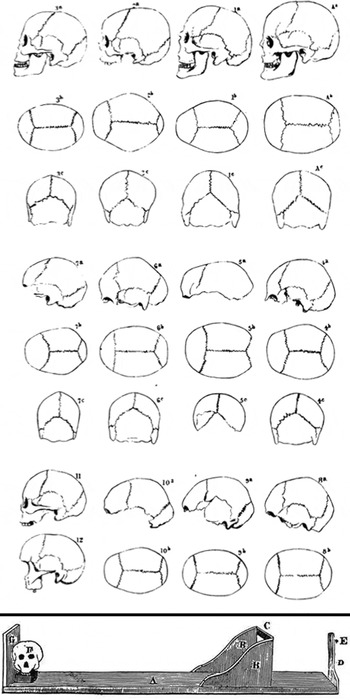
Although there are fewer letters from Thurnam to Bateman, requests for information on specific issues seem to form the basis of their correspondence. In the spring of 1848, Thurnam had been excavating at Lamel Hill in the grounds of The Retreat, a Quaker facility for the treatment of patients with mental illness near York, where he was employed as Medical Superintendent from 1846 to 1849 (Urquhart, Reference Urquhart2007). He wrote a letter of introduction to Bateman (Antiquarian Correspondence III, 10 May 1848), as the author of Vestiges and one who also had greater experience with a larger skeletal assemblage from Derbyshire and Staffordshire, asking about the curious nature of the worn teeth of the skulls found at Lamel Hill (Figure 2) and whether this feature might help determine the date of the burials as Romano-British or Anglo-Saxon.
Top: Crania from the tumulus of Lamel Hill near York (Thurnam, Reference Thurnam1849). Bottom: Craniograph (Morton, Reference Morton1839: 294).

A short time later, Davis proposed, in a letter to Bateman, to embark on a systematic study of the ‘crania from the ancient galleried cistvaen’ (Antiquarian Correspondence I, 22 March 1849). In this same letter and one following (Antiquarian Correspondence I, 28 March 1849), Davis discussed Thurnam's paper on the Lamel Hill burials (Thurnam, Reference Thurnam1849) and pointed out that Thurnam proposed a similar project. Davis drew Bateman's attention to Thurnam's outline drawings taken with a craniograph, a camera lucida instrument designed by the American craniologist, Samuel Morton (Reference Morton1839: 294) (see Figure 2). Nearly a year after they first corresponded, Davis and Bateman first met in person at Bateman's home on 7 August 1849, recorded in Davis’ pocket notebook, held in the archives of the Royal Anthropological Institute (RAI, MS 140/2). Davis’ note mentions that Bateman placed the Celtic crania at his service for drawing or other use.
In the spring of 1852, Davis sent Bateman a prospectus for his proposed publication Crania Celtica (Antiquarian Correspondence I, 15 May 1852; RAI, MS 436/12), hinting that Thurnam, with whom he had been in correspondence, was unwilling to disclose the exact nature of his project that had been announced in The Archaeological Journal (Thurnam, Reference Thurnam1850: 35), where Thurnam had indicated that ‘one gentleman, who possesses a valuable collection of antiquities from tumuli’ had promised him the use of his series of crania, likely referring to Bateman. Shortly thereafter, Davis wrote an agitated letter to Bateman (Antiquarian Correspondence I, 20 May 1852) indicating that Thurnam had finally admitted to him that his project was identical in character to his own and suggested pooling their resources and contacts for a joint publication, which resulted in Crania Britannica. Revised prospectuses were sent out to solicit subscriptions (RAI, MS 436/13–23) and Bateman's name appeared as the first subscriber on the list (RAI, MS 150/2). Davis further sought Bateman's advice in preparing a draft of ‘Hints for collecting and preserving bones’ because he saw the need to acquire more data from excavators all over the British Isles (Antiquarian Correspondence IV, 24 August 1853, 5 September 1853). Bateman's draft was extended and amended, appearing in The Gentleman's Magazine under Davis’ name only (Davis, Reference Davis1853). Pamphlets of ‘Hints for collecting’ were also printed and distributed, some made available to visitors at Bateman's private museum in Derbyshire (RAI, MS 436/10–11; Antiquarian Correspondence IV, 21 October 1853). Davis also solicited Bateman's help as an intermediary with other excavators, particularly Frederick Lukis (Antiquarian Correspondence IV, 5 September 1853).
Crania Britannica was planned in a series of ‘Decades’, so named because each included ten high quality lithographs depicting the side (norma lateralis), the frontal (norma frontalis), or basal (norma basilaris) views. Decade I was published in 1856 and contained the first ten lithographs, cataloguing eight skulls. Initialled by either Davis or Thurnam, each entry included outline drawings, a description of the physical attributes of the skull, and a discussion of its burial context. Some introductory chapters by Davis were also published at this time. Five further Decades were published between 1857 and 1865, including tabular data and more explanatory chapters (predominantly authored by Davis).
In its final form, Crania Britannica contained nine chapters of text, tables of measurements, and the catalogue in volume I with sixty full-size lithograph plates in volume II. The catalogue detailed fifty-six skulls: thirty-five ancient Briton, eight Roman or Romano-British, ten Anglo-Saxon, and three ancient Scandinavian. In addition to the catalogued skulls, 111 ancient British, forty-three Roman or Romano-British, fifty Anglo-Saxon, and forty-six Scandinavian skulls were measured for Crania Britannica. The numerical data were presented in tabular form with eighteen different measurements, including cranial capacity, an indicator of intellectual capability, and facial angle, a sign of race—both methods being deemed relevant for quantifying cultural values (Combe, Reference Combe and Morton1839: 275; Davis & Thurnam, Reference Davis and Thurnam1856–65: 222–23). However, the most significant addition in Crania Britannica was the cephalic index. Although numerous variations on head shapes were defined, such as Wilson's ‘kumbe-cephalic’, and Davis’ ‘acro-cephalic’ (Davis, Reference Davis1857: 44), a numeric expression of the cephalic index lent scientific rigour to the method of accurately distinguishing the different races (Davis and Thurnam Reference Davis and Thurnam1856–65: 222; Busk Reference Busk1861: 341, 346; Stewart, Reference Stewart1936: 101; Hoyme, Reference Hoyme1953: 409).
During the production of Crania Britannica, Bateman transported crania to London for lithography, provided access to his collection for study and measurement, and was often called upon by Davis and Thurnam to provide further information on archaeological context and to comment on draft texts. In particular, two letters from Thurnam in 1856 laid out a series of questions to Bateman to elicit information that would feature in Thurnam's only (albeit substantial) chapter in the second Decade of Crania Britannica in 1857 entitled ‘Historical Ethnology of Britain’, and in various catalogue entries. Thurnam's questions were about the occurrence of bronze implements accompanied by stone artefacts (Antiquarian Correspondence V, 9 December 1856) and later requesting more information, explaining that he wished to understand the context and mode of burial of Bateman's barrow excavations in order to compare them with a similar analysis of Richard Colt Hoare's material from Wiltshire (Antiquarian Correspondence V, 15 December 1856). Just after the initial publication, Bateman wrote a review of the first Decade of Crania Britannica for The Archaeological Journal (Bateman, Reference Bateman1856; MS Antiquarian Correspondence IV, 29 November 1856), praising it as a step forward in craniological research.
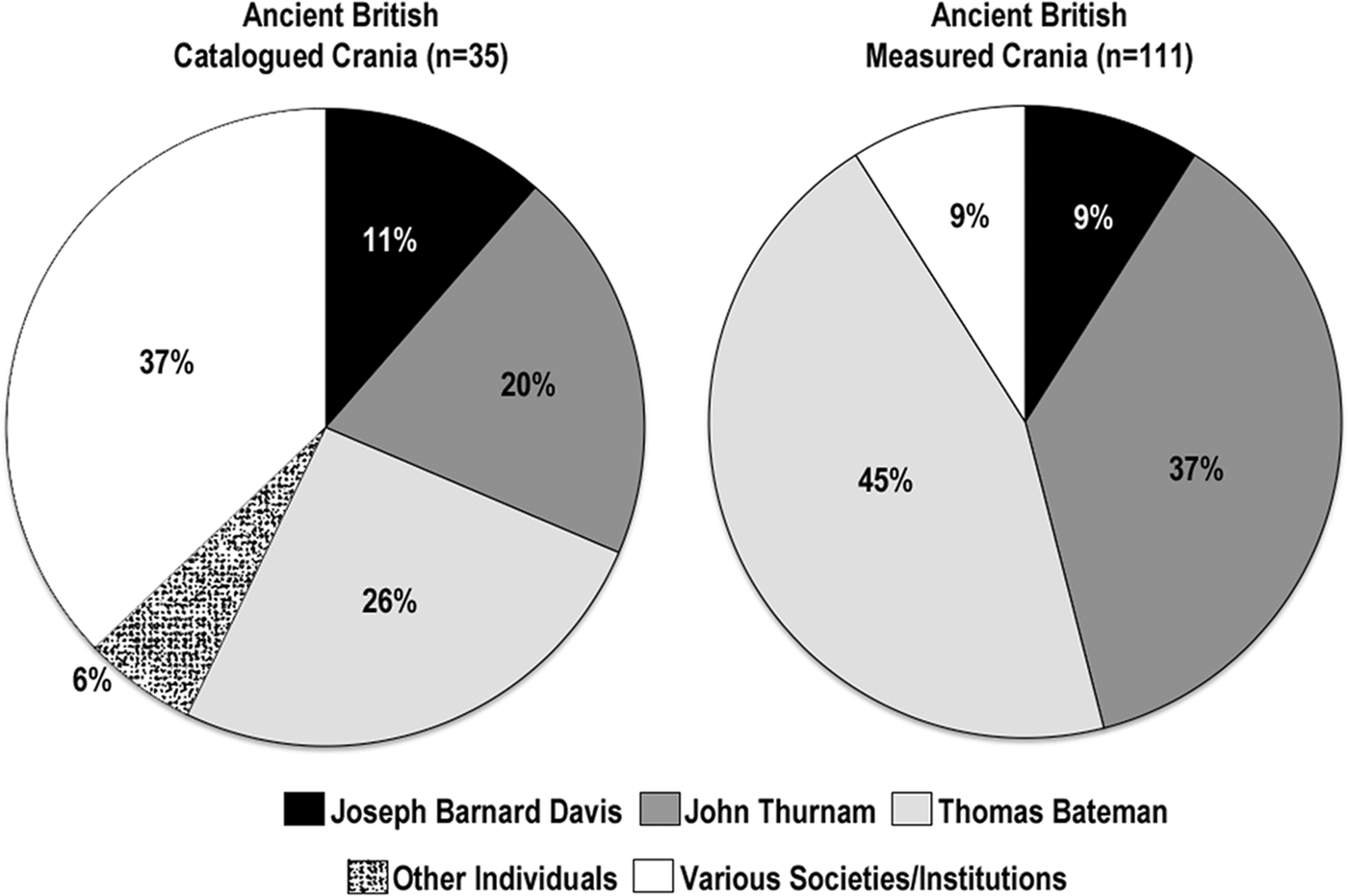
Although Bateman died in 1861, before the final version of Crania Britannica, nine crania from his collection were catalogued and lithographed, the largest percentage of crania from all periods from a single collection (Figure 3). The last skull from Bateman's collection appeared in the final Decade, included by the kindness of his widow, Sarah (Davis & Thurnam, Reference Davis and Thurnam1856–65: pl. 60, p. 4). Of the additional 111 ancient British skulls listed in the tables, fifty skulls from the Bateman collection were studied and measured, making up forty-five per cent of the total. The remaining Roman and Anglo-Saxon skulls measured were primarily from Thurnam's or Davis’ own collections and the ancient Scandinavian skulls came from institutions in Copenhagen and Stockholm. It seems that without Bateman's archaeological knowledge and, importantly, permission to access his collection of skeletal material, the project of Crania Britannica would have been seriously compromised.
Percentage of ancient British crania catalogued and measured (listed in the tables) from various collections in Crania Britannica.

Bateman, Crania, and Chronology
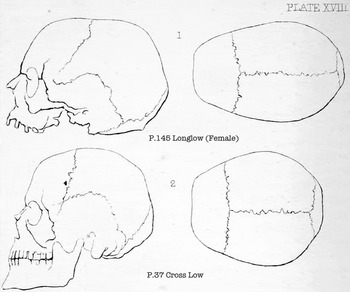
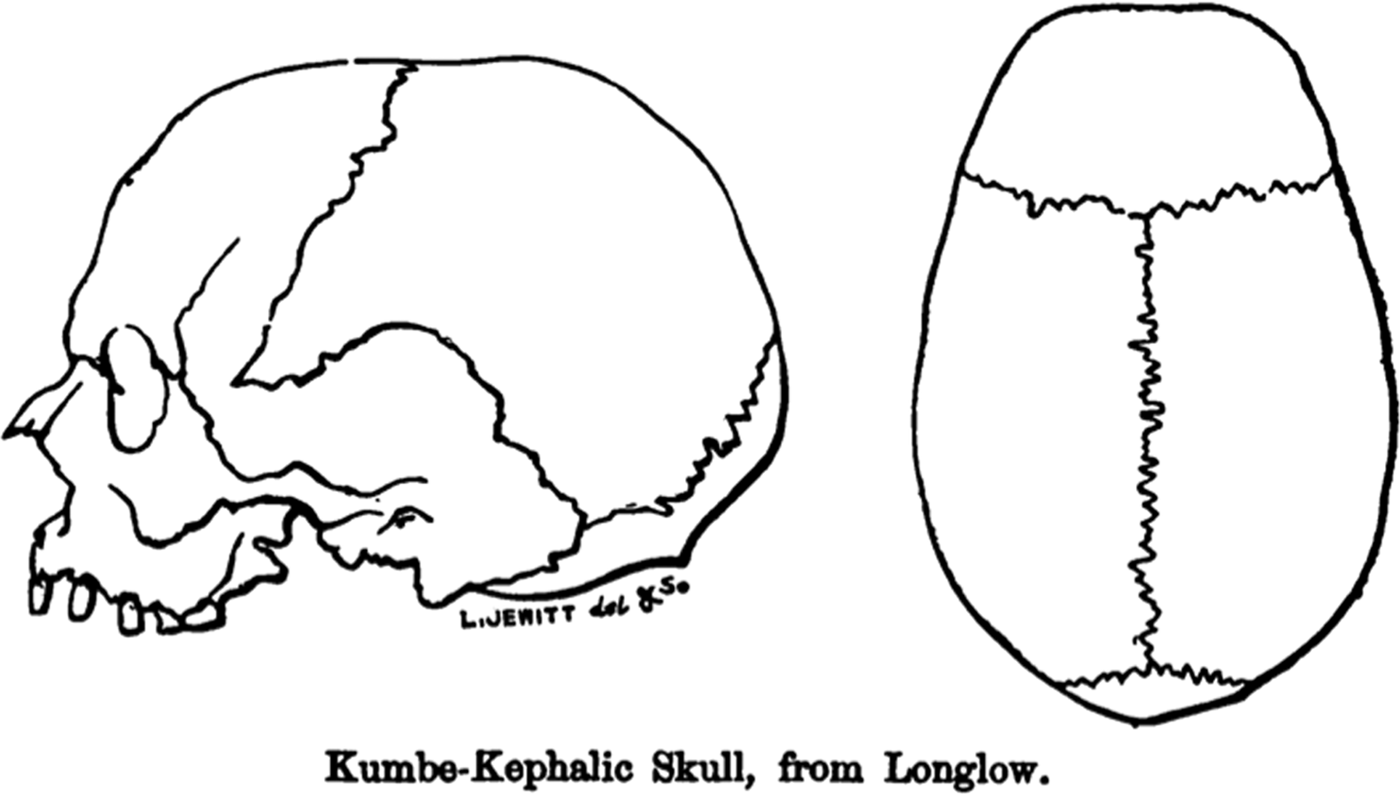
September 1851 marks a significant point for Bateman. This was the month when his paper was presented to the BAA at their annual congress in Derby; it is there that he took up the challenge to incorporate ethnological research—specifically that dealing with forms of crania—into archaeology in support of the Three Age System. Bateman was clearly under the influence of Daniel Wilson, whom he cites in his published paper (Bateman, Reference Bateman1852: 211). Taking skulls from the Derbyshire long barrow (Neolithic) site of Long Low as an example, Bateman assigned the long-headed (dolicocephalic), or, as Wilson referred to them, kumbe-cephalic, to the pre-Celtic period of remote antiquity, found in stone-lined chambered or galleried tombs in association with stone implements. These, Bateman indicated, differed from broad (brachycephalic) skulls from the end of the ‘stone period’ that were found in small round barrows associated with early bronze implements (Figure 4). After the publication of this paper in 1852, when, as Rowley-Conwy points out, Bateman appeared to retreat from this position, he only published one skull illustration (Figure 5) and no lists of skeletal measurements. This led Rowley-Conwy (Reference Rowley-Conwy2007: 130–31) to ask: ‘What happened to Bateman after 1852?’. Did he, in fact, pull back from his initial acceptance of the Three Age System?
Top: 1. Long-headed crania from the (Neolithic) long barrow at Long Low, Derbyshire, Bateman Reference Bateman1855a, no. P.145. Bottom: 2. Broad-headed crania from the (Bronze Age) bowl barrow at Cross Low, Derbyshire, Bateman Reference Bateman1855a, no. P.37 (Bateman, Reference Bateman1852, pl. XVIII).

‘Kumbe-Kephalic Skull, from Longlow’ (Bateman, Reference Bateman1861a: 146, 268).

Rowley-Conwy (Reference Rowley-Conwy2007: 131–36) speculated that either Thomas Wright or Albert Way, both prominent antiquarians, were responsible for subduing Bateman after 1852. Wright and Way were united in their scepticism about the Three Age System, but represented the two sides of warring factions within the archaeological community in the 1840s. Soon after the formation of the BAA in 1843, personality differences and petty disagreements led Way and others to split from the group and form the rival Archaeological Institute that would become the Royal Archaeological Institute in 1866 (Levine, Reference Levine1986: 48–49; Briggs, Reference Briggs2009a: 213–14, Reference Briggs and Sebire2009b: 76–77). There is only one letter to Bateman from Way (Antiquarian Correspondence V, 12 February 1846), explaining, somewhat acerbically, that since Bateman had not declined membership in the Archaeological Institute, he had been included by default. At this time, rivalries between the societies extended to seeking support from all the original members (Briggs, Reference Briggs2009a: 217). Bateman (unlike Davis and Thurnam) remained a member of the BAA and did not become a member of the Archaeological Institute, only publishing the 1856 Crania Britannica review in that society's journal at Davis’ request (Antiquarian Correspondence IV, 8 November 1856). Thomas Wright's correspondence with Bateman indicates that they were not in regular contact, with a long gap in the correspondence between 1849 and 1857 (Antiquarian Correspondence V, 29 August 1857). This evidence from the Bateman correspondence demonstrates that it was unlikely that either Way or Wright influenced Bateman.
A damning critique of Bateman's stance in favour of the Three Age System came from Davis (Antiquarian Correspondence I, 16 December 1851) at a time when Crania Britannica was in its planning stages. In this letter, Davis indicated that he had seen a synopsis of Bateman's paper delivered to the BAA, ‘Ancient Barrows and their Contents’, published in the local newspaper (Derby Mercury, 1851). Davis criticized him for agreeing with the ‘doctrine of the Northern Antiquaries for distinguishing the ages of people to when these Barrows belonged’. Bateman's conclusions were similar to those of Daniel Wilson in The Archaeology and Prehistoric Annals of Scotland (Reference Wilson1851)—a book Davis confessed that he had not yet read. Yet, Bateman's acquisition records indicate that he purchased this book for his library in early March, a few months before his paper to the BAA in Derby (Account Book 1851–1860: 4). Davis was also much struck by the ‘uniformity’ of Bateman's assignment of the long-headed skulls to an earlier period and of the short round skulls to a later period and remarked that this was the reverse of what Scandinavian investigators had discovered. Davis’ use of the word uniformity (i.e. a long, continuous, and uniform change) is perhaps significant in this context, showing his opposition to the idea of a deep remote past (Antiquarian Correspondence I, 27 October 1848).
From visual examination, as after dinner entertainment with fellow doctor and antiquarian Samuel Fennel, Davis tested Bateman's hypothesis against the two skulls that Bateman had sent him for his collection (Antiquarian Correspondence I, 16 December 1851). One of the two skulls, a broad-headed example, came from a (Neolithic) chambered tomb at Five Wells in Derbyshire and the other, a long-headed example, came from a barrow near Throwley in Staffordshire. Davis’ and Fennel's conclusions were the reverse of Bateman's, though Davis conceded that the sample was small and that Bateman may have seen this pattern in his larger Derbyshire collection. Davis concluded that cautious deductions could only be made after examining a large number of skulls from all over Britain. He also felt that assigning complex chambered or galleried tombs to a date before the cruder cist burials of the round barrows went against ‘antiquarian reasoning’, a thought that became a recurring theme throughout his writings on the subject.
Bateman apparently ignored Davis’ warning and published the paper in the 1852 Journal of the British Archaeological Association. The topic of the long-headed skulls and the pre-Celtic hypothesis continued to crop up in Davis’ correspondence with Bateman after 1851 in terms that made it clear that there was an on-going friendly debate between the two men. Davis wrote to Bateman (Antiquarian Correspondence IV, 24 August 1853) full of enthusiasm for a perfect skull from the ‘stone period before the advent of bronze’ that he had just acquired for his collection from the 1852 excavations at the round barrow at Green Gate Hill near Pickering, Yorkshire. Davis presented his thoughts on the Green Gate skull at the 1854 Liverpool meeting of the British Association for the Advancement of Science (BAAS), describing it as the ‘typical form’ of the ancient British, of the Celtic race, that tended to the round, brachycephalic form with a short face, small brain-case, upright jaws, prominent brow ridges—all indications of a ‘capable savage’, powerful but not of superior intelligence (Davis, Reference Davis1855: 128). All other ancient British skulls differing from his typical form were considered by Davis to be aberrant forms, but equally of Celtic race, presenting the outline drawing of the Long Low ‘kumbe-cephalic’ skull to illustrate the aberration (Antiquarian Correspondence IV, 17 September 1854). Davis also remarked that he was aware that Bateman maintained a ‘different view’. Not long after this, Bateman presented a neutral view describing the Long Low skulls as ‘by some considered as the type of an ancient race, by others as merely a tribal or family variation’ (Bateman, Reference Bateman1855a: 118).
Two years later, Davis wrote to Bateman indicating that he had made up his mind ‘to do full justice to the long skulls’ (Antiquarian Correspondence IV, 13 June 1857), hoping to finally convince Bateman. Davis’ subsequent article (Davis, Reference Davis1857) expanded the argument he first presented at the BAAS (Davis, Reference Davis1855), emphasizing that the forms of the cranium were considered to be fixed and not transmutable between different races, but variations, demonstrating different families, existed among ancient Britons, just as Morton had explained the diversity among the American race (Morton, Reference Morton1839: 62–83; Davis, Reference Davis1857: 42). Davis again stressed that there was little evidence to assign the chambered barrows and their dolicocephalic skulls to a past that preceded simpler barrows (Davis, Reference Davis1857: 43). This same conviction also appeared in Davis’ catalogue of the Long Low crania, published in 1860 in the fourth Decade of Crania Britannica.
In his concluding chapter of Crania Britannica, Davis struggled to provide an answer that did not contradict either his belief in polygenism or the idea of the Celts being the original (ancient historical) inhabitants of Britain. He, thus, indicated that the original ancient Britons were both brachycephalic and dolicocephalic, although the brachycephalic prevailed (Davis & Thurnam, Reference Davis and Thurnam1856–65: 228). He also argued that the pre-Celtic hypothesis put too high a value on the dolicocephalic skulls, which ‘alone is not an adequate basis for so important a hypothesis’, again reiterating that the archaeological evidence went against antiquarian reasoning (Davis & Thurnam, Reference Davis and Thurnam1856–65: 229). Dolicocephalic skulls were explained as due to deformation, caused by either cultural or post-depositional factors, or to an ‘admixture of blood’, referring to interbreeding between two supposed races.
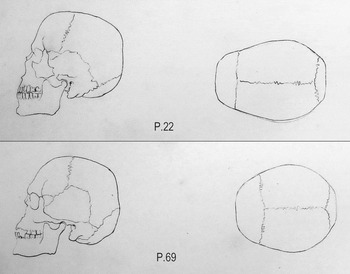
Bateman's response appeared in Ten Years Digging, suggesting that the dolicocephalic skulls might not be Celtic and, from his observations of similar burials (i.e. chambered tombs), indicated they were from ‘a period more strictly primeval’ (Bateman, Reference Bateman1861a: 146–47). He also chose, in Ten Years Digging, to illustrate only one skull: the most extreme of the dolicocephalic skulls in his collection, the female skull from Long Low (see Figure 4) re-drawn by Jewitt from the illustration published in his 1852 article (see Figure 5). Bateman could have included more drawings. Twenty-four similar outline drawings (top and side views) of both long-headed and round-headed types were bound with the manuscripts of his two major books (Figure 6), produced by Thurnam in 1849 (Antiquarian Correspondence I, 15 October 1852). In Ten Years Digging, Bateman also included an appendix, an updated ‘Descriptive list of skeletons, skulls, and separate bones, exhumed from Tumuli, chiefly of the Celtic Period, in Derbyshire, Staffordshire, and Yorkshire’ (Bateman, Reference Bateman1861a: 257–78). Many of the entries contained more descriptive text than the earlier 1855 catalogue and several included measurements such as cranial capacity and femur length, the latter to indicate stature. These measurements undoubtedly came from data that Davis and Thurnam had gleaned from his collection while preparing the publication of Crania Britannica. The entry for the Long Low skulls, however, repeated the text from Bateman's Reference Bateman1855 catalogue (Bateman, Reference Bateman1855a: 118; Reference Bateman1861a: 268).
Two of the twenty-four crania outlines from the Bateman Archive. Top: Dolicocephalic skull from Liffs Low barrow, Biggin (Derbyshire), Bateman Reference Bateman1855a, no. P.22. Bottom: Brachycephalic skull from Three Lows barrow, Wetton (Staffordshire), Bateman Reference Bateman1855a, no. P.69. By permission of Museums Sheffield.

It seems likely that Bateman never accepted Davis’ arguments. As a monogenist, Bateman would not have believed cranial forms to be the crucial issue. Instead, relative chronology was. He based his chronology on the scientific and detailed study of associated artefacts (including crania) in burials. The chambered tombs remained, in Bateman's mind, earlier than the round barrows, firmly in the remote antiquity of the stone period. He fully accepted the possibility of a pre-Celtic population in Britain, although he conceded that more data were needed to prove the theory.
Ironically, it was an influential article by Thurnam in the Memoirs of the Anthropological Society (Thurnam, Reference Thurnam1865), four years after Bateman's death, that mapped out the craniological sequence using archaeological evidence for the pre-Celtic hypothesis, a concept that Davis never accepted. In Crania Britannica Thurnam did not definitively contradict Davis, leading one to suspect that Thurnam—like Bateman—was put under pressure by Davis. In his only chapter in Crania Britannica, Thurnam addressed the pre-Celtic issue and concluded that, although the idea was worthy of great attention, it could not be supported by the evidence compiled by Daniel Wilson. Thurnam attempted to reproduce Wilson's results by examining the same skulls held in the museums of The Society of Antiquaries of Scotland and the Phrenological Society of Edinburgh, but his results were inconclusive (Davis & Thurnam, Reference Davis and Thurnam1856–65: 55). Thurnam's catalogue entries for Uley, Rodmarton (in Gloucestershire), Littleton Drew, and West Kennet (in Wiltshire), did indicate that the crania from the chambered tombs seemed to be of a lengthened form. A review of Crania Britannica by J.B. (possibly John Beddoe) published in 1868 clearly indicated that Thurnam and Davis were not in alignment with regard to this issue (J.B., 1868: 55). Thurnam was more explicit in his 1865 article, ending the article with the oft-quoted axiom ‘Long Barrows, Long Skulls; Round barrows, Round skulls’ (Thurnam, Reference Thurnam1865: 158). To back up this point, Thurnam quite clearly states that Bateman, in his 1852 article and later in Ten Years Digging, presented a similar chronological sequence, in which the long barrows were placed in ‘the most remote antiquity’ (Thurnam, Reference Thurnam1865: 125). Many years later, John Beddoe summed up the craniological evidence for the Neolithic and Bronze Age:
‘Since Daniel Wilson asserted the priority in Britain of the kymbe-kephalic or boat-shaped skull, and Thurnam broached his theory of “long barrows, long heads; round barrows, round heads”, so much evidence has been produced in favour of their views, and so little against them, that they may be regarded as fairly established.’ (Beddoe, Reference Beddoe1885: 12)
Despite his proof of the relative sequence of long skulls and their long barrows appearing before broad skulls and their round barrows, Thurnam still did not accept a deep chronology for the appearance of humans (Rowley-Conwy, Reference Rowley-Conwy and Melton2013: 22). On the other hand, in 1861, just before his death, Bateman published an article in The Reliquary (Bateman, Reference Bateman1861b) that sought to test the theory of a deep chronology for the appearance of humans based on the occurrence of bones in geological strata, perhaps influenced by uniformitarian theories of Charles Lyell in Principles of Geology, a book known to be in his library (Lyell, Reference Lyell1853; Account Book 1851–1860: 53; Sale Catalogue 1893: 69). In this article, Bateman discussed instances where human and extinct animal bones were found together in stratified geological deposits. He even mentioned the discoveries of Boucher de Perthes, the validity of which, confirmed by British scientists in 1859, tipped the scales in favour of a deep human history (Trigger, Reference Trigger2006: 146). Bateman, however, restricted his particular observations to his native county. He felt the Derbyshire evidence was inconclusive and, in some cases, inadmissible since it had been discovered and recorded under less rigorous conditions, some discoveries even dating back to the previous century. He concluded that the negative evidence did not disprove the prevailing opinion of the appearance of man at a late date. However, he felt that there was insufficient data to prove the opposite and that ‘it would be rash in the extreme to draw conclusions, as to the antiquity of the human race, from facts so scanty, gleaned from a field so limited’ (Bateman, Reference Bateman1861b: 229).
In the same year as Thurnam's article, John Lubbock published an analysis of Bateman's tumuli using the data published in Vestiges and Ten Years Digging (Lubbock, Reference Lubbock1865a). Lubbock discussed the relationship between the interment and the objects in the burial to justify the Three Age System. Unlike Thurnam, he stressed the type of burial (burnt, contracted, extended) rather than the shape of the crania. Further, he praised Bateman for his methodical collection of all evidence, including stone implements that were often overlooked by excavators, as well as human and animal remains that allowed him to fit the burials into a Stone, Bronze and Iron Age sequence. Lubbock, in his Pre-Historic Times, had by then linked the archaeological chronology of the Three Age System to geological time, accepting a deep chronology for the appearance of humans on earth, rationalized by theories of cultural evolutionism (Lubbock, Reference Lubbock1865b: 2–3).
Bateman remained reticent in print about his views on broader issues and theories after 1852, having been cowed by the rigid convictions of Davis. From hints in his later writing, it is, however, clear that Bateman stuck to his original conclusions presented in 1851 to the BAA (Bateman, Reference Bateman1852) about a pre-Celtic population in Britain represented by the long-headed skulls. His continuous commitment to combining archaeology with craniology can also be documented in the correspondence with Davis and Thurnam and by his provision of data for Crania Britannica. Nevertheless, Bateman put more stress on the archaeological evidence than on crania shapes for determining relative chronology. Bateman's engagement with theories prevailing in the field, including that of a long chronology for humanity based on geological stratification, continued up to his untimely death at the age of thirty-nine in 1861. He seemed unwilling to commit definitively to a theory, insisting on more data for a scientific analysis. It was others—such as Thurnam and Lubbock—who used Bateman's data, placing them in a wider context to confirm their own theories on cranial sequencing and archaeological chronology, those same theories originally discussed by Bateman. Based on the material presented here, it can be said that Bateman was more than just a typical antiquarian of the mid-nineteenth century, rather he was fully engaged with the debates of the time, corresponding with well-known figures in the field, yet restricting his own observations to the region surrounding his home in Derbyshire.
Acknowledgements
I am very grateful to Museums Sheffield and the Royal Anthropological Institute for granting access to their archives and for permission to cite materials in this article. Peter Rowley-Conwy, John Moreland, Dawn Hadley, and John Bennet have offered comments and encouragement on earlier drafts; none of them should be held responsible for the use to which I have put their advice or for any errors. This final version has benefitted from comments by EJA's anonymous reviewers and editors, to whom I am also most grateful.